Understanding Inequalities
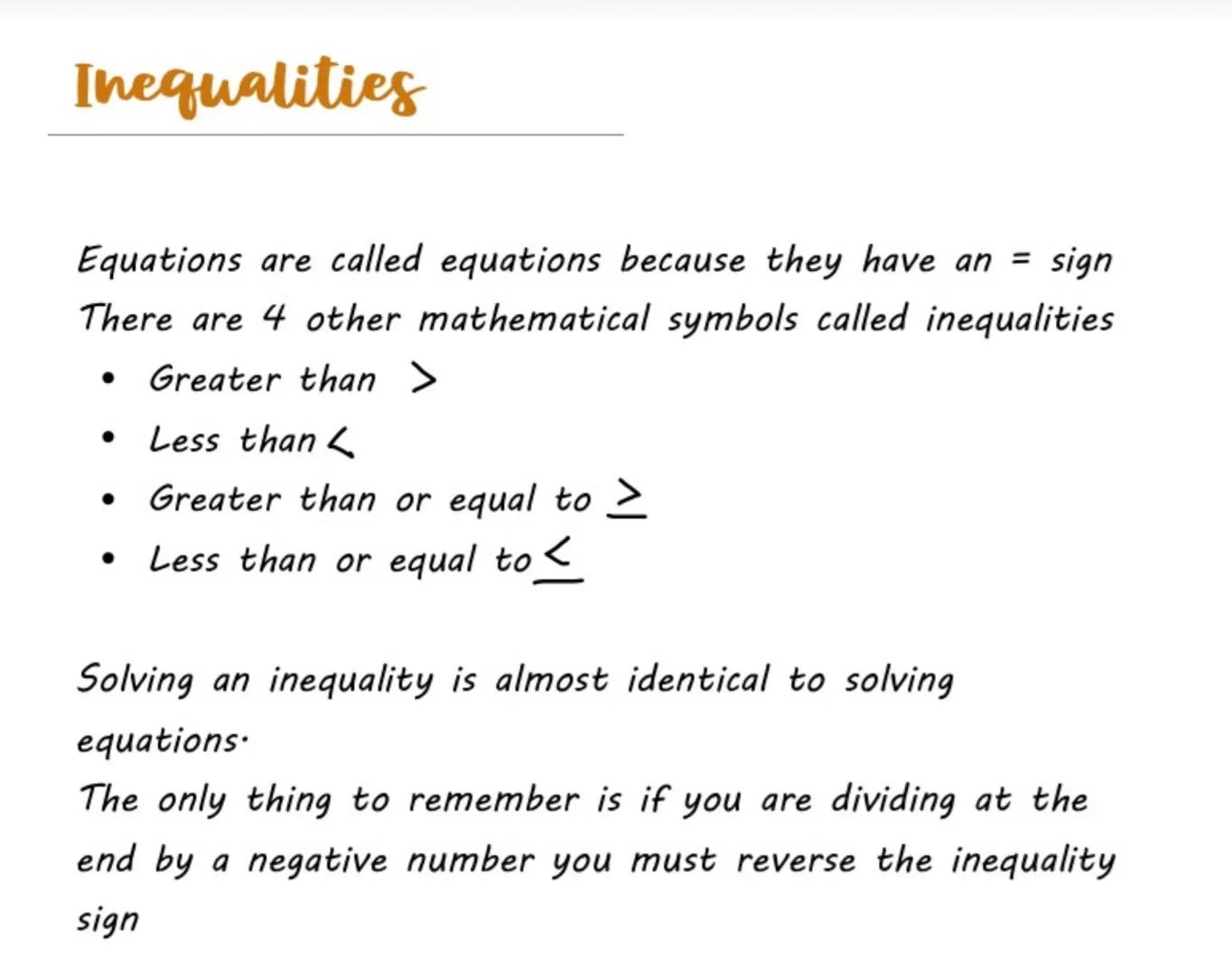
Ever wondered how to show when one number is bigger or smaller than another? That's where inequalities come in! Unlike equations that use the = sign, inequalities use four different symbols to compare values: greater than (>), less than (<), greater than or equal to (≥), and less than or equal to (≤).
Solving inequalities follows almost the same process as solving equations. You can add, subtract, or multiply both sides just like with equations. The steps feel familiar if you've solved equations before.
There's just one important rule to remember: when you divide or multiply both sides by a negative number, you must flip the inequality sign. For example, if you have -2x > 8 and divide by -2, it becomes x < -4 (notice how > changed to <).
Quick Tip: Think of the inequality symbol as an arrow that always points to the smaller value. When you multiply or divide by a negative, everything flips direction!


 Maths
Maths English Literature
 Biology
 Sociology