Solving Quadratic Inequalities
Ever wondered how to find not just one answer, but a whole range of values that work? That's exactly what quadratic inequalities are all about, and they're easier than you think.
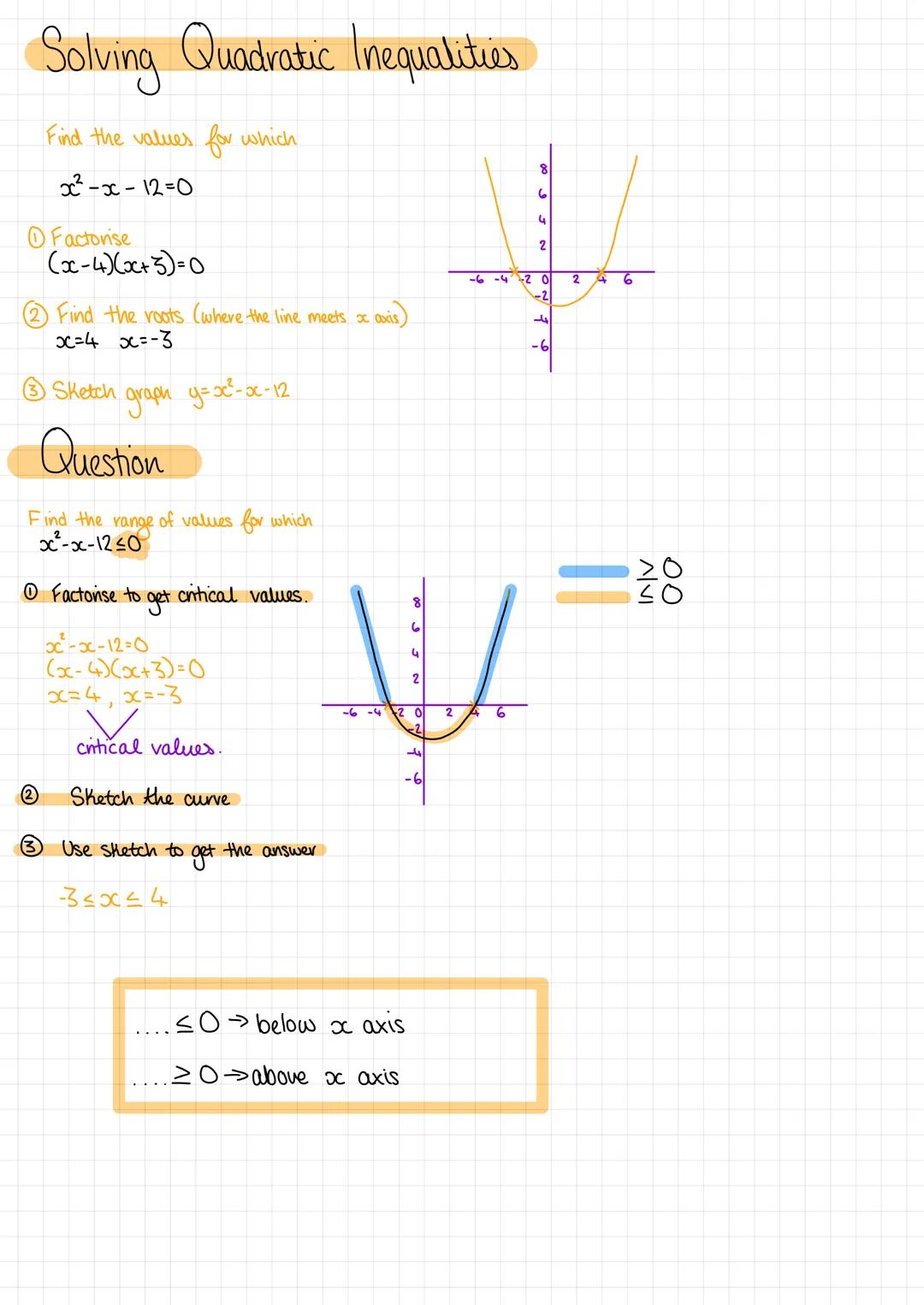
The secret is breaking it down into three simple steps. First, you factorise the quadratic to find where it equals zero - these are your critical values. For example, with x² - x - 12 = 0, factorising gives you x−4x+3 = 0, so your critical values are x = 4 and x = -3.
Next, sketch the parabola using these critical values as your x-intercepts. Since the coefficient of x² is positive, your parabola opens upwards. This visual step is crucial because it shows you exactly where the curve sits above or below the x-axis.
Finally, use your sketch to read off the answer. For x² - x - 12 ≤ 0, you need the parts where the curve is below or on the x-axis (that's what the ≤ 0 means). Looking at your sketch, this happens between x = -3 and x = 4, giving you -3 ≤ x ≤ 4.
Quick Tip: Remember that ≤ 0 means "below or on the x-axis" whilst ≥ 0 means "above or on the x-axis" - your sketch makes this obvious!


 Maths
Maths English Literature
 Biology
 Sociology
 Algebra 1