Chemical Calculations and Efficiency
Ever wondered why your chemistry experiments don't always give you the expected amount of product? Understanding moles and percentage yield will help you master these calculations and predict what really happens in reactions.
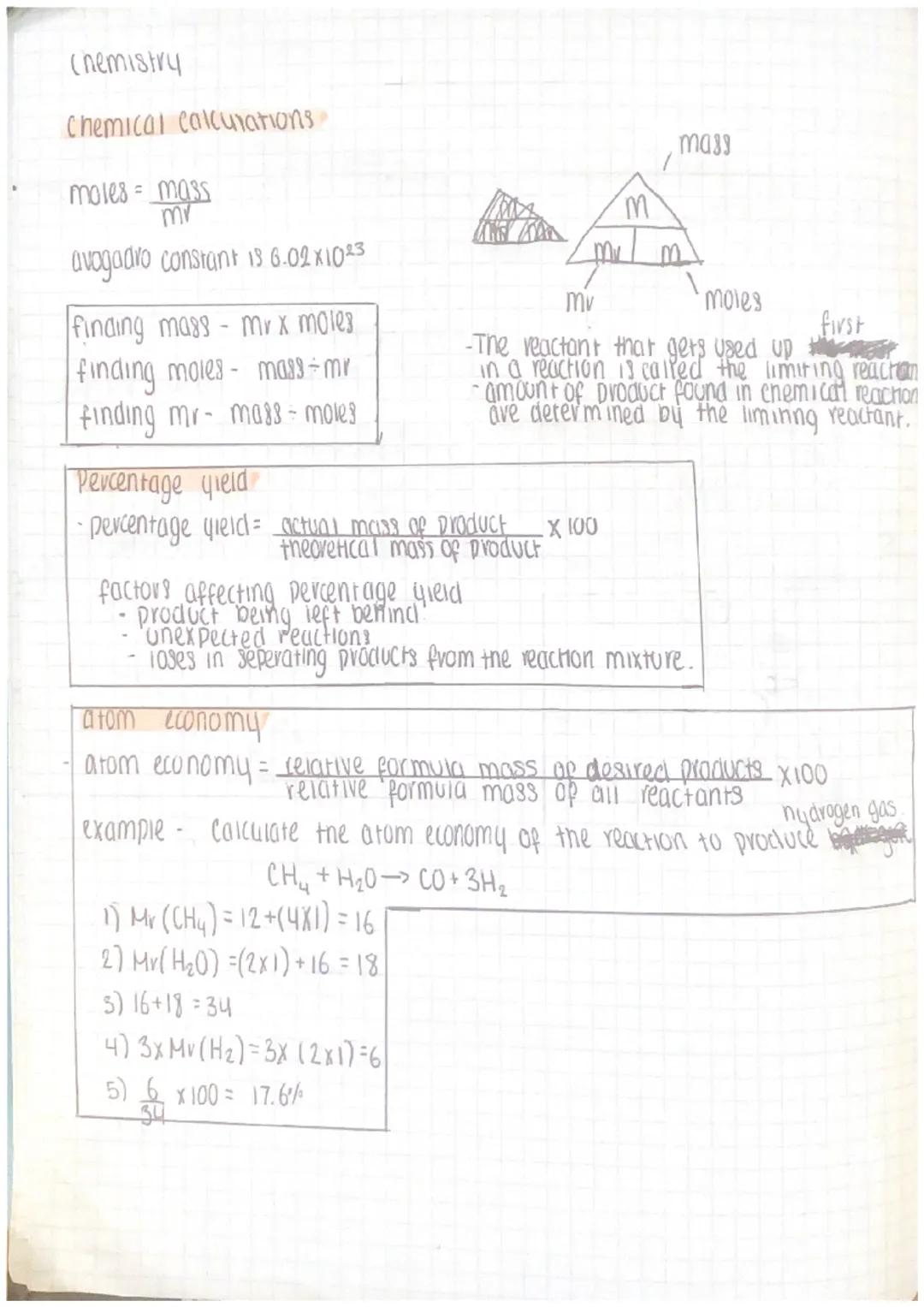
The foundation of all chemical calculations is the moles formula: moles = mass ÷ Mr. Remember Avogadro's constant (6.02×10²³) represents the number of particles in one mole. From this basic equation, you can rearrange to find mass (Mr × moles) or Mr (mass ÷ moles).
Percentage yield tells you how efficient your reaction actually was compared to what you expected theoretically. The formula is: (actual mass ÷ theoretical mass) × 100. Several factors affect this - product gets left behind in containers, unexpected side reactions occur, or you lose some product when separating it from the mixture.
Atom economy measures how many atoms from your reactants actually end up in your desired product. Calculate it using: (Mr of desired products ÷ Mr of all reactants) × 100. For example, when producing hydrogen from CH₄ + H₂O → CO + 3H₂, only 17.6% of atoms end up as hydrogen - the rest become unwanted CO.
Quick Tip: High atom economy reactions are more environmentally friendly because they waste fewer raw materials!


 Chemistry
 English Literature
 Biology
 Sociology