Open the App

Subjects

Understanding Atomic Structure and Bonding

18

1

A

Asma Farzand

12/10/2025

Chemistry

topic - Atomic structure and bonding

194

Dec 10, 2025

14 pages

Understanding Atomic Structure and Bonding

A

Asma Farzand

@asmafarzandx

Chemistry might seem complicated, but it's actually just about understanding... Show more

Page 1
Page 2
Page 3
Page 4
Page 5
Page 6
Page 7
Page 8
Page 9
Page 10
1 / 10
Classifying. Elements
1. Physical State (Solid, liquids and gases)
elements will either be SOLIDS, LIQUID or GAS at
room temperature
2 liqui

Classifying Elements

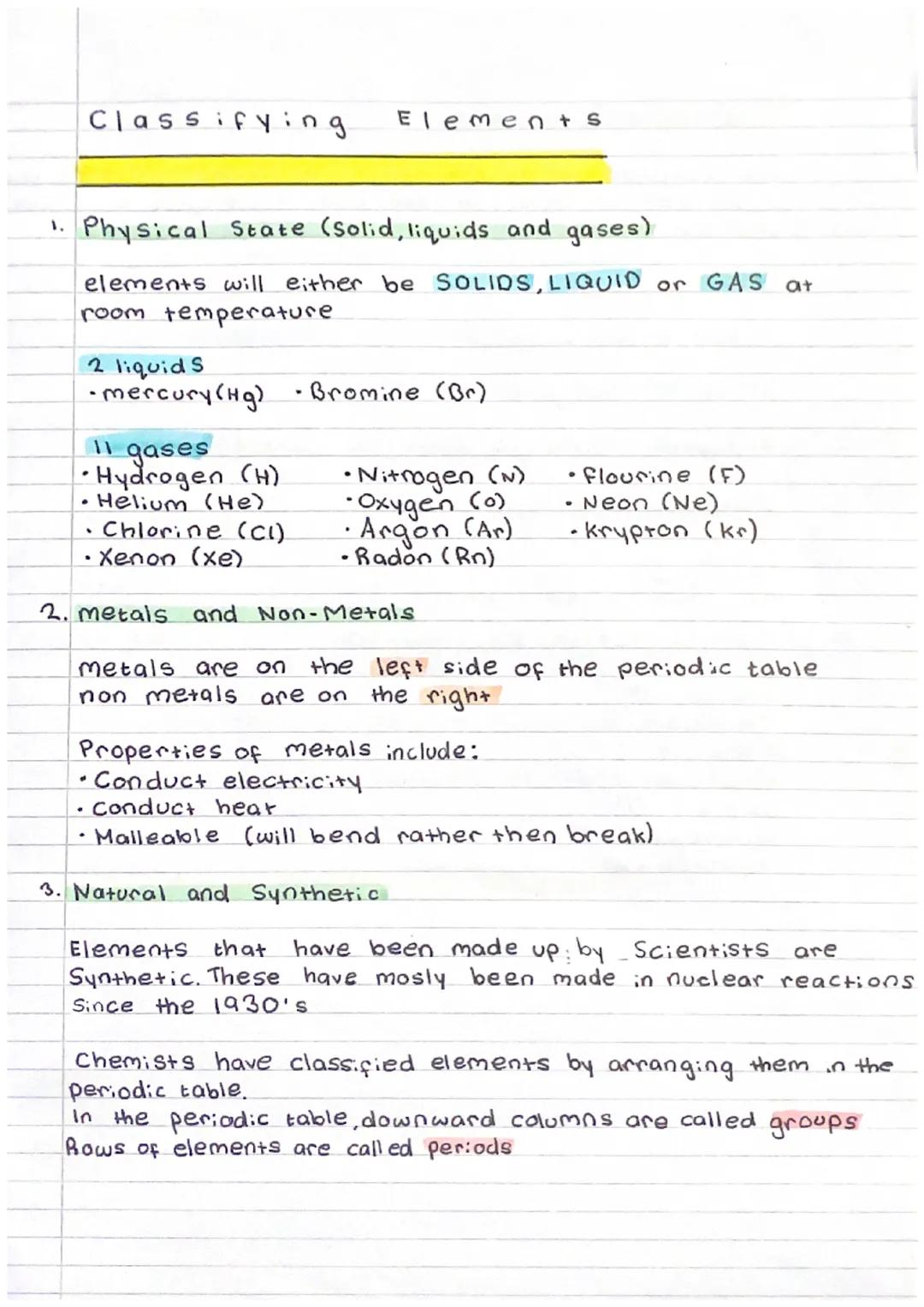
Ever wondered why some elements are shiny metals whilst others are colourless gases? Elements can be classified in several useful ways that help us predict their behaviour.

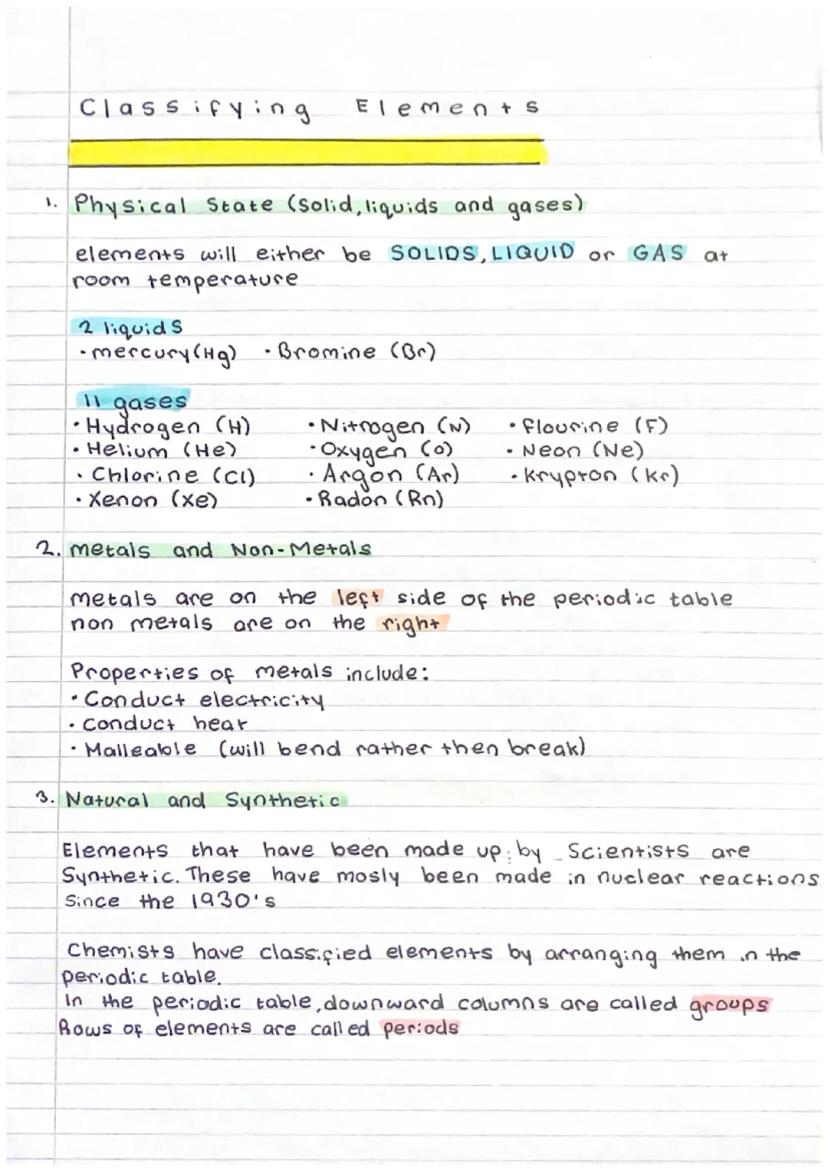
At room temperature, most elements are solid, but there are exactly 2 liquids (mercury and bromine) and 11 gases (including oxygen, nitrogen, and hydrogen). This physical state classification is dead useful for identifying elements in the lab.

The periodic table divides elements into metals (left side) and non-metals (right side). Metals are brilliant because they conduct electricity and heat, plus they're malleable - meaning they bend rather than break when you hit them.

Natural elements exist in nature, but synthetic elements have been created by scientists in nuclear reactions since the 1930s. The periodic table organises everything with groups (vertical columns) and periods (horizontal rows).

Quick Tip: Elements in the same group have similar chemical properties - this pattern makes chemistry much more predictable!

Classifying. Elements
1. Physical State (Solid, liquids and gases)
elements will either be SOLIDS, LIQUID or GAS at
room temperature
2 liqui

Groups and Diatomic Molecules

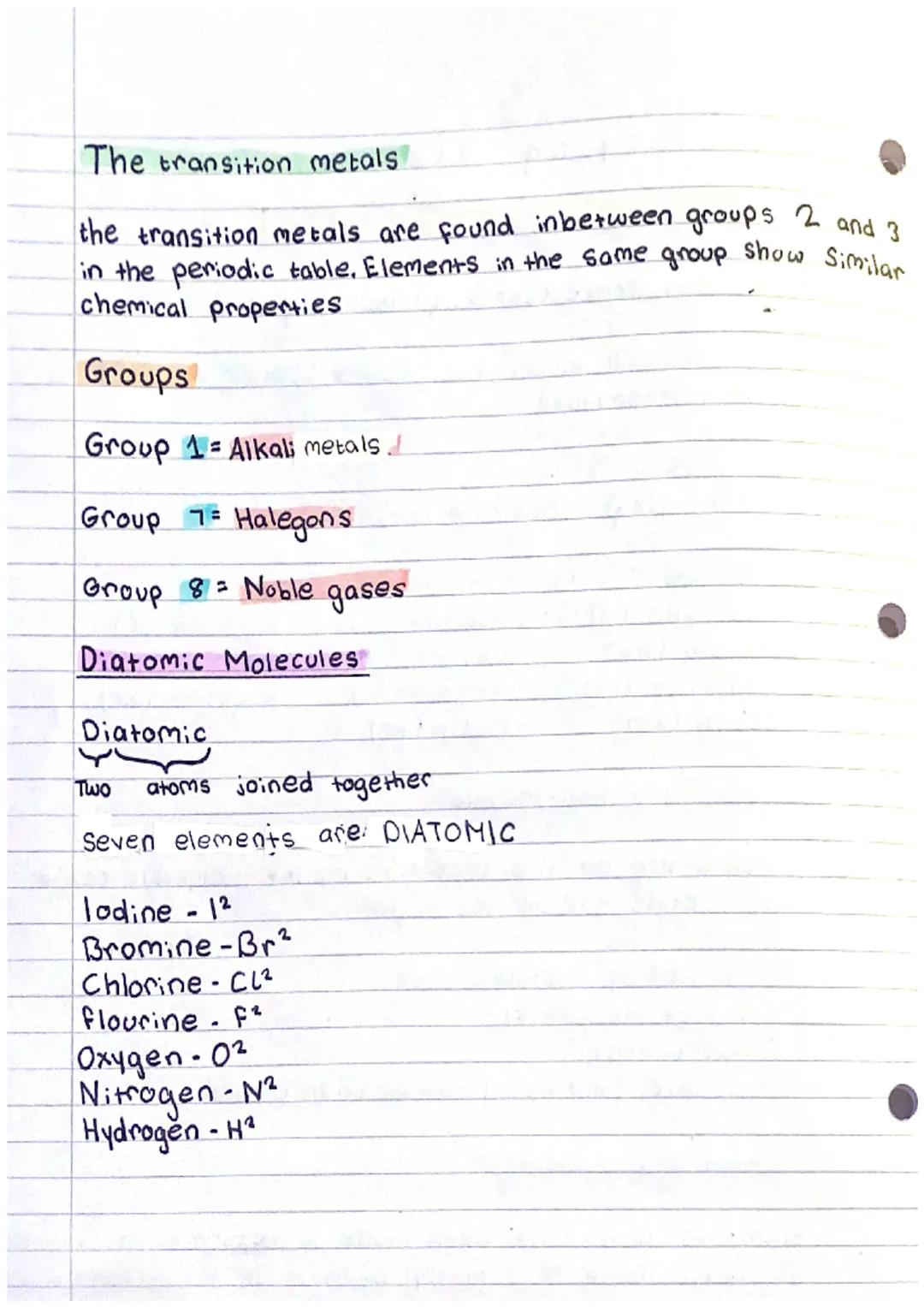
The periodic table has special groups you absolutely need to know. Group 1 contains the alkali metals, Group 7 has the halogens, and Group 8 includes the noble gases. Between groups 2 and 3, you'll find the transition metals.

Here's something quite cool - seven elements are diatomic, meaning they naturally exist as two atoms joined together. These are hydrogen (H₂), nitrogen (N₂), oxygen (O₂), fluorine (F₂), chlorine (Cl₂), bromine (Br₂), and iodine (I₂).

Diatomic molecules are crucial for chemical reactions because these elements rarely exist as single atoms in nature. You'll encounter them constantly in equations and calculations.

Memory Trick: Remember the diatomic elements with "Have No Fear Of Ice Cold Beer" - the first letters match H, N, F, O, I, Cl, Br!

Classifying. Elements
1. Physical State (Solid, liquids and gases)
elements will either be SOLIDS, LIQUID or GAS at
room temperature
2 liqui

Compounds and Naming Rules

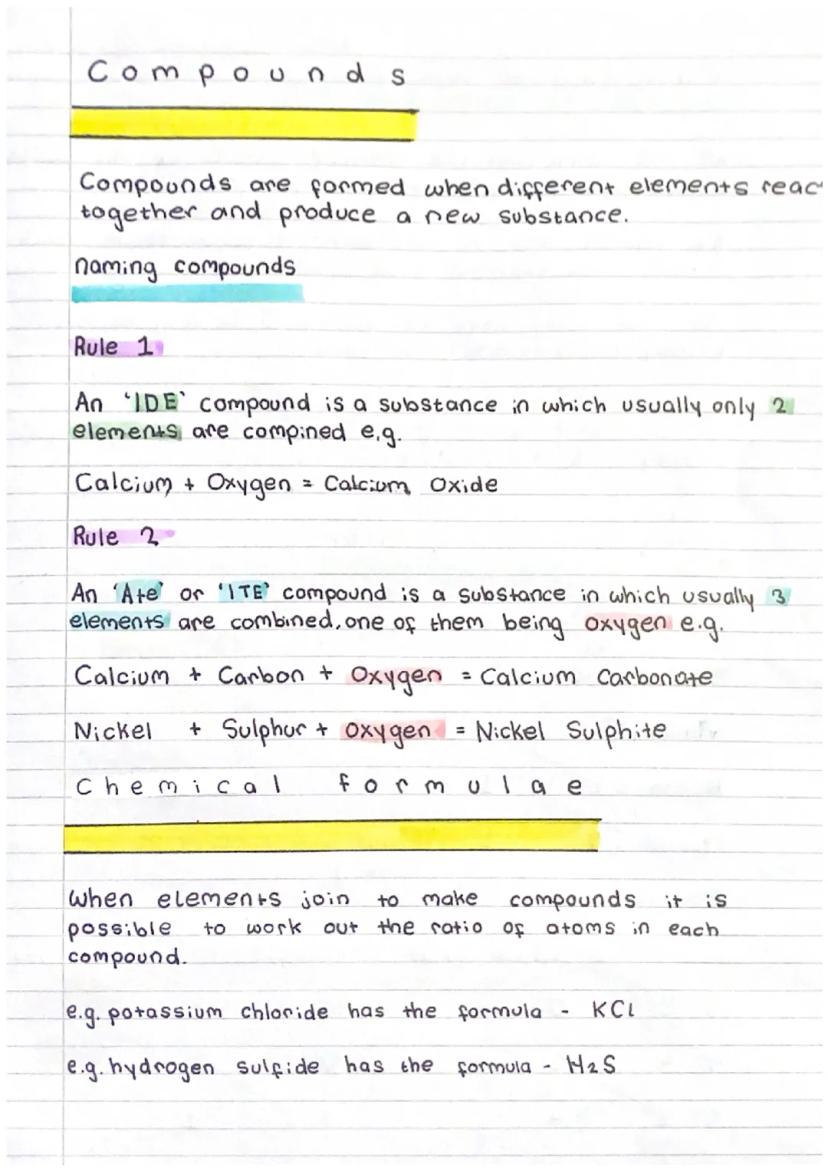
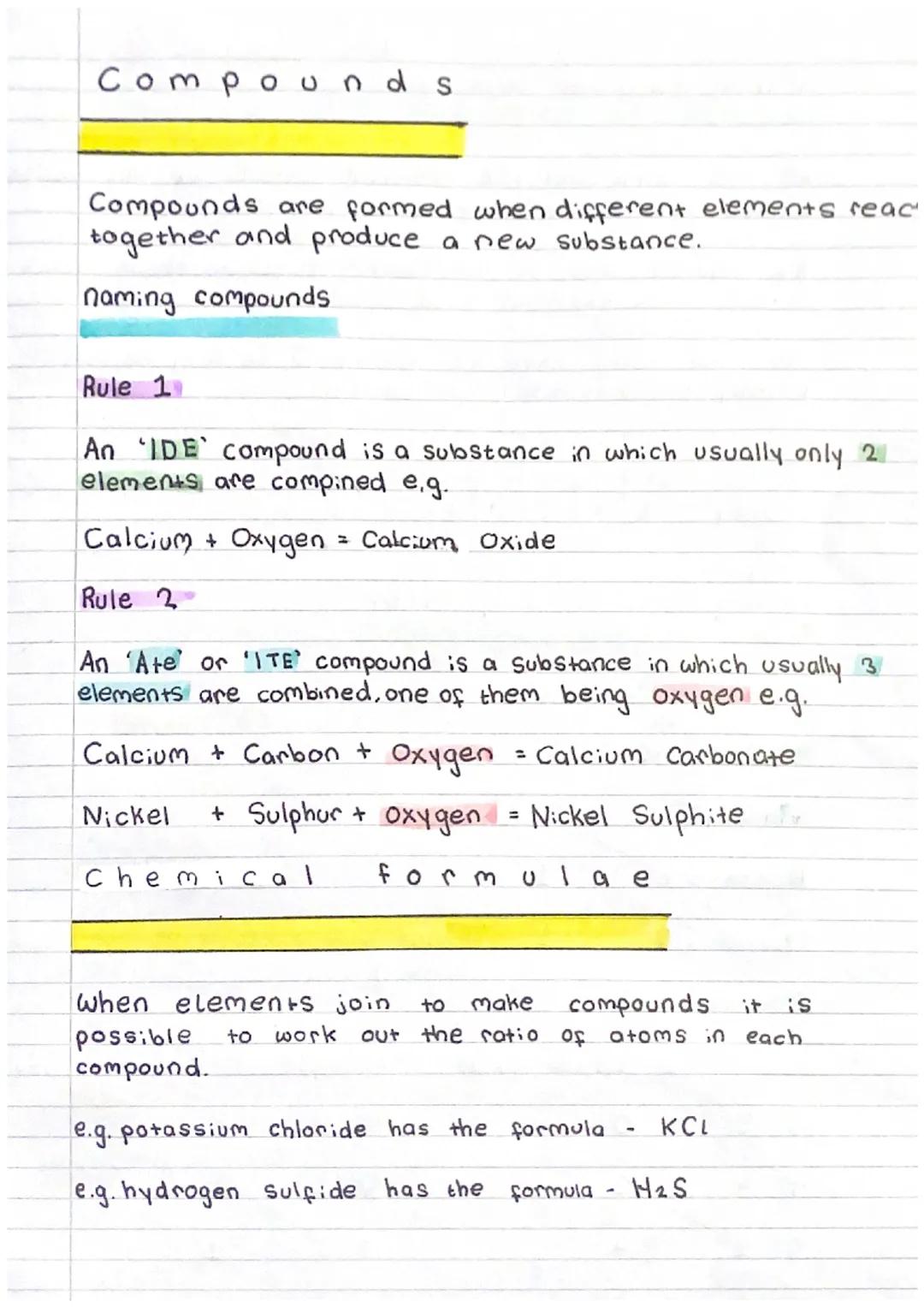
Compounds form when different elements react together to create completely new substances with different properties. Understanding how to name them properly is essential for any chemistry work.

The 'IDE' rule applies when usually only 2 elements combine. For example, calcium + oxygen = calcium oxide. It's straightforward and covers loads of common compounds.

The 'ATE' or 'ITE' rule kicks in when 3 elements combine, with one being oxygen. Think calcium + carbon + oxygen = calcium carbonate. These compounds are everywhere in real life.

Chemical formulas show the exact ratio of atoms in compounds. Potassium chloride is KCl (1:1 ratio), whilst hydrogen sulfide is H₂S (2:1 ratio). These formulas tell you everything about the compound's composition.

Real-World Connection: Calcium carbonate is literally chalk and limestone - so you're using chemistry knowledge every time you write on a blackboard!

Classifying. Elements
1. Physical State (Solid, liquids and gases)
elements will either be SOLIDS, LIQUID or GAS at
room temperature
2 liqui

Writing Chemical Formulas with SVSDF

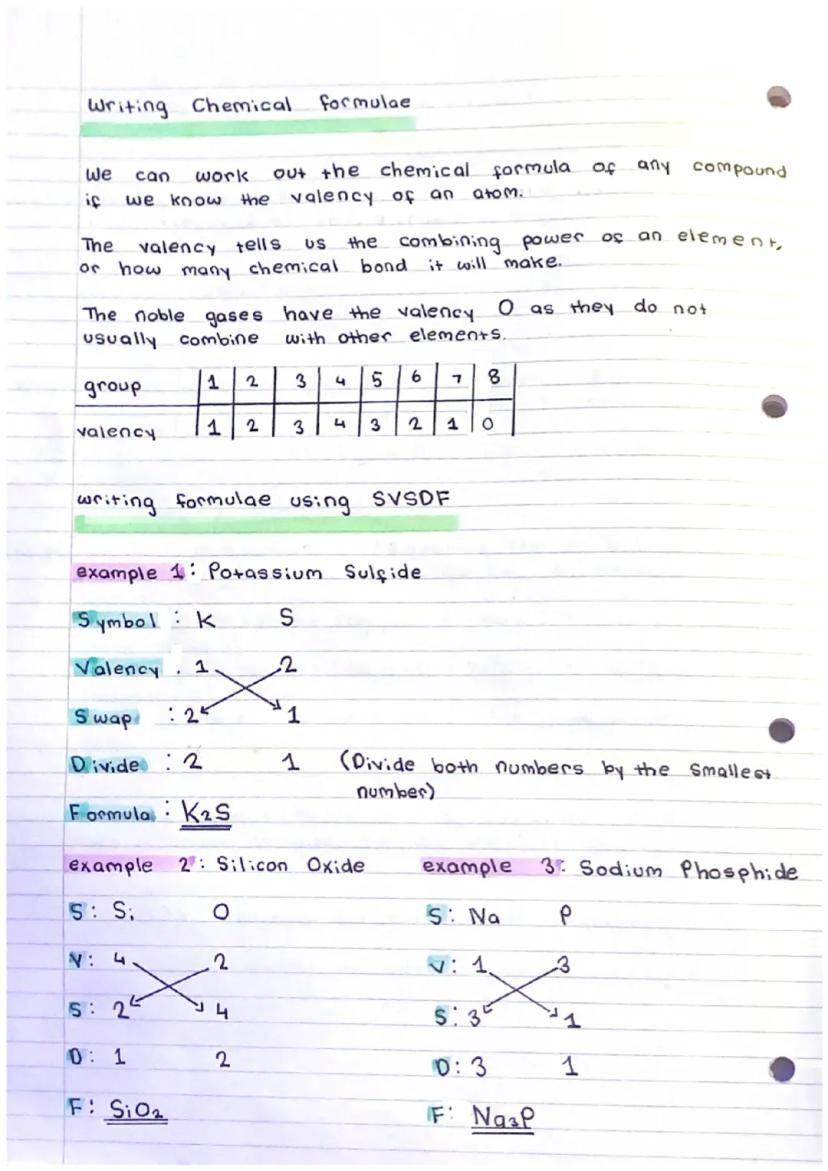
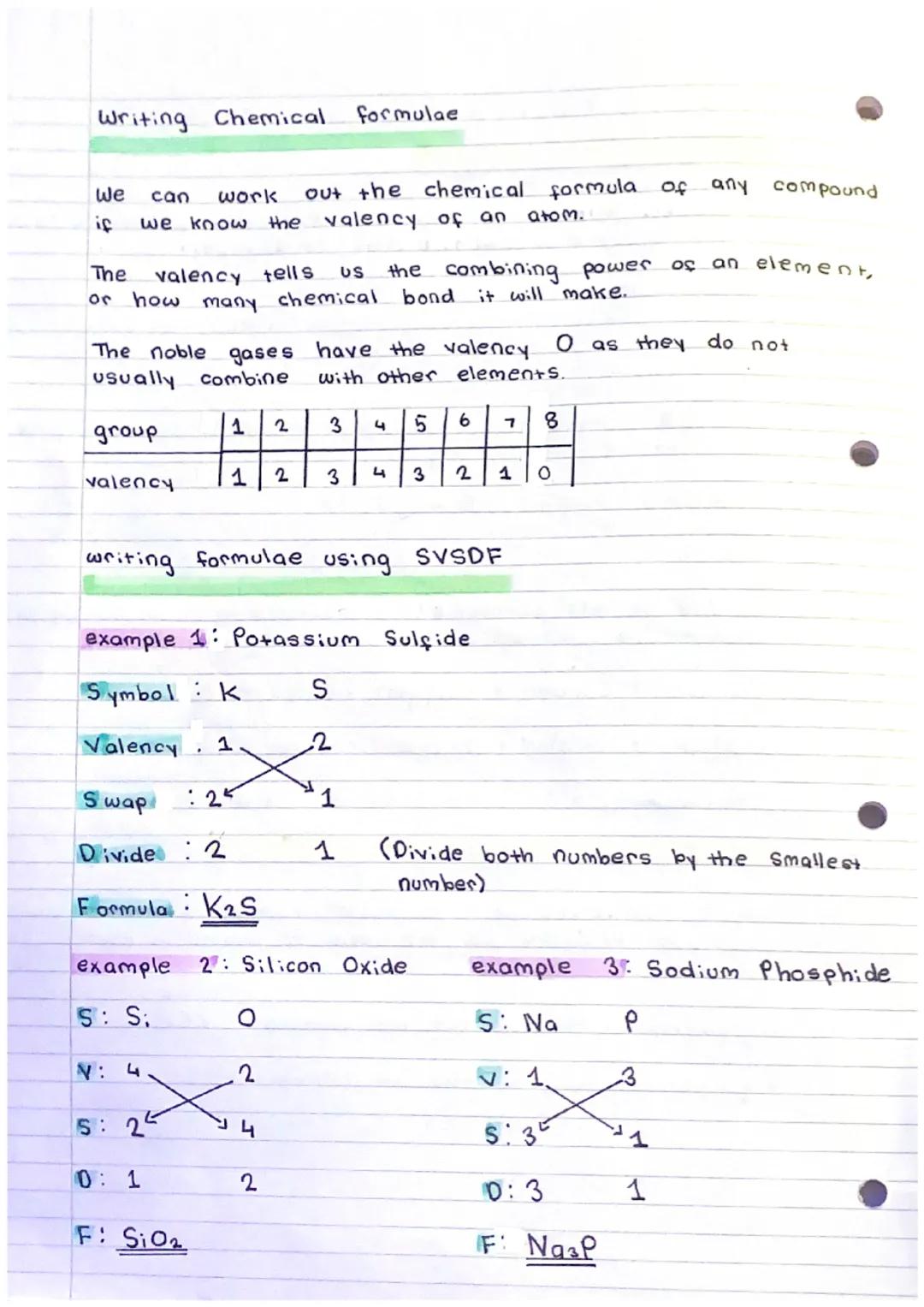
Chemical formulas might look intimidating, but there's a brilliant method called SVSDF that makes them dead easy. Each element has a valency - basically its combining power or how many bonds it makes.

The SVSDF method works like this: write the Symbols, note their Valencies, Swap the numbers, then Divide by the smallest number, giving you the Formula. For potassium sulfide: K (valency 1) + S (valency 2) becomes K₂S.

Group valencies follow a pattern: Group 1 = 1, Group 2 = 2, Group 3 = 3, etc. This pattern makes predicting formulas much simpler once you know where elements sit on the periodic table.

Practice with silicon oxide (SiO₂) and sodium phosphide (Na₃P) until the method becomes automatic. You'll use this constantly in chemistry.

Success Tip: Master SVSDF now and you'll breeze through formula writing for the rest of your chemistry studies!

Classifying. Elements
1. Physical State (Solid, liquids and gases)
elements will either be SOLIDS, LIQUID or GAS at
room temperature
2 liqui

Roman Numerals and Variable Valencies

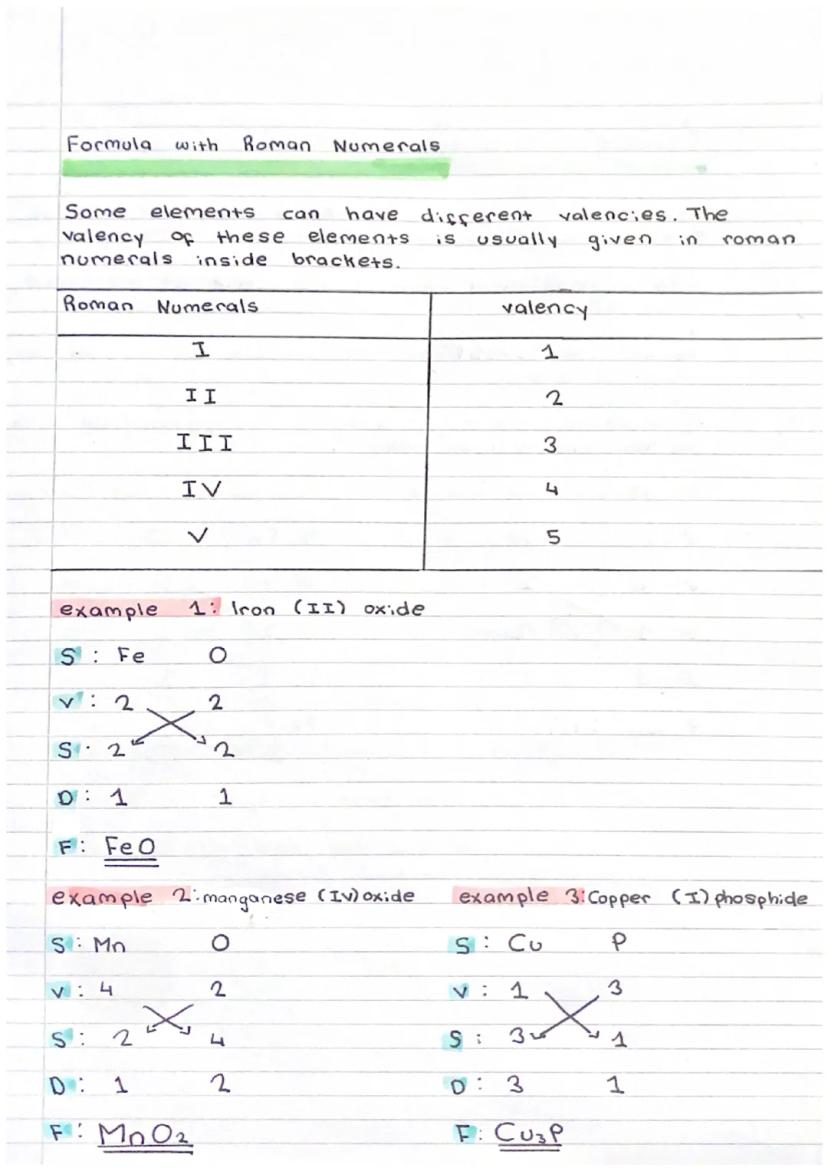
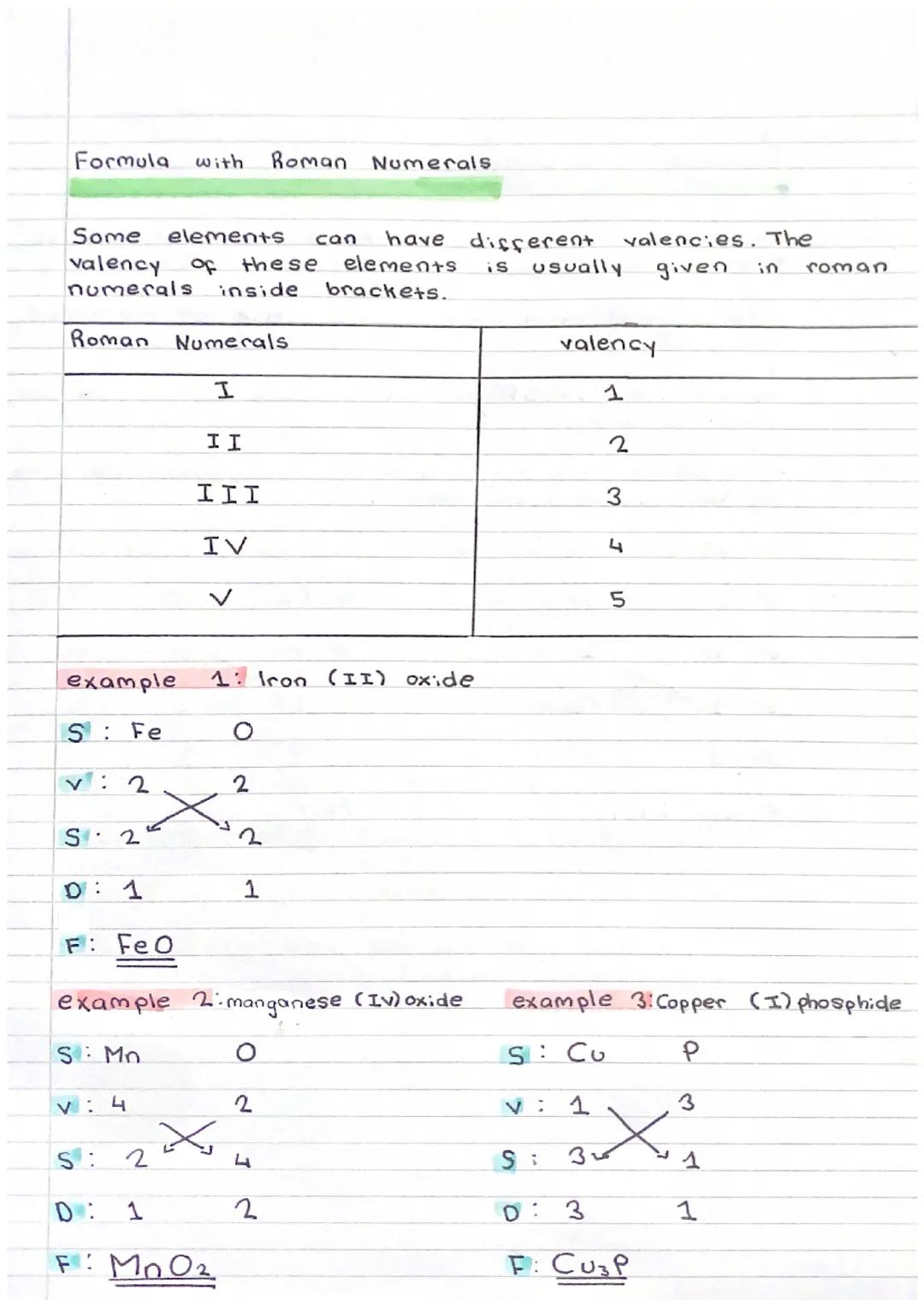
Some elements have different valencies depending on the compound they're in. When this happens, Roman numerals in brackets tell you exactly which valency to use.

Roman numerals are straightforward: I = 1, II = 2, III = 3, IV = 4, V = 5. So iron(II) oxide means iron has a valency of 2, giving you FeO using the SVSDF method.

Transition metals often show this variable valency behaviour. Manganese(IV) oxide becomes MnO₂, whilst copper(I) phosphide becomes Cu₃P. The Roman numeral removes all guesswork.

This system prevents confusion when elements can form multiple compounds. Without it, you wouldn't know whether you're dealing with FeO or Fe₂O₃.

Exam Alert: Always check for Roman numerals in compound names - missing them will give you completely wrong formulas!

Classifying. Elements
1. Physical State (Solid, liquids and gases)
elements will either be SOLIDS, LIQUID or GAS at
room temperature
2 liqui

Formulas with Groups of Atoms

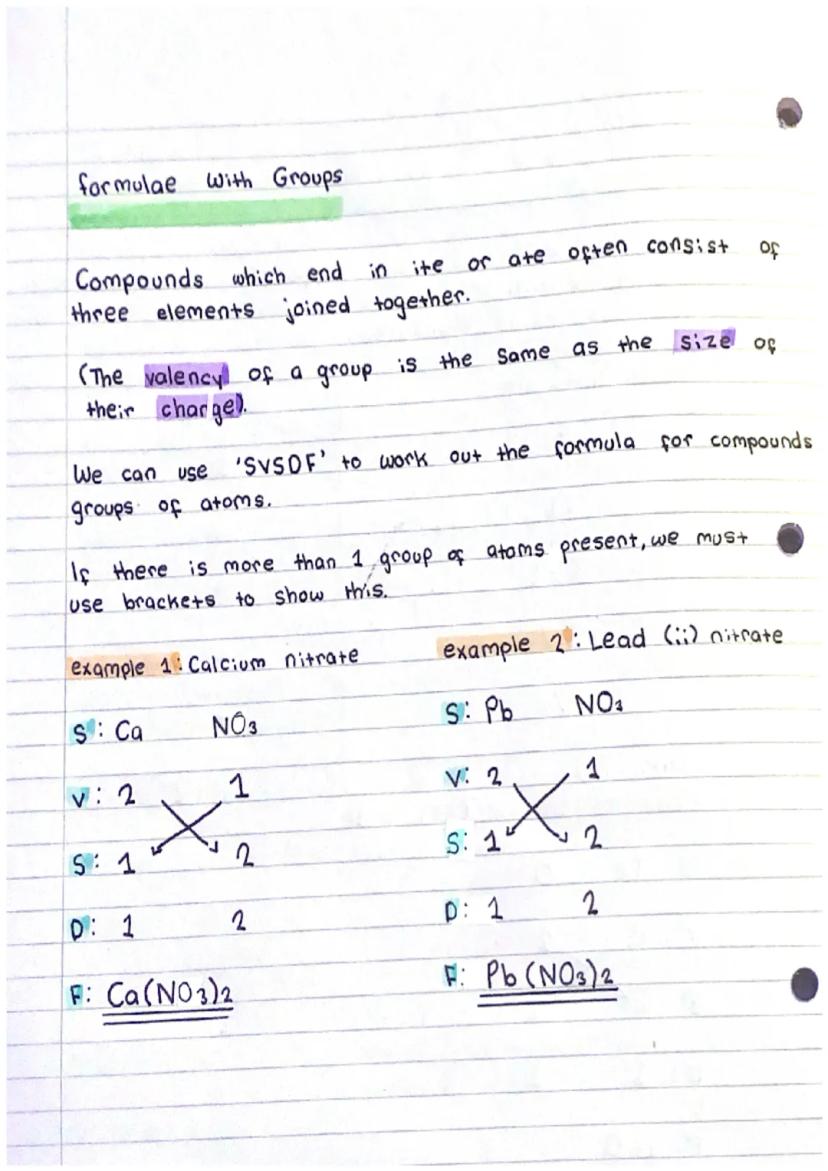
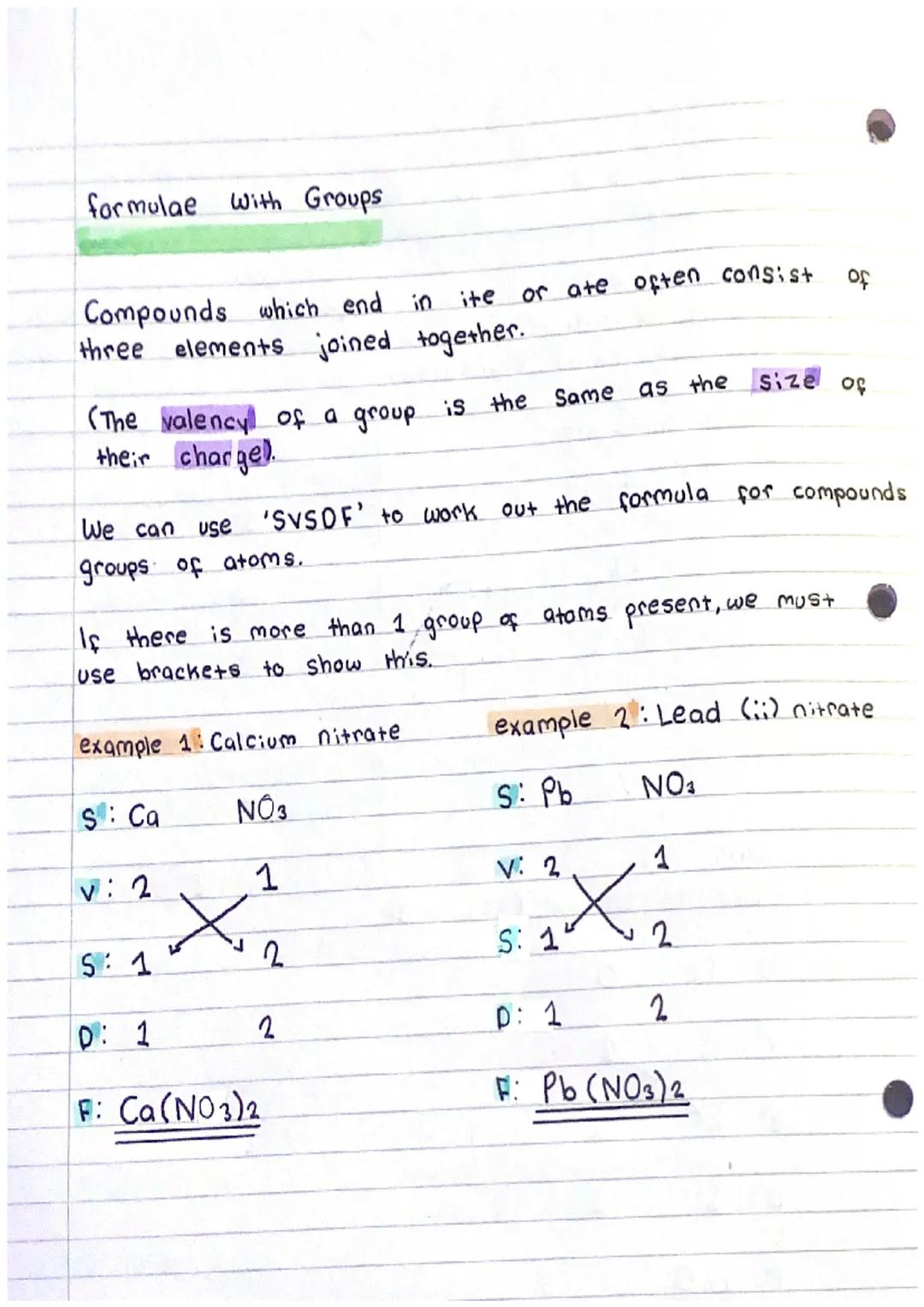
Compounds ending in 'ITE' or 'ATE' often contain three elements joined together as groups. These groups act as single units with their own valencies based on their charge.

Brackets become essential when you need more than one group of atoms. Calcium nitrate becomes Ca(NO₃)₂ because you need two NO₃ groups to balance one calcium atom.

The SVSDF method still works perfectly here. For lead(II) nitrate: Pb (valency 2) + NO₃ (valency 1) gives Pb(NO₃)₂. The process stays exactly the same.

These polyatomic ions appear frequently in real chemistry, so getting comfortable with brackets and group formulas is absolutely crucial for success.

Visual Tip: Think of brackets like packaging - they keep the atomic groups together as complete units!

Classifying. Elements
1. Physical State (Solid, liquids and gases)
elements will either be SOLIDS, LIQUID or GAS at
room temperature
2 liqui

Using Prefixes in Chemical Names

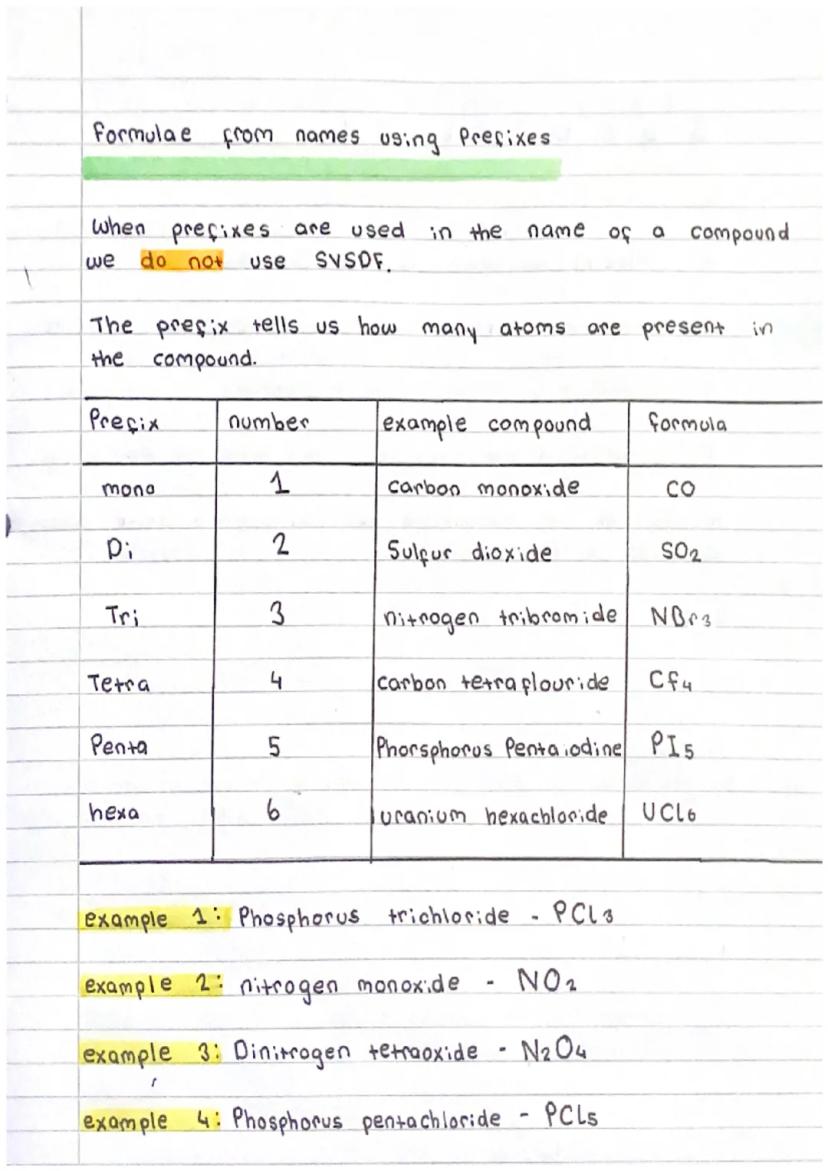
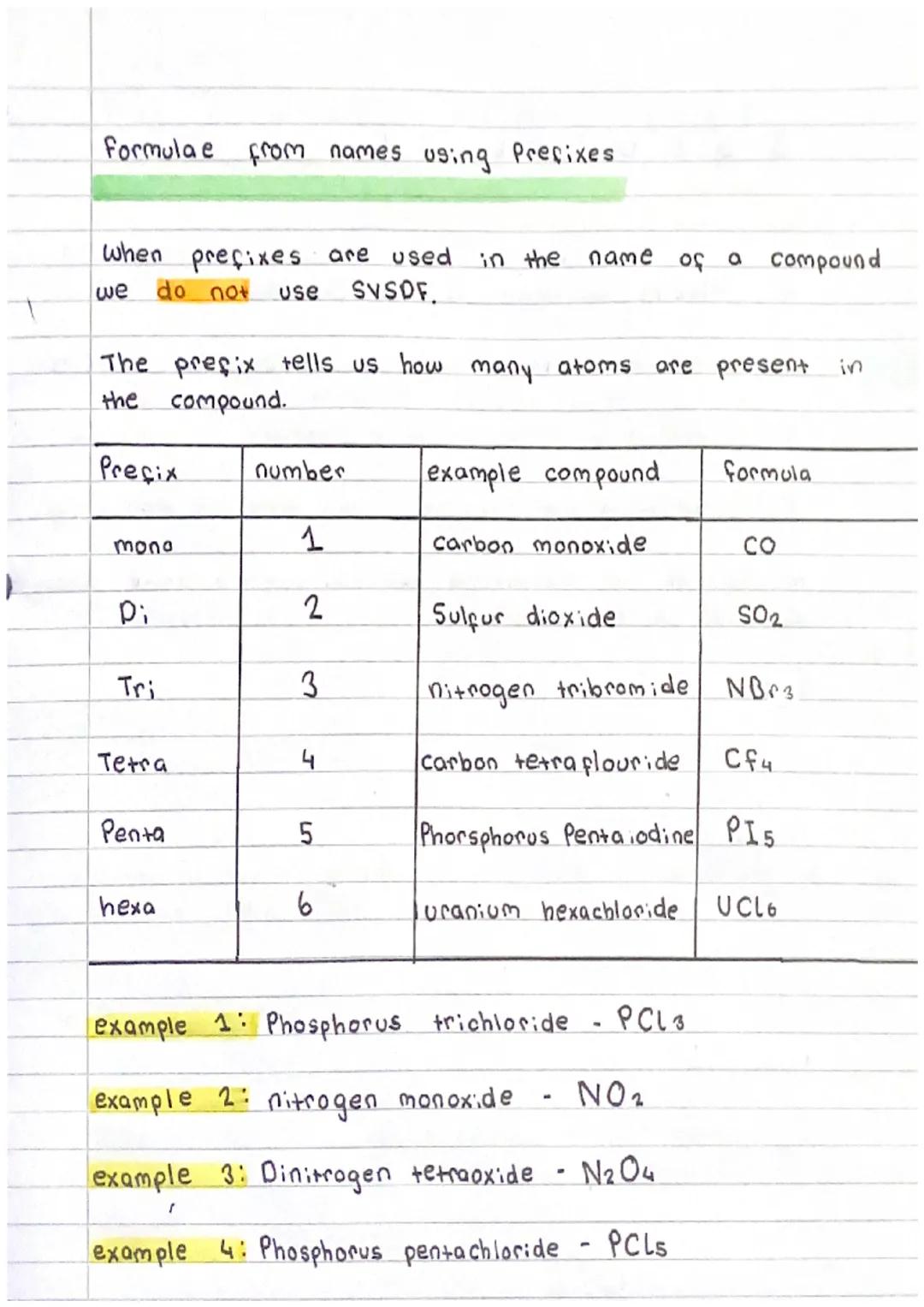
Prefixes make formula writing completely different - you don't use SVSDF at all! The prefix tells you directly how many atoms are present in the compound.

Common prefixes include: mono (1), di (2), tri (3), tetra (4), penta (5), and hexa (6). Carbon monoxide is simply CO, whilst sulfur dioxide is SO₂.

Prefix compounds like phosphorus trichloride (PCl₃) and dinitrogen tetraoxide (N₂O₄) are dead straightforward once you know what each prefix means. Just count and write!

This naming system is particularly common with non-metal compounds. It's much simpler than working out valencies, but you need to recognise when prefixes are being used.

Key Point: When you see prefixes like 'di', 'tri', or 'tetra', forget about SVSDF and just count the atoms directly!

Classifying. Elements
1. Physical State (Solid, liquids and gases)
elements will either be SOLIDS, LIQUID or GAS at
room temperature
2 liqui

Understanding Solubility

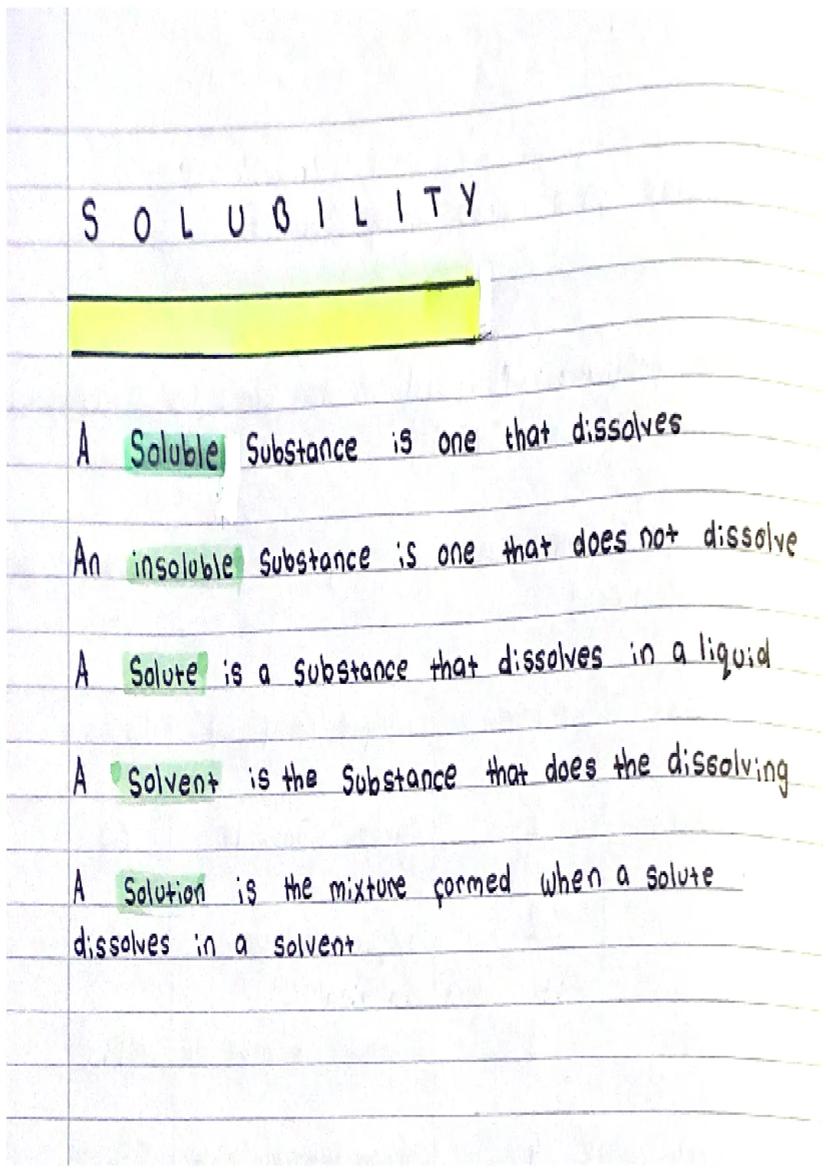
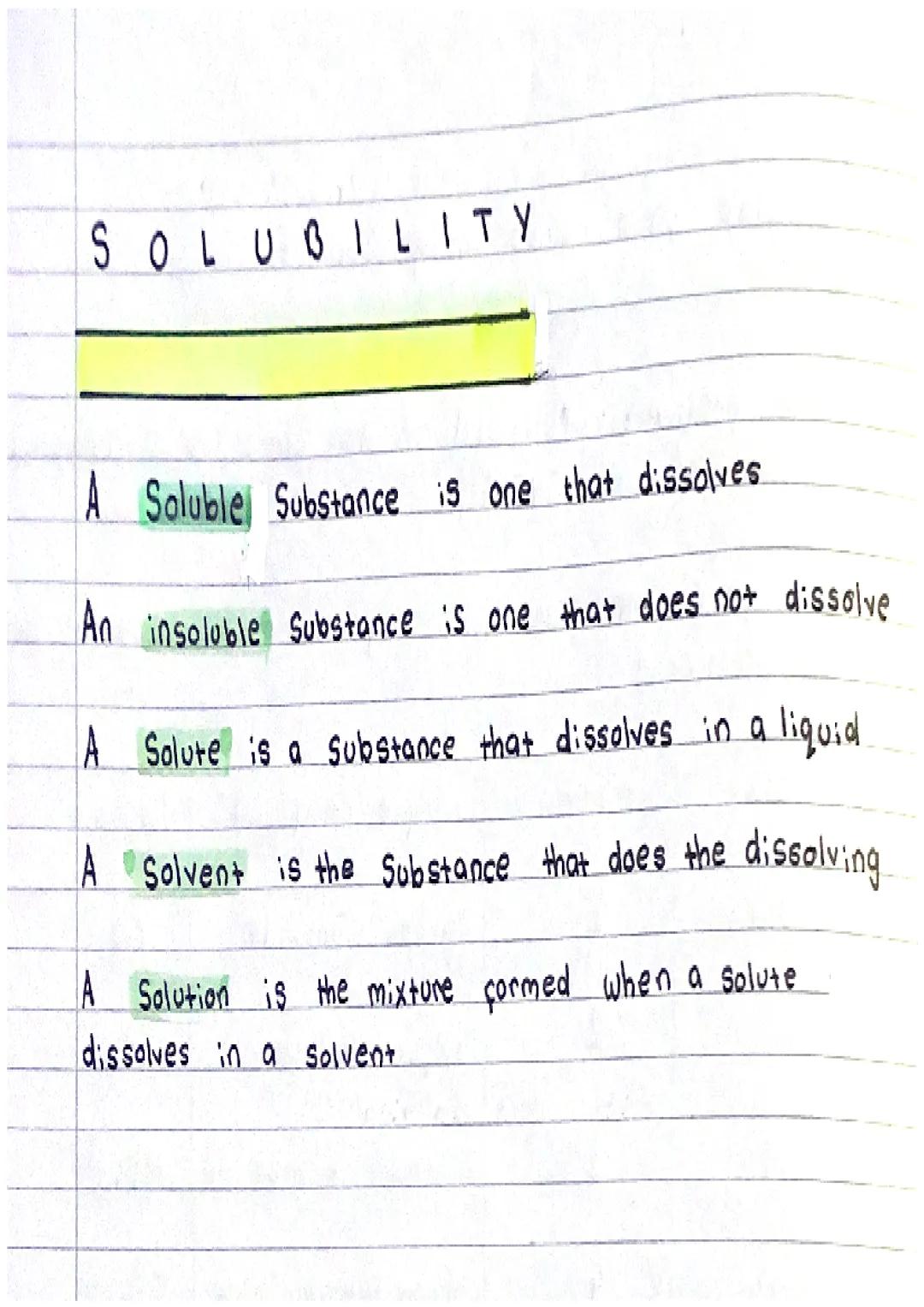
Solubility is basically about what dissolves and what doesn't. A soluble substance dissolves, whilst an insoluble substance stays solid and won't mix properly.

Key terms you need to know: the solute is what dissolves (like sugar), the solvent does the dissolving (like water), and the solution is what you get when they mix together.

Understanding solubility helps explain why oil and water don't mix, but salt and water do perfectly. It's fundamental to loads of chemical processes and everyday situations.

This knowledge becomes essential when you start doing separation techniques and chemical reactions. Knowing what dissolves helps predict what will happen in experiments.

Daily Life: Every time you make a hot drink, you're creating a solution - the sugar or coffee is the solute dissolving in water (the solvent)!

Classifying. Elements
1. Physical State (Solid, liquids and gases)
elements will either be SOLIDS, LIQUID or GAS at
room temperature
2 liqui

Separation Techniques

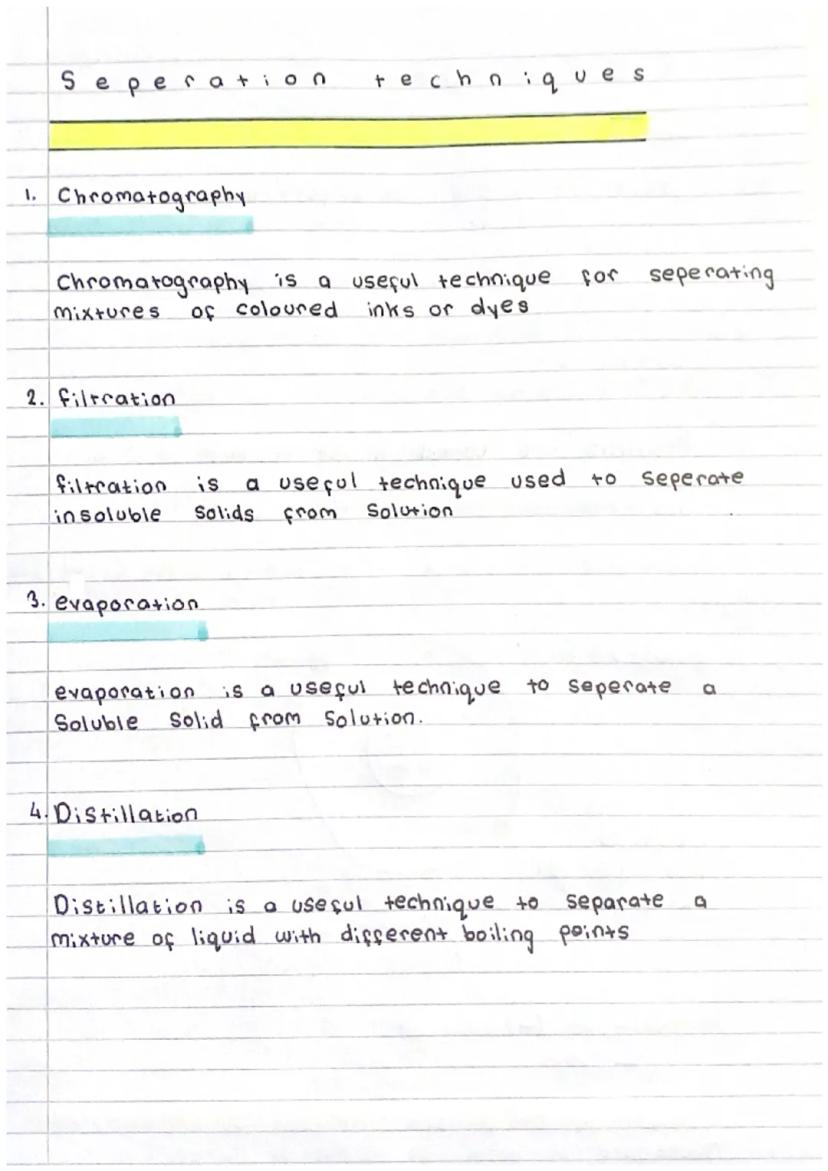
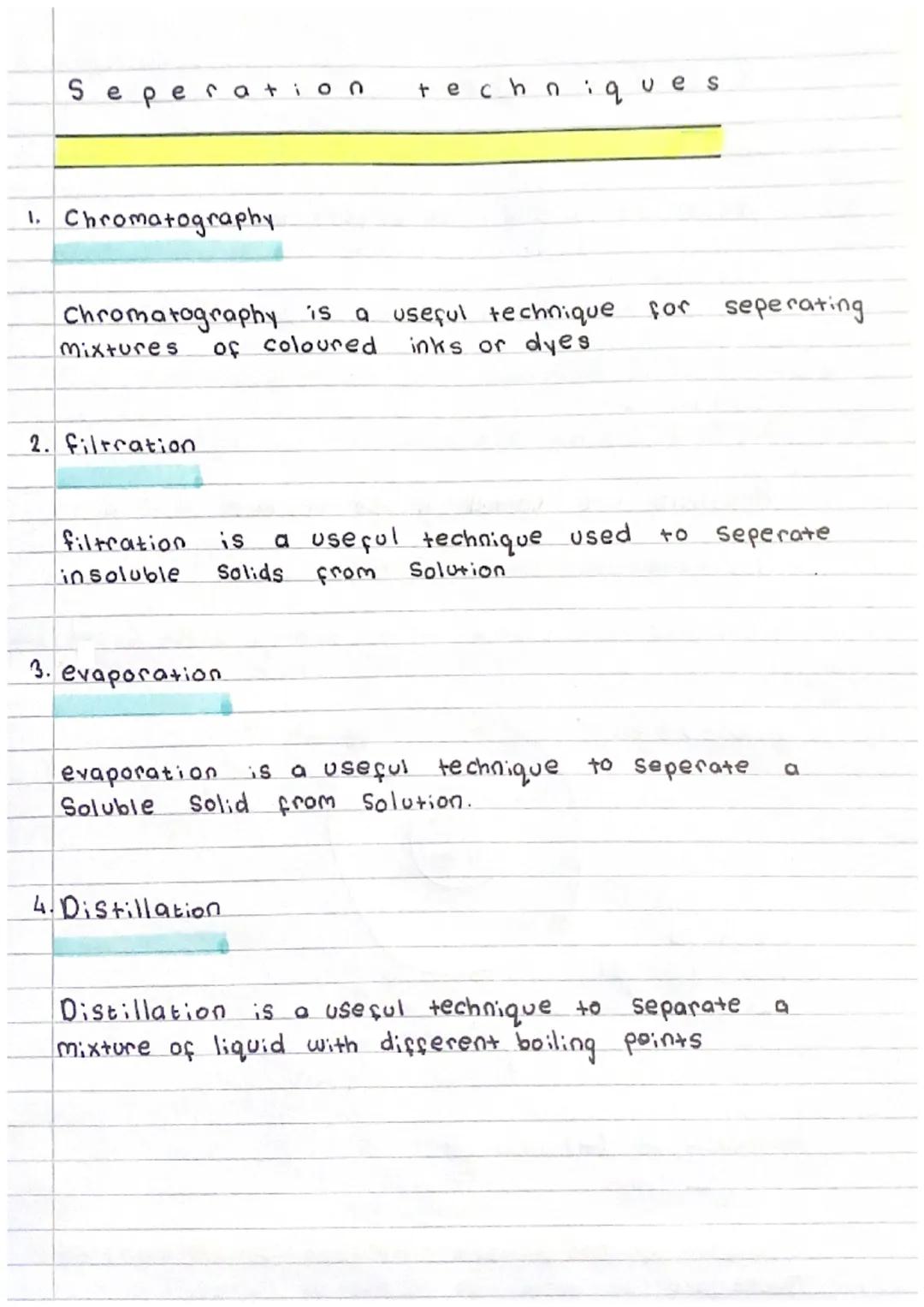
Separation methods let you split up mixtures back into their original components. Each technique works best for specific types of mixtures.

Chromatography separates coloured mixtures like inks and dyes by letting them travel up paper at different speeds. Filtration removes insoluble solids from liquids using filter paper.

Evaporation recovers soluble solids by heating the solution until only the solid remains. Distillation separates liquids with different boiling points by heating and cooling.

These techniques are absolutely everywhere in real chemistry labs and industrial processes. Understanding when to use each method is crucial for practical work.

Lab Skills: Master these four techniques and you'll be able to separate almost any mixture you encounter in chemistry!

Classifying. Elements
1. Physical State (Solid, liquids and gases)
elements will either be SOLIDS, LIQUID or GAS at
room temperature
2 liqui


We thought you’d never ask...

What is the Knowunity AI companion?

Our AI companion is specifically built for the needs of students. Based on the millions of content pieces we have on the platform we can provide truly meaningful and relevant answers to students. But its not only about answers, the companion is even more about guiding students through their daily learning challenges, with personalised study plans, quizzes or content pieces in the chat and 100% personalisation based on the students skills and developments.

Where can I download the Knowunity app?

You can download the app in the Google Play Store and in the Apple App Store.

Is Knowunity really free of charge?

That's right! Enjoy free access to study content, connect with fellow students, and get instant help – all at your fingertips.

Most popular content in Chemistry

Most popular content

Can't find what you're looking for? Explore other subjects.

Students love us — and so will you.

4.9/5

App Store

4.8/5

Google Play

The app is very easy to use and well designed. I have found everything I was looking for so far and have been able to learn a lot from the presentations! I will definitely use the app for a class assignment! And of course it also helps a lot as an inspiration.

Stefan S

iOS user

This app is really great. There are so many study notes and help [...]. My problem subject is French, for example, and the app has so many options for help. Thanks to this app, I have improved my French. I would recommend it to anyone.

Samantha Klich

Android user

Wow, I am really amazed. I just tried the app because I've seen it advertised many times and was absolutely stunned. This app is THE HELP you want for school and above all, it offers so many things, such as workouts and fact sheets, which have been VERY helpful to me personally.

Anna

iOS user

I think it’s very much worth it and you’ll end up using it a lot once you get the hang of it and even after looking at others notes you can still ask your Artificial intelligence buddy the question and ask to simplify it if you still don’t get it!!! In the end I think it’s worth it 😊👍 ⚠️Also DID I MENTION ITS FREEE YOU DON’T HAVE TO PAY FOR ANYTHING AND STILL GET YOUR GRADES IN PERFECTLY❗️❗️⚠️

Thomas R

iOS user

Knowunity is the BEST app I’ve used in a minute. This is not an ai review or anything this is genuinely coming from a 7th grade student (I know 2011 im young) but dude this app is a 10/10 i have maintained a 3.8 gpa and have plenty of time for gaming. I love it and my mom is just happy I got good grades

Brad T

Android user

Not only did it help me find the answer but it also showed me alternative ways to solve it. I was horrible in math and science but now I have an a in both subjects. Thanks for the help🤍🤍

David K

iOS user

The app's just great! All I have to do is enter the topic in the search bar and I get the response real fast. I don't have to watch 10 YouTube videos to understand something, so I'm saving my time. Highly recommended!

Sudenaz Ocak

Android user

In school I was really bad at maths but thanks to the app, I am doing better now. I am so grateful that you made the app.

Greenlight Bonnie

Android user

I found this app a couple years ago and it has only gotten better since then. I really love it because it can help with written questions and photo questions. Also, it can find study guides that other people have made as well as flashcard sets and practice tests. The free version is also amazing for students who might not be able to afford it. Would 100% recommend

Aubrey

iOS user

Best app if you're in Highschool or Junior high. I have been using this app for 2 school years and it's the best, it's good if you don't have anyone to help you with school work.😋🩷🎀

Marco B

iOS user

THE QUIZES AND FLASHCARDS ARE SO USEFUL AND I LOVE THE SCHOOLGPT. IT ALSO IS LITREALLY LIKE CHATGPT BUT SMARTER!! HELPED ME WITH MY MASCARA PROBLEMS TOO!! AS WELL AS MY REAL SUBJECTS ! DUHHH 😍😁😲🤑💗✨🎀😮

Elisha

iOS user

This app is phenomenal down to the correct info and the various topics you can study! I greatly recommend it for people who struggle with procrastination and those who need homework help. It has been perfectly accurate for world 1 history as far as I’ve seen! Geometry too!

Paul T

iOS user

The app is very easy to use and well designed. I have found everything I was looking for so far and have been able to learn a lot from the presentations! I will definitely use the app for a class assignment! And of course it also helps a lot as an inspiration.

Stefan S

iOS user

This app is really great. There are so many study notes and help [...]. My problem subject is French, for example, and the app has so many options for help. Thanks to this app, I have improved my French. I would recommend it to anyone.

Samantha Klich

Android user

Wow, I am really amazed. I just tried the app because I've seen it advertised many times and was absolutely stunned. This app is THE HELP you want for school and above all, it offers so many things, such as workouts and fact sheets, which have been VERY helpful to me personally.

Anna

iOS user

I think it’s very much worth it and you’ll end up using it a lot once you get the hang of it and even after looking at others notes you can still ask your Artificial intelligence buddy the question and ask to simplify it if you still don’t get it!!! In the end I think it’s worth it 😊👍 ⚠️Also DID I MENTION ITS FREEE YOU DON’T HAVE TO PAY FOR ANYTHING AND STILL GET YOUR GRADES IN PERFECTLY❗️❗️⚠️

Thomas R

iOS user

Knowunity is the BEST app I’ve used in a minute. This is not an ai review or anything this is genuinely coming from a 7th grade student (I know 2011 im young) but dude this app is a 10/10 i have maintained a 3.8 gpa and have plenty of time for gaming. I love it and my mom is just happy I got good grades

Brad T

Android user

Not only did it help me find the answer but it also showed me alternative ways to solve it. I was horrible in math and science but now I have an a in both subjects. Thanks for the help🤍🤍

David K

iOS user

The app's just great! All I have to do is enter the topic in the search bar and I get the response real fast. I don't have to watch 10 YouTube videos to understand something, so I'm saving my time. Highly recommended!

Sudenaz Ocak

Android user

In school I was really bad at maths but thanks to the app, I am doing better now. I am so grateful that you made the app.

Greenlight Bonnie

Android user

I found this app a couple years ago and it has only gotten better since then. I really love it because it can help with written questions and photo questions. Also, it can find study guides that other people have made as well as flashcard sets and practice tests. The free version is also amazing for students who might not be able to afford it. Would 100% recommend

Aubrey

iOS user

Best app if you're in Highschool or Junior high. I have been using this app for 2 school years and it's the best, it's good if you don't have anyone to help you with school work.😋🩷🎀

Marco B

iOS user

THE QUIZES AND FLASHCARDS ARE SO USEFUL AND I LOVE THE SCHOOLGPT. IT ALSO IS LITREALLY LIKE CHATGPT BUT SMARTER!! HELPED ME WITH MY MASCARA PROBLEMS TOO!! AS WELL AS MY REAL SUBJECTS ! DUHHH 😍😁😲🤑💗✨🎀😮

Elisha

iOS user

This app is phenomenal down to the correct info and the various topics you can study! I greatly recommend it for people who struggle with procrastination and those who need homework help. It has been perfectly accurate for world 1 history as far as I’ve seen! Geometry too!

Paul T

iOS user


Chemistry

194

Dec 10, 2025

14 pages

Understanding Atomic Structure and Bonding

A

Asma Farzand

@asmafarzandx

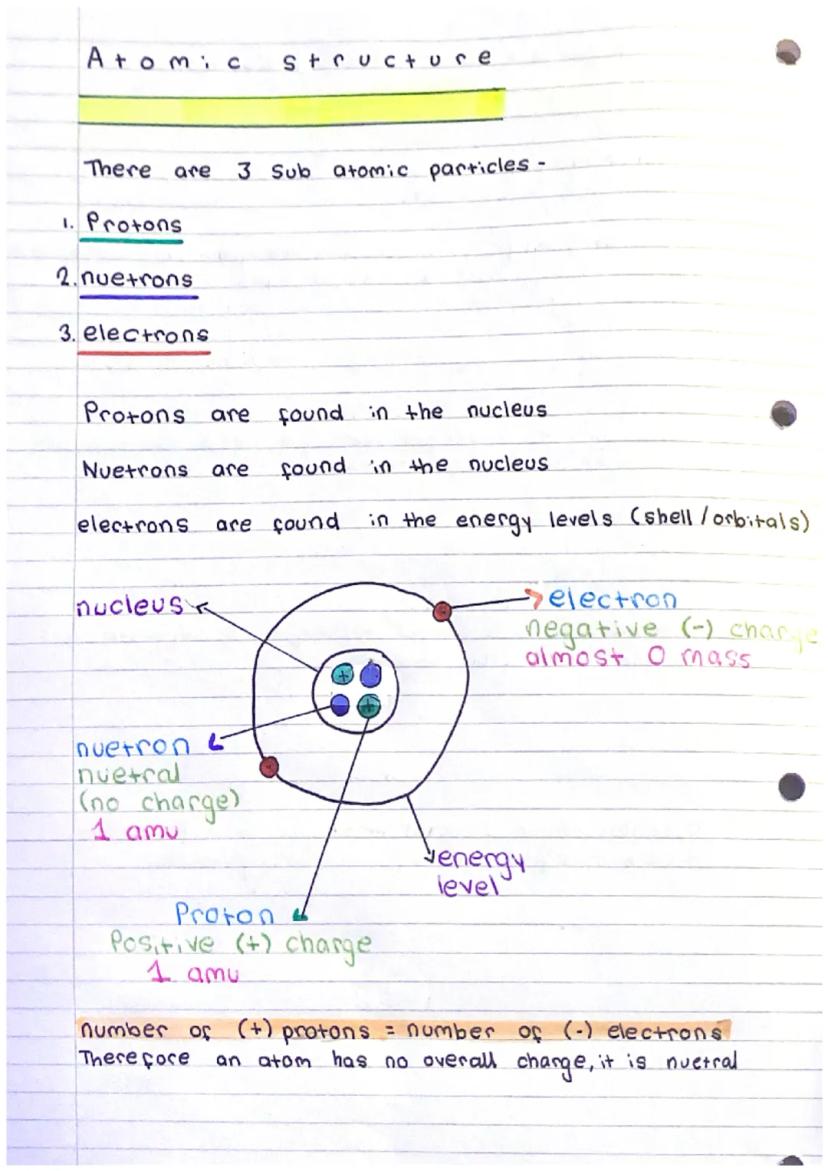
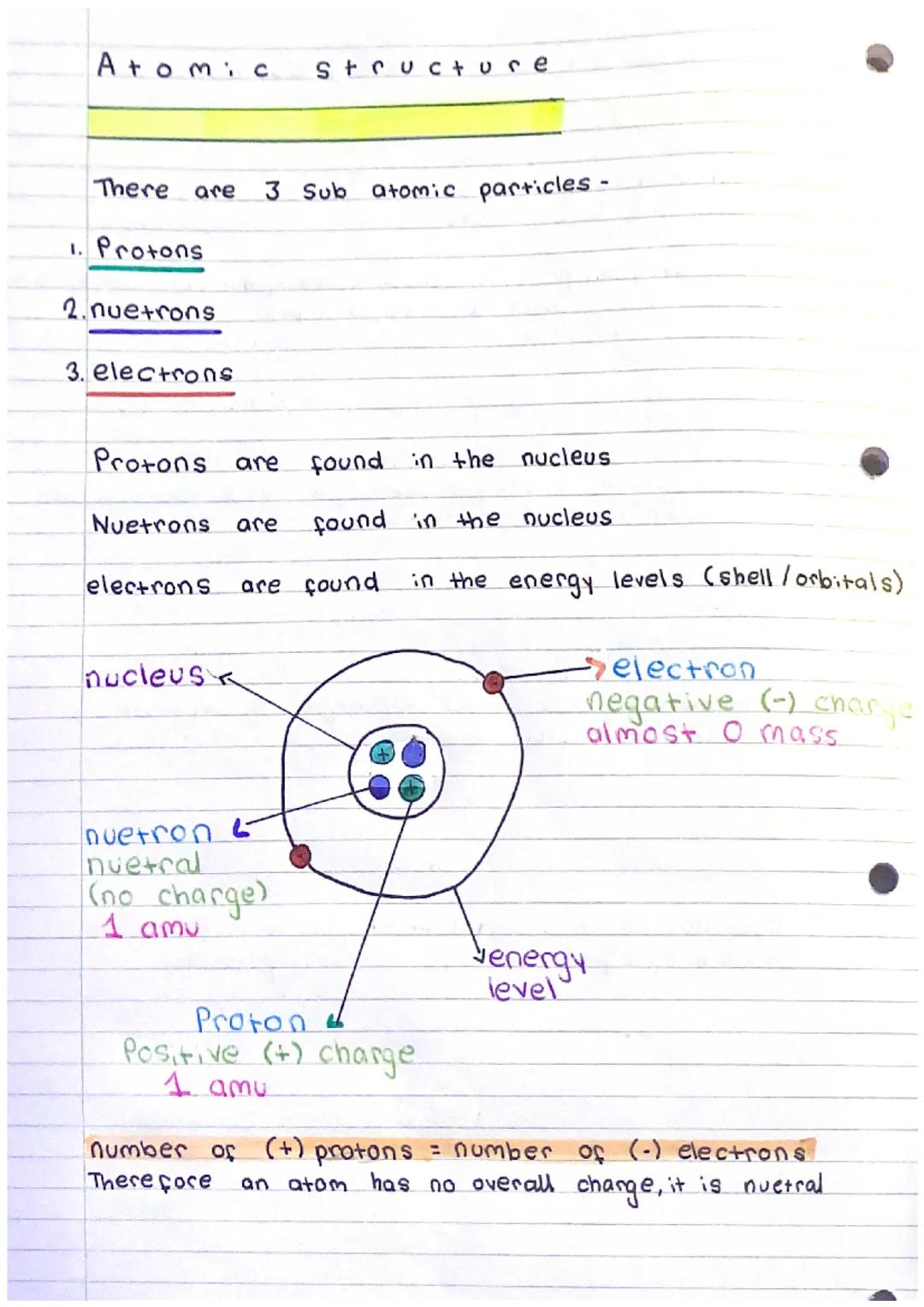
Chemistry might seem complicated, but it's actually just about understanding how elements behave and combine to form everything around us. This guide covers the essential basics you need to know about classifying elements, writing chemical formulas, and understanding atomic structure.

Classifying. Elements
1. Physical State (Solid, liquids and gases)
elements will either be SOLIDS, LIQUID or GAS at
room temperature
2 liqui

Sign up to see the contentIt's free!

Access to all documents

Improve your grades

Join milions of students

By signing up you accept Terms of Service and Privacy Policy

Classifying Elements

Ever wondered why some elements are shiny metals whilst others are colourless gases? Elements can be classified in several useful ways that help us predict their behaviour.

At room temperature, most elements are solid, but there are exactly 2 liquids (mercury and bromine) and 11 gases (including oxygen, nitrogen, and hydrogen). This physical state classification is dead useful for identifying elements in the lab.

The periodic table divides elements into metals (left side) and non-metals (right side). Metals are brilliant because they conduct electricity and heat, plus they're malleable - meaning they bend rather than break when you hit them.

Natural elements exist in nature, but synthetic elements have been created by scientists in nuclear reactions since the 1930s. The periodic table organises everything with groups (vertical columns) and periods (horizontal rows).

Quick Tip: Elements in the same group have similar chemical properties - this pattern makes chemistry much more predictable!

Classifying. Elements
1. Physical State (Solid, liquids and gases)
elements will either be SOLIDS, LIQUID or GAS at
room temperature
2 liqui

Sign up to see the contentIt's free!

Access to all documents

Improve your grades

Join milions of students

By signing up you accept Terms of Service and Privacy Policy

Groups and Diatomic Molecules

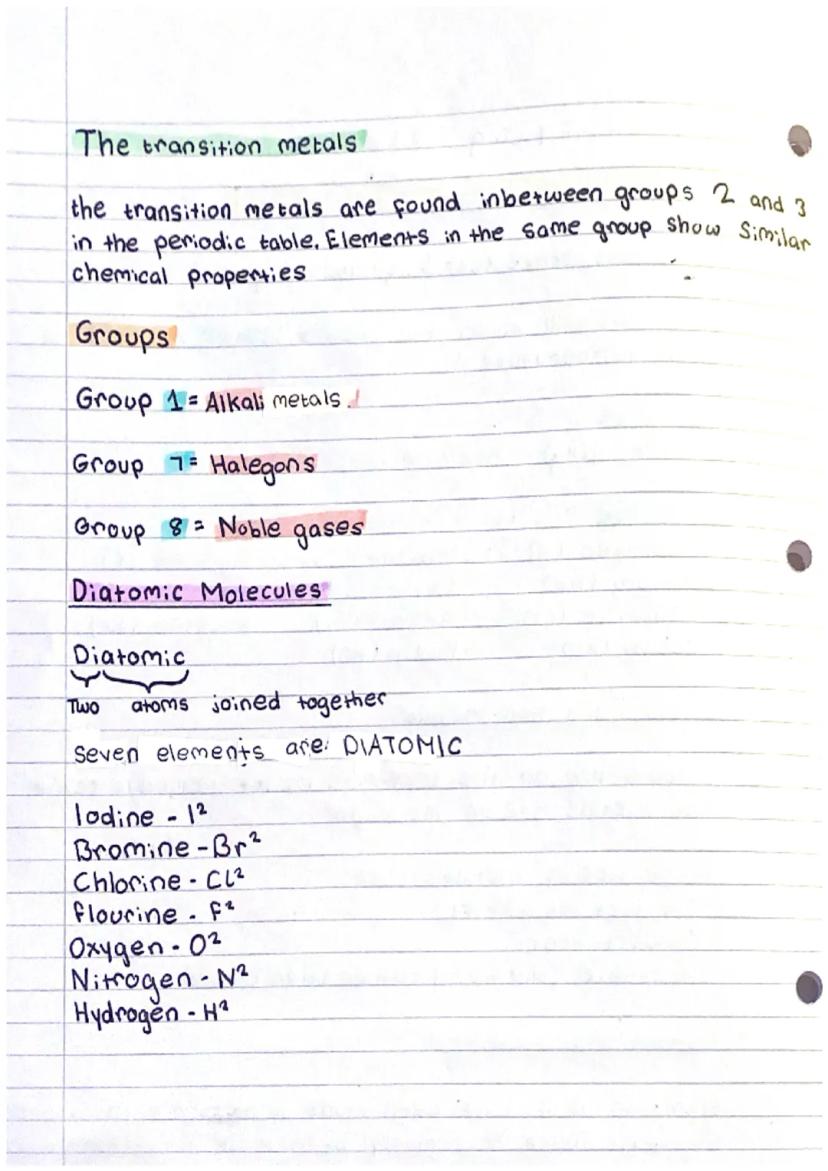
The periodic table has special groups you absolutely need to know. Group 1 contains the alkali metals, Group 7 has the halogens, and Group 8 includes the noble gases. Between groups 2 and 3, you'll find the transition metals.

Here's something quite cool - seven elements are diatomic, meaning they naturally exist as two atoms joined together. These are hydrogen (H₂), nitrogen (N₂), oxygen (O₂), fluorine (F₂), chlorine (Cl₂), bromine (Br₂), and iodine (I₂).

Diatomic molecules are crucial for chemical reactions because these elements rarely exist as single atoms in nature. You'll encounter them constantly in equations and calculations.

Memory Trick: Remember the diatomic elements with "Have No Fear Of Ice Cold Beer" - the first letters match H, N, F, O, I, Cl, Br!
Classifying. Elements
1. Physical State (Solid, liquids and gases)
elements will either be SOLIDS, LIQUID or GAS at
room temperature
2 liqui

Sign up to see the contentIt's free!

Access to all documents

Improve your grades

Join milions of students

By signing up you accept Terms of Service and Privacy Policy

Compounds and Naming Rules

Compounds form when different elements react together to create completely new substances with different properties. Understanding how to name them properly is essential for any chemistry work.

The 'IDE' rule applies when usually only 2 elements combine. For example, calcium + oxygen = calcium oxide. It's straightforward and covers loads of common compounds.

The 'ATE' or 'ITE' rule kicks in when 3 elements combine, with one being oxygen. Think calcium + carbon + oxygen = calcium carbonate. These compounds are everywhere in real life.

Chemical formulas show the exact ratio of atoms in compounds. Potassium chloride is KCl (1:1 ratio), whilst hydrogen sulfide is H₂S (2:1 ratio). These formulas tell you everything about the compound's composition.

Real-World Connection: Calcium carbonate is literally chalk and limestone - so you're using chemistry knowledge every time you write on a blackboard!

Classifying. Elements
1. Physical State (Solid, liquids and gases)
elements will either be SOLIDS, LIQUID or GAS at
room temperature
2 liqui

Sign up to see the contentIt's free!

Access to all documents

Improve your grades

Join milions of students

By signing up you accept Terms of Service and Privacy Policy

Writing Chemical Formulas with SVSDF

Chemical formulas might look intimidating, but there's a brilliant method called SVSDF that makes them dead easy. Each element has a valency - basically its combining power or how many bonds it makes.

The SVSDF method works like this: write the Symbols, note their Valencies, Swap the numbers, then Divide by the smallest number, giving you the Formula. For potassium sulfide: K (valency 1) + S (valency 2) becomes K₂S.

Group valencies follow a pattern: Group 1 = 1, Group 2 = 2, Group 3 = 3, etc. This pattern makes predicting formulas much simpler once you know where elements sit on the periodic table.

Practice with silicon oxide (SiO₂) and sodium phosphide (Na₃P) until the method becomes automatic. You'll use this constantly in chemistry.

Success Tip: Master SVSDF now and you'll breeze through formula writing for the rest of your chemistry studies!

Classifying. Elements
1. Physical State (Solid, liquids and gases)
elements will either be SOLIDS, LIQUID or GAS at
room temperature
2 liqui

Sign up to see the contentIt's free!

Access to all documents

Improve your grades

Join milions of students

By signing up you accept Terms of Service and Privacy Policy

Roman Numerals and Variable Valencies

Some elements have different valencies depending on the compound they're in. When this happens, Roman numerals in brackets tell you exactly which valency to use.

Roman numerals are straightforward: I = 1, II = 2, III = 3, IV = 4, V = 5. So iron(II) oxide means iron has a valency of 2, giving you FeO using the SVSDF method.

Transition metals often show this variable valency behaviour. Manganese(IV) oxide becomes MnO₂, whilst copper(I) phosphide becomes Cu₃P. The Roman numeral removes all guesswork.

This system prevents confusion when elements can form multiple compounds. Without it, you wouldn't know whether you're dealing with FeO or Fe₂O₃.

Exam Alert: Always check for Roman numerals in compound names - missing them will give you completely wrong formulas!

Classifying. Elements
1. Physical State (Solid, liquids and gases)
elements will either be SOLIDS, LIQUID or GAS at
room temperature
2 liqui

Sign up to see the contentIt's free!

Access to all documents

Improve your grades

Join milions of students

By signing up you accept Terms of Service and Privacy Policy

Formulas with Groups of Atoms

Compounds ending in 'ITE' or 'ATE' often contain three elements joined together as groups. These groups act as single units with their own valencies based on their charge.

Brackets become essential when you need more than one group of atoms. Calcium nitrate becomes Ca(NO₃)₂ because you need two NO₃ groups to balance one calcium atom.

The SVSDF method still works perfectly here. For lead(II) nitrate: Pb (valency 2) + NO₃ (valency 1) gives Pb(NO₃)₂. The process stays exactly the same.

These polyatomic ions appear frequently in real chemistry, so getting comfortable with brackets and group formulas is absolutely crucial for success.

Visual Tip: Think of brackets like packaging - they keep the atomic groups together as complete units!

Classifying. Elements
1. Physical State (Solid, liquids and gases)
elements will either be SOLIDS, LIQUID or GAS at
room temperature
2 liqui

Sign up to see the contentIt's free!

Access to all documents

Improve your grades

Join milions of students

By signing up you accept Terms of Service and Privacy Policy

Using Prefixes in Chemical Names

Prefixes make formula writing completely different - you don't use SVSDF at all! The prefix tells you directly how many atoms are present in the compound.

Common prefixes include: mono (1), di (2), tri (3), tetra (4), penta (5), and hexa (6). Carbon monoxide is simply CO, whilst sulfur dioxide is SO₂.

Prefix compounds like phosphorus trichloride (PCl₃) and dinitrogen tetraoxide (N₂O₄) are dead straightforward once you know what each prefix means. Just count and write!

This naming system is particularly common with non-metal compounds. It's much simpler than working out valencies, but you need to recognise when prefixes are being used.

Key Point: When you see prefixes like 'di', 'tri', or 'tetra', forget about SVSDF and just count the atoms directly!

Classifying. Elements
1. Physical State (Solid, liquids and gases)
elements will either be SOLIDS, LIQUID or GAS at
room temperature
2 liqui

Sign up to see the contentIt's free!

Access to all documents

Improve your grades

Join milions of students

By signing up you accept Terms of Service and Privacy Policy

Understanding Solubility

Solubility is basically about what dissolves and what doesn't. A soluble substance dissolves, whilst an insoluble substance stays solid and won't mix properly.

Key terms you need to know: the solute is what dissolves (like sugar), the solvent does the dissolving (like water), and the solution is what you get when they mix together.

Understanding solubility helps explain why oil and water don't mix, but salt and water do perfectly. It's fundamental to loads of chemical processes and everyday situations.

This knowledge becomes essential when you start doing separation techniques and chemical reactions. Knowing what dissolves helps predict what will happen in experiments.

Daily Life: Every time you make a hot drink, you're creating a solution - the sugar or coffee is the solute dissolving in water (the solvent)!

Classifying. Elements
1. Physical State (Solid, liquids and gases)
elements will either be SOLIDS, LIQUID or GAS at
room temperature
2 liqui

Sign up to see the contentIt's free!

Access to all documents

Improve your grades

Join milions of students

By signing up you accept Terms of Service and Privacy Policy

Separation Techniques

Separation methods let you split up mixtures back into their original components. Each technique works best for specific types of mixtures.

Chromatography separates coloured mixtures like inks and dyes by letting them travel up paper at different speeds. Filtration removes insoluble solids from liquids using filter paper.

Evaporation recovers soluble solids by heating the solution until only the solid remains. Distillation separates liquids with different boiling points by heating and cooling.

These techniques are absolutely everywhere in real chemistry labs and industrial processes. Understanding when to use each method is crucial for practical work.

Lab Skills: Master these four techniques and you'll be able to separate almost any mixture you encounter in chemistry!

Classifying. Elements
1. Physical State (Solid, liquids and gases)
elements will either be SOLIDS, LIQUID or GAS at
room temperature
2 liqui

Sign up to see the contentIt's free!

Access to all documents

Improve your grades

Join milions of students

By signing up you accept Terms of Service and Privacy Policy

We thought you’d never ask...

What is the Knowunity AI companion?

Our AI companion is specifically built for the needs of students. Based on the millions of content pieces we have on the platform we can provide truly meaningful and relevant answers to students. But its not only about answers, the companion is even more about guiding students through their daily learning challenges, with personalised study plans, quizzes or content pieces in the chat and 100% personalisation based on the students skills and developments.

Where can I download the Knowunity app?

You can download the app in the Google Play Store and in the Apple App Store.

Is Knowunity really free of charge?

That's right! Enjoy free access to study content, connect with fellow students, and get instant help – all at your fingertips.

18

Smart Tools NEW

Transform this note into: ✓ 50+ Practice Questions ✓ Interactive Flashcards ✓ Full Mock Exam ✓ Essay Outlines

Mock Exam
Quiz
Flashcards
Essay

Most popular content in Chemistry

Most popular content

Can't find what you're looking for? Explore other subjects.

Students love us — and so will you.

4.9/5

App Store

4.8/5

Google Play

The app is very easy to use and well designed. I have found everything I was looking for so far and have been able to learn a lot from the presentations! I will definitely use the app for a class assignment! And of course it also helps a lot as an inspiration.

Stefan S

iOS user

This app is really great. There are so many study notes and help [...]. My problem subject is French, for example, and the app has so many options for help. Thanks to this app, I have improved my French. I would recommend it to anyone.

Samantha Klich

Android user

Wow, I am really amazed. I just tried the app because I've seen it advertised many times and was absolutely stunned. This app is THE HELP you want for school and above all, it offers so many things, such as workouts and fact sheets, which have been VERY helpful to me personally.

Anna

iOS user

I think it’s very much worth it and you’ll end up using it a lot once you get the hang of it and even after looking at others notes you can still ask your Artificial intelligence buddy the question and ask to simplify it if you still don’t get it!!! In the end I think it’s worth it 😊👍 ⚠️Also DID I MENTION ITS FREEE YOU DON’T HAVE TO PAY FOR ANYTHING AND STILL GET YOUR GRADES IN PERFECTLY❗️❗️⚠️

Thomas R

iOS user

Knowunity is the BEST app I’ve used in a minute. This is not an ai review or anything this is genuinely coming from a 7th grade student (I know 2011 im young) but dude this app is a 10/10 i have maintained a 3.8 gpa and have plenty of time for gaming. I love it and my mom is just happy I got good grades

Brad T

Android user

Not only did it help me find the answer but it also showed me alternative ways to solve it. I was horrible in math and science but now I have an a in both subjects. Thanks for the help🤍🤍

David K

iOS user

The app's just great! All I have to do is enter the topic in the search bar and I get the response real fast. I don't have to watch 10 YouTube videos to understand something, so I'm saving my time. Highly recommended!

Sudenaz Ocak

Android user

In school I was really bad at maths but thanks to the app, I am doing better now. I am so grateful that you made the app.

Greenlight Bonnie

Android user

I found this app a couple years ago and it has only gotten better since then. I really love it because it can help with written questions and photo questions. Also, it can find study guides that other people have made as well as flashcard sets and practice tests. The free version is also amazing for students who might not be able to afford it. Would 100% recommend

Aubrey

iOS user

Best app if you're in Highschool or Junior high. I have been using this app for 2 school years and it's the best, it's good if you don't have anyone to help you with school work.😋🩷🎀

Marco B

iOS user

THE QUIZES AND FLASHCARDS ARE SO USEFUL AND I LOVE THE SCHOOLGPT. IT ALSO IS LITREALLY LIKE CHATGPT BUT SMARTER!! HELPED ME WITH MY MASCARA PROBLEMS TOO!! AS WELL AS MY REAL SUBJECTS ! DUHHH 😍😁😲🤑💗✨🎀😮

Elisha

iOS user

This app is phenomenal down to the correct info and the various topics you can study! I greatly recommend it for people who struggle with procrastination and those who need homework help. It has been perfectly accurate for world 1 history as far as I’ve seen! Geometry too!

Paul T

iOS user

The app is very easy to use and well designed. I have found everything I was looking for so far and have been able to learn a lot from the presentations! I will definitely use the app for a class assignment! And of course it also helps a lot as an inspiration.

Stefan S

iOS user

This app is really great. There are so many study notes and help [...]. My problem subject is French, for example, and the app has so many options for help. Thanks to this app, I have improved my French. I would recommend it to anyone.

Samantha Klich

Android user

Wow, I am really amazed. I just tried the app because I've seen it advertised many times and was absolutely stunned. This app is THE HELP you want for school and above all, it offers so many things, such as workouts and fact sheets, which have been VERY helpful to me personally.

Anna

iOS user

I think it’s very much worth it and you’ll end up using it a lot once you get the hang of it and even after looking at others notes you can still ask your Artificial intelligence buddy the question and ask to simplify it if you still don’t get it!!! In the end I think it’s worth it 😊👍 ⚠️Also DID I MENTION ITS FREEE YOU DON’T HAVE TO PAY FOR ANYTHING AND STILL GET YOUR GRADES IN PERFECTLY❗️❗️⚠️

Thomas R

iOS user

Knowunity is the BEST app I’ve used in a minute. This is not an ai review or anything this is genuinely coming from a 7th grade student (I know 2011 im young) but dude this app is a 10/10 i have maintained a 3.8 gpa and have plenty of time for gaming. I love it and my mom is just happy I got good grades

Brad T

Android user

Not only did it help me find the answer but it also showed me alternative ways to solve it. I was horrible in math and science but now I have an a in both subjects. Thanks for the help🤍🤍

David K

iOS user

The app's just great! All I have to do is enter the topic in the search bar and I get the response real fast. I don't have to watch 10 YouTube videos to understand something, so I'm saving my time. Highly recommended!

Sudenaz Ocak

Android user

In school I was really bad at maths but thanks to the app, I am doing better now. I am so grateful that you made the app.

Greenlight Bonnie

Android user

I found this app a couple years ago and it has only gotten better since then. I really love it because it can help with written questions and photo questions. Also, it can find study guides that other people have made as well as flashcard sets and practice tests. The free version is also amazing for students who might not be able to afford it. Would 100% recommend

Aubrey

iOS user

Best app if you're in Highschool or Junior high. I have been using this app for 2 school years and it's the best, it's good if you don't have anyone to help you with school work.😋🩷🎀

Marco B

iOS user

THE QUIZES AND FLASHCARDS ARE SO USEFUL AND I LOVE THE SCHOOLGPT. IT ALSO IS LITREALLY LIKE CHATGPT BUT SMARTER!! HELPED ME WITH MY MASCARA PROBLEMS TOO!! AS WELL AS MY REAL SUBJECTS ! DUHHH 😍😁😲🤑💗✨🎀😮

Elisha

iOS user

This app is phenomenal down to the correct info and the various topics you can study! I greatly recommend it for people who struggle with procrastination and those who need homework help. It has been perfectly accurate for world 1 history as far as I’ve seen! Geometry too!

Paul T

iOS user