Open the App

Subjects

294

Dec 9, 2025

12 pages

Understanding Coordinate Vectors in Linear Algebra

Coordinate vectors provide a powerful way to represent abstract vectors... Show more

Page 1
Page 2
Page 3
Page 4
Page 5
Page 6
Page 7
Page 8
Page 9
Page 10
1 / 10
1 Coordinates
Coordinate Vectors
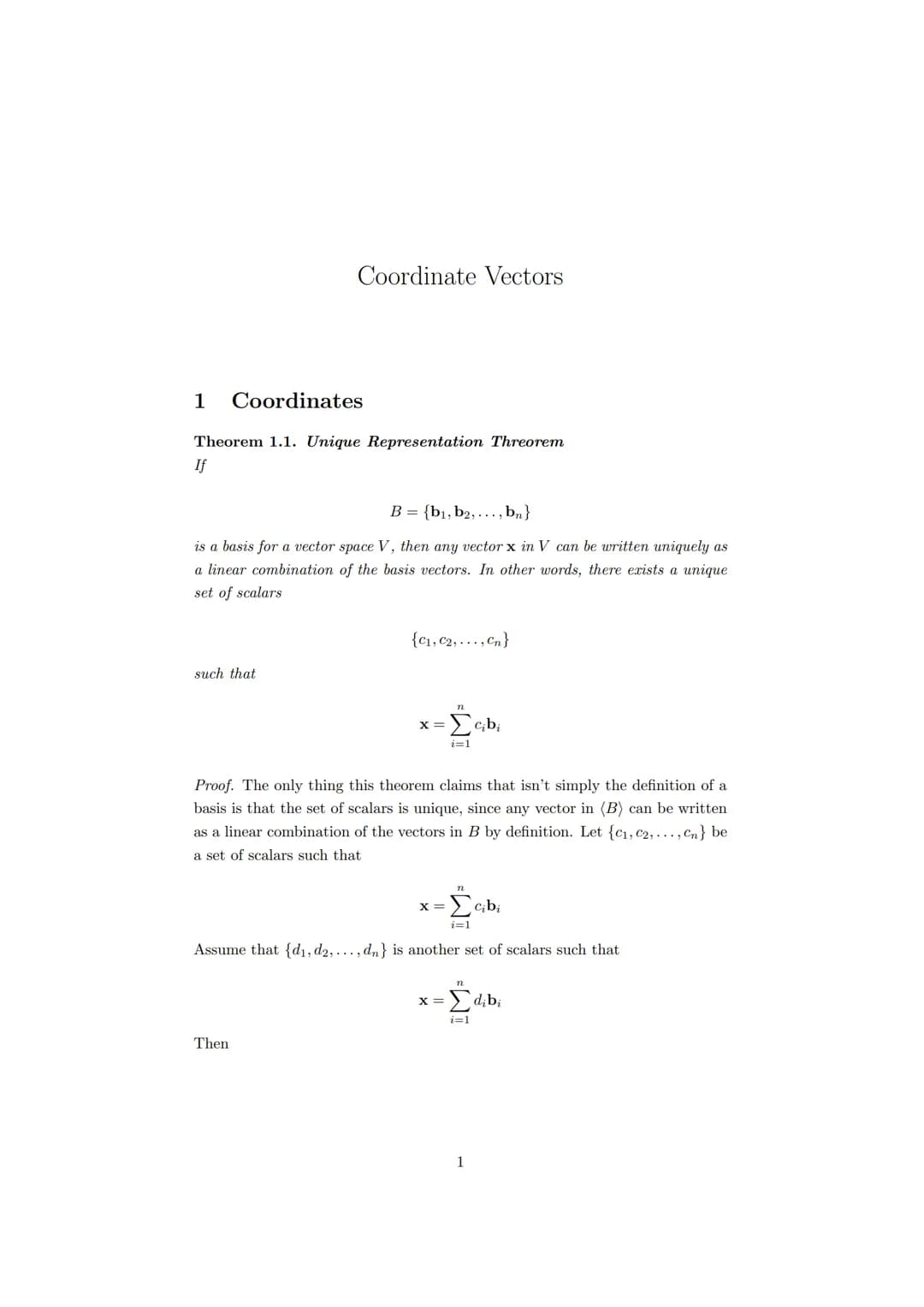
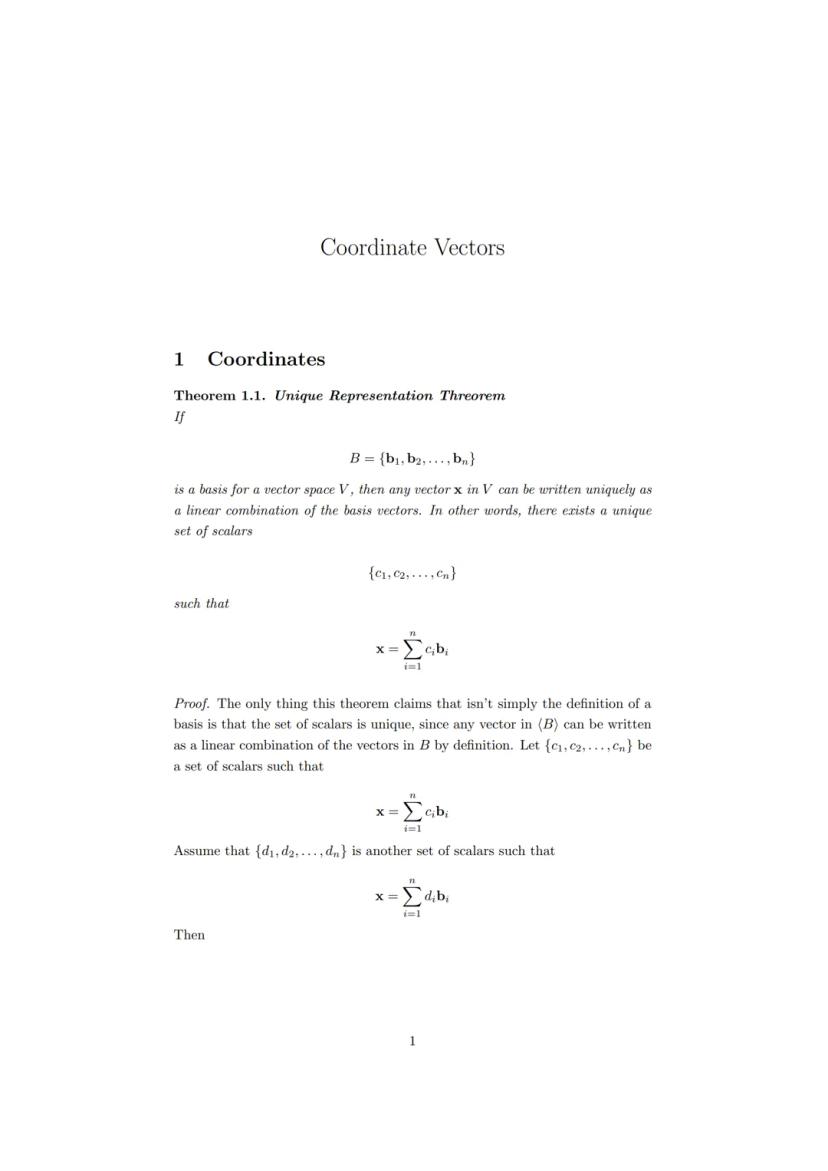
Theorem 1.1. Unique Representation Threorem
If
B = {b₁,b2,..., bn}
is a basis for a vector space V, then an

Unique Representation Theorem

Ever wondered how we can precisely describe any vector using a set of basis vectors? That's where the Unique Representation Theorem comes in!

When you have a basis B = {b₁, b₂, ..., bₙ} for a vector space V, any vector x in that space can be written as a linear combination of those basis vectors in exactly one way. This means there's a unique set of scalars {c₁, c₂, ..., cₙ} such that x = c₁b₁ + c₂b₂ + ... + cₙbₙ.

The uniqueness is what makes this powerful. If you find coefficients that work, you can be confident they're the only ones that will work. This theorem guarantees that no matter which approach you take, you'll arrive at the same answer.

Key Insight: The Unique Representation Theorem is what makes coordinate vectors possible - it ensures that every vector has exactly one representation in terms of a given basis.

1 Coordinates
Coordinate Vectors
Theorem 1.1. Unique Representation Threorem
If
B = {b₁,b2,..., bn}
is a basis for a vector space V, then an

Coordinate Vectors

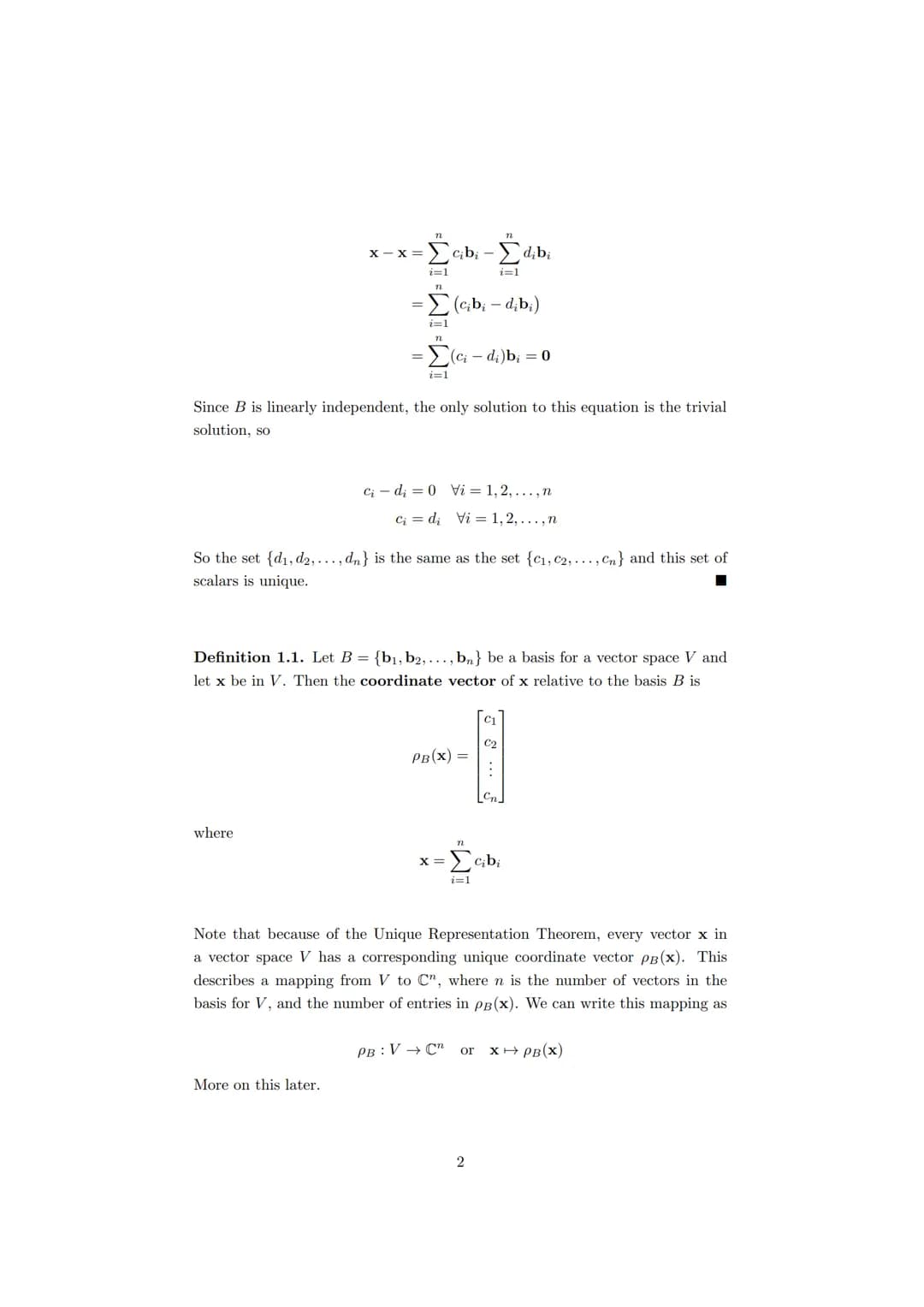
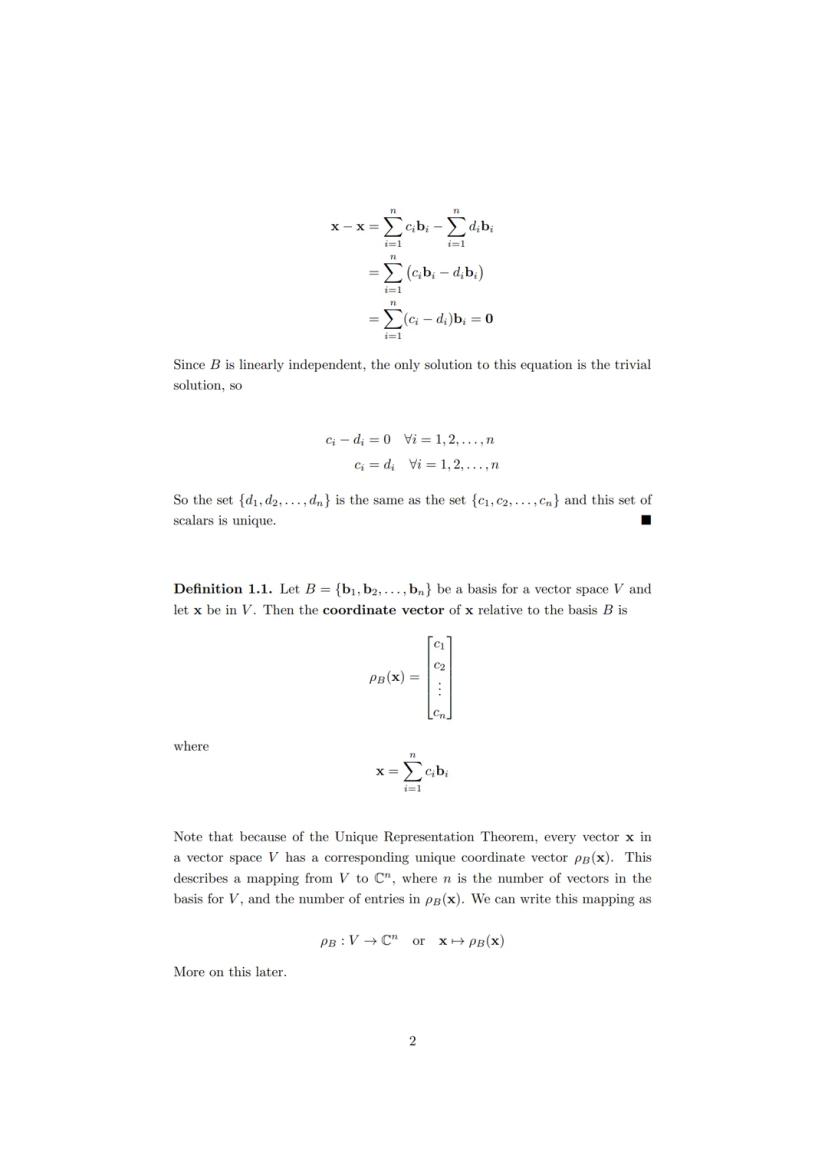
Coordinate vectors give us a way to translate abstract vectors into concrete numerical form. Given a basis B = {b₁, b₂, ..., bₙ} for a vector space V, the coordinate vector of x relative to B is:

ρᵦ(x) = c1,c2,...,cnc₁, c₂, ..., cₙ

Where the cᵢ values are the unique coefficients that satisfy x = c₁b₁ + c₂b₂ + ... + cₙbₙ. This creates a mapping from your vector space V to Cⁿ thespaceofndimensionalcomplexvectorsthe space of n-dimensional complex vectors.

Think of coordinate vectors like GPS coordinates - they tell you exactly where a vector is located relative to your chosen basis. Every vector in your space gets mapped to exactly one coordinate vector.

This mapping ρᵦ: V → Cⁿ will prove extremely useful, as we'll soon see it preserves all the important structural relationships between vectors.

1 Coordinates
Coordinate Vectors
Theorem 1.1. Unique Representation Threorem
If
B = {b₁,b2,..., bn}
is a basis for a vector space V, then an

Coordinates in C^n

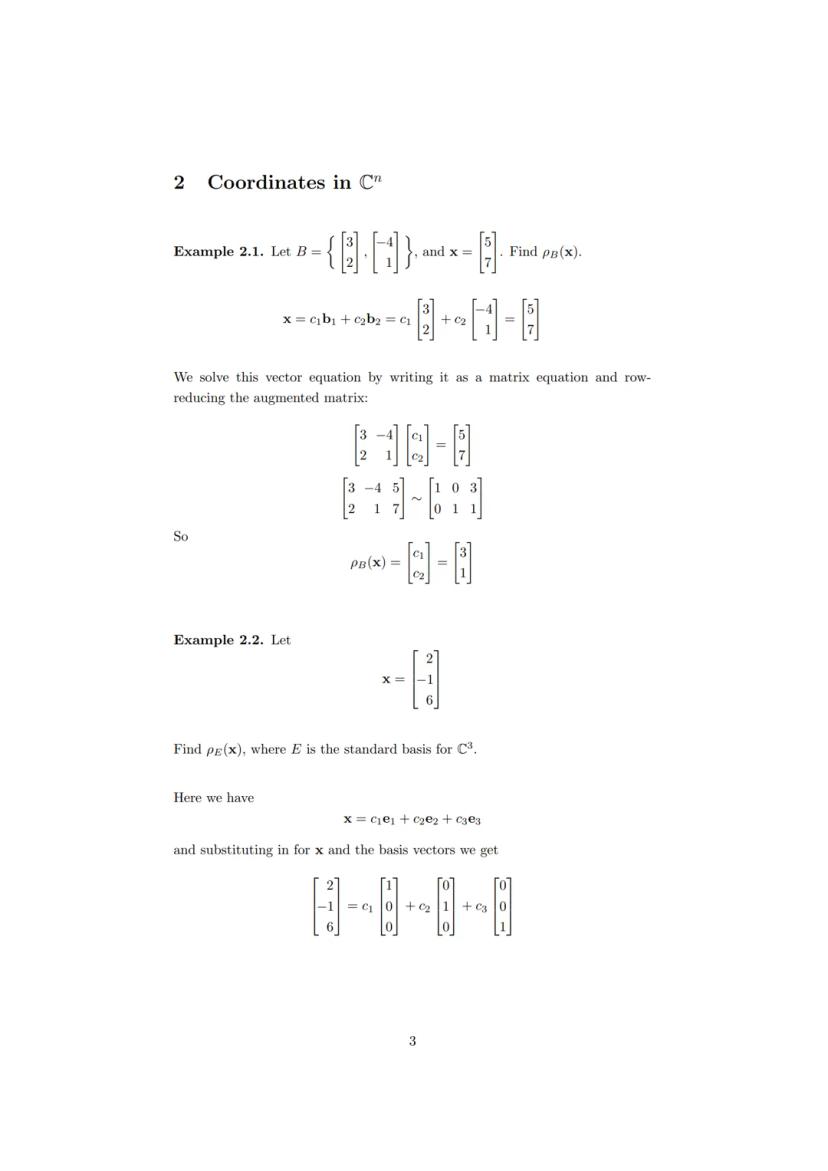
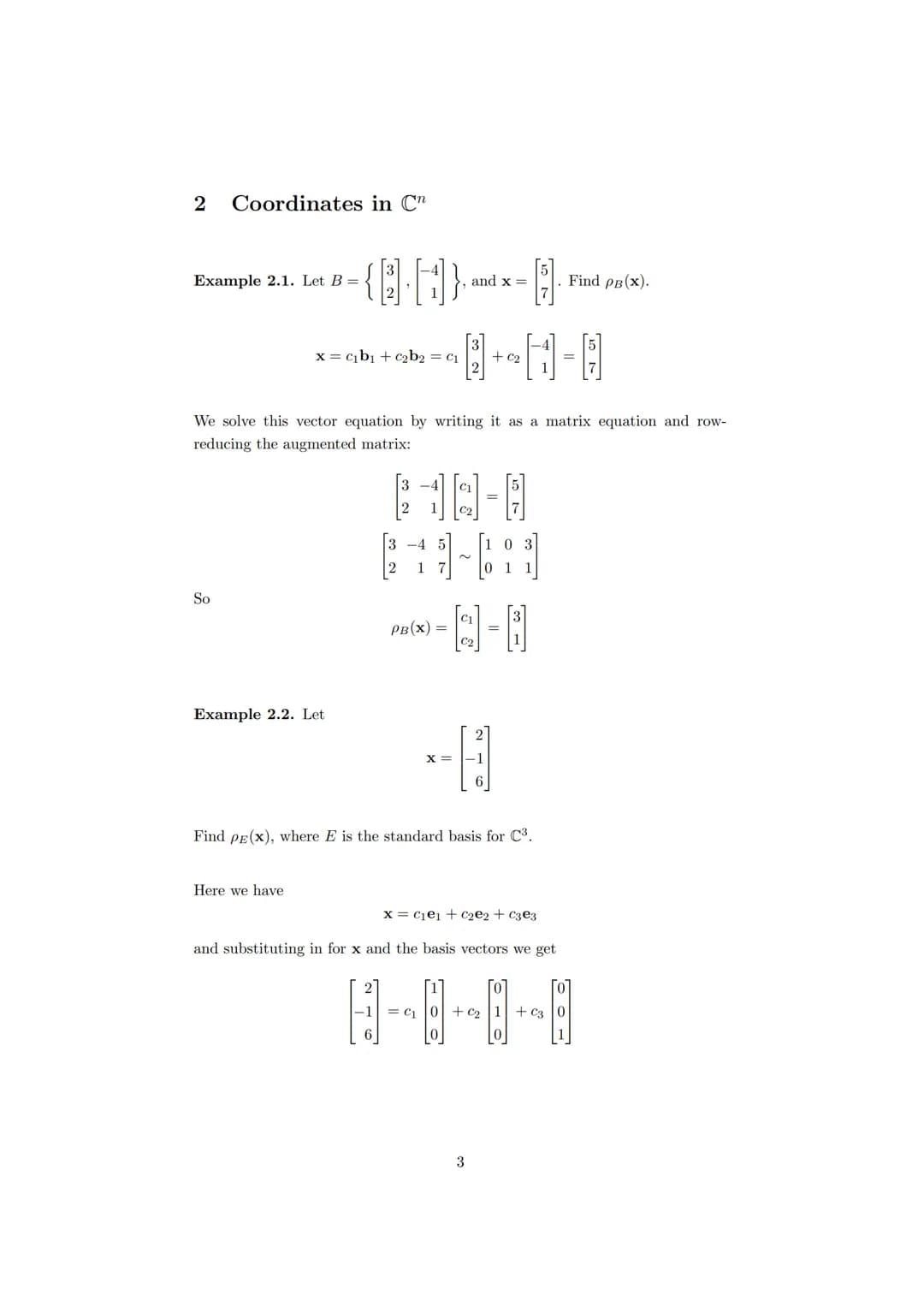
Let's see coordinate vectors in action with some concrete examples in C². Suppose we have a basis B = {3,23,2ᵀ, 4,1-4,1ᵀ} and we want to find the coordinate vector for x = 5,75,7ᵀ.

To find the coordinates, we need to solve: c₁3,23,2ᵀ + c₂4,1-4,1ᵀ = 5,75,7ᵀ This gives us a system of equations:

  • 3c₁ - 4c₂ = 5
  • 2c₁ + c₂ = 7

We can solve this by row-reducing the augmented matrix and find that c₁ = 3 and c₂ = 1. Therefore, ρᵦ(x) = 3,13,1ᵀ.

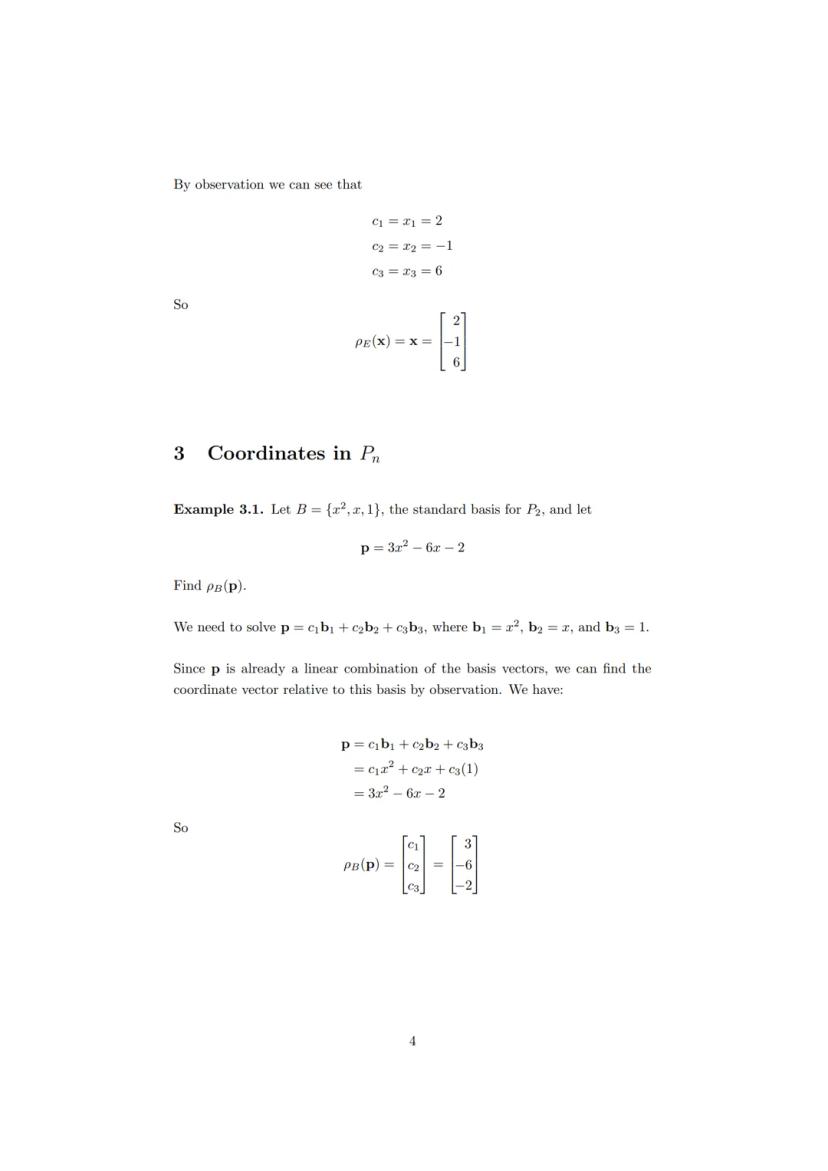
When working with the standard basis E like[1,0,0]T,[0,1,0]T,[0,0,1]TforC3like {[1,0,0]ᵀ, [0,1,0]ᵀ, [0,0,1]ᵀ} for C³, finding coordinate vectors becomes much simpler. For any vector x = 2,1,62,-1,6ᵀ, its coordinate vector relative to the standard basis is simply ρₑ(x) = x itself! This is because the standard basis vectors each "pick out" exactly one component of your vector.

Remember: The standard basis makes coordinate vectors super easy to find, but other bases require solving systems of equations.

1 Coordinates
Coordinate Vectors
Theorem 1.1. Unique Representation Threorem
If
B = {b₁,b2,..., bn}
is a basis for a vector space V, then an

Coordinates in Polynomial Spaces

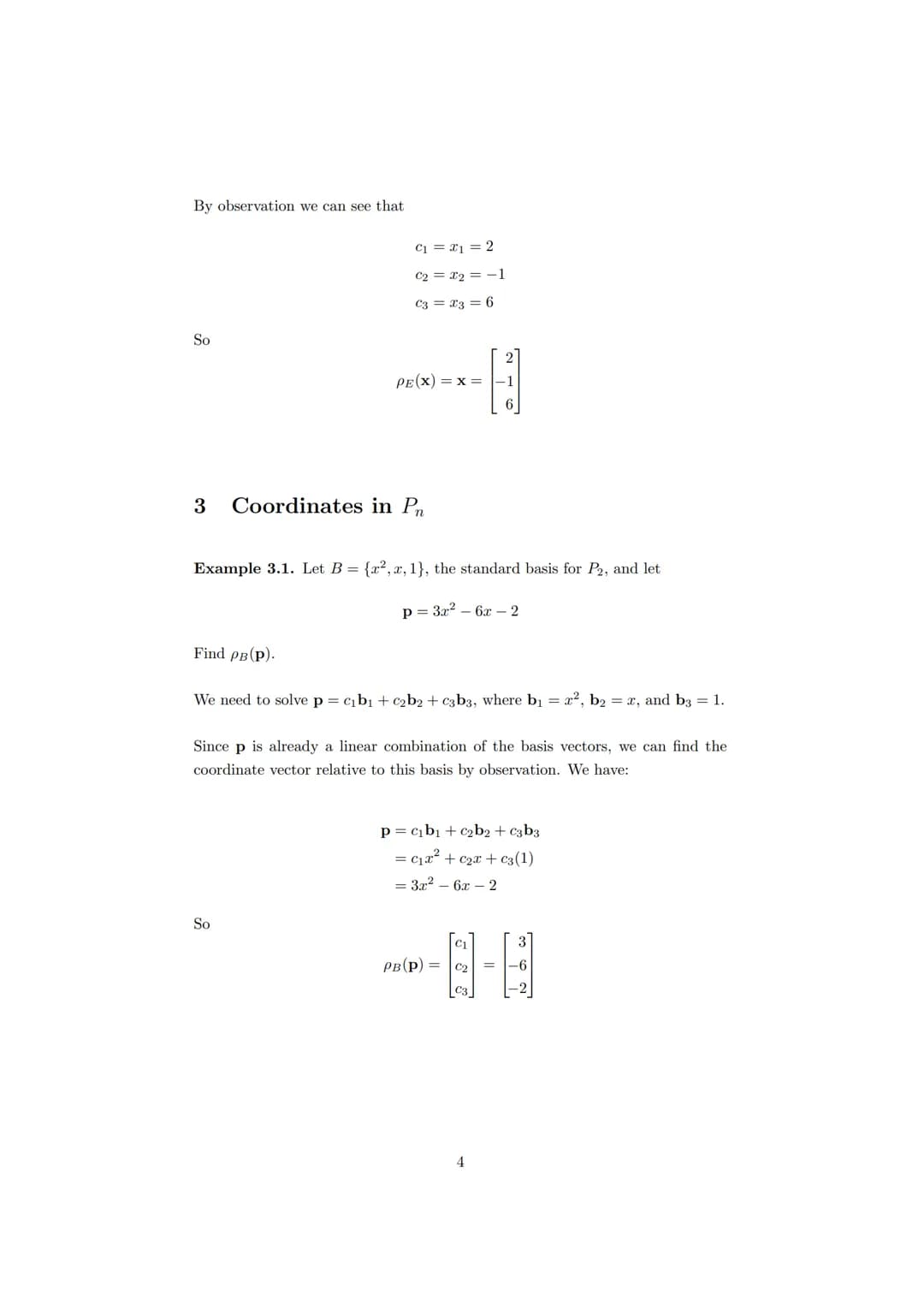
The concept of coordinate vectors extends beautifully to polynomial spaces too. For instance, in the polynomial space P₂ (polynomials of degree ≤ 2), we can work with the standard basis B = {x², x, 1}.

When we have a polynomial like p = 3x² - 6x - 2, finding its coordinate vector relative to the standard basis is straightforward. We just identify the coefficients:

  • Coefficient of x² is 3
  • Coefficient of x is -6
  • Coefficient of 1 is -2

So ρᵦ(p) = 3,6,23, -6, -2ᵀ.

The standard basis for polynomials makes finding coordinate vectors almost effortless - we simply read off the coefficients from the polynomial. This convenience is similar to what we saw with the standard basis in C^n.

Working with coordinate vectors in polynomial spaces allows us to translate polynomial operations into matrix and vector operations, which can often be more computationally efficient.

1 Coordinates
Coordinate Vectors
Theorem 1.1. Unique Representation Threorem
If
B = {b₁,b2,..., bn}
is a basis for a vector space V, then an

Non-Standard Bases in Polynomial Spaces

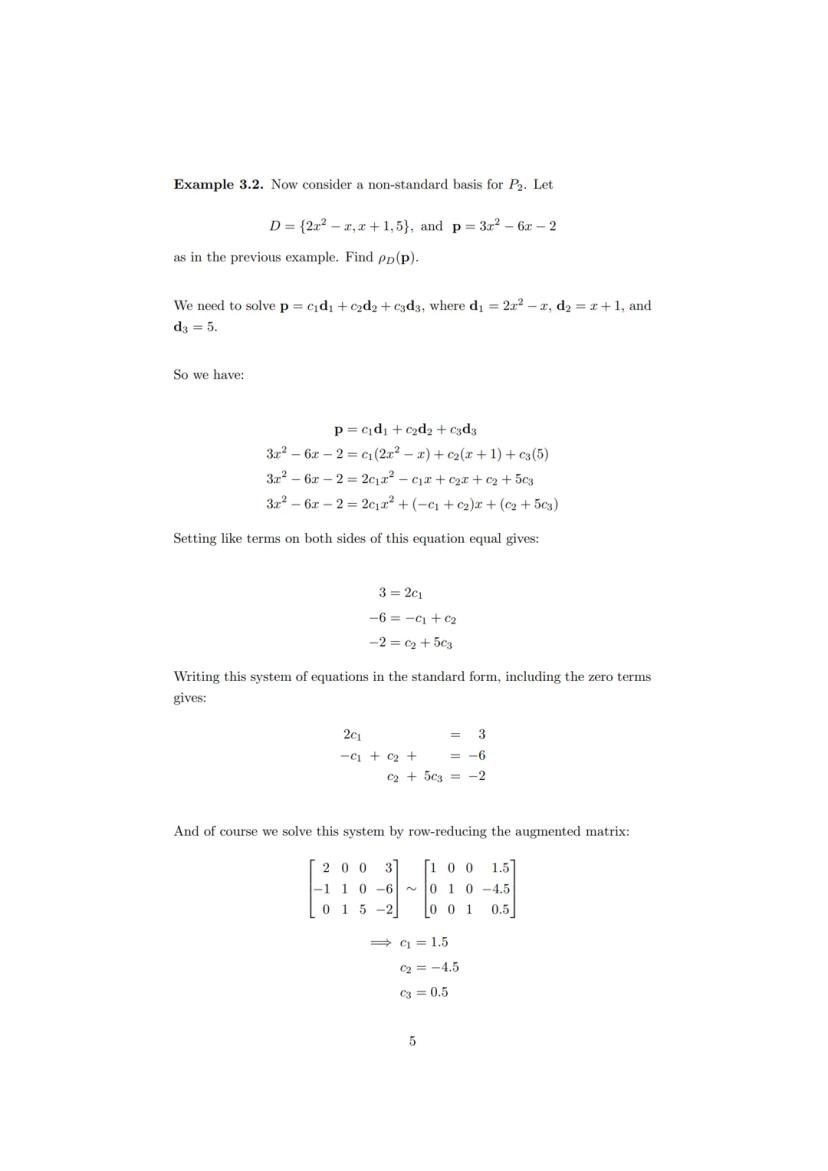
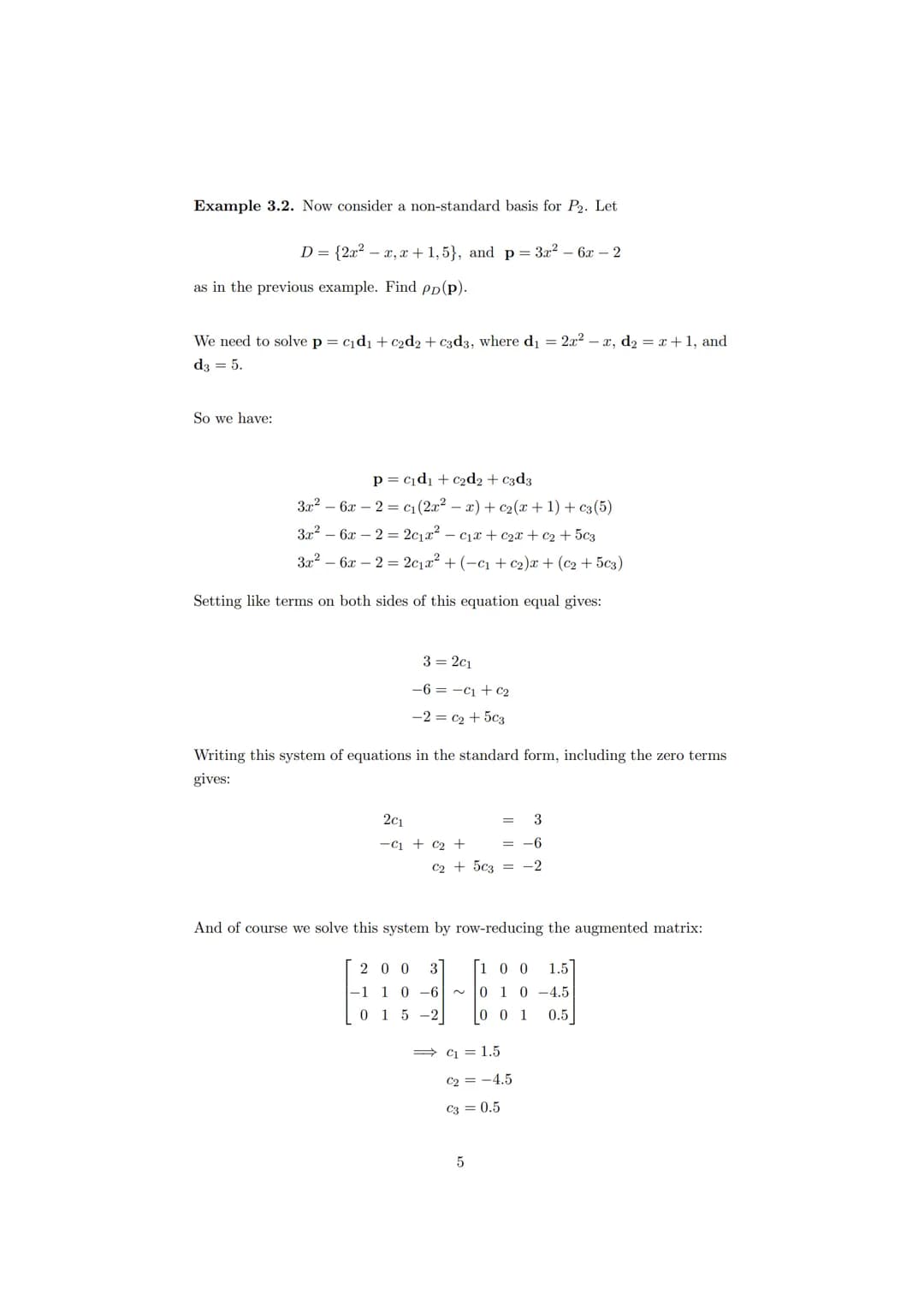
What happens when we work with a non-standard basis in P₂? Let's see with basis D = {2x² - x, x + 1, 5} and the same polynomial p = 3x² - 6x - 2.

To find ρᵈ(p), we need to solve for coefficients c₁, c₂, and c₃ such that: p = c₁2x2x2x² - x + c₂x+1x + 1 + c₃(5)

Expanding this equation: 3x² - 6x - 2 = 2c₁x² - c₁x + c₂x + c₂ + 5c₃ 3x² - 6x - 2 = 2c₁x² + c1+c2-c₁ + c₂x + c2+5c3c₂ + 5c₃

Matching coefficients gives us three equations:

  • 3 = 2c₁
  • -6 = -c₁ + c₂
  • -2 = c₂ + 5c₃

Solving this system yields c₁ = 1.5, c₂ = -4.5, and c₃ = 0.5.

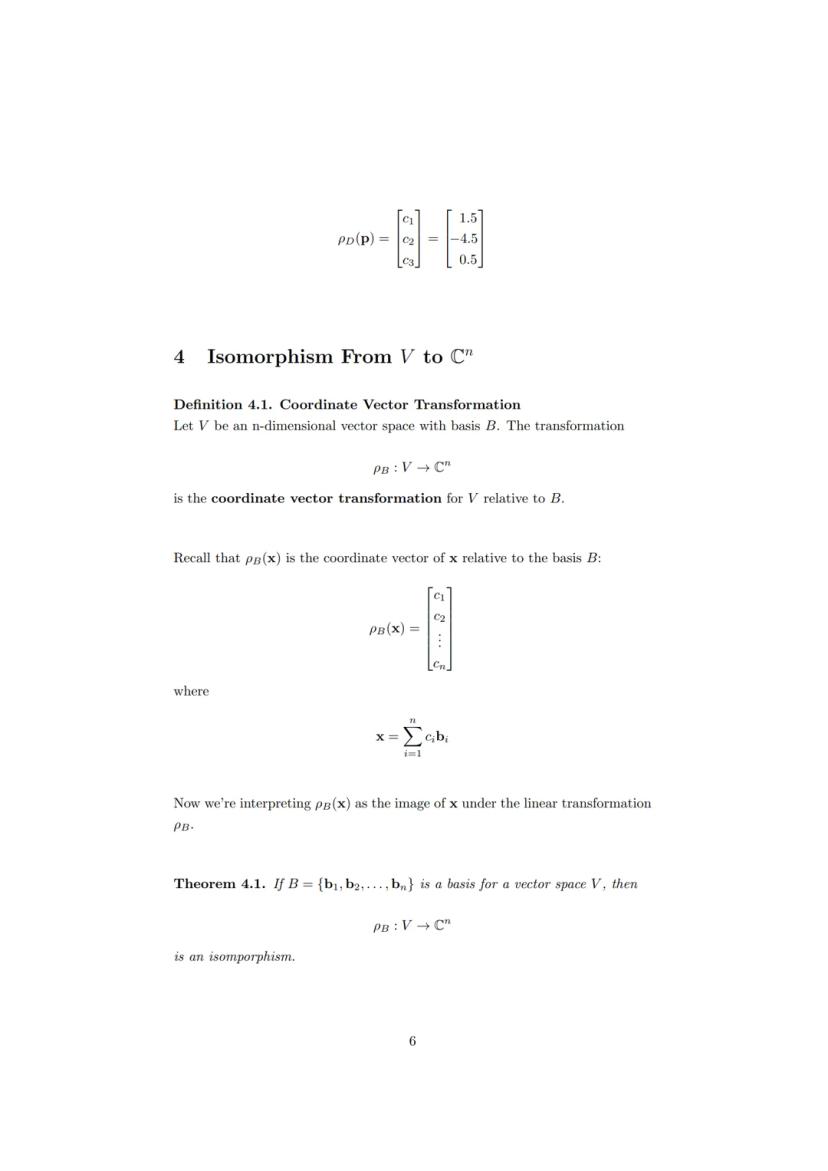
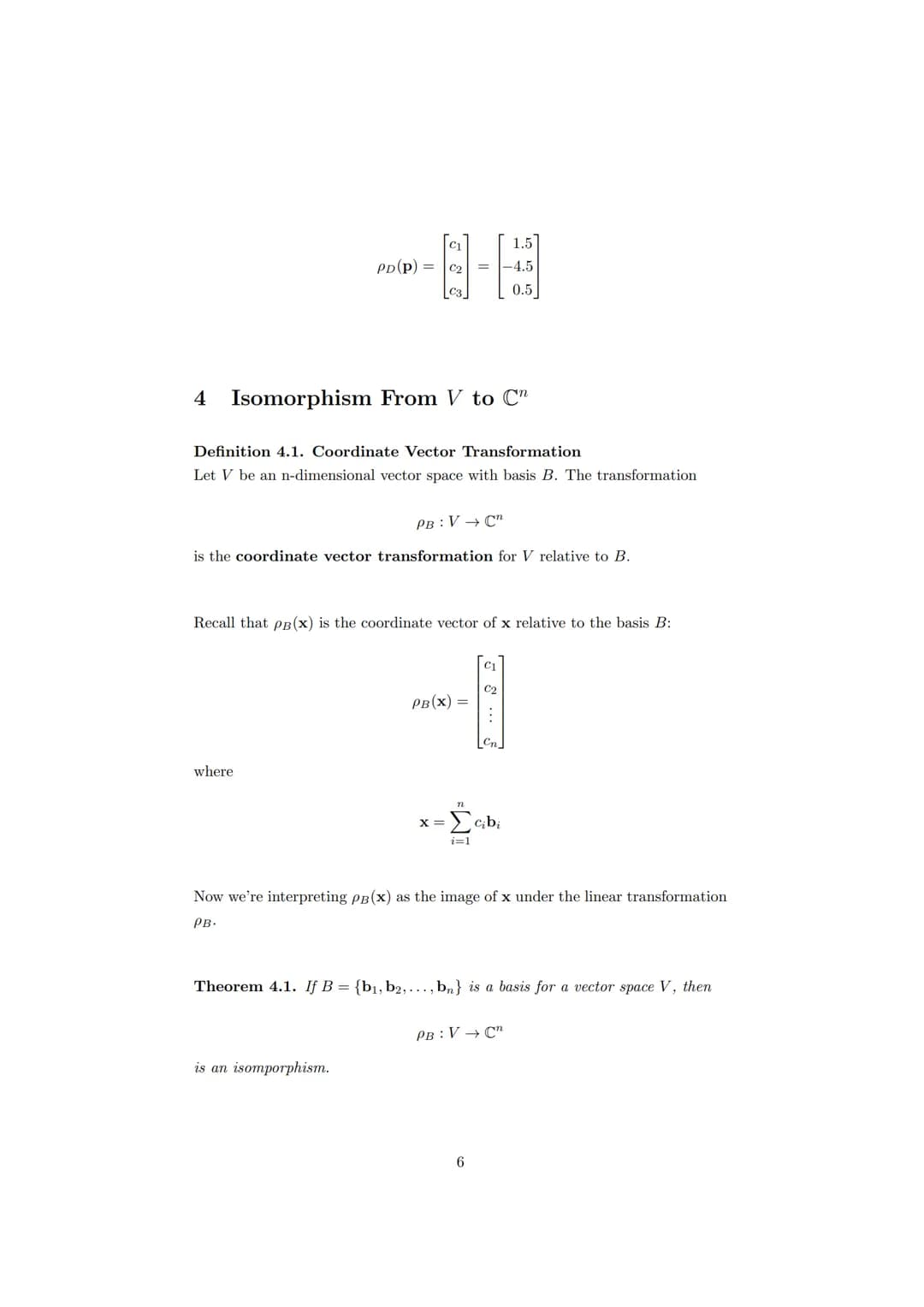
Therefore, ρᵈ(p) = 1.5,4.5,0.51.5, -4.5, 0.5ᵀ.

Pro Tip: When working with a non-standard basis, organize your equations by matching coefficients of like terms. This creates a cleaner system to solve.

Notice how our coordinate vector completely changed even though we're representing the same polynomial! The coordinate vector always depends on which basis you're using.

1 Coordinates
Coordinate Vectors
Theorem 1.1. Unique Representation Threorem
If
B = {b₁,b2,..., bn}
is a basis for a vector space V, then an

Coordinate Vector Transformation

We can formalize the mapping between a vector space and its coordinate representation as a transformation. The coordinate vector transformation ρᵦ: V → C^n takes any vector x in V and outputs its coordinate vector relative to basis B.

This transformation is more than just a convenient way to represent vectors - it has special properties that make it particularly valuable in linear algebra. It creates a bridge between abstract vector spaces and the concrete world of matrices and vectors in C^n.

The most important property is that ρᵦ is an isomorphism. This means it's a one-to-one and onto linear transformation that preserves all the structural relationships between vectors.

Think of an isomorphism like a perfect translation between languages - nothing gets lost in translation, and the meaning and relationships between words are perfectly preserved. Similarly, coordinate vector transformations preserve all the important vector relationships.

This connection allows us to translate problems in abstract vector spaces into equivalent problems in C^n, which are often easier to solve using computational techniques.

1 Coordinates
Coordinate Vectors
Theorem 1.1. Unique Representation Threorem
If
B = {b₁,b2,..., bn}
is a basis for a vector space V, then an

Isomorphism Properties

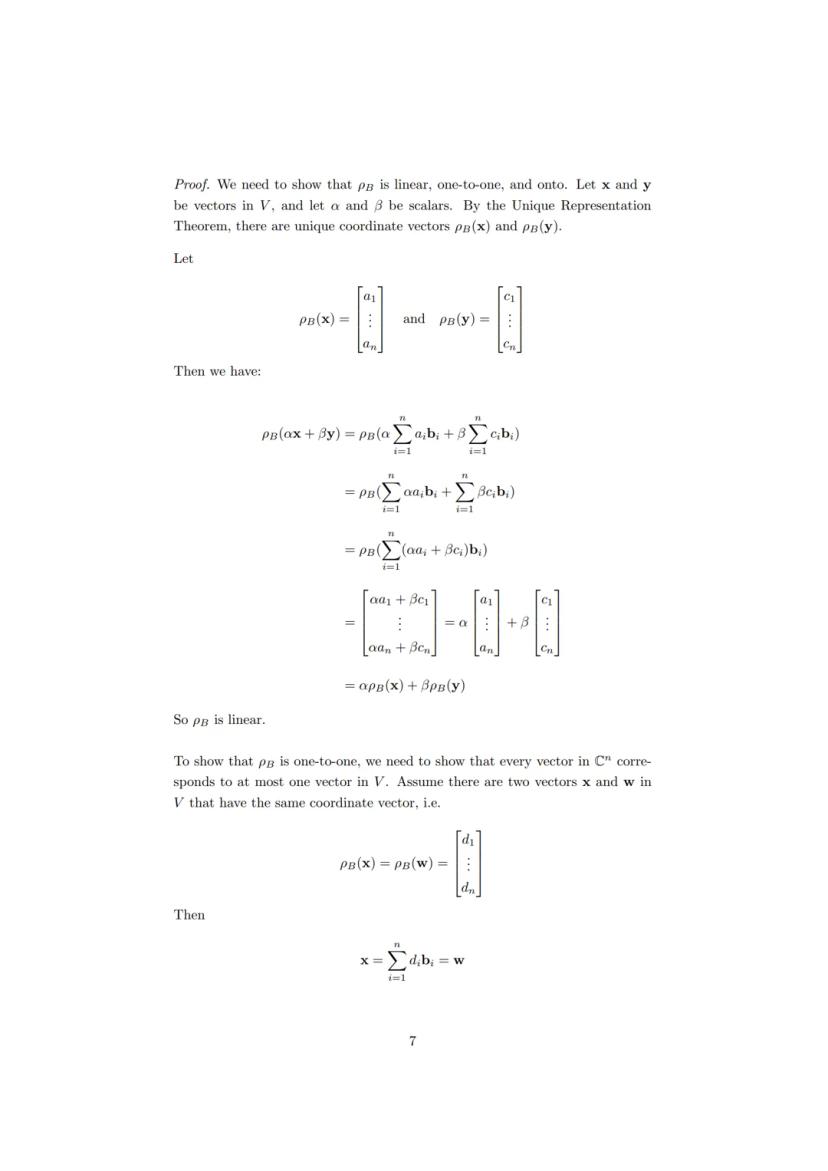
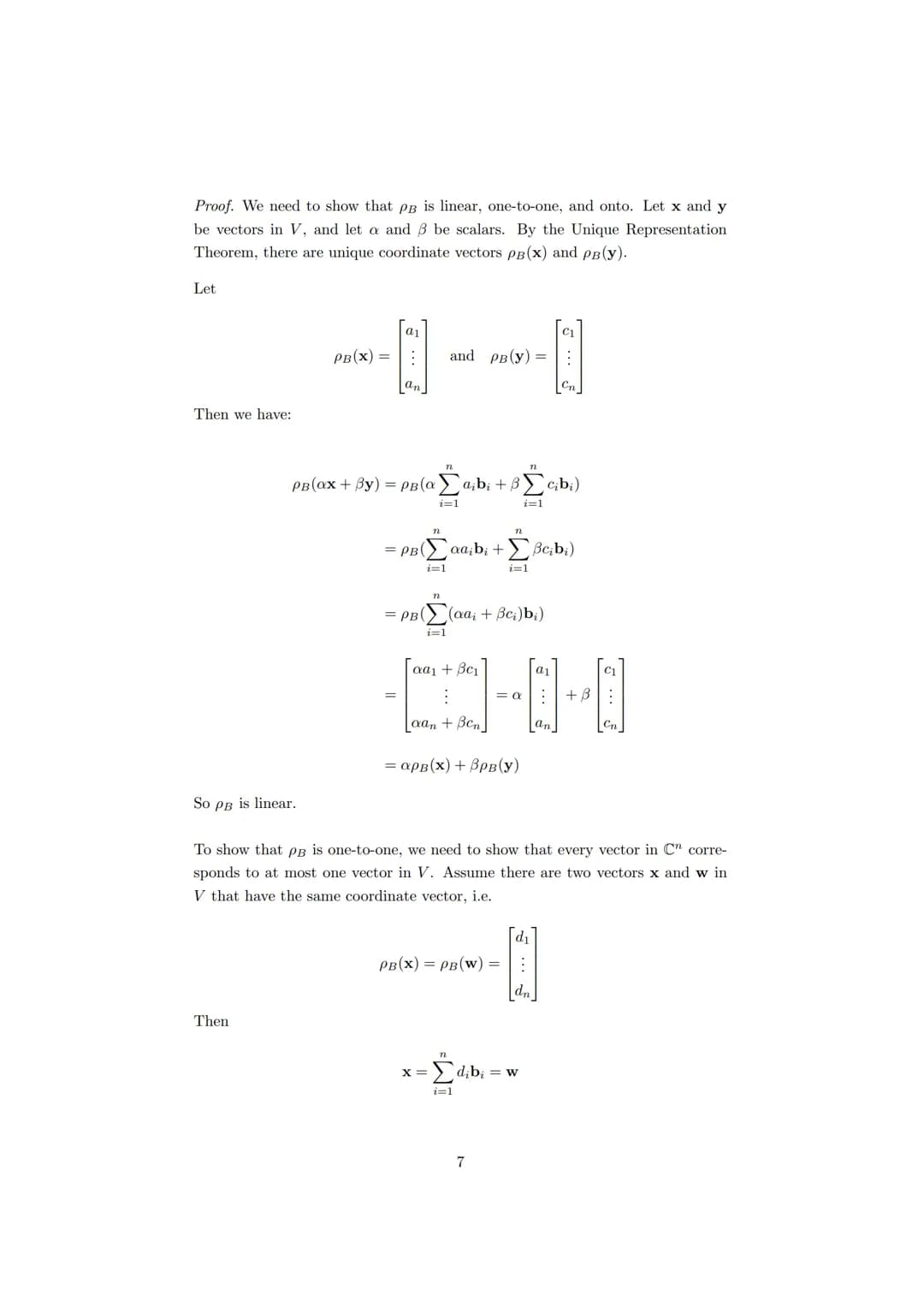
The coordinate transformation ρᵦ is an isomorphism between V and C^n, which has three crucial properties:

  1. Linearity: For any vectors x, y in V and scalars α, β: ρᵦαx+βyαx + βy = αρᵦ(x) + βρᵦ(y)

    This means the transformation preserves all linear combinations.

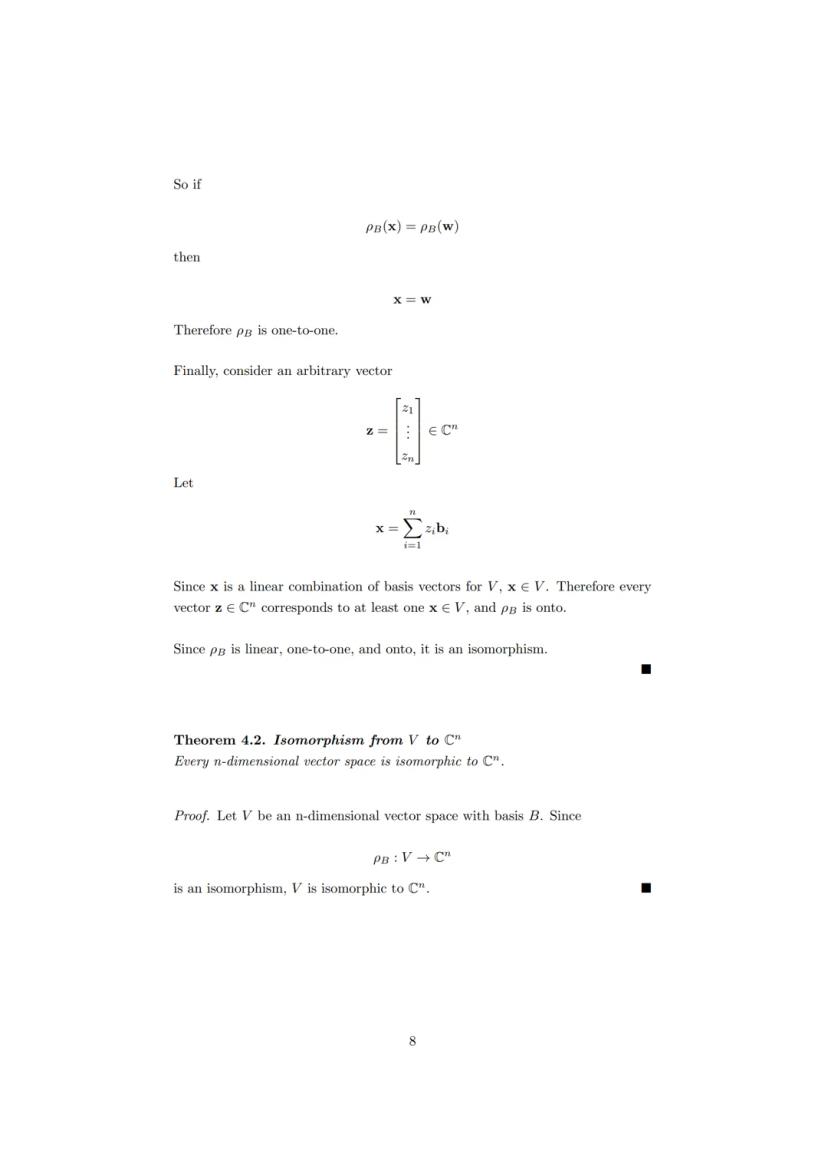
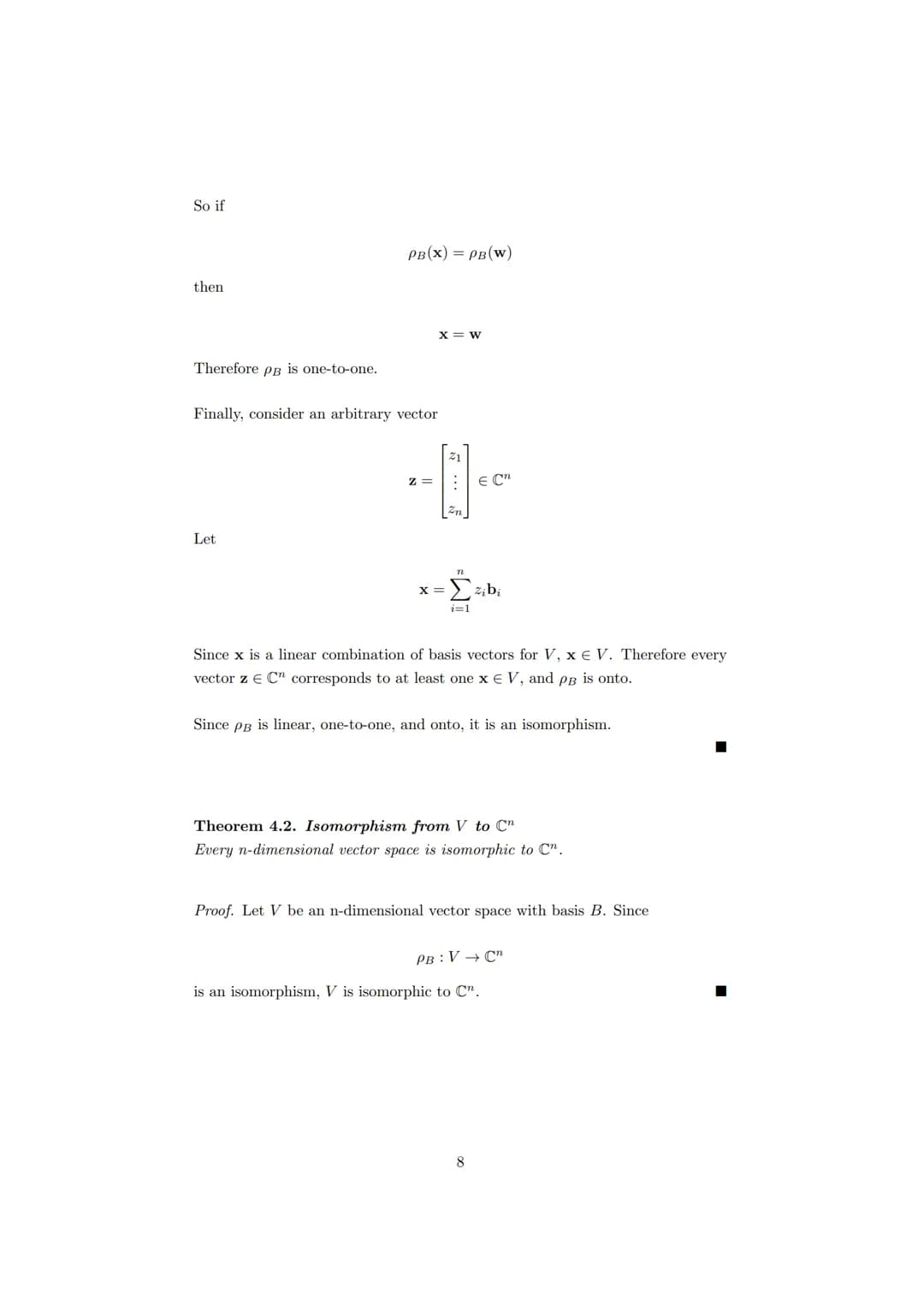
  2. One-to-one: Different vectors in V always map to different coordinate vectors in C^n. If ρᵦ(x) = ρᵦ(w), then x must equal w.

  3. Onto: Every vector in C^n corresponds to some vector in V. This means the transformation covers the entire target space.

These properties ensure that when we translate a problem from V to C^n using coordinate vectors, we don't lose any information or create ambiguities. Every vector relationship in V has an exact counterpart in C^n.

Helpful Insight: The isomorphism between V and C^n is why we can often solve problems about abstract vector spaces by working with matrices instead - they're just different perspectives on the same mathematical structure!

This powerful connection means we can use the computational tools of matrices to solve problems in any n-dimensional vector space.

1 Coordinates
Coordinate Vectors
Theorem 1.1. Unique Representation Threorem
If
B = {b₁,b2,..., bn}
is a basis for a vector space V, then an

Isomorphism to C^n

A remarkable result of the coordinate vector transformation is that every n-dimensional vector space is isomorphic to C^n. This means that, structurally speaking, all n-dimensional vector spaces are essentially the same!

Whether you're working with polynomials, matrices, functions, or other vector spaces, as long as they have dimension n, they're structurally equivalent to C^n. This is incredibly powerful because it means techniques that work in C^n can be applied to any n-dimensional vector space.

The proof is straightforward: since ρᵦ: V → C^n is an isomorphism for any basis B, every n-dimensional vector space V is isomorphic to C^n.

This theorem gives us a unified approach to all vector spaces of the same dimension. It's like discovering that despite different appearances, all these mathematical spaces follow the same underlying rules.

Think of it as learning that despite different alphabets and vocabularies, all human languages share fundamental grammatical structures. Once you understand these structures, you can more easily work across different languages.

1 Coordinates
Coordinate Vectors
Theorem 1.1. Unique Representation Threorem
If
B = {b₁,b2,..., bn}
is a basis for a vector space V, then an

Preservation of Vector Relationships

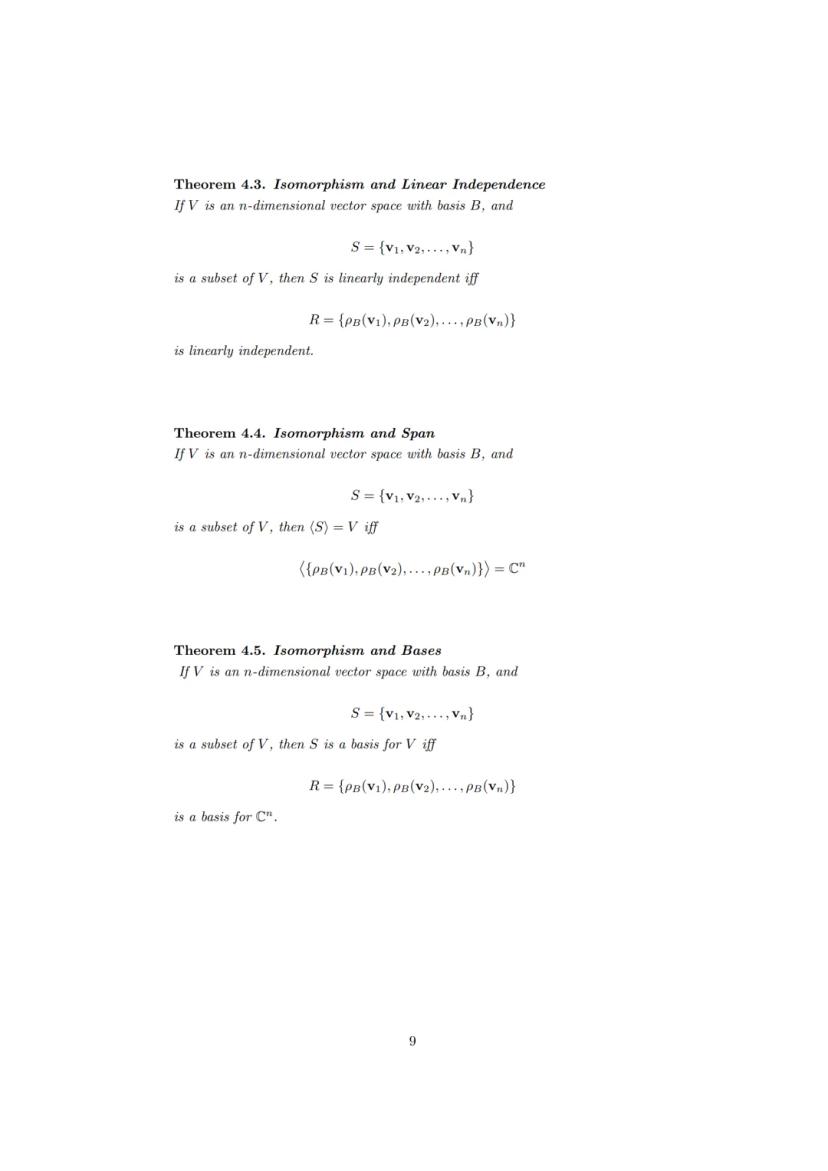
One of the most powerful aspects of the isomorphism between V and C^n is that it preserves key vector relationships. Three important theorems highlight this:

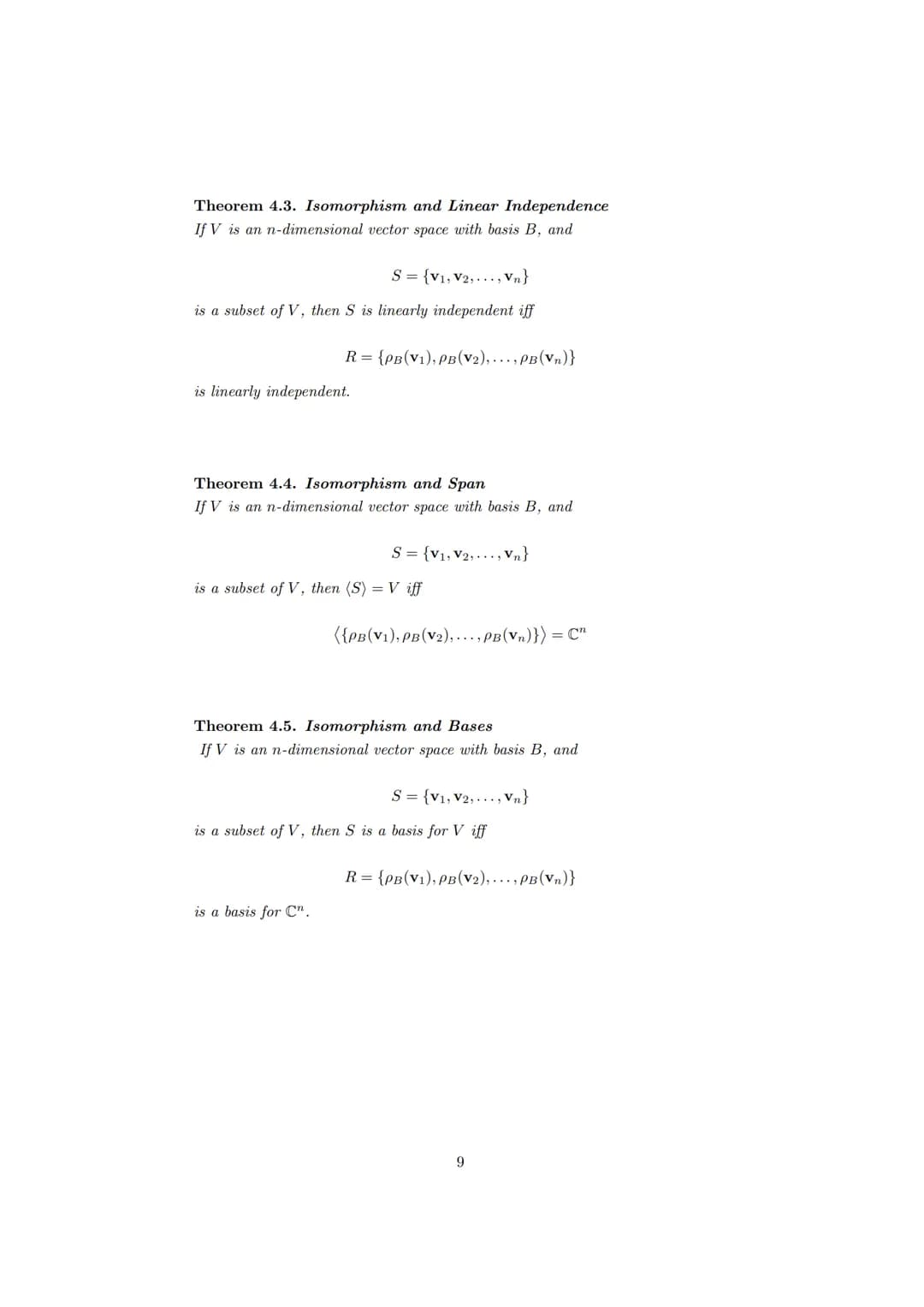
  1. Linear Independence: A set of vectors {v₁, v₂, ..., vₙ} in V is linearly independent if and only if their coordinate vectors {ρᵦ(v₁), ρᵦ(v₂), ..., ρᵦ(vₙ)} are linearly independent in C^n.

  2. Span: A set of vectors spans V if and only if their coordinate vectors span C^n. This means {v₁, v₂, ..., vₙ} generates all of V precisely when {ρᵦ(v₁), ρᵦ(v₂), ..., ρᵦ(vₙ)} generates all of C^n.

  3. Basis: A set S = {v₁, v₂, ..., vₙ} is a basis for V if and only if their coordinate vectors form a basis for C^n.

These theorems are extremely practical. They mean we can translate questions about linear independence, span, and bases in abstract vector spaces into equivalent questions about coordinate vectors, which are often easier to answer using computational methods like row reduction.

Application Tip: To check if vectors form a basis in any vector space, convert them to coordinate vectors and use matrix techniques like determinants or row reduction!

1 Coordinates
Coordinate Vectors
Theorem 1.1. Unique Representation Threorem
If
B = {b₁,b2,..., bn}
is a basis for a vector space V, then an

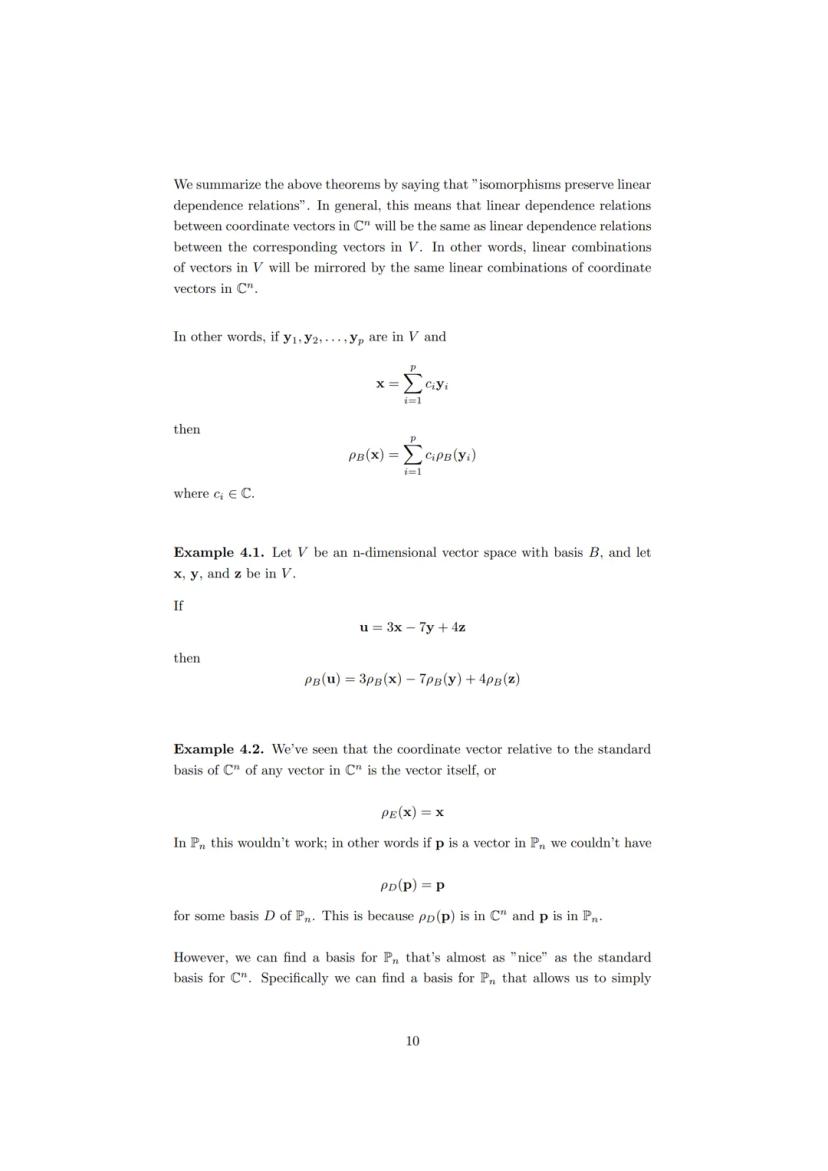
Preservation of Linear Combinations

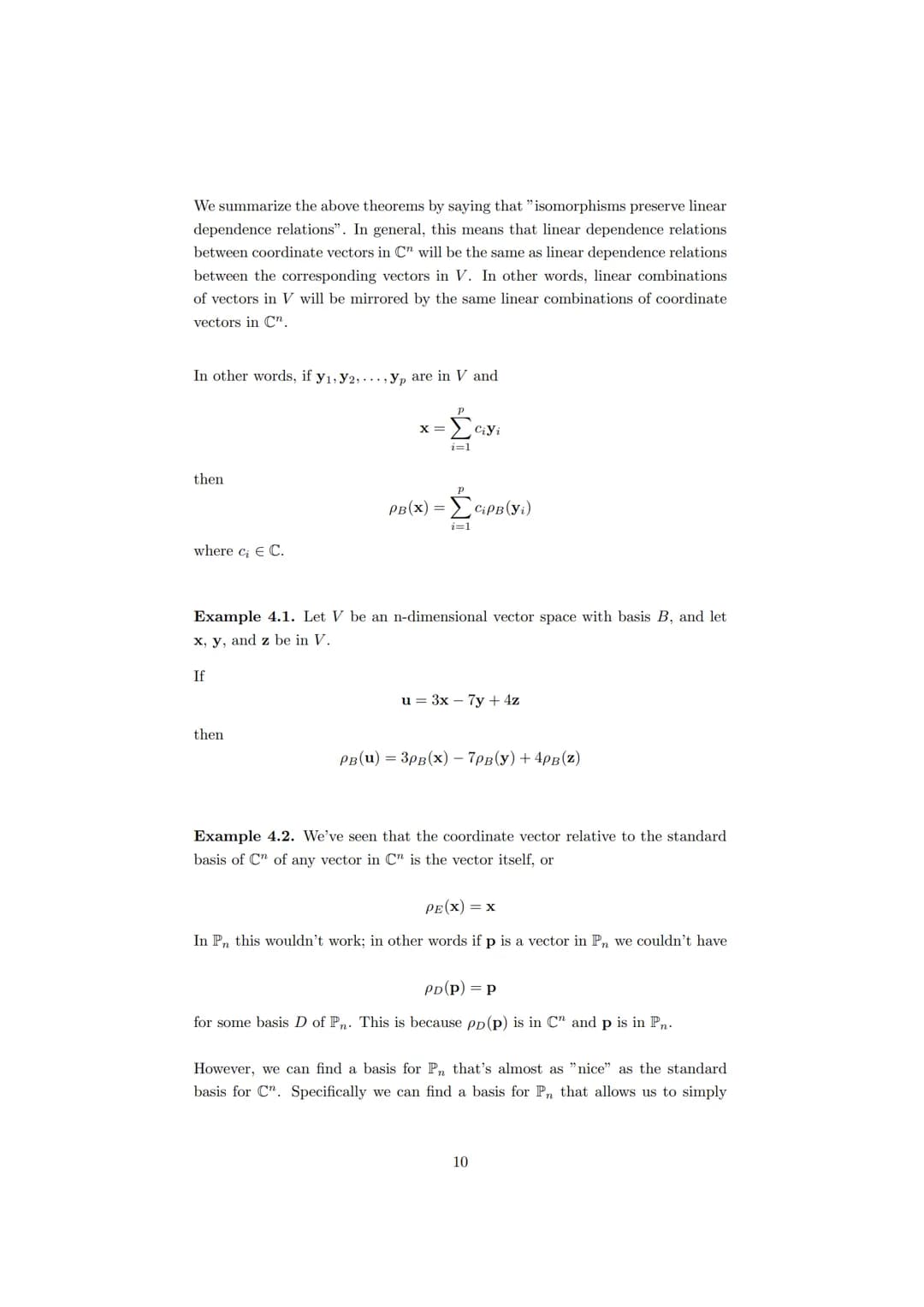
The coordinate vector transformation preserves all linear combinations. In simple terms, if you have a linear combination of vectors in V, the coordinate vector of that combination equals the same linear combination of the coordinate vectors.

For example, if u = 3x - 7y + 4z in vector space V, then: ρᵦ(u) = 3ρᵦ(x) - 7ρᵦ(y) + 4ρᵦ(z)

This property makes coordinate vectors incredibly useful for calculations. You can work with the concrete numbers in C^n rather than with abstract vectors, and the results will correspond perfectly.

The standard basis for C^n has a special property: for any vector x in C^n, ρₑ(x) = x. This means a vector is its own coordinate vector relative to the standard basis - no calculation needed!

Similarly, for polynomials in Pₙ, the standard basis D = {1, x, x², ..., x^n} lets us easily identify coordinate vectors. For a polynomial p(x) = a₀ + a₁x + ... + aₙx^n, its coordinate vector is simply ρᵈ(p) = a0,a1,...,ana₀, a₁, ..., aₙᵀ. This "easy reading" property is what makes standard bases so convenient to work with.

Remember: Standard bases are chosen specifically because they make finding coordinate vectors as simple as possible!


We thought you’d never ask...

What is the Knowunity AI companion?

Our AI companion is specifically built for the needs of students. Based on the millions of content pieces we have on the platform we can provide truly meaningful and relevant answers to students. But its not only about answers, the companion is even more about guiding students through their daily learning challenges, with personalised study plans, quizzes or content pieces in the chat and 100% personalisation based on the students skills and developments.

Where can I download the Knowunity app?

You can download the app in the Google Play Store and in the Apple App Store.

Is Knowunity really free of charge?

That's right! Enjoy free access to study content, connect with fellow students, and get instant help – all at your fingertips.

Can't find what you're looking for? Explore other subjects.

Students love us — and so will you.

4.9/5

App Store

4.8/5

Google Play

The app is very easy to use and well designed. I have found everything I was looking for so far and have been able to learn a lot from the presentations! I will definitely use the app for a class assignment! And of course it also helps a lot as an inspiration.

Stefan S

iOS user

This app is really great. There are so many study notes and help [...]. My problem subject is French, for example, and the app has so many options for help. Thanks to this app, I have improved my French. I would recommend it to anyone.

Samantha Klich

Android user

Wow, I am really amazed. I just tried the app because I've seen it advertised many times and was absolutely stunned. This app is THE HELP you want for school and above all, it offers so many things, such as workouts and fact sheets, which have been VERY helpful to me personally.

Anna

iOS user

I think it’s very much worth it and you’ll end up using it a lot once you get the hang of it and even after looking at others notes you can still ask your Artificial intelligence buddy the question and ask to simplify it if you still don’t get it!!! In the end I think it’s worth it 😊👍 ⚠️Also DID I MENTION ITS FREEE YOU DON’T HAVE TO PAY FOR ANYTHING AND STILL GET YOUR GRADES IN PERFECTLY❗️❗️⚠️

Thomas R

iOS user

Knowunity is the BEST app I’ve used in a minute. This is not an ai review or anything this is genuinely coming from a 7th grade student (I know 2011 im young) but dude this app is a 10/10 i have maintained a 3.8 gpa and have plenty of time for gaming. I love it and my mom is just happy I got good grades

Brad T

Android user

Not only did it help me find the answer but it also showed me alternative ways to solve it. I was horrible in math and science but now I have an a in both subjects. Thanks for the help🤍🤍

David K

iOS user

The app's just great! All I have to do is enter the topic in the search bar and I get the response real fast. I don't have to watch 10 YouTube videos to understand something, so I'm saving my time. Highly recommended!

Sudenaz Ocak

Android user

In school I was really bad at maths but thanks to the app, I am doing better now. I am so grateful that you made the app.

Greenlight Bonnie

Android user

I found this app a couple years ago and it has only gotten better since then. I really love it because it can help with written questions and photo questions. Also, it can find study guides that other people have made as well as flashcard sets and practice tests. The free version is also amazing for students who might not be able to afford it. Would 100% recommend

Aubrey

iOS user

Best app if you're in Highschool or Junior high. I have been using this app for 2 school years and it's the best, it's good if you don't have anyone to help you with school work.😋🩷🎀

Marco B

iOS user

THE QUIZES AND FLASHCARDS ARE SO USEFUL AND I LOVE THE SCHOOLGPT. IT ALSO IS LITREALLY LIKE CHATGPT BUT SMARTER!! HELPED ME WITH MY MASCARA PROBLEMS TOO!! AS WELL AS MY REAL SUBJECTS ! DUHHH 😍😁😲🤑💗✨🎀😮

Elisha

iOS user

This app is phenomenal down to the correct info and the various topics you can study! I greatly recommend it for people who struggle with procrastination and those who need homework help. It has been perfectly accurate for world 1 history as far as I’ve seen! Geometry too!

Paul T

iOS user

The app is very easy to use and well designed. I have found everything I was looking for so far and have been able to learn a lot from the presentations! I will definitely use the app for a class assignment! And of course it also helps a lot as an inspiration.

Stefan S

iOS user

This app is really great. There are so many study notes and help [...]. My problem subject is French, for example, and the app has so many options for help. Thanks to this app, I have improved my French. I would recommend it to anyone.

Samantha Klich

Android user

Wow, I am really amazed. I just tried the app because I've seen it advertised many times and was absolutely stunned. This app is THE HELP you want for school and above all, it offers so many things, such as workouts and fact sheets, which have been VERY helpful to me personally.

Anna

iOS user

I think it’s very much worth it and you’ll end up using it a lot once you get the hang of it and even after looking at others notes you can still ask your Artificial intelligence buddy the question and ask to simplify it if you still don’t get it!!! In the end I think it’s worth it 😊👍 ⚠️Also DID I MENTION ITS FREEE YOU DON’T HAVE TO PAY FOR ANYTHING AND STILL GET YOUR GRADES IN PERFECTLY❗️❗️⚠️

Thomas R

iOS user

Knowunity is the BEST app I’ve used in a minute. This is not an ai review or anything this is genuinely coming from a 7th grade student (I know 2011 im young) but dude this app is a 10/10 i have maintained a 3.8 gpa and have plenty of time for gaming. I love it and my mom is just happy I got good grades

Brad T

Android user

Not only did it help me find the answer but it also showed me alternative ways to solve it. I was horrible in math and science but now I have an a in both subjects. Thanks for the help🤍🤍

David K

iOS user

The app's just great! All I have to do is enter the topic in the search bar and I get the response real fast. I don't have to watch 10 YouTube videos to understand something, so I'm saving my time. Highly recommended!

Sudenaz Ocak

Android user

In school I was really bad at maths but thanks to the app, I am doing better now. I am so grateful that you made the app.

Greenlight Bonnie

Android user

I found this app a couple years ago and it has only gotten better since then. I really love it because it can help with written questions and photo questions. Also, it can find study guides that other people have made as well as flashcard sets and practice tests. The free version is also amazing for students who might not be able to afford it. Would 100% recommend

Aubrey

iOS user

Best app if you're in Highschool or Junior high. I have been using this app for 2 school years and it's the best, it's good if you don't have anyone to help you with school work.😋🩷🎀

Marco B

iOS user

THE QUIZES AND FLASHCARDS ARE SO USEFUL AND I LOVE THE SCHOOLGPT. IT ALSO IS LITREALLY LIKE CHATGPT BUT SMARTER!! HELPED ME WITH MY MASCARA PROBLEMS TOO!! AS WELL AS MY REAL SUBJECTS ! DUHHH 😍😁😲🤑💗✨🎀😮

Elisha

iOS user

This app is phenomenal down to the correct info and the various topics you can study! I greatly recommend it for people who struggle with procrastination and those who need homework help. It has been perfectly accurate for world 1 history as far as I’ve seen! Geometry too!

Paul T

iOS user


Arithmetic

294

Dec 9, 2025

12 pages

Understanding Coordinate Vectors in Linear Algebra

Coordinate vectors provide a powerful way to represent abstract vectors in concrete numerical form. This concept bridges different vector spaces and is fundamental to linear algebra, allowing us to translate complex vector problems into more manageable matrix operations.

1 Coordinates
Coordinate Vectors
Theorem 1.1. Unique Representation Threorem
If
B = {b₁,b2,..., bn}
is a basis for a vector space V, then an

Sign up to see the contentIt's free!

Access to all documents

Improve your grades

Join milions of students

By signing up you accept Terms of Service and Privacy Policy

Unique Representation Theorem

Ever wondered how we can precisely describe any vector using a set of basis vectors? That's where the Unique Representation Theorem comes in!

When you have a basis B = {b₁, b₂, ..., bₙ} for a vector space V, any vector x in that space can be written as a linear combination of those basis vectors in exactly one way. This means there's a unique set of scalars {c₁, c₂, ..., cₙ} such that x = c₁b₁ + c₂b₂ + ... + cₙbₙ.

The uniqueness is what makes this powerful. If you find coefficients that work, you can be confident they're the only ones that will work. This theorem guarantees that no matter which approach you take, you'll arrive at the same answer.

Key Insight: The Unique Representation Theorem is what makes coordinate vectors possible - it ensures that every vector has exactly one representation in terms of a given basis.

1 Coordinates
Coordinate Vectors
Theorem 1.1. Unique Representation Threorem
If
B = {b₁,b2,..., bn}
is a basis for a vector space V, then an

Sign up to see the contentIt's free!

Access to all documents

Improve your grades

Join milions of students

By signing up you accept Terms of Service and Privacy Policy

Coordinate Vectors

Coordinate vectors give us a way to translate abstract vectors into concrete numerical form. Given a basis B = {b₁, b₂, ..., bₙ} for a vector space V, the coordinate vector of x relative to B is:

ρᵦ(x) = c1,c2,...,cnc₁, c₂, ..., cₙ

Where the cᵢ values are the unique coefficients that satisfy x = c₁b₁ + c₂b₂ + ... + cₙbₙ. This creates a mapping from your vector space V to Cⁿ thespaceofndimensionalcomplexvectorsthe space of n-dimensional complex vectors.

Think of coordinate vectors like GPS coordinates - they tell you exactly where a vector is located relative to your chosen basis. Every vector in your space gets mapped to exactly one coordinate vector.

This mapping ρᵦ: V → Cⁿ will prove extremely useful, as we'll soon see it preserves all the important structural relationships between vectors.

1 Coordinates
Coordinate Vectors
Theorem 1.1. Unique Representation Threorem
If
B = {b₁,b2,..., bn}
is a basis for a vector space V, then an

Sign up to see the contentIt's free!

Access to all documents

Improve your grades

Join milions of students

By signing up you accept Terms of Service and Privacy Policy

Coordinates in C^n

Let's see coordinate vectors in action with some concrete examples in C². Suppose we have a basis B = {3,23,2ᵀ, 4,1-4,1ᵀ} and we want to find the coordinate vector for x = 5,75,7ᵀ.

To find the coordinates, we need to solve: c₁3,23,2ᵀ + c₂4,1-4,1ᵀ = 5,75,7ᵀ This gives us a system of equations:

  • 3c₁ - 4c₂ = 5
  • 2c₁ + c₂ = 7

We can solve this by row-reducing the augmented matrix and find that c₁ = 3 and c₂ = 1. Therefore, ρᵦ(x) = 3,13,1ᵀ.

When working with the standard basis E like[1,0,0]T,[0,1,0]T,[0,0,1]TforC3like {[1,0,0]ᵀ, [0,1,0]ᵀ, [0,0,1]ᵀ} for C³, finding coordinate vectors becomes much simpler. For any vector x = 2,1,62,-1,6ᵀ, its coordinate vector relative to the standard basis is simply ρₑ(x) = x itself! This is because the standard basis vectors each "pick out" exactly one component of your vector.

Remember: The standard basis makes coordinate vectors super easy to find, but other bases require solving systems of equations.
1 Coordinates
Coordinate Vectors
Theorem 1.1. Unique Representation Threorem
If
B = {b₁,b2,..., bn}
is a basis for a vector space V, then an

Sign up to see the contentIt's free!

Access to all documents

Improve your grades

Join milions of students

By signing up you accept Terms of Service and Privacy Policy

Coordinates in Polynomial Spaces

The concept of coordinate vectors extends beautifully to polynomial spaces too. For instance, in the polynomial space P₂ (polynomials of degree ≤ 2), we can work with the standard basis B = {x², x, 1}.

When we have a polynomial like p = 3x² - 6x - 2, finding its coordinate vector relative to the standard basis is straightforward. We just identify the coefficients:

  • Coefficient of x² is 3
  • Coefficient of x is -6
  • Coefficient of 1 is -2

So ρᵦ(p) = 3,6,23, -6, -2ᵀ.

The standard basis for polynomials makes finding coordinate vectors almost effortless - we simply read off the coefficients from the polynomial. This convenience is similar to what we saw with the standard basis in C^n.

Working with coordinate vectors in polynomial spaces allows us to translate polynomial operations into matrix and vector operations, which can often be more computationally efficient.

1 Coordinates
Coordinate Vectors
Theorem 1.1. Unique Representation Threorem
If
B = {b₁,b2,..., bn}
is a basis for a vector space V, then an

Sign up to see the contentIt's free!

Access to all documents

Improve your grades

Join milions of students

By signing up you accept Terms of Service and Privacy Policy

Non-Standard Bases in Polynomial Spaces

What happens when we work with a non-standard basis in P₂? Let's see with basis D = {2x² - x, x + 1, 5} and the same polynomial p = 3x² - 6x - 2.

To find ρᵈ(p), we need to solve for coefficients c₁, c₂, and c₃ such that: p = c₁2x2x2x² - x + c₂x+1x + 1 + c₃(5)

Expanding this equation: 3x² - 6x - 2 = 2c₁x² - c₁x + c₂x + c₂ + 5c₃ 3x² - 6x - 2 = 2c₁x² + c1+c2-c₁ + c₂x + c2+5c3c₂ + 5c₃

Matching coefficients gives us three equations:

  • 3 = 2c₁
  • -6 = -c₁ + c₂
  • -2 = c₂ + 5c₃

Solving this system yields c₁ = 1.5, c₂ = -4.5, and c₃ = 0.5.

Therefore, ρᵈ(p) = 1.5,4.5,0.51.5, -4.5, 0.5ᵀ.

Pro Tip: When working with a non-standard basis, organize your equations by matching coefficients of like terms. This creates a cleaner system to solve.

Notice how our coordinate vector completely changed even though we're representing the same polynomial! The coordinate vector always depends on which basis you're using.

1 Coordinates
Coordinate Vectors
Theorem 1.1. Unique Representation Threorem
If
B = {b₁,b2,..., bn}
is a basis for a vector space V, then an

Sign up to see the contentIt's free!

Access to all documents

Improve your grades

Join milions of students

By signing up you accept Terms of Service and Privacy Policy

Coordinate Vector Transformation

We can formalize the mapping between a vector space and its coordinate representation as a transformation. The coordinate vector transformation ρᵦ: V → C^n takes any vector x in V and outputs its coordinate vector relative to basis B.

This transformation is more than just a convenient way to represent vectors - it has special properties that make it particularly valuable in linear algebra. It creates a bridge between abstract vector spaces and the concrete world of matrices and vectors in C^n.

The most important property is that ρᵦ is an isomorphism. This means it's a one-to-one and onto linear transformation that preserves all the structural relationships between vectors.

Think of an isomorphism like a perfect translation between languages - nothing gets lost in translation, and the meaning and relationships between words are perfectly preserved. Similarly, coordinate vector transformations preserve all the important vector relationships.

This connection allows us to translate problems in abstract vector spaces into equivalent problems in C^n, which are often easier to solve using computational techniques.

1 Coordinates
Coordinate Vectors
Theorem 1.1. Unique Representation Threorem
If
B = {b₁,b2,..., bn}
is a basis for a vector space V, then an

Sign up to see the contentIt's free!

Access to all documents

Improve your grades

Join milions of students

By signing up you accept Terms of Service and Privacy Policy

Isomorphism Properties

The coordinate transformation ρᵦ is an isomorphism between V and C^n, which has three crucial properties:

  1. Linearity: For any vectors x, y in V and scalars α, β: ρᵦαx+βyαx + βy = αρᵦ(x) + βρᵦ(y)

    This means the transformation preserves all linear combinations.

  2. One-to-one: Different vectors in V always map to different coordinate vectors in C^n. If ρᵦ(x) = ρᵦ(w), then x must equal w.

  3. Onto: Every vector in C^n corresponds to some vector in V. This means the transformation covers the entire target space.

These properties ensure that when we translate a problem from V to C^n using coordinate vectors, we don't lose any information or create ambiguities. Every vector relationship in V has an exact counterpart in C^n.

Helpful Insight: The isomorphism between V and C^n is why we can often solve problems about abstract vector spaces by working with matrices instead - they're just different perspectives on the same mathematical structure!

This powerful connection means we can use the computational tools of matrices to solve problems in any n-dimensional vector space.

1 Coordinates
Coordinate Vectors
Theorem 1.1. Unique Representation Threorem
If
B = {b₁,b2,..., bn}
is a basis for a vector space V, then an

Sign up to see the contentIt's free!

Access to all documents

Improve your grades

Join milions of students

By signing up you accept Terms of Service and Privacy Policy

Isomorphism to C^n

A remarkable result of the coordinate vector transformation is that every n-dimensional vector space is isomorphic to C^n. This means that, structurally speaking, all n-dimensional vector spaces are essentially the same!

Whether you're working with polynomials, matrices, functions, or other vector spaces, as long as they have dimension n, they're structurally equivalent to C^n. This is incredibly powerful because it means techniques that work in C^n can be applied to any n-dimensional vector space.

The proof is straightforward: since ρᵦ: V → C^n is an isomorphism for any basis B, every n-dimensional vector space V is isomorphic to C^n.

This theorem gives us a unified approach to all vector spaces of the same dimension. It's like discovering that despite different appearances, all these mathematical spaces follow the same underlying rules.

Think of it as learning that despite different alphabets and vocabularies, all human languages share fundamental grammatical structures. Once you understand these structures, you can more easily work across different languages.

1 Coordinates
Coordinate Vectors
Theorem 1.1. Unique Representation Threorem
If
B = {b₁,b2,..., bn}
is a basis for a vector space V, then an

Sign up to see the contentIt's free!

Access to all documents

Improve your grades

Join milions of students

By signing up you accept Terms of Service and Privacy Policy

Preservation of Vector Relationships

One of the most powerful aspects of the isomorphism between V and C^n is that it preserves key vector relationships. Three important theorems highlight this:

  1. Linear Independence: A set of vectors {v₁, v₂, ..., vₙ} in V is linearly independent if and only if their coordinate vectors {ρᵦ(v₁), ρᵦ(v₂), ..., ρᵦ(vₙ)} are linearly independent in C^n.

  2. Span: A set of vectors spans V if and only if their coordinate vectors span C^n. This means {v₁, v₂, ..., vₙ} generates all of V precisely when {ρᵦ(v₁), ρᵦ(v₂), ..., ρᵦ(vₙ)} generates all of C^n.

  3. Basis: A set S = {v₁, v₂, ..., vₙ} is a basis for V if and only if their coordinate vectors form a basis for C^n.

These theorems are extremely practical. They mean we can translate questions about linear independence, span, and bases in abstract vector spaces into equivalent questions about coordinate vectors, which are often easier to answer using computational methods like row reduction.

Application Tip: To check if vectors form a basis in any vector space, convert them to coordinate vectors and use matrix techniques like determinants or row reduction!

1 Coordinates
Coordinate Vectors
Theorem 1.1. Unique Representation Threorem
If
B = {b₁,b2,..., bn}
is a basis for a vector space V, then an

Sign up to see the contentIt's free!

Access to all documents

Improve your grades

Join milions of students

By signing up you accept Terms of Service and Privacy Policy

Preservation of Linear Combinations

The coordinate vector transformation preserves all linear combinations. In simple terms, if you have a linear combination of vectors in V, the coordinate vector of that combination equals the same linear combination of the coordinate vectors.

For example, if u = 3x - 7y + 4z in vector space V, then: ρᵦ(u) = 3ρᵦ(x) - 7ρᵦ(y) + 4ρᵦ(z)

This property makes coordinate vectors incredibly useful for calculations. You can work with the concrete numbers in C^n rather than with abstract vectors, and the results will correspond perfectly.

The standard basis for C^n has a special property: for any vector x in C^n, ρₑ(x) = x. This means a vector is its own coordinate vector relative to the standard basis - no calculation needed!

Similarly, for polynomials in Pₙ, the standard basis D = {1, x, x², ..., x^n} lets us easily identify coordinate vectors. For a polynomial p(x) = a₀ + a₁x + ... + aₙx^n, its coordinate vector is simply ρᵈ(p) = a0,a1,...,ana₀, a₁, ..., aₙᵀ. This "easy reading" property is what makes standard bases so convenient to work with.

Remember: Standard bases are chosen specifically because they make finding coordinate vectors as simple as possible!

We thought you’d never ask...

What is the Knowunity AI companion?

Our AI companion is specifically built for the needs of students. Based on the millions of content pieces we have on the platform we can provide truly meaningful and relevant answers to students. But its not only about answers, the companion is even more about guiding students through their daily learning challenges, with personalised study plans, quizzes or content pieces in the chat and 100% personalisation based on the students skills and developments.

Where can I download the Knowunity app?

You can download the app in the Google Play Store and in the Apple App Store.

Is Knowunity really free of charge?

That's right! Enjoy free access to study content, connect with fellow students, and get instant help – all at your fingertips.

10

Smart Tools NEW

Transform this note into: ✓ 50+ Practice Questions ✓ Interactive Flashcards ✓ Full Mock Exam ✓ Essay Outlines

Mock Exam
Quiz
Flashcards
Essay

Can't find what you're looking for? Explore other subjects.

Students love us — and so will you.

4.9/5

App Store

4.8/5

Google Play

The app is very easy to use and well designed. I have found everything I was looking for so far and have been able to learn a lot from the presentations! I will definitely use the app for a class assignment! And of course it also helps a lot as an inspiration.

Stefan S

iOS user

This app is really great. There are so many study notes and help [...]. My problem subject is French, for example, and the app has so many options for help. Thanks to this app, I have improved my French. I would recommend it to anyone.

Samantha Klich

Android user

Wow, I am really amazed. I just tried the app because I've seen it advertised many times and was absolutely stunned. This app is THE HELP you want for school and above all, it offers so many things, such as workouts and fact sheets, which have been VERY helpful to me personally.

Anna

iOS user

I think it’s very much worth it and you’ll end up using it a lot once you get the hang of it and even after looking at others notes you can still ask your Artificial intelligence buddy the question and ask to simplify it if you still don’t get it!!! In the end I think it’s worth it 😊👍 ⚠️Also DID I MENTION ITS FREEE YOU DON’T HAVE TO PAY FOR ANYTHING AND STILL GET YOUR GRADES IN PERFECTLY❗️❗️⚠️

Thomas R

iOS user

Knowunity is the BEST app I’ve used in a minute. This is not an ai review or anything this is genuinely coming from a 7th grade student (I know 2011 im young) but dude this app is a 10/10 i have maintained a 3.8 gpa and have plenty of time for gaming. I love it and my mom is just happy I got good grades

Brad T

Android user

Not only did it help me find the answer but it also showed me alternative ways to solve it. I was horrible in math and science but now I have an a in both subjects. Thanks for the help🤍🤍

David K

iOS user

The app's just great! All I have to do is enter the topic in the search bar and I get the response real fast. I don't have to watch 10 YouTube videos to understand something, so I'm saving my time. Highly recommended!

Sudenaz Ocak

Android user

In school I was really bad at maths but thanks to the app, I am doing better now. I am so grateful that you made the app.

Greenlight Bonnie

Android user

I found this app a couple years ago and it has only gotten better since then. I really love it because it can help with written questions and photo questions. Also, it can find study guides that other people have made as well as flashcard sets and practice tests. The free version is also amazing for students who might not be able to afford it. Would 100% recommend

Aubrey

iOS user

Best app if you're in Highschool or Junior high. I have been using this app for 2 school years and it's the best, it's good if you don't have anyone to help you with school work.😋🩷🎀

Marco B

iOS user

THE QUIZES AND FLASHCARDS ARE SO USEFUL AND I LOVE THE SCHOOLGPT. IT ALSO IS LITREALLY LIKE CHATGPT BUT SMARTER!! HELPED ME WITH MY MASCARA PROBLEMS TOO!! AS WELL AS MY REAL SUBJECTS ! DUHHH 😍😁😲🤑💗✨🎀😮

Elisha

iOS user

This app is phenomenal down to the correct info and the various topics you can study! I greatly recommend it for people who struggle with procrastination and those who need homework help. It has been perfectly accurate for world 1 history as far as I’ve seen! Geometry too!

Paul T

iOS user

The app is very easy to use and well designed. I have found everything I was looking for so far and have been able to learn a lot from the presentations! I will definitely use the app for a class assignment! And of course it also helps a lot as an inspiration.

Stefan S

iOS user

This app is really great. There are so many study notes and help [...]. My problem subject is French, for example, and the app has so many options for help. Thanks to this app, I have improved my French. I would recommend it to anyone.

Samantha Klich

Android user

Wow, I am really amazed. I just tried the app because I've seen it advertised many times and was absolutely stunned. This app is THE HELP you want for school and above all, it offers so many things, such as workouts and fact sheets, which have been VERY helpful to me personally.

Anna

iOS user

I think it’s very much worth it and you’ll end up using it a lot once you get the hang of it and even after looking at others notes you can still ask your Artificial intelligence buddy the question and ask to simplify it if you still don’t get it!!! In the end I think it’s worth it 😊👍 ⚠️Also DID I MENTION ITS FREEE YOU DON’T HAVE TO PAY FOR ANYTHING AND STILL GET YOUR GRADES IN PERFECTLY❗️❗️⚠️

Thomas R

iOS user

Knowunity is the BEST app I’ve used in a minute. This is not an ai review or anything this is genuinely coming from a 7th grade student (I know 2011 im young) but dude this app is a 10/10 i have maintained a 3.8 gpa and have plenty of time for gaming. I love it and my mom is just happy I got good grades

Brad T

Android user

Not only did it help me find the answer but it also showed me alternative ways to solve it. I was horrible in math and science but now I have an a in both subjects. Thanks for the help🤍🤍

David K

iOS user

The app's just great! All I have to do is enter the topic in the search bar and I get the response real fast. I don't have to watch 10 YouTube videos to understand something, so I'm saving my time. Highly recommended!

Sudenaz Ocak

Android user

In school I was really bad at maths but thanks to the app, I am doing better now. I am so grateful that you made the app.

Greenlight Bonnie

Android user

I found this app a couple years ago and it has only gotten better since then. I really love it because it can help with written questions and photo questions. Also, it can find study guides that other people have made as well as flashcard sets and practice tests. The free version is also amazing for students who might not be able to afford it. Would 100% recommend

Aubrey

iOS user

Best app if you're in Highschool or Junior high. I have been using this app for 2 school years and it's the best, it's good if you don't have anyone to help you with school work.😋🩷🎀

Marco B

iOS user

THE QUIZES AND FLASHCARDS ARE SO USEFUL AND I LOVE THE SCHOOLGPT. IT ALSO IS LITREALLY LIKE CHATGPT BUT SMARTER!! HELPED ME WITH MY MASCARA PROBLEMS TOO!! AS WELL AS MY REAL SUBJECTS ! DUHHH 😍😁😲🤑💗✨🎀😮

Elisha

iOS user

This app is phenomenal down to the correct info and the various topics you can study! I greatly recommend it for people who struggle with procrastination and those who need homework help. It has been perfectly accurate for world 1 history as far as I’ve seen! Geometry too!

Paul T

iOS user