Rational Algebraic Expressions
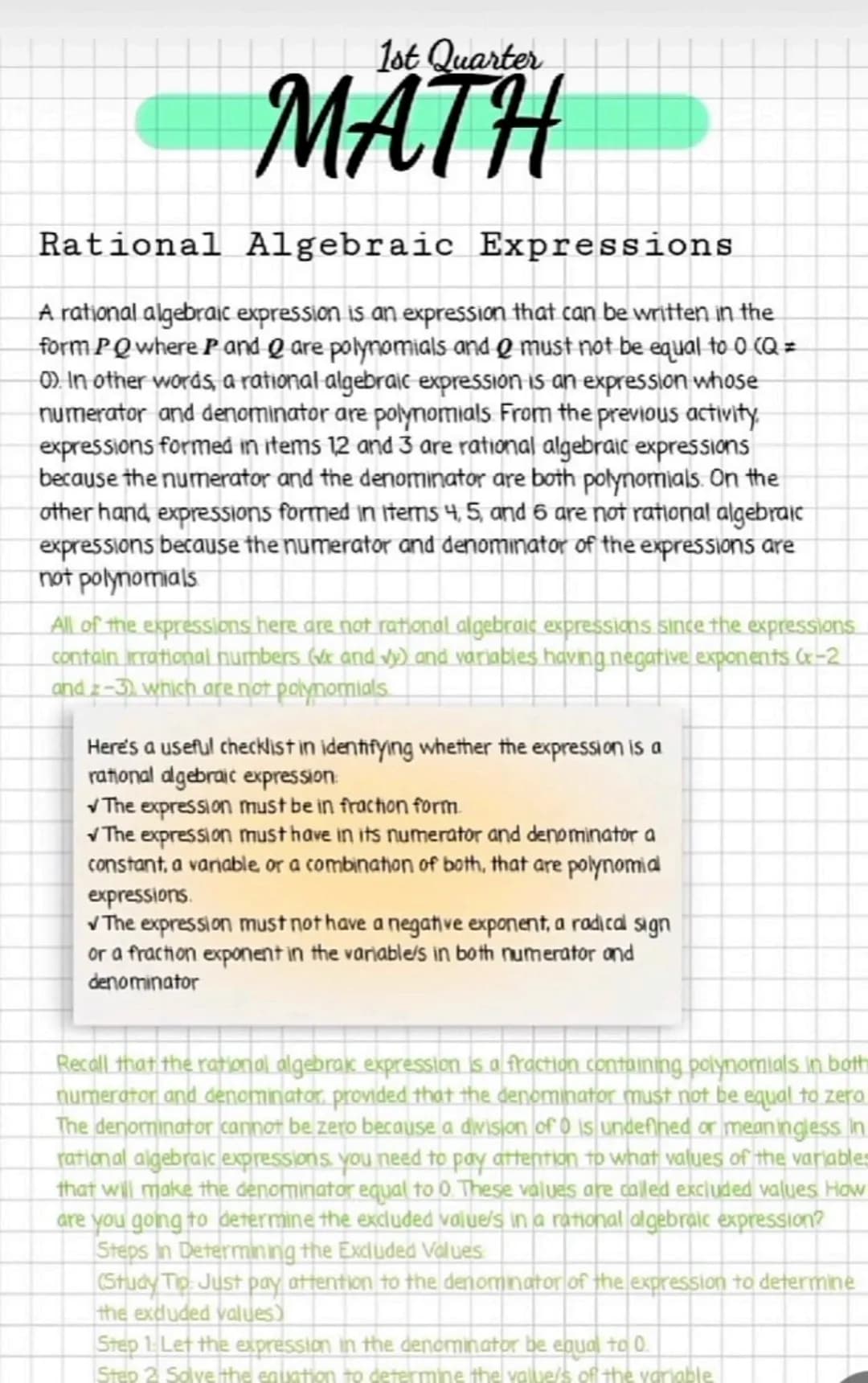
A rational algebraic expression is any expression written as QP where both P and Q are polynomials, and Q can never equal zero. Think of them as "polynomial fractions" - both the top and bottom need to be polynomials.
Not every fraction is a rational algebraic expression. To qualify, the expression must be in fraction form with polynomials in both parts. It cannot contain negative exponents, radical signs like $\sqrt{x}$, or fractional exponents in either the numerator or denominator.
When working with these expressions, you need to identify excluded values - any values that would make the denominator zero, which would make the expression undefined. Finding these values is simple: set the denominator equal to zero and solve the equation.
💡 Quick Check: To determine if an expression is a rational algebraic expression, ask yourself: Is it a fraction? Are both parts polynomials? Are there any negative exponents, radicals, or fraction exponents? If your answers are yes, yes, and no - it's a rational algebraic expression!


 Arithmetic
 Overige
 Algebra 1