

Ever wondered how your body automatically knows to breathe faster... Show more
 English Literature
 Sociology
Sign up to see the contentIt's free!
Access to all documents
Improve your grades
Join milions of students
By signing up you accept Terms of Service and Privacy Policy
Subjects
Triangle Congruence and Similarity Theorems
Triangle Properties and Classification
Linear Equations and Graphs
Geometric Angle Relationships
Trigonometric Functions and Identities
Equation Solving Techniques
Circle Geometry Fundamentals
Division Operations and Methods
Basic Differentiation Rules
Exponent and Logarithm Properties
Show all topics
Human Organ Systems
Reproductive Cell Cycles
Biological Sciences Subdisciplines
Cellular Energy Metabolism
Autotrophic Energy Processes
Inheritance Patterns and Principles
Biomolecular Structure and Organization
Cell Cycle and Division Mechanics
Cellular Organization and Development
Biological Structural Organization
Show all topics
Chemical Sciences and Applications
Atomic Structure and Composition
Molecular Electron Structure Representation
Atomic Electron Behavior
Matter Properties and Water
Mole Concept and Calculations
Gas Laws and Behavior
Periodic Table Organization
Chemical Thermodynamics Fundamentals
Chemical Bond Types and Properties
Show all topics
European Renaissance and Enlightenment
European Cultural Movements 800-1920
American Revolution Era 1763-1797
American Civil War 1861-1865
Global Imperial Systems
Mongol and Chinese Dynasties
U.S. Presidents and World Leaders
Historical Sources and Documentation
World Wars Era and Impact
World Religious Systems
Show all topics
Classic and Contemporary Novels
Literary Character Analysis
Rhetorical Theory and Practice
Classic Literary Narratives
Reading Analysis and Interpretation
Narrative Structure and Techniques
English Language Components
Influential English-Language Authors
Basic Sentence Structure
Narrative Voice and Perspective
Show all topics
99
•
Jan 2, 2026
•
Ever wondered how your body automatically knows to breathe faster... Show more
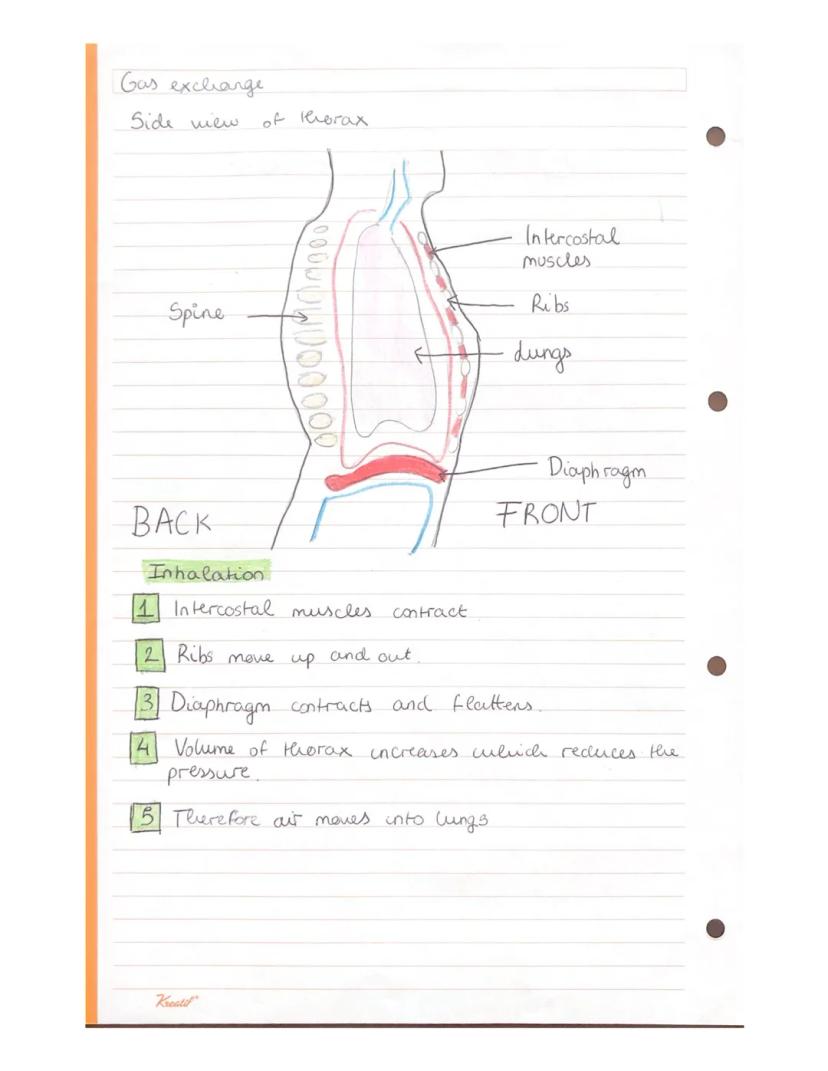
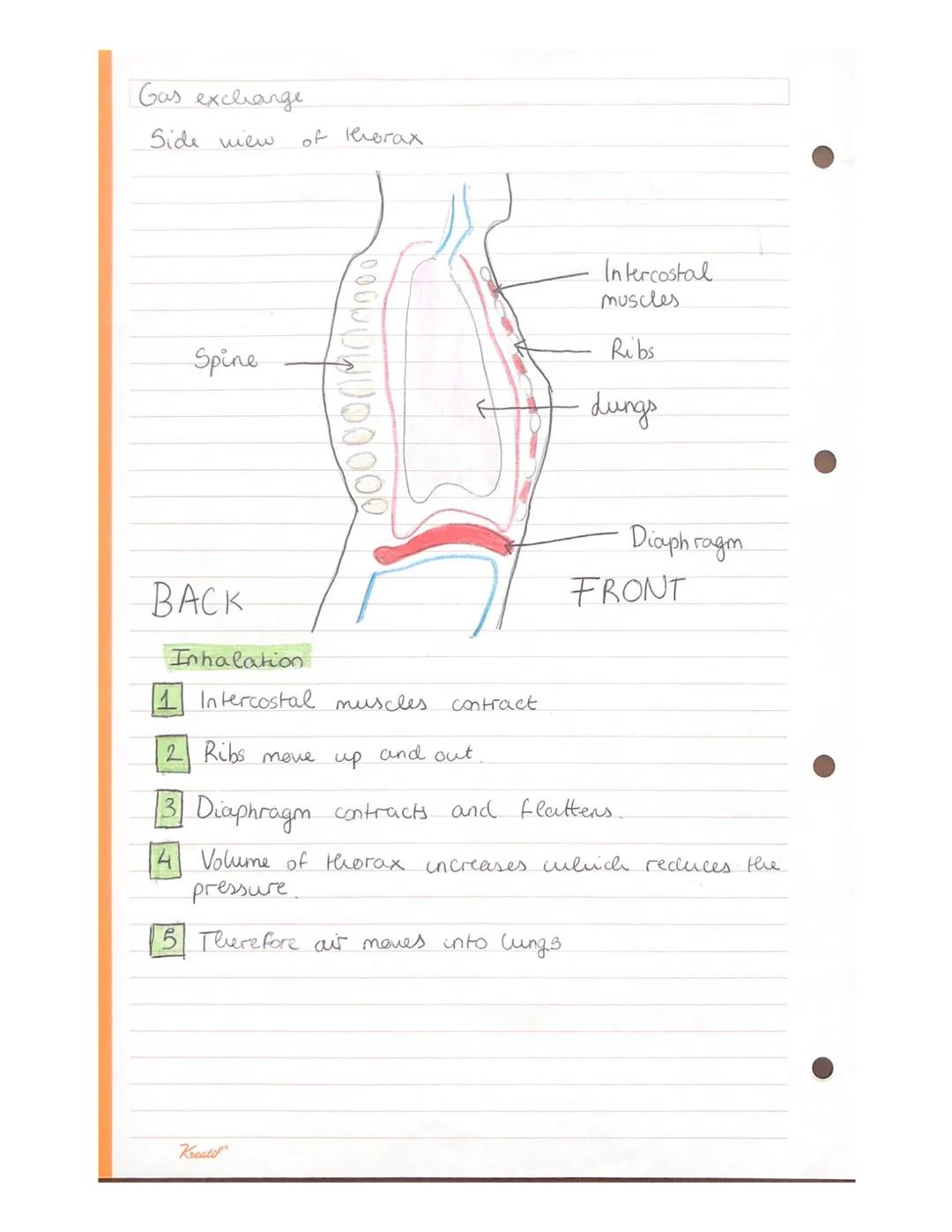
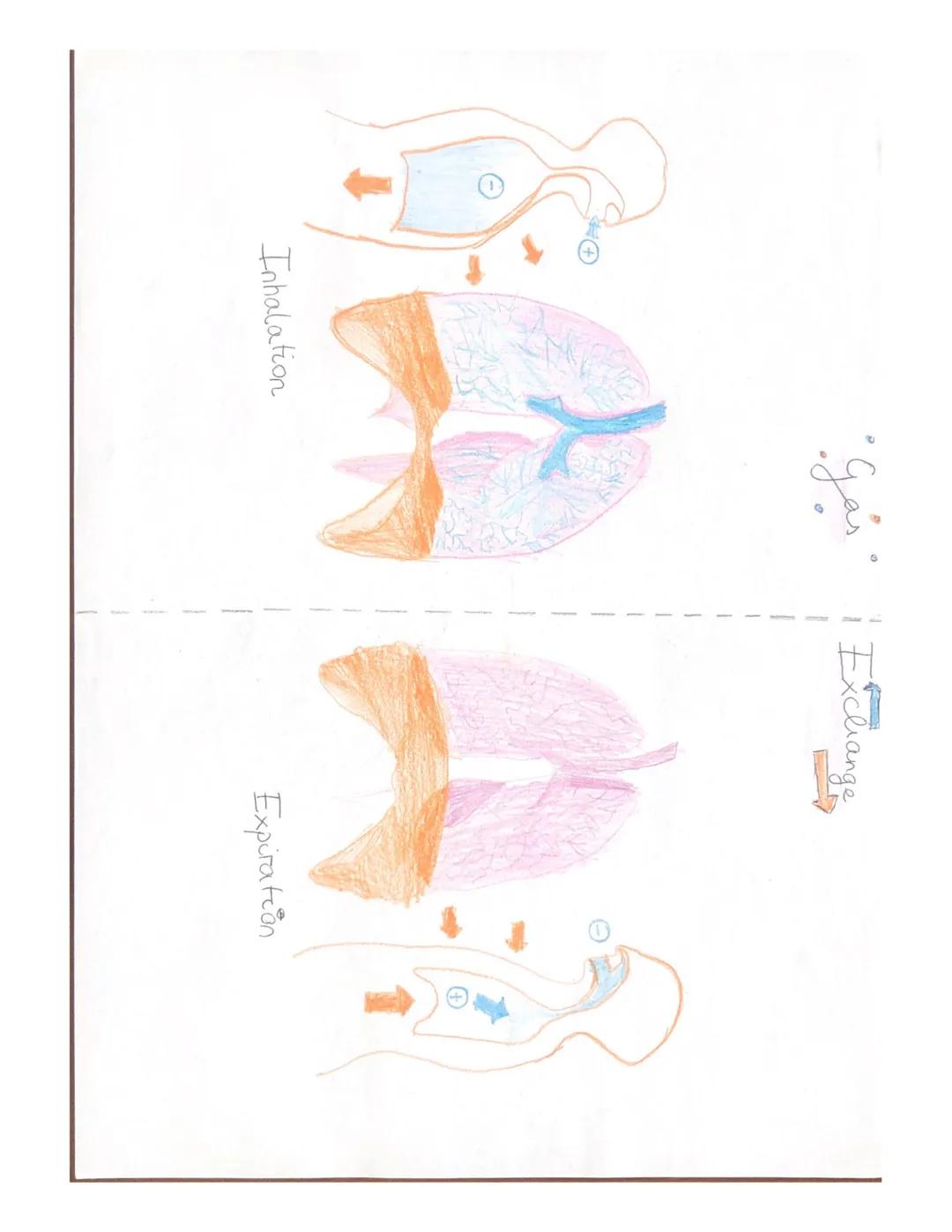
Taking a breath might seem simple, but there's actually a brilliant mechanical process happening inside your chest. When you need to breathe in, your intercostal muscles (the muscles between your ribs) contract and pull your ribs up and outwards.
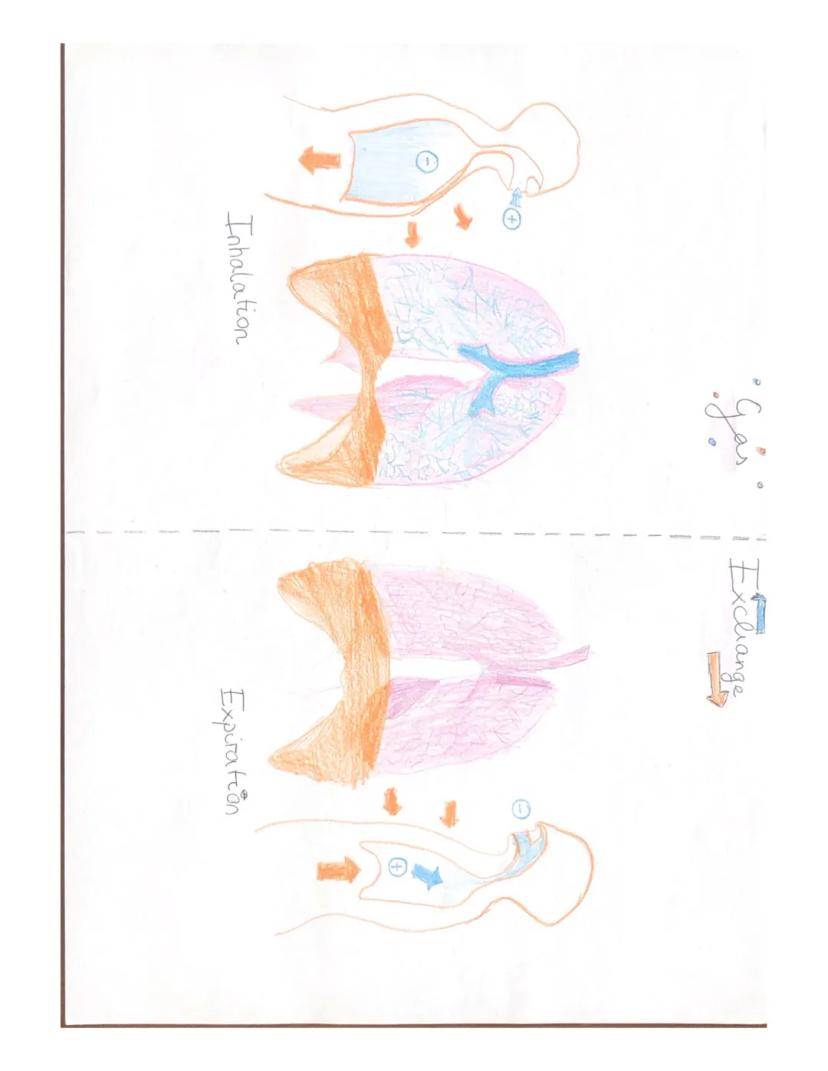
At the same time, your diaphragm - that dome-shaped muscle under your lungs - contracts and flattens out. This teamwork increases the volume inside your chest cavity, which cleverly reduces the air pressure.
Because air always moves from high pressure to low pressure, fresh air rushes into your lungs automatically. Your body is basically creating a vacuum that sucks air in - no effort required from you!
Quick Tip: Remember "contract = expand" - when muscles contract during inhalation, your chest expands to let air in.
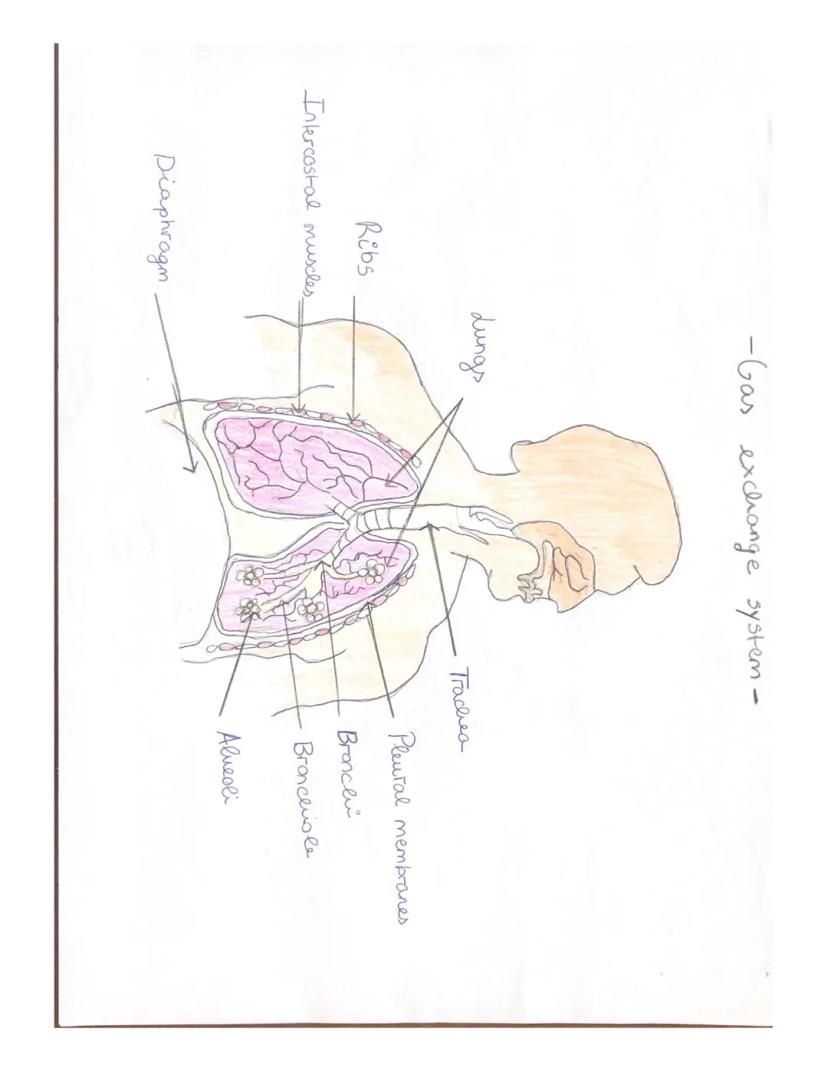
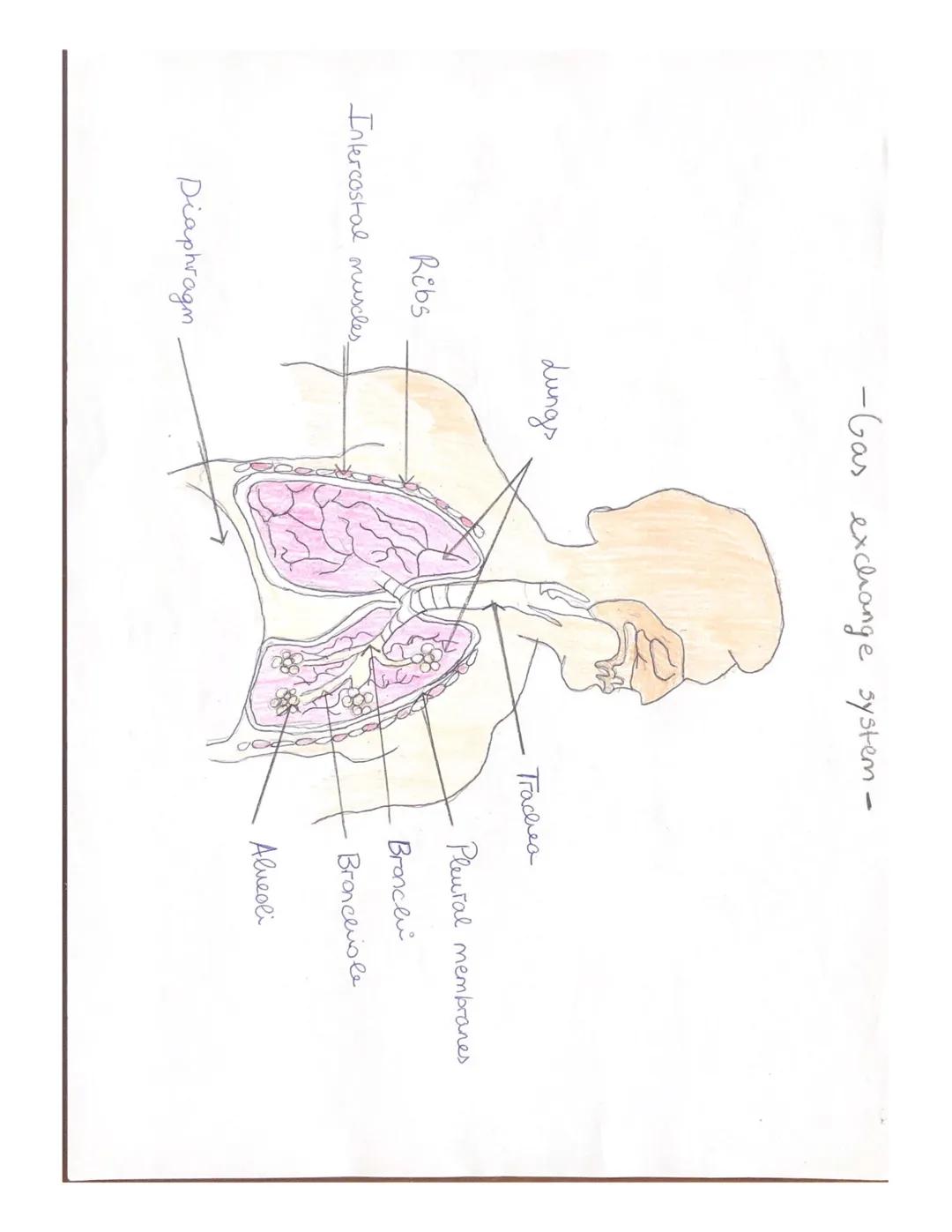
Your respiratory system is like a sophisticated tree with branches getting smaller and smaller. It all starts with your trachea (windpipe), which splits into two main bronchi - one leading to each lung.
These bronchi then branch into thousands of smaller tubes called bronchioles, which end in tiny air sacs called alveoli. Think of alveoli as microscopic balloons where the real magic happens.
Your lungs are protected by pleural membranes - slippery layers that let your lungs slide smoothly against your chest wall as you breathe. The whole system is powered by your diaphragm and intercostal muscles working together.
Mind-Blowing Fact: You have about 700 million alveoli in your lungs - that's roughly 100 times more than the UK population!
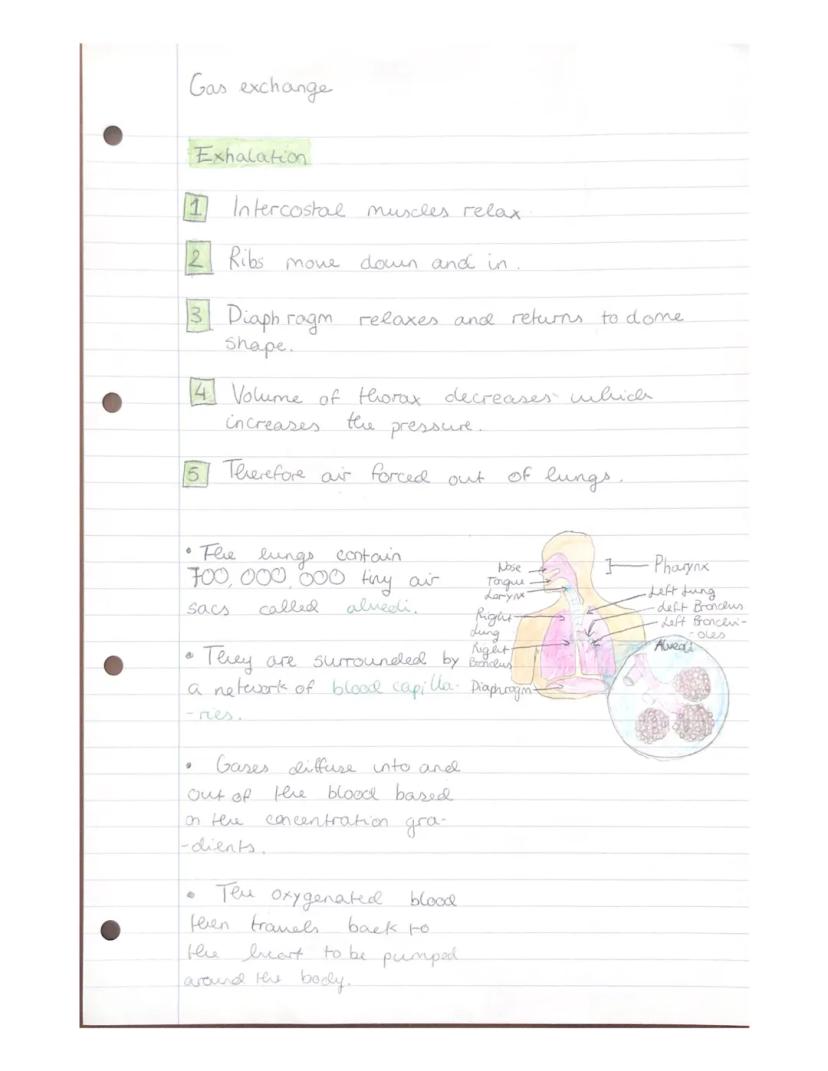
Breathing out is essentially the reverse of breathing in, but your body does most of the work for you. Your intercostal muscles relax, allowing your ribs to move down and inwards under their own weight.
Your diaphragm also relaxes and springs back to its natural dome shape. This reduces the volume in your chest cavity, which increases the air pressure inside your lungs.
The higher pressure forces air out of your lungs and through your mouth or nose. It's like gently squeezing a balloon - the air has to go somewhere, so it escapes!
Remember: Exhalation is mostly passive - your muscles just relax and gravity does the rest.
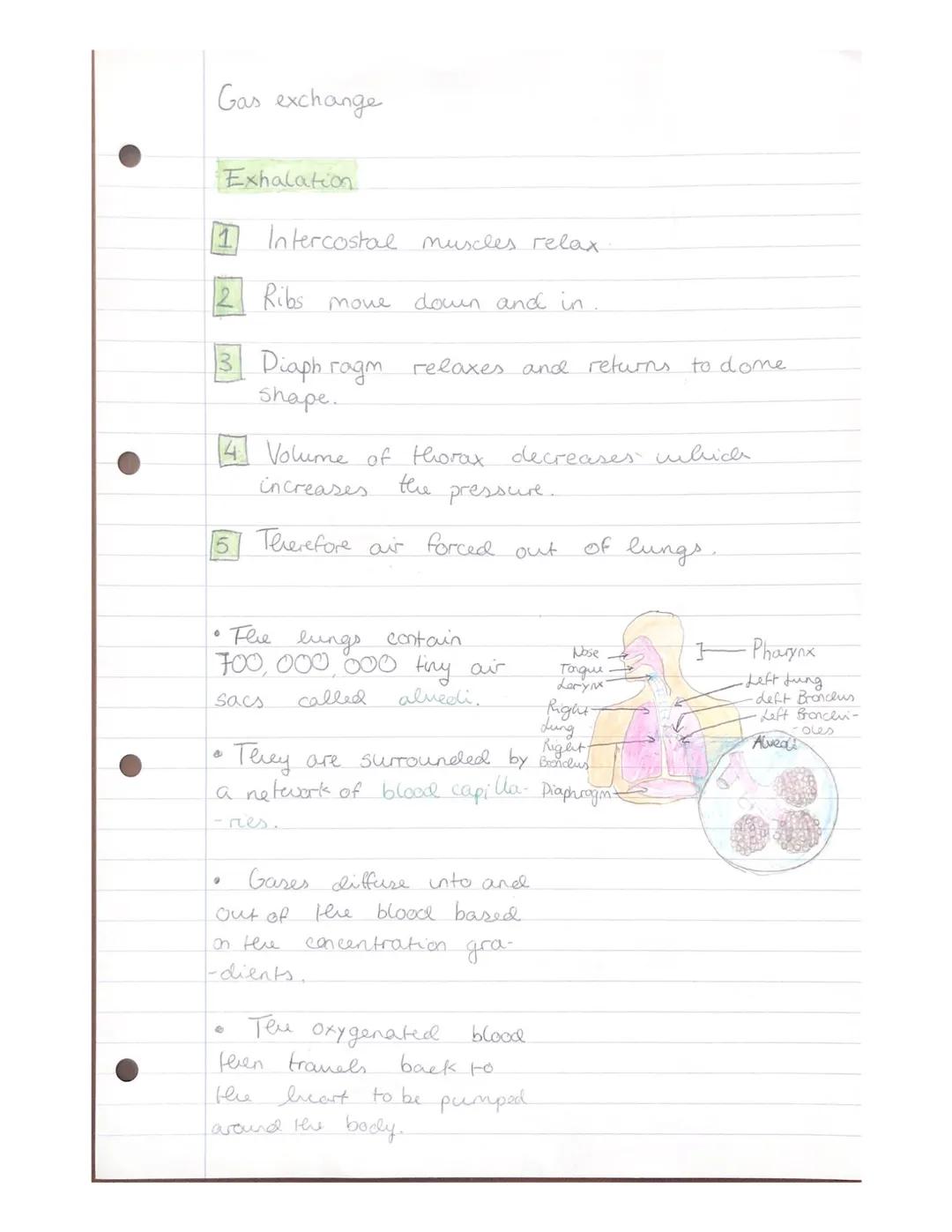
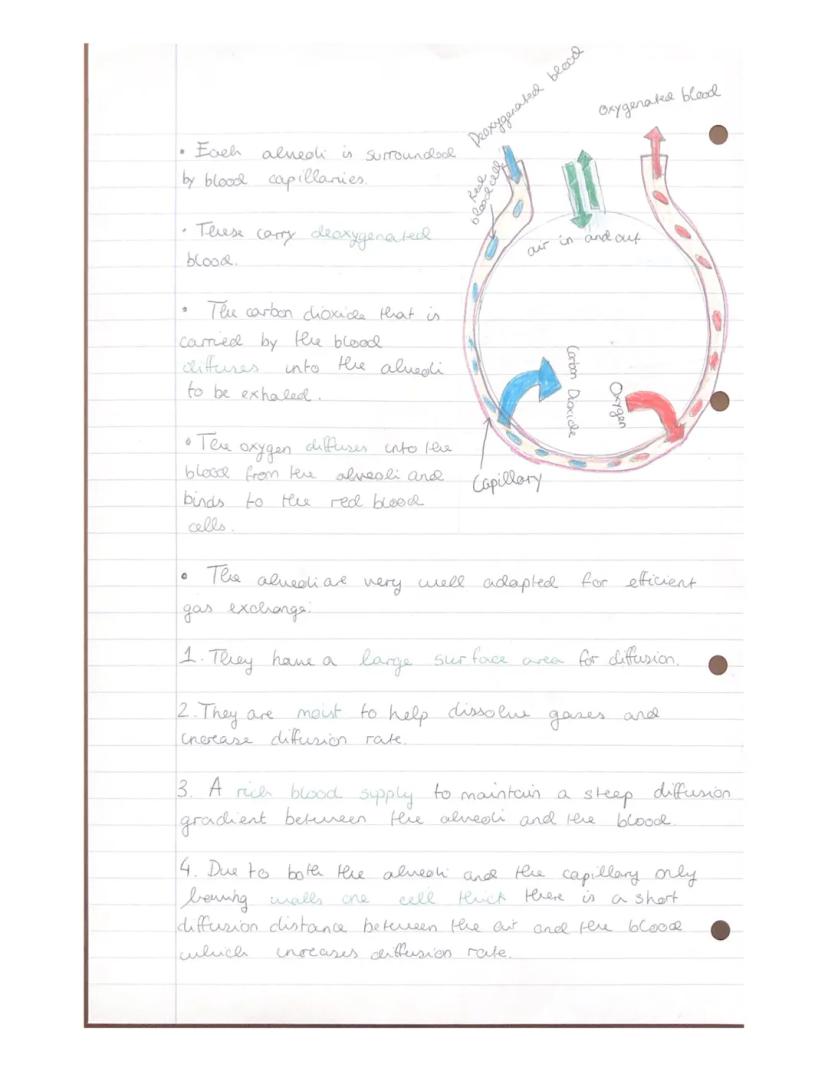
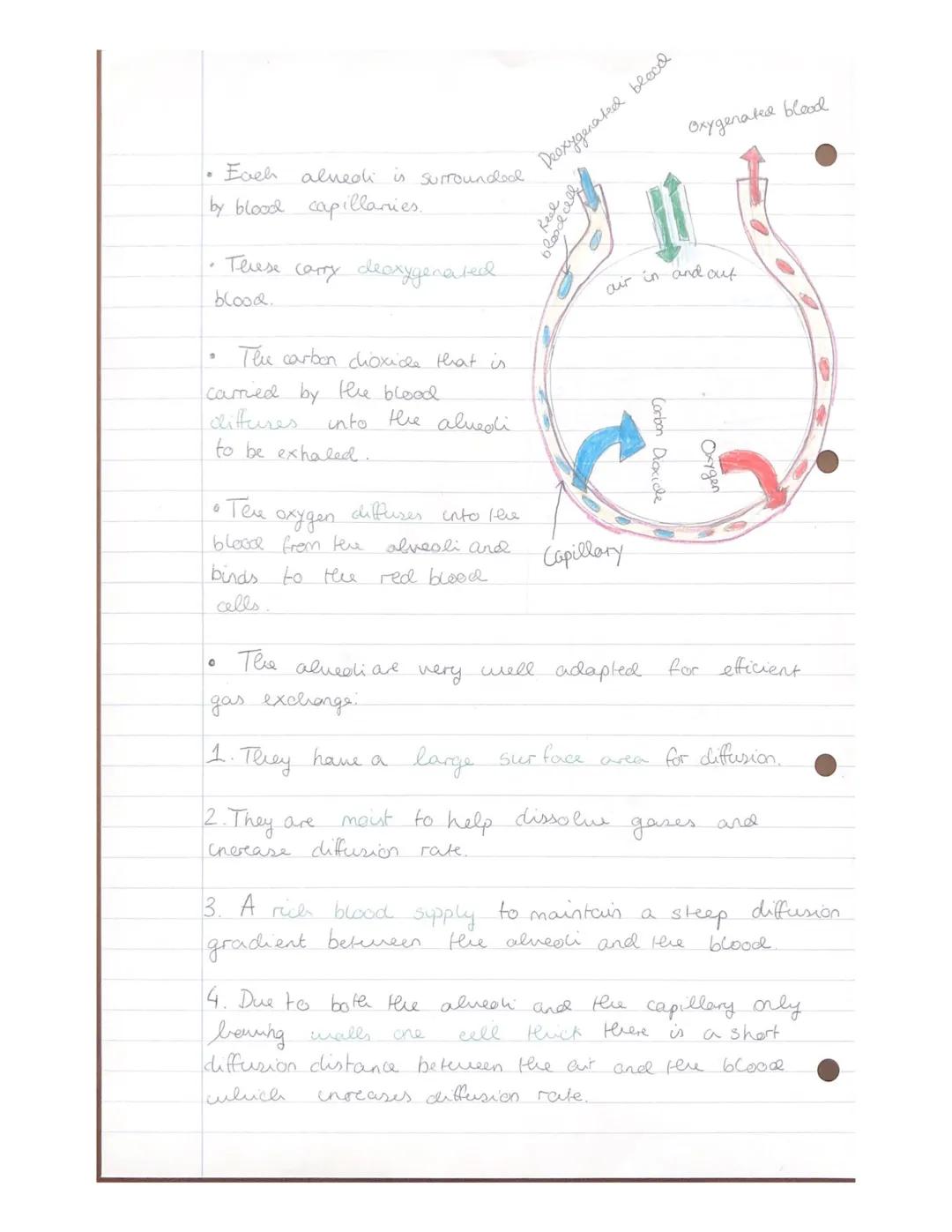
Here's where the real magic happens - gas exchange in your alveoli. Each tiny alveolus is surrounded by an intricate network of blood capillaries, creating the perfect setup for swapping gases.
Oxygen from the air you breathe diffuses through the thin alveolar walls into your blood, where it binds to red blood cells. Meanwhile, carbon dioxide waste diffuses from your blood into the alveoli to be breathed out.
This process works because of concentration gradients - gases naturally move from areas of high concentration to low concentration. Your oxygenated blood then travels back to your heart to be pumped around your entire body.
The whole system is incredibly efficient because both the alveolar walls and capillary walls are only one cell thick, making the diffusion distance extremely short.
Key Point: Diffusion happens automatically - no energy needed! Your body just sets up the right conditions.
Alveoli are brilliantly designed for maximum efficiency - they're basically evolution's masterpiece. They have an enormous surface area (about the size of a tennis court when spread out) packed into your chest.
The alveolar walls are moist, which helps dissolve gases and speeds up diffusion. They also have a rich blood supply that maintains steep concentration gradients between the air and blood.
Because the walls are permeable and only one cell thick, gases can pass through easily and quickly. This short diffusion distance means oxygen gets into your blood almost instantly.
Exam Tip: Remember the four key adaptations - large surface area, moist walls, rich blood supply, and thin walls for short diffusion distance.
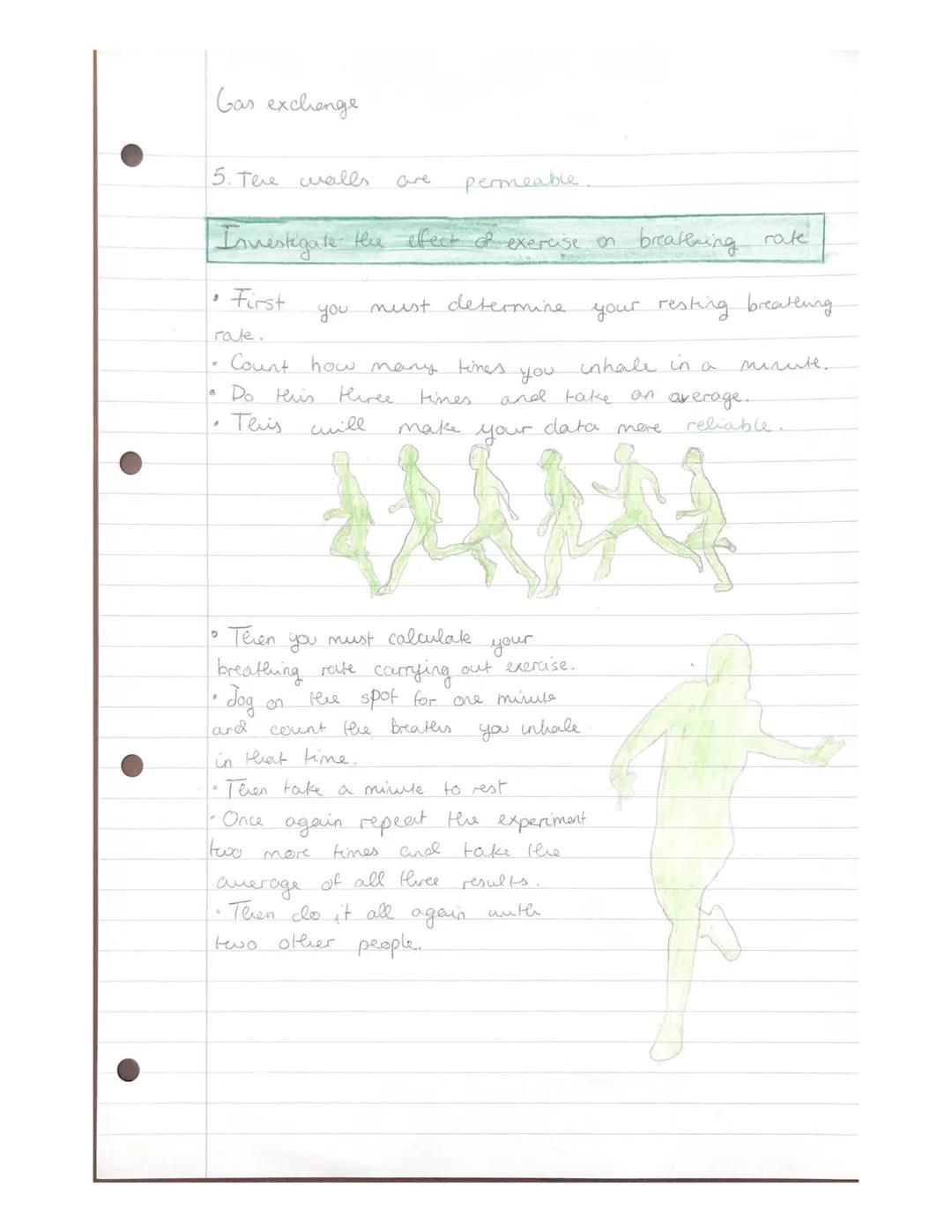
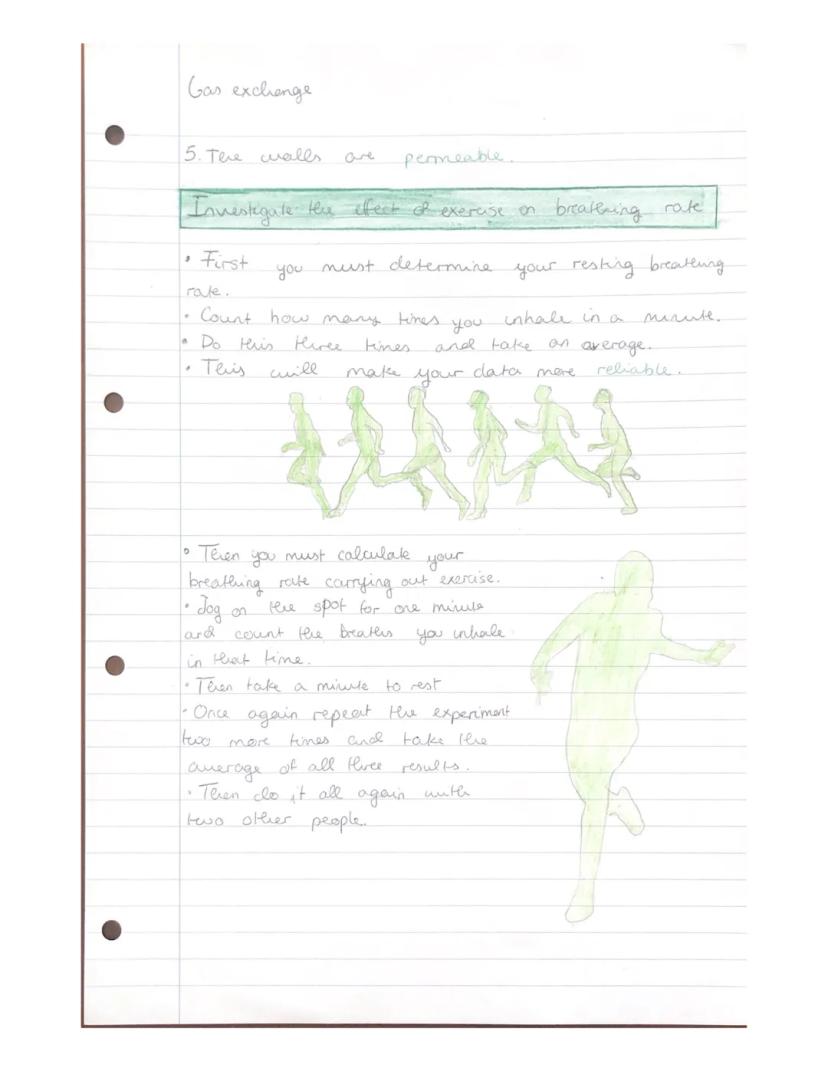
You can easily investigate how exercise changes your breathing rate with a simple experiment. Start by measuring your resting breathing rate - count how many breaths you take in one minute, repeat three times, and calculate the average.
Then jog on the spot for one minute and immediately count your breaths for another minute. Rest briefly, then repeat this two more times and find the average. Getting multiple readings makes your data much more reliable.
For even better results, test this on two other people as well. You'll definitely notice that everyone's breathing rate increases significantly after exercise.
Safety First: Make sure you're fit enough for exercise and stop immediately if you feel unwell or dizzy.
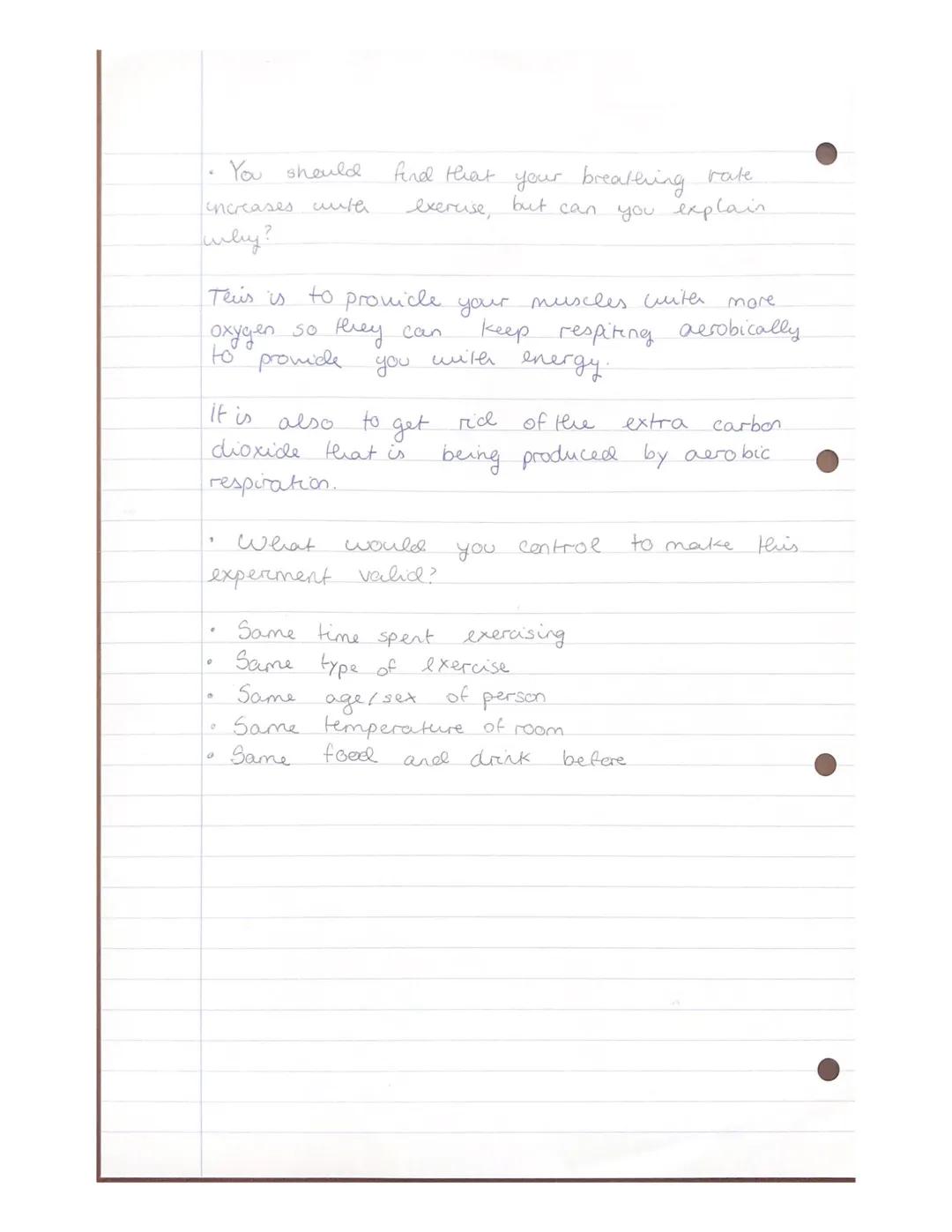
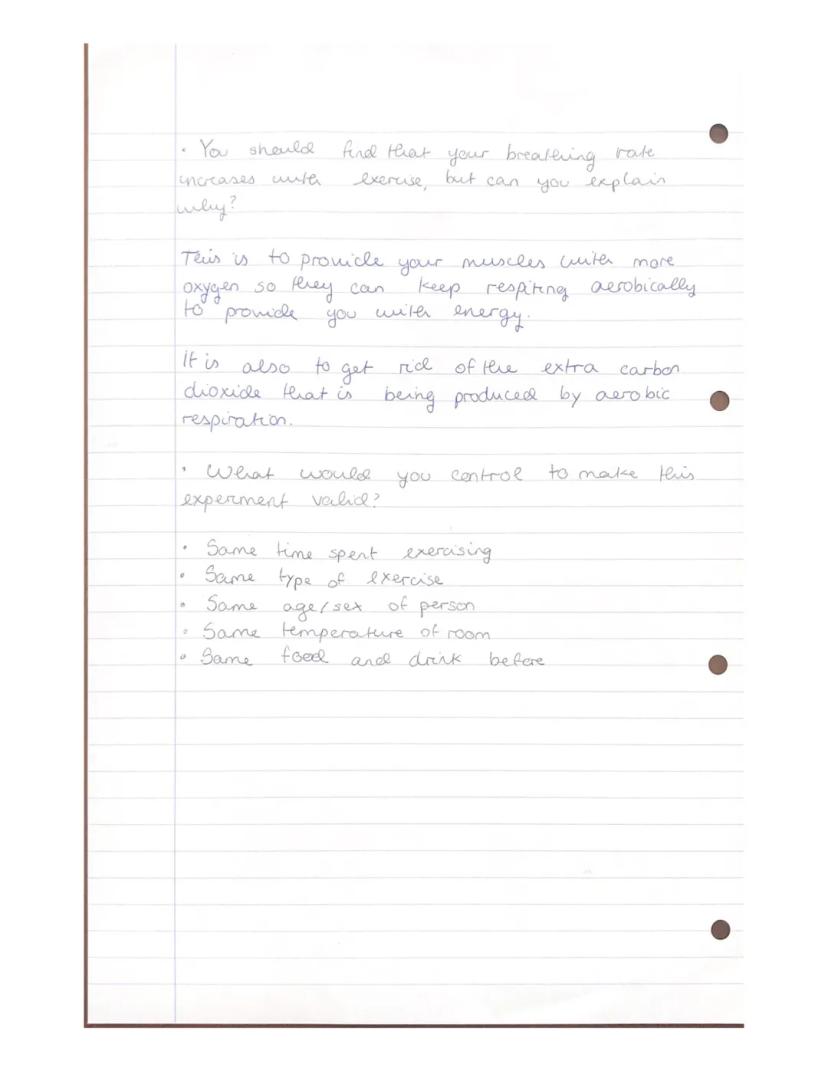
Your breathing rate shoots up during exercise for two crucial reasons. First, your muscles need much more oxygen to keep respiring aerobically and provide you with energy for movement.
Second, aerobic respiration produces loads more carbon dioxide waste that needs to be removed quickly. Your body cleverly increases breathing rate to supply more oxygen and get rid of excess carbon dioxide.
To make this experiment scientifically valid, you'd need to control several variables: same exercise duration, same type of exercise, people of similar age and fitness, same room temperature, and similar food/drink intake beforehand.
Real-Life Connection: This is why athletes train their cardiovascular systems - better gas exchange means better performance!
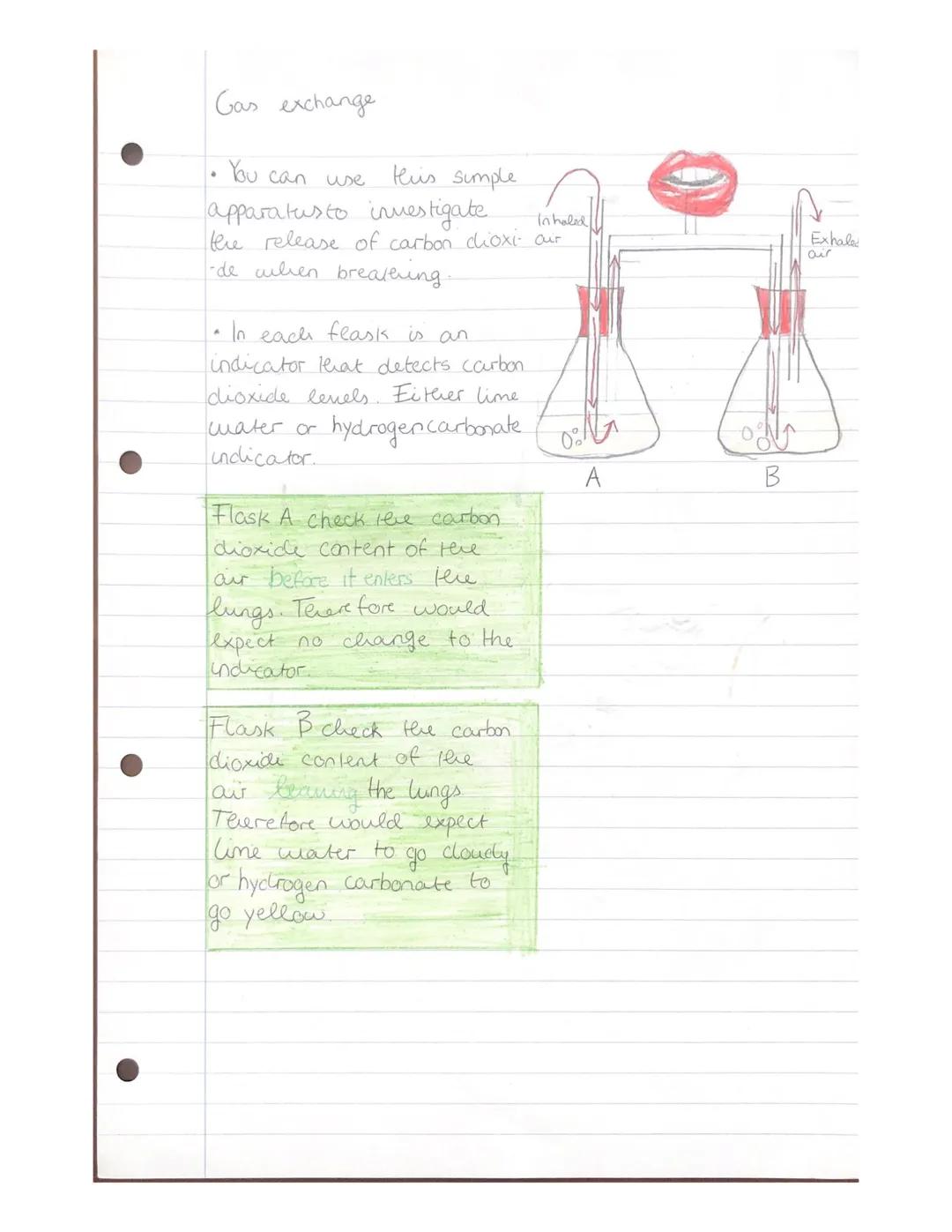
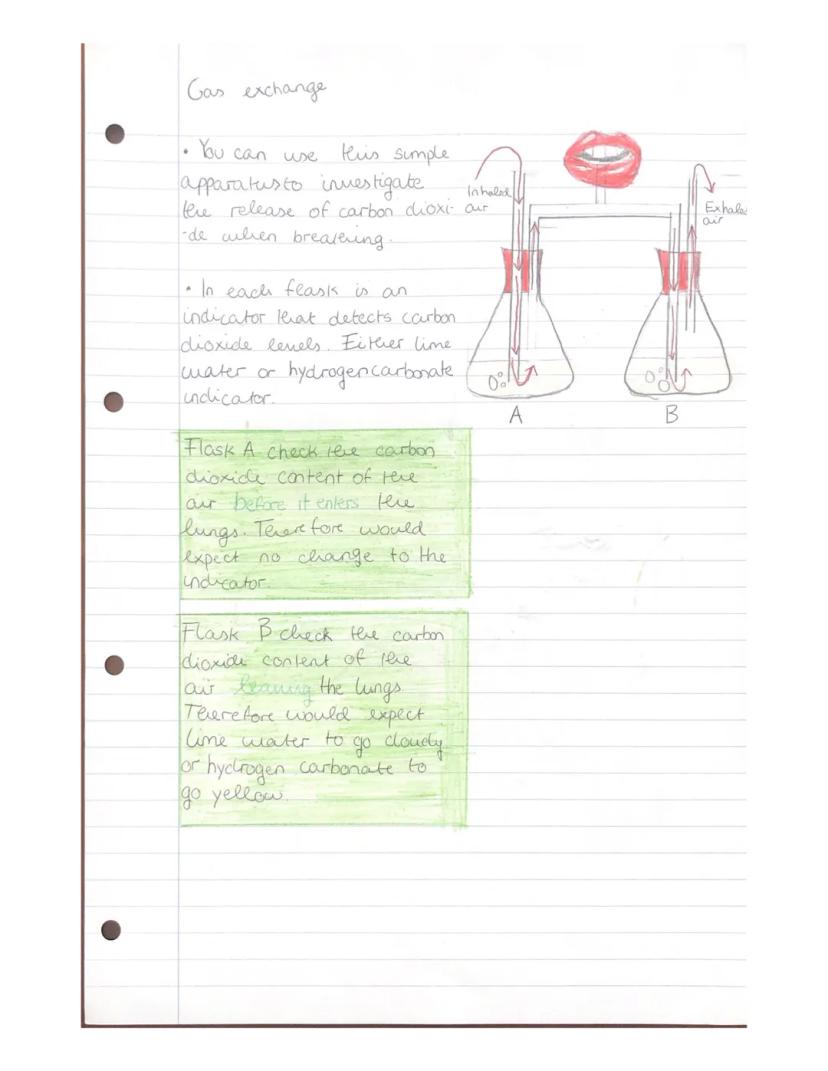
You can prove that you exhale carbon dioxide using a clever apparatus with two flasks containing indicators. Flask A tests the air going into your lungs, while Flask B tests the air coming out.
Use either lime water or hydrogen carbonate indicator to detect carbon dioxide levels. Flask A should show no change because the air going in contains very little carbon dioxide.
Flask B will show a clear change - lime water turns cloudy or hydrogen carbonate indicator turns yellow, proving that your exhaled air contains much more carbon dioxide than the air you breathed in.
Lab Tip: This experiment is perfect for demonstrating that cellular respiration really does produce carbon dioxide waste.
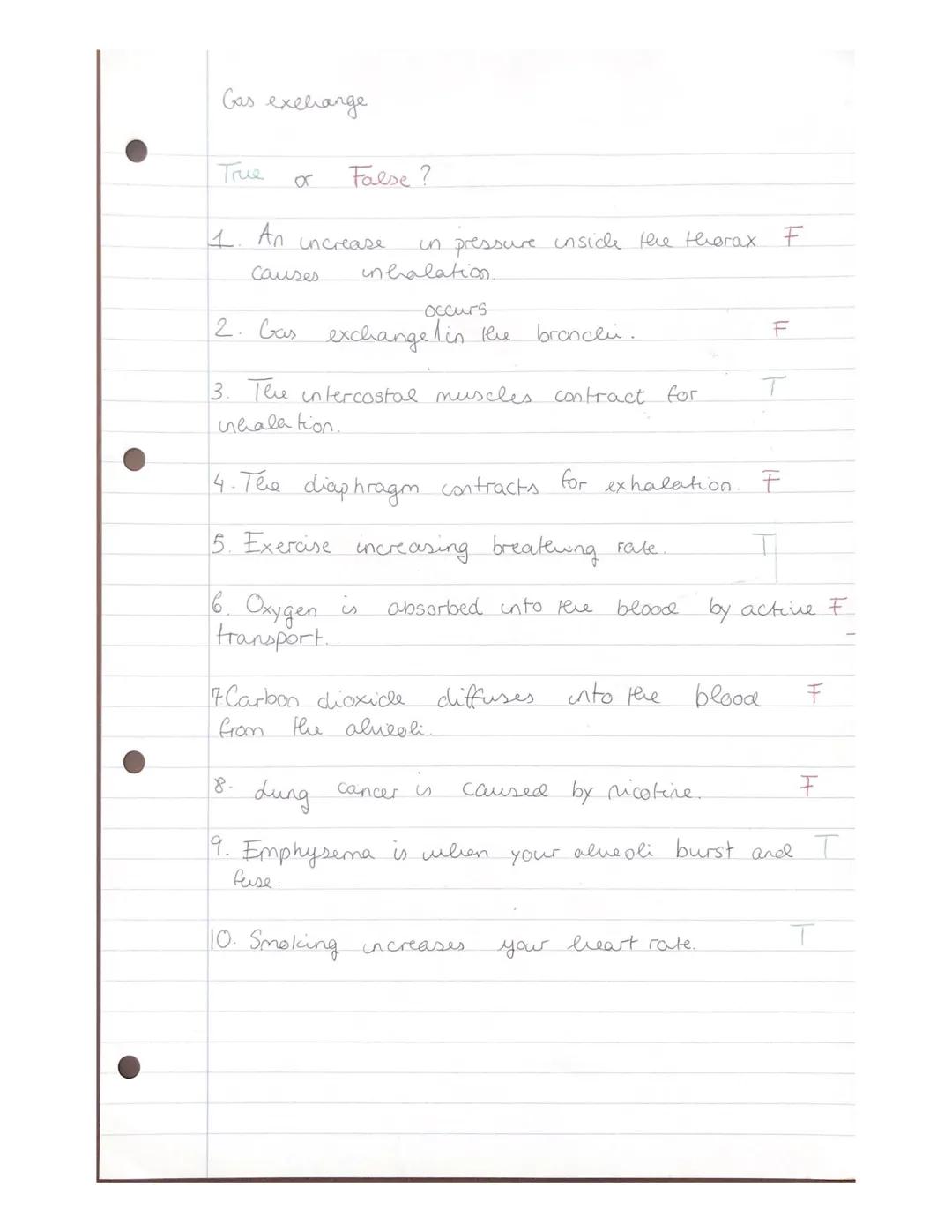
Test your understanding with these key facts about gas exchange. Remember that decreased pressure (not increased) inside the thorax causes inhalation, and gas exchange happens in alveoli, not bronchi.
Intercostal muscles do contract for inhalation, but the diaphragm relaxes during exhalation. Exercise definitely increases breathing rate to supply more oxygen to working muscles.
Oxygen enters blood by diffusion (not active transport), and carbon dioxide actually diffuses out of blood into alveoli. Understanding these processes will help you explain how your amazing respiratory system keeps you alive every single day.
Exam Success: Focus on the difference between active processes (muscle contractions) and passive processes (diffusion and exhalation).
Our AI companion is specifically built for the needs of students. Based on the millions of content pieces we have on the platform we can provide truly meaningful and relevant answers to students. But its not only about answers, the companion is even more about guiding students through their daily learning challenges, with personalised study plans, quizzes or content pieces in the chat and 100% personalisation based on the students skills and developments.
You can download the app in the Google Play Store and in the Apple App Store.
That's right! Enjoy free access to study content, connect with fellow students, and get instant help – all at your fingertips.
App Store
Google Play
The app is very easy to use and well designed. I have found everything I was looking for so far and have been able to learn a lot from the presentations! I will definitely use the app for a class assignment! And of course it also helps a lot as an inspiration.
Stefan S
iOS user
This app is really great. There are so many study notes and help [...]. My problem subject is French, for example, and the app has so many options for help. Thanks to this app, I have improved my French. I would recommend it to anyone.
Samantha Klich
Android user
Wow, I am really amazed. I just tried the app because I've seen it advertised many times and was absolutely stunned. This app is THE HELP you want for school and above all, it offers so many things, such as workouts and fact sheets, which have been VERY helpful to me personally.
Anna
iOS user
I think it’s very much worth it and you’ll end up using it a lot once you get the hang of it and even after looking at others notes you can still ask your Artificial intelligence buddy the question and ask to simplify it if you still don’t get it!!! In the end I think it’s worth it 😊👍 ⚠️Also DID I MENTION ITS FREEE YOU DON’T HAVE TO PAY FOR ANYTHING AND STILL GET YOUR GRADES IN PERFECTLY❗️❗️⚠️
Thomas R
iOS user
Knowunity is the BEST app I’ve used in a minute. This is not an ai review or anything this is genuinely coming from a 7th grade student (I know 2011 im young) but dude this app is a 10/10 i have maintained a 3.8 gpa and have plenty of time for gaming. I love it and my mom is just happy I got good grades
Brad T
Android user
Not only did it help me find the answer but it also showed me alternative ways to solve it. I was horrible in math and science but now I have an a in both subjects. Thanks for the help🤍🤍
David K
iOS user
The app's just great! All I have to do is enter the topic in the search bar and I get the response real fast. I don't have to watch 10 YouTube videos to understand something, so I'm saving my time. Highly recommended!
Sudenaz Ocak
Android user
In school I was really bad at maths but thanks to the app, I am doing better now. I am so grateful that you made the app.
Greenlight Bonnie
Android user
I found this app a couple years ago and it has only gotten better since then. I really love it because it can help with written questions and photo questions. Also, it can find study guides that other people have made as well as flashcard sets and practice tests. The free version is also amazing for students who might not be able to afford it. Would 100% recommend
Aubrey
iOS user
Best app if you're in Highschool or Junior high. I have been using this app for 2 school years and it's the best, it's good if you don't have anyone to help you with school work.😋🩷🎀
Marco B
iOS user
THE QUIZES AND FLASHCARDS ARE SO USEFUL AND I LOVE THE SCHOOLGPT. IT ALSO IS LITREALLY LIKE CHATGPT BUT SMARTER!! HELPED ME WITH MY MASCARA PROBLEMS TOO!! AS WELL AS MY REAL SUBJECTS ! DUHHH 😍😁😲🤑💗✨🎀😮
Elisha
iOS user
This app is phenomenal down to the correct info and the various topics you can study! I greatly recommend it for people who struggle with procrastination and those who need homework help. It has been perfectly accurate for world 1 history as far as I’ve seen! Geometry too!
Paul T
iOS user
The app is very easy to use and well designed. I have found everything I was looking for so far and have been able to learn a lot from the presentations! I will definitely use the app for a class assignment! And of course it also helps a lot as an inspiration.
Stefan S
iOS user
This app is really great. There are so many study notes and help [...]. My problem subject is French, for example, and the app has so many options for help. Thanks to this app, I have improved my French. I would recommend it to anyone.
Samantha Klich
Android user
Wow, I am really amazed. I just tried the app because I've seen it advertised many times and was absolutely stunned. This app is THE HELP you want for school and above all, it offers so many things, such as workouts and fact sheets, which have been VERY helpful to me personally.
Anna
iOS user
I think it’s very much worth it and you’ll end up using it a lot once you get the hang of it and even after looking at others notes you can still ask your Artificial intelligence buddy the question and ask to simplify it if you still don’t get it!!! In the end I think it’s worth it 😊👍 ⚠️Also DID I MENTION ITS FREEE YOU DON’T HAVE TO PAY FOR ANYTHING AND STILL GET YOUR GRADES IN PERFECTLY❗️❗️⚠️
Thomas R
iOS user
Knowunity is the BEST app I’ve used in a minute. This is not an ai review or anything this is genuinely coming from a 7th grade student (I know 2011 im young) but dude this app is a 10/10 i have maintained a 3.8 gpa and have plenty of time for gaming. I love it and my mom is just happy I got good grades
Brad T
Android user
Not only did it help me find the answer but it also showed me alternative ways to solve it. I was horrible in math and science but now I have an a in both subjects. Thanks for the help🤍🤍
David K
iOS user
The app's just great! All I have to do is enter the topic in the search bar and I get the response real fast. I don't have to watch 10 YouTube videos to understand something, so I'm saving my time. Highly recommended!
Sudenaz Ocak
Android user
In school I was really bad at maths but thanks to the app, I am doing better now. I am so grateful that you made the app.
Greenlight Bonnie
Android user
I found this app a couple years ago and it has only gotten better since then. I really love it because it can help with written questions and photo questions. Also, it can find study guides that other people have made as well as flashcard sets and practice tests. The free version is also amazing for students who might not be able to afford it. Would 100% recommend
Aubrey
iOS user
Best app if you're in Highschool or Junior high. I have been using this app for 2 school years and it's the best, it's good if you don't have anyone to help you with school work.😋🩷🎀
Marco B
iOS user
THE QUIZES AND FLASHCARDS ARE SO USEFUL AND I LOVE THE SCHOOLGPT. IT ALSO IS LITREALLY LIKE CHATGPT BUT SMARTER!! HELPED ME WITH MY MASCARA PROBLEMS TOO!! AS WELL AS MY REAL SUBJECTS ! DUHHH 😍😁😲🤑💗✨🎀😮
Elisha
iOS user
This app is phenomenal down to the correct info and the various topics you can study! I greatly recommend it for people who struggle with procrastination and those who need homework help. It has been perfectly accurate for world 1 history as far as I’ve seen! Geometry too!
Paul T
iOS user
Ever wondered how your body automatically knows to breathe faster when you're running? Gas exchange is the amazing process that keeps you alive by getting oxygen into your blood and removing carbon dioxide waste. Understanding how your lungs work will... Show more
Access to all documents
Improve your grades
Join milions of students
By signing up you accept Terms of Service and Privacy Policy
Taking a breath might seem simple, but there's actually a brilliant mechanical process happening inside your chest. When you need to breathe in, your intercostal muscles (the muscles between your ribs) contract and pull your ribs up and outwards.
At the same time, your diaphragm - that dome-shaped muscle under your lungs - contracts and flattens out. This teamwork increases the volume inside your chest cavity, which cleverly reduces the air pressure.
Because air always moves from high pressure to low pressure, fresh air rushes into your lungs automatically. Your body is basically creating a vacuum that sucks air in - no effort required from you!
Quick Tip: Remember "contract = expand" - when muscles contract during inhalation, your chest expands to let air in.
Access to all documents
Improve your grades
Join milions of students
By signing up you accept Terms of Service and Privacy Policy
Your respiratory system is like a sophisticated tree with branches getting smaller and smaller. It all starts with your trachea (windpipe), which splits into two main bronchi - one leading to each lung.
These bronchi then branch into thousands of smaller tubes called bronchioles, which end in tiny air sacs called alveoli. Think of alveoli as microscopic balloons where the real magic happens.
Your lungs are protected by pleural membranes - slippery layers that let your lungs slide smoothly against your chest wall as you breathe. The whole system is powered by your diaphragm and intercostal muscles working together.
Mind-Blowing Fact: You have about 700 million alveoli in your lungs - that's roughly 100 times more than the UK population!
Access to all documents
Improve your grades
Join milions of students
By signing up you accept Terms of Service and Privacy Policy
Breathing out is essentially the reverse of breathing in, but your body does most of the work for you. Your intercostal muscles relax, allowing your ribs to move down and inwards under their own weight.
Your diaphragm also relaxes and springs back to its natural dome shape. This reduces the volume in your chest cavity, which increases the air pressure inside your lungs.
The higher pressure forces air out of your lungs and through your mouth or nose. It's like gently squeezing a balloon - the air has to go somewhere, so it escapes!
Remember: Exhalation is mostly passive - your muscles just relax and gravity does the rest.
Access to all documents
Improve your grades
Join milions of students
By signing up you accept Terms of Service and Privacy Policy
Here's where the real magic happens - gas exchange in your alveoli. Each tiny alveolus is surrounded by an intricate network of blood capillaries, creating the perfect setup for swapping gases.
Oxygen from the air you breathe diffuses through the thin alveolar walls into your blood, where it binds to red blood cells. Meanwhile, carbon dioxide waste diffuses from your blood into the alveoli to be breathed out.
This process works because of concentration gradients - gases naturally move from areas of high concentration to low concentration. Your oxygenated blood then travels back to your heart to be pumped around your entire body.
The whole system is incredibly efficient because both the alveolar walls and capillary walls are only one cell thick, making the diffusion distance extremely short.
Key Point: Diffusion happens automatically - no energy needed! Your body just sets up the right conditions.
Access to all documents
Improve your grades
Join milions of students
By signing up you accept Terms of Service and Privacy Policy
Alveoli are brilliantly designed for maximum efficiency - they're basically evolution's masterpiece. They have an enormous surface area (about the size of a tennis court when spread out) packed into your chest.
The alveolar walls are moist, which helps dissolve gases and speeds up diffusion. They also have a rich blood supply that maintains steep concentration gradients between the air and blood.
Because the walls are permeable and only one cell thick, gases can pass through easily and quickly. This short diffusion distance means oxygen gets into your blood almost instantly.
Exam Tip: Remember the four key adaptations - large surface area, moist walls, rich blood supply, and thin walls for short diffusion distance.
Access to all documents
Improve your grades
Join milions of students
By signing up you accept Terms of Service and Privacy Policy
You can easily investigate how exercise changes your breathing rate with a simple experiment. Start by measuring your resting breathing rate - count how many breaths you take in one minute, repeat three times, and calculate the average.
Then jog on the spot for one minute and immediately count your breaths for another minute. Rest briefly, then repeat this two more times and find the average. Getting multiple readings makes your data much more reliable.
For even better results, test this on two other people as well. You'll definitely notice that everyone's breathing rate increases significantly after exercise.
Safety First: Make sure you're fit enough for exercise and stop immediately if you feel unwell or dizzy.
Access to all documents
Improve your grades
Join milions of students
By signing up you accept Terms of Service and Privacy Policy
Your breathing rate shoots up during exercise for two crucial reasons. First, your muscles need much more oxygen to keep respiring aerobically and provide you with energy for movement.
Second, aerobic respiration produces loads more carbon dioxide waste that needs to be removed quickly. Your body cleverly increases breathing rate to supply more oxygen and get rid of excess carbon dioxide.
To make this experiment scientifically valid, you'd need to control several variables: same exercise duration, same type of exercise, people of similar age and fitness, same room temperature, and similar food/drink intake beforehand.
Real-Life Connection: This is why athletes train their cardiovascular systems - better gas exchange means better performance!
Access to all documents
Improve your grades
Join milions of students
By signing up you accept Terms of Service and Privacy Policy
You can prove that you exhale carbon dioxide using a clever apparatus with two flasks containing indicators. Flask A tests the air going into your lungs, while Flask B tests the air coming out.
Use either lime water or hydrogen carbonate indicator to detect carbon dioxide levels. Flask A should show no change because the air going in contains very little carbon dioxide.
Flask B will show a clear change - lime water turns cloudy or hydrogen carbonate indicator turns yellow, proving that your exhaled air contains much more carbon dioxide than the air you breathed in.
Lab Tip: This experiment is perfect for demonstrating that cellular respiration really does produce carbon dioxide waste.
Access to all documents
Improve your grades
Join milions of students
By signing up you accept Terms of Service and Privacy Policy
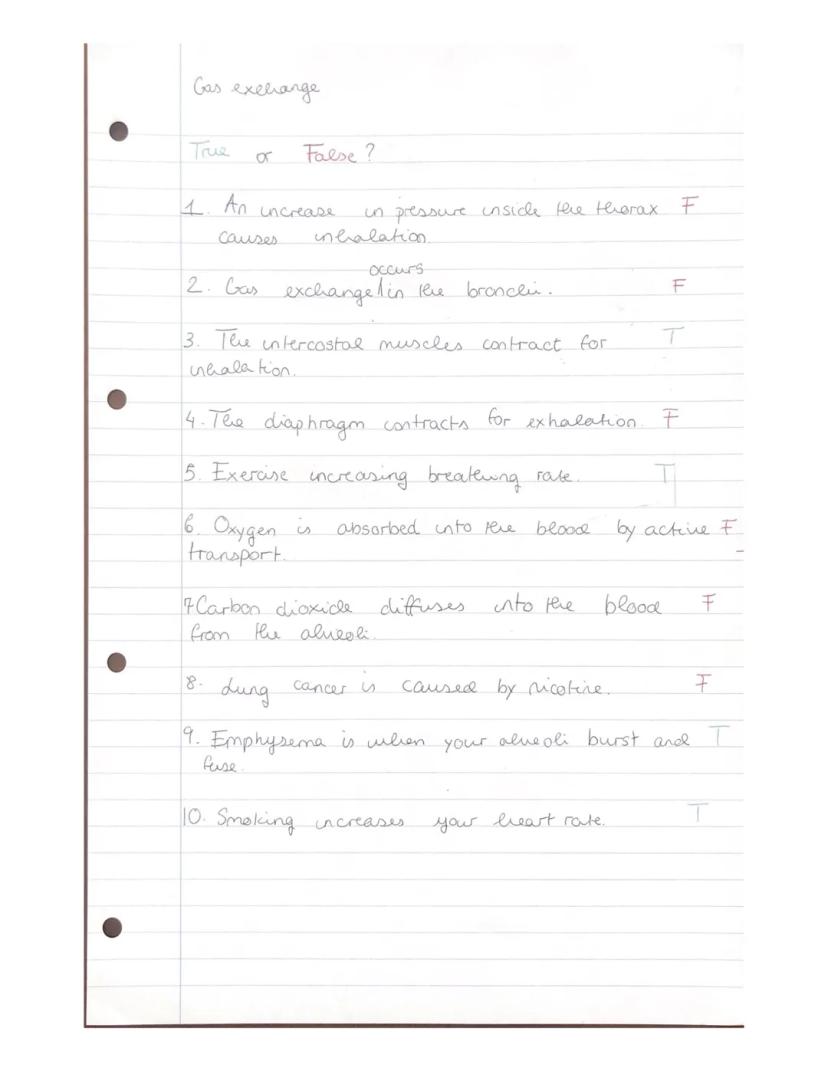
Test your understanding with these key facts about gas exchange. Remember that decreased pressure (not increased) inside the thorax causes inhalation, and gas exchange happens in alveoli, not bronchi.
Intercostal muscles do contract for inhalation, but the diaphragm relaxes during exhalation. Exercise definitely increases breathing rate to supply more oxygen to working muscles.
Oxygen enters blood by diffusion (not active transport), and carbon dioxide actually diffuses out of blood into alveoli. Understanding these processes will help you explain how your amazing respiratory system keeps you alive every single day.
Exam Success: Focus on the difference between active processes (muscle contractions) and passive processes (diffusion and exhalation).
Our AI companion is specifically built for the needs of students. Based on the millions of content pieces we have on the platform we can provide truly meaningful and relevant answers to students. But its not only about answers, the companion is even more about guiding students through their daily learning challenges, with personalised study plans, quizzes or content pieces in the chat and 100% personalisation based on the students skills and developments.
You can download the app in the Google Play Store and in the Apple App Store.
That's right! Enjoy free access to study content, connect with fellow students, and get instant help – all at your fingertips.
4
Smart Tools NEW
Transform this note into: ✓ 50+ Practice Questions ✓ Interactive Flashcards ✓ Full Mock Exam ✓ Essay Outlines
Explore the intricate gas exchange systems in insects, fish, and mammals. This summary covers key concepts such as spiracles, tracheal systems, gill ventilation, and the transport of oxygen and carbon dioxide in the blood. Ideal for OCR A Level Biology revision, focusing on transport in animals and specialized exchange surfaces.
 Biology
Explore the intricate gaseous exchange system in mammals, detailing the structure and function of the trachea, bronchi, bronchioles, and alveoli. Understand the roles of goblet cells, cilia, elastic fibers, smooth muscle, and cartilage in facilitating efficient gas exchange. This summary is essential for students studying biology and physiology.
BiologyExplore the essential processes of gas exchange in the human body, focusing on the anatomy of the lungs, the role of cilia, diffusion principles, and the impact of smoking on respiratory health. This presentation covers key concepts such as concentration gradients, specialized gas exchange surfaces, and the physiological mechanisms involved in respiration. Ideal for GCSE Biology students.
BiologyExplore the essential functions of the heart, blood circulation, and the process of gaseous exchange in this comprehensive study note. Key topics include muscle cells, the skeletal system, and the impact of drugs on bodily functions. Ideal for Year 7 science students preparing for exams.
BiologyExplore the intricate gas exchange systems in insects, focusing on the role of spiracles, tracheae, and tracheoles. This summary covers adaptations for efficient oxygen delivery and carbon dioxide removal, including the Discontinuous Gas Exchange Cycle and mechanical ventilation strategies. Ideal for biology students studying respiratory systems.
BiologyExplore the intricate process of gas exchange in the lungs, focusing on the role of alveoli, bronchi, and capillaries. This summary covers key concepts such as the function of haemoglobin, the importance of surface area, and the diffusion of oxygen and carbon dioxide. Ideal for biology students preparing for exams.
BiologyApp Store
Google Play
The app is very easy to use and well designed. I have found everything I was looking for so far and have been able to learn a lot from the presentations! I will definitely use the app for a class assignment! And of course it also helps a lot as an inspiration.
Stefan S
iOS user
This app is really great. There are so many study notes and help [...]. My problem subject is French, for example, and the app has so many options for help. Thanks to this app, I have improved my French. I would recommend it to anyone.
Samantha Klich
Android user
Wow, I am really amazed. I just tried the app because I've seen it advertised many times and was absolutely stunned. This app is THE HELP you want for school and above all, it offers so many things, such as workouts and fact sheets, which have been VERY helpful to me personally.
Anna
iOS user
I think it’s very much worth it and you’ll end up using it a lot once you get the hang of it and even after looking at others notes you can still ask your Artificial intelligence buddy the question and ask to simplify it if you still don’t get it!!! In the end I think it’s worth it 😊👍 ⚠️Also DID I MENTION ITS FREEE YOU DON’T HAVE TO PAY FOR ANYTHING AND STILL GET YOUR GRADES IN PERFECTLY❗️❗️⚠️
Thomas R
iOS user
Knowunity is the BEST app I’ve used in a minute. This is not an ai review or anything this is genuinely coming from a 7th grade student (I know 2011 im young) but dude this app is a 10/10 i have maintained a 3.8 gpa and have plenty of time for gaming. I love it and my mom is just happy I got good grades
Brad T
Android user
Not only did it help me find the answer but it also showed me alternative ways to solve it. I was horrible in math and science but now I have an a in both subjects. Thanks for the help🤍🤍
David K
iOS user
The app's just great! All I have to do is enter the topic in the search bar and I get the response real fast. I don't have to watch 10 YouTube videos to understand something, so I'm saving my time. Highly recommended!
Sudenaz Ocak
Android user
In school I was really bad at maths but thanks to the app, I am doing better now. I am so grateful that you made the app.
Greenlight Bonnie
Android user
I found this app a couple years ago and it has only gotten better since then. I really love it because it can help with written questions and photo questions. Also, it can find study guides that other people have made as well as flashcard sets and practice tests. The free version is also amazing for students who might not be able to afford it. Would 100% recommend
Aubrey
iOS user
Best app if you're in Highschool or Junior high. I have been using this app for 2 school years and it's the best, it's good if you don't have anyone to help you with school work.😋🩷🎀
Marco B
iOS user
THE QUIZES AND FLASHCARDS ARE SO USEFUL AND I LOVE THE SCHOOLGPT. IT ALSO IS LITREALLY LIKE CHATGPT BUT SMARTER!! HELPED ME WITH MY MASCARA PROBLEMS TOO!! AS WELL AS MY REAL SUBJECTS ! DUHHH 😍😁😲🤑💗✨🎀😮
Elisha
iOS user
This app is phenomenal down to the correct info and the various topics you can study! I greatly recommend it for people who struggle with procrastination and those who need homework help. It has been perfectly accurate for world 1 history as far as I’ve seen! Geometry too!
Paul T
iOS user
The app is very easy to use and well designed. I have found everything I was looking for so far and have been able to learn a lot from the presentations! I will definitely use the app for a class assignment! And of course it also helps a lot as an inspiration.
Stefan S
iOS user
This app is really great. There are so many study notes and help [...]. My problem subject is French, for example, and the app has so many options for help. Thanks to this app, I have improved my French. I would recommend it to anyone.
Samantha Klich
Android user
Wow, I am really amazed. I just tried the app because I've seen it advertised many times and was absolutely stunned. This app is THE HELP you want for school and above all, it offers so many things, such as workouts and fact sheets, which have been VERY helpful to me personally.
Anna
iOS user
I think it’s very much worth it and you’ll end up using it a lot once you get the hang of it and even after looking at others notes you can still ask your Artificial intelligence buddy the question and ask to simplify it if you still don’t get it!!! In the end I think it’s worth it 😊👍 ⚠️Also DID I MENTION ITS FREEE YOU DON’T HAVE TO PAY FOR ANYTHING AND STILL GET YOUR GRADES IN PERFECTLY❗️❗️⚠️
Thomas R
iOS user
Knowunity is the BEST app I’ve used in a minute. This is not an ai review or anything this is genuinely coming from a 7th grade student (I know 2011 im young) but dude this app is a 10/10 i have maintained a 3.8 gpa and have plenty of time for gaming. I love it and my mom is just happy I got good grades
Brad T
Android user
Not only did it help me find the answer but it also showed me alternative ways to solve it. I was horrible in math and science but now I have an a in both subjects. Thanks for the help🤍🤍
David K
iOS user
The app's just great! All I have to do is enter the topic in the search bar and I get the response real fast. I don't have to watch 10 YouTube videos to understand something, so I'm saving my time. Highly recommended!
Sudenaz Ocak
Android user
In school I was really bad at maths but thanks to the app, I am doing better now. I am so grateful that you made the app.
Greenlight Bonnie
Android user
I found this app a couple years ago and it has only gotten better since then. I really love it because it can help with written questions and photo questions. Also, it can find study guides that other people have made as well as flashcard sets and practice tests. The free version is also amazing for students who might not be able to afford it. Would 100% recommend
Aubrey
iOS user
Best app if you're in Highschool or Junior high. I have been using this app for 2 school years and it's the best, it's good if you don't have anyone to help you with school work.😋🩷🎀
Marco B
iOS user
THE QUIZES AND FLASHCARDS ARE SO USEFUL AND I LOVE THE SCHOOLGPT. IT ALSO IS LITREALLY LIKE CHATGPT BUT SMARTER!! HELPED ME WITH MY MASCARA PROBLEMS TOO!! AS WELL AS MY REAL SUBJECTS ! DUHHH 😍😁😲🤑💗✨🎀😮
Elisha
iOS user
This app is phenomenal down to the correct info and the various topics you can study! I greatly recommend it for people who struggle with procrastination and those who need homework help. It has been perfectly accurate for world 1 history as far as I’ve seen! Geometry too!
Paul T
iOS user