
Ever wondered what happens to rainwater after it hits the... Show more
 Biology
 English Literature
 Sociology
Sign up to see the contentIt's free!
Access to all documents
Improve your grades
Join milions of students
By signing up you accept Terms of Service and Privacy Policy
Subjects
Triangle Congruence and Similarity Theorems
Triangle Properties and Classification
Linear Equations and Graphs
Geometric Angle Relationships
Trigonometric Functions and Identities
Equation Solving Techniques
Circle Geometry Fundamentals
Division Operations and Methods
Basic Differentiation Rules
Exponent and Logarithm Properties
Show all topics
Human Organ Systems
Reproductive Cell Cycles
Biological Sciences Subdisciplines
Cellular Energy Metabolism
Autotrophic Energy Processes
Inheritance Patterns and Principles
Biomolecular Structure and Organization
Cell Cycle and Division Mechanics
Cellular Organization and Development
Biological Structural Organization
Show all topics
Chemical Sciences and Applications
Atomic Structure and Composition
Molecular Electron Structure Representation
Atomic Electron Behavior
Matter Properties and Water
Mole Concept and Calculations
Gas Laws and Behavior
Periodic Table Organization
Chemical Thermodynamics Fundamentals
Chemical Bond Types and Properties
Show all topics
European Renaissance and Enlightenment
European Cultural Movements 800-1920
American Revolution Era 1763-1797
American Civil War 1861-1865
Global Imperial Systems
Mongol and Chinese Dynasties
U.S. Presidents and World Leaders
Historical Sources and Documentation
World Wars Era and Impact
World Religious Systems
Show all topics
Classic and Contemporary Novels
Literary Character Analysis
Rhetorical Theory and Practice
Classic Literary Narratives
Reading Analysis and Interpretation
Narrative Structure and Techniques
English Language Components
Influential English-Language Authors
Basic Sentence Structure
Narrative Voice and Perspective
Show all topics
303
•
Dec 26, 2025
•
Sushi
@sausage_roll
Ever wondered what happens to rainwater after it hits the... Show more
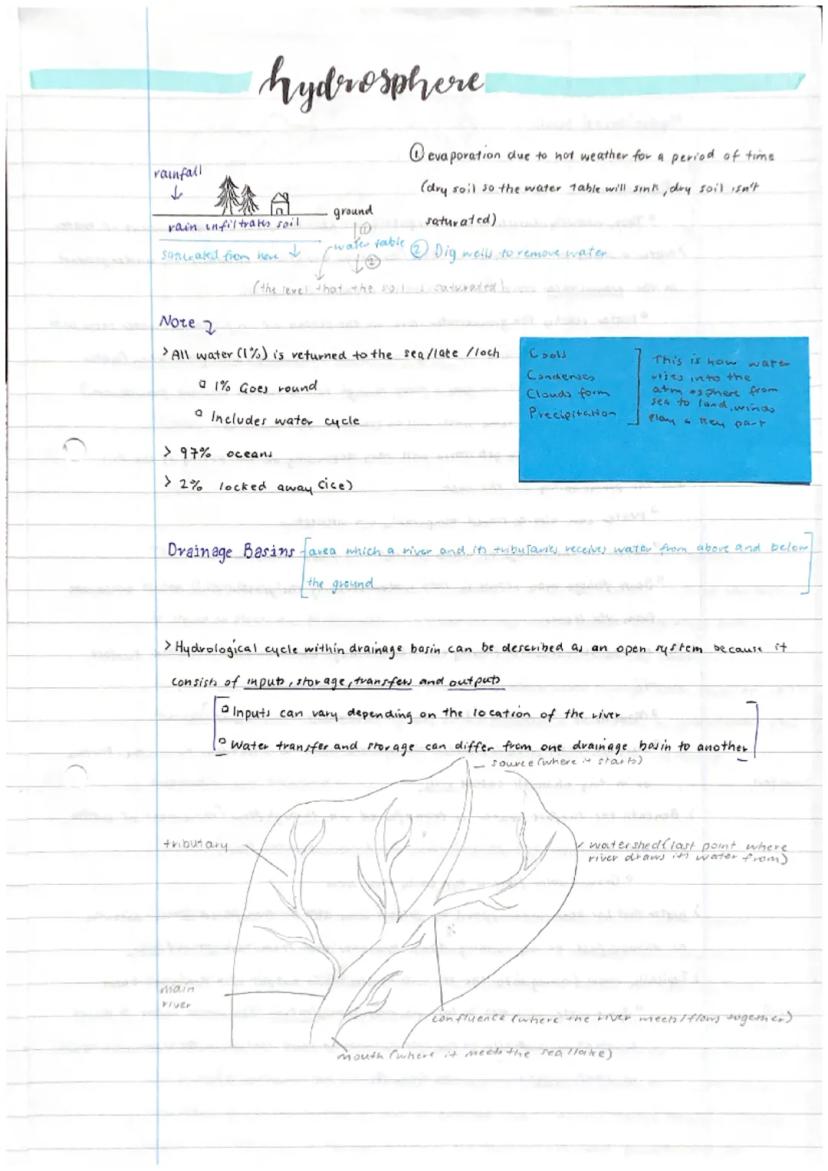
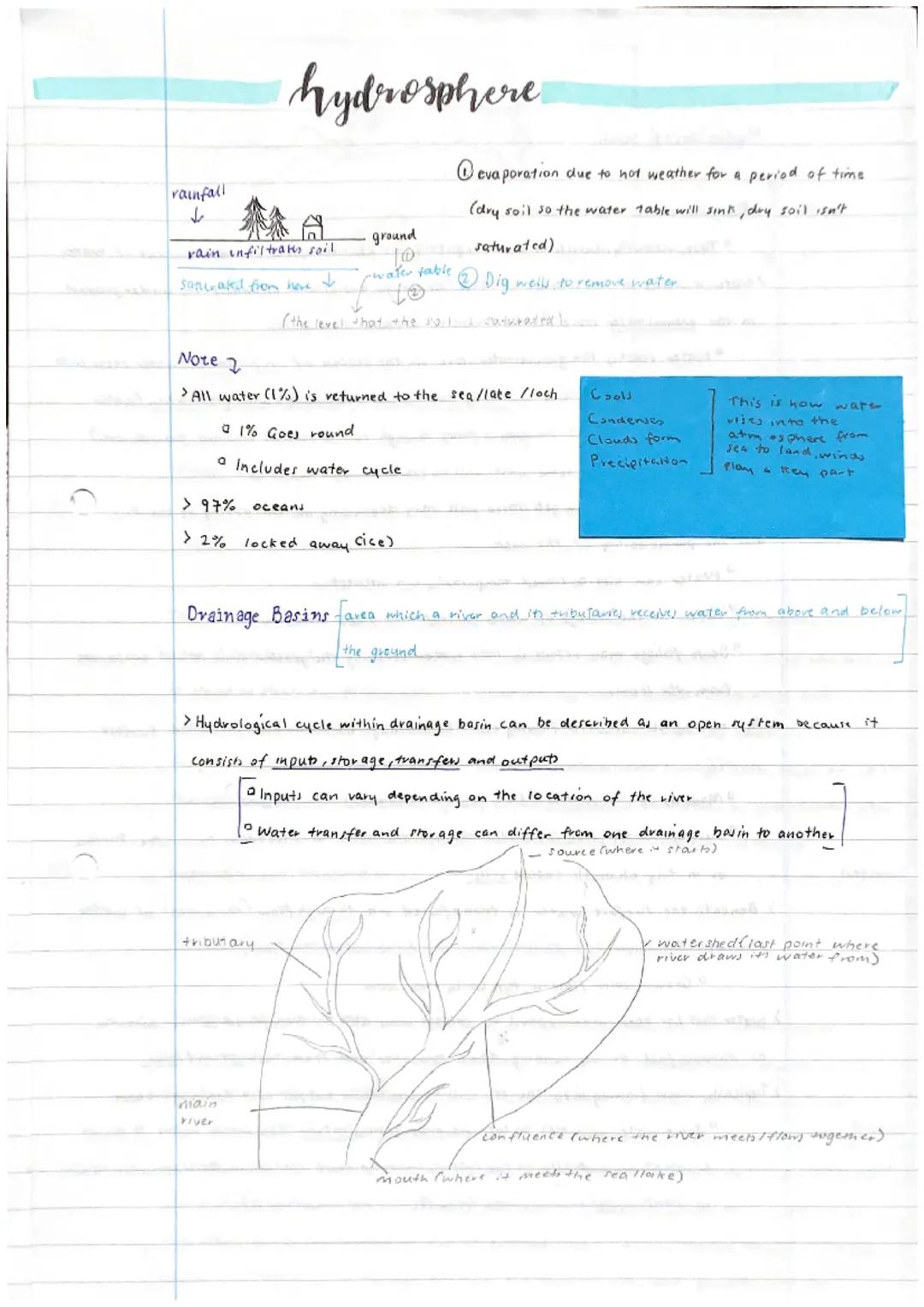
Think of a drainage basin as nature's catchment area - it's the region where a river and its tributaries collect water from both above and below ground. This system works like a giant funnel, gathering rainfall and channelling it towards the sea.
When rain falls, it doesn't just disappear. Some water infiltrates into the soil, slowly making its way down to the water table - that's the level where soil becomes completely saturated with water. During dry periods, this water table drops as evaporation removes moisture from the surface.
A drainage basin functions as an open system because it has clear inputs (mainly precipitation), storage areas (lakes, soil, underground rocks), transfers (water movement), and outputs (rivers flowing to the sea). The key landmarks include the source (where the river starts), tributaries (smaller streams joining the main river), confluence (where rivers meet), and the mouth (where it reaches the sea).
Quick Tip: Only 1% of Earth's water is actively cycling through this system - 97% sits in oceans and 2% is locked away as ice!
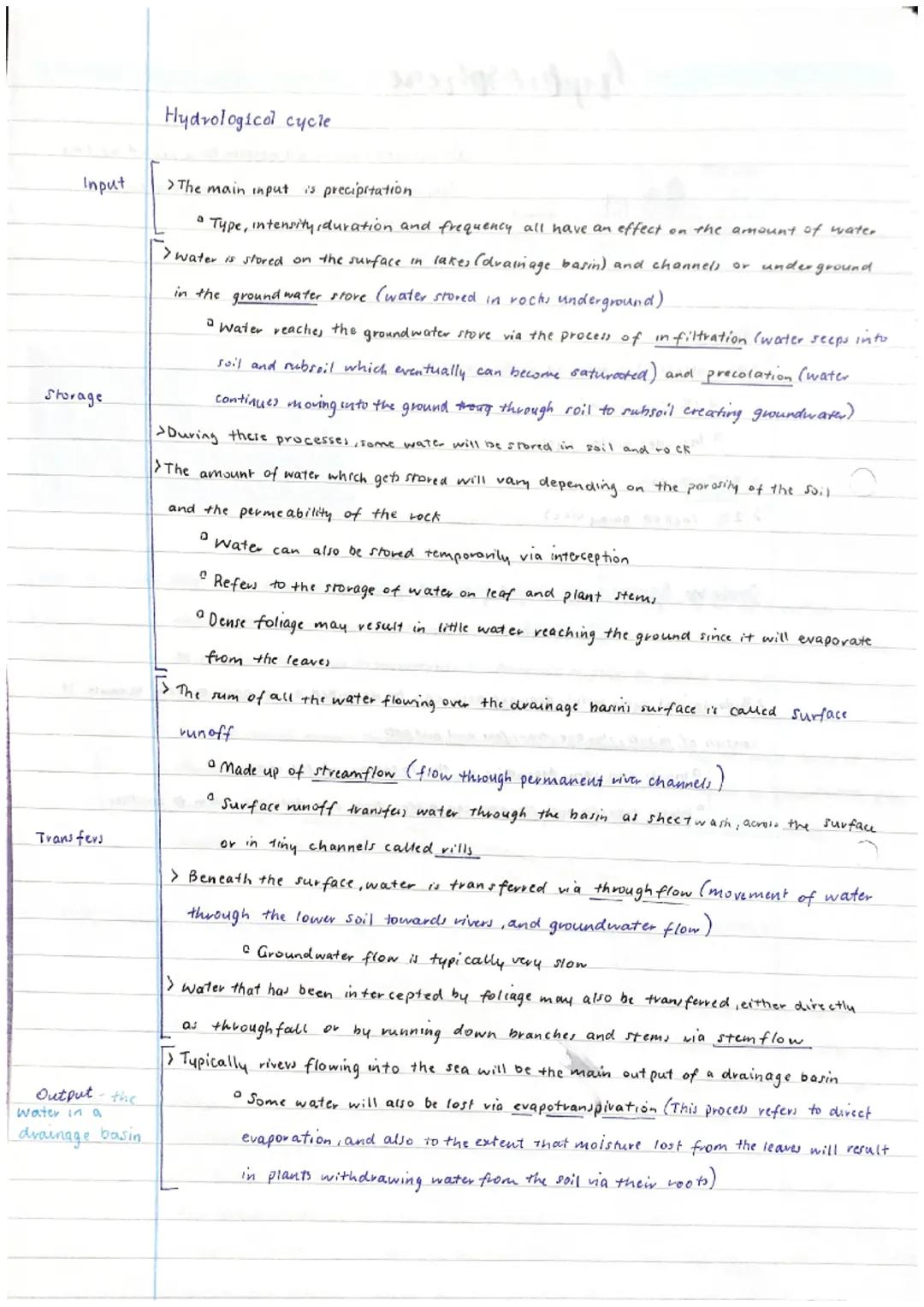
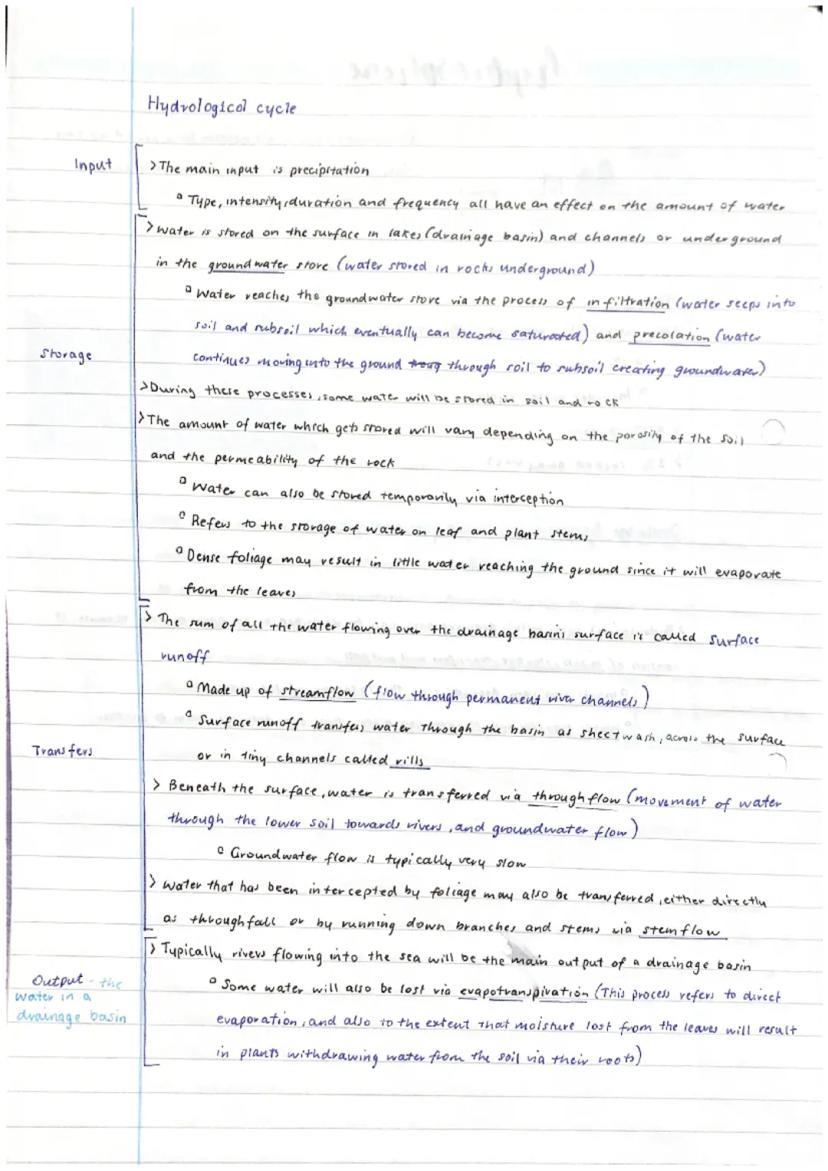
Precipitation is the main input that kicks everything off. The type, intensity and duration of rainfall massively affects how much water enters the system. Once it arrives, water gets stored in various places - on the surface in lakes and river channels, or underground in the groundwater store.
Getting underground isn't instant though. Water first goes through infiltration (seeping into soil) then percolation (continuing deeper to create groundwater). How much gets stored depends on soil porosity and rock permeability - basically how many gaps there are and how well connected they are.
Interception happens when vegetation catches rainwater on leaves and stems before it hits the ground. Dense forest canopy can stop loads of water reaching the soil because it evaporates straight from the leaves instead.
Water moves around the basin through surface runoff (flowing over the ground), throughflow (moving through upper soil layers), and groundwater flow (very slow movement through rocks). Eventually, most water exits through rivers reaching the sea, though some escapes via evapotranspiration - that's direct evaporation plus moisture lost through plant leaves.
Remember: Groundwater flow is incredibly slow compared to surface runoff - it can take years to reach a river!
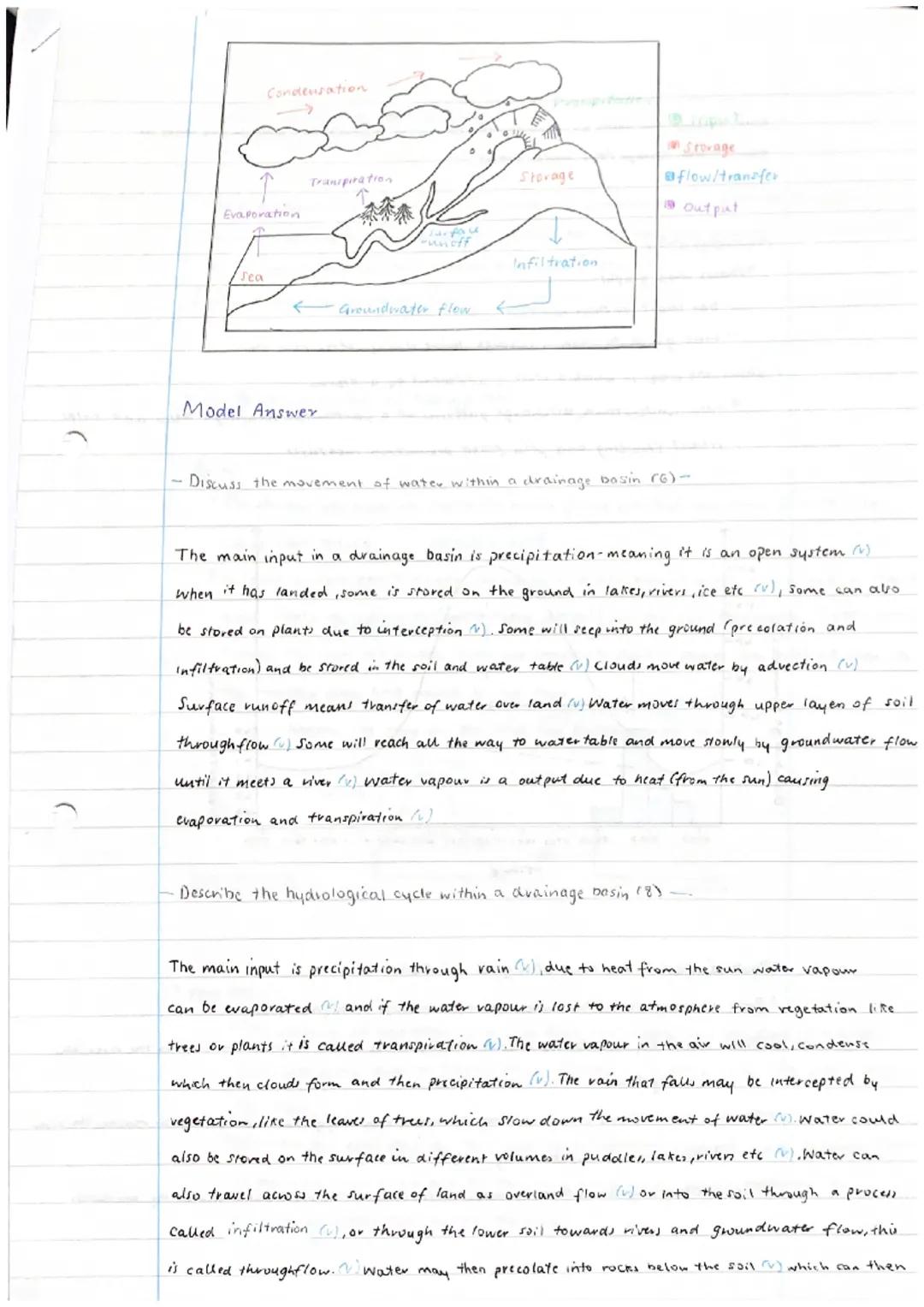
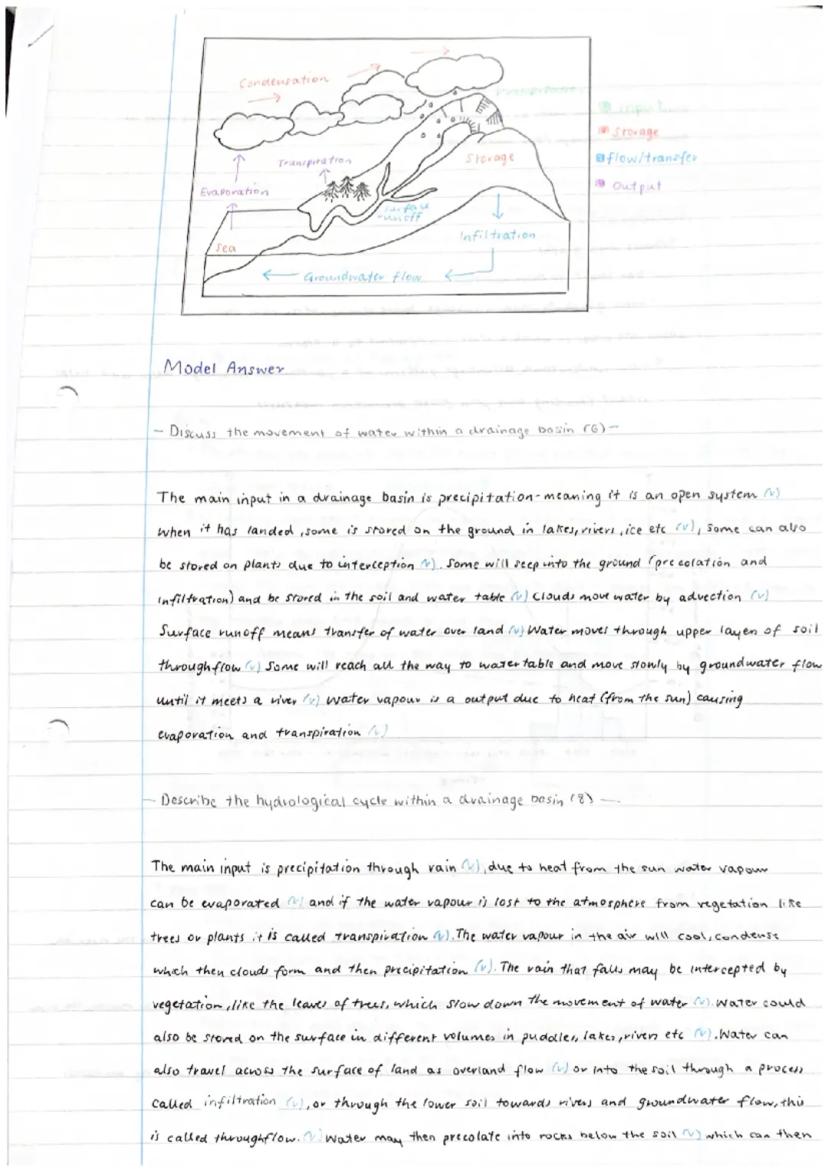
Picture the whole system working together: evaporation from the sea creates water vapour that forms clouds through condensation. Advection (cloud movement by wind) brings these clouds over land where they release precipitation.
This creates a continuous loop where water constantly moves between different stores and transfers. Some gets temporarily held by interception on vegetation, some flows as surface runoff, whilst other water infiltrates down to join groundwater flow systems.
The beauty of this system is that it's self-sustaining. Solar energy drives evaporation and transpiration, gravity pulls water downhill, and the whole cycle keeps repeating. Each drainage basin has its own unique characteristics depending on local climate, geology, and vegetation.
Understanding this helps explain why some areas flood whilst others suffer droughts, and why protecting watersheds is crucial for water security.
Key Point: This is an open system because water can enter from outside (precipitation) and leave the basin (rivers to sea, evapotranspiration to atmosphere).
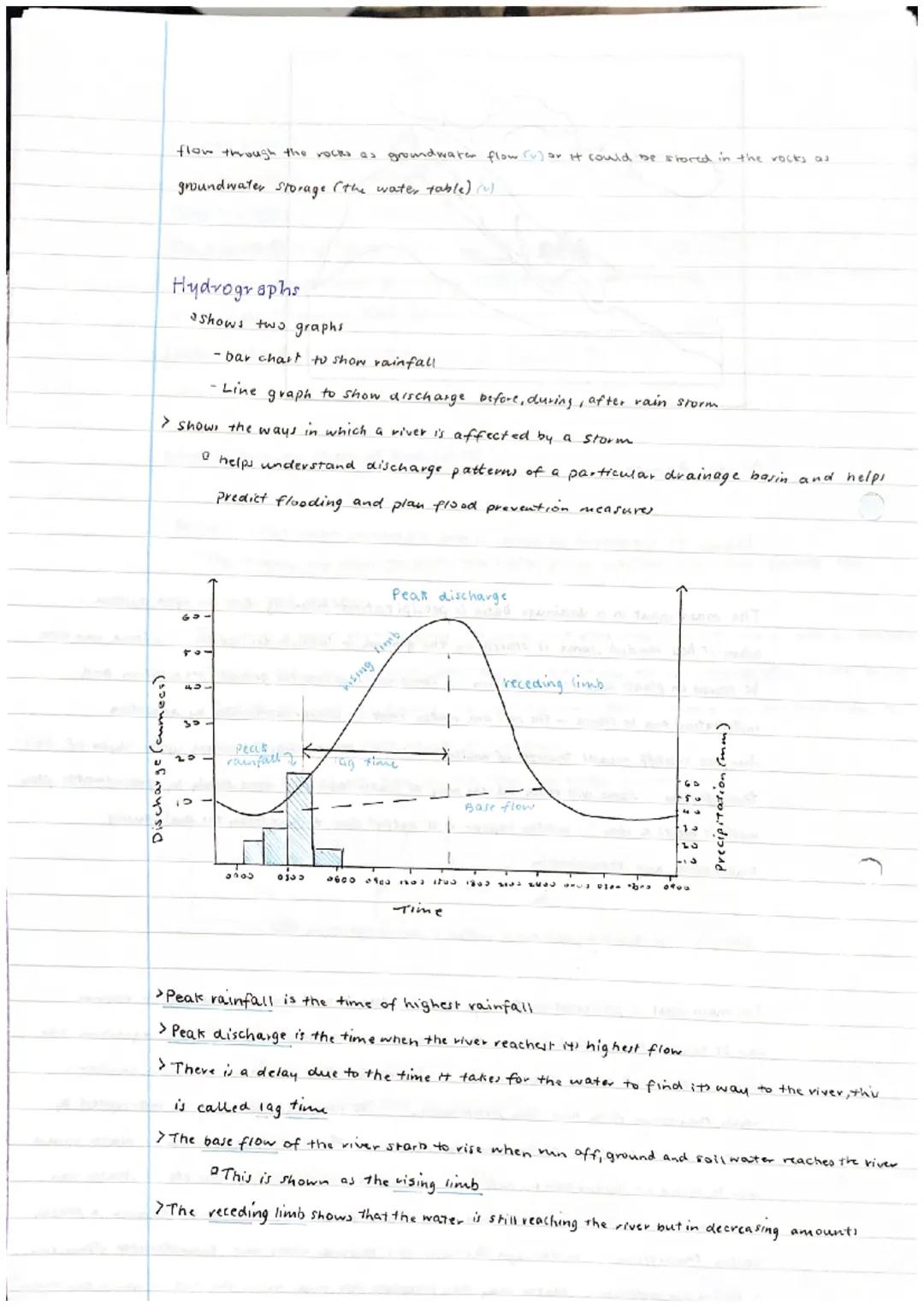
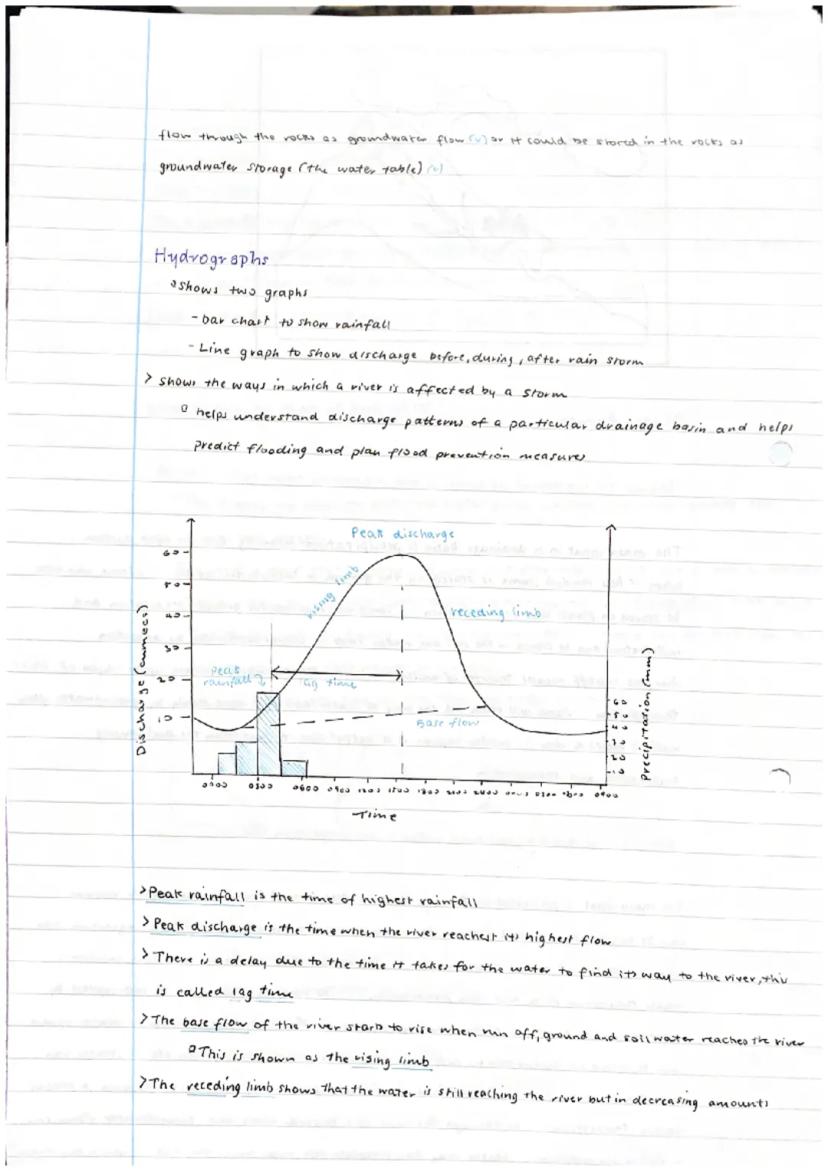
Hydrographs are like the river's medical chart - they show exactly how a river responds to rainfall events. You'll see a bar chart showing precipitation alongside a line graph tracking discharge (water flow measured in cumecs).
The pattern is fairly predictable: peak rainfall happens first, followed by peak discharge after a delay called lag time. This delay exists because water takes time to travel from where it falls to the river channel.
The rising limb shows discharge increasing as runoff and groundwater reach the river. Base flow is the river's normal level, which starts climbing as more water arrives. After peak discharge, the receding limb shows water levels dropping as the storm's effects wear off.
These graphs are incredibly useful for predicting floods and planning defences. By understanding how quickly a river responds to rainfall, authorities can issue warnings and take protective measures.
Practical Use: Hydrographs help predict flooding timing - crucial for emergency planning and evacuation procedures.
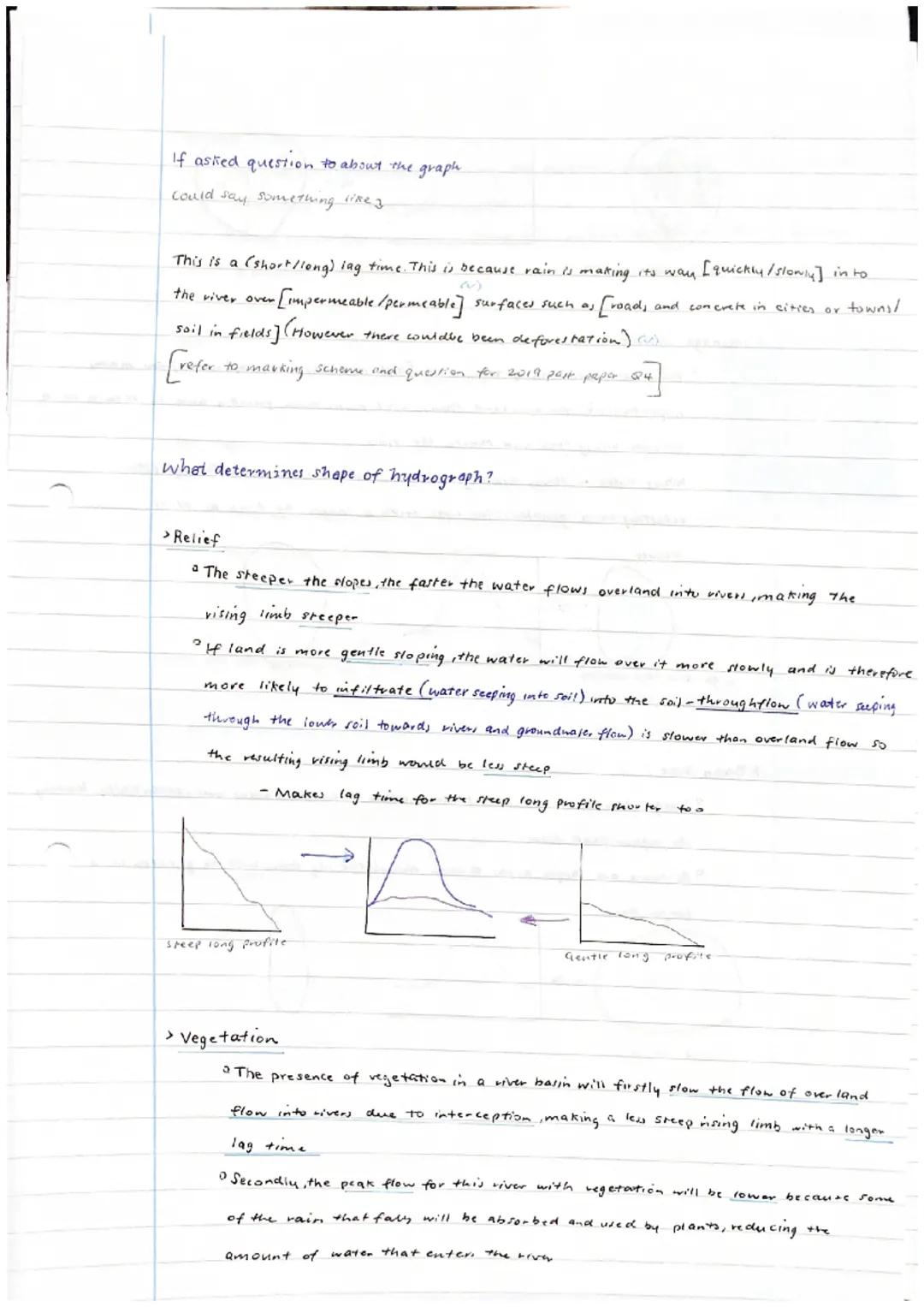
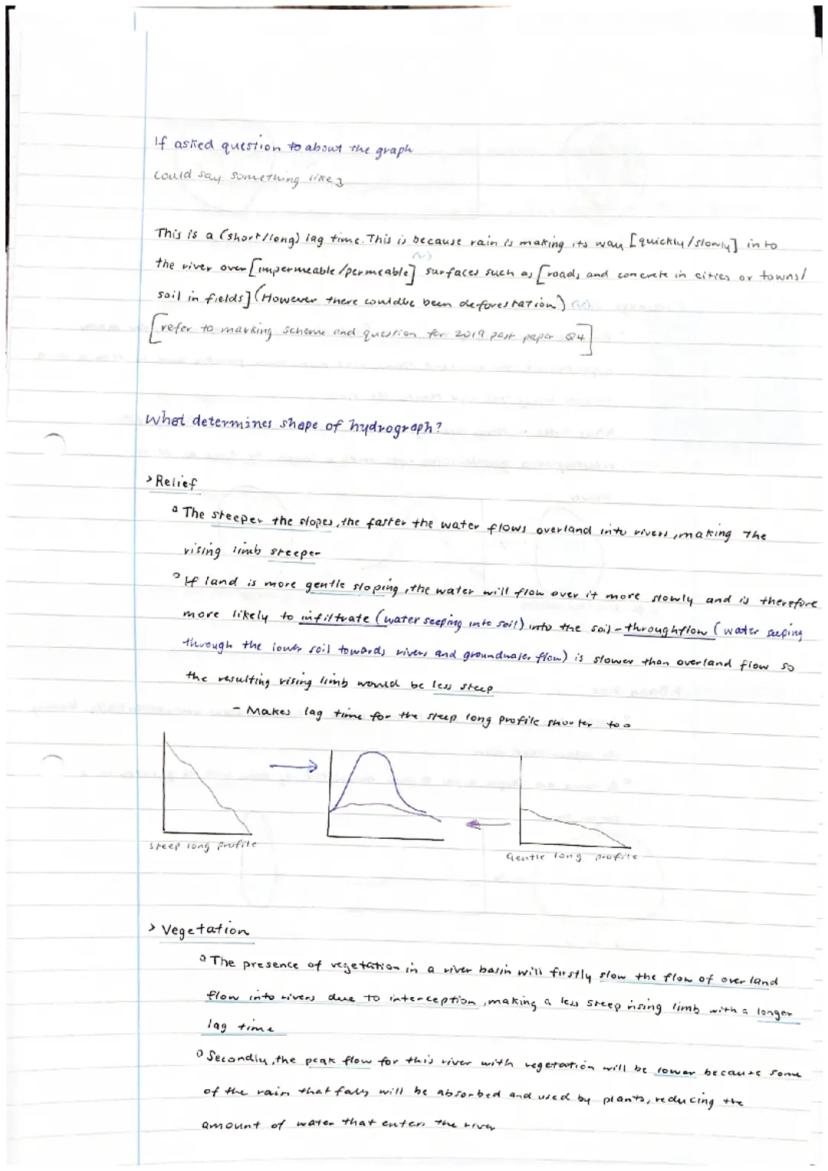
Several factors determine whether a river has a steep, dramatic response or a gentle, delayed reaction to rainfall. Relief (slope steepness) is massive - steep slopes mean faster overland flow, creating a steeper rising limb and shorter lag time. Gentle slopes allow more infiltration, slowing the response.
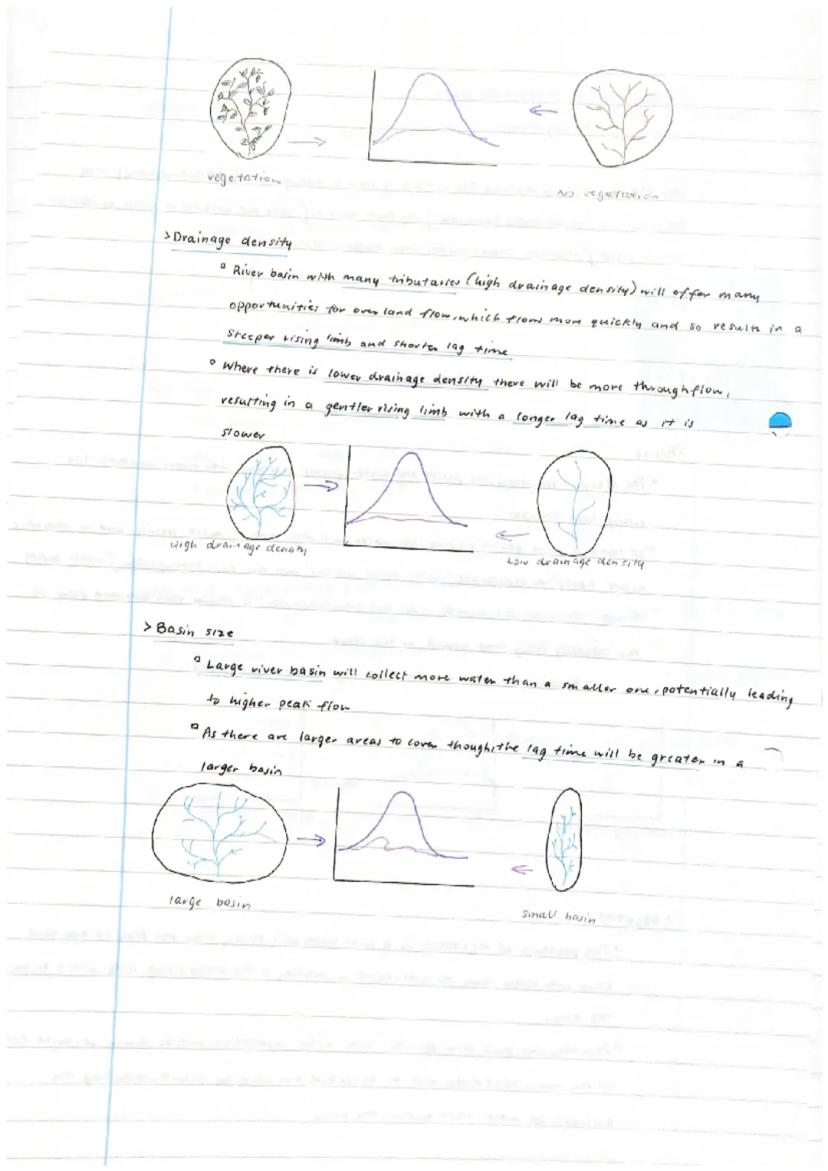
Vegetation acts like nature's speed bump. Trees and plants intercept rainfall and slow overland flow, creating a gentler rising limb with longer lag time. Plus, plants absorb water for growth, reducing the peak flow altogether.
Drainage density (how many tributaries exist) affects speed too. Lots of tributaries mean more opportunities for fast overland flow, whilst fewer tributaries force more water through slower throughflow systems.
Basin size creates a trade-off: larger basins collect more water (higher peak flow) but take longer to respond (greater lag time) because water has further to travel.
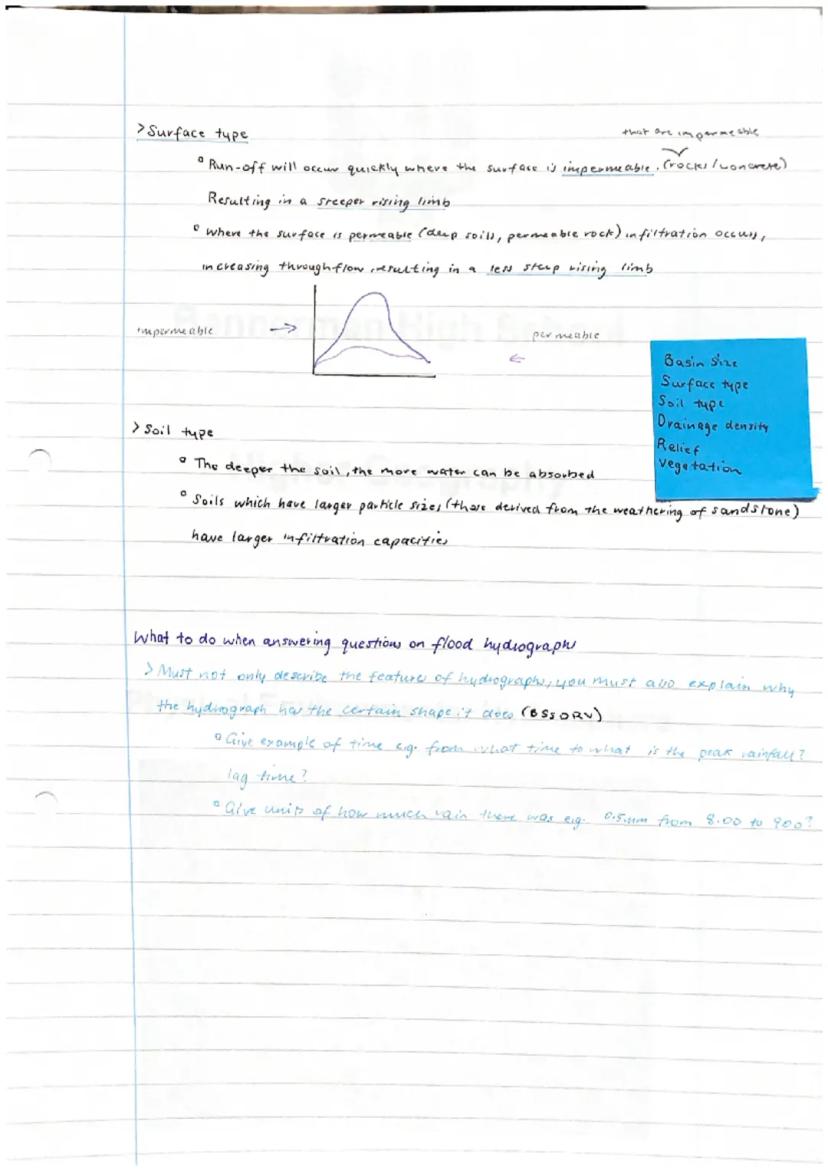
Study Tip: Remember the acronym BSSORV - Basin size, Surface type, Soil type, Organisation (drainage density), Relief, Vegetation - covers all the key factors!
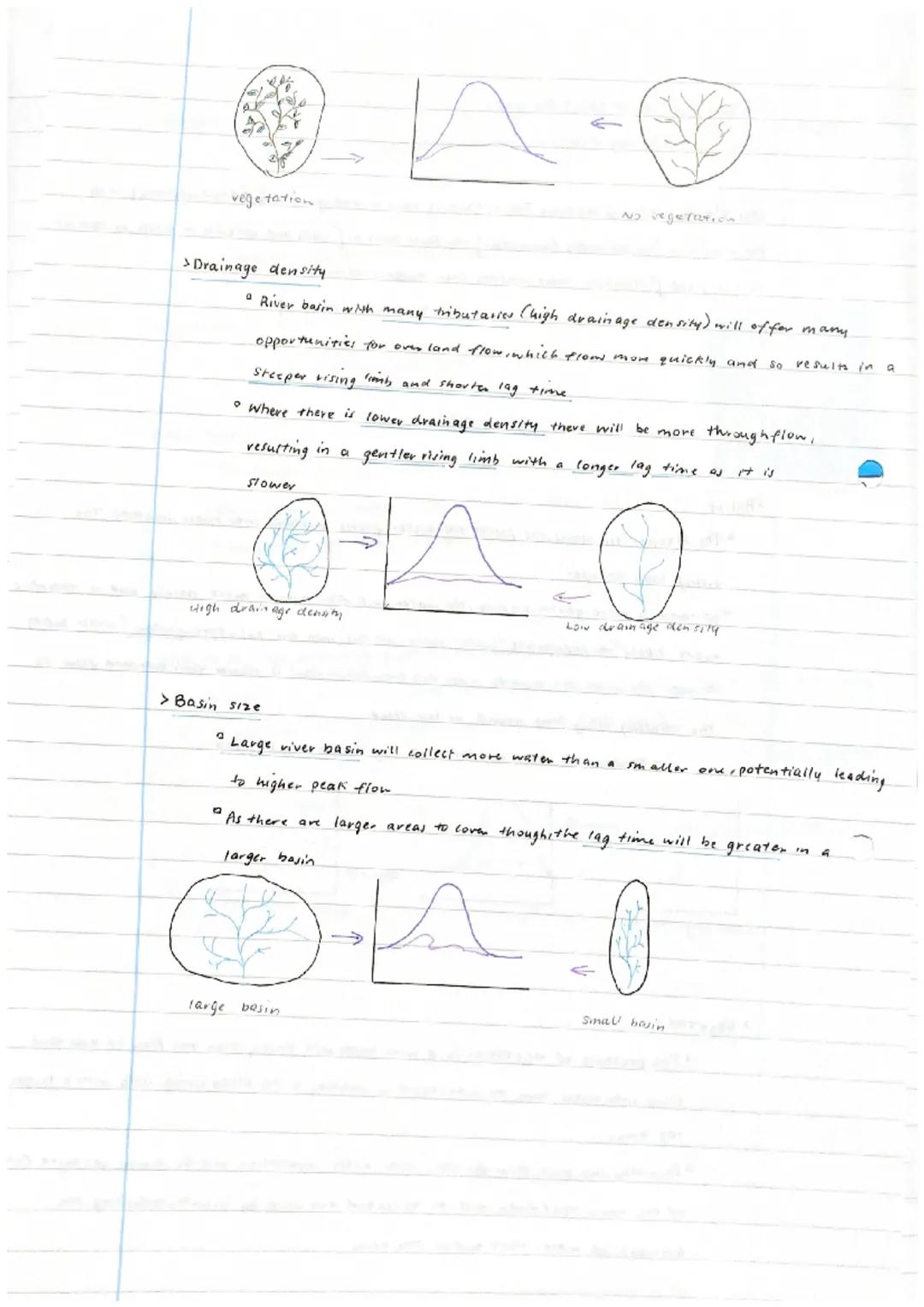
Surface type dramatically affects how quickly water reaches rivers. Impermeable surfaces like concrete or solid rock create rapid runoff, leading to steeper rising limbs and shorter lag times. Permeable surfaces like deep soils allow infiltration, slowing the response through throughflow.
Soil type matters just as much. Deeper soils can absorb more water before becoming saturated. Soils with larger particle sizes (like those from weathered sandstone) have greater infiltration capacity - they can soak up water faster.
Urban areas typically show dramatic hydrograph responses because of all the impermeable concrete and tarmac. Rural areas with deep, permeable soils show much gentler responses because water takes time to move through the ground.
This explains why cities flood more readily than countryside during heavy rainfall - there's nowhere for the water to go except straight into drainage systems and rivers.
Real-world Application: Urban planners use this knowledge to design sustainable drainage systems (SUDS) that mimic natural infiltration processes.
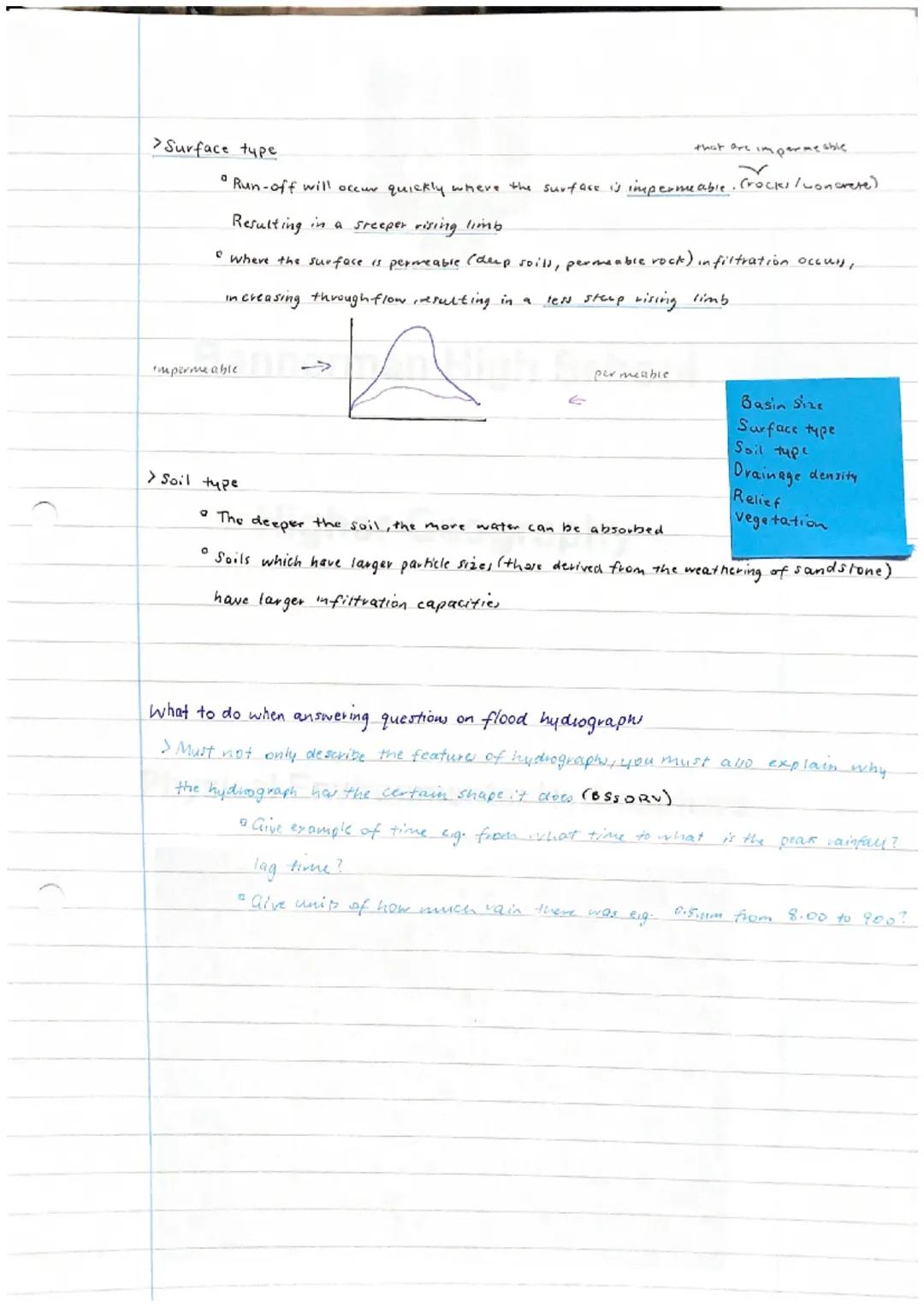
When tackling hydrograph questions, don't just describe what you see - explain why the pattern exists using those key factors. Always include specific timings (like "lag time of 3 hours from 14:00 to 17:00") and measurements .
Link the hydrograph shape to probable causes. A short lag time suggests impermeable surfaces, steep slopes, or limited vegetation. A long lag time indicates permeable geology, gentle relief, or dense forest cover.
Use the BSSORV factors to build your explanations: Basin size, Surface type, Soil type, Organisation (drainage density), Relief, and Vegetation. Each factor affects the speed and volume of water reaching the river differently.
Remember that real drainage basins usually show combinations of these factors, creating unique response patterns. Urban basins might have impermeable surfaces but also storm drains (high drainage density), whilst rural basins might have gentle slopes but thin soils over impermeable rock.
Exam Success: Always support descriptions with specific data from the graph and clear explanations using geographical processes and factors.
Our AI companion is specifically built for the needs of students. Based on the millions of content pieces we have on the platform we can provide truly meaningful and relevant answers to students. But its not only about answers, the companion is even more about guiding students through their daily learning challenges, with personalised study plans, quizzes or content pieces in the chat and 100% personalisation based on the students skills and developments.
You can download the app in the Google Play Store and in the Apple App Store.
That's right! Enjoy free access to study content, connect with fellow students, and get instant help – all at your fingertips.
App Store
Google Play
The app is very easy to use and well designed. I have found everything I was looking for so far and have been able to learn a lot from the presentations! I will definitely use the app for a class assignment! And of course it also helps a lot as an inspiration.
Stefan S
iOS user
This app is really great. There are so many study notes and help [...]. My problem subject is French, for example, and the app has so many options for help. Thanks to this app, I have improved my French. I would recommend it to anyone.
Samantha Klich
Android user
Wow, I am really amazed. I just tried the app because I've seen it advertised many times and was absolutely stunned. This app is THE HELP you want for school and above all, it offers so many things, such as workouts and fact sheets, which have been VERY helpful to me personally.
Anna
iOS user
I think it’s very much worth it and you’ll end up using it a lot once you get the hang of it and even after looking at others notes you can still ask your Artificial intelligence buddy the question and ask to simplify it if you still don’t get it!!! In the end I think it’s worth it 😊👍 ⚠️Also DID I MENTION ITS FREEE YOU DON’T HAVE TO PAY FOR ANYTHING AND STILL GET YOUR GRADES IN PERFECTLY❗️❗️⚠️
Thomas R
iOS user
Knowunity is the BEST app I’ve used in a minute. This is not an ai review or anything this is genuinely coming from a 7th grade student (I know 2011 im young) but dude this app is a 10/10 i have maintained a 3.8 gpa and have plenty of time for gaming. I love it and my mom is just happy I got good grades
Brad T
Android user
Not only did it help me find the answer but it also showed me alternative ways to solve it. I was horrible in math and science but now I have an a in both subjects. Thanks for the help🤍🤍
David K
iOS user
The app's just great! All I have to do is enter the topic in the search bar and I get the response real fast. I don't have to watch 10 YouTube videos to understand something, so I'm saving my time. Highly recommended!
Sudenaz Ocak
Android user
In school I was really bad at maths but thanks to the app, I am doing better now. I am so grateful that you made the app.
Greenlight Bonnie
Android user
I found this app a couple years ago and it has only gotten better since then. I really love it because it can help with written questions and photo questions. Also, it can find study guides that other people have made as well as flashcard sets and practice tests. The free version is also amazing for students who might not be able to afford it. Would 100% recommend
Aubrey
iOS user
Best app if you're in Highschool or Junior high. I have been using this app for 2 school years and it's the best, it's good if you don't have anyone to help you with school work.😋🩷🎀
Marco B
iOS user
THE QUIZES AND FLASHCARDS ARE SO USEFUL AND I LOVE THE SCHOOLGPT. IT ALSO IS LITREALLY LIKE CHATGPT BUT SMARTER!! HELPED ME WITH MY MASCARA PROBLEMS TOO!! AS WELL AS MY REAL SUBJECTS ! DUHHH 😍😁😲🤑💗✨🎀😮
Elisha
iOS user
This app is phenomenal down to the correct info and the various topics you can study! I greatly recommend it for people who struggle with procrastination and those who need homework help. It has been perfectly accurate for world 1 history as far as I’ve seen! Geometry too!
Paul T
iOS user
The app is very easy to use and well designed. I have found everything I was looking for so far and have been able to learn a lot from the presentations! I will definitely use the app for a class assignment! And of course it also helps a lot as an inspiration.
Stefan S
iOS user
This app is really great. There are so many study notes and help [...]. My problem subject is French, for example, and the app has so many options for help. Thanks to this app, I have improved my French. I would recommend it to anyone.
Samantha Klich
Android user
Wow, I am really amazed. I just tried the app because I've seen it advertised many times and was absolutely stunned. This app is THE HELP you want for school and above all, it offers so many things, such as workouts and fact sheets, which have been VERY helpful to me personally.
Anna
iOS user
I think it’s very much worth it and you’ll end up using it a lot once you get the hang of it and even after looking at others notes you can still ask your Artificial intelligence buddy the question and ask to simplify it if you still don’t get it!!! In the end I think it’s worth it 😊👍 ⚠️Also DID I MENTION ITS FREEE YOU DON’T HAVE TO PAY FOR ANYTHING AND STILL GET YOUR GRADES IN PERFECTLY❗️❗️⚠️
Thomas R
iOS user
Knowunity is the BEST app I’ve used in a minute. This is not an ai review or anything this is genuinely coming from a 7th grade student (I know 2011 im young) but dude this app is a 10/10 i have maintained a 3.8 gpa and have plenty of time for gaming. I love it and my mom is just happy I got good grades
Brad T
Android user
Not only did it help me find the answer but it also showed me alternative ways to solve it. I was horrible in math and science but now I have an a in both subjects. Thanks for the help🤍🤍
David K
iOS user
The app's just great! All I have to do is enter the topic in the search bar and I get the response real fast. I don't have to watch 10 YouTube videos to understand something, so I'm saving my time. Highly recommended!
Sudenaz Ocak
Android user
In school I was really bad at maths but thanks to the app, I am doing better now. I am so grateful that you made the app.
Greenlight Bonnie
Android user
I found this app a couple years ago and it has only gotten better since then. I really love it because it can help with written questions and photo questions. Also, it can find study guides that other people have made as well as flashcard sets and practice tests. The free version is also amazing for students who might not be able to afford it. Would 100% recommend
Aubrey
iOS user
Best app if you're in Highschool or Junior high. I have been using this app for 2 school years and it's the best, it's good if you don't have anyone to help you with school work.😋🩷🎀
Marco B
iOS user
THE QUIZES AND FLASHCARDS ARE SO USEFUL AND I LOVE THE SCHOOLGPT. IT ALSO IS LITREALLY LIKE CHATGPT BUT SMARTER!! HELPED ME WITH MY MASCARA PROBLEMS TOO!! AS WELL AS MY REAL SUBJECTS ! DUHHH 😍😁😲🤑💗✨🎀😮
Elisha
iOS user
This app is phenomenal down to the correct info and the various topics you can study! I greatly recommend it for people who struggle with procrastination and those who need homework help. It has been perfectly accurate for world 1 history as far as I’ve seen! Geometry too!
Paul T
iOS user
Sushi
@sausage_roll
Ever wondered what happens to rainwater after it hits the ground? The water cycle within a drainage basinis like nature's recycling system - water moves through different stages from rainfall to rivers to the sea and back again. Understanding... Show more
Access to all documents
Improve your grades
Join milions of students
By signing up you accept Terms of Service and Privacy Policy
Think of a drainage basin as nature's catchment area - it's the region where a river and its tributaries collect water from both above and below ground. This system works like a giant funnel, gathering rainfall and channelling it towards the sea.
When rain falls, it doesn't just disappear. Some water infiltrates into the soil, slowly making its way down to the water table - that's the level where soil becomes completely saturated with water. During dry periods, this water table drops as evaporation removes moisture from the surface.
A drainage basin functions as an open system because it has clear inputs (mainly precipitation), storage areas (lakes, soil, underground rocks), transfers (water movement), and outputs (rivers flowing to the sea). The key landmarks include the source (where the river starts), tributaries (smaller streams joining the main river), confluence (where rivers meet), and the mouth (where it reaches the sea).
Quick Tip: Only 1% of Earth's water is actively cycling through this system - 97% sits in oceans and 2% is locked away as ice!
Access to all documents
Improve your grades
Join milions of students
By signing up you accept Terms of Service and Privacy Policy
Precipitation is the main input that kicks everything off. The type, intensity and duration of rainfall massively affects how much water enters the system. Once it arrives, water gets stored in various places - on the surface in lakes and river channels, or underground in the groundwater store.
Getting underground isn't instant though. Water first goes through infiltration (seeping into soil) then percolation (continuing deeper to create groundwater). How much gets stored depends on soil porosity and rock permeability - basically how many gaps there are and how well connected they are.
Interception happens when vegetation catches rainwater on leaves and stems before it hits the ground. Dense forest canopy can stop loads of water reaching the soil because it evaporates straight from the leaves instead.
Water moves around the basin through surface runoff (flowing over the ground), throughflow (moving through upper soil layers), and groundwater flow (very slow movement through rocks). Eventually, most water exits through rivers reaching the sea, though some escapes via evapotranspiration - that's direct evaporation plus moisture lost through plant leaves.
Remember: Groundwater flow is incredibly slow compared to surface runoff - it can take years to reach a river!
Access to all documents
Improve your grades
Join milions of students
By signing up you accept Terms of Service and Privacy Policy
Picture the whole system working together: evaporation from the sea creates water vapour that forms clouds through condensation. Advection (cloud movement by wind) brings these clouds over land where they release precipitation.
This creates a continuous loop where water constantly moves between different stores and transfers. Some gets temporarily held by interception on vegetation, some flows as surface runoff, whilst other water infiltrates down to join groundwater flow systems.
The beauty of this system is that it's self-sustaining. Solar energy drives evaporation and transpiration, gravity pulls water downhill, and the whole cycle keeps repeating. Each drainage basin has its own unique characteristics depending on local climate, geology, and vegetation.
Understanding this helps explain why some areas flood whilst others suffer droughts, and why protecting watersheds is crucial for water security.
Key Point: This is an open system because water can enter from outside (precipitation) and leave the basin (rivers to sea, evapotranspiration to atmosphere).
Access to all documents
Improve your grades
Join milions of students
By signing up you accept Terms of Service and Privacy Policy
Hydrographs are like the river's medical chart - they show exactly how a river responds to rainfall events. You'll see a bar chart showing precipitation alongside a line graph tracking discharge (water flow measured in cumecs).
The pattern is fairly predictable: peak rainfall happens first, followed by peak discharge after a delay called lag time. This delay exists because water takes time to travel from where it falls to the river channel.
The rising limb shows discharge increasing as runoff and groundwater reach the river. Base flow is the river's normal level, which starts climbing as more water arrives. After peak discharge, the receding limb shows water levels dropping as the storm's effects wear off.
These graphs are incredibly useful for predicting floods and planning defences. By understanding how quickly a river responds to rainfall, authorities can issue warnings and take protective measures.
Practical Use: Hydrographs help predict flooding timing - crucial for emergency planning and evacuation procedures.
Access to all documents
Improve your grades
Join milions of students
By signing up you accept Terms of Service and Privacy Policy
Several factors determine whether a river has a steep, dramatic response or a gentle, delayed reaction to rainfall. Relief (slope steepness) is massive - steep slopes mean faster overland flow, creating a steeper rising limb and shorter lag time. Gentle slopes allow more infiltration, slowing the response.
Vegetation acts like nature's speed bump. Trees and plants intercept rainfall and slow overland flow, creating a gentler rising limb with longer lag time. Plus, plants absorb water for growth, reducing the peak flow altogether.
Drainage density (how many tributaries exist) affects speed too. Lots of tributaries mean more opportunities for fast overland flow, whilst fewer tributaries force more water through slower throughflow systems.
Basin size creates a trade-off: larger basins collect more water (higher peak flow) but take longer to respond (greater lag time) because water has further to travel.
Study Tip: Remember the acronym BSSORV - Basin size, Surface type, Soil type, Organisation (drainage density), Relief, Vegetation - covers all the key factors!
Access to all documents
Improve your grades
Join milions of students
By signing up you accept Terms of Service and Privacy Policy
Surface type dramatically affects how quickly water reaches rivers. Impermeable surfaces like concrete or solid rock create rapid runoff, leading to steeper rising limbs and shorter lag times. Permeable surfaces like deep soils allow infiltration, slowing the response through throughflow.
Soil type matters just as much. Deeper soils can absorb more water before becoming saturated. Soils with larger particle sizes (like those from weathered sandstone) have greater infiltration capacity - they can soak up water faster.
Urban areas typically show dramatic hydrograph responses because of all the impermeable concrete and tarmac. Rural areas with deep, permeable soils show much gentler responses because water takes time to move through the ground.
This explains why cities flood more readily than countryside during heavy rainfall - there's nowhere for the water to go except straight into drainage systems and rivers.
Real-world Application: Urban planners use this knowledge to design sustainable drainage systems (SUDS) that mimic natural infiltration processes.
Access to all documents
Improve your grades
Join milions of students
By signing up you accept Terms of Service and Privacy Policy
When tackling hydrograph questions, don't just describe what you see - explain why the pattern exists using those key factors. Always include specific timings (like "lag time of 3 hours from 14:00 to 17:00") and measurements .
Link the hydrograph shape to probable causes. A short lag time suggests impermeable surfaces, steep slopes, or limited vegetation. A long lag time indicates permeable geology, gentle relief, or dense forest cover.
Use the BSSORV factors to build your explanations: Basin size, Surface type, Soil type, Organisation (drainage density), Relief, and Vegetation. Each factor affects the speed and volume of water reaching the river differently.
Remember that real drainage basins usually show combinations of these factors, creating unique response patterns. Urban basins might have impermeable surfaces but also storm drains (high drainage density), whilst rural basins might have gentle slopes but thin soils over impermeable rock.
Exam Success: Always support descriptions with specific data from the graph and clear explanations using geographical processes and factors.
Our AI companion is specifically built for the needs of students. Based on the millions of content pieces we have on the platform we can provide truly meaningful and relevant answers to students. But its not only about answers, the companion is even more about guiding students through their daily learning challenges, with personalised study plans, quizzes or content pieces in the chat and 100% personalisation based on the students skills and developments.
You can download the app in the Google Play Store and in the Apple App Store.
That's right! Enjoy free access to study content, connect with fellow students, and get instant help – all at your fingertips.
7
Smart Tools NEW
Transform this note into: ✓ 50+ Practice Questions ✓ Interactive Flashcards ✓ Full Mock Exam ✓ Essay Outlines
unit 1 test
 Biology
A basic run-down of what food chains/webs/pyramids consist of, including definitions and an explanation of the 10% Rule of Energy Transfer.
Biologyenvironmental science
BiologyLearn about the process of photosynthesis, the role of chlorophyll, chloroplasts, and xylem, and interesting facts about organisms that can undergo photosynthesis.
BiologyExplore the mechanisms of coastal erosion and mass movement, including the impact of waves, gravity, and water saturation on coastal landscapes. This summary covers destructive and constructive waves, mass movement types, and erosion processes such as hydraulic action, abrasion, and attrition. Ideal for geography students studying coastal processes.
BiologyExplore the multifaceted concept of development, including key indicators like GDP and HDI, and the impact of globalisation on economic growth. This summary covers theories of development, the role of emerging economies like India, and the social, historical, and environmental factors influencing global disparities. Ideal for students studying global development and economics.
BiologyApp Store
Google Play
The app is very easy to use and well designed. I have found everything I was looking for so far and have been able to learn a lot from the presentations! I will definitely use the app for a class assignment! And of course it also helps a lot as an inspiration.
Stefan S
iOS user
This app is really great. There are so many study notes and help [...]. My problem subject is French, for example, and the app has so many options for help. Thanks to this app, I have improved my French. I would recommend it to anyone.
Samantha Klich
Android user
Wow, I am really amazed. I just tried the app because I've seen it advertised many times and was absolutely stunned. This app is THE HELP you want for school and above all, it offers so many things, such as workouts and fact sheets, which have been VERY helpful to me personally.
Anna
iOS user
I think it’s very much worth it and you’ll end up using it a lot once you get the hang of it and even after looking at others notes you can still ask your Artificial intelligence buddy the question and ask to simplify it if you still don’t get it!!! In the end I think it’s worth it 😊👍 ⚠️Also DID I MENTION ITS FREEE YOU DON’T HAVE TO PAY FOR ANYTHING AND STILL GET YOUR GRADES IN PERFECTLY❗️❗️⚠️
Thomas R
iOS user
Knowunity is the BEST app I’ve used in a minute. This is not an ai review or anything this is genuinely coming from a 7th grade student (I know 2011 im young) but dude this app is a 10/10 i have maintained a 3.8 gpa and have plenty of time for gaming. I love it and my mom is just happy I got good grades
Brad T
Android user
Not only did it help me find the answer but it also showed me alternative ways to solve it. I was horrible in math and science but now I have an a in both subjects. Thanks for the help🤍🤍
David K
iOS user
The app's just great! All I have to do is enter the topic in the search bar and I get the response real fast. I don't have to watch 10 YouTube videos to understand something, so I'm saving my time. Highly recommended!
Sudenaz Ocak
Android user
In school I was really bad at maths but thanks to the app, I am doing better now. I am so grateful that you made the app.
Greenlight Bonnie
Android user
I found this app a couple years ago and it has only gotten better since then. I really love it because it can help with written questions and photo questions. Also, it can find study guides that other people have made as well as flashcard sets and practice tests. The free version is also amazing for students who might not be able to afford it. Would 100% recommend
Aubrey
iOS user
Best app if you're in Highschool or Junior high. I have been using this app for 2 school years and it's the best, it's good if you don't have anyone to help you with school work.😋🩷🎀
Marco B
iOS user
THE QUIZES AND FLASHCARDS ARE SO USEFUL AND I LOVE THE SCHOOLGPT. IT ALSO IS LITREALLY LIKE CHATGPT BUT SMARTER!! HELPED ME WITH MY MASCARA PROBLEMS TOO!! AS WELL AS MY REAL SUBJECTS ! DUHHH 😍😁😲🤑💗✨🎀😮
Elisha
iOS user
This app is phenomenal down to the correct info and the various topics you can study! I greatly recommend it for people who struggle with procrastination and those who need homework help. It has been perfectly accurate for world 1 history as far as I’ve seen! Geometry too!
Paul T
iOS user
The app is very easy to use and well designed. I have found everything I was looking for so far and have been able to learn a lot from the presentations! I will definitely use the app for a class assignment! And of course it also helps a lot as an inspiration.
Stefan S
iOS user
This app is really great. There are so many study notes and help [...]. My problem subject is French, for example, and the app has so many options for help. Thanks to this app, I have improved my French. I would recommend it to anyone.
Samantha Klich
Android user
Wow, I am really amazed. I just tried the app because I've seen it advertised many times and was absolutely stunned. This app is THE HELP you want for school and above all, it offers so many things, such as workouts and fact sheets, which have been VERY helpful to me personally.
Anna
iOS user
I think it’s very much worth it and you’ll end up using it a lot once you get the hang of it and even after looking at others notes you can still ask your Artificial intelligence buddy the question and ask to simplify it if you still don’t get it!!! In the end I think it’s worth it 😊👍 ⚠️Also DID I MENTION ITS FREEE YOU DON’T HAVE TO PAY FOR ANYTHING AND STILL GET YOUR GRADES IN PERFECTLY❗️❗️⚠️
Thomas R
iOS user
Knowunity is the BEST app I’ve used in a minute. This is not an ai review or anything this is genuinely coming from a 7th grade student (I know 2011 im young) but dude this app is a 10/10 i have maintained a 3.8 gpa and have plenty of time for gaming. I love it and my mom is just happy I got good grades
Brad T
Android user
Not only did it help me find the answer but it also showed me alternative ways to solve it. I was horrible in math and science but now I have an a in both subjects. Thanks for the help🤍🤍
David K
iOS user
The app's just great! All I have to do is enter the topic in the search bar and I get the response real fast. I don't have to watch 10 YouTube videos to understand something, so I'm saving my time. Highly recommended!
Sudenaz Ocak
Android user
In school I was really bad at maths but thanks to the app, I am doing better now. I am so grateful that you made the app.
Greenlight Bonnie
Android user
I found this app a couple years ago and it has only gotten better since then. I really love it because it can help with written questions and photo questions. Also, it can find study guides that other people have made as well as flashcard sets and practice tests. The free version is also amazing for students who might not be able to afford it. Would 100% recommend
Aubrey
iOS user
Best app if you're in Highschool or Junior high. I have been using this app for 2 school years and it's the best, it's good if you don't have anyone to help you with school work.😋🩷🎀
Marco B
iOS user
THE QUIZES AND FLASHCARDS ARE SO USEFUL AND I LOVE THE SCHOOLGPT. IT ALSO IS LITREALLY LIKE CHATGPT BUT SMARTER!! HELPED ME WITH MY MASCARA PROBLEMS TOO!! AS WELL AS MY REAL SUBJECTS ! DUHHH 😍😁😲🤑💗✨🎀😮
Elisha
iOS user
This app is phenomenal down to the correct info and the various topics you can study! I greatly recommend it for people who struggle with procrastination and those who need homework help. It has been perfectly accurate for world 1 history as far as I’ve seen! Geometry too!
Paul T
iOS user