

Welcome to the fascinating world of atomic theory! This guide... Show more
 Algebra
 Biology
Sign up to see the contentIt's free!
Access to all documents
Improve your grades
Join milions of students
Knowunity AI
Subjects
Triangle Congruence and Similarity Theorems
Triangle Properties and Classification
Linear Equations and Graphs
Geometric Angle Relationships
Trigonometric Functions and Identities
Equation Solving Techniques
Circle Geometry Fundamentals
Division Operations and Methods
Basic Differentiation Rules
Exponent and Logarithm Properties
Show all topics
Human Organ Systems
Reproductive Cell Cycles
Biological Sciences Subdisciplines
Cellular Energy Metabolism
Autotrophic Energy Processes
Inheritance Patterns and Principles
Biomolecular Structure and Organization
Cell Cycle and Division Mechanics
Cellular Organization and Development
Biological Structural Organization
Show all topics
Chemical Sciences and Applications
Atomic Structure and Composition
Molecular Electron Structure Representation
Atomic Electron Behavior
Matter Properties and Water
Mole Concept and Calculations
Gas Laws and Behavior
Periodic Table Organization
Chemical Thermodynamics Fundamentals
Chemical Bond Types and Properties
Show all topics
European Renaissance and Enlightenment
European Cultural Movements 800-1920
American Revolution Era 1763-1797
American Civil War 1861-1865
Global Imperial Systems
Mongol and Chinese Dynasties
U.S. Presidents and World Leaders
Historical Sources and Documentation
World Wars Era and Impact
World Religious Systems
Show all topics
Classic and Contemporary Novels
Literary Character Analysis
Rhetorical Theory and Practice
Classic Literary Narratives
Reading Analysis and Interpretation
Narrative Structure and Techniques
English Language Components
Influential English-Language Authors
Basic Sentence Structure
Narrative Voice and Perspective
Show all topics
437
•
Updated Apr 4, 2026
•
Welcome to the fascinating world of atomic theory! This guide... Show more
Ever wondered what atoms really look like? The quantum mechanical model is the most advanced and accurate description of atomic structure we have today.
This model represents a significant leap forward from earlier atomic theories, showing atoms not as tiny solar systems, but as complex systems where electrons exist in clouds of probability.
Unlike previous models, the quantum approach doesn't try to pinpoint exactly where electrons are, but instead tells us where they're most likely to be found.
Did You Know? The quantum mechanical model might seem strange, but it successfully explains atomic behavior that no previous model could account for!
Atomic theory has evolved dramatically over time, with each model improving on the last:
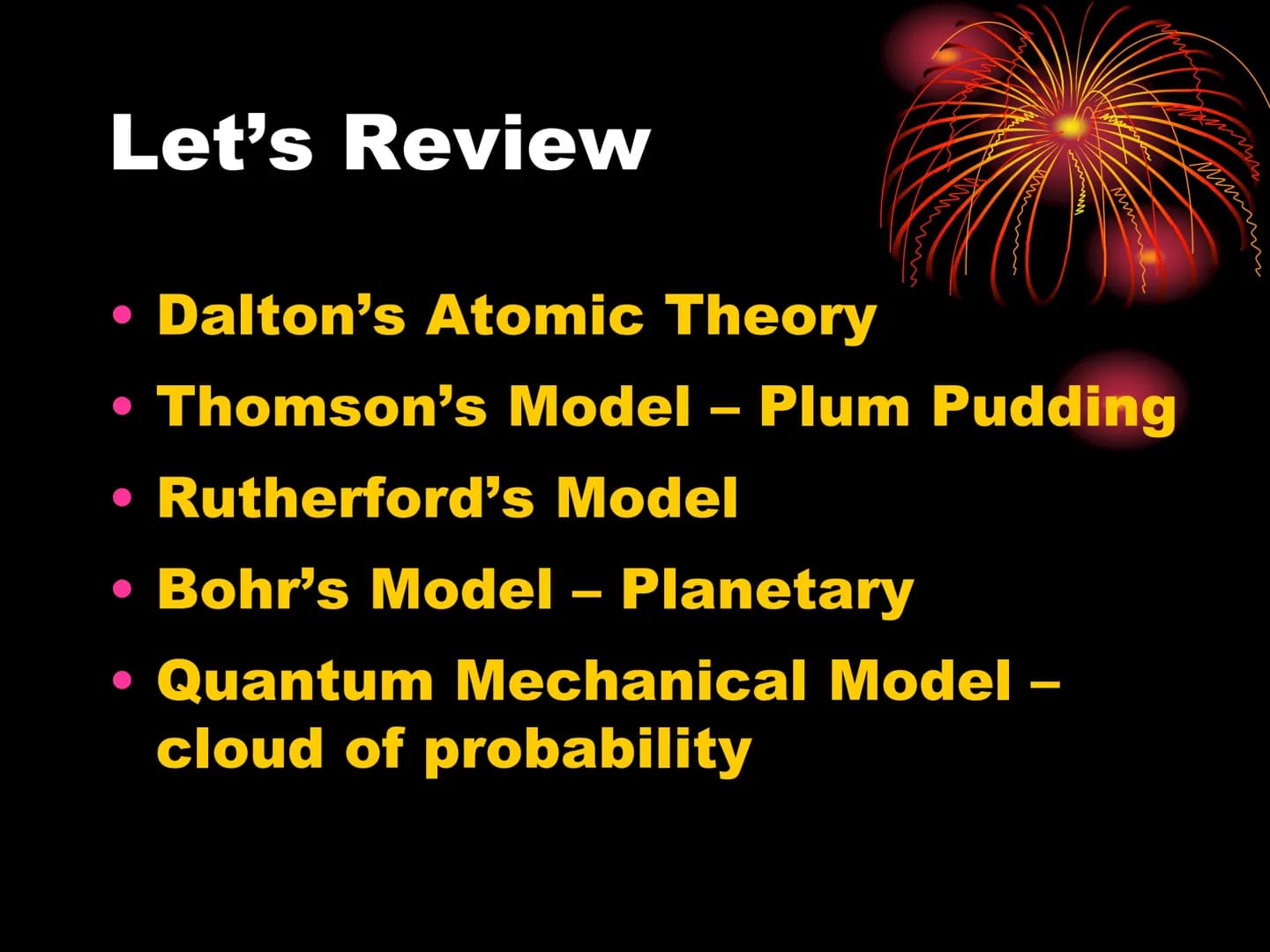
Dalton's Atomic Theory started it all, proposing that matter consists of indivisible particles called atoms. Then came Thomson's Plum Pudding Model, which suggested electrons were embedded in a positive mass.
Rutherford's Model introduced the nuclear concept, placing a dense, positive nucleus at the center with electrons orbiting around it. Bohr's Planetary Model refined this by placing electrons in fixed energy levels or orbits.
Finally, the Quantum Mechanical Model replaced exact orbits with clouds of probability, reflecting the uncertain nature of electron positions.
Remember: Each model solved problems with previous theories while creating new questions that led to better models!
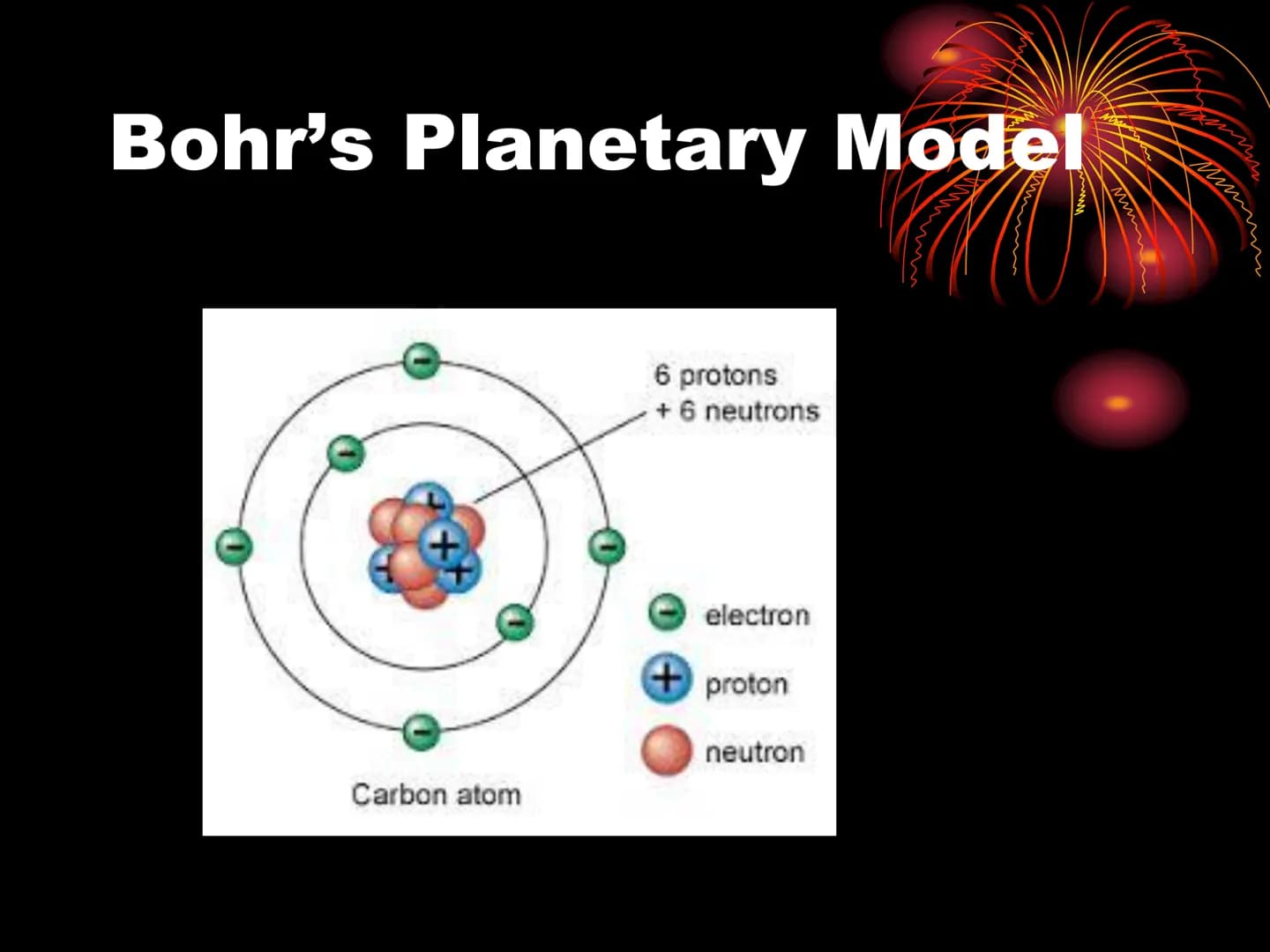
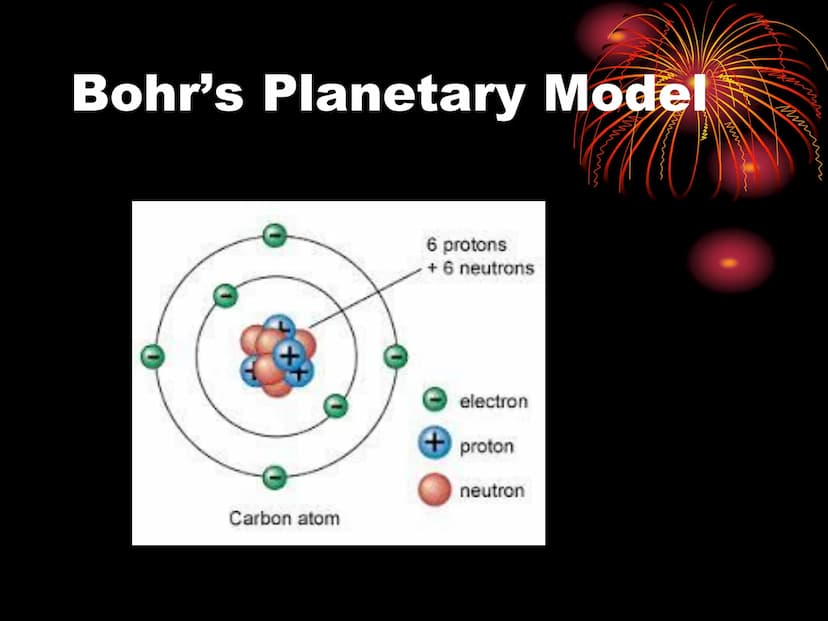
Bohr's model represented a significant breakthrough in atomic theory, picturing electrons orbiting the nucleus like planets around the sun.
In this model of a carbon atom, six protons and six neutrons form the nucleus, while six electrons orbit in fixed paths or "energy levels" around it. The electrons can only exist in these specific energy levels - not anywhere in between.
Though ultimately replaced by the quantum mechanical model, Bohr's model successfully explained certain atomic behaviors and introduced the critical concept of quantized energy levels.
Quick Tip: Think of Bohr's model as a stepping stone - it's not completely accurate, but it helped scientists move toward our current understanding.
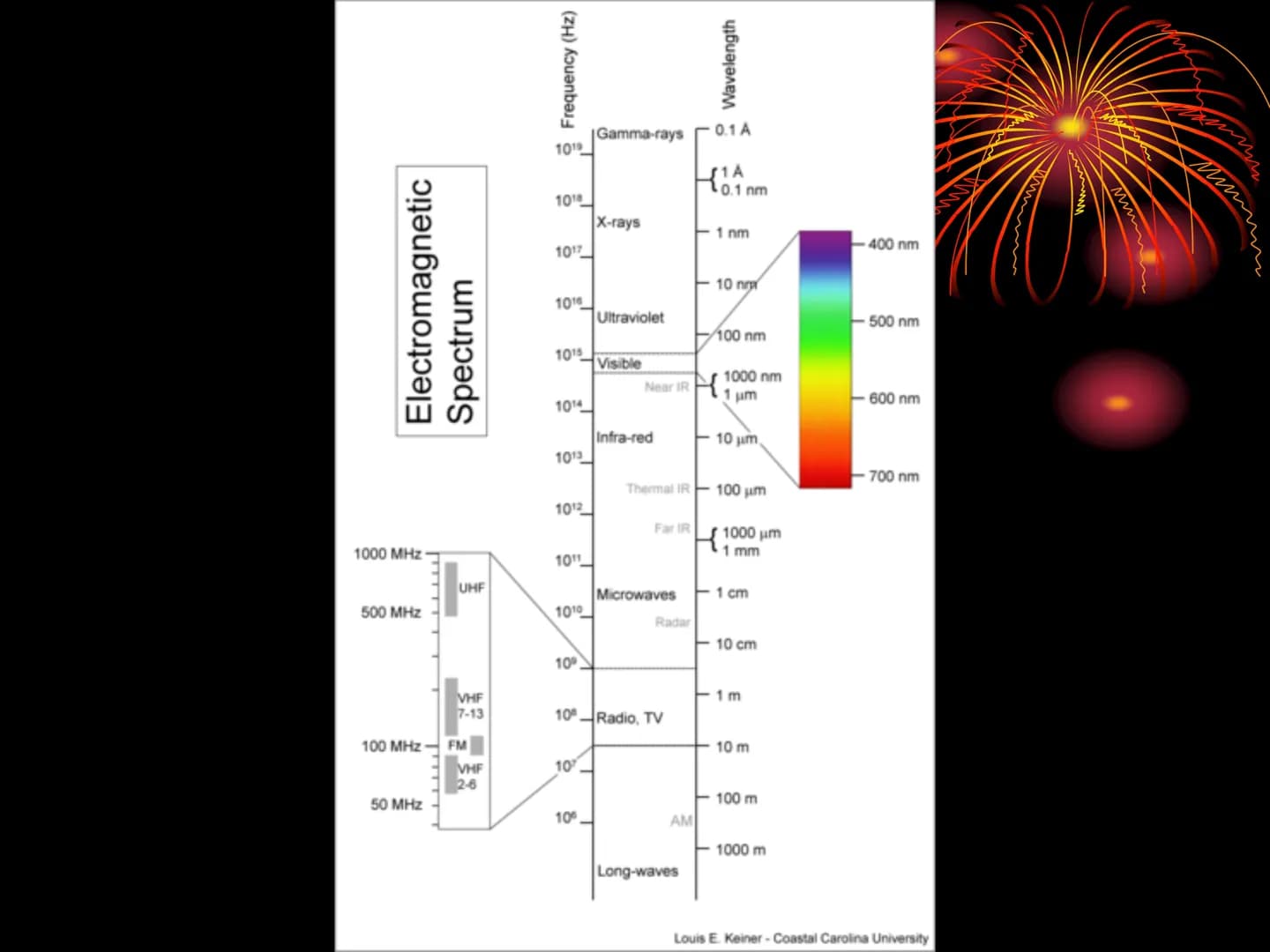
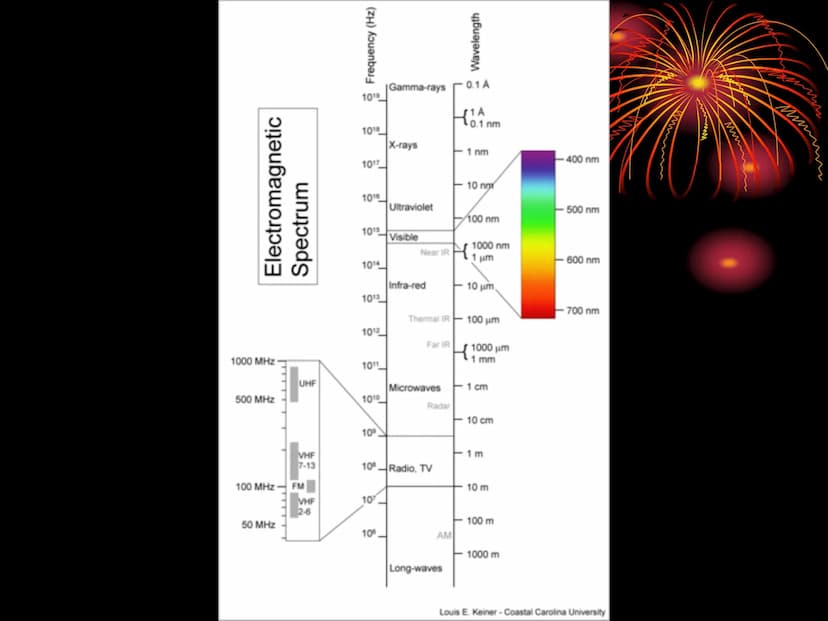
Light travels in waves with different wavelengths and frequencies, forming the electromagnetic spectrum. The shorter the wavelength, the higher the frequency and energy.
The spectrum ranges from high-energy gamma rays (tiny wavelengths around 0.1 Å) through X-rays, ultraviolet, visible light, infrared, and radio waves (long wavelengths up to 1000 meters).
Visible light is just a small slice of this spectrum—wavelengths between 400-700 nanometers that our eyes can detect as different colors.
Make the Connection: The electromagnetic spectrum is key to understanding how atoms absorb and emit energy, which reveals their structure!
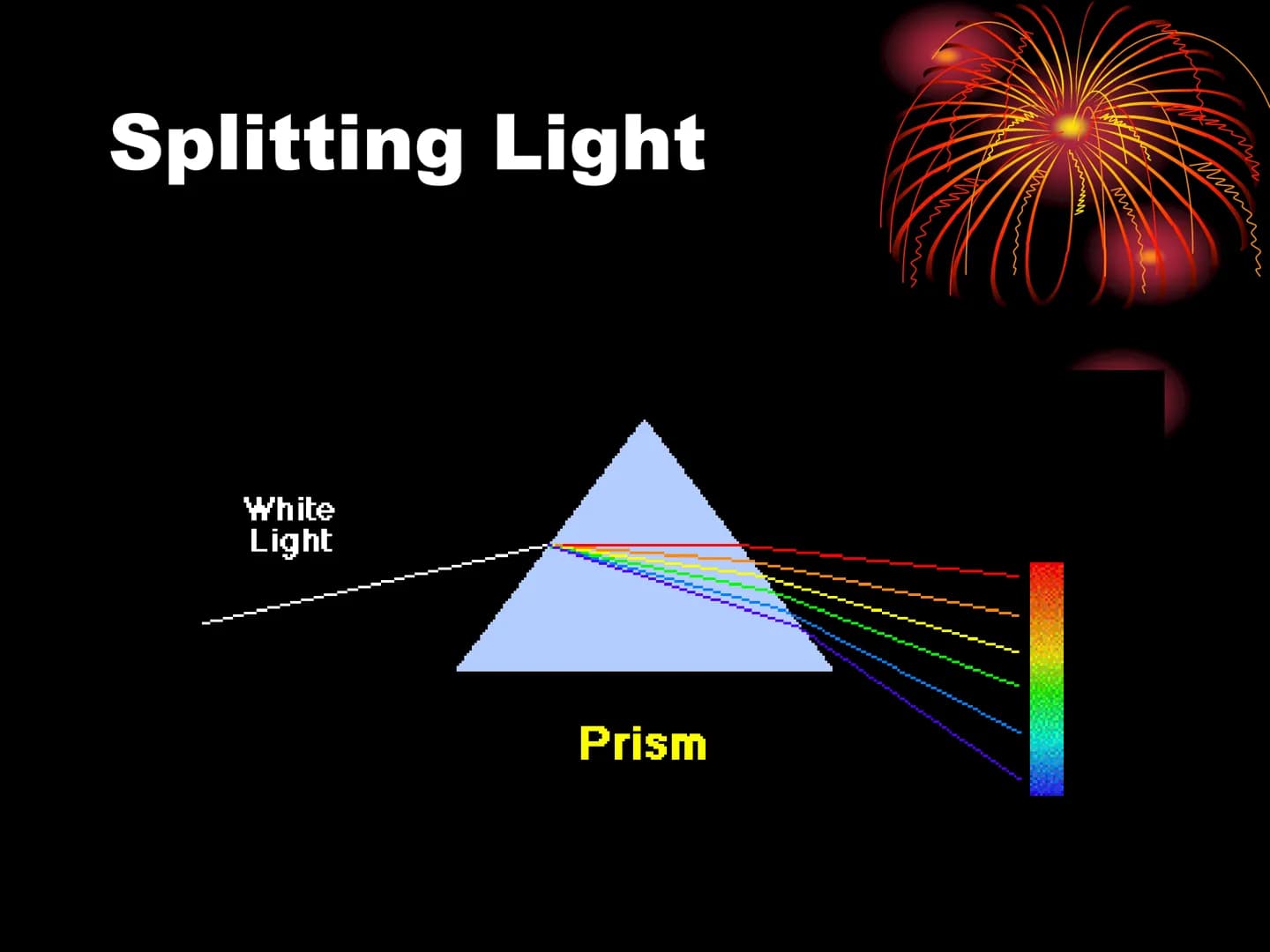
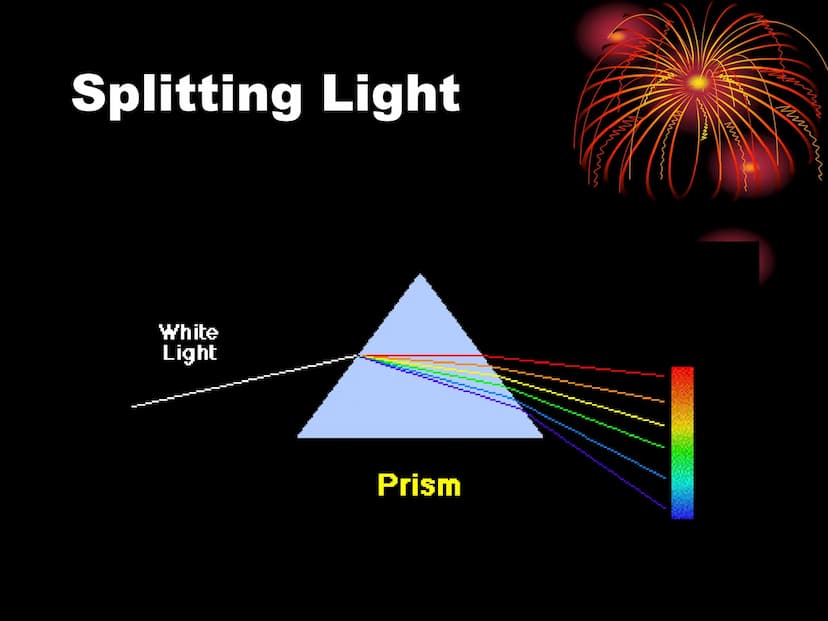
When white light passes through a prism, something amazing happens - it separates into a rainbow of colors!
This phenomenon, called dispersion, occurs because different wavelengths of light (different colors) bend at slightly different angles when passing through the prism. Shorter wavelengths (violet and blue) bend more than longer wavelengths (orange and red).
Scientists use this principle to study light emitted or absorbed by elements, which gives us valuable information about atomic structure.
Light Insight: The splitting of light reveals that what appears as simple white light is actually a combination of all colors - this is crucial for understanding atomic spectra!
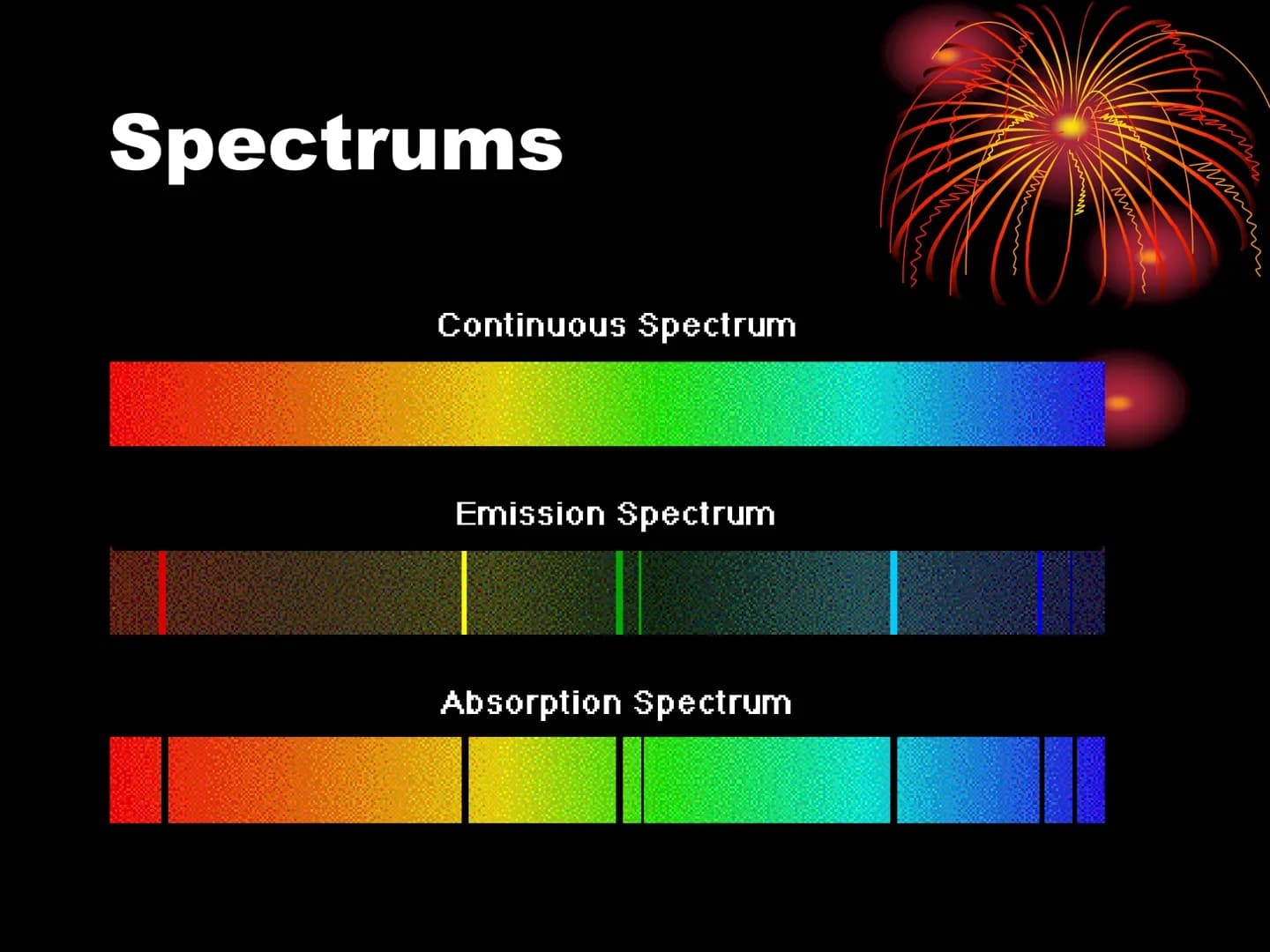
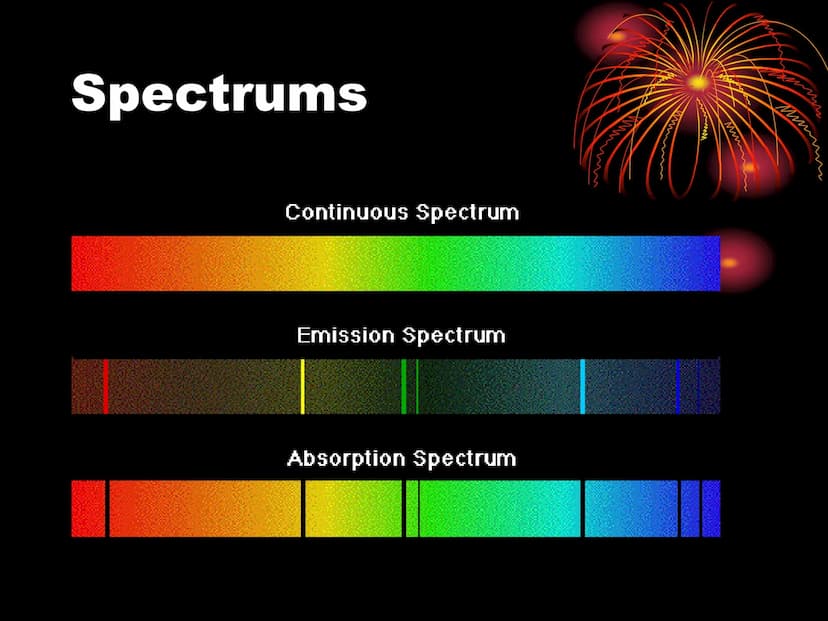
Different types of spectrums tell us different things about atoms:
A continuous spectrum shows all wavelengths of light with no gaps, like a perfect rainbow. This is what you get from sources like the sun or a light bulb.
An emission spectrum consists of bright lines against a dark background. These colored lines appear when excited atoms release energy as light of specific wavelengths.
An absorption spectrum looks like a continuous spectrum with dark lines where specific wavelengths have been absorbed by atoms. It's essentially the opposite of an emission spectrum.
Spectrum Secret: These spectrums act like atomic fingerprints - each element produces a unique pattern that can identify it!
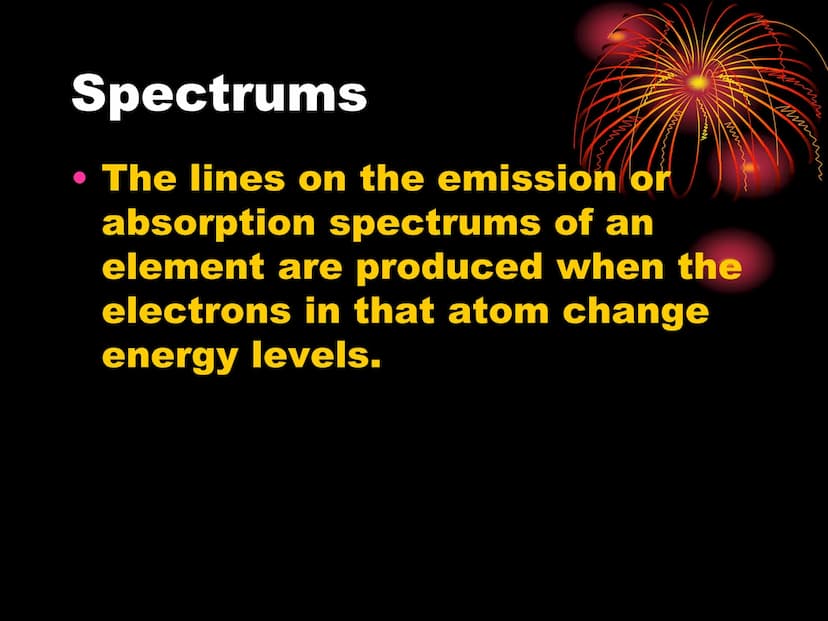
The colorful lines you see in emission and absorption spectrums aren't random - they're direct evidence of electron behavior in atoms!
When electrons in an atom jump from a higher energy level to a lower one, they release energy as light with a specific wavelength, creating a bright line in the emission spectrum.
Conversely, when atoms absorb light energy, electrons jump to higher energy levels, creating dark lines in the absorption spectrum at those specific wavelengths.
Think About It: Every line in a spectrum represents an electron changing energy levels - it's like watching atomic activity in real time!
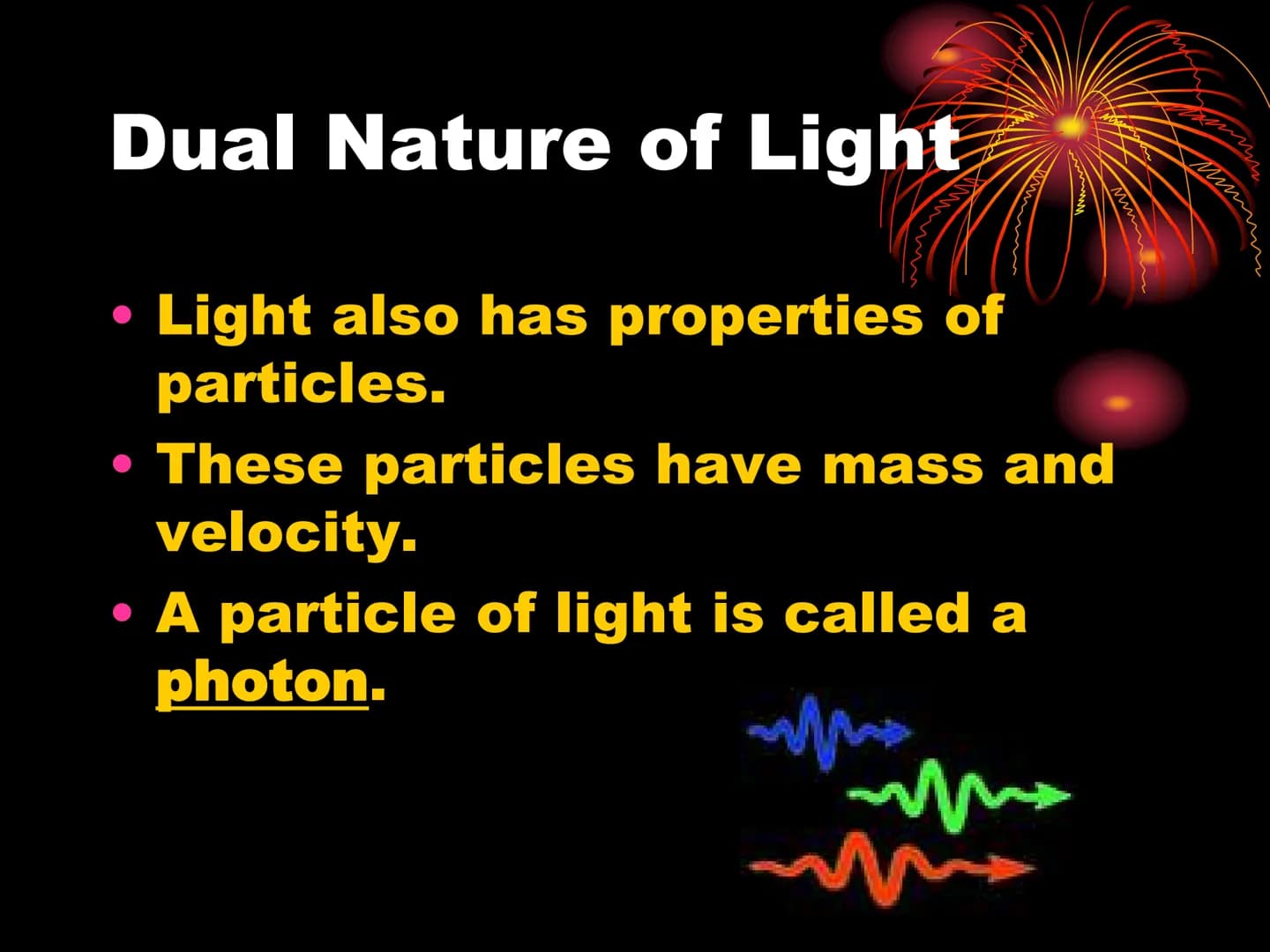
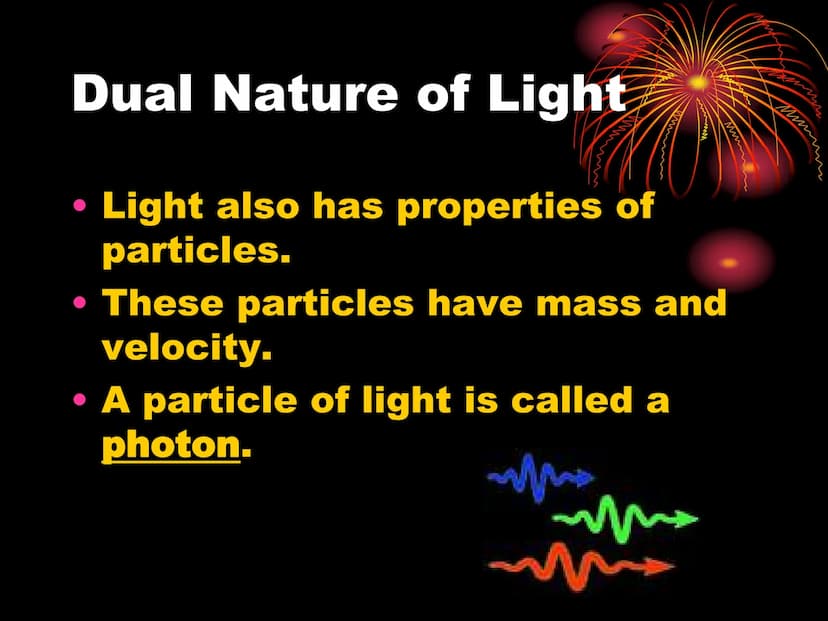
Light behaves in ways that seem contradictory - it acts as both a wave AND a particle!
As a wave, light can be described by its wavelength and frequency. But light also behaves like tiny particles called photons that have mass and velocity.
This dual wave-particle nature was revolutionary in physics and essential for understanding how light interacts with matter. Einstein's work on the photoelectric effect confirmed that light comes in discrete packets of energy (photons).
Mind-Blowing Fact: This dual nature of light challenged scientists' understanding of physics and helped lead to the development of quantum mechanics!
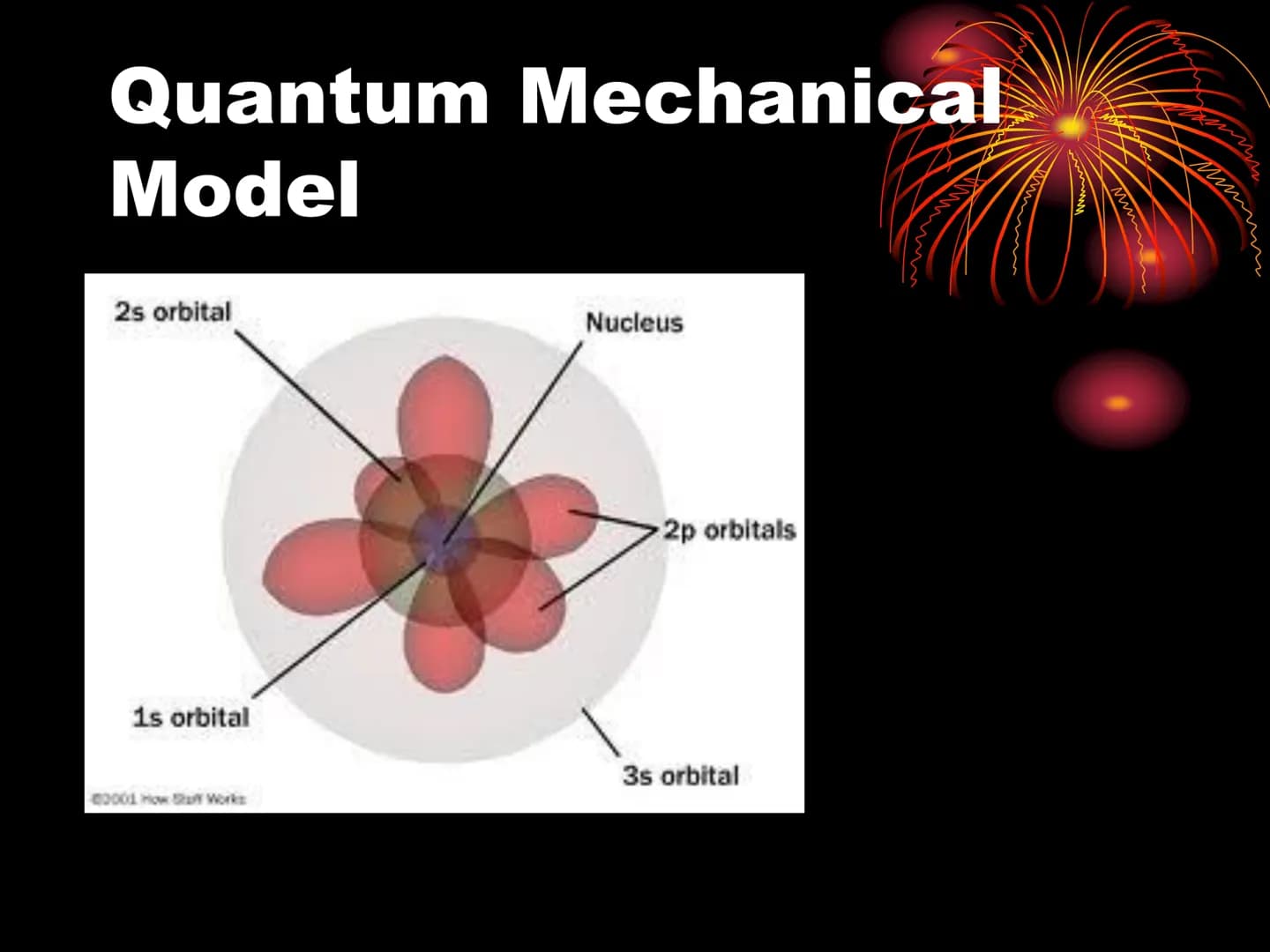
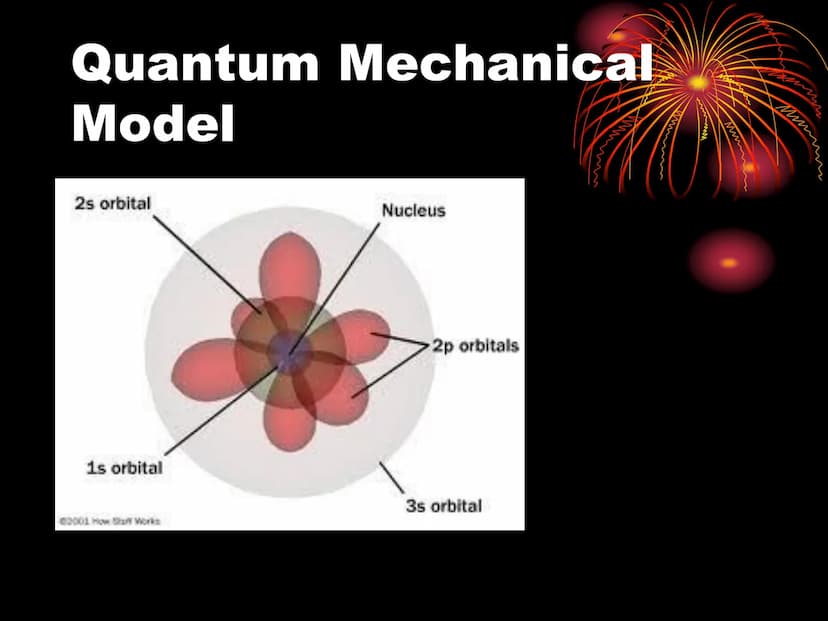
The quantum mechanical model represents electrons as probability clouds rather than in fixed orbits. Each cloud shape represents a different orbital.
In this model, you can see the spherical 1s orbital closest to the nucleus, then the 2s orbital (also spherical but larger), the dumbbell-shaped 2p orbitals, and the 3s orbital furthest out.
The different shapes and sizes correspond to different energy levels and the various ways electrons can distribute around the nucleus.
Visualization Tip: Don't think of these as exact boundaries but as fuzzy regions where you're most likely to find electrons if you could take thousands of "snapshots" of the atom.
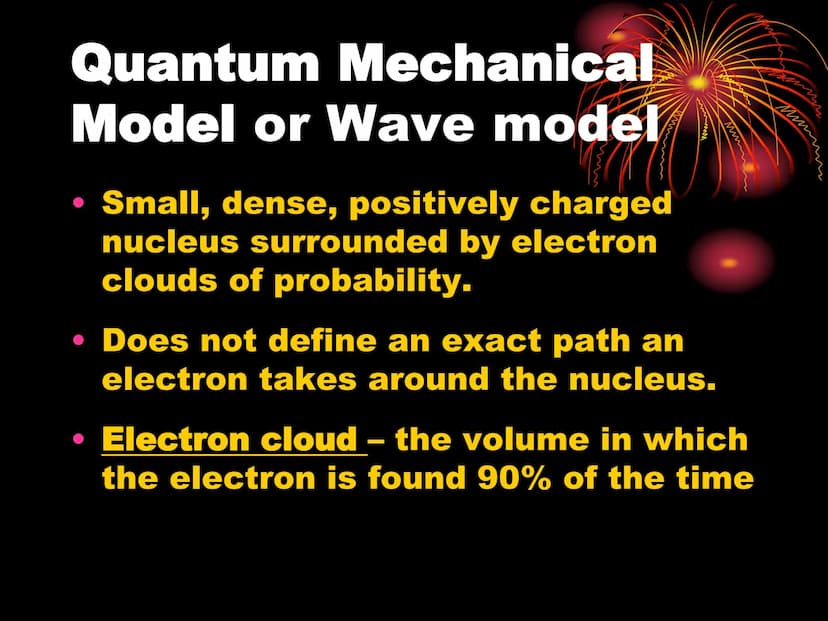
Unlike previous models, the quantum mechanical model doesn't claim to know exactly where electrons are at any moment.
Instead, it describes electron clouds - regions where an electron has a 90% probability of being found. This reflects the fundamental uncertainty about particle positions at the quantum level.
The nucleus remains at the center, small and positively charged, but electrons no longer follow defined paths. Their behavior is described by mathematical equations that give probabilities rather than certainties.
Modern Insight: This uncertainty isn't a failure of the model but reflects actual reality at the quantum level - electrons genuinely don't have exact positions until measured!
Our AI companion is specifically built for the needs of students. Based on the millions of content pieces we have on the platform we can provide truly meaningful and relevant answers to students. But its not only about answers, the companion is even more about guiding students through their daily learning challenges, with personalised study plans, quizzes or content pieces in the chat and 100% personalisation based on the students skills and developments.
You can download the app in the Google Play Store and in the Apple App Store.
That's right! Enjoy free access to study content, connect with fellow students, and get instant help – all at your fingertips.
App Store
Google Play
The app is very easy to use and well designed. I have found everything I was looking for so far and have been able to learn a lot from the presentations! I will definitely use the app for a class assignment! And of course it also helps a lot as an inspiration.
Stefan S
iOS user
This app is really great. There are so many study notes and help [...]. My problem subject is French, for example, and the app has so many options for help. Thanks to this app, I have improved my French. I would recommend it to anyone.
Samantha Klich
Android user
Wow, I am really amazed. I just tried the app because I've seen it advertised many times and was absolutely stunned. This app is THE HELP you want for school and above all, it offers so many things, such as workouts and fact sheets, which have been VERY helpful to me personally.
Anna
iOS user
I think it’s very much worth it and you’ll end up using it a lot once you get the hang of it and even after looking at others notes you can still ask your Artificial intelligence buddy the question and ask to simplify it if you still don’t get it!!! In the end I think it’s worth it 😊👍 ⚠️Also DID I MENTION ITS FREEE YOU DON’T HAVE TO PAY FOR ANYTHING AND STILL GET YOUR GRADES IN PERFECTLY❗️❗️⚠️
Thomas R
iOS user
Knowunity is the BEST app I’ve used in a minute. This is not an ai review or anything this is genuinely coming from a 7th grade student (I know 2011 im young) but dude this app is a 10/10 i have maintained a 3.8 gpa and have plenty of time for gaming. I love it and my mom is just happy I got good grades
Brad T
Android user
Not only did it help me find the answer but it also showed me alternative ways to solve it. I was horrible in math and science but now I have an a in both subjects. Thanks for the help🤍🤍
David K
iOS user
The app's just great! All I have to do is enter the topic in the search bar and I get the response real fast. I don't have to watch 10 YouTube videos to understand something, so I'm saving my time. Highly recommended!
Sudenaz Ocak
Android user
In school I was really bad at maths but thanks to the app, I am doing better now. I am so grateful that you made the app.
Greenlight Bonnie
Android user
I found this app a couple years ago and it has only gotten better since then. I really love it because it can help with written questions and photo questions. Also, it can find study guides that other people have made as well as flashcard sets and practice tests. The free version is also amazing for students who might not be able to afford it. Would 100% recommend
Aubrey
iOS user
Best app if you're in Highschool or Junior high. I have been using this app for 2 school years and it's the best, it's good if you don't have anyone to help you with school work.😋🩷🎀
Marco B
iOS user
THE QUIZES AND FLASHCARDS ARE SO USEFUL AND I LOVE Knowunity AI. IT ALSO IS LITREALLY LIKE CHATGPT BUT SMARTER!! HELPED ME WITH MY MASCARA PROBLEMS TOO!! AS WELL AS MY REAL SUBJECTS ! DUHHH 😍😁😲🤑💗✨🎀😮
Elisha
iOS user
This app is phenomenal down to the correct info and the various topics you can study! I greatly recommend it for people who struggle with procrastination and those who need homework help. It has been perfectly accurate for world 1 history as far as I’ve seen! Geometry too!
Paul T
iOS user
The app is very easy to use and well designed. I have found everything I was looking for so far and have been able to learn a lot from the presentations! I will definitely use the app for a class assignment! And of course it also helps a lot as an inspiration.
Stefan S
iOS user
This app is really great. There are so many study notes and help [...]. My problem subject is French, for example, and the app has so many options for help. Thanks to this app, I have improved my French. I would recommend it to anyone.
Samantha Klich
Android user
Wow, I am really amazed. I just tried the app because I've seen it advertised many times and was absolutely stunned. This app is THE HELP you want for school and above all, it offers so many things, such as workouts and fact sheets, which have been VERY helpful to me personally.
Anna
iOS user
I think it’s very much worth it and you’ll end up using it a lot once you get the hang of it and even after looking at others notes you can still ask your Artificial intelligence buddy the question and ask to simplify it if you still don’t get it!!! In the end I think it’s worth it 😊👍 ⚠️Also DID I MENTION ITS FREEE YOU DON’T HAVE TO PAY FOR ANYTHING AND STILL GET YOUR GRADES IN PERFECTLY❗️❗️⚠️
Thomas R
iOS user
Knowunity is the BEST app I’ve used in a minute. This is not an ai review or anything this is genuinely coming from a 7th grade student (I know 2011 im young) but dude this app is a 10/10 i have maintained a 3.8 gpa and have plenty of time for gaming. I love it and my mom is just happy I got good grades
Brad T
Android user
Not only did it help me find the answer but it also showed me alternative ways to solve it. I was horrible in math and science but now I have an a in both subjects. Thanks for the help🤍🤍
David K
iOS user
The app's just great! All I have to do is enter the topic in the search bar and I get the response real fast. I don't have to watch 10 YouTube videos to understand something, so I'm saving my time. Highly recommended!
Sudenaz Ocak
Android user
In school I was really bad at maths but thanks to the app, I am doing better now. I am so grateful that you made the app.
Greenlight Bonnie
Android user
I found this app a couple years ago and it has only gotten better since then. I really love it because it can help with written questions and photo questions. Also, it can find study guides that other people have made as well as flashcard sets and practice tests. The free version is also amazing for students who might not be able to afford it. Would 100% recommend
Aubrey
iOS user
Best app if you're in Highschool or Junior high. I have been using this app for 2 school years and it's the best, it's good if you don't have anyone to help you with school work.😋🩷🎀
Marco B
iOS user
THE QUIZES AND FLASHCARDS ARE SO USEFUL AND I LOVE Knowunity AI. IT ALSO IS LITREALLY LIKE CHATGPT BUT SMARTER!! HELPED ME WITH MY MASCARA PROBLEMS TOO!! AS WELL AS MY REAL SUBJECTS ! DUHHH 😍😁😲🤑💗✨🎀😮
Elisha
iOS user
This app is phenomenal down to the correct info and the various topics you can study! I greatly recommend it for people who struggle with procrastination and those who need homework help. It has been perfectly accurate for world 1 history as far as I’ve seen! Geometry too!
Paul T
iOS user
Welcome to the fascinating world of atomic theory! This guide will take you on a journey through the development of our understanding of atoms, focusing on the quantum mechanical model. You'll learn how we moved from simple early models to... Show more
Access to all documents
Improve your grades
Join milions of students
Ever wondered what atoms really look like? The quantum mechanical model is the most advanced and accurate description of atomic structure we have today.
This model represents a significant leap forward from earlier atomic theories, showing atoms not as tiny solar systems, but as complex systems where electrons exist in clouds of probability.
Unlike previous models, the quantum approach doesn't try to pinpoint exactly where electrons are, but instead tells us where they're most likely to be found.
Did You Know? The quantum mechanical model might seem strange, but it successfully explains atomic behavior that no previous model could account for!
Access to all documents
Improve your grades
Join milions of students
Atomic theory has evolved dramatically over time, with each model improving on the last:
Dalton's Atomic Theory started it all, proposing that matter consists of indivisible particles called atoms. Then came Thomson's Plum Pudding Model, which suggested electrons were embedded in a positive mass.
Rutherford's Model introduced the nuclear concept, placing a dense, positive nucleus at the center with electrons orbiting around it. Bohr's Planetary Model refined this by placing electrons in fixed energy levels or orbits.
Finally, the Quantum Mechanical Model replaced exact orbits with clouds of probability, reflecting the uncertain nature of electron positions.
Remember: Each model solved problems with previous theories while creating new questions that led to better models!
Access to all documents
Improve your grades
Join milions of students
Bohr's model represented a significant breakthrough in atomic theory, picturing electrons orbiting the nucleus like planets around the sun.
In this model of a carbon atom, six protons and six neutrons form the nucleus, while six electrons orbit in fixed paths or "energy levels" around it. The electrons can only exist in these specific energy levels - not anywhere in between.
Though ultimately replaced by the quantum mechanical model, Bohr's model successfully explained certain atomic behaviors and introduced the critical concept of quantized energy levels.
Quick Tip: Think of Bohr's model as a stepping stone - it's not completely accurate, but it helped scientists move toward our current understanding.
Access to all documents
Improve your grades
Join milions of students
Light travels in waves with different wavelengths and frequencies, forming the electromagnetic spectrum. The shorter the wavelength, the higher the frequency and energy.
The spectrum ranges from high-energy gamma rays (tiny wavelengths around 0.1 Å) through X-rays, ultraviolet, visible light, infrared, and radio waves (long wavelengths up to 1000 meters).
Visible light is just a small slice of this spectrum—wavelengths between 400-700 nanometers that our eyes can detect as different colors.
Make the Connection: The electromagnetic spectrum is key to understanding how atoms absorb and emit energy, which reveals their structure!
Access to all documents
Improve your grades
Join milions of students
When white light passes through a prism, something amazing happens - it separates into a rainbow of colors!
This phenomenon, called dispersion, occurs because different wavelengths of light (different colors) bend at slightly different angles when passing through the prism. Shorter wavelengths (violet and blue) bend more than longer wavelengths (orange and red).
Scientists use this principle to study light emitted or absorbed by elements, which gives us valuable information about atomic structure.
Light Insight: The splitting of light reveals that what appears as simple white light is actually a combination of all colors - this is crucial for understanding atomic spectra!
Access to all documents
Improve your grades
Join milions of students
Different types of spectrums tell us different things about atoms:
A continuous spectrum shows all wavelengths of light with no gaps, like a perfect rainbow. This is what you get from sources like the sun or a light bulb.
An emission spectrum consists of bright lines against a dark background. These colored lines appear when excited atoms release energy as light of specific wavelengths.
An absorption spectrum looks like a continuous spectrum with dark lines where specific wavelengths have been absorbed by atoms. It's essentially the opposite of an emission spectrum.
Spectrum Secret: These spectrums act like atomic fingerprints - each element produces a unique pattern that can identify it!
Access to all documents
Improve your grades
Join milions of students
The colorful lines you see in emission and absorption spectrums aren't random - they're direct evidence of electron behavior in atoms!
When electrons in an atom jump from a higher energy level to a lower one, they release energy as light with a specific wavelength, creating a bright line in the emission spectrum.
Conversely, when atoms absorb light energy, electrons jump to higher energy levels, creating dark lines in the absorption spectrum at those specific wavelengths.
Think About It: Every line in a spectrum represents an electron changing energy levels - it's like watching atomic activity in real time!
Access to all documents
Improve your grades
Join milions of students
Light behaves in ways that seem contradictory - it acts as both a wave AND a particle!
As a wave, light can be described by its wavelength and frequency. But light also behaves like tiny particles called photons that have mass and velocity.
This dual wave-particle nature was revolutionary in physics and essential for understanding how light interacts with matter. Einstein's work on the photoelectric effect confirmed that light comes in discrete packets of energy (photons).
Mind-Blowing Fact: This dual nature of light challenged scientists' understanding of physics and helped lead to the development of quantum mechanics!
Access to all documents
Improve your grades
Join milions of students
The quantum mechanical model represents electrons as probability clouds rather than in fixed orbits. Each cloud shape represents a different orbital.
In this model, you can see the spherical 1s orbital closest to the nucleus, then the 2s orbital (also spherical but larger), the dumbbell-shaped 2p orbitals, and the 3s orbital furthest out.
The different shapes and sizes correspond to different energy levels and the various ways electrons can distribute around the nucleus.
Visualization Tip: Don't think of these as exact boundaries but as fuzzy regions where you're most likely to find electrons if you could take thousands of "snapshots" of the atom.
Access to all documents
Improve your grades
Join milions of students
Unlike previous models, the quantum mechanical model doesn't claim to know exactly where electrons are at any moment.
Instead, it describes electron clouds - regions where an electron has a 90% probability of being found. This reflects the fundamental uncertainty about particle positions at the quantum level.
The nucleus remains at the center, small and positively charged, but electrons no longer follow defined paths. Their behavior is described by mathematical equations that give probabilities rather than certainties.
Modern Insight: This uncertainty isn't a failure of the model but reflects actual reality at the quantum level - electrons genuinely don't have exact positions until measured!
Our AI companion is specifically built for the needs of students. Based on the millions of content pieces we have on the platform we can provide truly meaningful and relevant answers to students. But its not only about answers, the companion is even more about guiding students through their daily learning challenges, with personalised study plans, quizzes or content pieces in the chat and 100% personalisation based on the students skills and developments.
You can download the app in the Google Play Store and in the Apple App Store.
That's right! Enjoy free access to study content, connect with fellow students, and get instant help – all at your fingertips.
8
Smart Tools NEW
Transform this note into: ✓ 50+ Practice Questions ✓ Interactive Flashcards ✓ Full Practice Test ✓ Essay Outlines
notes about atomic numbers and electron configurations on the periodic table
 Chemistry
This involves fundamental concepts in chemistry, periodic table, analysis of simple experimental set-ups, laws and principles.
ChemistryBasics of electron configuration
ChemistryExplore the fundamentals of hydrocarbons, focusing on alkanes, their properties, nomenclature, and the concept of homologous series. This summary covers key definitions, structural representations, and the significance of isomers in organic chemistry.
ChemistryCations and ions
ChemistryNotes describing the parts and structure of the Atom
ChemistryApp Store
Google Play
The app is very easy to use and well designed. I have found everything I was looking for so far and have been able to learn a lot from the presentations! I will definitely use the app for a class assignment! And of course it also helps a lot as an inspiration.
Stefan S
iOS user
This app is really great. There are so many study notes and help [...]. My problem subject is French, for example, and the app has so many options for help. Thanks to this app, I have improved my French. I would recommend it to anyone.
Samantha Klich
Android user
Wow, I am really amazed. I just tried the app because I've seen it advertised many times and was absolutely stunned. This app is THE HELP you want for school and above all, it offers so many things, such as workouts and fact sheets, which have been VERY helpful to me personally.
Anna
iOS user
I think it’s very much worth it and you’ll end up using it a lot once you get the hang of it and even after looking at others notes you can still ask your Artificial intelligence buddy the question and ask to simplify it if you still don’t get it!!! In the end I think it’s worth it 😊👍 ⚠️Also DID I MENTION ITS FREEE YOU DON’T HAVE TO PAY FOR ANYTHING AND STILL GET YOUR GRADES IN PERFECTLY❗️❗️⚠️
Thomas R
iOS user
Knowunity is the BEST app I’ve used in a minute. This is not an ai review or anything this is genuinely coming from a 7th grade student (I know 2011 im young) but dude this app is a 10/10 i have maintained a 3.8 gpa and have plenty of time for gaming. I love it and my mom is just happy I got good grades
Brad T
Android user
Not only did it help me find the answer but it also showed me alternative ways to solve it. I was horrible in math and science but now I have an a in both subjects. Thanks for the help🤍🤍
David K
iOS user
The app's just great! All I have to do is enter the topic in the search bar and I get the response real fast. I don't have to watch 10 YouTube videos to understand something, so I'm saving my time. Highly recommended!
Sudenaz Ocak
Android user
In school I was really bad at maths but thanks to the app, I am doing better now. I am so grateful that you made the app.
Greenlight Bonnie
Android user
I found this app a couple years ago and it has only gotten better since then. I really love it because it can help with written questions and photo questions. Also, it can find study guides that other people have made as well as flashcard sets and practice tests. The free version is also amazing for students who might not be able to afford it. Would 100% recommend
Aubrey
iOS user
Best app if you're in Highschool or Junior high. I have been using this app for 2 school years and it's the best, it's good if you don't have anyone to help you with school work.😋🩷🎀
Marco B
iOS user
THE QUIZES AND FLASHCARDS ARE SO USEFUL AND I LOVE Knowunity AI. IT ALSO IS LITREALLY LIKE CHATGPT BUT SMARTER!! HELPED ME WITH MY MASCARA PROBLEMS TOO!! AS WELL AS MY REAL SUBJECTS ! DUHHH 😍😁😲🤑💗✨🎀😮
Elisha
iOS user
This app is phenomenal down to the correct info and the various topics you can study! I greatly recommend it for people who struggle with procrastination and those who need homework help. It has been perfectly accurate for world 1 history as far as I’ve seen! Geometry too!
Paul T
iOS user
The app is very easy to use and well designed. I have found everything I was looking for so far and have been able to learn a lot from the presentations! I will definitely use the app for a class assignment! And of course it also helps a lot as an inspiration.
Stefan S
iOS user
This app is really great. There are so many study notes and help [...]. My problem subject is French, for example, and the app has so many options for help. Thanks to this app, I have improved my French. I would recommend it to anyone.
Samantha Klich
Android user
Wow, I am really amazed. I just tried the app because I've seen it advertised many times and was absolutely stunned. This app is THE HELP you want for school and above all, it offers so many things, such as workouts and fact sheets, which have been VERY helpful to me personally.
Anna
iOS user
I think it’s very much worth it and you’ll end up using it a lot once you get the hang of it and even after looking at others notes you can still ask your Artificial intelligence buddy the question and ask to simplify it if you still don’t get it!!! In the end I think it’s worth it 😊👍 ⚠️Also DID I MENTION ITS FREEE YOU DON’T HAVE TO PAY FOR ANYTHING AND STILL GET YOUR GRADES IN PERFECTLY❗️❗️⚠️
Thomas R
iOS user
Knowunity is the BEST app I’ve used in a minute. This is not an ai review or anything this is genuinely coming from a 7th grade student (I know 2011 im young) but dude this app is a 10/10 i have maintained a 3.8 gpa and have plenty of time for gaming. I love it and my mom is just happy I got good grades
Brad T
Android user
Not only did it help me find the answer but it also showed me alternative ways to solve it. I was horrible in math and science but now I have an a in both subjects. Thanks for the help🤍🤍
David K
iOS user
The app's just great! All I have to do is enter the topic in the search bar and I get the response real fast. I don't have to watch 10 YouTube videos to understand something, so I'm saving my time. Highly recommended!
Sudenaz Ocak
Android user
In school I was really bad at maths but thanks to the app, I am doing better now. I am so grateful that you made the app.
Greenlight Bonnie
Android user
I found this app a couple years ago and it has only gotten better since then. I really love it because it can help with written questions and photo questions. Also, it can find study guides that other people have made as well as flashcard sets and practice tests. The free version is also amazing for students who might not be able to afford it. Would 100% recommend
Aubrey
iOS user
Best app if you're in Highschool or Junior high. I have been using this app for 2 school years and it's the best, it's good if you don't have anyone to help you with school work.😋🩷🎀
Marco B
iOS user
THE QUIZES AND FLASHCARDS ARE SO USEFUL AND I LOVE Knowunity AI. IT ALSO IS LITREALLY LIKE CHATGPT BUT SMARTER!! HELPED ME WITH MY MASCARA PROBLEMS TOO!! AS WELL AS MY REAL SUBJECTS ! DUHHH 😍😁😲🤑💗✨🎀😮
Elisha
iOS user
This app is phenomenal down to the correct info and the various topics you can study! I greatly recommend it for people who struggle with procrastination and those who need homework help. It has been perfectly accurate for world 1 history as far as I’ve seen! Geometry too!
Paul T
iOS user