Open the App

Subjects

61

Dec 10, 2025

15 pages

Understanding Child Development: Chapter 1 Overview

K

Kaiya Wade

@aiyaade_fhcb

Child development is a fascinating journey from conception through adolescence... Show more

Page 1
Page 2
Page 3
Page 4
Page 5
Page 6
Page 7
Page 8
Page 9
Page 10
1 / 10
--- OCR Start ---
CHAPTER 1
History, Theory, and Research Strategies
Child Development: A field of study devoted to understanding constancy

Child Development Foundations

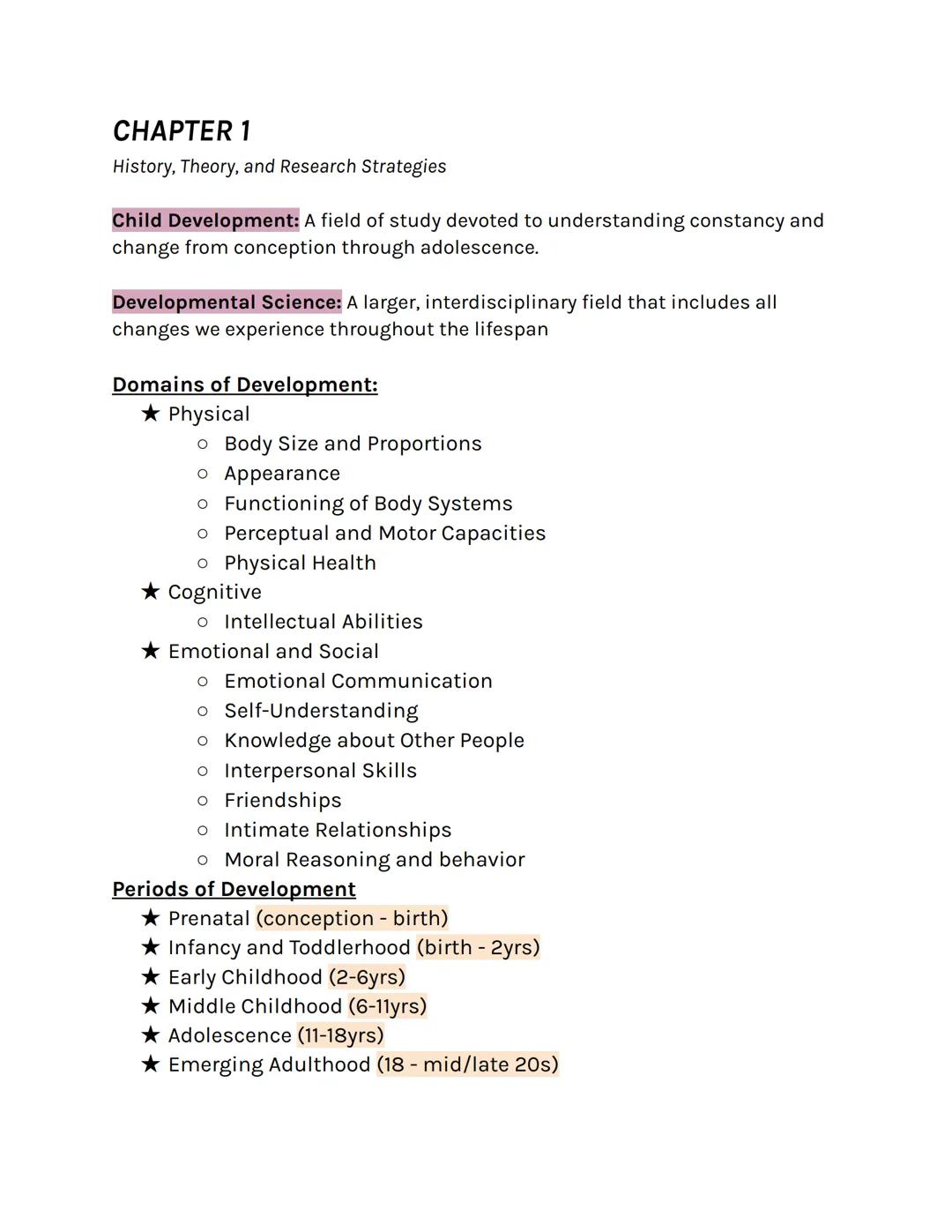
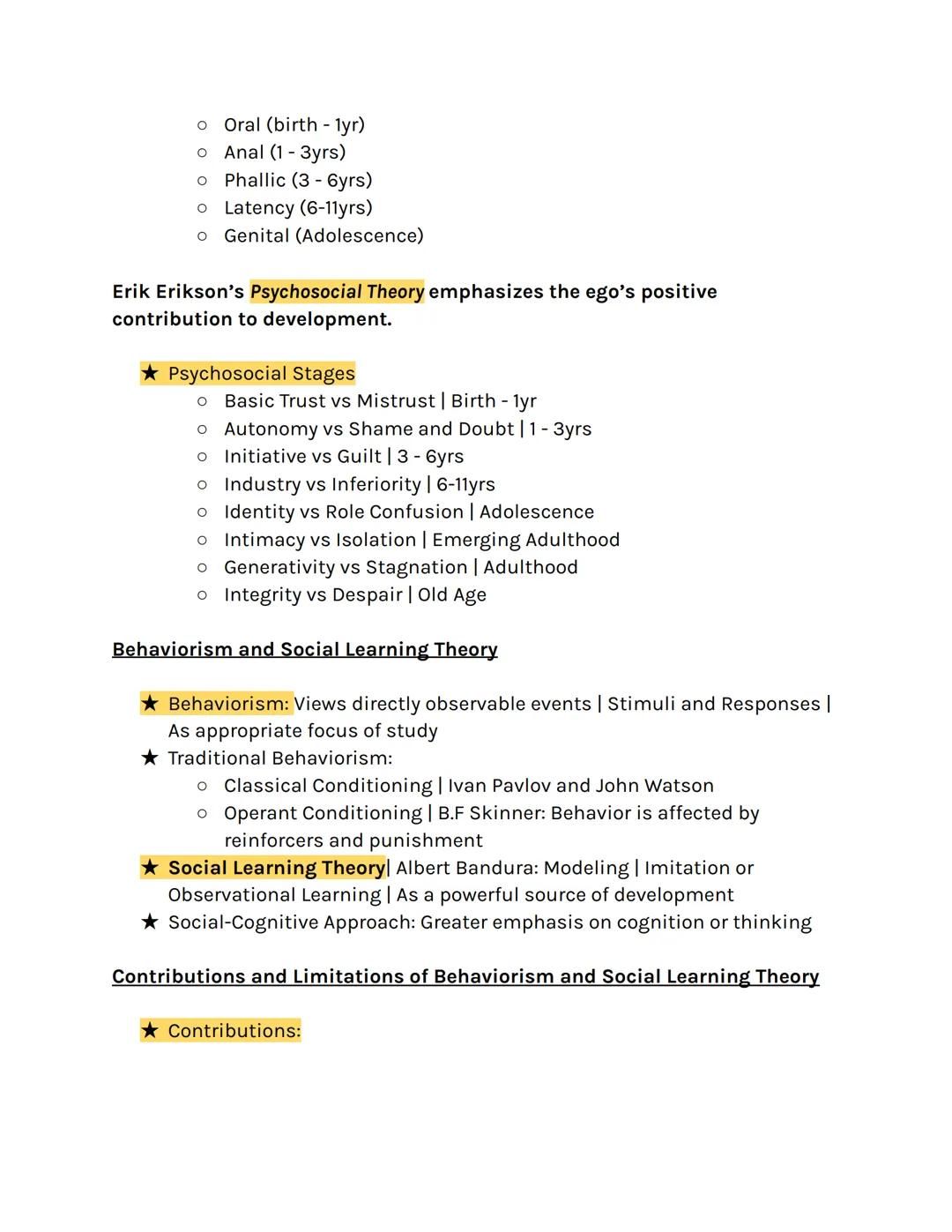
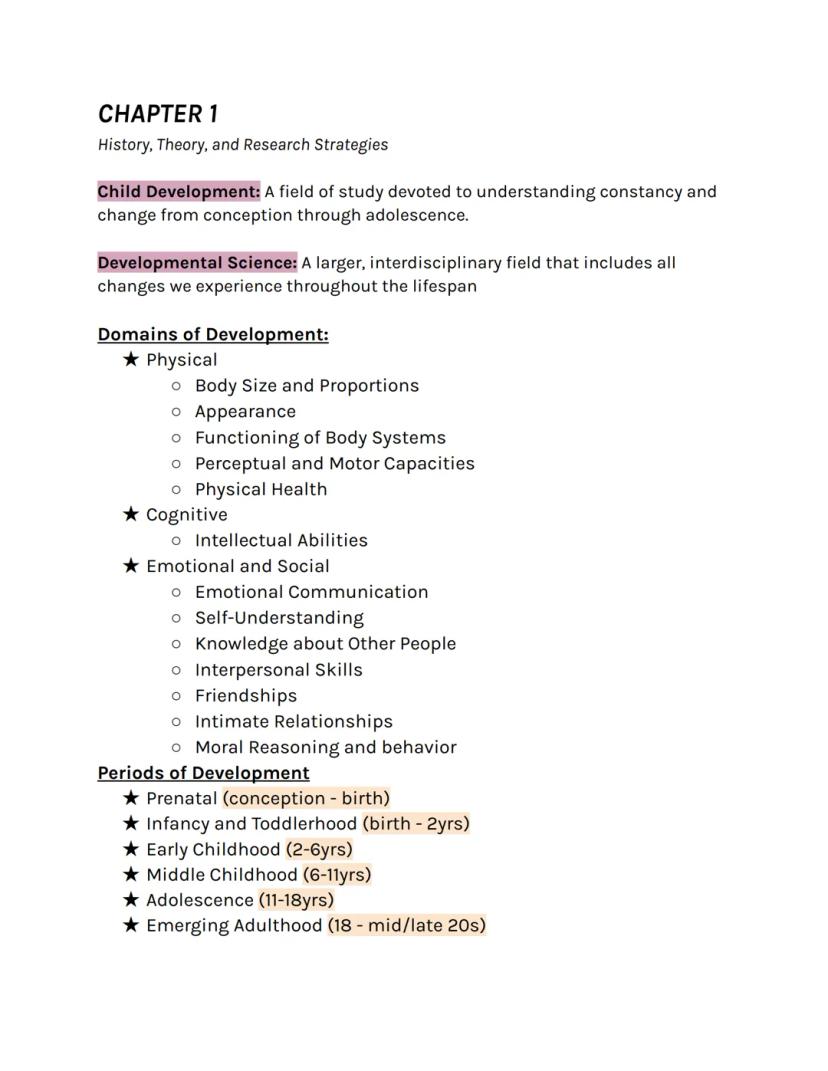
Child development spans multiple interconnected domains that work together as children grow. When studying development, we typically look at three primary areas: physical (body growth, health, motor skills), cognitive thinking,learning,problemsolvingthinking, learning, problem-solving, and emotional/social relationships,selfunderstanding,moralreasoningrelationships, self-understanding, moral reasoning.

Development occurs across distinct periods, each with its own characteristics and milestones. These include the prenatal period (conception to birth), infancy and toddlerhood (birth to 2 years), early childhood 26years2-6 years, middle childhood 611years6-11 years, and adolescence 1118years11-18 years. Recently, researchers have also recognized emerging adulthood 18tomid/late20s18 to mid/late 20s as a distinct developmental period.

Understanding these domains and periods helps us recognize what's typical at different ages. This knowledge is crucial whether you're studying child development, working with children, or simply trying to understand the children in your life.

Remember This: The domains of development don't exist in isolation—physical, cognitive, and emotional/social development constantly influence each other throughout childhood.

--- OCR Start ---
CHAPTER 1
History, Theory, and Research Strategies
Child Development: A field of study devoted to understanding constancy

Basic Developmental Issues

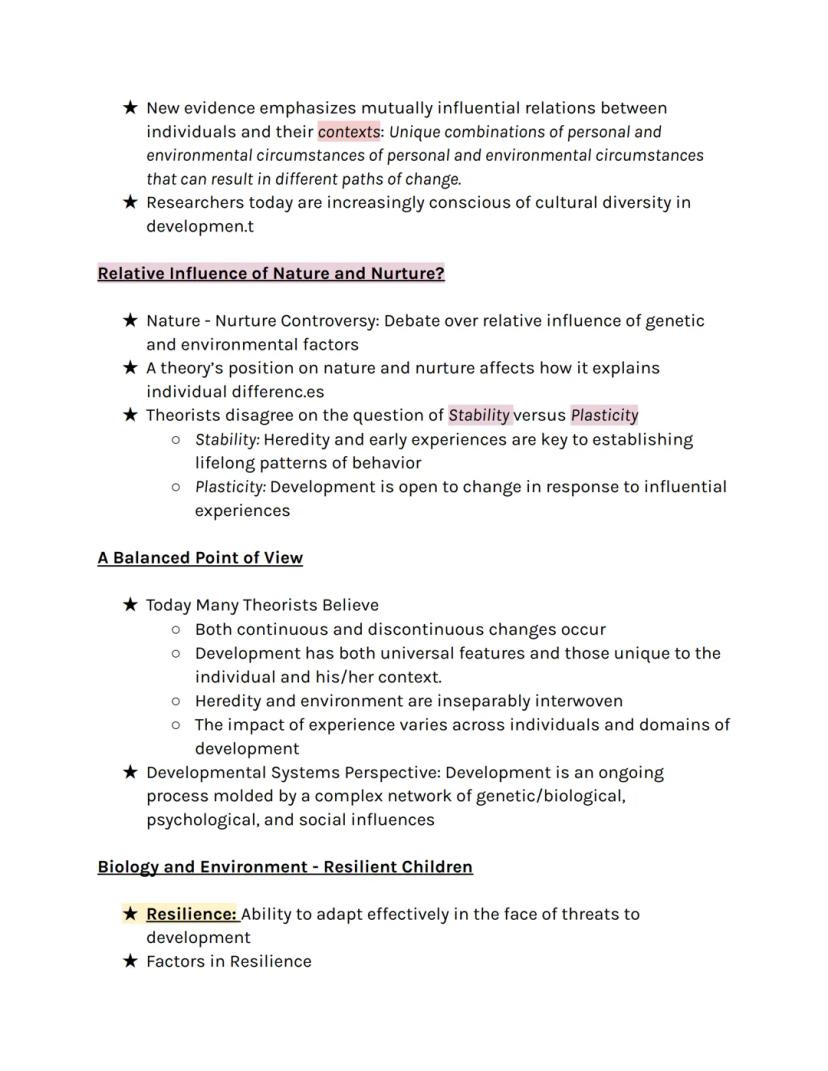
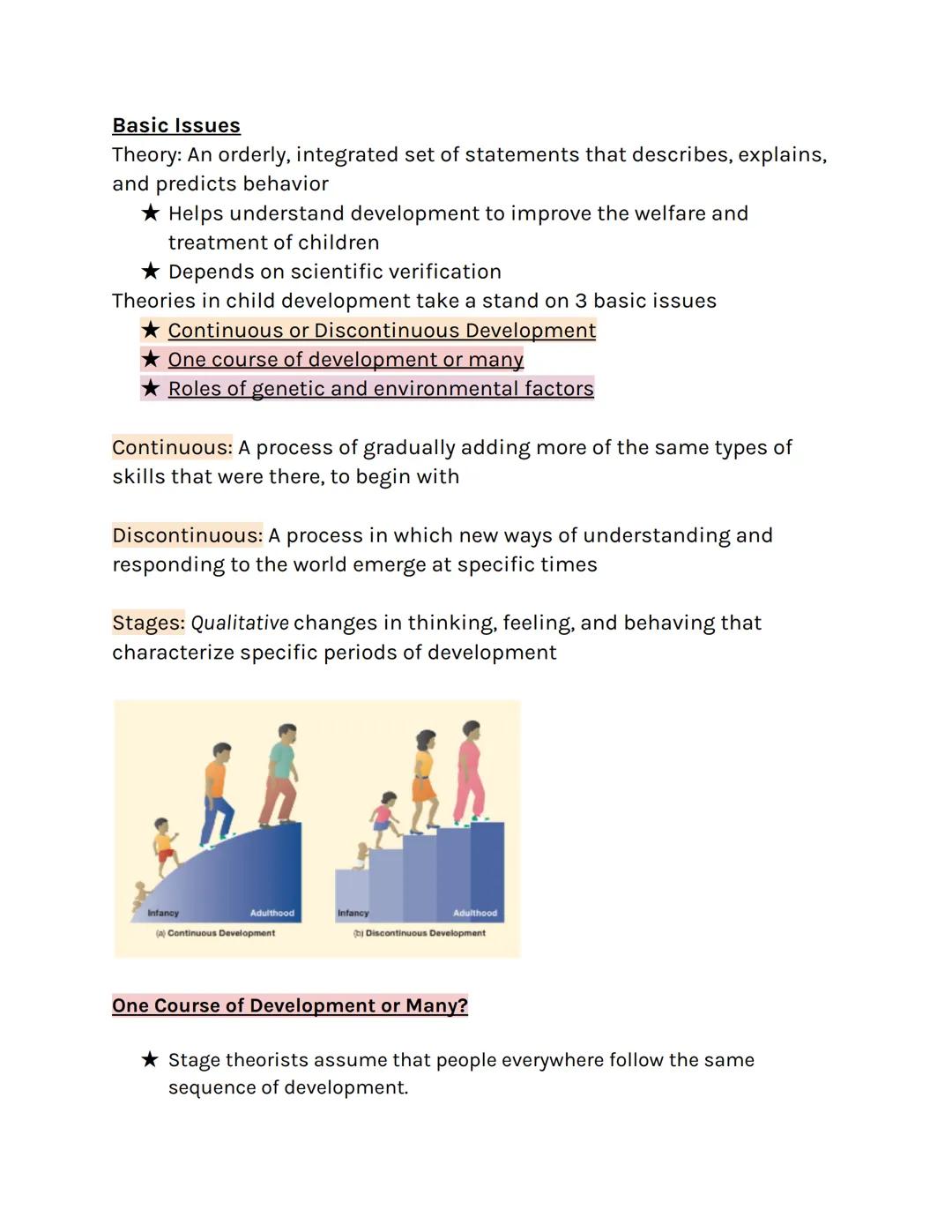
When studying development, scientists create theories – organized frameworks that describe, explain and predict behavior. These aren't just academic exercises; they guide how we understand and support children's growth. Every developmental theory takes a position on three fundamental issues.

First, is development continuous or discontinuous? Continuous development views growth as gradually adding more of the same skills over time, like steadily climbing a ramp. Discontinuous development sees growth happening in distinct stages with qualitative differences between periods, like climbing separate steps on a staircase.

Second, do all children follow one universal course of development or many possible paths? Stage theorists believe everyone follows the same developmental sequence regardless of background. However, newer research recognizes the importance of cultural diversity and individual circumstances in shaping unique developmental paths.

Think About It: Consider your own development—can you identify areas where you seemed to grow gradually (continuously) versus times when you experienced dramatic shifts in how you thought or behaved (discontinuously)?

--- OCR Start ---
CHAPTER 1
History, Theory, and Research Strategies
Child Development: A field of study devoted to understanding constancy

Nature, Nurture, and Resilience

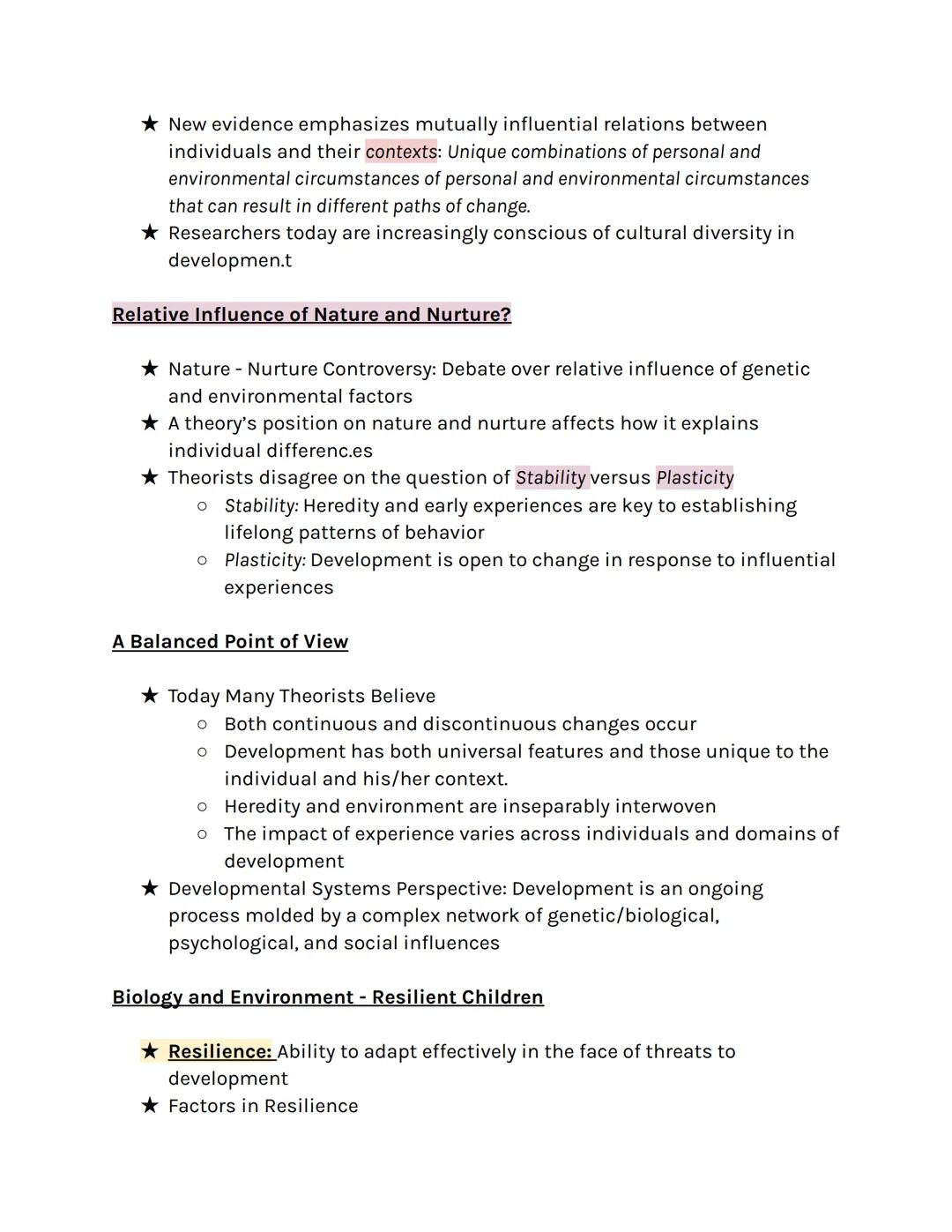
The nature-nurture controversy represents the ongoing debate about whether our genes or our experiences have more influence on who we become. This fundamental question shapes how theories explain differences between individuals. Connected to this is the question of stability versus plasticity—how fixed are developmental patterns once established?

Today's developmental scientists take a balanced view on these core issues. Most recognize that development involves both continuous and discontinuous changes, has both universal and individual-specific features, and is shaped by the complex interplay of genetic and environmental factors. This integrated perspective is known as the developmental systems perspective.

One fascinating concept in developmental research is resilience—the remarkable ability some children have to thrive despite significant adversity. Resilient children often possess personal characteristics like positive temperament, benefit from warm parental relationships, receive social support outside their immediate family, and have access to community resources and opportunities.

Good News: Research on resilience shows that children have tremendous capacity to overcome challenges when provided with the right supports—a powerful reminder that development remains flexible throughout childhood.

--- OCR Start ---
CHAPTER 1
History, Theory, and Research Strategies
Child Development: A field of study devoted to understanding constancy

Historical Views of Childhood

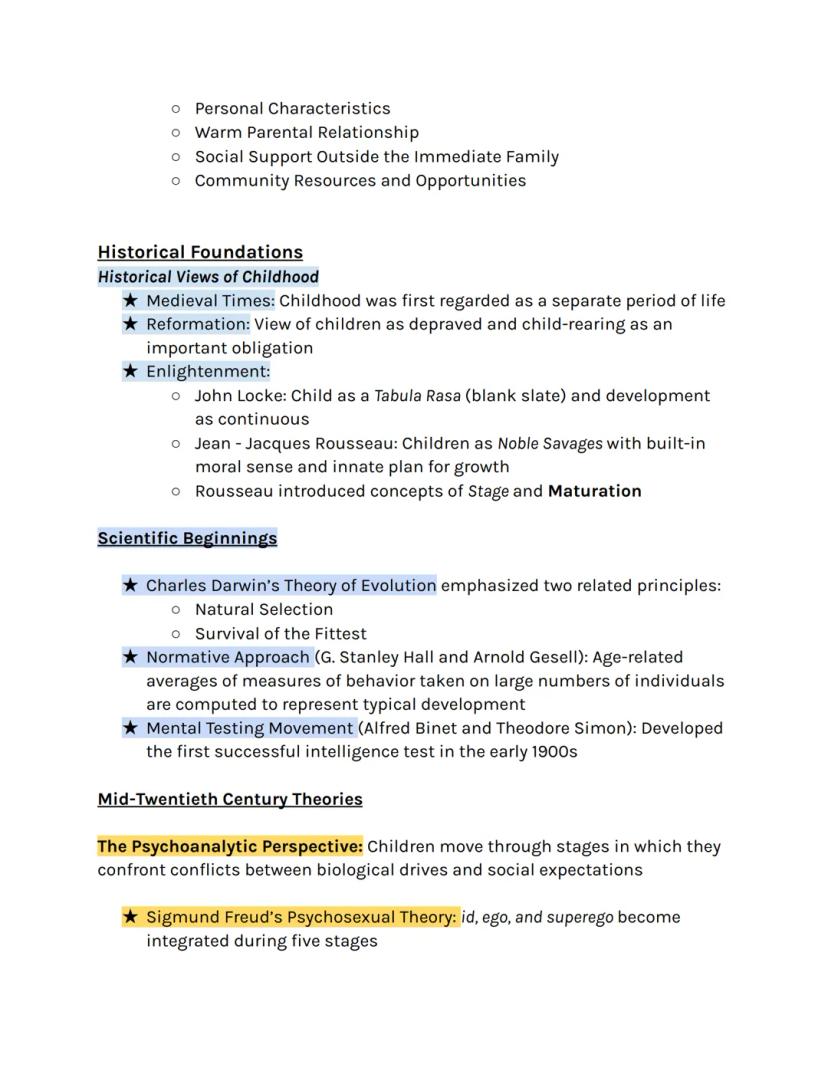
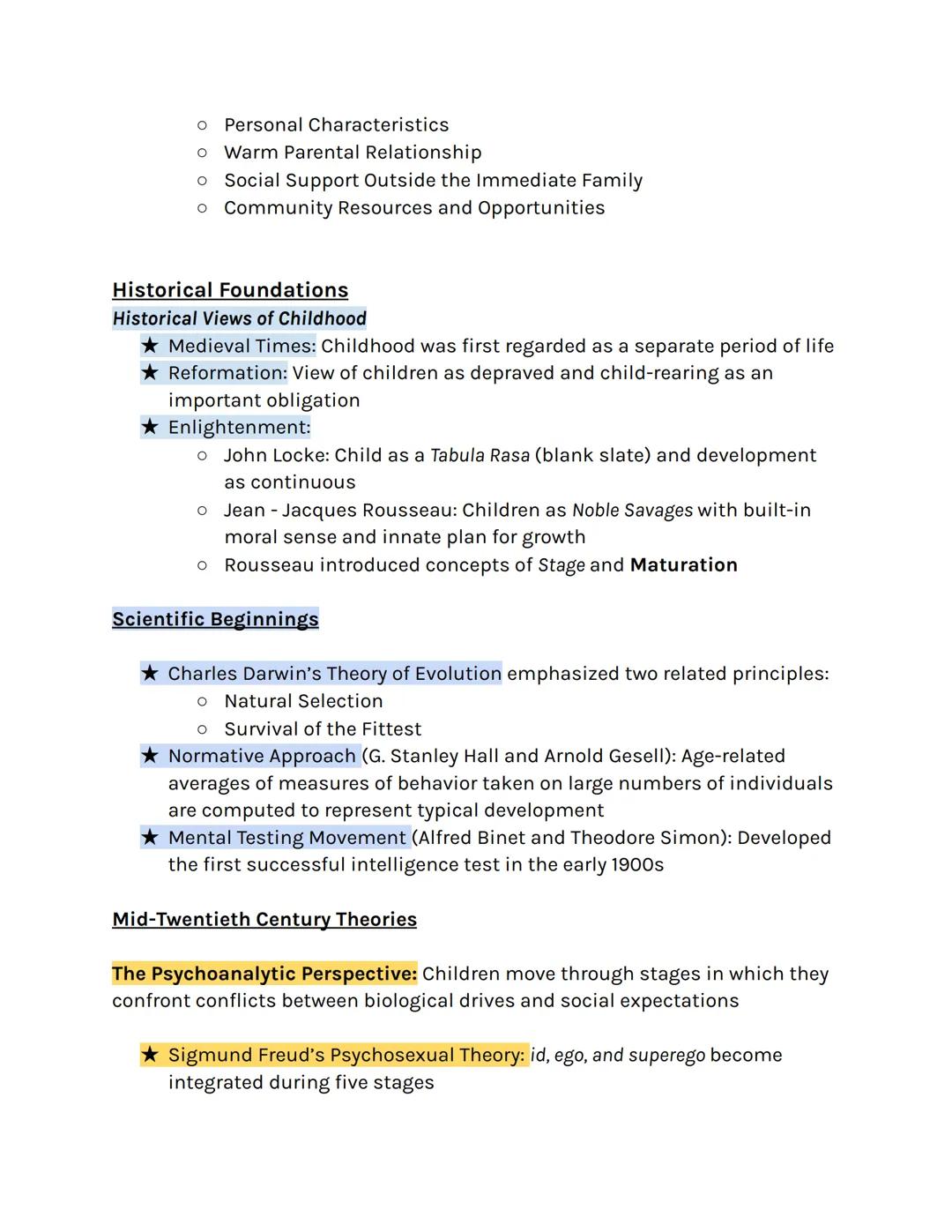
Our understanding of child development has evolved dramatically over centuries. In medieval times, childhood was first recognized as a distinct life period. During the Reformation, children were viewed as inherently depraved beings who needed discipline. The Enlightenment brought contrasting perspectives: John Locke's view of the child as a tabula rasa (blank slate) shaped by experience, and Jean-Jacques Rousseau's concept of children as "noble savages" with an innate moral sense and natural development plan.

Scientific study of children began in earnest after Charles Darwin's evolutionary theory emphasized natural selection and survival of the fittest. Early researchers like G. Stanley Hall and Arnold Gesell pioneered the normative approach, establishing age-related averages of behavior. The mental testing movement, started by Alfred Binet and Theodore Simon, created the first successful intelligence tests in the early 1900s.

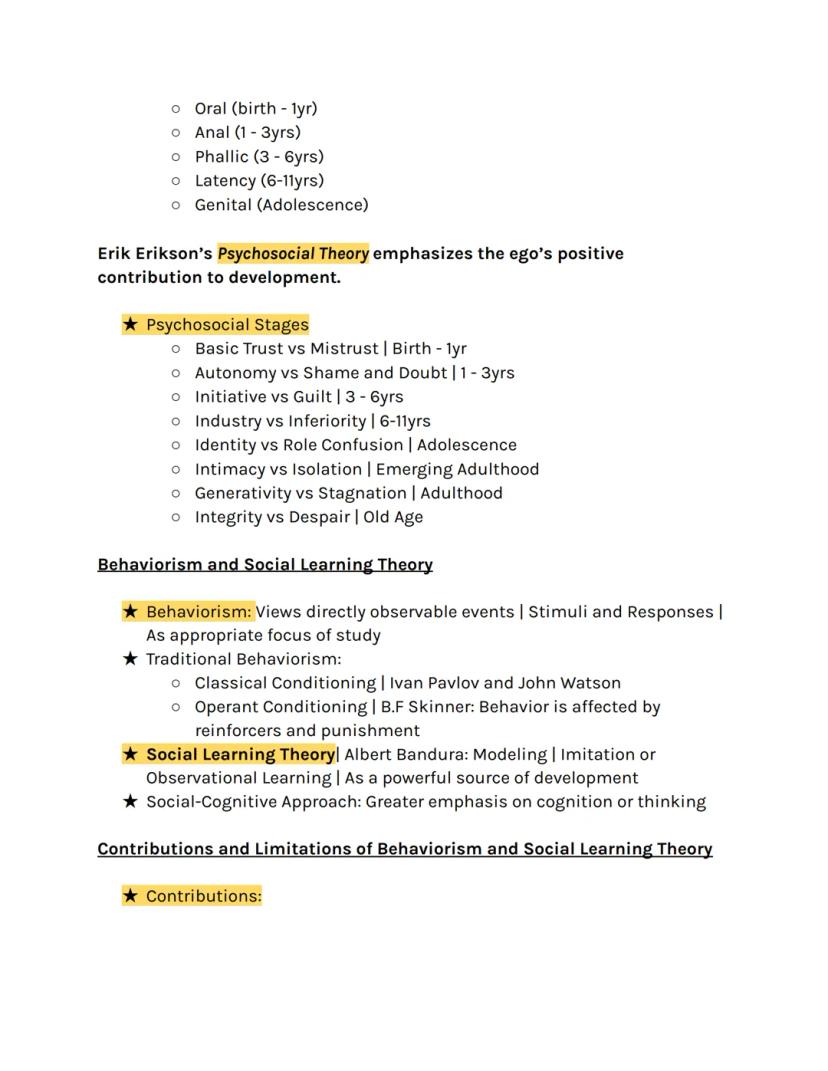
By the mid-twentieth century, several influential theories emerged. Sigmund Freud's psychoanalytic perspective proposed that children move through stages where they confront conflicts between biological drives and social expectations. His theory identified five psychosexual stages involving three personality structures: the id (primitive impulses), ego (rational thinking), and superego (moral conscience).

Historical Context: Remember that each historical perspective on childhood reflected the social and cultural beliefs of its time. This helps explain why views on children's development have changed so dramatically over the centuries.

--- OCR Start ---
CHAPTER 1
History, Theory, and Research Strategies
Child Development: A field of study devoted to understanding constancy

Psychosocial and Behavioral Perspectives

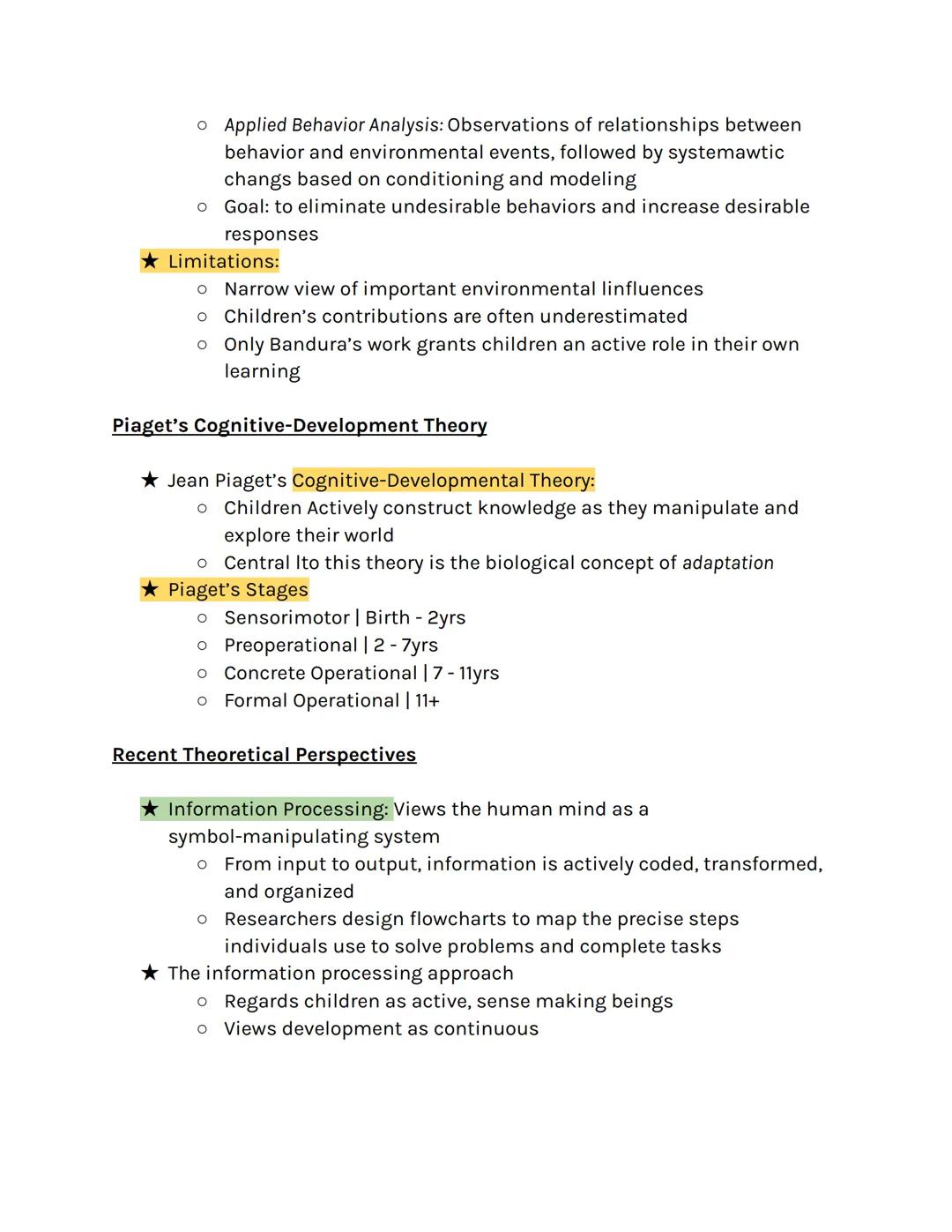
Erik Erikson expanded on Freud's work with his psychosocial theory, which emphasized the ego's positive contribution to development. Unlike Freud's focus on sexual drives, Erikson identified eight stages throughout the lifespan, each centered around a specific crisis to be resolved. These range from trust versus mistrust in infancy to integrity versus despair in old age.

Behaviorism took a dramatically different approach, focusing only on directly observable events—stimuli and responses. Traditional behaviorists like Ivan Pavlov and John Watson studied classical conditioning, while B.F. Skinner explored operant conditioning, showing how behavior is shaped by reinforcers and punishment. Albert Bandura's social learning theory expanded behaviorism by recognizing the importance of modeling and observational learning.

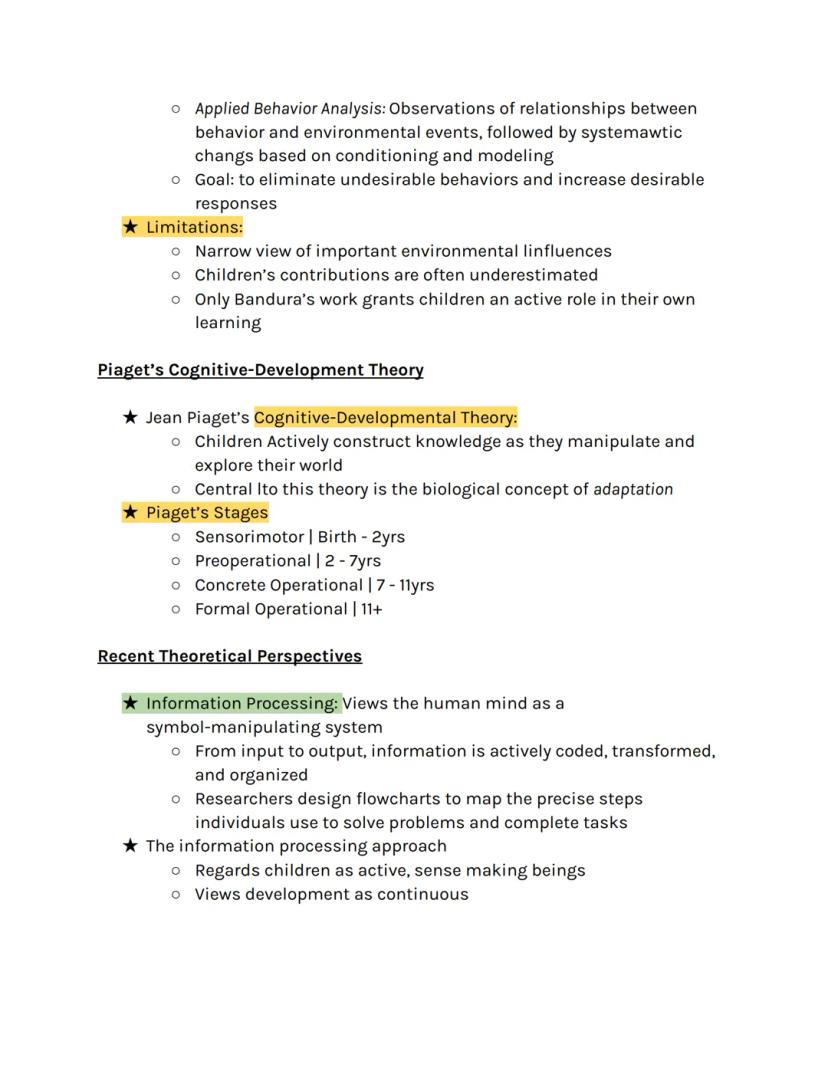
Behaviorism made significant practical contributions through applied behavior analysis, which helps modify problematic behaviors and encourage positive ones. However, its limitations include taking a narrow view of environmental influences and underestimating children's active role in their development. Only Bandura's social-cognitive approach fully acknowledges children's capacity to direct their own learning.

Practical Application: Next time you want to encourage a behavior in a child, consider whether you're using principles from these theories—like positive reinforcement (behaviorism) or providing a good model to imitate (social learning).

--- OCR Start ---
CHAPTER 1
History, Theory, and Research Strategies
Child Development: A field of study devoted to understanding constancy

Cognitive and Information Processing Theories

Jean Piaget revolutionized our understanding of children's thinking with his cognitive-developmental theory. He proposed that children actively construct knowledge by manipulating and exploring their world—they aren't passive recipients of information. Central to his theory is the biological concept of adaptation, where children adjust their thinking as they encounter new experiences.

Piaget organized development into four major stages: sensorimotor birth2yearsbirth-2 years, preoperational 27years2-7 years, concrete operational 711years7-11 years, and formal operational 11+years11+ years. Each stage represents a qualitatively different way of understanding the world, with increasingly sophisticated logical thinking developing over time.

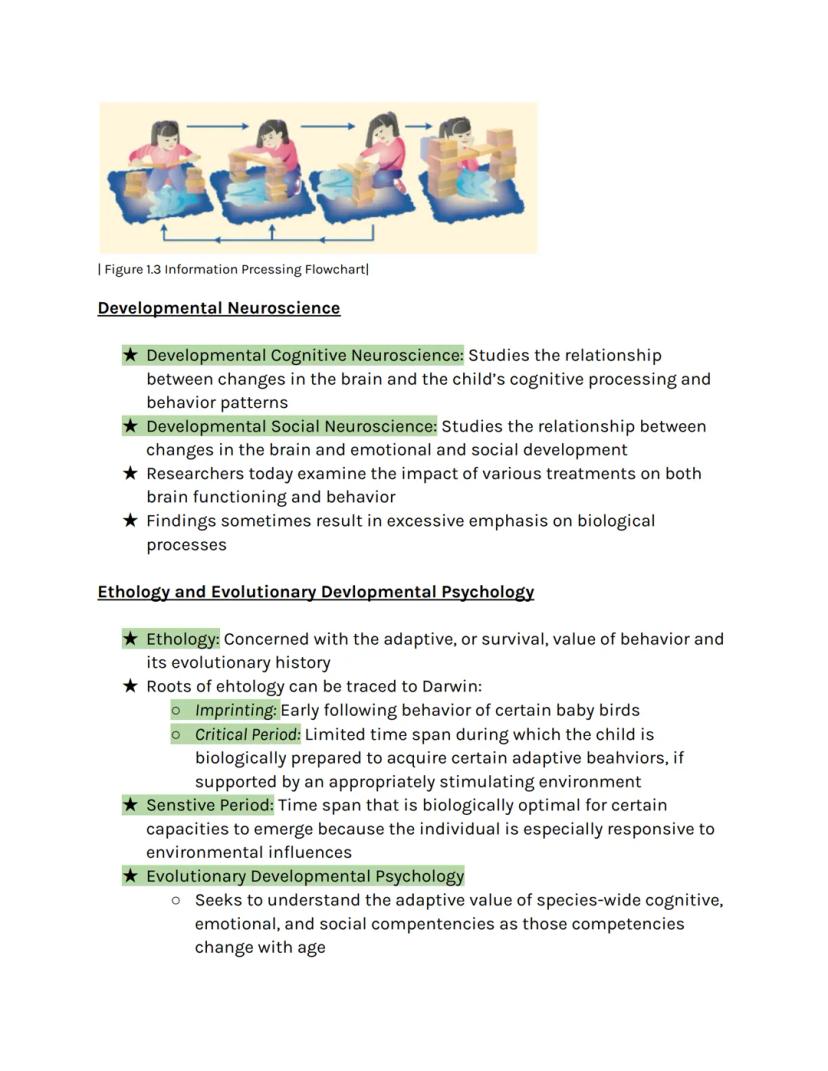
The information processing approach views the human mind as a symbol-manipulating system, similar to a computer. This perspective traces how information moves from input to output—being coded, transformed, and organized along the way. Researchers create detailed flowcharts mapping the precise steps children use to solve problems and complete tasks.

Cognitive Connection: Think about how Piaget's theory explains why young children often believe that a tall, thin glass contains more liquid than a short, wide one even when they contain the same amount. Their thinking in the preoperational stage hasn't yet mastered conservation of quantity!

--- OCR Start ---
CHAPTER 1
History, Theory, and Research Strategies
Child Development: A field of study devoted to understanding constancy

Brain Science and Evolutionary Perspectives

Developmental neuroscience has transformed our understanding of children's growth by connecting brain development to behavior. Developmental cognitive neuroscience examines how brain changes relate to thinking and processing, while developmental social neuroscience focuses on emotional and social development. Modern researchers study how various interventions affect both brain function and behavior, though sometimes biological processes receive excessive emphasis.

Ethology explores behavior's adaptive value for survival, tracing its roots to Darwin's evolutionary theory. Key concepts include imprinting (like baby birds following their mothers) and critical periods—limited time spans when children are biologically ready to acquire certain adaptive behaviors if given appropriate stimulation. The related concept of sensitive periods describes optimal windows for developing specific capacities.

Building on ethological foundations, evolutionary developmental psychology seeks to understand the adaptive value of cognitive, emotional, and social competencies as they change with age. The goal is to comprehend the entire person-environment system and how natural selection has shaped human development over evolutionary time.

Brain Fact: Your brain develops dramatically during childhood through both growth and pruning. Like a sculptor who adds clay and then carves away excess, your brain first creates many neural connections and then eliminates less-used pathways to increase efficiency.

--- OCR Start ---
CHAPTER 1
History, Theory, and Research Strategies
Child Development: A field of study devoted to understanding constancy

Sociocultural and Ecological Perspectives

Lev Vygotsky's sociocultural theory emphasizes how culture—including values, beliefs, customs, and skills—passes from one generation to the next. Unlike theories that focus primarily on individual development, Vygotsky argued that social interaction, particularly collaborative dialogues with more knowledgeable people, is essential for children to acquire their community's ways of thinking. This makes cognitive development a socially mediated process.

Contemporary sociocultural theorists recognize the balanced, mutually influential roles of individuals and society. They study how children's development is shaped by cultural practices while acknowledging that children actively participate in their cultural learning.

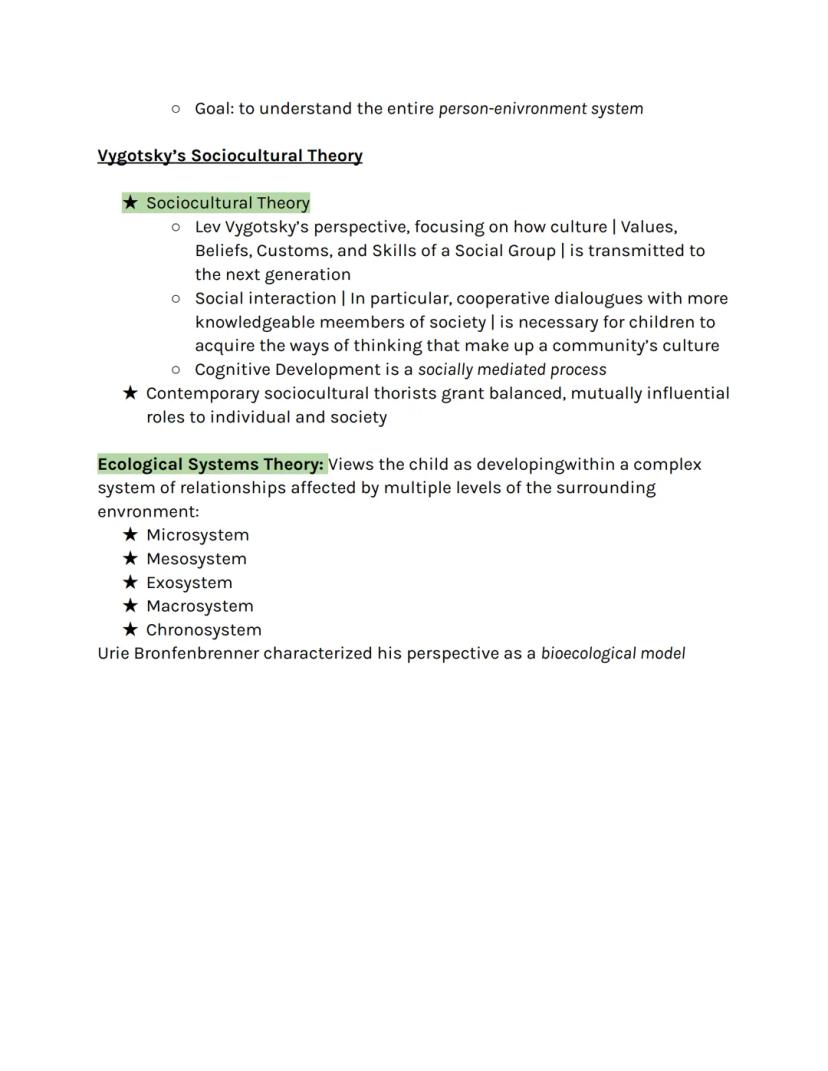
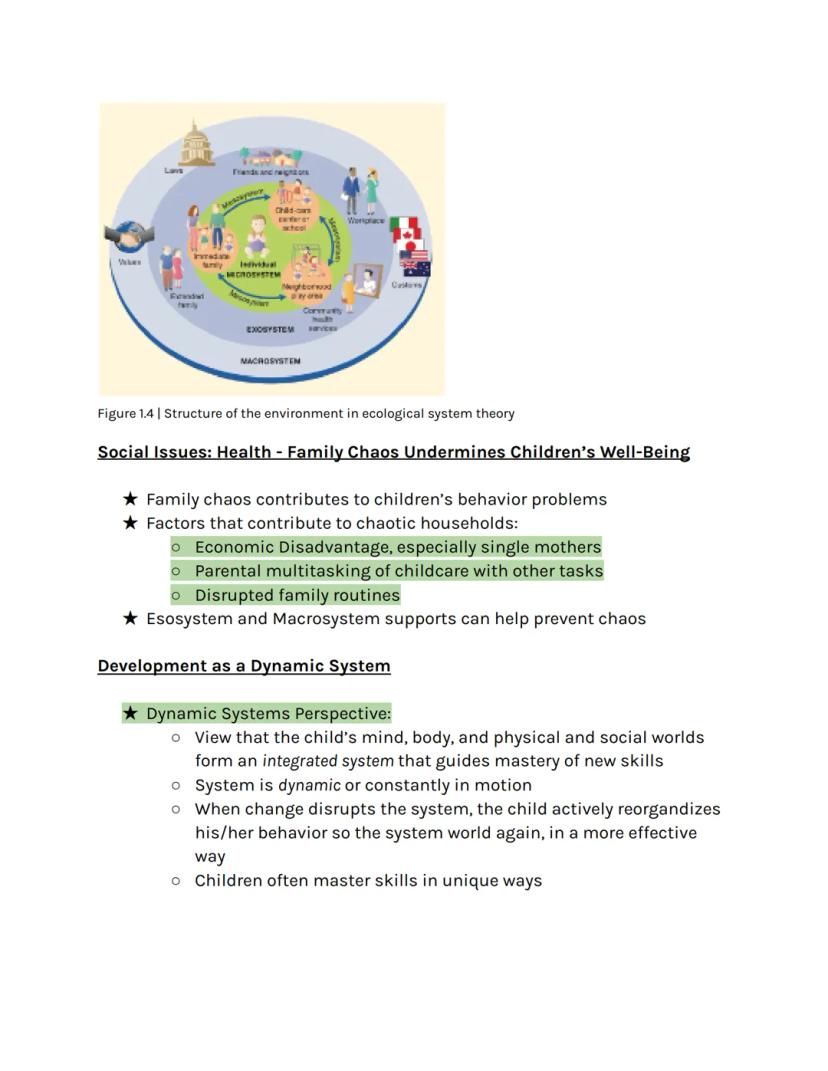
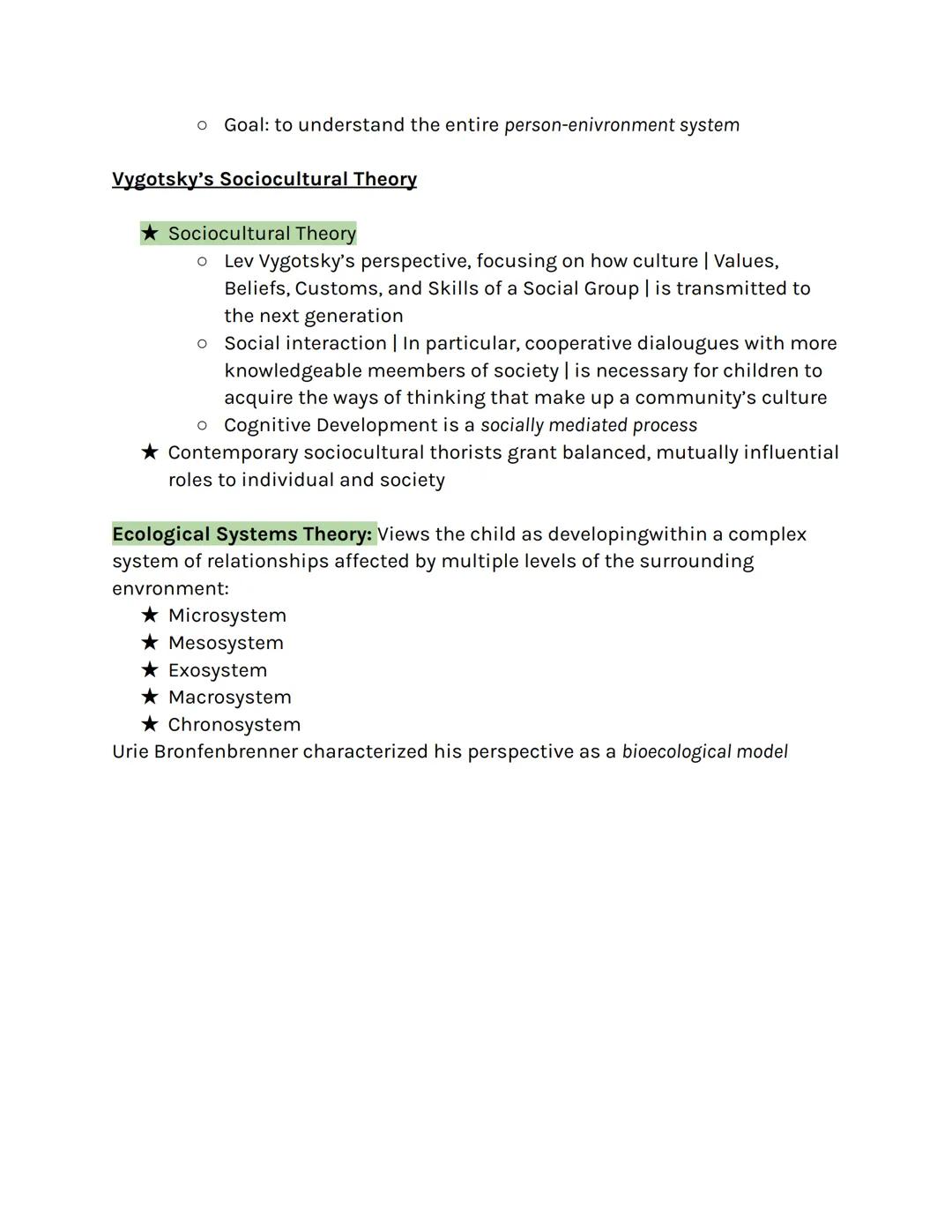
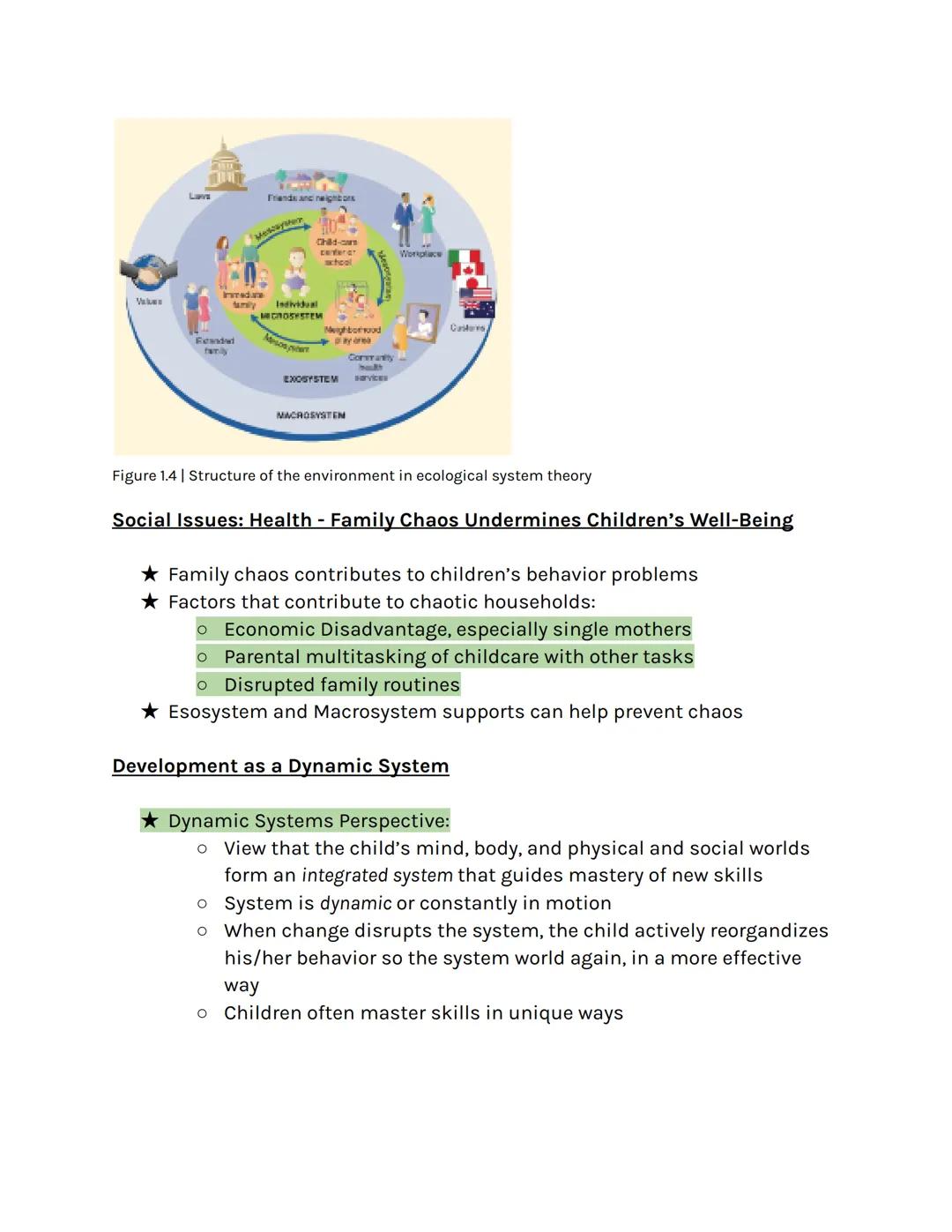
Urie Bronfenbrenner's ecological systems theory views children as developing within complex relationship networks affected by multiple environmental levels. His model includes the microsystem (direct interactions), mesosystem (connections between microsystems), exosystem (indirect environmental influences), macrosystem (cultural context), and chronosystem (changes over time). This perspective, now called the bioecological model, recognizes how these nested systems interact with the child's biology.

Systems Insight: Consider how many different levels affect a child's school performance—from direct teacher interactions (microsystem) to parent-teacher relationships (mesosystem) to school funding decisions (exosystem) to cultural values about education (macrosystem).

--- OCR Start ---
CHAPTER 1
History, Theory, and Research Strategies
Child Development: A field of study devoted to understanding constancy

Family Dynamics and Systems Perspectives

Family chaos can significantly undermine children's development and well-being, contributing to behavior problems. Several factors increase household chaos, including economic disadvantage (especially for single mothers), parental multitasking, and disrupted family routines. Support systems at both the exosystem level (like workplace flexibility) and macrosystem level (like affordable childcare) can help prevent family chaos and promote stability.

The dynamic systems perspective offers an integrated approach to development. This view sees the child's mind, body, and physical/social environments as forming a single system that guides the mastery of new skills. The system is constantly in motion—when change disrupts the system, children actively reorganize their behavior to restore balance in more effective ways. This perspective helps explain why children often master skills in unique ways.

Dynamic systems theory visualizes development as occurring across physical, cognitive, and emotional/social domains simultaneously, with each domain influencing the others. This interconnected view helps explain both the complexity and the resilience of children's developmental paths.

Dynamic Insight: Think about learning to ride a bike—it requires coordinating physical skills, cognitive understanding, emotional regulation (managing fear), and often social support. A change in any part of this system affects all the others!

--- OCR Start ---
CHAPTER 1
History, Theory, and Research Strategies
Child Development: A field of study devoted to understanding constancy

Comparing Developmental Theories

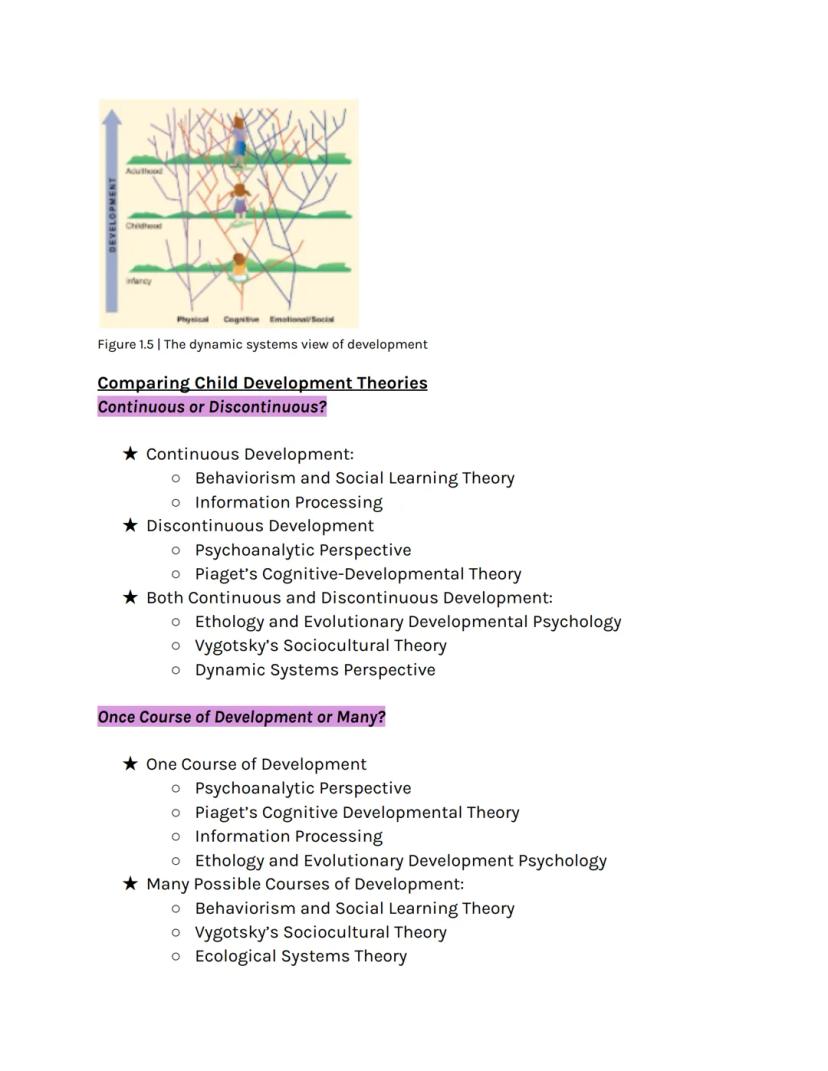
Developmental theories take different positions on whether development is continuous or discontinuous. Behaviorism, social learning theory, and information processing see development as continuous—gradual improvement without dramatic shifts. The psychoanalytic perspective and Piaget's cognitive-developmental theory view development as discontinuous—occurring in distinct stages. Other theories like ethology, Vygotsky's sociocultural theory, and the dynamic systems perspective recognize both continuous and discontinuous elements.

Theories also differ on whether children follow one universal developmental course or many possible paths. The psychoanalytic perspective, Piaget's theory, information processing, and evolutionary psychology generally support a universal sequence. In contrast, behaviorism, social learning theory, sociocultural theory, ecological systems theory, and the dynamic systems perspective emphasize multiple possible developmental trajectories shaped by individual and cultural differences.

These theoretical comparisons help us understand the various lenses through which we can view child development. Each perspective offers valuable insights, and together they provide a more complete picture than any single theory alone.

Theory Application: When working with children, consider which theories might best explain the behavior you observe. For example, is a child's fear of the dark better explained by learning theories (previous scary experiences) or psychoanalytic perspectives (unconscious fears)?


We thought you’d never ask...

What is the Knowunity AI companion?

Our AI companion is specifically built for the needs of students. Based on the millions of content pieces we have on the platform we can provide truly meaningful and relevant answers to students. But its not only about answers, the companion is even more about guiding students through their daily learning challenges, with personalised study plans, quizzes or content pieces in the chat and 100% personalisation based on the students skills and developments.

Where can I download the Knowunity app?

You can download the app in the Google Play Store and in the Apple App Store.

Is Knowunity really free of charge?

That's right! Enjoy free access to study content, connect with fellow students, and get instant help – all at your fingertips.

Can't find what you're looking for? Explore other subjects.

Students love us — and so will you.

4.9/5

App Store

4.8/5

Google Play

The app is very easy to use and well designed. I have found everything I was looking for so far and have been able to learn a lot from the presentations! I will definitely use the app for a class assignment! And of course it also helps a lot as an inspiration.

Stefan S

iOS user

This app is really great. There are so many study notes and help [...]. My problem subject is French, for example, and the app has so many options for help. Thanks to this app, I have improved my French. I would recommend it to anyone.

Samantha Klich

Android user

Wow, I am really amazed. I just tried the app because I've seen it advertised many times and was absolutely stunned. This app is THE HELP you want for school and above all, it offers so many things, such as workouts and fact sheets, which have been VERY helpful to me personally.

Anna

iOS user

I think it’s very much worth it and you’ll end up using it a lot once you get the hang of it and even after looking at others notes you can still ask your Artificial intelligence buddy the question and ask to simplify it if you still don’t get it!!! In the end I think it’s worth it 😊👍 ⚠️Also DID I MENTION ITS FREEE YOU DON’T HAVE TO PAY FOR ANYTHING AND STILL GET YOUR GRADES IN PERFECTLY❗️❗️⚠️

Thomas R

iOS user

Knowunity is the BEST app I’ve used in a minute. This is not an ai review or anything this is genuinely coming from a 7th grade student (I know 2011 im young) but dude this app is a 10/10 i have maintained a 3.8 gpa and have plenty of time for gaming. I love it and my mom is just happy I got good grades

Brad T

Android user

Not only did it help me find the answer but it also showed me alternative ways to solve it. I was horrible in math and science but now I have an a in both subjects. Thanks for the help🤍🤍

David K

iOS user

The app's just great! All I have to do is enter the topic in the search bar and I get the response real fast. I don't have to watch 10 YouTube videos to understand something, so I'm saving my time. Highly recommended!

Sudenaz Ocak

Android user

In school I was really bad at maths but thanks to the app, I am doing better now. I am so grateful that you made the app.

Greenlight Bonnie

Android user

I found this app a couple years ago and it has only gotten better since then. I really love it because it can help with written questions and photo questions. Also, it can find study guides that other people have made as well as flashcard sets and practice tests. The free version is also amazing for students who might not be able to afford it. Would 100% recommend

Aubrey

iOS user

Best app if you're in Highschool or Junior high. I have been using this app for 2 school years and it's the best, it's good if you don't have anyone to help you with school work.😋🩷🎀

Marco B

iOS user

THE QUIZES AND FLASHCARDS ARE SO USEFUL AND I LOVE THE SCHOOLGPT. IT ALSO IS LITREALLY LIKE CHATGPT BUT SMARTER!! HELPED ME WITH MY MASCARA PROBLEMS TOO!! AS WELL AS MY REAL SUBJECTS ! DUHHH 😍😁😲🤑💗✨🎀😮

Elisha

iOS user

This app is phenomenal down to the correct info and the various topics you can study! I greatly recommend it for people who struggle with procrastination and those who need homework help. It has been perfectly accurate for world 1 history as far as I’ve seen! Geometry too!

Paul T

iOS user

The app is very easy to use and well designed. I have found everything I was looking for so far and have been able to learn a lot from the presentations! I will definitely use the app for a class assignment! And of course it also helps a lot as an inspiration.

Stefan S

iOS user

This app is really great. There are so many study notes and help [...]. My problem subject is French, for example, and the app has so many options for help. Thanks to this app, I have improved my French. I would recommend it to anyone.

Samantha Klich

Android user

Wow, I am really amazed. I just tried the app because I've seen it advertised many times and was absolutely stunned. This app is THE HELP you want for school and above all, it offers so many things, such as workouts and fact sheets, which have been VERY helpful to me personally.

Anna

iOS user

I think it’s very much worth it and you’ll end up using it a lot once you get the hang of it and even after looking at others notes you can still ask your Artificial intelligence buddy the question and ask to simplify it if you still don’t get it!!! In the end I think it’s worth it 😊👍 ⚠️Also DID I MENTION ITS FREEE YOU DON’T HAVE TO PAY FOR ANYTHING AND STILL GET YOUR GRADES IN PERFECTLY❗️❗️⚠️

Thomas R

iOS user

Knowunity is the BEST app I’ve used in a minute. This is not an ai review or anything this is genuinely coming from a 7th grade student (I know 2011 im young) but dude this app is a 10/10 i have maintained a 3.8 gpa and have plenty of time for gaming. I love it and my mom is just happy I got good grades

Brad T

Android user

Not only did it help me find the answer but it also showed me alternative ways to solve it. I was horrible in math and science but now I have an a in both subjects. Thanks for the help🤍🤍

David K

iOS user

The app's just great! All I have to do is enter the topic in the search bar and I get the response real fast. I don't have to watch 10 YouTube videos to understand something, so I'm saving my time. Highly recommended!

Sudenaz Ocak

Android user

In school I was really bad at maths but thanks to the app, I am doing better now. I am so grateful that you made the app.

Greenlight Bonnie

Android user

I found this app a couple years ago and it has only gotten better since then. I really love it because it can help with written questions and photo questions. Also, it can find study guides that other people have made as well as flashcard sets and practice tests. The free version is also amazing for students who might not be able to afford it. Would 100% recommend

Aubrey

iOS user

Best app if you're in Highschool or Junior high. I have been using this app for 2 school years and it's the best, it's good if you don't have anyone to help you with school work.😋🩷🎀

Marco B

iOS user

THE QUIZES AND FLASHCARDS ARE SO USEFUL AND I LOVE THE SCHOOLGPT. IT ALSO IS LITREALLY LIKE CHATGPT BUT SMARTER!! HELPED ME WITH MY MASCARA PROBLEMS TOO!! AS WELL AS MY REAL SUBJECTS ! DUHHH 😍😁😲🤑💗✨🎀😮

Elisha

iOS user

This app is phenomenal down to the correct info and the various topics you can study! I greatly recommend it for people who struggle with procrastination and those who need homework help. It has been perfectly accurate for world 1 history as far as I’ve seen! Geometry too!

Paul T

iOS user


Health

61

Dec 10, 2025

15 pages

Understanding Child Development: Chapter 1 Overview

K

Kaiya Wade

@aiyaade_fhcb

Child development is a fascinating journey from conception through adolescence that encompasses physical, cognitive, emotional, and social changes. This field helps us understand how children grow, learn, and interact with their world across various developmental periods. Studying developmental science equips... Show more

--- OCR Start ---
CHAPTER 1
History, Theory, and Research Strategies
Child Development: A field of study devoted to understanding constancy

Sign up to see the contentIt's free!

Access to all documents

Improve your grades

Join milions of students

By signing up you accept Terms of Service and Privacy Policy

Child Development Foundations

Child development spans multiple interconnected domains that work together as children grow. When studying development, we typically look at three primary areas: physical (body growth, health, motor skills), cognitive thinking,learning,problemsolvingthinking, learning, problem-solving, and emotional/social relationships,selfunderstanding,moralreasoningrelationships, self-understanding, moral reasoning.

Development occurs across distinct periods, each with its own characteristics and milestones. These include the prenatal period (conception to birth), infancy and toddlerhood (birth to 2 years), early childhood 26years2-6 years, middle childhood 611years6-11 years, and adolescence 1118years11-18 years. Recently, researchers have also recognized emerging adulthood 18tomid/late20s18 to mid/late 20s as a distinct developmental period.

Understanding these domains and periods helps us recognize what's typical at different ages. This knowledge is crucial whether you're studying child development, working with children, or simply trying to understand the children in your life.

Remember This: The domains of development don't exist in isolation—physical, cognitive, and emotional/social development constantly influence each other throughout childhood.
--- OCR Start ---
CHAPTER 1
History, Theory, and Research Strategies
Child Development: A field of study devoted to understanding constancy

Sign up to see the contentIt's free!

Access to all documents

Improve your grades

Join milions of students

By signing up you accept Terms of Service and Privacy Policy

Basic Developmental Issues

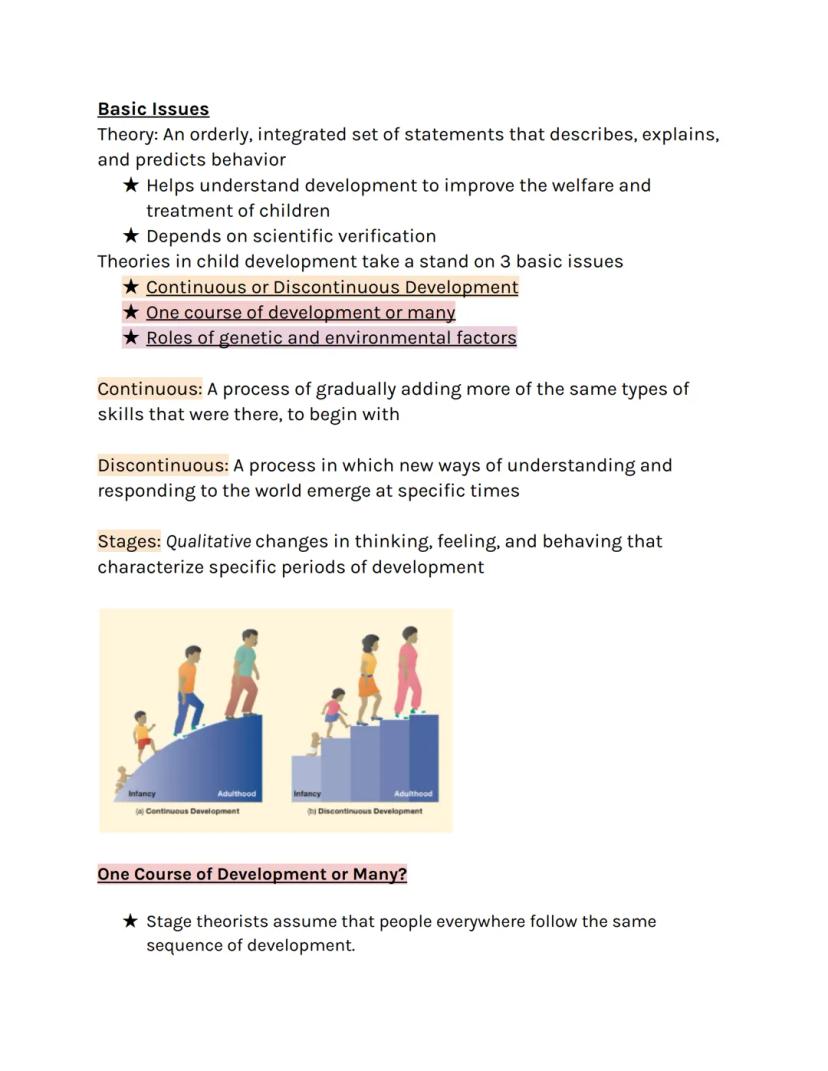
When studying development, scientists create theories – organized frameworks that describe, explain and predict behavior. These aren't just academic exercises; they guide how we understand and support children's growth. Every developmental theory takes a position on three fundamental issues.

First, is development continuous or discontinuous? Continuous development views growth as gradually adding more of the same skills over time, like steadily climbing a ramp. Discontinuous development sees growth happening in distinct stages with qualitative differences between periods, like climbing separate steps on a staircase.

Second, do all children follow one universal course of development or many possible paths? Stage theorists believe everyone follows the same developmental sequence regardless of background. However, newer research recognizes the importance of cultural diversity and individual circumstances in shaping unique developmental paths.

Think About It: Consider your own development—can you identify areas where you seemed to grow gradually (continuously) versus times when you experienced dramatic shifts in how you thought or behaved (discontinuously)?

--- OCR Start ---
CHAPTER 1
History, Theory, and Research Strategies
Child Development: A field of study devoted to understanding constancy

Sign up to see the contentIt's free!

Access to all documents

Improve your grades

Join milions of students

By signing up you accept Terms of Service and Privacy Policy

Nature, Nurture, and Resilience

The nature-nurture controversy represents the ongoing debate about whether our genes or our experiences have more influence on who we become. This fundamental question shapes how theories explain differences between individuals. Connected to this is the question of stability versus plasticity—how fixed are developmental patterns once established?

Today's developmental scientists take a balanced view on these core issues. Most recognize that development involves both continuous and discontinuous changes, has both universal and individual-specific features, and is shaped by the complex interplay of genetic and environmental factors. This integrated perspective is known as the developmental systems perspective.

One fascinating concept in developmental research is resilience—the remarkable ability some children have to thrive despite significant adversity. Resilient children often possess personal characteristics like positive temperament, benefit from warm parental relationships, receive social support outside their immediate family, and have access to community resources and opportunities.

Good News: Research on resilience shows that children have tremendous capacity to overcome challenges when provided with the right supports—a powerful reminder that development remains flexible throughout childhood.
--- OCR Start ---
CHAPTER 1
History, Theory, and Research Strategies
Child Development: A field of study devoted to understanding constancy

Sign up to see the contentIt's free!

Access to all documents

Improve your grades

Join milions of students

By signing up you accept Terms of Service and Privacy Policy

Historical Views of Childhood

Our understanding of child development has evolved dramatically over centuries. In medieval times, childhood was first recognized as a distinct life period. During the Reformation, children were viewed as inherently depraved beings who needed discipline. The Enlightenment brought contrasting perspectives: John Locke's view of the child as a tabula rasa (blank slate) shaped by experience, and Jean-Jacques Rousseau's concept of children as "noble savages" with an innate moral sense and natural development plan.

Scientific study of children began in earnest after Charles Darwin's evolutionary theory emphasized natural selection and survival of the fittest. Early researchers like G. Stanley Hall and Arnold Gesell pioneered the normative approach, establishing age-related averages of behavior. The mental testing movement, started by Alfred Binet and Theodore Simon, created the first successful intelligence tests in the early 1900s.

By the mid-twentieth century, several influential theories emerged. Sigmund Freud's psychoanalytic perspective proposed that children move through stages where they confront conflicts between biological drives and social expectations. His theory identified five psychosexual stages involving three personality structures: the id (primitive impulses), ego (rational thinking), and superego (moral conscience).

Historical Context: Remember that each historical perspective on childhood reflected the social and cultural beliefs of its time. This helps explain why views on children's development have changed so dramatically over the centuries.

--- OCR Start ---
CHAPTER 1
History, Theory, and Research Strategies
Child Development: A field of study devoted to understanding constancy

Sign up to see the contentIt's free!

Access to all documents

Improve your grades

Join milions of students

By signing up you accept Terms of Service and Privacy Policy

Psychosocial and Behavioral Perspectives

Erik Erikson expanded on Freud's work with his psychosocial theory, which emphasized the ego's positive contribution to development. Unlike Freud's focus on sexual drives, Erikson identified eight stages throughout the lifespan, each centered around a specific crisis to be resolved. These range from trust versus mistrust in infancy to integrity versus despair in old age.

Behaviorism took a dramatically different approach, focusing only on directly observable events—stimuli and responses. Traditional behaviorists like Ivan Pavlov and John Watson studied classical conditioning, while B.F. Skinner explored operant conditioning, showing how behavior is shaped by reinforcers and punishment. Albert Bandura's social learning theory expanded behaviorism by recognizing the importance of modeling and observational learning.

Behaviorism made significant practical contributions through applied behavior analysis, which helps modify problematic behaviors and encourage positive ones. However, its limitations include taking a narrow view of environmental influences and underestimating children's active role in their development. Only Bandura's social-cognitive approach fully acknowledges children's capacity to direct their own learning.

Practical Application: Next time you want to encourage a behavior in a child, consider whether you're using principles from these theories—like positive reinforcement (behaviorism) or providing a good model to imitate (social learning).

--- OCR Start ---
CHAPTER 1
History, Theory, and Research Strategies
Child Development: A field of study devoted to understanding constancy

Sign up to see the contentIt's free!

Access to all documents

Improve your grades

Join milions of students

By signing up you accept Terms of Service and Privacy Policy

Cognitive and Information Processing Theories

Jean Piaget revolutionized our understanding of children's thinking with his cognitive-developmental theory. He proposed that children actively construct knowledge by manipulating and exploring their world—they aren't passive recipients of information. Central to his theory is the biological concept of adaptation, where children adjust their thinking as they encounter new experiences.

Piaget organized development into four major stages: sensorimotor birth2yearsbirth-2 years, preoperational 27years2-7 years, concrete operational 711years7-11 years, and formal operational 11+years11+ years. Each stage represents a qualitatively different way of understanding the world, with increasingly sophisticated logical thinking developing over time.

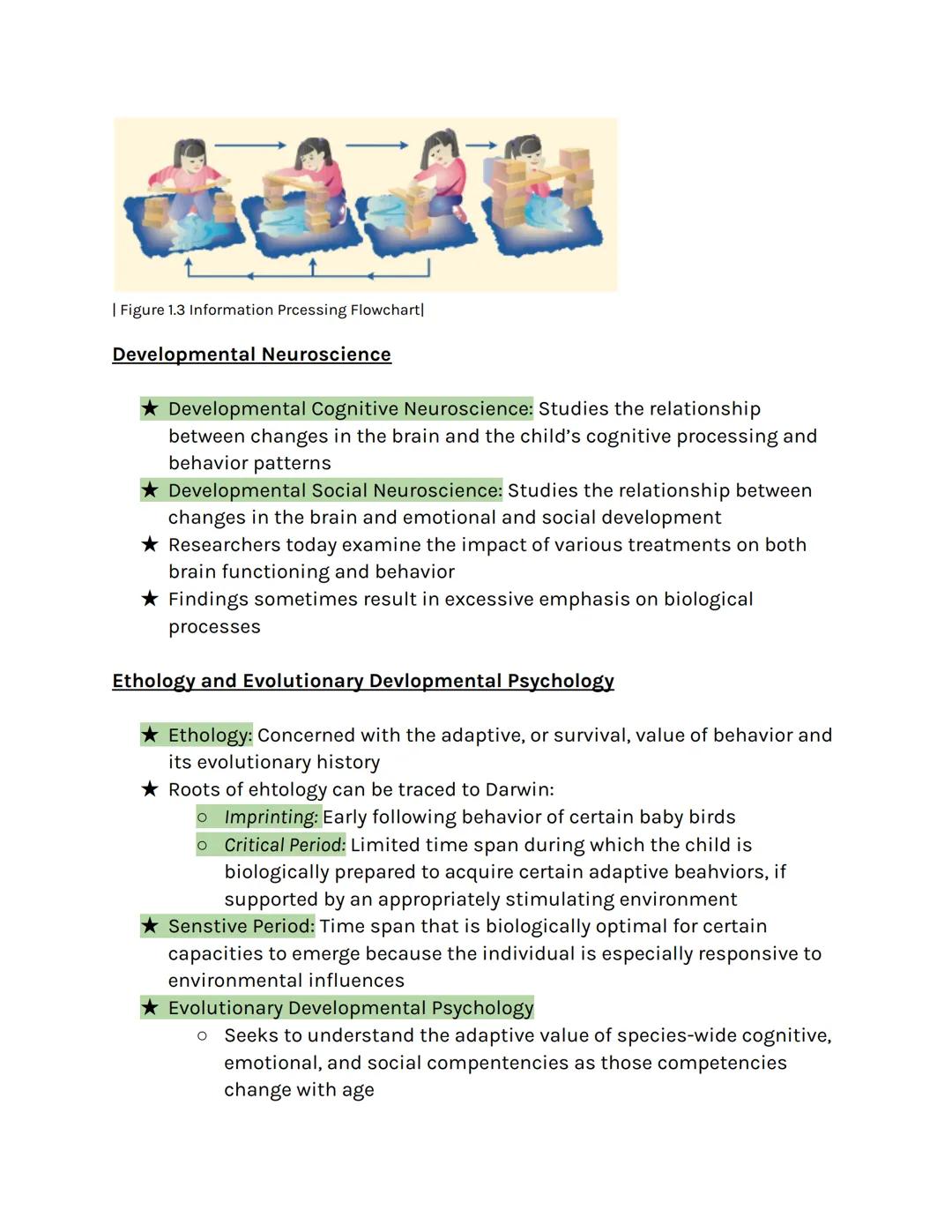
The information processing approach views the human mind as a symbol-manipulating system, similar to a computer. This perspective traces how information moves from input to output—being coded, transformed, and organized along the way. Researchers create detailed flowcharts mapping the precise steps children use to solve problems and complete tasks.

Cognitive Connection: Think about how Piaget's theory explains why young children often believe that a tall, thin glass contains more liquid than a short, wide one even when they contain the same amount. Their thinking in the preoperational stage hasn't yet mastered conservation of quantity!

--- OCR Start ---
CHAPTER 1
History, Theory, and Research Strategies
Child Development: A field of study devoted to understanding constancy

Sign up to see the contentIt's free!

Access to all documents

Improve your grades

Join milions of students

By signing up you accept Terms of Service and Privacy Policy

Brain Science and Evolutionary Perspectives

Developmental neuroscience has transformed our understanding of children's growth by connecting brain development to behavior. Developmental cognitive neuroscience examines how brain changes relate to thinking and processing, while developmental social neuroscience focuses on emotional and social development. Modern researchers study how various interventions affect both brain function and behavior, though sometimes biological processes receive excessive emphasis.

Ethology explores behavior's adaptive value for survival, tracing its roots to Darwin's evolutionary theory. Key concepts include imprinting (like baby birds following their mothers) and critical periods—limited time spans when children are biologically ready to acquire certain adaptive behaviors if given appropriate stimulation. The related concept of sensitive periods describes optimal windows for developing specific capacities.

Building on ethological foundations, evolutionary developmental psychology seeks to understand the adaptive value of cognitive, emotional, and social competencies as they change with age. The goal is to comprehend the entire person-environment system and how natural selection has shaped human development over evolutionary time.

Brain Fact: Your brain develops dramatically during childhood through both growth and pruning. Like a sculptor who adds clay and then carves away excess, your brain first creates many neural connections and then eliminates less-used pathways to increase efficiency.

--- OCR Start ---
CHAPTER 1
History, Theory, and Research Strategies
Child Development: A field of study devoted to understanding constancy

Sign up to see the contentIt's free!

Access to all documents

Improve your grades

Join milions of students

By signing up you accept Terms of Service and Privacy Policy

Sociocultural and Ecological Perspectives

Lev Vygotsky's sociocultural theory emphasizes how culture—including values, beliefs, customs, and skills—passes from one generation to the next. Unlike theories that focus primarily on individual development, Vygotsky argued that social interaction, particularly collaborative dialogues with more knowledgeable people, is essential for children to acquire their community's ways of thinking. This makes cognitive development a socially mediated process.

Contemporary sociocultural theorists recognize the balanced, mutually influential roles of individuals and society. They study how children's development is shaped by cultural practices while acknowledging that children actively participate in their cultural learning.

Urie Bronfenbrenner's ecological systems theory views children as developing within complex relationship networks affected by multiple environmental levels. His model includes the microsystem (direct interactions), mesosystem (connections between microsystems), exosystem (indirect environmental influences), macrosystem (cultural context), and chronosystem (changes over time). This perspective, now called the bioecological model, recognizes how these nested systems interact with the child's biology.

Systems Insight: Consider how many different levels affect a child's school performance—from direct teacher interactions (microsystem) to parent-teacher relationships (mesosystem) to school funding decisions (exosystem) to cultural values about education (macrosystem).

--- OCR Start ---
CHAPTER 1
History, Theory, and Research Strategies
Child Development: A field of study devoted to understanding constancy

Sign up to see the contentIt's free!

Access to all documents

Improve your grades

Join milions of students

By signing up you accept Terms of Service and Privacy Policy

Family Dynamics and Systems Perspectives

Family chaos can significantly undermine children's development and well-being, contributing to behavior problems. Several factors increase household chaos, including economic disadvantage (especially for single mothers), parental multitasking, and disrupted family routines. Support systems at both the exosystem level (like workplace flexibility) and macrosystem level (like affordable childcare) can help prevent family chaos and promote stability.

The dynamic systems perspective offers an integrated approach to development. This view sees the child's mind, body, and physical/social environments as forming a single system that guides the mastery of new skills. The system is constantly in motion—when change disrupts the system, children actively reorganize their behavior to restore balance in more effective ways. This perspective helps explain why children often master skills in unique ways.

Dynamic systems theory visualizes development as occurring across physical, cognitive, and emotional/social domains simultaneously, with each domain influencing the others. This interconnected view helps explain both the complexity and the resilience of children's developmental paths.

Dynamic Insight: Think about learning to ride a bike—it requires coordinating physical skills, cognitive understanding, emotional regulation (managing fear), and often social support. A change in any part of this system affects all the others!

--- OCR Start ---
CHAPTER 1
History, Theory, and Research Strategies
Child Development: A field of study devoted to understanding constancy

Sign up to see the contentIt's free!

Access to all documents

Improve your grades

Join milions of students

By signing up you accept Terms of Service and Privacy Policy

Comparing Developmental Theories

Developmental theories take different positions on whether development is continuous or discontinuous. Behaviorism, social learning theory, and information processing see development as continuous—gradual improvement without dramatic shifts. The psychoanalytic perspective and Piaget's cognitive-developmental theory view development as discontinuous—occurring in distinct stages. Other theories like ethology, Vygotsky's sociocultural theory, and the dynamic systems perspective recognize both continuous and discontinuous elements.

Theories also differ on whether children follow one universal developmental course or many possible paths. The psychoanalytic perspective, Piaget's theory, information processing, and evolutionary psychology generally support a universal sequence. In contrast, behaviorism, social learning theory, sociocultural theory, ecological systems theory, and the dynamic systems perspective emphasize multiple possible developmental trajectories shaped by individual and cultural differences.

These theoretical comparisons help us understand the various lenses through which we can view child development. Each perspective offers valuable insights, and together they provide a more complete picture than any single theory alone.

Theory Application: When working with children, consider which theories might best explain the behavior you observe. For example, is a child's fear of the dark better explained by learning theories (previous scary experiences) or psychoanalytic perspectives (unconscious fears)?

We thought you’d never ask...

What is the Knowunity AI companion?

Our AI companion is specifically built for the needs of students. Based on the millions of content pieces we have on the platform we can provide truly meaningful and relevant answers to students. But its not only about answers, the companion is even more about guiding students through their daily learning challenges, with personalised study plans, quizzes or content pieces in the chat and 100% personalisation based on the students skills and developments.

Where can I download the Knowunity app?

You can download the app in the Google Play Store and in the Apple App Store.

Is Knowunity really free of charge?

That's right! Enjoy free access to study content, connect with fellow students, and get instant help – all at your fingertips.

1

Smart Tools NEW

Transform this note into: ✓ 50+ Practice Questions ✓ Interactive Flashcards ✓ Full Mock Exam ✓ Essay Outlines

Mock Exam
Quiz
Flashcards
Essay

Can't find what you're looking for? Explore other subjects.

Students love us — and so will you.

4.9/5

App Store

4.8/5

Google Play

The app is very easy to use and well designed. I have found everything I was looking for so far and have been able to learn a lot from the presentations! I will definitely use the app for a class assignment! And of course it also helps a lot as an inspiration.

Stefan S

iOS user

This app is really great. There are so many study notes and help [...]. My problem subject is French, for example, and the app has so many options for help. Thanks to this app, I have improved my French. I would recommend it to anyone.

Samantha Klich

Android user

Wow, I am really amazed. I just tried the app because I've seen it advertised many times and was absolutely stunned. This app is THE HELP you want for school and above all, it offers so many things, such as workouts and fact sheets, which have been VERY helpful to me personally.

Anna

iOS user

I think it’s very much worth it and you’ll end up using it a lot once you get the hang of it and even after looking at others notes you can still ask your Artificial intelligence buddy the question and ask to simplify it if you still don’t get it!!! In the end I think it’s worth it 😊👍 ⚠️Also DID I MENTION ITS FREEE YOU DON’T HAVE TO PAY FOR ANYTHING AND STILL GET YOUR GRADES IN PERFECTLY❗️❗️⚠️

Thomas R

iOS user

Knowunity is the BEST app I’ve used in a minute. This is not an ai review or anything this is genuinely coming from a 7th grade student (I know 2011 im young) but dude this app is a 10/10 i have maintained a 3.8 gpa and have plenty of time for gaming. I love it and my mom is just happy I got good grades

Brad T

Android user

Not only did it help me find the answer but it also showed me alternative ways to solve it. I was horrible in math and science but now I have an a in both subjects. Thanks for the help🤍🤍

David K

iOS user

The app's just great! All I have to do is enter the topic in the search bar and I get the response real fast. I don't have to watch 10 YouTube videos to understand something, so I'm saving my time. Highly recommended!

Sudenaz Ocak

Android user

In school I was really bad at maths but thanks to the app, I am doing better now. I am so grateful that you made the app.

Greenlight Bonnie

Android user

I found this app a couple years ago and it has only gotten better since then. I really love it because it can help with written questions and photo questions. Also, it can find study guides that other people have made as well as flashcard sets and practice tests. The free version is also amazing for students who might not be able to afford it. Would 100% recommend

Aubrey

iOS user

Best app if you're in Highschool or Junior high. I have been using this app for 2 school years and it's the best, it's good if you don't have anyone to help you with school work.😋🩷🎀

Marco B

iOS user

THE QUIZES AND FLASHCARDS ARE SO USEFUL AND I LOVE THE SCHOOLGPT. IT ALSO IS LITREALLY LIKE CHATGPT BUT SMARTER!! HELPED ME WITH MY MASCARA PROBLEMS TOO!! AS WELL AS MY REAL SUBJECTS ! DUHHH 😍😁😲🤑💗✨🎀😮

Elisha

iOS user

This app is phenomenal down to the correct info and the various topics you can study! I greatly recommend it for people who struggle with procrastination and those who need homework help. It has been perfectly accurate for world 1 history as far as I’ve seen! Geometry too!

Paul T

iOS user

The app is very easy to use and well designed. I have found everything I was looking for so far and have been able to learn a lot from the presentations! I will definitely use the app for a class assignment! And of course it also helps a lot as an inspiration.

Stefan S

iOS user

This app is really great. There are so many study notes and help [...]. My problem subject is French, for example, and the app has so many options for help. Thanks to this app, I have improved my French. I would recommend it to anyone.

Samantha Klich

Android user

Wow, I am really amazed. I just tried the app because I've seen it advertised many times and was absolutely stunned. This app is THE HELP you want for school and above all, it offers so many things, such as workouts and fact sheets, which have been VERY helpful to me personally.

Anna

iOS user

I think it’s very much worth it and you’ll end up using it a lot once you get the hang of it and even after looking at others notes you can still ask your Artificial intelligence buddy the question and ask to simplify it if you still don’t get it!!! In the end I think it’s worth it 😊👍 ⚠️Also DID I MENTION ITS FREEE YOU DON’T HAVE TO PAY FOR ANYTHING AND STILL GET YOUR GRADES IN PERFECTLY❗️❗️⚠️

Thomas R

iOS user

Knowunity is the BEST app I’ve used in a minute. This is not an ai review or anything this is genuinely coming from a 7th grade student (I know 2011 im young) but dude this app is a 10/10 i have maintained a 3.8 gpa and have plenty of time for gaming. I love it and my mom is just happy I got good grades

Brad T

Android user

Not only did it help me find the answer but it also showed me alternative ways to solve it. I was horrible in math and science but now I have an a in both subjects. Thanks for the help🤍🤍

David K

iOS user

The app's just great! All I have to do is enter the topic in the search bar and I get the response real fast. I don't have to watch 10 YouTube videos to understand something, so I'm saving my time. Highly recommended!

Sudenaz Ocak

Android user

In school I was really bad at maths but thanks to the app, I am doing better now. I am so grateful that you made the app.

Greenlight Bonnie

Android user

I found this app a couple years ago and it has only gotten better since then. I really love it because it can help with written questions and photo questions. Also, it can find study guides that other people have made as well as flashcard sets and practice tests. The free version is also amazing for students who might not be able to afford it. Would 100% recommend

Aubrey

iOS user

Best app if you're in Highschool or Junior high. I have been using this app for 2 school years and it's the best, it's good if you don't have anyone to help you with school work.😋🩷🎀

Marco B

iOS user

THE QUIZES AND FLASHCARDS ARE SO USEFUL AND I LOVE THE SCHOOLGPT. IT ALSO IS LITREALLY LIKE CHATGPT BUT SMARTER!! HELPED ME WITH MY MASCARA PROBLEMS TOO!! AS WELL AS MY REAL SUBJECTS ! DUHHH 😍😁😲🤑💗✨🎀😮

Elisha

iOS user

This app is phenomenal down to the correct info and the various topics you can study! I greatly recommend it for people who struggle with procrastination and those who need homework help. It has been perfectly accurate for world 1 history as far as I’ve seen! Geometry too!

Paul T

iOS user