
Respiratory and cardiovascular care is at the heart of nursing... Show more
 Health
 Fun Stuff
 Algebra
 Overige
 Algebra 1
 Biology
Sign up to see the contentIt's free!
Access to all documents
Improve your grades
Join milions of students
By signing up you accept Terms of Service and Privacy Policy
Subjects
Triangle Congruence and Similarity Theorems
Triangle Properties and Classification
Linear Equations and Graphs
Geometric Angle Relationships
Trigonometric Functions and Identities
Equation Solving Techniques
Circle Geometry Fundamentals
Division Operations and Methods
Basic Differentiation Rules
Exponent and Logarithm Properties
Show all topics
Human Organ Systems
Reproductive Cell Cycles
Biological Sciences Subdisciplines
Cellular Energy Metabolism
Autotrophic Energy Processes
Inheritance Patterns and Principles
Biomolecular Structure and Organization
Cell Cycle and Division Mechanics
Cellular Organization and Development
Biological Structural Organization
Show all topics
Chemical Sciences and Applications
Atomic Structure and Composition
Molecular Electron Structure Representation
Atomic Electron Behavior
Matter Properties and Water
Mole Concept and Calculations
Gas Laws and Behavior
Periodic Table Organization
Chemical Thermodynamics Fundamentals
Chemical Bond Types and Properties
Show all topics
European Renaissance and Enlightenment
European Cultural Movements 800-1920
American Revolution Era 1763-1797
American Civil War 1861-1865
Global Imperial Systems
Mongol and Chinese Dynasties
U.S. Presidents and World Leaders
Historical Sources and Documentation
World Wars Era and Impact
World Religious Systems
Show all topics
Classic and Contemporary Novels
Literary Character Analysis
Rhetorical Theory and Practice
Classic Literary Narratives
Reading Analysis and Interpretation
Narrative Structure and Techniques
English Language Components
Influential English-Language Authors
Basic Sentence Structure
Narrative Voice and Perspective
Show all topics
54
•
Dec 21, 2025
•
Sabrina
@sabrina_q1b8i
Respiratory and cardiovascular care is at the heart of nursing... Show more
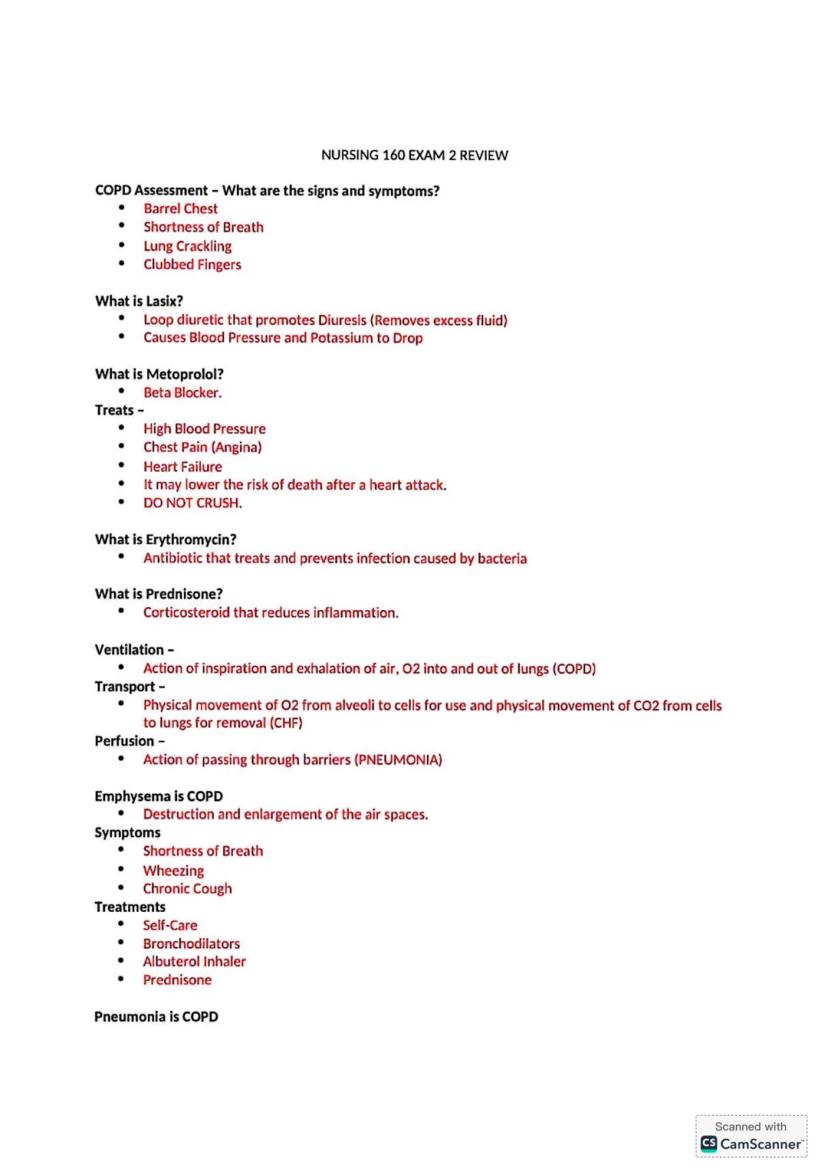
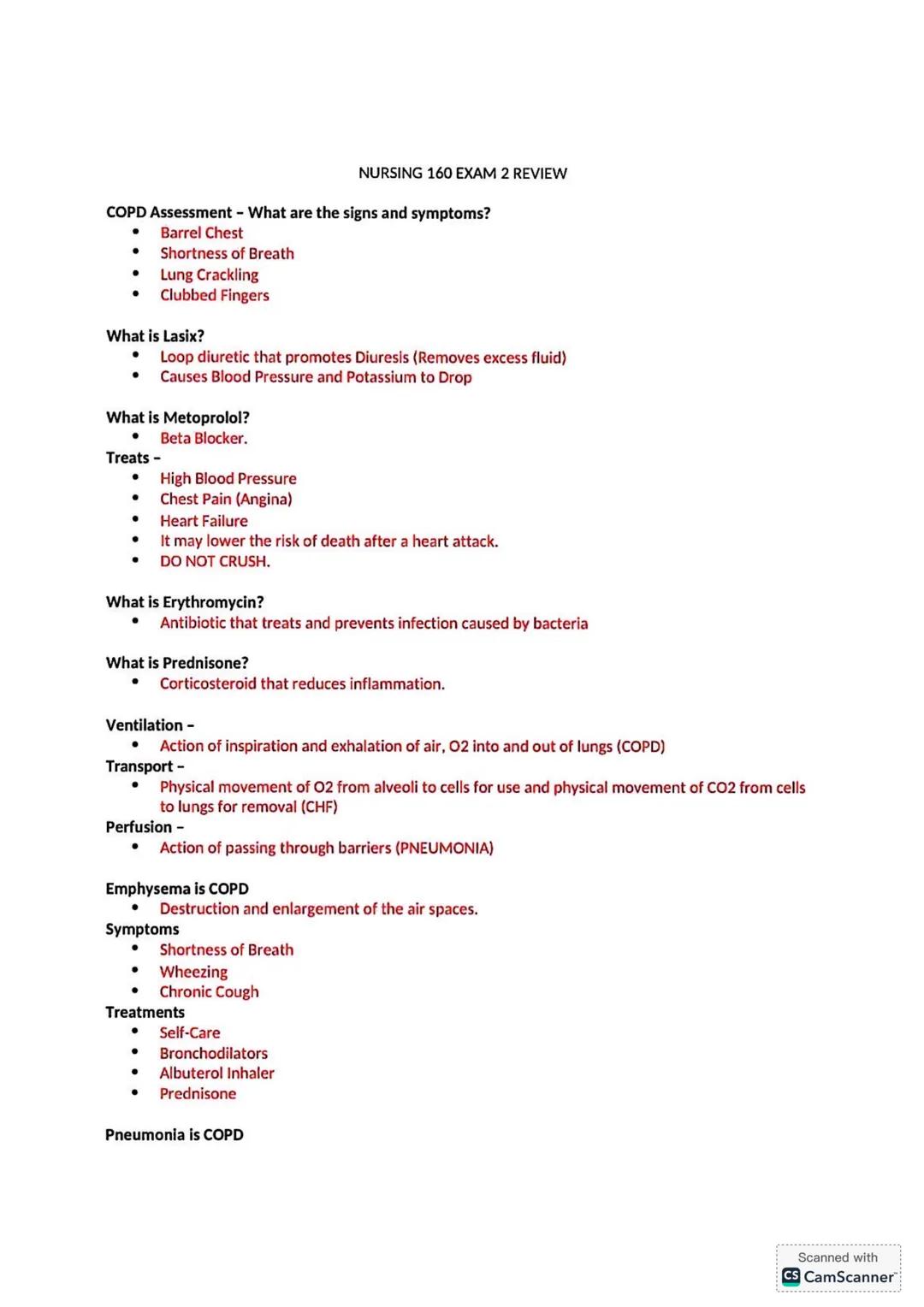
When assessing COPD patients, look for key physical signs including barrel chest, shortness of breath, lung crackling, and clubbed fingers. These indicators help identify respiratory compromise early.
Understanding medications is crucial for respiratory patients. Lasix is a loop diuretic that removes excess fluid but can drop blood pressure and potassium levels. Metoprolol, a beta-blocker that should never be crushed, treats high blood pressure, chest pain, heart failure, and reduces post-heart attack mortality risk. Erythromycin fights bacterial infections, while Prednisone reduces inflammation as a corticosteroid.
Respiratory function involves three key processes: ventilation (breathing air in and out, affected in COPD), transport (moving oxygen from lungs to cells and CO2 back, affected in CHF), and perfusion (passing through barriers, affected in pneumonia).
💡 Remember: COPD patients like those with emphysema have destructed, enlarged air spaces causing shortness of breath, wheezing, and chronic cough. Treatments include self-care strategies, bronchodilators, albuterol inhalers, and prednisone.
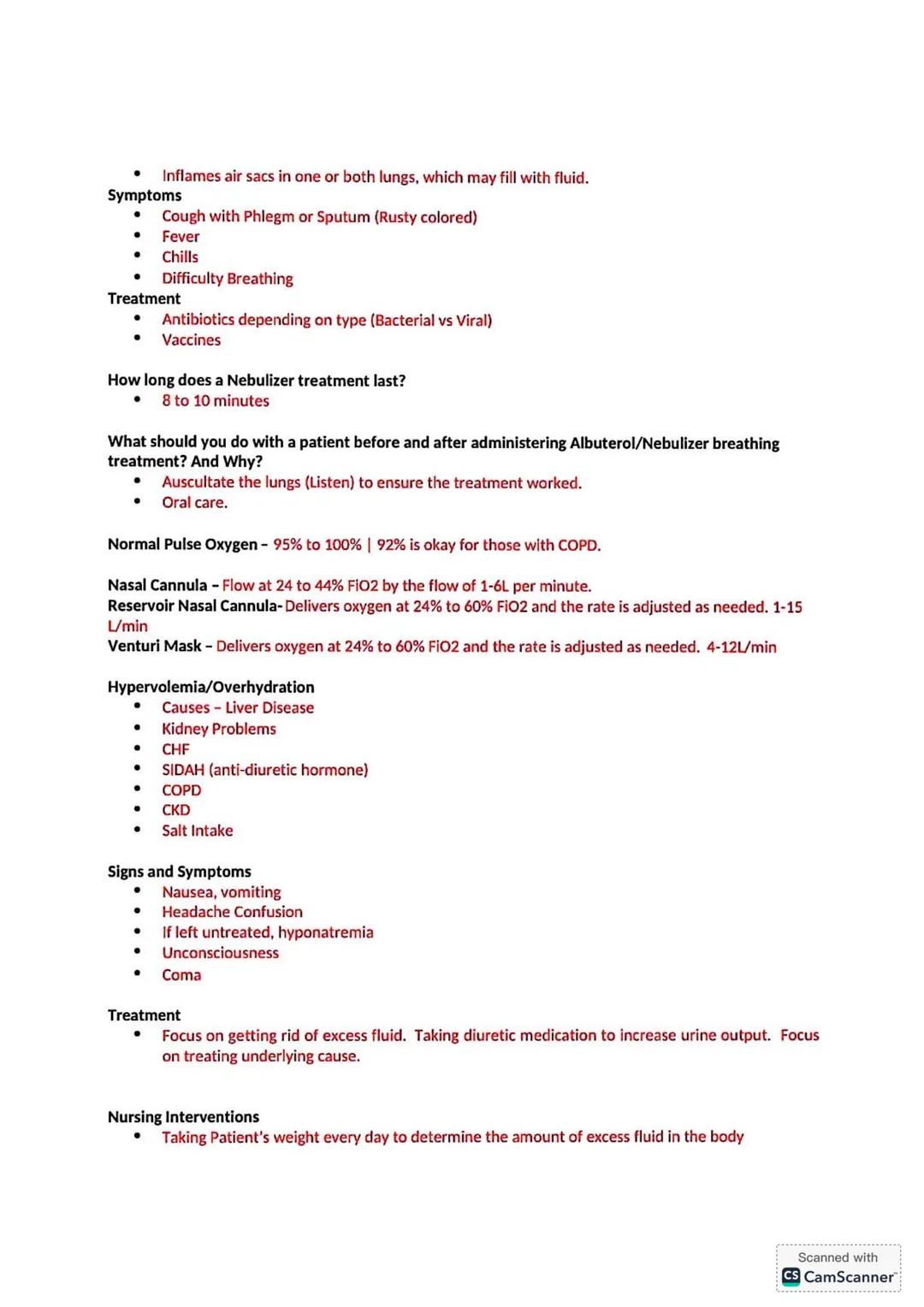
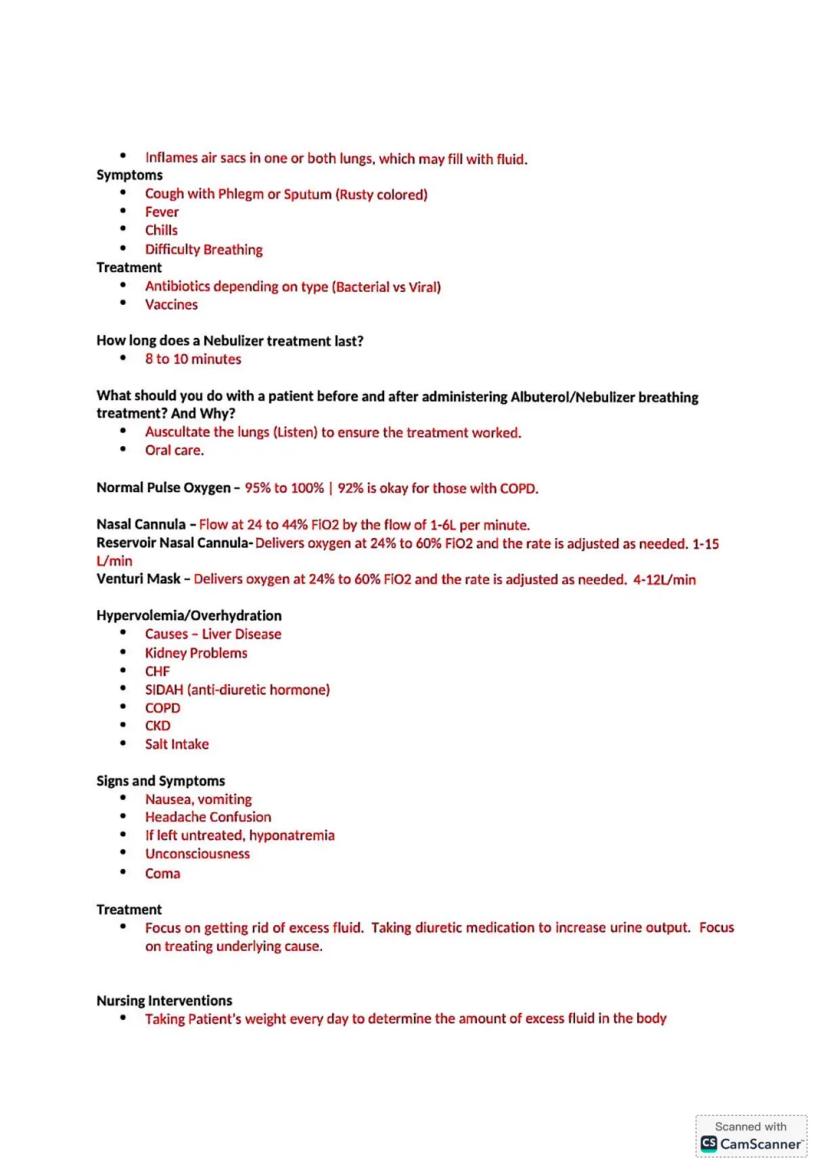
Pneumonia inflames the air sacs in one or both lungs, which may fill with fluid. Look for classic symptoms: cough with rusty-colored phlegm, fever, chills, and difficulty breathing. Treatment depends on whether it's bacterial (requiring antibiotics) or viral, with vaccines playing a preventive role.
When administering breathing treatments, always auscultate the lungs before and after nebulizer treatments to evaluate effectiveness. Don't forget oral care afterward to maintain hygiene.
Oxygen administration methods vary in their delivery capabilities:
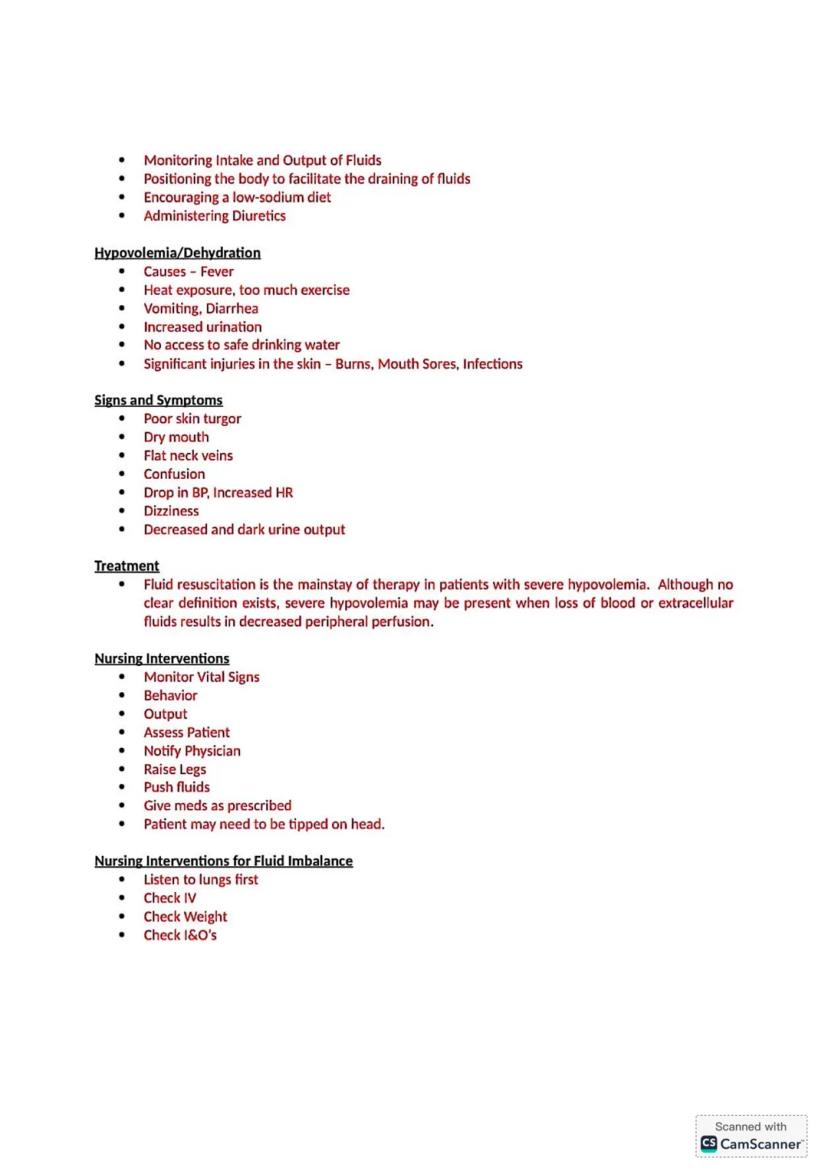
When dealing with hypervolemia (fluid overload) caused by liver disease, kidney problems, CHF, or COPD, watch for symptoms like nausea, headache, and confusion. Treatment focuses on diuretics and addressing the underlying cause. Daily weight monitoring is essential to track fluid status.
💡 Critical point: Normal pulse oxygen should be 95-100%, but 92% is acceptable for COPD patients due to their altered respiratory physiology.
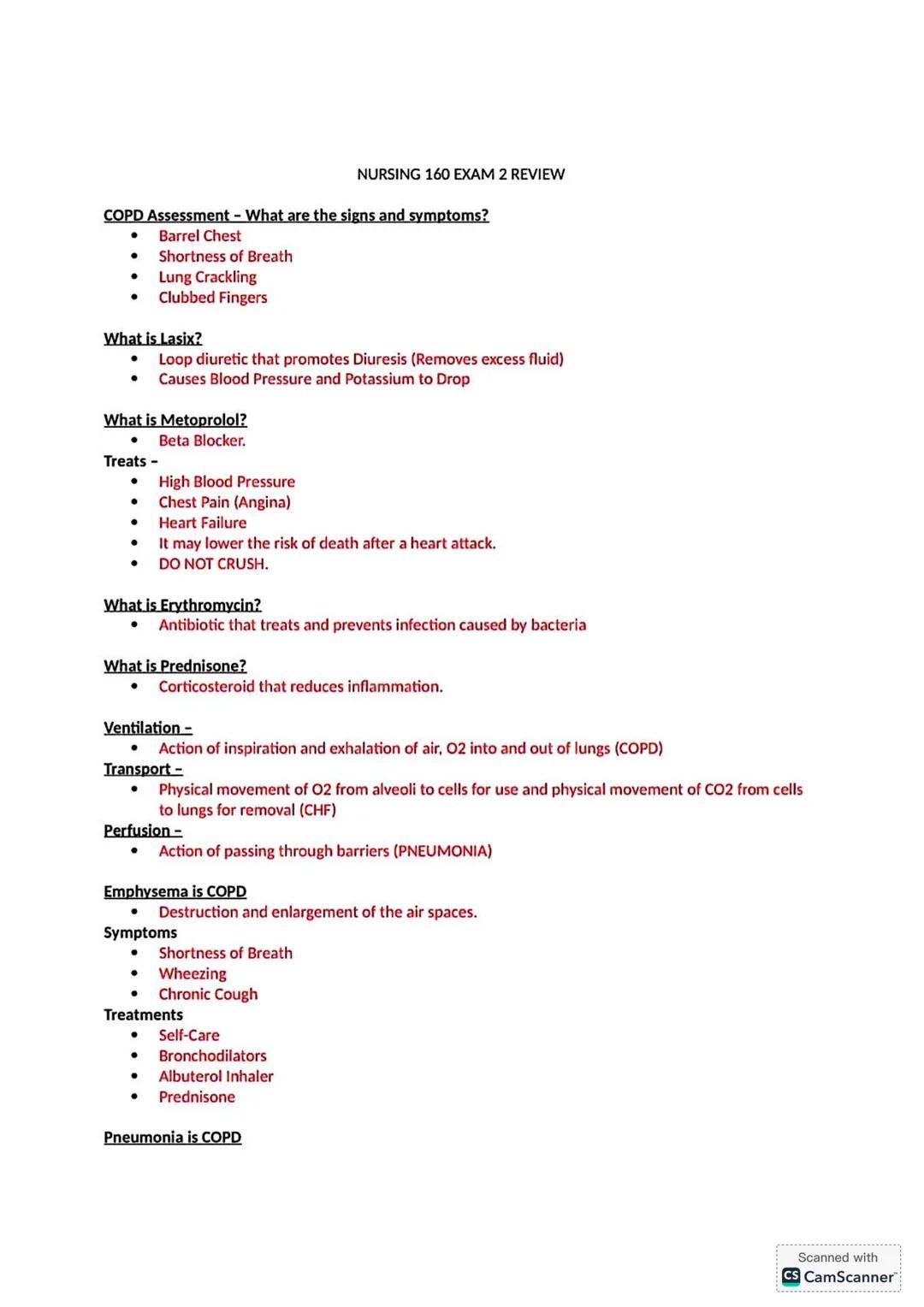
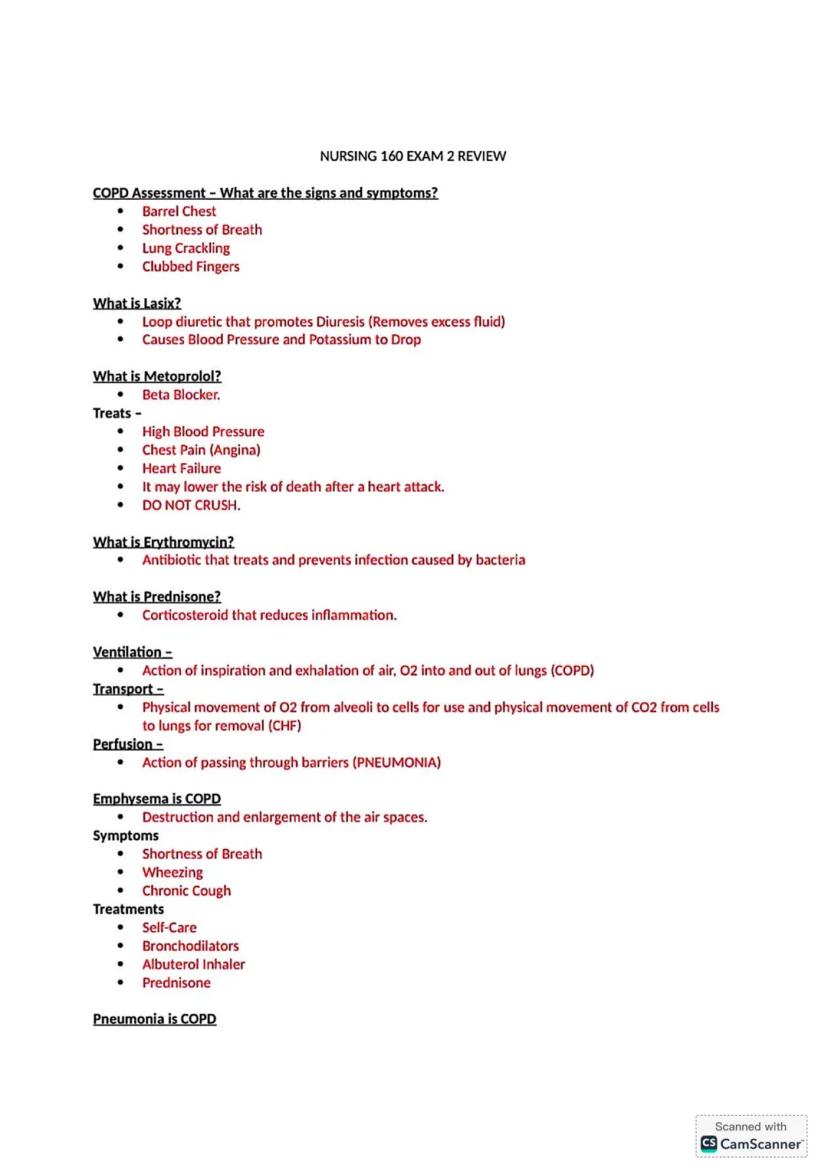
COPD assessment requires identifying characteristic physical signs: barrel chest, shortness of breath, lung crackling, and clubbed fingers. These indicators help track disease progression and response to treatment.
Common medications for respiratory and cardiac conditions include:
Understanding respiratory physiology is essential. Ventilation involves the movement of air in and out of lungs (affected in COPD). Transport moves oxygen from alveoli to cells and carbon dioxide back (affected in CHF). Perfusion involves passing through barriers (affected in pneumonia).
Emphysema, a type of COPD, causes destruction and enlargement of air spaces. Symptoms include shortness of breath, wheezing, and chronic cough, treated with self-care, bronchodilators, albuterol inhalers, and prednisone.
💡 Remember: When administering respiratory medications, always assess lung sounds before and after treatment to evaluate effectiveness.
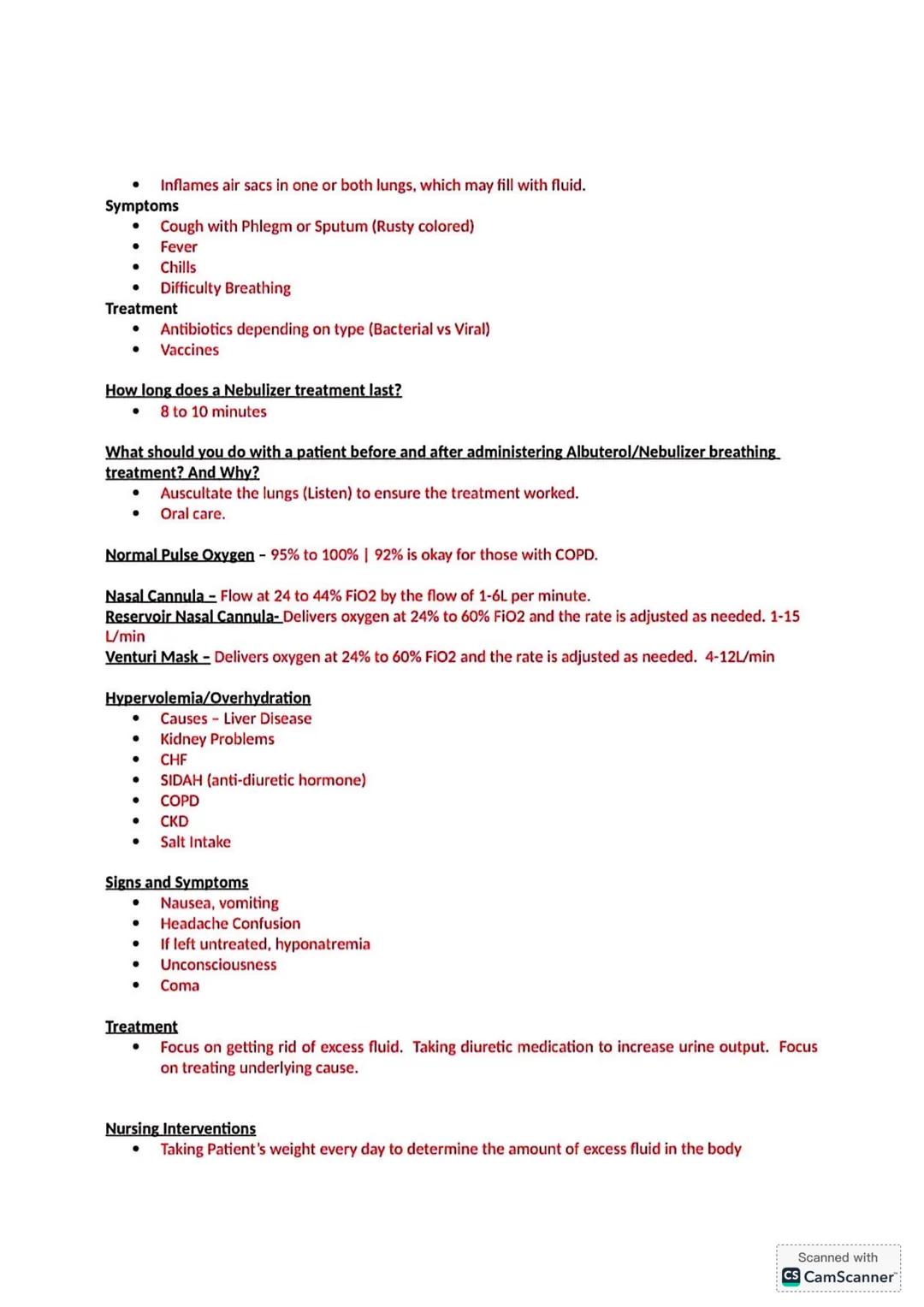
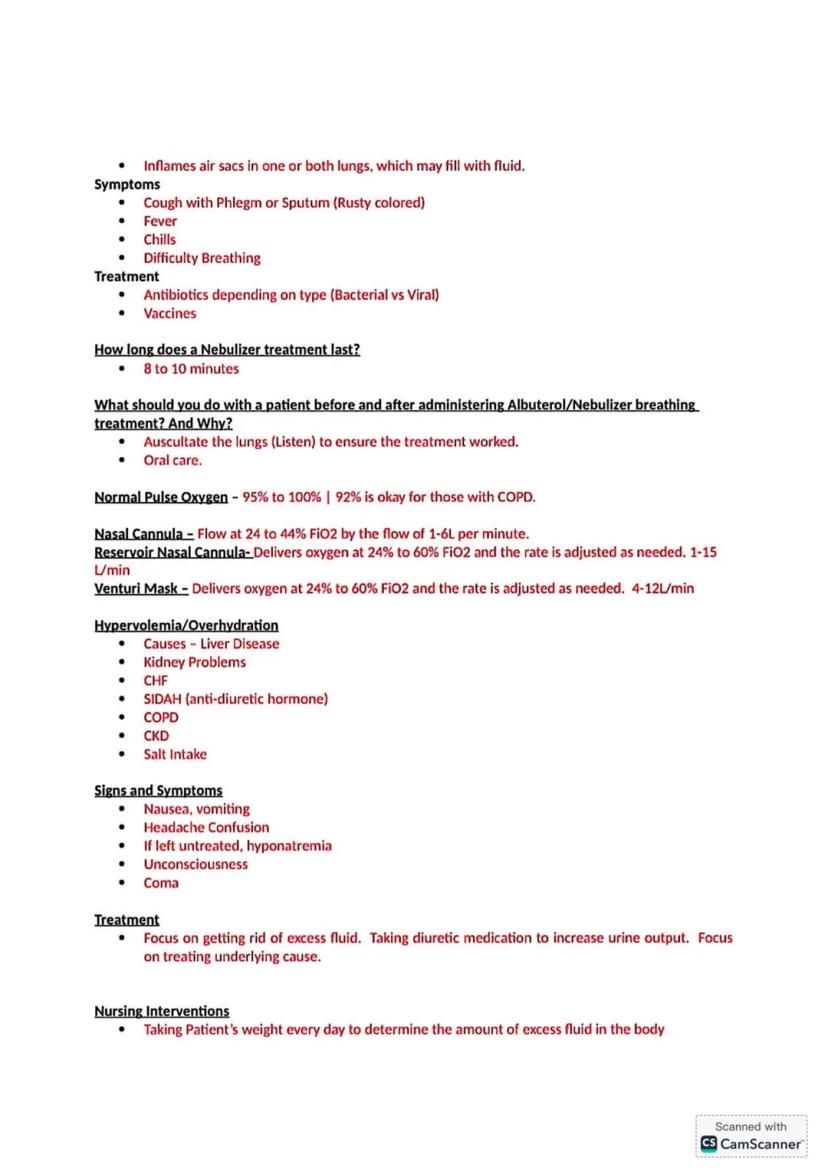
Pneumonia is characterized by inflamed air sacs that may fill with fluid. Watch for its distinctive symptoms: cough with rusty-colored sputum, fever, chills, and difficulty breathing. Treatment varies between bacterial pneumonia (requiring antibiotics) and viral pneumonia, with vaccines serving as important preventive measures.
When administering nebulizer treatments , always auscultate the lungs before and after to verify effectiveness, and provide oral care afterward. This assessment is crucial for documenting treatment response.
Different oxygen delivery systems provide varying concentrations:
Hypervolemia (fluid overload) can result from various conditions including liver disease, kidney problems, CHF, and COPD. Symptoms include nausea, headache, confusion, and if untreated, hyponatremia leading to unconsciousness. Treatment focuses on diuretics and addressing the underlying cause.
💡 Clinical tip: Daily weight measurements are the most accurate way to monitor fluid status in patients with hypervolemia. A sudden weight gain often indicates fluid retention before other symptoms appear.
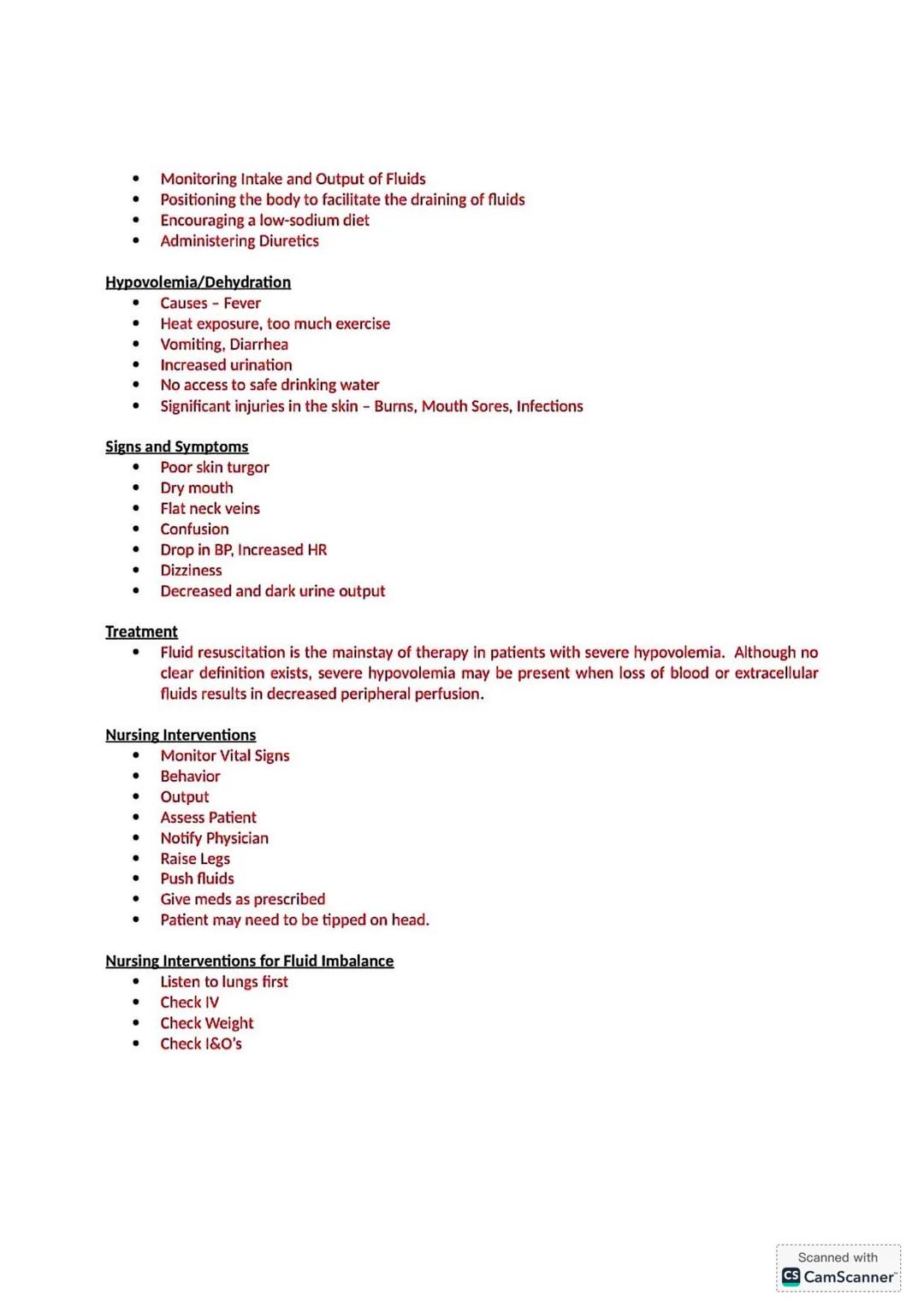
Nursing interventions for hypervolemia (fluid overload) include monitoring intake and output, positioning to facilitate fluid drainage, encouraging a low-sodium diet, and administering diuretics. These strategies help reduce excess fluid and prevent complications.
Hypovolemia (dehydration) can result from fever, excessive exercise, vomiting, diarrhea, increased urination, or significant skin injuries. Key assessment findings include poor skin turgor, dry mouth, flat neck veins, confusion, decreased blood pressure, increased heart rate, and dark, concentrated urine.
Treatment for severe hypovolemia centers on fluid resuscitation to restore peripheral perfusion. As a nurse, your interventions should include:
When managing any fluid imbalance, follow these essential steps: listen to the lungs first, check IVs, monitor weight, and track intake and output carefully. These assessments provide crucial data about the patient's fluid status.
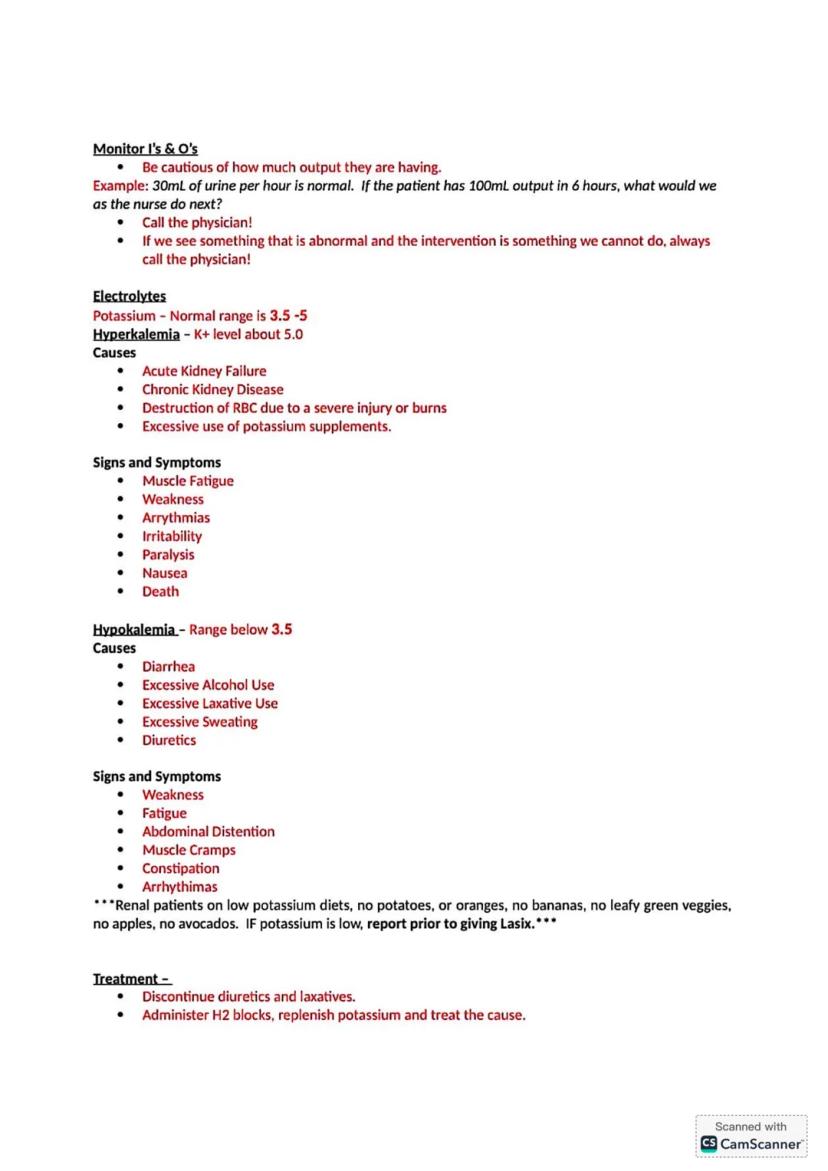
💡 Critical nursing action: If urine output falls below normal , contact the physician immediately. For example, if a patient produces only 100mL in 6 hours instead of the expected 180mL, this requires prompt medical intervention.
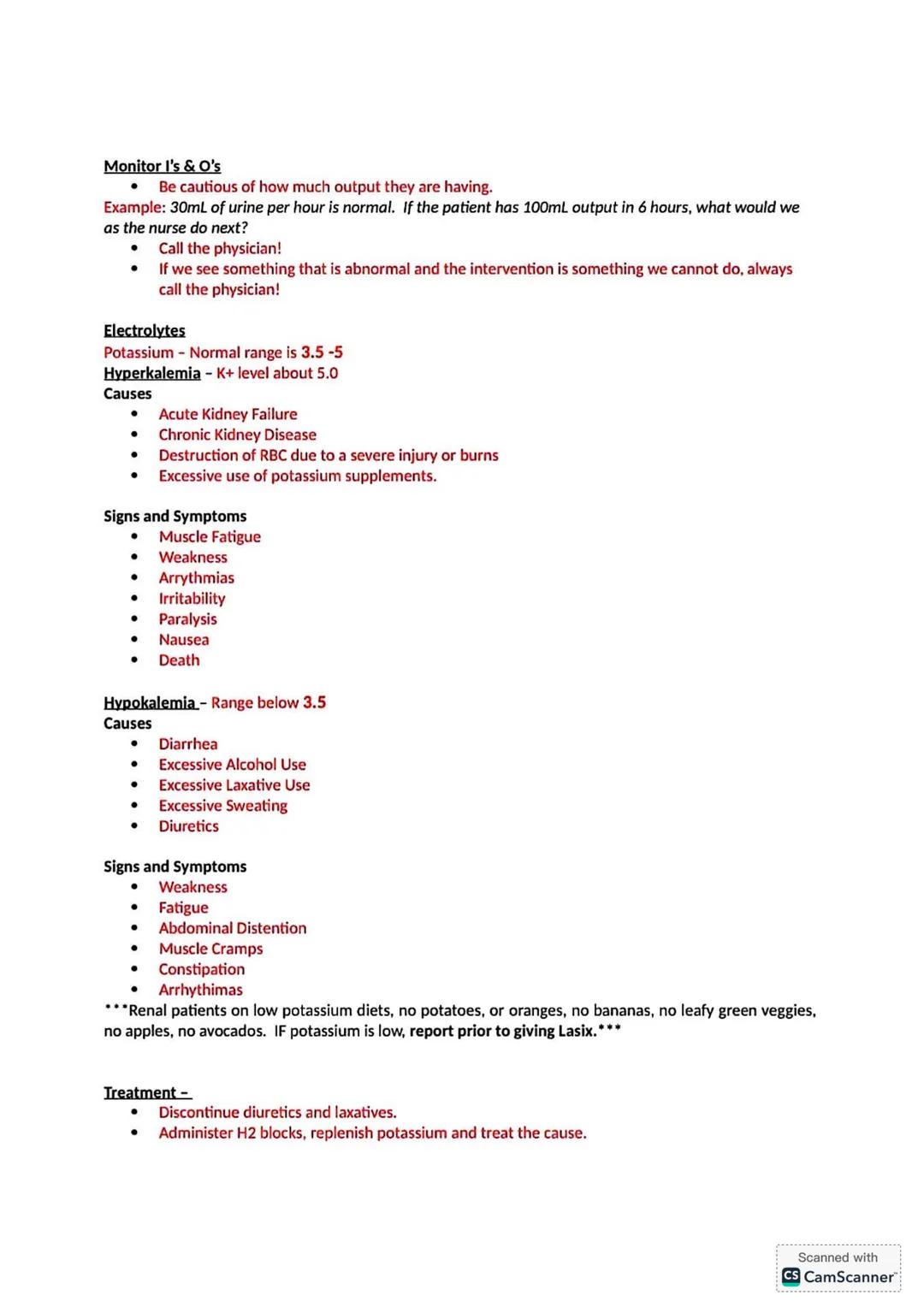
Monitoring intake and output is critical for patients with fluid imbalances. The normal urine output is 30mL per hour, and significant deviations require physician notification. For example, if a patient produces only 100mL in 6 hours (instead of the expected 180mL), you must contact the doctor immediately.
Potassium imbalances can be life-threatening and require careful monitoring. The normal range is 3.5-5 mEq/L. Hyperkalemia can result from acute kidney failure, chronic kidney disease, severe injuries, burns, or excessive potassium supplementation. Symptoms include muscle fatigue, weakness, arrhythmias, irritability, paralysis, nausea, and can lead to death if untreated.
Hypokalemia may be caused by diarrhea, excessive alcohol or laxative use, excessive sweating, or diuretics. Patients typically experience weakness, fatigue, abdominal distention, muscle cramps, constipation, and arrhythmias.
Dietary management is crucial for renal patients on low potassium diets, requiring avoidance of potatoes, oranges, bananas, leafy greens, apples, and avocados. Always report low potassium levels before administering Lasix, as this diuretic further depletes potassium.
💡 Critical safety note: Always check potassium levels before giving diuretics like Lasix. Administering diuretics to patients with already low potassium can precipitate dangerous cardiac arrhythmias.
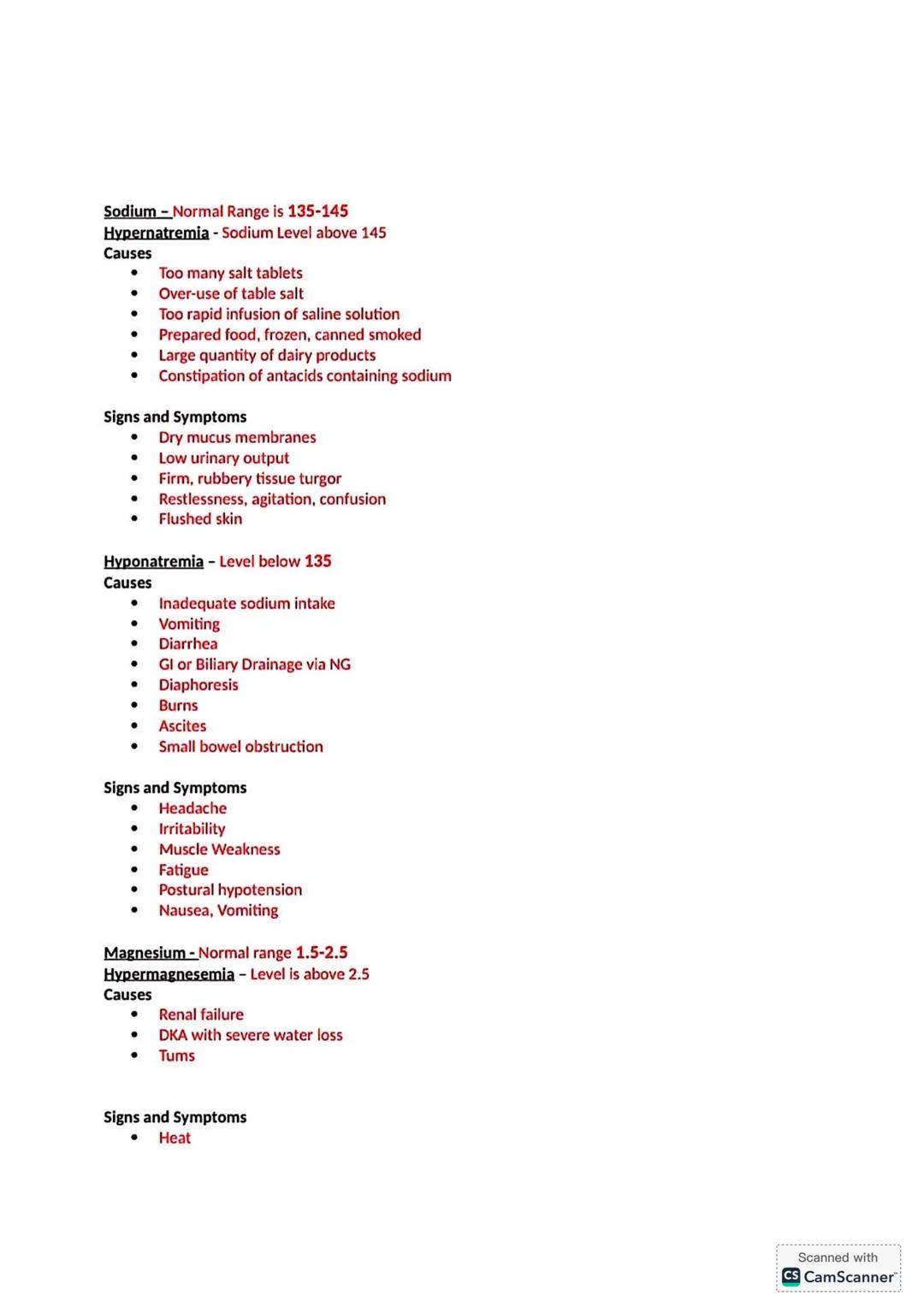
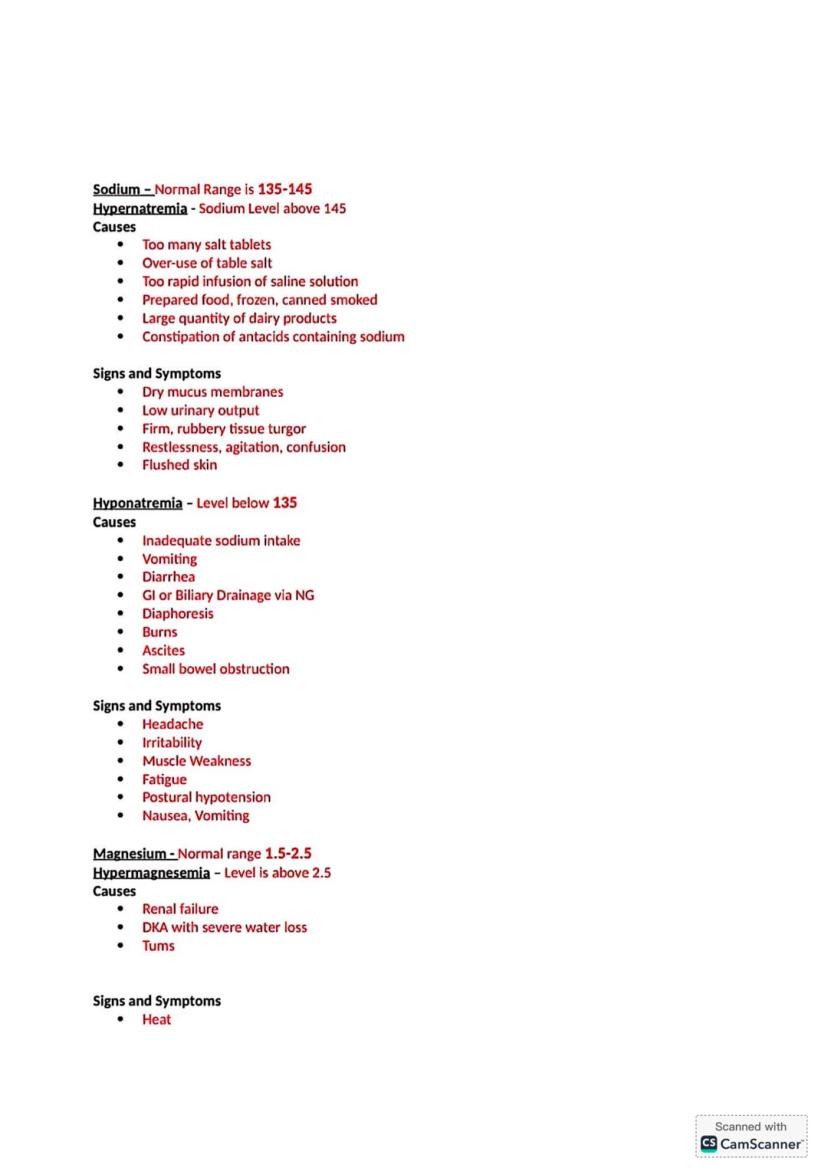
Sodium balance is crucial for proper cellular function, with a normal range of 135-145 mEq/L. Hypernatremia can result from excessive salt intake, rapid saline infusions, or consumption of high-sodium foods like processed, frozen, or canned items. Look for key symptoms including dry mucous membranes, low urinary output, firm tissue turgor, restlessness, confusion, and flushed skin.
Hyponatremia may be caused by inadequate sodium intake, fluid losses from vomiting, diarrhea, GI drainage, diaphoresis, burns, or small bowel obstruction. Patients typically present with headache, irritability, muscle weakness, fatigue, postural hypotension, and nausea/vomiting.
Magnesium imbalances also impact patient health, with a normal range of 1.5-2.5 mEq/L. Hypermagnesemia can occur with renal failure, diabetic ketoacidosis with severe water loss, or excessive antacid use. Watch for symptoms like increased body heat and thirst, which can progress to respiratory depression, coma, or death if untreated.
💡 Clinical connection: Sodium and fluid balance are closely related. Hyponatremia often accompanies fluid overload (dilutional hyponatremia), while hypernatremia frequently occurs with dehydration (concentrational hypernatremia).
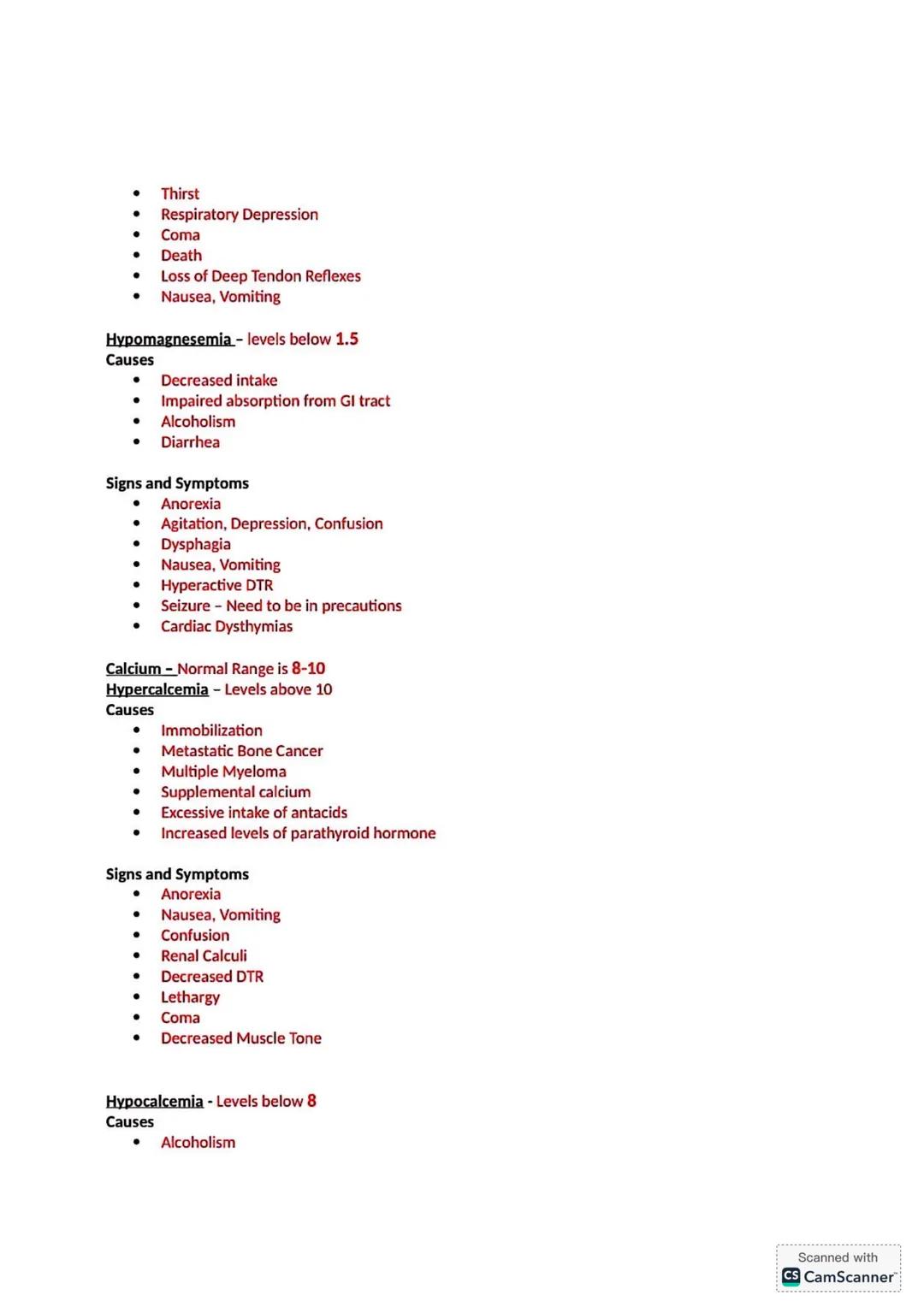
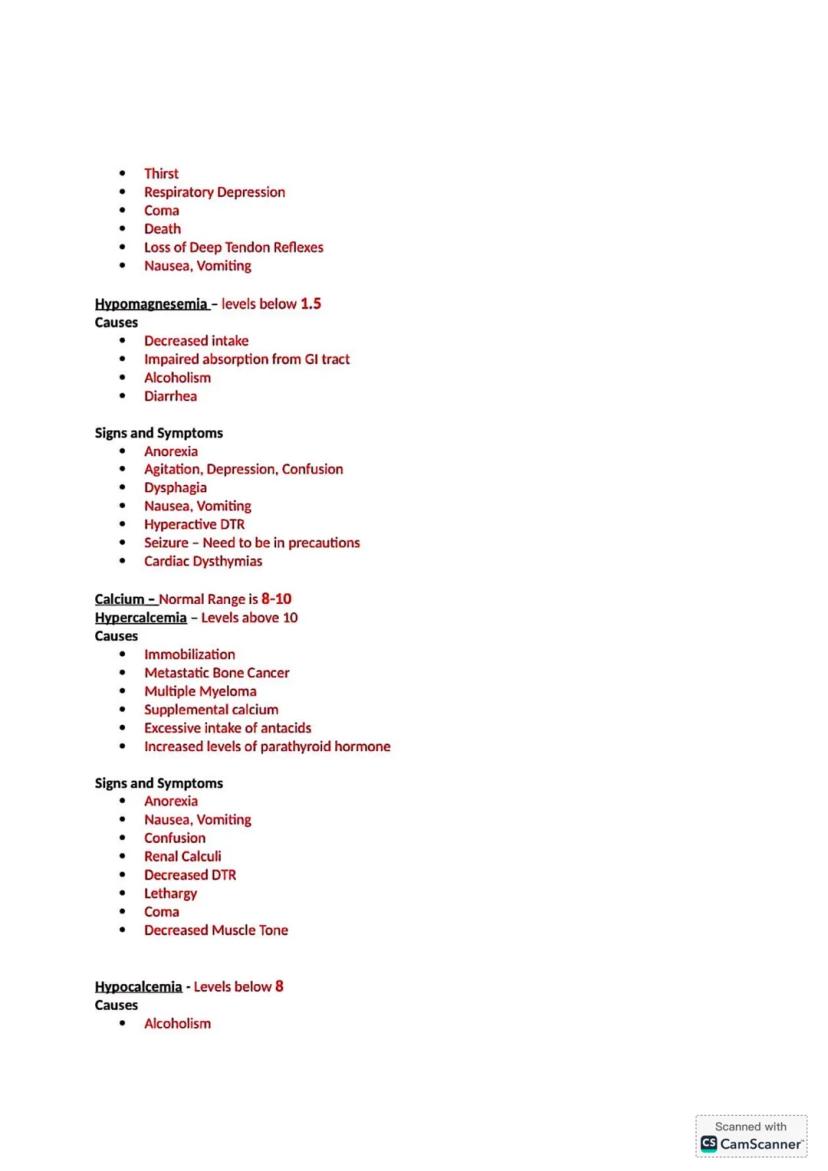
Hypomagnesemia can result from decreased intake, impaired GI absorption, alcoholism, or diarrhea. Watch for symptoms including anorexia, agitation, confusion, dysphagia, nausea, hyperactive deep tendon reflexes, and seizures requiring precautions. Cardiac dysrhythmias may also develop.
Calcium balance is essential for nerve and muscle function, with a normal range of 8-10 mg/dL. Hypercalcemia can be caused by immobilization, metastatic bone cancer, multiple myeloma, excessive calcium supplements, antacids, or increased parathyroid hormone. Symptoms include anorexia, nausea, confusion, renal calculi, decreased deep tendon reflexes, lethargy, coma, and decreased muscle tone.
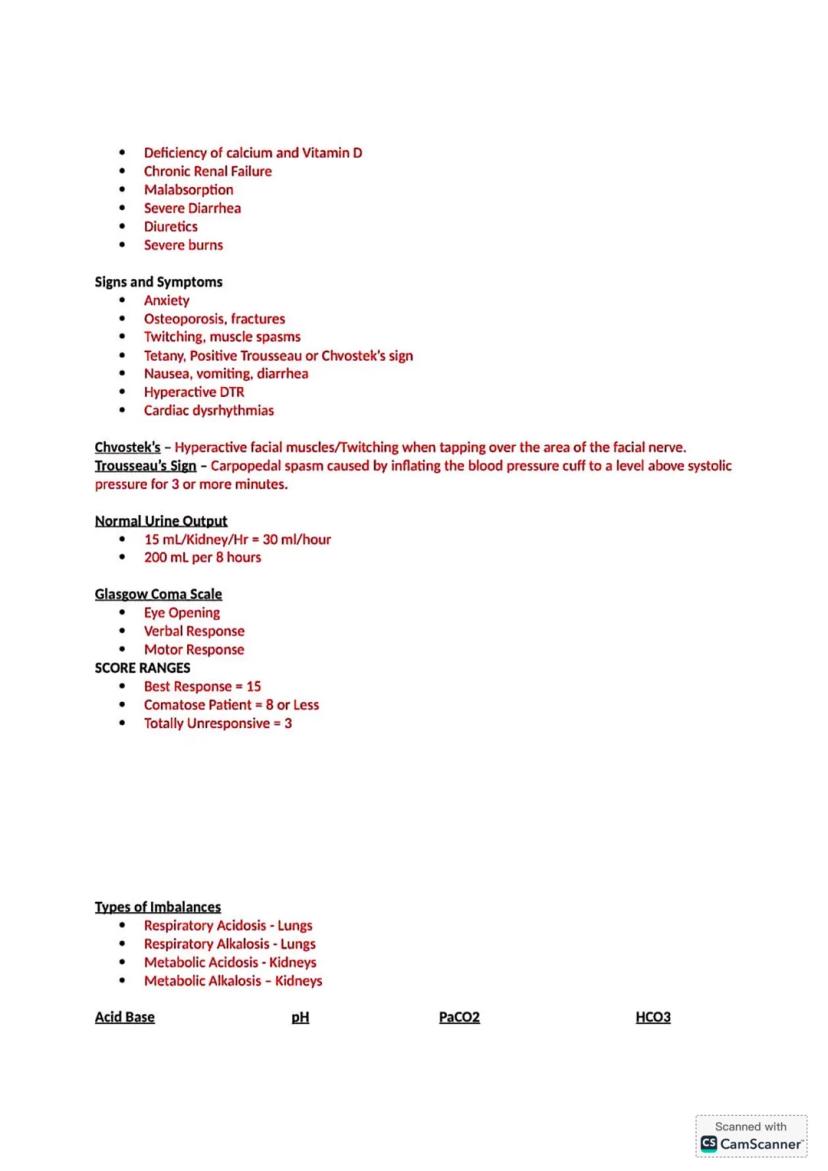
Hypocalcemia may result from alcoholism, vitamin D deficiency, chronic renal failure, malabsorption, severe diarrhea, diuretics, or severe burns. Patients typically present with anxiety, osteoporosis, muscle spasms, tetany, nausea, hyperactive deep tendon reflexes, and cardiac dysrhythmias.
Two specific tests help identify hypocalcemia: Chvostek's sign (facial muscle twitching when tapping over the facial nerve) and Trousseau's sign .
💡 Assessment tip: To properly assess for Trousseau's sign, inflate the BP cuff above the patient's systolic pressure and leave it in place for 3 minutes. A positive sign (indicating hypocalcemia) occurs when the patient develops carpopedal spasm - a contraction of fingers and wrist.
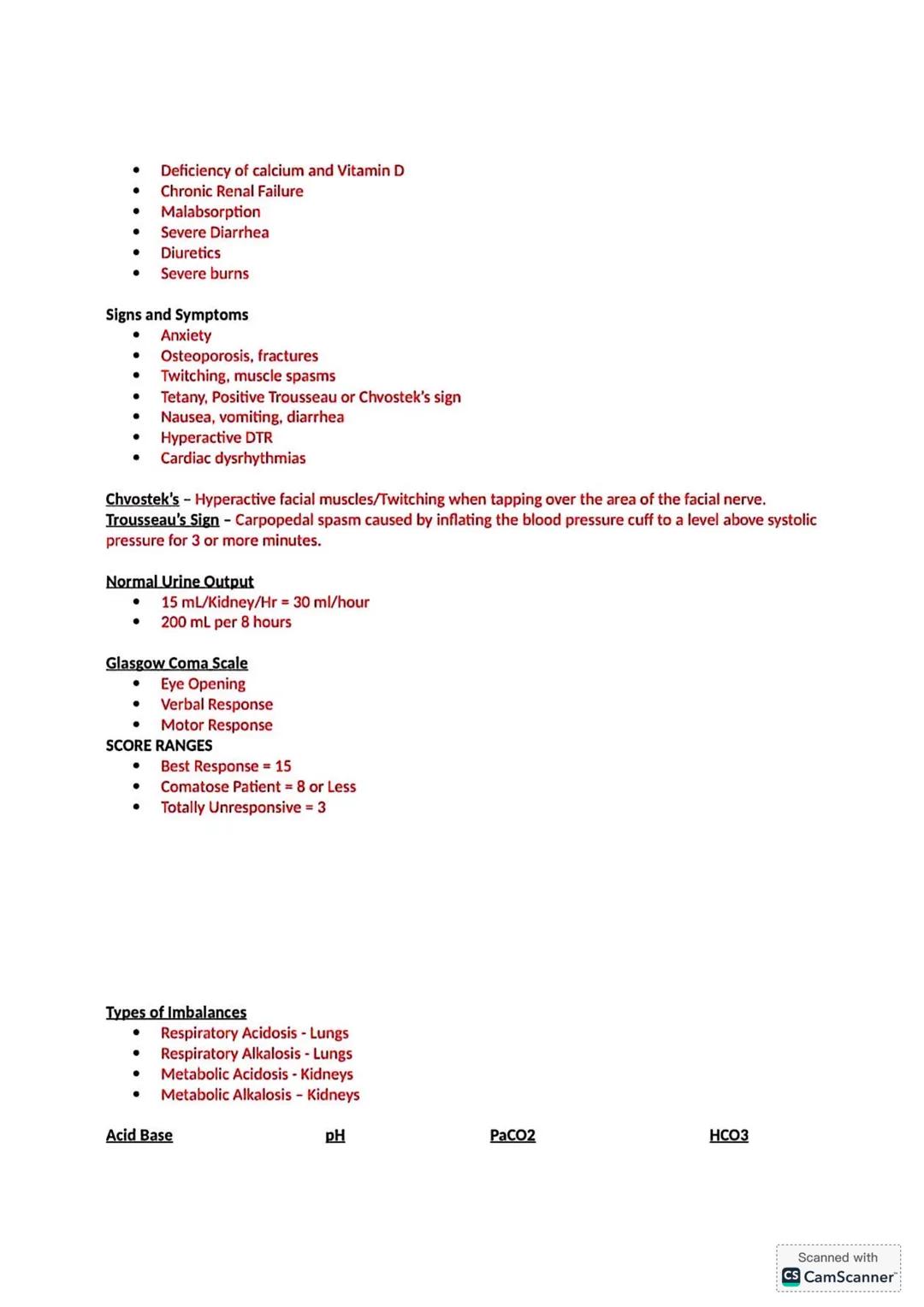
Normal urine output is 15 mL per kidney per hour, totaling approximately 30 mL/hour or 200 mL per 8 hours. This is an important baseline for assessing kidney function and fluid balance.
The Glasgow Coma Scale is an essential assessment tool that evaluates eye opening, verbal response, and motor response. Scores range from 3-15, with 15 representing the best response, 8 or less indicating a comatose patient, and 3 signifying total unresponsiveness.
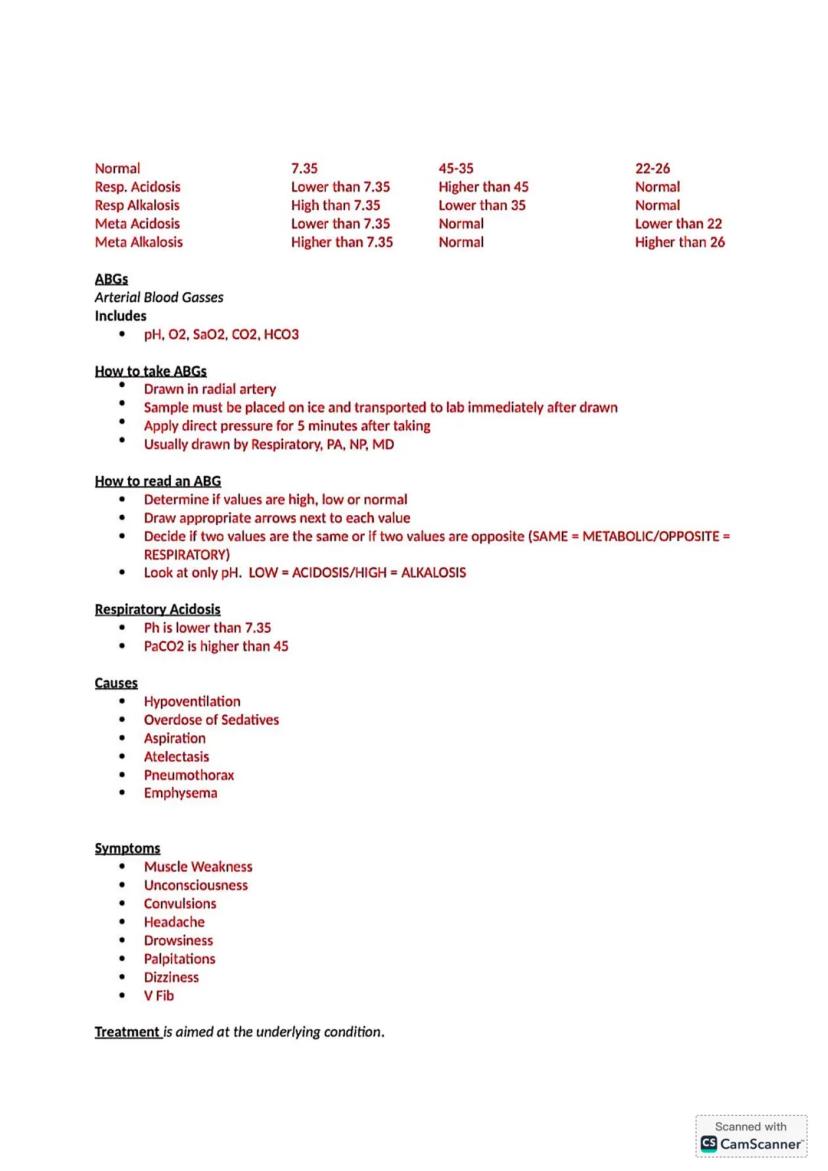
Acid-base imbalances fall into four main categories:
Understanding normal ranges is crucial for interpreting arterial blood gas (ABG) values:
Deviations from these ranges help identify specific acid-base disorders. For respiratory acidosis, the pH is below 7.35 with a PaCO2 above 45. In respiratory alkalosis, the pH is above 7.45 with a PaCO2 below 35. Metabolic acidosis shows a pH below 7.35 with HCO3 below 22, while metabolic alkalosis presents with a pH above 7.45 and HCO3 above 26.
💡 ABG interpretation tip: Use the "ROME" mnemonic to understand compensation patterns: Respiratory imbalances show Opposite changes in pH and PCO2, while Metabolic imbalances show Equal changes in pH and HCO3.
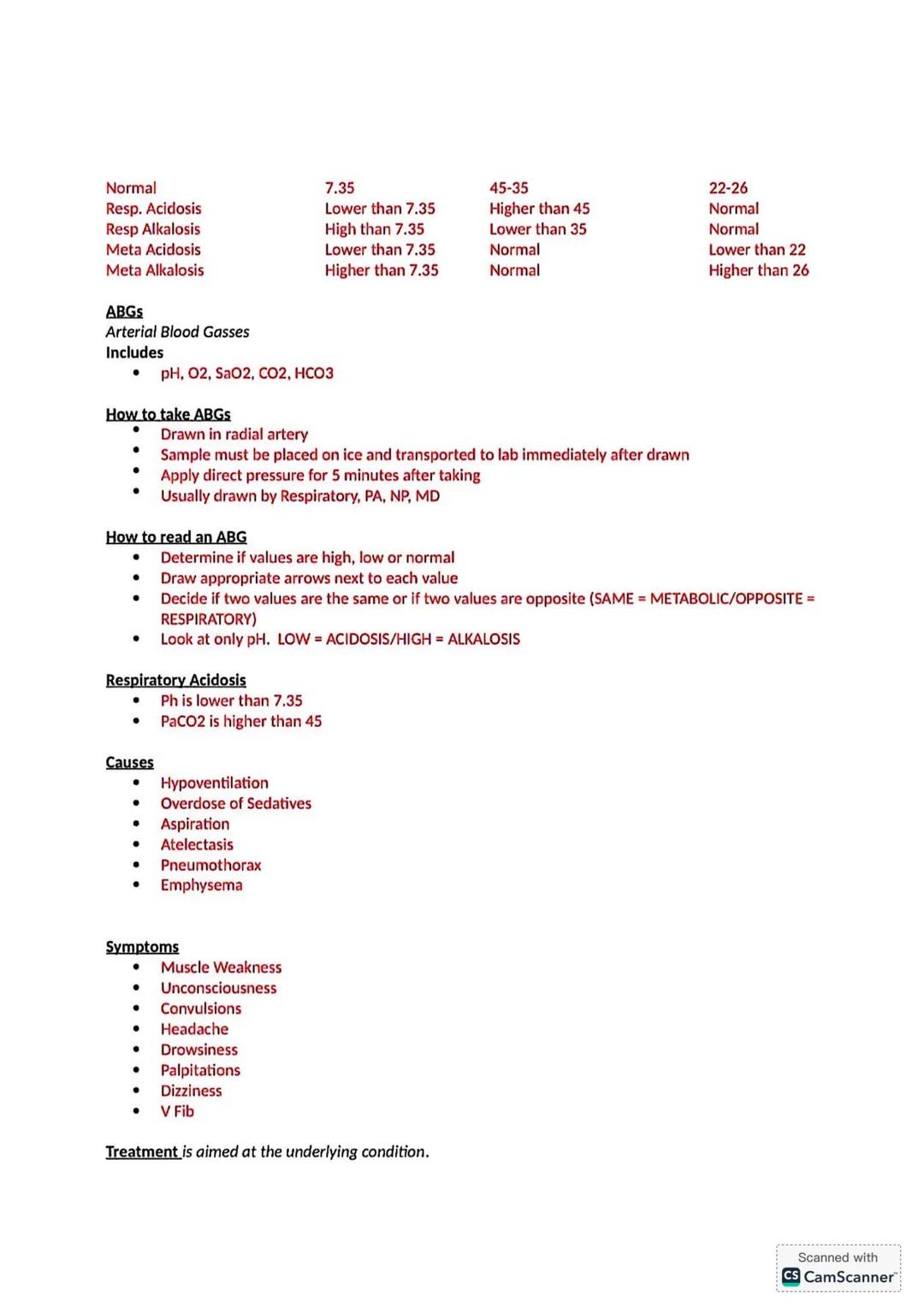
ABG (Arterial Blood Gas) analysis is crucial for assessing acid-base balance. Normal values are: pH 7.35-7.45, PaCO2 35-45 mmHg, and HCO3 22-26 mEq/L. When interpreting ABGs, first determine if values are high, low, or normal, then identify if two values move in the same or opposite directions .
Respiratory acidosis (pH <7.35, PaCO2 >45) results from hypoventilation due to sedative overdose, aspiration, atelectasis, pneumothorax, or emphysema. Symptoms include muscle weakness, unconsciousness, convulsions, headache, drowsiness, palpitations, dizziness, and potentially ventricular fibrillation.
Treatment for respiratory acidosis targets the underlying condition using:
Respiratory alkalosis (pH >7.45, PaCO2 <35) can be caused by anxiety, fever, hypoxemia, pulmonary emboli, mechanical ventilators, or continuous suction. Symptoms include lightheadedness, numbness, tingling, sweating, nausea, vomiting, and palpitations.
💡 Clinical application: When a patient is hyperventilating (respiratory alkalosis), having them breathe into a paper bag or using a rebreather mask can help increase CO2 levels. Anti-anxiety medication, inhalers, and relaxation techniques may also be beneficial depending on the cause.
Our AI companion is specifically built for the needs of students. Based on the millions of content pieces we have on the platform we can provide truly meaningful and relevant answers to students. But its not only about answers, the companion is even more about guiding students through their daily learning challenges, with personalised study plans, quizzes or content pieces in the chat and 100% personalisation based on the students skills and developments.
You can download the app in the Google Play Store and in the Apple App Store.
That's right! Enjoy free access to study content, connect with fellow students, and get instant help – all at your fingertips.
App Store
Google Play
The app is very easy to use and well designed. I have found everything I was looking for so far and have been able to learn a lot from the presentations! I will definitely use the app for a class assignment! And of course it also helps a lot as an inspiration.
Stefan S
iOS user
This app is really great. There are so many study notes and help [...]. My problem subject is French, for example, and the app has so many options for help. Thanks to this app, I have improved my French. I would recommend it to anyone.
Samantha Klich
Android user
Wow, I am really amazed. I just tried the app because I've seen it advertised many times and was absolutely stunned. This app is THE HELP you want for school and above all, it offers so many things, such as workouts and fact sheets, which have been VERY helpful to me personally.
Anna
iOS user
I think it’s very much worth it and you’ll end up using it a lot once you get the hang of it and even after looking at others notes you can still ask your Artificial intelligence buddy the question and ask to simplify it if you still don’t get it!!! In the end I think it’s worth it 😊👍 ⚠️Also DID I MENTION ITS FREEE YOU DON’T HAVE TO PAY FOR ANYTHING AND STILL GET YOUR GRADES IN PERFECTLY❗️❗️⚠️
Thomas R
iOS user
Knowunity is the BEST app I’ve used in a minute. This is not an ai review or anything this is genuinely coming from a 7th grade student (I know 2011 im young) but dude this app is a 10/10 i have maintained a 3.8 gpa and have plenty of time for gaming. I love it and my mom is just happy I got good grades
Brad T
Android user
Not only did it help me find the answer but it also showed me alternative ways to solve it. I was horrible in math and science but now I have an a in both subjects. Thanks for the help🤍🤍
David K
iOS user
The app's just great! All I have to do is enter the topic in the search bar and I get the response real fast. I don't have to watch 10 YouTube videos to understand something, so I'm saving my time. Highly recommended!
Sudenaz Ocak
Android user
In school I was really bad at maths but thanks to the app, I am doing better now. I am so grateful that you made the app.
Greenlight Bonnie
Android user
I found this app a couple years ago and it has only gotten better since then. I really love it because it can help with written questions and photo questions. Also, it can find study guides that other people have made as well as flashcard sets and practice tests. The free version is also amazing for students who might not be able to afford it. Would 100% recommend
Aubrey
iOS user
Best app if you're in Highschool or Junior high. I have been using this app for 2 school years and it's the best, it's good if you don't have anyone to help you with school work.😋🩷🎀
Marco B
iOS user
THE QUIZES AND FLASHCARDS ARE SO USEFUL AND I LOVE THE SCHOOLGPT. IT ALSO IS LITREALLY LIKE CHATGPT BUT SMARTER!! HELPED ME WITH MY MASCARA PROBLEMS TOO!! AS WELL AS MY REAL SUBJECTS ! DUHHH 😍😁😲🤑💗✨🎀😮
Elisha
iOS user
This app is phenomenal down to the correct info and the various topics you can study! I greatly recommend it for people who struggle with procrastination and those who need homework help. It has been perfectly accurate for world 1 history as far as I’ve seen! Geometry too!
Paul T
iOS user
The app is very easy to use and well designed. I have found everything I was looking for so far and have been able to learn a lot from the presentations! I will definitely use the app for a class assignment! And of course it also helps a lot as an inspiration.
Stefan S
iOS user
This app is really great. There are so many study notes and help [...]. My problem subject is French, for example, and the app has so many options for help. Thanks to this app, I have improved my French. I would recommend it to anyone.
Samantha Klich
Android user
Wow, I am really amazed. I just tried the app because I've seen it advertised many times and was absolutely stunned. This app is THE HELP you want for school and above all, it offers so many things, such as workouts and fact sheets, which have been VERY helpful to me personally.
Anna
iOS user
I think it’s very much worth it and you’ll end up using it a lot once you get the hang of it and even after looking at others notes you can still ask your Artificial intelligence buddy the question and ask to simplify it if you still don’t get it!!! In the end I think it’s worth it 😊👍 ⚠️Also DID I MENTION ITS FREEE YOU DON’T HAVE TO PAY FOR ANYTHING AND STILL GET YOUR GRADES IN PERFECTLY❗️❗️⚠️
Thomas R
iOS user
Knowunity is the BEST app I’ve used in a minute. This is not an ai review or anything this is genuinely coming from a 7th grade student (I know 2011 im young) but dude this app is a 10/10 i have maintained a 3.8 gpa and have plenty of time for gaming. I love it and my mom is just happy I got good grades
Brad T
Android user
Not only did it help me find the answer but it also showed me alternative ways to solve it. I was horrible in math and science but now I have an a in both subjects. Thanks for the help🤍🤍
David K
iOS user
The app's just great! All I have to do is enter the topic in the search bar and I get the response real fast. I don't have to watch 10 YouTube videos to understand something, so I'm saving my time. Highly recommended!
Sudenaz Ocak
Android user
In school I was really bad at maths but thanks to the app, I am doing better now. I am so grateful that you made the app.
Greenlight Bonnie
Android user
I found this app a couple years ago and it has only gotten better since then. I really love it because it can help with written questions and photo questions. Also, it can find study guides that other people have made as well as flashcard sets and practice tests. The free version is also amazing for students who might not be able to afford it. Would 100% recommend
Aubrey
iOS user
Best app if you're in Highschool or Junior high. I have been using this app for 2 school years and it's the best, it's good if you don't have anyone to help you with school work.😋🩷🎀
Marco B
iOS user
THE QUIZES AND FLASHCARDS ARE SO USEFUL AND I LOVE THE SCHOOLGPT. IT ALSO IS LITREALLY LIKE CHATGPT BUT SMARTER!! HELPED ME WITH MY MASCARA PROBLEMS TOO!! AS WELL AS MY REAL SUBJECTS ! DUHHH 😍😁😲🤑💗✨🎀😮
Elisha
iOS user
This app is phenomenal down to the correct info and the various topics you can study! I greatly recommend it for people who struggle with procrastination and those who need homework help. It has been perfectly accurate for world 1 history as far as I’ve seen! Geometry too!
Paul T
iOS user
Sabrina
@sabrina_q1b8i
Respiratory and cardiovascular care is at the heart of nursing practice, with critical assessments and interventions making the difference in patient outcomes. This study guide covers essential concepts in COPD, pneumonia, fluid balance, electrolytes, and post-operative care that you'll need... Show more
Access to all documents
Improve your grades
Join milions of students
By signing up you accept Terms of Service and Privacy Policy
When assessing COPD patients, look for key physical signs including barrel chest, shortness of breath, lung crackling, and clubbed fingers. These indicators help identify respiratory compromise early.
Understanding medications is crucial for respiratory patients. Lasix is a loop diuretic that removes excess fluid but can drop blood pressure and potassium levels. Metoprolol, a beta-blocker that should never be crushed, treats high blood pressure, chest pain, heart failure, and reduces post-heart attack mortality risk. Erythromycin fights bacterial infections, while Prednisone reduces inflammation as a corticosteroid.
Respiratory function involves three key processes: ventilation (breathing air in and out, affected in COPD), transport (moving oxygen from lungs to cells and CO2 back, affected in CHF), and perfusion (passing through barriers, affected in pneumonia).
💡 Remember: COPD patients like those with emphysema have destructed, enlarged air spaces causing shortness of breath, wheezing, and chronic cough. Treatments include self-care strategies, bronchodilators, albuterol inhalers, and prednisone.
Access to all documents
Improve your grades
Join milions of students
By signing up you accept Terms of Service and Privacy Policy
Pneumonia inflames the air sacs in one or both lungs, which may fill with fluid. Look for classic symptoms: cough with rusty-colored phlegm, fever, chills, and difficulty breathing. Treatment depends on whether it's bacterial (requiring antibiotics) or viral, with vaccines playing a preventive role.
When administering breathing treatments, always auscultate the lungs before and after nebulizer treatments to evaluate effectiveness. Don't forget oral care afterward to maintain hygiene.
Oxygen administration methods vary in their delivery capabilities:
When dealing with hypervolemia (fluid overload) caused by liver disease, kidney problems, CHF, or COPD, watch for symptoms like nausea, headache, and confusion. Treatment focuses on diuretics and addressing the underlying cause. Daily weight monitoring is essential to track fluid status.
💡 Critical point: Normal pulse oxygen should be 95-100%, but 92% is acceptable for COPD patients due to their altered respiratory physiology.
Access to all documents
Improve your grades
Join milions of students
By signing up you accept Terms of Service and Privacy Policy
COPD assessment requires identifying characteristic physical signs: barrel chest, shortness of breath, lung crackling, and clubbed fingers. These indicators help track disease progression and response to treatment.
Common medications for respiratory and cardiac conditions include:
Understanding respiratory physiology is essential. Ventilation involves the movement of air in and out of lungs (affected in COPD). Transport moves oxygen from alveoli to cells and carbon dioxide back (affected in CHF). Perfusion involves passing through barriers (affected in pneumonia).
Emphysema, a type of COPD, causes destruction and enlargement of air spaces. Symptoms include shortness of breath, wheezing, and chronic cough, treated with self-care, bronchodilators, albuterol inhalers, and prednisone.
💡 Remember: When administering respiratory medications, always assess lung sounds before and after treatment to evaluate effectiveness.
Access to all documents
Improve your grades
Join milions of students
By signing up you accept Terms of Service and Privacy Policy
Pneumonia is characterized by inflamed air sacs that may fill with fluid. Watch for its distinctive symptoms: cough with rusty-colored sputum, fever, chills, and difficulty breathing. Treatment varies between bacterial pneumonia (requiring antibiotics) and viral pneumonia, with vaccines serving as important preventive measures.
When administering nebulizer treatments , always auscultate the lungs before and after to verify effectiveness, and provide oral care afterward. This assessment is crucial for documenting treatment response.
Different oxygen delivery systems provide varying concentrations:
Hypervolemia (fluid overload) can result from various conditions including liver disease, kidney problems, CHF, and COPD. Symptoms include nausea, headache, confusion, and if untreated, hyponatremia leading to unconsciousness. Treatment focuses on diuretics and addressing the underlying cause.
💡 Clinical tip: Daily weight measurements are the most accurate way to monitor fluid status in patients with hypervolemia. A sudden weight gain often indicates fluid retention before other symptoms appear.
Access to all documents
Improve your grades
Join milions of students
By signing up you accept Terms of Service and Privacy Policy
Nursing interventions for hypervolemia (fluid overload) include monitoring intake and output, positioning to facilitate fluid drainage, encouraging a low-sodium diet, and administering diuretics. These strategies help reduce excess fluid and prevent complications.
Hypovolemia (dehydration) can result from fever, excessive exercise, vomiting, diarrhea, increased urination, or significant skin injuries. Key assessment findings include poor skin turgor, dry mouth, flat neck veins, confusion, decreased blood pressure, increased heart rate, and dark, concentrated urine.
Treatment for severe hypovolemia centers on fluid resuscitation to restore peripheral perfusion. As a nurse, your interventions should include:
When managing any fluid imbalance, follow these essential steps: listen to the lungs first, check IVs, monitor weight, and track intake and output carefully. These assessments provide crucial data about the patient's fluid status.
💡 Critical nursing action: If urine output falls below normal , contact the physician immediately. For example, if a patient produces only 100mL in 6 hours instead of the expected 180mL, this requires prompt medical intervention.
Access to all documents
Improve your grades
Join milions of students
By signing up you accept Terms of Service and Privacy Policy
Monitoring intake and output is critical for patients with fluid imbalances. The normal urine output is 30mL per hour, and significant deviations require physician notification. For example, if a patient produces only 100mL in 6 hours (instead of the expected 180mL), you must contact the doctor immediately.
Potassium imbalances can be life-threatening and require careful monitoring. The normal range is 3.5-5 mEq/L. Hyperkalemia can result from acute kidney failure, chronic kidney disease, severe injuries, burns, or excessive potassium supplementation. Symptoms include muscle fatigue, weakness, arrhythmias, irritability, paralysis, nausea, and can lead to death if untreated.
Hypokalemia may be caused by diarrhea, excessive alcohol or laxative use, excessive sweating, or diuretics. Patients typically experience weakness, fatigue, abdominal distention, muscle cramps, constipation, and arrhythmias.
Dietary management is crucial for renal patients on low potassium diets, requiring avoidance of potatoes, oranges, bananas, leafy greens, apples, and avocados. Always report low potassium levels before administering Lasix, as this diuretic further depletes potassium.
💡 Critical safety note: Always check potassium levels before giving diuretics like Lasix. Administering diuretics to patients with already low potassium can precipitate dangerous cardiac arrhythmias.
Access to all documents
Improve your grades
Join milions of students
By signing up you accept Terms of Service and Privacy Policy
Sodium balance is crucial for proper cellular function, with a normal range of 135-145 mEq/L. Hypernatremia can result from excessive salt intake, rapid saline infusions, or consumption of high-sodium foods like processed, frozen, or canned items. Look for key symptoms including dry mucous membranes, low urinary output, firm tissue turgor, restlessness, confusion, and flushed skin.
Hyponatremia may be caused by inadequate sodium intake, fluid losses from vomiting, diarrhea, GI drainage, diaphoresis, burns, or small bowel obstruction. Patients typically present with headache, irritability, muscle weakness, fatigue, postural hypotension, and nausea/vomiting.
Magnesium imbalances also impact patient health, with a normal range of 1.5-2.5 mEq/L. Hypermagnesemia can occur with renal failure, diabetic ketoacidosis with severe water loss, or excessive antacid use. Watch for symptoms like increased body heat and thirst, which can progress to respiratory depression, coma, or death if untreated.
💡 Clinical connection: Sodium and fluid balance are closely related. Hyponatremia often accompanies fluid overload (dilutional hyponatremia), while hypernatremia frequently occurs with dehydration (concentrational hypernatremia).
Access to all documents
Improve your grades
Join milions of students
By signing up you accept Terms of Service and Privacy Policy
Hypomagnesemia can result from decreased intake, impaired GI absorption, alcoholism, or diarrhea. Watch for symptoms including anorexia, agitation, confusion, dysphagia, nausea, hyperactive deep tendon reflexes, and seizures requiring precautions. Cardiac dysrhythmias may also develop.
Calcium balance is essential for nerve and muscle function, with a normal range of 8-10 mg/dL. Hypercalcemia can be caused by immobilization, metastatic bone cancer, multiple myeloma, excessive calcium supplements, antacids, or increased parathyroid hormone. Symptoms include anorexia, nausea, confusion, renal calculi, decreased deep tendon reflexes, lethargy, coma, and decreased muscle tone.
Hypocalcemia may result from alcoholism, vitamin D deficiency, chronic renal failure, malabsorption, severe diarrhea, diuretics, or severe burns. Patients typically present with anxiety, osteoporosis, muscle spasms, tetany, nausea, hyperactive deep tendon reflexes, and cardiac dysrhythmias.
Two specific tests help identify hypocalcemia: Chvostek's sign (facial muscle twitching when tapping over the facial nerve) and Trousseau's sign .
💡 Assessment tip: To properly assess for Trousseau's sign, inflate the BP cuff above the patient's systolic pressure and leave it in place for 3 minutes. A positive sign (indicating hypocalcemia) occurs when the patient develops carpopedal spasm - a contraction of fingers and wrist.
Access to all documents
Improve your grades
Join milions of students
By signing up you accept Terms of Service and Privacy Policy
Normal urine output is 15 mL per kidney per hour, totaling approximately 30 mL/hour or 200 mL per 8 hours. This is an important baseline for assessing kidney function and fluid balance.
The Glasgow Coma Scale is an essential assessment tool that evaluates eye opening, verbal response, and motor response. Scores range from 3-15, with 15 representing the best response, 8 or less indicating a comatose patient, and 3 signifying total unresponsiveness.
Acid-base imbalances fall into four main categories:
Understanding normal ranges is crucial for interpreting arterial blood gas (ABG) values:
Deviations from these ranges help identify specific acid-base disorders. For respiratory acidosis, the pH is below 7.35 with a PaCO2 above 45. In respiratory alkalosis, the pH is above 7.45 with a PaCO2 below 35. Metabolic acidosis shows a pH below 7.35 with HCO3 below 22, while metabolic alkalosis presents with a pH above 7.45 and HCO3 above 26.
💡 ABG interpretation tip: Use the "ROME" mnemonic to understand compensation patterns: Respiratory imbalances show Opposite changes in pH and PCO2, while Metabolic imbalances show Equal changes in pH and HCO3.
Access to all documents
Improve your grades
Join milions of students
By signing up you accept Terms of Service and Privacy Policy
ABG (Arterial Blood Gas) analysis is crucial for assessing acid-base balance. Normal values are: pH 7.35-7.45, PaCO2 35-45 mmHg, and HCO3 22-26 mEq/L. When interpreting ABGs, first determine if values are high, low, or normal, then identify if two values move in the same or opposite directions .
Respiratory acidosis (pH <7.35, PaCO2 >45) results from hypoventilation due to sedative overdose, aspiration, atelectasis, pneumothorax, or emphysema. Symptoms include muscle weakness, unconsciousness, convulsions, headache, drowsiness, palpitations, dizziness, and potentially ventricular fibrillation.
Treatment for respiratory acidosis targets the underlying condition using:
Respiratory alkalosis (pH >7.45, PaCO2 <35) can be caused by anxiety, fever, hypoxemia, pulmonary emboli, mechanical ventilators, or continuous suction. Symptoms include lightheadedness, numbness, tingling, sweating, nausea, vomiting, and palpitations.
💡 Clinical application: When a patient is hyperventilating (respiratory alkalosis), having them breathe into a paper bag or using a rebreather mask can help increase CO2 levels. Anti-anxiety medication, inhalers, and relaxation techniques may also be beneficial depending on the cause.
Our AI companion is specifically built for the needs of students. Based on the millions of content pieces we have on the platform we can provide truly meaningful and relevant answers to students. But its not only about answers, the companion is even more about guiding students through their daily learning challenges, with personalised study plans, quizzes or content pieces in the chat and 100% personalisation based on the students skills and developments.
You can download the app in the Google Play Store and in the Apple App Store.
That's right! Enjoy free access to study content, connect with fellow students, and get instant help – all at your fingertips.
0
Smart Tools NEW
Transform this note into: ✓ 50+ Practice Questions ✓ Interactive Flashcards ✓ Full Mock Exam ✓ Essay Outlines
App Store
Google Play
The app is very easy to use and well designed. I have found everything I was looking for so far and have been able to learn a lot from the presentations! I will definitely use the app for a class assignment! And of course it also helps a lot as an inspiration.
Stefan S
iOS user
This app is really great. There are so many study notes and help [...]. My problem subject is French, for example, and the app has so many options for help. Thanks to this app, I have improved my French. I would recommend it to anyone.
Samantha Klich
Android user
Wow, I am really amazed. I just tried the app because I've seen it advertised many times and was absolutely stunned. This app is THE HELP you want for school and above all, it offers so many things, such as workouts and fact sheets, which have been VERY helpful to me personally.
Anna
iOS user
I think it’s very much worth it and you’ll end up using it a lot once you get the hang of it and even after looking at others notes you can still ask your Artificial intelligence buddy the question and ask to simplify it if you still don’t get it!!! In the end I think it’s worth it 😊👍 ⚠️Also DID I MENTION ITS FREEE YOU DON’T HAVE TO PAY FOR ANYTHING AND STILL GET YOUR GRADES IN PERFECTLY❗️❗️⚠️
Thomas R
iOS user
Knowunity is the BEST app I’ve used in a minute. This is not an ai review or anything this is genuinely coming from a 7th grade student (I know 2011 im young) but dude this app is a 10/10 i have maintained a 3.8 gpa and have plenty of time for gaming. I love it and my mom is just happy I got good grades
Brad T
Android user
Not only did it help me find the answer but it also showed me alternative ways to solve it. I was horrible in math and science but now I have an a in both subjects. Thanks for the help🤍🤍
David K
iOS user
The app's just great! All I have to do is enter the topic in the search bar and I get the response real fast. I don't have to watch 10 YouTube videos to understand something, so I'm saving my time. Highly recommended!
Sudenaz Ocak
Android user
In school I was really bad at maths but thanks to the app, I am doing better now. I am so grateful that you made the app.
Greenlight Bonnie
Android user
I found this app a couple years ago and it has only gotten better since then. I really love it because it can help with written questions and photo questions. Also, it can find study guides that other people have made as well as flashcard sets and practice tests. The free version is also amazing for students who might not be able to afford it. Would 100% recommend
Aubrey
iOS user
Best app if you're in Highschool or Junior high. I have been using this app for 2 school years and it's the best, it's good if you don't have anyone to help you with school work.😋🩷🎀
Marco B
iOS user
THE QUIZES AND FLASHCARDS ARE SO USEFUL AND I LOVE THE SCHOOLGPT. IT ALSO IS LITREALLY LIKE CHATGPT BUT SMARTER!! HELPED ME WITH MY MASCARA PROBLEMS TOO!! AS WELL AS MY REAL SUBJECTS ! DUHHH 😍😁😲🤑💗✨🎀😮
Elisha
iOS user
This app is phenomenal down to the correct info and the various topics you can study! I greatly recommend it for people who struggle with procrastination and those who need homework help. It has been perfectly accurate for world 1 history as far as I’ve seen! Geometry too!
Paul T
iOS user
The app is very easy to use and well designed. I have found everything I was looking for so far and have been able to learn a lot from the presentations! I will definitely use the app for a class assignment! And of course it also helps a lot as an inspiration.
Stefan S
iOS user
This app is really great. There are so many study notes and help [...]. My problem subject is French, for example, and the app has so many options for help. Thanks to this app, I have improved my French. I would recommend it to anyone.
Samantha Klich
Android user
Wow, I am really amazed. I just tried the app because I've seen it advertised many times and was absolutely stunned. This app is THE HELP you want for school and above all, it offers so many things, such as workouts and fact sheets, which have been VERY helpful to me personally.
Anna
iOS user
I think it’s very much worth it and you’ll end up using it a lot once you get the hang of it and even after looking at others notes you can still ask your Artificial intelligence buddy the question and ask to simplify it if you still don’t get it!!! In the end I think it’s worth it 😊👍 ⚠️Also DID I MENTION ITS FREEE YOU DON’T HAVE TO PAY FOR ANYTHING AND STILL GET YOUR GRADES IN PERFECTLY❗️❗️⚠️
Thomas R
iOS user
Knowunity is the BEST app I’ve used in a minute. This is not an ai review or anything this is genuinely coming from a 7th grade student (I know 2011 im young) but dude this app is a 10/10 i have maintained a 3.8 gpa and have plenty of time for gaming. I love it and my mom is just happy I got good grades
Brad T
Android user
Not only did it help me find the answer but it also showed me alternative ways to solve it. I was horrible in math and science but now I have an a in both subjects. Thanks for the help🤍🤍
David K
iOS user
The app's just great! All I have to do is enter the topic in the search bar and I get the response real fast. I don't have to watch 10 YouTube videos to understand something, so I'm saving my time. Highly recommended!
Sudenaz Ocak
Android user
In school I was really bad at maths but thanks to the app, I am doing better now. I am so grateful that you made the app.
Greenlight Bonnie
Android user
I found this app a couple years ago and it has only gotten better since then. I really love it because it can help with written questions and photo questions. Also, it can find study guides that other people have made as well as flashcard sets and practice tests. The free version is also amazing for students who might not be able to afford it. Would 100% recommend
Aubrey
iOS user
Best app if you're in Highschool or Junior high. I have been using this app for 2 school years and it's the best, it's good if you don't have anyone to help you with school work.😋🩷🎀
Marco B
iOS user
THE QUIZES AND FLASHCARDS ARE SO USEFUL AND I LOVE THE SCHOOLGPT. IT ALSO IS LITREALLY LIKE CHATGPT BUT SMARTER!! HELPED ME WITH MY MASCARA PROBLEMS TOO!! AS WELL AS MY REAL SUBJECTS ! DUHHH 😍😁😲🤑💗✨🎀😮
Elisha
iOS user
This app is phenomenal down to the correct info and the various topics you can study! I greatly recommend it for people who struggle with procrastination and those who need homework help. It has been perfectly accurate for world 1 history as far as I’ve seen! Geometry too!
Paul T
iOS user