

This hypothesis testing project for high school studentsexplores whether...
 AP Statistics201 views·Updated Jun 12, 2026·9 pages
Fun Hypothesis Testing Project for High School: Gummy Bear Flavors Blind Taste Test
1 / 9
1
of 9
Target Audience and Study Details
This page outlines the key parameters of the study:
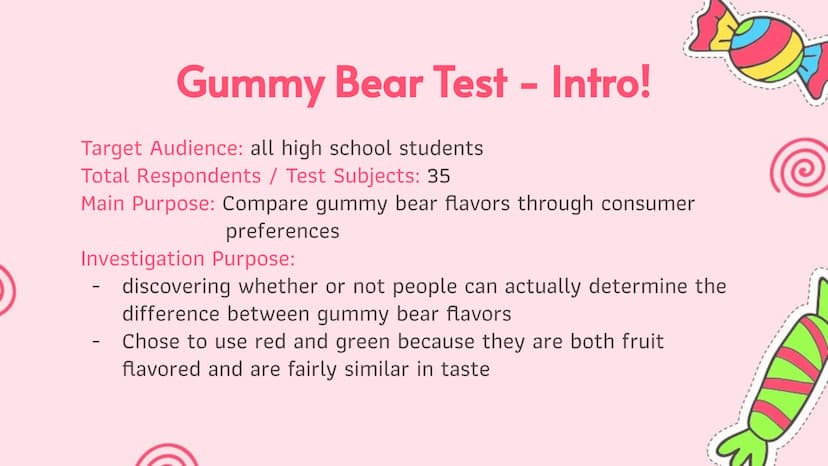
The target audience for this project is all high school students. The study involved a total of 35 respondents or test subjects. The main purpose of the experiment was to compare gummy bear flavors through consumer preferences, specifically focusing on the ability to distinguish between red and green Haribo gummy bears.
Example: The study uses red and green Haribo gummy bears for the taste test.
2
of 9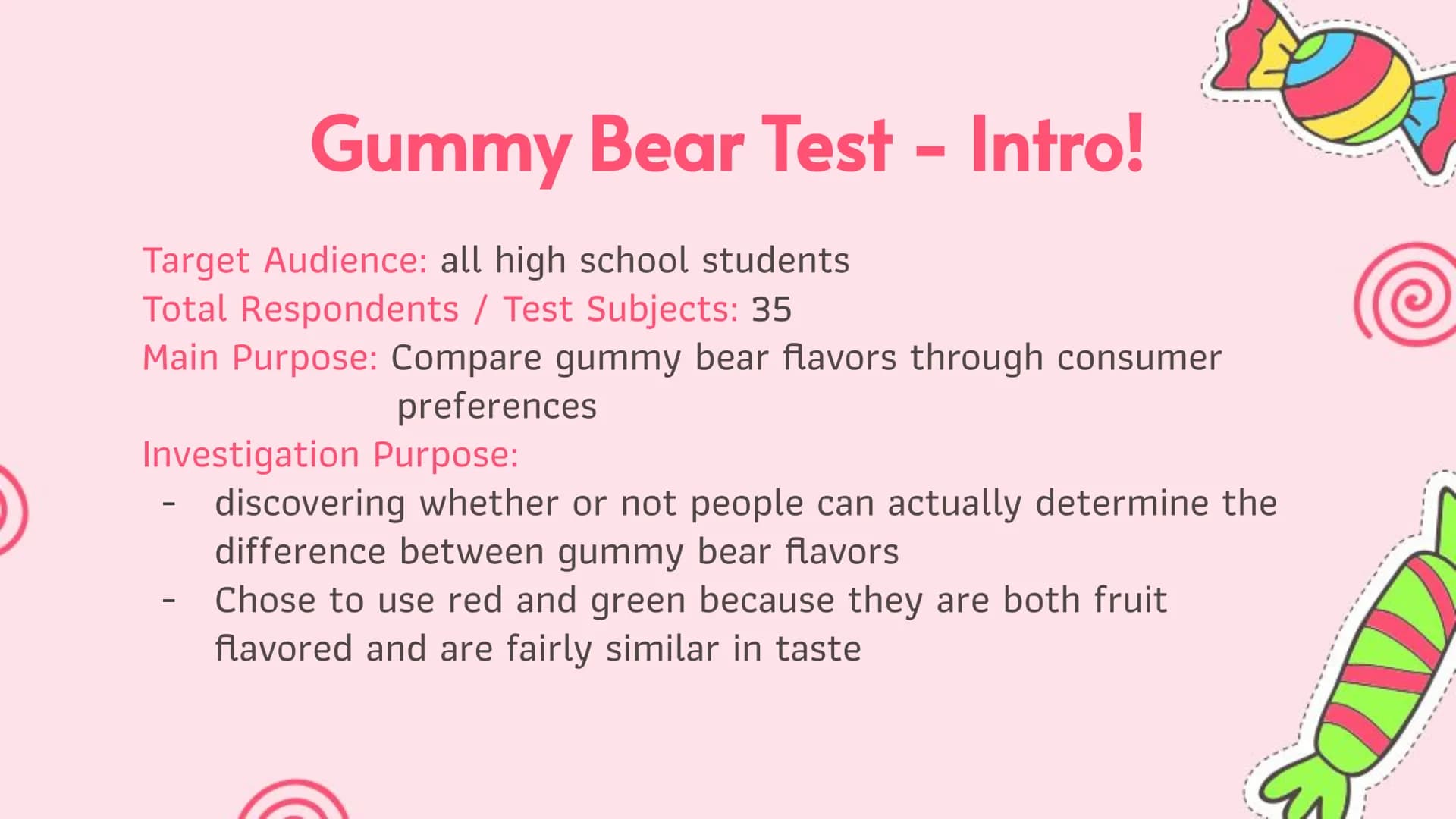
Hypothesis and Significance Level
This page presents the null and alternative hypothesis for the gummy bear flavors null alternative hypothesis test:
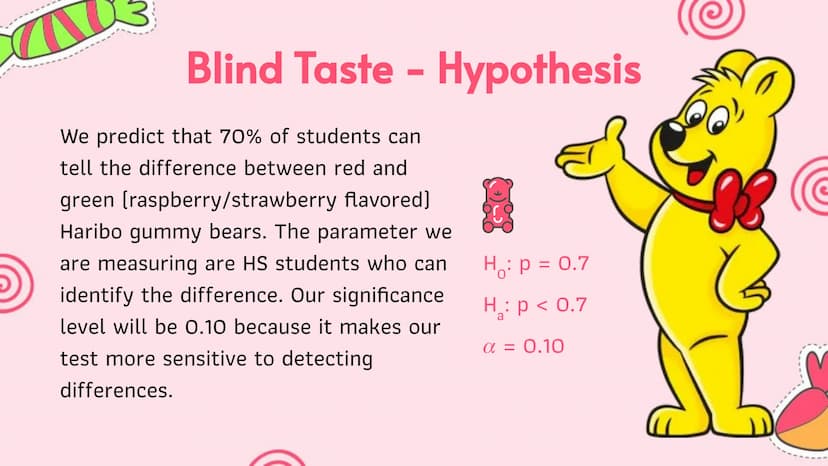
The researchers predict that 70% of students can tell the difference between red and green Haribo gummy bears. The parameter being measured is the proportion of high school students who can identify the difference.
Definition: Significance level (α) - The probability of rejecting the null hypothesis when it is actually true.
The significance level for this test is set at 0.10, which makes the test more sensitive to detecting differences.
The hypotheses are formally stated as:
- Null Hypothesis (H₀): p = 0.7
- Alternative Hypothesis (H₁): p < 0.7
Where p represents the proportion of high school students who can identify the difference between the gummy bear flavors.
3
of 9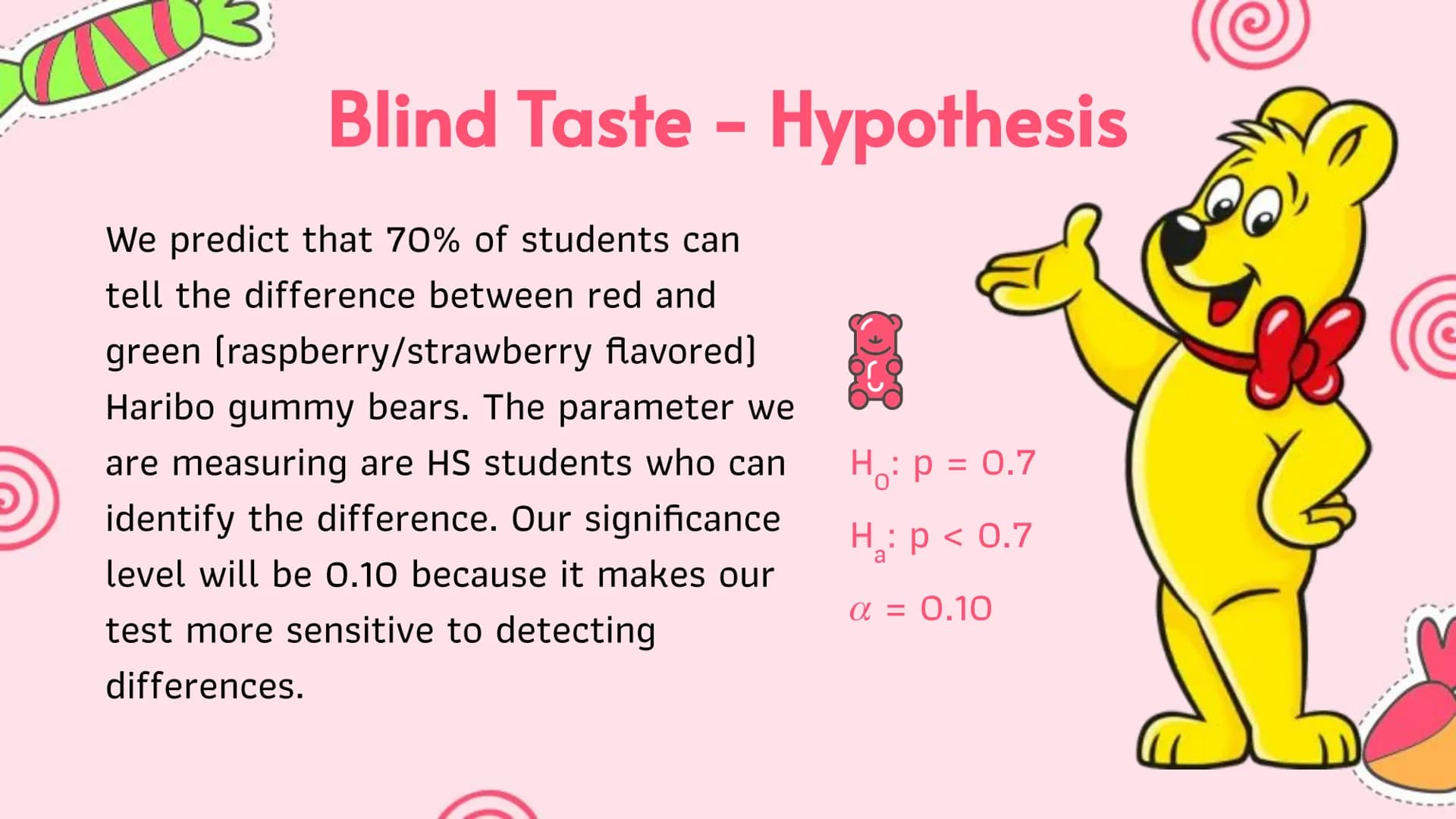
Data Collection Process
This page describes the data collection methodology for the blind taste test statistics project:
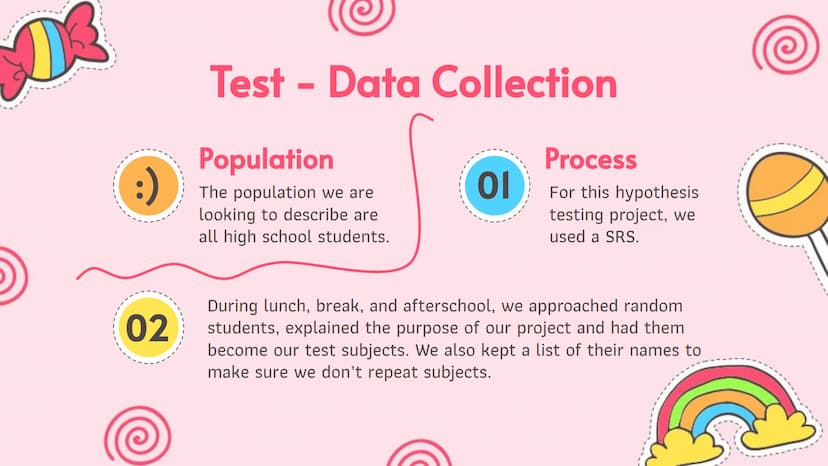
The population of interest for this study is all high school students. To ensure a representative sample, the researchers employed a Simple Random Sampling (SRS) method.
The data collection process involved approaching random students during lunch, break, and after school hours. The researchers explained the purpose of the project and invited students to participate as test subjects. To maintain the integrity of the study and prevent duplicate responses, a list of participants' names was kept.
Highlight: The use of SRS and careful tracking of participants ensures the validity and reliability of the study results.
4
of 9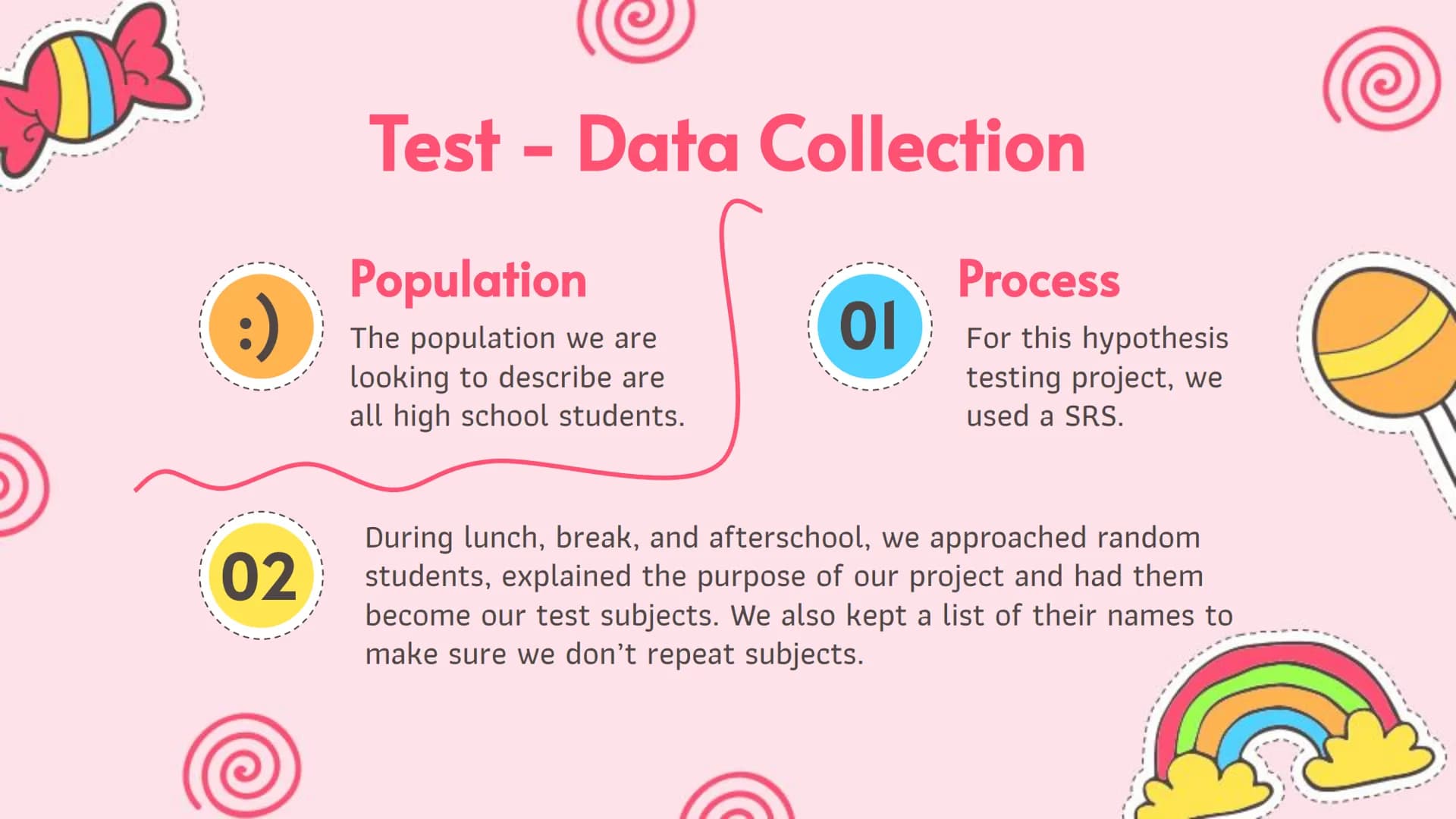
Data Presentation and Conditions
This page presents the collected data and checks for the conditions necessary for hypothesis testing:
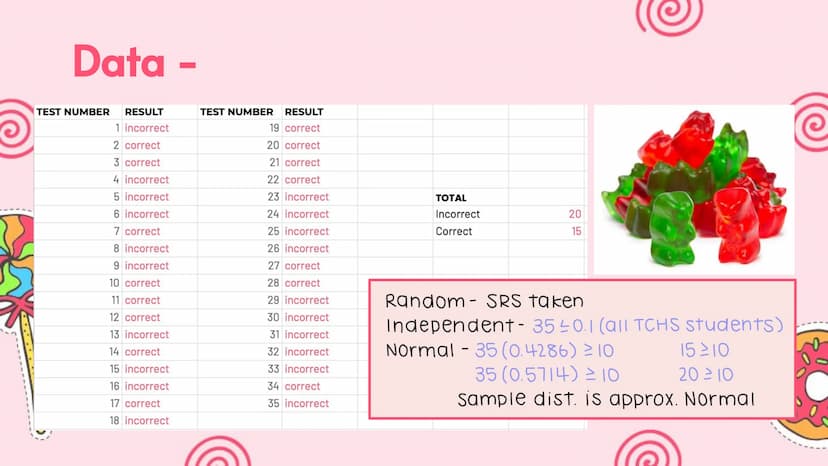
The results of the taste test are presented in a table, showing the outcomes for all 35 participants. Out of the total, 20 participants were incorrect in identifying the flavors, while 15 were correct.
The researchers then verify the conditions for conducting a hypothesis test:
- Random: The sample was obtained through SRS.
- Independent: The sample size (35) is less than 10% of the population (all high school students).
- Normal: Both np and n are greater than or equal to 10, indicating that the sampling distribution is approximately normal.
Vocabulary: Sampling distribution - The distribution of a statistic calculated from repeated samples drawn from a population.
5
of 9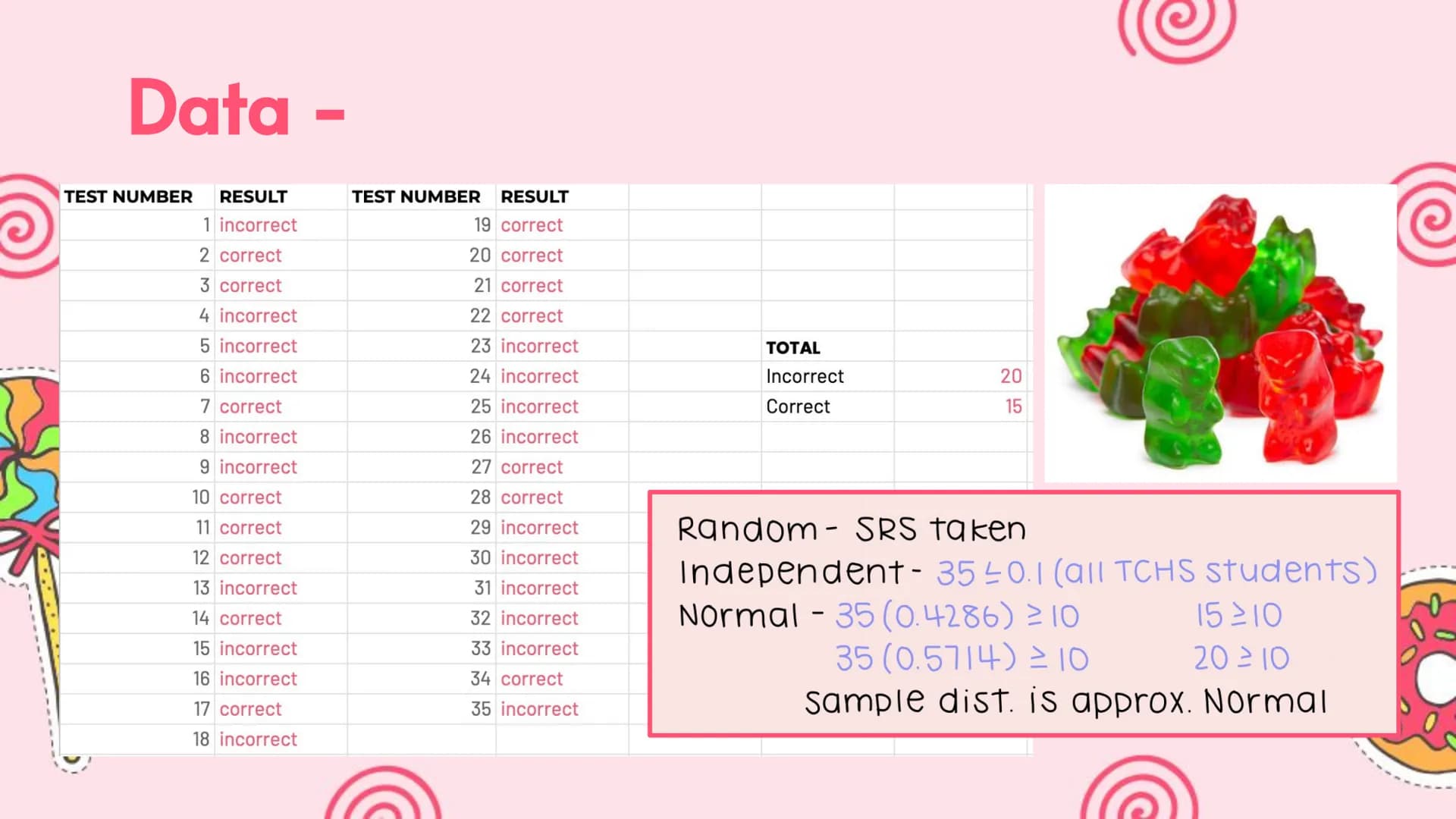
Hypothesis Testing Calculation
This page details the calculation process for the hypothesis testing project high school students conducted:
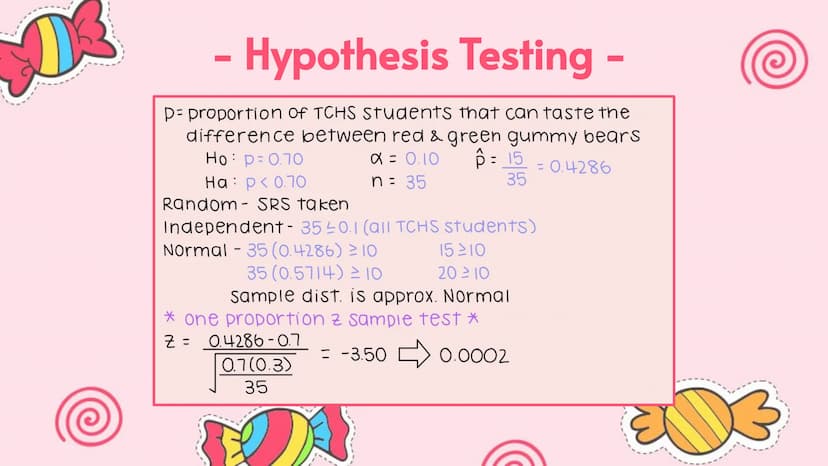
The test statistic is calculated using a one-proportion z-test:
Z = / √
Where:
- p̂ (sample proportion) = 15/35 = 0.4286
- p (hypothesized population proportion) = 0.7
- n (sample size) = 35
Plugging in these values yields a z-score of -3.50.
Example: The calculated z-score of -3.50 indicates that the sample proportion is 3.50 standard deviations below the hypothesized population proportion.
The p-value associated with this z-score is 0.0002, which is less than the significance level of 0.10.
6
of 9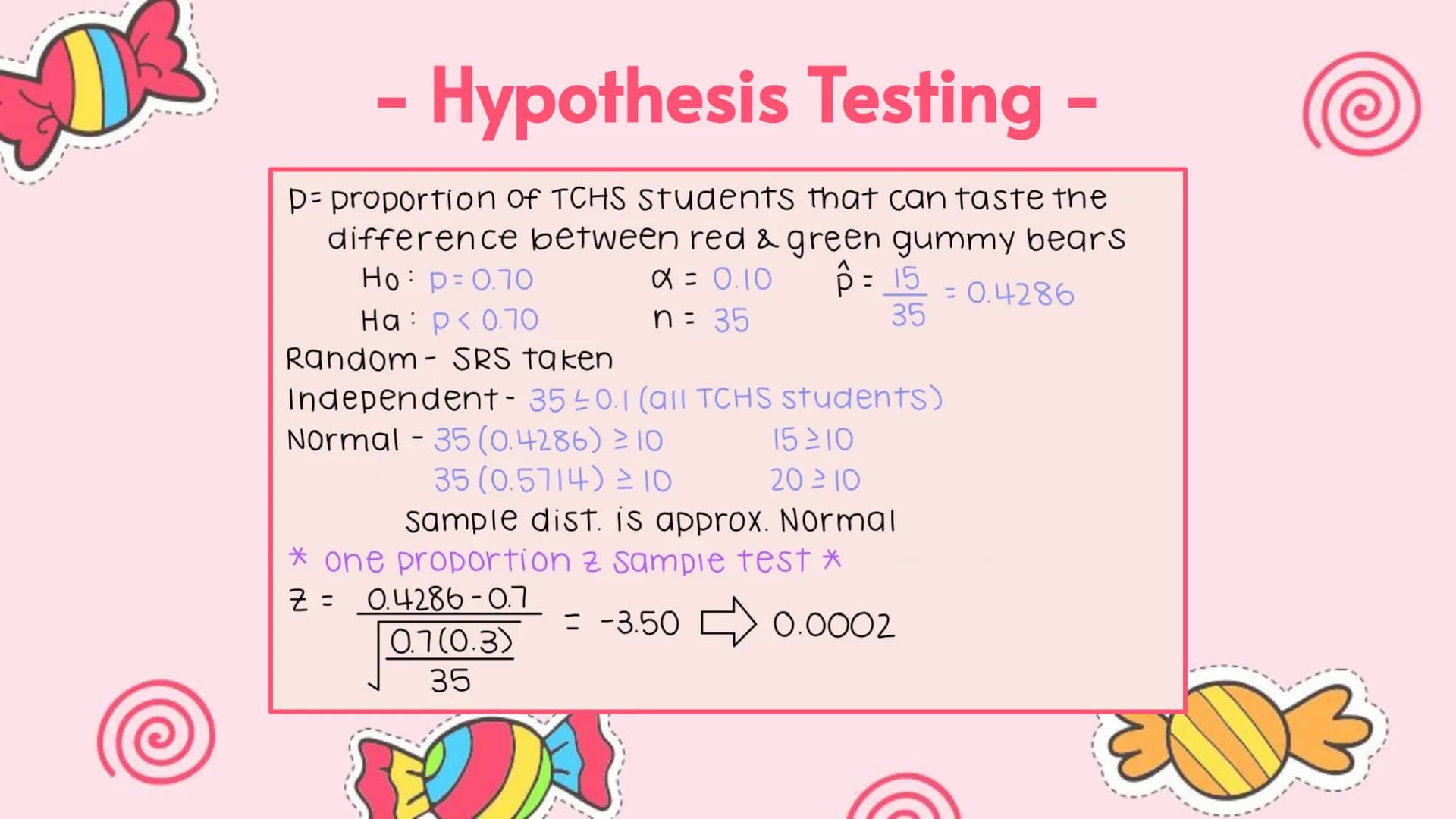
Type I and Type II Errors
This page explains the concepts of Type I and Type II errors in the context of the gummy bear taste test:
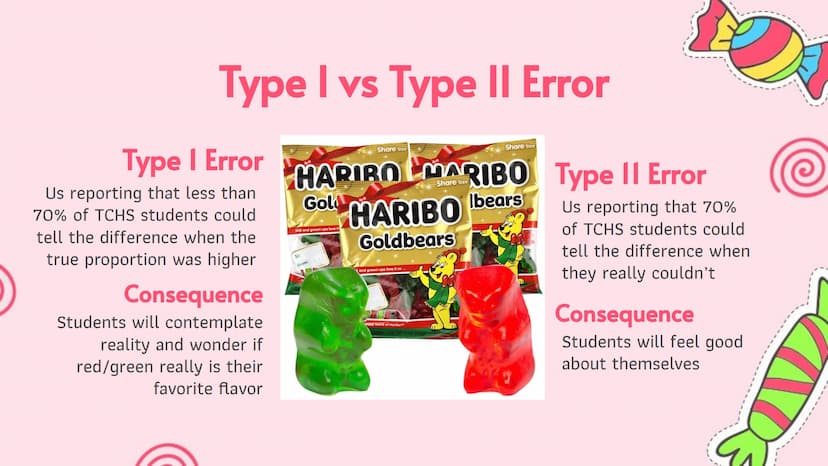
Type I Error: This would occur if the researchers report that less than 70% of the high school students could tell the difference between the gummy bear flavors when the true proportion was actually higher. The consequence of this error would be that students might question their ability to distinguish their favorite flavors.
Definition: Type I Error - Rejecting the null hypothesis when it is actually true.
Type II Error: This would happen if the researchers report that 70% of the students could tell the difference when they actually couldn't. The consequence of this error would be that students might feel overly confident about their taste-distinguishing abilities.
Definition: Type II Error - Failing to reject the null hypothesis when it is actually false.
7
of 9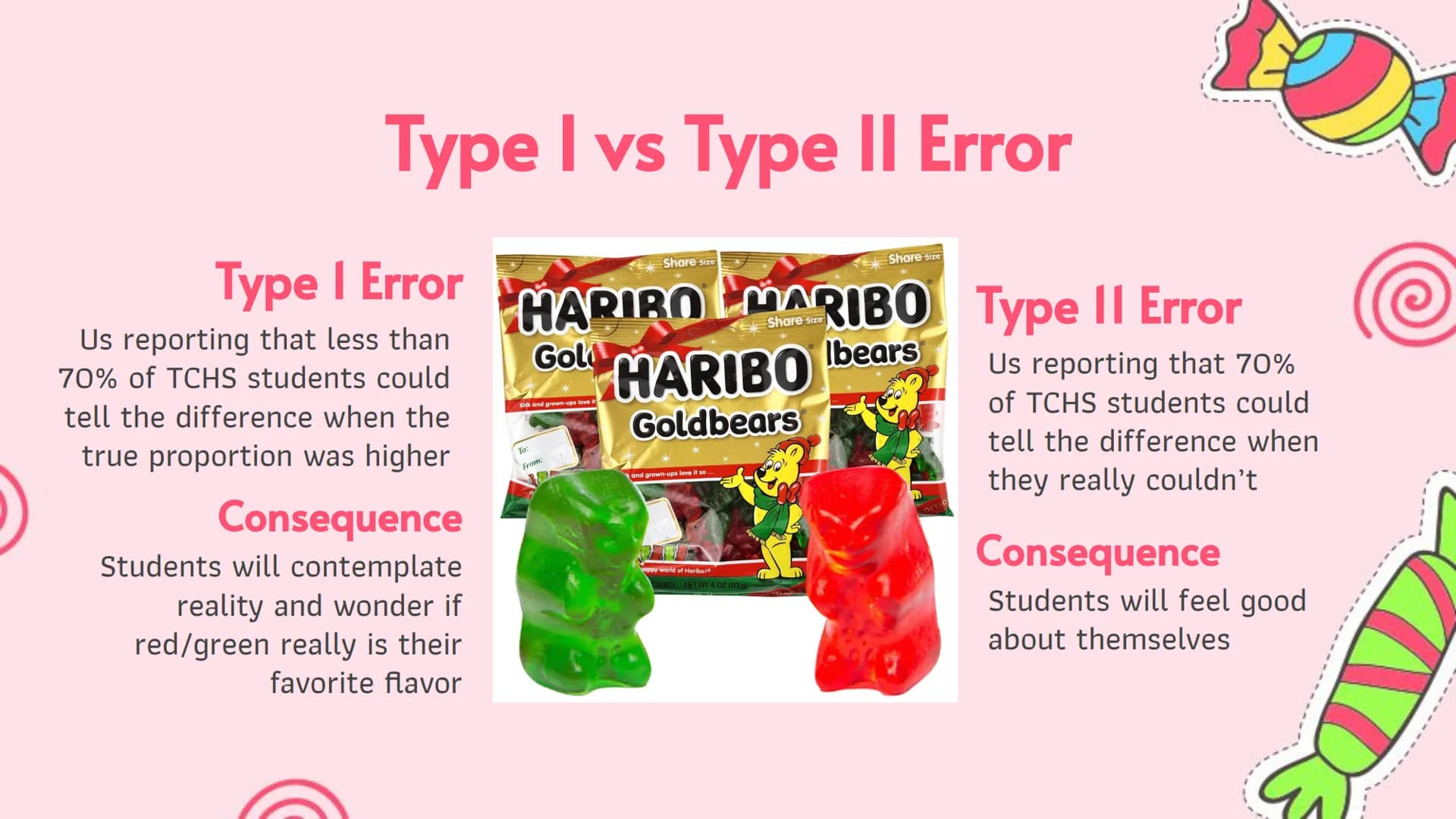
Summary and Conclusion
This page presents the key findings and conclusion of the blind taste test statistics project:
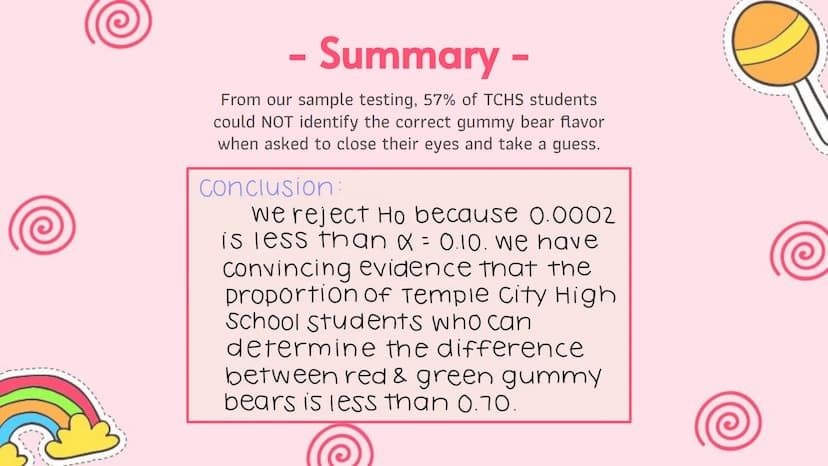
The sample testing revealed that 57% of the high school students could NOT correctly identify the gummy bear flavor when asked to guess with their eyes closed.
Highlight: The study concludes by rejecting the null hypothesis because the p-value (0.0002) is less than the significance level (α = 0.10).
The researchers state that they have convincing evidence that the proportion of high school students who can determine the difference between red and green gummy bears is less than 0.70 (70%).
Quote: "We reject H₀ because 0.0002 is less than α = 0.10. We have convincing evidence that the proportion of Temple City High School students who can determine the difference between red & green gummy bears is less than 0.70."
This conclusion challenges the initial hypothesis and provides valuable insights into taste perception among high school students.
8
of 9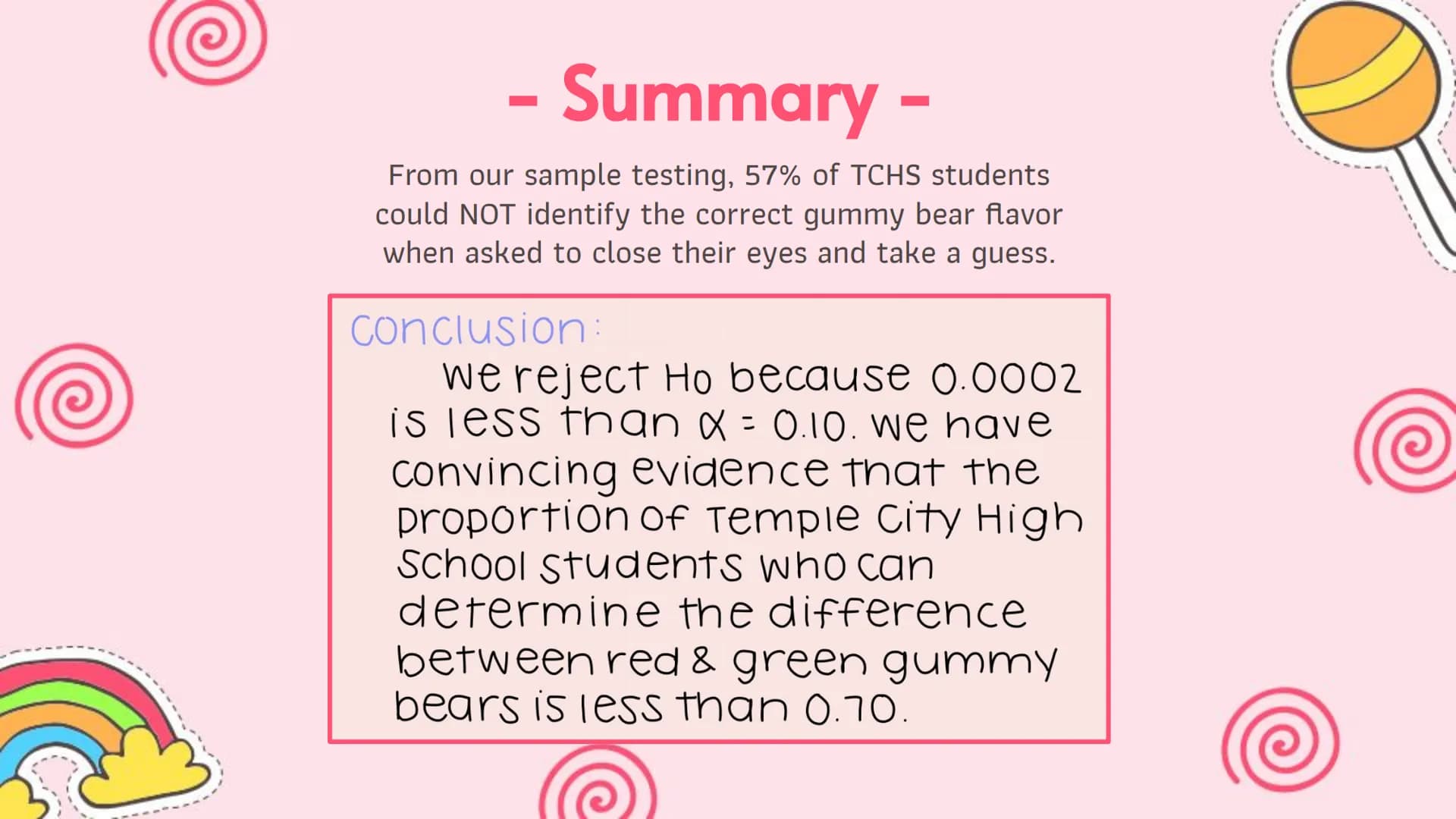
Conclusion
This final page wraps up the presentation with a brief thank you message to the audience. It reinforces the completion of the hypothesis testing project high school students conducted on gummy bear flavor differentiation.
The project successfully demonstrated the application of statistical concepts such as hypothesis testing, sampling methods, and data analysis in a real-world scenario that is relatable and interesting to high school students.
9
of 9
Hypothesis Testing: Blind Taste Test
This page introduces a hypothesis testing project designed for AP Statistics students. The project focuses on conducting a blind taste test to compare gummy bear flavors through consumer preferences.
Highlight: The project aims to discover whether people can actually determine the difference between gummy bear flavors.
The study specifically chose to use red and green gummy bears because they are both fruit-flavored and relatively similar in taste, making the comparison more challenging and interesting.
Vocabulary: Hypothesis testing - A statistical method used to make inferences about population parameters based on sample data.
We thought you’d never ask...
What is the Knowunity AI companion?
Our AI companion is specifically built for the needs of students. Based on the millions of content pieces we have on the platform we can provide truly meaningful and relevant answers to students. But its not only about answers, the companion is even more about guiding students through their daily learning challenges, with personalised study plans, quizzes or content pieces in the chat and 100% personalisation based on the students skills and developments.
Where can I download the Knowunity app?
You can download the app in the Google Play Store and in the Apple App Store.
Is Knowunity really free of charge?
That's right! Enjoy free access to study content, connect with fellow students, and get instant help – all at your fingertips.
Similar Content
 Matemáticas
Most popular content in AP Statistics
1Most popular content
9O
 AP US History
Origins and Dynamics of the Columbian Exchange
Analyze the ecological and economic motivations behind the initial transfer of goods, people, and diseases between the Old and New Worlds.
9th3,1280
I
AP US HistoryIntroduction to Early Cultural Interactions
Analyze the initial social and religious encounters between Europeans, Africans, and Indigenous peoples in the colonial Americas.
9th2,7730
O
 AP World History
Origins of Ancient River Civilizations
Analyze the environmental factors and technological innovations that led to the rise of early states in Mesopotamia, Egypt, and the Indus Valley.
9th3,1870
M
AP US HistoryMotivations for European Exploration
Analyze the economic, religious, and political factors that drove European powers to the Americas during the 15th and 16th centuries.
9th1,7780
F
 AP Psychology
Foundations of Ethical Guidelines in Research
Practice the core principles of the APA ethical code including informed consent, debriefing, and the role of Institutional Review Boards.
9th1,3360
I
AP US HistoryIntroduction to Native American Societies
Examine the diverse social, political, and economic structures of North American indigenous groups prior to European contact.
9th1,1100
I
 AP Biology
Introduction to Biological Elements of Life
Practice identifying the essential elements including carbon, nitrogen, phosphorus, and sulfur that compose biological macromolecules.
9th1,7400
I
AP US HistoryIntroduction to the Spanish Encomienda System
Explore the fundamental economic and social structures of the Spanish colonial system, focusing on the encomienda and the casta social hierarchy.
9th8890
O
AP World HistoryOrigins and Continuity of the Byzantine Empire
Analyze the political and cultural transitions from the Roman Empire to the Byzantine Empire, focusing on the reign of Justinian I and his code.
9th1,6320
Can't find what you're looking for? Explore other subjects.
Students love us — and so will you.
4.6/5App Store
4.7/5Google Play
The app is very easy to use and well designed. I have found everything I was looking for so far and have been able to learn a lot from the presentations! I will definitely use the app for a class assignment! And of course it also helps a lot as an inspiration.
Stefan SiOS user
This app is really great. There are so many study notes and help [...]. My problem subject is French, for example, and the app has so many options for help. Thanks to this app, I have improved my French. I would recommend it to anyone.
Samantha KlichAndroid user
Wow, I am really amazed. I just tried the app because I've seen it advertised many times and was absolutely stunned. This app is THE HELP you want for school and above all, it offers so many things, such as workouts and fact sheets, which have been VERY helpful to me personally.
AnnaiOS user
AP Statistics201 views·Updated Jun 12, 2026·9 pagesFun Hypothesis Testing Project for High School: Gummy Bear Flavors Blind Taste Test
This hypothesis testing project for high school students explores whether students can differentiate between red and green gummy bear flavors through a blind taste test statistics project. Key findings include:
- 57% of participants could not correctly identify gummy bear...
1
of 9
Sign up to see the content. It's free!
- Access to all documents
- Improve your grades
- Join milions of students
Target Audience and Study Details
This page outlines the key parameters of the study:
The target audience for this project is all high school students. The study involved a total of 35 respondents or test subjects. The main purpose of the experiment was to compare gummy bear flavors through consumer preferences, specifically focusing on the ability to distinguish between red and green Haribo gummy bears.
Example: The study uses red and green Haribo gummy bears for the taste test.
2
of 9Sign up to see the content. It's free!
- Access to all documents
- Improve your grades
- Join milions of students
Hypothesis and Significance Level
This page presents the null and alternative hypothesis for the gummy bear flavors null alternative hypothesis test:
The researchers predict that 70% of students can tell the difference between red and green Haribo gummy bears. The parameter being measured is the proportion of high school students who can identify the difference.
Definition: Significance level (α) - The probability of rejecting the null hypothesis when it is actually true.
The significance level for this test is set at 0.10, which makes the test more sensitive to detecting differences.
The hypotheses are formally stated as:
- Null Hypothesis (H₀): p = 0.7
- Alternative Hypothesis (H₁): p < 0.7
Where p represents the proportion of high school students who can identify the difference between the gummy bear flavors.
3
of 9Sign up to see the content. It's free!
- Access to all documents
- Improve your grades
- Join milions of students
Data Collection Process
This page describes the data collection methodology for the blind taste test statistics project:
The population of interest for this study is all high school students. To ensure a representative sample, the researchers employed a Simple Random Sampling (SRS) method.
The data collection process involved approaching random students during lunch, break, and after school hours. The researchers explained the purpose of the project and invited students to participate as test subjects. To maintain the integrity of the study and prevent duplicate responses, a list of participants' names was kept.
Highlight: The use of SRS and careful tracking of participants ensures the validity and reliability of the study results.
4
of 9Sign up to see the content. It's free!
- Access to all documents
- Improve your grades
- Join milions of students
Data Presentation and Conditions
This page presents the collected data and checks for the conditions necessary for hypothesis testing:
The results of the taste test are presented in a table, showing the outcomes for all 35 participants. Out of the total, 20 participants were incorrect in identifying the flavors, while 15 were correct.
The researchers then verify the conditions for conducting a hypothesis test:
- Random: The sample was obtained through SRS.
- Independent: The sample size (35) is less than 10% of the population (all high school students).
- Normal: Both np and n are greater than or equal to 10, indicating that the sampling distribution is approximately normal.
Vocabulary: Sampling distribution - The distribution of a statistic calculated from repeated samples drawn from a population.
5
of 9Sign up to see the content. It's free!
- Access to all documents
- Improve your grades
- Join milions of students
Hypothesis Testing Calculation
This page details the calculation process for the hypothesis testing project high school students conducted:
The test statistic is calculated using a one-proportion z-test:
Z = / √
Where:
- p̂ (sample proportion) = 15/35 = 0.4286
- p (hypothesized population proportion) = 0.7
- n (sample size) = 35
Plugging in these values yields a z-score of -3.50.
Example: The calculated z-score of -3.50 indicates that the sample proportion is 3.50 standard deviations below the hypothesized population proportion.
The p-value associated with this z-score is 0.0002, which is less than the significance level of 0.10.
6
of 9Sign up to see the content. It's free!
- Access to all documents
- Improve your grades
- Join milions of students
Type I and Type II Errors
This page explains the concepts of Type I and Type II errors in the context of the gummy bear taste test:
Type I Error: This would occur if the researchers report that less than 70% of the high school students could tell the difference between the gummy bear flavors when the true proportion was actually higher. The consequence of this error would be that students might question their ability to distinguish their favorite flavors.
Definition: Type I Error - Rejecting the null hypothesis when it is actually true.
Type II Error: This would happen if the researchers report that 70% of the students could tell the difference when they actually couldn't. The consequence of this error would be that students might feel overly confident about their taste-distinguishing abilities.
Definition: Type II Error - Failing to reject the null hypothesis when it is actually false.
7
of 9Sign up to see the content. It's free!
- Access to all documents
- Improve your grades
- Join milions of students
Summary and Conclusion
This page presents the key findings and conclusion of the blind taste test statistics project:
The sample testing revealed that 57% of the high school students could NOT correctly identify the gummy bear flavor when asked to guess with their eyes closed.
Highlight: The study concludes by rejecting the null hypothesis because the p-value (0.0002) is less than the significance level (α = 0.10).
The researchers state that they have convincing evidence that the proportion of high school students who can determine the difference between red and green gummy bears is less than 0.70 (70%).
Quote: "We reject H₀ because 0.0002 is less than α = 0.10. We have convincing evidence that the proportion of Temple City High School students who can determine the difference between red & green gummy bears is less than 0.70."
This conclusion challenges the initial hypothesis and provides valuable insights into taste perception among high school students.
8
of 9Sign up to see the content. It's free!
- Access to all documents
- Improve your grades
- Join milions of students
Conclusion
This final page wraps up the presentation with a brief thank you message to the audience. It reinforces the completion of the hypothesis testing project high school students conducted on gummy bear flavor differentiation.
The project successfully demonstrated the application of statistical concepts such as hypothesis testing, sampling methods, and data analysis in a real-world scenario that is relatable and interesting to high school students.
9
of 9Sign up to see the content. It's free!
- Access to all documents
- Improve your grades
- Join milions of students
Hypothesis Testing: Blind Taste Test
This page introduces a hypothesis testing project designed for AP Statistics students. The project focuses on conducting a blind taste test to compare gummy bear flavors through consumer preferences.
Highlight: The project aims to discover whether people can actually determine the difference between gummy bear flavors.
The study specifically chose to use red and green gummy bears because they are both fruit-flavored and relatively similar in taste, making the comparison more challenging and interesting.
Vocabulary: Hypothesis testing - A statistical method used to make inferences about population parameters based on sample data.
We thought you’d never ask...
What is the Knowunity AI companion?
Our AI companion is specifically built for the needs of students. Based on the millions of content pieces we have on the platform we can provide truly meaningful and relevant answers to students. But its not only about answers, the companion is even more about guiding students through their daily learning challenges, with personalised study plans, quizzes or content pieces in the chat and 100% personalisation based on the students skills and developments.
Where can I download the Knowunity app?
You can download the app in the Google Play Store and in the Apple App Store.
Is Knowunity really free of charge?
That's right! Enjoy free access to study content, connect with fellow students, and get instant help – all at your fingertips.
Similar Content
Most popular content in AP Statistics
1Most popular content
9O
AP US HistoryOrigins and Dynamics of the Columbian Exchange
Analyze the ecological and economic motivations behind the initial transfer of goods, people, and diseases between the Old and New Worlds.
9th3,1280
I
AP US HistoryIntroduction to Early Cultural Interactions
Analyze the initial social and religious encounters between Europeans, Africans, and Indigenous peoples in the colonial Americas.
9th2,7730
O
AP World HistoryOrigins of Ancient River Civilizations
Analyze the environmental factors and technological innovations that led to the rise of early states in Mesopotamia, Egypt, and the Indus Valley.
9th3,1870
M
AP US HistoryMotivations for European Exploration
Analyze the economic, religious, and political factors that drove European powers to the Americas during the 15th and 16th centuries.
9th1,7780
F
AP PsychologyFoundations of Ethical Guidelines in Research
Practice the core principles of the APA ethical code including informed consent, debriefing, and the role of Institutional Review Boards.
9th1,3360
I
AP US HistoryIntroduction to Native American Societies
Examine the diverse social, political, and economic structures of North American indigenous groups prior to European contact.
9th1,1100
I
AP BiologyIntroduction to Biological Elements of Life
Practice identifying the essential elements including carbon, nitrogen, phosphorus, and sulfur that compose biological macromolecules.
9th1,7400
I
AP US HistoryIntroduction to the Spanish Encomienda System
Explore the fundamental economic and social structures of the Spanish colonial system, focusing on the encomienda and the casta social hierarchy.
9th8890
O
AP World HistoryOrigins and Continuity of the Byzantine Empire
Analyze the political and cultural transitions from the Roman Empire to the Byzantine Empire, focusing on the reign of Justinian I and his code.
9th1,6320
Can't find what you're looking for? Explore other subjects.
Students love us — and so will you.
4.6/5App Store
4.7/5Google Play
The app is very easy to use and well designed. I have found everything I was looking for so far and have been able to learn a lot from the presentations! I will definitely use the app for a class assignment! And of course it also helps a lot as an inspiration.
Stefan SiOS user
This app is really great. There are so many study notes and help [...]. My problem subject is French, for example, and the app has so many options for help. Thanks to this app, I have improved my French. I would recommend it to anyone.
Samantha KlichAndroid user
Wow, I am really amazed. I just tried the app because I've seen it advertised many times and was absolutely stunned. This app is THE HELP you want for school and above all, it offers so many things, such as workouts and fact sheets, which have been VERY helpful to me personally.
AnnaiOS user