
The Renaissance was a period of "rebirth" in Europe from... Show more
 AP European History
 World/Global History
 Algebra
 Overige
 Algebra 1
Sign up to see the contentIt's free!
Access to all documents
Improve your grades
Join milions of students
By signing up you accept Terms of Service and Privacy Policy
Subjects
Triangle Congruence and Similarity Theorems
Triangle Properties and Classification
Linear Equations and Graphs
Geometric Angle Relationships
Trigonometric Functions and Identities
Equation Solving Techniques
Circle Geometry Fundamentals
Division Operations and Methods
Basic Differentiation Rules
Exponent and Logarithm Properties
Show all topics
Human Organ Systems
Reproductive Cell Cycles
Biological Sciences Subdisciplines
Cellular Energy Metabolism
Autotrophic Energy Processes
Inheritance Patterns and Principles
Biomolecular Structure and Organization
Cell Cycle and Division Mechanics
Cellular Organization and Development
Biological Structural Organization
Show all topics
Chemical Sciences and Applications
Atomic Structure and Composition
Molecular Electron Structure Representation
Atomic Electron Behavior
Matter Properties and Water
Mole Concept and Calculations
Gas Laws and Behavior
Periodic Table Organization
Chemical Thermodynamics Fundamentals
Chemical Bond Types and Properties
Show all topics
European Renaissance and Enlightenment
European Cultural Movements 800-1920
American Revolution Era 1763-1797
American Civil War 1861-1865
Global Imperial Systems
Mongol and Chinese Dynasties
U.S. Presidents and World Leaders
Historical Sources and Documentation
World Wars Era and Impact
World Religious Systems
Show all topics
Classic and Contemporary Novels
Literary Character Analysis
Rhetorical Theory and Practice
Classic Literary Narratives
Reading Analysis and Interpretation
Narrative Structure and Techniques
English Language Components
Influential English-Language Authors
Basic Sentence Structure
Narrative Voice and Perspective
Show all topics
14
•
Dec 26, 2025
•
Violet C
@iolet_nucf6h9ab40z04
The Renaissance was a period of "rebirth" in Europe from... Show more
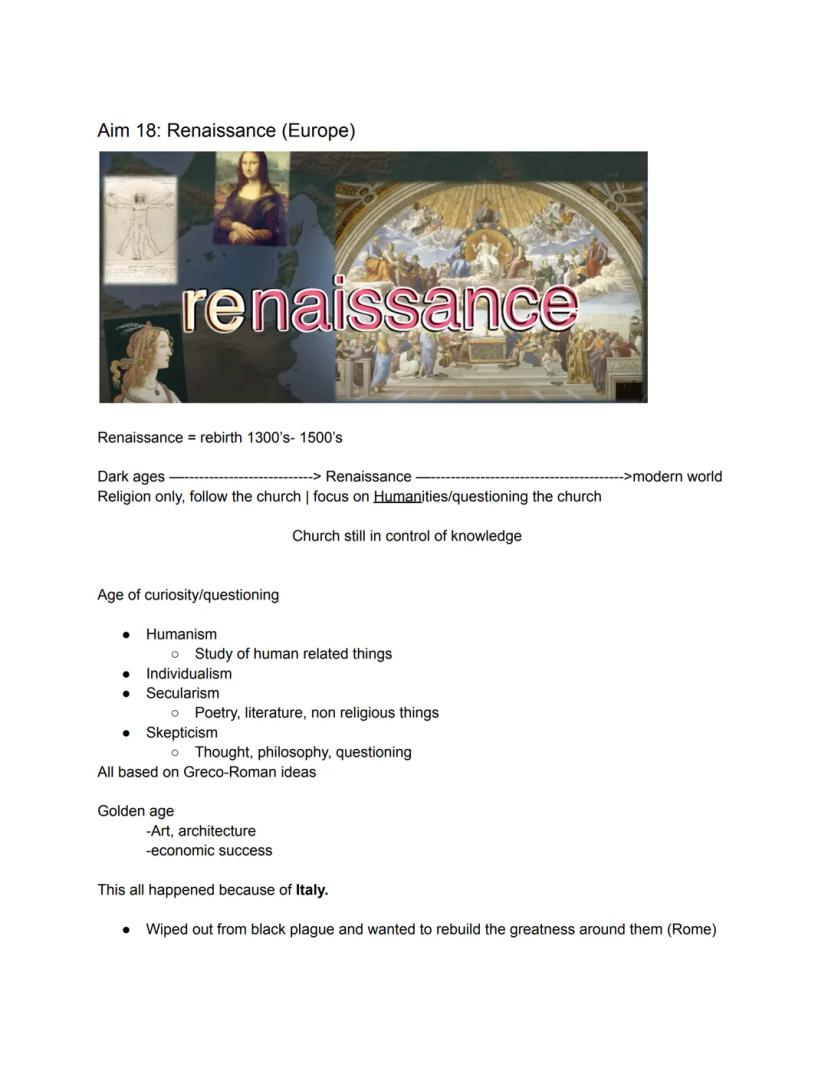


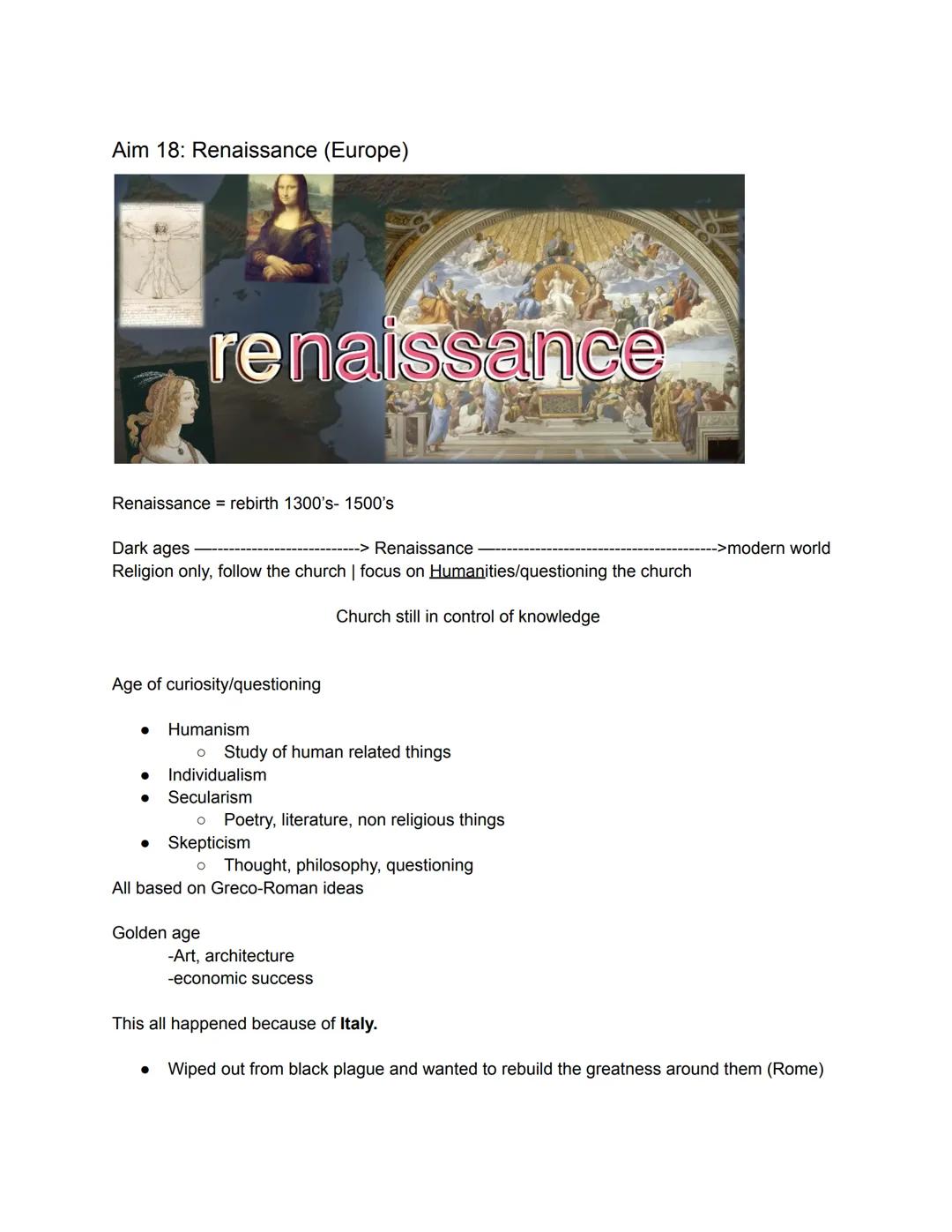
Ever wondered how Europe went from the Dark Ages to the modern world? The Renaissance (meaning "rebirth") was that bridge! From the 1300s to 1500s, Europe transformed as people began to question traditional ideas.
While the Church still controlled knowledge, people developed humanism - the study of human-related things rather than just religious matters. This led to individualism and secularism, allowing focus on poetry, literature, and non-religious topics. People embraced skepticism, questioning everything around them.
All these ideas were based on ancient Greco-Roman thinking. The Renaissance became a golden age of art, architecture, and economic success.
💡 The Renaissance began in Italy after the Black Plague devastated the population. Italians wanted to rebuild and recapture the greatness of ancient Rome that surrounded them.
This cultural explosion was possible because of Italy's wealth from Mediterranean trade and the Medici family of Florence, who sponsored artists and owned the city where the Renaissance began.
Art completely transformed during the Renaissance! Artists made huge breakthroughs that still influence how we create today.
Renaissance painters discovered perspective (showing depth with foreground and background), creating more realistic images. Unlike the flat religious paintings before, Renaissance art featured detailed, lifelike human figures. The most famous Renaissance artists changed how we think about art forever:
Leonardo da Vinci was the ultimate "Renaissance man" - not just an artist but also an engineer and mathematician. His works like the Mona Lisa and The Last Supper remain world-famous masterpieces.
Raphael created the beautiful Madonna and Child and philosophical School of Athens, which represented deep thinking. Michelangelo gave us the incredible Sistine Chapel ceiling and the sculpture of David.
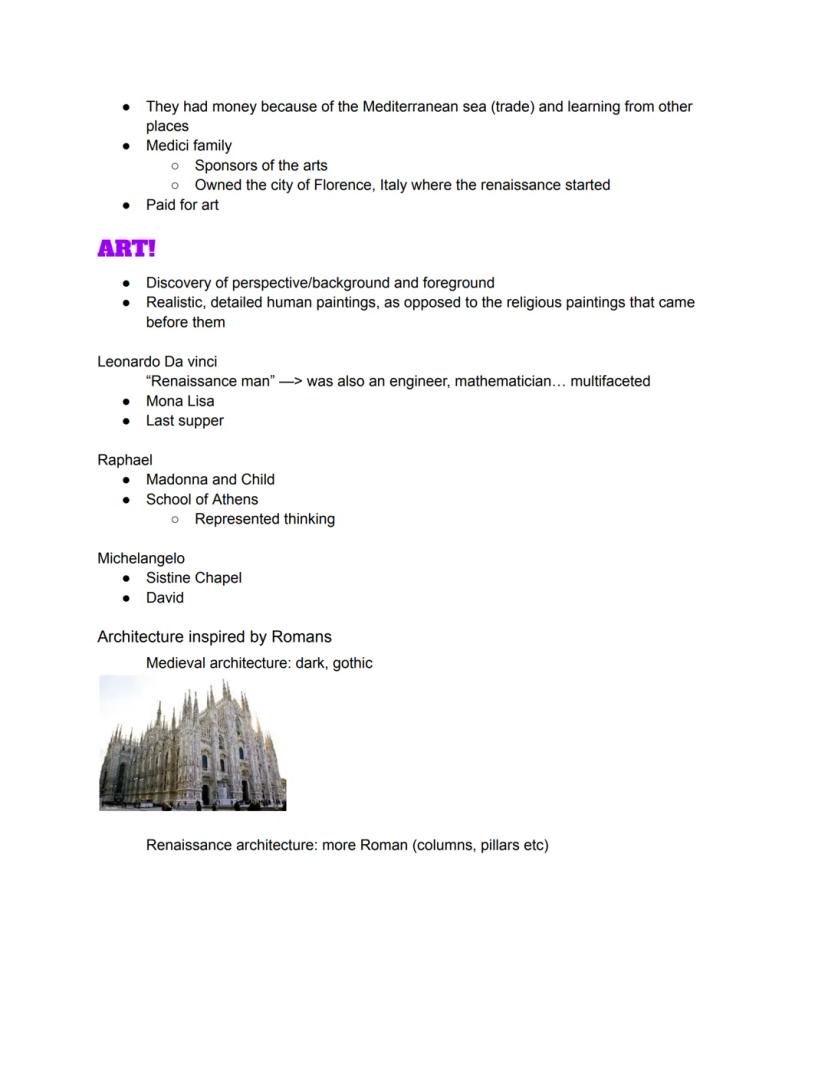
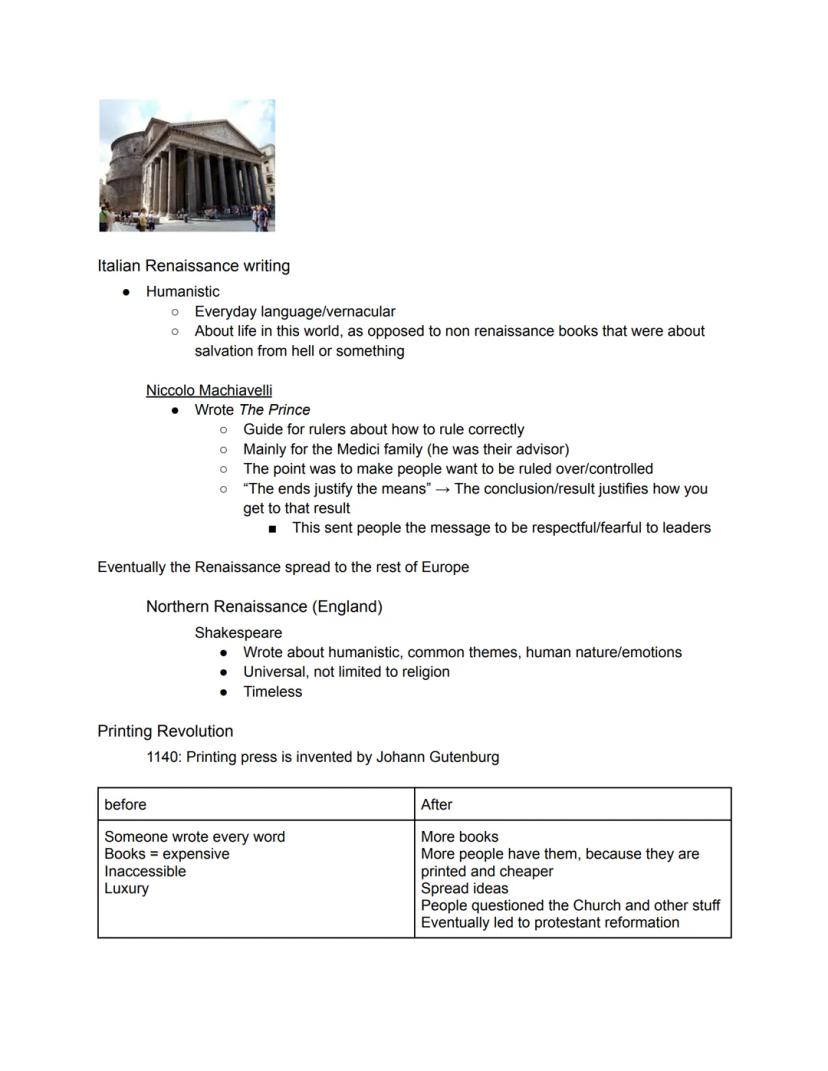
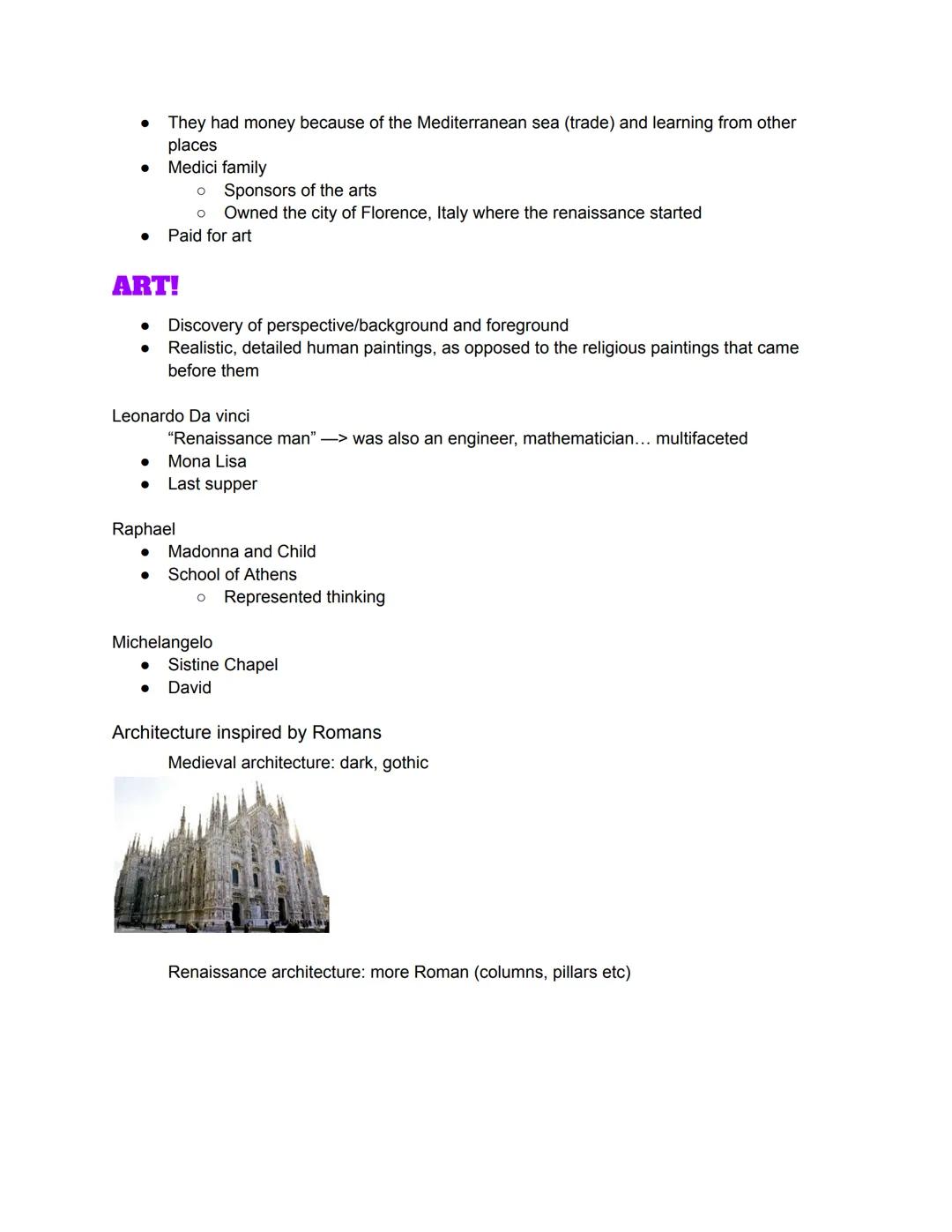
Architecture also transformed, abandoning the dark, gothic style of medieval times for designs inspired by ancient Romans. Buildings featured columns and pillars in bright, open spaces that celebrated human achievement.
💡 Renaissance artists were supported by wealthy patrons like the Medici family, who paid them to create works that would show off their wealth and culture.

Renaissance writers changed what books were about and who could read them. Their work was humanistic, using everyday language (called "vernacular") that regular people understood, not just Latin. They wrote about life in this world rather than just salvation in the next.
Niccolo Machiavelli wrote The Prince, a guide for rulers (especially the Medici family) on how to control people effectively. His famous idea that "the ends justify the means" suggested that results matter more than how you achieve them. This taught people to respect and fear their leaders.
As the Renaissance spread to northern Europe, Shakespeare emerged in England, writing about universal human themes and emotions that still speak to us today. His work wasn't limited to religion but explored timeless aspects of human nature.
The printing revolution transformed knowledge forever. When Johann Gutenberg invented the printing press in 1440, books went from luxury items to mass-produced items regular people could afford. This spread ideas faster than ever before.
💡 Before printing, a single book might take a year to copy by hand and cost as much as a house! The printing press made books affordable and led to questioning of authority that eventually sparked the Protestant Reformation.

Have you ever wondered how Christianity split into so many different groups? It all started with the Protestant Reformation in 1517!
Before the Reformation, the Catholic Church controlled almost everything - money, religion, and knowledge. The Pope wielded enormous power throughout Europe. However, as printing spread knowledge to ordinary people, many began to see corruption in the Church.
The Church had several problems that angered people. The Pope started wars (not his job), sold indulgences (pardons for sins) to raise money, and punished anyone who disagreed with Church teachings.
Martin Luther, a German monk, finally spoke up against these practices in 1517. Growing up with Renaissance ideas of humanism and skepticism, Luther wasn't afraid to question authority.
💡 Indulgences were basically "get out of hell" certificates that the Church sold to raise money. The Church convinced people they could buy salvation for themselves or dead relatives - a practice that outraged reformers like Luther.
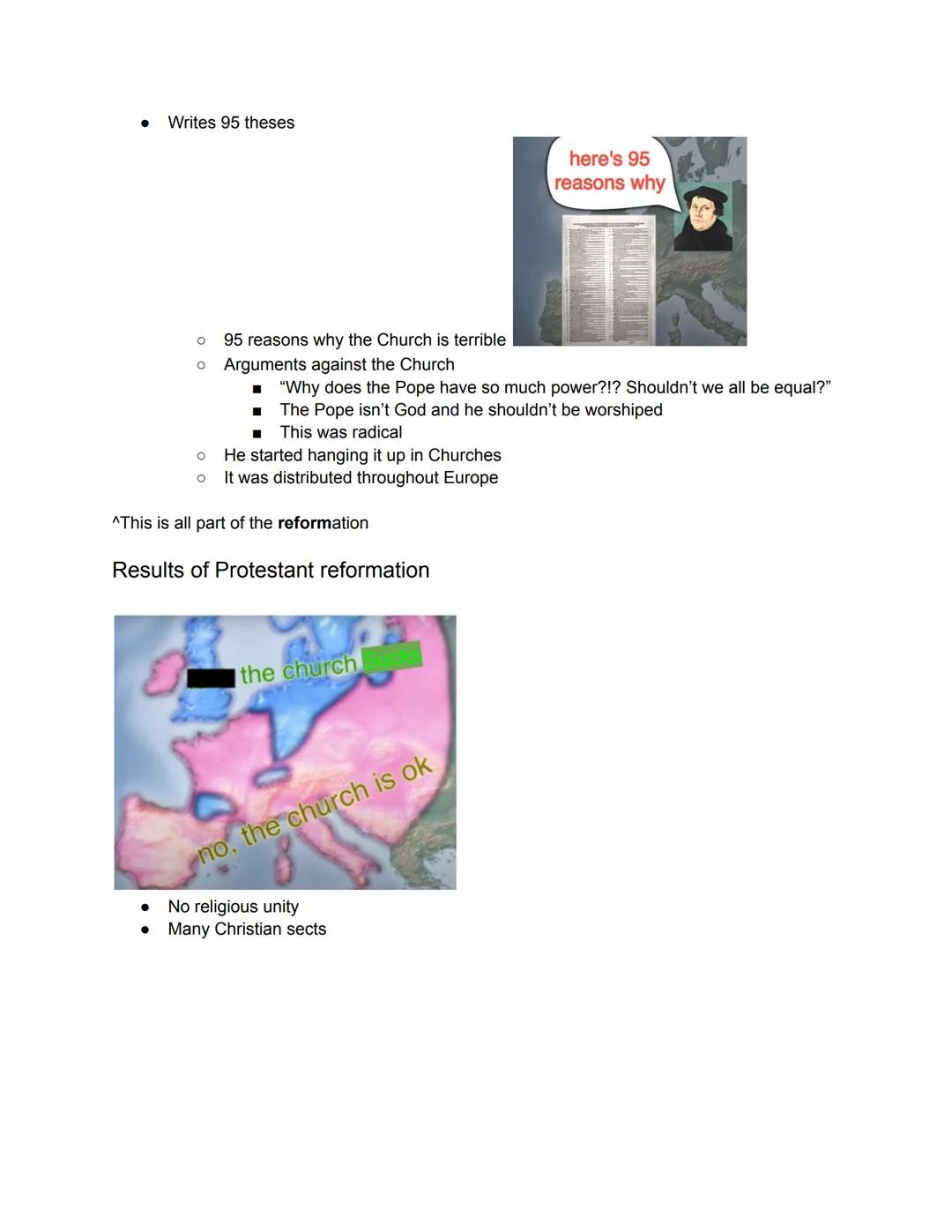
Martin Luther's famous 95 Theses launched the Protestant Reformation and forever changed Christianity. These 95 arguments against Church practices questioned the Pope's power, arguing that all Christians should be equal.
Luther's radical ideas included:
At first, Luther simply hung these arguments on church doors, but thanks to the printing press, they spread rapidly throughout Europe. Suddenly everyone was debating Church authority!
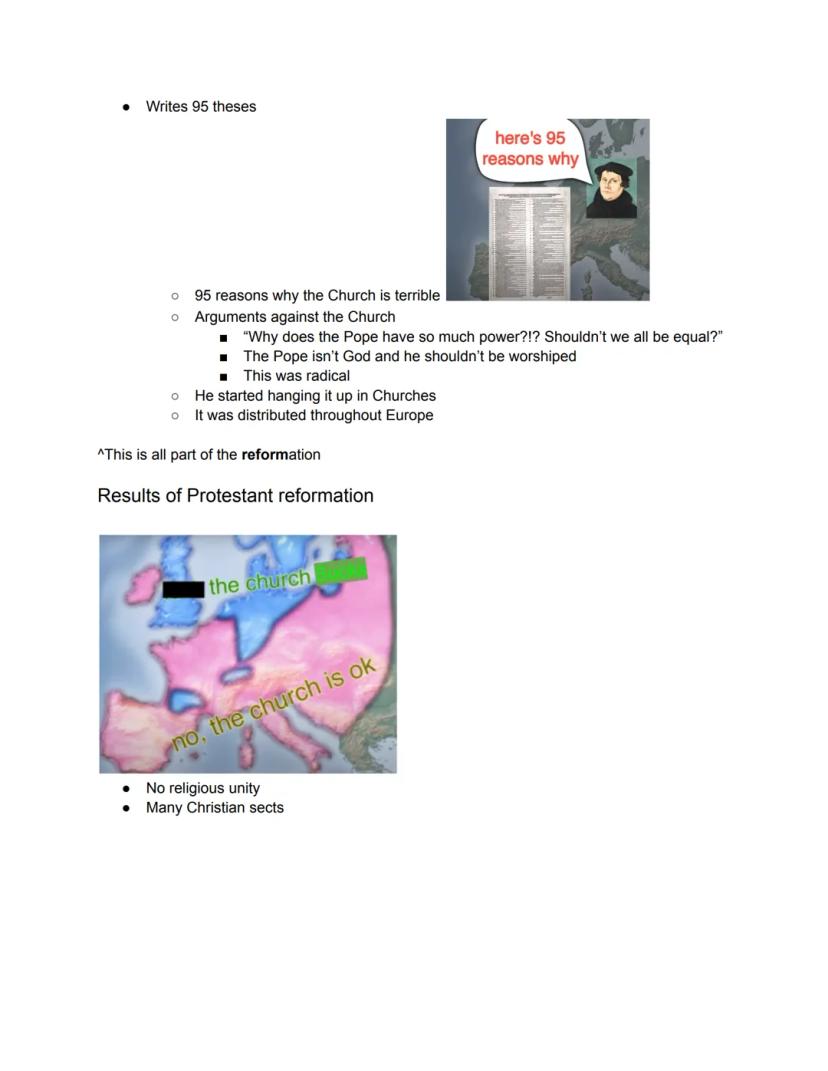
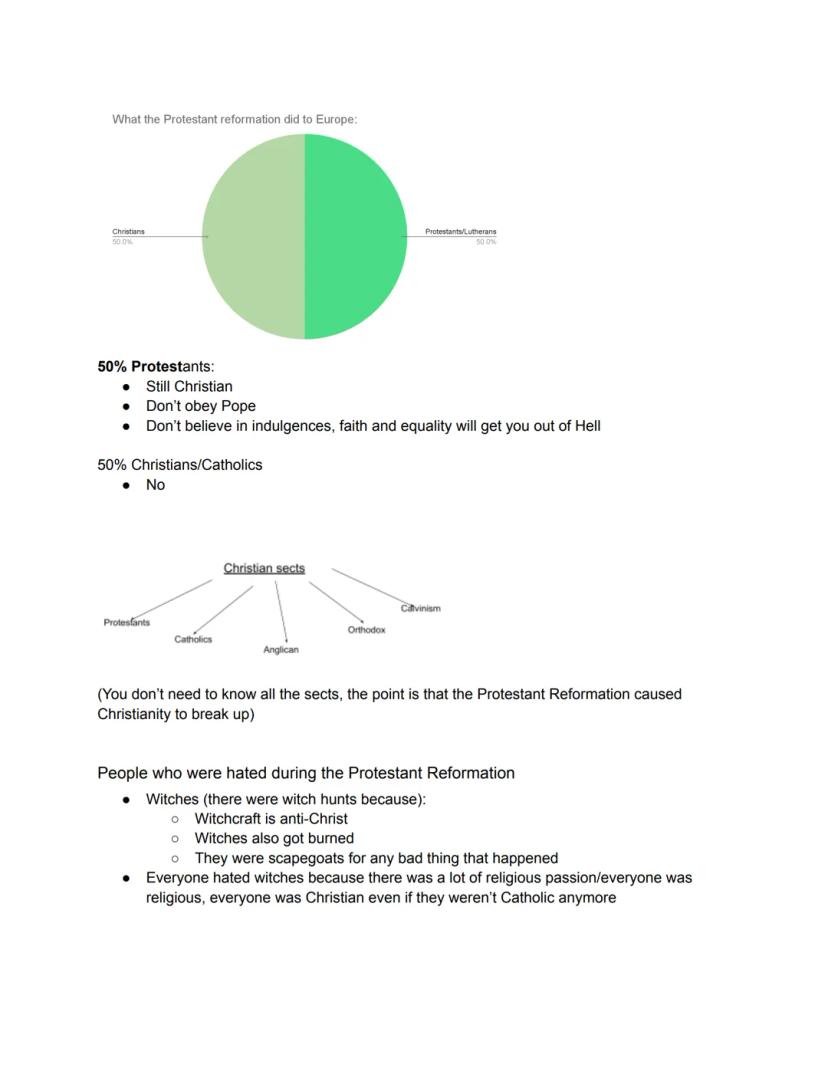
The results were dramatic. Christianity split into many different sects as religious unity collapsed across Europe. About half of European Christians became Protestants (those who "protested" against the Catholic Church). They still considered themselves Christians but:
💡 The Protestant Reformation wasn't just about religion - it completely changed the balance of power in Europe, weakening the Catholic Church's control over politics and knowledge.

The Protestant Reformation sparked intense religious passion - sometimes with dangerous results. Many groups were persecuted, especially witches. During this time, people blamed witchcraft for everything from bad harvests to illness, leading to witch hunts and executions.
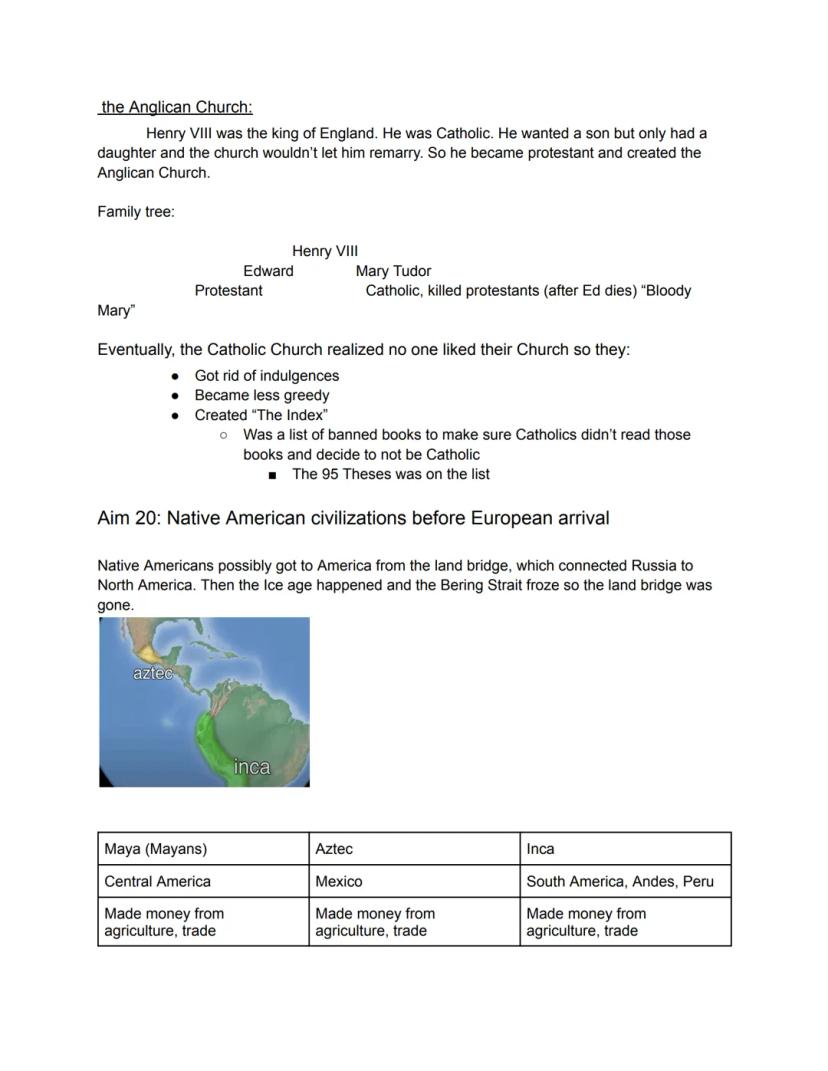
New Christian groups appeared across Europe, including Calvinists, Lutherans, and the Anglican Church. The Anglican Church started when England's King Henry VIII wanted a divorce that the Pope wouldn't grant. His solution? Create his own church where he made the rules!
This led to a complicated family tree in England:
The Catholic Church finally realized it needed to reform or lose everyone. They:
💡 Religious divisions created during the Reformation still exist today! The Protestant churches that formed then evolved into many of the denominations we now know, including Lutherans, Anglicans (Episcopalians in America), and others.
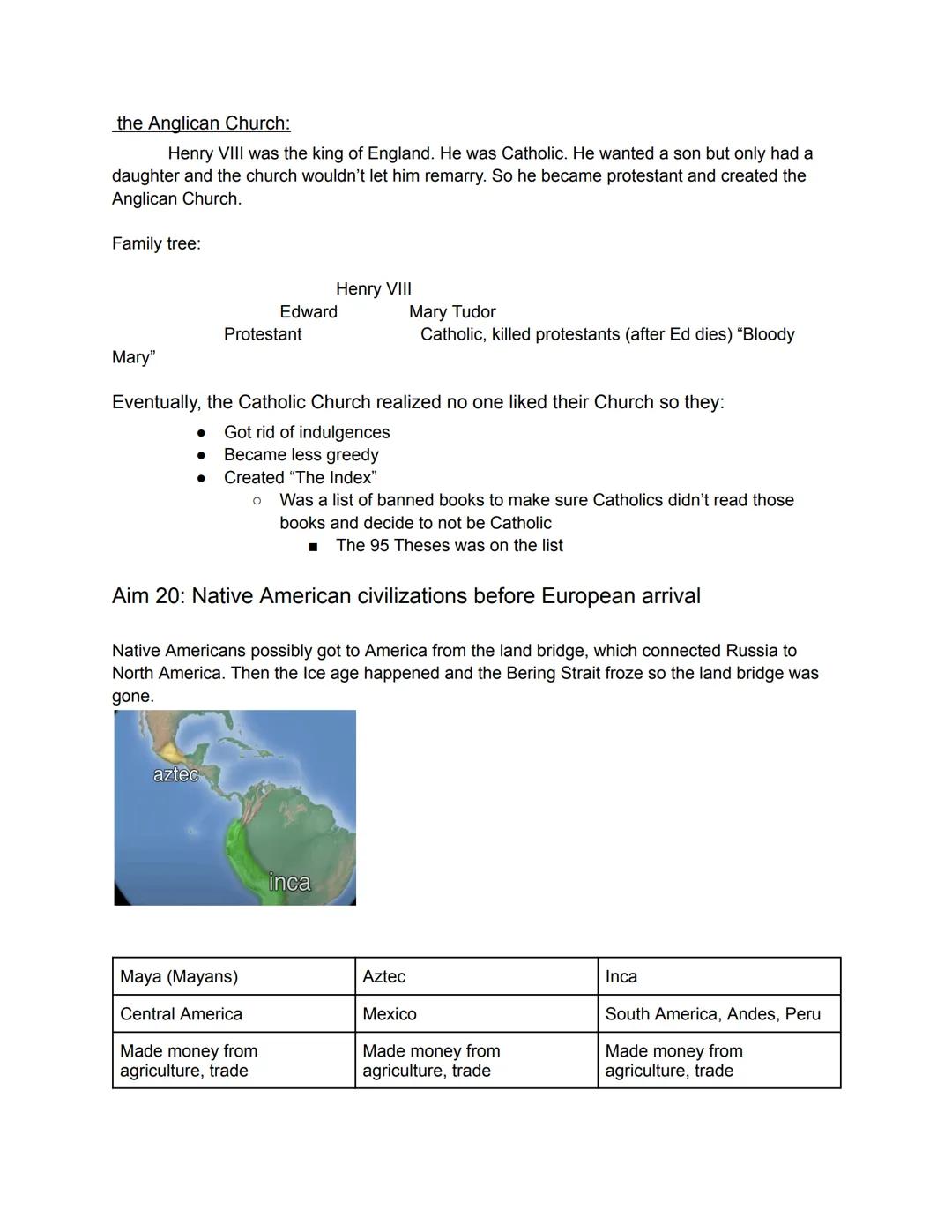
Long before Europeans arrived in the Americas, advanced civilizations thrived across the continents. Native Americans likely reached the Americas by crossing a land bridge connecting Russia to North America, which later disappeared when sea levels rose.
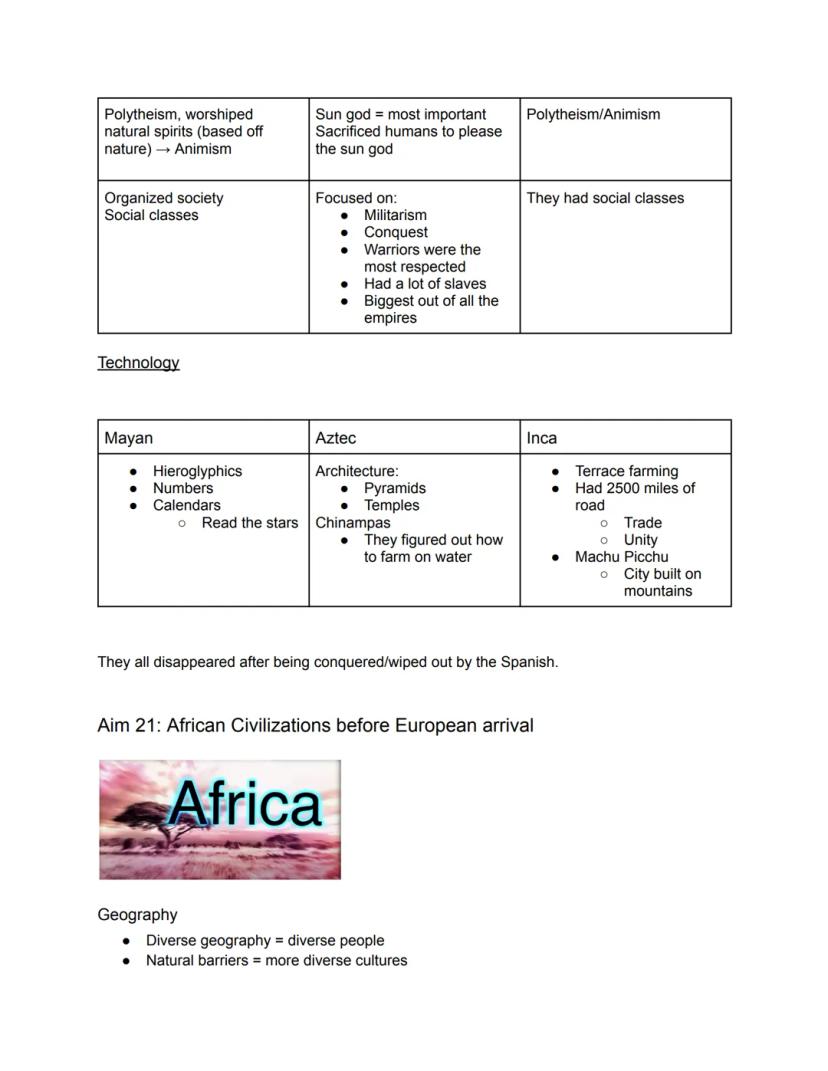
Three major empires dominated different regions:
Maya (Mayans) in Central America built complex societies with advanced mathematics, calendars, and writing systems. They practiced polytheism, worshiping many gods connected to nature (animism).
Aztecs controlled much of Mexico with a highly organized society divided into clear social classes. Their religion centered on the sun god, to whom they offered human sacrifices. Aztec society was militaristic, valuing warriors and conquest above all else.
Incas built a massive empire along the Andes mountains in South America. Like the Maya and Aztecs, they developed sophisticated agricultural techniques and organized their society into distinct classes.
💡 All three of these powerful civilizations had something in common that would prove fatal: they had never been exposed to European diseases and had no immunity when explorers arrived.
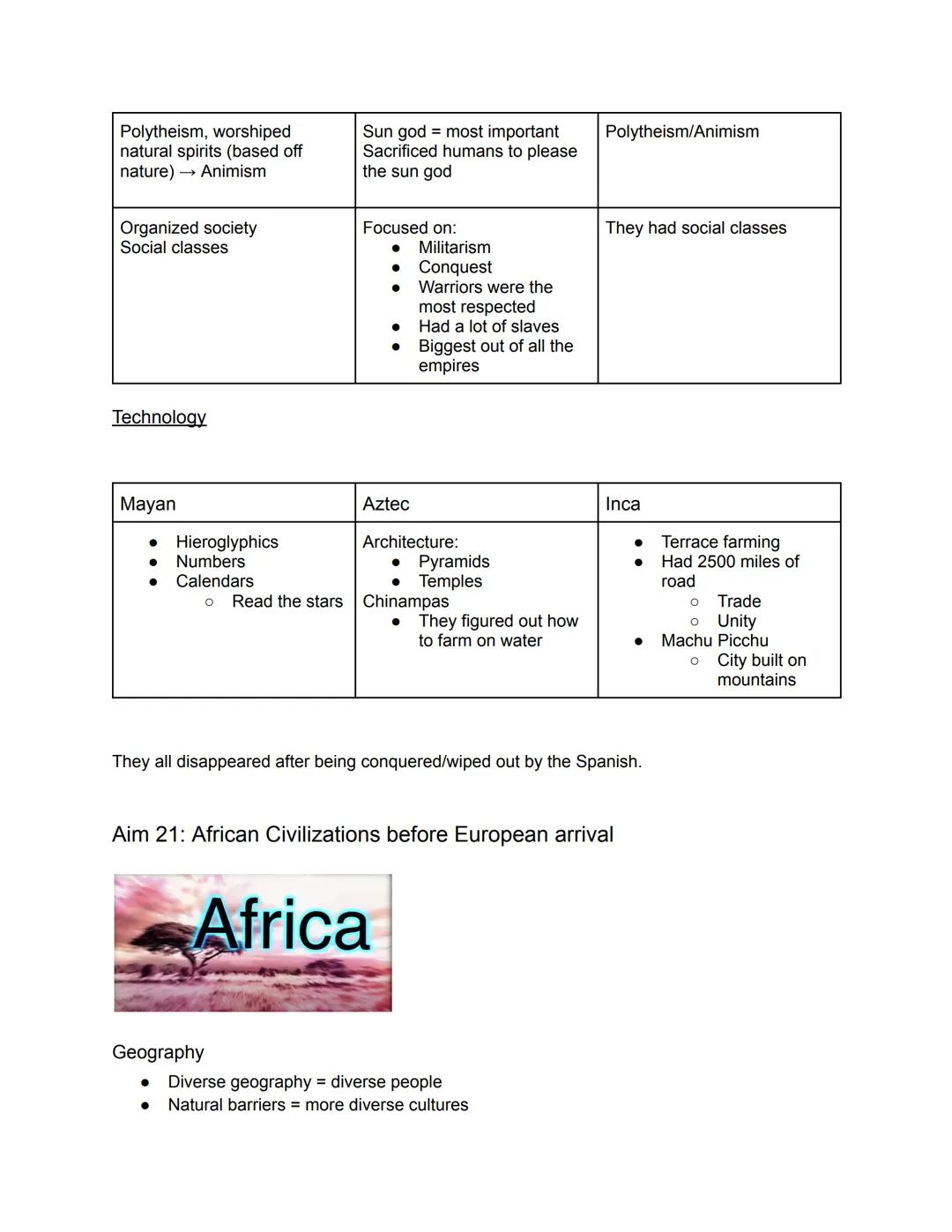
Native American civilizations developed impressive technologies perfectly adapted to their environments. The Mayans created sophisticated hieroglyphics, mathematical systems, and accurate calendars based on astronomical observations.
The Aztecs excelled in architecture, building massive pyramids and temples. They invented chinampas - floating gardens that allowed farming on lake surfaces. Meanwhile, the Incas mastered terrace farming on steep mountain slopes and built an impressive 2,500-mile road system connecting their vast empire. Their engineering skills are still visible at Machu Picchu, the mountaintop city.
Across the Atlantic, Africa developed diverse civilizations shaped by varied geography. The continent's natural barriers (deserts, forests, mountains) created distinct cultural regions. Africa's geography included:
💡 The impressive Inca road system stretched nearly the distance from New York to Los Angeles, connecting their empire through some of the world's most challenging mountain terrain. This engineering feat helped unify their diverse territories.
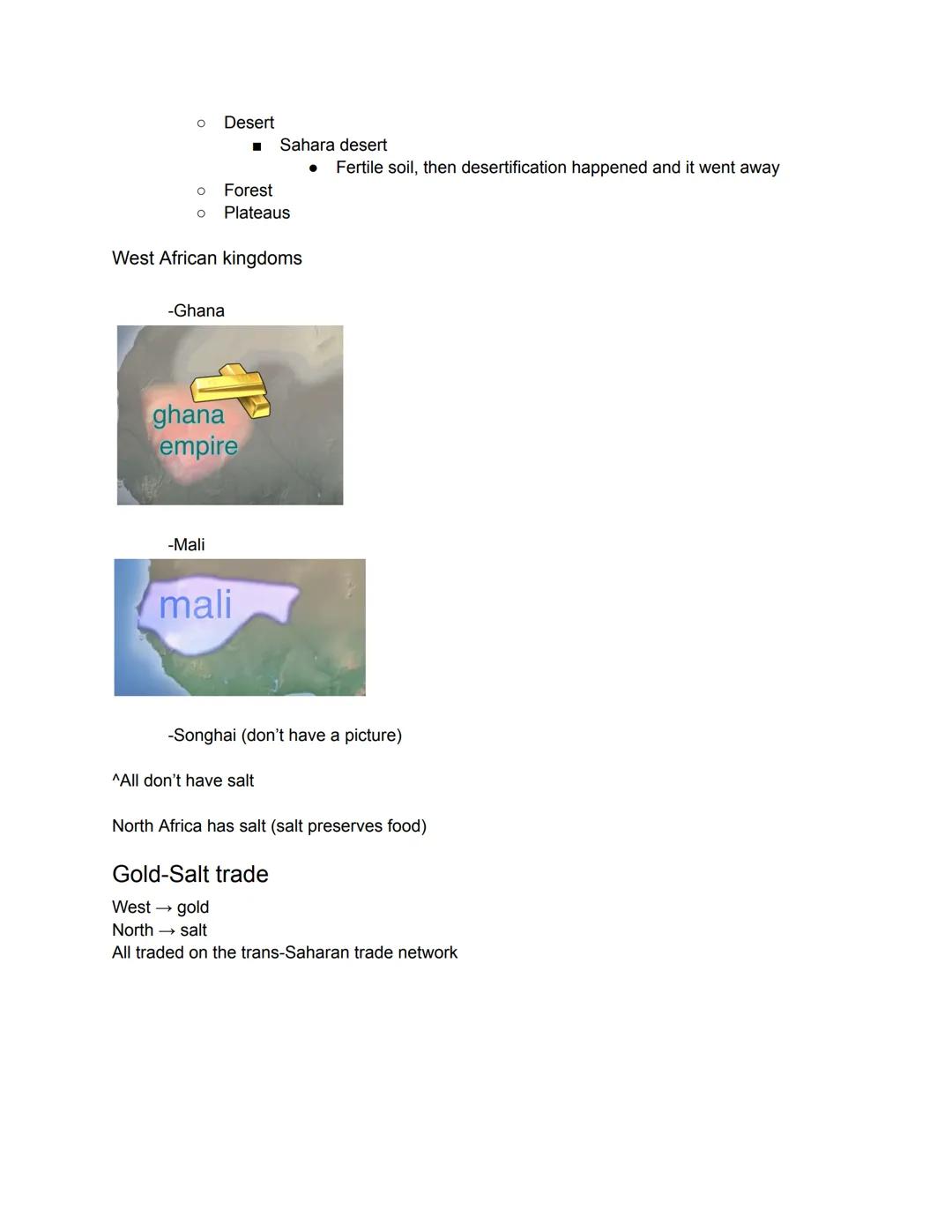
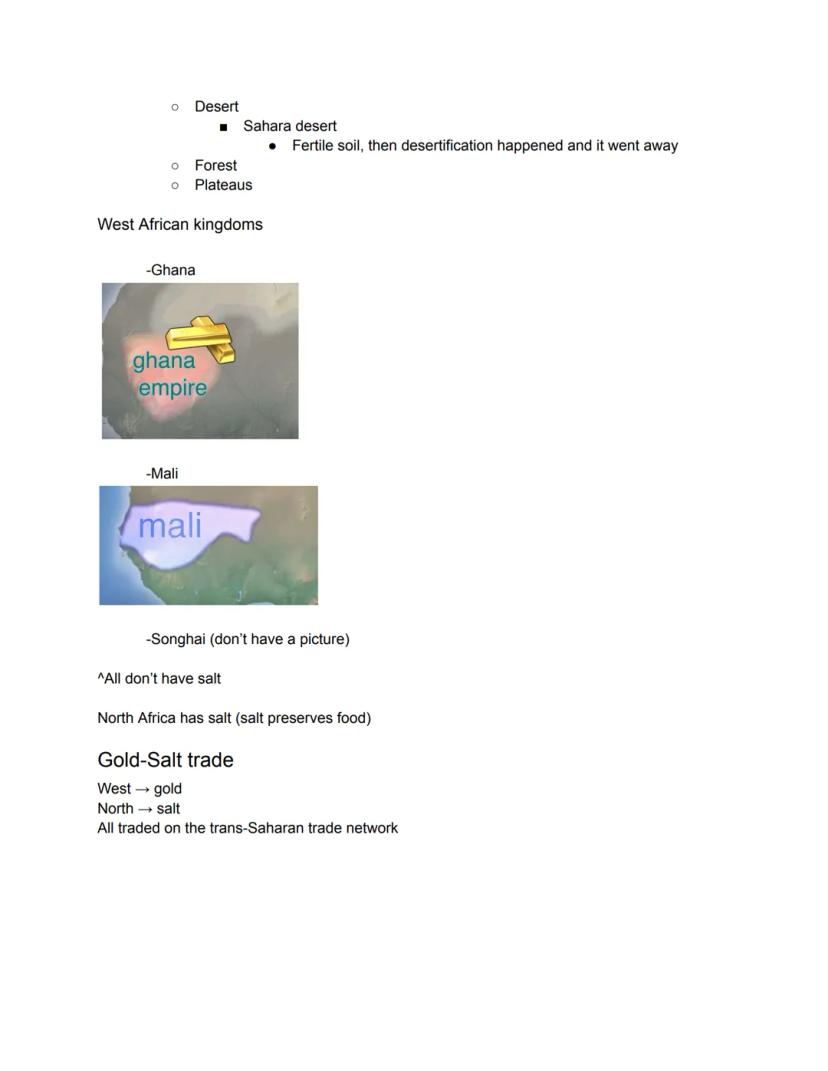
West Africa developed powerful kingdoms built on trade networks that connected different regions. The kingdoms of Ghana, Mali, and Songhai controlled valuable resources that made them wealthy and influential.
The key to their success was the Gold-Salt trade. West African kingdoms had gold but lacked salt (essential for preserving food in hot climates). North Africans had plenty of salt but needed gold. This perfect trade balance created wealth on both sides.
Goods moved along the trans-Saharan trade network - camel caravans crossing the desert carrying valuable items between regions. This dangerous journey was incredibly profitable for those who controlled key trading points.
The most famous West African ruler was Mansa Musa, the incredibly wealthy king of Mali. When he traveled to Mecca (after converting to Islam), he spent so much gold along the way that he caused inflation in Egypt! Under his rule, the city of Timbuktu became a center of learning where Arabic was spoken and scholars gathered.
💡 Mansa Musa is considered one of the wealthiest people in history. His pilgrimage to Mecca was so lavish that medieval maps of Africa often featured him sitting on a throne holding a gold nugget!

Beyond the western kingdoms, other powerful African civilizations flourished. The Axum Empire controlled strategic trading positions along the Red Sea and Mediterranean, becoming wealthy through commerce.
African societies maintained their histories through griots - specialized storytellers who passed down cultural knowledge orally through generations. Tribal and clan connections formed the foundation of many African societies.
African religious practices often centered around animism - belief in spirits connected to nature. Their art, especially ceremonial masks, expressed these spiritual connections and were used in important rituals and warfare.
Meanwhile, by the 1400s, Europeans began looking beyond their borders. What drove them to explore unknown oceans? Five major motives pushed European exploration:
💡 African masks weren't just art - they served important spiritual and social functions. People believed wearing these masks in ceremonies could connect them directly to ancestor spirits or important natural forces.
Our AI companion is specifically built for the needs of students. Based on the millions of content pieces we have on the platform we can provide truly meaningful and relevant answers to students. But its not only about answers, the companion is even more about guiding students through their daily learning challenges, with personalised study plans, quizzes or content pieces in the chat and 100% personalisation based on the students skills and developments.
You can download the app in the Google Play Store and in the Apple App Store.
That's right! Enjoy free access to study content, connect with fellow students, and get instant help – all at your fingertips.
App Store
Google Play
The app is very easy to use and well designed. I have found everything I was looking for so far and have been able to learn a lot from the presentations! I will definitely use the app for a class assignment! And of course it also helps a lot as an inspiration.
Stefan S
iOS user
This app is really great. There are so many study notes and help [...]. My problem subject is French, for example, and the app has so many options for help. Thanks to this app, I have improved my French. I would recommend it to anyone.
Samantha Klich
Android user
Wow, I am really amazed. I just tried the app because I've seen it advertised many times and was absolutely stunned. This app is THE HELP you want for school and above all, it offers so many things, such as workouts and fact sheets, which have been VERY helpful to me personally.
Anna
iOS user
I think it’s very much worth it and you’ll end up using it a lot once you get the hang of it and even after looking at others notes you can still ask your Artificial intelligence buddy the question and ask to simplify it if you still don’t get it!!! In the end I think it’s worth it 😊👍 ⚠️Also DID I MENTION ITS FREEE YOU DON’T HAVE TO PAY FOR ANYTHING AND STILL GET YOUR GRADES IN PERFECTLY❗️❗️⚠️
Thomas R
iOS user
Knowunity is the BEST app I’ve used in a minute. This is not an ai review or anything this is genuinely coming from a 7th grade student (I know 2011 im young) but dude this app is a 10/10 i have maintained a 3.8 gpa and have plenty of time for gaming. I love it and my mom is just happy I got good grades
Brad T
Android user
Not only did it help me find the answer but it also showed me alternative ways to solve it. I was horrible in math and science but now I have an a in both subjects. Thanks for the help🤍🤍
David K
iOS user
The app's just great! All I have to do is enter the topic in the search bar and I get the response real fast. I don't have to watch 10 YouTube videos to understand something, so I'm saving my time. Highly recommended!
Sudenaz Ocak
Android user
In school I was really bad at maths but thanks to the app, I am doing better now. I am so grateful that you made the app.
Greenlight Bonnie
Android user
I found this app a couple years ago and it has only gotten better since then. I really love it because it can help with written questions and photo questions. Also, it can find study guides that other people have made as well as flashcard sets and practice tests. The free version is also amazing for students who might not be able to afford it. Would 100% recommend
Aubrey
iOS user
Best app if you're in Highschool or Junior high. I have been using this app for 2 school years and it's the best, it's good if you don't have anyone to help you with school work.😋🩷🎀
Marco B
iOS user
THE QUIZES AND FLASHCARDS ARE SO USEFUL AND I LOVE THE SCHOOLGPT. IT ALSO IS LITREALLY LIKE CHATGPT BUT SMARTER!! HELPED ME WITH MY MASCARA PROBLEMS TOO!! AS WELL AS MY REAL SUBJECTS ! DUHHH 😍😁😲🤑💗✨🎀😮
Elisha
iOS user
This app is phenomenal down to the correct info and the various topics you can study! I greatly recommend it for people who struggle with procrastination and those who need homework help. It has been perfectly accurate for world 1 history as far as I’ve seen! Geometry too!
Paul T
iOS user
The app is very easy to use and well designed. I have found everything I was looking for so far and have been able to learn a lot from the presentations! I will definitely use the app for a class assignment! And of course it also helps a lot as an inspiration.
Stefan S
iOS user
This app is really great. There are so many study notes and help [...]. My problem subject is French, for example, and the app has so many options for help. Thanks to this app, I have improved my French. I would recommend it to anyone.
Samantha Klich
Android user
Wow, I am really amazed. I just tried the app because I've seen it advertised many times and was absolutely stunned. This app is THE HELP you want for school and above all, it offers so many things, such as workouts and fact sheets, which have been VERY helpful to me personally.
Anna
iOS user
I think it’s very much worth it and you’ll end up using it a lot once you get the hang of it and even after looking at others notes you can still ask your Artificial intelligence buddy the question and ask to simplify it if you still don’t get it!!! In the end I think it’s worth it 😊👍 ⚠️Also DID I MENTION ITS FREEE YOU DON’T HAVE TO PAY FOR ANYTHING AND STILL GET YOUR GRADES IN PERFECTLY❗️❗️⚠️
Thomas R
iOS user
Knowunity is the BEST app I’ve used in a minute. This is not an ai review or anything this is genuinely coming from a 7th grade student (I know 2011 im young) but dude this app is a 10/10 i have maintained a 3.8 gpa and have plenty of time for gaming. I love it and my mom is just happy I got good grades
Brad T
Android user
Not only did it help me find the answer but it also showed me alternative ways to solve it. I was horrible in math and science but now I have an a in both subjects. Thanks for the help🤍🤍
David K
iOS user
The app's just great! All I have to do is enter the topic in the search bar and I get the response real fast. I don't have to watch 10 YouTube videos to understand something, so I'm saving my time. Highly recommended!
Sudenaz Ocak
Android user
In school I was really bad at maths but thanks to the app, I am doing better now. I am so grateful that you made the app.
Greenlight Bonnie
Android user
I found this app a couple years ago and it has only gotten better since then. I really love it because it can help with written questions and photo questions. Also, it can find study guides that other people have made as well as flashcard sets and practice tests. The free version is also amazing for students who might not be able to afford it. Would 100% recommend
Aubrey
iOS user
Best app if you're in Highschool or Junior high. I have been using this app for 2 school years and it's the best, it's good if you don't have anyone to help you with school work.😋🩷🎀
Marco B
iOS user
THE QUIZES AND FLASHCARDS ARE SO USEFUL AND I LOVE THE SCHOOLGPT. IT ALSO IS LITREALLY LIKE CHATGPT BUT SMARTER!! HELPED ME WITH MY MASCARA PROBLEMS TOO!! AS WELL AS MY REAL SUBJECTS ! DUHHH 😍😁😲🤑💗✨🎀😮
Elisha
iOS user
This app is phenomenal down to the correct info and the various topics you can study! I greatly recommend it for people who struggle with procrastination and those who need homework help. It has been perfectly accurate for world 1 history as far as I’ve seen! Geometry too!
Paul T
iOS user
Violet C
@iolet_nucf6h9ab40z04
The Renaissance was a period of "rebirth" in Europe from the 1300s to 1500s that transformed society from the religion-focused Middle Ages into a world of curiosity, art, and questioning. During this time, exploration, religious reformation, and new ways of... Show more
Access to all documents
Improve your grades
Join milions of students
By signing up you accept Terms of Service and Privacy Policy
Ever wondered how Europe went from the Dark Ages to the modern world? The Renaissance (meaning "rebirth") was that bridge! From the 1300s to 1500s, Europe transformed as people began to question traditional ideas.
While the Church still controlled knowledge, people developed humanism - the study of human-related things rather than just religious matters. This led to individualism and secularism, allowing focus on poetry, literature, and non-religious topics. People embraced skepticism, questioning everything around them.
All these ideas were based on ancient Greco-Roman thinking. The Renaissance became a golden age of art, architecture, and economic success.
💡 The Renaissance began in Italy after the Black Plague devastated the population. Italians wanted to rebuild and recapture the greatness of ancient Rome that surrounded them.
This cultural explosion was possible because of Italy's wealth from Mediterranean trade and the Medici family of Florence, who sponsored artists and owned the city where the Renaissance began.
Access to all documents
Improve your grades
Join milions of students
By signing up you accept Terms of Service and Privacy Policy
Art completely transformed during the Renaissance! Artists made huge breakthroughs that still influence how we create today.
Renaissance painters discovered perspective (showing depth with foreground and background), creating more realistic images. Unlike the flat religious paintings before, Renaissance art featured detailed, lifelike human figures. The most famous Renaissance artists changed how we think about art forever:
Leonardo da Vinci was the ultimate "Renaissance man" - not just an artist but also an engineer and mathematician. His works like the Mona Lisa and The Last Supper remain world-famous masterpieces.
Raphael created the beautiful Madonna and Child and philosophical School of Athens, which represented deep thinking. Michelangelo gave us the incredible Sistine Chapel ceiling and the sculpture of David.
Architecture also transformed, abandoning the dark, gothic style of medieval times for designs inspired by ancient Romans. Buildings featured columns and pillars in bright, open spaces that celebrated human achievement.
💡 Renaissance artists were supported by wealthy patrons like the Medici family, who paid them to create works that would show off their wealth and culture.
Access to all documents
Improve your grades
Join milions of students
By signing up you accept Terms of Service and Privacy Policy
Renaissance writers changed what books were about and who could read them. Their work was humanistic, using everyday language (called "vernacular") that regular people understood, not just Latin. They wrote about life in this world rather than just salvation in the next.
Niccolo Machiavelli wrote The Prince, a guide for rulers (especially the Medici family) on how to control people effectively. His famous idea that "the ends justify the means" suggested that results matter more than how you achieve them. This taught people to respect and fear their leaders.
As the Renaissance spread to northern Europe, Shakespeare emerged in England, writing about universal human themes and emotions that still speak to us today. His work wasn't limited to religion but explored timeless aspects of human nature.
The printing revolution transformed knowledge forever. When Johann Gutenberg invented the printing press in 1440, books went from luxury items to mass-produced items regular people could afford. This spread ideas faster than ever before.
💡 Before printing, a single book might take a year to copy by hand and cost as much as a house! The printing press made books affordable and led to questioning of authority that eventually sparked the Protestant Reformation.
Access to all documents
Improve your grades
Join milions of students
By signing up you accept Terms of Service and Privacy Policy
Have you ever wondered how Christianity split into so many different groups? It all started with the Protestant Reformation in 1517!
Before the Reformation, the Catholic Church controlled almost everything - money, religion, and knowledge. The Pope wielded enormous power throughout Europe. However, as printing spread knowledge to ordinary people, many began to see corruption in the Church.
The Church had several problems that angered people. The Pope started wars (not his job), sold indulgences (pardons for sins) to raise money, and punished anyone who disagreed with Church teachings.
Martin Luther, a German monk, finally spoke up against these practices in 1517. Growing up with Renaissance ideas of humanism and skepticism, Luther wasn't afraid to question authority.
💡 Indulgences were basically "get out of hell" certificates that the Church sold to raise money. The Church convinced people they could buy salvation for themselves or dead relatives - a practice that outraged reformers like Luther.
Access to all documents
Improve your grades
Join milions of students
By signing up you accept Terms of Service and Privacy Policy
Martin Luther's famous 95 Theses launched the Protestant Reformation and forever changed Christianity. These 95 arguments against Church practices questioned the Pope's power, arguing that all Christians should be equal.
Luther's radical ideas included:
At first, Luther simply hung these arguments on church doors, but thanks to the printing press, they spread rapidly throughout Europe. Suddenly everyone was debating Church authority!
The results were dramatic. Christianity split into many different sects as religious unity collapsed across Europe. About half of European Christians became Protestants (those who "protested" against the Catholic Church). They still considered themselves Christians but:
💡 The Protestant Reformation wasn't just about religion - it completely changed the balance of power in Europe, weakening the Catholic Church's control over politics and knowledge.
Access to all documents
Improve your grades
Join milions of students
By signing up you accept Terms of Service and Privacy Policy
The Protestant Reformation sparked intense religious passion - sometimes with dangerous results. Many groups were persecuted, especially witches. During this time, people blamed witchcraft for everything from bad harvests to illness, leading to witch hunts and executions.
New Christian groups appeared across Europe, including Calvinists, Lutherans, and the Anglican Church. The Anglican Church started when England's King Henry VIII wanted a divorce that the Pope wouldn't grant. His solution? Create his own church where he made the rules!
This led to a complicated family tree in England:
The Catholic Church finally realized it needed to reform or lose everyone. They:
💡 Religious divisions created during the Reformation still exist today! The Protestant churches that formed then evolved into many of the denominations we now know, including Lutherans, Anglicans (Episcopalians in America), and others.
Access to all documents
Improve your grades
Join milions of students
By signing up you accept Terms of Service and Privacy Policy
Long before Europeans arrived in the Americas, advanced civilizations thrived across the continents. Native Americans likely reached the Americas by crossing a land bridge connecting Russia to North America, which later disappeared when sea levels rose.
Three major empires dominated different regions:
Maya (Mayans) in Central America built complex societies with advanced mathematics, calendars, and writing systems. They practiced polytheism, worshiping many gods connected to nature (animism).
Aztecs controlled much of Mexico with a highly organized society divided into clear social classes. Their religion centered on the sun god, to whom they offered human sacrifices. Aztec society was militaristic, valuing warriors and conquest above all else.
Incas built a massive empire along the Andes mountains in South America. Like the Maya and Aztecs, they developed sophisticated agricultural techniques and organized their society into distinct classes.
💡 All three of these powerful civilizations had something in common that would prove fatal: they had never been exposed to European diseases and had no immunity when explorers arrived.
Access to all documents
Improve your grades
Join milions of students
By signing up you accept Terms of Service and Privacy Policy
Native American civilizations developed impressive technologies perfectly adapted to their environments. The Mayans created sophisticated hieroglyphics, mathematical systems, and accurate calendars based on astronomical observations.
The Aztecs excelled in architecture, building massive pyramids and temples. They invented chinampas - floating gardens that allowed farming on lake surfaces. Meanwhile, the Incas mastered terrace farming on steep mountain slopes and built an impressive 2,500-mile road system connecting their vast empire. Their engineering skills are still visible at Machu Picchu, the mountaintop city.
Across the Atlantic, Africa developed diverse civilizations shaped by varied geography. The continent's natural barriers (deserts, forests, mountains) created distinct cultural regions. Africa's geography included:
💡 The impressive Inca road system stretched nearly the distance from New York to Los Angeles, connecting their empire through some of the world's most challenging mountain terrain. This engineering feat helped unify their diverse territories.
Access to all documents
Improve your grades
Join milions of students
By signing up you accept Terms of Service and Privacy Policy
West Africa developed powerful kingdoms built on trade networks that connected different regions. The kingdoms of Ghana, Mali, and Songhai controlled valuable resources that made them wealthy and influential.
The key to their success was the Gold-Salt trade. West African kingdoms had gold but lacked salt (essential for preserving food in hot climates). North Africans had plenty of salt but needed gold. This perfect trade balance created wealth on both sides.
Goods moved along the trans-Saharan trade network - camel caravans crossing the desert carrying valuable items between regions. This dangerous journey was incredibly profitable for those who controlled key trading points.
The most famous West African ruler was Mansa Musa, the incredibly wealthy king of Mali. When he traveled to Mecca (after converting to Islam), he spent so much gold along the way that he caused inflation in Egypt! Under his rule, the city of Timbuktu became a center of learning where Arabic was spoken and scholars gathered.
💡 Mansa Musa is considered one of the wealthiest people in history. His pilgrimage to Mecca was so lavish that medieval maps of Africa often featured him sitting on a throne holding a gold nugget!
Access to all documents
Improve your grades
Join milions of students
By signing up you accept Terms of Service and Privacy Policy
Beyond the western kingdoms, other powerful African civilizations flourished. The Axum Empire controlled strategic trading positions along the Red Sea and Mediterranean, becoming wealthy through commerce.
African societies maintained their histories through griots - specialized storytellers who passed down cultural knowledge orally through generations. Tribal and clan connections formed the foundation of many African societies.
African religious practices often centered around animism - belief in spirits connected to nature. Their art, especially ceremonial masks, expressed these spiritual connections and were used in important rituals and warfare.
Meanwhile, by the 1400s, Europeans began looking beyond their borders. What drove them to explore unknown oceans? Five major motives pushed European exploration:
💡 African masks weren't just art - they served important spiritual and social functions. People believed wearing these masks in ceremonies could connect them directly to ancestor spirits or important natural forces.
Our AI companion is specifically built for the needs of students. Based on the millions of content pieces we have on the platform we can provide truly meaningful and relevant answers to students. But its not only about answers, the companion is even more about guiding students through their daily learning challenges, with personalised study plans, quizzes or content pieces in the chat and 100% personalisation based on the students skills and developments.
You can download the app in the Google Play Store and in the Apple App Store.
That's right! Enjoy free access to study content, connect with fellow students, and get instant help – all at your fingertips.
0
Smart Tools NEW
Transform this note into: ✓ 50+ Practice Questions ✓ Interactive Flashcards ✓ Full Mock Exam ✓ Essay Outlines
App Store
Google Play
The app is very easy to use and well designed. I have found everything I was looking for so far and have been able to learn a lot from the presentations! I will definitely use the app for a class assignment! And of course it also helps a lot as an inspiration.
Stefan S
iOS user
This app is really great. There are so many study notes and help [...]. My problem subject is French, for example, and the app has so many options for help. Thanks to this app, I have improved my French. I would recommend it to anyone.
Samantha Klich
Android user
Wow, I am really amazed. I just tried the app because I've seen it advertised many times and was absolutely stunned. This app is THE HELP you want for school and above all, it offers so many things, such as workouts and fact sheets, which have been VERY helpful to me personally.
Anna
iOS user
I think it’s very much worth it and you’ll end up using it a lot once you get the hang of it and even after looking at others notes you can still ask your Artificial intelligence buddy the question and ask to simplify it if you still don’t get it!!! In the end I think it’s worth it 😊👍 ⚠️Also DID I MENTION ITS FREEE YOU DON’T HAVE TO PAY FOR ANYTHING AND STILL GET YOUR GRADES IN PERFECTLY❗️❗️⚠️
Thomas R
iOS user
Knowunity is the BEST app I’ve used in a minute. This is not an ai review or anything this is genuinely coming from a 7th grade student (I know 2011 im young) but dude this app is a 10/10 i have maintained a 3.8 gpa and have plenty of time for gaming. I love it and my mom is just happy I got good grades
Brad T
Android user
Not only did it help me find the answer but it also showed me alternative ways to solve it. I was horrible in math and science but now I have an a in both subjects. Thanks for the help🤍🤍
David K
iOS user
The app's just great! All I have to do is enter the topic in the search bar and I get the response real fast. I don't have to watch 10 YouTube videos to understand something, so I'm saving my time. Highly recommended!
Sudenaz Ocak
Android user
In school I was really bad at maths but thanks to the app, I am doing better now. I am so grateful that you made the app.
Greenlight Bonnie
Android user
I found this app a couple years ago and it has only gotten better since then. I really love it because it can help with written questions and photo questions. Also, it can find study guides that other people have made as well as flashcard sets and practice tests. The free version is also amazing for students who might not be able to afford it. Would 100% recommend
Aubrey
iOS user
Best app if you're in Highschool or Junior high. I have been using this app for 2 school years and it's the best, it's good if you don't have anyone to help you with school work.😋🩷🎀
Marco B
iOS user
THE QUIZES AND FLASHCARDS ARE SO USEFUL AND I LOVE THE SCHOOLGPT. IT ALSO IS LITREALLY LIKE CHATGPT BUT SMARTER!! HELPED ME WITH MY MASCARA PROBLEMS TOO!! AS WELL AS MY REAL SUBJECTS ! DUHHH 😍😁😲🤑💗✨🎀😮
Elisha
iOS user
This app is phenomenal down to the correct info and the various topics you can study! I greatly recommend it for people who struggle with procrastination and those who need homework help. It has been perfectly accurate for world 1 history as far as I’ve seen! Geometry too!
Paul T
iOS user
The app is very easy to use and well designed. I have found everything I was looking for so far and have been able to learn a lot from the presentations! I will definitely use the app for a class assignment! And of course it also helps a lot as an inspiration.
Stefan S
iOS user
This app is really great. There are so many study notes and help [...]. My problem subject is French, for example, and the app has so many options for help. Thanks to this app, I have improved my French. I would recommend it to anyone.
Samantha Klich
Android user
Wow, I am really amazed. I just tried the app because I've seen it advertised many times and was absolutely stunned. This app is THE HELP you want for school and above all, it offers so many things, such as workouts and fact sheets, which have been VERY helpful to me personally.
Anna
iOS user
I think it’s very much worth it and you’ll end up using it a lot once you get the hang of it and even after looking at others notes you can still ask your Artificial intelligence buddy the question and ask to simplify it if you still don’t get it!!! In the end I think it’s worth it 😊👍 ⚠️Also DID I MENTION ITS FREEE YOU DON’T HAVE TO PAY FOR ANYTHING AND STILL GET YOUR GRADES IN PERFECTLY❗️❗️⚠️
Thomas R
iOS user
Knowunity is the BEST app I’ve used in a minute. This is not an ai review or anything this is genuinely coming from a 7th grade student (I know 2011 im young) but dude this app is a 10/10 i have maintained a 3.8 gpa and have plenty of time for gaming. I love it and my mom is just happy I got good grades
Brad T
Android user
Not only did it help me find the answer but it also showed me alternative ways to solve it. I was horrible in math and science but now I have an a in both subjects. Thanks for the help🤍🤍
David K
iOS user
The app's just great! All I have to do is enter the topic in the search bar and I get the response real fast. I don't have to watch 10 YouTube videos to understand something, so I'm saving my time. Highly recommended!
Sudenaz Ocak
Android user
In school I was really bad at maths but thanks to the app, I am doing better now. I am so grateful that you made the app.
Greenlight Bonnie
Android user
I found this app a couple years ago and it has only gotten better since then. I really love it because it can help with written questions and photo questions. Also, it can find study guides that other people have made as well as flashcard sets and practice tests. The free version is also amazing for students who might not be able to afford it. Would 100% recommend
Aubrey
iOS user
Best app if you're in Highschool or Junior high. I have been using this app for 2 school years and it's the best, it's good if you don't have anyone to help you with school work.😋🩷🎀
Marco B
iOS user
THE QUIZES AND FLASHCARDS ARE SO USEFUL AND I LOVE THE SCHOOLGPT. IT ALSO IS LITREALLY LIKE CHATGPT BUT SMARTER!! HELPED ME WITH MY MASCARA PROBLEMS TOO!! AS WELL AS MY REAL SUBJECTS ! DUHHH 😍😁😲🤑💗✨🎀😮
Elisha
iOS user
This app is phenomenal down to the correct info and the various topics you can study! I greatly recommend it for people who struggle with procrastination and those who need homework help. It has been perfectly accurate for world 1 history as far as I’ve seen! Geometry too!
Paul T
iOS user