
Want to understand the rich tapestry of Filipino literature that... Show more
 21st Lit
 Science
 Econ
Econ Araling Panlipunan (AP)
 Iba pa
 Practical Research
 DISS
DISSSign up to see the contentIt's free!
Access to all documents
Improve your grades
Join milions of students
By signing up you accept Terms of Service and Privacy Policy

Biology

Chemistry
AP Chemistry

English
AP English Literature
742
•
Dec 8, 2025
•
Reigh<3
@reigh0fsunshine
Want to understand the rich tapestry of Filipino literature that... Show more
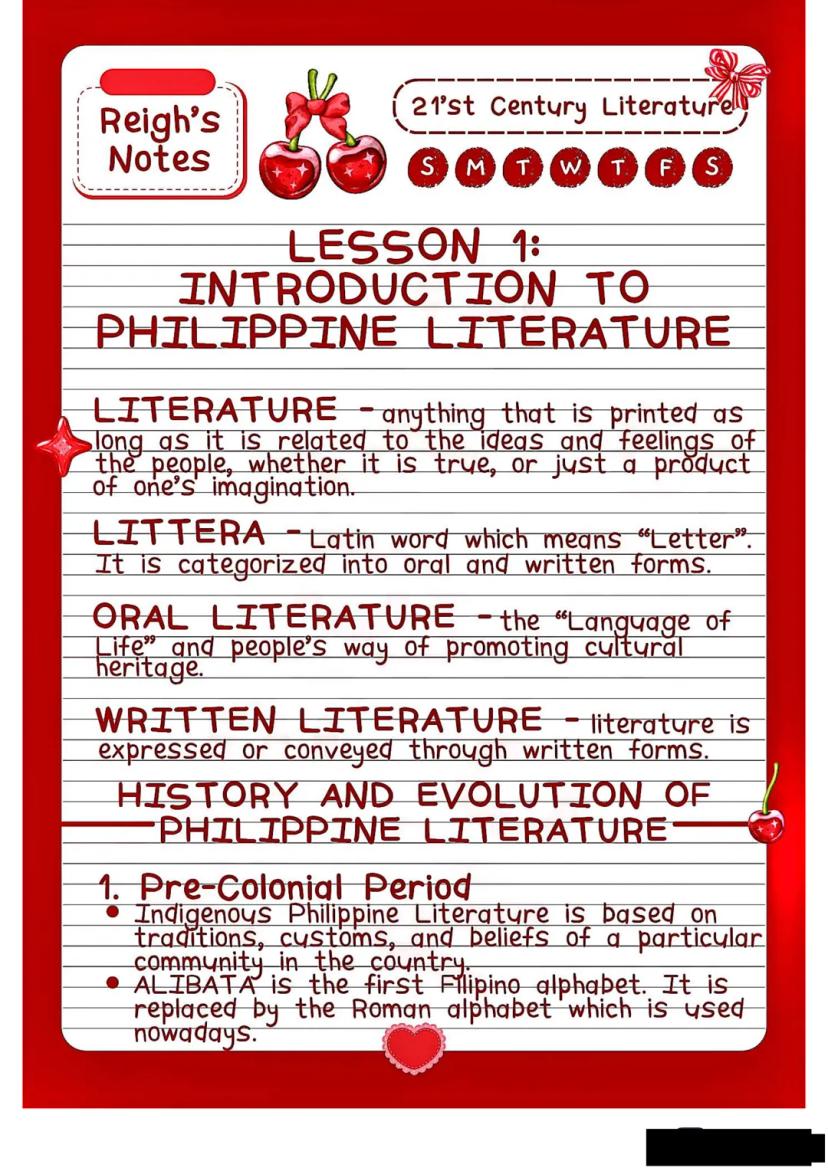
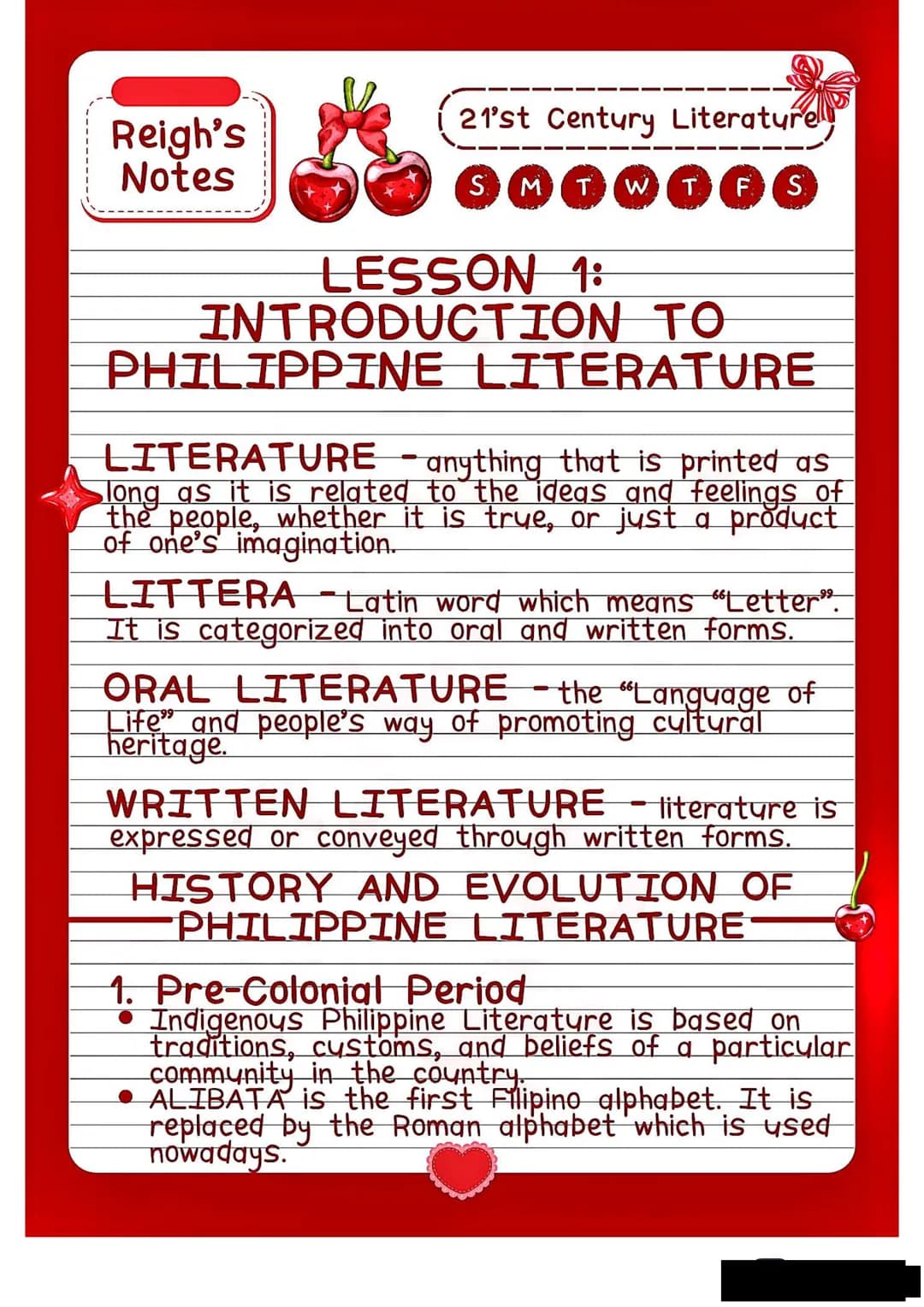
Ever wondered why your lola tells those fascinating stories or why certain phrases stick in your mind? Literature is basically anything printed that connects to people's ideas and feelings - whether real or imagined. The word comes from the Latin "littera" meaning "letter."
Philippine literature comes in two main forms. Oral literature serves as the "language of life," helping communities pass down their cultural heritage through spoken word. Written literature expresses ideas through written forms, preserving our thoughts and stories for future generations.
Our literary journey begins in the Pre-Colonial Period when indigenous communities created literature based on their unique traditions, customs, and beliefs. Back then, Filipinos used Alibata as their first alphabet before the Spanish introduced the Roman alphabet we use today.
Quick Tip: Think of literature as a time machine - it shows us how Filipinos thought, felt, and lived throughout different periods in history!
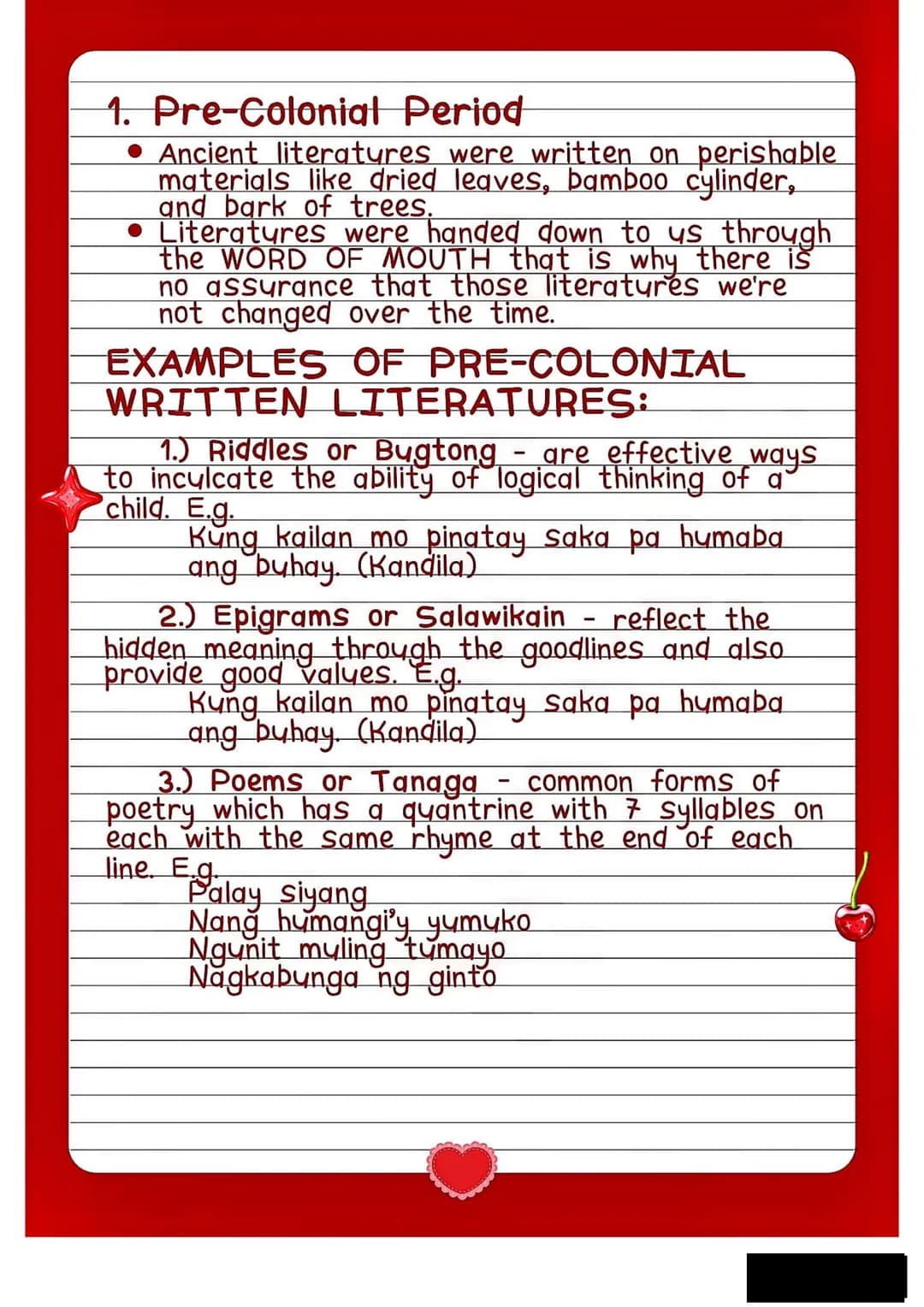
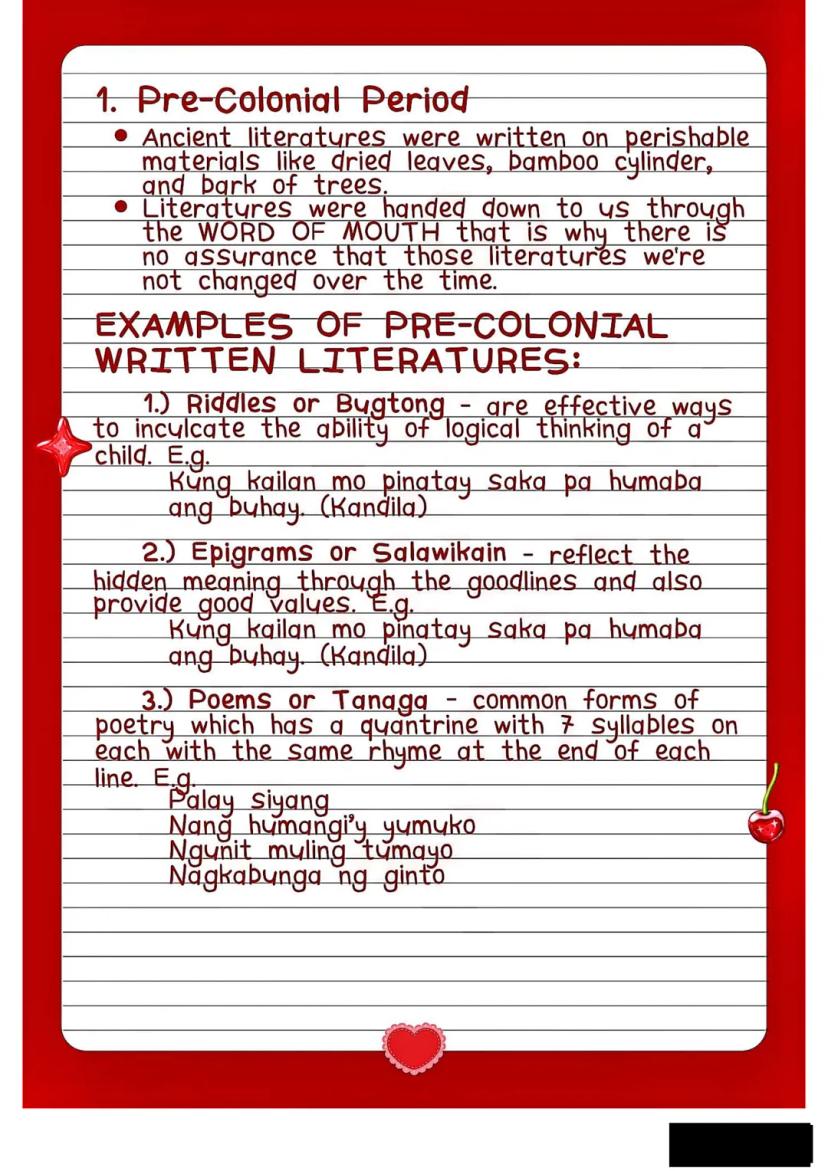
Before colonizers arrived, our ancestors were already creating amazing literature! They wrote on perishable materials like dried leaves, bamboo cylinders, and tree bark. Since these materials didn't last long, most literature survived through word of mouth, though this means some stories might have changed over time.
Written forms included clever riddles (bugtong) that helped kids think logically - like "Kung kailan mo pinatay saka pa humaba ang buhay" (candle). Epigrams (salawikain) taught good values through wise sayings, while poems (tanaga) followed a strict pattern of four lines with seven syllables each and matching rhymes.
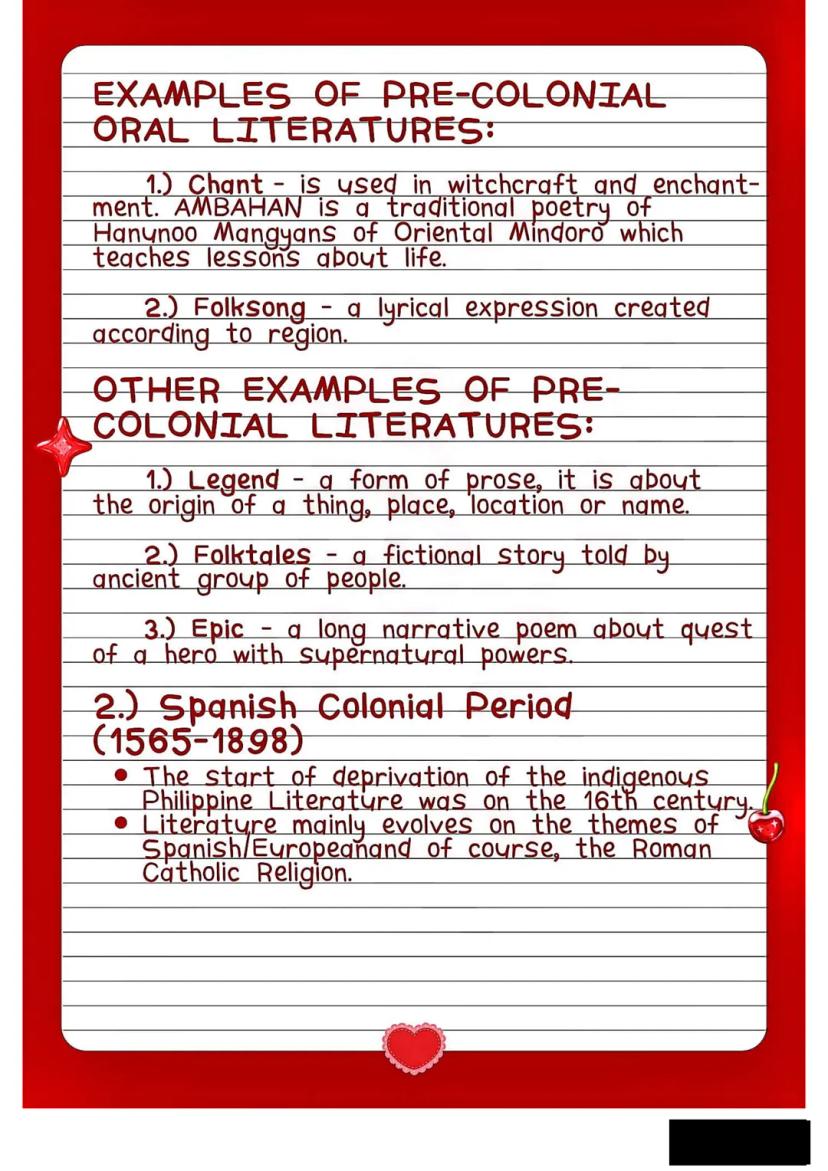
Oral literature was equally rich. Chants were used in rituals, with Ambahan being traditional Mangyan poetry teaching life lessons. Folksongs expressed regional emotions and experiences, creating a musical map of our diverse islands.
Fun Fact: The Ambahan poetry of Hanunuo Mangyans is still alive today, proving how powerful oral tradition can be in preserving culture!
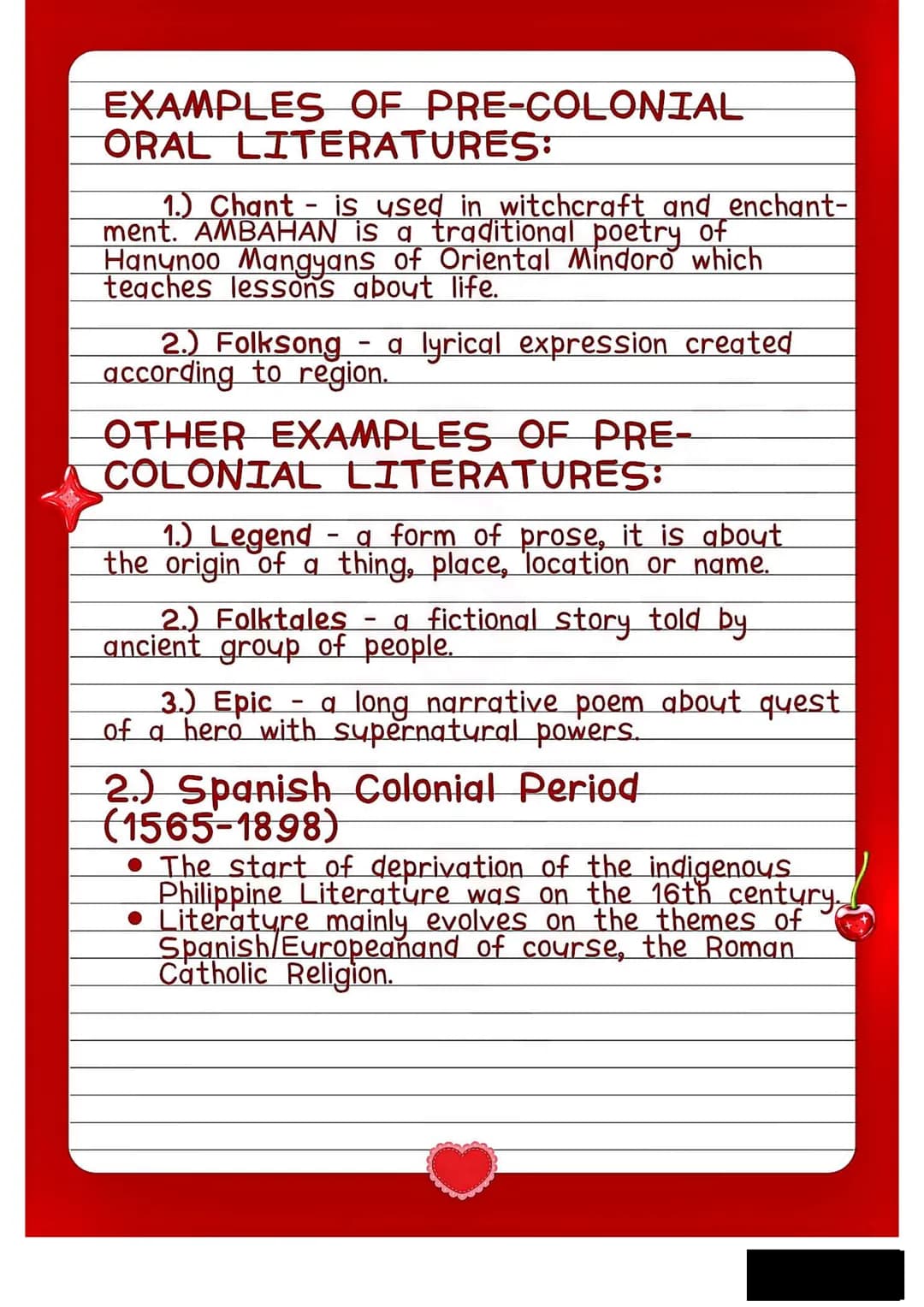
Our ancestors also created legends explaining how places got their names, folktales sharing fictional stories with moral lessons, and epics - long poems about heroes with supernatural powers. These stories formed the backbone of Filipino storytelling traditions.
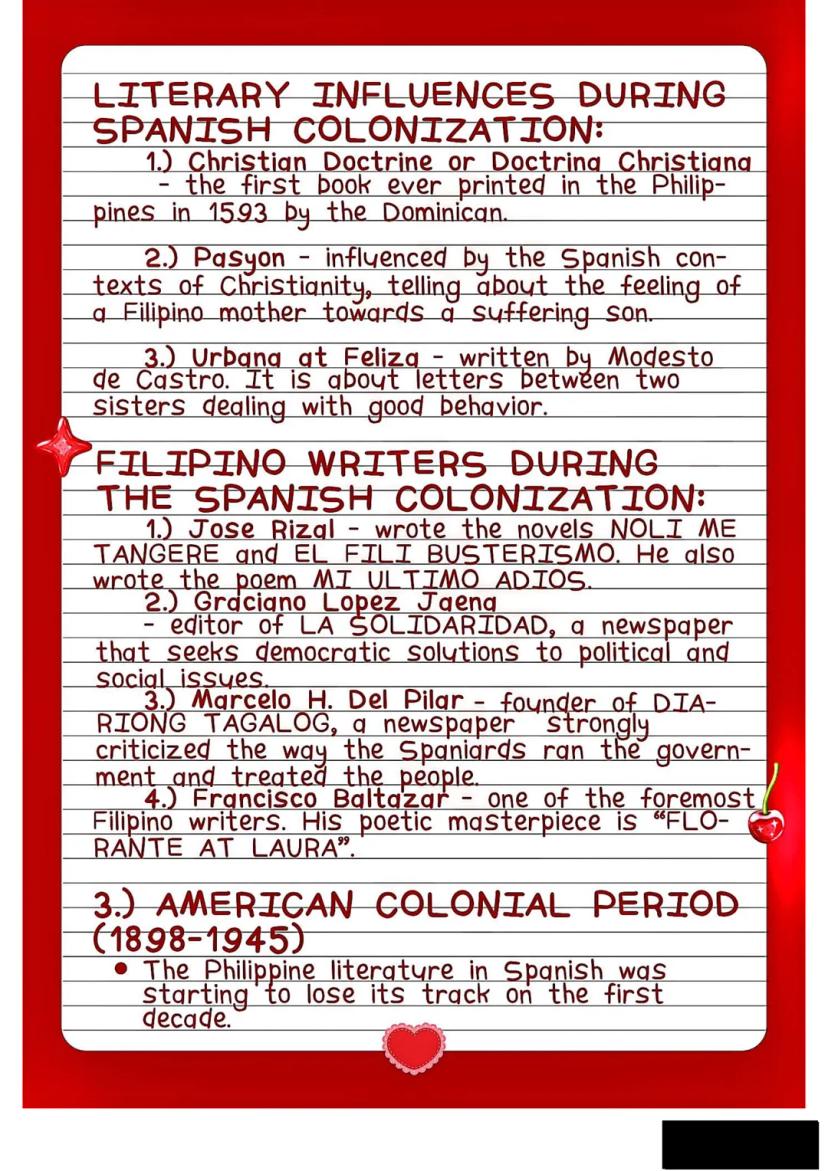
Everything changed during the Spanish Colonial Period (1565-1898). The 16th century marked the beginning of indigenous literature's decline as Spanish and Roman Catholic themes dominated. This period introduced new literary forms but also suppressed many traditional Filipino stories.
The Spanish brought religious literature like Doctrina Christiana - the first book printed in the Philippines in 1593. Pasyon told stories of Christian suffering that resonated with Filipino mothers, while Urbana at Feliza taught proper behavior through letters between sisters.
Remember: While Spanish colonization introduced new literary forms, it also marked the beginning of our struggle to preserve authentic Filipino voices in literature.
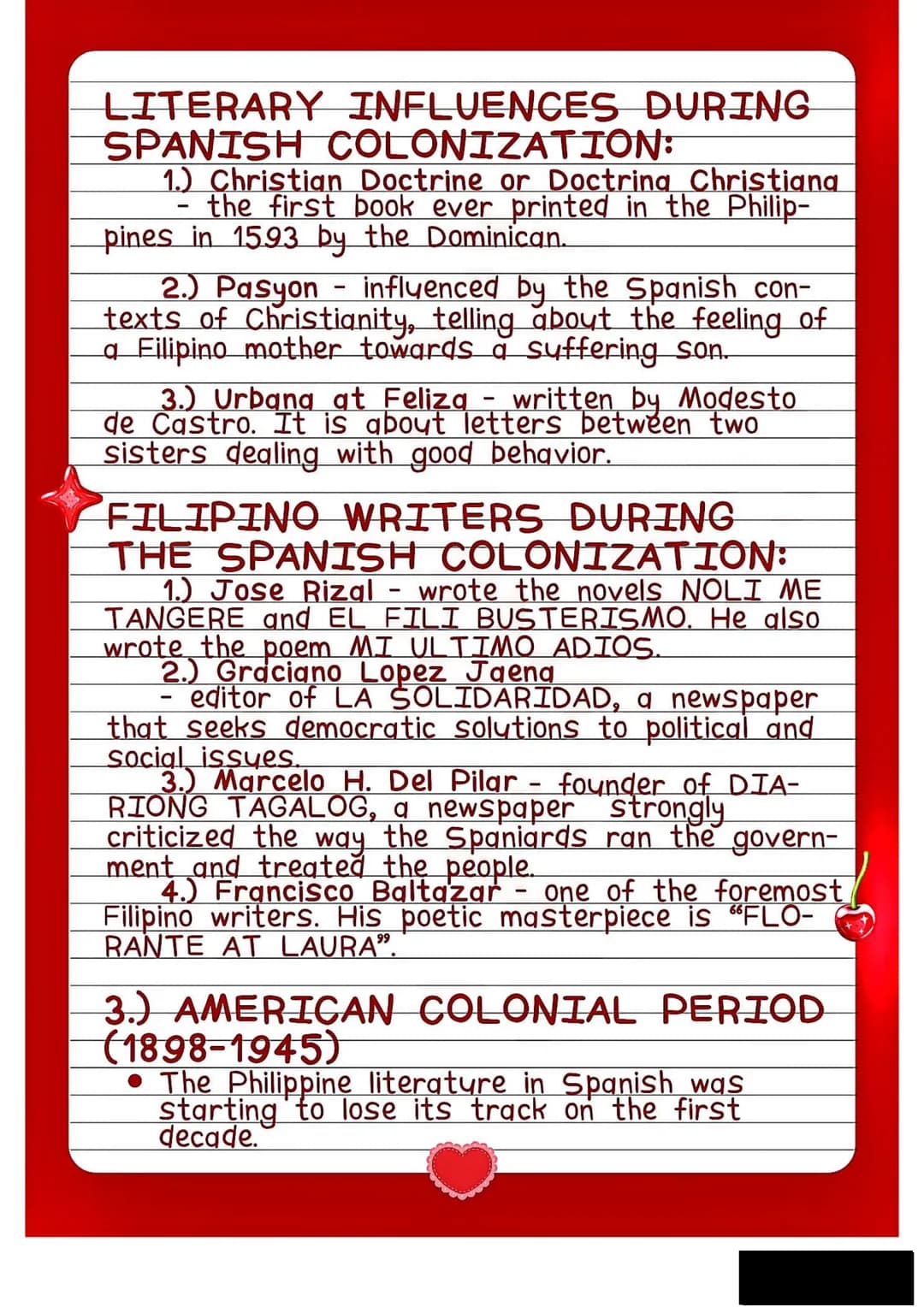
During Spanish rule, brave Filipino writers used literature to fight for freedom and express national identity. Jose Rizal stands out as our greatest literary hero, writing Noli Me Tangere and El Filibusterismo - novels that exposed Spanish abuses and sparked our revolution. His final poem Mi Ultimo Adios remains one of our most treasured pieces.
Graciano Lopez Jaena edited La Solidaridad, a newspaper seeking democratic solutions to political problems. Marcelo H. Del Pilar founded Diariong Tagalog, boldly criticizing Spanish government and treatment of Filipinos. These writers risked their lives for truth.
Francisco Baltazar gave us the poetic masterpiece "Florante at Laura," which remains a cornerstone of Filipino literature. These writers proved that the pen could be mightier than the sword in fighting oppression.
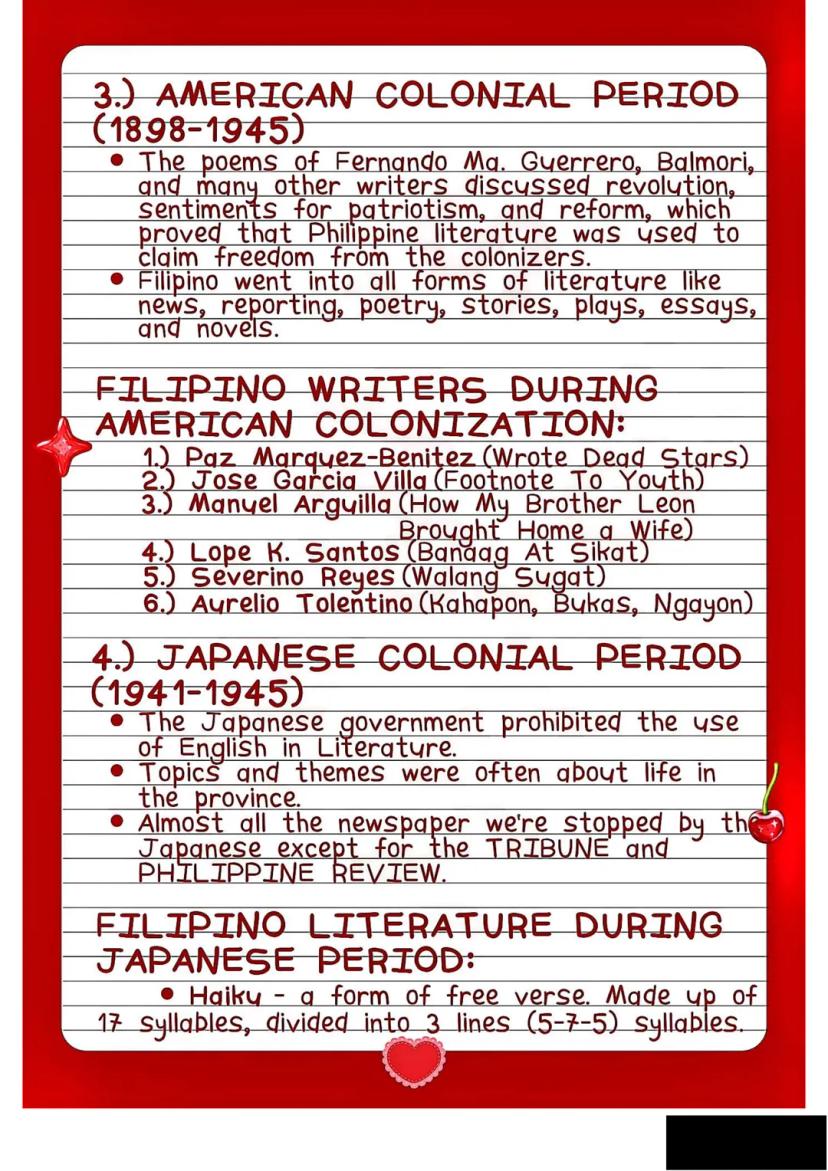
The American Colonial Period (1898-1945) began as Spanish literature lost influence. Writers like Fernando Ma. Guerrero used poetry to discuss revolution and patriotism, proving literature's power in claiming freedom.
Hero Highlight: Jose Rizal didn't just write novels - he used literature as a weapon against injustice, inspiring generations of freedom fighters!
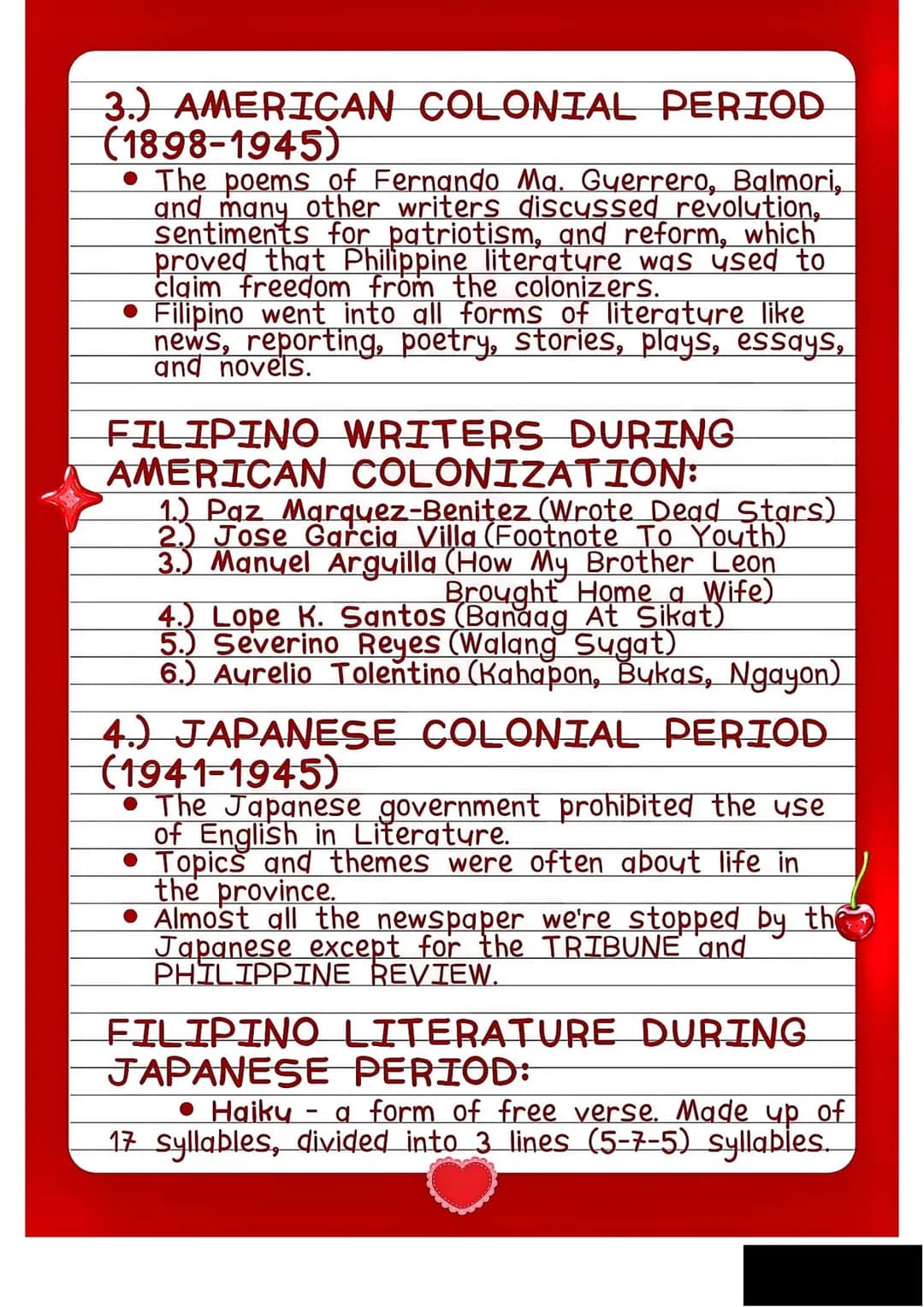
American colonization opened new literary doors as Filipinos explored news reporting, poetry, stories, plays, essays, and novels. This period produced literary giants whose works you might recognize: Paz Marquez-Benitez wrote "Dead Stars," Jose Garcia Villa penned "Footnote to Youth," and Manuel Arguilla created "How My Brother Leon Brought Home a Wife."
Writers like Lope K. Santos ("Banak At Sikat"), Severino Reyes ("Walang Sugat"), and Aurelio Tolentino ("Kahapon, Bukas, Ngayon") enriched Filipino literature with diverse themes and styles. American influence encouraged experimentation with different literary forms.
The Japanese Colonial Period (1941-1945) dramatically restricted literary freedom. The Japanese government banned English in literature and stopped most newspapers except Tribune and Philippine Review. Themes focused mainly on provincial life as writers navigated censorship.
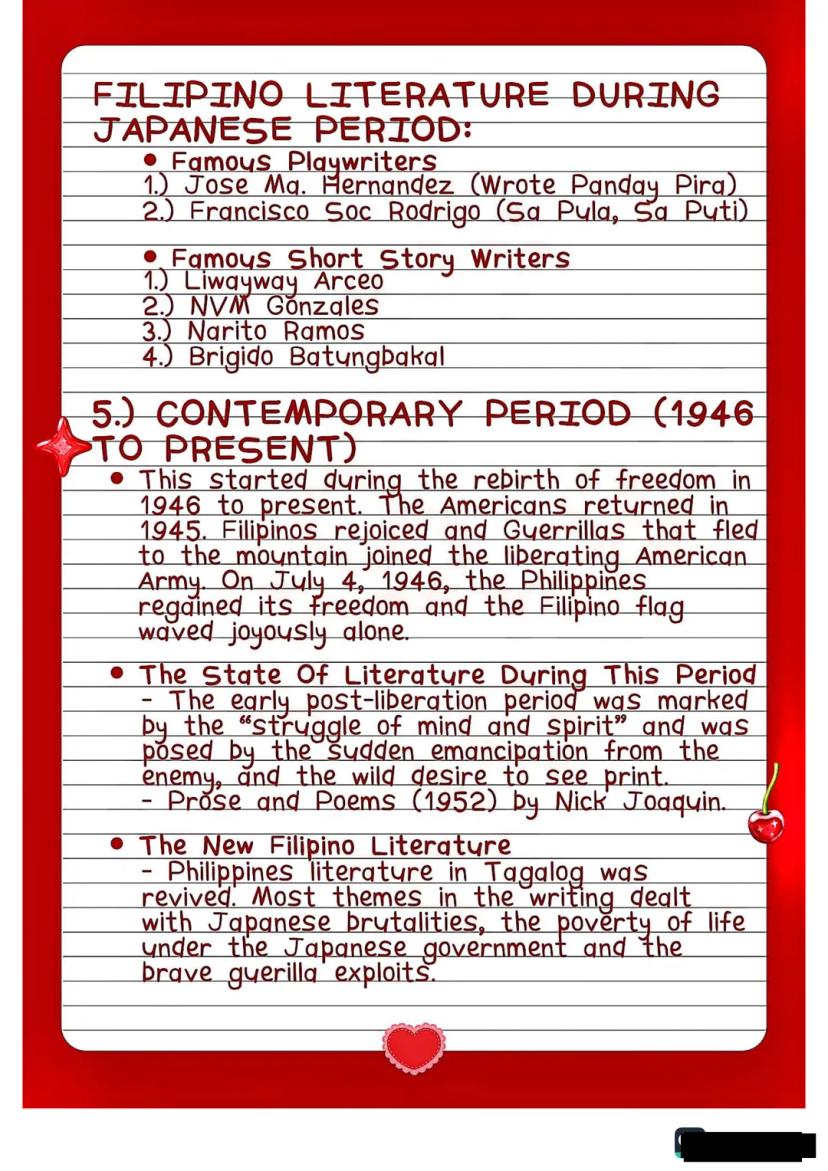
This period introduced Haiku - Japanese free verse poetry with 17 syllables arranged in three lines . Famous playwrights included Jose Ma. Hernandez ("Panday Pira") and Francisco Soc Rodrigo ("Sa Pula, Sa Puti"), while short story writers like NVM Gonzales and Liwayway Arceo kept Filipino storytelling alive.
Survival Story: Even under strict Japanese censorship, Filipino writers found creative ways to express themselves and preserve our literary traditions!
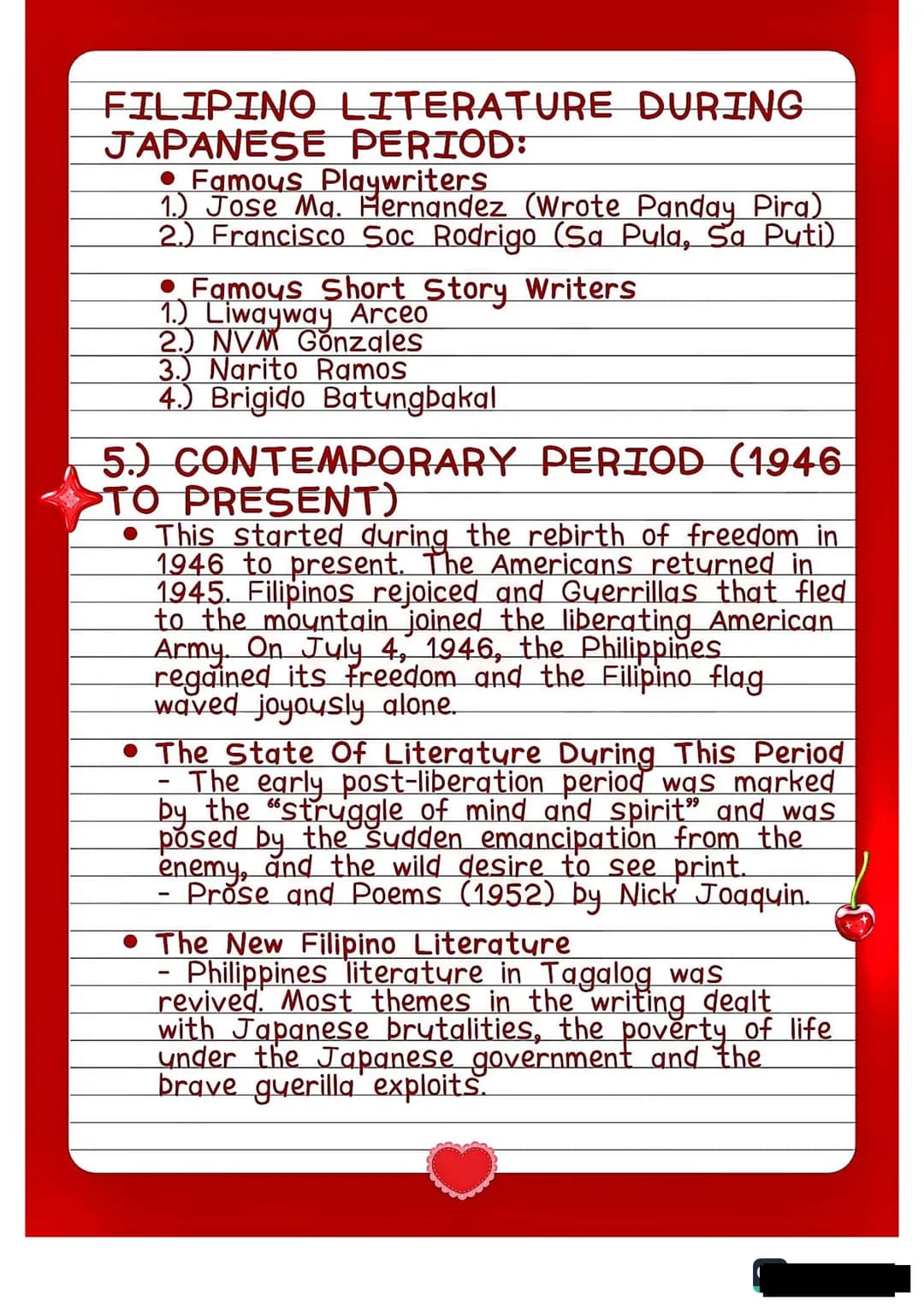
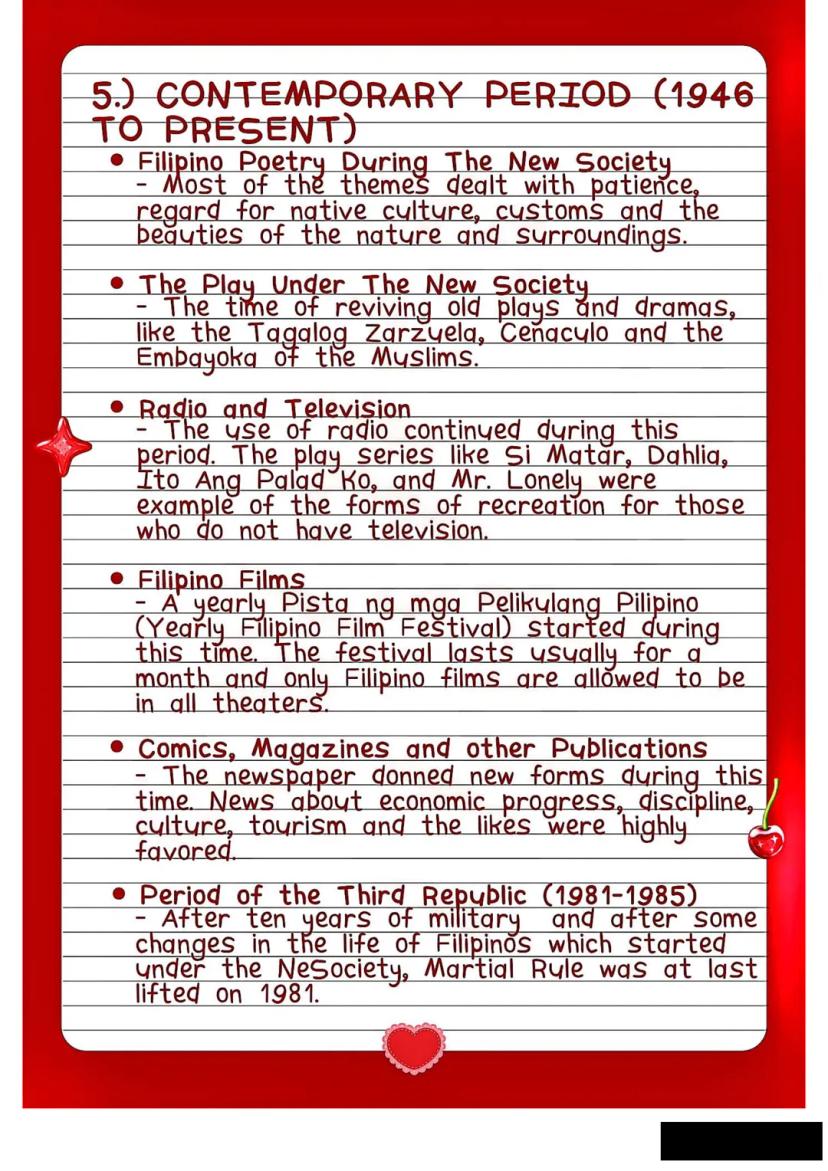
July 4, 1946 marked the beginning of the Contemporary Period as the Philippines regained freedom and the Filipino flag waved independently. The early post-liberation era saw a "struggle of mind and spirit" as writers eagerly returned to print, with works like Nick Joaquin's "Prose and Poems" (1952) leading the revival.
New Filipino Literature emerged with Tagalog literature experiencing a renaissance. Writers focused on Japanese brutalities, poverty under occupation, and heroic guerrilla exploits. This period marked the rebirth of authentic Filipino voices in literature.
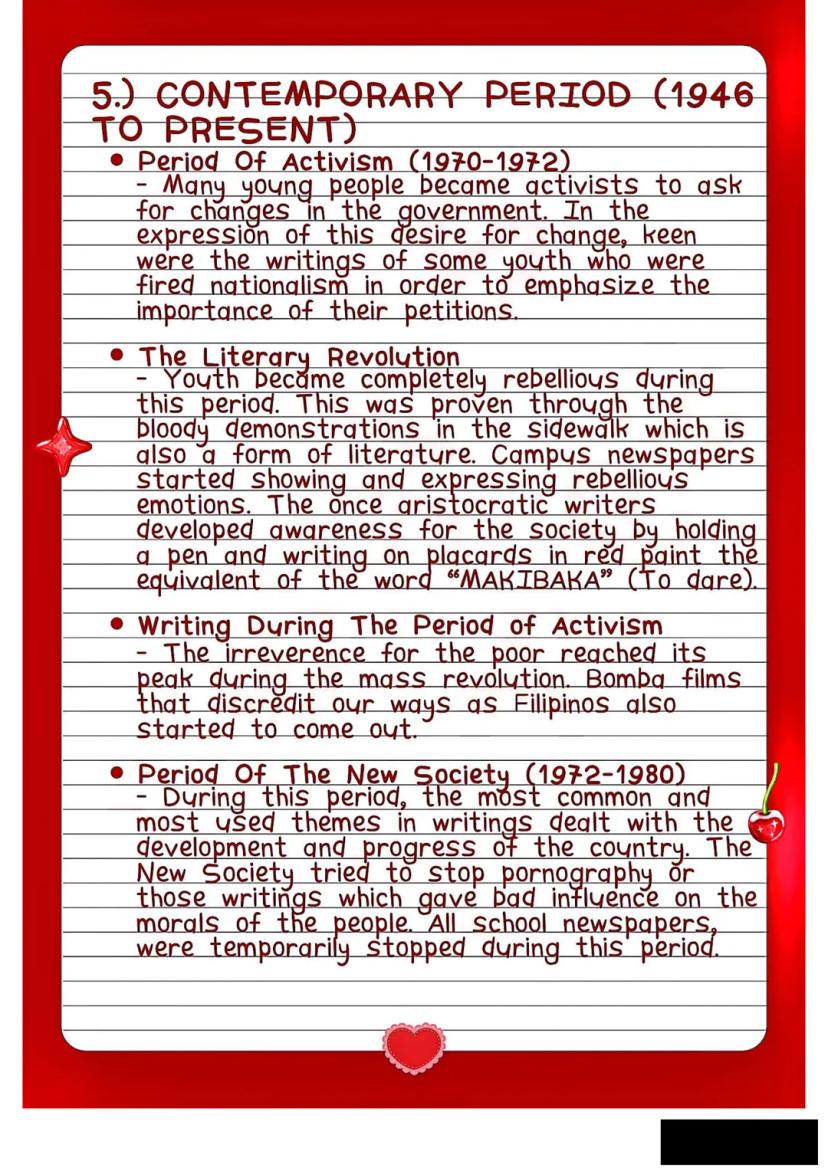
The Period of Activism (1970-1972) saw young people using literature to demand government changes. Campus newspapers became platforms for rebellious emotions, and the word "MAKIBAKA" (to dare) appeared on placards as students combined literature with protest.
During this Literary Revolution, aristocratic writers developed social awareness, and even sidewalk demonstrations became a form of literature. Youth rebellion reached new heights as literature became a tool for social change.
Power Moment: The 1970s proved that literature wasn't just entertainment - it became a powerful weapon for social change and youth activism!
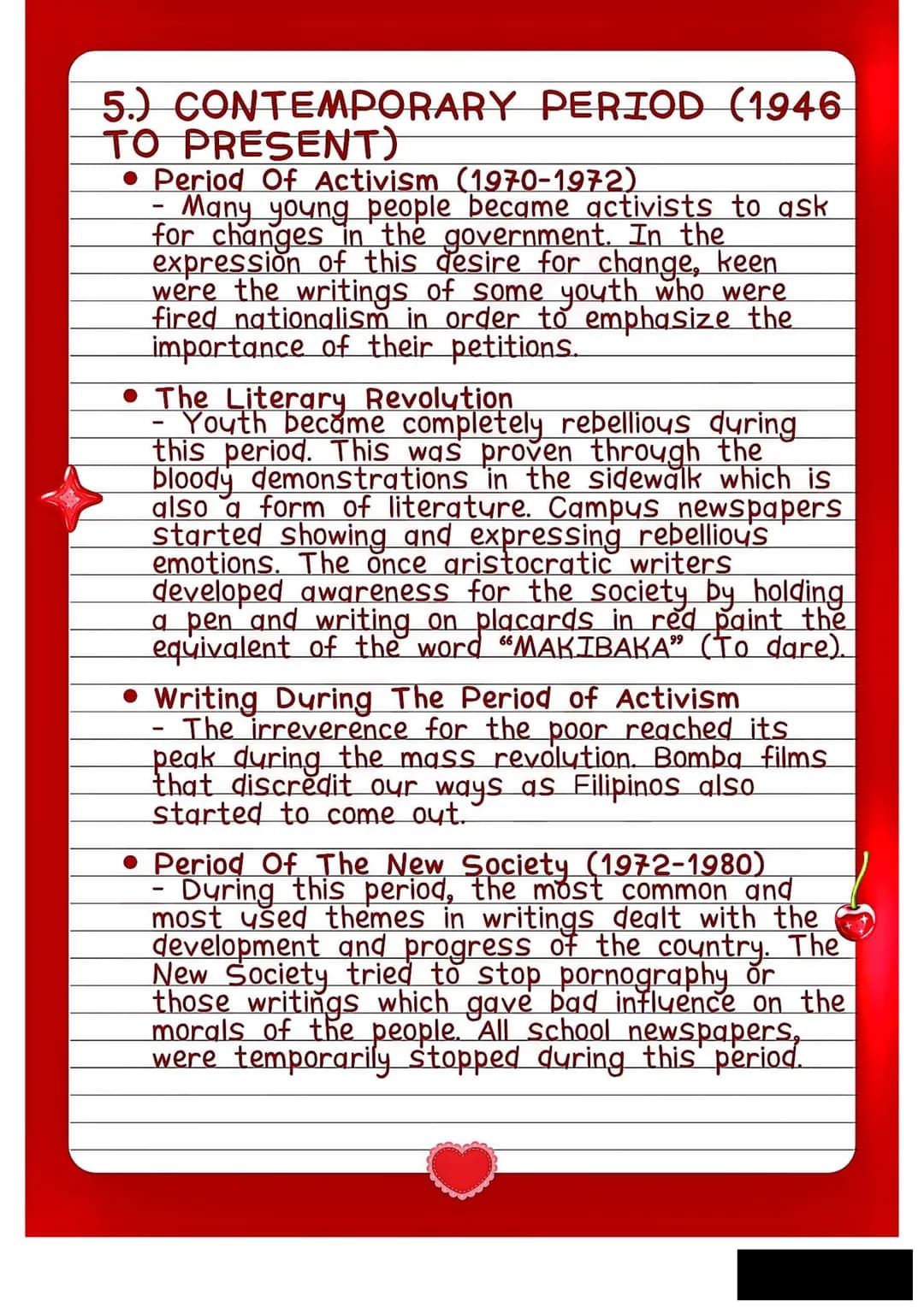
The Period of the New Society (1972-1980) shifted literary themes toward national development and progress. The government attempted to stop pornographic writings that negatively influenced public morals, and school newspapers were temporarily suspended during this period.
Filipino poetry during this era emphasized patience, native culture appreciation, customs, and natural beauty. The period also revived traditional performances like Tagalog Zarzuela, Cenaculo, and Muslim Embayoka, connecting modern audiences with historical Filipino entertainment.
Radio and television became major literary platforms. Popular series like "Si Matar," "Dahlia," "Ito Ang Palad Ko," and "Mr. Lonely" entertained families without televisions. These shows brought literature directly into Filipino homes.
The yearly Filipino Film Festival started during this time, lasting a month with only Filipino films in theaters. Comics, magazines, and newspapers adopted new forms, favoring news about economic progress, discipline, culture, and tourism over sensational content.
Cultural Renaissance: The New Society period proved that literature could celebrate Filipino identity while promoting national development and cultural pride!
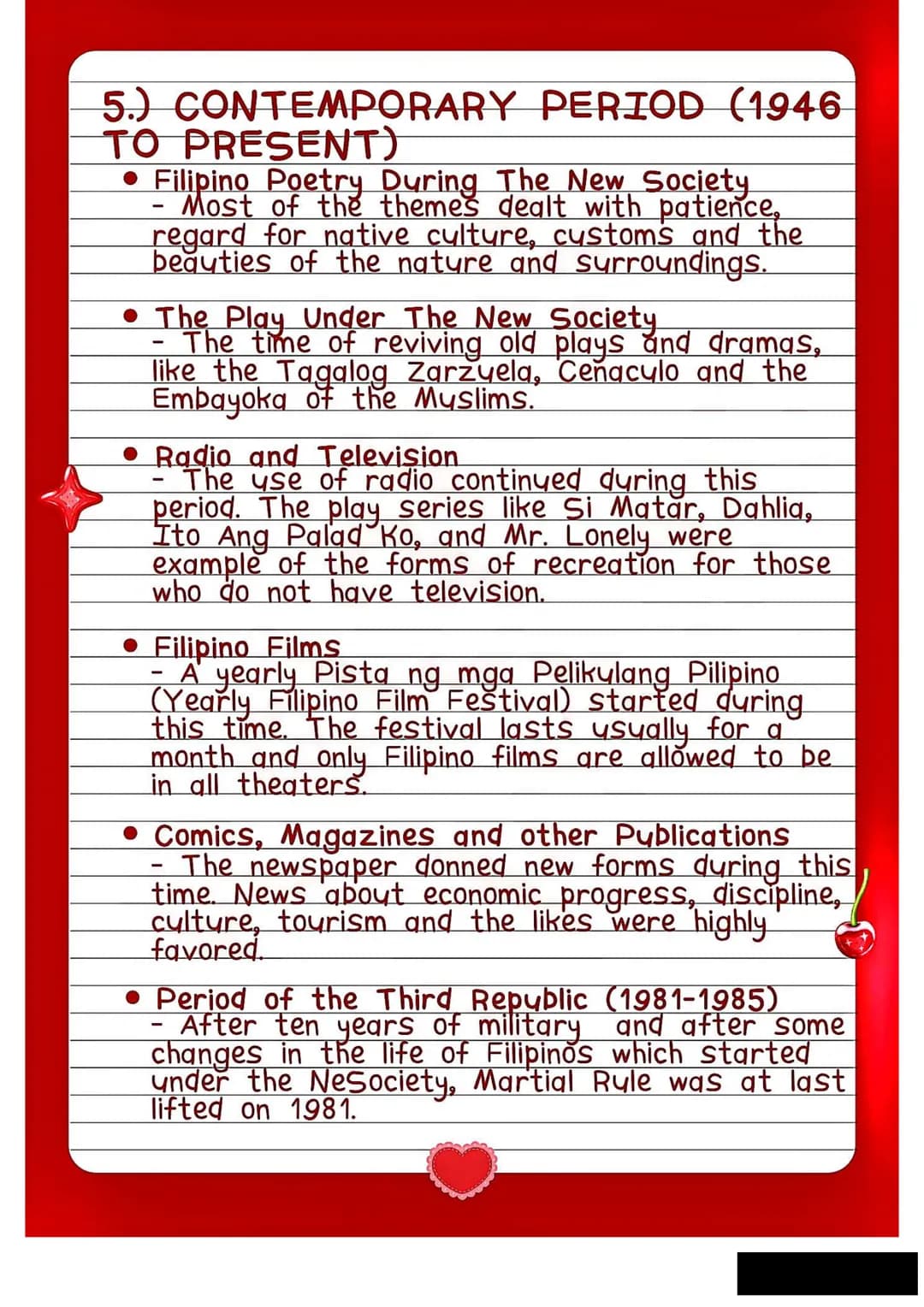
The Period of the Third Republic (1981-1985) began when martial law ended in 1981 after ten years. This era brought new freedom to Filipino writers and artists who had been restricted under military rule.
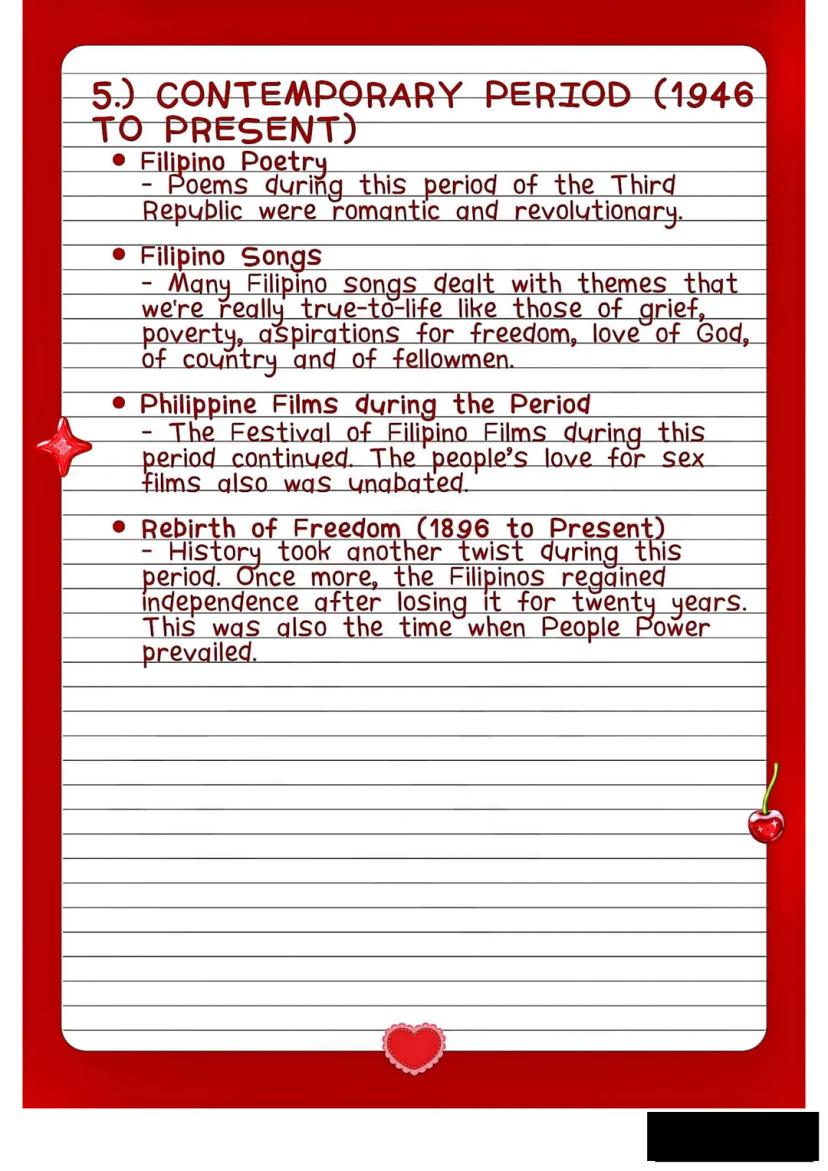
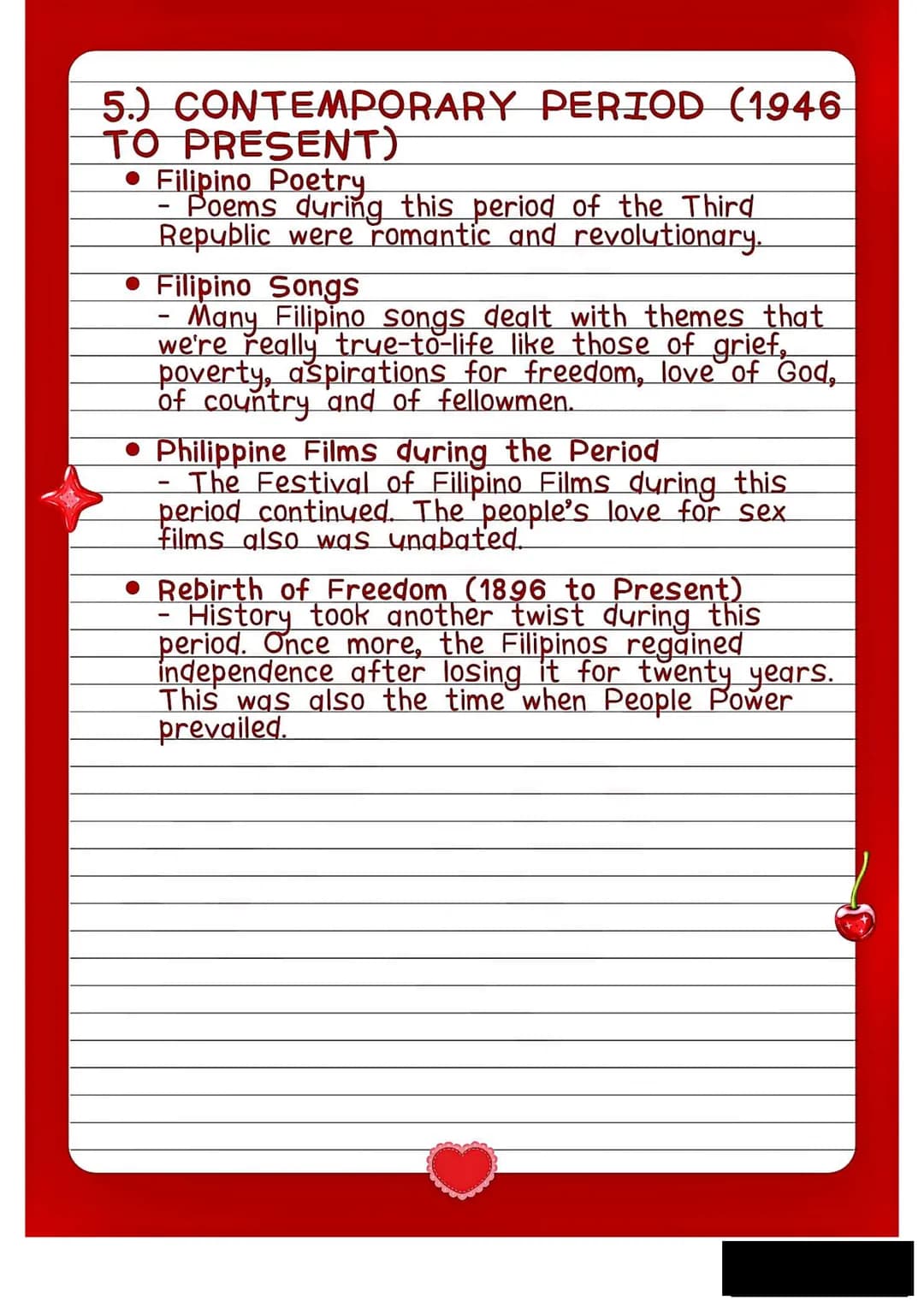
Filipino poetry became both romantic and revolutionary, reflecting the complex emotions of a nation rediscovering its voice. Filipino songs dealt with true-to-life themes including grief, poverty, freedom aspirations, and love of God, country, and fellowmen.
Philippine films continued the festival tradition, though people's interest in controversial films remained strong. This period showed how literature and entertainment reflected society's changing values and ongoing struggles.
The Rebirth of Freedom (1986 to Present) marked another historical twist when Filipinos regained independence after twenty years of authoritarian rule. This became the era when People Power prevailed, proving that ordinary citizens could create extraordinary change through collective action.
Victory Note: The People Power revolution showed that Filipinos had learned literature's greatest lesson - that words, voices, and unified action can topple even the most powerful oppressors!
Our AI companion is specifically built for the needs of students. Based on the millions of content pieces we have on the platform we can provide truly meaningful and relevant answers to students. But its not only about answers, the companion is even more about guiding students through their daily learning challenges, with personalised study plans, quizzes or content pieces in the chat and 100% personalisation based on the students skills and developments.
You can download the app in the Google Play Store and in the Apple App Store.
That's right! Enjoy free access to study content, connect with fellow students, and get instant help – all at your fingertips.
App Store
Google Play
The app is very easy to use and well designed. I have found everything I was looking for so far and have been able to learn a lot from the presentations! I will definitely use the app for a class assignment! And of course it also helps a lot as an inspiration.
Stefan S
iOS user
This app is really great. There are so many study notes and help [...]. My problem subject is French, for example, and the app has so many options for help. Thanks to this app, I have improved my French. I would recommend it to anyone.
Samantha Klich
Android user
Wow, I am really amazed. I just tried the app because I've seen it advertised many times and was absolutely stunned. This app is THE HELP you want for school and above all, it offers so many things, such as workouts and fact sheets, which have been VERY helpful to me personally.
Anna
iOS user
I think it’s very much worth it and you’ll end up using it a lot once you get the hang of it and even after looking at others notes you can still ask your Artificial intelligence buddy the question and ask to simplify it if you still don’t get it!!! In the end I think it’s worth it 😊👍 ⚠️Also DID I MENTION ITS FREEE YOU DON’T HAVE TO PAY FOR ANYTHING AND STILL GET YOUR GRADES IN PERFECTLY❗️❗️⚠️
Thomas R
iOS user
Knowunity is the BEST app I’ve used in a minute. This is not an ai review or anything this is genuinely coming from a 7th grade student (I know 2011 im young) but dude this app is a 10/10 i have maintained a 3.8 gpa and have plenty of time for gaming. I love it and my mom is just happy I got good grades
Brad T
Android user
Not only did it help me find the answer but it also showed me alternative ways to solve it. I was horrible in math and science but now I have an a in both subjects. Thanks for the help🤍🤍
David K
iOS user
The app's just great! All I have to do is enter the topic in the search bar and I get the response real fast. I don't have to watch 10 YouTube videos to understand something, so I'm saving my time. Highly recommended!
Sudenaz Ocak
Android user
In school I was really bad at maths but thanks to the app, I am doing better now. I am so grateful that you made the app.
Greenlight Bonnie
Android user
I found this app a couple years ago and it has only gotten better since then. I really love it because it can help with written questions and photo questions. Also, it can find study guides that other people have made as well as flashcard sets and practice tests. The free version is also amazing for students who might not be able to afford it. Would 100% recommend
Aubrey
iOS user
Best app if you're in Highschool or Junior high. I have been using this app for 2 school years and it's the best, it's good if you don't have anyone to help you with school work.😋🩷🎀
Marco B
iOS user
THE QUIZES AND FLASHCARDS ARE SO USEFUL AND I LOVE THE SCHOOLGPT. IT ALSO IS LITREALLY LIKE CHATGPT BUT SMARTER!! HELPED ME WITH MY MASCARA PROBLEMS TOO!! AS WELL AS MY REAL SUBJECTS ! DUHHH 😍😁😲🤑💗✨🎀😮
Elisha
iOS user
This app is phenomenal down to the correct info and the various topics you can study! I greatly recommend it for people who struggle with procrastination and those who need homework help. It has been perfectly accurate for world 1 history as far as I’ve seen! Geometry too!
Paul T
iOS user
The app is very easy to use and well designed. I have found everything I was looking for so far and have been able to learn a lot from the presentations! I will definitely use the app for a class assignment! And of course it also helps a lot as an inspiration.
Stefan S
iOS user
This app is really great. There are so many study notes and help [...]. My problem subject is French, for example, and the app has so many options for help. Thanks to this app, I have improved my French. I would recommend it to anyone.
Samantha Klich
Android user
Wow, I am really amazed. I just tried the app because I've seen it advertised many times and was absolutely stunned. This app is THE HELP you want for school and above all, it offers so many things, such as workouts and fact sheets, which have been VERY helpful to me personally.
Anna
iOS user
I think it’s very much worth it and you’ll end up using it a lot once you get the hang of it and even after looking at others notes you can still ask your Artificial intelligence buddy the question and ask to simplify it if you still don’t get it!!! In the end I think it’s worth it 😊👍 ⚠️Also DID I MENTION ITS FREEE YOU DON’T HAVE TO PAY FOR ANYTHING AND STILL GET YOUR GRADES IN PERFECTLY❗️❗️⚠️
Thomas R
iOS user
Knowunity is the BEST app I’ve used in a minute. This is not an ai review or anything this is genuinely coming from a 7th grade student (I know 2011 im young) but dude this app is a 10/10 i have maintained a 3.8 gpa and have plenty of time for gaming. I love it and my mom is just happy I got good grades
Brad T
Android user
Not only did it help me find the answer but it also showed me alternative ways to solve it. I was horrible in math and science but now I have an a in both subjects. Thanks for the help🤍🤍
David K
iOS user
The app's just great! All I have to do is enter the topic in the search bar and I get the response real fast. I don't have to watch 10 YouTube videos to understand something, so I'm saving my time. Highly recommended!
Sudenaz Ocak
Android user
In school I was really bad at maths but thanks to the app, I am doing better now. I am so grateful that you made the app.
Greenlight Bonnie
Android user
I found this app a couple years ago and it has only gotten better since then. I really love it because it can help with written questions and photo questions. Also, it can find study guides that other people have made as well as flashcard sets and practice tests. The free version is also amazing for students who might not be able to afford it. Would 100% recommend
Aubrey
iOS user
Best app if you're in Highschool or Junior high. I have been using this app for 2 school years and it's the best, it's good if you don't have anyone to help you with school work.😋🩷🎀
Marco B
iOS user
THE QUIZES AND FLASHCARDS ARE SO USEFUL AND I LOVE THE SCHOOLGPT. IT ALSO IS LITREALLY LIKE CHATGPT BUT SMARTER!! HELPED ME WITH MY MASCARA PROBLEMS TOO!! AS WELL AS MY REAL SUBJECTS ! DUHHH 😍😁😲🤑💗✨🎀😮
Elisha
iOS user
This app is phenomenal down to the correct info and the various topics you can study! I greatly recommend it for people who struggle with procrastination and those who need homework help. It has been perfectly accurate for world 1 history as far as I’ve seen! Geometry too!
Paul T
iOS user
Reigh<3
@reigh0fsunshine
Want to understand the rich tapestry of Filipino literature that shaped our culture? Philippine literature spans from ancient oral traditions to modern-day writings, reflecting our people's struggles, triumphs, and evolving identity through different colonial periods and into independence.
Access to all documents
Improve your grades
Join milions of students
By signing up you accept Terms of Service and Privacy Policy
Ever wondered why your lola tells those fascinating stories or why certain phrases stick in your mind? Literature is basically anything printed that connects to people's ideas and feelings - whether real or imagined. The word comes from the Latin "littera" meaning "letter."
Philippine literature comes in two main forms. Oral literature serves as the "language of life," helping communities pass down their cultural heritage through spoken word. Written literature expresses ideas through written forms, preserving our thoughts and stories for future generations.
Our literary journey begins in the Pre-Colonial Period when indigenous communities created literature based on their unique traditions, customs, and beliefs. Back then, Filipinos used Alibata as their first alphabet before the Spanish introduced the Roman alphabet we use today.
Quick Tip: Think of literature as a time machine - it shows us how Filipinos thought, felt, and lived throughout different periods in history!
Access to all documents
Improve your grades
Join milions of students
By signing up you accept Terms of Service and Privacy Policy
Before colonizers arrived, our ancestors were already creating amazing literature! They wrote on perishable materials like dried leaves, bamboo cylinders, and tree bark. Since these materials didn't last long, most literature survived through word of mouth, though this means some stories might have changed over time.
Written forms included clever riddles (bugtong) that helped kids think logically - like "Kung kailan mo pinatay saka pa humaba ang buhay" (candle). Epigrams (salawikain) taught good values through wise sayings, while poems (tanaga) followed a strict pattern of four lines with seven syllables each and matching rhymes.
Oral literature was equally rich. Chants were used in rituals, with Ambahan being traditional Mangyan poetry teaching life lessons. Folksongs expressed regional emotions and experiences, creating a musical map of our diverse islands.
Fun Fact: The Ambahan poetry of Hanunuo Mangyans is still alive today, proving how powerful oral tradition can be in preserving culture!
Access to all documents
Improve your grades
Join milions of students
By signing up you accept Terms of Service and Privacy Policy
Our ancestors also created legends explaining how places got their names, folktales sharing fictional stories with moral lessons, and epics - long poems about heroes with supernatural powers. These stories formed the backbone of Filipino storytelling traditions.
Everything changed during the Spanish Colonial Period (1565-1898). The 16th century marked the beginning of indigenous literature's decline as Spanish and Roman Catholic themes dominated. This period introduced new literary forms but also suppressed many traditional Filipino stories.
The Spanish brought religious literature like Doctrina Christiana - the first book printed in the Philippines in 1593. Pasyon told stories of Christian suffering that resonated with Filipino mothers, while Urbana at Feliza taught proper behavior through letters between sisters.
Remember: While Spanish colonization introduced new literary forms, it also marked the beginning of our struggle to preserve authentic Filipino voices in literature.
Access to all documents
Improve your grades
Join milions of students
By signing up you accept Terms of Service and Privacy Policy
During Spanish rule, brave Filipino writers used literature to fight for freedom and express national identity. Jose Rizal stands out as our greatest literary hero, writing Noli Me Tangere and El Filibusterismo - novels that exposed Spanish abuses and sparked our revolution. His final poem Mi Ultimo Adios remains one of our most treasured pieces.
Graciano Lopez Jaena edited La Solidaridad, a newspaper seeking democratic solutions to political problems. Marcelo H. Del Pilar founded Diariong Tagalog, boldly criticizing Spanish government and treatment of Filipinos. These writers risked their lives for truth.
Francisco Baltazar gave us the poetic masterpiece "Florante at Laura," which remains a cornerstone of Filipino literature. These writers proved that the pen could be mightier than the sword in fighting oppression.
The American Colonial Period (1898-1945) began as Spanish literature lost influence. Writers like Fernando Ma. Guerrero used poetry to discuss revolution and patriotism, proving literature's power in claiming freedom.
Hero Highlight: Jose Rizal didn't just write novels - he used literature as a weapon against injustice, inspiring generations of freedom fighters!
Access to all documents
Improve your grades
Join milions of students
By signing up you accept Terms of Service and Privacy Policy
American colonization opened new literary doors as Filipinos explored news reporting, poetry, stories, plays, essays, and novels. This period produced literary giants whose works you might recognize: Paz Marquez-Benitez wrote "Dead Stars," Jose Garcia Villa penned "Footnote to Youth," and Manuel Arguilla created "How My Brother Leon Brought Home a Wife."
Writers like Lope K. Santos ("Banak At Sikat"), Severino Reyes ("Walang Sugat"), and Aurelio Tolentino ("Kahapon, Bukas, Ngayon") enriched Filipino literature with diverse themes and styles. American influence encouraged experimentation with different literary forms.
The Japanese Colonial Period (1941-1945) dramatically restricted literary freedom. The Japanese government banned English in literature and stopped most newspapers except Tribune and Philippine Review. Themes focused mainly on provincial life as writers navigated censorship.
This period introduced Haiku - Japanese free verse poetry with 17 syllables arranged in three lines . Famous playwrights included Jose Ma. Hernandez ("Panday Pira") and Francisco Soc Rodrigo ("Sa Pula, Sa Puti"), while short story writers like NVM Gonzales and Liwayway Arceo kept Filipino storytelling alive.
Survival Story: Even under strict Japanese censorship, Filipino writers found creative ways to express themselves and preserve our literary traditions!
Access to all documents
Improve your grades
Join milions of students
By signing up you accept Terms of Service and Privacy Policy
July 4, 1946 marked the beginning of the Contemporary Period as the Philippines regained freedom and the Filipino flag waved independently. The early post-liberation era saw a "struggle of mind and spirit" as writers eagerly returned to print, with works like Nick Joaquin's "Prose and Poems" (1952) leading the revival.
New Filipino Literature emerged with Tagalog literature experiencing a renaissance. Writers focused on Japanese brutalities, poverty under occupation, and heroic guerrilla exploits. This period marked the rebirth of authentic Filipino voices in literature.
The Period of Activism (1970-1972) saw young people using literature to demand government changes. Campus newspapers became platforms for rebellious emotions, and the word "MAKIBAKA" (to dare) appeared on placards as students combined literature with protest.
During this Literary Revolution, aristocratic writers developed social awareness, and even sidewalk demonstrations became a form of literature. Youth rebellion reached new heights as literature became a tool for social change.
Power Moment: The 1970s proved that literature wasn't just entertainment - it became a powerful weapon for social change and youth activism!
Access to all documents
Improve your grades
Join milions of students
By signing up you accept Terms of Service and Privacy Policy
The Period of the New Society (1972-1980) shifted literary themes toward national development and progress. The government attempted to stop pornographic writings that negatively influenced public morals, and school newspapers were temporarily suspended during this period.
Filipino poetry during this era emphasized patience, native culture appreciation, customs, and natural beauty. The period also revived traditional performances like Tagalog Zarzuela, Cenaculo, and Muslim Embayoka, connecting modern audiences with historical Filipino entertainment.
Radio and television became major literary platforms. Popular series like "Si Matar," "Dahlia," "Ito Ang Palad Ko," and "Mr. Lonely" entertained families without televisions. These shows brought literature directly into Filipino homes.
The yearly Filipino Film Festival started during this time, lasting a month with only Filipino films in theaters. Comics, magazines, and newspapers adopted new forms, favoring news about economic progress, discipline, culture, and tourism over sensational content.
Cultural Renaissance: The New Society period proved that literature could celebrate Filipino identity while promoting national development and cultural pride!
Access to all documents
Improve your grades
Join milions of students
By signing up you accept Terms of Service and Privacy Policy
The Period of the Third Republic (1981-1985) began when martial law ended in 1981 after ten years. This era brought new freedom to Filipino writers and artists who had been restricted under military rule.
Filipino poetry became both romantic and revolutionary, reflecting the complex emotions of a nation rediscovering its voice. Filipino songs dealt with true-to-life themes including grief, poverty, freedom aspirations, and love of God, country, and fellowmen.
Philippine films continued the festival tradition, though people's interest in controversial films remained strong. This period showed how literature and entertainment reflected society's changing values and ongoing struggles.
The Rebirth of Freedom (1986 to Present) marked another historical twist when Filipinos regained independence after twenty years of authoritarian rule. This became the era when People Power prevailed, proving that ordinary citizens could create extraordinary change through collective action.
Victory Note: The People Power revolution showed that Filipinos had learned literature's greatest lesson - that words, voices, and unified action can topple even the most powerful oppressors!
Access to all documents
Improve your grades
Join milions of students
By signing up you accept Terms of Service and Privacy Policy
Our AI companion is specifically built for the needs of students. Based on the millions of content pieces we have on the platform we can provide truly meaningful and relevant answers to students. But its not only about answers, the companion is even more about guiding students through their daily learning challenges, with personalised study plans, quizzes or content pieces in the chat and 100% personalisation based on the students skills and developments.
You can download the app in the Google Play Store and in the Apple App Store.
That's right! Enjoy free access to study content, connect with fellow students, and get instant help – all at your fingertips.
11
Smart Tools NEW
Transform this note into: ✓ 50+ Practice Questions ✓ Interactive Flashcards ✓ Full Mock Exam ✓ Essay Outlines
App Store
Google Play
The app is very easy to use and well designed. I have found everything I was looking for so far and have been able to learn a lot from the presentations! I will definitely use the app for a class assignment! And of course it also helps a lot as an inspiration.
Stefan S
iOS user
This app is really great. There are so many study notes and help [...]. My problem subject is French, for example, and the app has so many options for help. Thanks to this app, I have improved my French. I would recommend it to anyone.
Samantha Klich
Android user
Wow, I am really amazed. I just tried the app because I've seen it advertised many times and was absolutely stunned. This app is THE HELP you want for school and above all, it offers so many things, such as workouts and fact sheets, which have been VERY helpful to me personally.
Anna
iOS user
I think it’s very much worth it and you’ll end up using it a lot once you get the hang of it and even after looking at others notes you can still ask your Artificial intelligence buddy the question and ask to simplify it if you still don’t get it!!! In the end I think it’s worth it 😊👍 ⚠️Also DID I MENTION ITS FREEE YOU DON’T HAVE TO PAY FOR ANYTHING AND STILL GET YOUR GRADES IN PERFECTLY❗️❗️⚠️
Thomas R
iOS user
Knowunity is the BEST app I’ve used in a minute. This is not an ai review or anything this is genuinely coming from a 7th grade student (I know 2011 im young) but dude this app is a 10/10 i have maintained a 3.8 gpa and have plenty of time for gaming. I love it and my mom is just happy I got good grades
Brad T
Android user
Not only did it help me find the answer but it also showed me alternative ways to solve it. I was horrible in math and science but now I have an a in both subjects. Thanks for the help🤍🤍
David K
iOS user
The app's just great! All I have to do is enter the topic in the search bar and I get the response real fast. I don't have to watch 10 YouTube videos to understand something, so I'm saving my time. Highly recommended!
Sudenaz Ocak
Android user
In school I was really bad at maths but thanks to the app, I am doing better now. I am so grateful that you made the app.
Greenlight Bonnie
Android user
I found this app a couple years ago and it has only gotten better since then. I really love it because it can help with written questions and photo questions. Also, it can find study guides that other people have made as well as flashcard sets and practice tests. The free version is also amazing for students who might not be able to afford it. Would 100% recommend
Aubrey
iOS user
Best app if you're in Highschool or Junior high. I have been using this app for 2 school years and it's the best, it's good if you don't have anyone to help you with school work.😋🩷🎀
Marco B
iOS user
THE QUIZES AND FLASHCARDS ARE SO USEFUL AND I LOVE THE SCHOOLGPT. IT ALSO IS LITREALLY LIKE CHATGPT BUT SMARTER!! HELPED ME WITH MY MASCARA PROBLEMS TOO!! AS WELL AS MY REAL SUBJECTS ! DUHHH 😍😁😲🤑💗✨🎀😮
Elisha
iOS user
This app is phenomenal down to the correct info and the various topics you can study! I greatly recommend it for people who struggle with procrastination and those who need homework help. It has been perfectly accurate for world 1 history as far as I’ve seen! Geometry too!
Paul T
iOS user
The app is very easy to use and well designed. I have found everything I was looking for so far and have been able to learn a lot from the presentations! I will definitely use the app for a class assignment! And of course it also helps a lot as an inspiration.
Stefan S
iOS user
This app is really great. There are so many study notes and help [...]. My problem subject is French, for example, and the app has so many options for help. Thanks to this app, I have improved my French. I would recommend it to anyone.
Samantha Klich
Android user
Wow, I am really amazed. I just tried the app because I've seen it advertised many times and was absolutely stunned. This app is THE HELP you want for school and above all, it offers so many things, such as workouts and fact sheets, which have been VERY helpful to me personally.
Anna
iOS user
I think it’s very much worth it and you’ll end up using it a lot once you get the hang of it and even after looking at others notes you can still ask your Artificial intelligence buddy the question and ask to simplify it if you still don’t get it!!! In the end I think it’s worth it 😊👍 ⚠️Also DID I MENTION ITS FREEE YOU DON’T HAVE TO PAY FOR ANYTHING AND STILL GET YOUR GRADES IN PERFECTLY❗️❗️⚠️
Thomas R
iOS user
Knowunity is the BEST app I’ve used in a minute. This is not an ai review or anything this is genuinely coming from a 7th grade student (I know 2011 im young) but dude this app is a 10/10 i have maintained a 3.8 gpa and have plenty of time for gaming. I love it and my mom is just happy I got good grades
Brad T
Android user
Not only did it help me find the answer but it also showed me alternative ways to solve it. I was horrible in math and science but now I have an a in both subjects. Thanks for the help🤍🤍
David K
iOS user
The app's just great! All I have to do is enter the topic in the search bar and I get the response real fast. I don't have to watch 10 YouTube videos to understand something, so I'm saving my time. Highly recommended!
Sudenaz Ocak
Android user
In school I was really bad at maths but thanks to the app, I am doing better now. I am so grateful that you made the app.
Greenlight Bonnie
Android user
I found this app a couple years ago and it has only gotten better since then. I really love it because it can help with written questions and photo questions. Also, it can find study guides that other people have made as well as flashcard sets and practice tests. The free version is also amazing for students who might not be able to afford it. Would 100% recommend
Aubrey
iOS user
Best app if you're in Highschool or Junior high. I have been using this app for 2 school years and it's the best, it's good if you don't have anyone to help you with school work.😋🩷🎀
Marco B
iOS user
THE QUIZES AND FLASHCARDS ARE SO USEFUL AND I LOVE THE SCHOOLGPT. IT ALSO IS LITREALLY LIKE CHATGPT BUT SMARTER!! HELPED ME WITH MY MASCARA PROBLEMS TOO!! AS WELL AS MY REAL SUBJECTS ! DUHHH 😍😁😲🤑💗✨🎀😮
Elisha
iOS user
This app is phenomenal down to the correct info and the various topics you can study! I greatly recommend it for people who struggle with procrastination and those who need homework help. It has been perfectly accurate for world 1 history as far as I’ve seen! Geometry too!
Paul T
iOS user