Open the App

Subjects

3,087

Dec 13, 2025

12 pages

Exploring 21st Century Literature

S

secret

@secretaccountto

Welcome to 21st Century Literature! This course explores how literature... Show more

Page 1
Page 2
Page 3
Page 4
Page 5
Page 6
Page 7
Page 8
Page 9
Page 10
1 / 10
21st CENTURY LITERATURE
PRELIMS ALL TOPICS
- SEM 2 ALL TOPICS -
aims to teach ethical principles or practical
widsom.
1.0 THE PHILIPPINE LIT

Philippine Literature Through Time

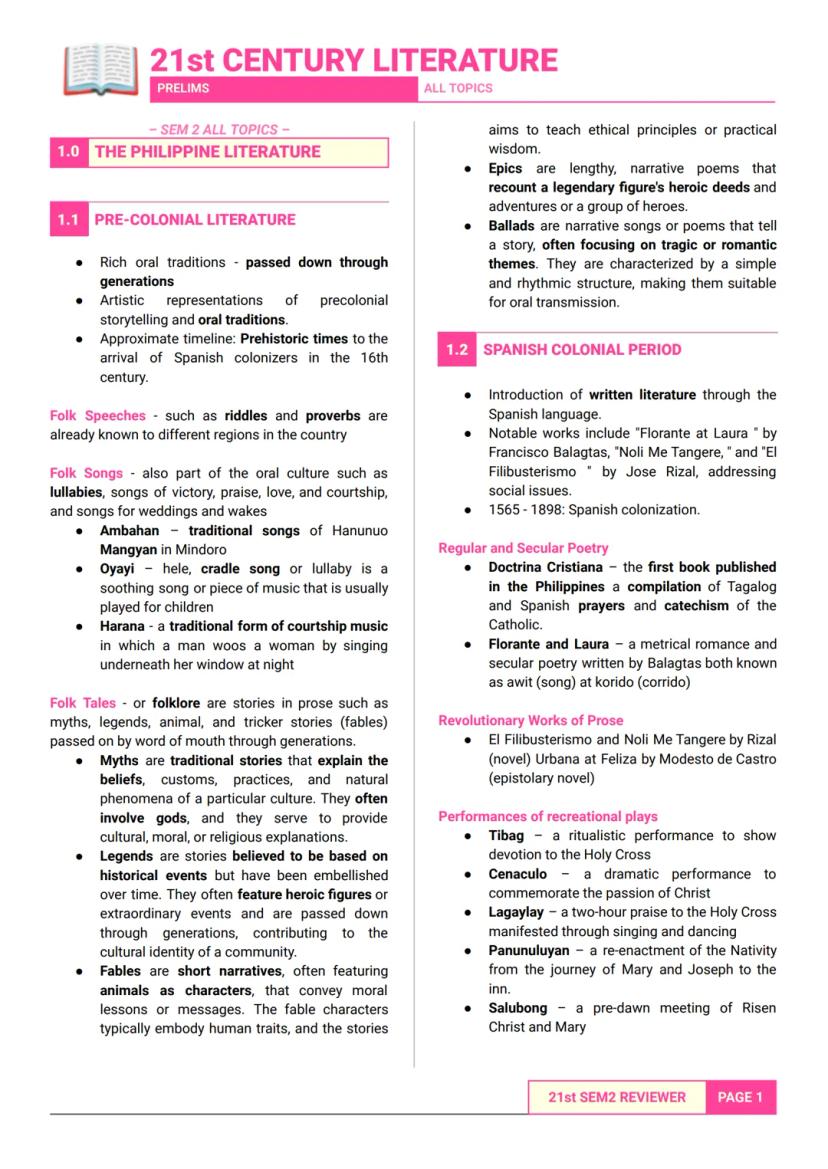
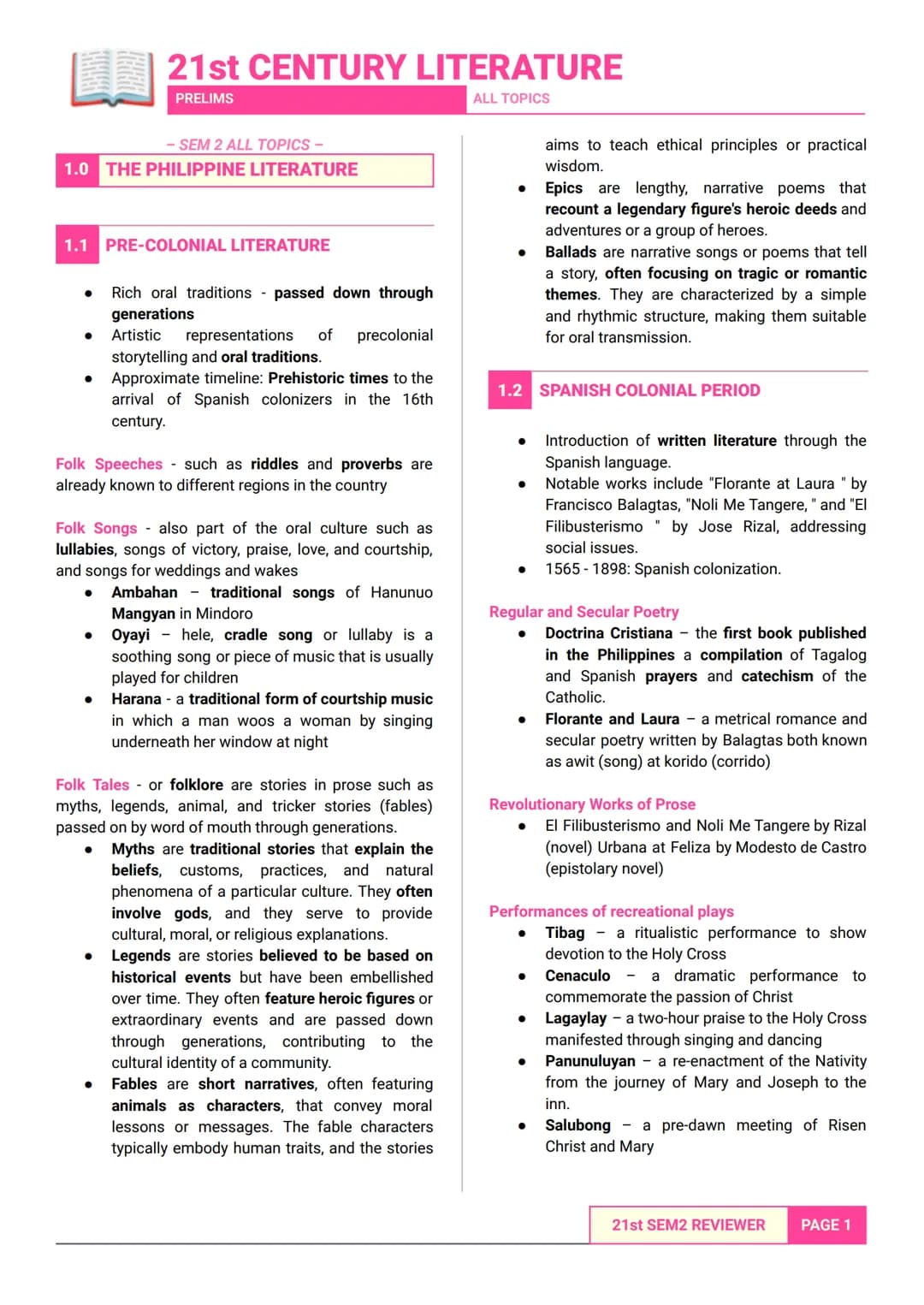
The rich tapestry of Philippine literature began long before colonizers arrived on our shores. During the pre-colonial period, literature thrived through oral traditions that were passed down through generations.

Folk literature took various forms including riddles, proverbs, and folk songs like the soothing Oyayi (lullabies) and romantic Harana (courtship songs). Folk tales or folklore were stories in prose such as myths (explaining cultural beliefs), legends (based on historical events but embellished), and fables (short stories with moral lessons, often featuring animals).

During the Spanish colonial period (1565-1898), written literature was introduced through Spanish. Notable works include Francisco Balagtas's "Florante at Laura" and Jose Rizal's revolutionary novels "Noli Me Tangere" and "El Filibusterismo". Religious performances emerged such as Tibag (devotion to the Holy Cross), Cenaculo (Christ's passion), and Panunuluyan reenactmentoftheNativityre-enactment of the Nativity.

Did you know? The first book published in the Philippines was the "Doctrina Cristiana" - a compilation of Tagalog and Spanish prayers and Catholic catechism.

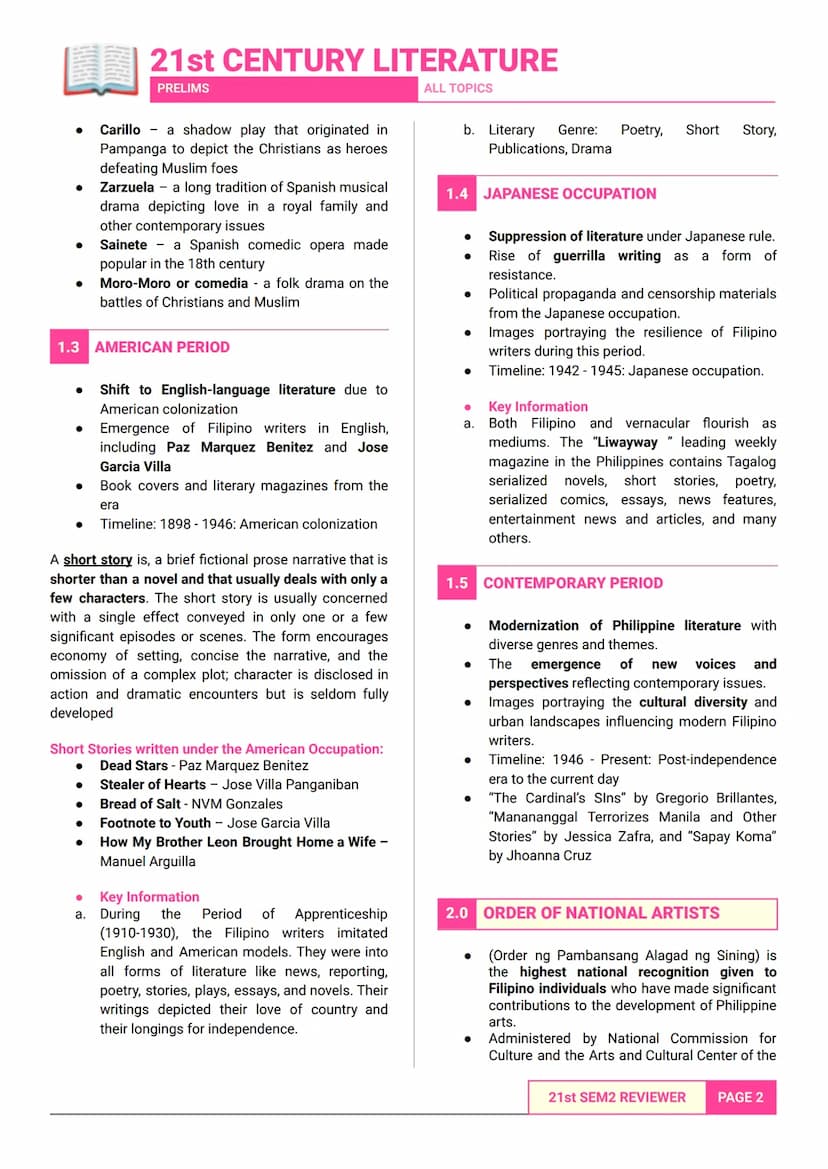
The American period (1898-1946) brought a shift to English-language literature. This era saw the rise of the short story form with works like Paz Marquez Benitez's "Dead Stars" and Manuel Arguilla's "How My Brother Leon Brought Home a Wife". Writers during this time often depicted their love for country and longing for independence.

21st CENTURY LITERATURE
PRELIMS ALL TOPICS
- SEM 2 ALL TOPICS -
aims to teach ethical principles or practical
widsom.
1.0 THE PHILIPPINE LIT

Colonial Influences and Contemporary Literature

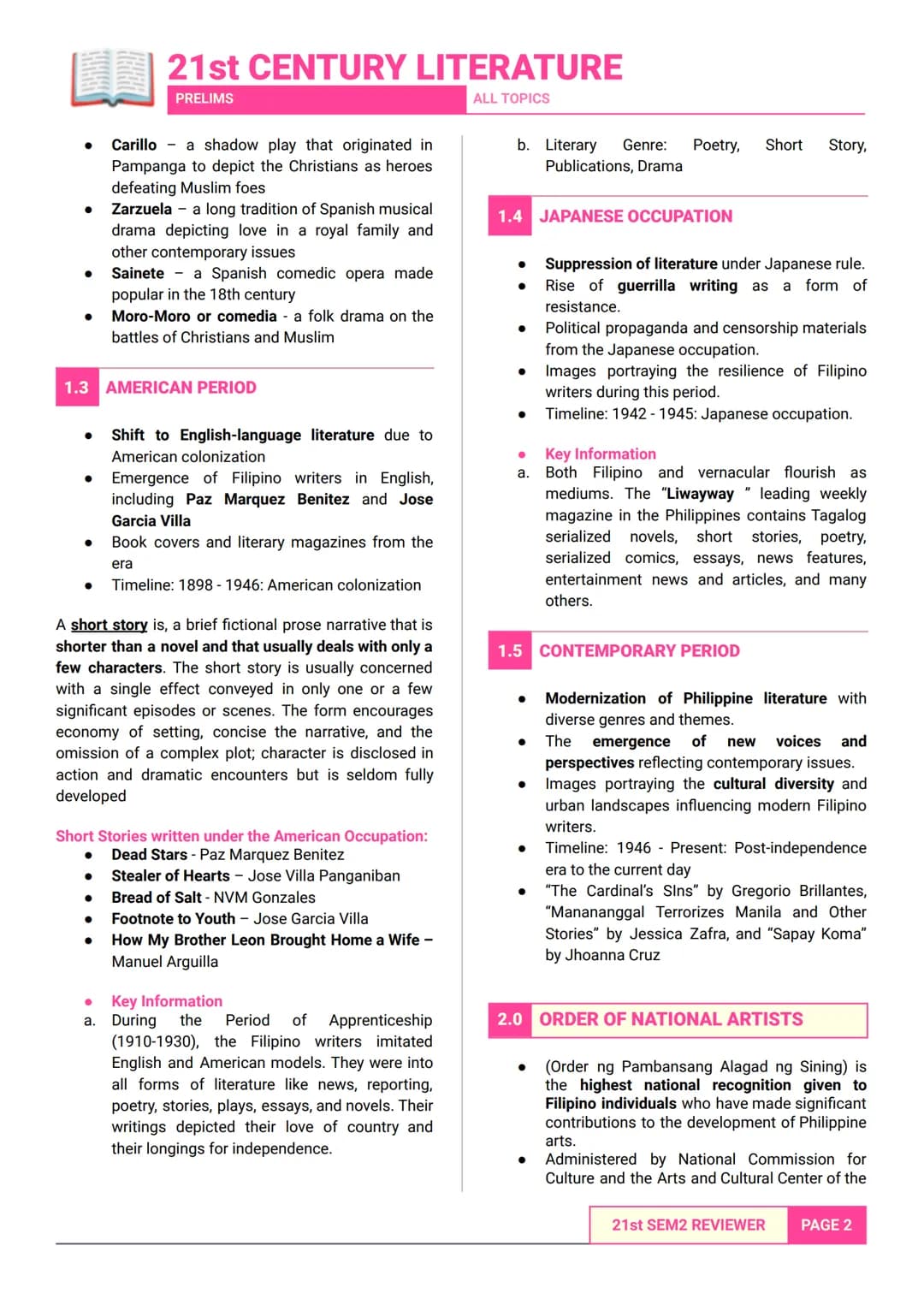
During the American period, Filipino writers went through a period of apprenticeship (1910-1930), imitating English and American models while expressing patriotic themes. Their writings spanned various genres including poetry, short stories, and drama.

The Japanese occupation (1942-1945) brought severe suppression of literature, yet sparked resistance through guerrilla writing. Despite harsh censorship, Filipino literature continued to develop, with publications like "Liwayway" magazine featuring Tagalog serialized novels, short stories, and poetry.

The contemporary period 1946present1946-present has witnessed the modernization of Philippine literature with diverse genres and themes. Writers began exploring new voices and perspectives that reflect contemporary issues. Notable works include "The Cardinal's Sins" by Gregorio Brillantes and "Manananggal Terrorizes Manila and Other Stories" by Jessica Zafra.

Order of National Artists

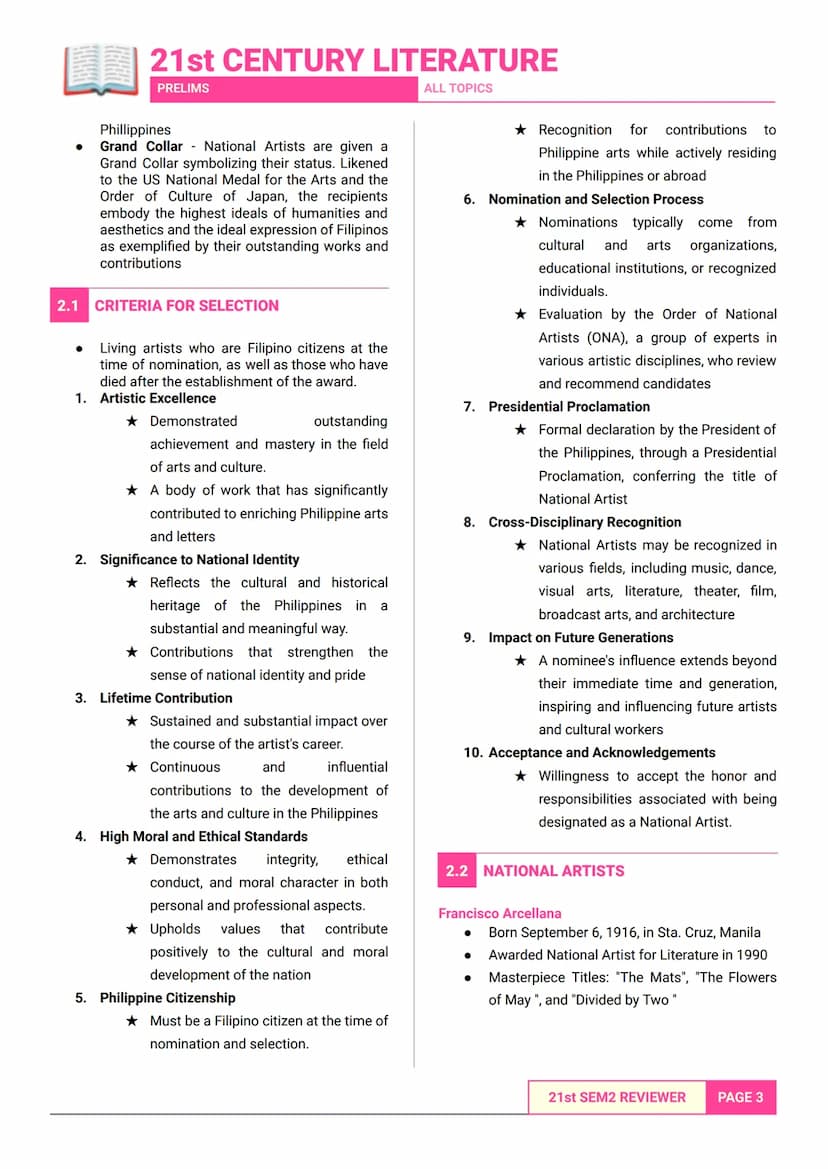
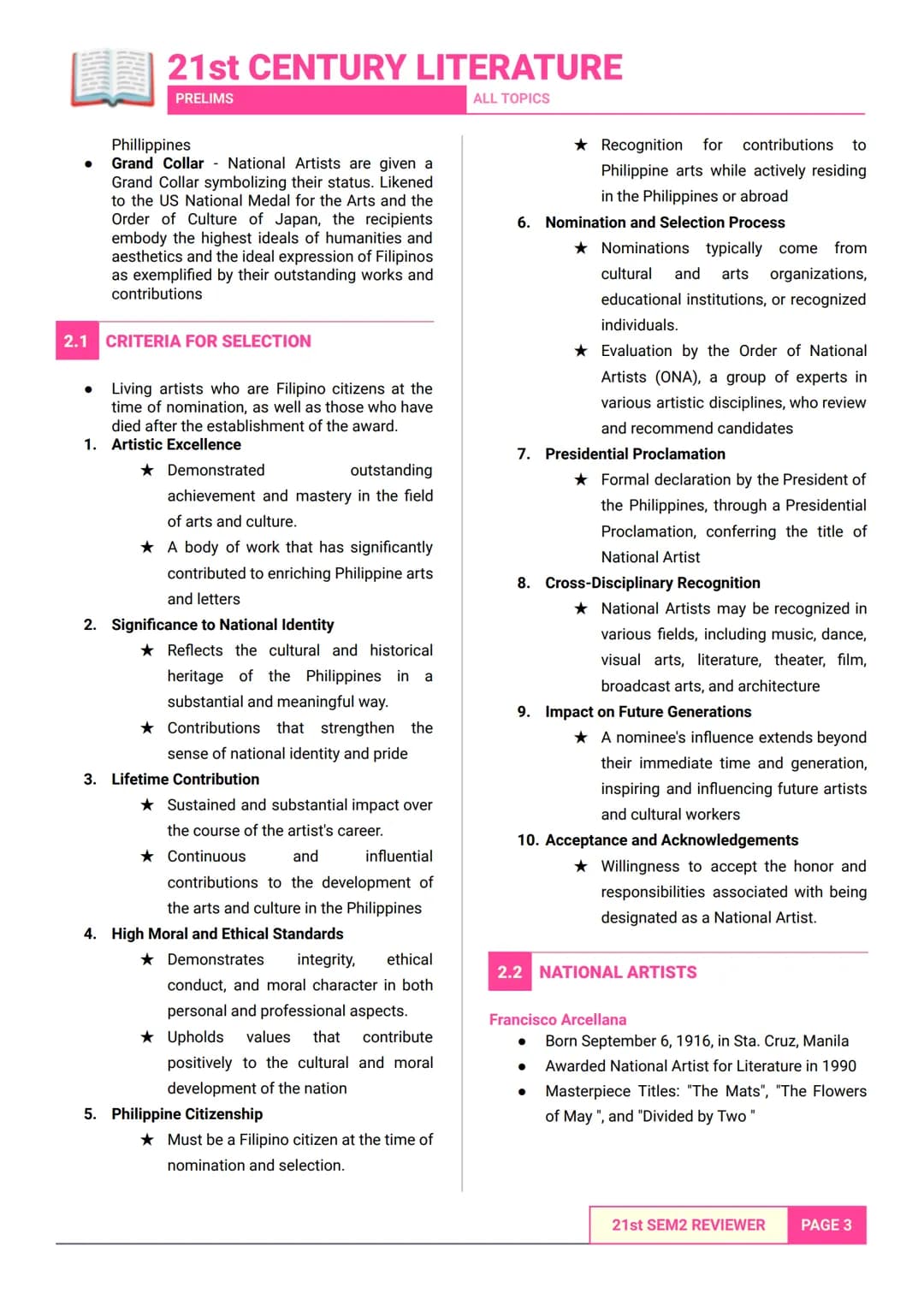
The Order of National Artists is the highest national recognition given to Filipino individuals who have made significant contributions to Philippine arts. Recipients receive a Grand Collar symbolizing their status and representing the highest ideals of humanities and aesthetics.

Remember this: National Artists are selected based on several criteria including artistic excellence, significance to national identity, lifetime contribution, and high moral standards.

Selection is a rigorous process requiring evaluation by experts and formal declaration through a Presidential Proclamation. The honor recognizes various fields including literature, music, dance, visual arts, theater, film, and architecture.

21st CENTURY LITERATURE
PRELIMS ALL TOPICS
- SEM 2 ALL TOPICS -
aims to teach ethical principles or practical
widsom.
1.0 THE PHILIPPINE LIT

National Artists for Literature

The Philippines honors its literary giants through the National Artist award. These writers have shaped the nation's literary landscape through their exceptional works.

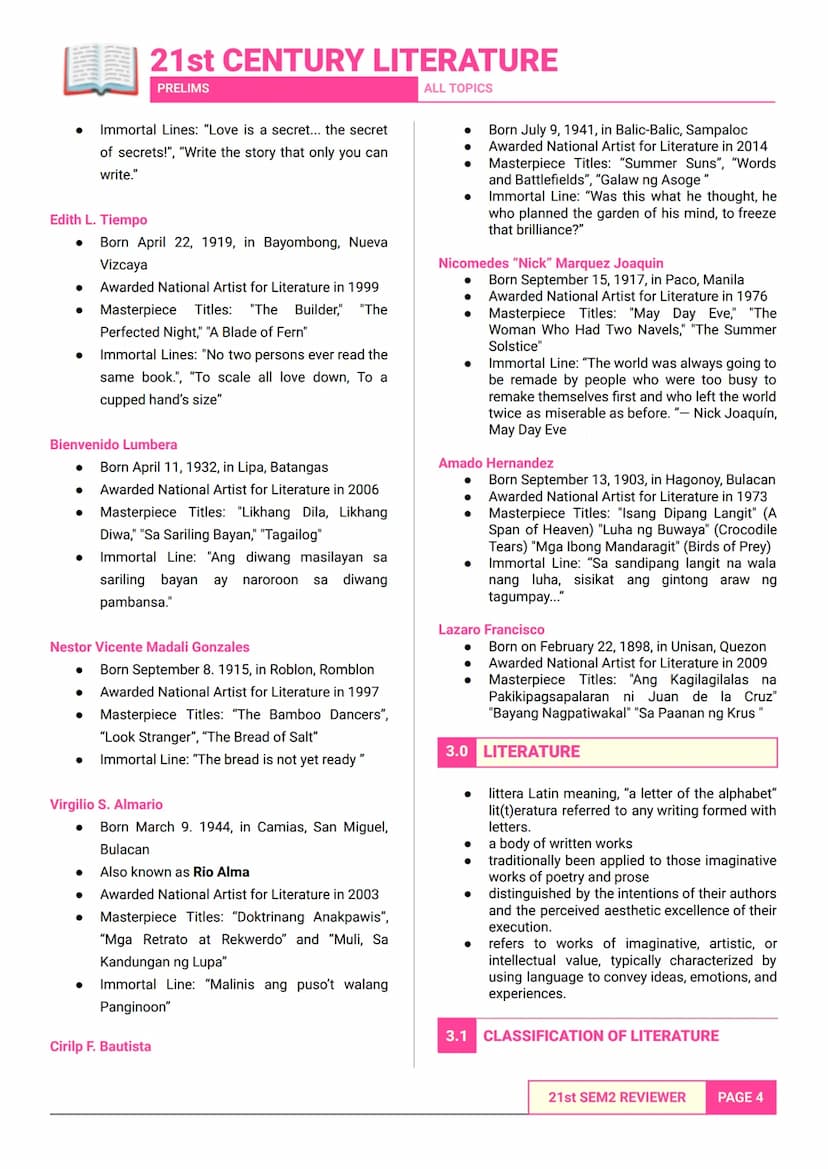
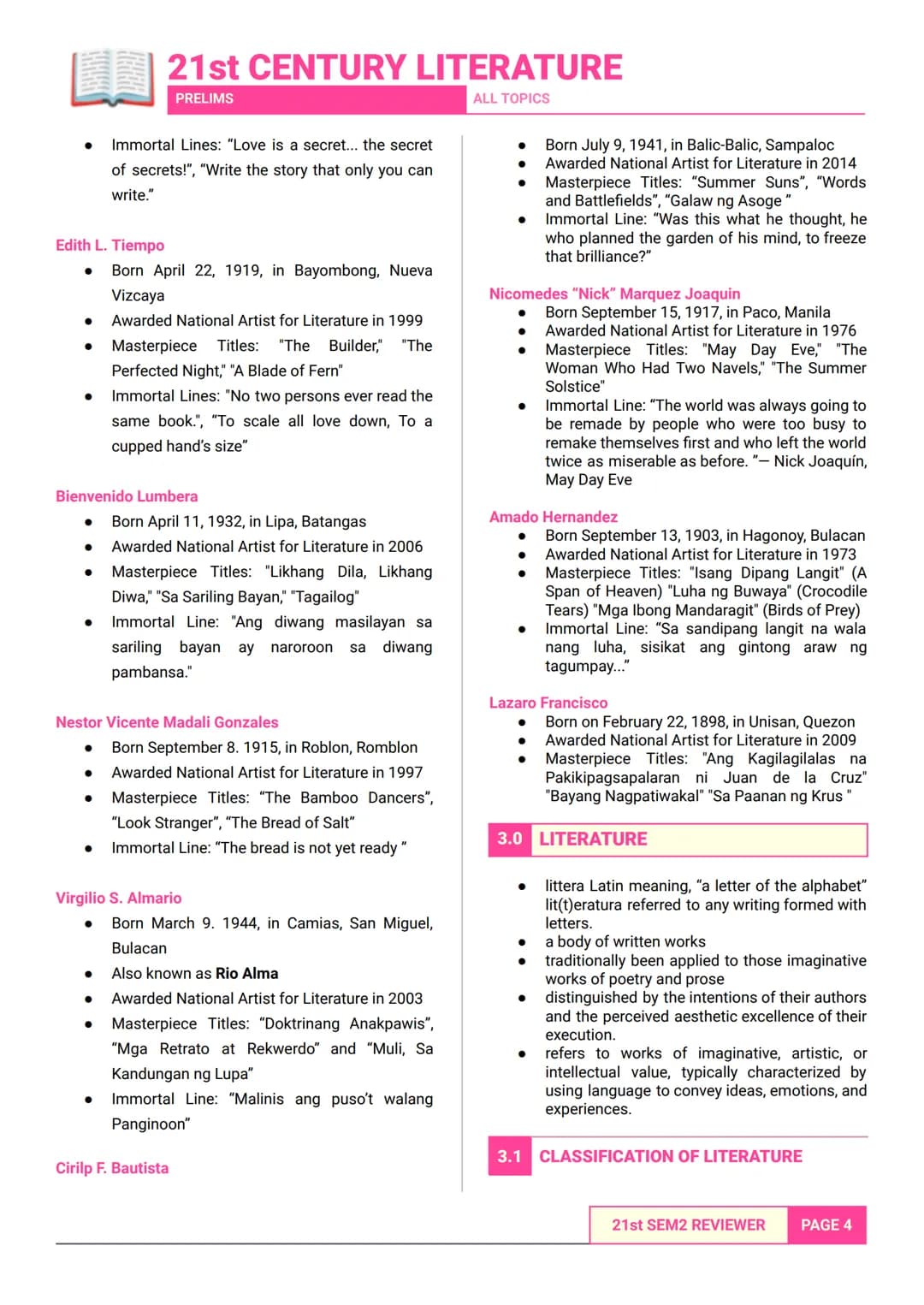
Francisco Arcellana (awarded 1990) wrote masterpieces like "The Mats" and "Divided by Two." His immortal line "Write the story that only you can write" continues to inspire young writers today.

Edith L. Tiempo (awarded 1999) crafted beautiful works like "The Builder" and "A Blade of Fern." Her profound statement "No two persons ever read the same book" reminds us how literature connects uniquely with each reader.

Bienvenido Lumbera (awarded 2006) contributed significantly to Filipino literature with works like "Likhang Dila, Likhang Diwa." His writings often emphasized national identity, stating "Ang diwang masilayan sa sariling bayan ay naroroon sa diwang pambansa."

Nestor Vicente Madali Gonzales (awarded 1997) is known for "The Bamboo Dancers" and the short story "The Bread of Salt" with its famous line "The bread is not yet ready."

Fun fact: Many National Artists for Literature were also educators who shaped generations of Filipino writers through their teaching and mentorship.

Other distinguished National Artists include Virgilio S. Almario (Rio Alma), Cirilo F. Bautista, Nick Joaquin (the first National Artist for Literature), and Amado Hernandez. Each brought unique perspectives and styles that enriched Philippine literature.

21st CENTURY LITERATURE
PRELIMS ALL TOPICS
- SEM 2 ALL TOPICS -
aims to teach ethical principles or practical
widsom.
1.0 THE PHILIPPINE LIT

Understanding Literature and Poetry

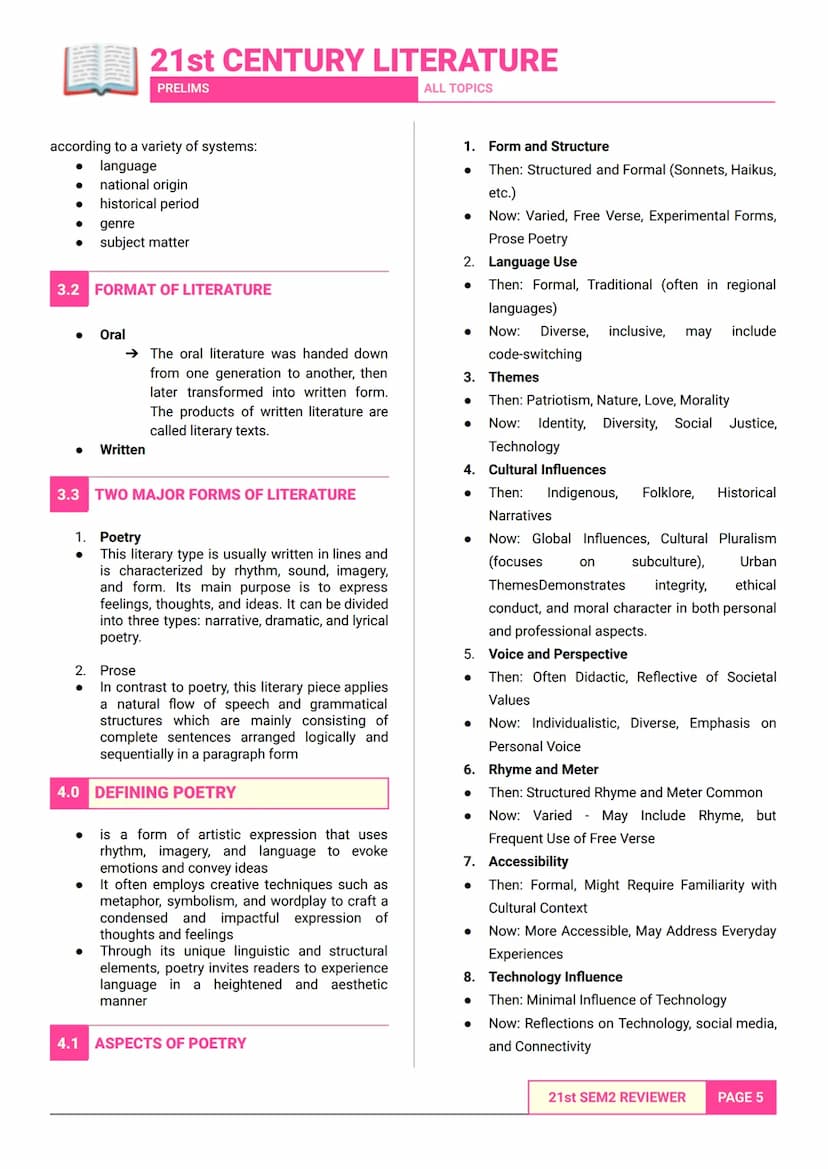
Literature comes from the Latin word "littera" meaning "a letter of the alphabet." It refers to works of imaginative, artistic, or intellectual value that use language to convey ideas, emotions, and experiences.

Literature can be classified according to language, national origin, historical period, genre, or subject matter. It exists in both oral (handed down through generations) and written forms (literary texts).

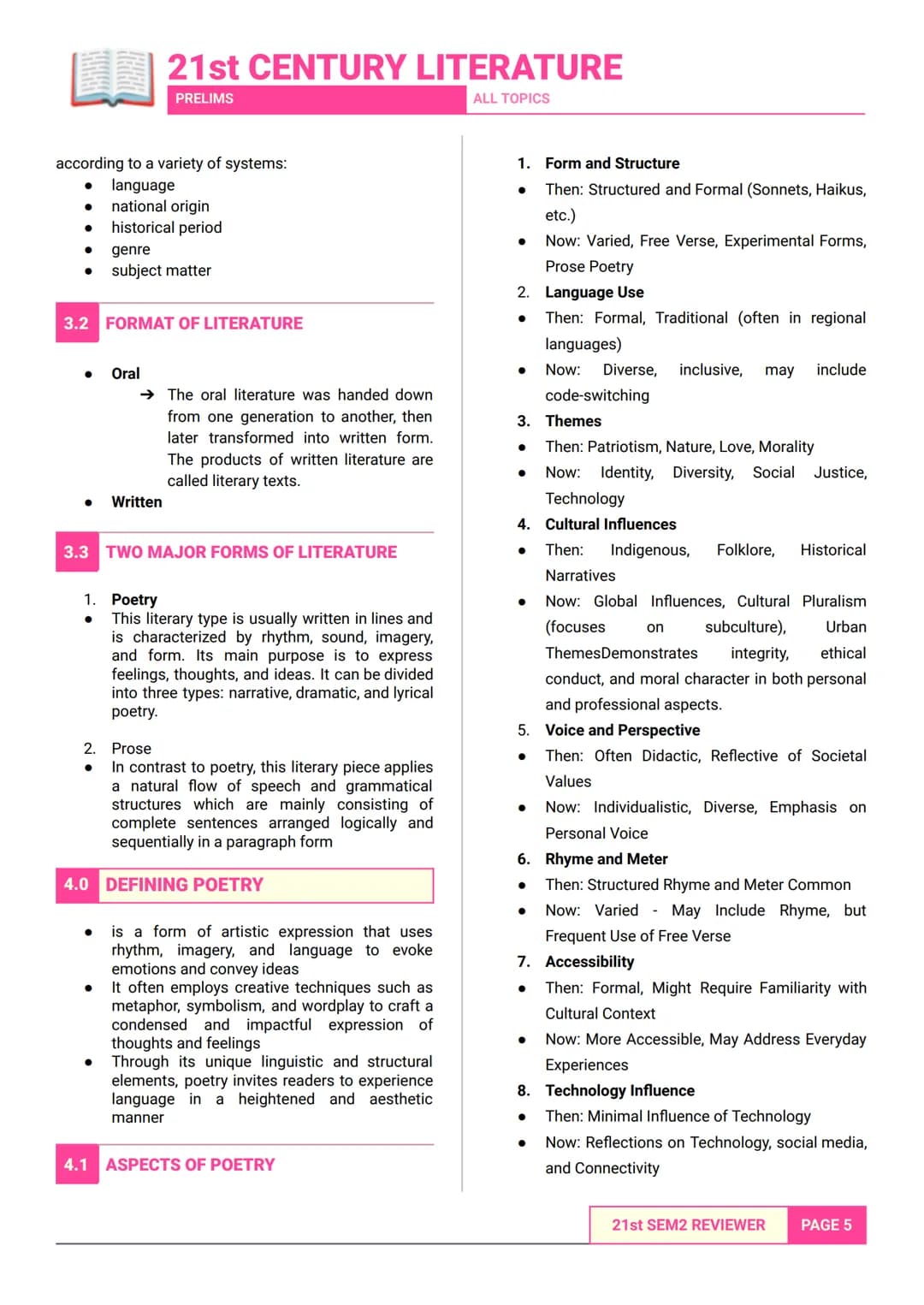
The two major forms of literature are poetry and prose. Poetry is usually written in lines with rhythm, sound, imagery, and specific forms, primarily expressing feelings and ideas. Prose follows a natural flow of speech with complete sentences arranged logically in paragraphs.

Poetry is a condensed and impactful form of artistic expression using rhythm, imagery, and language to evoke emotions. It employs creative techniques like metaphor, symbolism, and wordplay to craft concentrated expressions of thoughts and feelings.

Poetry has evolved significantly over time:

  1. Form and Structure: Traditional poetry used structured forms like sonnets and haikus, while modern poetry embraces free verse and experimental forms.

  2. Language Use: Earlier poetry used formal, traditional language, often in regional dialects. Contemporary poetry employs diverse, inclusive language that may include code-switching.

Try this: Read a traditional poem and a contemporary poem side by side. Notice how the language, structure, and themes differ between them.

  1. Themes: Traditional poetry often focused on patriotism, nature, love, and morality, while modern poetry explores identity, diversity, social justice, and technology.
21st CENTURY LITERATURE
PRELIMS ALL TOPICS
- SEM 2 ALL TOPICS -
aims to teach ethical principles or practical
widsom.
1.0 THE PHILIPPINE LIT

Modern Poetry and Interpretation

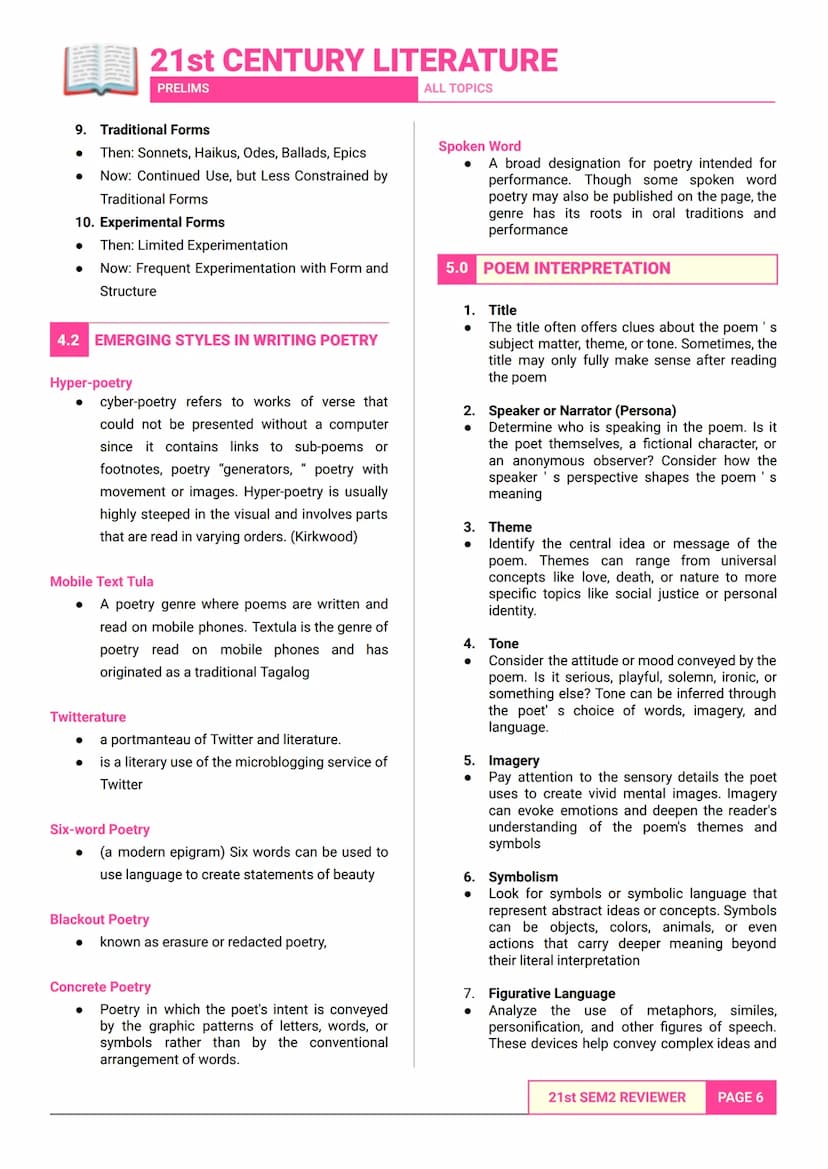
Contemporary poetry continues to evolve with changing cultural influences. Where traditional poetry drew from indigenous folklore and historical narratives, modern poetry incorporates global influences and urban themes.

Emerging styles in poetry show how technology has transformed this ancient art form:

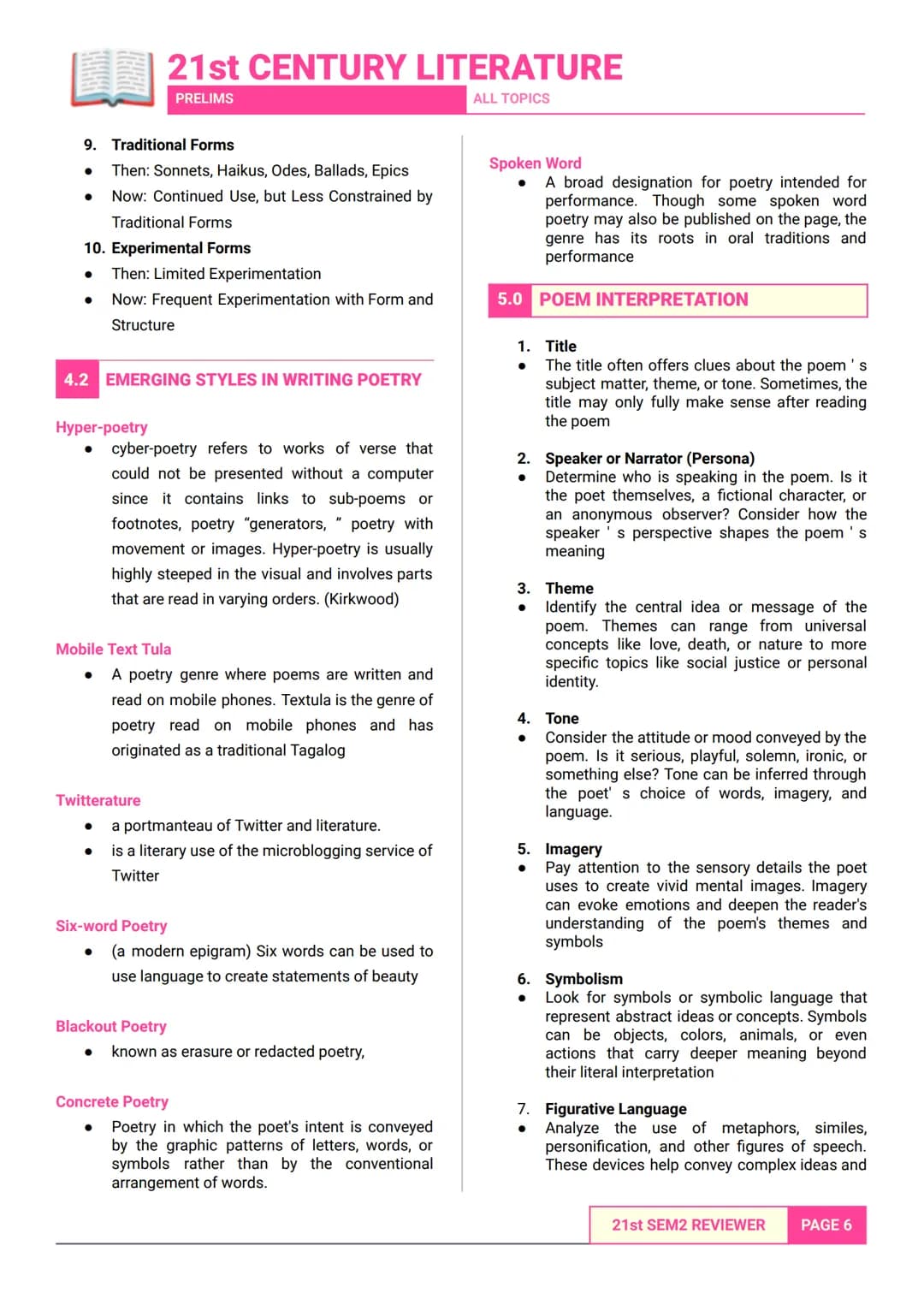
  • Hyper-poetry cyberpoetrycyber-poetry requires computers to display links, generators, or moving elements
  • Mobile Text Tula involves poems written and read on mobile phones
  • Twitterature adapts poetry to Twitter's character limitations
  • Six-word Poetry creates meaning within extreme brevity
  • Blackout Poetry (erasure poetry) creates new meaning by redacting existing text
  • Concrete Poetry uses the graphic patterns of letters and symbols to convey meaning
  • Spoken Word is poetry designed specifically for performance

When interpreting poetry, consider these key elements:

  1. Title - Often contains clues about the subject matter or theme
  2. Speaker/Persona - Identify who is speaking in the poem
  3. Theme - Determine the central idea or message
  4. Tone - Consider the attitude or mood conveyed

Reading tip: When interpreting a poem, read it multiple times. First for general understanding, then to analyze specific elements like imagery and symbolism.

  1. Imagery - Notice sensory details that create vivid mental pictures
  2. Symbolism - Look for objects or concepts that represent deeper meanings
  3. Figurative Language - Analyze metaphors, similes, and personification
  4. Structure and Form - Examine how the poem is organized
  5. Sound Devices - Pay attention to alliteration, assonance, and rhythm
  6. Context - Consider historical, cultural, and biographical influences
21st CENTURY LITERATURE
PRELIMS ALL TOPICS
- SEM 2 ALL TOPICS -
aims to teach ethical principles or practical
widsom.
1.0 THE PHILIPPINE LIT

Understanding Drama

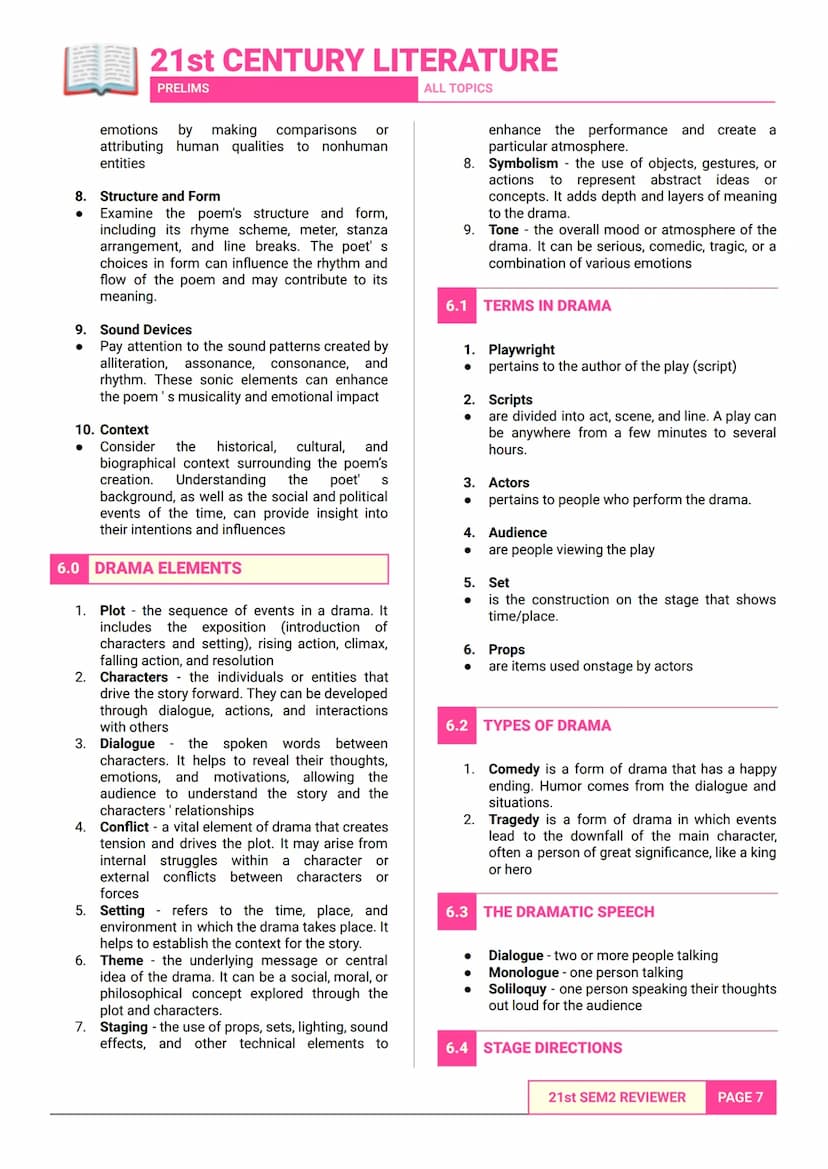
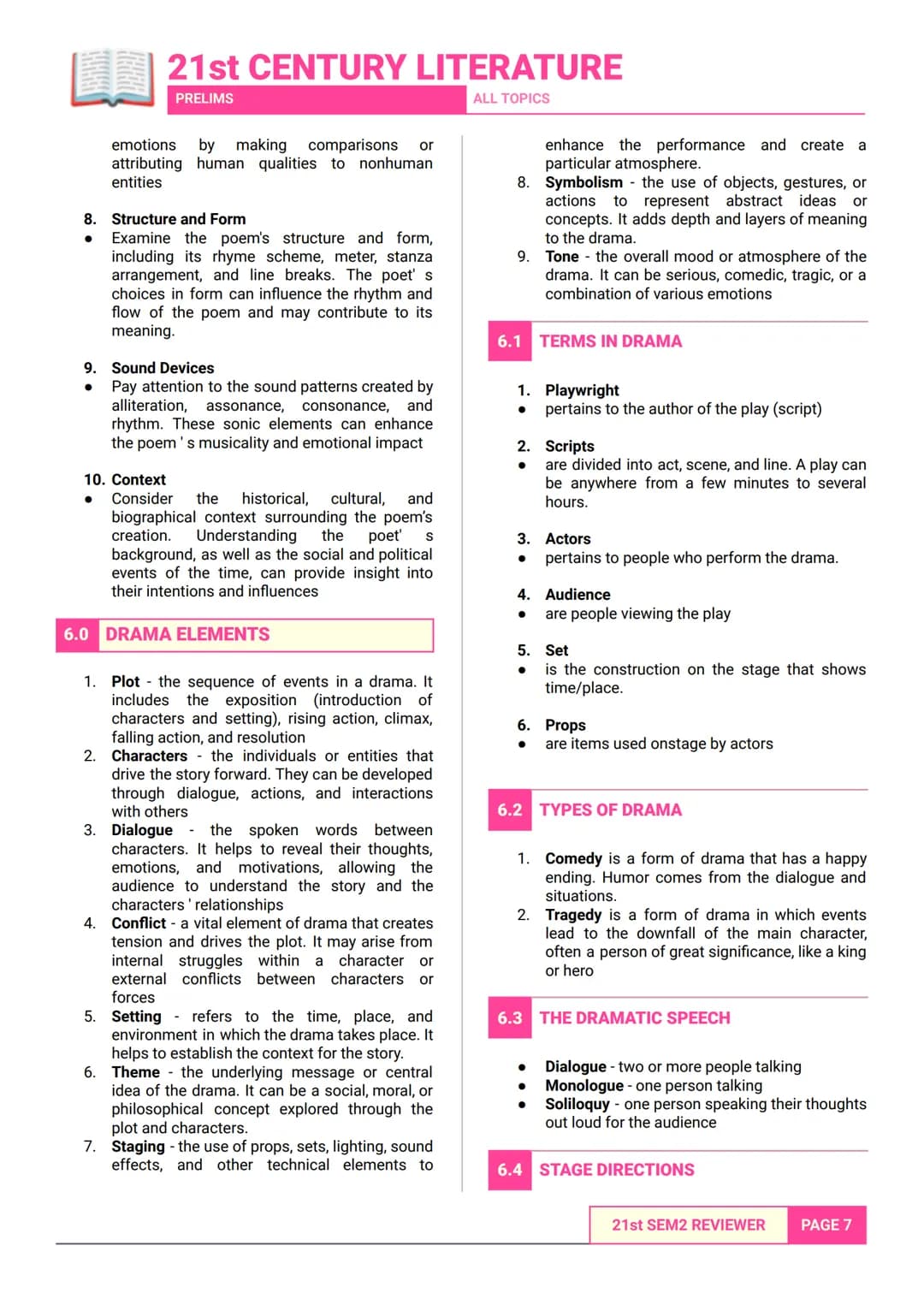
Drama is a literary form meant to be performed before an audience. Its elements work together to create a compelling theatrical experience.

The essential elements of drama include:

  • Plot - The sequence of events including exposition, rising action, climax, falling action, and resolution
  • Characters - The individuals who drive the story forward through dialogue, actions, and interactions
  • Dialogue - The spoken words between characters that reveal thoughts, emotions, and motivations
  • Conflict - The tension that drives the plot, arising from internal or external struggles
  • Setting - The time, place, and environment in which the drama unfolds
  • Theme - The underlying message or central idea explored through the story
  • Staging - The use of props, sets, lighting, and sound to enhance the performance
  • Symbolism - Objects, gestures, or actions representing abstract concepts
  • Tone - The overall mood or atmosphere (serious, comedic, tragic)

Stage direction: In drama scripts, stage directions appear in brackets or parentheses, guiding actors on how to move or speak and describing the scene.

Drama involves several key roles: the playwright (author of the script), actors (performers), and the audience (viewers). The set constructs the time/place on stage, while props are items used by actors during the performance.

The main types of drama are comedy (with a happy ending and humor) and tragedy (leading to the downfall of the main character). Dramatic speech can take several forms: dialogue (conversation between two or more characters), monologue (one person speaking at length), or soliloquy (character speaking thoughts aloud to the audience).

21st CENTURY LITERATURE
PRELIMS ALL TOPICS
- SEM 2 ALL TOPICS -
aims to teach ethical principles or practical
widsom.
1.0 THE PHILIPPINE LIT

Literary Criticism: Psychoanalytic Approach

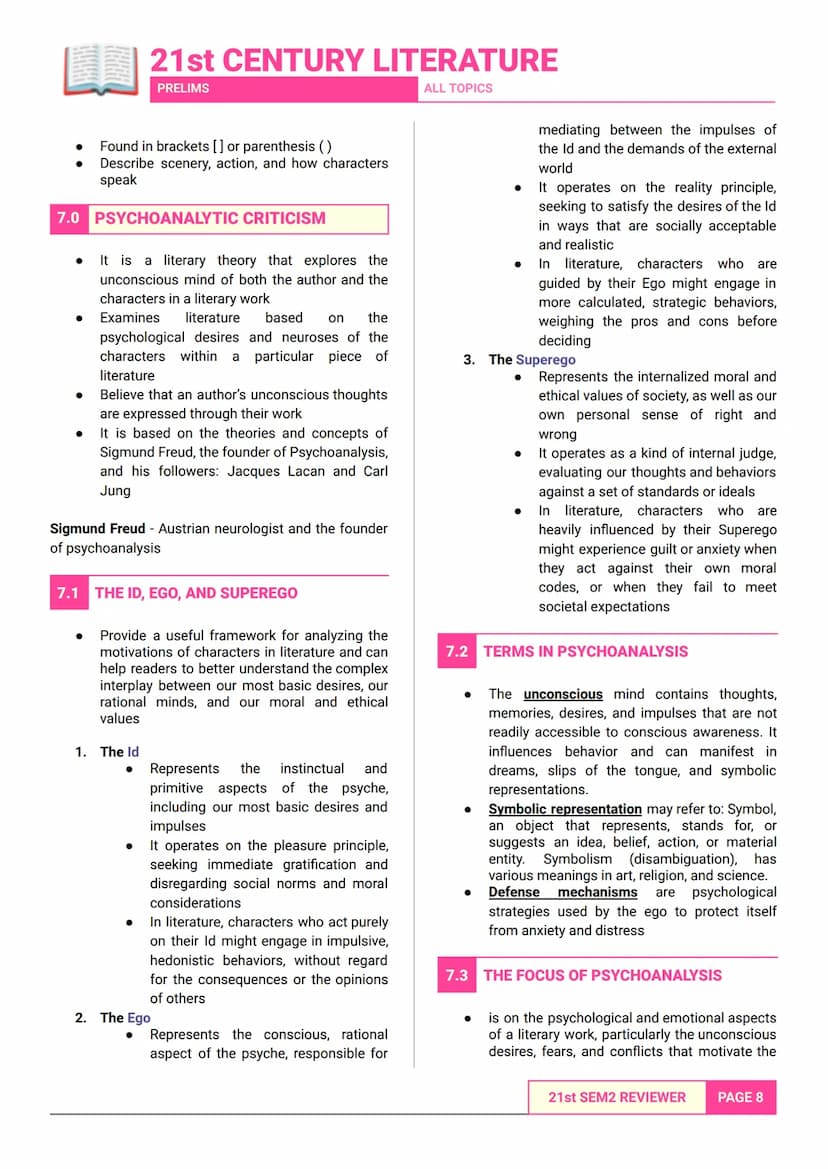
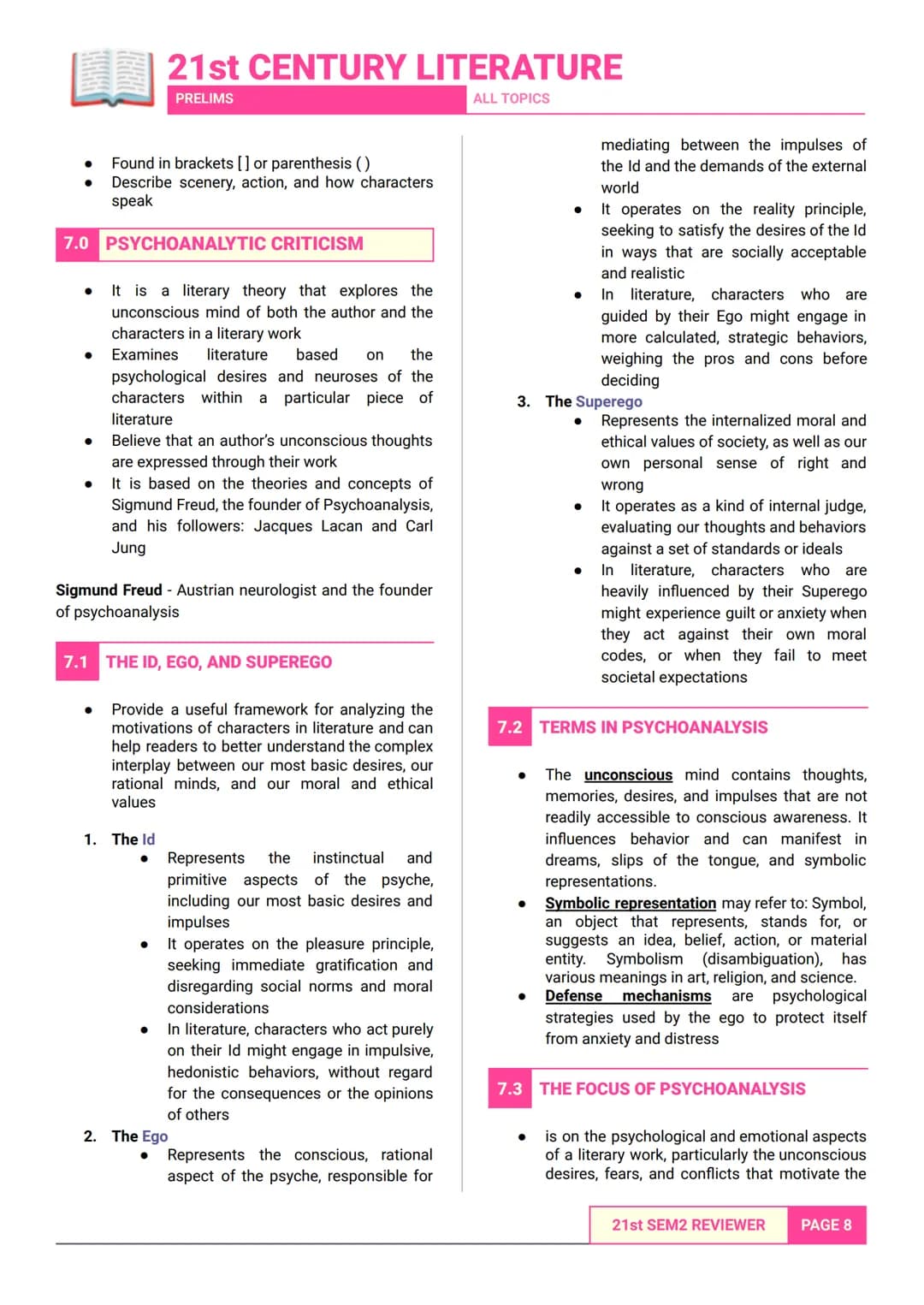
Psychoanalytic criticism explores the unconscious mind of both authors and characters in literature. Based on Sigmund Freud's theories, this approach examines how psychological desires and neuroses shape literary works.

Freud's concept of the human psyche divided into three parts forms the foundation of this approach:

  1. The Id represents our primitive instincts and basic desires, operating on the pleasure principle and seeking immediate gratification. Characters driven by their Id often act impulsively without considering consequences.

  2. The Ego is the rational, conscious aspect that mediates between the Id's impulses and real-world demands. Characters guided by their Ego make calculated decisions, weighing pros and cons before acting.

  3. The Superego embodies our internalized moral and ethical values. Characters heavily influenced by their Superego might experience guilt when acting against their moral code or failing to meet societal expectations.

Literary insight: When analyzing characters through psychoanalysis, look for patterns of behavior that reveal their dominant psychological drives—whether instinctual (Id), rational (Ego), or moral (Superego).

Key concepts in psychoanalysis include the unconscious mind (containing thoughts and desires not readily accessible to awareness), symbolic representation (objects that represent deeper meanings), and defense mechanisms (psychological strategies protecting the ego from anxiety).

When applying psychoanalytic criticism to works like Mary Shelley's Frankenstein, critics might interpret Victor's desire to create life as an unresolved Oedipal complex. In Shakespeare's Hamlet, the protagonist's behavior might be analyzed as stemming from unconscious desires and fear of mortality.

21st CENTURY LITERATURE
PRELIMS ALL TOPICS
- SEM 2 ALL TOPICS -
aims to teach ethical principles or practical
widsom.
1.0 THE PHILIPPINE LIT

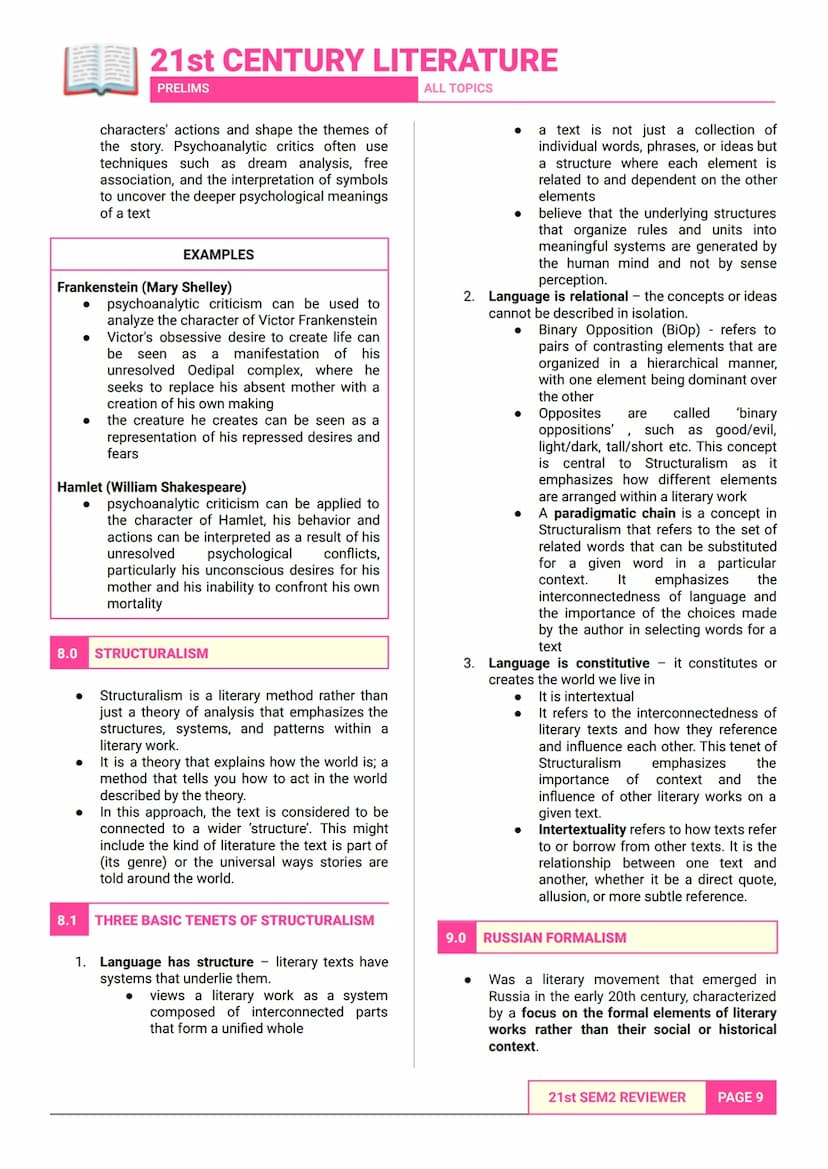
Literary Criticism: Structuralism and Russian Formalism

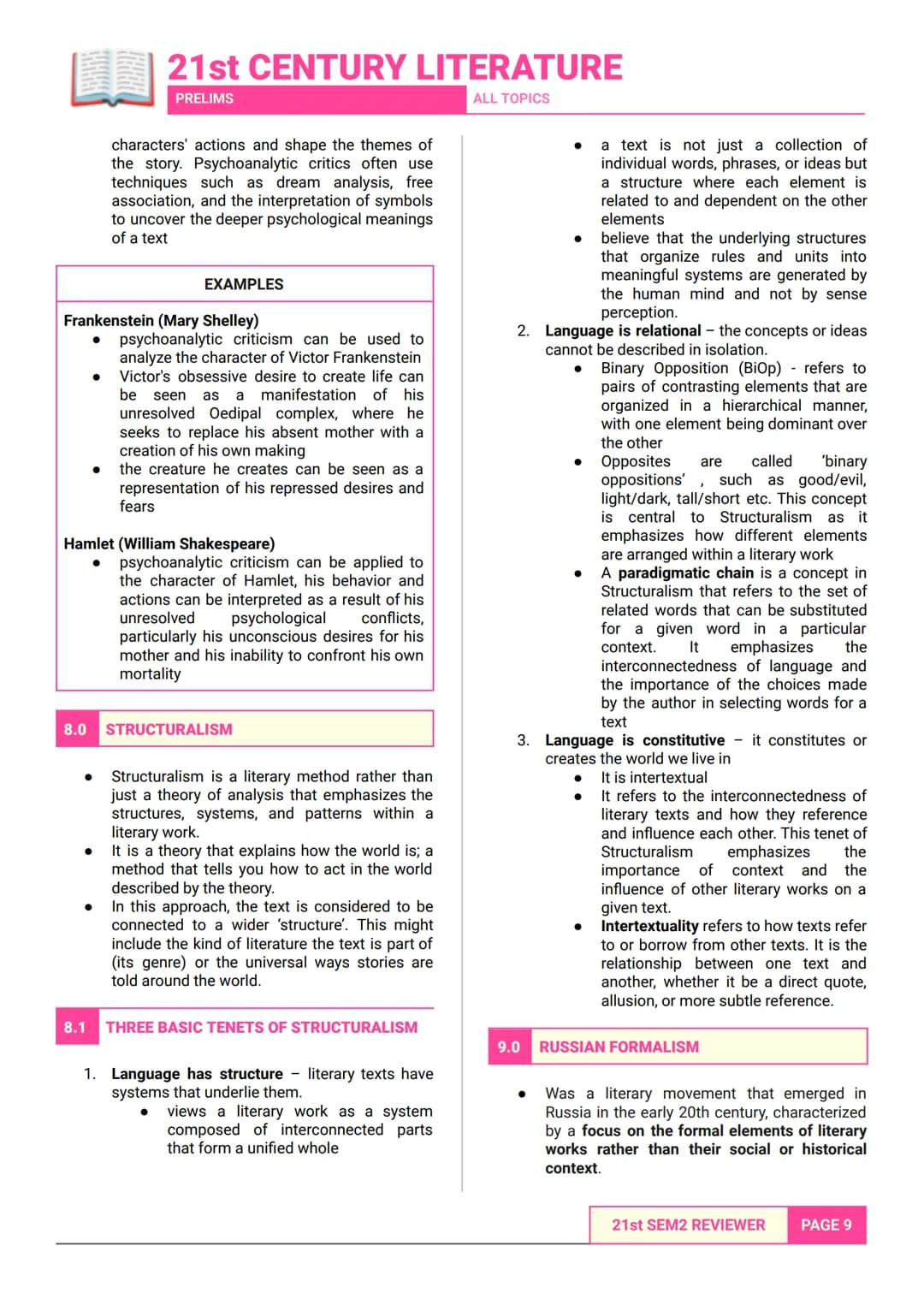
Structuralism examines the structures, systems, and patterns within literary works rather than focusing on content. It views texts as connected to wider structures like genre or universal storytelling patterns.

The three basic tenets of structuralism are:

  1. Language has structure - Literary texts have systems underlying them, forming a unified whole where each element relates to others. Structuralists believe these organizing principles originate in the human mind.

  2. Language is relational - Concepts cannot be described in isolation. Important structuralist concepts include binary oppositions contrastingelementslikegood/evilarrangedhierarchicallycontrasting elements like good/evil arranged hierarchically and paradigmatic chains (sets of related words that can substitute for each other).

  3. Language is constitutive - It creates the world we live in and is intertextual, meaning texts reference and influence each other. Intertextuality refers to relationships between texts through quotes, allusions, or subtle references.

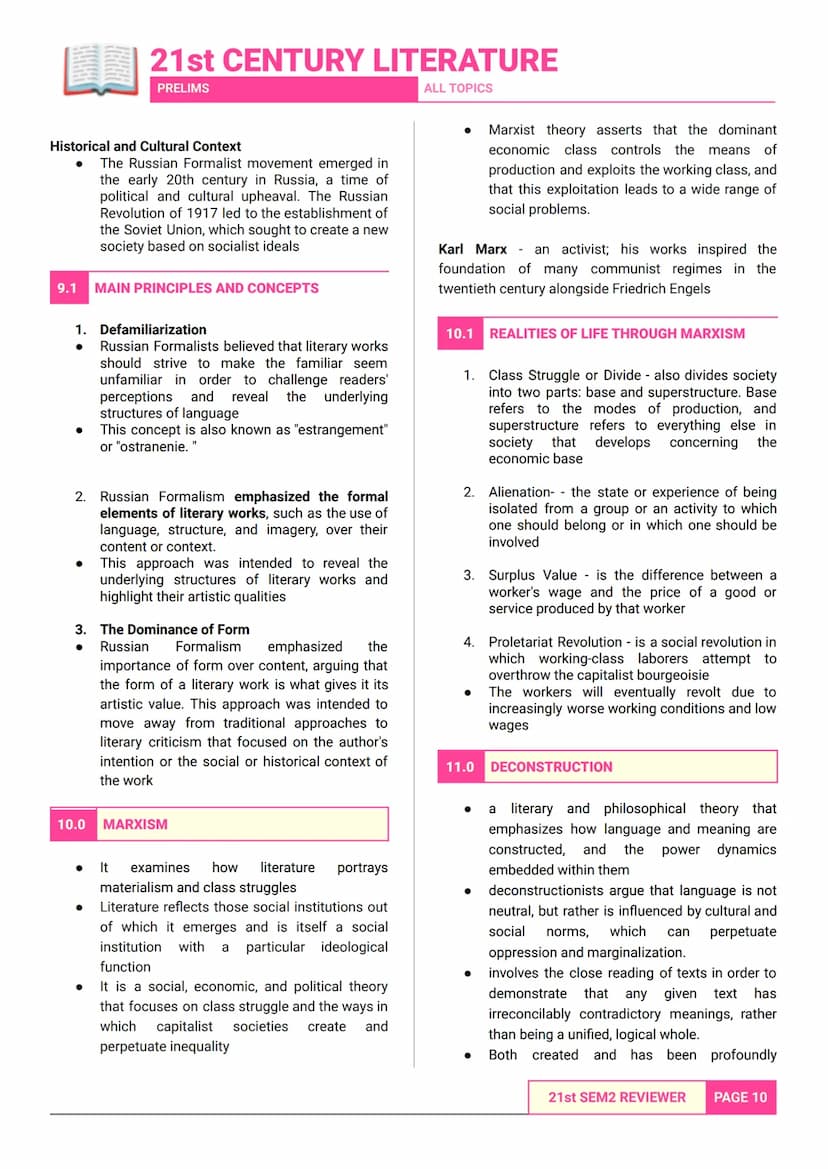
Russian Formalism emerged in early 20th century Russia during political and cultural upheaval. This movement focused on formal elements of literary works rather than social or historical context.

Key concept: Russian Formalists introduced "defamiliarization" (making the familiar seem strange) to challenge readers' perceptions and reveal underlying structures of language.

The main principles of Russian Formalism include:

  1. Defamiliarization (ostranenie) - Making the familiar seem unfamiliar to challenge perceptions
  2. Emphasis on formal elements - Focusing on language use, structure, and imagery over content
  3. The dominance of form - Arguing that a work's form gives it artistic value, rather than content or context
21st CENTURY LITERATURE
PRELIMS ALL TOPICS
- SEM 2 ALL TOPICS -
aims to teach ethical principles or practical
widsom.
1.0 THE PHILIPPINE LIT

Literary Criticism: Marxism and Deconstruction

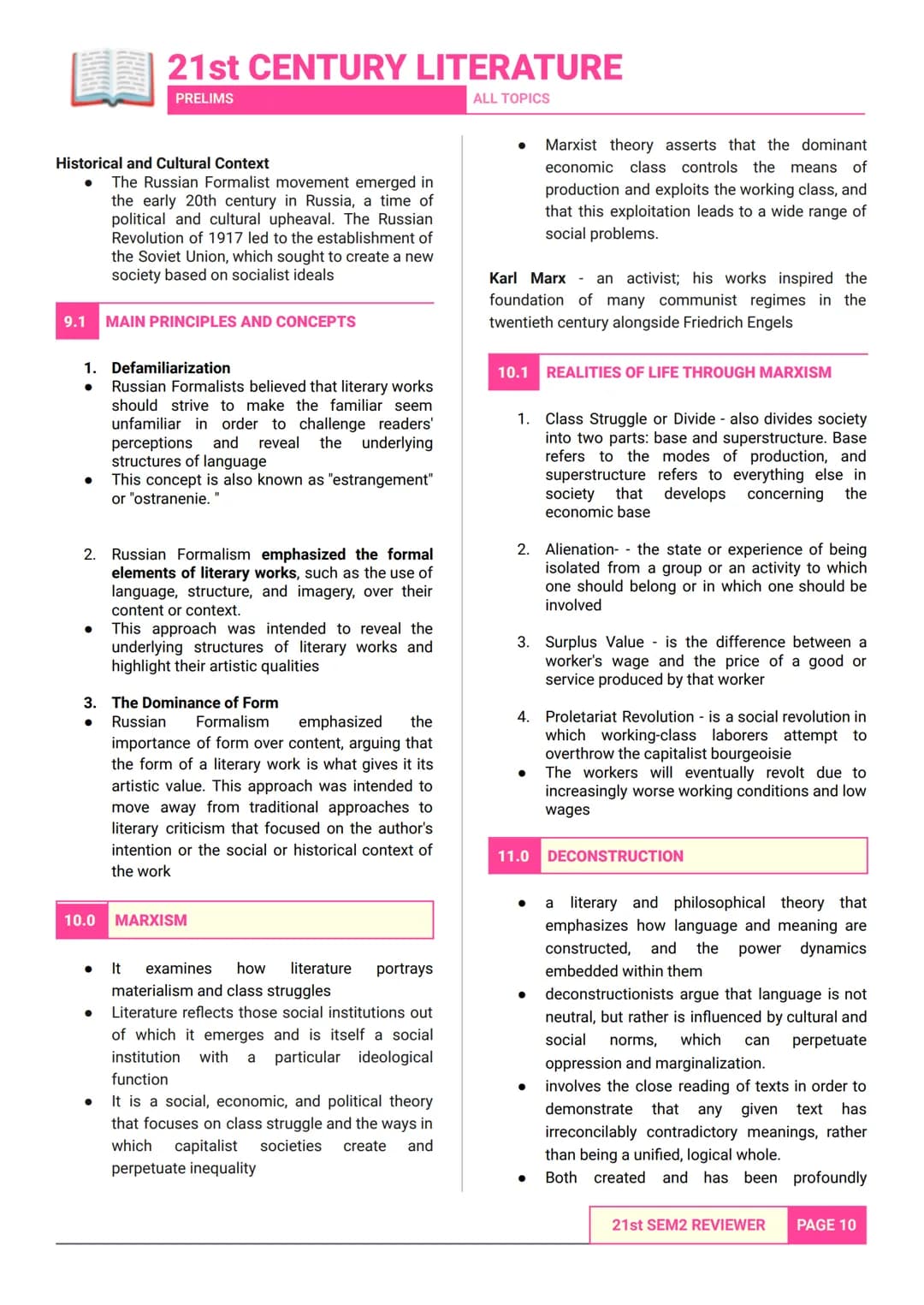
Marxism examines how literature portrays materialism and class struggles. This approach views literature as a social institution reflecting the economic conditions from which it emerges.

Based on the theories of Karl Marx, Marxist criticism analyzes how capitalist societies create and perpetuate inequality. It asserts that the dominant economic class controls production and exploits the working class, leading to social problems.

Key Marxist concepts for analyzing literature include:

  1. Class Struggle/Divide - Society is divided into base (modes of production) and superstructure (everything else in society)
  2. Alienation - The state of being isolated from a group or activity to which one should belong
  3. Surplus Value - The difference between a worker's wage and the price of goods produced
  4. Proletariat Revolution - Working-class laborers attempt to overthrow capitalists due to poor conditions and low wages

Deconstruction is a theory that examines how language and meaning are constructed, along with embedded power dynamics. Created by French philosopher Jacques Derrida, it involves close reading to demonstrate that texts contain contradictory meanings rather than being unified wholes.

Remember: Deconstructionists argue that meaning is always unstable because language itself is unreliable. All texts are therefore open to multiple interpretations.

Characteristics of deconstruction include:

  1. The idea that meaning is always deferred or postponed, never fixed or stable
  2. Recognition that language is inherently self-contradictory and undermines its own authority
  3. Focus on how language marginalizes certain groups and attempts to subvert these power structures
  4. Emphasis on interplay between language and non-linguistic elements (culture, history, ideology)
21st CENTURY LITERATURE
PRELIMS ALL TOPICS
- SEM 2 ALL TOPICS -
aims to teach ethical principles or practical
widsom.
1.0 THE PHILIPPINE LIT

Literary Criticism: Feminist Approach

The feminist approach to literary criticism emerged in the 1970s as a response to the male-dominated nature of traditional literary analysis. This approach examines how literature reflects and reinforces gender norms while promoting representation of women's experiences.

Feminism has developed through three major waves:

  1. First Wave late19thearly20thcenturieslate 19th-early 20th centuries focused on women's political and legal rights including voting rights, property ownership, and equal access to education and employment.

  2. Second Wave 1960s1980s1960s-1980s addressed reproductive rights, domestic violence, and workplace discrimination while challenging cultural norms that perpetuate gender inequality.

  3. Third Wave 1990spresent1990s-present emphasizes intersectionality - recognizing that gender inequality connects with other forms of oppression like racism and classism. It embraces diversity among women and advocates for multiple identities and experiences.

The main goals of feminists include:

  • Equal Rights - Ensuring women have the same legal and political rights as men
  • Social and Political Equality - Challenging gender-based discrimination, violence, and pay inequality
  • Representation - Increasing women's presence in positions of power across society
  • Recognition - Challenging gender stereotypes that limit women's potential

Notable feminists: Mary Wollstonecraft's "A Vindication of the Rights of Woman" (1792) was revolutionary in advocating for women's education. Later influential figures include Elizabeth Cady Stanton (women's suffrage), Betty Friedan ("The Feminine Mystique"), bell hooks (examining race and gender connections), and Maya Angelou ("I Know Why the Caged Bird Sings").

When applying feminist criticism to literature, look for how female characters are portrayed, whether women's voices are authentic, and how gender roles are reinforced or challenged in the text.


We thought you’d never ask...

What is the Knowunity AI companion?

Our AI companion is specifically built for the needs of students. Based on the millions of content pieces we have on the platform we can provide truly meaningful and relevant answers to students. But its not only about answers, the companion is even more about guiding students through their daily learning challenges, with personalised study plans, quizzes or content pieces in the chat and 100% personalisation based on the students skills and developments.

Where can I download the Knowunity app?

You can download the app in the Google Play Store and in the Apple App Store.

Is Knowunity really free of charge?

That's right! Enjoy free access to study content, connect with fellow students, and get instant help – all at your fingertips.

Can't find what you're looking for? Explore other subjects.

Students love us — and so will you.

4.9/5

App Store

4.8/5

Google Play

The app is very easy to use and well designed. I have found everything I was looking for so far and have been able to learn a lot from the presentations! I will definitely use the app for a class assignment! And of course it also helps a lot as an inspiration.

Stefan S

iOS user

This app is really great. There are so many study notes and help [...]. My problem subject is French, for example, and the app has so many options for help. Thanks to this app, I have improved my French. I would recommend it to anyone.

Samantha Klich

Android user

Wow, I am really amazed. I just tried the app because I've seen it advertised many times and was absolutely stunned. This app is THE HELP you want for school and above all, it offers so many things, such as workouts and fact sheets, which have been VERY helpful to me personally.

Anna

iOS user

I think it’s very much worth it and you’ll end up using it a lot once you get the hang of it and even after looking at others notes you can still ask your Artificial intelligence buddy the question and ask to simplify it if you still don’t get it!!! In the end I think it’s worth it 😊👍 ⚠️Also DID I MENTION ITS FREEE YOU DON’T HAVE TO PAY FOR ANYTHING AND STILL GET YOUR GRADES IN PERFECTLY❗️❗️⚠️

Thomas R

iOS user

Knowunity is the BEST app I’ve used in a minute. This is not an ai review or anything this is genuinely coming from a 7th grade student (I know 2011 im young) but dude this app is a 10/10 i have maintained a 3.8 gpa and have plenty of time for gaming. I love it and my mom is just happy I got good grades

Brad T

Android user

Not only did it help me find the answer but it also showed me alternative ways to solve it. I was horrible in math and science but now I have an a in both subjects. Thanks for the help🤍🤍

David K

iOS user

The app's just great! All I have to do is enter the topic in the search bar and I get the response real fast. I don't have to watch 10 YouTube videos to understand something, so I'm saving my time. Highly recommended!

Sudenaz Ocak

Android user

In school I was really bad at maths but thanks to the app, I am doing better now. I am so grateful that you made the app.

Greenlight Bonnie

Android user

I found this app a couple years ago and it has only gotten better since then. I really love it because it can help with written questions and photo questions. Also, it can find study guides that other people have made as well as flashcard sets and practice tests. The free version is also amazing for students who might not be able to afford it. Would 100% recommend

Aubrey

iOS user

Best app if you're in Highschool or Junior high. I have been using this app for 2 school years and it's the best, it's good if you don't have anyone to help you with school work.😋🩷🎀

Marco B

iOS user

THE QUIZES AND FLASHCARDS ARE SO USEFUL AND I LOVE THE SCHOOLGPT. IT ALSO IS LITREALLY LIKE CHATGPT BUT SMARTER!! HELPED ME WITH MY MASCARA PROBLEMS TOO!! AS WELL AS MY REAL SUBJECTS ! DUHHH 😍😁😲🤑💗✨🎀😮

Elisha

iOS user

This app is phenomenal down to the correct info and the various topics you can study! I greatly recommend it for people who struggle with procrastination and those who need homework help. It has been perfectly accurate for world 1 history as far as I’ve seen! Geometry too!

Paul T

iOS user

The app is very easy to use and well designed. I have found everything I was looking for so far and have been able to learn a lot from the presentations! I will definitely use the app for a class assignment! And of course it also helps a lot as an inspiration.

Stefan S

iOS user

This app is really great. There are so many study notes and help [...]. My problem subject is French, for example, and the app has so many options for help. Thanks to this app, I have improved my French. I would recommend it to anyone.

Samantha Klich

Android user

Wow, I am really amazed. I just tried the app because I've seen it advertised many times and was absolutely stunned. This app is THE HELP you want for school and above all, it offers so many things, such as workouts and fact sheets, which have been VERY helpful to me personally.

Anna

iOS user

I think it’s very much worth it and you’ll end up using it a lot once you get the hang of it and even after looking at others notes you can still ask your Artificial intelligence buddy the question and ask to simplify it if you still don’t get it!!! In the end I think it’s worth it 😊👍 ⚠️Also DID I MENTION ITS FREEE YOU DON’T HAVE TO PAY FOR ANYTHING AND STILL GET YOUR GRADES IN PERFECTLY❗️❗️⚠️

Thomas R

iOS user

Knowunity is the BEST app I’ve used in a minute. This is not an ai review or anything this is genuinely coming from a 7th grade student (I know 2011 im young) but dude this app is a 10/10 i have maintained a 3.8 gpa and have plenty of time for gaming. I love it and my mom is just happy I got good grades

Brad T

Android user

Not only did it help me find the answer but it also showed me alternative ways to solve it. I was horrible in math and science but now I have an a in both subjects. Thanks for the help🤍🤍

David K

iOS user

The app's just great! All I have to do is enter the topic in the search bar and I get the response real fast. I don't have to watch 10 YouTube videos to understand something, so I'm saving my time. Highly recommended!

Sudenaz Ocak

Android user

In school I was really bad at maths but thanks to the app, I am doing better now. I am so grateful that you made the app.

Greenlight Bonnie

Android user

I found this app a couple years ago and it has only gotten better since then. I really love it because it can help with written questions and photo questions. Also, it can find study guides that other people have made as well as flashcard sets and practice tests. The free version is also amazing for students who might not be able to afford it. Would 100% recommend

Aubrey

iOS user

Best app if you're in Highschool or Junior high. I have been using this app for 2 school years and it's the best, it's good if you don't have anyone to help you with school work.😋🩷🎀

Marco B

iOS user

THE QUIZES AND FLASHCARDS ARE SO USEFUL AND I LOVE THE SCHOOLGPT. IT ALSO IS LITREALLY LIKE CHATGPT BUT SMARTER!! HELPED ME WITH MY MASCARA PROBLEMS TOO!! AS WELL AS MY REAL SUBJECTS ! DUHHH 😍😁😲🤑💗✨🎀😮

Elisha

iOS user

This app is phenomenal down to the correct info and the various topics you can study! I greatly recommend it for people who struggle with procrastination and those who need homework help. It has been perfectly accurate for world 1 history as far as I’ve seen! Geometry too!

Paul T

iOS user


21st Lit

3,087

Dec 13, 2025

12 pages

Exploring 21st Century Literature

S

secret

@secretaccountto

Welcome to 21st Century Literature! This course explores how literature has evolved across different periods, from pre-colonial oral traditions to contemporary works, while examining various critical approaches to understanding literature. You'll learn about Philippine literary history, notable national artists, and... Show more

21st CENTURY LITERATURE
PRELIMS ALL TOPICS
- SEM 2 ALL TOPICS -
aims to teach ethical principles or practical
widsom.
1.0 THE PHILIPPINE LIT

Sign up to see the contentIt's free!

Access to all documents

Improve your grades

Join milions of students

By signing up you accept Terms of Service and Privacy Policy

Philippine Literature Through Time

The rich tapestry of Philippine literature began long before colonizers arrived on our shores. During the pre-colonial period, literature thrived through oral traditions that were passed down through generations.

Folk literature took various forms including riddles, proverbs, and folk songs like the soothing Oyayi (lullabies) and romantic Harana (courtship songs). Folk tales or folklore were stories in prose such as myths (explaining cultural beliefs), legends (based on historical events but embellished), and fables (short stories with moral lessons, often featuring animals).

During the Spanish colonial period (1565-1898), written literature was introduced through Spanish. Notable works include Francisco Balagtas's "Florante at Laura" and Jose Rizal's revolutionary novels "Noli Me Tangere" and "El Filibusterismo". Religious performances emerged such as Tibag (devotion to the Holy Cross), Cenaculo (Christ's passion), and Panunuluyan reenactmentoftheNativityre-enactment of the Nativity.

Did you know? The first book published in the Philippines was the "Doctrina Cristiana" - a compilation of Tagalog and Spanish prayers and Catholic catechism.

The American period (1898-1946) brought a shift to English-language literature. This era saw the rise of the short story form with works like Paz Marquez Benitez's "Dead Stars" and Manuel Arguilla's "How My Brother Leon Brought Home a Wife". Writers during this time often depicted their love for country and longing for independence.

21st CENTURY LITERATURE
PRELIMS ALL TOPICS
- SEM 2 ALL TOPICS -
aims to teach ethical principles or practical
widsom.
1.0 THE PHILIPPINE LIT

Sign up to see the contentIt's free!

Access to all documents

Improve your grades

Join milions of students

By signing up you accept Terms of Service and Privacy Policy

Colonial Influences and Contemporary Literature

During the American period, Filipino writers went through a period of apprenticeship (1910-1930), imitating English and American models while expressing patriotic themes. Their writings spanned various genres including poetry, short stories, and drama.

The Japanese occupation (1942-1945) brought severe suppression of literature, yet sparked resistance through guerrilla writing. Despite harsh censorship, Filipino literature continued to develop, with publications like "Liwayway" magazine featuring Tagalog serialized novels, short stories, and poetry.

The contemporary period 1946present1946-present has witnessed the modernization of Philippine literature with diverse genres and themes. Writers began exploring new voices and perspectives that reflect contemporary issues. Notable works include "The Cardinal's Sins" by Gregorio Brillantes and "Manananggal Terrorizes Manila and Other Stories" by Jessica Zafra.

Order of National Artists

The Order of National Artists is the highest national recognition given to Filipino individuals who have made significant contributions to Philippine arts. Recipients receive a Grand Collar symbolizing their status and representing the highest ideals of humanities and aesthetics.

Remember this: National Artists are selected based on several criteria including artistic excellence, significance to national identity, lifetime contribution, and high moral standards.

Selection is a rigorous process requiring evaluation by experts and formal declaration through a Presidential Proclamation. The honor recognizes various fields including literature, music, dance, visual arts, theater, film, and architecture.

21st CENTURY LITERATURE
PRELIMS ALL TOPICS
- SEM 2 ALL TOPICS -
aims to teach ethical principles or practical
widsom.
1.0 THE PHILIPPINE LIT

Sign up to see the contentIt's free!

Access to all documents

Improve your grades

Join milions of students

By signing up you accept Terms of Service and Privacy Policy

National Artists for Literature

The Philippines honors its literary giants through the National Artist award. These writers have shaped the nation's literary landscape through their exceptional works.

Francisco Arcellana (awarded 1990) wrote masterpieces like "The Mats" and "Divided by Two." His immortal line "Write the story that only you can write" continues to inspire young writers today.

Edith L. Tiempo (awarded 1999) crafted beautiful works like "The Builder" and "A Blade of Fern." Her profound statement "No two persons ever read the same book" reminds us how literature connects uniquely with each reader.

Bienvenido Lumbera (awarded 2006) contributed significantly to Filipino literature with works like "Likhang Dila, Likhang Diwa." His writings often emphasized national identity, stating "Ang diwang masilayan sa sariling bayan ay naroroon sa diwang pambansa."

Nestor Vicente Madali Gonzales (awarded 1997) is known for "The Bamboo Dancers" and the short story "The Bread of Salt" with its famous line "The bread is not yet ready."

Fun fact: Many National Artists for Literature were also educators who shaped generations of Filipino writers through their teaching and mentorship.

Other distinguished National Artists include Virgilio S. Almario (Rio Alma), Cirilo F. Bautista, Nick Joaquin (the first National Artist for Literature), and Amado Hernandez. Each brought unique perspectives and styles that enriched Philippine literature.

21st CENTURY LITERATURE
PRELIMS ALL TOPICS
- SEM 2 ALL TOPICS -
aims to teach ethical principles or practical
widsom.
1.0 THE PHILIPPINE LIT

Sign up to see the contentIt's free!

Access to all documents

Improve your grades

Join milions of students

By signing up you accept Terms of Service and Privacy Policy

Understanding Literature and Poetry

Literature comes from the Latin word "littera" meaning "a letter of the alphabet." It refers to works of imaginative, artistic, or intellectual value that use language to convey ideas, emotions, and experiences.

Literature can be classified according to language, national origin, historical period, genre, or subject matter. It exists in both oral (handed down through generations) and written forms (literary texts).

The two major forms of literature are poetry and prose. Poetry is usually written in lines with rhythm, sound, imagery, and specific forms, primarily expressing feelings and ideas. Prose follows a natural flow of speech with complete sentences arranged logically in paragraphs.

Poetry is a condensed and impactful form of artistic expression using rhythm, imagery, and language to evoke emotions. It employs creative techniques like metaphor, symbolism, and wordplay to craft concentrated expressions of thoughts and feelings.

Poetry has evolved significantly over time:

  1. Form and Structure: Traditional poetry used structured forms like sonnets and haikus, while modern poetry embraces free verse and experimental forms.

  2. Language Use: Earlier poetry used formal, traditional language, often in regional dialects. Contemporary poetry employs diverse, inclusive language that may include code-switching.

Try this: Read a traditional poem and a contemporary poem side by side. Notice how the language, structure, and themes differ between them.

  1. Themes: Traditional poetry often focused on patriotism, nature, love, and morality, while modern poetry explores identity, diversity, social justice, and technology.
21st CENTURY LITERATURE
PRELIMS ALL TOPICS
- SEM 2 ALL TOPICS -
aims to teach ethical principles or practical
widsom.
1.0 THE PHILIPPINE LIT

Sign up to see the contentIt's free!

Access to all documents

Improve your grades

Join milions of students

By signing up you accept Terms of Service and Privacy Policy

Modern Poetry and Interpretation

Contemporary poetry continues to evolve with changing cultural influences. Where traditional poetry drew from indigenous folklore and historical narratives, modern poetry incorporates global influences and urban themes.

Emerging styles in poetry show how technology has transformed this ancient art form:

  • Hyper-poetry cyberpoetrycyber-poetry requires computers to display links, generators, or moving elements
  • Mobile Text Tula involves poems written and read on mobile phones
  • Twitterature adapts poetry to Twitter's character limitations
  • Six-word Poetry creates meaning within extreme brevity
  • Blackout Poetry (erasure poetry) creates new meaning by redacting existing text
  • Concrete Poetry uses the graphic patterns of letters and symbols to convey meaning
  • Spoken Word is poetry designed specifically for performance

When interpreting poetry, consider these key elements:

  1. Title - Often contains clues about the subject matter or theme
  2. Speaker/Persona - Identify who is speaking in the poem
  3. Theme - Determine the central idea or message
  4. Tone - Consider the attitude or mood conveyed

Reading tip: When interpreting a poem, read it multiple times. First for general understanding, then to analyze specific elements like imagery and symbolism.

  1. Imagery - Notice sensory details that create vivid mental pictures
  2. Symbolism - Look for objects or concepts that represent deeper meanings
  3. Figurative Language - Analyze metaphors, similes, and personification
  4. Structure and Form - Examine how the poem is organized
  5. Sound Devices - Pay attention to alliteration, assonance, and rhythm
  6. Context - Consider historical, cultural, and biographical influences
21st CENTURY LITERATURE
PRELIMS ALL TOPICS
- SEM 2 ALL TOPICS -
aims to teach ethical principles or practical
widsom.
1.0 THE PHILIPPINE LIT

Sign up to see the contentIt's free!

Access to all documents

Improve your grades

Join milions of students

By signing up you accept Terms of Service and Privacy Policy

Understanding Drama

Drama is a literary form meant to be performed before an audience. Its elements work together to create a compelling theatrical experience.

The essential elements of drama include:

  • Plot - The sequence of events including exposition, rising action, climax, falling action, and resolution
  • Characters - The individuals who drive the story forward through dialogue, actions, and interactions
  • Dialogue - The spoken words between characters that reveal thoughts, emotions, and motivations
  • Conflict - The tension that drives the plot, arising from internal or external struggles
  • Setting - The time, place, and environment in which the drama unfolds
  • Theme - The underlying message or central idea explored through the story
  • Staging - The use of props, sets, lighting, and sound to enhance the performance
  • Symbolism - Objects, gestures, or actions representing abstract concepts
  • Tone - The overall mood or atmosphere (serious, comedic, tragic)

Stage direction: In drama scripts, stage directions appear in brackets or parentheses, guiding actors on how to move or speak and describing the scene.

Drama involves several key roles: the playwright (author of the script), actors (performers), and the audience (viewers). The set constructs the time/place on stage, while props are items used by actors during the performance.

The main types of drama are comedy (with a happy ending and humor) and tragedy (leading to the downfall of the main character). Dramatic speech can take several forms: dialogue (conversation between two or more characters), monologue (one person speaking at length), or soliloquy (character speaking thoughts aloud to the audience).

21st CENTURY LITERATURE
PRELIMS ALL TOPICS
- SEM 2 ALL TOPICS -
aims to teach ethical principles or practical
widsom.
1.0 THE PHILIPPINE LIT

Sign up to see the contentIt's free!

Access to all documents

Improve your grades

Join milions of students

By signing up you accept Terms of Service and Privacy Policy

Literary Criticism: Psychoanalytic Approach

Psychoanalytic criticism explores the unconscious mind of both authors and characters in literature. Based on Sigmund Freud's theories, this approach examines how psychological desires and neuroses shape literary works.

Freud's concept of the human psyche divided into three parts forms the foundation of this approach:

  1. The Id represents our primitive instincts and basic desires, operating on the pleasure principle and seeking immediate gratification. Characters driven by their Id often act impulsively without considering consequences.

  2. The Ego is the rational, conscious aspect that mediates between the Id's impulses and real-world demands. Characters guided by their Ego make calculated decisions, weighing pros and cons before acting.

  3. The Superego embodies our internalized moral and ethical values. Characters heavily influenced by their Superego might experience guilt when acting against their moral code or failing to meet societal expectations.

Literary insight: When analyzing characters through psychoanalysis, look for patterns of behavior that reveal their dominant psychological drives—whether instinctual (Id), rational (Ego), or moral (Superego).

Key concepts in psychoanalysis include the unconscious mind (containing thoughts and desires not readily accessible to awareness), symbolic representation (objects that represent deeper meanings), and defense mechanisms (psychological strategies protecting the ego from anxiety).

When applying psychoanalytic criticism to works like Mary Shelley's Frankenstein, critics might interpret Victor's desire to create life as an unresolved Oedipal complex. In Shakespeare's Hamlet, the protagonist's behavior might be analyzed as stemming from unconscious desires and fear of mortality.

21st CENTURY LITERATURE
PRELIMS ALL TOPICS
- SEM 2 ALL TOPICS -
aims to teach ethical principles or practical
widsom.
1.0 THE PHILIPPINE LIT

Sign up to see the contentIt's free!

Access to all documents

Improve your grades

Join milions of students

By signing up you accept Terms of Service and Privacy Policy

Literary Criticism: Structuralism and Russian Formalism

Structuralism examines the structures, systems, and patterns within literary works rather than focusing on content. It views texts as connected to wider structures like genre or universal storytelling patterns.

The three basic tenets of structuralism are:

  1. Language has structure - Literary texts have systems underlying them, forming a unified whole where each element relates to others. Structuralists believe these organizing principles originate in the human mind.

  2. Language is relational - Concepts cannot be described in isolation. Important structuralist concepts include binary oppositions contrastingelementslikegood/evilarrangedhierarchicallycontrasting elements like good/evil arranged hierarchically and paradigmatic chains (sets of related words that can substitute for each other).

  3. Language is constitutive - It creates the world we live in and is intertextual, meaning texts reference and influence each other. Intertextuality refers to relationships between texts through quotes, allusions, or subtle references.

Russian Formalism emerged in early 20th century Russia during political and cultural upheaval. This movement focused on formal elements of literary works rather than social or historical context.

Key concept: Russian Formalists introduced "defamiliarization" (making the familiar seem strange) to challenge readers' perceptions and reveal underlying structures of language.

The main principles of Russian Formalism include:

  1. Defamiliarization (ostranenie) - Making the familiar seem unfamiliar to challenge perceptions
  2. Emphasis on formal elements - Focusing on language use, structure, and imagery over content
  3. The dominance of form - Arguing that a work's form gives it artistic value, rather than content or context
21st CENTURY LITERATURE
PRELIMS ALL TOPICS
- SEM 2 ALL TOPICS -
aims to teach ethical principles or practical
widsom.
1.0 THE PHILIPPINE LIT

Sign up to see the contentIt's free!

Access to all documents

Improve your grades

Join milions of students

By signing up you accept Terms of Service and Privacy Policy

Literary Criticism: Marxism and Deconstruction

Marxism examines how literature portrays materialism and class struggles. This approach views literature as a social institution reflecting the economic conditions from which it emerges.

Based on the theories of Karl Marx, Marxist criticism analyzes how capitalist societies create and perpetuate inequality. It asserts that the dominant economic class controls production and exploits the working class, leading to social problems.

Key Marxist concepts for analyzing literature include:

  1. Class Struggle/Divide - Society is divided into base (modes of production) and superstructure (everything else in society)
  2. Alienation - The state of being isolated from a group or activity to which one should belong
  3. Surplus Value - The difference between a worker's wage and the price of goods produced
  4. Proletariat Revolution - Working-class laborers attempt to overthrow capitalists due to poor conditions and low wages

Deconstruction is a theory that examines how language and meaning are constructed, along with embedded power dynamics. Created by French philosopher Jacques Derrida, it involves close reading to demonstrate that texts contain contradictory meanings rather than being unified wholes.

Remember: Deconstructionists argue that meaning is always unstable because language itself is unreliable. All texts are therefore open to multiple interpretations.

Characteristics of deconstruction include:

  1. The idea that meaning is always deferred or postponed, never fixed or stable
  2. Recognition that language is inherently self-contradictory and undermines its own authority
  3. Focus on how language marginalizes certain groups and attempts to subvert these power structures
  4. Emphasis on interplay between language and non-linguistic elements (culture, history, ideology)
21st CENTURY LITERATURE
PRELIMS ALL TOPICS
- SEM 2 ALL TOPICS -
aims to teach ethical principles or practical
widsom.
1.0 THE PHILIPPINE LIT

Sign up to see the contentIt's free!

Access to all documents

Improve your grades

Join milions of students

By signing up you accept Terms of Service and Privacy Policy

Literary Criticism: Feminist Approach

The feminist approach to literary criticism emerged in the 1970s as a response to the male-dominated nature of traditional literary analysis. This approach examines how literature reflects and reinforces gender norms while promoting representation of women's experiences.

Feminism has developed through three major waves:

  1. First Wave late19thearly20thcenturieslate 19th-early 20th centuries focused on women's political and legal rights including voting rights, property ownership, and equal access to education and employment.

  2. Second Wave 1960s1980s1960s-1980s addressed reproductive rights, domestic violence, and workplace discrimination while challenging cultural norms that perpetuate gender inequality.

  3. Third Wave 1990spresent1990s-present emphasizes intersectionality - recognizing that gender inequality connects with other forms of oppression like racism and classism. It embraces diversity among women and advocates for multiple identities and experiences.

The main goals of feminists include:

  • Equal Rights - Ensuring women have the same legal and political rights as men
  • Social and Political Equality - Challenging gender-based discrimination, violence, and pay inequality
  • Representation - Increasing women's presence in positions of power across society
  • Recognition - Challenging gender stereotypes that limit women's potential

Notable feminists: Mary Wollstonecraft's "A Vindication of the Rights of Woman" (1792) was revolutionary in advocating for women's education. Later influential figures include Elizabeth Cady Stanton (women's suffrage), Betty Friedan ("The Feminine Mystique"), bell hooks (examining race and gender connections), and Maya Angelou ("I Know Why the Caged Bird Sings").

When applying feminist criticism to literature, look for how female characters are portrayed, whether women's voices are authentic, and how gender roles are reinforced or challenged in the text.

We thought you’d never ask...

What is the Knowunity AI companion?

Our AI companion is specifically built for the needs of students. Based on the millions of content pieces we have on the platform we can provide truly meaningful and relevant answers to students. But its not only about answers, the companion is even more about guiding students through their daily learning challenges, with personalised study plans, quizzes or content pieces in the chat and 100% personalisation based on the students skills and developments.

Where can I download the Knowunity app?

You can download the app in the Google Play Store and in the Apple App Store.

Is Knowunity really free of charge?

That's right! Enjoy free access to study content, connect with fellow students, and get instant help – all at your fingertips.

70

Smart Tools NEW

Transform this note into: ✓ 50+ Practice Questions ✓ Interactive Flashcards ✓ Full Mock Exam ✓ Essay Outlines

Mock Exam
Quiz
Flashcards
Essay

Can't find what you're looking for? Explore other subjects.

Students love us — and so will you.

4.9/5

App Store

4.8/5

Google Play

The app is very easy to use and well designed. I have found everything I was looking for so far and have been able to learn a lot from the presentations! I will definitely use the app for a class assignment! And of course it also helps a lot as an inspiration.

Stefan S

iOS user

This app is really great. There are so many study notes and help [...]. My problem subject is French, for example, and the app has so many options for help. Thanks to this app, I have improved my French. I would recommend it to anyone.

Samantha Klich

Android user

Wow, I am really amazed. I just tried the app because I've seen it advertised many times and was absolutely stunned. This app is THE HELP you want for school and above all, it offers so many things, such as workouts and fact sheets, which have been VERY helpful to me personally.

Anna

iOS user

I think it’s very much worth it and you’ll end up using it a lot once you get the hang of it and even after looking at others notes you can still ask your Artificial intelligence buddy the question and ask to simplify it if you still don’t get it!!! In the end I think it’s worth it 😊👍 ⚠️Also DID I MENTION ITS FREEE YOU DON’T HAVE TO PAY FOR ANYTHING AND STILL GET YOUR GRADES IN PERFECTLY❗️❗️⚠️

Thomas R

iOS user

Knowunity is the BEST app I’ve used in a minute. This is not an ai review or anything this is genuinely coming from a 7th grade student (I know 2011 im young) but dude this app is a 10/10 i have maintained a 3.8 gpa and have plenty of time for gaming. I love it and my mom is just happy I got good grades

Brad T

Android user

Not only did it help me find the answer but it also showed me alternative ways to solve it. I was horrible in math and science but now I have an a in both subjects. Thanks for the help🤍🤍

David K

iOS user

The app's just great! All I have to do is enter the topic in the search bar and I get the response real fast. I don't have to watch 10 YouTube videos to understand something, so I'm saving my time. Highly recommended!

Sudenaz Ocak

Android user

In school I was really bad at maths but thanks to the app, I am doing better now. I am so grateful that you made the app.

Greenlight Bonnie

Android user

I found this app a couple years ago and it has only gotten better since then. I really love it because it can help with written questions and photo questions. Also, it can find study guides that other people have made as well as flashcard sets and practice tests. The free version is also amazing for students who might not be able to afford it. Would 100% recommend

Aubrey

iOS user

Best app if you're in Highschool or Junior high. I have been using this app for 2 school years and it's the best, it's good if you don't have anyone to help you with school work.😋🩷🎀

Marco B

iOS user

THE QUIZES AND FLASHCARDS ARE SO USEFUL AND I LOVE THE SCHOOLGPT. IT ALSO IS LITREALLY LIKE CHATGPT BUT SMARTER!! HELPED ME WITH MY MASCARA PROBLEMS TOO!! AS WELL AS MY REAL SUBJECTS ! DUHHH 😍😁😲🤑💗✨🎀😮

Elisha

iOS user

This app is phenomenal down to the correct info and the various topics you can study! I greatly recommend it for people who struggle with procrastination and those who need homework help. It has been perfectly accurate for world 1 history as far as I’ve seen! Geometry too!

Paul T

iOS user

The app is very easy to use and well designed. I have found everything I was looking for so far and have been able to learn a lot from the presentations! I will definitely use the app for a class assignment! And of course it also helps a lot as an inspiration.

Stefan S

iOS user

This app is really great. There are so many study notes and help [...]. My problem subject is French, for example, and the app has so many options for help. Thanks to this app, I have improved my French. I would recommend it to anyone.

Samantha Klich

Android user

Wow, I am really amazed. I just tried the app because I've seen it advertised many times and was absolutely stunned. This app is THE HELP you want for school and above all, it offers so many things, such as workouts and fact sheets, which have been VERY helpful to me personally.

Anna

iOS user

I think it’s very much worth it and you’ll end up using it a lot once you get the hang of it and even after looking at others notes you can still ask your Artificial intelligence buddy the question and ask to simplify it if you still don’t get it!!! In the end I think it’s worth it 😊👍 ⚠️Also DID I MENTION ITS FREEE YOU DON’T HAVE TO PAY FOR ANYTHING AND STILL GET YOUR GRADES IN PERFECTLY❗️❗️⚠️

Thomas R

iOS user

Knowunity is the BEST app I’ve used in a minute. This is not an ai review or anything this is genuinely coming from a 7th grade student (I know 2011 im young) but dude this app is a 10/10 i have maintained a 3.8 gpa and have plenty of time for gaming. I love it and my mom is just happy I got good grades

Brad T

Android user

Not only did it help me find the answer but it also showed me alternative ways to solve it. I was horrible in math and science but now I have an a in both subjects. Thanks for the help🤍🤍

David K

iOS user

The app's just great! All I have to do is enter the topic in the search bar and I get the response real fast. I don't have to watch 10 YouTube videos to understand something, so I'm saving my time. Highly recommended!

Sudenaz Ocak

Android user

In school I was really bad at maths but thanks to the app, I am doing better now. I am so grateful that you made the app.

Greenlight Bonnie

Android user

I found this app a couple years ago and it has only gotten better since then. I really love it because it can help with written questions and photo questions. Also, it can find study guides that other people have made as well as flashcard sets and practice tests. The free version is also amazing for students who might not be able to afford it. Would 100% recommend

Aubrey

iOS user

Best app if you're in Highschool or Junior high. I have been using this app for 2 school years and it's the best, it's good if you don't have anyone to help you with school work.😋🩷🎀

Marco B

iOS user

THE QUIZES AND FLASHCARDS ARE SO USEFUL AND I LOVE THE SCHOOLGPT. IT ALSO IS LITREALLY LIKE CHATGPT BUT SMARTER!! HELPED ME WITH MY MASCARA PROBLEMS TOO!! AS WELL AS MY REAL SUBJECTS ! DUHHH 😍😁😲🤑💗✨🎀😮

Elisha

iOS user

This app is phenomenal down to the correct info and the various topics you can study! I greatly recommend it for people who struggle with procrastination and those who need homework help. It has been perfectly accurate for world 1 history as far as I’ve seen! Geometry too!

Paul T

iOS user