
The Statement of Changes in Equity (SCE) is a financial... Show more
 ACT®40 views·Updated May 31, 2026·5 pages
Essential Accounting Business and Management Notes

ms.ellegrumpy@ms.elle

1 / 5
1
of 5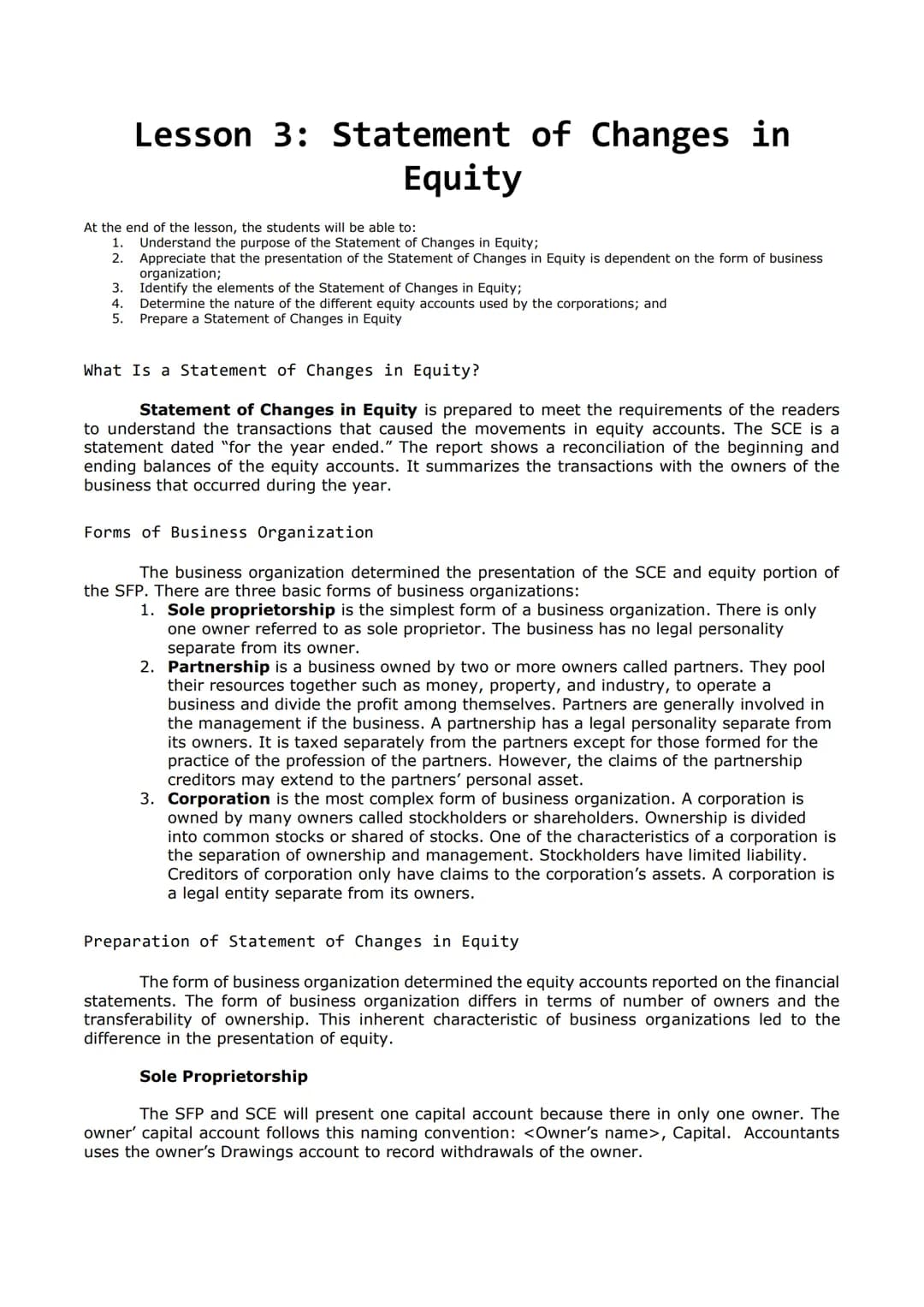
Understanding the Statement of Changes in Equity
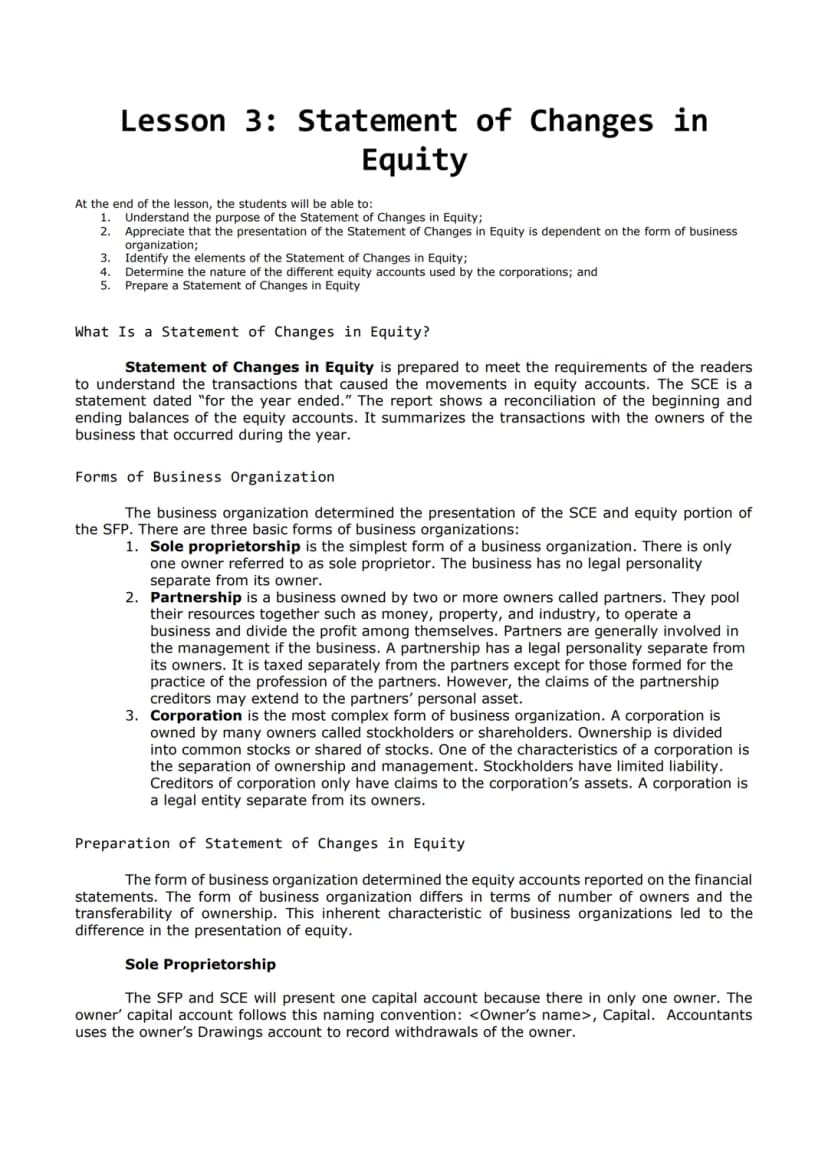
The Statement of Changes in Equity helps readers understand what caused movements in equity accounts during a financial period. It's a reconciliation report showing the beginning and ending balances of equity accounts, summarizing all transactions with business owners.
The presentation of the SCE depends on the form of business organization. The three basic forms are:
-
Sole proprietorship: The simplest form with one owner (sole proprietor). The business has no legal personality separate from its owner.
-
Partnership: A business owned by two or more partners who pool resources and share profits. Partnerships have legal personality separate from owners, though creditors' claims may extend to partners' personal assets.
-
Corporation: The most complex form with ownership divided into shares of stock among many stockholders. Management is separate from ownership, and stockholders have limited liability.
Important Note: The equity section of financial statements looks different depending on whether a business is a sole proprietorship, partnership, or corporation. This reflects differences in ownership structure and liability.
Each form of business organization uses different equity accounts and presentation styles in their financial statements, based on their number of owners and how ownership can be transferred.
2
of 5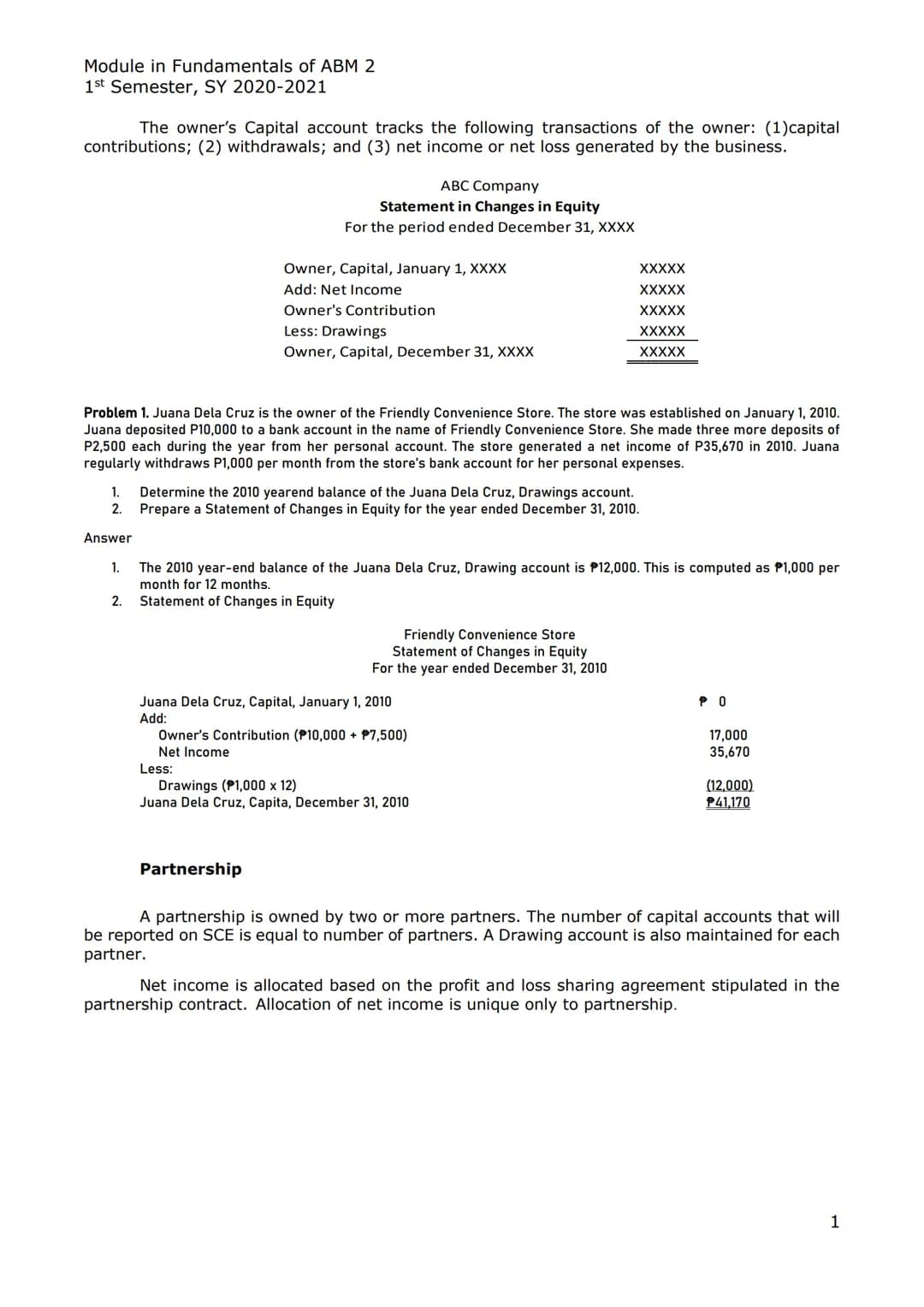
Sole Proprietorship Statement of Changes in Equity
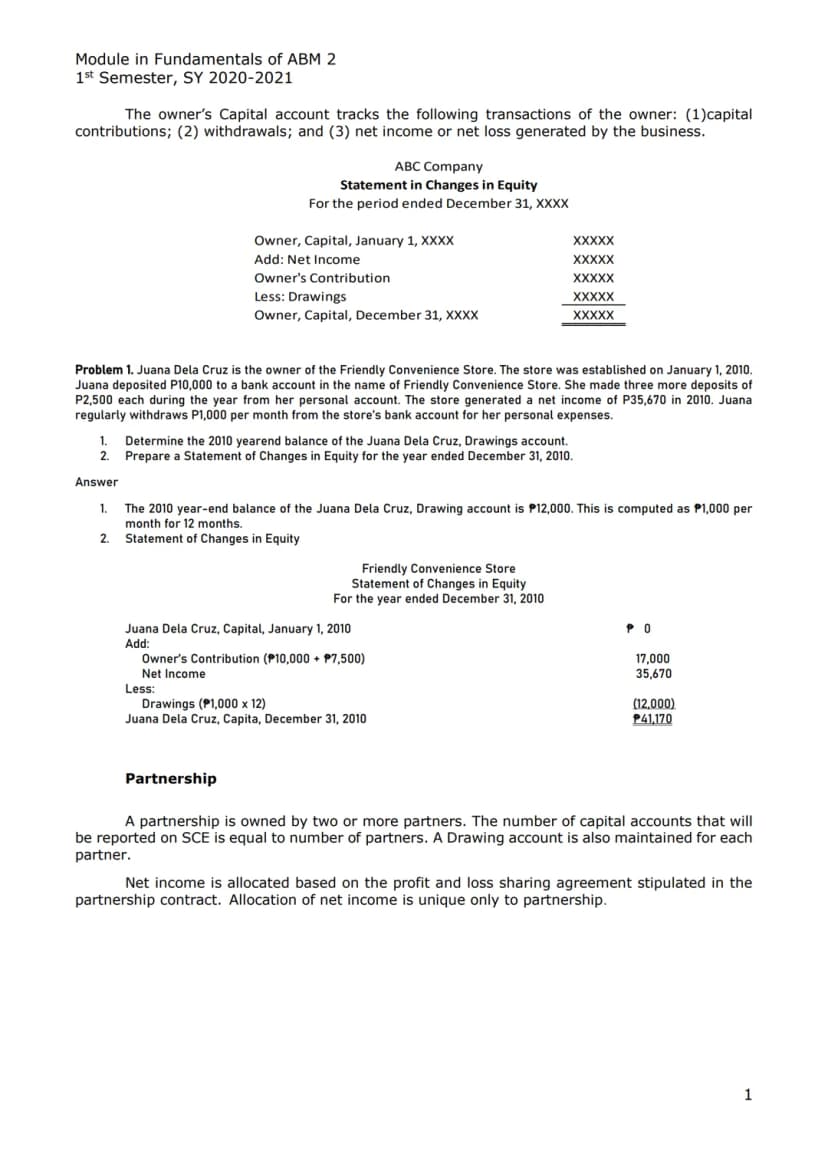
In a sole proprietorship, the SCE presents just one capital account since there's only one owner. The account is typically named "[Owner's name], Capital." A separate Drawings account tracks the owner's withdrawals from the business.
The owner's Capital account reflects three key transactions:
- Capital contributions (money or assets the owner puts into the business)
- Withdrawals (money or assets the owner takes out)
- Net income or loss generated by the business
A typical sole proprietorship SCE follows this simple format:
Owner, Capital, January 1, XXXX      XXXXX
Add: Net Income                      XXXXX
     Owner's Contribution            XXXXX
Less: Drawings                       XXXXX
Owner, Capital, December 31, XXXX    XXXXX
For example, in the case of Friendly Convenience Store owned by Juana Dela Cruz, her capital grew from zero to ₱41,170 in one year. This resulted from her initial ₱10,000 deposit plus three additional deposits of ₱2,500 each, plus the store's net income of ₱35,670, minus her monthly withdrawals of ₱1,000 (totaling ₱12,000 for the year).
The SCE clearly shows how Juana's equity in the business changed over the year through her investments, the business performance, and her personal withdrawals.
3
of 5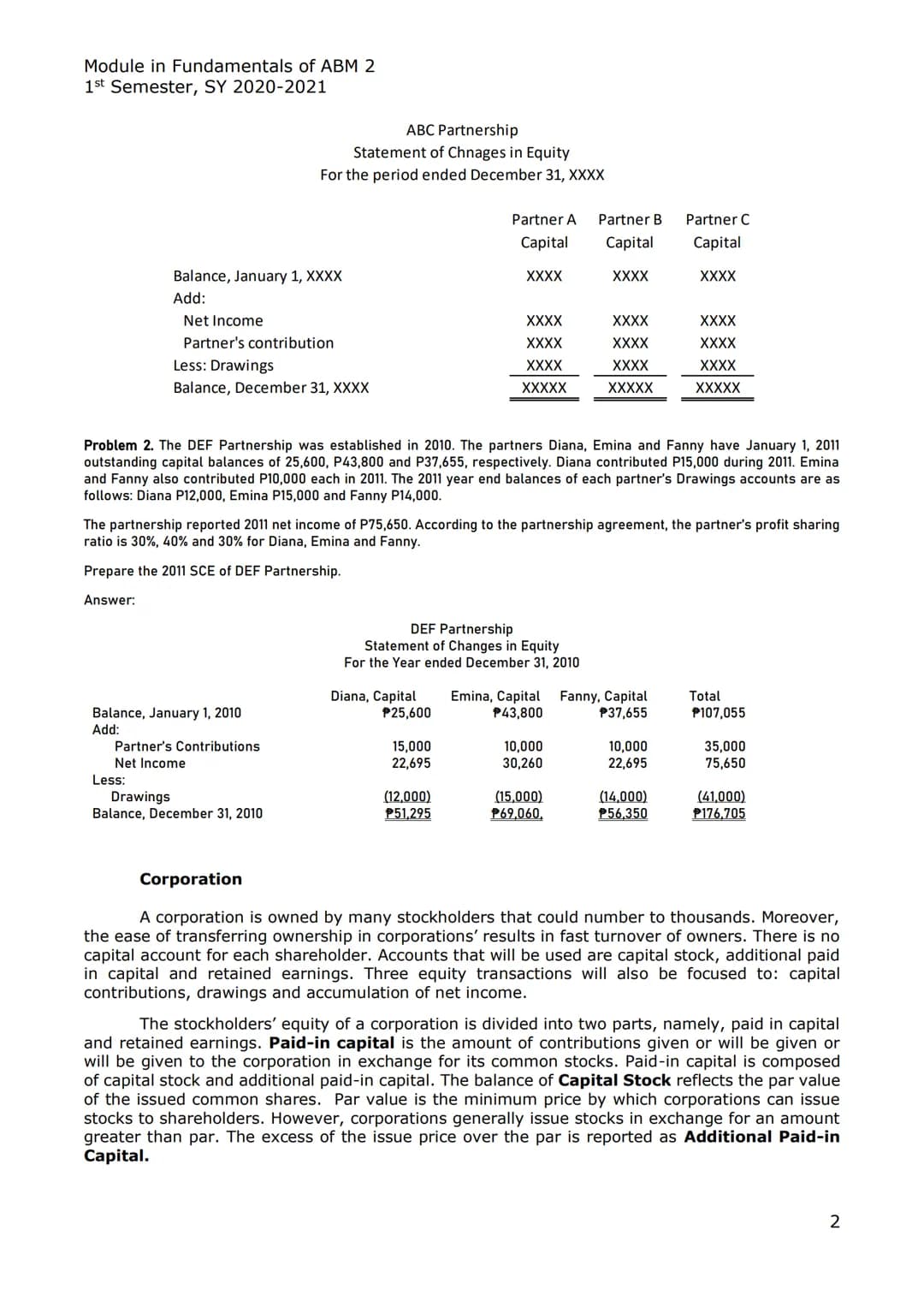
Partnership Statement of Changes in Equity
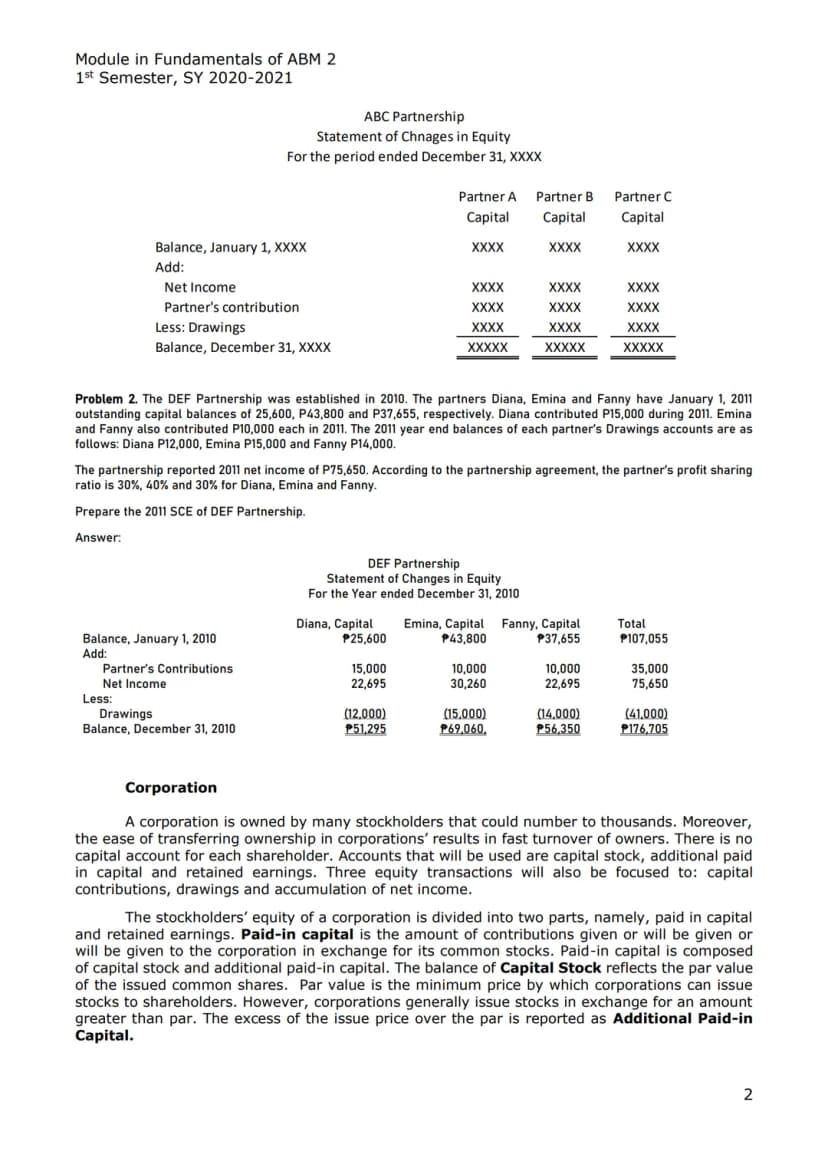
A partnership SCE is more complex because it tracks multiple owners' capital accounts. Each partner has their own capital account and drawings account in the financial statements.
What makes partnerships unique is how net income is allocated. Unlike sole proprietorships, partnerships distribute profits based on the profit-sharing agreement specified in the partnership contract. This means partners might receive different percentages of the profit regardless of their capital contributions.
A partnership SCE typically shows columns for each partner's capital account:
Partner A Capital | Partner B Capital | Partner C Capital
Each column tracks:
- Beginning balance
- Additional contributions
- Share of net income
- Drawings (withdrawals)
- Ending balance
In the DEF Partnership example, the three partners (Diana, Emina, and Fanny) have different profit-sharing ratios (30%, 40%, and 30%). The SCE shows how each partner's capital changed through their contributions, profit shares, and withdrawals, with the total partnership equity growing from ₱107,055 to ₱176,705 over the year.
Real-world application: In partnerships, the profit-sharing ratio is critical! It determines how much of the business's profit each partner receives, regardless of their capital contributions or work input, unless specified differently in the partnership agreement.
4
of 5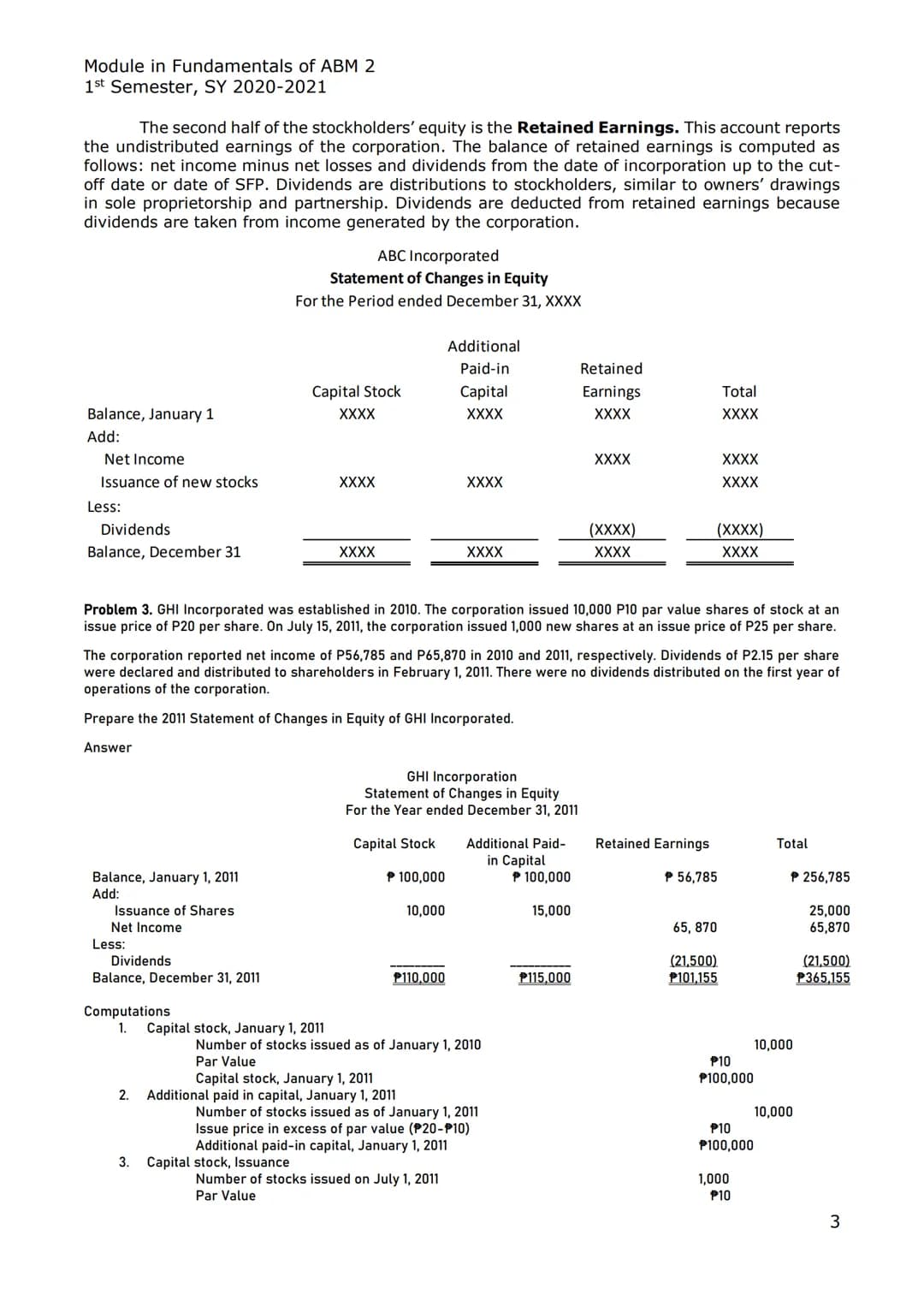
Corporation Statement of Changes in Equity
Corporations have the most complex equity structure because they can have numerous stockholders with easily transferable ownership. Instead of tracking individual capital accounts, corporations use standardized equity accounts: capital stock, additional paid-in capital, and retained earnings.
The stockholders' equity section is divided into two main parts:
-
Paid-in Capital: This represents contributions from shareholders in exchange for stock and includes:
- Capital Stock: Shows the par value of issued shares (the minimum legal value assigned to each share)
- Additional Paid-in Capital: The excess amount over par value that investors paid for shares
-
Retained Earnings: This represents accumulated profits that haven't been distributed to shareholders as dividends.
Corporations distribute profits through dividends rather than drawings. Dividends are formal distributions to stockholders that must be declared by the board of directors and are deducted from retained earnings.
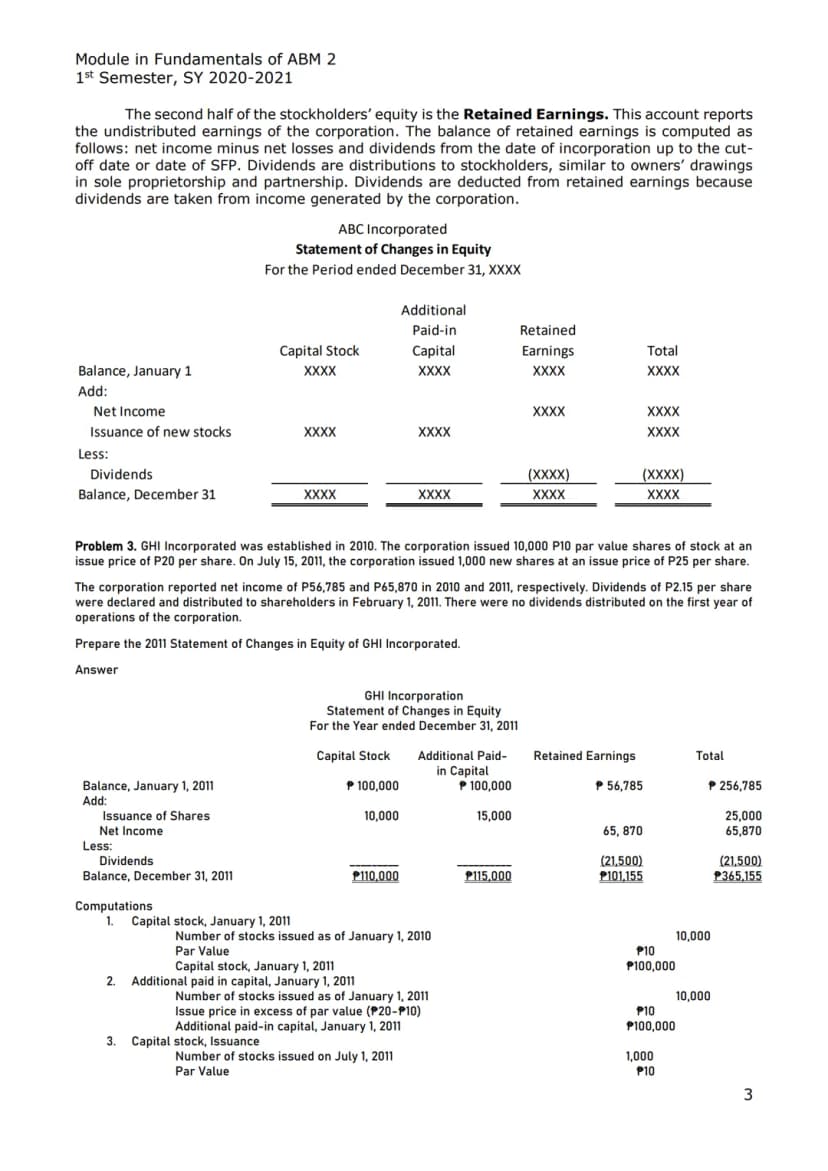
A corporation's SCE typically shows columns for:
Capital Stock | Additional Paid-in Capital | Retained Earnings | Total
In the GHI Incorporated example, the SCE shows how the corporation's equity changed through new stock issuance , net income (increasing retained earnings), and dividend distributions (decreasing retained earnings).
Remember: In corporations, par value is just a legal minimum for issuing stock. The actual market value is typically much higher, and the difference is recorded as additional paid-in capital.
5
of 5
Preparing a Corporate Statement of Changes in Equity
When preparing a corporation's SCE, you'll need to calculate several components:
Capital Stock:
- Multiply the number of shares issued by their par value
- For GHI Inc., 10,000 shares × ₱10 par value = ₱100,000 initial capital stock
- Additional 1,000 shares × ₱10 par value = ₱10,000 increase
Additional Paid-in Capital:
- Calculate the excess amount paid above par value
- Initially: 10,000 shares × = ₱100,000
- New issuance: 1,000 shares × (₱25 - ₱10) = ₱15,000
Retained Earnings:
- Beginning balance (previous year's accumulated profits)
- Add: Net income for the current period
- Subtract: Dividends declared
Dividends:
- Calculate based on shares outstanding and dividend rate
- For GHI Inc.: 10,000 shares × ₱2.15 per share = ₱21,500
The completed SCE shows the opening balance in each equity account, additions (from profits or new stock issuance), deductions (like dividends), and ending balances. It gives stakeholders a clear picture of how and why the company's equity changed during the year.
Pro tip: When corporations issue shares above par value, they generate additional capital without increasing the stated capital stock. This flexibility is one reason corporations are the preferred structure for large businesses needing substantial capital.
We thought you’d never ask...
What is the Knowunity AI companion?
Our AI companion is specifically built for the needs of students. Based on the millions of content pieces we have on the platform we can provide truly meaningful and relevant answers to students. But its not only about answers, the companion is even more about guiding students through their daily learning challenges, with personalised study plans, quizzes or content pieces in the chat and 100% personalisation based on the students skills and developments.
Where can I download the Knowunity app?
You can download the app in the Google Play Store and in the Apple App Store.
Is Knowunity really free of charge?
That's right! Enjoy free access to study content, connect with fellow students, and get instant help – all at your fingertips.
Most popular content in ACT®
9Most popular content
9Can't find what you're looking for? Explore other subjects.
Students love us — and so will you.
4.6/5App Store
4.7/5Google Play
The app is very easy to use and well designed. I have found everything I was looking for so far and have been able to learn a lot from the presentations! I will definitely use the app for a class assignment! And of course it also helps a lot as an inspiration.
Stefan SiOS user
This app is really great. There are so many study notes and help [...]. My problem subject is French, for example, and the app has so many options for help. Thanks to this app, I have improved my French. I would recommend it to anyone.
Samantha KlichAndroid user
Wow, I am really amazed. I just tried the app because I've seen it advertised many times and was absolutely stunned. This app is THE HELP you want for school and above all, it offers so many things, such as workouts and fact sheets, which have been VERY helpful to me personally.
AnnaiOS user
ACT®40 views·Updated May 31, 2026·5 pagesEssential Accounting Business and Management Notes
ms.ellegrumpy@ms.elle
The Statement of Changes in Equity (SCE) is a financial report that shows how a company's equity accounts have changed during a specific period. It reconciles the beginning and ending balances of equity accounts, revealing transactions with business owners that... Show more
1
of 5Sign up to see the content. It's free!
- Access to all documents
- Improve your grades
- Join milions of students
Understanding the Statement of Changes in Equity
The Statement of Changes in Equity helps readers understand what caused movements in equity accounts during a financial period. It's a reconciliation report showing the beginning and ending balances of equity accounts, summarizing all transactions with business owners.
The presentation of the SCE depends on the form of business organization. The three basic forms are:
-
Sole proprietorship: The simplest form with one owner (sole proprietor). The business has no legal personality separate from its owner.
-
Partnership: A business owned by two or more partners who pool resources and share profits. Partnerships have legal personality separate from owners, though creditors' claims may extend to partners' personal assets.
-
Corporation: The most complex form with ownership divided into shares of stock among many stockholders. Management is separate from ownership, and stockholders have limited liability.
Important Note: The equity section of financial statements looks different depending on whether a business is a sole proprietorship, partnership, or corporation. This reflects differences in ownership structure and liability.
Each form of business organization uses different equity accounts and presentation styles in their financial statements, based on their number of owners and how ownership can be transferred.
2
of 5Sign up to see the content. It's free!
- Access to all documents
- Improve your grades
- Join milions of students
Sole Proprietorship Statement of Changes in Equity
In a sole proprietorship, the SCE presents just one capital account since there's only one owner. The account is typically named "[Owner's name], Capital." A separate Drawings account tracks the owner's withdrawals from the business.
The owner's Capital account reflects three key transactions:
- Capital contributions (money or assets the owner puts into the business)
- Withdrawals (money or assets the owner takes out)
- Net income or loss generated by the business
A typical sole proprietorship SCE follows this simple format:
Owner, Capital, January 1, XXXX      XXXXX
Add: Net Income                      XXXXX
     Owner's Contribution            XXXXX
Less: Drawings                       XXXXX
Owner, Capital, December 31, XXXX    XXXXX
For example, in the case of Friendly Convenience Store owned by Juana Dela Cruz, her capital grew from zero to ₱41,170 in one year. This resulted from her initial ₱10,000 deposit plus three additional deposits of ₱2,500 each, plus the store's net income of ₱35,670, minus her monthly withdrawals of ₱1,000 (totaling ₱12,000 for the year).
The SCE clearly shows how Juana's equity in the business changed over the year through her investments, the business performance, and her personal withdrawals.
3
of 5Sign up to see the content. It's free!
- Access to all documents
- Improve your grades
- Join milions of students
Partnership Statement of Changes in Equity
A partnership SCE is more complex because it tracks multiple owners' capital accounts. Each partner has their own capital account and drawings account in the financial statements.
What makes partnerships unique is how net income is allocated. Unlike sole proprietorships, partnerships distribute profits based on the profit-sharing agreement specified in the partnership contract. This means partners might receive different percentages of the profit regardless of their capital contributions.
A partnership SCE typically shows columns for each partner's capital account:
Partner A Capital | Partner B Capital | Partner C Capital
Each column tracks:
- Beginning balance
- Additional contributions
- Share of net income
- Drawings (withdrawals)
- Ending balance
In the DEF Partnership example, the three partners (Diana, Emina, and Fanny) have different profit-sharing ratios (30%, 40%, and 30%). The SCE shows how each partner's capital changed through their contributions, profit shares, and withdrawals, with the total partnership equity growing from ₱107,055 to ₱176,705 over the year.
Real-world application: In partnerships, the profit-sharing ratio is critical! It determines how much of the business's profit each partner receives, regardless of their capital contributions or work input, unless specified differently in the partnership agreement.
4
of 5Sign up to see the content. It's free!
- Access to all documents
- Improve your grades
- Join milions of students
Corporation Statement of Changes in Equity
Corporations have the most complex equity structure because they can have numerous stockholders with easily transferable ownership. Instead of tracking individual capital accounts, corporations use standardized equity accounts: capital stock, additional paid-in capital, and retained earnings.
The stockholders' equity section is divided into two main parts:
-
Paid-in Capital: This represents contributions from shareholders in exchange for stock and includes:
- Capital Stock: Shows the par value of issued shares (the minimum legal value assigned to each share)
- Additional Paid-in Capital: The excess amount over par value that investors paid for shares
-
Retained Earnings: This represents accumulated profits that haven't been distributed to shareholders as dividends.
Corporations distribute profits through dividends rather than drawings. Dividends are formal distributions to stockholders that must be declared by the board of directors and are deducted from retained earnings.
A corporation's SCE typically shows columns for:
Capital Stock | Additional Paid-in Capital | Retained Earnings | Total
In the GHI Incorporated example, the SCE shows how the corporation's equity changed through new stock issuance , net income (increasing retained earnings), and dividend distributions (decreasing retained earnings).
Remember: In corporations, par value is just a legal minimum for issuing stock. The actual market value is typically much higher, and the difference is recorded as additional paid-in capital.
5
of 5Sign up to see the content. It's free!
- Access to all documents
- Improve your grades
- Join milions of students
Preparing a Corporate Statement of Changes in Equity
When preparing a corporation's SCE, you'll need to calculate several components:
Capital Stock:
- Multiply the number of shares issued by their par value
- For GHI Inc., 10,000 shares × ₱10 par value = ₱100,000 initial capital stock
- Additional 1,000 shares × ₱10 par value = ₱10,000 increase
Additional Paid-in Capital:
- Calculate the excess amount paid above par value
- Initially: 10,000 shares × = ₱100,000
- New issuance: 1,000 shares × (₱25 - ₱10) = ₱15,000
Retained Earnings:
- Beginning balance (previous year's accumulated profits)
- Add: Net income for the current period
- Subtract: Dividends declared
Dividends:
- Calculate based on shares outstanding and dividend rate
- For GHI Inc.: 10,000 shares × ₱2.15 per share = ₱21,500
The completed SCE shows the opening balance in each equity account, additions (from profits or new stock issuance), deductions (like dividends), and ending balances. It gives stakeholders a clear picture of how and why the company's equity changed during the year.
Pro tip: When corporations issue shares above par value, they generate additional capital without increasing the stated capital stock. This flexibility is one reason corporations are the preferred structure for large businesses needing substantial capital.
We thought you’d never ask...
What is the Knowunity AI companion?
Our AI companion is specifically built for the needs of students. Based on the millions of content pieces we have on the platform we can provide truly meaningful and relevant answers to students. But its not only about answers, the companion is even more about guiding students through their daily learning challenges, with personalised study plans, quizzes or content pieces in the chat and 100% personalisation based on the students skills and developments.
Where can I download the Knowunity app?
You can download the app in the Google Play Store and in the Apple App Store.
Is Knowunity really free of charge?
That's right! Enjoy free access to study content, connect with fellow students, and get instant help – all at your fingertips.
Most popular content in ACT®
9Most popular content
9Can't find what you're looking for? Explore other subjects.
Students love us — and so will you.
4.6/5App Store
4.7/5Google Play
The app is very easy to use and well designed. I have found everything I was looking for so far and have been able to learn a lot from the presentations! I will definitely use the app for a class assignment! And of course it also helps a lot as an inspiration.
Stefan SiOS user
This app is really great. There are so many study notes and help [...]. My problem subject is French, for example, and the app has so many options for help. Thanks to this app, I have improved my French. I would recommend it to anyone.
Samantha KlichAndroid user
Wow, I am really amazed. I just tried the app because I've seen it advertised many times and was absolutely stunned. This app is THE HELP you want for school and above all, it offers so many things, such as workouts and fact sheets, which have been VERY helpful to me personally.
AnnaiOS user