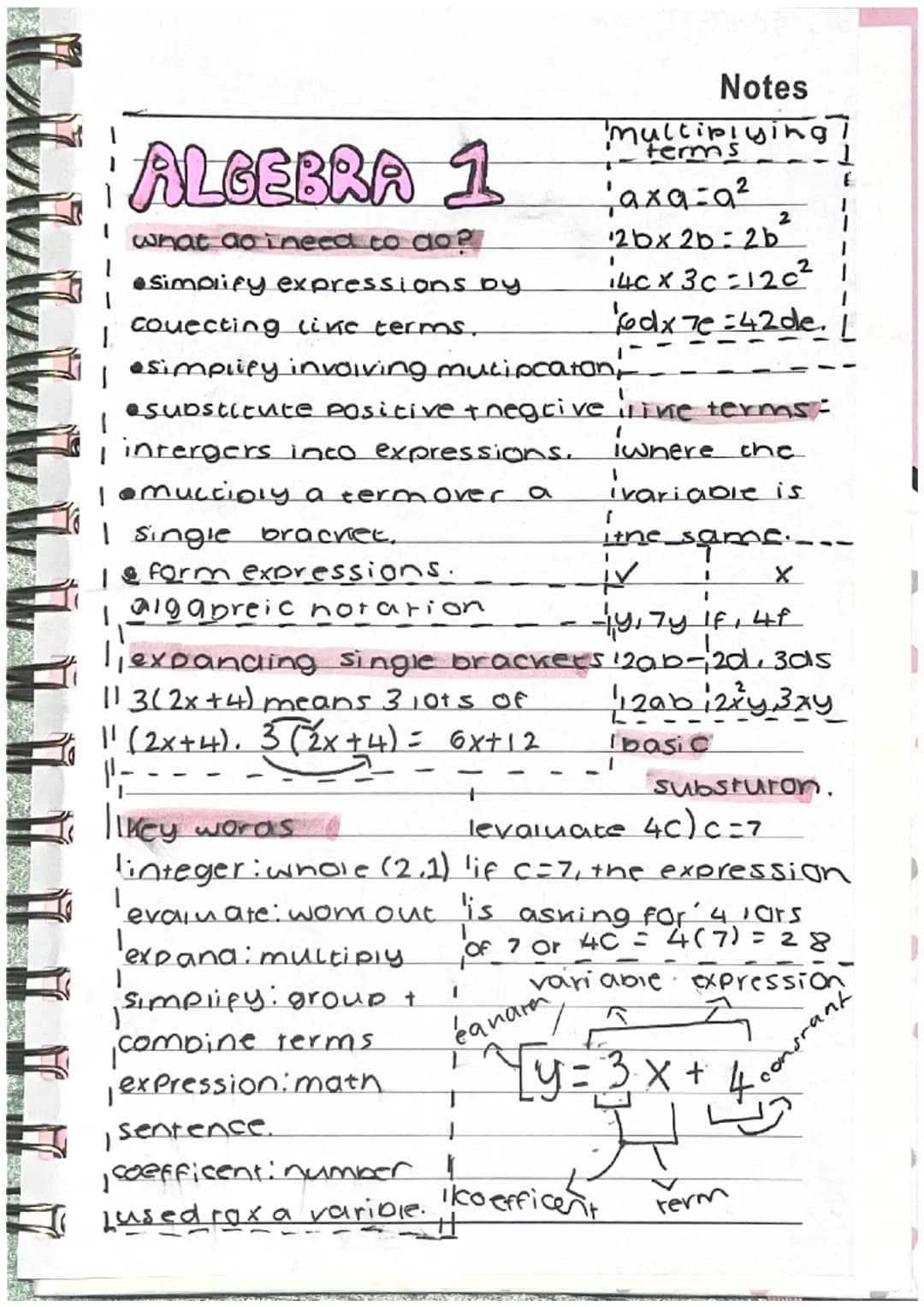
Algebra Basics: Working with Expressions
Algebraic expressions are mathematical sentences that contain numbers, letters (called variables), and operation symbols. Think of variables like mystery numbers - they represent values we don't know yet or that can change.
When you see something like 4c, this means 4 multiplied by whatever value c represents. The number 4 is called the coefficient - it's the number that multiplies the variable. If c = 7, then 4c = 4 × 7 = 28.
Like terms are terms that have exactly the same variable part. For example, 3x and 5x are like terms because they both have just 'x'. However, 3x and 3y are not like terms because they have different variables. You can only combine like terms when simplifying expressions.
Quick Tip: When multiplying terms with the same variable, add the powers together. So a × a = a², and 2b × 2b = 4b².
Expanding brackets means multiplying everything inside the brackets by the number outside. When you see 32x+4, think "3 lots of everything in the brackets". This gives you 3 × 2x + 3 × 4 = 6x + 12.