Completing the Square and the Quadratic Formula
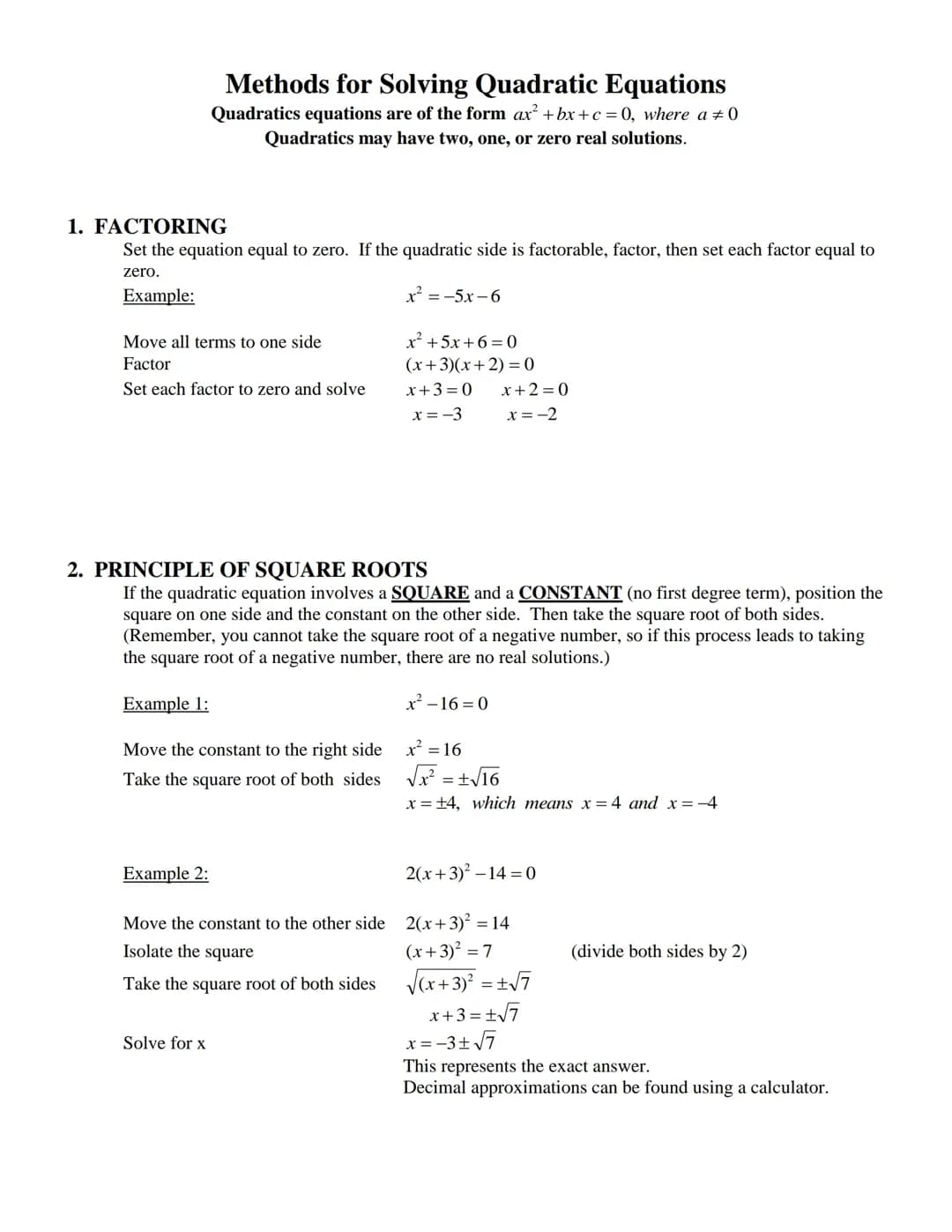
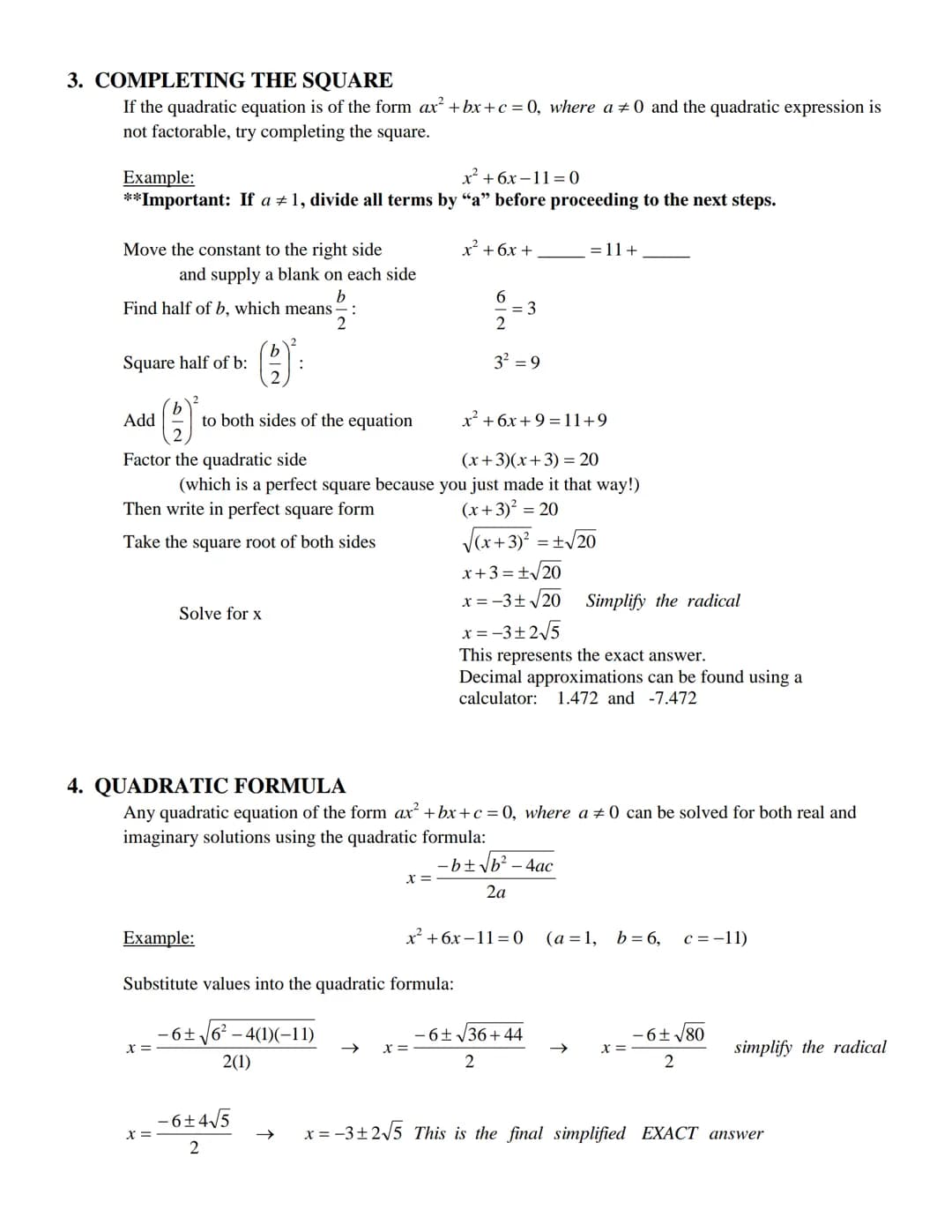
Completing the square helps when factoring doesn't work. Take x² + 6x - 11 = 0. First, move the constant: x² + 6x = 11. Then find half of the x-coefficient (6 ÷ 2 = 3) and square it (3² = 9). Add this value to both sides: x² + 6x + 9 = 11 + 9. Now the left side becomes a perfect square x+3² = 20, which you can solve by taking the square root.
The quadratic formula is your universal solution for any quadratic equation. For ax² + bx + c = 0, use x = −b±√(b2−4ac) ÷ (2a). Just plug in the values for a, b, and c to find your solutions. It works for equations with real solutions and even those with imaginary solutions!
For our example x² + 6x - 11 = 0, we have a = 1, b = 6, and c = -11. Using the formula gives us x = (-6 ± √(36 + 44)) ÷ 2, which simplifies to x = -3 ± 2√5, matching our completing the square answer.
Remember: The expression b² - 4ac under the square root is called the discriminant. It tells you how many solutions exist: two real solutions if positive, one real solution if zero, and two complex solutions if negative.



 Algebra 1
 Algebra
 Calculus 1
 Overige