
Ancient Egypt was one of the world's most impressive early... Show more
 AP Art History
 Algebra
Sign up to see the contentIt's free!
Access to all documents
Improve your grades
Join milions of students
By signing up you accept Terms of Service and Privacy Policy
Subjects
Triangle Congruence and Similarity Theorems
Triangle Properties and Classification
Linear Equations and Graphs
Geometric Angle Relationships
Trigonometric Functions and Identities
Equation Solving Techniques
Circle Geometry Fundamentals
Division Operations and Methods
Basic Differentiation Rules
Exponent and Logarithm Properties
Show all topics
Human Organ Systems
Reproductive Cell Cycles
Biological Sciences Subdisciplines
Cellular Energy Metabolism
Autotrophic Energy Processes
Inheritance Patterns and Principles
Biomolecular Structure and Organization
Cell Cycle and Division Mechanics
Cellular Organization and Development
Biological Structural Organization
Show all topics
Chemical Sciences and Applications
Atomic Structure and Composition
Molecular Electron Structure Representation
Atomic Electron Behavior
Matter Properties and Water
Mole Concept and Calculations
Gas Laws and Behavior
Periodic Table Organization
Chemical Thermodynamics Fundamentals
Chemical Bond Types and Properties
Show all topics
European Renaissance and Enlightenment
European Cultural Movements 800-1920
American Revolution Era 1763-1797
American Civil War 1861-1865
Global Imperial Systems
Mongol and Chinese Dynasties
U.S. Presidents and World Leaders
Historical Sources and Documentation
World Wars Era and Impact
World Religious Systems
Show all topics
Classic and Contemporary Novels
Literary Character Analysis
Rhetorical Theory and Practice
Classic Literary Narratives
Reading Analysis and Interpretation
Narrative Structure and Techniques
English Language Components
Influential English-Language Authors
Basic Sentence Structure
Narrative Voice and Perspective
Show all topics
81
•
Jan 14, 2026
•
Stella
@stellasofia
Ancient Egypt was one of the world's most impressive early... Show more
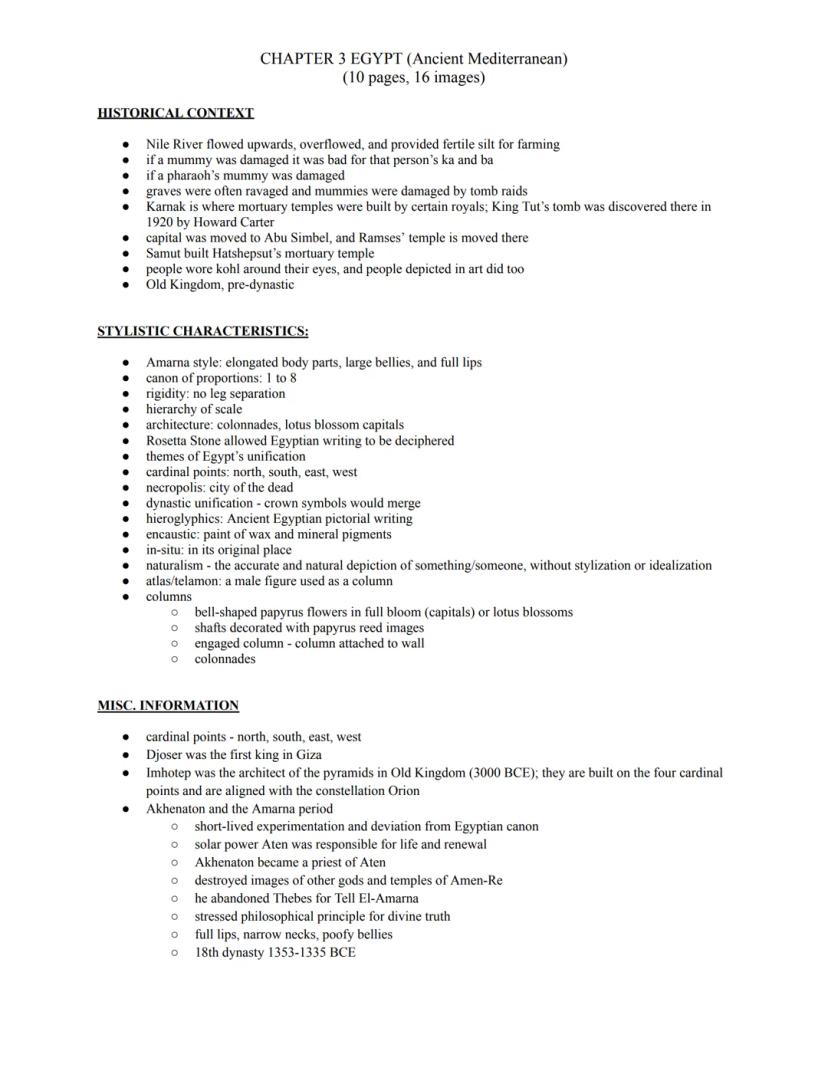

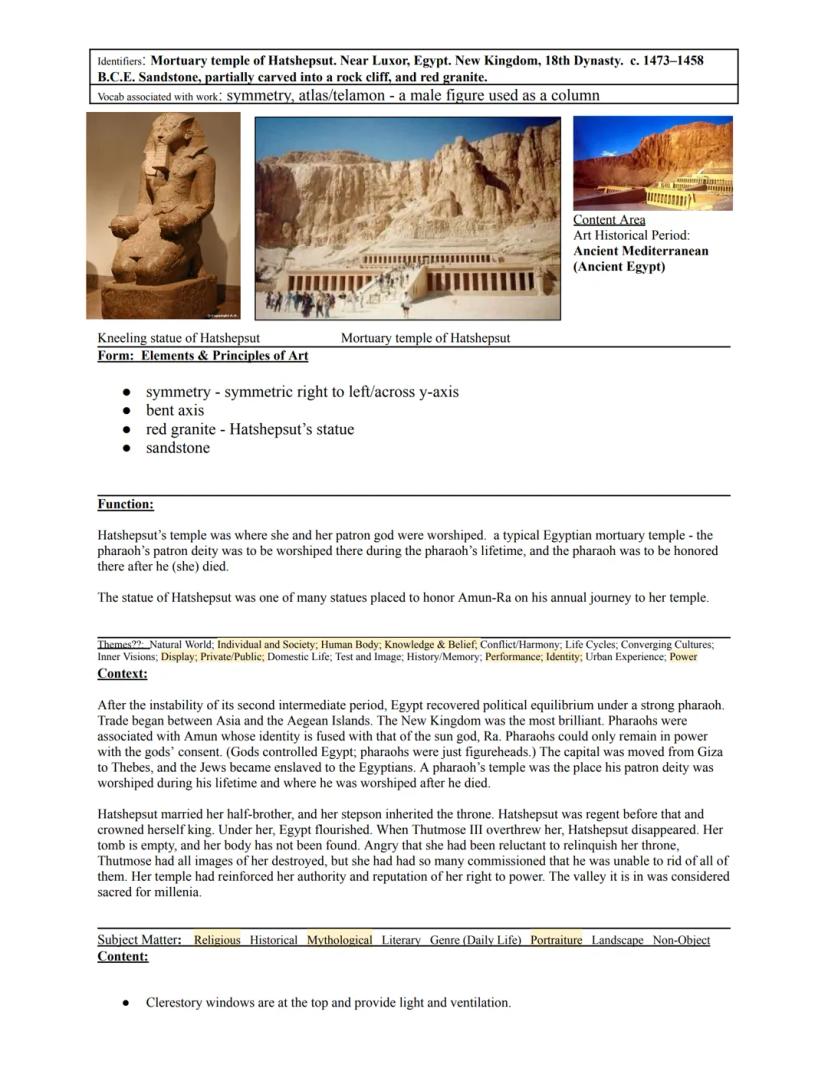
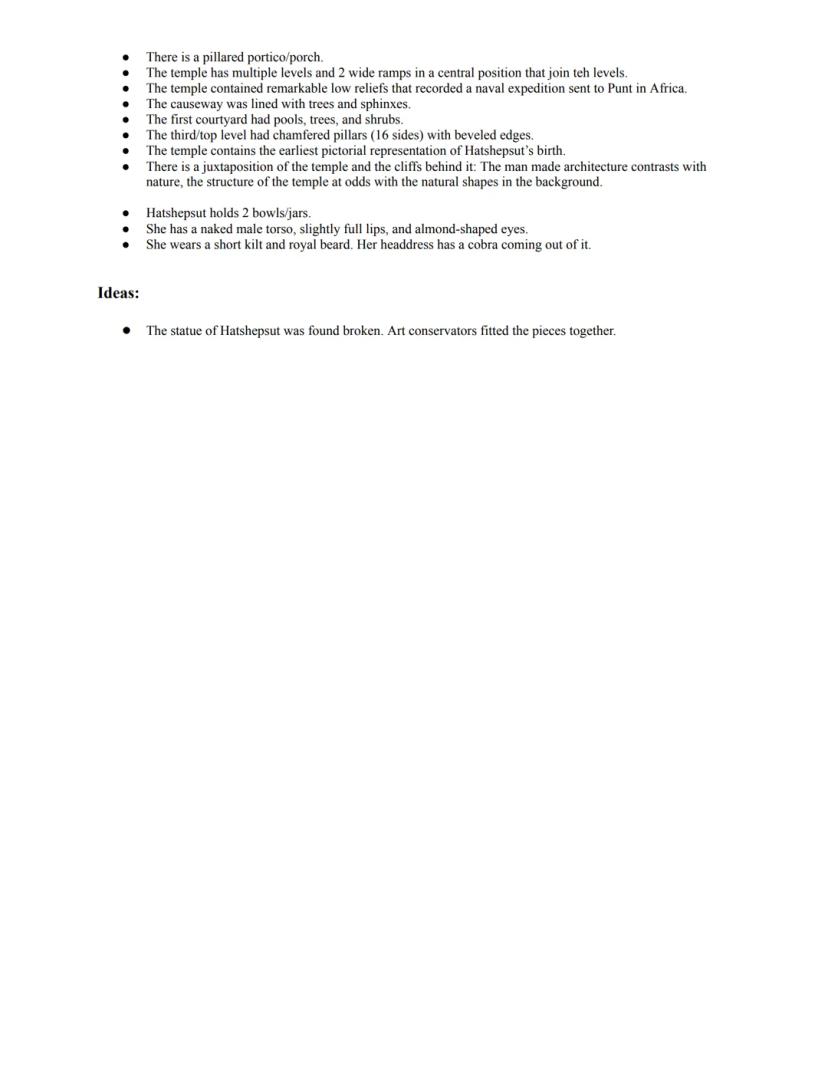
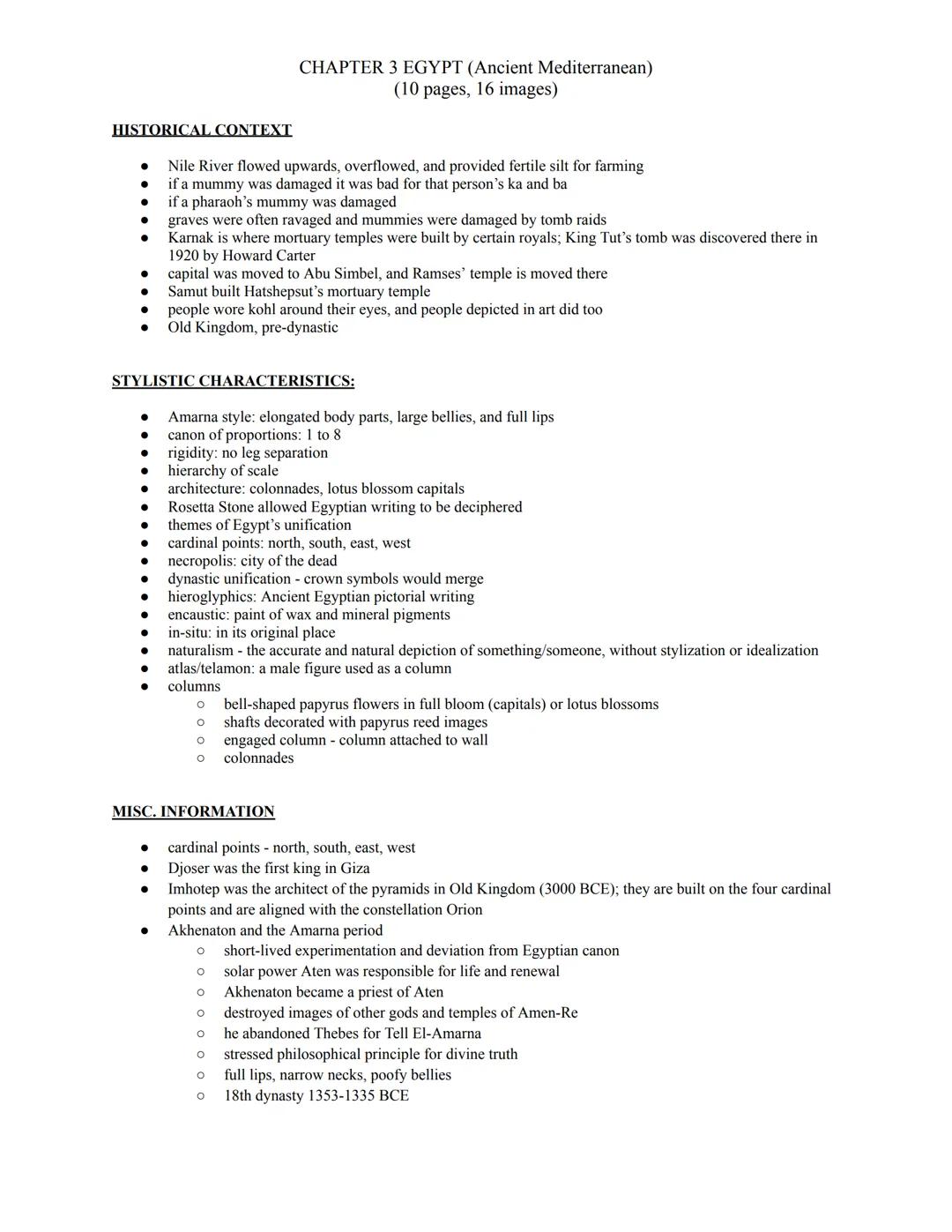
Ever wonder why Egyptian art looks so distinct? The ancient Egyptians developed specific artistic conventions that lasted for thousands of years! Their art was heavily influenced by the Nile River, which provided fertile silt for farming and shaped their entire civilization.
Egyptian art followed strict stylistic characteristics including a precise canon of proportions (1:8 ratio) and hierarchy of scale (important figures shown larger). When looking at Egyptian figures, you'll notice they typically appear rigid with no leg separation and are shown in a composite view – face and feet in profile but eyes and torso facing forward.
Architecture featured impressive colonnades with distinctive lotus blossom capitals. The Egyptians developed a complex writing system called hieroglyphics, which remained mysterious until the discovery of the Rosetta Stone allowed scholars to finally translate their pictorial language.
Quick Fact: During the brief Amarna period under Pharaoh Akhenaton, Egyptian art temporarily broke from tradition with a distinctive style featuring elongated body parts, large bellies, and full lips – quite different from the rigid traditional canon!
Understanding Egyptian art requires knowledge of their beliefs about death and the afterlife. They believed that if a mummy was damaged, it would harm that person's ka (life force) and ba (personality), which is why they went to such great lengths to preserve bodies and build elaborate tombs.
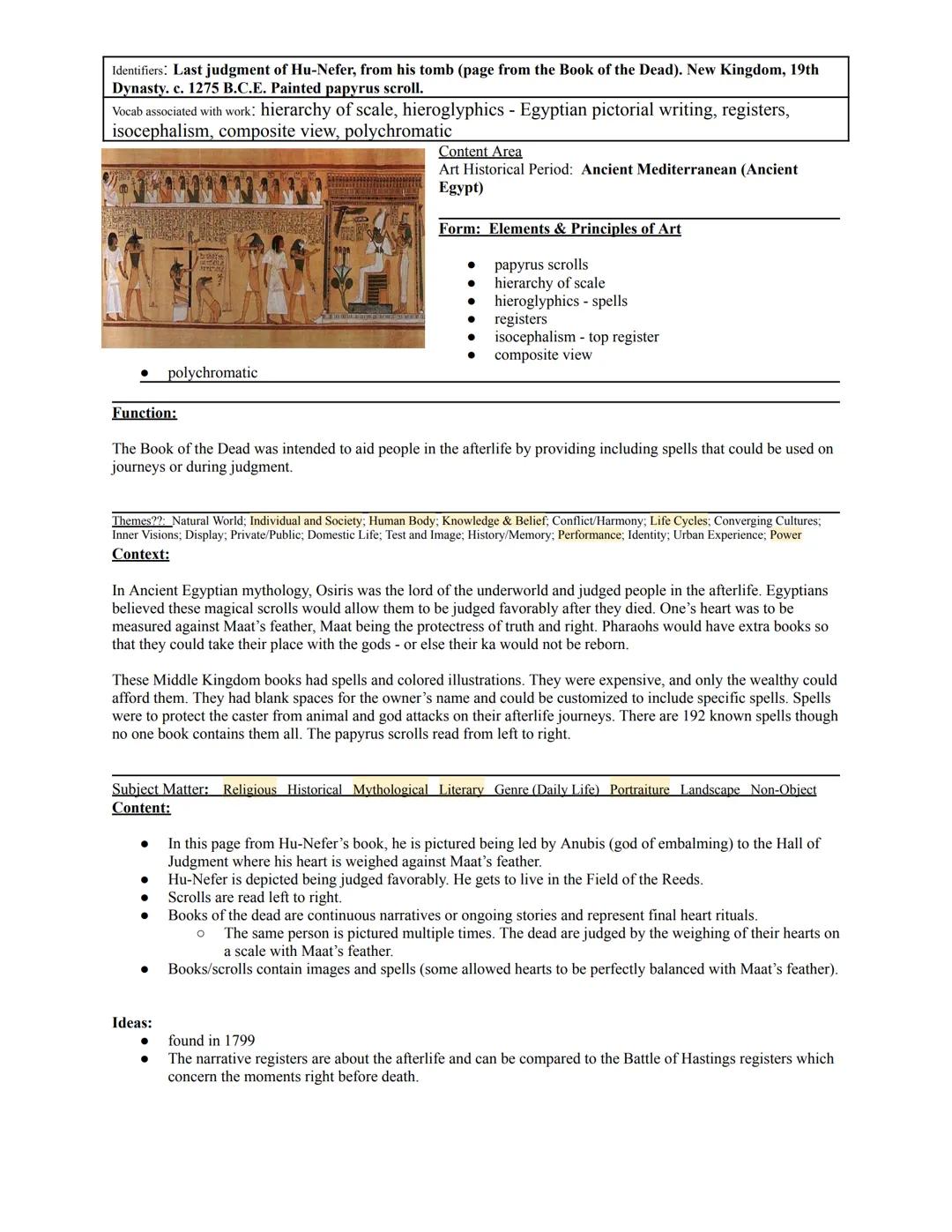
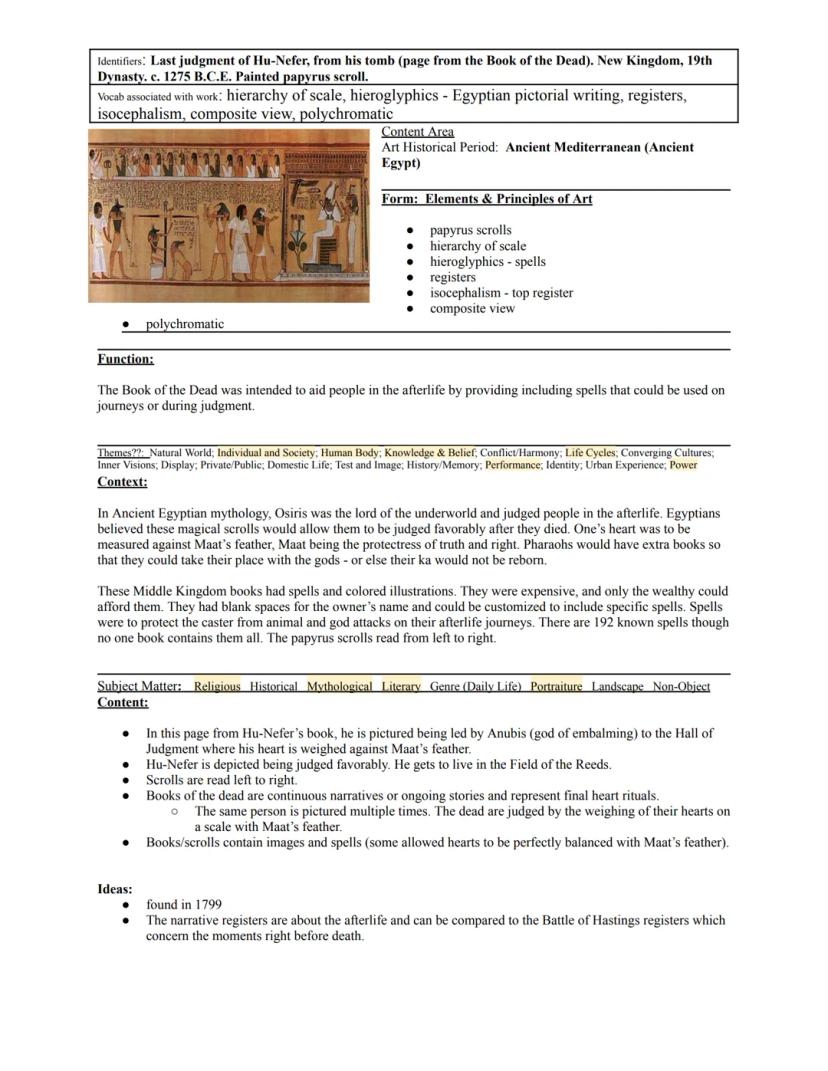
Imagine having a magical scroll that could guarantee your success in the afterlife! That's exactly what the Book of the Dead was for ancient Egyptians. This painted papyrus scroll belonging to Hu-Nefer (c. 1275 BCE) contains spells and illustrations to help guide the deceased through judgment and into eternal paradise.
When examining this artwork, notice how it's organized in horizontal registers (like rows) that tell a continuous narrative. The story reads from left to right, showing Hu-Nefer being led by Anubis to the Hall of Judgment. There, his heart is weighed against the feather of Maat (goddess of truth) to determine if he lived a virtuous life.
The artwork employs several Egyptian conventions including hieroglyphics (pictorial writing) that accompany the images, isocephalism (heads at the same level) in the top register, and polychromatic painting techniques. The same person appears multiple times throughout the narrative, showing different moments in the judgment process.
Did you know? Books of the Dead were expensive luxury items that only wealthy Egyptians could afford! They could be customized with specific spells from a collection of 192 known spells, though no single book contained all of them.
The scroll reflects the Egyptian belief that magic could influence the afterlife. Special spells could ensure your heart balanced perfectly with Maat's feather, allowing you to live eternally in the Field of the Reeds – the Egyptian paradise.
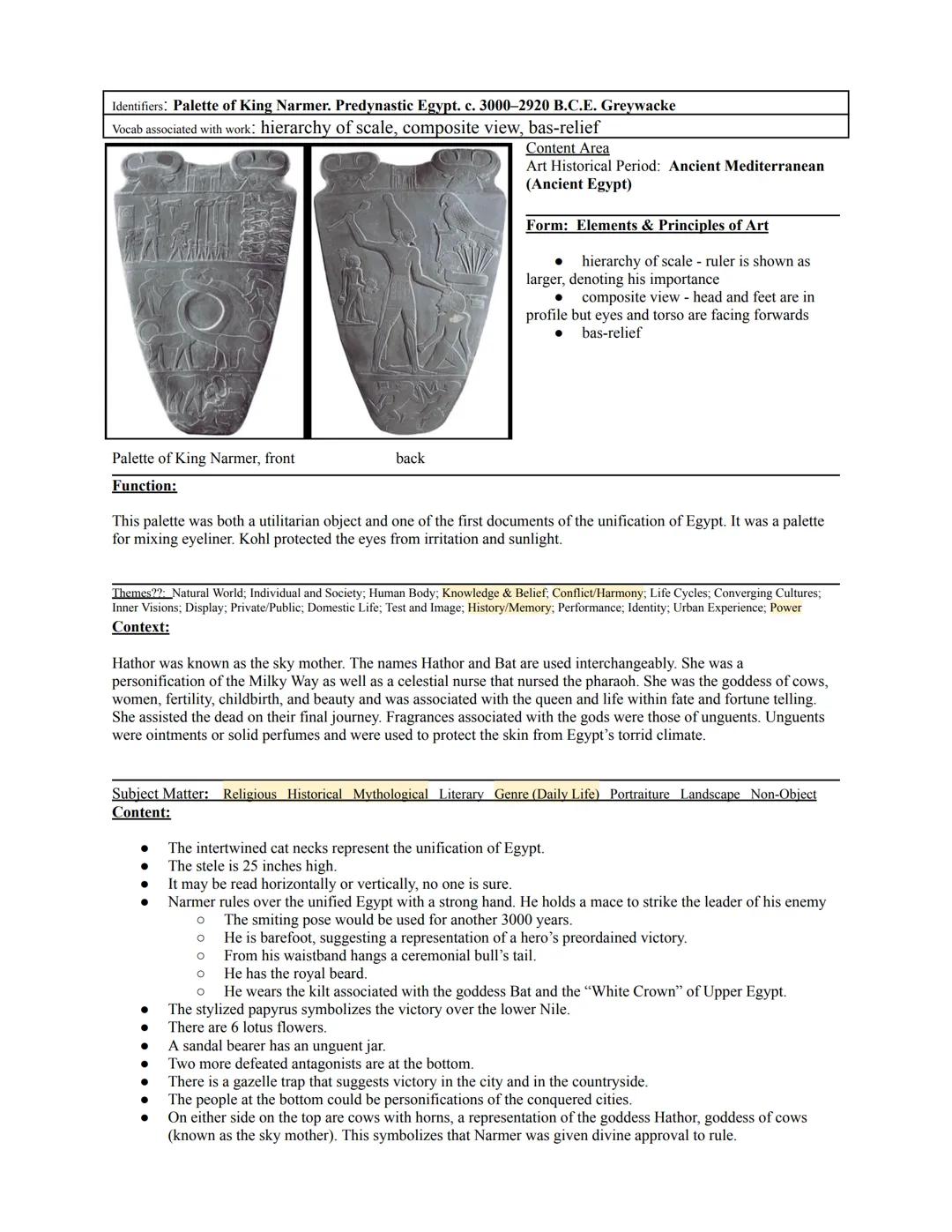
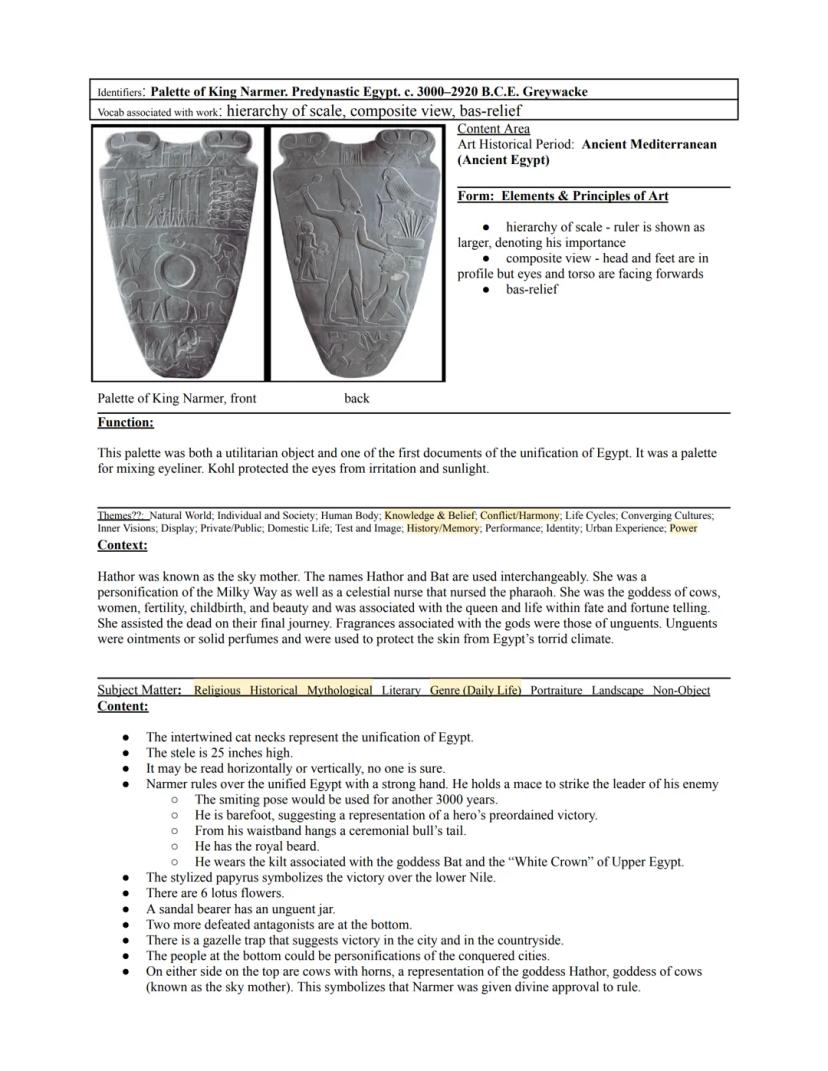
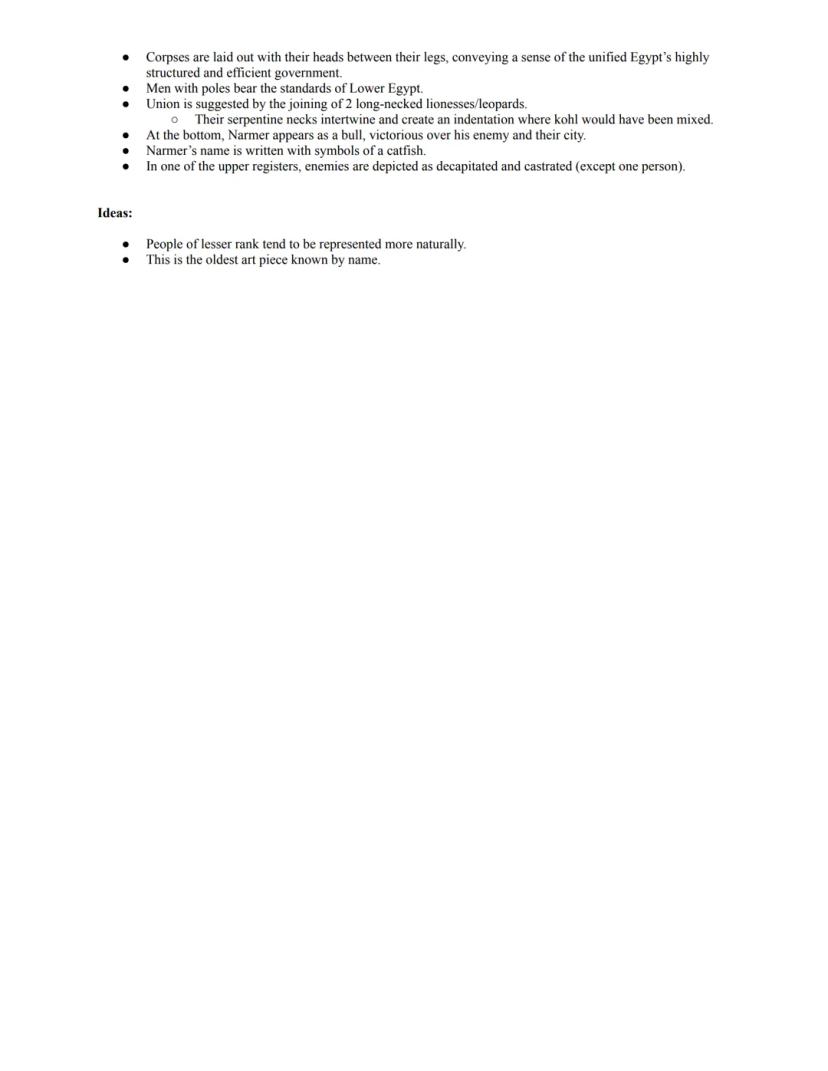
The Palette of King Narmer isn't just an ancient makeup tool—it's one of history's earliest political documents! Created around 3000 BCE from greywacke stone, this palette tells the dramatic story of Egypt's unification under a single ruler.
This remarkable artifact served a dual purpose: practically for grinding ingredients to make kohl (ancient eyeliner that protected against sun and irritation) and symbolically to commemorate King Narmer's conquest. Standing at 25 inches tall, the palette features detailed bas-relief carvings on both sides that can be read either horizontally or vertically.
On the front, Narmer appears in the classic smiting pose that would become standard in Egyptian art for 3,000 years. He wears the White Crown of Upper Egypt and prepares to strike his enemy with a mace. Notice the hierarchy of scale—Narmer towers over his enemies, showing his importance. His body is shown in the traditional composite view with head in profile but eye and torso facing forward.
Look closely! At the top of the palette are two cow heads representing the goddess Hathor, showing divine approval of Narmer's rule. The intertwined long-necked lionesses/leopards symbolize the unification of Upper and Lower Egypt.
The palette reveals much about early Egyptian symbolism. Narmer appears as a bull at the bottom, destroying a city. His sandal bearer carries an unguent jar (for ointments or perfumes), and defeated enemies lie with their heads between their legs. This artifact is considered the oldest artwork known by a creator's name!
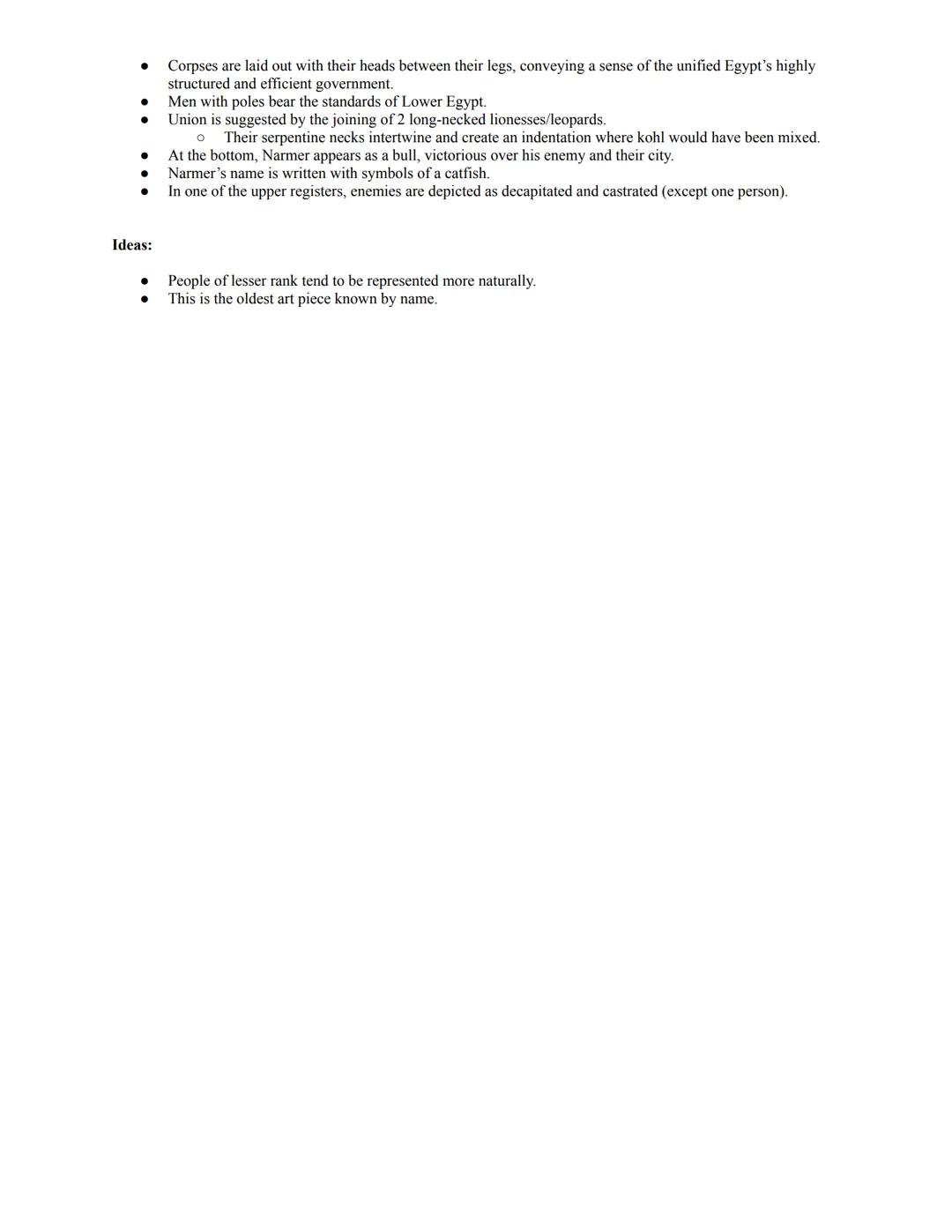
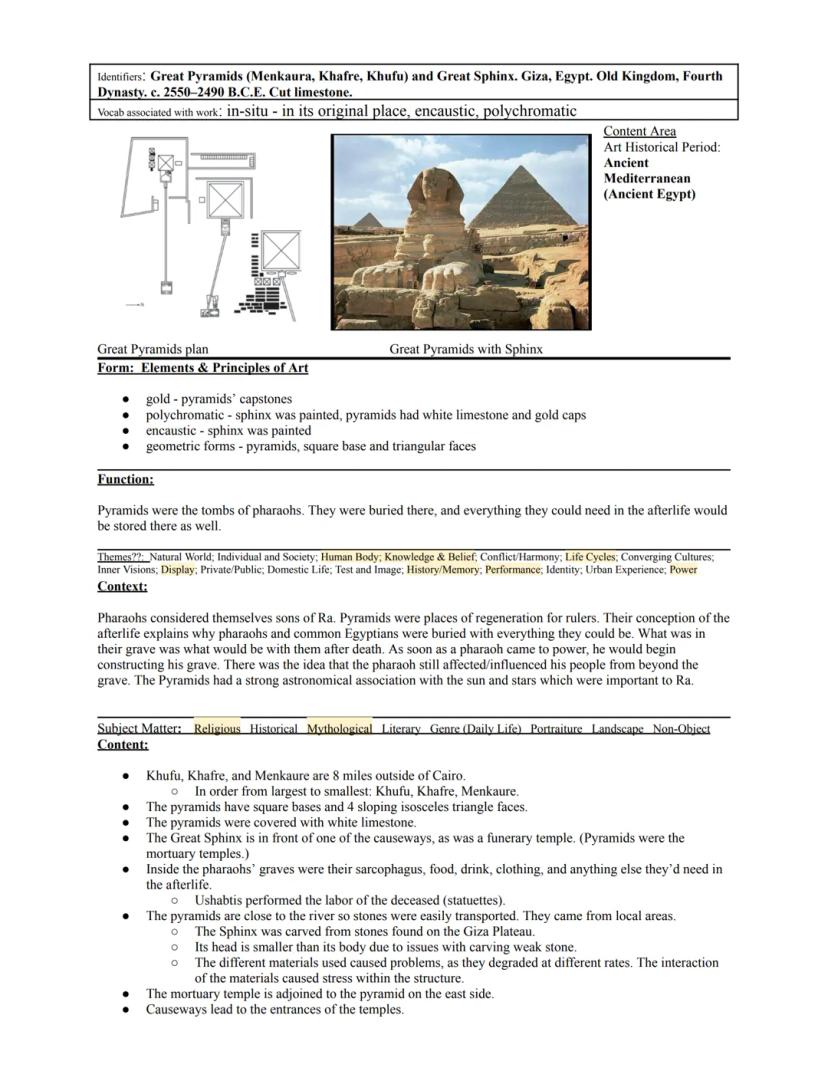
The Great Pyramids of Giza stand as the ultimate monuments to ancient Egyptian ingenuity and belief in the afterlife. Built during the Old Kingdom's Fourth Dynasty , these massive structures were constructed as tombs for Pharaohs Khufu, Khafre, and Menkaura.
Each pyramid features a square base with four sloping triangular faces, originally covered with gleaming white limestone and topped with gold capstones. Located just 8 miles outside modern Cairo, these structures are aligned with astronomical precision. The Great Sphinx, with its lion's body and human head, guards the pyramid complex and was carved from stone found on the Giza Plateau.
The pyramids reveal the Egyptians' extraordinary engineering capabilities and obsession with preparing for the afterlife. Inside each tomb was the pharaoh's sarcophagus along with everything they'd need in the next life—food, drink, clothing, and even ushabtis (small statuettes that would perform labor for the deceased).
Engineering challenge: The pyramids were built near the river for easy transport of materials, but using different stone types created structural problems as materials degraded at different rates. The Sphinx's head is disproportionately small because carvers encountered weak stone during construction!
These structures weren't just tombs but complete complexes. Each pyramid had a mortuary temple on its east side connected by causeways. Originally, the Sphinx was painted in bright colors and the pyramids gleamed white with gold caps—quite different from how they appear today! As the oldest of the Seven Wonders of the Ancient World, they've faced restoration efforts since Roman times.
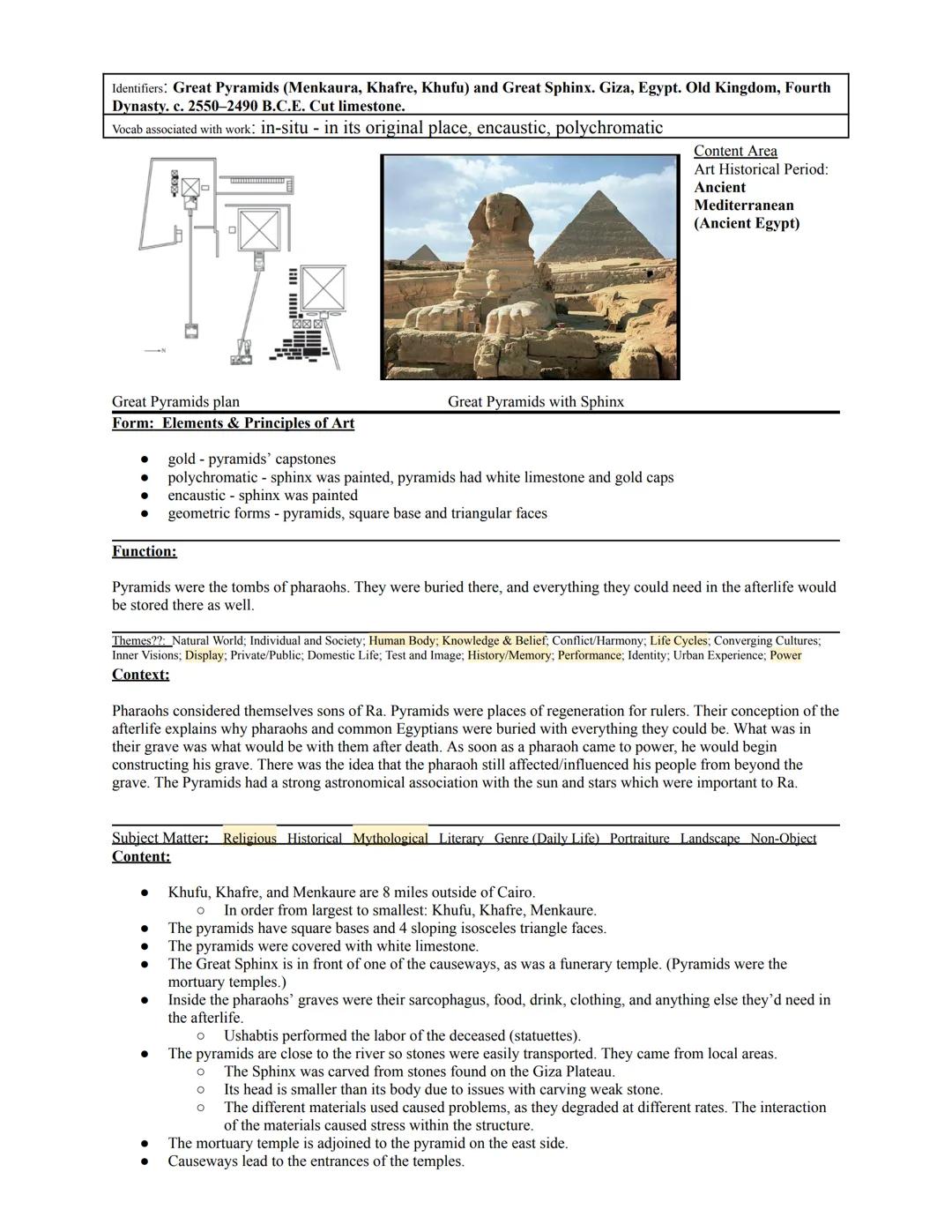
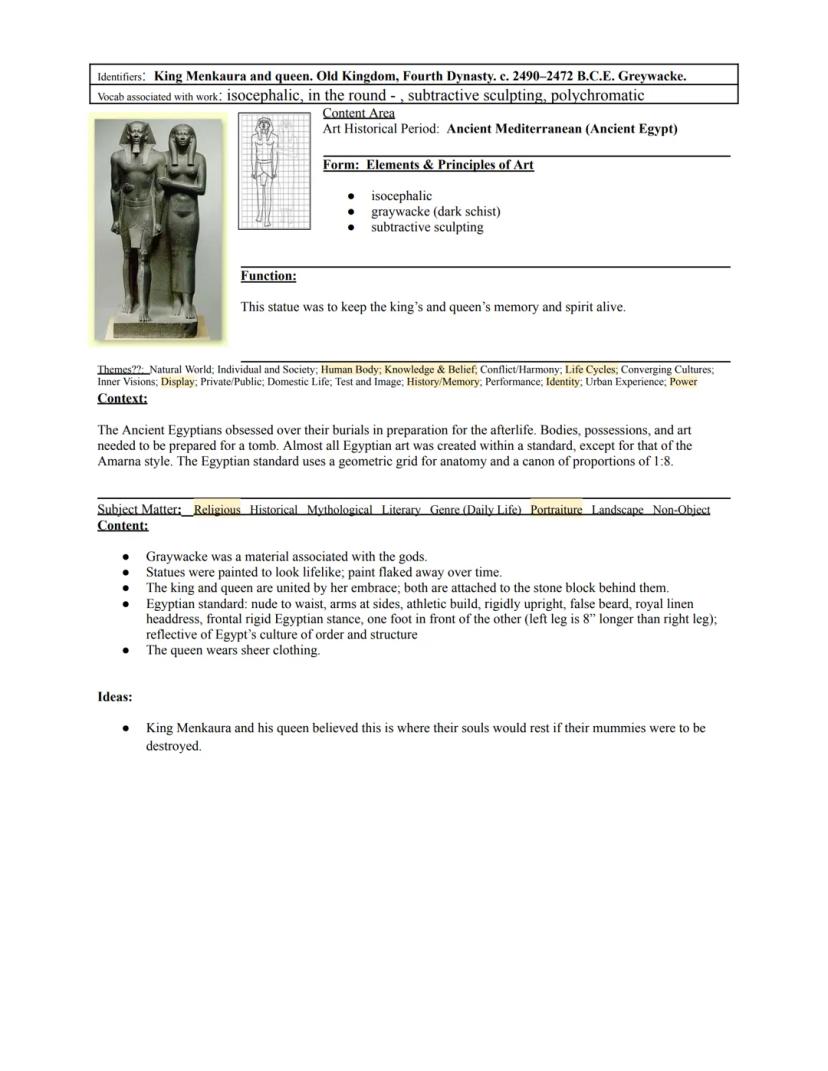
When you look at this statue of King Menkaura and his queen, you're seeing how ancient Egyptians wanted to be remembered for eternity. Carved from dark graywacke stone (a material associated with the gods) around 2490-2472 BCE, this sculpture was created to house the royal couple's spirits if their mummies were destroyed.
The statue perfectly demonstrates the Egyptian standard for royal portraiture. The king stands with one foot forward (his left leg is actually 8 inches longer than his right), creating a sense of movement while maintaining rigid stability. He has the athletic build, false beard, and royal headdress typical of pharaoh depictions. The queen embraces him, symbolizing their unity, while wearing a sheer garment that reveals her form.
Though now plain stone, this statue was originally polychromatic—painted with lifelike colors that flaked away over time. Both figures remain attached to the stone block behind them for stability, a common practice in Egyptian sculpture using subtractive sculpting techniques.
Why so strict? The rigid artistic standards reflect Egypt's culture of order and structure. These weren't meant to be creative expressions but functional objects that would serve the deceased in the afterlife.
What makes this piece special is how it shows the relationship between the royal couple while still adhering to artistic conventions. They stand at equal height (isocephalic), though the queen's stance is less rigid than typically seen in Egyptian royal sculpture. Their eternal partnership is captured in stone, ready to continue into the afterlife.

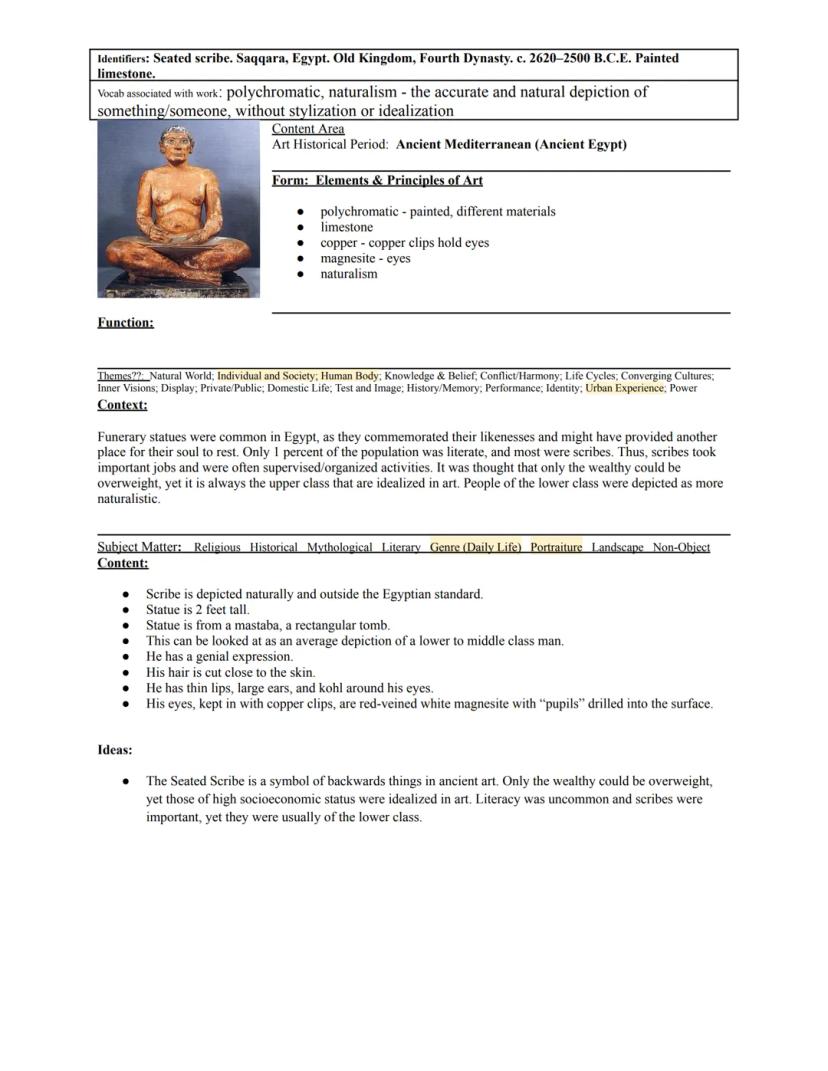
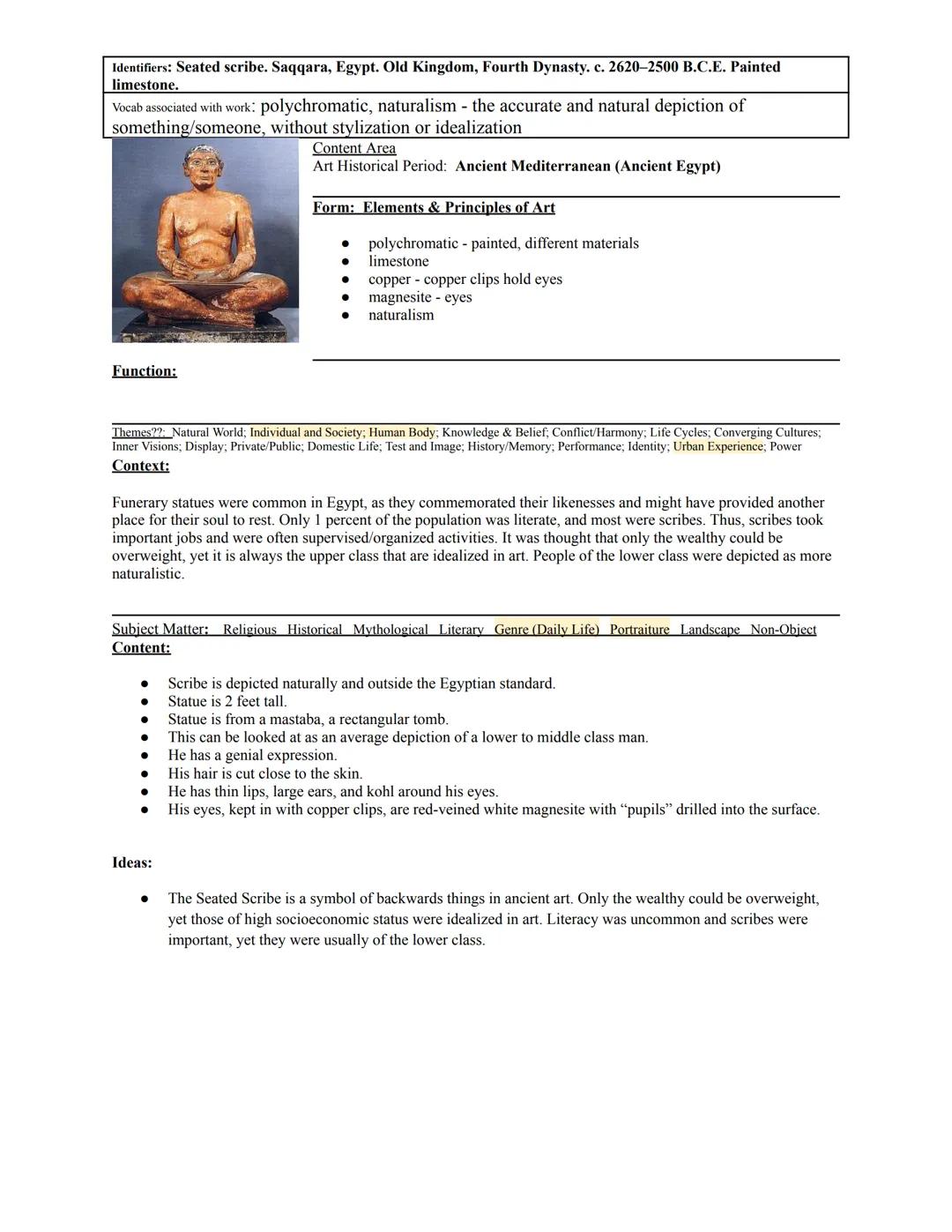
Unlike most Egyptian art that idealized the powerful, the Seated Scribe offers something refreshingly real. Created during the Old Kingdom from painted limestone, this statue captures a middle-class professional in a surprisingly natural pose.
Standing just two feet tall, this figure sits cross-legged with a papyrus scroll across his lap, ready to record important information. What makes this statue stand out is its departure from the rigid Egyptian standard that governed most art. Instead of an idealized physique, we see a slightly overweight man with realistic features—something usually reserved for depictions of lower social classes.
The artist paid incredible attention to detail. The scribe has thin lips, large ears, and a genial expression that makes him seem approachable. His eyes are especially remarkable—made of white magnesite with red veining and held in place with copper clips. The pupils are drilled into the surface, creating a lifelike gaze that seems to follow viewers.
Social irony: Though scribes held important positions (only 1% of Egyptians were literate), they were usually from the lower classes. Meanwhile, only wealthy Egyptians could be overweight, yet those of high status were typically idealized in art—the opposite of what we see here!
Found in a mastaba (rectangular tomb), this statue represents a crucial professional in ancient Egyptian society. Scribes organized activities, supervised projects, and maintained records in a society where literacy was rare and valuable. This naturalistic portrayal gives us a genuine connection to an individual who lived over 4,500 years ago.
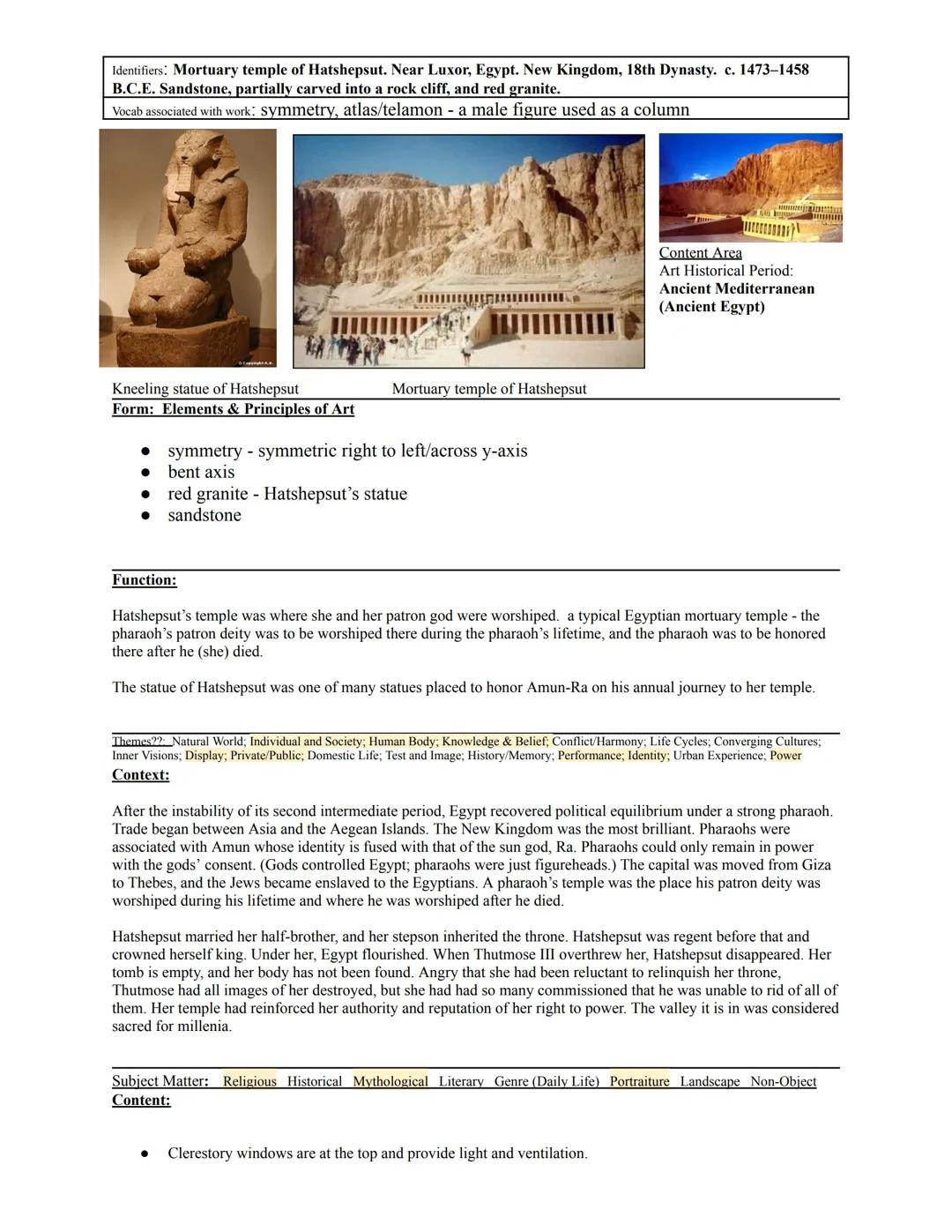
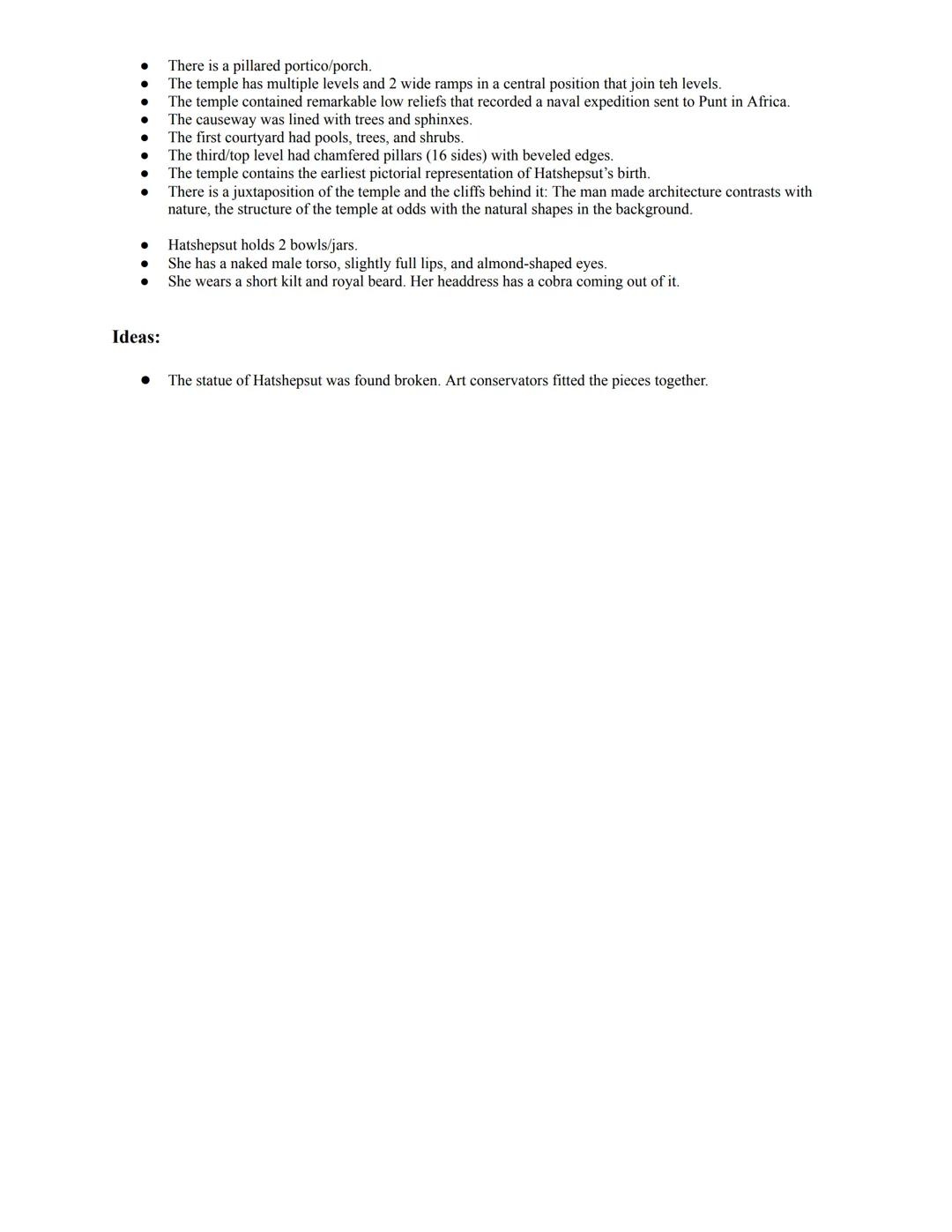
Hatshepsut wasn't just any pharaoh—she was one of Egypt's few female rulers, and her mortuary temple near Luxor reflects her exceptional reign. Built between 1473-1458 BCE, this remarkable structure blends harmoniously with the dramatic cliffs behind it while making a bold architectural statement.
The temple rises in three distinct terraces connected by wide central ramps, creating a sense of ascension toward the heavens. Each level features colonnaded porticoes with symmetrical designs. The top level contains impressive columns with chamfered (beveled) edges, giving them 16 sides each. Clerestory windows at the upper levels provided light and ventilation throughout the structure.
During Hatshepsut's time, the temple grounds featured reflecting pools, trees, and gardens, with a causeway lined with sphinxes leading to the entrance. Inside, remarkable low reliefs recorded important events, including a naval expedition to Punt in Africa and even the earliest pictorial representation of Hatshepsut's divine birth.
Political erasure: After Hatshepsut's death, her stepson Thutmose III tried to erase her from history by destroying her images. He was angry that she had ruled instead of remaining merely a regent. Fortunately, she had commissioned so many works that he couldn't eliminate all traces of her reign!
The temple also housed a striking statue of Hatshepsut made of red granite. Though found broken, it depicts her with the traditional male pharaonic attributes—a naked male torso, short kilt, royal beard, and cobra headdress. These masculine elements reinforced her authority as pharaoh during her lifetime and her divinity after death.
The Temple of Amun-Re at Karnak stands as one of ancient Egypt's most impressive architectural achievements. Built near Luxor during the New Kingdom , this massive religious complex was constructed over centuries by approximately 30 different pharaohs.
At the heart of the temple lies the spectacular Hypostyle Hall, featuring 134 massive columns arranged in 16 rows. The central columns tower an incredible 78 feet high with lotus blossom capitals, while shorter columns line the side aisles. Light enters through clerestory windows above, creating a dramatic, mystical atmosphere. These columns were carved in sunken relief with painted scenes showing kings offering tribute, battle victories, and parades of captives.
The entire complex was designed as Amun-Ra's earthly home. Tall stone obelisks throughout the complex symbolized the sun god Ra, while the inner sanctuary housed a statue of Amun-Ra that only priests could access. The temple's layout cleverly manipulated spatial experience—as visitors moved deeper into the temple, the ground level gradually rose while the ceiling lowered, creating increasing darkness and mystery.
Sacred geography: The temple's outer walls protected it from secular activities, and surrounding land was taxed to support its operations. Only priests could enter the innermost chambers, maintaining the god's sacred privacy.
This magnificent complex, built from cut sandstone and mud brick, exemplifies how ancient Egyptians used architecture to express religious devotion. The polychromatic painted columns and ornate carvings would have created an awe-inspiring experience for ancient visitors, reinforcing the power of both the gods and the pharaohs who commissioned these structures.
The limestone relief of Akhenaton, Nefertiti, and their three daughters represents one of the most dramatic artistic revolutions in ancient history! Created during the brief Amarna period , this intimate family scene broke nearly every rule of traditional Egyptian art.
This sunken relief carving served as an altar top dedicated to Akhenaton and the sun disk god Aten. What makes it revolutionary is its informal, naturalistic depiction of the royal family. Akhenaton sits on a throne holding his eldest daughter and kissing her, while Nefertiti sits opposite him with their second daughter pointing toward her father. A third daughter playfully tugs at Nefertiti's earring!
The artwork employs the distinctive Amarna style with its curvilinear rather than geometric forms. Figures have elongated skulls, swollen bellies, and thin limbs—a dramatic departure from the rigid traditional Egyptian standard. The attention to flowing drapery and natural family interaction creates a scene that feels surprisingly modern.
Religious revolution: This style emerged only because Akhenaton changed Egypt's entire religion, replacing worship of multiple gods with the single sun-disk deity Aten. This dramatic religious shift temporarily liberated artists from thousands of years of artistic convention!
The scene still maintains some traditional elements like the composite view of bodies. The sun-disk Aten appears above, with rays ending in hands holding ankh symbols (representing life), blessing the royal family. Most striking is how Akhenaton and Nefertiti are portrayed as equals—extremely unusual in ancient Egyptian art and reflecting their actual co-rulership during this fascinating period.
King Tutankhamun's innermost coffin represents the pinnacle of ancient Egyptian funerary luxury. Created during the 18th Dynasty (c. 1323 BCE), this stunning coffin is made of solid gold inlaid with colorful enamel and semi-precious stones.
Standing over six feet tall and weighing an incredible 243 pounds (with gold valued at approximately $1.7 million in today's market), this coffin held the teenage pharaoh's mummified body. Between this innermost coffin and the next outer one, excavators discovered layers of ancient perfume—two full buckets had been poured inside during burial!
The coffin shows Tutankhamun in idealized form, holding the royal crook and flail (symbols of kingship) and wearing the striped royal headdress. His broad collar and wrist ornaments are carved in low relief. Unlike the earlier Amarna style associated with Tutankhamun's father Akhenaton, this coffin returns to traditional Egyptian artistic conventions with an impassive, impersonal image of royalty.
Discovery drama: When Howard Carter discovered Tutankhamun's tomb in 1922, it took over a year to excavate and nine months just to remove all the treasures! It remains the most intact royal tomb ever found in Egypt.
Ancient Egyptians believed gods had skin of gold, bones of silver, and hair of lapis lazuli—Tutankhamun's golden coffin literally transformed him into a divine being for the afterlife. Though he died young (probably from complications of a broken leg rather than murder as once suspected), his nearly perfectly preserved tomb has made him the most famous Egyptian pharaoh, despite his relatively minor historical importance.
Our AI companion is specifically built for the needs of students. Based on the millions of content pieces we have on the platform we can provide truly meaningful and relevant answers to students. But its not only about answers, the companion is even more about guiding students through their daily learning challenges, with personalised study plans, quizzes or content pieces in the chat and 100% personalisation based on the students skills and developments.
You can download the app in the Google Play Store and in the Apple App Store.
That's right! Enjoy free access to study content, connect with fellow students, and get instant help – all at your fingertips.
App Store
Google Play
The app is very easy to use and well designed. I have found everything I was looking for so far and have been able to learn a lot from the presentations! I will definitely use the app for a class assignment! And of course it also helps a lot as an inspiration.
Stefan S
iOS user
This app is really great. There are so many study notes and help [...]. My problem subject is French, for example, and the app has so many options for help. Thanks to this app, I have improved my French. I would recommend it to anyone.
Samantha Klich
Android user
Wow, I am really amazed. I just tried the app because I've seen it advertised many times and was absolutely stunned. This app is THE HELP you want for school and above all, it offers so many things, such as workouts and fact sheets, which have been VERY helpful to me personally.
Anna
iOS user
I think it’s very much worth it and you’ll end up using it a lot once you get the hang of it and even after looking at others notes you can still ask your Artificial intelligence buddy the question and ask to simplify it if you still don’t get it!!! In the end I think it’s worth it 😊👍 ⚠️Also DID I MENTION ITS FREEE YOU DON’T HAVE TO PAY FOR ANYTHING AND STILL GET YOUR GRADES IN PERFECTLY❗️❗️⚠️
Thomas R
iOS user
Knowunity is the BEST app I’ve used in a minute. This is not an ai review or anything this is genuinely coming from a 7th grade student (I know 2011 im young) but dude this app is a 10/10 i have maintained a 3.8 gpa and have plenty of time for gaming. I love it and my mom is just happy I got good grades
Brad T
Android user
Not only did it help me find the answer but it also showed me alternative ways to solve it. I was horrible in math and science but now I have an a in both subjects. Thanks for the help🤍🤍
David K
iOS user
The app's just great! All I have to do is enter the topic in the search bar and I get the response real fast. I don't have to watch 10 YouTube videos to understand something, so I'm saving my time. Highly recommended!
Sudenaz Ocak
Android user
In school I was really bad at maths but thanks to the app, I am doing better now. I am so grateful that you made the app.
Greenlight Bonnie
Android user
I found this app a couple years ago and it has only gotten better since then. I really love it because it can help with written questions and photo questions. Also, it can find study guides that other people have made as well as flashcard sets and practice tests. The free version is also amazing for students who might not be able to afford it. Would 100% recommend
Aubrey
iOS user
Best app if you're in Highschool or Junior high. I have been using this app for 2 school years and it's the best, it's good if you don't have anyone to help you with school work.😋🩷🎀
Marco B
iOS user
homepage/newPositiveReviewText6
Elisha
iOS user
This app is phenomenal down to the correct info and the various topics you can study! I greatly recommend it for people who struggle with procrastination and those who need homework help. It has been perfectly accurate for world 1 history as far as I’ve seen! Geometry too!
Paul T
iOS user
The app is very easy to use and well designed. I have found everything I was looking for so far and have been able to learn a lot from the presentations! I will definitely use the app for a class assignment! And of course it also helps a lot as an inspiration.
Stefan S
iOS user
This app is really great. There are so many study notes and help [...]. My problem subject is French, for example, and the app has so many options for help. Thanks to this app, I have improved my French. I would recommend it to anyone.
Samantha Klich
Android user
Wow, I am really amazed. I just tried the app because I've seen it advertised many times and was absolutely stunned. This app is THE HELP you want for school and above all, it offers so many things, such as workouts and fact sheets, which have been VERY helpful to me personally.
Anna
iOS user
I think it’s very much worth it and you’ll end up using it a lot once you get the hang of it and even after looking at others notes you can still ask your Artificial intelligence buddy the question and ask to simplify it if you still don’t get it!!! In the end I think it’s worth it 😊👍 ⚠️Also DID I MENTION ITS FREEE YOU DON’T HAVE TO PAY FOR ANYTHING AND STILL GET YOUR GRADES IN PERFECTLY❗️❗️⚠️
Thomas R
iOS user
Knowunity is the BEST app I’ve used in a minute. This is not an ai review or anything this is genuinely coming from a 7th grade student (I know 2011 im young) but dude this app is a 10/10 i have maintained a 3.8 gpa and have plenty of time for gaming. I love it and my mom is just happy I got good grades
Brad T
Android user
Not only did it help me find the answer but it also showed me alternative ways to solve it. I was horrible in math and science but now I have an a in both subjects. Thanks for the help🤍🤍
David K
iOS user
The app's just great! All I have to do is enter the topic in the search bar and I get the response real fast. I don't have to watch 10 YouTube videos to understand something, so I'm saving my time. Highly recommended!
Sudenaz Ocak
Android user
In school I was really bad at maths but thanks to the app, I am doing better now. I am so grateful that you made the app.
Greenlight Bonnie
Android user
I found this app a couple years ago and it has only gotten better since then. I really love it because it can help with written questions and photo questions. Also, it can find study guides that other people have made as well as flashcard sets and practice tests. The free version is also amazing for students who might not be able to afford it. Would 100% recommend
Aubrey
iOS user
Best app if you're in Highschool or Junior high. I have been using this app for 2 school years and it's the best, it's good if you don't have anyone to help you with school work.😋🩷🎀
Marco B
iOS user
homepage/newPositiveReviewText6
Elisha
iOS user
This app is phenomenal down to the correct info and the various topics you can study! I greatly recommend it for people who struggle with procrastination and those who need homework help. It has been perfectly accurate for world 1 history as far as I’ve seen! Geometry too!
Paul T
iOS user
Stella
@stellasofia
Ancient Egypt was one of the world's most impressive early civilizations, leaving behind magnificent artwork, architecture, and cultural practices that still fascinate us today. From the mighty pyramids to intricate tomb art, the Egyptians created a visual legacy that tells... Show more
Access to all documents
Improve your grades
Join milions of students
By signing up you accept Terms of Service and Privacy Policy
Ever wonder why Egyptian art looks so distinct? The ancient Egyptians developed specific artistic conventions that lasted for thousands of years! Their art was heavily influenced by the Nile River, which provided fertile silt for farming and shaped their entire civilization.
Egyptian art followed strict stylistic characteristics including a precise canon of proportions (1:8 ratio) and hierarchy of scale (important figures shown larger). When looking at Egyptian figures, you'll notice they typically appear rigid with no leg separation and are shown in a composite view – face and feet in profile but eyes and torso facing forward.
Architecture featured impressive colonnades with distinctive lotus blossom capitals. The Egyptians developed a complex writing system called hieroglyphics, which remained mysterious until the discovery of the Rosetta Stone allowed scholars to finally translate their pictorial language.
Quick Fact: During the brief Amarna period under Pharaoh Akhenaton, Egyptian art temporarily broke from tradition with a distinctive style featuring elongated body parts, large bellies, and full lips – quite different from the rigid traditional canon!
Understanding Egyptian art requires knowledge of their beliefs about death and the afterlife. They believed that if a mummy was damaged, it would harm that person's ka (life force) and ba (personality), which is why they went to such great lengths to preserve bodies and build elaborate tombs.
Access to all documents
Improve your grades
Join milions of students
By signing up you accept Terms of Service and Privacy Policy
Imagine having a magical scroll that could guarantee your success in the afterlife! That's exactly what the Book of the Dead was for ancient Egyptians. This painted papyrus scroll belonging to Hu-Nefer (c. 1275 BCE) contains spells and illustrations to help guide the deceased through judgment and into eternal paradise.
When examining this artwork, notice how it's organized in horizontal registers (like rows) that tell a continuous narrative. The story reads from left to right, showing Hu-Nefer being led by Anubis to the Hall of Judgment. There, his heart is weighed against the feather of Maat (goddess of truth) to determine if he lived a virtuous life.
The artwork employs several Egyptian conventions including hieroglyphics (pictorial writing) that accompany the images, isocephalism (heads at the same level) in the top register, and polychromatic painting techniques. The same person appears multiple times throughout the narrative, showing different moments in the judgment process.
Did you know? Books of the Dead were expensive luxury items that only wealthy Egyptians could afford! They could be customized with specific spells from a collection of 192 known spells, though no single book contained all of them.
The scroll reflects the Egyptian belief that magic could influence the afterlife. Special spells could ensure your heart balanced perfectly with Maat's feather, allowing you to live eternally in the Field of the Reeds – the Egyptian paradise.
Access to all documents
Improve your grades
Join milions of students
By signing up you accept Terms of Service and Privacy Policy
The Palette of King Narmer isn't just an ancient makeup tool—it's one of history's earliest political documents! Created around 3000 BCE from greywacke stone, this palette tells the dramatic story of Egypt's unification under a single ruler.
This remarkable artifact served a dual purpose: practically for grinding ingredients to make kohl (ancient eyeliner that protected against sun and irritation) and symbolically to commemorate King Narmer's conquest. Standing at 25 inches tall, the palette features detailed bas-relief carvings on both sides that can be read either horizontally or vertically.
On the front, Narmer appears in the classic smiting pose that would become standard in Egyptian art for 3,000 years. He wears the White Crown of Upper Egypt and prepares to strike his enemy with a mace. Notice the hierarchy of scale—Narmer towers over his enemies, showing his importance. His body is shown in the traditional composite view with head in profile but eye and torso facing forward.
Look closely! At the top of the palette are two cow heads representing the goddess Hathor, showing divine approval of Narmer's rule. The intertwined long-necked lionesses/leopards symbolize the unification of Upper and Lower Egypt.
The palette reveals much about early Egyptian symbolism. Narmer appears as a bull at the bottom, destroying a city. His sandal bearer carries an unguent jar (for ointments or perfumes), and defeated enemies lie with their heads between their legs. This artifact is considered the oldest artwork known by a creator's name!
Access to all documents
Improve your grades
Join milions of students
By signing up you accept Terms of Service and Privacy Policy
The Great Pyramids of Giza stand as the ultimate monuments to ancient Egyptian ingenuity and belief in the afterlife. Built during the Old Kingdom's Fourth Dynasty , these massive structures were constructed as tombs for Pharaohs Khufu, Khafre, and Menkaura.
Each pyramid features a square base with four sloping triangular faces, originally covered with gleaming white limestone and topped with gold capstones. Located just 8 miles outside modern Cairo, these structures are aligned with astronomical precision. The Great Sphinx, with its lion's body and human head, guards the pyramid complex and was carved from stone found on the Giza Plateau.
The pyramids reveal the Egyptians' extraordinary engineering capabilities and obsession with preparing for the afterlife. Inside each tomb was the pharaoh's sarcophagus along with everything they'd need in the next life—food, drink, clothing, and even ushabtis (small statuettes that would perform labor for the deceased).
Engineering challenge: The pyramids were built near the river for easy transport of materials, but using different stone types created structural problems as materials degraded at different rates. The Sphinx's head is disproportionately small because carvers encountered weak stone during construction!
These structures weren't just tombs but complete complexes. Each pyramid had a mortuary temple on its east side connected by causeways. Originally, the Sphinx was painted in bright colors and the pyramids gleamed white with gold caps—quite different from how they appear today! As the oldest of the Seven Wonders of the Ancient World, they've faced restoration efforts since Roman times.
Access to all documents
Improve your grades
Join milions of students
By signing up you accept Terms of Service and Privacy Policy
When you look at this statue of King Menkaura and his queen, you're seeing how ancient Egyptians wanted to be remembered for eternity. Carved from dark graywacke stone (a material associated with the gods) around 2490-2472 BCE, this sculpture was created to house the royal couple's spirits if their mummies were destroyed.
The statue perfectly demonstrates the Egyptian standard for royal portraiture. The king stands with one foot forward (his left leg is actually 8 inches longer than his right), creating a sense of movement while maintaining rigid stability. He has the athletic build, false beard, and royal headdress typical of pharaoh depictions. The queen embraces him, symbolizing their unity, while wearing a sheer garment that reveals her form.
Though now plain stone, this statue was originally polychromatic—painted with lifelike colors that flaked away over time. Both figures remain attached to the stone block behind them for stability, a common practice in Egyptian sculpture using subtractive sculpting techniques.
Why so strict? The rigid artistic standards reflect Egypt's culture of order and structure. These weren't meant to be creative expressions but functional objects that would serve the deceased in the afterlife.
What makes this piece special is how it shows the relationship between the royal couple while still adhering to artistic conventions. They stand at equal height (isocephalic), though the queen's stance is less rigid than typically seen in Egyptian royal sculpture. Their eternal partnership is captured in stone, ready to continue into the afterlife.
Access to all documents
Improve your grades
Join milions of students
By signing up you accept Terms of Service and Privacy Policy
Unlike most Egyptian art that idealized the powerful, the Seated Scribe offers something refreshingly real. Created during the Old Kingdom from painted limestone, this statue captures a middle-class professional in a surprisingly natural pose.
Standing just two feet tall, this figure sits cross-legged with a papyrus scroll across his lap, ready to record important information. What makes this statue stand out is its departure from the rigid Egyptian standard that governed most art. Instead of an idealized physique, we see a slightly overweight man with realistic features—something usually reserved for depictions of lower social classes.
The artist paid incredible attention to detail. The scribe has thin lips, large ears, and a genial expression that makes him seem approachable. His eyes are especially remarkable—made of white magnesite with red veining and held in place with copper clips. The pupils are drilled into the surface, creating a lifelike gaze that seems to follow viewers.
Social irony: Though scribes held important positions (only 1% of Egyptians were literate), they were usually from the lower classes. Meanwhile, only wealthy Egyptians could be overweight, yet those of high status were typically idealized in art—the opposite of what we see here!
Found in a mastaba (rectangular tomb), this statue represents a crucial professional in ancient Egyptian society. Scribes organized activities, supervised projects, and maintained records in a society where literacy was rare and valuable. This naturalistic portrayal gives us a genuine connection to an individual who lived over 4,500 years ago.
Access to all documents
Improve your grades
Join milions of students
By signing up you accept Terms of Service and Privacy Policy
Hatshepsut wasn't just any pharaoh—she was one of Egypt's few female rulers, and her mortuary temple near Luxor reflects her exceptional reign. Built between 1473-1458 BCE, this remarkable structure blends harmoniously with the dramatic cliffs behind it while making a bold architectural statement.
The temple rises in three distinct terraces connected by wide central ramps, creating a sense of ascension toward the heavens. Each level features colonnaded porticoes with symmetrical designs. The top level contains impressive columns with chamfered (beveled) edges, giving them 16 sides each. Clerestory windows at the upper levels provided light and ventilation throughout the structure.
During Hatshepsut's time, the temple grounds featured reflecting pools, trees, and gardens, with a causeway lined with sphinxes leading to the entrance. Inside, remarkable low reliefs recorded important events, including a naval expedition to Punt in Africa and even the earliest pictorial representation of Hatshepsut's divine birth.
Political erasure: After Hatshepsut's death, her stepson Thutmose III tried to erase her from history by destroying her images. He was angry that she had ruled instead of remaining merely a regent. Fortunately, she had commissioned so many works that he couldn't eliminate all traces of her reign!
The temple also housed a striking statue of Hatshepsut made of red granite. Though found broken, it depicts her with the traditional male pharaonic attributes—a naked male torso, short kilt, royal beard, and cobra headdress. These masculine elements reinforced her authority as pharaoh during her lifetime and her divinity after death.
Access to all documents
Improve your grades
Join milions of students
By signing up you accept Terms of Service and Privacy Policy
The Temple of Amun-Re at Karnak stands as one of ancient Egypt's most impressive architectural achievements. Built near Luxor during the New Kingdom , this massive religious complex was constructed over centuries by approximately 30 different pharaohs.
At the heart of the temple lies the spectacular Hypostyle Hall, featuring 134 massive columns arranged in 16 rows. The central columns tower an incredible 78 feet high with lotus blossom capitals, while shorter columns line the side aisles. Light enters through clerestory windows above, creating a dramatic, mystical atmosphere. These columns were carved in sunken relief with painted scenes showing kings offering tribute, battle victories, and parades of captives.
The entire complex was designed as Amun-Ra's earthly home. Tall stone obelisks throughout the complex symbolized the sun god Ra, while the inner sanctuary housed a statue of Amun-Ra that only priests could access. The temple's layout cleverly manipulated spatial experience—as visitors moved deeper into the temple, the ground level gradually rose while the ceiling lowered, creating increasing darkness and mystery.
Sacred geography: The temple's outer walls protected it from secular activities, and surrounding land was taxed to support its operations. Only priests could enter the innermost chambers, maintaining the god's sacred privacy.
This magnificent complex, built from cut sandstone and mud brick, exemplifies how ancient Egyptians used architecture to express religious devotion. The polychromatic painted columns and ornate carvings would have created an awe-inspiring experience for ancient visitors, reinforcing the power of both the gods and the pharaohs who commissioned these structures.
Access to all documents
Improve your grades
Join milions of students
By signing up you accept Terms of Service and Privacy Policy
The limestone relief of Akhenaton, Nefertiti, and their three daughters represents one of the most dramatic artistic revolutions in ancient history! Created during the brief Amarna period , this intimate family scene broke nearly every rule of traditional Egyptian art.
This sunken relief carving served as an altar top dedicated to Akhenaton and the sun disk god Aten. What makes it revolutionary is its informal, naturalistic depiction of the royal family. Akhenaton sits on a throne holding his eldest daughter and kissing her, while Nefertiti sits opposite him with their second daughter pointing toward her father. A third daughter playfully tugs at Nefertiti's earring!
The artwork employs the distinctive Amarna style with its curvilinear rather than geometric forms. Figures have elongated skulls, swollen bellies, and thin limbs—a dramatic departure from the rigid traditional Egyptian standard. The attention to flowing drapery and natural family interaction creates a scene that feels surprisingly modern.
Religious revolution: This style emerged only because Akhenaton changed Egypt's entire religion, replacing worship of multiple gods with the single sun-disk deity Aten. This dramatic religious shift temporarily liberated artists from thousands of years of artistic convention!
The scene still maintains some traditional elements like the composite view of bodies. The sun-disk Aten appears above, with rays ending in hands holding ankh symbols (representing life), blessing the royal family. Most striking is how Akhenaton and Nefertiti are portrayed as equals—extremely unusual in ancient Egyptian art and reflecting their actual co-rulership during this fascinating period.
Access to all documents
Improve your grades
Join milions of students
By signing up you accept Terms of Service and Privacy Policy
King Tutankhamun's innermost coffin represents the pinnacle of ancient Egyptian funerary luxury. Created during the 18th Dynasty (c. 1323 BCE), this stunning coffin is made of solid gold inlaid with colorful enamel and semi-precious stones.
Standing over six feet tall and weighing an incredible 243 pounds (with gold valued at approximately $1.7 million in today's market), this coffin held the teenage pharaoh's mummified body. Between this innermost coffin and the next outer one, excavators discovered layers of ancient perfume—two full buckets had been poured inside during burial!
The coffin shows Tutankhamun in idealized form, holding the royal crook and flail (symbols of kingship) and wearing the striped royal headdress. His broad collar and wrist ornaments are carved in low relief. Unlike the earlier Amarna style associated with Tutankhamun's father Akhenaton, this coffin returns to traditional Egyptian artistic conventions with an impassive, impersonal image of royalty.
Discovery drama: When Howard Carter discovered Tutankhamun's tomb in 1922, it took over a year to excavate and nine months just to remove all the treasures! It remains the most intact royal tomb ever found in Egypt.
Ancient Egyptians believed gods had skin of gold, bones of silver, and hair of lapis lazuli—Tutankhamun's golden coffin literally transformed him into a divine being for the afterlife. Though he died young (probably from complications of a broken leg rather than murder as once suspected), his nearly perfectly preserved tomb has made him the most famous Egyptian pharaoh, despite his relatively minor historical importance.
Our AI companion is specifically built for the needs of students. Based on the millions of content pieces we have on the platform we can provide truly meaningful and relevant answers to students. But its not only about answers, the companion is even more about guiding students through their daily learning challenges, with personalised study plans, quizzes or content pieces in the chat and 100% personalisation based on the students skills and developments.
You can download the app in the Google Play Store and in the Apple App Store.
That's right! Enjoy free access to study content, connect with fellow students, and get instant help – all at your fingertips.
2
Smart Tools NEW
Transform this note into: ✓ 50+ Practice Questions ✓ Interactive Flashcards ✓ Full Mock Exam ✓ Essay Outlines
App Store
Google Play
The app is very easy to use and well designed. I have found everything I was looking for so far and have been able to learn a lot from the presentations! I will definitely use the app for a class assignment! And of course it also helps a lot as an inspiration.
Stefan S
iOS user
This app is really great. There are so many study notes and help [...]. My problem subject is French, for example, and the app has so many options for help. Thanks to this app, I have improved my French. I would recommend it to anyone.
Samantha Klich
Android user
Wow, I am really amazed. I just tried the app because I've seen it advertised many times and was absolutely stunned. This app is THE HELP you want for school and above all, it offers so many things, such as workouts and fact sheets, which have been VERY helpful to me personally.
Anna
iOS user
I think it’s very much worth it and you’ll end up using it a lot once you get the hang of it and even after looking at others notes you can still ask your Artificial intelligence buddy the question and ask to simplify it if you still don’t get it!!! In the end I think it’s worth it 😊👍 ⚠️Also DID I MENTION ITS FREEE YOU DON’T HAVE TO PAY FOR ANYTHING AND STILL GET YOUR GRADES IN PERFECTLY❗️❗️⚠️
Thomas R
iOS user
Knowunity is the BEST app I’ve used in a minute. This is not an ai review or anything this is genuinely coming from a 7th grade student (I know 2011 im young) but dude this app is a 10/10 i have maintained a 3.8 gpa and have plenty of time for gaming. I love it and my mom is just happy I got good grades
Brad T
Android user
Not only did it help me find the answer but it also showed me alternative ways to solve it. I was horrible in math and science but now I have an a in both subjects. Thanks for the help🤍🤍
David K
iOS user
The app's just great! All I have to do is enter the topic in the search bar and I get the response real fast. I don't have to watch 10 YouTube videos to understand something, so I'm saving my time. Highly recommended!
Sudenaz Ocak
Android user
In school I was really bad at maths but thanks to the app, I am doing better now. I am so grateful that you made the app.
Greenlight Bonnie
Android user
I found this app a couple years ago and it has only gotten better since then. I really love it because it can help with written questions and photo questions. Also, it can find study guides that other people have made as well as flashcard sets and practice tests. The free version is also amazing for students who might not be able to afford it. Would 100% recommend
Aubrey
iOS user
Best app if you're in Highschool or Junior high. I have been using this app for 2 school years and it's the best, it's good if you don't have anyone to help you with school work.😋🩷🎀
Marco B
iOS user
homepage/newPositiveReviewText6
Elisha
iOS user
This app is phenomenal down to the correct info and the various topics you can study! I greatly recommend it for people who struggle with procrastination and those who need homework help. It has been perfectly accurate for world 1 history as far as I’ve seen! Geometry too!
Paul T
iOS user
The app is very easy to use and well designed. I have found everything I was looking for so far and have been able to learn a lot from the presentations! I will definitely use the app for a class assignment! And of course it also helps a lot as an inspiration.
Stefan S
iOS user
This app is really great. There are so many study notes and help [...]. My problem subject is French, for example, and the app has so many options for help. Thanks to this app, I have improved my French. I would recommend it to anyone.
Samantha Klich
Android user
Wow, I am really amazed. I just tried the app because I've seen it advertised many times and was absolutely stunned. This app is THE HELP you want for school and above all, it offers so many things, such as workouts and fact sheets, which have been VERY helpful to me personally.
Anna
iOS user
I think it’s very much worth it and you’ll end up using it a lot once you get the hang of it and even after looking at others notes you can still ask your Artificial intelligence buddy the question and ask to simplify it if you still don’t get it!!! In the end I think it’s worth it 😊👍 ⚠️Also DID I MENTION ITS FREEE YOU DON’T HAVE TO PAY FOR ANYTHING AND STILL GET YOUR GRADES IN PERFECTLY❗️❗️⚠️
Thomas R
iOS user
Knowunity is the BEST app I’ve used in a minute. This is not an ai review or anything this is genuinely coming from a 7th grade student (I know 2011 im young) but dude this app is a 10/10 i have maintained a 3.8 gpa and have plenty of time for gaming. I love it and my mom is just happy I got good grades
Brad T
Android user
Not only did it help me find the answer but it also showed me alternative ways to solve it. I was horrible in math and science but now I have an a in both subjects. Thanks for the help🤍🤍
David K
iOS user
The app's just great! All I have to do is enter the topic in the search bar and I get the response real fast. I don't have to watch 10 YouTube videos to understand something, so I'm saving my time. Highly recommended!
Sudenaz Ocak
Android user
In school I was really bad at maths but thanks to the app, I am doing better now. I am so grateful that you made the app.
Greenlight Bonnie
Android user
I found this app a couple years ago and it has only gotten better since then. I really love it because it can help with written questions and photo questions. Also, it can find study guides that other people have made as well as flashcard sets and practice tests. The free version is also amazing for students who might not be able to afford it. Would 100% recommend
Aubrey
iOS user
Best app if you're in Highschool or Junior high. I have been using this app for 2 school years and it's the best, it's good if you don't have anyone to help you with school work.😋🩷🎀
Marco B
iOS user
homepage/newPositiveReviewText6
Elisha
iOS user
This app is phenomenal down to the correct info and the various topics you can study! I greatly recommend it for people who struggle with procrastination and those who need homework help. It has been perfectly accurate for world 1 history as far as I’ve seen! Geometry too!
Paul T
iOS user