
Welcome to an essential guide on human anatomy and physiology... Show more
 Algebra
Sign up to see the contentIt's free!
Access to all documents
Improve your grades
Join milions of students
Knowunity AI
Subjects
Triangle Congruence and Similarity Theorems
Triangle Properties and Classification
Linear Equations and Graphs
Geometric Angle Relationships
Trigonometric Functions and Identities
Equation Solving Techniques
Circle Geometry Fundamentals
Division Operations and Methods
Basic Differentiation Rules
Exponent and Logarithm Properties
Show all topics
Human Organ Systems
Reproductive Cell Cycles
Biological Sciences Subdisciplines
Cellular Energy Metabolism
Autotrophic Energy Processes
Inheritance Patterns and Principles
Biomolecular Structure and Organization
Cell Cycle and Division Mechanics
Cellular Organization and Development
Biological Structural Organization
Show all topics
Chemical Sciences and Applications
Atomic Structure and Composition
Molecular Electron Structure Representation
Atomic Electron Behavior
Matter Properties and Water
Mole Concept and Calculations
Gas Laws and Behavior
Periodic Table Organization
Chemical Thermodynamics Fundamentals
Chemical Bond Types and Properties
Show all topics
European Renaissance and Enlightenment
European Cultural Movements 800-1920
American Revolution Era 1763-1797
American Civil War 1861-1865
Global Imperial Systems
Mongol and Chinese Dynasties
U.S. Presidents and World Leaders
Historical Sources and Documentation
World Wars Era and Impact
World Religious Systems
Show all topics
Classic and Contemporary Novels
Literary Character Analysis
Rhetorical Theory and Practice
Classic Literary Narratives
Reading Analysis and Interpretation
Narrative Structure and Techniques
English Language Components
Influential English-Language Authors
Basic Sentence Structure
Narrative Voice and Perspective
Show all topics
153
•
Updated Mar 21, 2026
•
Giana Lynch
@gianalynch_dpez
Welcome to an essential guide on human anatomy and physiology... Show more
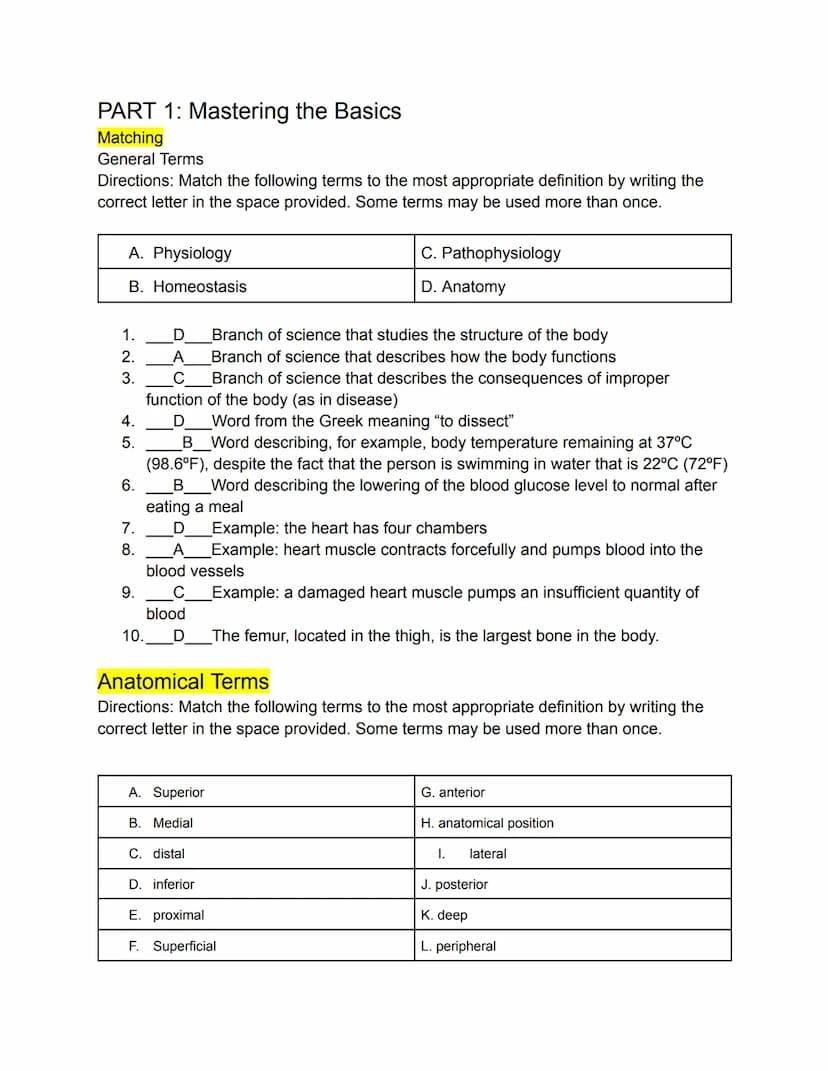
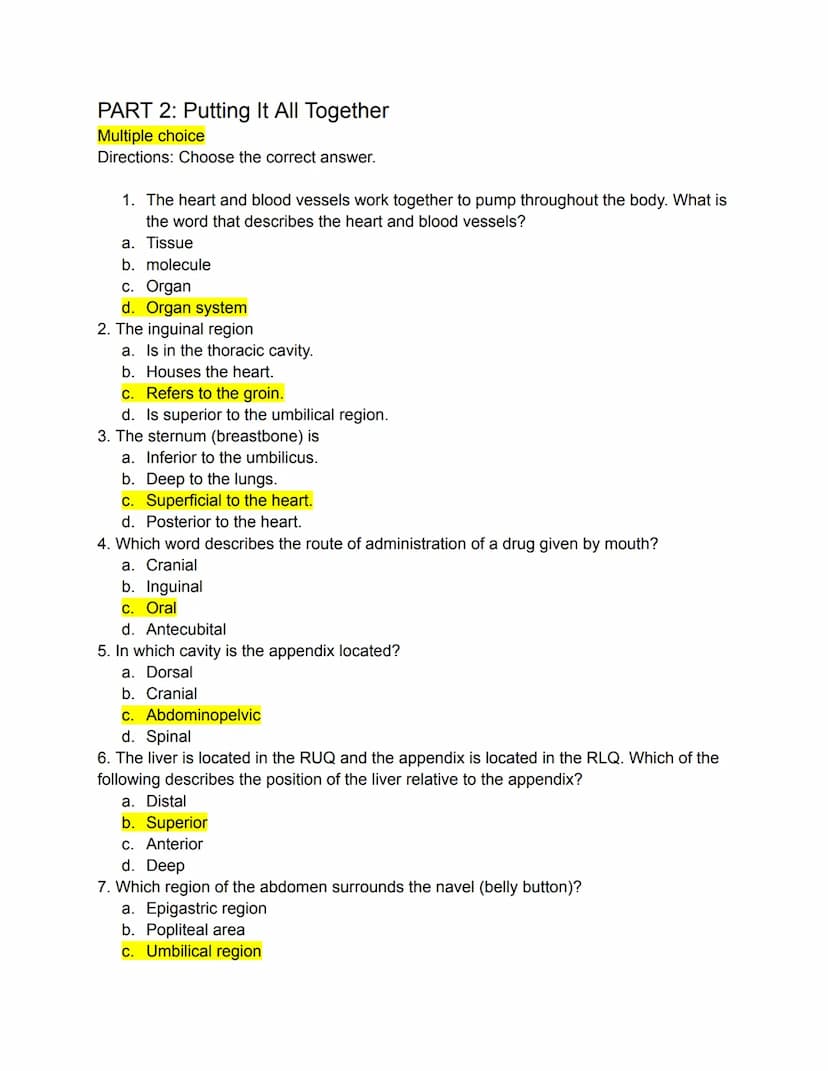
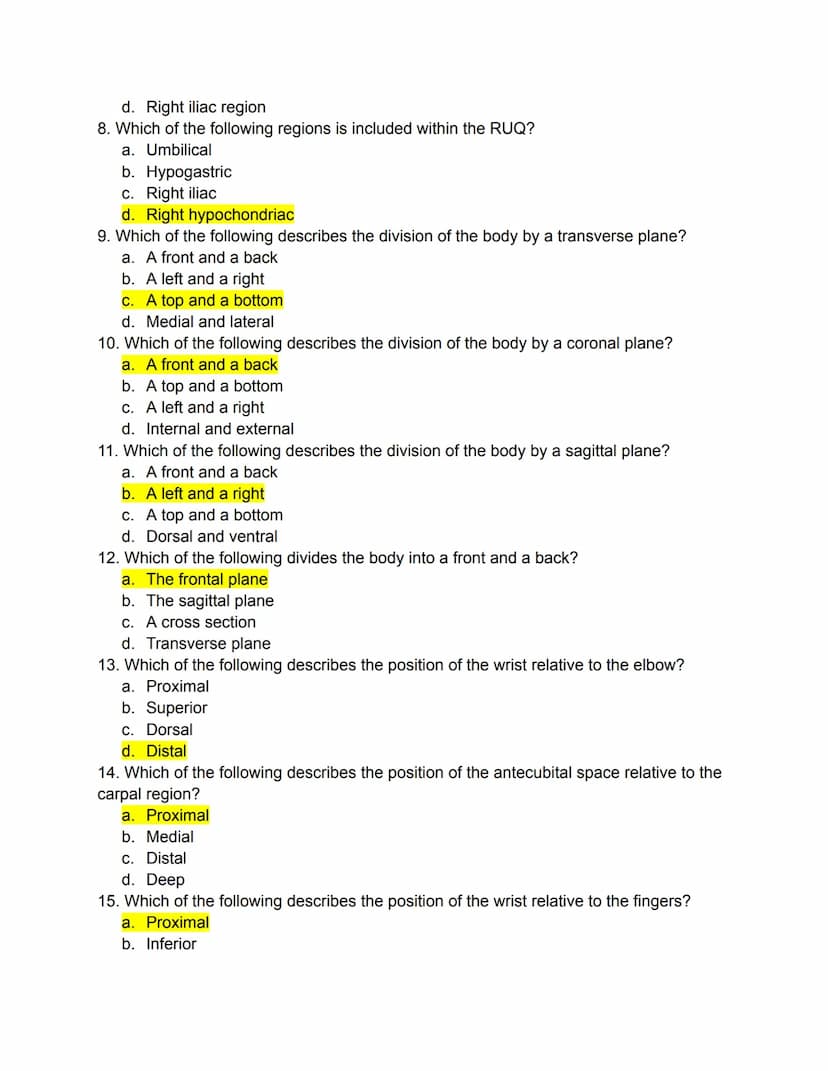
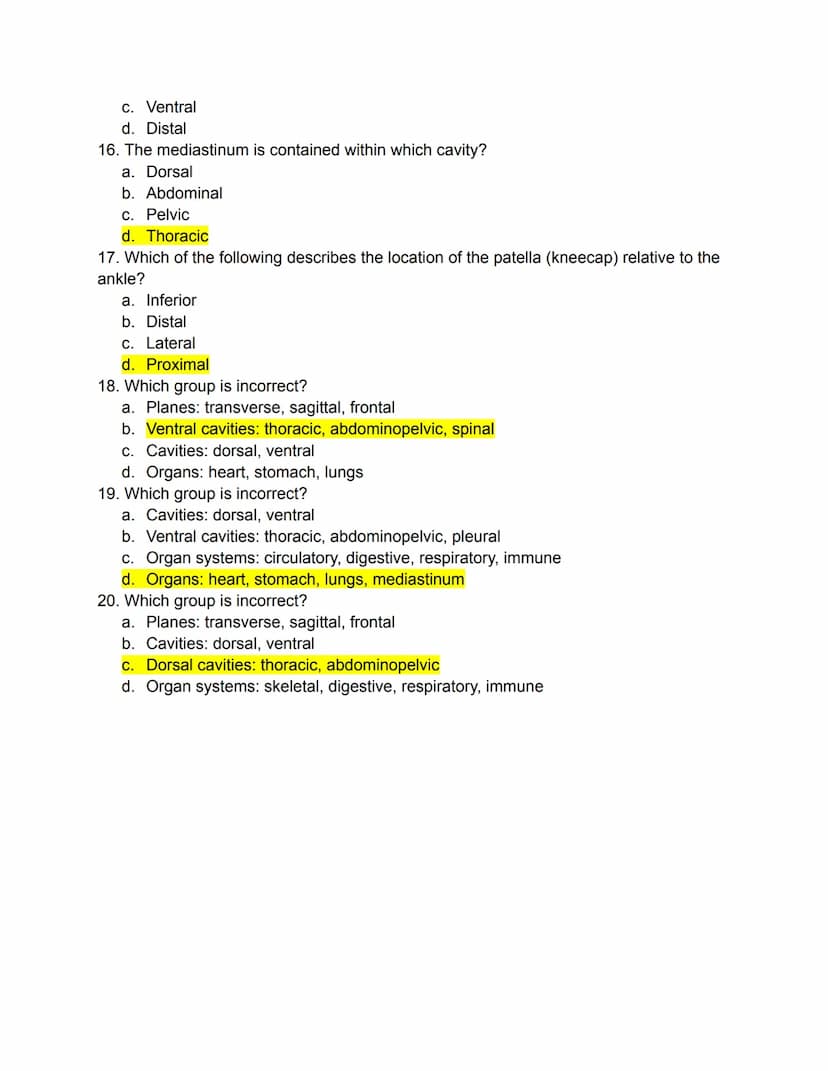
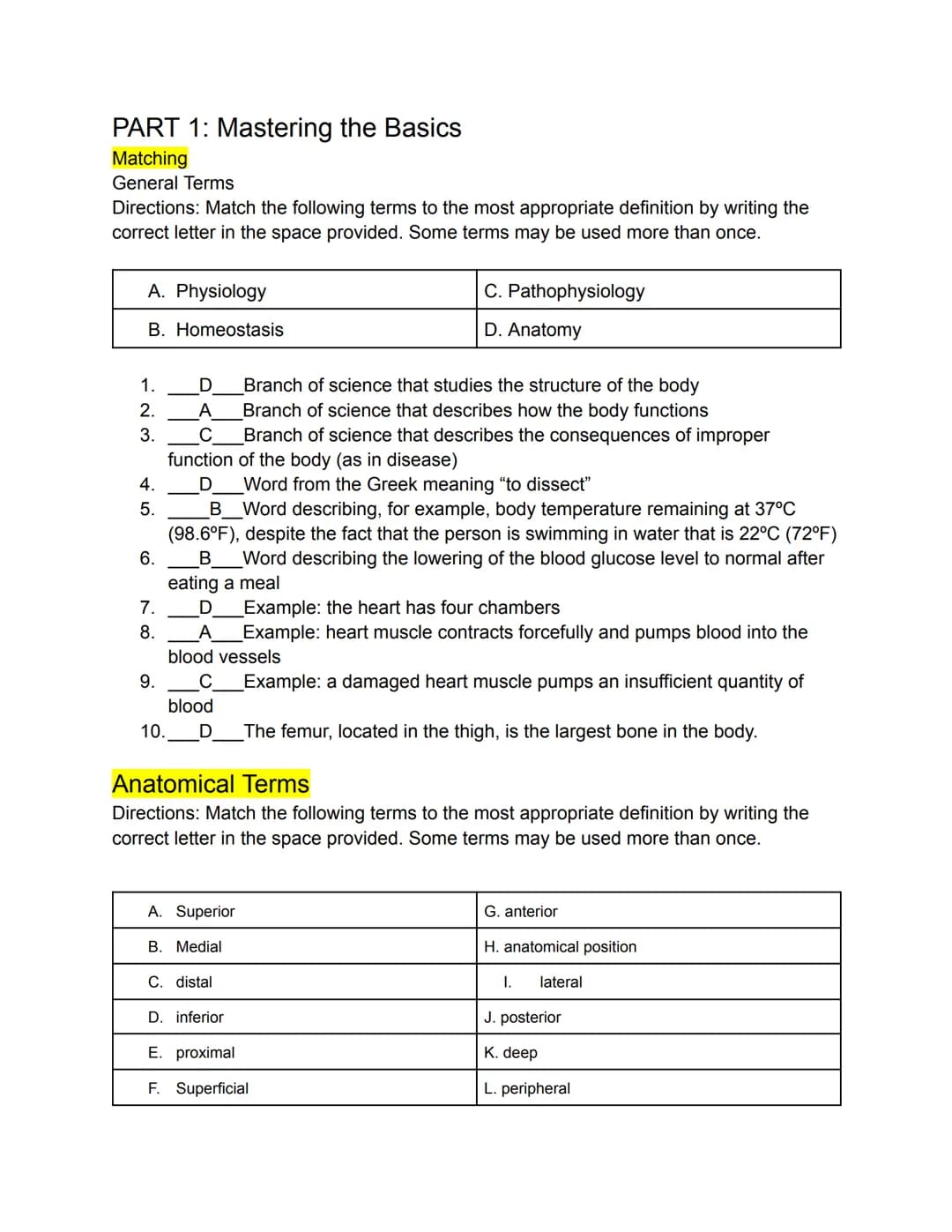
When studying the human body, you'll need to understand several fundamental branches of science. Anatomy refers to the study of body structures and comes from the Greek word "to dissect." For example, knowing that the heart has four chambers is anatomical knowledge.
Physiology describes how the body functions—like how the heart muscle contracts to pump blood. When these normal functions go wrong, we enter the realm of pathophysiology, which explains disease processes such as a damaged heart muscle that can't pump efficiently.
One of the most important concepts in physiology is homeostasis—your body's ability to maintain stable internal conditions despite external changes. For instance, your body maintains a temperature of about 98.6°F even when swimming in much cooler water, and it returns blood glucose to normal levels after a meal.
💡 Quick Tip: When studying anatomy, always connect structure with function. Understanding what a body part looks like (anatomy) makes more sense when you know what it does (physiology)!
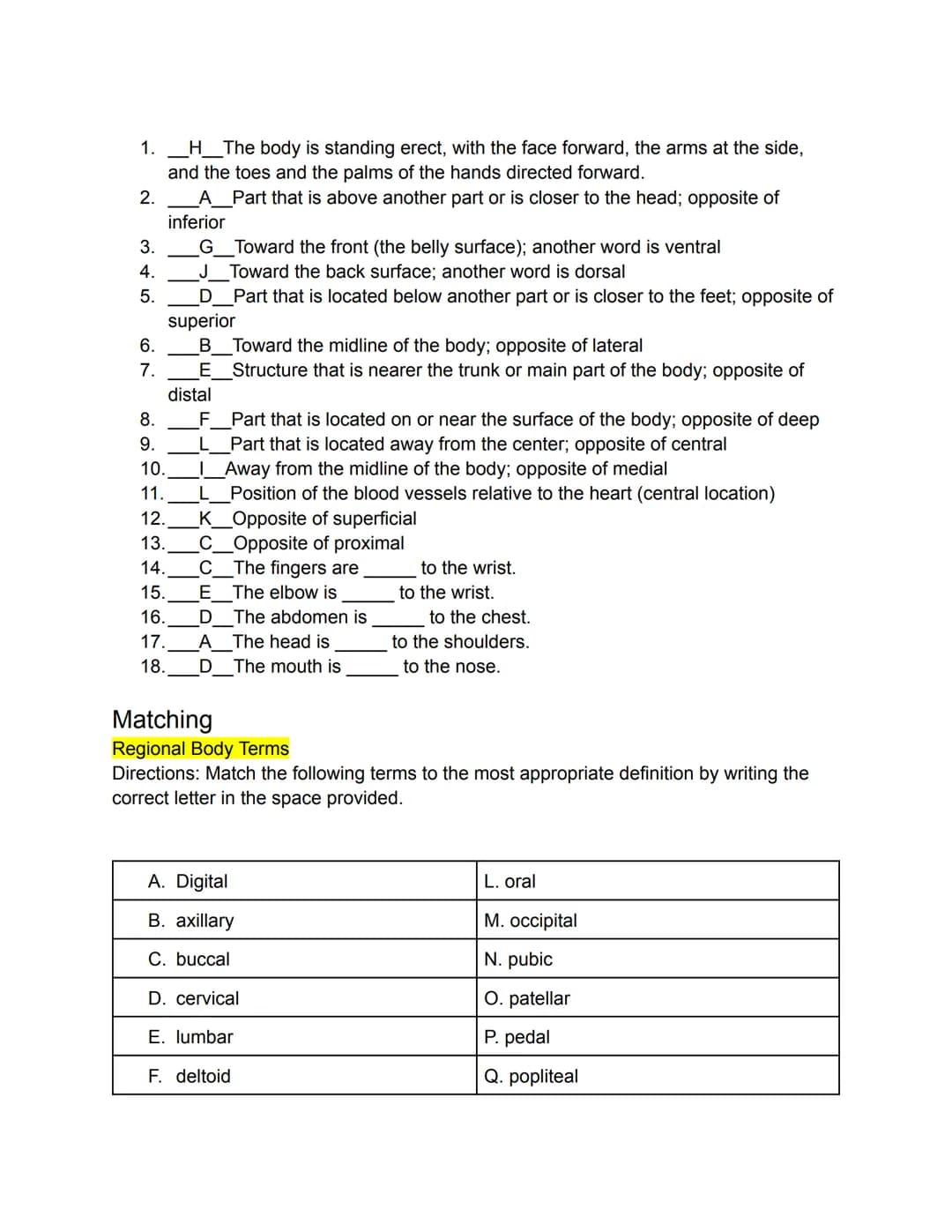
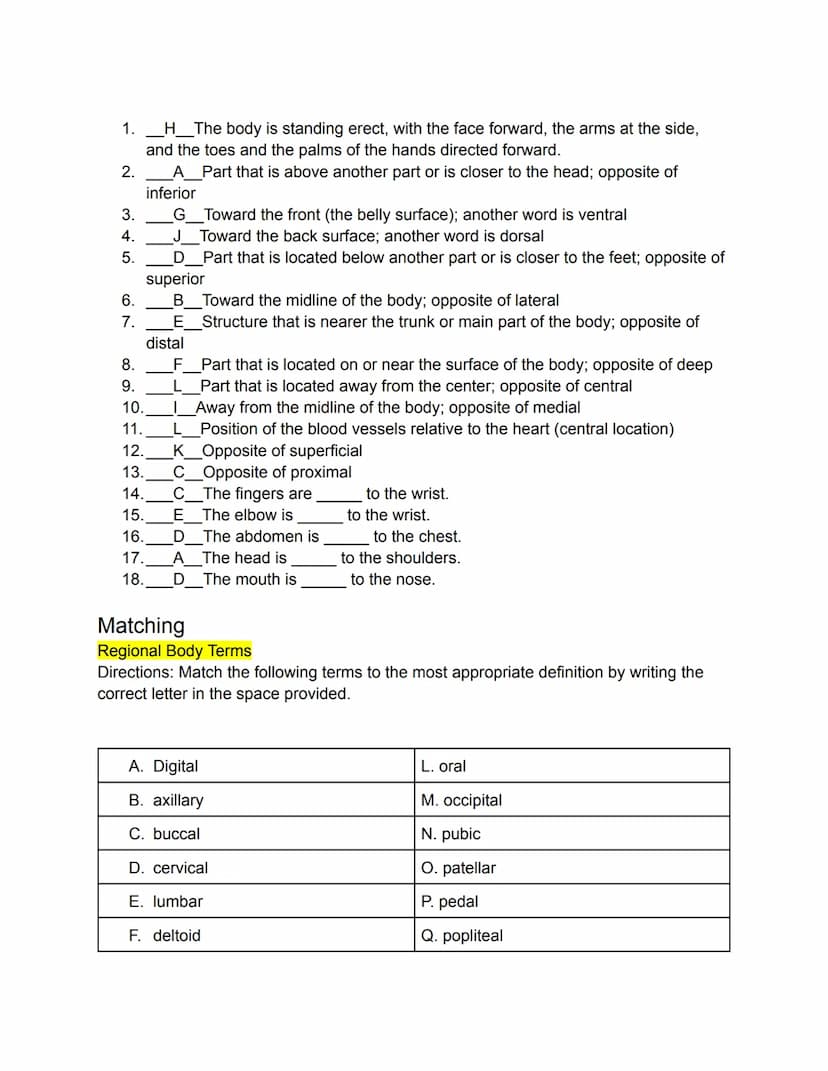
Learning anatomical directions will help you precisely describe where things are in the body. It all starts with anatomical position—standing erect, facing forward, arms at sides, with palms and toes pointing forward. This is our standard reference position.
From there, we use paired terms to indicate directions:
We also use superficial to describe structures near the body's surface and deep for structures farther inside. Structures away from the center are called peripheral, like blood vessels relative to the heart.
🧠 Remember: These directional terms always refer to anatomical position, regardless of how the body is actually positioned at the moment!
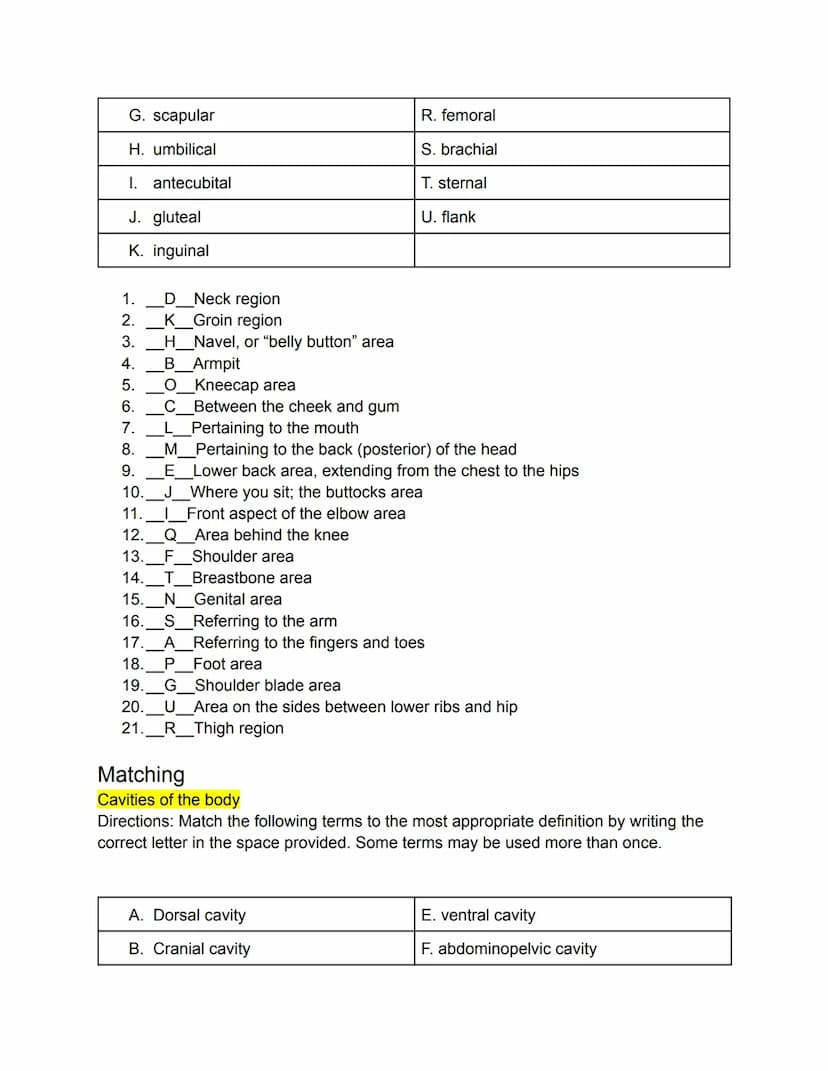
Your body is divided into specific regions, each with its own name. Mastering these terms will help you communicate precisely about different body areas.
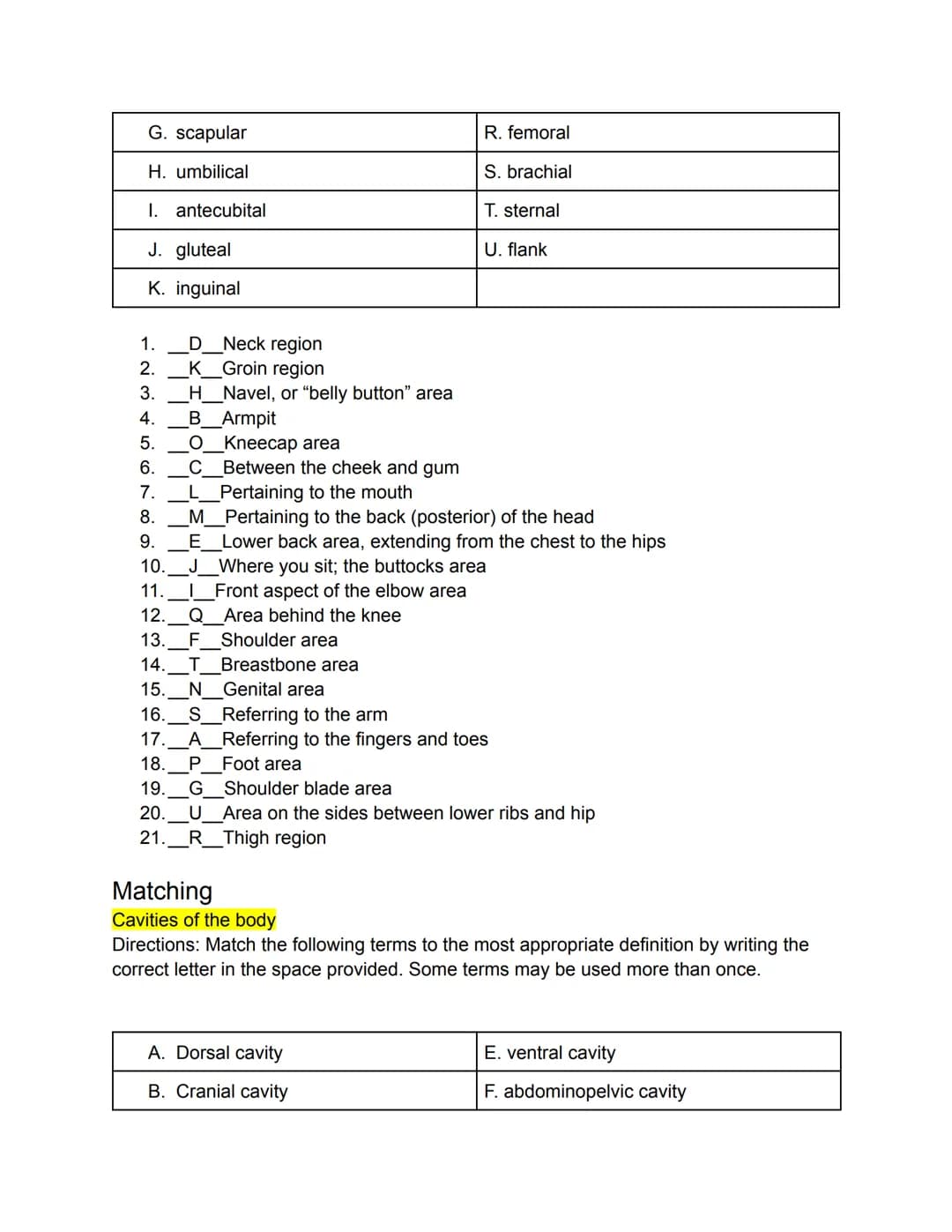
The cervical region refers to the neck, while the lumbar region is your lower back. If you're talking about the armpit, that's the axillary region. The area where you sit—your buttocks—is called the gluteal region, and your groin is the inguinal area.
For your head and face, the buccal region is between your cheek and gum, while oral pertains to your mouth. The back of your head is the occipital region. Your umbilical region surrounds your navel or "belly button."
For your limbs, the antecubital space is at the front of your elbow, the popliteal area is behind your knee, and the patellar area is your kneecap. Your fingers and toes are referred to as digital, while the pedal region is your foot.
✨ Pro Tip: Many medical procedures and injections are named after these regions (like antecubital venipuncture for drawing blood from the arm), so knowing these terms has practical applications!
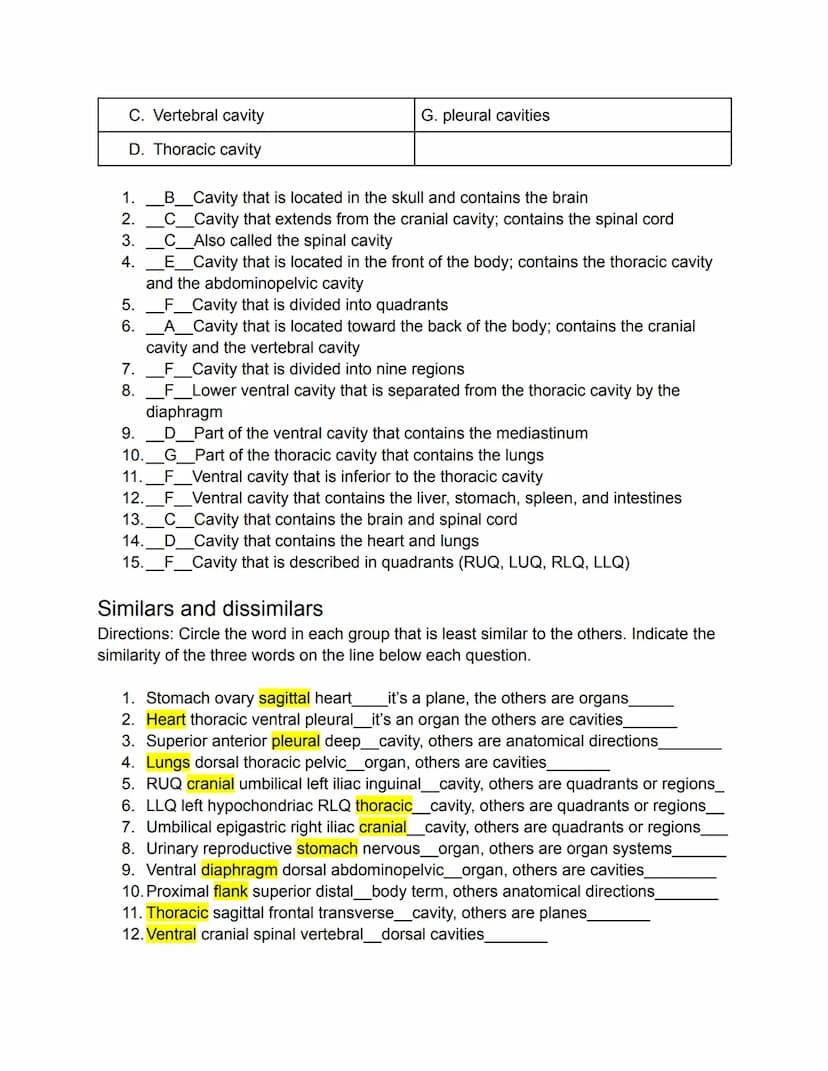
Your body contains several major cavities that house and protect your organs. These cavities are organized into two main groups: dorsal and ventral.
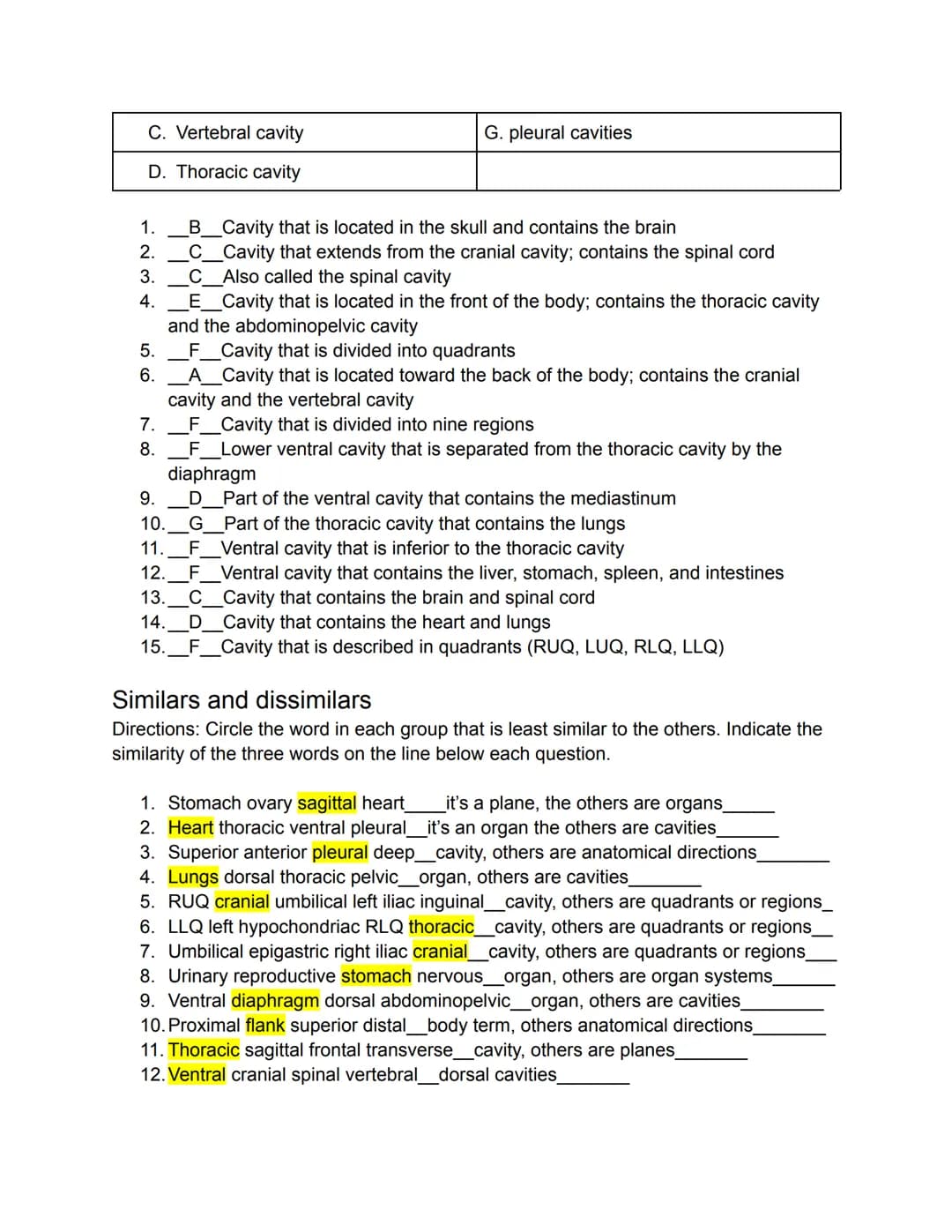
The dorsal cavity is located toward the back of your body and consists of the cranial cavity (containing your brain) and the vertebral cavity (also called the spinal cavity, containing your spinal cord).
The ventral cavity is at the front of your body and includes the thoracic cavity (containing your heart and lungs) and the abdominopelvic cavity. The thoracic cavity includes the pleural cavities (containing the lungs) and the mediastinum (containing the heart). The abdominopelvic cavity is divided into either quadrants (RUQ, LUQ, RLQ, LLQ) or nine regions for more specific location descriptions.
We also use planes to describe how the body can be sectioned:
🔍 Visual Aid: Think of planes like slices through a loaf of bread—each gives you a different perspective of what's inside the body!
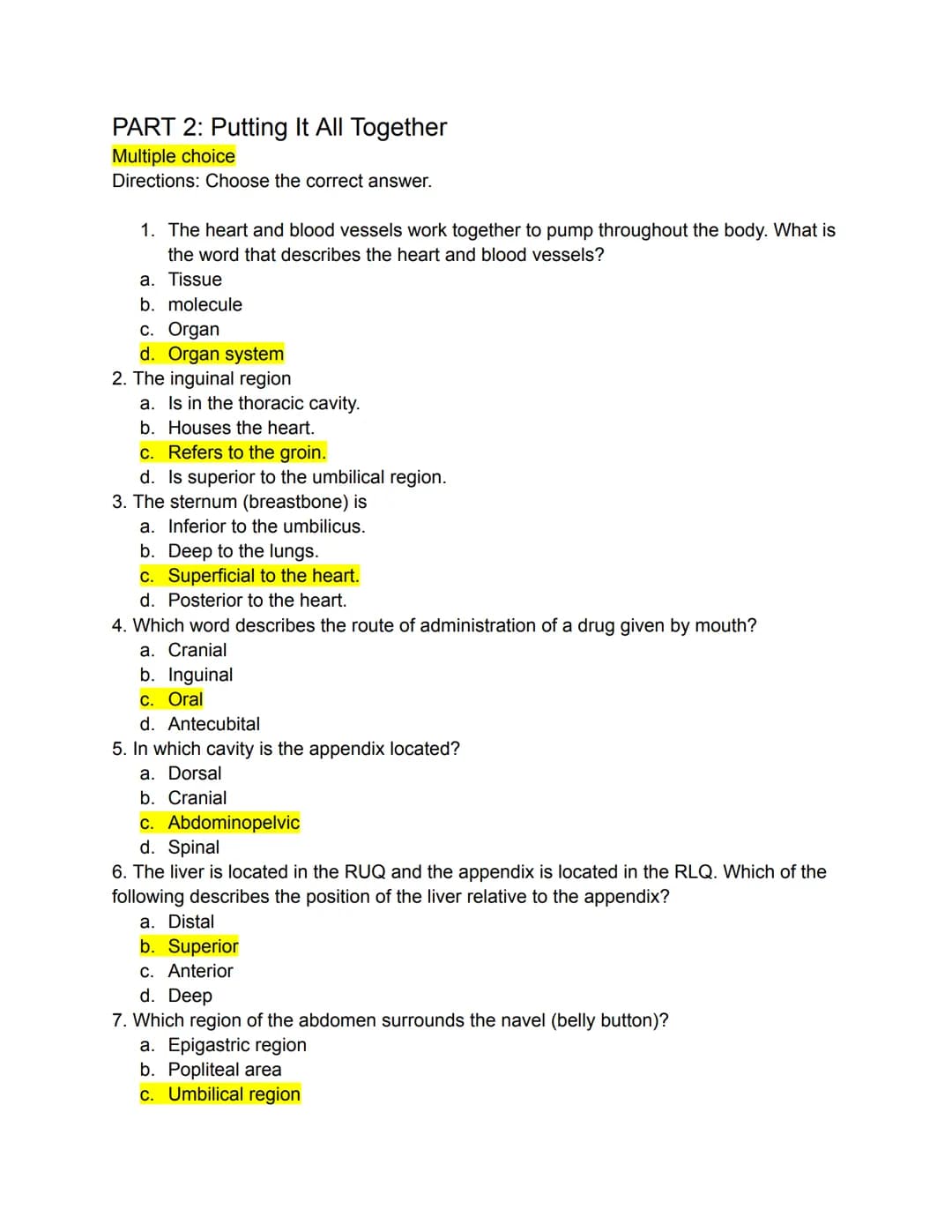
The human body is organized in increasing levels of complexity. Individual cells form tissues, which combine to form organs, which work together as organ systems.
For example, the heart is an organ that, together with blood vessels, forms the cardiovascular system. This system works alongside other major systems like the respiratory, digestive, urinary, reproductive, and nervous systems to keep your body functioning.
When describing locations in the abdomen, we use regions and quadrants. The inguinal region refers to the groin area and is not in the thoracic cavity. The sternum (breastbone) is superficial to the heart, meaning it's closer to the body surface than the heart is.
For medical purposes, the oral route describes medications taken by mouth. The appendix is located in the abdominopelvic cavity, specifically in the right lower quadrant (RLQ). Compared to the appendix, the liver (in the right upper quadrant) is superior to it.
🔄 Connection Point: The organization of your body from cells to organ systems shows how specialized parts work together—similar to how different departments in a school coordinate to create your entire educational experience!
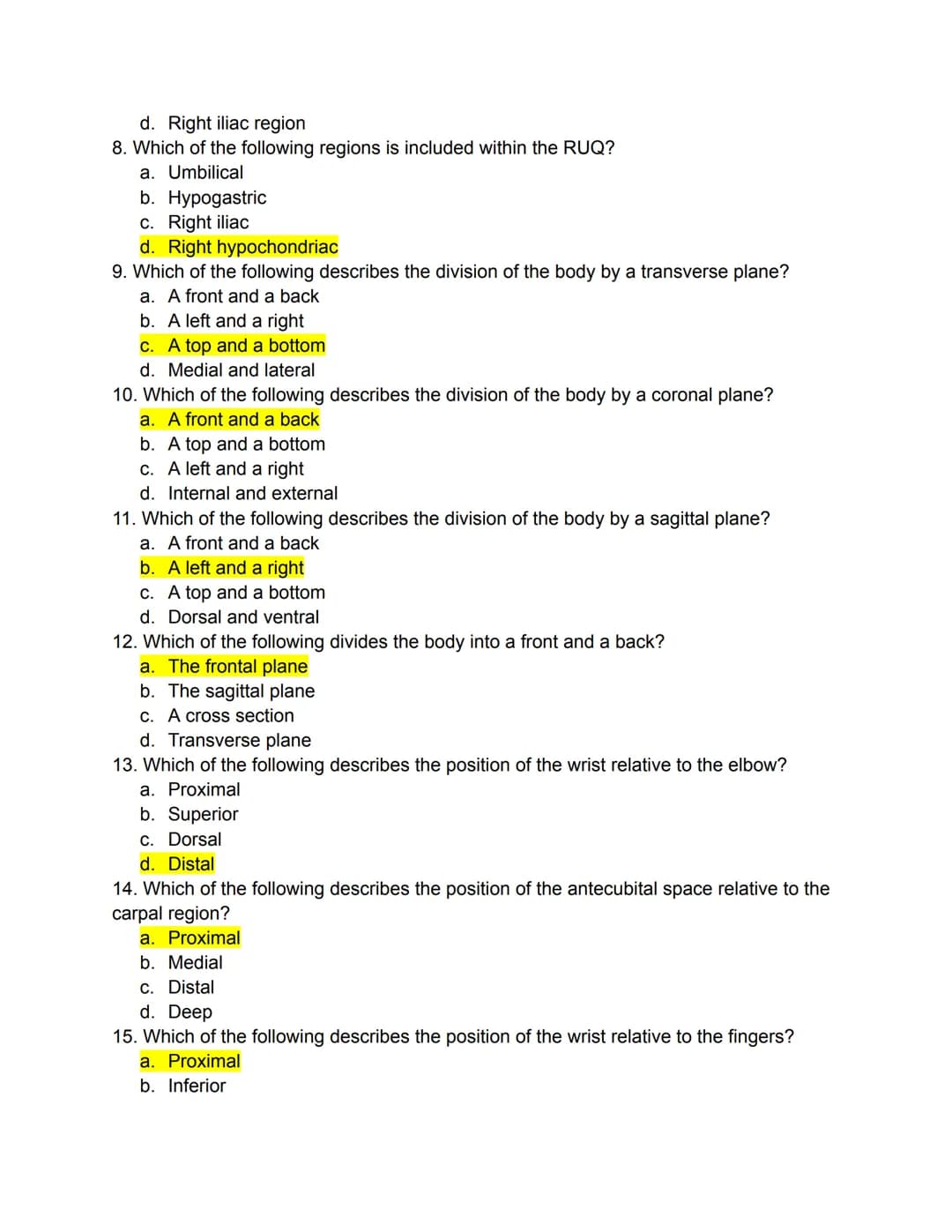
The umbilical region surrounds your navel or belly button, and it's one of the nine regions used to describe the abdomen. The right hypochondriac region is included within the right upper quadrant (RUQ) of the abdomen.
When describing how the body is divided by different planes, remember:
These planes help us understand spatial relationships and create cross-sectional images that are crucial for medical imaging like CT scans and MRIs.
When describing relationships between body parts, the wrist is distal to the elbow (farther from the trunk) but proximal to the fingers (closer to the trunk than the fingers are). The antecubital space (elbow region) is proximal to the carpal region (wrist).
🧩 Putting It Together: Think of your anatomy knowledge like a 3D map that helps you navigate the human body. Each term gives you precise coordinates to locate structures!
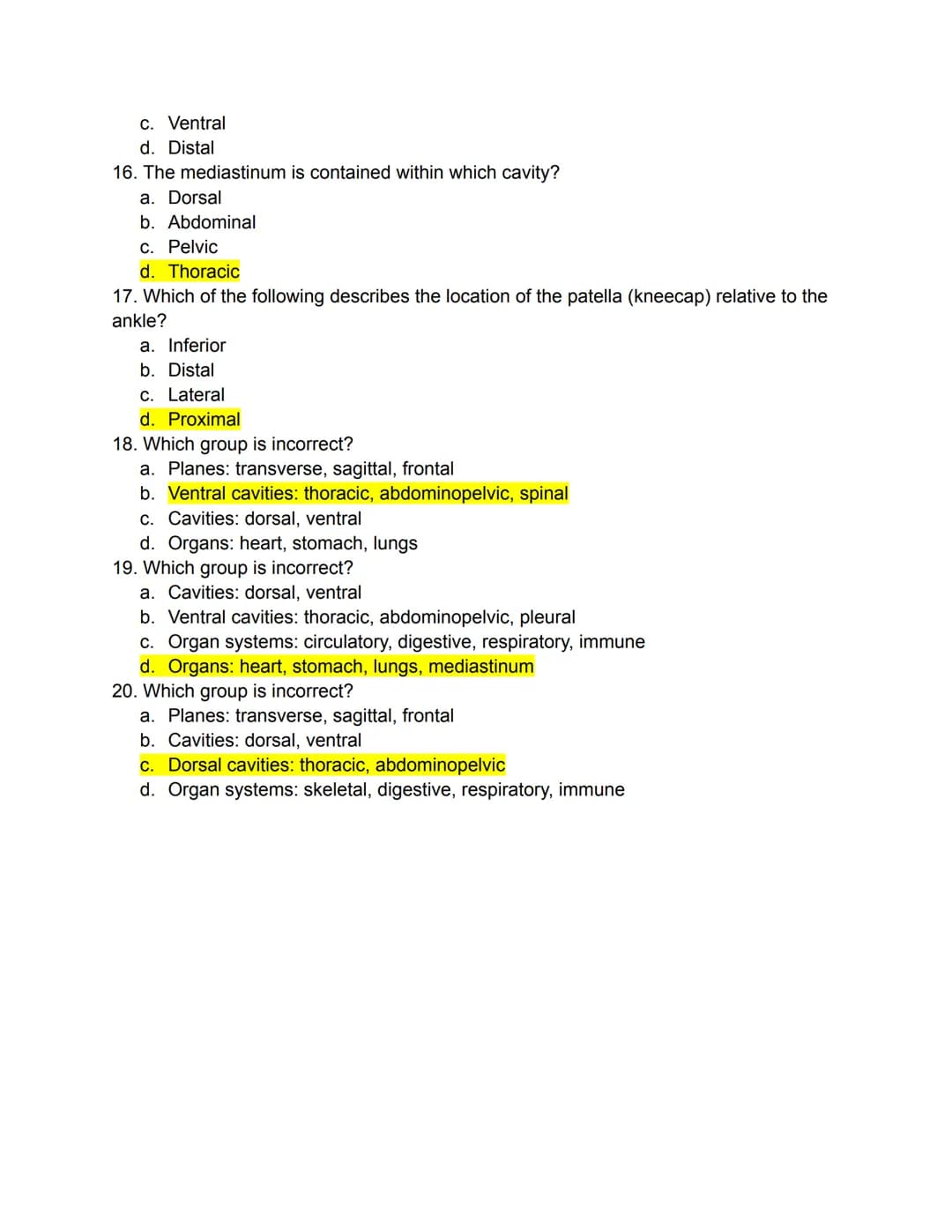
Let's solidify your understanding with some final key relationships. The mediastinum is contained within the thoracic cavity and houses the heart and other vital structures between the lungs. When describing the position of the patella (kneecap) relative to the ankle, it's proximal—meaning closer to the trunk of the body.
It's important to avoid common misconceptions about body organization:
Being precise with these terms is essential for accurate communication in healthcare and science. Remember that these anatomical terms create a standardized language that allows healthcare professionals to communicate clearly about body locations regardless of a patient's position.
🌟 Success Strategy: Create your own body diagram and label all the cavities, regions, and directional terms. Then explain the diagram to someone else—teaching is one of the best ways to solidify your understanding!
Our AI companion is specifically built for the needs of students. Based on the millions of content pieces we have on the platform we can provide truly meaningful and relevant answers to students. But its not only about answers, the companion is even more about guiding students through their daily learning challenges, with personalised study plans, quizzes or content pieces in the chat and 100% personalisation based on the students skills and developments.
You can download the app in the Google Play Store and in the Apple App Store.
That's right! Enjoy free access to study content, connect with fellow students, and get instant help – all at your fingertips.
App Store
Google Play
The app is very easy to use and well designed. I have found everything I was looking for so far and have been able to learn a lot from the presentations! I will definitely use the app for a class assignment! And of course it also helps a lot as an inspiration.
Stefan S
iOS user
This app is really great. There are so many study notes and help [...]. My problem subject is French, for example, and the app has so many options for help. Thanks to this app, I have improved my French. I would recommend it to anyone.
Samantha Klich
Android user
Wow, I am really amazed. I just tried the app because I've seen it advertised many times and was absolutely stunned. This app is THE HELP you want for school and above all, it offers so many things, such as workouts and fact sheets, which have been VERY helpful to me personally.
Anna
iOS user
I think it’s very much worth it and you’ll end up using it a lot once you get the hang of it and even after looking at others notes you can still ask your Artificial intelligence buddy the question and ask to simplify it if you still don’t get it!!! In the end I think it’s worth it 😊👍 ⚠️Also DID I MENTION ITS FREEE YOU DON’T HAVE TO PAY FOR ANYTHING AND STILL GET YOUR GRADES IN PERFECTLY❗️❗️⚠️
Thomas R
iOS user
Knowunity is the BEST app I’ve used in a minute. This is not an ai review or anything this is genuinely coming from a 7th grade student (I know 2011 im young) but dude this app is a 10/10 i have maintained a 3.8 gpa and have plenty of time for gaming. I love it and my mom is just happy I got good grades
Brad T
Android user
Not only did it help me find the answer but it also showed me alternative ways to solve it. I was horrible in math and science but now I have an a in both subjects. Thanks for the help🤍🤍
David K
iOS user
The app's just great! All I have to do is enter the topic in the search bar and I get the response real fast. I don't have to watch 10 YouTube videos to understand something, so I'm saving my time. Highly recommended!
Sudenaz Ocak
Android user
In school I was really bad at maths but thanks to the app, I am doing better now. I am so grateful that you made the app.
Greenlight Bonnie
Android user
I found this app a couple years ago and it has only gotten better since then. I really love it because it can help with written questions and photo questions. Also, it can find study guides that other people have made as well as flashcard sets and practice tests. The free version is also amazing for students who might not be able to afford it. Would 100% recommend
Aubrey
iOS user
Best app if you're in Highschool or Junior high. I have been using this app for 2 school years and it's the best, it's good if you don't have anyone to help you with school work.😋🩷🎀
Marco B
iOS user
THE QUIZES AND FLASHCARDS ARE SO USEFUL AND I LOVE Knowunity AI. IT ALSO IS LITREALLY LIKE CHATGPT BUT SMARTER!! HELPED ME WITH MY MASCARA PROBLEMS TOO!! AS WELL AS MY REAL SUBJECTS ! DUHHH 😍😁😲🤑💗✨🎀😮
Elisha
iOS user
This app is phenomenal down to the correct info and the various topics you can study! I greatly recommend it for people who struggle with procrastination and those who need homework help. It has been perfectly accurate for world 1 history as far as I’ve seen! Geometry too!
Paul T
iOS user
The app is very easy to use and well designed. I have found everything I was looking for so far and have been able to learn a lot from the presentations! I will definitely use the app for a class assignment! And of course it also helps a lot as an inspiration.
Stefan S
iOS user
This app is really great. There are so many study notes and help [...]. My problem subject is French, for example, and the app has so many options for help. Thanks to this app, I have improved my French. I would recommend it to anyone.
Samantha Klich
Android user
Wow, I am really amazed. I just tried the app because I've seen it advertised many times and was absolutely stunned. This app is THE HELP you want for school and above all, it offers so many things, such as workouts and fact sheets, which have been VERY helpful to me personally.
Anna
iOS user
I think it’s very much worth it and you’ll end up using it a lot once you get the hang of it and even after looking at others notes you can still ask your Artificial intelligence buddy the question and ask to simplify it if you still don’t get it!!! In the end I think it’s worth it 😊👍 ⚠️Also DID I MENTION ITS FREEE YOU DON’T HAVE TO PAY FOR ANYTHING AND STILL GET YOUR GRADES IN PERFECTLY❗️❗️⚠️
Thomas R
iOS user
Knowunity is the BEST app I’ve used in a minute. This is not an ai review or anything this is genuinely coming from a 7th grade student (I know 2011 im young) but dude this app is a 10/10 i have maintained a 3.8 gpa and have plenty of time for gaming. I love it and my mom is just happy I got good grades
Brad T
Android user
Not only did it help me find the answer but it also showed me alternative ways to solve it. I was horrible in math and science but now I have an a in both subjects. Thanks for the help🤍🤍
David K
iOS user
The app's just great! All I have to do is enter the topic in the search bar and I get the response real fast. I don't have to watch 10 YouTube videos to understand something, so I'm saving my time. Highly recommended!
Sudenaz Ocak
Android user
In school I was really bad at maths but thanks to the app, I am doing better now. I am so grateful that you made the app.
Greenlight Bonnie
Android user
I found this app a couple years ago and it has only gotten better since then. I really love it because it can help with written questions and photo questions. Also, it can find study guides that other people have made as well as flashcard sets and practice tests. The free version is also amazing for students who might not be able to afford it. Would 100% recommend
Aubrey
iOS user
Best app if you're in Highschool or Junior high. I have been using this app for 2 school years and it's the best, it's good if you don't have anyone to help you with school work.😋🩷🎀
Marco B
iOS user
THE QUIZES AND FLASHCARDS ARE SO USEFUL AND I LOVE Knowunity AI. IT ALSO IS LITREALLY LIKE CHATGPT BUT SMARTER!! HELPED ME WITH MY MASCARA PROBLEMS TOO!! AS WELL AS MY REAL SUBJECTS ! DUHHH 😍😁😲🤑💗✨🎀😮
Elisha
iOS user
This app is phenomenal down to the correct info and the various topics you can study! I greatly recommend it for people who struggle with procrastination and those who need homework help. It has been perfectly accurate for world 1 history as far as I’ve seen! Geometry too!
Paul T
iOS user
Giana Lynch
@gianalynch_dpez
Welcome to an essential guide on human anatomy and physiology terminology! Understanding how to describe body parts, positions, and regions is the foundation of all medical and biological sciences. This summary breaks down the key anatomical terms, body cavities, and... Show more
Access to all documents
Improve your grades
Join milions of students
When studying the human body, you'll need to understand several fundamental branches of science. Anatomy refers to the study of body structures and comes from the Greek word "to dissect." For example, knowing that the heart has four chambers is anatomical knowledge.
Physiology describes how the body functions—like how the heart muscle contracts to pump blood. When these normal functions go wrong, we enter the realm of pathophysiology, which explains disease processes such as a damaged heart muscle that can't pump efficiently.
One of the most important concepts in physiology is homeostasis—your body's ability to maintain stable internal conditions despite external changes. For instance, your body maintains a temperature of about 98.6°F even when swimming in much cooler water, and it returns blood glucose to normal levels after a meal.
💡 Quick Tip: When studying anatomy, always connect structure with function. Understanding what a body part looks like (anatomy) makes more sense when you know what it does (physiology)!
Access to all documents
Improve your grades
Join milions of students
Learning anatomical directions will help you precisely describe where things are in the body. It all starts with anatomical position—standing erect, facing forward, arms at sides, with palms and toes pointing forward. This is our standard reference position.
From there, we use paired terms to indicate directions:
We also use superficial to describe structures near the body's surface and deep for structures farther inside. Structures away from the center are called peripheral, like blood vessels relative to the heart.
🧠 Remember: These directional terms always refer to anatomical position, regardless of how the body is actually positioned at the moment!
Access to all documents
Improve your grades
Join milions of students
Your body is divided into specific regions, each with its own name. Mastering these terms will help you communicate precisely about different body areas.
The cervical region refers to the neck, while the lumbar region is your lower back. If you're talking about the armpit, that's the axillary region. The area where you sit—your buttocks—is called the gluteal region, and your groin is the inguinal area.
For your head and face, the buccal region is between your cheek and gum, while oral pertains to your mouth. The back of your head is the occipital region. Your umbilical region surrounds your navel or "belly button."
For your limbs, the antecubital space is at the front of your elbow, the popliteal area is behind your knee, and the patellar area is your kneecap. Your fingers and toes are referred to as digital, while the pedal region is your foot.
✨ Pro Tip: Many medical procedures and injections are named after these regions (like antecubital venipuncture for drawing blood from the arm), so knowing these terms has practical applications!
Access to all documents
Improve your grades
Join milions of students
Your body contains several major cavities that house and protect your organs. These cavities are organized into two main groups: dorsal and ventral.
The dorsal cavity is located toward the back of your body and consists of the cranial cavity (containing your brain) and the vertebral cavity (also called the spinal cavity, containing your spinal cord).
The ventral cavity is at the front of your body and includes the thoracic cavity (containing your heart and lungs) and the abdominopelvic cavity. The thoracic cavity includes the pleural cavities (containing the lungs) and the mediastinum (containing the heart). The abdominopelvic cavity is divided into either quadrants (RUQ, LUQ, RLQ, LLQ) or nine regions for more specific location descriptions.
We also use planes to describe how the body can be sectioned:
🔍 Visual Aid: Think of planes like slices through a loaf of bread—each gives you a different perspective of what's inside the body!
Access to all documents
Improve your grades
Join milions of students
The human body is organized in increasing levels of complexity. Individual cells form tissues, which combine to form organs, which work together as organ systems.
For example, the heart is an organ that, together with blood vessels, forms the cardiovascular system. This system works alongside other major systems like the respiratory, digestive, urinary, reproductive, and nervous systems to keep your body functioning.
When describing locations in the abdomen, we use regions and quadrants. The inguinal region refers to the groin area and is not in the thoracic cavity. The sternum (breastbone) is superficial to the heart, meaning it's closer to the body surface than the heart is.
For medical purposes, the oral route describes medications taken by mouth. The appendix is located in the abdominopelvic cavity, specifically in the right lower quadrant (RLQ). Compared to the appendix, the liver (in the right upper quadrant) is superior to it.
🔄 Connection Point: The organization of your body from cells to organ systems shows how specialized parts work together—similar to how different departments in a school coordinate to create your entire educational experience!
Access to all documents
Improve your grades
Join milions of students
The umbilical region surrounds your navel or belly button, and it's one of the nine regions used to describe the abdomen. The right hypochondriac region is included within the right upper quadrant (RUQ) of the abdomen.
When describing how the body is divided by different planes, remember:
These planes help us understand spatial relationships and create cross-sectional images that are crucial for medical imaging like CT scans and MRIs.
When describing relationships between body parts, the wrist is distal to the elbow (farther from the trunk) but proximal to the fingers (closer to the trunk than the fingers are). The antecubital space (elbow region) is proximal to the carpal region (wrist).
🧩 Putting It Together: Think of your anatomy knowledge like a 3D map that helps you navigate the human body. Each term gives you precise coordinates to locate structures!
Access to all documents
Improve your grades
Join milions of students
Let's solidify your understanding with some final key relationships. The mediastinum is contained within the thoracic cavity and houses the heart and other vital structures between the lungs. When describing the position of the patella (kneecap) relative to the ankle, it's proximal—meaning closer to the trunk of the body.
It's important to avoid common misconceptions about body organization:
Being precise with these terms is essential for accurate communication in healthcare and science. Remember that these anatomical terms create a standardized language that allows healthcare professionals to communicate clearly about body locations regardless of a patient's position.
🌟 Success Strategy: Create your own body diagram and label all the cavities, regions, and directional terms. Then explain the diagram to someone else—teaching is one of the best ways to solidify your understanding!
Our AI companion is specifically built for the needs of students. Based on the millions of content pieces we have on the platform we can provide truly meaningful and relevant answers to students. But its not only about answers, the companion is even more about guiding students through their daily learning challenges, with personalised study plans, quizzes or content pieces in the chat and 100% personalisation based on the students skills and developments.
You can download the app in the Google Play Store and in the Apple App Store.
That's right! Enjoy free access to study content, connect with fellow students, and get instant help – all at your fingertips.
4
Smart Tools NEW
Transform this note into: ✓ 50+ Practice Questions ✓ Interactive Flashcards ✓ Full Practice Test ✓ Essay Outlines
Learn about the structure, composition, and functions of the axial and appendicular skeleton, as well as the embryonic origin and development of bones and joints.
 AP Biology
:)
AP BiologyHow the Calvin benson cycle or light independent reaction happens in photosynthesis after light dependent reaction happens.
AP Biologyall notes from ap classroom slides and videos
AP Biologybiology flash cards
 Biology
Overview of water, macromolecules, and functional groups in biochemistry. Includes bonding, properties, and composition of carbohydrates and lipids.
AP BiologyApp Store
Google Play
The app is very easy to use and well designed. I have found everything I was looking for so far and have been able to learn a lot from the presentations! I will definitely use the app for a class assignment! And of course it also helps a lot as an inspiration.
Stefan S
iOS user
This app is really great. There are so many study notes and help [...]. My problem subject is French, for example, and the app has so many options for help. Thanks to this app, I have improved my French. I would recommend it to anyone.
Samantha Klich
Android user
Wow, I am really amazed. I just tried the app because I've seen it advertised many times and was absolutely stunned. This app is THE HELP you want for school and above all, it offers so many things, such as workouts and fact sheets, which have been VERY helpful to me personally.
Anna
iOS user
I think it’s very much worth it and you’ll end up using it a lot once you get the hang of it and even after looking at others notes you can still ask your Artificial intelligence buddy the question and ask to simplify it if you still don’t get it!!! In the end I think it’s worth it 😊👍 ⚠️Also DID I MENTION ITS FREEE YOU DON’T HAVE TO PAY FOR ANYTHING AND STILL GET YOUR GRADES IN PERFECTLY❗️❗️⚠️
Thomas R
iOS user
Knowunity is the BEST app I’ve used in a minute. This is not an ai review or anything this is genuinely coming from a 7th grade student (I know 2011 im young) but dude this app is a 10/10 i have maintained a 3.8 gpa and have plenty of time for gaming. I love it and my mom is just happy I got good grades
Brad T
Android user
Not only did it help me find the answer but it also showed me alternative ways to solve it. I was horrible in math and science but now I have an a in both subjects. Thanks for the help🤍🤍
David K
iOS user
The app's just great! All I have to do is enter the topic in the search bar and I get the response real fast. I don't have to watch 10 YouTube videos to understand something, so I'm saving my time. Highly recommended!
Sudenaz Ocak
Android user
In school I was really bad at maths but thanks to the app, I am doing better now. I am so grateful that you made the app.
Greenlight Bonnie
Android user
I found this app a couple years ago and it has only gotten better since then. I really love it because it can help with written questions and photo questions. Also, it can find study guides that other people have made as well as flashcard sets and practice tests. The free version is also amazing for students who might not be able to afford it. Would 100% recommend
Aubrey
iOS user
Best app if you're in Highschool or Junior high. I have been using this app for 2 school years and it's the best, it's good if you don't have anyone to help you with school work.😋🩷🎀
Marco B
iOS user
THE QUIZES AND FLASHCARDS ARE SO USEFUL AND I LOVE Knowunity AI. IT ALSO IS LITREALLY LIKE CHATGPT BUT SMARTER!! HELPED ME WITH MY MASCARA PROBLEMS TOO!! AS WELL AS MY REAL SUBJECTS ! DUHHH 😍😁😲🤑💗✨🎀😮
Elisha
iOS user
This app is phenomenal down to the correct info and the various topics you can study! I greatly recommend it for people who struggle with procrastination and those who need homework help. It has been perfectly accurate for world 1 history as far as I’ve seen! Geometry too!
Paul T
iOS user
The app is very easy to use and well designed. I have found everything I was looking for so far and have been able to learn a lot from the presentations! I will definitely use the app for a class assignment! And of course it also helps a lot as an inspiration.
Stefan S
iOS user
This app is really great. There are so many study notes and help [...]. My problem subject is French, for example, and the app has so many options for help. Thanks to this app, I have improved my French. I would recommend it to anyone.
Samantha Klich
Android user
Wow, I am really amazed. I just tried the app because I've seen it advertised many times and was absolutely stunned. This app is THE HELP you want for school and above all, it offers so many things, such as workouts and fact sheets, which have been VERY helpful to me personally.
Anna
iOS user
I think it’s very much worth it and you’ll end up using it a lot once you get the hang of it and even after looking at others notes you can still ask your Artificial intelligence buddy the question and ask to simplify it if you still don’t get it!!! In the end I think it’s worth it 😊👍 ⚠️Also DID I MENTION ITS FREEE YOU DON’T HAVE TO PAY FOR ANYTHING AND STILL GET YOUR GRADES IN PERFECTLY❗️❗️⚠️
Thomas R
iOS user
Knowunity is the BEST app I’ve used in a minute. This is not an ai review or anything this is genuinely coming from a 7th grade student (I know 2011 im young) but dude this app is a 10/10 i have maintained a 3.8 gpa and have plenty of time for gaming. I love it and my mom is just happy I got good grades
Brad T
Android user
Not only did it help me find the answer but it also showed me alternative ways to solve it. I was horrible in math and science but now I have an a in both subjects. Thanks for the help🤍🤍
David K
iOS user
The app's just great! All I have to do is enter the topic in the search bar and I get the response real fast. I don't have to watch 10 YouTube videos to understand something, so I'm saving my time. Highly recommended!
Sudenaz Ocak
Android user
In school I was really bad at maths but thanks to the app, I am doing better now. I am so grateful that you made the app.
Greenlight Bonnie
Android user
I found this app a couple years ago and it has only gotten better since then. I really love it because it can help with written questions and photo questions. Also, it can find study guides that other people have made as well as flashcard sets and practice tests. The free version is also amazing for students who might not be able to afford it. Would 100% recommend
Aubrey
iOS user
Best app if you're in Highschool or Junior high. I have been using this app for 2 school years and it's the best, it's good if you don't have anyone to help you with school work.😋🩷🎀
Marco B
iOS user
THE QUIZES AND FLASHCARDS ARE SO USEFUL AND I LOVE Knowunity AI. IT ALSO IS LITREALLY LIKE CHATGPT BUT SMARTER!! HELPED ME WITH MY MASCARA PROBLEMS TOO!! AS WELL AS MY REAL SUBJECTS ! DUHHH 😍😁😲🤑💗✨🎀😮
Elisha
iOS user
This app is phenomenal down to the correct info and the various topics you can study! I greatly recommend it for people who struggle with procrastination and those who need homework help. It has been perfectly accurate for world 1 history as far as I’ve seen! Geometry too!
Paul T
iOS user