
The skeletal system provides the framework that supports your body,... Show more
 Health & Medicine
 Algebra
Sign up to see the contentIt's free!
Access to all documents
Improve your grades
Join milions of students
Knowunity AI
Subjects
Triangle Congruence and Similarity Theorems
Triangle Properties and Classification
Linear Equations and Graphs
Geometric Angle Relationships
Trigonometric Functions and Identities
Equation Solving Techniques
Circle Geometry Fundamentals
Division Operations and Methods
Basic Differentiation Rules
Exponent and Logarithm Properties
Show all topics
Human Organ Systems
Reproductive Cell Cycles
Biological Sciences Subdisciplines
Cellular Energy Metabolism
Autotrophic Energy Processes
Inheritance Patterns and Principles
Biomolecular Structure and Organization
Cell Cycle and Division Mechanics
Cellular Organization and Development
Biological Structural Organization
Show all topics
Chemical Sciences and Applications
Atomic Structure and Composition
Molecular Electron Structure Representation
Atomic Electron Behavior
Matter Properties and Water
Mole Concept and Calculations
Gas Laws and Behavior
Periodic Table Organization
Chemical Thermodynamics Fundamentals
Chemical Bond Types and Properties
Show all topics
European Renaissance and Enlightenment
European Cultural Movements 800-1920
American Revolution Era 1763-1797
American Civil War 1861-1865
Global Imperial Systems
Mongol and Chinese Dynasties
U.S. Presidents and World Leaders
Historical Sources and Documentation
World Wars Era and Impact
World Religious Systems
Show all topics
Classic and Contemporary Novels
Literary Character Analysis
Rhetorical Theory and Practice
Classic Literary Narratives
Reading Analysis and Interpretation
Narrative Structure and Techniques
English Language Components
Influential English-Language Authors
Basic Sentence Structure
Narrative Voice and Perspective
Show all topics
230
•
Updated Apr 3, 2026
•
Ashli Atwood
@ashliatwood_qgzm
The skeletal system provides the framework that supports your body,... Show more
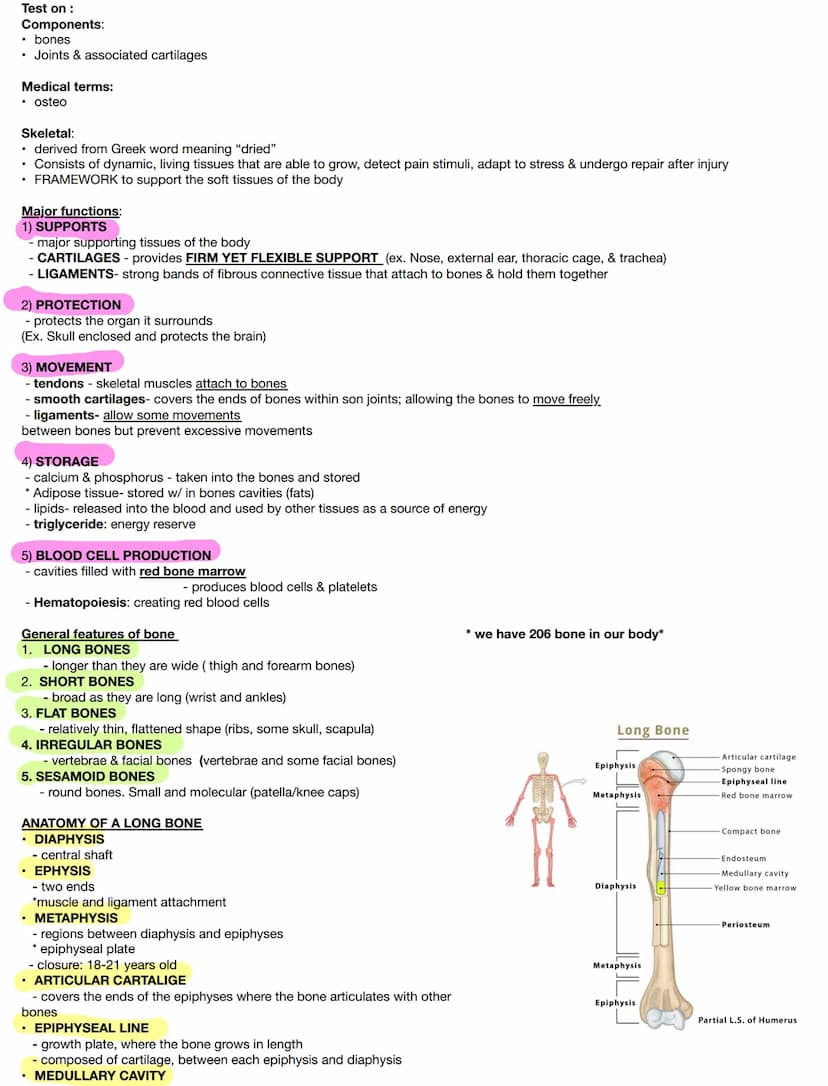
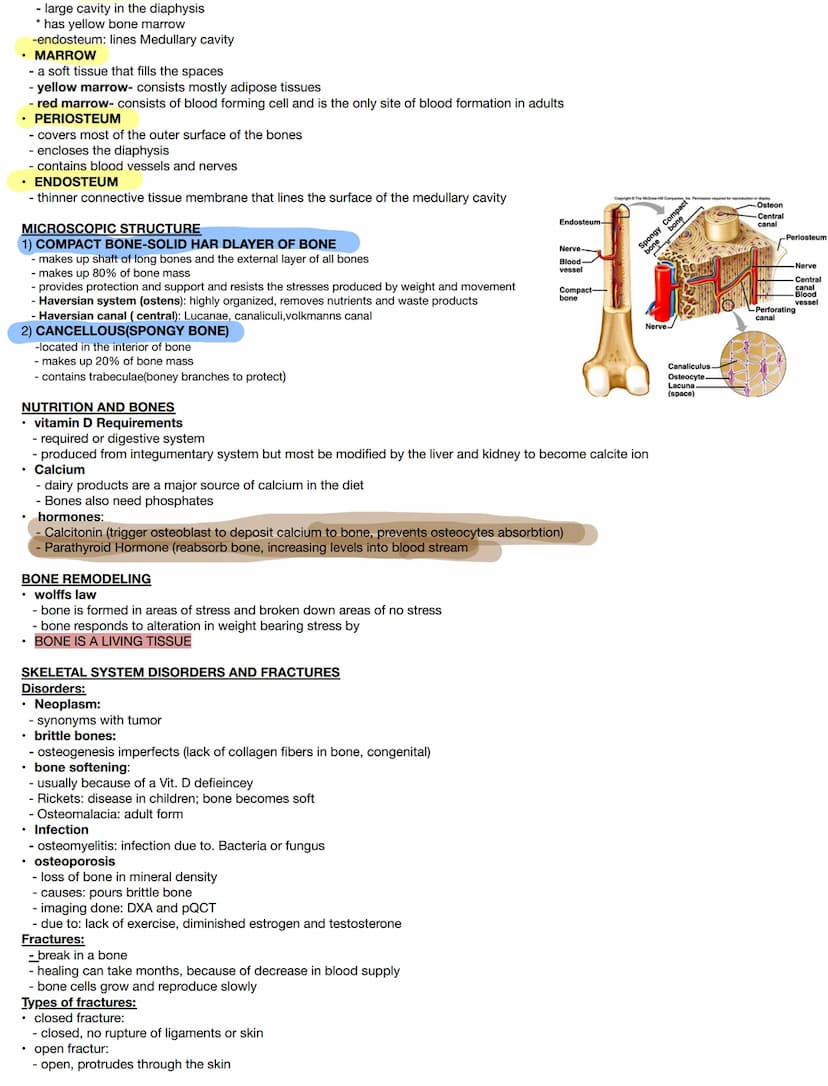
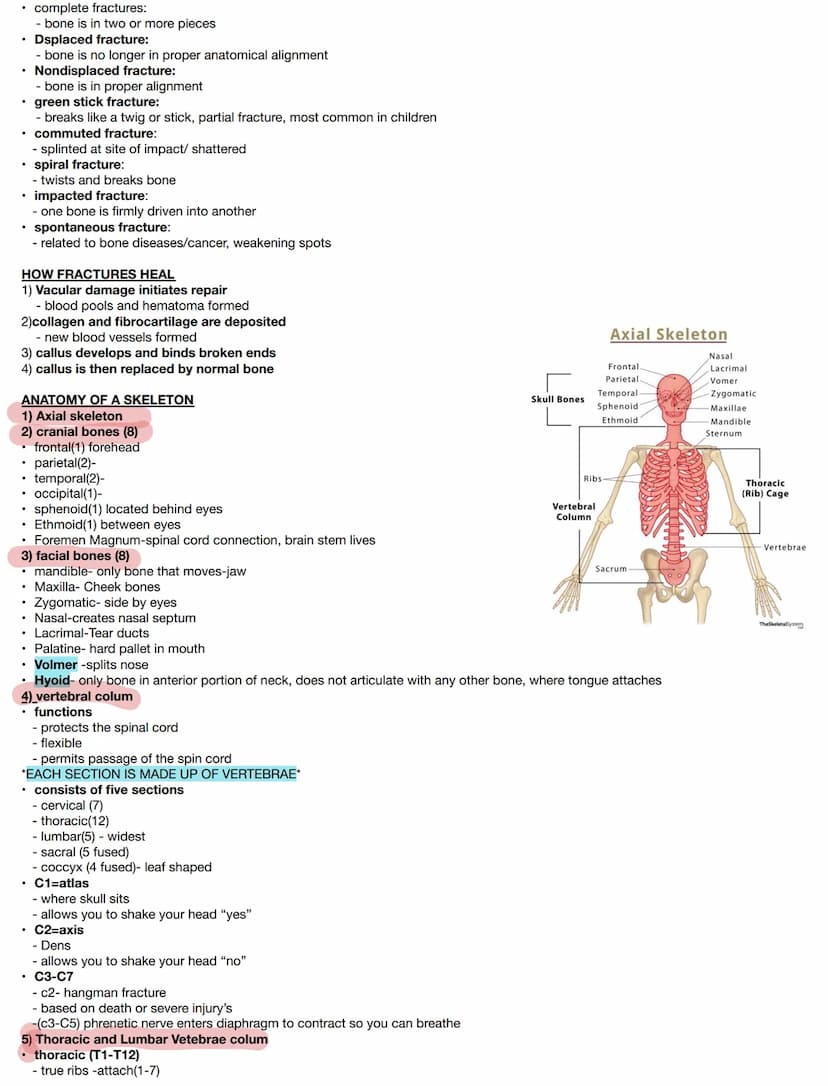
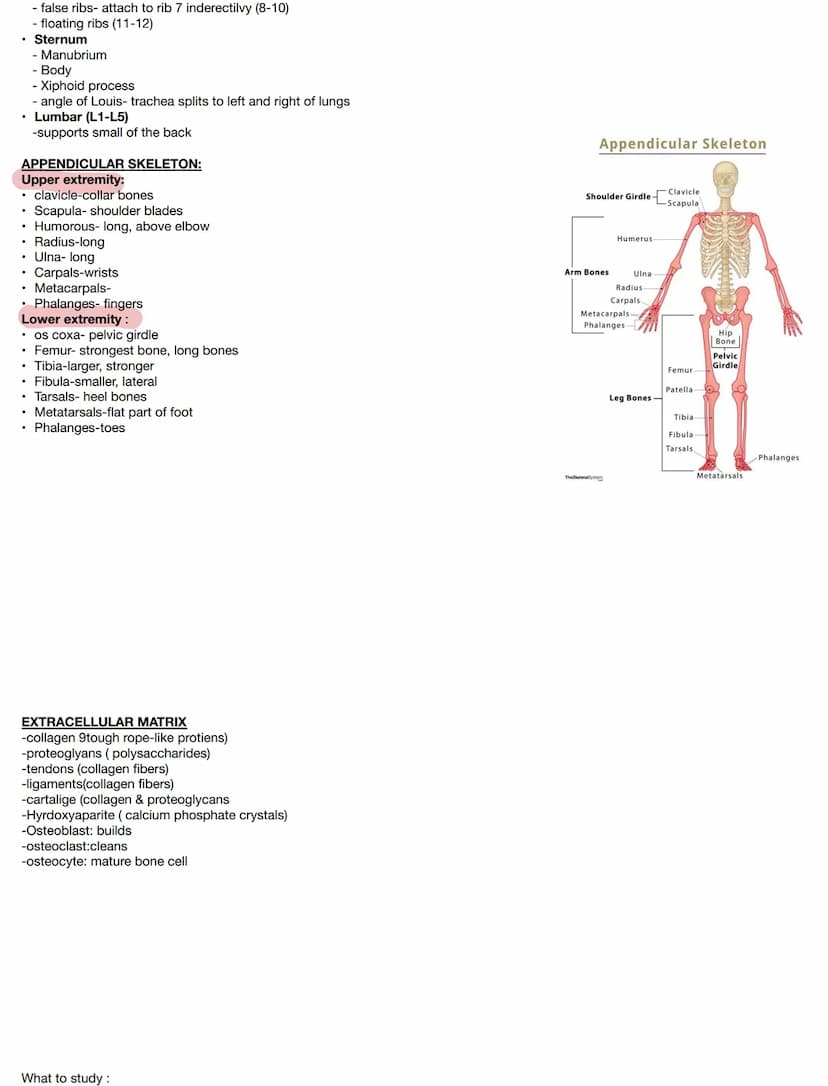
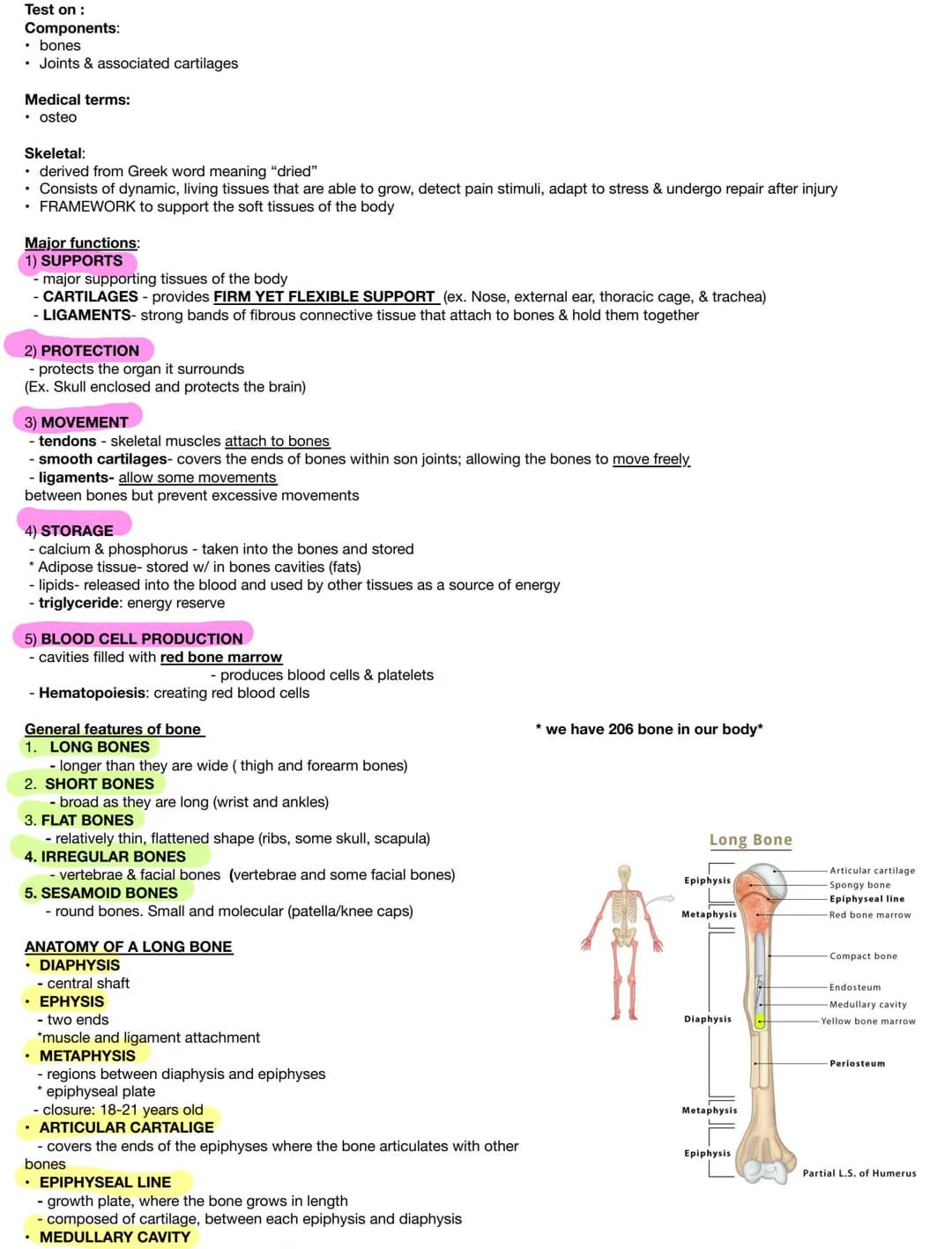
Your skeleton does way more than just keep you upright! This living tissue system performs five critical functions: it supports your body through bones and cartilages, protects vital organs like your brain, enables movement through joints and muscle attachments, stores minerals like calcium and phosphorus, and produces blood cells in red bone marrow through hematopoiesis.
Bones come in five distinct shapes, each designed for specific roles. Long bones like those in your thighs and forearms provide leverage for movement. Short bones in your wrists and ankles offer stability with movement. Flat bones protect vital organs, while irregular bones like vertebrae have complex shapes for specialized functions. Sesamoid bones like your kneecaps (patellae) protect tendons from excessive wear.
A typical long bone has several key regions. The diaphysis is the central shaft, while the epiphyses are the ends where the bone connects to other bones. The metaphysis is the region between them, containing the epiphyseal plate where growth occurs until around age 18-21. Inside, the medullary cavity contains yellow bone marrow, while the outer surface is covered by the periosteum, a membrane rich with blood vessels and nerves.
Did you know? Your skeleton contains 206 bones, but you weren't born with that many! Babies have about 300 bones, many of which fuse together as you grow up.
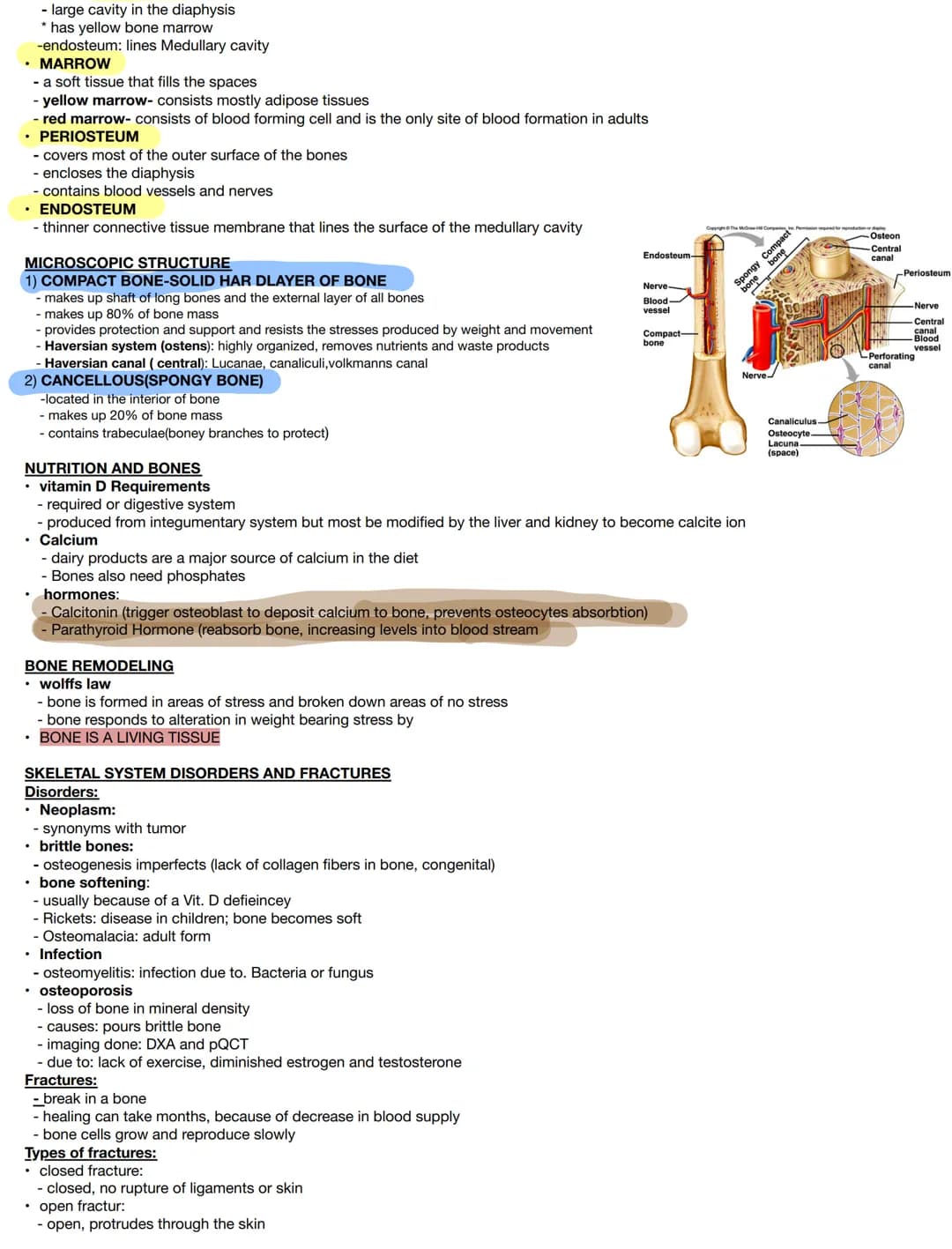
Looking at a bone under a microscope reveals two main types of bone tissue. Compact bone makes up about 80% of your skeleton, forming the hard outer layer that provides strength and protection. It's organized into units called Haversian systems (osteons) with central canals that transport nutrients and remove waste. Spongy bone makes up the remaining 20% and contains a network of trabeculae (bony branches) that provide strength while reducing weight.
Your bones need proper nutrition to stay healthy. Vitamin D is essential for calcium absorption and is produced when your skin is exposed to sunlight. Calcium from dairy and other foods provides the mineral foundation of bone tissue. Hormones like calcitonin trigger bone-building cells (osteoblasts) to deposit calcium, while parathyroid hormone activates bone breakdown when calcium is needed elsewhere in the body.
Bone constantly adapts to the stresses placed on it, a principle known as Wolff's law. This explains why weight-bearing exercise strengthens bones, while prolonged bed rest or space flight leads to bone loss. Your skeleton is truly a living tissue, constantly remodeling itself based on your activity levels.
Several disorders can affect bones, including osteoporosis (decreased bone density), osteogenesis imperfecta (brittle bones), and rickets (softening due to vitamin D deficiency). Fractures (breaks in bones) can be classified as closed or open, complete or incomplete, and vary in their healing time based on blood supply and the individual's health.
Remember this: Bone health isn't just about calcium! Regular weight-bearing exercise is crucial for maintaining strong bones throughout your life.
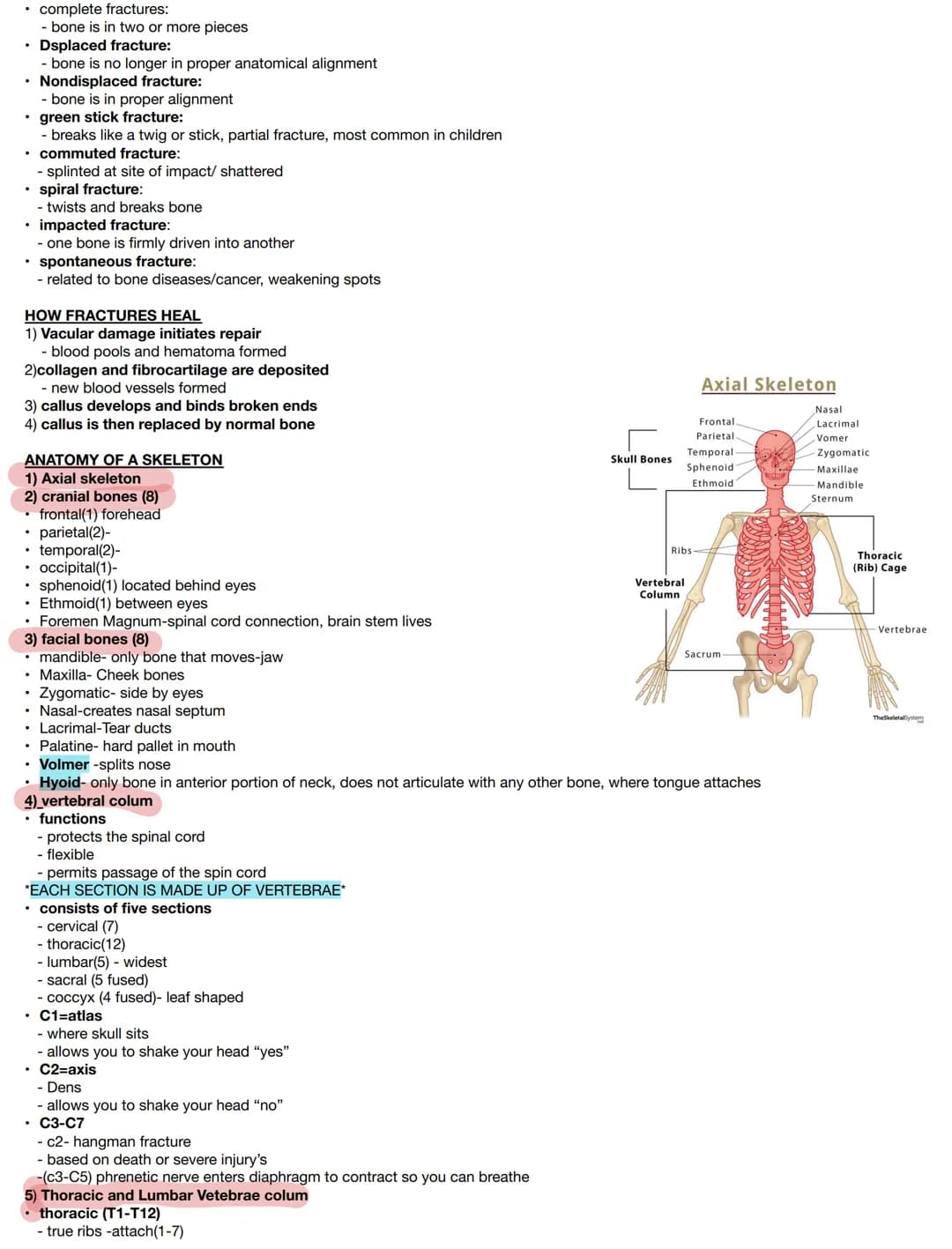
Your skeleton is divided into two main sections. The axial skeleton forms the central axis of your body, including your skull, vertebral column, and rib cage. It houses and protects your most vital organs. The appendicular skeleton includes your limbs and the structures that attach them to your axial skeleton.
The skull contains 8 cranial bones that protect your brain, including the frontal bone (forehead), parietal bones , and occipital bone (back). The foramen magnum is a large opening at the base of the skull where the spinal cord connects to the brain. Your face is formed by 14 facial bones, including the mandible (jaw), the only movable bone in the skull.
The vertebral column protects your spinal cord while allowing flexibility for movement. It consists of 33 vertebrae divided into five regions: 7 cervical (neck), 12 thoracic (upper back), 5 lumbar (lower back), 5 fused sacral vertebrae, and 4 fused coccyx (tailbone) vertebrae. The first cervical vertebra (C1), called the atlas, supports your head and allows nodding movements. The second vertebra (C2), the axis, has a projection called the dens that enables side-to-side head rotation.
Fun fact: The hyoid bone in your neck is the only bone in your body that doesn't connect to any other bone! It provides an attachment point for your tongue and muscles involved in swallowing.
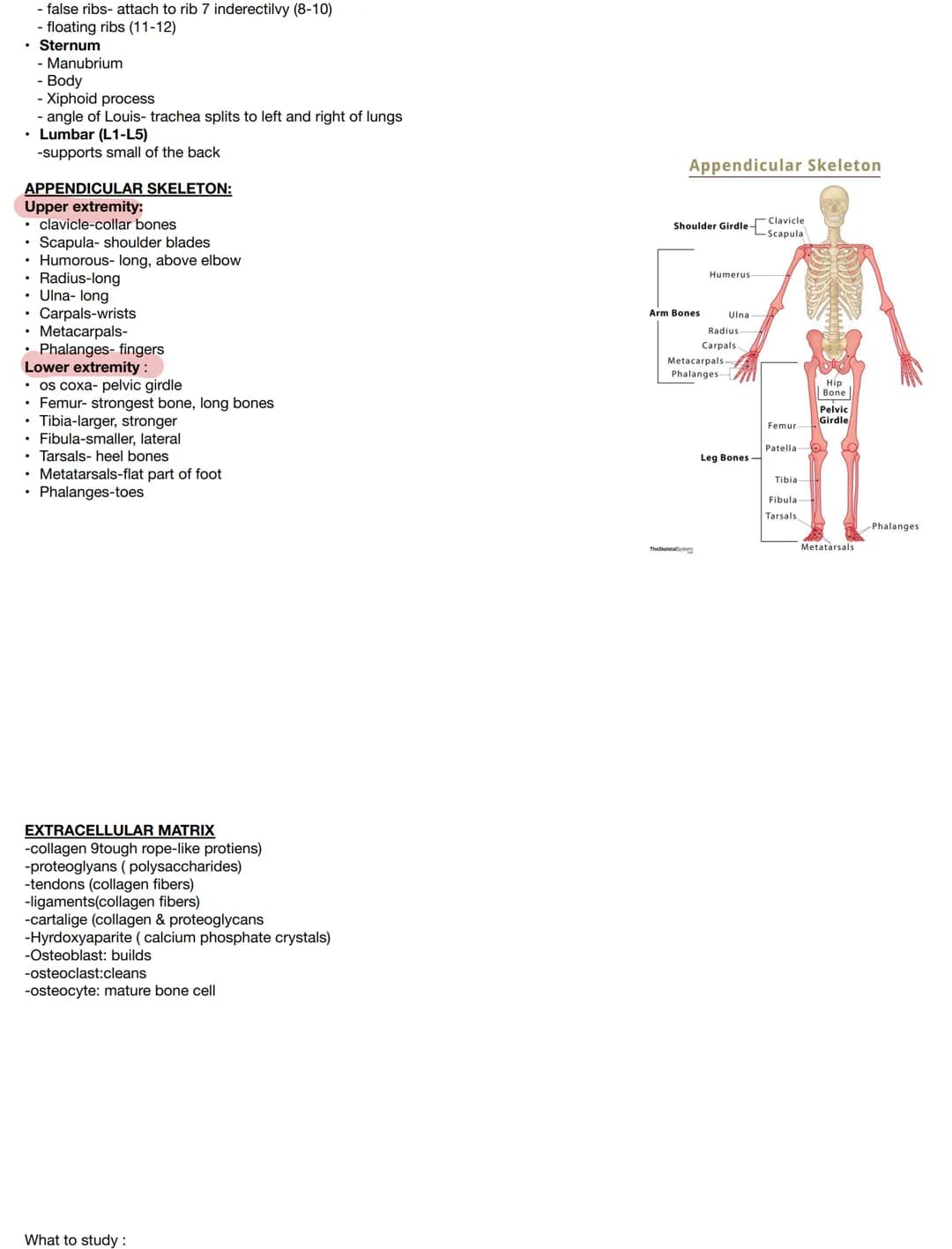
The thoracic vertebrae connect to your ribs, which attach to the sternum (breastbone) in front. The top seven pairs are true ribs that connect directly to the sternum. The next three pairs are false ribs that connect indirectly, and the bottom two pairs are floating ribs with no frontal attachment. The sternum has three parts: the manubrium (top), body (middle), and xiphoid process (bottom tip).
Your appendicular skeleton includes your arms and legs and their connecting structures. Upper limbs contain the clavicle (collarbone), scapula (shoulder blade), humerus (upper arm), radius and ulna (forearm), carpals (wrist bones), metacarpals (palm), and phalanges (fingers). Lower limbs include the os coxa (hip bone), femur (thigh bone, your strongest bone), patella (kneecap), tibia and fibula (lower leg), tarsals (ankle), metatarsals (foot), and phalanges (toes).
At the cellular level, bone contains three main cell types. Osteoblasts are bone-building cells that deposit new bone material. Osteoclasts break down bone tissue during remodeling and calcium mobilization. Osteocytes are mature bone cells that maintain the bone matrix and respond to mechanical stresses. These cells work within an extracellular matrix containing tough collagen fibers for flexibility and hydroxyapatite (calcium phosphate crystals) for hardness.
Think about this: Your femur (thigh bone) is stronger than concrete and can support up to 30 times your body weight! This incredible strength comes from the perfect combination of minerals and collagen fibers in its structure.
Our AI companion is specifically built for the needs of students. Based on the millions of content pieces we have on the platform we can provide truly meaningful and relevant answers to students. But its not only about answers, the companion is even more about guiding students through their daily learning challenges, with personalised study plans, quizzes or content pieces in the chat and 100% personalisation based on the students skills and developments.
You can download the app in the Google Play Store and in the Apple App Store.
That's right! Enjoy free access to study content, connect with fellow students, and get instant help – all at your fingertips.
App Store
Google Play
The app is very easy to use and well designed. I have found everything I was looking for so far and have been able to learn a lot from the presentations! I will definitely use the app for a class assignment! And of course it also helps a lot as an inspiration.
Stefan S
iOS user
This app is really great. There are so many study notes and help [...]. My problem subject is French, for example, and the app has so many options for help. Thanks to this app, I have improved my French. I would recommend it to anyone.
Samantha Klich
Android user
Wow, I am really amazed. I just tried the app because I've seen it advertised many times and was absolutely stunned. This app is THE HELP you want for school and above all, it offers so many things, such as workouts and fact sheets, which have been VERY helpful to me personally.
Anna
iOS user
I think it’s very much worth it and you’ll end up using it a lot once you get the hang of it and even after looking at others notes you can still ask your Artificial intelligence buddy the question and ask to simplify it if you still don’t get it!!! In the end I think it’s worth it 😊👍 ⚠️Also DID I MENTION ITS FREEE YOU DON’T HAVE TO PAY FOR ANYTHING AND STILL GET YOUR GRADES IN PERFECTLY❗️❗️⚠️
Thomas R
iOS user
Knowunity is the BEST app I’ve used in a minute. This is not an ai review or anything this is genuinely coming from a 7th grade student (I know 2011 im young) but dude this app is a 10/10 i have maintained a 3.8 gpa and have plenty of time for gaming. I love it and my mom is just happy I got good grades
Brad T
Android user
Not only did it help me find the answer but it also showed me alternative ways to solve it. I was horrible in math and science but now I have an a in both subjects. Thanks for the help🤍🤍
David K
iOS user
The app's just great! All I have to do is enter the topic in the search bar and I get the response real fast. I don't have to watch 10 YouTube videos to understand something, so I'm saving my time. Highly recommended!
Sudenaz Ocak
Android user
In school I was really bad at maths but thanks to the app, I am doing better now. I am so grateful that you made the app.
Greenlight Bonnie
Android user
I found this app a couple years ago and it has only gotten better since then. I really love it because it can help with written questions and photo questions. Also, it can find study guides that other people have made as well as flashcard sets and practice tests. The free version is also amazing for students who might not be able to afford it. Would 100% recommend
Aubrey
iOS user
Best app if you're in Highschool or Junior high. I have been using this app for 2 school years and it's the best, it's good if you don't have anyone to help you with school work.😋🩷🎀
Marco B
iOS user
THE QUIZES AND FLASHCARDS ARE SO USEFUL AND I LOVE Knowunity AI. IT ALSO IS LITREALLY LIKE CHATGPT BUT SMARTER!! HELPED ME WITH MY MASCARA PROBLEMS TOO!! AS WELL AS MY REAL SUBJECTS ! DUHHH 😍😁😲🤑💗✨🎀😮
Elisha
iOS user
This app is phenomenal down to the correct info and the various topics you can study! I greatly recommend it for people who struggle with procrastination and those who need homework help. It has been perfectly accurate for world 1 history as far as I’ve seen! Geometry too!
Paul T
iOS user
The app is very easy to use and well designed. I have found everything I was looking for so far and have been able to learn a lot from the presentations! I will definitely use the app for a class assignment! And of course it also helps a lot as an inspiration.
Stefan S
iOS user
This app is really great. There are so many study notes and help [...]. My problem subject is French, for example, and the app has so many options for help. Thanks to this app, I have improved my French. I would recommend it to anyone.
Samantha Klich
Android user
Wow, I am really amazed. I just tried the app because I've seen it advertised many times and was absolutely stunned. This app is THE HELP you want for school and above all, it offers so many things, such as workouts and fact sheets, which have been VERY helpful to me personally.
Anna
iOS user
I think it’s very much worth it and you’ll end up using it a lot once you get the hang of it and even after looking at others notes you can still ask your Artificial intelligence buddy the question and ask to simplify it if you still don’t get it!!! In the end I think it’s worth it 😊👍 ⚠️Also DID I MENTION ITS FREEE YOU DON’T HAVE TO PAY FOR ANYTHING AND STILL GET YOUR GRADES IN PERFECTLY❗️❗️⚠️
Thomas R
iOS user
Knowunity is the BEST app I’ve used in a minute. This is not an ai review or anything this is genuinely coming from a 7th grade student (I know 2011 im young) but dude this app is a 10/10 i have maintained a 3.8 gpa and have plenty of time for gaming. I love it and my mom is just happy I got good grades
Brad T
Android user
Not only did it help me find the answer but it also showed me alternative ways to solve it. I was horrible in math and science but now I have an a in both subjects. Thanks for the help🤍🤍
David K
iOS user
The app's just great! All I have to do is enter the topic in the search bar and I get the response real fast. I don't have to watch 10 YouTube videos to understand something, so I'm saving my time. Highly recommended!
Sudenaz Ocak
Android user
In school I was really bad at maths but thanks to the app, I am doing better now. I am so grateful that you made the app.
Greenlight Bonnie
Android user
I found this app a couple years ago and it has only gotten better since then. I really love it because it can help with written questions and photo questions. Also, it can find study guides that other people have made as well as flashcard sets and practice tests. The free version is also amazing for students who might not be able to afford it. Would 100% recommend
Aubrey
iOS user
Best app if you're in Highschool or Junior high. I have been using this app for 2 school years and it's the best, it's good if you don't have anyone to help you with school work.😋🩷🎀
Marco B
iOS user
THE QUIZES AND FLASHCARDS ARE SO USEFUL AND I LOVE Knowunity AI. IT ALSO IS LITREALLY LIKE CHATGPT BUT SMARTER!! HELPED ME WITH MY MASCARA PROBLEMS TOO!! AS WELL AS MY REAL SUBJECTS ! DUHHH 😍😁😲🤑💗✨🎀😮
Elisha
iOS user
This app is phenomenal down to the correct info and the various topics you can study! I greatly recommend it for people who struggle with procrastination and those who need homework help. It has been perfectly accurate for world 1 history as far as I’ve seen! Geometry too!
Paul T
iOS user
Ashli Atwood
@ashliatwood_qgzm
The skeletal system provides the framework that supports your body, protects vital organs, and enables movement. This dynamic system consists of bones, joints, cartilages, and associated tissues that work together to perform essential functions while continuously adapting to your body's... Show more
Access to all documents
Improve your grades
Join milions of students
Your skeleton does way more than just keep you upright! This living tissue system performs five critical functions: it supports your body through bones and cartilages, protects vital organs like your brain, enables movement through joints and muscle attachments, stores minerals like calcium and phosphorus, and produces blood cells in red bone marrow through hematopoiesis.
Bones come in five distinct shapes, each designed for specific roles. Long bones like those in your thighs and forearms provide leverage for movement. Short bones in your wrists and ankles offer stability with movement. Flat bones protect vital organs, while irregular bones like vertebrae have complex shapes for specialized functions. Sesamoid bones like your kneecaps (patellae) protect tendons from excessive wear.
A typical long bone has several key regions. The diaphysis is the central shaft, while the epiphyses are the ends where the bone connects to other bones. The metaphysis is the region between them, containing the epiphyseal plate where growth occurs until around age 18-21. Inside, the medullary cavity contains yellow bone marrow, while the outer surface is covered by the periosteum, a membrane rich with blood vessels and nerves.
Did you know? Your skeleton contains 206 bones, but you weren't born with that many! Babies have about 300 bones, many of which fuse together as you grow up.
Access to all documents
Improve your grades
Join milions of students
Looking at a bone under a microscope reveals two main types of bone tissue. Compact bone makes up about 80% of your skeleton, forming the hard outer layer that provides strength and protection. It's organized into units called Haversian systems (osteons) with central canals that transport nutrients and remove waste. Spongy bone makes up the remaining 20% and contains a network of trabeculae (bony branches) that provide strength while reducing weight.
Your bones need proper nutrition to stay healthy. Vitamin D is essential for calcium absorption and is produced when your skin is exposed to sunlight. Calcium from dairy and other foods provides the mineral foundation of bone tissue. Hormones like calcitonin trigger bone-building cells (osteoblasts) to deposit calcium, while parathyroid hormone activates bone breakdown when calcium is needed elsewhere in the body.
Bone constantly adapts to the stresses placed on it, a principle known as Wolff's law. This explains why weight-bearing exercise strengthens bones, while prolonged bed rest or space flight leads to bone loss. Your skeleton is truly a living tissue, constantly remodeling itself based on your activity levels.
Several disorders can affect bones, including osteoporosis (decreased bone density), osteogenesis imperfecta (brittle bones), and rickets (softening due to vitamin D deficiency). Fractures (breaks in bones) can be classified as closed or open, complete or incomplete, and vary in their healing time based on blood supply and the individual's health.
Remember this: Bone health isn't just about calcium! Regular weight-bearing exercise is crucial for maintaining strong bones throughout your life.
Access to all documents
Improve your grades
Join milions of students
Your skeleton is divided into two main sections. The axial skeleton forms the central axis of your body, including your skull, vertebral column, and rib cage. It houses and protects your most vital organs. The appendicular skeleton includes your limbs and the structures that attach them to your axial skeleton.
The skull contains 8 cranial bones that protect your brain, including the frontal bone (forehead), parietal bones , and occipital bone (back). The foramen magnum is a large opening at the base of the skull where the spinal cord connects to the brain. Your face is formed by 14 facial bones, including the mandible (jaw), the only movable bone in the skull.
The vertebral column protects your spinal cord while allowing flexibility for movement. It consists of 33 vertebrae divided into five regions: 7 cervical (neck), 12 thoracic (upper back), 5 lumbar (lower back), 5 fused sacral vertebrae, and 4 fused coccyx (tailbone) vertebrae. The first cervical vertebra (C1), called the atlas, supports your head and allows nodding movements. The second vertebra (C2), the axis, has a projection called the dens that enables side-to-side head rotation.
Fun fact: The hyoid bone in your neck is the only bone in your body that doesn't connect to any other bone! It provides an attachment point for your tongue and muscles involved in swallowing.
Access to all documents
Improve your grades
Join milions of students
The thoracic vertebrae connect to your ribs, which attach to the sternum (breastbone) in front. The top seven pairs are true ribs that connect directly to the sternum. The next three pairs are false ribs that connect indirectly, and the bottom two pairs are floating ribs with no frontal attachment. The sternum has three parts: the manubrium (top), body (middle), and xiphoid process (bottom tip).
Your appendicular skeleton includes your arms and legs and their connecting structures. Upper limbs contain the clavicle (collarbone), scapula (shoulder blade), humerus (upper arm), radius and ulna (forearm), carpals (wrist bones), metacarpals (palm), and phalanges (fingers). Lower limbs include the os coxa (hip bone), femur (thigh bone, your strongest bone), patella (kneecap), tibia and fibula (lower leg), tarsals (ankle), metatarsals (foot), and phalanges (toes).
At the cellular level, bone contains three main cell types. Osteoblasts are bone-building cells that deposit new bone material. Osteoclasts break down bone tissue during remodeling and calcium mobilization. Osteocytes are mature bone cells that maintain the bone matrix and respond to mechanical stresses. These cells work within an extracellular matrix containing tough collagen fibers for flexibility and hydroxyapatite (calcium phosphate crystals) for hardness.
Think about this: Your femur (thigh bone) is stronger than concrete and can support up to 30 times your body weight! This incredible strength comes from the perfect combination of minerals and collagen fibers in its structure.
Our AI companion is specifically built for the needs of students. Based on the millions of content pieces we have on the platform we can provide truly meaningful and relevant answers to students. But its not only about answers, the companion is even more about guiding students through their daily learning challenges, with personalised study plans, quizzes or content pieces in the chat and 100% personalisation based on the students skills and developments.
You can download the app in the Google Play Store and in the Apple App Store.
That's right! Enjoy free access to study content, connect with fellow students, and get instant help – all at your fingertips.
5
Smart Tools NEW
Transform this note into: ✓ 50+ Practice Questions ✓ Interactive Flashcards ✓ Full Practice Test ✓ Essay Outlines
Reviews AP Bio 7.13
 AP Biology
App Store
Google Play
The app is very easy to use and well designed. I have found everything I was looking for so far and have been able to learn a lot from the presentations! I will definitely use the app for a class assignment! And of course it also helps a lot as an inspiration.
Stefan S
iOS user
This app is really great. There are so many study notes and help [...]. My problem subject is French, for example, and the app has so many options for help. Thanks to this app, I have improved my French. I would recommend it to anyone.
Samantha Klich
Android user
Wow, I am really amazed. I just tried the app because I've seen it advertised many times and was absolutely stunned. This app is THE HELP you want for school and above all, it offers so many things, such as workouts and fact sheets, which have been VERY helpful to me personally.
Anna
iOS user
I think it’s very much worth it and you’ll end up using it a lot once you get the hang of it and even after looking at others notes you can still ask your Artificial intelligence buddy the question and ask to simplify it if you still don’t get it!!! In the end I think it’s worth it 😊👍 ⚠️Also DID I MENTION ITS FREEE YOU DON’T HAVE TO PAY FOR ANYTHING AND STILL GET YOUR GRADES IN PERFECTLY❗️❗️⚠️
Thomas R
iOS user
Knowunity is the BEST app I’ve used in a minute. This is not an ai review or anything this is genuinely coming from a 7th grade student (I know 2011 im young) but dude this app is a 10/10 i have maintained a 3.8 gpa and have plenty of time for gaming. I love it and my mom is just happy I got good grades
Brad T
Android user
Not only did it help me find the answer but it also showed me alternative ways to solve it. I was horrible in math and science but now I have an a in both subjects. Thanks for the help🤍🤍
David K
iOS user
The app's just great! All I have to do is enter the topic in the search bar and I get the response real fast. I don't have to watch 10 YouTube videos to understand something, so I'm saving my time. Highly recommended!
Sudenaz Ocak
Android user
In school I was really bad at maths but thanks to the app, I am doing better now. I am so grateful that you made the app.
Greenlight Bonnie
Android user
I found this app a couple years ago and it has only gotten better since then. I really love it because it can help with written questions and photo questions. Also, it can find study guides that other people have made as well as flashcard sets and practice tests. The free version is also amazing for students who might not be able to afford it. Would 100% recommend
Aubrey
iOS user
Best app if you're in Highschool or Junior high. I have been using this app for 2 school years and it's the best, it's good if you don't have anyone to help you with school work.😋🩷🎀
Marco B
iOS user
THE QUIZES AND FLASHCARDS ARE SO USEFUL AND I LOVE Knowunity AI. IT ALSO IS LITREALLY LIKE CHATGPT BUT SMARTER!! HELPED ME WITH MY MASCARA PROBLEMS TOO!! AS WELL AS MY REAL SUBJECTS ! DUHHH 😍😁😲🤑💗✨🎀😮
Elisha
iOS user
This app is phenomenal down to the correct info and the various topics you can study! I greatly recommend it for people who struggle with procrastination and those who need homework help. It has been perfectly accurate for world 1 history as far as I’ve seen! Geometry too!
Paul T
iOS user
The app is very easy to use and well designed. I have found everything I was looking for so far and have been able to learn a lot from the presentations! I will definitely use the app for a class assignment! And of course it also helps a lot as an inspiration.
Stefan S
iOS user
This app is really great. There are so many study notes and help [...]. My problem subject is French, for example, and the app has so many options for help. Thanks to this app, I have improved my French. I would recommend it to anyone.
Samantha Klich
Android user
Wow, I am really amazed. I just tried the app because I've seen it advertised many times and was absolutely stunned. This app is THE HELP you want for school and above all, it offers so many things, such as workouts and fact sheets, which have been VERY helpful to me personally.
Anna
iOS user
I think it’s very much worth it and you’ll end up using it a lot once you get the hang of it and even after looking at others notes you can still ask your Artificial intelligence buddy the question and ask to simplify it if you still don’t get it!!! In the end I think it’s worth it 😊👍 ⚠️Also DID I MENTION ITS FREEE YOU DON’T HAVE TO PAY FOR ANYTHING AND STILL GET YOUR GRADES IN PERFECTLY❗️❗️⚠️
Thomas R
iOS user
Knowunity is the BEST app I’ve used in a minute. This is not an ai review or anything this is genuinely coming from a 7th grade student (I know 2011 im young) but dude this app is a 10/10 i have maintained a 3.8 gpa and have plenty of time for gaming. I love it and my mom is just happy I got good grades
Brad T
Android user
Not only did it help me find the answer but it also showed me alternative ways to solve it. I was horrible in math and science but now I have an a in both subjects. Thanks for the help🤍🤍
David K
iOS user
The app's just great! All I have to do is enter the topic in the search bar and I get the response real fast. I don't have to watch 10 YouTube videos to understand something, so I'm saving my time. Highly recommended!
Sudenaz Ocak
Android user
In school I was really bad at maths but thanks to the app, I am doing better now. I am so grateful that you made the app.
Greenlight Bonnie
Android user
I found this app a couple years ago and it has only gotten better since then. I really love it because it can help with written questions and photo questions. Also, it can find study guides that other people have made as well as flashcard sets and practice tests. The free version is also amazing for students who might not be able to afford it. Would 100% recommend
Aubrey
iOS user
Best app if you're in Highschool or Junior high. I have been using this app for 2 school years and it's the best, it's good if you don't have anyone to help you with school work.😋🩷🎀
Marco B
iOS user
THE QUIZES AND FLASHCARDS ARE SO USEFUL AND I LOVE Knowunity AI. IT ALSO IS LITREALLY LIKE CHATGPT BUT SMARTER!! HELPED ME WITH MY MASCARA PROBLEMS TOO!! AS WELL AS MY REAL SUBJECTS ! DUHHH 😍😁😲🤑💗✨🎀😮
Elisha
iOS user
This app is phenomenal down to the correct info and the various topics you can study! I greatly recommend it for people who struggle with procrastination and those who need homework help. It has been perfectly accurate for world 1 history as far as I’ve seen! Geometry too!
Paul T
iOS user