States of Matter and Their Properties
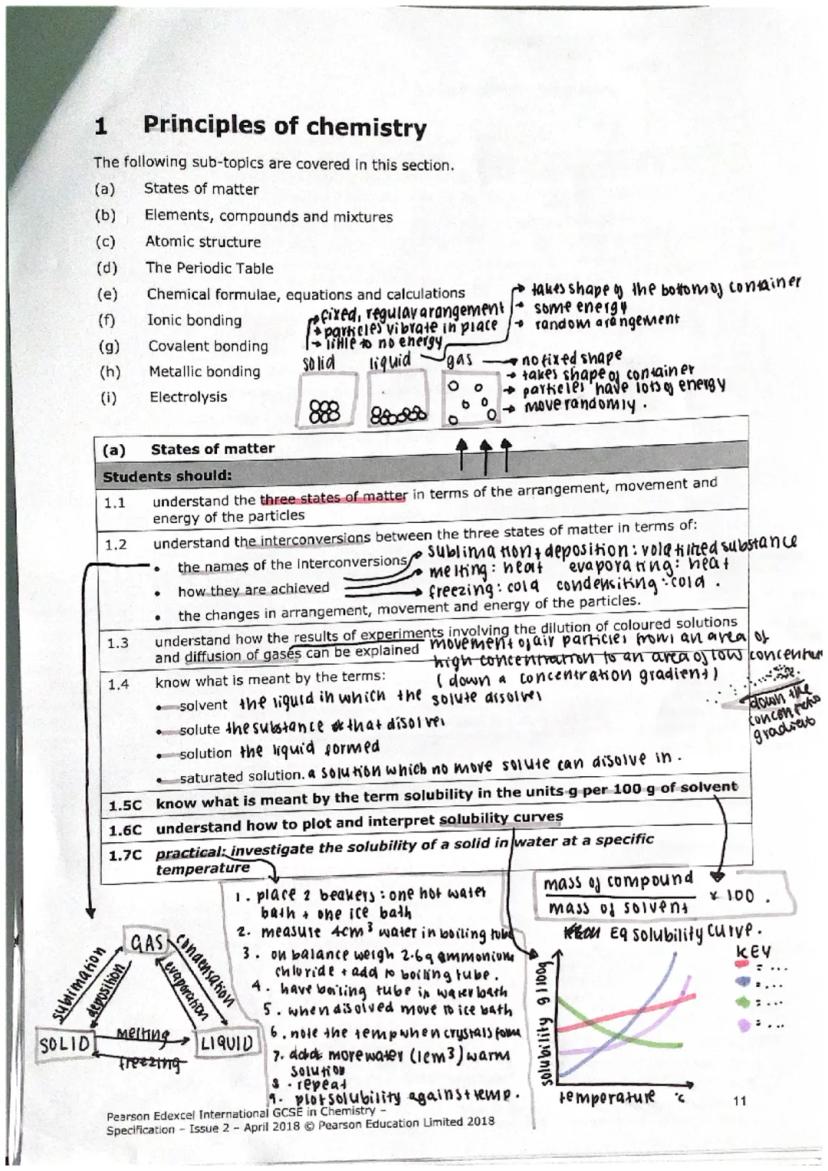
Matter exists in three main states: solid, liquid and gas. In solids, particles are arranged in a fixed, regular pattern, vibrating in place with little energy. Liquids have particles with some energy that take the shape of their container's bottom. Gases contain particles with high energy moving randomly with no fixed shape.
These states can transform through processes like melting (solid to liquid), freezing (liquid to solid), evaporation (liquid to gas), and condensation (gas to liquid). Less common transitions include sublimation (solid directly to gas) and deposition (gas directly to solid). These changes involve adjustments in the arrangement, movement, and energy of particles.
When substances dissolve, we get solutions consisting of a solute (the substance that dissolves) and a solvent (the liquid that does the dissolving). A saturated solution occurs when no more solute can dissolve. Solubility is measured in grams per 100g of solvent and varies with temperature.
Did you know? You can create your own solubility curve by measuring how much of a compound dissolves at different temperatures. This is exactly what scientists do to understand how substances behave in solution!



 Chemistry
 English Literature
 Biology
 Sociology