Moles and Chemical Calculations
Ever wondered how chemists predict exactly how much product they'll get from a reaction? It all starts with understanding moles - think of them as chemistry's way of counting particles.
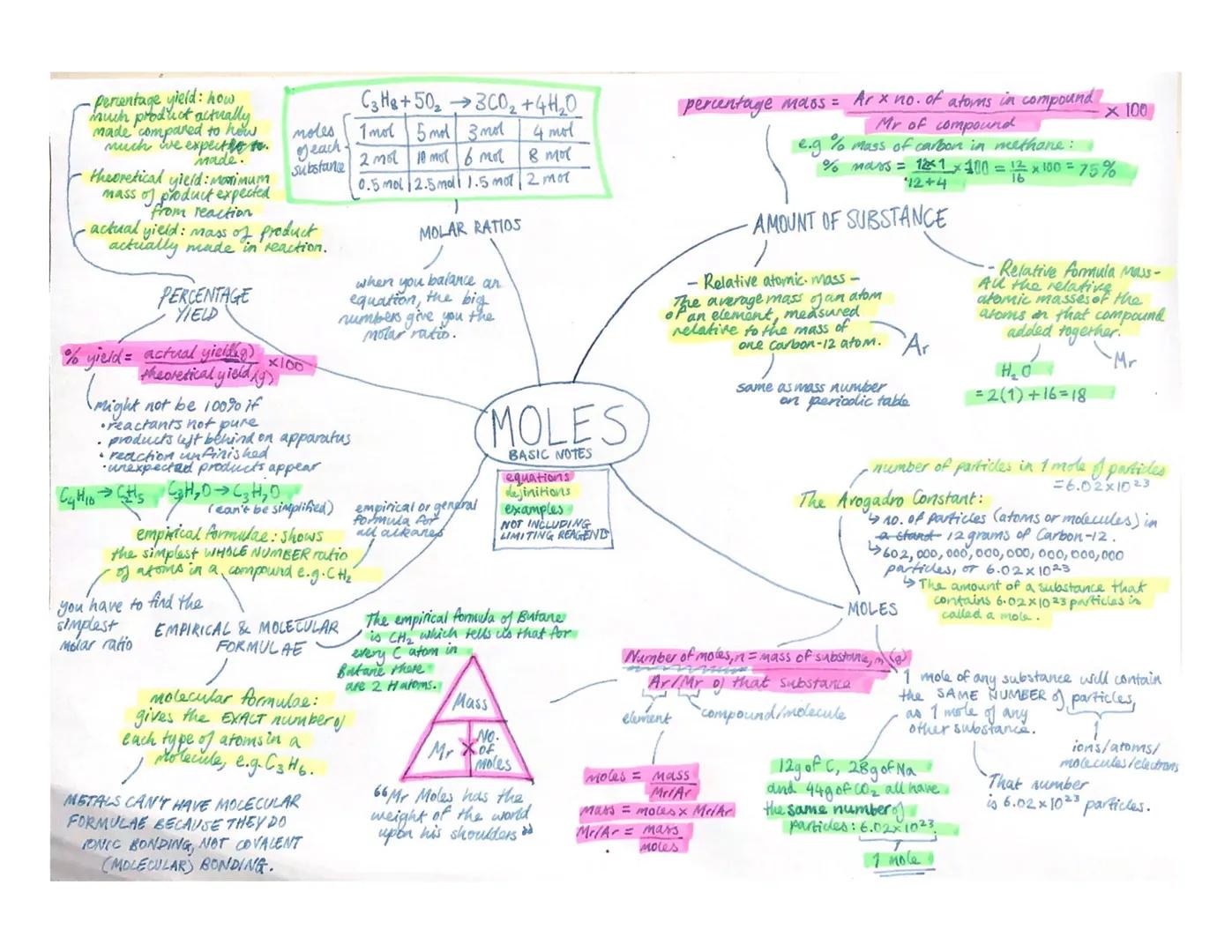
A mole contains exactly 6.02 × 10²³ particles (that's Avogadro's constant). Whether you're counting atoms, molecules, or ions, one mole always contains this same massive number. This means 12g of carbon, 28g of sodium, and 44g of CO₂ all contain exactly the same number of particles.
To calculate moles, use this essential formula: n = m/Mr, where n is moles, m is mass, and Mr is relative formula mass. The relative atomic mass (Ar) comes straight from your periodic table, whilst relative formula mass (Mr) is all the atomic masses in a compound added together.
Molar ratios come from balanced equations - those big numbers in front of compounds tell you exactly how many moles of each substance react together. For example, in C₃H₈ + 5O₂ → 3CO₂ + 4H₂O, you need 5 moles of oxygen for every 1 mole of propane.
Quick Tip: Remember "66 Mr Moles has the weight of the world upon his shoulders" - Mass over Mr equals Moles!
Percentage mass calculations show what fraction of a compound is made up of each element. Use the formula: Ar×numberofatoms/Mrofcompound × 100. In methane (CH₄), carbon makes up 75% of the total mass.


 Chemistry
 English Literature
 Biology
 Sociology