
Welcome to Python programming! This unit covers the fundamentals of... Show more
 AP Computer Science A
 Algebra
Sign up to see the contentIt's free!
Access to all documents
Improve your grades
Join milions of students
Knowunity AI
Subjects
Triangle Congruence and Similarity Theorems
Triangle Properties and Classification
Linear Equations and Graphs
Geometric Angle Relationships
Trigonometric Functions and Identities
Equation Solving Techniques
Circle Geometry Fundamentals
Division Operations and Methods
Basic Differentiation Rules
Exponent and Logarithm Properties
Show all topics
Human Organ Systems
Reproductive Cell Cycles
Biological Sciences Subdisciplines
Cellular Energy Metabolism
Autotrophic Energy Processes
Inheritance Patterns and Principles
Biomolecular Structure and Organization
Cell Cycle and Division Mechanics
Cellular Organization and Development
Biological Structural Organization
Show all topics
Chemical Sciences and Applications
Atomic Structure and Composition
Molecular Electron Structure Representation
Atomic Electron Behavior
Matter Properties and Water
Mole Concept and Calculations
Gas Laws and Behavior
Periodic Table Organization
Chemical Thermodynamics Fundamentals
Chemical Bond Types and Properties
Show all topics
European Renaissance and Enlightenment
European Cultural Movements 800-1920
American Revolution Era 1763-1797
American Civil War 1861-1865
Global Imperial Systems
Mongol and Chinese Dynasties
U.S. Presidents and World Leaders
Historical Sources and Documentation
World Wars Era and Impact
World Religious Systems
Show all topics
Classic and Contemporary Novels
Literary Character Analysis
Rhetorical Theory and Practice
Classic Literary Narratives
Reading Analysis and Interpretation
Narrative Structure and Techniques
English Language Components
Influential English-Language Authors
Basic Sentence Structure
Narrative Voice and Perspective
Show all topics
390
•
Updated Mar 2, 2026
•
YATHARTH SAXENA
@yatharthsaxena_okba
Welcome to Python programming! This unit covers the fundamentals of... Show more
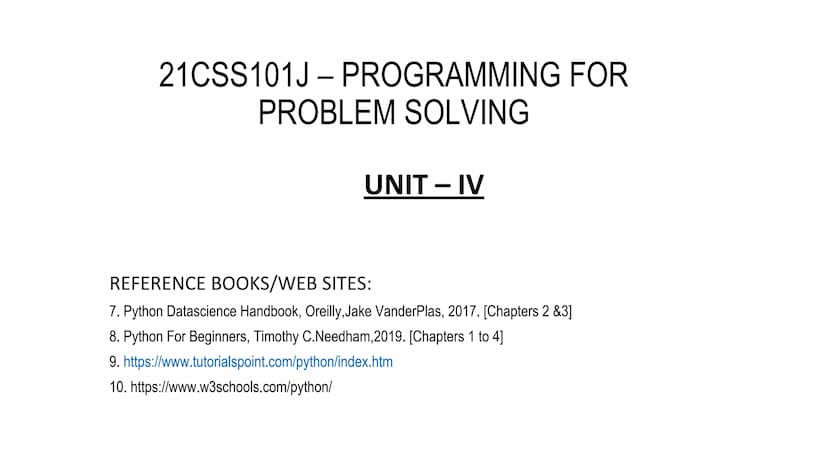
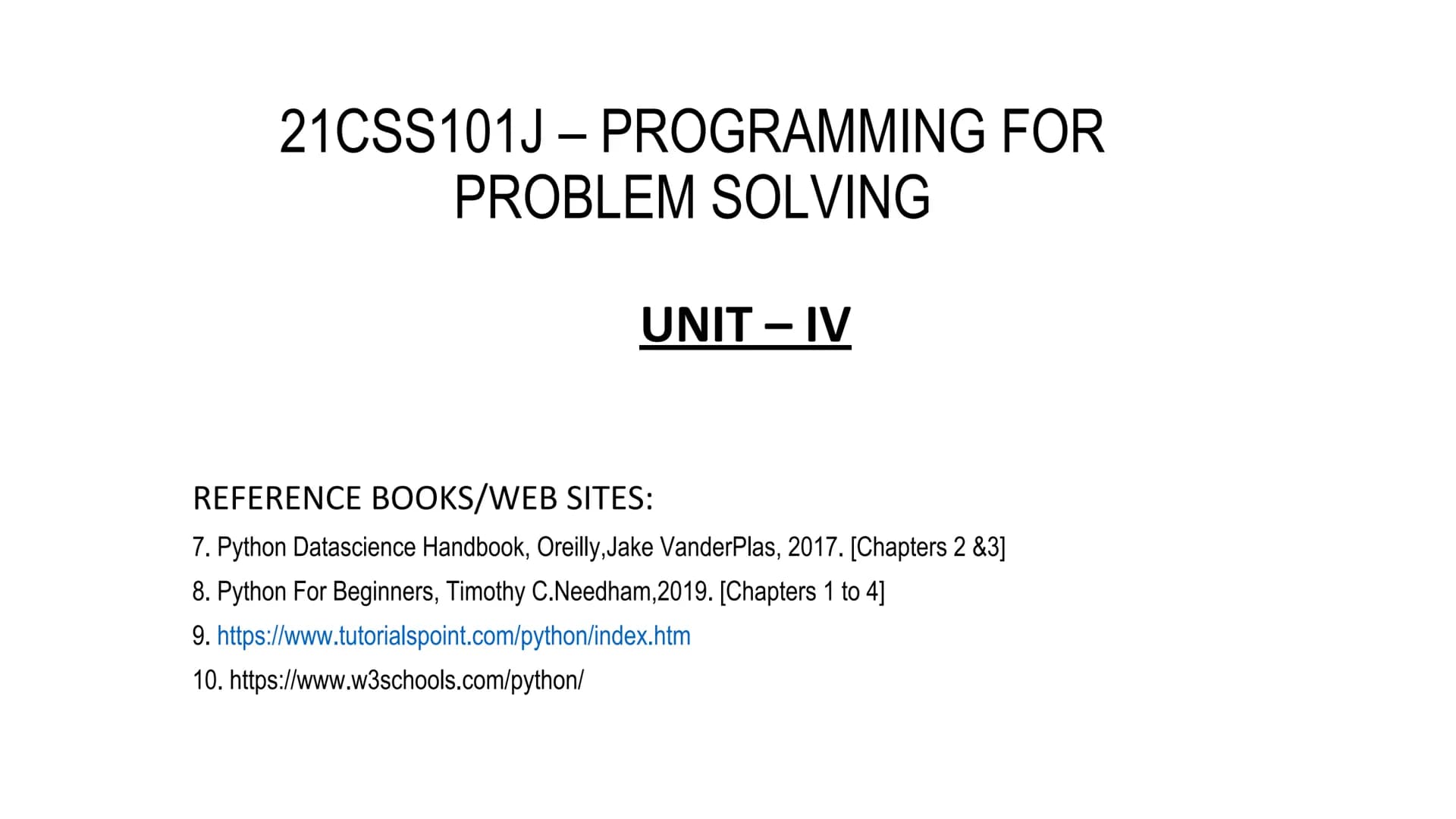
Python is a versatile programming language used for everything from web development to data science. To succeed in this unit, you'll want to explore these helpful resources:
The Python DataScience Handbook by Jake VanderPlas is excellent for understanding data manipulation and analysis. Python For Beginners by Timothy C. Needham provides a solid foundation for newcomers.
For online tutorials and reference materials, check out tutorialspoint.com and w3schools.com. These websites offer interactive examples and explanations that can reinforce your classroom learning.
💡 Don't just read about Python—practice regularly! The best way to learn programming is by writing code and experimenting with different concepts.
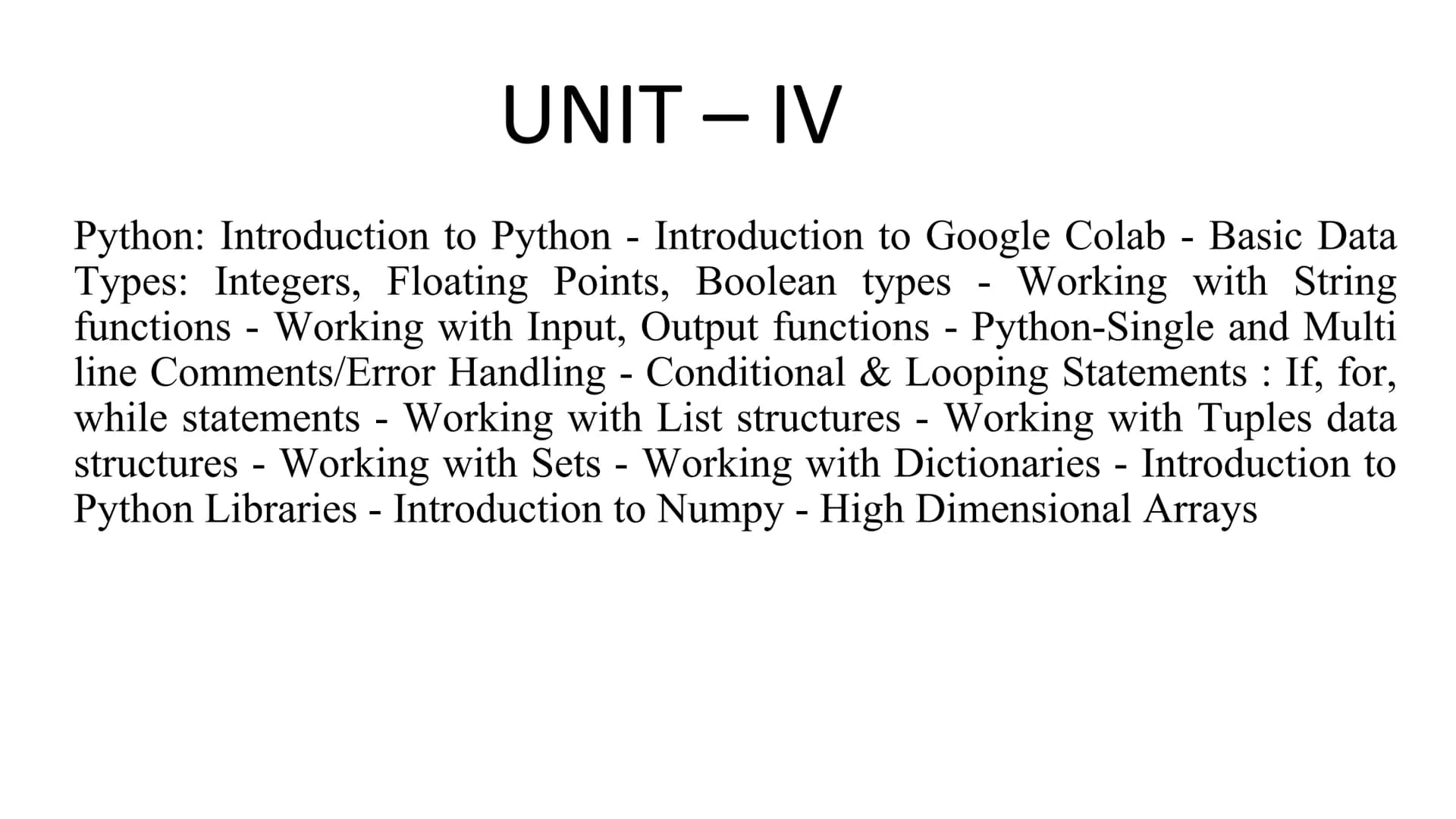
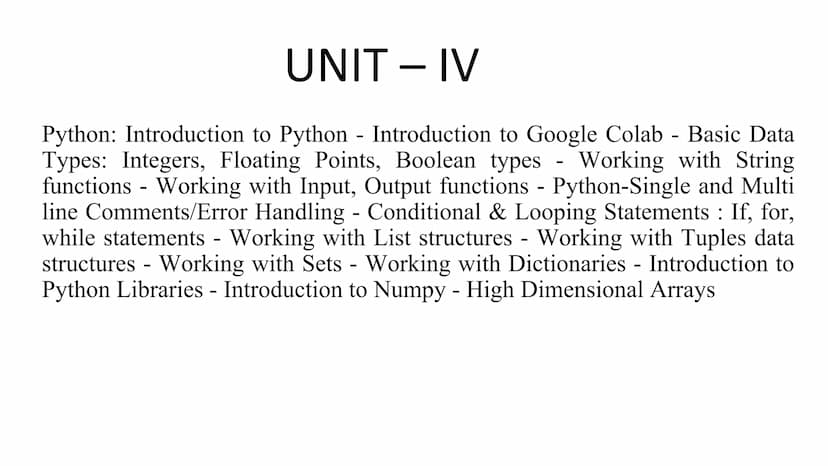
This unit covers the essential building blocks of Python programming that you'll need for problem-solving applications. You'll start with an introduction to Python and Google Colab as a development environment.
You'll learn about basic data types including integers, floating-point numbers, and boolean values. The unit covers working with strings and various input/output functions for interacting with users.
The course explores Python's control flow statements like if, for, and while loops for creating conditional logic and repetitive operations. You'll also work with Python's powerful data structures: lists, tuples, sets, and dictionaries.
Finally, you'll get an introduction to Python's libraries, particularly NumPy, which enables high-dimensional array operations for scientific computing and data analysis.
🔑 Master these fundamentals and you'll have the skills to tackle more complex programming challenges in your future courses!
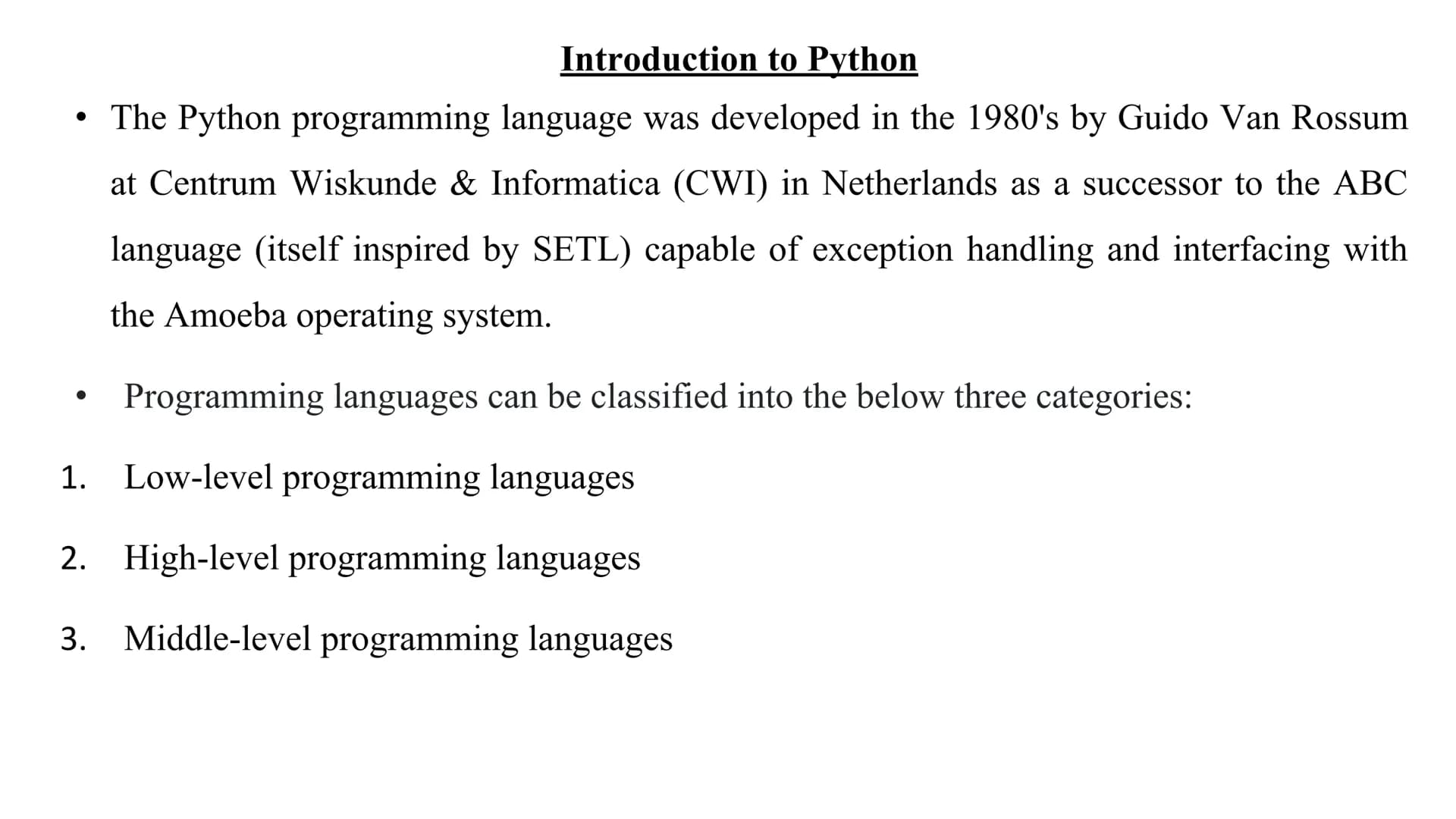
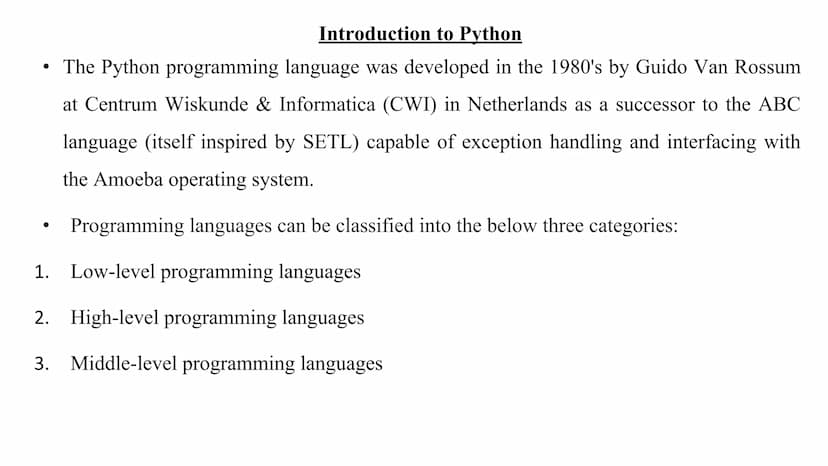
Python was developed in the 1980s by Guido Van Rossum at the Centrum Wiskunde & Informatica (CWI) in the Netherlands. It was designed as a successor to the ABC language, with capabilities for exception handling and interfacing with the Amoeba operating system.
Programming languages typically fall into three categories:
Python is considered a high-level language because it's intuitive and readable, making it perfect for beginners while still being powerful enough for professional developers.
💡 Python's creator, Guido van Rossum, named the language after the British comedy group Monty Python, not the snake!
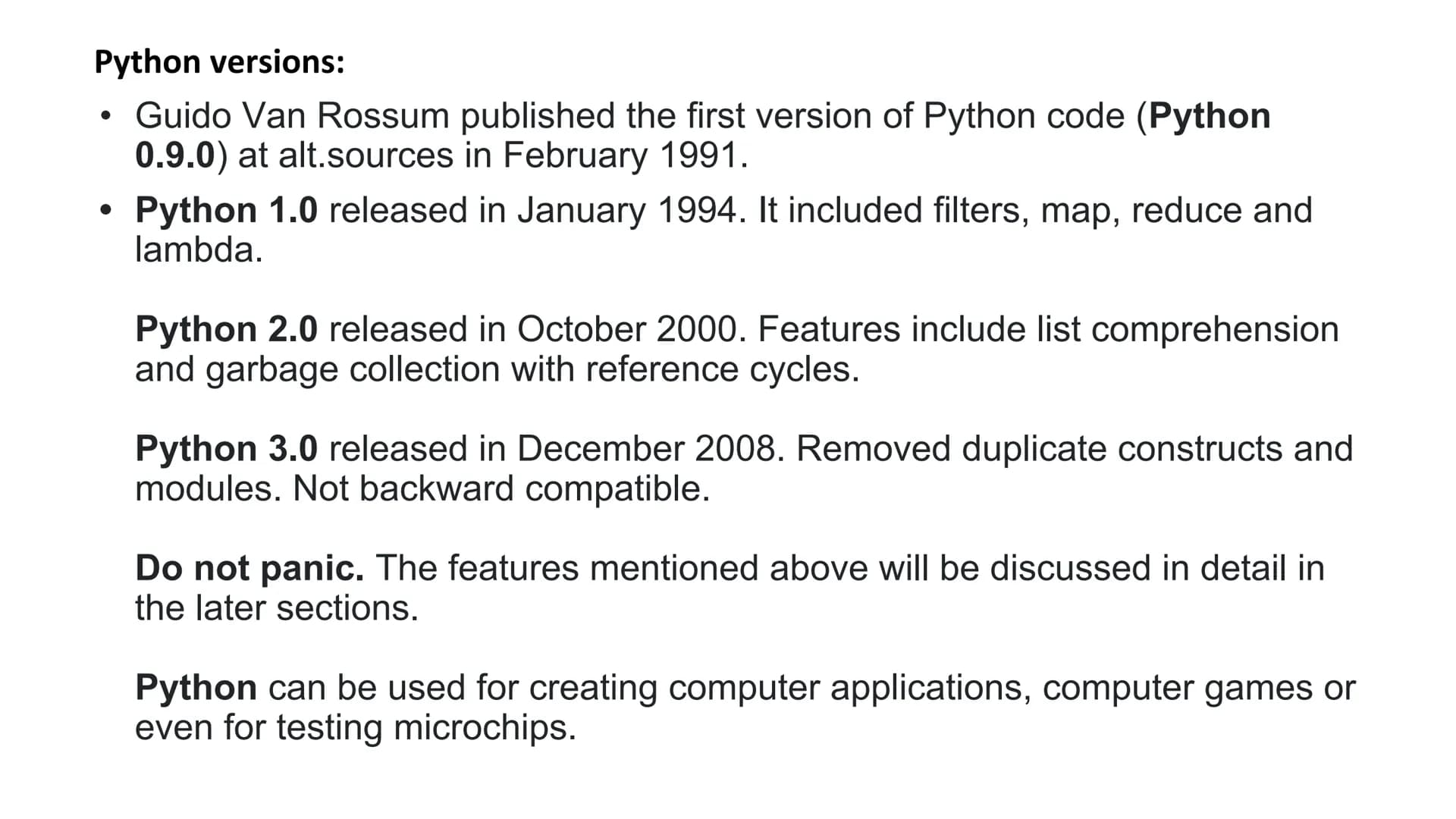
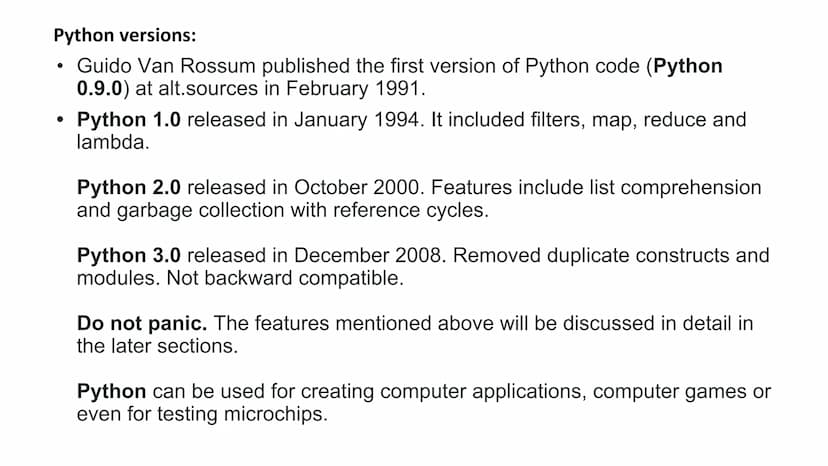
Python has evolved significantly since its creation. The first public version, Python 0.9.0, was released in February 1991. Python 1.0 followed in January 1994, introducing features like filters, map, reduce, and lambda functions.
Python 2.0 (October 2000) brought major improvements including list comprehension and garbage collection. Python 3.0 (December 2008) made substantial changes that weren't backward compatible with Python 2, cleaning up duplicate constructs and modules.
Python's versatility makes it ideal for a wide range of applications:
Most modern projects use Python 3, as Python 2 reached end-of-life in January 2020.
🔑 When you see code examples online, check whether they're written for Python 2 or 3, as there are important syntax differences between them!
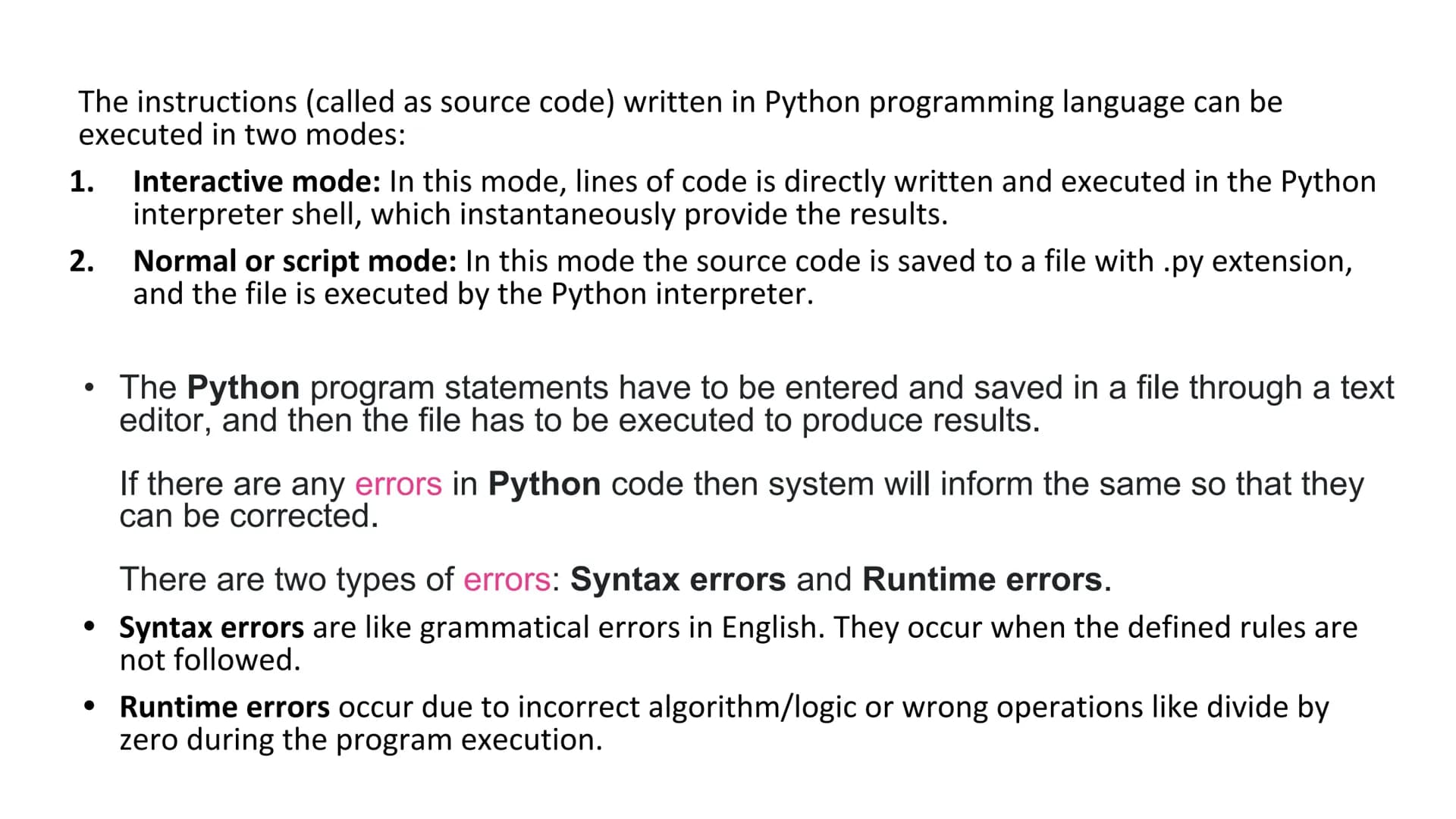
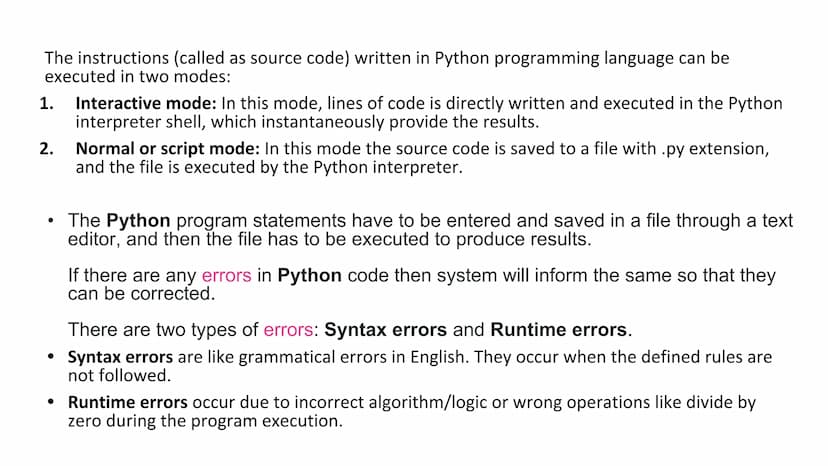
Python code can be executed in two different ways:
Interactive mode lets you write and execute code directly in the Python interpreter shell, which immediately provides results. This is perfect for testing small snippets of code or learning new concepts.
Script mode (or normal mode) involves saving your code in a file with a .py extension and then executing that file with the Python interpreter. This is how you'll develop actual programs and applications.
When you run Python code, the interpreter checks for errors that might prevent your program from working correctly:
Syntax errors are like grammatical mistakes in your code—they occur when you don't follow Python's rules for writing statements. For example, forgetting a colon after an if statement.
Runtime errors happen during program execution due to logical issues or invalid operations, like trying to divide by zero or accessing an index that doesn't exist.
💡 The interactive mode is great for quick experimentation, while script mode is better for developing complete programs. Try both to see which works best for different situations!
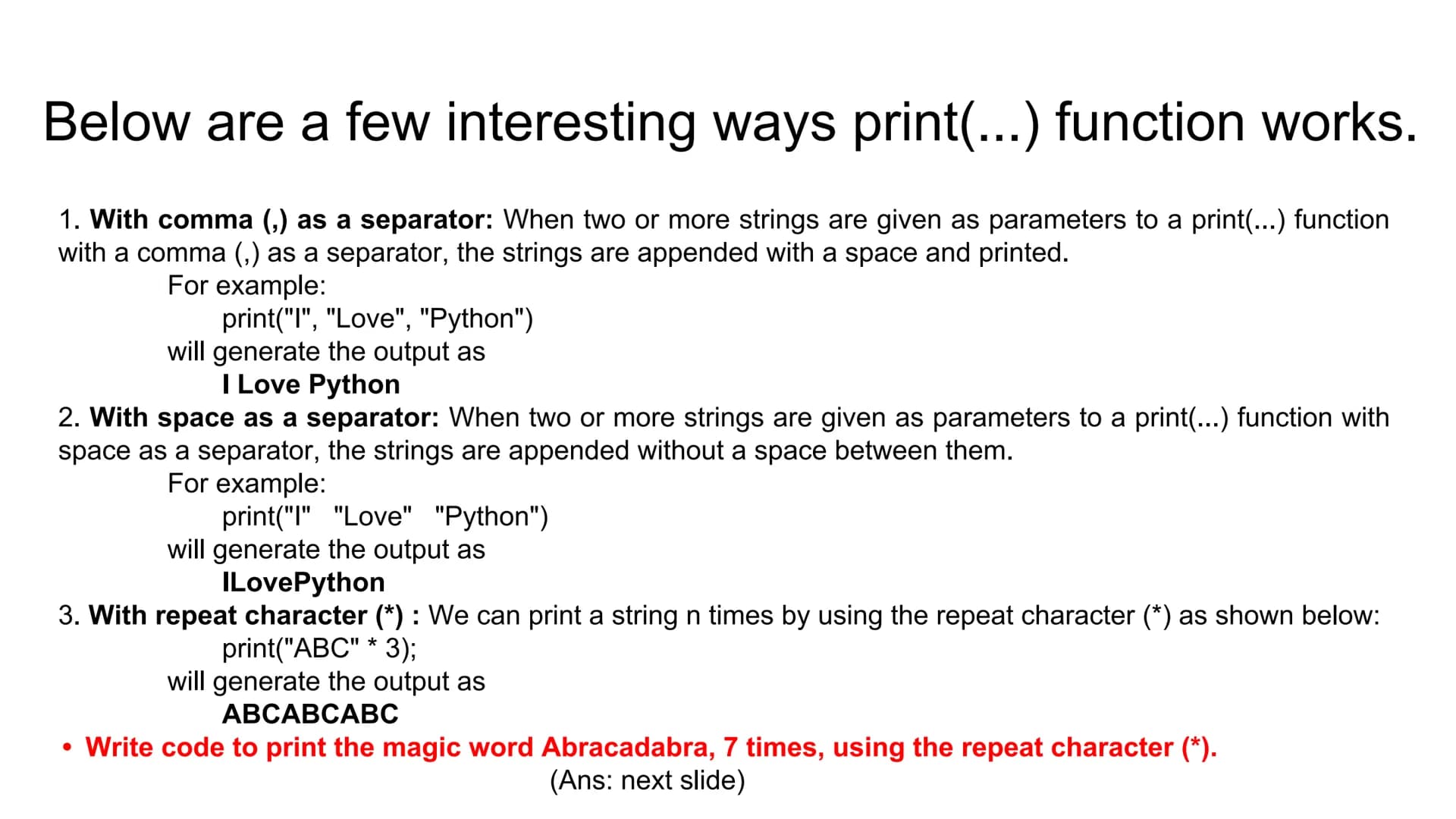
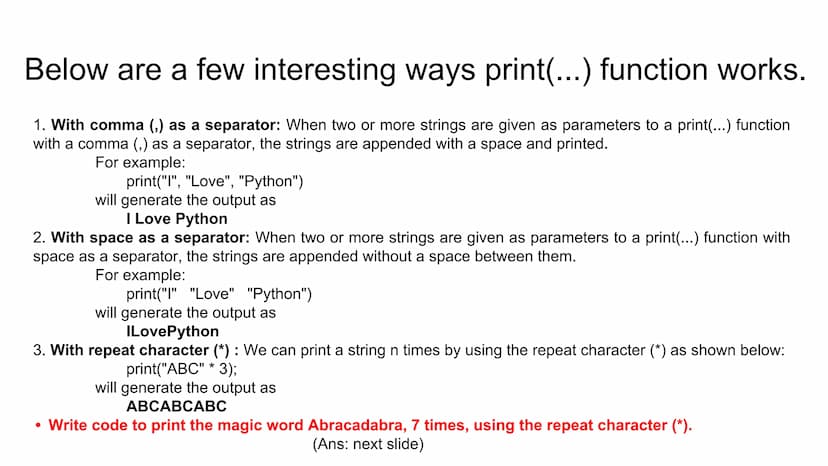
The print() function is one of the most commonly used functions in Python. It displays output to the console and has several interesting behaviors:
When you use a comma as a separator between strings in a print function, Python automatically adds a space between them:
print("I", "Love", "Python") # Output: I Love Python
When strings are placed next to each other without a separator, they're concatenated without spaces:
print("I" "Love" "Python") # Output: ILovePython
You can use the repetition operator (*) to print a string multiple times:
print("ABC" * 3) # Output: ABCABCABC
These different approaches give you flexibility in formatting your output, whether you need spaces between words or want to repeat content.
💡 The print function can take multiple arguments of different types. Try printing a mix of strings, numbers, and variables to see how Python handles them!
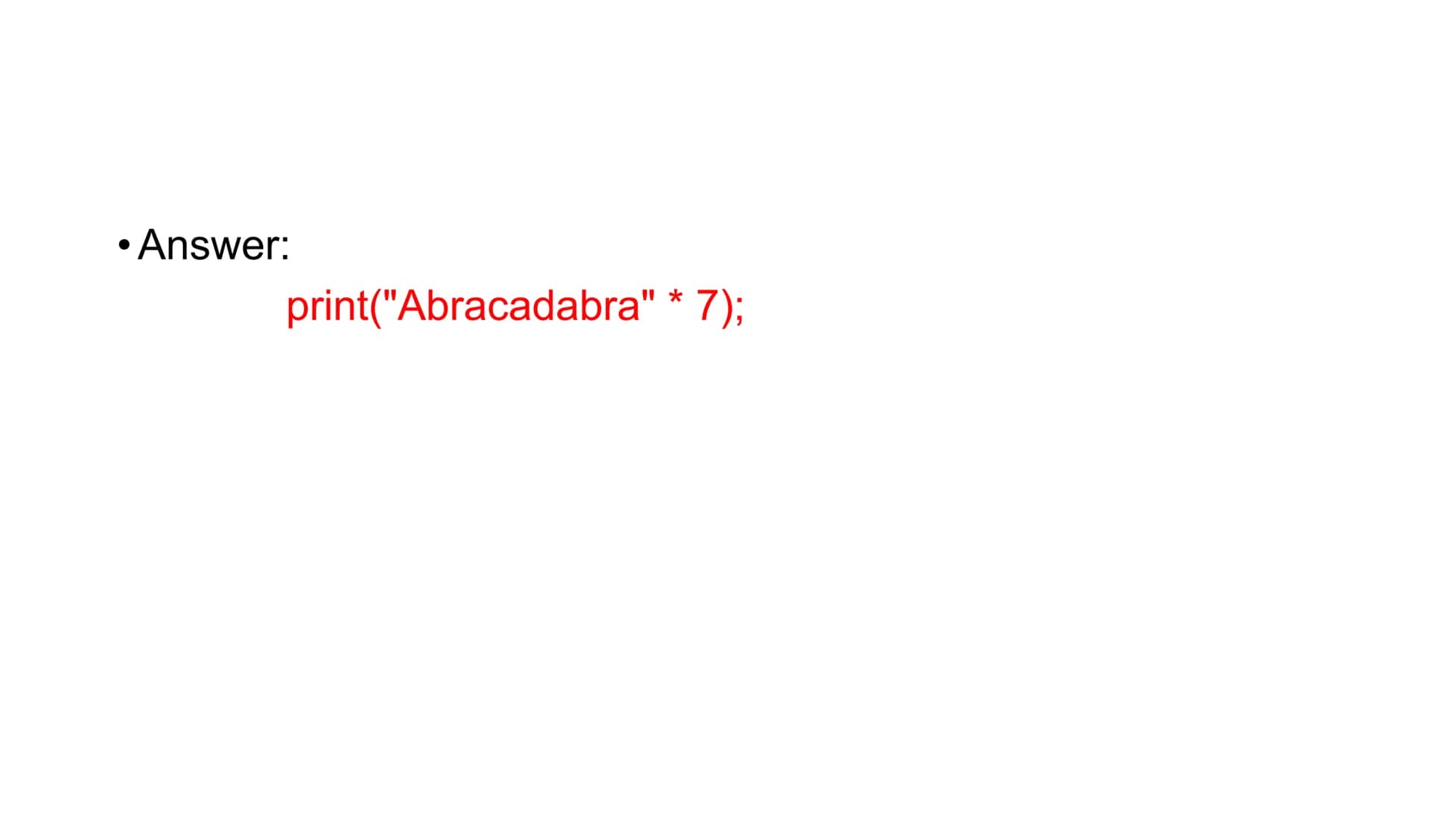
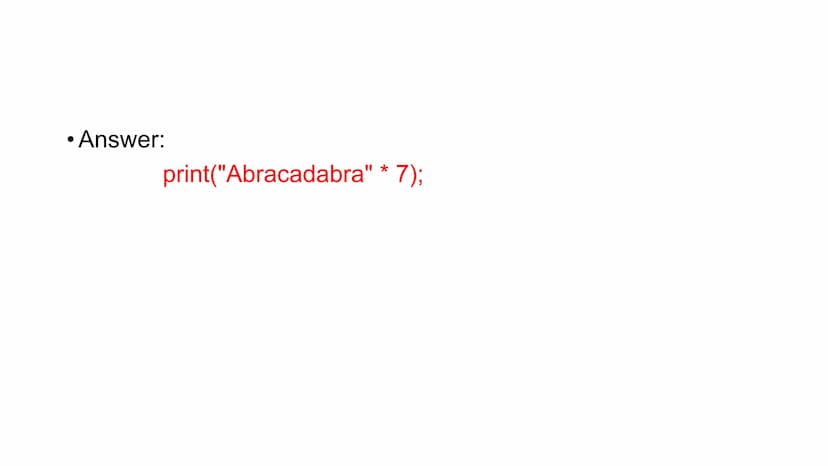
To print the magic word "Abracadabra" 7 times using the repetition character (*), we simply use:
print("Abracadabra" * 7)
This produces:
AbracadabraAbracadabraAbracadabraAbracadabraAbracadabraAbracadabraAbracadabra
The repetition operator is a quick way to duplicate strings without writing them out multiple times or using loops. This can be useful for creating patterns, separators, or other repeated elements in your output.
Notice that there are no spaces between the repetitions unless you explicitly add them to the string or use a different approach.
🔑 String repetition with the * operator is much more efficient than concatenating the same string multiple times in a loop.
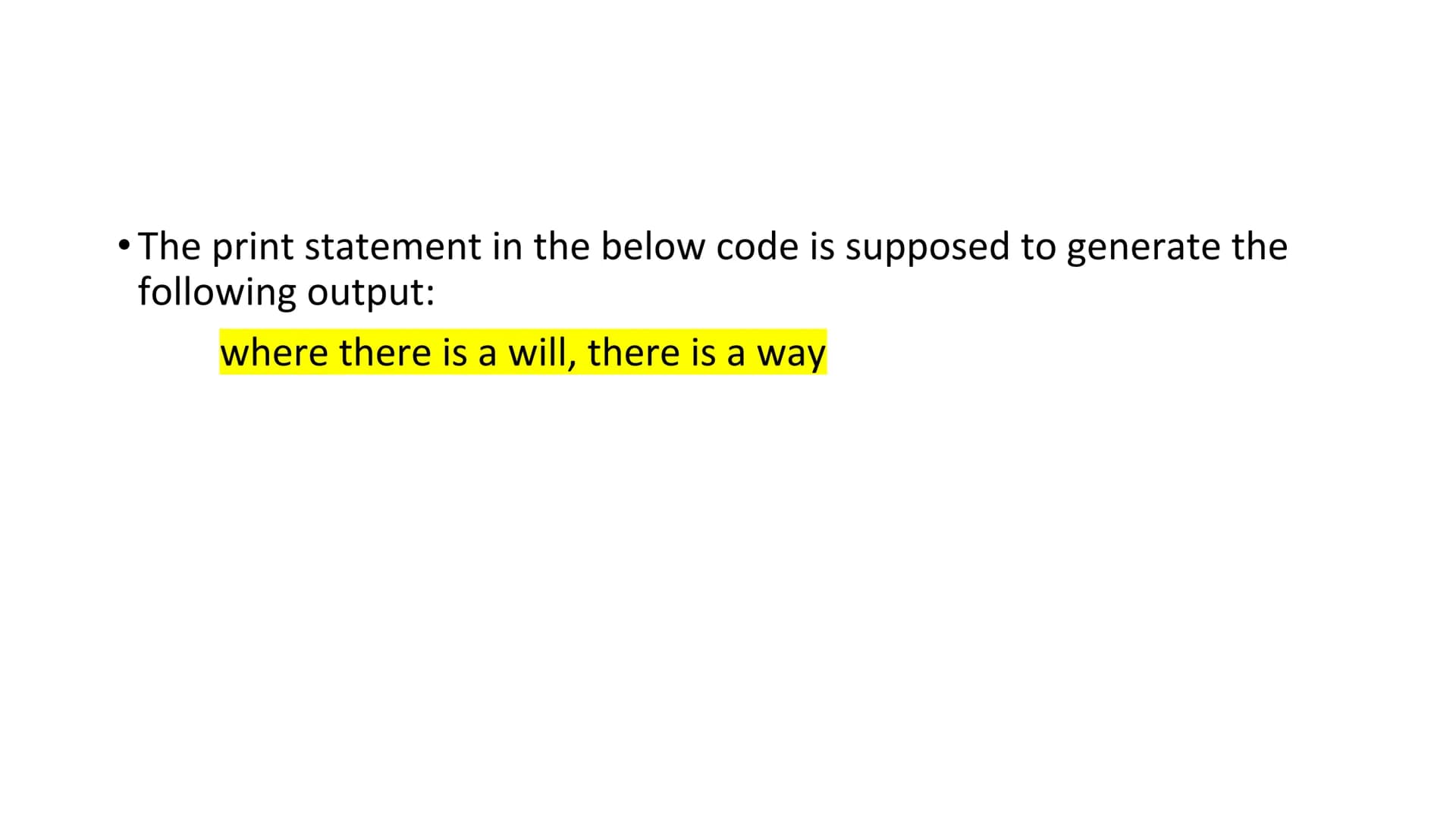
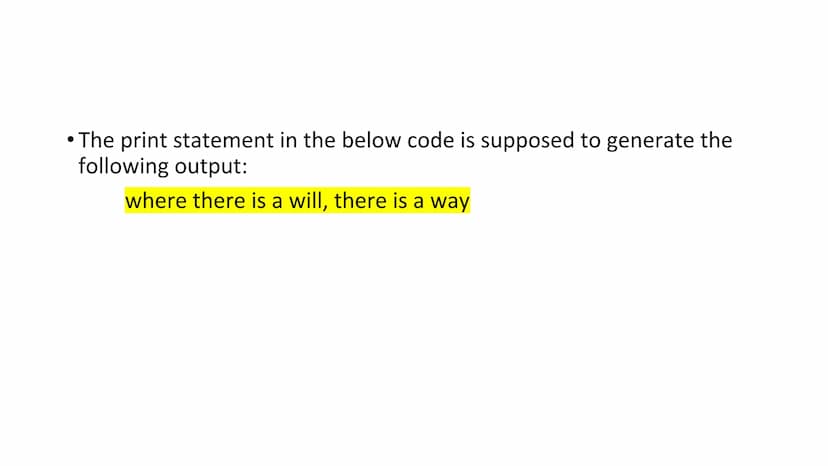
Let's solve a simple problem: we need to write a print statement that generates the output:
where there is a will, there is a way
To create this output, we'll need to think about how to include proper spacing between words. Remember that when we use commas to separate strings in a print statement, Python automatically adds spaces between them.
Think about how you would construct this statement before looking at the answer. Would you use commas or string concatenation? How would you ensure proper spacing?
💡 This exercise demonstrates how proper spacing affects readability—just like in your code!
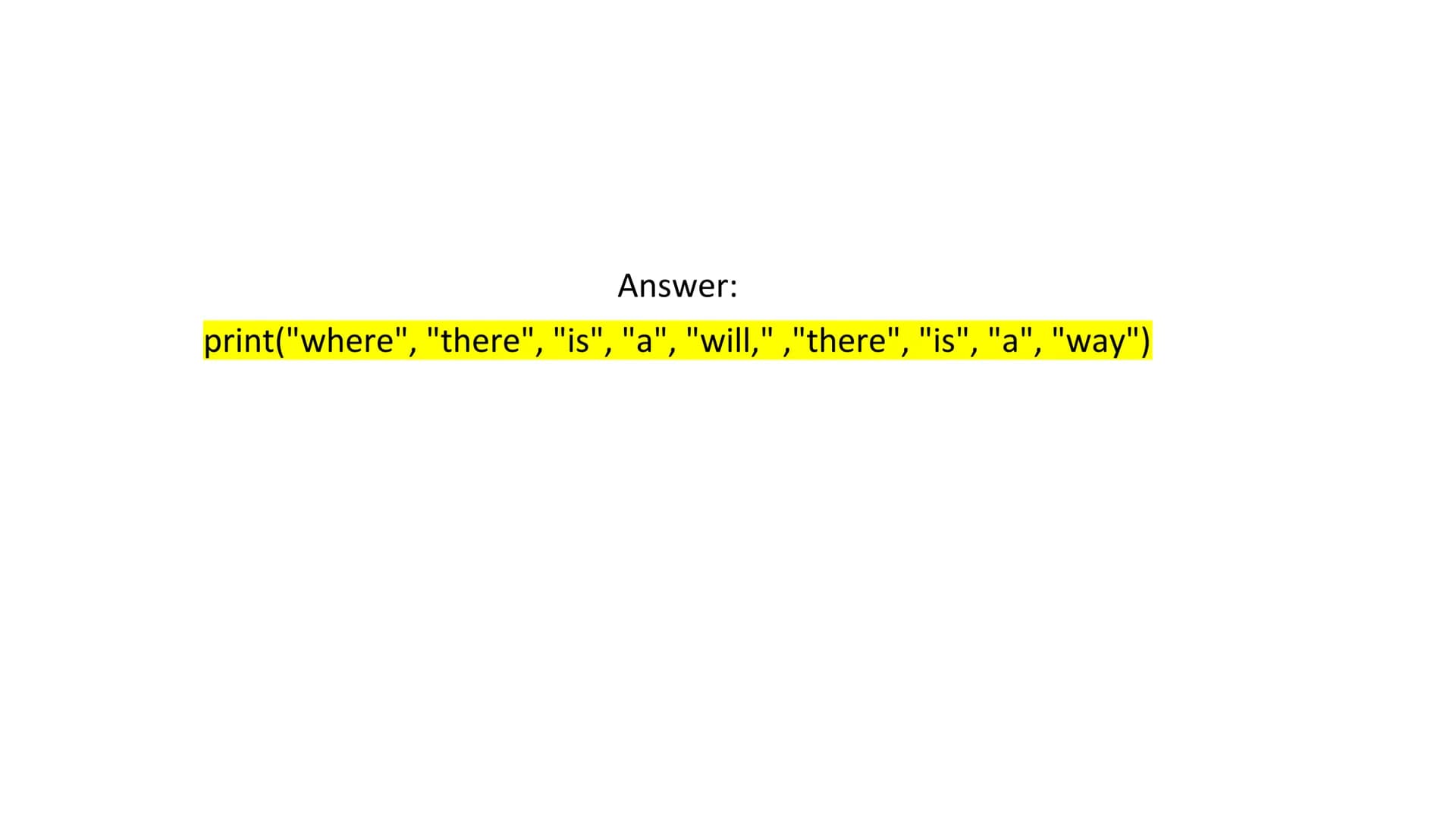
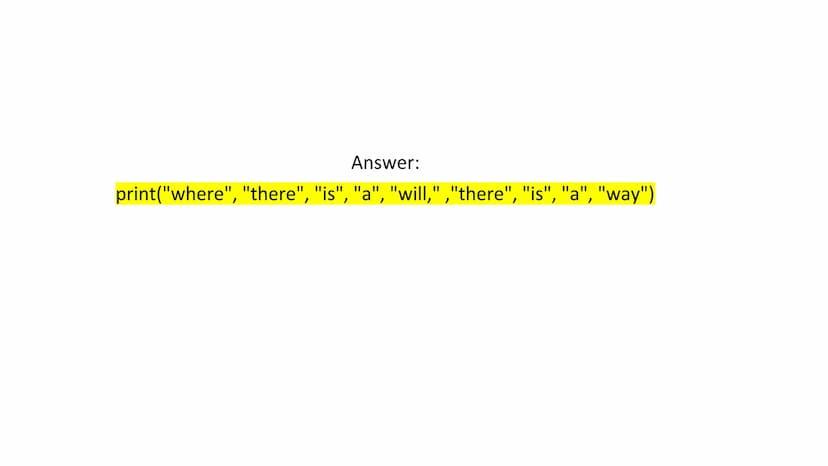
The solution to generate "where there is a will, there is a way" is:
print("where", "there", "is", "a", "will,", "there", "is", "a", "way")
This uses commas between each word, allowing Python to automatically add spaces between the strings. Notice that "will," includes the comma as part of the string—this ensures the comma appears immediately after "will" with no space.
If we had used string concatenation without spaces, like print("where" "there" "is"...), the output would be one long word: "wherethereiswill,thereisaway".
Understanding these formatting options is essential for producing readable output from your programs.
🔑 Pay attention to spaces and punctuation in your output—they make a big difference in readability!
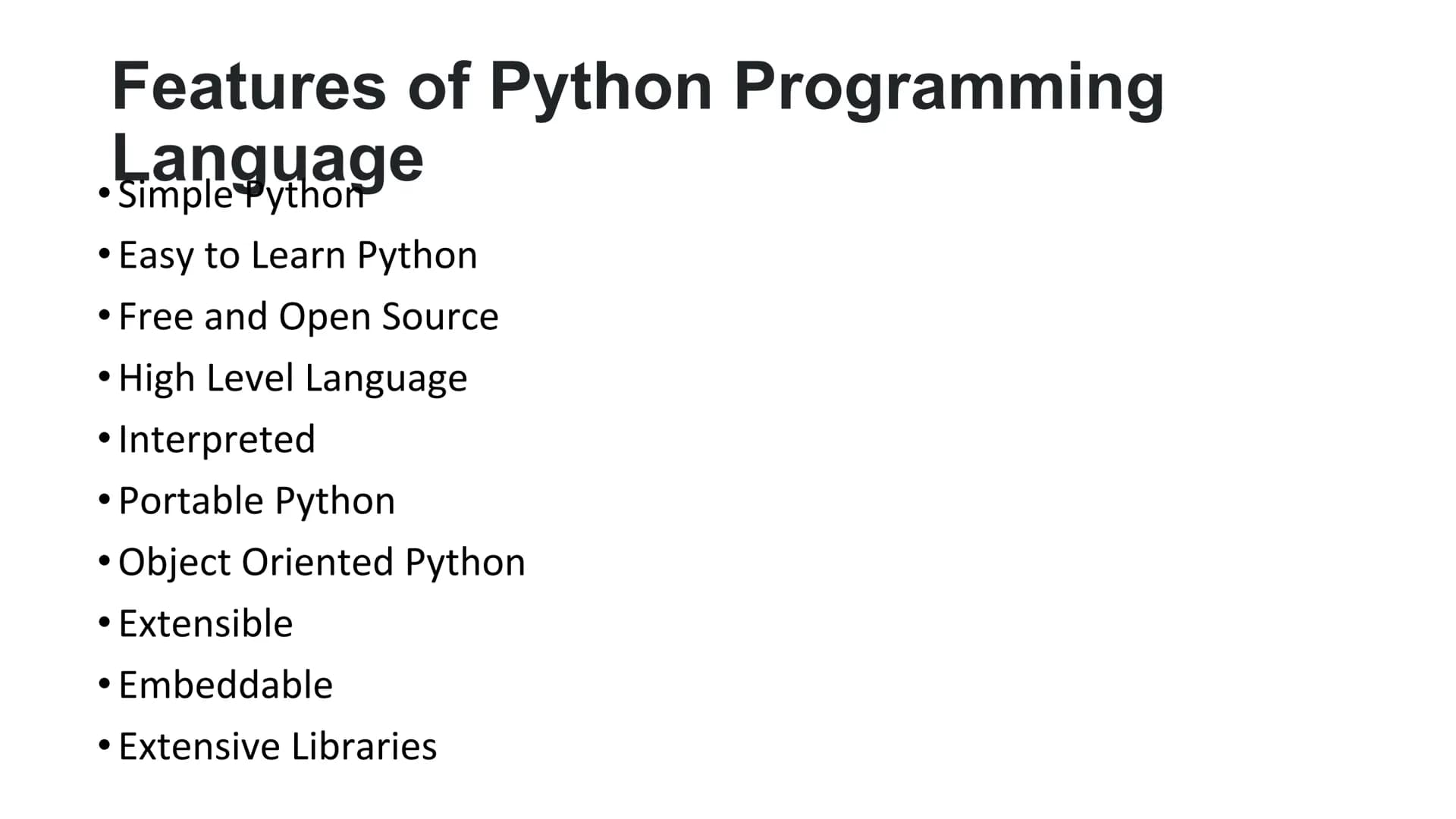
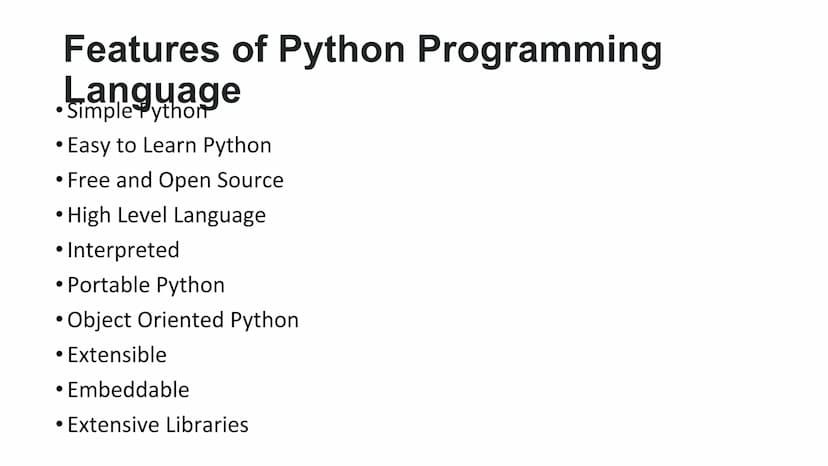
Python has become one of the world's most popular programming languages due to its outstanding features:
Simple and Easy to Learn: Python's syntax is clear and intuitive, resembling English more than complex programming notation.
Free and Open Source: Anyone can use, modify, and distribute Python without licensing fees.
High-Level Language: Python abstracts away complex memory management and other low-level operations.
Interpreted: Code executes line-by-line without requiring compilation, making development faster.
Portable: Python programs can run on different platforms with minimal or no modifications.
Object-Oriented: Python supports classes, inheritance, and other OOP concepts.
Extensible and Embeddable: You can extend Python with C/C++ and embed Python code in other applications.
Extensive Libraries: Python's standard library and third-party packages provide ready-to-use functionality for almost any task.
💡 Python's combination of simplicity and power makes it ideal for beginners, but don't be fooled—it's also used by companies like Google, Netflix, and NASA for serious applications!
Our AI companion is specifically built for the needs of students. Based on the millions of content pieces we have on the platform we can provide truly meaningful and relevant answers to students. But its not only about answers, the companion is even more about guiding students through their daily learning challenges, with personalised study plans, quizzes or content pieces in the chat and 100% personalisation based on the students skills and developments.
You can download the app in the Google Play Store and in the Apple App Store.
That's right! Enjoy free access to study content, connect with fellow students, and get instant help – all at your fingertips.
App Store
Google Play
The app is very easy to use and well designed. I have found everything I was looking for so far and have been able to learn a lot from the presentations! I will definitely use the app for a class assignment! And of course it also helps a lot as an inspiration.
Stefan S
iOS user
This app is really great. There are so many study notes and help [...]. My problem subject is French, for example, and the app has so many options for help. Thanks to this app, I have improved my French. I would recommend it to anyone.
Samantha Klich
Android user
Wow, I am really amazed. I just tried the app because I've seen it advertised many times and was absolutely stunned. This app is THE HELP you want for school and above all, it offers so many things, such as workouts and fact sheets, which have been VERY helpful to me personally.
Anna
iOS user
I think it’s very much worth it and you’ll end up using it a lot once you get the hang of it and even after looking at others notes you can still ask your Artificial intelligence buddy the question and ask to simplify it if you still don’t get it!!! In the end I think it’s worth it 😊👍 ⚠️Also DID I MENTION ITS FREEE YOU DON’T HAVE TO PAY FOR ANYTHING AND STILL GET YOUR GRADES IN PERFECTLY❗️❗️⚠️
Thomas R
iOS user
Knowunity is the BEST app I’ve used in a minute. This is not an ai review or anything this is genuinely coming from a 7th grade student (I know 2011 im young) but dude this app is a 10/10 i have maintained a 3.8 gpa and have plenty of time for gaming. I love it and my mom is just happy I got good grades
Brad T
Android user
Not only did it help me find the answer but it also showed me alternative ways to solve it. I was horrible in math and science but now I have an a in both subjects. Thanks for the help🤍🤍
David K
iOS user
The app's just great! All I have to do is enter the topic in the search bar and I get the response real fast. I don't have to watch 10 YouTube videos to understand something, so I'm saving my time. Highly recommended!
Sudenaz Ocak
Android user
In school I was really bad at maths but thanks to the app, I am doing better now. I am so grateful that you made the app.
Greenlight Bonnie
Android user
I found this app a couple years ago and it has only gotten better since then. I really love it because it can help with written questions and photo questions. Also, it can find study guides that other people have made as well as flashcard sets and practice tests. The free version is also amazing for students who might not be able to afford it. Would 100% recommend
Aubrey
iOS user
Best app if you're in Highschool or Junior high. I have been using this app for 2 school years and it's the best, it's good if you don't have anyone to help you with school work.😋🩷🎀
Marco B
iOS user
THE QUIZES AND FLASHCARDS ARE SO USEFUL AND I LOVE Knowunity AI. IT ALSO IS LITREALLY LIKE CHATGPT BUT SMARTER!! HELPED ME WITH MY MASCARA PROBLEMS TOO!! AS WELL AS MY REAL SUBJECTS ! DUHHH 😍😁😲🤑💗✨🎀😮
Elisha
iOS user
This app is phenomenal down to the correct info and the various topics you can study! I greatly recommend it for people who struggle with procrastination and those who need homework help. It has been perfectly accurate for world 1 history as far as I’ve seen! Geometry too!
Paul T
iOS user
The app is very easy to use and well designed. I have found everything I was looking for so far and have been able to learn a lot from the presentations! I will definitely use the app for a class assignment! And of course it also helps a lot as an inspiration.
Stefan S
iOS user
This app is really great. There are so many study notes and help [...]. My problem subject is French, for example, and the app has so many options for help. Thanks to this app, I have improved my French. I would recommend it to anyone.
Samantha Klich
Android user
Wow, I am really amazed. I just tried the app because I've seen it advertised many times and was absolutely stunned. This app is THE HELP you want for school and above all, it offers so many things, such as workouts and fact sheets, which have been VERY helpful to me personally.
Anna
iOS user
I think it’s very much worth it and you’ll end up using it a lot once you get the hang of it and even after looking at others notes you can still ask your Artificial intelligence buddy the question and ask to simplify it if you still don’t get it!!! In the end I think it’s worth it 😊👍 ⚠️Also DID I MENTION ITS FREEE YOU DON’T HAVE TO PAY FOR ANYTHING AND STILL GET YOUR GRADES IN PERFECTLY❗️❗️⚠️
Thomas R
iOS user
Knowunity is the BEST app I’ve used in a minute. This is not an ai review or anything this is genuinely coming from a 7th grade student (I know 2011 im young) but dude this app is a 10/10 i have maintained a 3.8 gpa and have plenty of time for gaming. I love it and my mom is just happy I got good grades
Brad T
Android user
Not only did it help me find the answer but it also showed me alternative ways to solve it. I was horrible in math and science but now I have an a in both subjects. Thanks for the help🤍🤍
David K
iOS user
The app's just great! All I have to do is enter the topic in the search bar and I get the response real fast. I don't have to watch 10 YouTube videos to understand something, so I'm saving my time. Highly recommended!
Sudenaz Ocak
Android user
In school I was really bad at maths but thanks to the app, I am doing better now. I am so grateful that you made the app.
Greenlight Bonnie
Android user
I found this app a couple years ago and it has only gotten better since then. I really love it because it can help with written questions and photo questions. Also, it can find study guides that other people have made as well as flashcard sets and practice tests. The free version is also amazing for students who might not be able to afford it. Would 100% recommend
Aubrey
iOS user
Best app if you're in Highschool or Junior high. I have been using this app for 2 school years and it's the best, it's good if you don't have anyone to help you with school work.😋🩷🎀
Marco B
iOS user
THE QUIZES AND FLASHCARDS ARE SO USEFUL AND I LOVE Knowunity AI. IT ALSO IS LITREALLY LIKE CHATGPT BUT SMARTER!! HELPED ME WITH MY MASCARA PROBLEMS TOO!! AS WELL AS MY REAL SUBJECTS ! DUHHH 😍😁😲🤑💗✨🎀😮
Elisha
iOS user
This app is phenomenal down to the correct info and the various topics you can study! I greatly recommend it for people who struggle with procrastination and those who need homework help. It has been perfectly accurate for world 1 history as far as I’ve seen! Geometry too!
Paul T
iOS user
YATHARTH SAXENA
@yatharthsaxena_okba
Welcome to Python programming! This unit covers the fundamentals of Python, from basic data types to advanced structures like lists, tuples, sets, and dictionaries. You'll also learn about control flow statements, input/output functions, and an introduction to NumPy for data... Show more
Access to all documents
Improve your grades
Join milions of students
Python is a versatile programming language used for everything from web development to data science. To succeed in this unit, you'll want to explore these helpful resources:
The Python DataScience Handbook by Jake VanderPlas is excellent for understanding data manipulation and analysis. Python For Beginners by Timothy C. Needham provides a solid foundation for newcomers.
For online tutorials and reference materials, check out tutorialspoint.com and w3schools.com. These websites offer interactive examples and explanations that can reinforce your classroom learning.
💡 Don't just read about Python—practice regularly! The best way to learn programming is by writing code and experimenting with different concepts.
Access to all documents
Improve your grades
Join milions of students
This unit covers the essential building blocks of Python programming that you'll need for problem-solving applications. You'll start with an introduction to Python and Google Colab as a development environment.
You'll learn about basic data types including integers, floating-point numbers, and boolean values. The unit covers working with strings and various input/output functions for interacting with users.
The course explores Python's control flow statements like if, for, and while loops for creating conditional logic and repetitive operations. You'll also work with Python's powerful data structures: lists, tuples, sets, and dictionaries.
Finally, you'll get an introduction to Python's libraries, particularly NumPy, which enables high-dimensional array operations for scientific computing and data analysis.
🔑 Master these fundamentals and you'll have the skills to tackle more complex programming challenges in your future courses!
Access to all documents
Improve your grades
Join milions of students
Python was developed in the 1980s by Guido Van Rossum at the Centrum Wiskunde & Informatica (CWI) in the Netherlands. It was designed as a successor to the ABC language, with capabilities for exception handling and interfacing with the Amoeba operating system.
Programming languages typically fall into three categories:
Python is considered a high-level language because it's intuitive and readable, making it perfect for beginners while still being powerful enough for professional developers.
💡 Python's creator, Guido van Rossum, named the language after the British comedy group Monty Python, not the snake!
Access to all documents
Improve your grades
Join milions of students
Python has evolved significantly since its creation. The first public version, Python 0.9.0, was released in February 1991. Python 1.0 followed in January 1994, introducing features like filters, map, reduce, and lambda functions.
Python 2.0 (October 2000) brought major improvements including list comprehension and garbage collection. Python 3.0 (December 2008) made substantial changes that weren't backward compatible with Python 2, cleaning up duplicate constructs and modules.
Python's versatility makes it ideal for a wide range of applications:
Most modern projects use Python 3, as Python 2 reached end-of-life in January 2020.
🔑 When you see code examples online, check whether they're written for Python 2 or 3, as there are important syntax differences between them!
Access to all documents
Improve your grades
Join milions of students
Python code can be executed in two different ways:
Interactive mode lets you write and execute code directly in the Python interpreter shell, which immediately provides results. This is perfect for testing small snippets of code or learning new concepts.
Script mode (or normal mode) involves saving your code in a file with a .py extension and then executing that file with the Python interpreter. This is how you'll develop actual programs and applications.
When you run Python code, the interpreter checks for errors that might prevent your program from working correctly:
Syntax errors are like grammatical mistakes in your code—they occur when you don't follow Python's rules for writing statements. For example, forgetting a colon after an if statement.
Runtime errors happen during program execution due to logical issues or invalid operations, like trying to divide by zero or accessing an index that doesn't exist.
💡 The interactive mode is great for quick experimentation, while script mode is better for developing complete programs. Try both to see which works best for different situations!
Access to all documents
Improve your grades
Join milions of students
The print() function is one of the most commonly used functions in Python. It displays output to the console and has several interesting behaviors:
When you use a comma as a separator between strings in a print function, Python automatically adds a space between them:
print("I", "Love", "Python") # Output: I Love Python
When strings are placed next to each other without a separator, they're concatenated without spaces:
print("I" "Love" "Python") # Output: ILovePython
You can use the repetition operator (*) to print a string multiple times:
print("ABC" * 3) # Output: ABCABCABC
These different approaches give you flexibility in formatting your output, whether you need spaces between words or want to repeat content.
💡 The print function can take multiple arguments of different types. Try printing a mix of strings, numbers, and variables to see how Python handles them!
Access to all documents
Improve your grades
Join milions of students
To print the magic word "Abracadabra" 7 times using the repetition character (*), we simply use:
print("Abracadabra" * 7)
This produces:
AbracadabraAbracadabraAbracadabraAbracadabraAbracadabraAbracadabraAbracadabra
The repetition operator is a quick way to duplicate strings without writing them out multiple times or using loops. This can be useful for creating patterns, separators, or other repeated elements in your output.
Notice that there are no spaces between the repetitions unless you explicitly add them to the string or use a different approach.
🔑 String repetition with the * operator is much more efficient than concatenating the same string multiple times in a loop.
Access to all documents
Improve your grades
Join milions of students
Let's solve a simple problem: we need to write a print statement that generates the output:
where there is a will, there is a way
To create this output, we'll need to think about how to include proper spacing between words. Remember that when we use commas to separate strings in a print statement, Python automatically adds spaces between them.
Think about how you would construct this statement before looking at the answer. Would you use commas or string concatenation? How would you ensure proper spacing?
💡 This exercise demonstrates how proper spacing affects readability—just like in your code!
Access to all documents
Improve your grades
Join milions of students
The solution to generate "where there is a will, there is a way" is:
print("where", "there", "is", "a", "will,", "there", "is", "a", "way")
This uses commas between each word, allowing Python to automatically add spaces between the strings. Notice that "will," includes the comma as part of the string—this ensures the comma appears immediately after "will" with no space.
If we had used string concatenation without spaces, like print("where" "there" "is"...), the output would be one long word: "wherethereiswill,thereisaway".
Understanding these formatting options is essential for producing readable output from your programs.
🔑 Pay attention to spaces and punctuation in your output—they make a big difference in readability!
Access to all documents
Improve your grades
Join milions of students
Python has become one of the world's most popular programming languages due to its outstanding features:
Simple and Easy to Learn: Python's syntax is clear and intuitive, resembling English more than complex programming notation.
Free and Open Source: Anyone can use, modify, and distribute Python without licensing fees.
High-Level Language: Python abstracts away complex memory management and other low-level operations.
Interpreted: Code executes line-by-line without requiring compilation, making development faster.
Portable: Python programs can run on different platforms with minimal or no modifications.
Object-Oriented: Python supports classes, inheritance, and other OOP concepts.
Extensible and Embeddable: You can extend Python with C/C++ and embed Python code in other applications.
Extensive Libraries: Python's standard library and third-party packages provide ready-to-use functionality for almost any task.
💡 Python's combination of simplicity and power makes it ideal for beginners, but don't be fooled—it's also used by companies like Google, Netflix, and NASA for serious applications!
Our AI companion is specifically built for the needs of students. Based on the millions of content pieces we have on the platform we can provide truly meaningful and relevant answers to students. But its not only about answers, the companion is even more about guiding students through their daily learning challenges, with personalised study plans, quizzes or content pieces in the chat and 100% personalisation based on the students skills and developments.
You can download the app in the Google Play Store and in the Apple App Store.
That's right! Enjoy free access to study content, connect with fellow students, and get instant help – all at your fingertips.
19
Smart Tools NEW
Transform this note into: ✓ 50+ Practice Questions ✓ Interactive Flashcards ✓ Full Practice Test ✓ Essay Outlines
App Store
Google Play
The app is very easy to use and well designed. I have found everything I was looking for so far and have been able to learn a lot from the presentations! I will definitely use the app for a class assignment! And of course it also helps a lot as an inspiration.
Stefan S
iOS user
This app is really great. There are so many study notes and help [...]. My problem subject is French, for example, and the app has so many options for help. Thanks to this app, I have improved my French. I would recommend it to anyone.
Samantha Klich
Android user
Wow, I am really amazed. I just tried the app because I've seen it advertised many times and was absolutely stunned. This app is THE HELP you want for school and above all, it offers so many things, such as workouts and fact sheets, which have been VERY helpful to me personally.
Anna
iOS user
I think it’s very much worth it and you’ll end up using it a lot once you get the hang of it and even after looking at others notes you can still ask your Artificial intelligence buddy the question and ask to simplify it if you still don’t get it!!! In the end I think it’s worth it 😊👍 ⚠️Also DID I MENTION ITS FREEE YOU DON’T HAVE TO PAY FOR ANYTHING AND STILL GET YOUR GRADES IN PERFECTLY❗️❗️⚠️
Thomas R
iOS user
Knowunity is the BEST app I’ve used in a minute. This is not an ai review or anything this is genuinely coming from a 7th grade student (I know 2011 im young) but dude this app is a 10/10 i have maintained a 3.8 gpa and have plenty of time for gaming. I love it and my mom is just happy I got good grades
Brad T
Android user
Not only did it help me find the answer but it also showed me alternative ways to solve it. I was horrible in math and science but now I have an a in both subjects. Thanks for the help🤍🤍
David K
iOS user
The app's just great! All I have to do is enter the topic in the search bar and I get the response real fast. I don't have to watch 10 YouTube videos to understand something, so I'm saving my time. Highly recommended!
Sudenaz Ocak
Android user
In school I was really bad at maths but thanks to the app, I am doing better now. I am so grateful that you made the app.
Greenlight Bonnie
Android user
I found this app a couple years ago and it has only gotten better since then. I really love it because it can help with written questions and photo questions. Also, it can find study guides that other people have made as well as flashcard sets and practice tests. The free version is also amazing for students who might not be able to afford it. Would 100% recommend
Aubrey
iOS user
Best app if you're in Highschool or Junior high. I have been using this app for 2 school years and it's the best, it's good if you don't have anyone to help you with school work.😋🩷🎀
Marco B
iOS user
THE QUIZES AND FLASHCARDS ARE SO USEFUL AND I LOVE Knowunity AI. IT ALSO IS LITREALLY LIKE CHATGPT BUT SMARTER!! HELPED ME WITH MY MASCARA PROBLEMS TOO!! AS WELL AS MY REAL SUBJECTS ! DUHHH 😍😁😲🤑💗✨🎀😮
Elisha
iOS user
This app is phenomenal down to the correct info and the various topics you can study! I greatly recommend it for people who struggle with procrastination and those who need homework help. It has been perfectly accurate for world 1 history as far as I’ve seen! Geometry too!
Paul T
iOS user
The app is very easy to use and well designed. I have found everything I was looking for so far and have been able to learn a lot from the presentations! I will definitely use the app for a class assignment! And of course it also helps a lot as an inspiration.
Stefan S
iOS user
This app is really great. There are so many study notes and help [...]. My problem subject is French, for example, and the app has so many options for help. Thanks to this app, I have improved my French. I would recommend it to anyone.
Samantha Klich
Android user
Wow, I am really amazed. I just tried the app because I've seen it advertised many times and was absolutely stunned. This app is THE HELP you want for school and above all, it offers so many things, such as workouts and fact sheets, which have been VERY helpful to me personally.
Anna
iOS user
I think it’s very much worth it and you’ll end up using it a lot once you get the hang of it and even after looking at others notes you can still ask your Artificial intelligence buddy the question and ask to simplify it if you still don’t get it!!! In the end I think it’s worth it 😊👍 ⚠️Also DID I MENTION ITS FREEE YOU DON’T HAVE TO PAY FOR ANYTHING AND STILL GET YOUR GRADES IN PERFECTLY❗️❗️⚠️
Thomas R
iOS user
Knowunity is the BEST app I’ve used in a minute. This is not an ai review or anything this is genuinely coming from a 7th grade student (I know 2011 im young) but dude this app is a 10/10 i have maintained a 3.8 gpa and have plenty of time for gaming. I love it and my mom is just happy I got good grades
Brad T
Android user
Not only did it help me find the answer but it also showed me alternative ways to solve it. I was horrible in math and science but now I have an a in both subjects. Thanks for the help🤍🤍
David K
iOS user
The app's just great! All I have to do is enter the topic in the search bar and I get the response real fast. I don't have to watch 10 YouTube videos to understand something, so I'm saving my time. Highly recommended!
Sudenaz Ocak
Android user
In school I was really bad at maths but thanks to the app, I am doing better now. I am so grateful that you made the app.
Greenlight Bonnie
Android user
I found this app a couple years ago and it has only gotten better since then. I really love it because it can help with written questions and photo questions. Also, it can find study guides that other people have made as well as flashcard sets and practice tests. The free version is also amazing for students who might not be able to afford it. Would 100% recommend
Aubrey
iOS user
Best app if you're in Highschool or Junior high. I have been using this app for 2 school years and it's the best, it's good if you don't have anyone to help you with school work.😋🩷🎀
Marco B
iOS user
THE QUIZES AND FLASHCARDS ARE SO USEFUL AND I LOVE Knowunity AI. IT ALSO IS LITREALLY LIKE CHATGPT BUT SMARTER!! HELPED ME WITH MY MASCARA PROBLEMS TOO!! AS WELL AS MY REAL SUBJECTS ! DUHHH 😍😁😲🤑💗✨🎀😮
Elisha
iOS user
This app is phenomenal down to the correct info and the various topics you can study! I greatly recommend it for people who struggle with procrastination and those who need homework help. It has been perfectly accurate for world 1 history as far as I’ve seen! Geometry too!
Paul T
iOS user