
The study of Power and Conflict poemsexplores profound themes... Show more
 Biology
 Sociology
Sign up to see the contentIt's free!
Access to all documents
Improve your grades
Join milions of students
By signing up you accept Terms of Service and Privacy Policy
Subjects
Triangle Congruence and Similarity Theorems
Triangle Properties and Classification
Linear Equations and Graphs
Geometric Angle Relationships
Trigonometric Functions and Identities
Equation Solving Techniques
Circle Geometry Fundamentals
Division Operations and Methods
Basic Differentiation Rules
Exponent and Logarithm Properties
Show all topics
Human Organ Systems
Reproductive Cell Cycles
Biological Sciences Subdisciplines
Cellular Energy Metabolism
Autotrophic Energy Processes
Inheritance Patterns and Principles
Biomolecular Structure and Organization
Cell Cycle and Division Mechanics
Cellular Organization and Development
Biological Structural Organization
Show all topics
Chemical Sciences and Applications
Atomic Structure and Composition
Molecular Electron Structure Representation
Atomic Electron Behavior
Matter Properties and Water
Mole Concept and Calculations
Gas Laws and Behavior
Periodic Table Organization
Chemical Thermodynamics Fundamentals
Chemical Bond Types and Properties
Show all topics
European Renaissance and Enlightenment
European Cultural Movements 800-1920
American Revolution Era 1763-1797
American Civil War 1861-1865
Global Imperial Systems
Mongol and Chinese Dynasties
U.S. Presidents and World Leaders
Historical Sources and Documentation
World Wars Era and Impact
World Religious Systems
Show all topics
Classic and Contemporary Novels
Literary Character Analysis
Rhetorical Theory and Practice
Classic Literary Narratives
Reading Analysis and Interpretation
Narrative Structure and Techniques
English Language Components
Influential English-Language Authors
Basic Sentence Structure
Narrative Voice and Perspective
Show all topics
8,917
•
Dec 23, 2025
•
Lauren Male
@laurenmale
The study of Power and Conflict poemsexplores profound themes... Show more
Power and Conflict poems analysis reveals how poets masterfully explore themes of loss, absence, and haunting memories through various perspectives. The examination of these elements provides crucial insights into the human experience during times of conflict.
Definition: Loss and absence in conflict poetry refers to the physical, emotional, and psychological void experienced by individuals affected by war and strife.
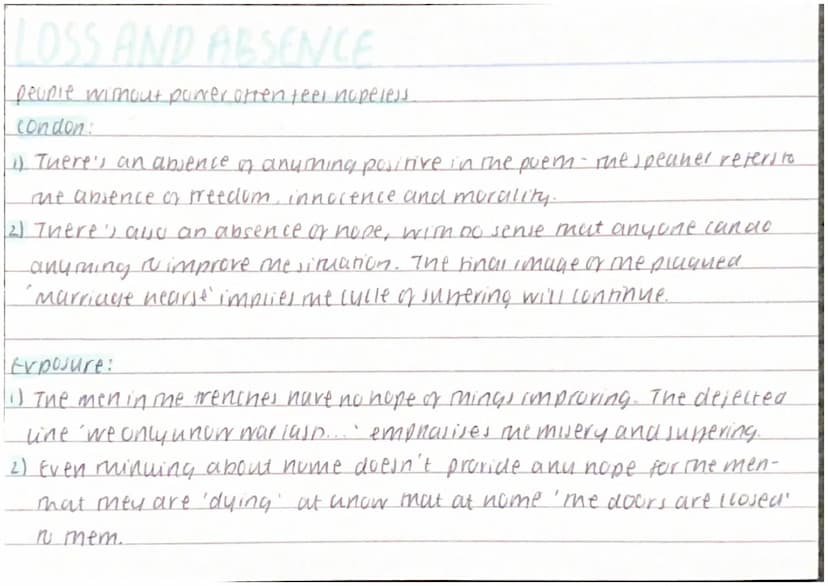
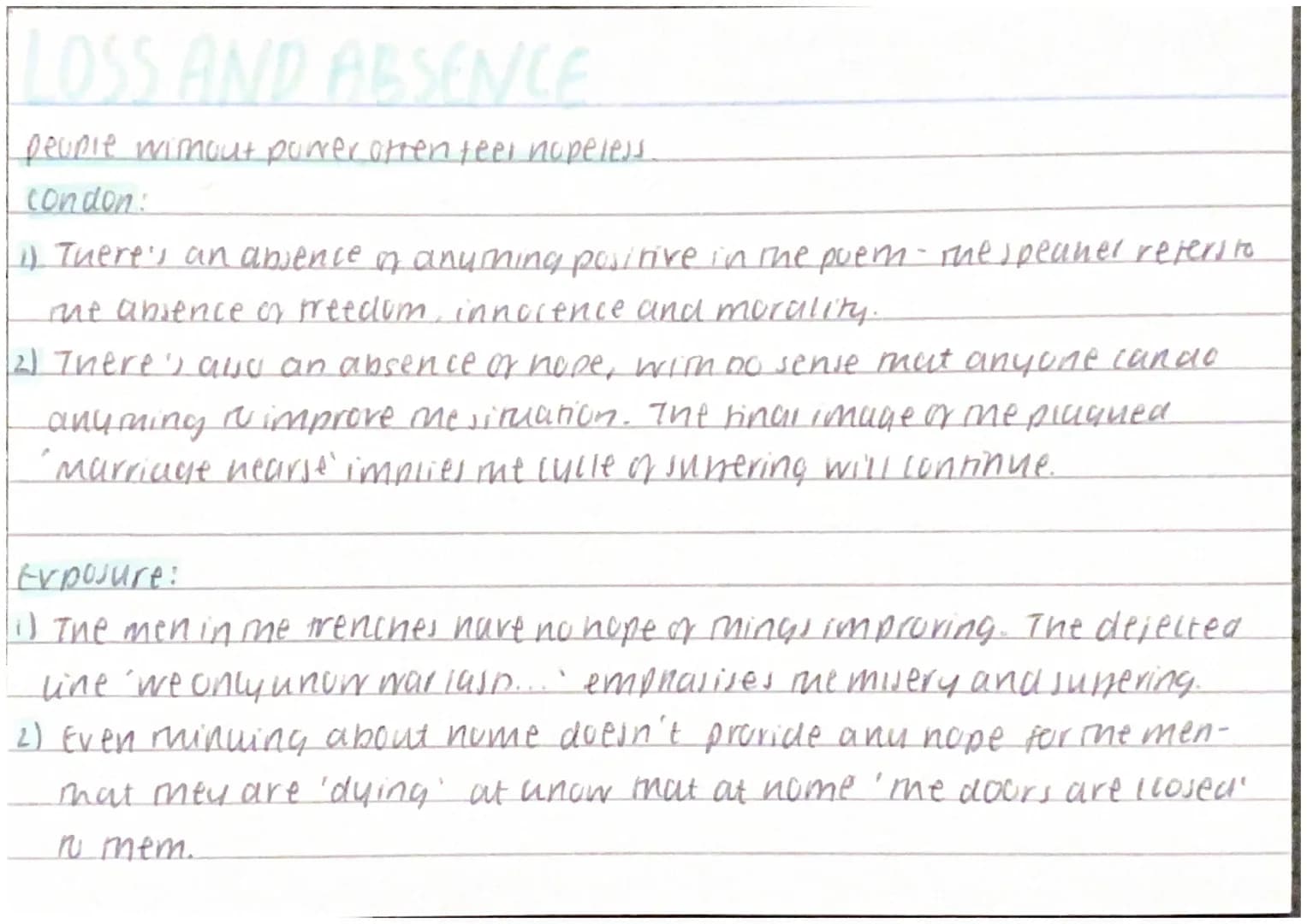
In studying the Analysis of loss and absence in conflict poetry anthology, we see how poets like Wilfred Owen in Exposure poem capture the devastating sense of hopelessness experienced by soldiers. The poem portrays soldiers in trenches, stripped of hope, emphasizing their misery through lines like "we only know war lasts." This feeling of abandonment is reinforced when even thoughts of home provide no comfort, as "the doors are closed" to them.
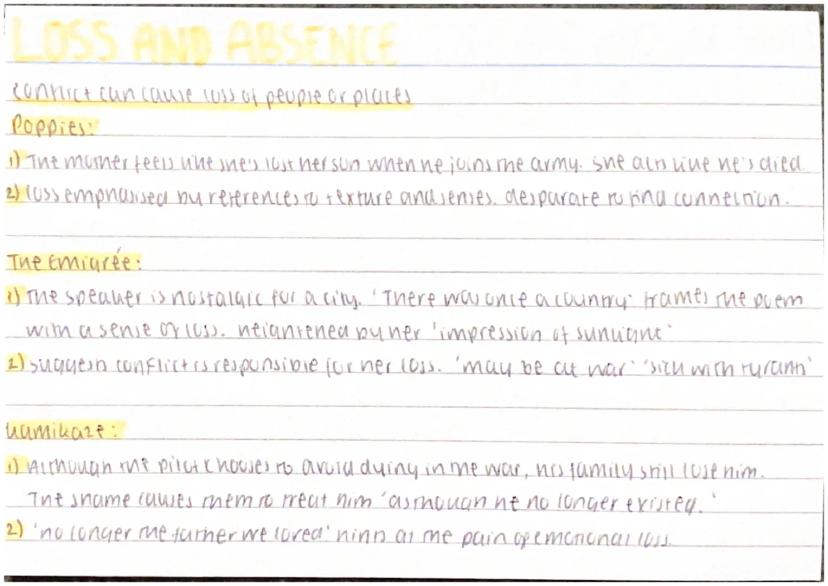
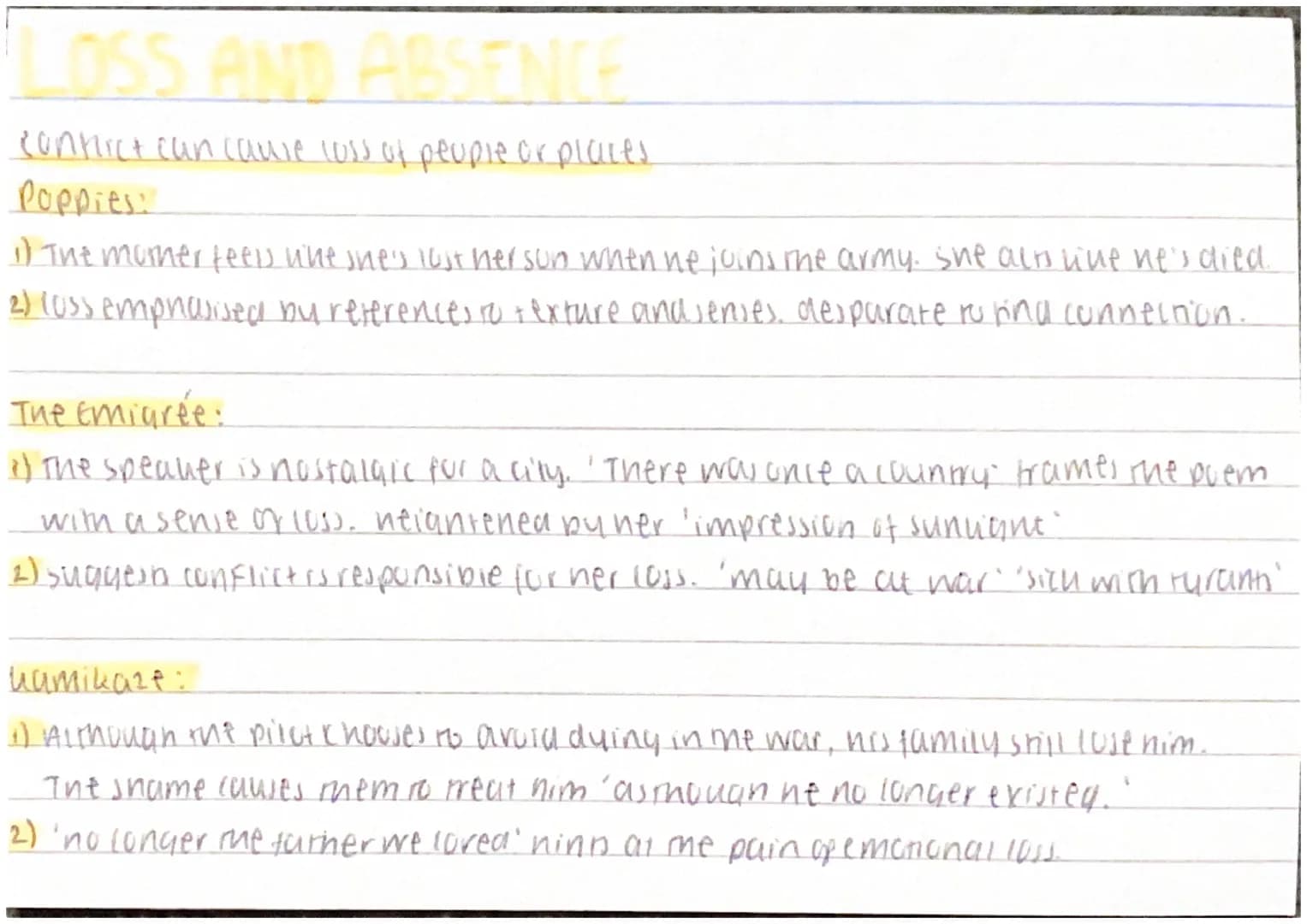
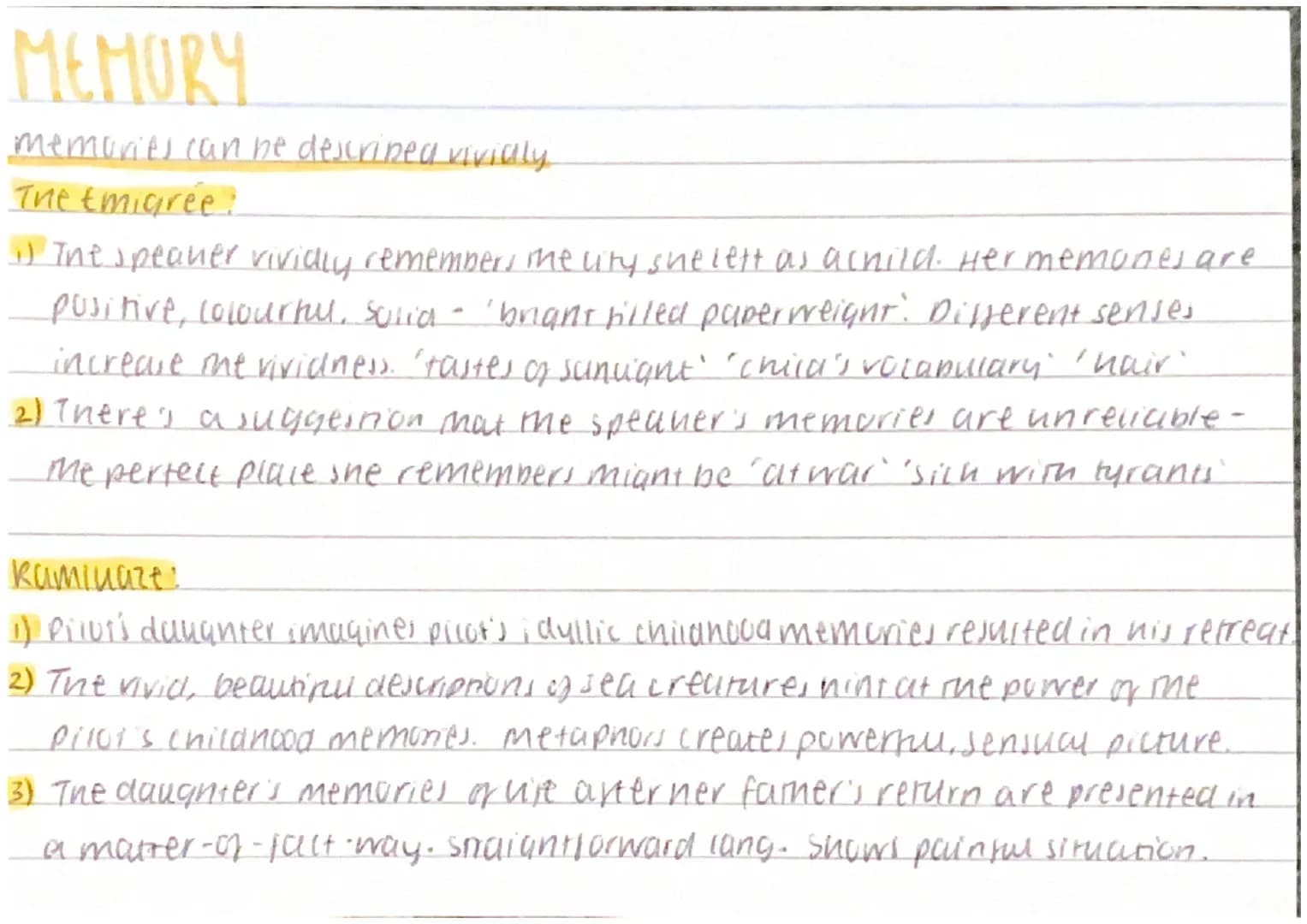
The theme of loss extends beyond physical separation. In "Poppies," the mother's grief is portrayed through sensory details, desperately seeking connection with her absent son. Similarly, "The Emigrée" presents loss through nostalgia for a lost homeland, with the speaker's "impression of sunlight" highlighting what conflict has taken away.
Highlight: Memory plays a crucial role in War photographer analysis, where the development of photographs triggers vivid recollections of conflict zones.
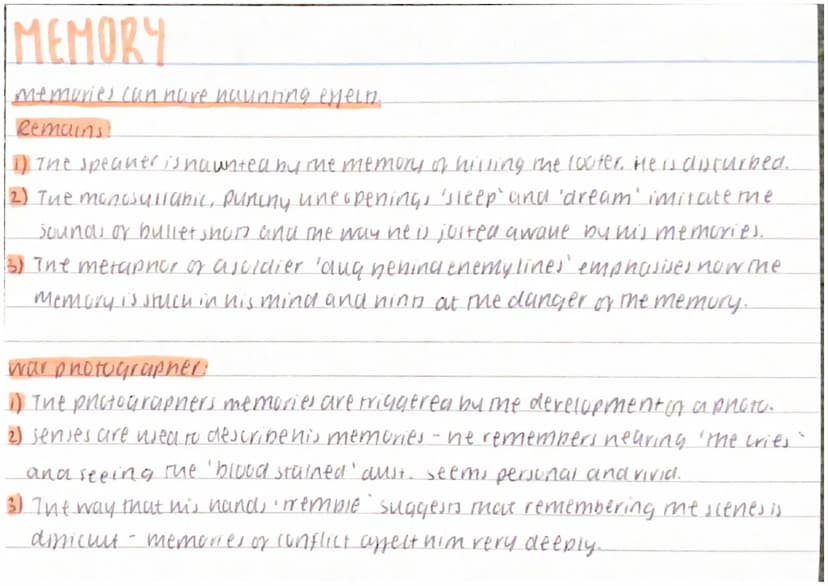
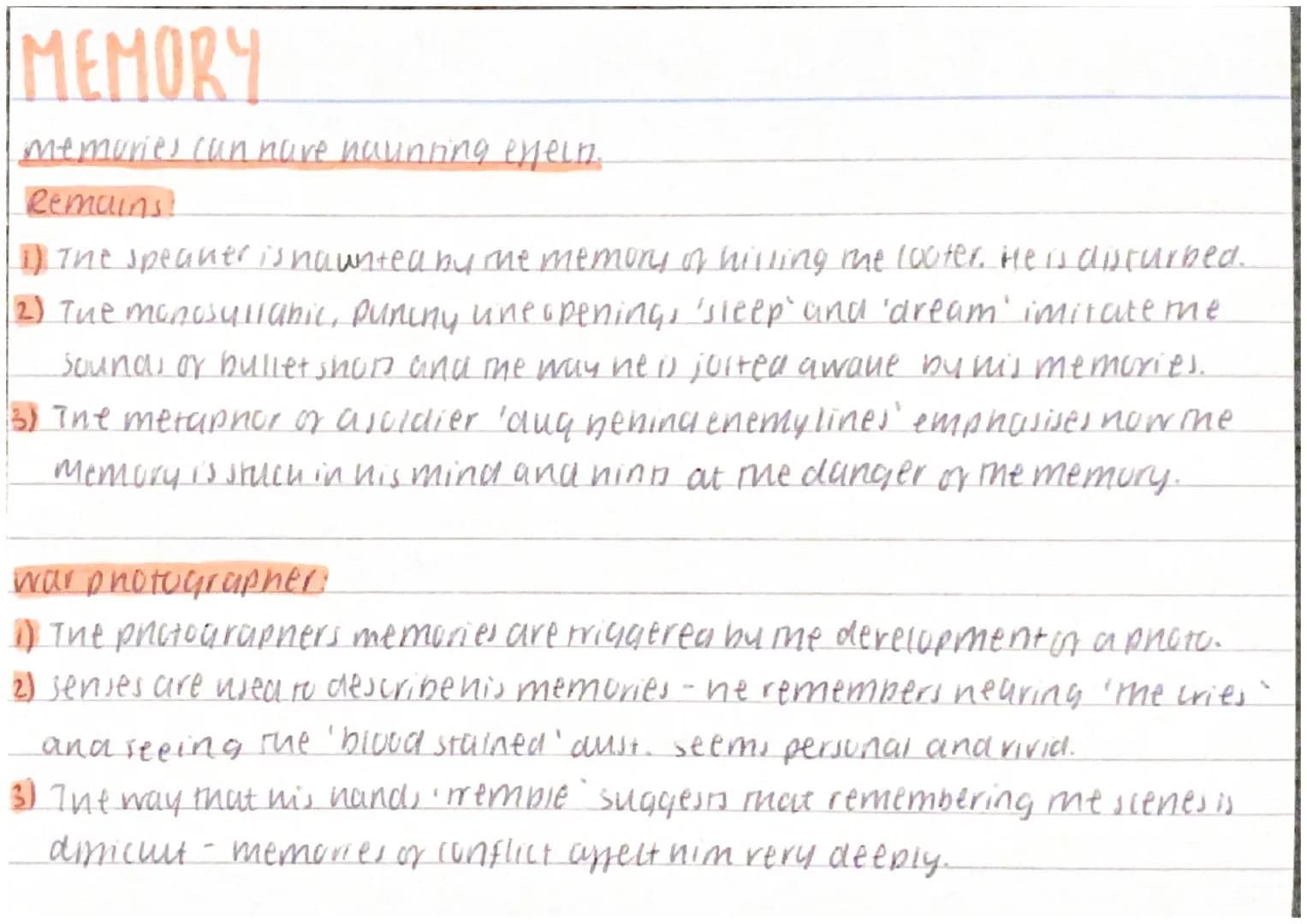
The Impact of memory in war photographer poem analysis demonstrates how memories can haunt those who witness conflict. The photographer's trembling hands while developing photos reveal how deeply affected he is by his memories of war zones.
Quote: "Blood stained into foreign dust" - This vivid imagery from War photographer poem shows how memories of conflict become permanently etched in one's mind.
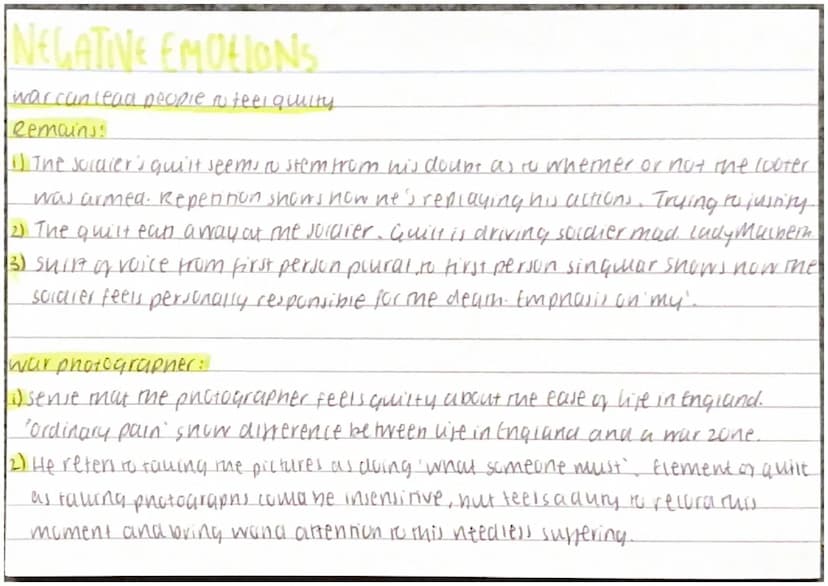
In "Remains," the speaker's haunting memory of killing a looter is portrayed through punchy, monosyllabic lines that mirror gunshots. The metaphor of a soldier "dug in behind enemy lines" emphasizes how memories can become entrenched in one's consciousness.
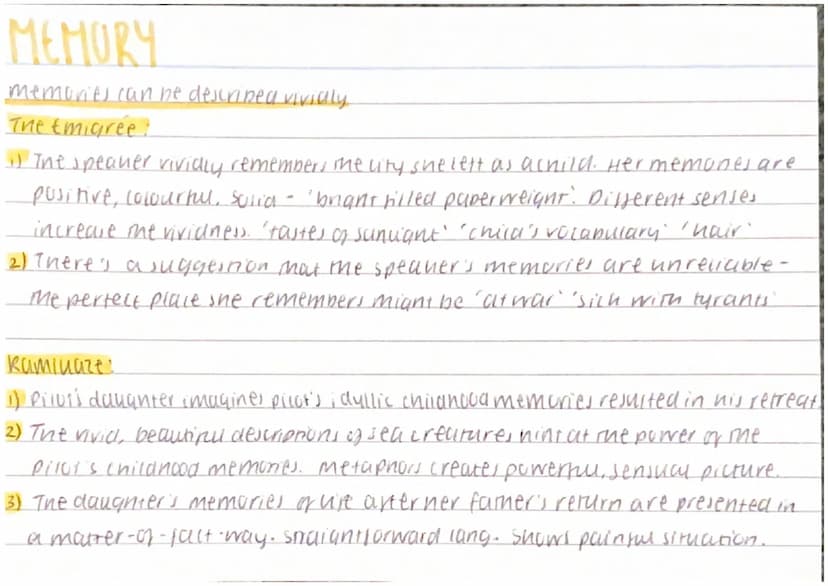
The Power and Conflict poems themes often explore how memories can be both preservative and destructive. "The Emigrée" presents potentially unreliable but cherished memories of a homeland that might now be "sick with tyrants," while "Kamikaze" shows how memories of childhood influenced a pilot's decision to turn back from his mission.
The Power and Conflict identity question often centers on how conflict affects personal and cultural identity. This theme is particularly evident in poems dealing with displacement and alienation.
Example: In "Kamikaze," the pilot's identity is erased by his family's shame, demonstrated by the line "no longer the father we loved."
The Themes of power and conflict in poetry anthology gcse shows how loss of identity often accompanies physical displacement. "The Emigrée" captures this through the speaker's desperate clinging to memories of their homeland, while "Poppies" explores how a mother's identity shifts when her son leaves for war.
These poems from the Power and Conflict Poetry Anthology PDF demonstrate how conflict can strip individuals of their sense of self, leaving them to grapple with new identities formed through loss and absence.
The Best power and conflict poems to learn often deal with the intersection of memory and identity in modern warfare. These works provide powerful insights into how conflict shapes personal and collective memory.
Vocabulary: Collective memory refers to how communities remember and interpret shared experiences of conflict and loss.
The War photographer poem context shows how modern warfare creates complex layers of memory, where the photographer must navigate between being a witness and a participant. The development of photographs becomes a metaphor for the development of traumatic memories.
In examining the Power and Conflict poems comparison pdf, we see how different poets approach similar themes through varied perspectives. Whether through the direct experience of soldiers, the grief of those left behind, or the observations of witnesses, these poems capture the enduring impact of conflict on human consciousness and identity.
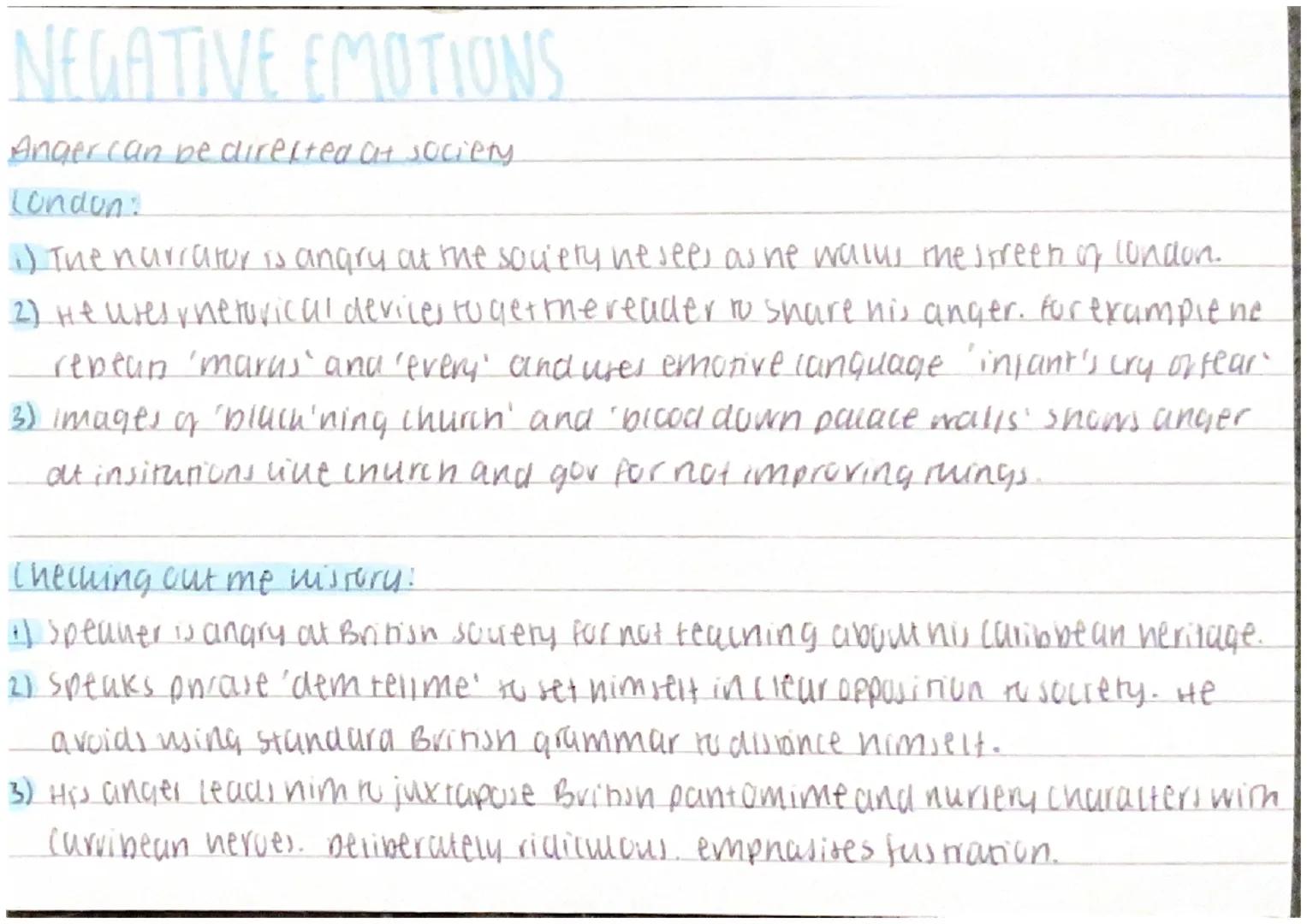
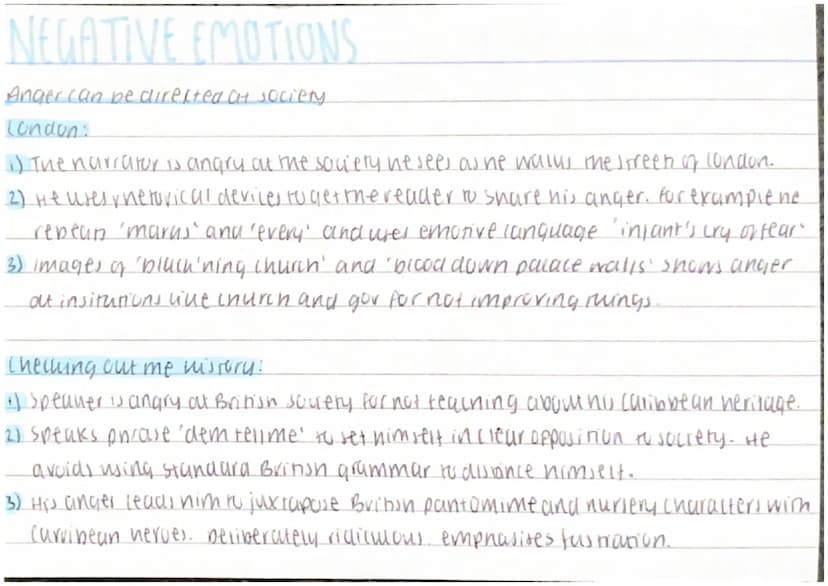
The expression of anger and societal criticism features prominently in conflict poetry, particularly when examining works like "London" and "Checking Out Me History." In "London," the narrator's fury at social injustice manifests through powerful imagery and carefully chosen language. The poet employs repetition of words like "marks" and "every" to emphasize the widespread nature of suffering, while emotionally charged phrases like "infant's cry of fear" create a visceral impact. The imagery of "blood down palace walls" and "black'ning church" serves as a direct indictment of institutional failure.
"Power and Conflict poems analysis" reveals how poets use various techniques to convey their message. In "Checking Out Me History," the speaker's anger stems from educational discrimination, specifically the omission of Caribbean heritage from British curriculum. The repeated phrase "dem tell me" establishes a clear opposition to mainstream society, while the deliberate use of non-standard English grammar serves as a form of linguistic resistance.
Definition: Power and conflict poetry often uses linguistic devices and imagery to express anger at societal injustice and institutional failure.
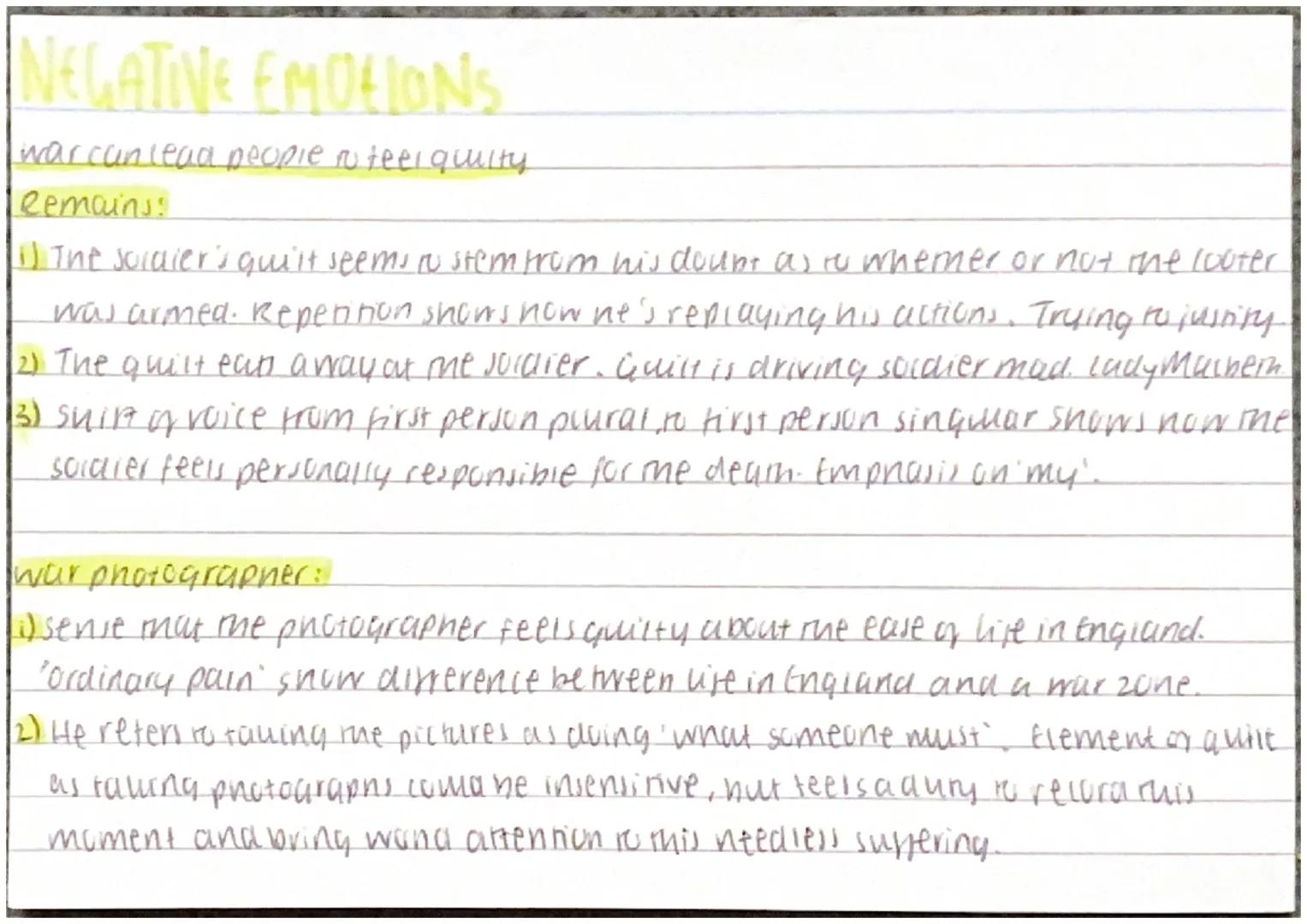
The theme of guilt pervades war poetry, particularly in works like "Remains" and "War Photographer." The War photographer analysis shows how guilt manifests differently in civilian observers versus direct participants. The photographer's guilt stems from witnessing suffering while remaining somewhat detached, expressed through phrases like "ordinary pain" that highlight the stark contrast between war zones and peaceful territories.
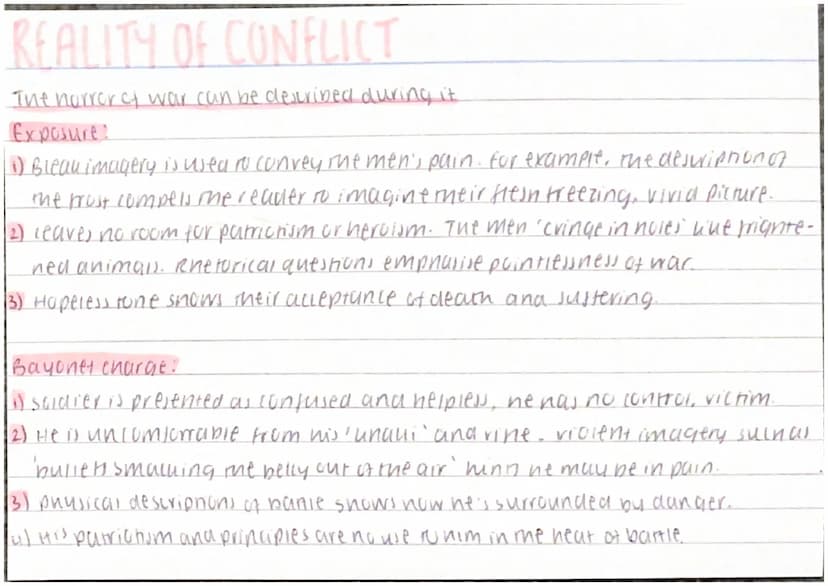
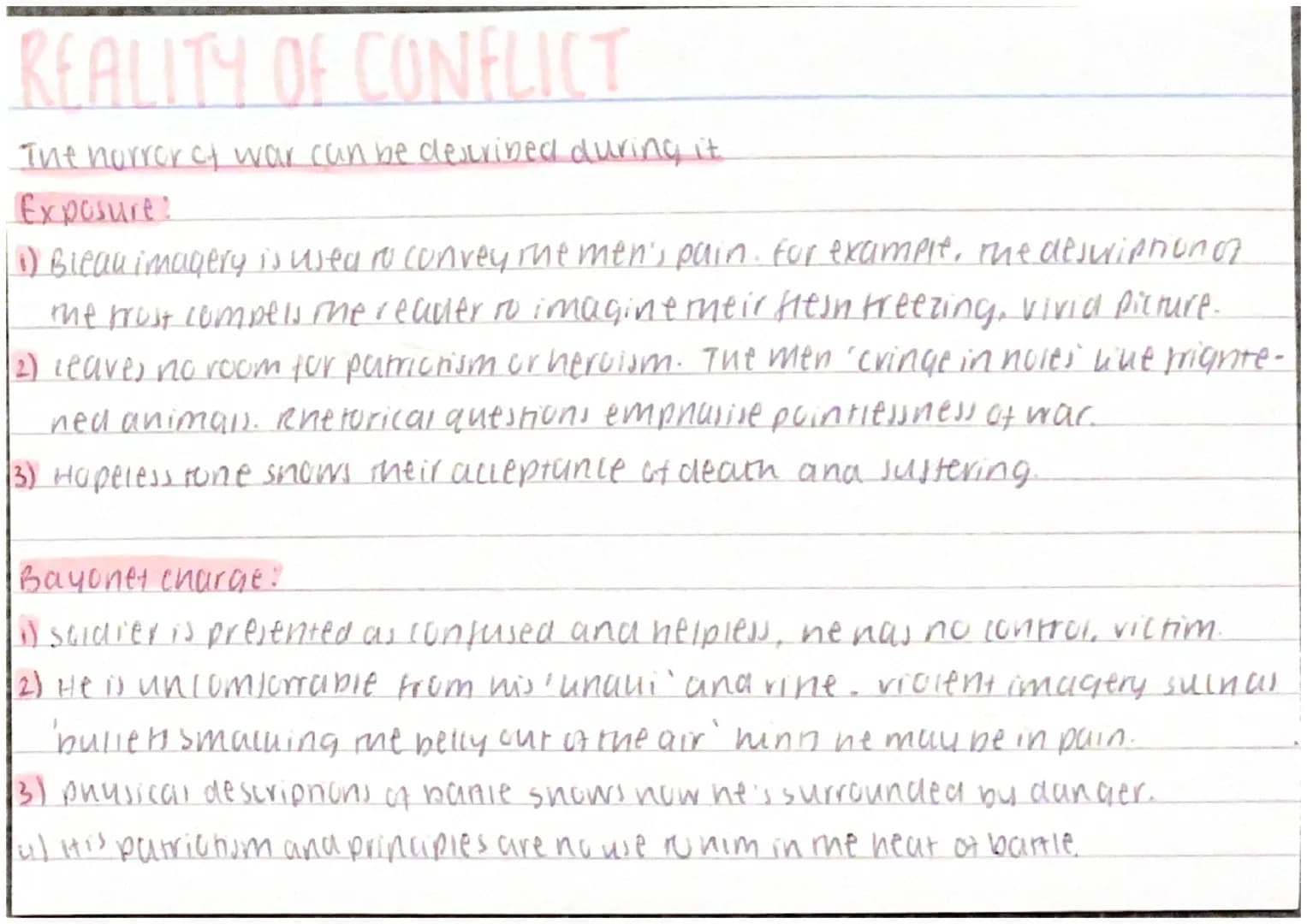
The immediate experience of war receives powerful treatment in poems like "Exposure poem" and "Bayonet Charge." These works focus on the physical and psychological toll of combat, stripping away any glamorized notions of warfare. In "Exposure," Owen uses bleak imagery to convey the soldiers' suffering, with descriptions of flesh-biting frost and men cringing "in holes like frightened animals."
The Power and Conflict poems themes consistently highlight the dehumanizing aspects of war. "Bayonet Charge" presents a soldier stripped of agency, confused and helpless amid chaos. The violent imagery, such as "bullet smacking the belly out of the air," creates a visceral sense of danger and disorientation.
Highlight: The reality of war in these poems emphasizes physical suffering, psychological trauma, and the futility of patriotic ideals in the face of actual combat.
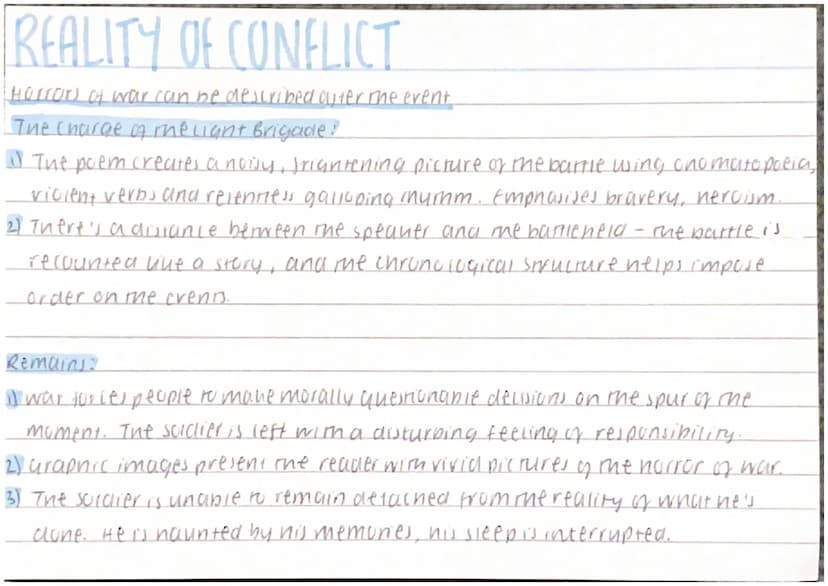
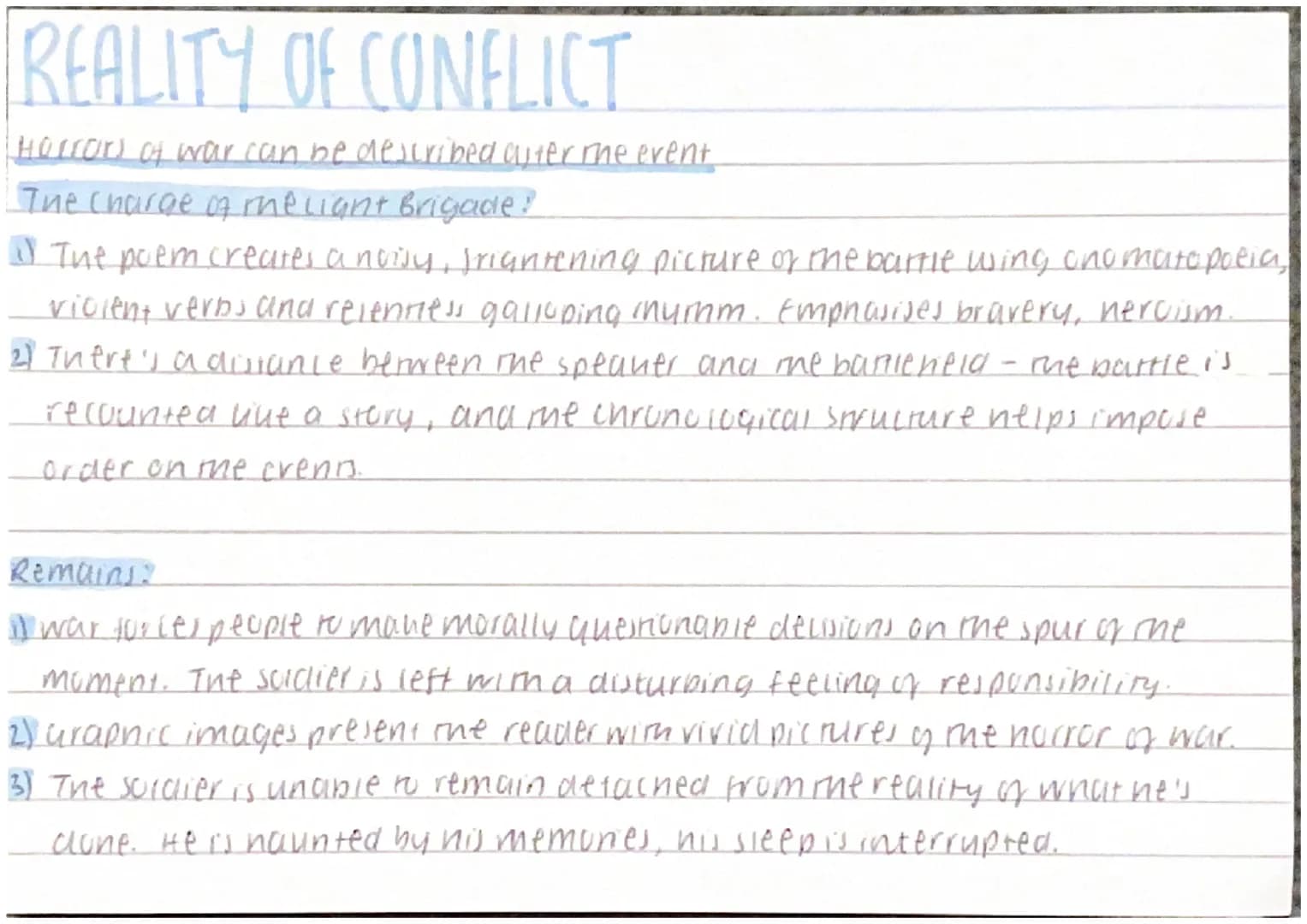
The aftermath of conflict receives equally powerful treatment in poems like "The Charge of the Light Brigade" and "Remains." These works demonstrate how the horror of war continues to affect individuals long after the actual fighting ends. The Impact of memory in war photographer poem analysis shows how traumatic experiences persist in memory and consciousness.
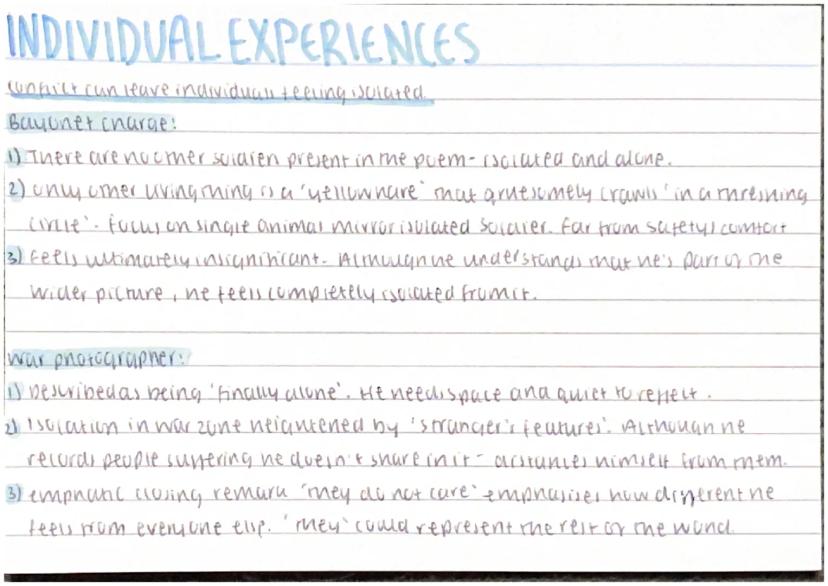
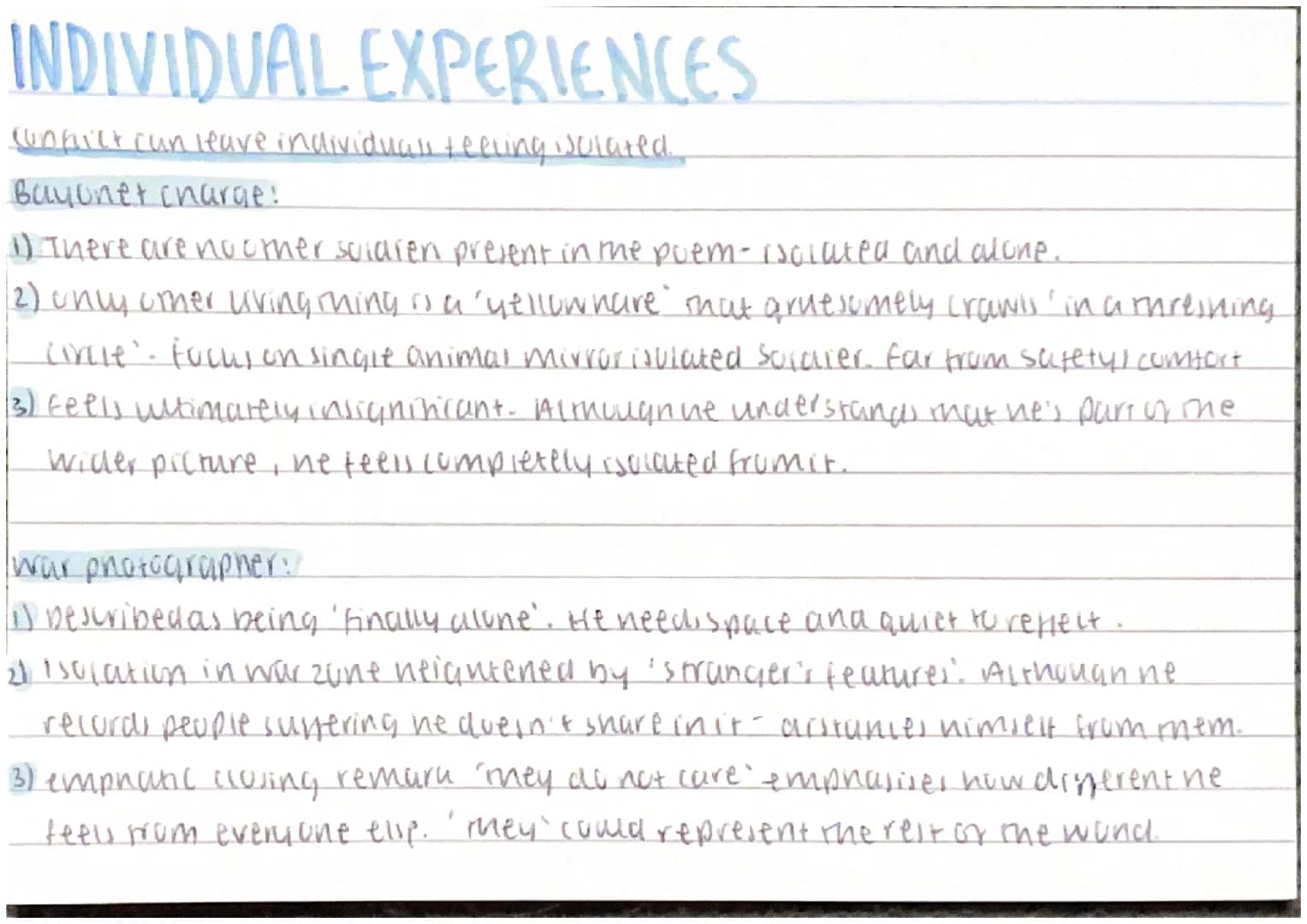
The theme of isolation runs deeply through conflict poetry, particularly evident in "Bayonet Charge" and "War Photographer." These poems explore how conflict can create profound psychological and emotional separation from others. In "Bayonet Charge," the soldier's isolation is emphasized through the absence of other human figures, with only a yellow hare present as a mirror to his own desperate situation.
The War photographer poem context reveals how professional observers of conflict can experience a different kind of isolation. The photographer's solitude is both physical ("finally alone") and emotional, as he processes experiences that others cannot fully comprehend. The emphasis on being a stranger in war zones highlights the psychological distance between observer and subject.
Quote: "They do not care" - this closing remark from "War Photographer" emphasizes the gulf between those who witness conflict firsthand and those who view it from a safe distance.
The Power and Conflict Poetry Anthology PDF examines how these works collectively portray the isolating effects of conflict, whether through direct combat experience or through the act of witnessing and documenting warfare. The poems demonstrate how conflict can create multiple layers of separation: from society, from shared human experience, and from one's own pre-war identity.
The role of memory and traumatic recall features prominently in conflict poetry, particularly in works dealing with post-war experiences. The Analysis of loss and absence in conflict poetry anthology shows how poets capture the lingering effects of warfare on consciousness and identity. In "Remains," the soldier's inability to escape his memories manifests through repetitive language and shifting perspectives, moving from collective to personal responsibility.
The War photographer poem summary demonstrates how memory operates differently for those who witness conflict as observers rather than participants. The photographer's darkroom becomes a metaphor for the processing of traumatic memories, where images develop both literally and metaphorically. The contrast between war zones and peaceful homeland emphasizes how memory creates a bridge between these disparate experiences.
Example: The photographer's development of film serves as a metaphor for how traumatic memories emerge and take shape in consciousness, revealing details that were perhaps too overwhelming to process in the moment.
The Themes of power and conflict in poetry anthology gcse explores how different poets approach the representation of traumatic memory and its lasting impact on individuals. These works demonstrate that the experience of conflict extends far beyond the immediate moment of violence or confrontation, creating lasting psychological and emotional effects that continue to shape identity and perception.
The exploration of individual experiences in Power and Conflict poems reveals how personal encounters shape our understanding of place, nature, and society. Through careful analysis of loss and absence in conflict poetry, we can see how poets craft unique perspectives that illuminate universal themes.
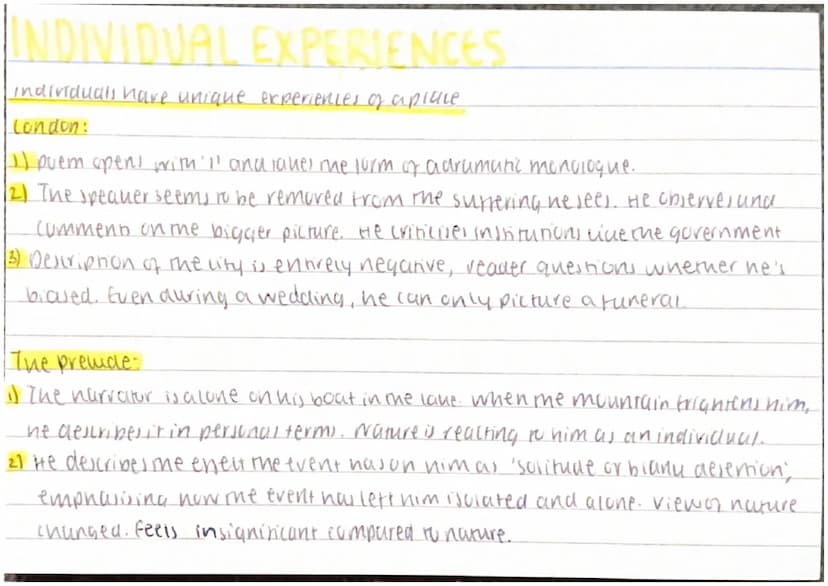
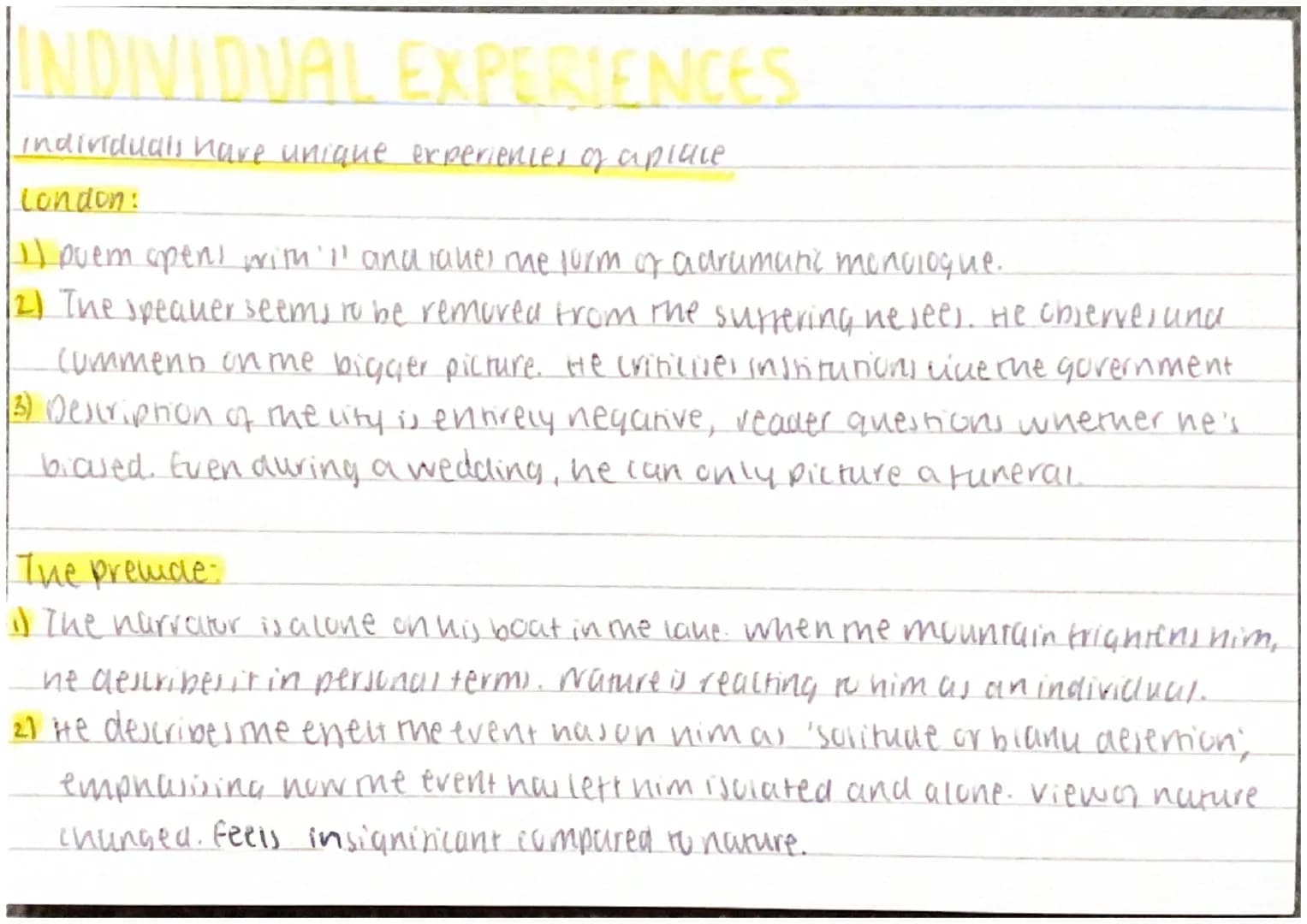
In Blake's "London," the speaker's individual journey through the city becomes a powerful lens for social criticism. The poem employs a dramatic monologue format, opening with an immediate first-person perspective that draws readers into the speaker's worldview. This narrative choice creates an intimate yet detached observation of urban suffering, allowing the speaker to critique institutional power while maintaining emotional distance. The speaker's consistently negative portrayal of London, even transforming celebratory moments like weddings into funeral imagery, reveals how personal bias can color our perception of place.
Definition: A dramatic monologue is a type of poem where a single character speaks to an implied listener, revealing their personality and perspective through their words.
Wordsworth's "The Prelude" presents a markedly different individual experience through its portrayal of solitary encounter with nature. The narrator's isolated boat journey becomes a profound meditation on human insignificance in the face of natural power. When confronted by the looming mountain, the speaker personalizes nature's response, suggesting an intimate yet threatening relationship between individual and environment. This experience fundamentally alters the speaker's worldview, leaving him with a lasting sense of "solitude" and "blank desertion."
Highlight: The contrast between these poems demonstrates how individual experiences can shape our understanding of both human-made environments and natural landscapes, contributing to key themes in the Power and Conflict Poetry Anthology.
The theme of isolation plays a crucial role in shaping the narrative voice within Power and Conflict poems themes. Through careful examination of poetic techniques and personal perspectives, we can understand how poets use individual experiences to explore broader themes of power, conflict, and human nature.
In "London," the speaker's isolation manifests through emotional detachment, allowing for a critical examination of social issues. This distance enables the poet to present a comprehensive critique of institutional power while maintaining an observational stance. The speaker's persistent focus on negative aspects, even in potentially joyous moments, suggests how isolation can lead to a singular, perhaps distorted worldview.
Example: When the speaker encounters a wedding procession, their immediate association with a "hearse" demonstrates how personal perspective can transform even celebratory moments into expressions of despair.
The isolation in "The Prelude" takes on a more physical and psychological dimension. The solitary boat journey becomes a metaphor for human vulnerability in the face of nature's power. The speaker's encounter with the mountain creates a profound sense of personal insignificance, leading to a transformative experience that fundamentally alters their relationship with the natural world. This isolation serves not just as a physical state but as a catalyst for deep philosophical reflection.
Quote: The phrase "solitude or blank desertion" encapsulates the profound impact of isolation on individual perspective, highlighting how solitary experiences can reshape our understanding of power and our place in the world.
Our AI companion is specifically built for the needs of students. Based on the millions of content pieces we have on the platform we can provide truly meaningful and relevant answers to students. But its not only about answers, the companion is even more about guiding students through their daily learning challenges, with personalised study plans, quizzes or content pieces in the chat and 100% personalisation based on the students skills and developments.
You can download the app in the Google Play Store and in the Apple App Store.
That's right! Enjoy free access to study content, connect with fellow students, and get instant help – all at your fingertips.
App Store
Google Play
The app is very easy to use and well designed. I have found everything I was looking for so far and have been able to learn a lot from the presentations! I will definitely use the app for a class assignment! And of course it also helps a lot as an inspiration.
Stefan S
iOS user
This app is really great. There are so many study notes and help [...]. My problem subject is French, for example, and the app has so many options for help. Thanks to this app, I have improved my French. I would recommend it to anyone.
Samantha Klich
Android user
Wow, I am really amazed. I just tried the app because I've seen it advertised many times and was absolutely stunned. This app is THE HELP you want for school and above all, it offers so many things, such as workouts and fact sheets, which have been VERY helpful to me personally.
Anna
iOS user
I think it’s very much worth it and you’ll end up using it a lot once you get the hang of it and even after looking at others notes you can still ask your Artificial intelligence buddy the question and ask to simplify it if you still don’t get it!!! In the end I think it’s worth it 😊👍 ⚠️Also DID I MENTION ITS FREEE YOU DON’T HAVE TO PAY FOR ANYTHING AND STILL GET YOUR GRADES IN PERFECTLY❗️❗️⚠️
Thomas R
iOS user
Knowunity is the BEST app I’ve used in a minute. This is not an ai review or anything this is genuinely coming from a 7th grade student (I know 2011 im young) but dude this app is a 10/10 i have maintained a 3.8 gpa and have plenty of time for gaming. I love it and my mom is just happy I got good grades
Brad T
Android user
Not only did it help me find the answer but it also showed me alternative ways to solve it. I was horrible in math and science but now I have an a in both subjects. Thanks for the help🤍🤍
David K
iOS user
The app's just great! All I have to do is enter the topic in the search bar and I get the response real fast. I don't have to watch 10 YouTube videos to understand something, so I'm saving my time. Highly recommended!
Sudenaz Ocak
Android user
In school I was really bad at maths but thanks to the app, I am doing better now. I am so grateful that you made the app.
Greenlight Bonnie
Android user
I found this app a couple years ago and it has only gotten better since then. I really love it because it can help with written questions and photo questions. Also, it can find study guides that other people have made as well as flashcard sets and practice tests. The free version is also amazing for students who might not be able to afford it. Would 100% recommend
Aubrey
iOS user
Best app if you're in Highschool or Junior high. I have been using this app for 2 school years and it's the best, it's good if you don't have anyone to help you with school work.😋🩷🎀
Marco B
iOS user
THE QUIZES AND FLASHCARDS ARE SO USEFUL AND I LOVE THE SCHOOLGPT. IT ALSO IS LITREALLY LIKE CHATGPT BUT SMARTER!! HELPED ME WITH MY MASCARA PROBLEMS TOO!! AS WELL AS MY REAL SUBJECTS ! DUHHH 😍😁😲🤑💗✨🎀😮
Elisha
iOS user
This app is phenomenal down to the correct info and the various topics you can study! I greatly recommend it for people who struggle with procrastination and those who need homework help. It has been perfectly accurate for world 1 history as far as I’ve seen! Geometry too!
Paul T
iOS user
The app is very easy to use and well designed. I have found everything I was looking for so far and have been able to learn a lot from the presentations! I will definitely use the app for a class assignment! And of course it also helps a lot as an inspiration.
Stefan S
iOS user
This app is really great. There are so many study notes and help [...]. My problem subject is French, for example, and the app has so many options for help. Thanks to this app, I have improved my French. I would recommend it to anyone.
Samantha Klich
Android user
Wow, I am really amazed. I just tried the app because I've seen it advertised many times and was absolutely stunned. This app is THE HELP you want for school and above all, it offers so many things, such as workouts and fact sheets, which have been VERY helpful to me personally.
Anna
iOS user
I think it’s very much worth it and you’ll end up using it a lot once you get the hang of it and even after looking at others notes you can still ask your Artificial intelligence buddy the question and ask to simplify it if you still don’t get it!!! In the end I think it’s worth it 😊👍 ⚠️Also DID I MENTION ITS FREEE YOU DON’T HAVE TO PAY FOR ANYTHING AND STILL GET YOUR GRADES IN PERFECTLY❗️❗️⚠️
Thomas R
iOS user
Knowunity is the BEST app I’ve used in a minute. This is not an ai review or anything this is genuinely coming from a 7th grade student (I know 2011 im young) but dude this app is a 10/10 i have maintained a 3.8 gpa and have plenty of time for gaming. I love it and my mom is just happy I got good grades
Brad T
Android user
Not only did it help me find the answer but it also showed me alternative ways to solve it. I was horrible in math and science but now I have an a in both subjects. Thanks for the help🤍🤍
David K
iOS user
The app's just great! All I have to do is enter the topic in the search bar and I get the response real fast. I don't have to watch 10 YouTube videos to understand something, so I'm saving my time. Highly recommended!
Sudenaz Ocak
Android user
In school I was really bad at maths but thanks to the app, I am doing better now. I am so grateful that you made the app.
Greenlight Bonnie
Android user
I found this app a couple years ago and it has only gotten better since then. I really love it because it can help with written questions and photo questions. Also, it can find study guides that other people have made as well as flashcard sets and practice tests. The free version is also amazing for students who might not be able to afford it. Would 100% recommend
Aubrey
iOS user
Best app if you're in Highschool or Junior high. I have been using this app for 2 school years and it's the best, it's good if you don't have anyone to help you with school work.😋🩷🎀
Marco B
iOS user
THE QUIZES AND FLASHCARDS ARE SO USEFUL AND I LOVE THE SCHOOLGPT. IT ALSO IS LITREALLY LIKE CHATGPT BUT SMARTER!! HELPED ME WITH MY MASCARA PROBLEMS TOO!! AS WELL AS MY REAL SUBJECTS ! DUHHH 😍😁😲🤑💗✨🎀😮
Elisha
iOS user
This app is phenomenal down to the correct info and the various topics you can study! I greatly recommend it for people who struggle with procrastination and those who need homework help. It has been perfectly accurate for world 1 history as far as I’ve seen! Geometry too!
Paul T
iOS user
Lauren Male
@laurenmale
The study of Power and Conflict poemsexplores profound themes of loss, identity, and the lasting impact of warfare through carefully selected works in the poetry anthology. These poems provide deep insights into human experiences during times of conflict and... Show more
Access to all documents
Improve your grades
Join milions of students
By signing up you accept Terms of Service and Privacy Policy
Power and Conflict poems analysis reveals how poets masterfully explore themes of loss, absence, and haunting memories through various perspectives. The examination of these elements provides crucial insights into the human experience during times of conflict.
Definition: Loss and absence in conflict poetry refers to the physical, emotional, and psychological void experienced by individuals affected by war and strife.
In studying the Analysis of loss and absence in conflict poetry anthology, we see how poets like Wilfred Owen in Exposure poem capture the devastating sense of hopelessness experienced by soldiers. The poem portrays soldiers in trenches, stripped of hope, emphasizing their misery through lines like "we only know war lasts." This feeling of abandonment is reinforced when even thoughts of home provide no comfort, as "the doors are closed" to them.
The theme of loss extends beyond physical separation. In "Poppies," the mother's grief is portrayed through sensory details, desperately seeking connection with her absent son. Similarly, "The Emigrée" presents loss through nostalgia for a lost homeland, with the speaker's "impression of sunlight" highlighting what conflict has taken away.
Highlight: Memory plays a crucial role in War photographer analysis, where the development of photographs triggers vivid recollections of conflict zones.
Access to all documents
Improve your grades
Join milions of students
By signing up you accept Terms of Service and Privacy Policy
The Impact of memory in war photographer poem analysis demonstrates how memories can haunt those who witness conflict. The photographer's trembling hands while developing photos reveal how deeply affected he is by his memories of war zones.
Quote: "Blood stained into foreign dust" - This vivid imagery from War photographer poem shows how memories of conflict become permanently etched in one's mind.
In "Remains," the speaker's haunting memory of killing a looter is portrayed through punchy, monosyllabic lines that mirror gunshots. The metaphor of a soldier "dug in behind enemy lines" emphasizes how memories can become entrenched in one's consciousness.
The Power and Conflict poems themes often explore how memories can be both preservative and destructive. "The Emigrée" presents potentially unreliable but cherished memories of a homeland that might now be "sick with tyrants," while "Kamikaze" shows how memories of childhood influenced a pilot's decision to turn back from his mission.
Access to all documents
Improve your grades
Join milions of students
By signing up you accept Terms of Service and Privacy Policy
The Power and Conflict identity question often centers on how conflict affects personal and cultural identity. This theme is particularly evident in poems dealing with displacement and alienation.
Example: In "Kamikaze," the pilot's identity is erased by his family's shame, demonstrated by the line "no longer the father we loved."
The Themes of power and conflict in poetry anthology gcse shows how loss of identity often accompanies physical displacement. "The Emigrée" captures this through the speaker's desperate clinging to memories of their homeland, while "Poppies" explores how a mother's identity shifts when her son leaves for war.
These poems from the Power and Conflict Poetry Anthology PDF demonstrate how conflict can strip individuals of their sense of self, leaving them to grapple with new identities formed through loss and absence.
Access to all documents
Improve your grades
Join milions of students
By signing up you accept Terms of Service and Privacy Policy
The Best power and conflict poems to learn often deal with the intersection of memory and identity in modern warfare. These works provide powerful insights into how conflict shapes personal and collective memory.
Vocabulary: Collective memory refers to how communities remember and interpret shared experiences of conflict and loss.
The War photographer poem context shows how modern warfare creates complex layers of memory, where the photographer must navigate between being a witness and a participant. The development of photographs becomes a metaphor for the development of traumatic memories.
In examining the Power and Conflict poems comparison pdf, we see how different poets approach similar themes through varied perspectives. Whether through the direct experience of soldiers, the grief of those left behind, or the observations of witnesses, these poems capture the enduring impact of conflict on human consciousness and identity.
Access to all documents
Improve your grades
Join milions of students
By signing up you accept Terms of Service and Privacy Policy
The expression of anger and societal criticism features prominently in conflict poetry, particularly when examining works like "London" and "Checking Out Me History." In "London," the narrator's fury at social injustice manifests through powerful imagery and carefully chosen language. The poet employs repetition of words like "marks" and "every" to emphasize the widespread nature of suffering, while emotionally charged phrases like "infant's cry of fear" create a visceral impact. The imagery of "blood down palace walls" and "black'ning church" serves as a direct indictment of institutional failure.
"Power and Conflict poems analysis" reveals how poets use various techniques to convey their message. In "Checking Out Me History," the speaker's anger stems from educational discrimination, specifically the omission of Caribbean heritage from British curriculum. The repeated phrase "dem tell me" establishes a clear opposition to mainstream society, while the deliberate use of non-standard English grammar serves as a form of linguistic resistance.
Definition: Power and conflict poetry often uses linguistic devices and imagery to express anger at societal injustice and institutional failure.
The theme of guilt pervades war poetry, particularly in works like "Remains" and "War Photographer." The War photographer analysis shows how guilt manifests differently in civilian observers versus direct participants. The photographer's guilt stems from witnessing suffering while remaining somewhat detached, expressed through phrases like "ordinary pain" that highlight the stark contrast between war zones and peaceful territories.
Access to all documents
Improve your grades
Join milions of students
By signing up you accept Terms of Service and Privacy Policy
The immediate experience of war receives powerful treatment in poems like "Exposure poem" and "Bayonet Charge." These works focus on the physical and psychological toll of combat, stripping away any glamorized notions of warfare. In "Exposure," Owen uses bleak imagery to convey the soldiers' suffering, with descriptions of flesh-biting frost and men cringing "in holes like frightened animals."
The Power and Conflict poems themes consistently highlight the dehumanizing aspects of war. "Bayonet Charge" presents a soldier stripped of agency, confused and helpless amid chaos. The violent imagery, such as "bullet smacking the belly out of the air," creates a visceral sense of danger and disorientation.
Highlight: The reality of war in these poems emphasizes physical suffering, psychological trauma, and the futility of patriotic ideals in the face of actual combat.
The aftermath of conflict receives equally powerful treatment in poems like "The Charge of the Light Brigade" and "Remains." These works demonstrate how the horror of war continues to affect individuals long after the actual fighting ends. The Impact of memory in war photographer poem analysis shows how traumatic experiences persist in memory and consciousness.
Access to all documents
Improve your grades
Join milions of students
By signing up you accept Terms of Service and Privacy Policy
The theme of isolation runs deeply through conflict poetry, particularly evident in "Bayonet Charge" and "War Photographer." These poems explore how conflict can create profound psychological and emotional separation from others. In "Bayonet Charge," the soldier's isolation is emphasized through the absence of other human figures, with only a yellow hare present as a mirror to his own desperate situation.
The War photographer poem context reveals how professional observers of conflict can experience a different kind of isolation. The photographer's solitude is both physical ("finally alone") and emotional, as he processes experiences that others cannot fully comprehend. The emphasis on being a stranger in war zones highlights the psychological distance between observer and subject.
Quote: "They do not care" - this closing remark from "War Photographer" emphasizes the gulf between those who witness conflict firsthand and those who view it from a safe distance.
The Power and Conflict Poetry Anthology PDF examines how these works collectively portray the isolating effects of conflict, whether through direct combat experience or through the act of witnessing and documenting warfare. The poems demonstrate how conflict can create multiple layers of separation: from society, from shared human experience, and from one's own pre-war identity.
Access to all documents
Improve your grades
Join milions of students
By signing up you accept Terms of Service and Privacy Policy
The role of memory and traumatic recall features prominently in conflict poetry, particularly in works dealing with post-war experiences. The Analysis of loss and absence in conflict poetry anthology shows how poets capture the lingering effects of warfare on consciousness and identity. In "Remains," the soldier's inability to escape his memories manifests through repetitive language and shifting perspectives, moving from collective to personal responsibility.
The War photographer poem summary demonstrates how memory operates differently for those who witness conflict as observers rather than participants. The photographer's darkroom becomes a metaphor for the processing of traumatic memories, where images develop both literally and metaphorically. The contrast between war zones and peaceful homeland emphasizes how memory creates a bridge between these disparate experiences.
Example: The photographer's development of film serves as a metaphor for how traumatic memories emerge and take shape in consciousness, revealing details that were perhaps too overwhelming to process in the moment.
The Themes of power and conflict in poetry anthology gcse explores how different poets approach the representation of traumatic memory and its lasting impact on individuals. These works demonstrate that the experience of conflict extends far beyond the immediate moment of violence or confrontation, creating lasting psychological and emotional effects that continue to shape identity and perception.
Access to all documents
Improve your grades
Join milions of students
By signing up you accept Terms of Service and Privacy Policy
The exploration of individual experiences in Power and Conflict poems reveals how personal encounters shape our understanding of place, nature, and society. Through careful analysis of loss and absence in conflict poetry, we can see how poets craft unique perspectives that illuminate universal themes.
In Blake's "London," the speaker's individual journey through the city becomes a powerful lens for social criticism. The poem employs a dramatic monologue format, opening with an immediate first-person perspective that draws readers into the speaker's worldview. This narrative choice creates an intimate yet detached observation of urban suffering, allowing the speaker to critique institutional power while maintaining emotional distance. The speaker's consistently negative portrayal of London, even transforming celebratory moments like weddings into funeral imagery, reveals how personal bias can color our perception of place.
Definition: A dramatic monologue is a type of poem where a single character speaks to an implied listener, revealing their personality and perspective through their words.
Wordsworth's "The Prelude" presents a markedly different individual experience through its portrayal of solitary encounter with nature. The narrator's isolated boat journey becomes a profound meditation on human insignificance in the face of natural power. When confronted by the looming mountain, the speaker personalizes nature's response, suggesting an intimate yet threatening relationship between individual and environment. This experience fundamentally alters the speaker's worldview, leaving him with a lasting sense of "solitude" and "blank desertion."
Highlight: The contrast between these poems demonstrates how individual experiences can shape our understanding of both human-made environments and natural landscapes, contributing to key themes in the Power and Conflict Poetry Anthology.
Access to all documents
Improve your grades
Join milions of students
By signing up you accept Terms of Service and Privacy Policy
The theme of isolation plays a crucial role in shaping the narrative voice within Power and Conflict poems themes. Through careful examination of poetic techniques and personal perspectives, we can understand how poets use individual experiences to explore broader themes of power, conflict, and human nature.
In "London," the speaker's isolation manifests through emotional detachment, allowing for a critical examination of social issues. This distance enables the poet to present a comprehensive critique of institutional power while maintaining an observational stance. The speaker's persistent focus on negative aspects, even in potentially joyous moments, suggests how isolation can lead to a singular, perhaps distorted worldview.
Example: When the speaker encounters a wedding procession, their immediate association with a "hearse" demonstrates how personal perspective can transform even celebratory moments into expressions of despair.
The isolation in "The Prelude" takes on a more physical and psychological dimension. The solitary boat journey becomes a metaphor for human vulnerability in the face of nature's power. The speaker's encounter with the mountain creates a profound sense of personal insignificance, leading to a transformative experience that fundamentally alters their relationship with the natural world. This isolation serves not just as a physical state but as a catalyst for deep philosophical reflection.
Quote: The phrase "solitude or blank desertion" encapsulates the profound impact of isolation on individual perspective, highlighting how solitary experiences can reshape our understanding of power and our place in the world.
Our AI companion is specifically built for the needs of students. Based on the millions of content pieces we have on the platform we can provide truly meaningful and relevant answers to students. But its not only about answers, the companion is even more about guiding students through their daily learning challenges, with personalised study plans, quizzes or content pieces in the chat and 100% personalisation based on the students skills and developments.
You can download the app in the Google Play Store and in the Apple App Store.
That's right! Enjoy free access to study content, connect with fellow students, and get instant help – all at your fingertips.
403
Smart Tools NEW
Transform this note into: ✓ 50+ Practice Questions ✓ Interactive Flashcards ✓ Full Mock Exam ✓ Essay Outlines
Explore the themes of identity, memory, and cultural conflict in Carol Rumens' poem 'The Emigrée'. This annotated analysis delves into the structure, key motifs, and the poet's reflections on belonging and nostalgia amidst war and exile. Ideal for GCSE English Literature students seeking to understand the emotional depth and political consciousness in poetry.
 English Literature
Explore the themes of nature, memory, and conflict in 'Kamikaze' and 'The Prelude: Stealing the Boat'. This comparative analysis highlights how both poems depict the profound impact of nature on human emotions and decisions, illustrating the tension between beauty and fear. Ideal for students studying war poetry and the theme of suffering.
English LanguageExplore the themes of power and conflict in Carol Ann Duffy's 'War Photographer'. This analysis delves into the emotional tension between the photographer's experiences of war and the detached reactions of society. Key concepts include the juxtaposition of war imagery, the impact of suffering, and the role of the media in portraying conflict. Ideal for GCSE English Literature students studying poetry anthologies.
English LiteratureExplore a comprehensive analysis of Christina Rossetti's poem 'Echo', focusing on themes of longing, memory, and the interplay between life and death. This detailed examination covers the poem's structure, emotional depth, and literary context, including references to classical myths and Rossetti's influences. Ideal for students studying Victorian poetry and literary techniques.
English LiteratureExplore a detailed analysis of Ted Hughes' 'Hawk Roosting' with comprehensive annotations and a mind map. This resource delves into key themes, literary devices, and character insights, making it essential for English literature students preparing for exams or deepening their understanding of the poem.
English LiteratureExplore the vivid imagery and powerful themes in Lord Byron's poem 'The Destruction of Sennacherib'. This analysis delves into the use of similes, metaphors, and alliteration that illustrate the Assyrian army's defeat and the divine intervention that leads to their destruction. Key concepts include the symbolism of the wolf, the changing fortunes of war, and the contrasting imagery of life and death on the battlefield. Ideal for students studying literature and poetry analysis.
English LiteratureApp Store
Google Play
The app is very easy to use and well designed. I have found everything I was looking for so far and have been able to learn a lot from the presentations! I will definitely use the app for a class assignment! And of course it also helps a lot as an inspiration.
Stefan S
iOS user
This app is really great. There are so many study notes and help [...]. My problem subject is French, for example, and the app has so many options for help. Thanks to this app, I have improved my French. I would recommend it to anyone.
Samantha Klich
Android user
Wow, I am really amazed. I just tried the app because I've seen it advertised many times and was absolutely stunned. This app is THE HELP you want for school and above all, it offers so many things, such as workouts and fact sheets, which have been VERY helpful to me personally.
Anna
iOS user
I think it’s very much worth it and you’ll end up using it a lot once you get the hang of it and even after looking at others notes you can still ask your Artificial intelligence buddy the question and ask to simplify it if you still don’t get it!!! In the end I think it’s worth it 😊👍 ⚠️Also DID I MENTION ITS FREEE YOU DON’T HAVE TO PAY FOR ANYTHING AND STILL GET YOUR GRADES IN PERFECTLY❗️❗️⚠️
Thomas R
iOS user
Knowunity is the BEST app I’ve used in a minute. This is not an ai review or anything this is genuinely coming from a 7th grade student (I know 2011 im young) but dude this app is a 10/10 i have maintained a 3.8 gpa and have plenty of time for gaming. I love it and my mom is just happy I got good grades
Brad T
Android user
Not only did it help me find the answer but it also showed me alternative ways to solve it. I was horrible in math and science but now I have an a in both subjects. Thanks for the help🤍🤍
David K
iOS user
The app's just great! All I have to do is enter the topic in the search bar and I get the response real fast. I don't have to watch 10 YouTube videos to understand something, so I'm saving my time. Highly recommended!
Sudenaz Ocak
Android user
In school I was really bad at maths but thanks to the app, I am doing better now. I am so grateful that you made the app.
Greenlight Bonnie
Android user
I found this app a couple years ago and it has only gotten better since then. I really love it because it can help with written questions and photo questions. Also, it can find study guides that other people have made as well as flashcard sets and practice tests. The free version is also amazing for students who might not be able to afford it. Would 100% recommend
Aubrey
iOS user
Best app if you're in Highschool or Junior high. I have been using this app for 2 school years and it's the best, it's good if you don't have anyone to help you with school work.😋🩷🎀
Marco B
iOS user
THE QUIZES AND FLASHCARDS ARE SO USEFUL AND I LOVE THE SCHOOLGPT. IT ALSO IS LITREALLY LIKE CHATGPT BUT SMARTER!! HELPED ME WITH MY MASCARA PROBLEMS TOO!! AS WELL AS MY REAL SUBJECTS ! DUHHH 😍😁😲🤑💗✨🎀😮
Elisha
iOS user
This app is phenomenal down to the correct info and the various topics you can study! I greatly recommend it for people who struggle with procrastination and those who need homework help. It has been perfectly accurate for world 1 history as far as I’ve seen! Geometry too!
Paul T
iOS user
The app is very easy to use and well designed. I have found everything I was looking for so far and have been able to learn a lot from the presentations! I will definitely use the app for a class assignment! And of course it also helps a lot as an inspiration.
Stefan S
iOS user
This app is really great. There are so many study notes and help [...]. My problem subject is French, for example, and the app has so many options for help. Thanks to this app, I have improved my French. I would recommend it to anyone.
Samantha Klich
Android user
Wow, I am really amazed. I just tried the app because I've seen it advertised many times and was absolutely stunned. This app is THE HELP you want for school and above all, it offers so many things, such as workouts and fact sheets, which have been VERY helpful to me personally.
Anna
iOS user
I think it’s very much worth it and you’ll end up using it a lot once you get the hang of it and even after looking at others notes you can still ask your Artificial intelligence buddy the question and ask to simplify it if you still don’t get it!!! In the end I think it’s worth it 😊👍 ⚠️Also DID I MENTION ITS FREEE YOU DON’T HAVE TO PAY FOR ANYTHING AND STILL GET YOUR GRADES IN PERFECTLY❗️❗️⚠️
Thomas R
iOS user
Knowunity is the BEST app I’ve used in a minute. This is not an ai review or anything this is genuinely coming from a 7th grade student (I know 2011 im young) but dude this app is a 10/10 i have maintained a 3.8 gpa and have plenty of time for gaming. I love it and my mom is just happy I got good grades
Brad T
Android user
Not only did it help me find the answer but it also showed me alternative ways to solve it. I was horrible in math and science but now I have an a in both subjects. Thanks for the help🤍🤍
David K
iOS user
The app's just great! All I have to do is enter the topic in the search bar and I get the response real fast. I don't have to watch 10 YouTube videos to understand something, so I'm saving my time. Highly recommended!
Sudenaz Ocak
Android user
In school I was really bad at maths but thanks to the app, I am doing better now. I am so grateful that you made the app.
Greenlight Bonnie
Android user
I found this app a couple years ago and it has only gotten better since then. I really love it because it can help with written questions and photo questions. Also, it can find study guides that other people have made as well as flashcard sets and practice tests. The free version is also amazing for students who might not be able to afford it. Would 100% recommend
Aubrey
iOS user
Best app if you're in Highschool or Junior high. I have been using this app for 2 school years and it's the best, it's good if you don't have anyone to help you with school work.😋🩷🎀
Marco B
iOS user
THE QUIZES AND FLASHCARDS ARE SO USEFUL AND I LOVE THE SCHOOLGPT. IT ALSO IS LITREALLY LIKE CHATGPT BUT SMARTER!! HELPED ME WITH MY MASCARA PROBLEMS TOO!! AS WELL AS MY REAL SUBJECTS ! DUHHH 😍😁😲🤑💗✨🎀😮
Elisha
iOS user
This app is phenomenal down to the correct info and the various topics you can study! I greatly recommend it for people who struggle with procrastination and those who need homework help. It has been perfectly accurate for world 1 history as far as I’ve seen! Geometry too!
Paul T
iOS user