
The poem "Winter Swans" by Owen Sheers explores themes of... Show more
 Sociology
 Biology
Sign up to see the contentIt's free!
Access to all documents
Improve your grades
Join milions of students
By signing up you accept Terms of Service and Privacy Policy
Subjects

Biology

Chemistry
AP Chemistry

English
AP English Literature
7
0
jana carney
12/9/2025
English Literature
Winter Swans notes: Love and Relationships cluster
452
•
Dec 9, 2025
•
jana carney
@jana_carney
The poem "Winter Swans" by Owen Sheers explores themes of... Show more
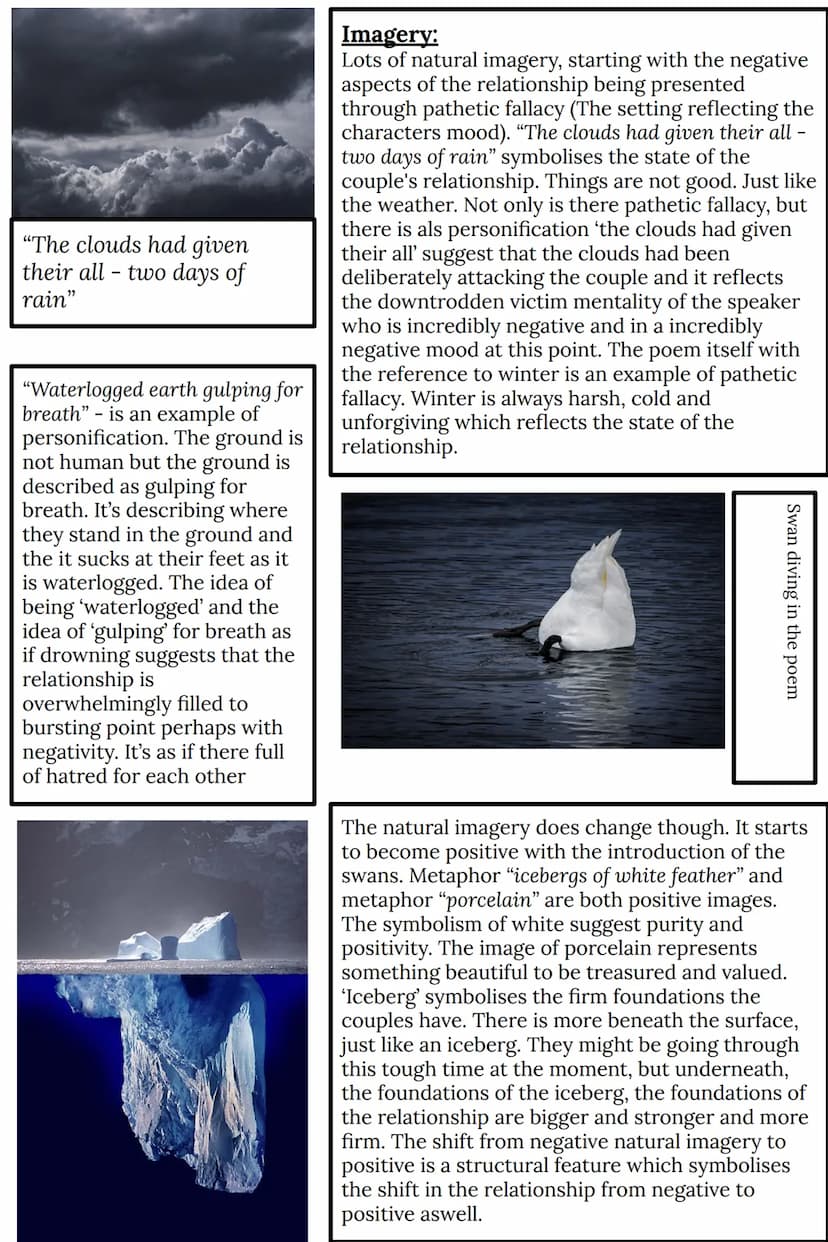
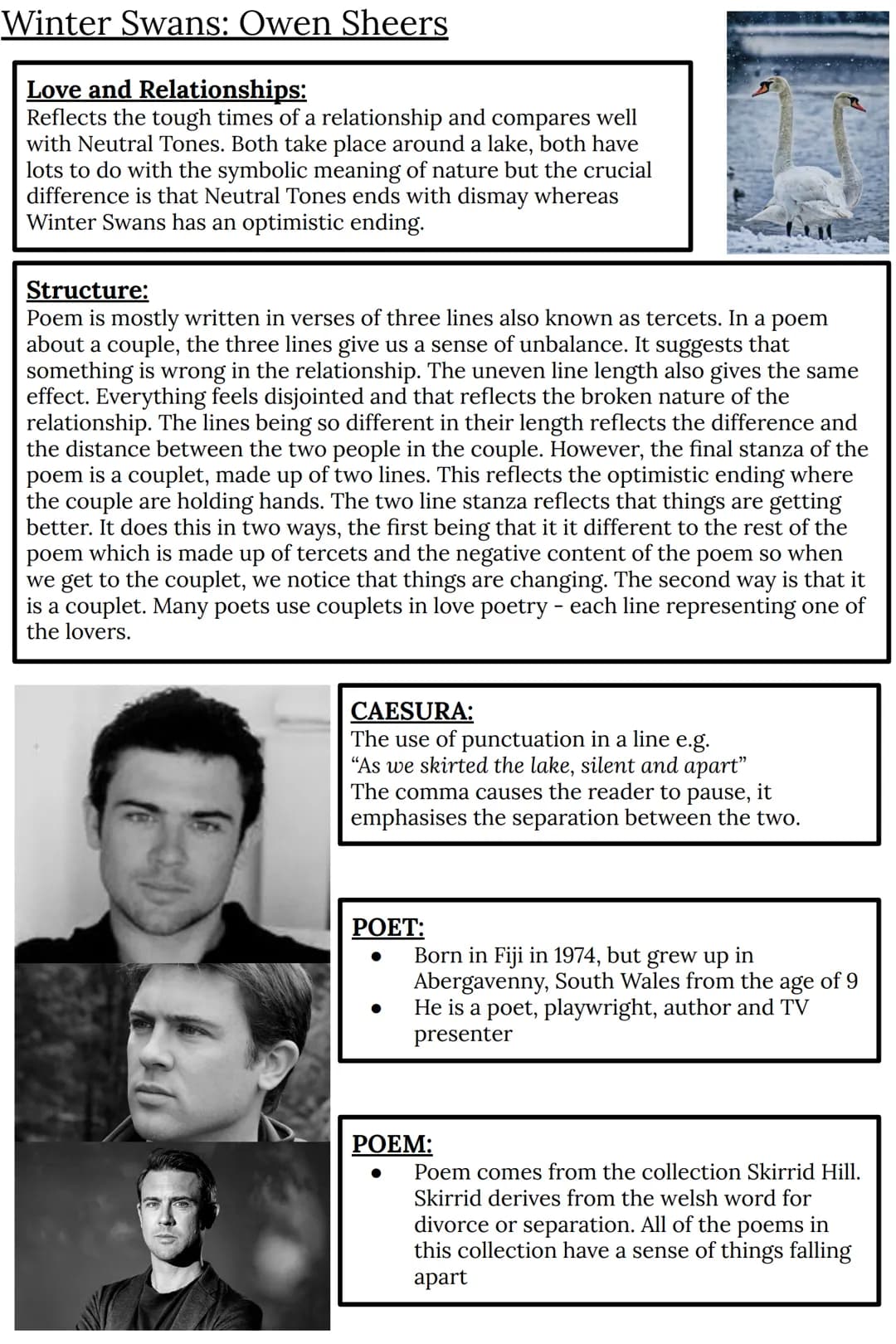
The poem begins with powerful natural imagery that reflects the couple's emotional state through pathetic fallacy. The opening lines set a somber tone:
Quote: "The clouds had given their all - two days of rain"
This imagery symbolizes the challenging state of the couple's relationship, with the personification of the clouds suggesting a deliberate attack on the couple. The winter setting itself serves as an extended metaphor for the harsh, cold state of their relationship.
Vocabulary: Pathetic fallacy - A literary device where the natural world reflects or corresponds to human emotions or experiences.
The poem's imagery shifts as swans are introduced, bringing more positive connotations. Metaphors such as "icebergs of white feather" and "porcelain" create beautiful, pure images. These positive descriptions symbolize the potential for renewal in the relationship.
Example: The metaphor "icebergs of white feather" suggests purity and strength, with the hidden depth of an iceberg representing the unseen strength of the couple's bond.
The transition from negative to positive natural imagery mirrors the shift in the relationship itself, serving as a structural feature that reinforces the poem's thematic progression.
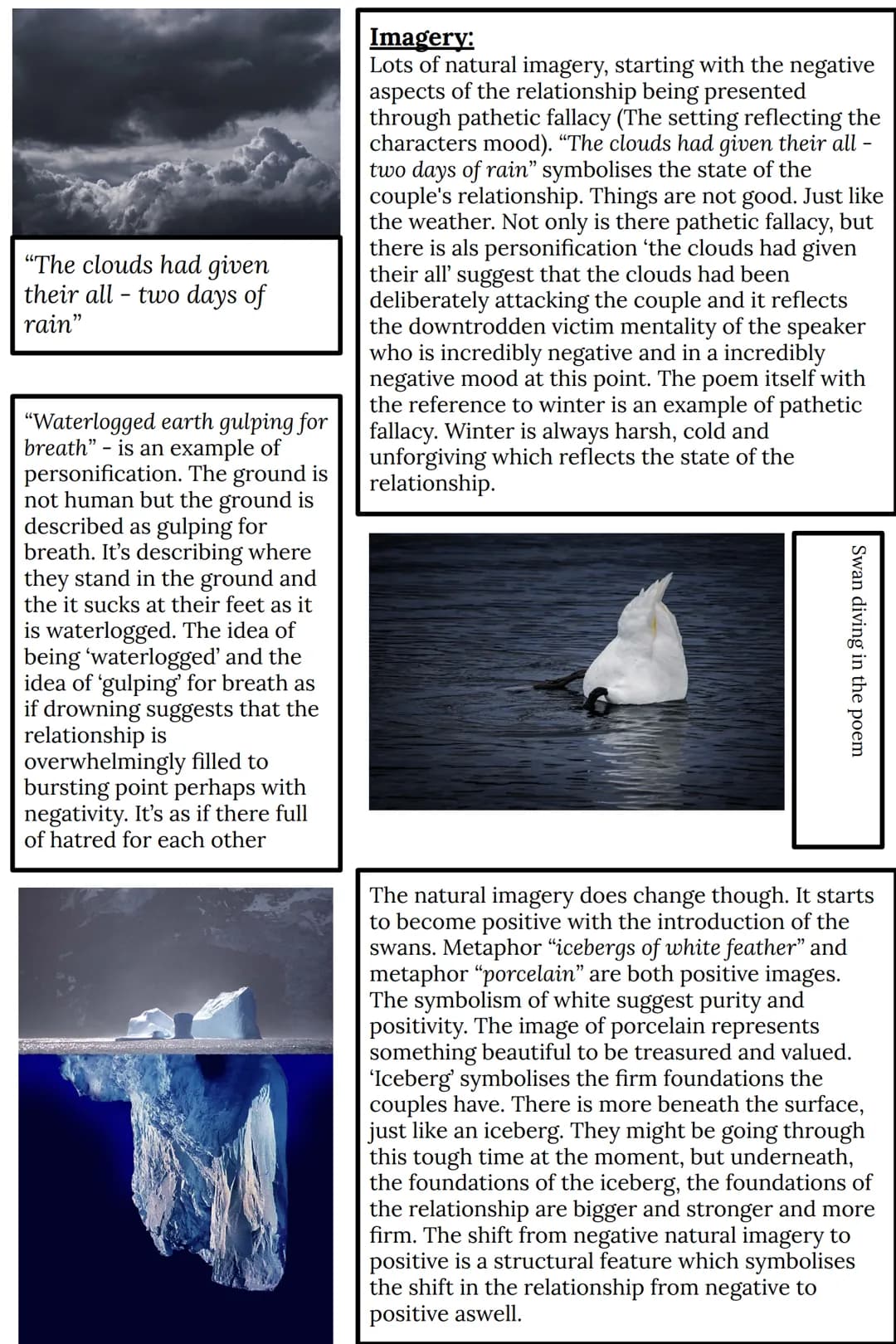
The poem makes effective use of enjambment, where sentences continue across line breaks. This technique is particularly notable in the first stanza:
Quote: "Two days of rain and then a break / In which we walked,"
The enjambment on the word "break" cleverly reflects both the break in the weather and the potential breaking point in the relationship.
Vocabulary: Enjambment - The continuation of a sentence or phrase beyond the end of a line of poetry.
The swans themselves serve as powerful symbols within the poem. Their synchronized movements are described as:
Quote: "A show of tipping in unison. / As if rolling weights down their bodies / to their heads"
This image of unity and togetherness provides a model for the human couple, suggesting that love and harmony are possible.
The final image of the swans is particularly striking:
Quote: "They halved themselves in the dark water"
This powerful metaphor reflects the moment of connection between the couple, suggesting a coming together of two halves.
Highlight: The poem's final couplet, diverging from the tercet structure, symbolizes the couple's reunion and the potential for a positive future in their relationship.
The analysis of "Winter Swans" reveals a complex exploration of relationship dynamics, using natural imagery and poetic structure to reflect emotional states. Unlike "Neutral Tones," this poem offers hope for renewal and connection, making it a compelling study of love's resilience in the face of challenges.
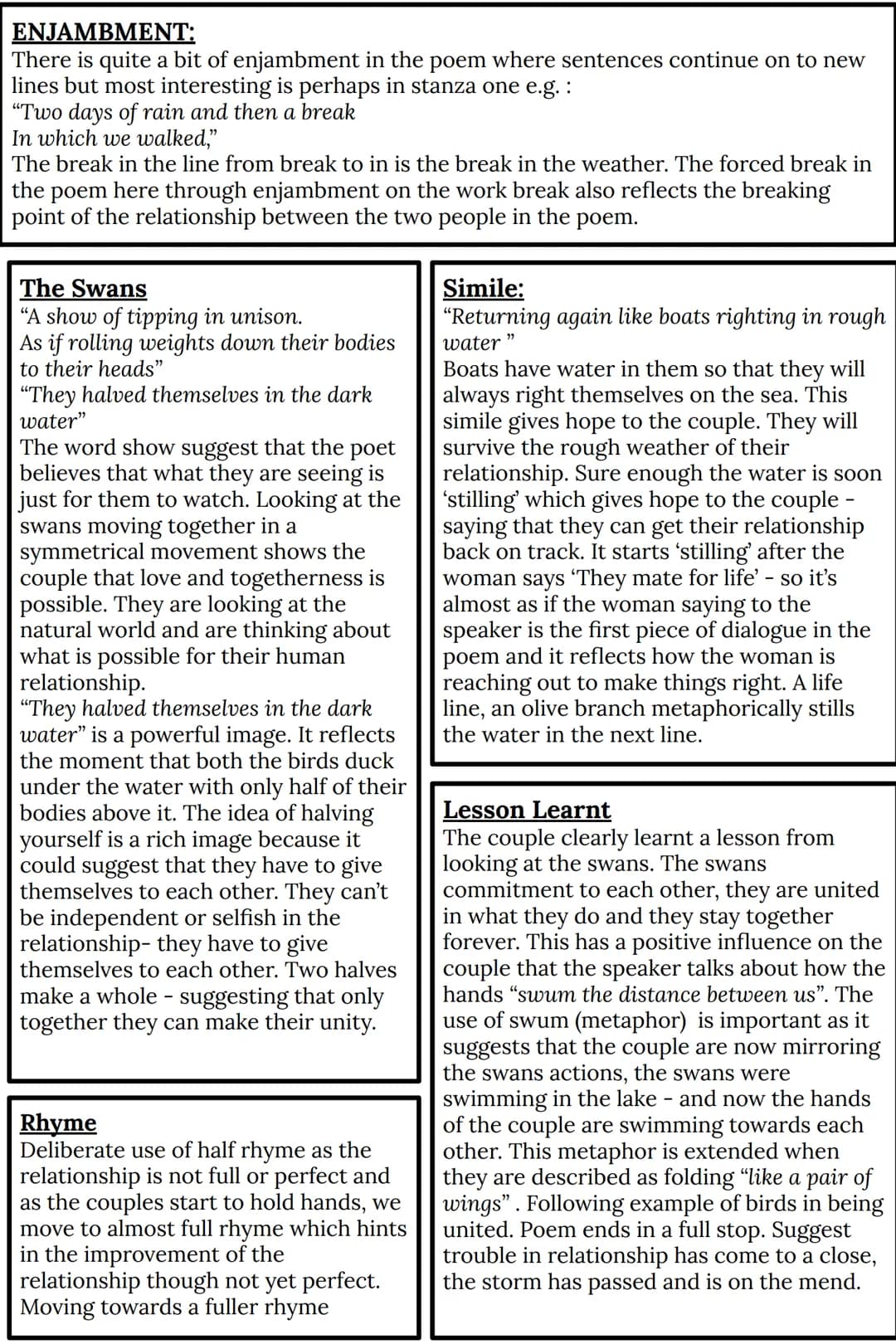
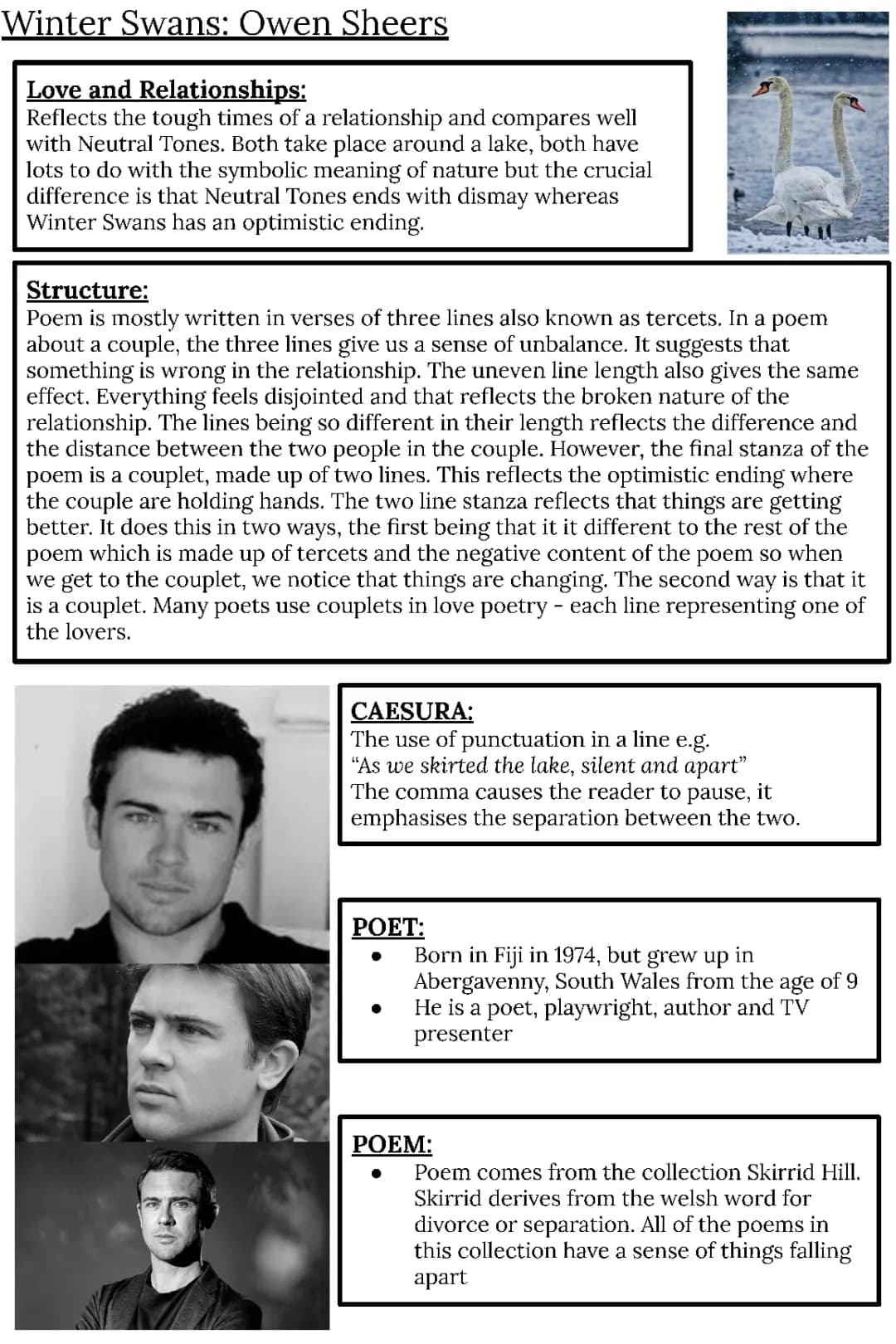
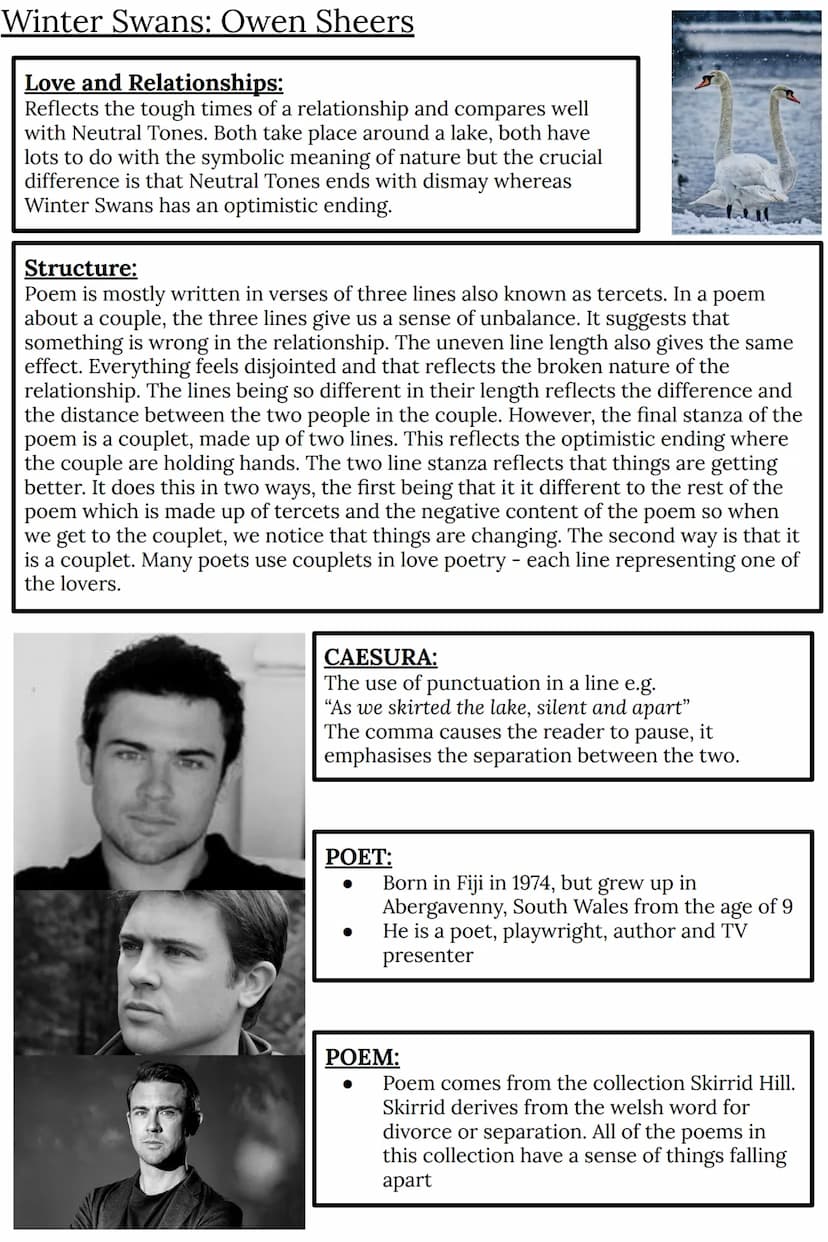
Owen Sheers' poem "Winter Swans" offers a nuanced exploration of love and relationships, drawing comparisons with Thomas Hardy's "Neutral Tones." Both poems utilize lake settings and natural symbolism, but "Winter Swans" distinguishes itself with an optimistic conclusion.
The poem's structure is primarily composed of tercets, which are three-line stanzas. This unusual structure creates a sense of imbalance, mirroring the instability in the relationship depicted. The varying line lengths further emphasize this disjointed feeling, reflecting the emotional distance between the couple.
Highlight: The use of tercets and uneven line lengths symbolizes the broken nature of the relationship and the differences between the two individuals.
A significant structural element is the use of caesura, a pause within a line created by punctuation. For example:
Quote: "As we skirted the lake, silent and apart"
This caesura emphasizes the separation between the couple, forcing the reader to pause and consider the emotional distance.
Vocabulary: Caesura - A pause or break within a line of poetry, often created by punctuation.
The poem comes from Sheers' collection "Skirrid Hill," with "Skirrid" derived from the Welsh word for divorce or separation. This context adds depth to the poem's exploration of relationship struggles.
Definition: Skirrid - A Welsh term related to divorce or separation, setting the thematic tone for the collection.
Our AI companion is specifically built for the needs of students. Based on the millions of content pieces we have on the platform we can provide truly meaningful and relevant answers to students. But its not only about answers, the companion is even more about guiding students through their daily learning challenges, with personalised study plans, quizzes or content pieces in the chat and 100% personalisation based on the students skills and developments.
You can download the app in the Google Play Store and in the Apple App Store.
That's right! Enjoy free access to study content, connect with fellow students, and get instant help – all at your fingertips.
App Store
Google Play
The app is very easy to use and well designed. I have found everything I was looking for so far and have been able to learn a lot from the presentations! I will definitely use the app for a class assignment! And of course it also helps a lot as an inspiration.
Stefan S
iOS user
This app is really great. There are so many study notes and help [...]. My problem subject is French, for example, and the app has so many options for help. Thanks to this app, I have improved my French. I would recommend it to anyone.
Samantha Klich
Android user
Wow, I am really amazed. I just tried the app because I've seen it advertised many times and was absolutely stunned. This app is THE HELP you want for school and above all, it offers so many things, such as workouts and fact sheets, which have been VERY helpful to me personally.
Anna
iOS user
I think it’s very much worth it and you’ll end up using it a lot once you get the hang of it and even after looking at others notes you can still ask your Artificial intelligence buddy the question and ask to simplify it if you still don’t get it!!! In the end I think it’s worth it 😊👍 ⚠️Also DID I MENTION ITS FREEE YOU DON’T HAVE TO PAY FOR ANYTHING AND STILL GET YOUR GRADES IN PERFECTLY❗️❗️⚠️
Thomas R
iOS user
Knowunity is the BEST app I’ve used in a minute. This is not an ai review or anything this is genuinely coming from a 7th grade student (I know 2011 im young) but dude this app is a 10/10 i have maintained a 3.8 gpa and have plenty of time for gaming. I love it and my mom is just happy I got good grades
Brad T
Android user
Not only did it help me find the answer but it also showed me alternative ways to solve it. I was horrible in math and science but now I have an a in both subjects. Thanks for the help🤍🤍
David K
iOS user
The app's just great! All I have to do is enter the topic in the search bar and I get the response real fast. I don't have to watch 10 YouTube videos to understand something, so I'm saving my time. Highly recommended!
Sudenaz Ocak
Android user
In school I was really bad at maths but thanks to the app, I am doing better now. I am so grateful that you made the app.
Greenlight Bonnie
Android user
I found this app a couple years ago and it has only gotten better since then. I really love it because it can help with written questions and photo questions. Also, it can find study guides that other people have made as well as flashcard sets and practice tests. The free version is also amazing for students who might not be able to afford it. Would 100% recommend
Aubrey
iOS user
Best app if you're in Highschool or Junior high. I have been using this app for 2 school years and it's the best, it's good if you don't have anyone to help you with school work.😋🩷🎀
Marco B
iOS user
THE QUIZES AND FLASHCARDS ARE SO USEFUL AND I LOVE THE SCHOOLGPT. IT ALSO IS LITREALLY LIKE CHATGPT BUT SMARTER!! HELPED ME WITH MY MASCARA PROBLEMS TOO!! AS WELL AS MY REAL SUBJECTS ! DUHHH 😍😁😲🤑💗✨🎀😮
Elisha
iOS user
This app is phenomenal down to the correct info and the various topics you can study! I greatly recommend it for people who struggle with procrastination and those who need homework help. It has been perfectly accurate for world 1 history as far as I’ve seen! Geometry too!
Paul T
iOS user
The app is very easy to use and well designed. I have found everything I was looking for so far and have been able to learn a lot from the presentations! I will definitely use the app for a class assignment! And of course it also helps a lot as an inspiration.
Stefan S
iOS user
This app is really great. There are so many study notes and help [...]. My problem subject is French, for example, and the app has so many options for help. Thanks to this app, I have improved my French. I would recommend it to anyone.
Samantha Klich
Android user
Wow, I am really amazed. I just tried the app because I've seen it advertised many times and was absolutely stunned. This app is THE HELP you want for school and above all, it offers so many things, such as workouts and fact sheets, which have been VERY helpful to me personally.
Anna
iOS user
I think it’s very much worth it and you’ll end up using it a lot once you get the hang of it and even after looking at others notes you can still ask your Artificial intelligence buddy the question and ask to simplify it if you still don’t get it!!! In the end I think it’s worth it 😊👍 ⚠️Also DID I MENTION ITS FREEE YOU DON’T HAVE TO PAY FOR ANYTHING AND STILL GET YOUR GRADES IN PERFECTLY❗️❗️⚠️
Thomas R
iOS user
Knowunity is the BEST app I’ve used in a minute. This is not an ai review or anything this is genuinely coming from a 7th grade student (I know 2011 im young) but dude this app is a 10/10 i have maintained a 3.8 gpa and have plenty of time for gaming. I love it and my mom is just happy I got good grades
Brad T
Android user
Not only did it help me find the answer but it also showed me alternative ways to solve it. I was horrible in math and science but now I have an a in both subjects. Thanks for the help🤍🤍
David K
iOS user
The app's just great! All I have to do is enter the topic in the search bar and I get the response real fast. I don't have to watch 10 YouTube videos to understand something, so I'm saving my time. Highly recommended!
Sudenaz Ocak
Android user
In school I was really bad at maths but thanks to the app, I am doing better now. I am so grateful that you made the app.
Greenlight Bonnie
Android user
I found this app a couple years ago and it has only gotten better since then. I really love it because it can help with written questions and photo questions. Also, it can find study guides that other people have made as well as flashcard sets and practice tests. The free version is also amazing for students who might not be able to afford it. Would 100% recommend
Aubrey
iOS user
Best app if you're in Highschool or Junior high. I have been using this app for 2 school years and it's the best, it's good if you don't have anyone to help you with school work.😋🩷🎀
Marco B
iOS user
THE QUIZES AND FLASHCARDS ARE SO USEFUL AND I LOVE THE SCHOOLGPT. IT ALSO IS LITREALLY LIKE CHATGPT BUT SMARTER!! HELPED ME WITH MY MASCARA PROBLEMS TOO!! AS WELL AS MY REAL SUBJECTS ! DUHHH 😍😁😲🤑💗✨🎀😮
Elisha
iOS user
This app is phenomenal down to the correct info and the various topics you can study! I greatly recommend it for people who struggle with procrastination and those who need homework help. It has been perfectly accurate for world 1 history as far as I’ve seen! Geometry too!
Paul T
iOS user
jana carney
@jana_carney
The poem "Winter Swans" by Owen Sheers explores themes of love, relationships, and nature, drawing parallels between the natural world and human emotions. It contrasts with "Neutral Tones" in its optimistic ending, despite both poems featuring lake settings and natural... Show more
Access to all documents
Improve your grades
Join milions of students
By signing up you accept Terms of Service and Privacy Policy
The poem begins with powerful natural imagery that reflects the couple's emotional state through pathetic fallacy. The opening lines set a somber tone:
Quote: "The clouds had given their all - two days of rain"
This imagery symbolizes the challenging state of the couple's relationship, with the personification of the clouds suggesting a deliberate attack on the couple. The winter setting itself serves as an extended metaphor for the harsh, cold state of their relationship.
Vocabulary: Pathetic fallacy - A literary device where the natural world reflects or corresponds to human emotions or experiences.
The poem's imagery shifts as swans are introduced, bringing more positive connotations. Metaphors such as "icebergs of white feather" and "porcelain" create beautiful, pure images. These positive descriptions symbolize the potential for renewal in the relationship.
Example: The metaphor "icebergs of white feather" suggests purity and strength, with the hidden depth of an iceberg representing the unseen strength of the couple's bond.
The transition from negative to positive natural imagery mirrors the shift in the relationship itself, serving as a structural feature that reinforces the poem's thematic progression.
Access to all documents
Improve your grades
Join milions of students
By signing up you accept Terms of Service and Privacy Policy
The poem makes effective use of enjambment, where sentences continue across line breaks. This technique is particularly notable in the first stanza:
Quote: "Two days of rain and then a break / In which we walked,"
The enjambment on the word "break" cleverly reflects both the break in the weather and the potential breaking point in the relationship.
Vocabulary: Enjambment - The continuation of a sentence or phrase beyond the end of a line of poetry.
The swans themselves serve as powerful symbols within the poem. Their synchronized movements are described as:
Quote: "A show of tipping in unison. / As if rolling weights down their bodies / to their heads"
This image of unity and togetherness provides a model for the human couple, suggesting that love and harmony are possible.
The final image of the swans is particularly striking:
Quote: "They halved themselves in the dark water"
This powerful metaphor reflects the moment of connection between the couple, suggesting a coming together of two halves.
Highlight: The poem's final couplet, diverging from the tercet structure, symbolizes the couple's reunion and the potential for a positive future in their relationship.
The analysis of "Winter Swans" reveals a complex exploration of relationship dynamics, using natural imagery and poetic structure to reflect emotional states. Unlike "Neutral Tones," this poem offers hope for renewal and connection, making it a compelling study of love's resilience in the face of challenges.
Access to all documents
Improve your grades
Join milions of students
By signing up you accept Terms of Service and Privacy Policy
Owen Sheers' poem "Winter Swans" offers a nuanced exploration of love and relationships, drawing comparisons with Thomas Hardy's "Neutral Tones." Both poems utilize lake settings and natural symbolism, but "Winter Swans" distinguishes itself with an optimistic conclusion.
The poem's structure is primarily composed of tercets, which are three-line stanzas. This unusual structure creates a sense of imbalance, mirroring the instability in the relationship depicted. The varying line lengths further emphasize this disjointed feeling, reflecting the emotional distance between the couple.
Highlight: The use of tercets and uneven line lengths symbolizes the broken nature of the relationship and the differences between the two individuals.
A significant structural element is the use of caesura, a pause within a line created by punctuation. For example:
Quote: "As we skirted the lake, silent and apart"
This caesura emphasizes the separation between the couple, forcing the reader to pause and consider the emotional distance.
Vocabulary: Caesura - A pause or break within a line of poetry, often created by punctuation.
The poem comes from Sheers' collection "Skirrid Hill," with "Skirrid" derived from the Welsh word for divorce or separation. This context adds depth to the poem's exploration of relationship struggles.
Definition: Skirrid - A Welsh term related to divorce or separation, setting the thematic tone for the collection.
Our AI companion is specifically built for the needs of students. Based on the millions of content pieces we have on the platform we can provide truly meaningful and relevant answers to students. But its not only about answers, the companion is even more about guiding students through their daily learning challenges, with personalised study plans, quizzes or content pieces in the chat and 100% personalisation based on the students skills and developments.
You can download the app in the Google Play Store and in the Apple App Store.
That's right! Enjoy free access to study content, connect with fellow students, and get instant help – all at your fingertips.
7
Smart Tools NEW
Transform this note into: ✓ 50+ Practice Questions ✓ Interactive Flashcards ✓ Full Mock Exam ✓ Essay Outlines
Explore the themes of power, legacy, and despair in Percy Bysshe Shelley's 'Ozymandias'. This mindmap highlights key annotations, including metaphors, imagery, and the ironic contrast between the king's ambition and his eventual downfall. Ideal for students studying literature and poetry analysis.
English LiteratureExplore Juliet's complex emotions and assertive nature in 'Romeo and Juliet'. This analysis delves into her struggle for autonomy, the impact of familial conflict, and her passionate love for Romeo. Key themes include fate, love, and the juxtaposition of life and death. Ideal for students studying character development and thematic elements in Shakespeare's work.
English LiteratureExplore a detailed analysis of Seamus Heaney's poem 'Follower,' focusing on themes of love, relationships, and the evolving parent-child dynamic. This study note delves into the poem's structure, use of rhyme, enjambment, and extended metaphors, highlighting the admiration and complexity of familial bonds. Ideal for students studying the Love and Relationships cluster in English Literature.
English LiteratureExplore the complex character of Inspector Goole in J.B. Priestley's 'An Inspector Calls'. This analysis delves into his symbolic representation of societal guilt, the impact of lighting changes, and key quotes that reveal his role as a powerful figure challenging the Birlings' superficiality. Understand the inspector's connection to socialism and the critique of capitalism, alongside the themes of intimacy and moral responsibility. Ideal for English Literature students seeking to deepen their understanding of character dynamics and thematic elements.
English LiteratureExplore a detailed analysis of Simon Armitage's poem 'The Manhunt,' focusing on its themes of PTSD, the emotional and physical scars of war, and the impact on relationships. This study note includes comparisons to 'A Wife in London' and highlights key metaphors and interpretations. Ideal for GCSE poetry studies.
English LiteratureDive into a comprehensive analysis of Carol Ann Duffy's 'Feminine Gospels' anthology. This resource offers detailed line-by-line breakdowns and contextual insights for each poem, exploring themes of femininity, identity, and societal expectations. Perfect for students seeking to deepen their understanding of Duffy's work and its implications.
English LiteratureApp Store
Google Play
The app is very easy to use and well designed. I have found everything I was looking for so far and have been able to learn a lot from the presentations! I will definitely use the app for a class assignment! And of course it also helps a lot as an inspiration.
Stefan S
iOS user
This app is really great. There are so many study notes and help [...]. My problem subject is French, for example, and the app has so many options for help. Thanks to this app, I have improved my French. I would recommend it to anyone.
Samantha Klich
Android user
Wow, I am really amazed. I just tried the app because I've seen it advertised many times and was absolutely stunned. This app is THE HELP you want for school and above all, it offers so many things, such as workouts and fact sheets, which have been VERY helpful to me personally.
Anna
iOS user
I think it’s very much worth it and you’ll end up using it a lot once you get the hang of it and even after looking at others notes you can still ask your Artificial intelligence buddy the question and ask to simplify it if you still don’t get it!!! In the end I think it’s worth it 😊👍 ⚠️Also DID I MENTION ITS FREEE YOU DON’T HAVE TO PAY FOR ANYTHING AND STILL GET YOUR GRADES IN PERFECTLY❗️❗️⚠️
Thomas R
iOS user
Knowunity is the BEST app I’ve used in a minute. This is not an ai review or anything this is genuinely coming from a 7th grade student (I know 2011 im young) but dude this app is a 10/10 i have maintained a 3.8 gpa and have plenty of time for gaming. I love it and my mom is just happy I got good grades
Brad T
Android user
Not only did it help me find the answer but it also showed me alternative ways to solve it. I was horrible in math and science but now I have an a in both subjects. Thanks for the help🤍🤍
David K
iOS user
The app's just great! All I have to do is enter the topic in the search bar and I get the response real fast. I don't have to watch 10 YouTube videos to understand something, so I'm saving my time. Highly recommended!
Sudenaz Ocak
Android user
In school I was really bad at maths but thanks to the app, I am doing better now. I am so grateful that you made the app.
Greenlight Bonnie
Android user
I found this app a couple years ago and it has only gotten better since then. I really love it because it can help with written questions and photo questions. Also, it can find study guides that other people have made as well as flashcard sets and practice tests. The free version is also amazing for students who might not be able to afford it. Would 100% recommend
Aubrey
iOS user
Best app if you're in Highschool or Junior high. I have been using this app for 2 school years and it's the best, it's good if you don't have anyone to help you with school work.😋🩷🎀
Marco B
iOS user
THE QUIZES AND FLASHCARDS ARE SO USEFUL AND I LOVE THE SCHOOLGPT. IT ALSO IS LITREALLY LIKE CHATGPT BUT SMARTER!! HELPED ME WITH MY MASCARA PROBLEMS TOO!! AS WELL AS MY REAL SUBJECTS ! DUHHH 😍😁😲🤑💗✨🎀😮
Elisha
iOS user
This app is phenomenal down to the correct info and the various topics you can study! I greatly recommend it for people who struggle with procrastination and those who need homework help. It has been perfectly accurate for world 1 history as far as I’ve seen! Geometry too!
Paul T
iOS user
The app is very easy to use and well designed. I have found everything I was looking for so far and have been able to learn a lot from the presentations! I will definitely use the app for a class assignment! And of course it also helps a lot as an inspiration.
Stefan S
iOS user
This app is really great. There are so many study notes and help [...]. My problem subject is French, for example, and the app has so many options for help. Thanks to this app, I have improved my French. I would recommend it to anyone.
Samantha Klich
Android user
Wow, I am really amazed. I just tried the app because I've seen it advertised many times and was absolutely stunned. This app is THE HELP you want for school and above all, it offers so many things, such as workouts and fact sheets, which have been VERY helpful to me personally.
Anna
iOS user
I think it’s very much worth it and you’ll end up using it a lot once you get the hang of it and even after looking at others notes you can still ask your Artificial intelligence buddy the question and ask to simplify it if you still don’t get it!!! In the end I think it’s worth it 😊👍 ⚠️Also DID I MENTION ITS FREEE YOU DON’T HAVE TO PAY FOR ANYTHING AND STILL GET YOUR GRADES IN PERFECTLY❗️❗️⚠️
Thomas R
iOS user
Knowunity is the BEST app I’ve used in a minute. This is not an ai review or anything this is genuinely coming from a 7th grade student (I know 2011 im young) but dude this app is a 10/10 i have maintained a 3.8 gpa and have plenty of time for gaming. I love it and my mom is just happy I got good grades
Brad T
Android user
Not only did it help me find the answer but it also showed me alternative ways to solve it. I was horrible in math and science but now I have an a in both subjects. Thanks for the help🤍🤍
David K
iOS user
The app's just great! All I have to do is enter the topic in the search bar and I get the response real fast. I don't have to watch 10 YouTube videos to understand something, so I'm saving my time. Highly recommended!
Sudenaz Ocak
Android user
In school I was really bad at maths but thanks to the app, I am doing better now. I am so grateful that you made the app.
Greenlight Bonnie
Android user
I found this app a couple years ago and it has only gotten better since then. I really love it because it can help with written questions and photo questions. Also, it can find study guides that other people have made as well as flashcard sets and practice tests. The free version is also amazing for students who might not be able to afford it. Would 100% recommend
Aubrey
iOS user
Best app if you're in Highschool or Junior high. I have been using this app for 2 school years and it's the best, it's good if you don't have anyone to help you with school work.😋🩷🎀
Marco B
iOS user
THE QUIZES AND FLASHCARDS ARE SO USEFUL AND I LOVE THE SCHOOLGPT. IT ALSO IS LITREALLY LIKE CHATGPT BUT SMARTER!! HELPED ME WITH MY MASCARA PROBLEMS TOO!! AS WELL AS MY REAL SUBJECTS ! DUHHH 😍😁😲🤑💗✨🎀😮
Elisha
iOS user
This app is phenomenal down to the correct info and the various topics you can study! I greatly recommend it for people who struggle with procrastination and those who need homework help. It has been perfectly accurate for world 1 history as far as I’ve seen! Geometry too!
Paul T
iOS user