
Earth's ecosystems rely on the constant movement and cycling of... Show more
 AP Environmental Science
 Algebra
 Biology
Sign up to see the contentIt's free!
Access to all documents
Improve your grades
Join milions of students
Knowunity AI
Subjects
Triangle Congruence and Similarity Theorems
Triangle Properties and Classification
Linear Equations and Graphs
Geometric Angle Relationships
Trigonometric Functions and Identities
Equation Solving Techniques
Circle Geometry Fundamentals
Division Operations and Methods
Basic Differentiation Rules
Exponent and Logarithm Properties
Show all topics
Human Organ Systems
Reproductive Cell Cycles
Biological Sciences Subdisciplines
Cellular Energy Metabolism
Autotrophic Energy Processes
Inheritance Patterns and Principles
Biomolecular Structure and Organization
Cell Cycle and Division Mechanics
Cellular Organization and Development
Biological Structural Organization
Show all topics
Chemical Sciences and Applications
Atomic Structure and Composition
Molecular Electron Structure Representation
Atomic Electron Behavior
Matter Properties and Water
Mole Concept and Calculations
Gas Laws and Behavior
Periodic Table Organization
Chemical Thermodynamics Fundamentals
Chemical Bond Types and Properties
Show all topics
European Renaissance and Enlightenment
European Cultural Movements 800-1920
American Revolution Era 1763-1797
American Civil War 1861-1865
Global Imperial Systems
Mongol and Chinese Dynasties
U.S. Presidents and World Leaders
Historical Sources and Documentation
World Wars Era and Impact
World Religious Systems
Show all topics
Classic and Contemporary Novels
Literary Character Analysis
Rhetorical Theory and Practice
Classic Literary Narratives
Reading Analysis and Interpretation
Narrative Structure and Techniques
English Language Components
Influential English-Language Authors
Basic Sentence Structure
Narrative Voice and Perspective
Show all topics
137
•
Updated Mar 24, 2026
•

Katelyn
@rosieanox
Earth's ecosystems rely on the constant movement and cycling of... Show more
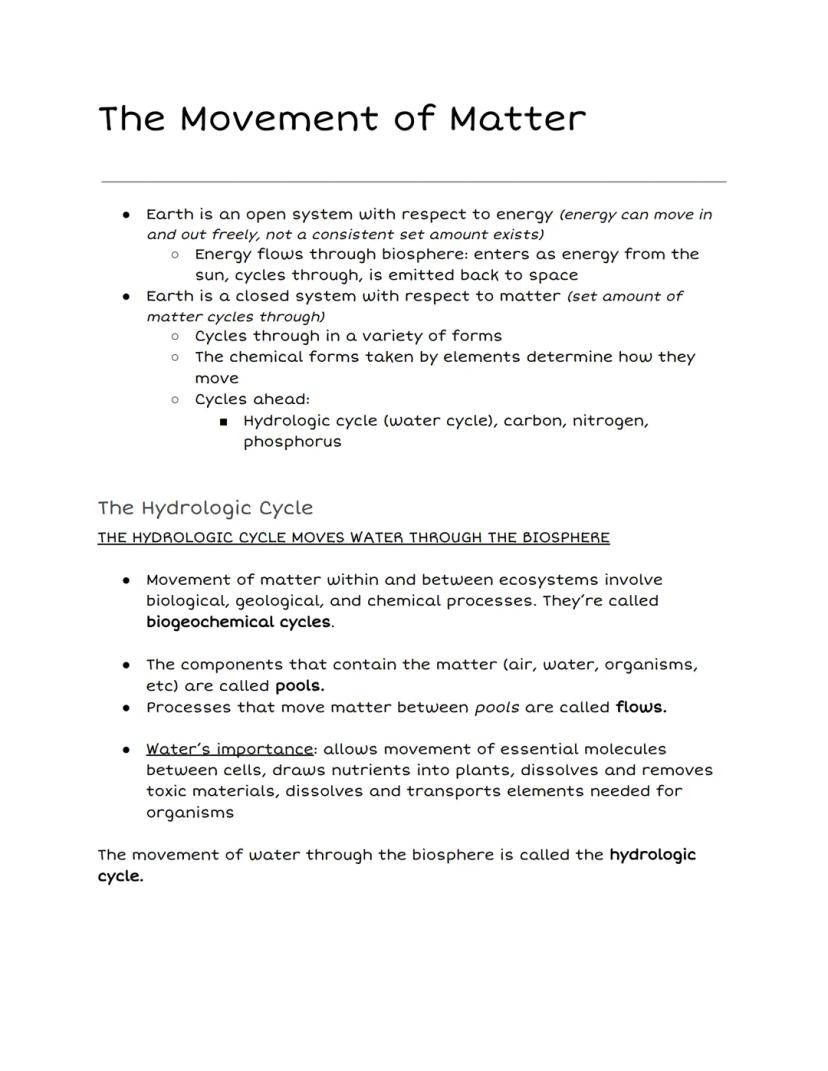
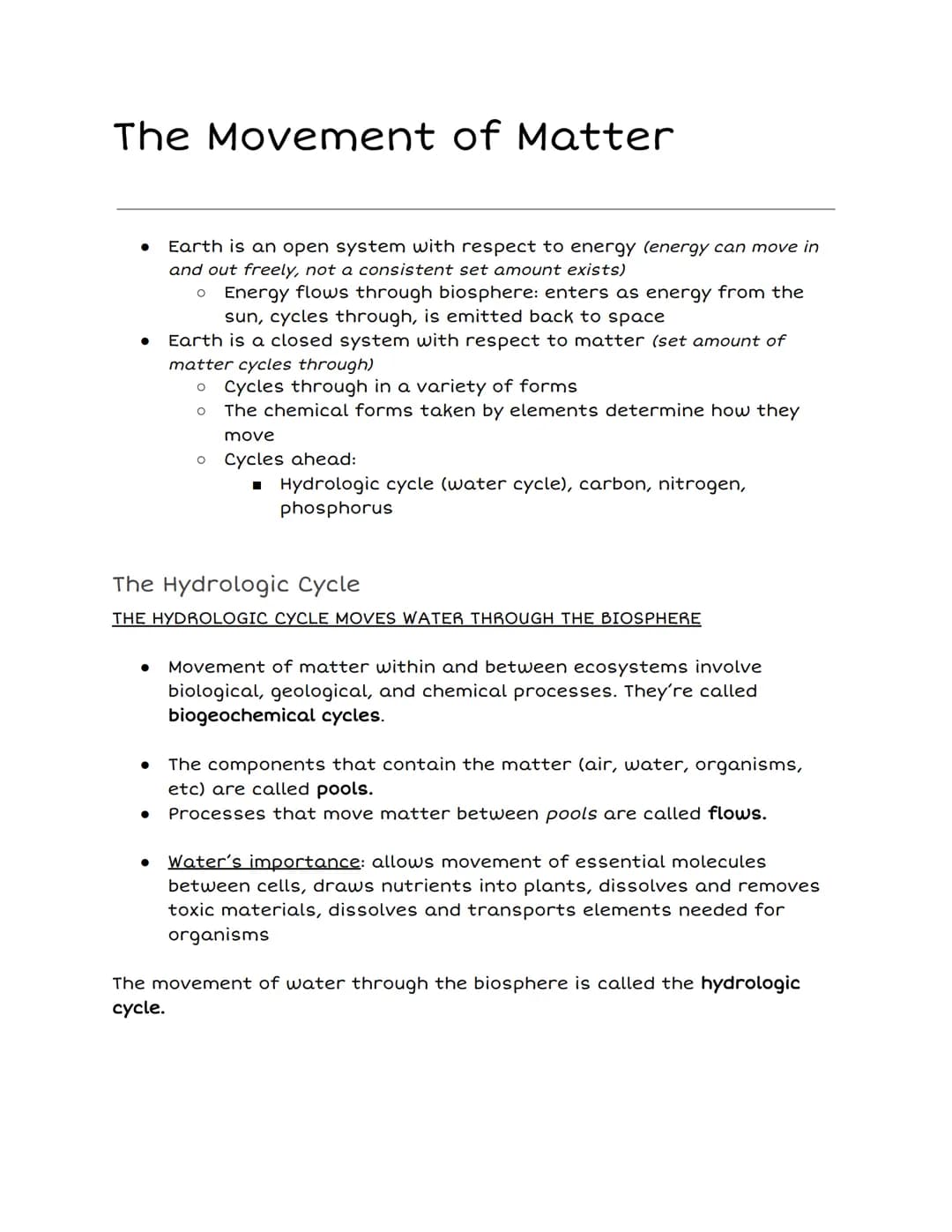
Earth functions as a closed system for matter but an open system for energy. While energy flows through our biosphere, entering as sunlight and eventually exiting as heat, the same finite amount of matter continuously cycles through Earth in different forms.
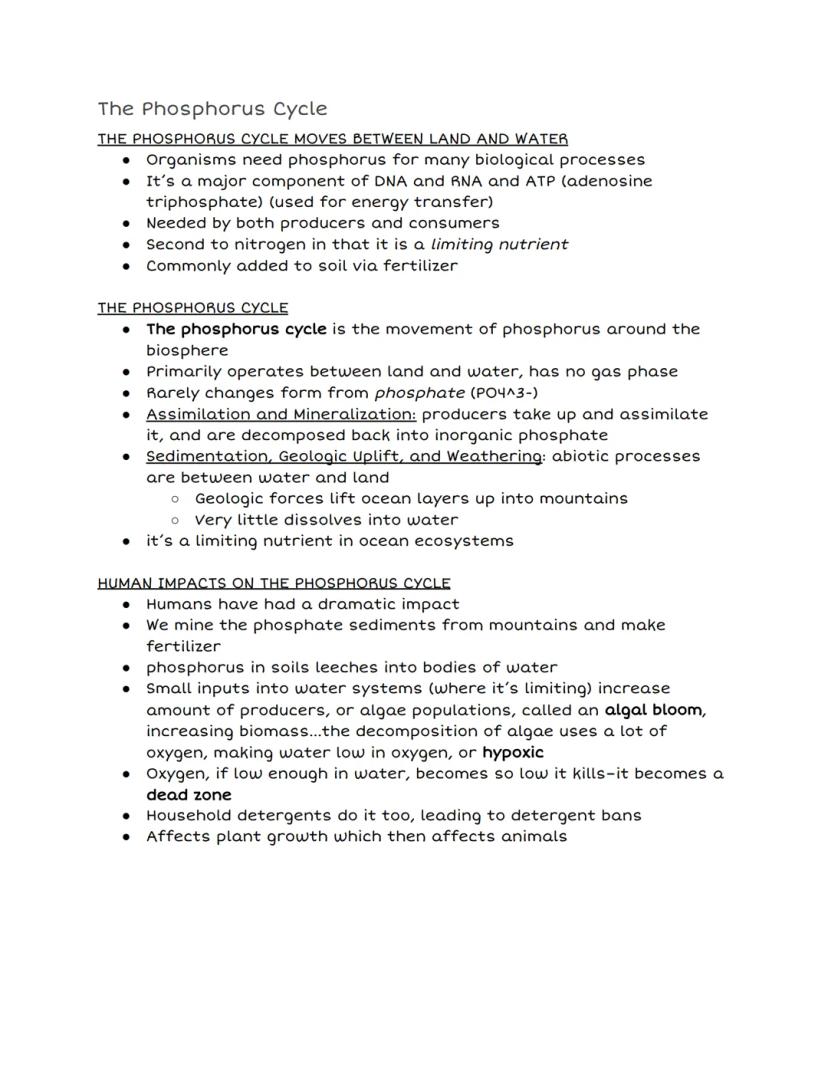
The movement of matter between ecosystems involves biological, geological, and chemical processes, collectively called biogeochemical cycles. These cycles move materials through different pools (like air, water, and organisms) via various flows or processes.
Water plays a crucial role in these cycles, transporting nutrients, dissolving waste, and supporting cellular functions. The hydrologic cycle describes water's continuous journey through the biosphere. This cycle is powered by the sun's energy, which causes water to evaporate from oceans, lakes, and soil surfaces, creating water vapor that eventually forms clouds and returns to Earth as precipitation.
Helpful Hint: Think of Earth like a snow globe - the same materials are always inside, they just move around and change form. The hydrologic cycle is the most familiar cycle and influences all other nutrient cycles.
When rain falls on land, it follows three main paths: it can evaporate back into the atmosphere, absorb into soil to become groundwater, or flow across the surface as runoff into streams and eventually back to the ocean.
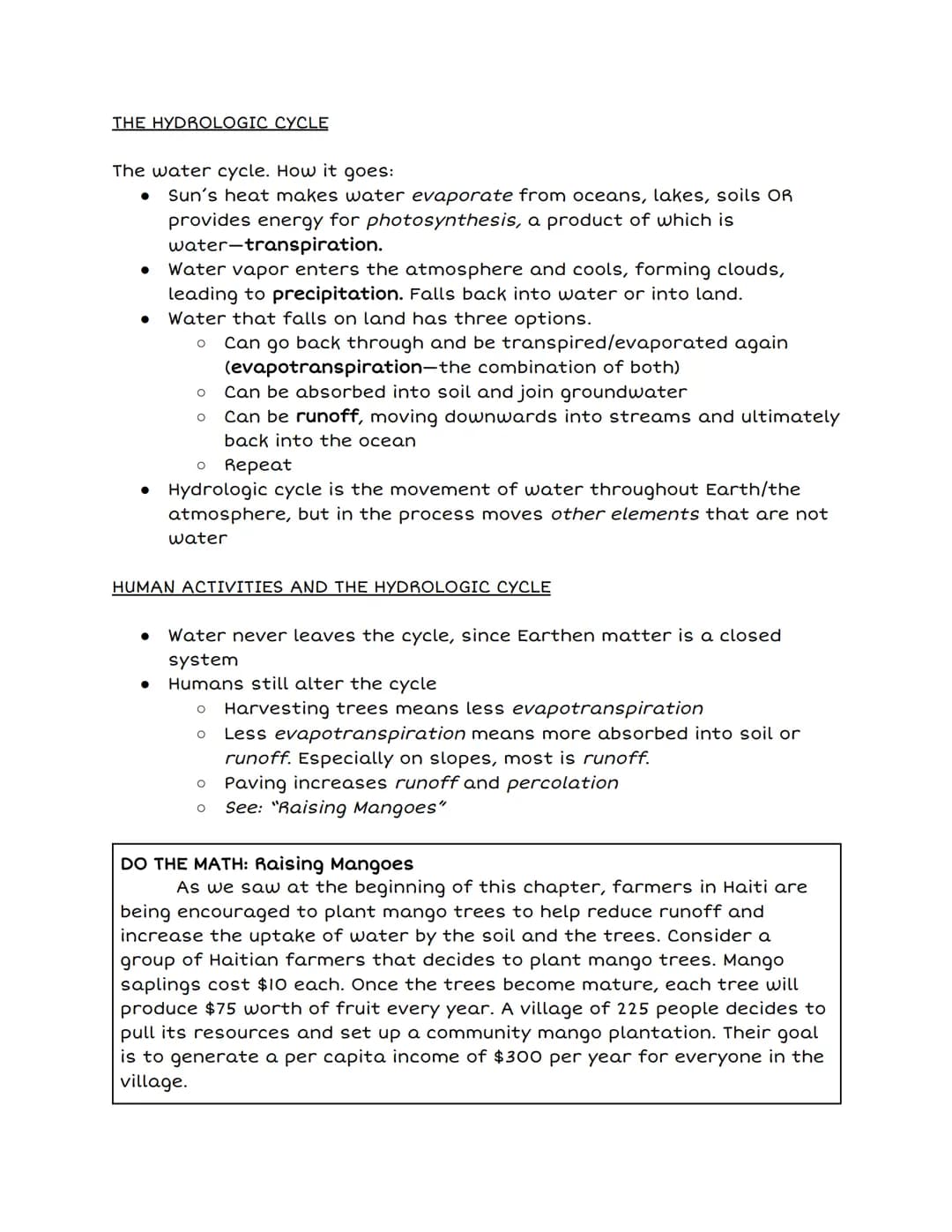
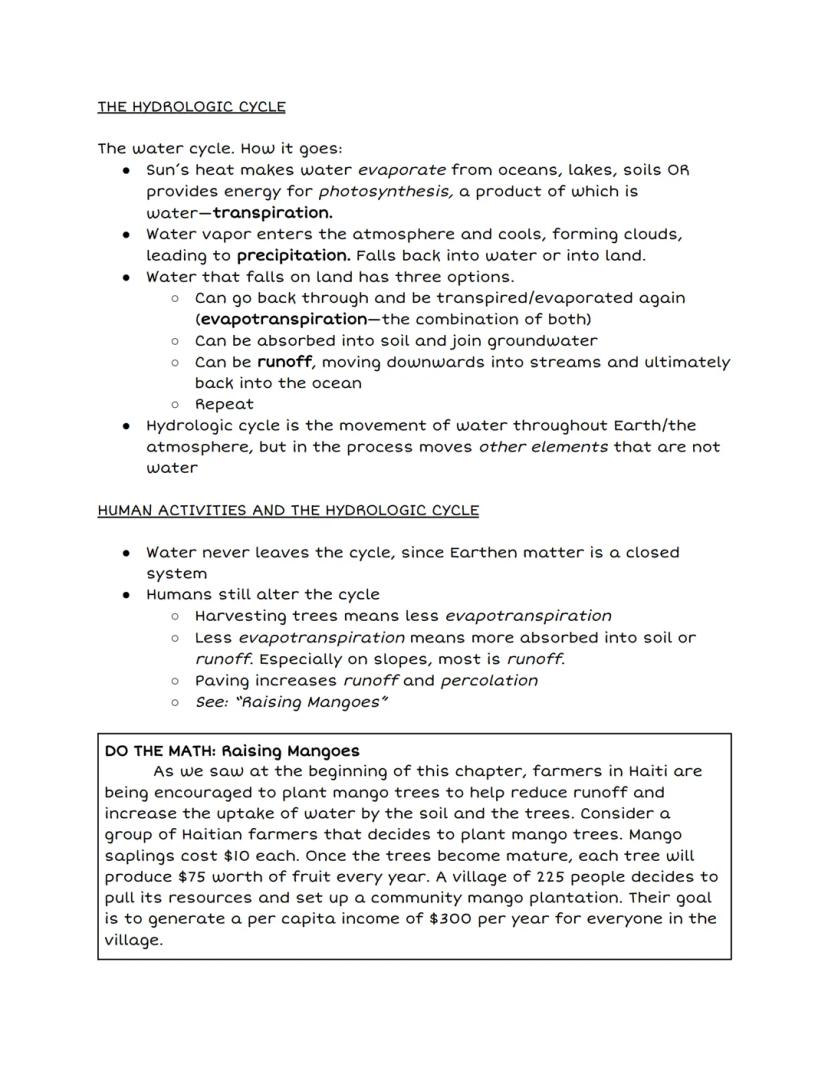
The water cycle keeps our planet's water in constant motion. The sun drives this process by heating water, causing evaporation from oceans and lakes. Plants release water vapor through transpiration during photosynthesis. Together, these processes are called evapotranspiration.
Water vapor rises into the atmosphere, cools to form clouds, and returns to Earth as precipitation. When rainfall hits land, it can:
Human activities significantly alter the water cycle even though water itself never leaves Earth's closed system. When we cut down forests, we reduce evapotranspiration. This means more water becomes runoff, especially on hillsides, leading to soil erosion and flooding.
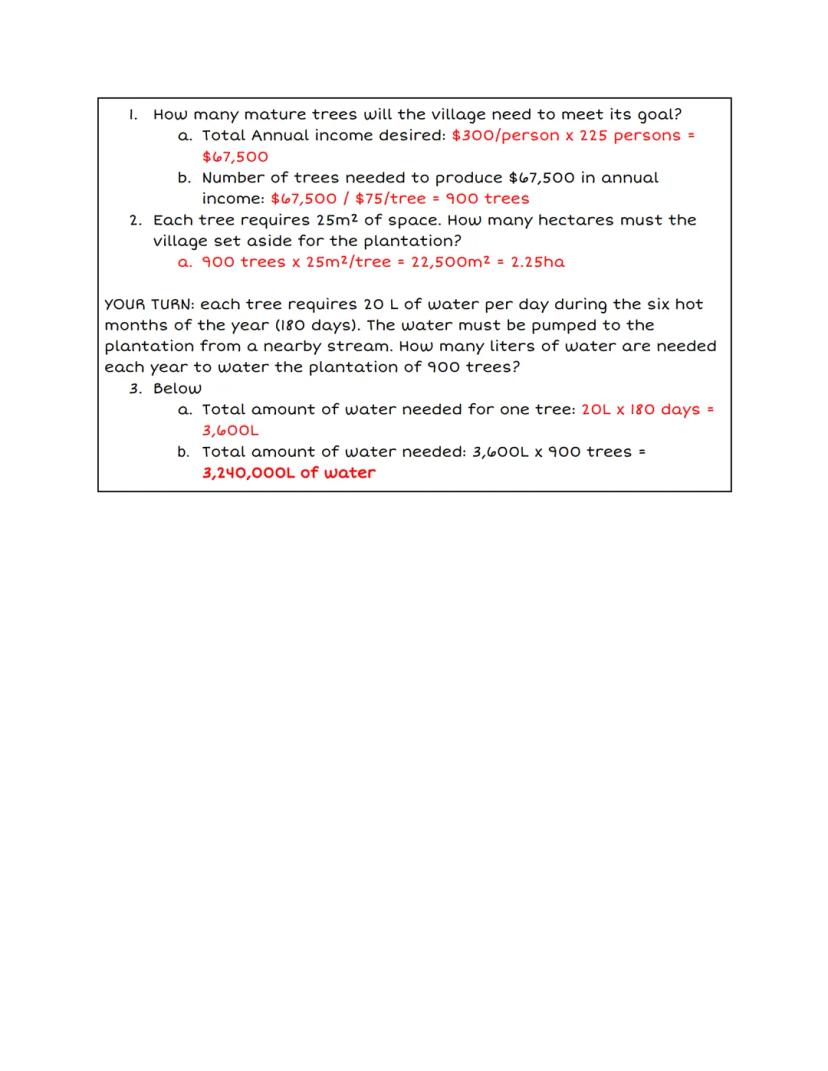
Real-World Application: In Haiti, farmers are planting mango trees to reduce runoff and increase water absorption. This not only helps manage water resources but also provides economic benefits through fruit production.
Urban development with paved surfaces prevents water from soaking into the ground, increasing runoff that can overwhelm storm drains and cause flooding. These disruptions to the natural water cycle can have far-reaching consequences for ecosystems and communities.
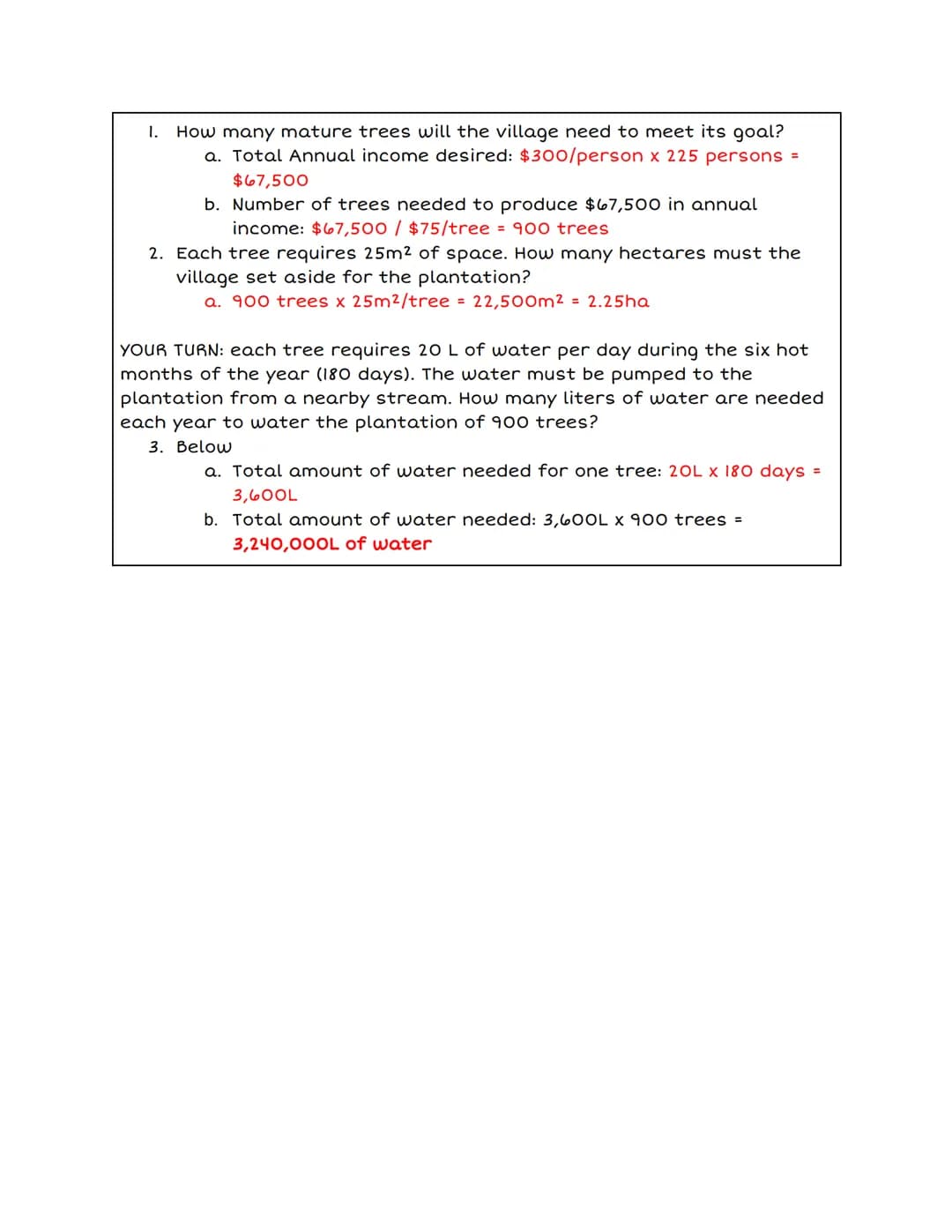
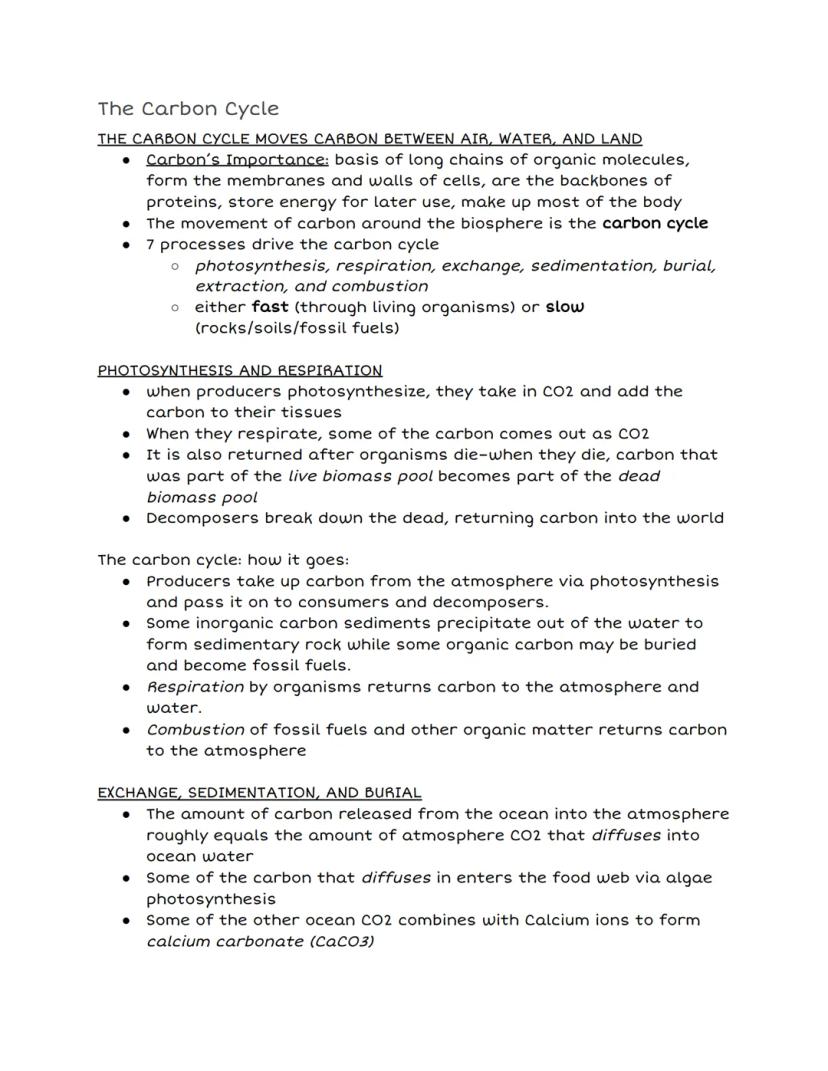
Carbon is essential for life on Earth. It forms the backbone of organic molecules that make up cell membranes, proteins, and energy storage compounds. The carbon cycle describes how this element moves through the atmosphere, oceans, and land.
Seven key processes drive the carbon cycle: photosynthesis, respiration, exchange, sedimentation, burial, extraction, and combustion. Some of these processes happen quickly through living organisms, while others occur slowly through rocks, soils, and fossil fuels.
During photosynthesis, producers like plants take CO₂ from the atmosphere and incorporate carbon into their tissues. Animals then consume plants, transferring this carbon up the food chain. Through respiration, both plants and animals release some carbon back to the atmosphere as CO₂.
Think About This: Every breath you take connects you to the carbon cycle. You inhale oxygen and exhale carbon dioxide, which plants then use for photosynthesis!
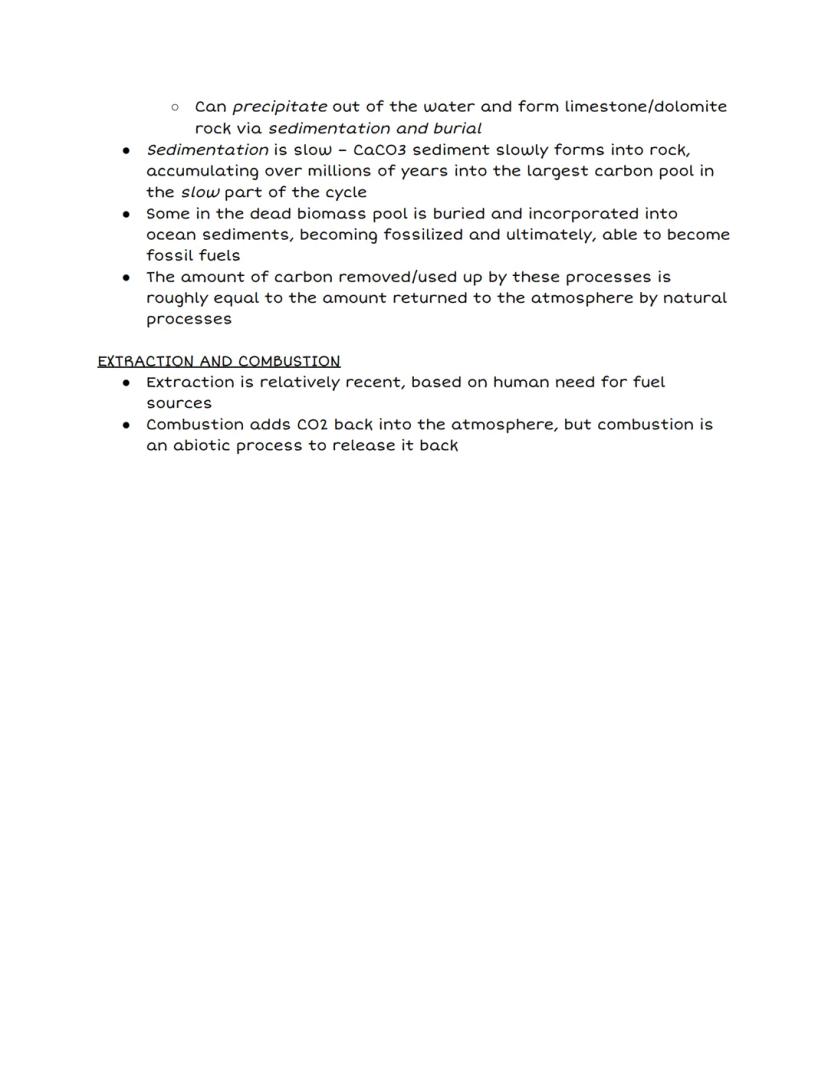
The oceans play a crucial role in the carbon cycle through exchange with the atmosphere. Some carbon in ocean water combines with calcium to form calcium carbonate (CaCO₃), which can precipitate out to eventually form limestone through sedimentation and burial. Some dead organic matter gets buried and, over millions of years, can transform into fossil fuels like coal and oil.
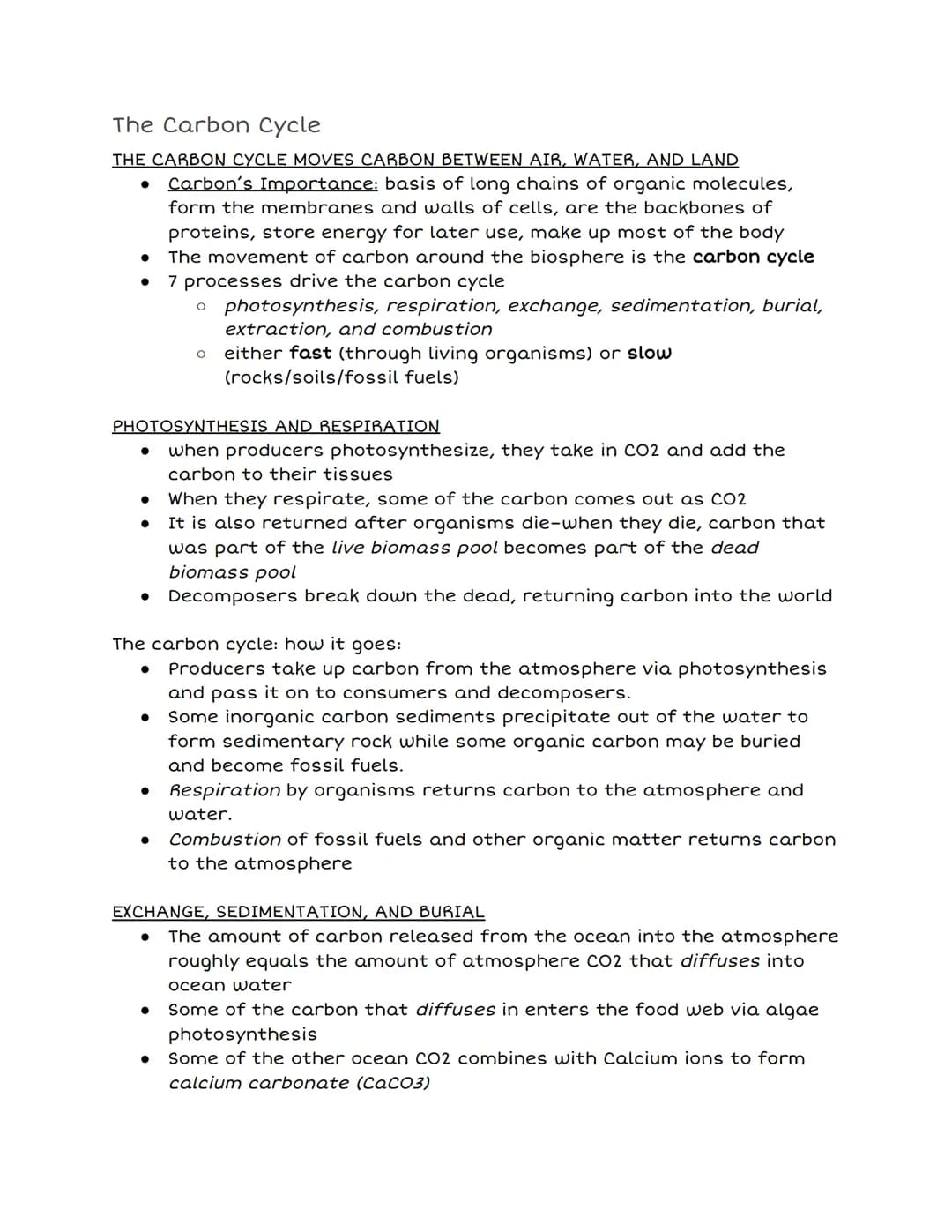
The carbon cycle involves both fast and slow processes that maintain balance in natural systems. When calcium carbonate (CaCO₃) precipitates out of ocean water, it slowly forms sedimentary rocks like limestone through sedimentation. This creates the largest carbon pool in the slow part of the cycle.
Dead organisms that get buried in ocean sediments may eventually become fossilized and transform into fossil fuels over millions of years. In natural systems, the amount of carbon removed by these slow processes roughly equals the carbon returned to the atmosphere by natural events like volcanic eruptions.
Extraction is a relatively recent process in Earth's history, driven by human needs for energy. When we extract and burn fossil fuels, we release carbon that has been stored underground for millions of years. This combustion adds carbon dioxide back to the atmosphere at rates much faster than natural processes.
Important Concept: The carbon cycle was largely balanced before human intervention. The carbon we release through burning fossil fuels was removed from the atmosphere millions of years ago and stored underground—now we're releasing it all at once!
Unlike the biological processes of respiration that return carbon to the atmosphere, combustion is an abiotic process that rapidly increases atmospheric carbon dioxide levels.
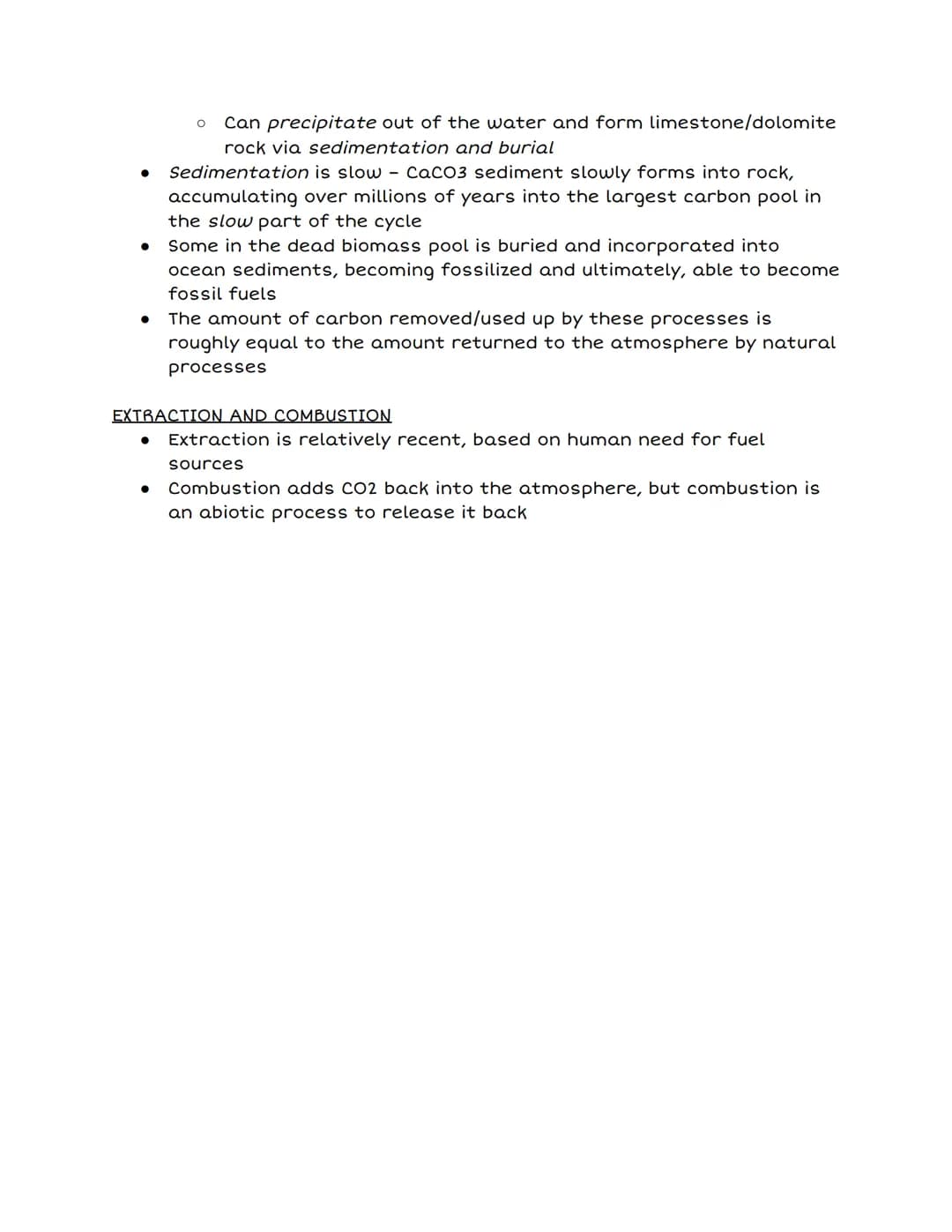
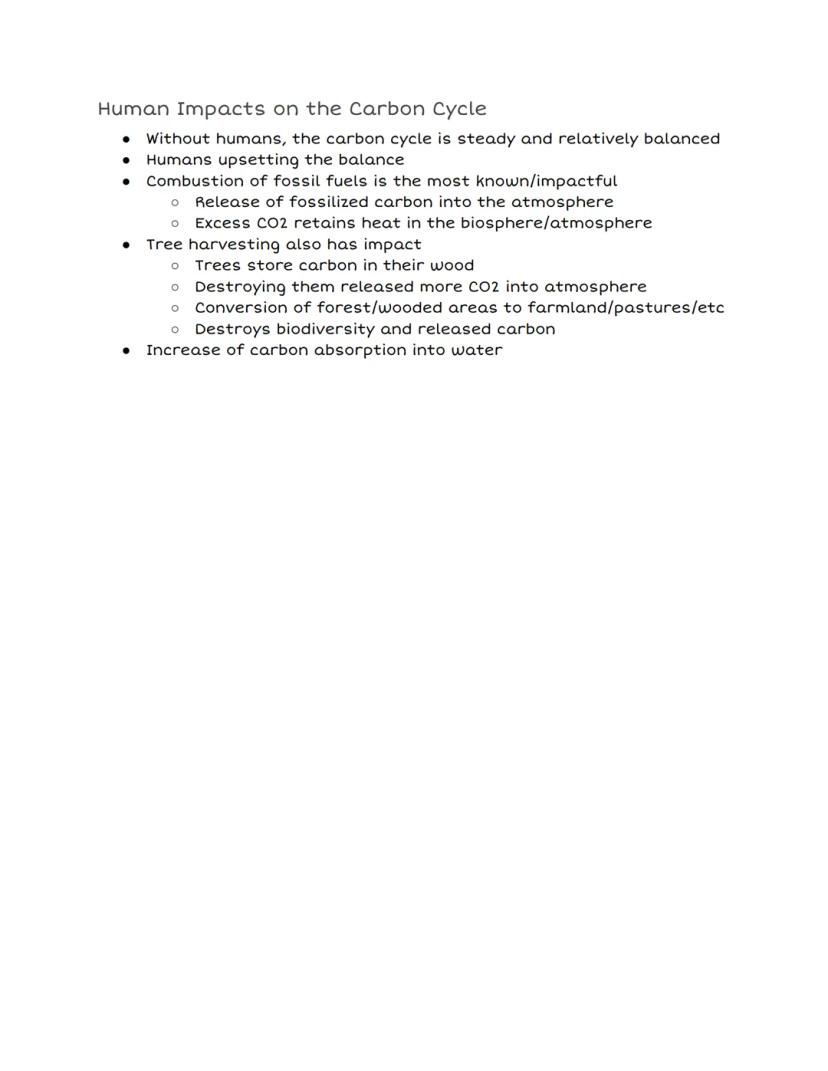
Humans have dramatically upset the balance of the carbon cycle that remained relatively steady for millions of years. Our activities are releasing carbon faster than natural processes can remove it from the atmosphere.
The combustion of fossil fuels is the most significant human impact. When we burn coal, oil, and natural gas, we release carbon that has been locked away underground for millions of years. This excess carbon dioxide in the atmosphere traps heat, contributing to global warming and climate change.
Deforestation is another major disruptor of the carbon cycle. Trees are natural carbon storage systems—they absorb CO₂ during photosynthesis and store carbon in their wood. When we cut down forests, we not only release the stored carbon but also reduce the planet's capacity to absorb carbon dioxide from the atmosphere.
Connect the Dots: When you drive a car or use electricity from coal-powered plants, you're participating in the altered carbon cycle. Small changes in your daily habits can help reduce carbon emissions!
Converting forests to farmland, pastures, or urban areas has the double impact of releasing stored carbon and destroying biodiversity. Additionally, increasing atmospheric CO₂ levels are causing more carbon to dissolve into oceans, leading to ocean acidification that threatens marine ecosystems.
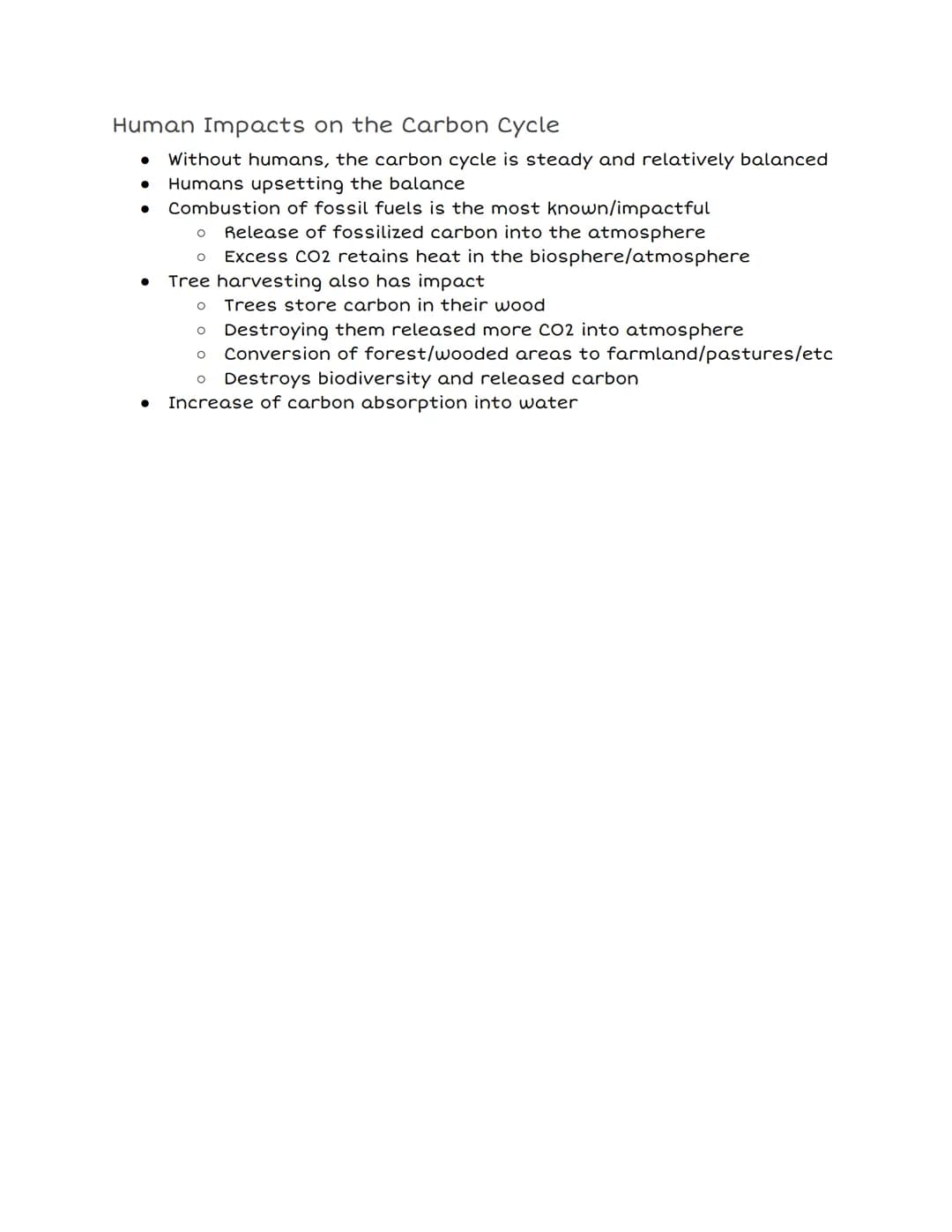
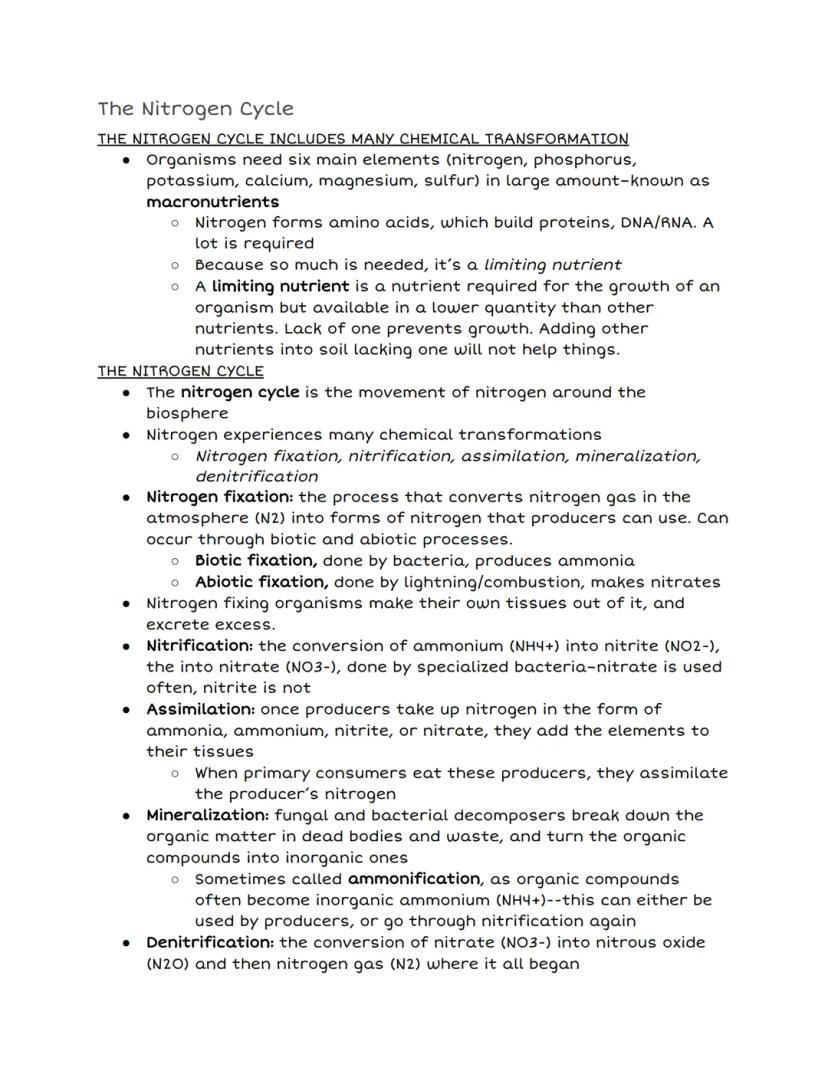
Nitrogen is a critical macronutrient that organisms need in large amounts to build proteins, DNA, and RNA. Despite making up 78% of our atmosphere, most organisms can't use nitrogen directly from the air because it exists as stable N₂ gas. This makes nitrogen a limiting nutrient in many ecosystems—meaning its availability can restrict growth even when other nutrients are abundant.
The nitrogen cycle involves several chemical transformations that convert nitrogen between different forms. Nitrogen fixation is the crucial first step that converts atmospheric N₂ into forms that producers can use. This happens through:
Once nitrogen is fixed, it undergoes nitrification by specialized bacteria that convert ammonium (NH₄⁺) to nitrite (NO₂⁻) and then to nitrate (NO₃⁻). Plants primarily absorb nitrogen as nitrate or ammonium through their roots in a process called assimilation, incorporating it into their tissues.
Cool Connection: Legumes like beans and peas have special relationships with nitrogen-fixing bacteria in their roots, which is why farmers often rotate crops with legumes to naturally replenish soil nitrogen!
When organisms die, decomposers break down their remains through mineralization (sometimes called ammonification), converting organic nitrogen compounds back into inorganic forms like ammonium. Finally, in oxygen-poor environments, denitrification converts nitrates back to nitrogen gas, completing the cycle.
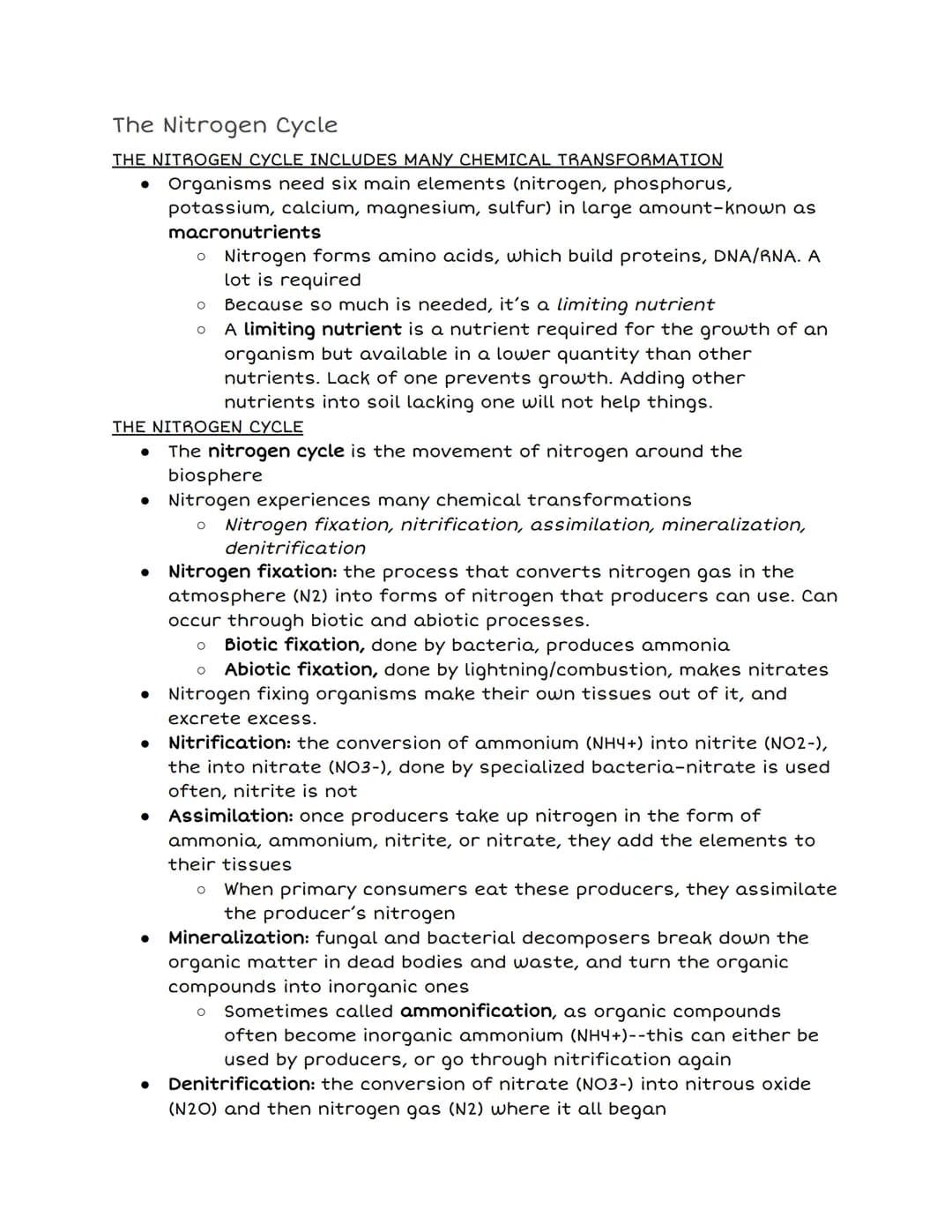
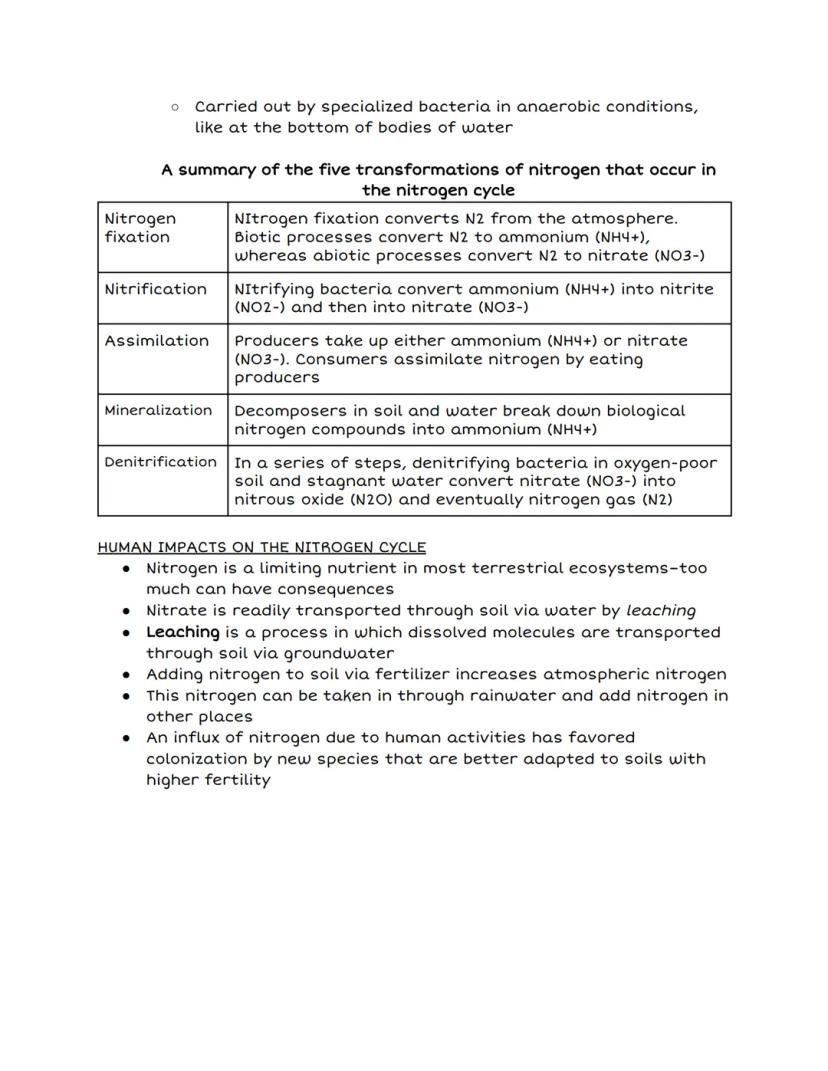
The nitrogen cycle involves five key transformations that convert nitrogen between different chemical forms. Each transformation is driven by specific organisms or processes:
Human activities have dramatically altered the natural nitrogen cycle. The invention of synthetic fertilizers has doubled the amount of fixed nitrogen entering ecosystems. This excess nitrogen causes significant environmental problems because it's easily transported through soil via water in a process called leaching.
Think About This: Before synthetic fertilizers, nitrogen availability limited agricultural production. Now we face the opposite problem—too much nitrogen in our environment!
Excess nitrogen in waterways causes algal blooms and dead zones, while nitrogen pollution in the atmosphere can travel long distances through rainfall. This disruption favors fast-growing species that thrive in nitrogen-rich environments, often at the expense of native plants adapted to lower-nitrogen conditions.
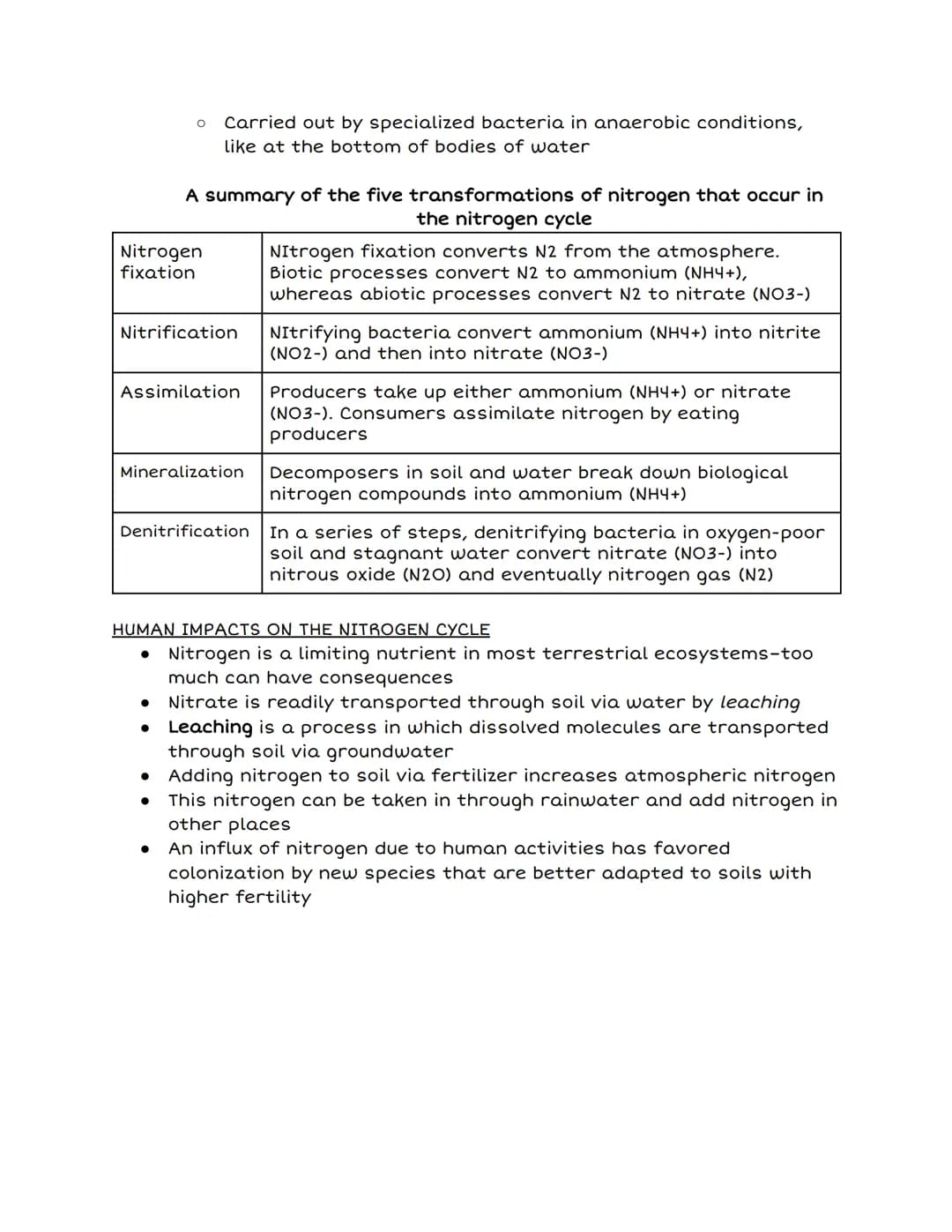
Phosphorus is another essential macronutrient that organisms need for DNA, RNA, and ATP (the energy currency of cells). Like nitrogen, phosphorus is often a limiting nutrient in ecosystems, especially in aquatic environments. Farmers commonly add phosphorus to soil through fertilizers to boost crop yields.
The phosphorus cycle differs from other biogeochemical cycles because it has no gaseous phase. Phosphorus primarily moves between land and water, usually in the form of phosphate (PO₄³⁻). The cycle involves several key processes:
Environmental Alert: Just one pound of phosphorus can cause the growth of 500 pounds of algae in a lake or stream!
Human activities have dramatically accelerated this cycle by mining phosphate rock for fertilizers. When excess phosphorus leaches into waterways, it causes algal blooms that can lead to hypoxic conditions. In extreme cases, oxygen levels drop so low that fish and other aquatic animals die, creating dead zones. This problem has led to restrictions on phosphates in detergents and increased attention to managing agricultural runoff.
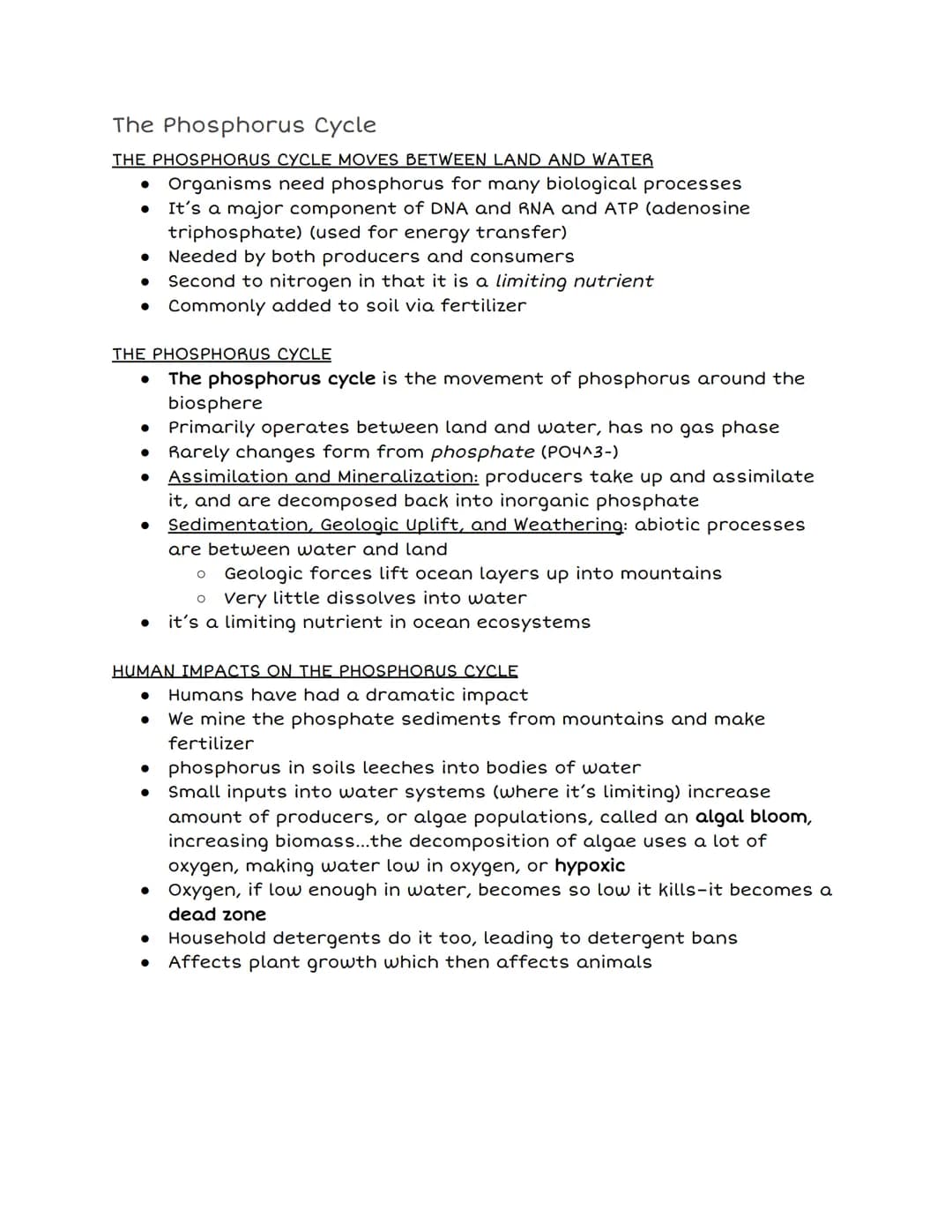
Beyond carbon, nitrogen, and phosphorus, several other elements are crucial for life and cycle through ecosystems in important ways. Calcium, magnesium, and potassium all play vital roles in cellular processes and messaging within organisms.
These elements typically originate from rocks and decomposing organisms. Because they carry positive charges, calcium and magnesium tend to bind to negatively charged particles in soil, especially in areas with limestone and marble. This makes them relatively stable in soil systems.
Potassium behaves differently, as it leaches more readily from soil. When potassium becomes depleted, ecosystems may struggle to support plant life, which in turn affects animals that depend on those plants.
Real-Life Connection: If you've ever taken a multivitamin or sports drink, you've probably consumed supplemental potassium, calcium, and magnesium—the same elements plants need from soil!
Sulfur is another essential element that enables organisms to use oxygen effectively. The sulfur cycle describes how this element moves through the biosphere. Volcanic eruptions naturally release significant amounts of sulfur into the atmosphere. However, human burning of fossil fuels has greatly increased sulfur dioxide emissions, contributing to acid rain and environmental damage.
Our AI companion is specifically built for the needs of students. Based on the millions of content pieces we have on the platform we can provide truly meaningful and relevant answers to students. But its not only about answers, the companion is even more about guiding students through their daily learning challenges, with personalised study plans, quizzes or content pieces in the chat and 100% personalisation based on the students skills and developments.
You can download the app in the Google Play Store and in the Apple App Store.
That's right! Enjoy free access to study content, connect with fellow students, and get instant help – all at your fingertips.
App Store
Google Play
The app is very easy to use and well designed. I have found everything I was looking for so far and have been able to learn a lot from the presentations! I will definitely use the app for a class assignment! And of course it also helps a lot as an inspiration.
Stefan S
iOS user
This app is really great. There are so many study notes and help [...]. My problem subject is French, for example, and the app has so many options for help. Thanks to this app, I have improved my French. I would recommend it to anyone.
Samantha Klich
Android user
Wow, I am really amazed. I just tried the app because I've seen it advertised many times and was absolutely stunned. This app is THE HELP you want for school and above all, it offers so many things, such as workouts and fact sheets, which have been VERY helpful to me personally.
Anna
iOS user
I think it’s very much worth it and you’ll end up using it a lot once you get the hang of it and even after looking at others notes you can still ask your Artificial intelligence buddy the question and ask to simplify it if you still don’t get it!!! In the end I think it’s worth it 😊👍 ⚠️Also DID I MENTION ITS FREEE YOU DON’T HAVE TO PAY FOR ANYTHING AND STILL GET YOUR GRADES IN PERFECTLY❗️❗️⚠️
Thomas R
iOS user
Knowunity is the BEST app I’ve used in a minute. This is not an ai review or anything this is genuinely coming from a 7th grade student (I know 2011 im young) but dude this app is a 10/10 i have maintained a 3.8 gpa and have plenty of time for gaming. I love it and my mom is just happy I got good grades
Brad T
Android user
Not only did it help me find the answer but it also showed me alternative ways to solve it. I was horrible in math and science but now I have an a in both subjects. Thanks for the help🤍🤍
David K
iOS user
The app's just great! All I have to do is enter the topic in the search bar and I get the response real fast. I don't have to watch 10 YouTube videos to understand something, so I'm saving my time. Highly recommended!
Sudenaz Ocak
Android user
In school I was really bad at maths but thanks to the app, I am doing better now. I am so grateful that you made the app.
Greenlight Bonnie
Android user
I found this app a couple years ago and it has only gotten better since then. I really love it because it can help with written questions and photo questions. Also, it can find study guides that other people have made as well as flashcard sets and practice tests. The free version is also amazing for students who might not be able to afford it. Would 100% recommend
Aubrey
iOS user
Best app if you're in Highschool or Junior high. I have been using this app for 2 school years and it's the best, it's good if you don't have anyone to help you with school work.😋🩷🎀
Marco B
iOS user
THE QUIZES AND FLASHCARDS ARE SO USEFUL AND I LOVE Knowunity AI. IT ALSO IS LITREALLY LIKE CHATGPT BUT SMARTER!! HELPED ME WITH MY MASCARA PROBLEMS TOO!! AS WELL AS MY REAL SUBJECTS ! DUHHH 😍😁😲🤑💗✨🎀😮
Elisha
iOS user
This app is phenomenal down to the correct info and the various topics you can study! I greatly recommend it for people who struggle with procrastination and those who need homework help. It has been perfectly accurate for world 1 history as far as I’ve seen! Geometry too!
Paul T
iOS user
The app is very easy to use and well designed. I have found everything I was looking for so far and have been able to learn a lot from the presentations! I will definitely use the app for a class assignment! And of course it also helps a lot as an inspiration.
Stefan S
iOS user
This app is really great. There are so many study notes and help [...]. My problem subject is French, for example, and the app has so many options for help. Thanks to this app, I have improved my French. I would recommend it to anyone.
Samantha Klich
Android user
Wow, I am really amazed. I just tried the app because I've seen it advertised many times and was absolutely stunned. This app is THE HELP you want for school and above all, it offers so many things, such as workouts and fact sheets, which have been VERY helpful to me personally.
Anna
iOS user
I think it’s very much worth it and you’ll end up using it a lot once you get the hang of it and even after looking at others notes you can still ask your Artificial intelligence buddy the question and ask to simplify it if you still don’t get it!!! In the end I think it’s worth it 😊👍 ⚠️Also DID I MENTION ITS FREEE YOU DON’T HAVE TO PAY FOR ANYTHING AND STILL GET YOUR GRADES IN PERFECTLY❗️❗️⚠️
Thomas R
iOS user
Knowunity is the BEST app I’ve used in a minute. This is not an ai review or anything this is genuinely coming from a 7th grade student (I know 2011 im young) but dude this app is a 10/10 i have maintained a 3.8 gpa and have plenty of time for gaming. I love it and my mom is just happy I got good grades
Brad T
Android user
Not only did it help me find the answer but it also showed me alternative ways to solve it. I was horrible in math and science but now I have an a in both subjects. Thanks for the help🤍🤍
David K
iOS user
The app's just great! All I have to do is enter the topic in the search bar and I get the response real fast. I don't have to watch 10 YouTube videos to understand something, so I'm saving my time. Highly recommended!
Sudenaz Ocak
Android user
In school I was really bad at maths but thanks to the app, I am doing better now. I am so grateful that you made the app.
Greenlight Bonnie
Android user
I found this app a couple years ago and it has only gotten better since then. I really love it because it can help with written questions and photo questions. Also, it can find study guides that other people have made as well as flashcard sets and practice tests. The free version is also amazing for students who might not be able to afford it. Would 100% recommend
Aubrey
iOS user
Best app if you're in Highschool or Junior high. I have been using this app for 2 school years and it's the best, it's good if you don't have anyone to help you with school work.😋🩷🎀
Marco B
iOS user
THE QUIZES AND FLASHCARDS ARE SO USEFUL AND I LOVE Knowunity AI. IT ALSO IS LITREALLY LIKE CHATGPT BUT SMARTER!! HELPED ME WITH MY MASCARA PROBLEMS TOO!! AS WELL AS MY REAL SUBJECTS ! DUHHH 😍😁😲🤑💗✨🎀😮
Elisha
iOS user
This app is phenomenal down to the correct info and the various topics you can study! I greatly recommend it for people who struggle with procrastination and those who need homework help. It has been perfectly accurate for world 1 history as far as I’ve seen! Geometry too!
Paul T
iOS user
Katelyn
@rosieanox
Earth's ecosystems rely on the constant movement and cycling of matter. These biogeochemical cycles connect living and non-living components of our planet, showing how water, carbon, nitrogen, and other essential elements move through the environment. Understanding these cycles helps explain... Show more
Access to all documents
Improve your grades
Join milions of students
Earth functions as a closed system for matter but an open system for energy. While energy flows through our biosphere, entering as sunlight and eventually exiting as heat, the same finite amount of matter continuously cycles through Earth in different forms.
The movement of matter between ecosystems involves biological, geological, and chemical processes, collectively called biogeochemical cycles. These cycles move materials through different pools (like air, water, and organisms) via various flows or processes.
Water plays a crucial role in these cycles, transporting nutrients, dissolving waste, and supporting cellular functions. The hydrologic cycle describes water's continuous journey through the biosphere. This cycle is powered by the sun's energy, which causes water to evaporate from oceans, lakes, and soil surfaces, creating water vapor that eventually forms clouds and returns to Earth as precipitation.
Helpful Hint: Think of Earth like a snow globe - the same materials are always inside, they just move around and change form. The hydrologic cycle is the most familiar cycle and influences all other nutrient cycles.
When rain falls on land, it follows three main paths: it can evaporate back into the atmosphere, absorb into soil to become groundwater, or flow across the surface as runoff into streams and eventually back to the ocean.
Access to all documents
Improve your grades
Join milions of students
The water cycle keeps our planet's water in constant motion. The sun drives this process by heating water, causing evaporation from oceans and lakes. Plants release water vapor through transpiration during photosynthesis. Together, these processes are called evapotranspiration.
Water vapor rises into the atmosphere, cools to form clouds, and returns to Earth as precipitation. When rainfall hits land, it can:
Human activities significantly alter the water cycle even though water itself never leaves Earth's closed system. When we cut down forests, we reduce evapotranspiration. This means more water becomes runoff, especially on hillsides, leading to soil erosion and flooding.
Real-World Application: In Haiti, farmers are planting mango trees to reduce runoff and increase water absorption. This not only helps manage water resources but also provides economic benefits through fruit production.
Urban development with paved surfaces prevents water from soaking into the ground, increasing runoff that can overwhelm storm drains and cause flooding. These disruptions to the natural water cycle can have far-reaching consequences for ecosystems and communities.
Access to all documents
Improve your grades
Join milions of students
Carbon is essential for life on Earth. It forms the backbone of organic molecules that make up cell membranes, proteins, and energy storage compounds. The carbon cycle describes how this element moves through the atmosphere, oceans, and land.
Seven key processes drive the carbon cycle: photosynthesis, respiration, exchange, sedimentation, burial, extraction, and combustion. Some of these processes happen quickly through living organisms, while others occur slowly through rocks, soils, and fossil fuels.
During photosynthesis, producers like plants take CO₂ from the atmosphere and incorporate carbon into their tissues. Animals then consume plants, transferring this carbon up the food chain. Through respiration, both plants and animals release some carbon back to the atmosphere as CO₂.
Think About This: Every breath you take connects you to the carbon cycle. You inhale oxygen and exhale carbon dioxide, which plants then use for photosynthesis!
The oceans play a crucial role in the carbon cycle through exchange with the atmosphere. Some carbon in ocean water combines with calcium to form calcium carbonate (CaCO₃), which can precipitate out to eventually form limestone through sedimentation and burial. Some dead organic matter gets buried and, over millions of years, can transform into fossil fuels like coal and oil.
Access to all documents
Improve your grades
Join milions of students
The carbon cycle involves both fast and slow processes that maintain balance in natural systems. When calcium carbonate (CaCO₃) precipitates out of ocean water, it slowly forms sedimentary rocks like limestone through sedimentation. This creates the largest carbon pool in the slow part of the cycle.
Dead organisms that get buried in ocean sediments may eventually become fossilized and transform into fossil fuels over millions of years. In natural systems, the amount of carbon removed by these slow processes roughly equals the carbon returned to the atmosphere by natural events like volcanic eruptions.
Extraction is a relatively recent process in Earth's history, driven by human needs for energy. When we extract and burn fossil fuels, we release carbon that has been stored underground for millions of years. This combustion adds carbon dioxide back to the atmosphere at rates much faster than natural processes.
Important Concept: The carbon cycle was largely balanced before human intervention. The carbon we release through burning fossil fuels was removed from the atmosphere millions of years ago and stored underground—now we're releasing it all at once!
Unlike the biological processes of respiration that return carbon to the atmosphere, combustion is an abiotic process that rapidly increases atmospheric carbon dioxide levels.
Access to all documents
Improve your grades
Join milions of students
Humans have dramatically upset the balance of the carbon cycle that remained relatively steady for millions of years. Our activities are releasing carbon faster than natural processes can remove it from the atmosphere.
The combustion of fossil fuels is the most significant human impact. When we burn coal, oil, and natural gas, we release carbon that has been locked away underground for millions of years. This excess carbon dioxide in the atmosphere traps heat, contributing to global warming and climate change.
Deforestation is another major disruptor of the carbon cycle. Trees are natural carbon storage systems—they absorb CO₂ during photosynthesis and store carbon in their wood. When we cut down forests, we not only release the stored carbon but also reduce the planet's capacity to absorb carbon dioxide from the atmosphere.
Connect the Dots: When you drive a car or use electricity from coal-powered plants, you're participating in the altered carbon cycle. Small changes in your daily habits can help reduce carbon emissions!
Converting forests to farmland, pastures, or urban areas has the double impact of releasing stored carbon and destroying biodiversity. Additionally, increasing atmospheric CO₂ levels are causing more carbon to dissolve into oceans, leading to ocean acidification that threatens marine ecosystems.
Access to all documents
Improve your grades
Join milions of students
Nitrogen is a critical macronutrient that organisms need in large amounts to build proteins, DNA, and RNA. Despite making up 78% of our atmosphere, most organisms can't use nitrogen directly from the air because it exists as stable N₂ gas. This makes nitrogen a limiting nutrient in many ecosystems—meaning its availability can restrict growth even when other nutrients are abundant.
The nitrogen cycle involves several chemical transformations that convert nitrogen between different forms. Nitrogen fixation is the crucial first step that converts atmospheric N₂ into forms that producers can use. This happens through:
Once nitrogen is fixed, it undergoes nitrification by specialized bacteria that convert ammonium (NH₄⁺) to nitrite (NO₂⁻) and then to nitrate (NO₃⁻). Plants primarily absorb nitrogen as nitrate or ammonium through their roots in a process called assimilation, incorporating it into their tissues.
Cool Connection: Legumes like beans and peas have special relationships with nitrogen-fixing bacteria in their roots, which is why farmers often rotate crops with legumes to naturally replenish soil nitrogen!
When organisms die, decomposers break down their remains through mineralization (sometimes called ammonification), converting organic nitrogen compounds back into inorganic forms like ammonium. Finally, in oxygen-poor environments, denitrification converts nitrates back to nitrogen gas, completing the cycle.
Access to all documents
Improve your grades
Join milions of students
The nitrogen cycle involves five key transformations that convert nitrogen between different chemical forms. Each transformation is driven by specific organisms or processes:
Human activities have dramatically altered the natural nitrogen cycle. The invention of synthetic fertilizers has doubled the amount of fixed nitrogen entering ecosystems. This excess nitrogen causes significant environmental problems because it's easily transported through soil via water in a process called leaching.
Think About This: Before synthetic fertilizers, nitrogen availability limited agricultural production. Now we face the opposite problem—too much nitrogen in our environment!
Excess nitrogen in waterways causes algal blooms and dead zones, while nitrogen pollution in the atmosphere can travel long distances through rainfall. This disruption favors fast-growing species that thrive in nitrogen-rich environments, often at the expense of native plants adapted to lower-nitrogen conditions.
Access to all documents
Improve your grades
Join milions of students
Phosphorus is another essential macronutrient that organisms need for DNA, RNA, and ATP (the energy currency of cells). Like nitrogen, phosphorus is often a limiting nutrient in ecosystems, especially in aquatic environments. Farmers commonly add phosphorus to soil through fertilizers to boost crop yields.
The phosphorus cycle differs from other biogeochemical cycles because it has no gaseous phase. Phosphorus primarily moves between land and water, usually in the form of phosphate (PO₄³⁻). The cycle involves several key processes:
Environmental Alert: Just one pound of phosphorus can cause the growth of 500 pounds of algae in a lake or stream!
Human activities have dramatically accelerated this cycle by mining phosphate rock for fertilizers. When excess phosphorus leaches into waterways, it causes algal blooms that can lead to hypoxic conditions. In extreme cases, oxygen levels drop so low that fish and other aquatic animals die, creating dead zones. This problem has led to restrictions on phosphates in detergents and increased attention to managing agricultural runoff.
Access to all documents
Improve your grades
Join milions of students
Beyond carbon, nitrogen, and phosphorus, several other elements are crucial for life and cycle through ecosystems in important ways. Calcium, magnesium, and potassium all play vital roles in cellular processes and messaging within organisms.
These elements typically originate from rocks and decomposing organisms. Because they carry positive charges, calcium and magnesium tend to bind to negatively charged particles in soil, especially in areas with limestone and marble. This makes them relatively stable in soil systems.
Potassium behaves differently, as it leaches more readily from soil. When potassium becomes depleted, ecosystems may struggle to support plant life, which in turn affects animals that depend on those plants.
Real-Life Connection: If you've ever taken a multivitamin or sports drink, you've probably consumed supplemental potassium, calcium, and magnesium—the same elements plants need from soil!
Sulfur is another essential element that enables organisms to use oxygen effectively. The sulfur cycle describes how this element moves through the biosphere. Volcanic eruptions naturally release significant amounts of sulfur into the atmosphere. However, human burning of fossil fuels has greatly increased sulfur dioxide emissions, contributing to acid rain and environmental damage.
Access to all documents
Improve your grades
Join milions of students
Our AI companion is specifically built for the needs of students. Based on the millions of content pieces we have on the platform we can provide truly meaningful and relevant answers to students. But its not only about answers, the companion is even more about guiding students through their daily learning challenges, with personalised study plans, quizzes or content pieces in the chat and 100% personalisation based on the students skills and developments.
You can download the app in the Google Play Store and in the Apple App Store.
That's right! Enjoy free access to study content, connect with fellow students, and get instant help – all at your fingertips.
6
Smart Tools NEW
Transform this note into: ✓ 50+ Practice Questions ✓ Interactive Flashcards ✓ Full Practice Test ✓ Essay Outlines
App Store
Google Play
The app is very easy to use and well designed. I have found everything I was looking for so far and have been able to learn a lot from the presentations! I will definitely use the app for a class assignment! And of course it also helps a lot as an inspiration.
Stefan S
iOS user
This app is really great. There are so many study notes and help [...]. My problem subject is French, for example, and the app has so many options for help. Thanks to this app, I have improved my French. I would recommend it to anyone.
Samantha Klich
Android user
Wow, I am really amazed. I just tried the app because I've seen it advertised many times and was absolutely stunned. This app is THE HELP you want for school and above all, it offers so many things, such as workouts and fact sheets, which have been VERY helpful to me personally.
Anna
iOS user
I think it’s very much worth it and you’ll end up using it a lot once you get the hang of it and even after looking at others notes you can still ask your Artificial intelligence buddy the question and ask to simplify it if you still don’t get it!!! In the end I think it’s worth it 😊👍 ⚠️Also DID I MENTION ITS FREEE YOU DON’T HAVE TO PAY FOR ANYTHING AND STILL GET YOUR GRADES IN PERFECTLY❗️❗️⚠️
Thomas R
iOS user
Knowunity is the BEST app I’ve used in a minute. This is not an ai review or anything this is genuinely coming from a 7th grade student (I know 2011 im young) but dude this app is a 10/10 i have maintained a 3.8 gpa and have plenty of time for gaming. I love it and my mom is just happy I got good grades
Brad T
Android user
Not only did it help me find the answer but it also showed me alternative ways to solve it. I was horrible in math and science but now I have an a in both subjects. Thanks for the help🤍🤍
David K
iOS user
The app's just great! All I have to do is enter the topic in the search bar and I get the response real fast. I don't have to watch 10 YouTube videos to understand something, so I'm saving my time. Highly recommended!
Sudenaz Ocak
Android user
In school I was really bad at maths but thanks to the app, I am doing better now. I am so grateful that you made the app.
Greenlight Bonnie
Android user
I found this app a couple years ago and it has only gotten better since then. I really love it because it can help with written questions and photo questions. Also, it can find study guides that other people have made as well as flashcard sets and practice tests. The free version is also amazing for students who might not be able to afford it. Would 100% recommend
Aubrey
iOS user
Best app if you're in Highschool or Junior high. I have been using this app for 2 school years and it's the best, it's good if you don't have anyone to help you with school work.😋🩷🎀
Marco B
iOS user
THE QUIZES AND FLASHCARDS ARE SO USEFUL AND I LOVE Knowunity AI. IT ALSO IS LITREALLY LIKE CHATGPT BUT SMARTER!! HELPED ME WITH MY MASCARA PROBLEMS TOO!! AS WELL AS MY REAL SUBJECTS ! DUHHH 😍😁😲🤑💗✨🎀😮
Elisha
iOS user
This app is phenomenal down to the correct info and the various topics you can study! I greatly recommend it for people who struggle with procrastination and those who need homework help. It has been perfectly accurate for world 1 history as far as I’ve seen! Geometry too!
Paul T
iOS user
The app is very easy to use and well designed. I have found everything I was looking for so far and have been able to learn a lot from the presentations! I will definitely use the app for a class assignment! And of course it also helps a lot as an inspiration.
Stefan S
iOS user
This app is really great. There are so many study notes and help [...]. My problem subject is French, for example, and the app has so many options for help. Thanks to this app, I have improved my French. I would recommend it to anyone.
Samantha Klich
Android user
Wow, I am really amazed. I just tried the app because I've seen it advertised many times and was absolutely stunned. This app is THE HELP you want for school and above all, it offers so many things, such as workouts and fact sheets, which have been VERY helpful to me personally.
Anna
iOS user
I think it’s very much worth it and you’ll end up using it a lot once you get the hang of it and even after looking at others notes you can still ask your Artificial intelligence buddy the question and ask to simplify it if you still don’t get it!!! In the end I think it’s worth it 😊👍 ⚠️Also DID I MENTION ITS FREEE YOU DON’T HAVE TO PAY FOR ANYTHING AND STILL GET YOUR GRADES IN PERFECTLY❗️❗️⚠️
Thomas R
iOS user
Knowunity is the BEST app I’ve used in a minute. This is not an ai review or anything this is genuinely coming from a 7th grade student (I know 2011 im young) but dude this app is a 10/10 i have maintained a 3.8 gpa and have plenty of time for gaming. I love it and my mom is just happy I got good grades
Brad T
Android user
Not only did it help me find the answer but it also showed me alternative ways to solve it. I was horrible in math and science but now I have an a in both subjects. Thanks for the help🤍🤍
David K
iOS user
The app's just great! All I have to do is enter the topic in the search bar and I get the response real fast. I don't have to watch 10 YouTube videos to understand something, so I'm saving my time. Highly recommended!
Sudenaz Ocak
Android user
In school I was really bad at maths but thanks to the app, I am doing better now. I am so grateful that you made the app.
Greenlight Bonnie
Android user
I found this app a couple years ago and it has only gotten better since then. I really love it because it can help with written questions and photo questions. Also, it can find study guides that other people have made as well as flashcard sets and practice tests. The free version is also amazing for students who might not be able to afford it. Would 100% recommend
Aubrey
iOS user
Best app if you're in Highschool or Junior high. I have been using this app for 2 school years and it's the best, it's good if you don't have anyone to help you with school work.😋🩷🎀
Marco B
iOS user
THE QUIZES AND FLASHCARDS ARE SO USEFUL AND I LOVE Knowunity AI. IT ALSO IS LITREALLY LIKE CHATGPT BUT SMARTER!! HELPED ME WITH MY MASCARA PROBLEMS TOO!! AS WELL AS MY REAL SUBJECTS ! DUHHH 😍😁😲🤑💗✨🎀😮
Elisha
iOS user
This app is phenomenal down to the correct info and the various topics you can study! I greatly recommend it for people who struggle with procrastination and those who need homework help. It has been perfectly accurate for world 1 history as far as I’ve seen! Geometry too!
Paul T
iOS user