
Ready to dive into AP Human Geography? These notes cover...
 AP Human Geography130 views·Updated Jul 4, 2026·18 pages
AP Human Geography Notes: Comprehensive Unit 3 Overview
E
Ethan Sison@ethansison_oagl

1 / 10
1
of 10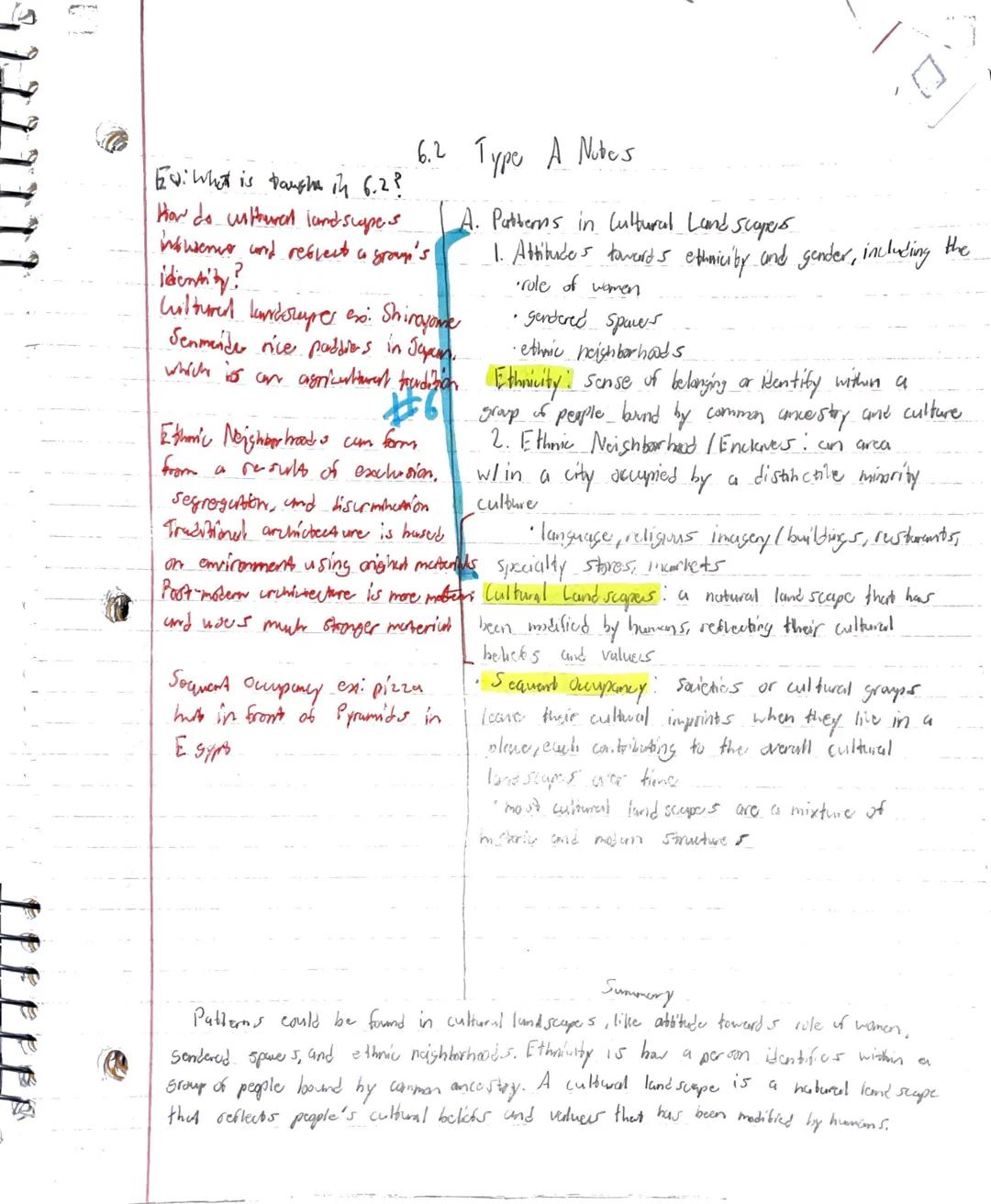
Cultural Landscapes and Identity
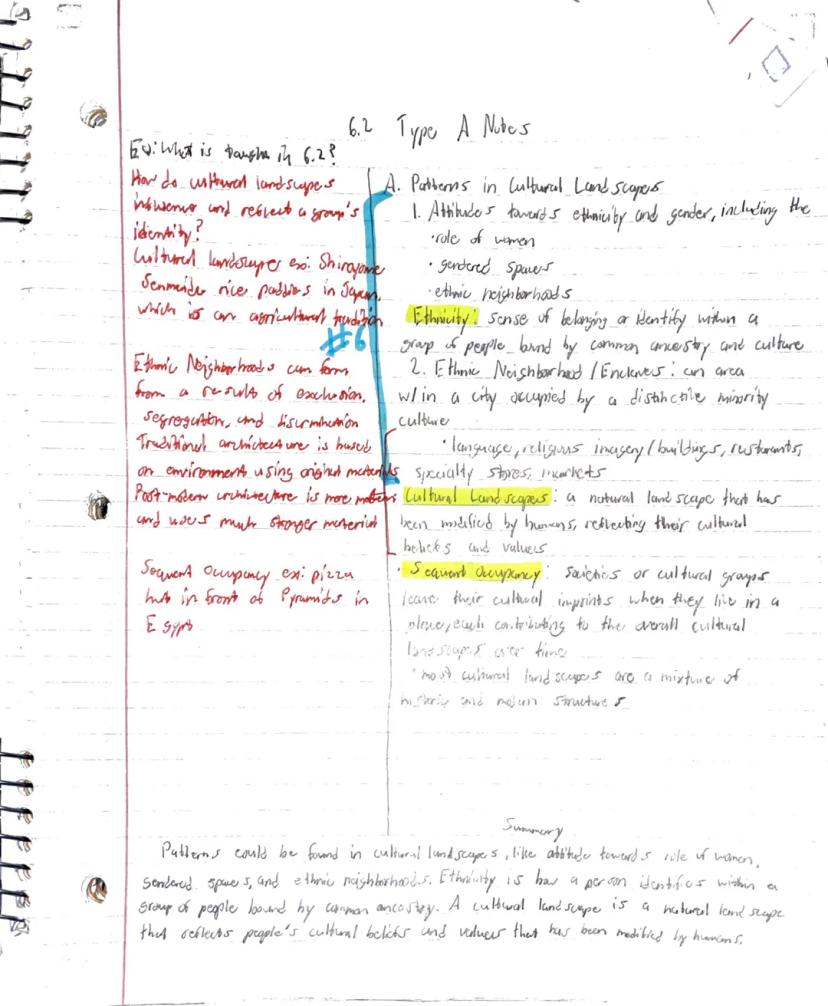
Ever notice how neighborhoods and buildings tell stories about the people who live there? Cultural landscapes are natural environments modified by humans that reflect beliefs and values. Think of Japan's Shiroyama Senmaida rice paddies—they're not just farms but living traditions!
Ethnic neighborhoods form when people with common ancestry and culture live together, sometimes due to segregation or discrimination. These areas often feature distinct languages, restaurants, and religious buildings that showcase the community's identity.
When different groups occupy the same place over time, they each leave their mark—a concept called sequent occupancy. Picture a Pizza Hut in front of the Egyptian pyramids! Most cultural landscapes blend historic structures with modern additions.
Fun fact: Architecture tells cultural stories! Traditional buildings use local materials suited to the environment, while postmodern architecture embraces stronger materials and reflects global popular culture.
2
of 10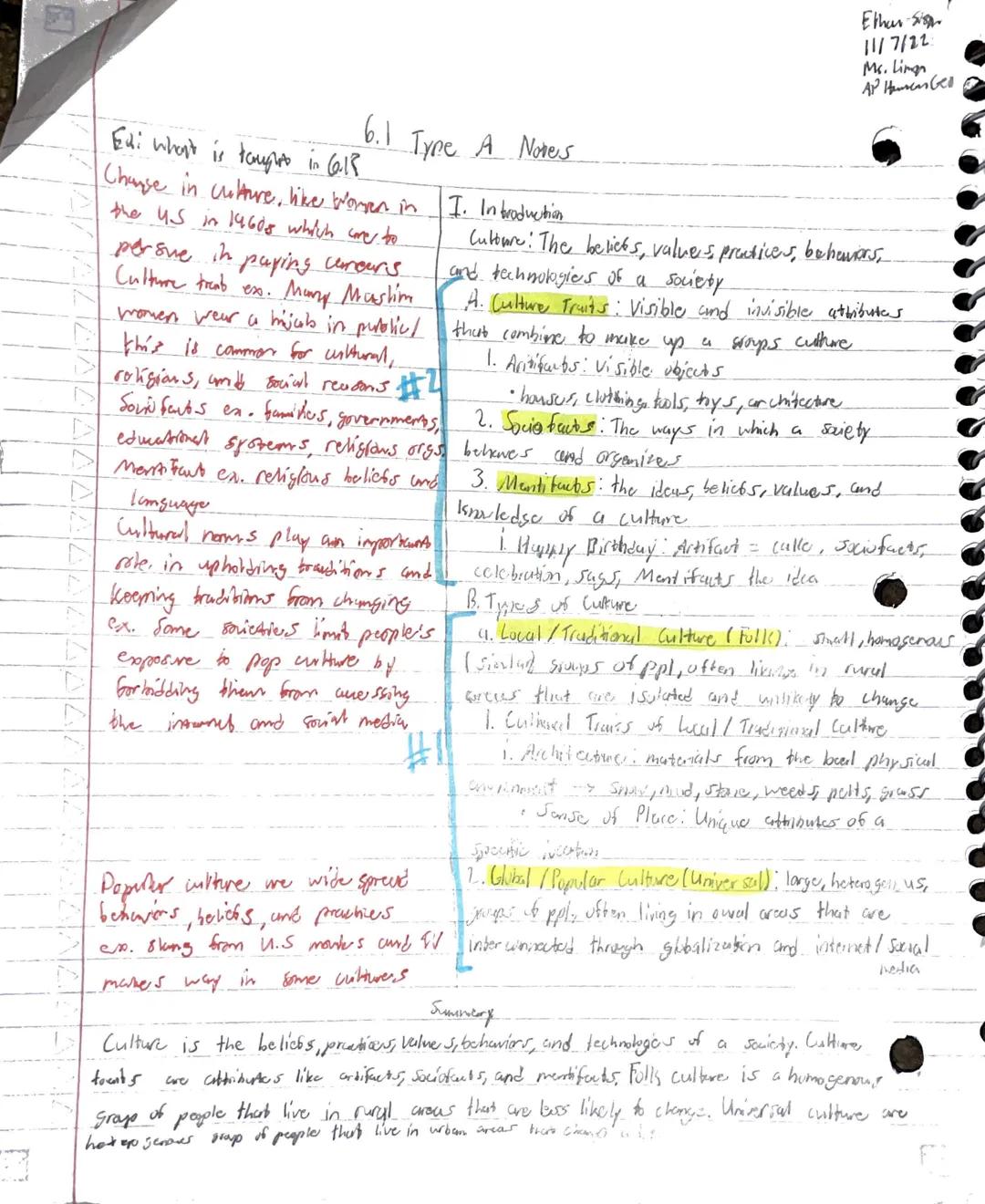
Understanding Culture and Cultural Traits
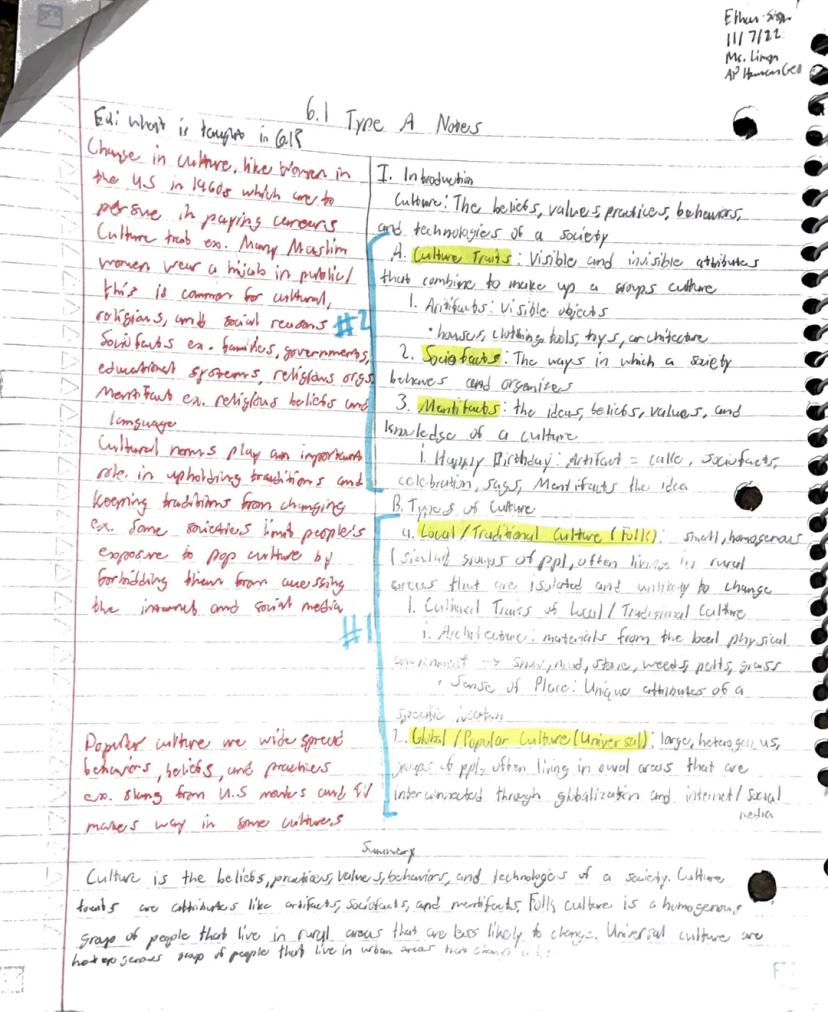
Culture shapes everything around us! It's the collection of beliefs, values, practices, and technologies that define a society. You encounter it every day without even realizing it.
Cultural traits come in three main forms. Artifacts are visible objects like houses, clothing, and tools. Sociofacts are how societies organize themselves—think families, governments, and educational systems. Mentifacts include ideas, beliefs, and values that guide people's lives.
Culture comes in two main flavors. Local/traditional culture (folk culture) thrives in small, homogeneous groups in rural areas that change slowly. Their architecture uses local materials like stone, mud, and straw, creating a strong sense of place. Meanwhile, global/popular culture exists in large, diverse urban populations that change rapidly due to globalization and technology.
Remember: Cultural taboos are behaviors discouraged by a culture, while cultural relativism means viewing other cultures without bias or judgment.
3
of 10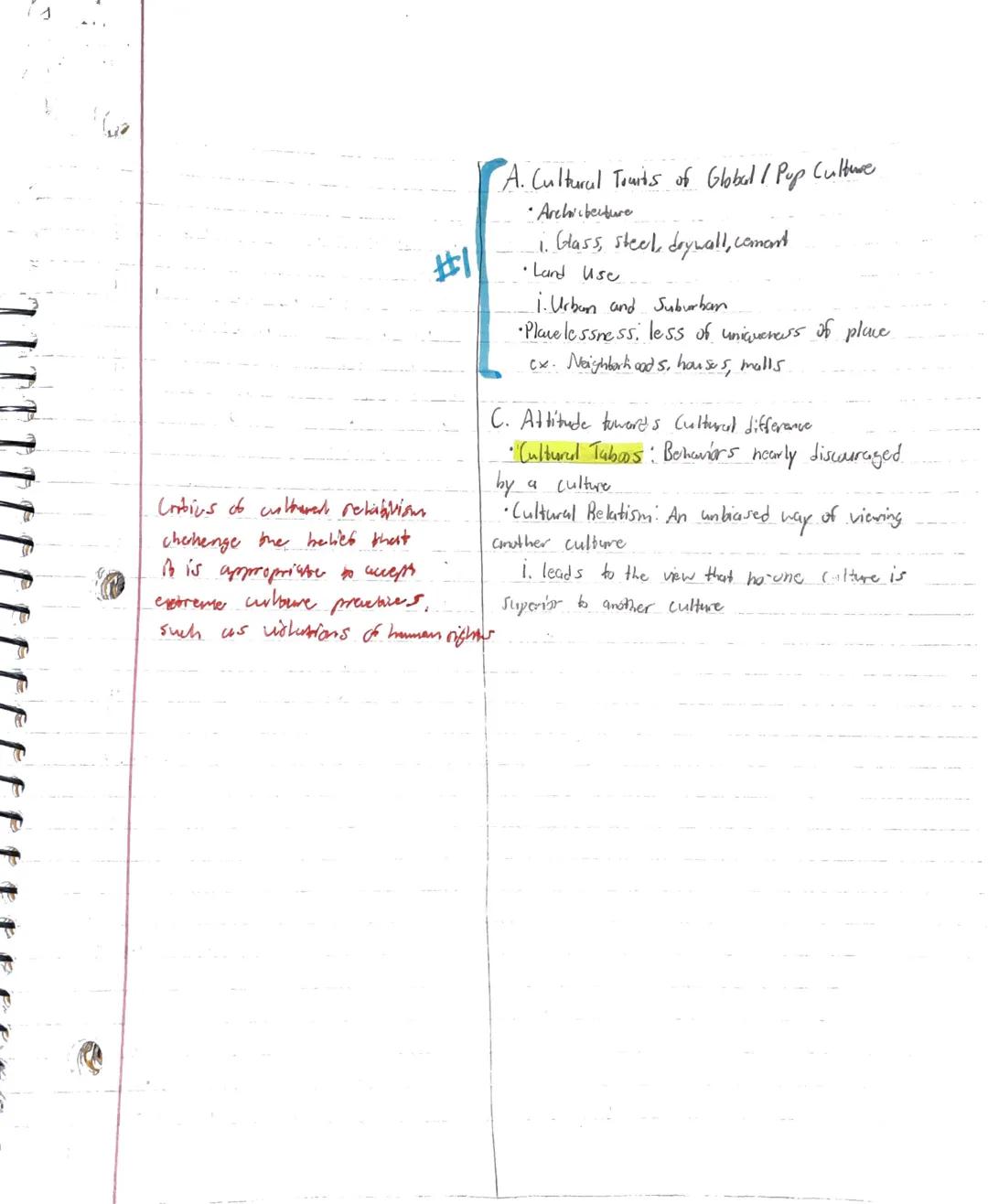
Cultural Differences and Perspectives
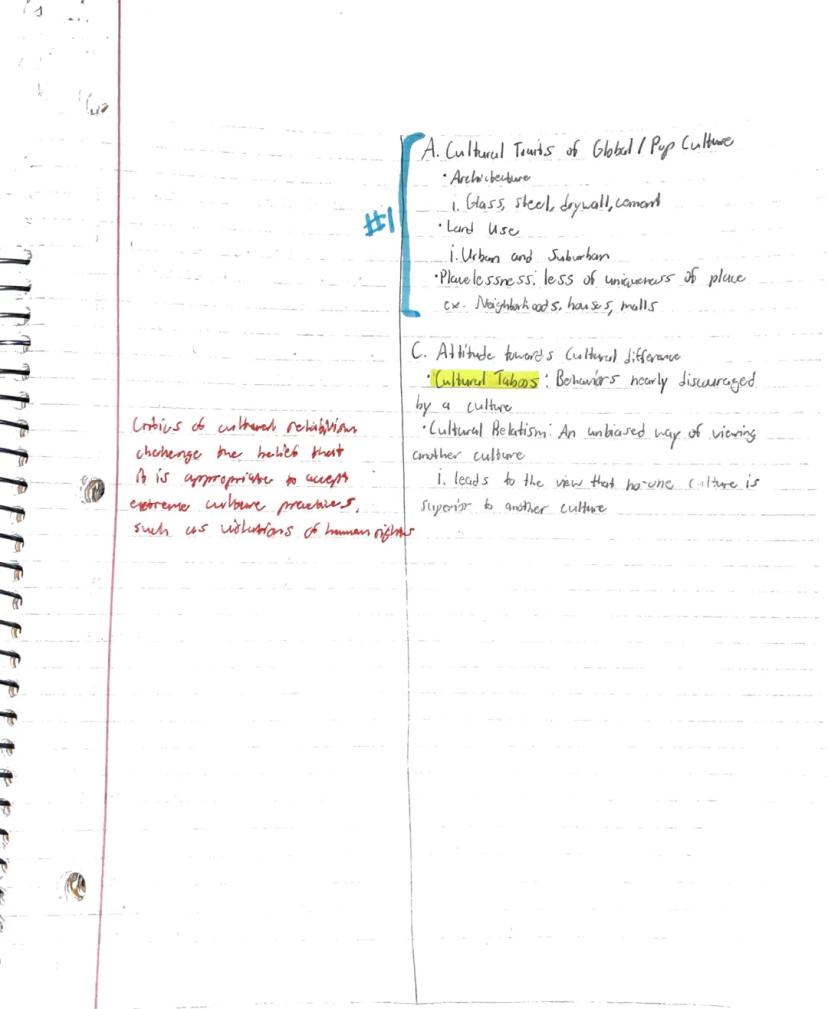
How do we view cultural differences? Some practices raise important questions about what's acceptable. Critics of extreme cultural relativism argue that we shouldn't accept practices that violate human rights, no matter the cultural context.
Global popular culture has its own distinct traits. Its architecture uses materials like glass, steel, drywall, and cement—quite different from traditional buildings. Land use tends to be urban and suburban, often creating placelessness where neighborhoods, houses, and malls start to look the same everywhere.
Cultural taboos are behaviors strongly discouraged within a culture. They vary widely around the world and help define cultural boundaries. Meanwhile, cultural relativism offers an unbiased way to view other cultures, suggesting that no single culture is superior to another.
Think about it: What examples of placelessness do you see in your own community? How many chain stores or restaurants look exactly the same no matter where you go?
4
of 10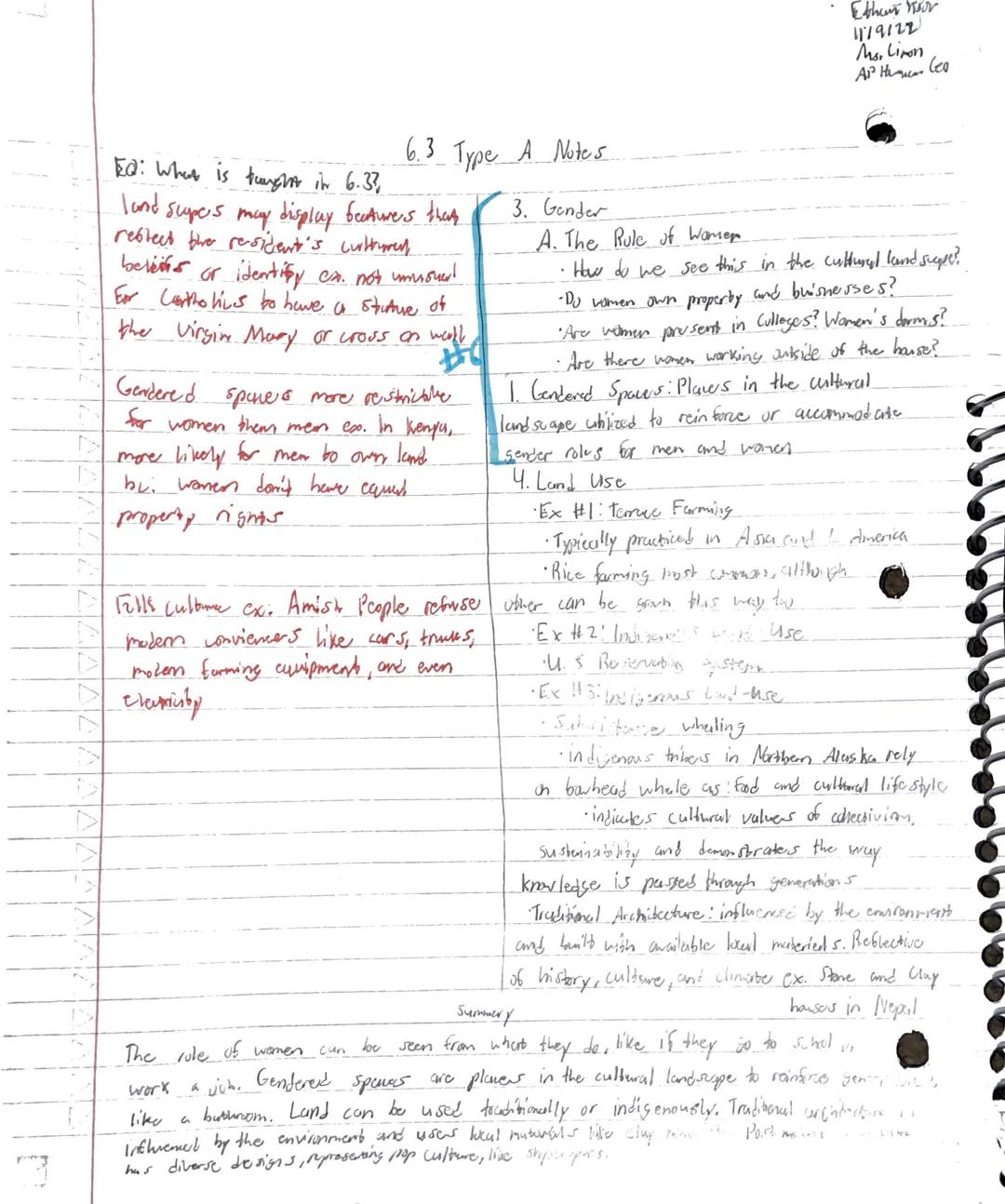
Gender and Land Use in Cultural Landscapes
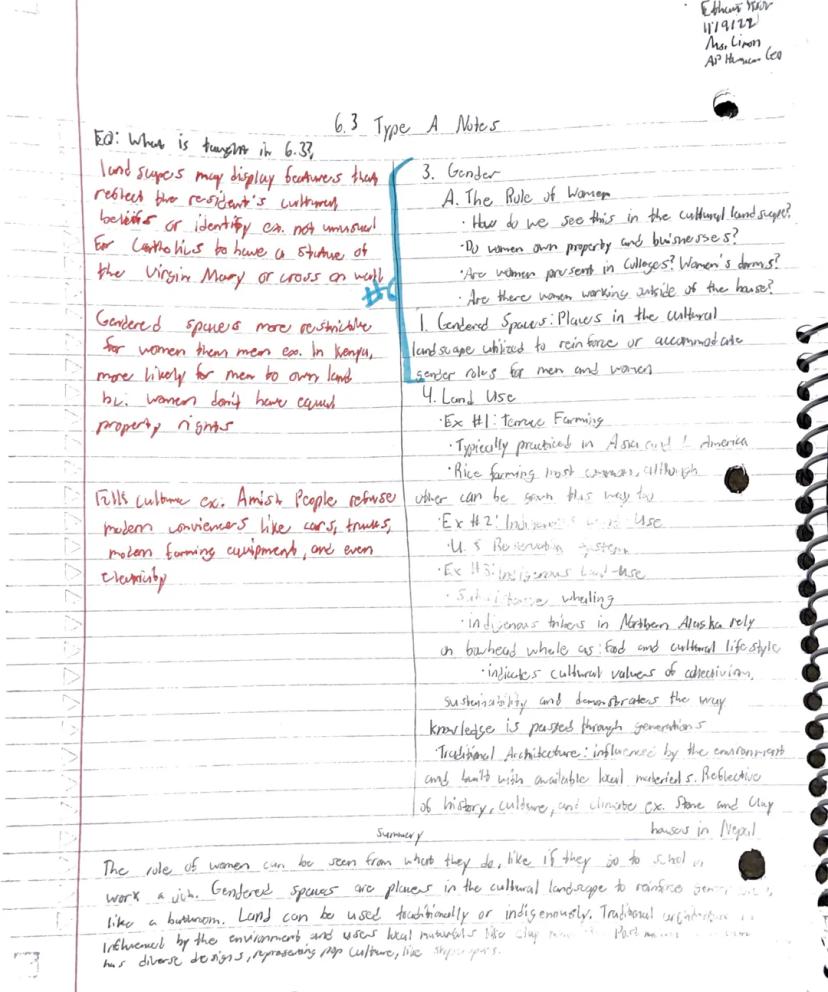
Land tells stories about the people who live there! Religious symbols like crosses or statues on property reflect cultural beliefs and identity. These visual clues help us understand who lives in a place.
Gender roles are clearly visible in landscapes. We can see them by asking: Do women own property and businesses? Are they present in colleges? Do they work outside the home? Gendered spaces are places that reinforce different roles for men and women—like separate bathrooms or, in some cultures, entirely different social areas. In Kenya, for instance, men are more likely to own land while women often lack property rights.
Land use varies dramatically across cultures. Terrace farming in Asia and the Americas (especially for rice) shows how people adapt to mountainous terrain. Indigenous land use practices, like traditional whaling by tribes in Northern Alaska, reflect values of collectivism and sustainability passed through generations.
Cool connection: Traditional architecture uses local materials like stone and clay, perfectly suited to the local climate and environment. Next time you travel, notice how buildings differ based on what's locally available!
5
of 10
Modern Architecture and Cultural Expression
Postmodern architecture represents a dramatic shift in how we build our environments. Unlike traditional buildings that use local materials, postmodern structures embrace diverse designs that showcase popular culture and economic success.
Look at skyscrapers in major cities—they're not just tall buildings but symbols of business achievement and technological advancement. These structures use stronger, more manufactured materials than traditional buildings, allowing for previously impossible designs.
This architectural style reflects our increasingly connected global culture. The same design principles might appear in Tokyo, New York, and Dubai, creating visual connections between distant places.
Think about it: Next time you're downtown, look up at modern buildings. How do they differ from older structures? What messages do they send about our current values and priorities?
6
of 10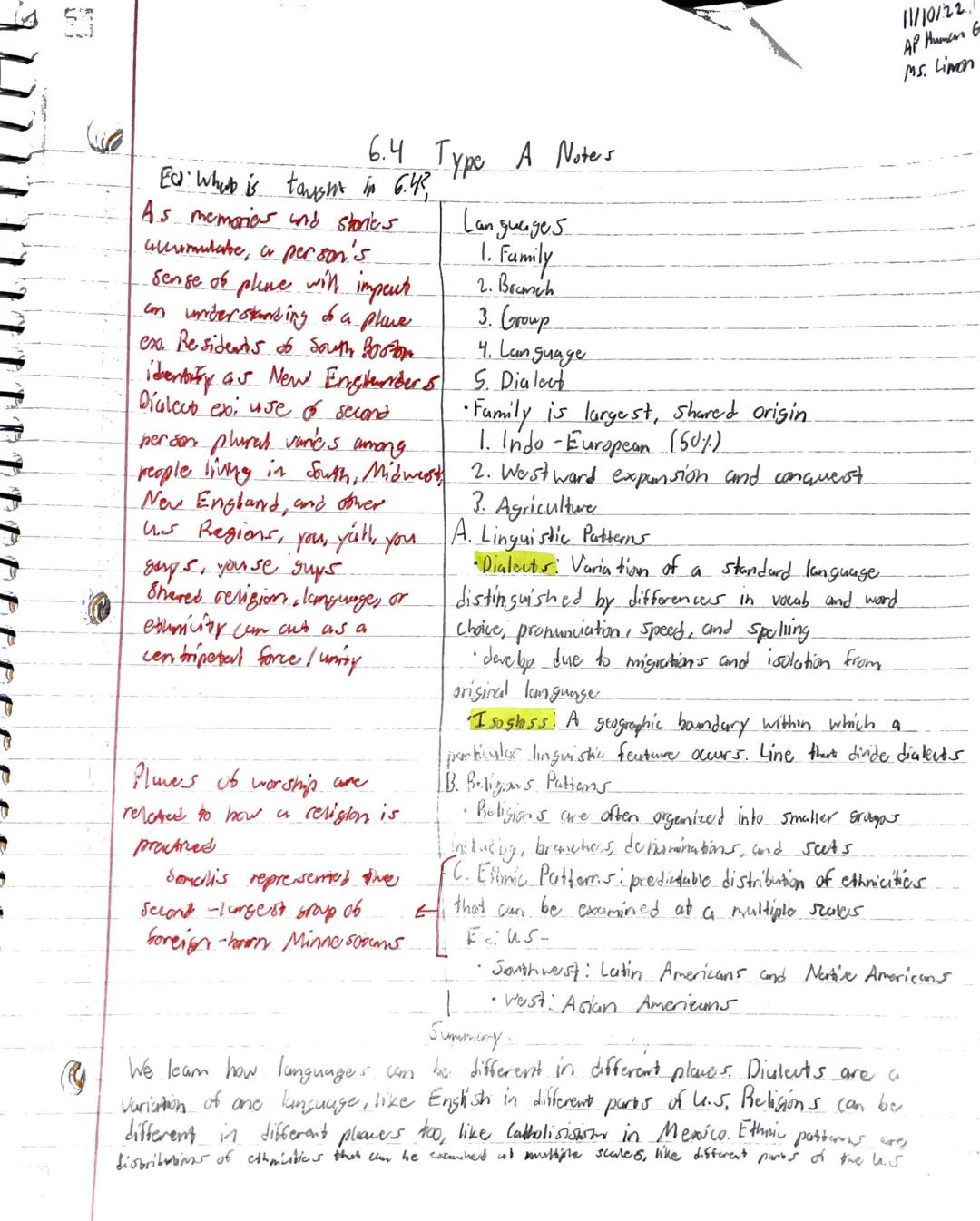
Language, Religion, and Ethnic Patterns
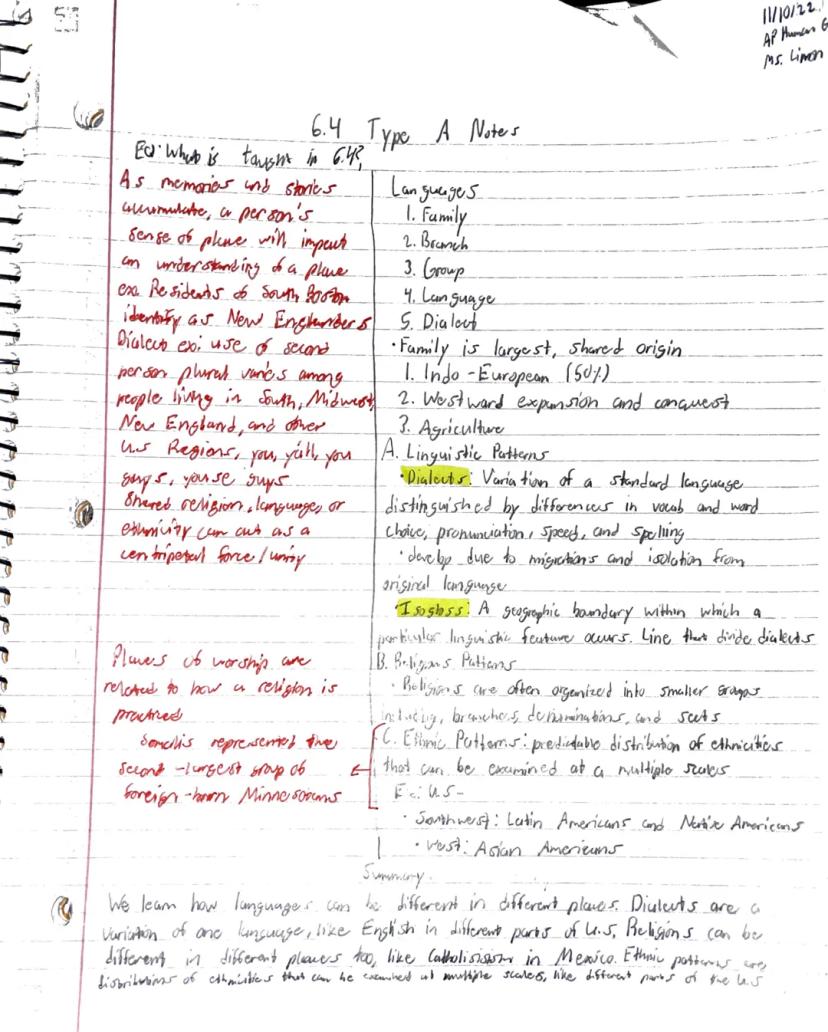
Your sense of place develops from memories and stories that give meaning to locations. People in South Boston, for example, identify as New Englanders—showing how regional identity forms.
Dialects are variations of a standard language with differences in vocabulary, pronunciation, and spelling. That's why people say "you," "y'all," or "you guys" depending on whether they're from New England, the South, or the Midwest! These variations form due to migrations and isolation from the original language.
Languages organize into families, branches, groups, languages, and dialects—with families being the largest category. The Indo-European family accounts for about 50% of the world's languages! An isogloss marks the geographic boundary where linguistic features change.
Did you know? Religion follows similar patterns of organization into branches, denominations, and sects. Different regions of the U.S. show distinct ethnic patterns too—like Latin Americans and Native Americans in the Southwest and Asian Americans in the West.
7
of 10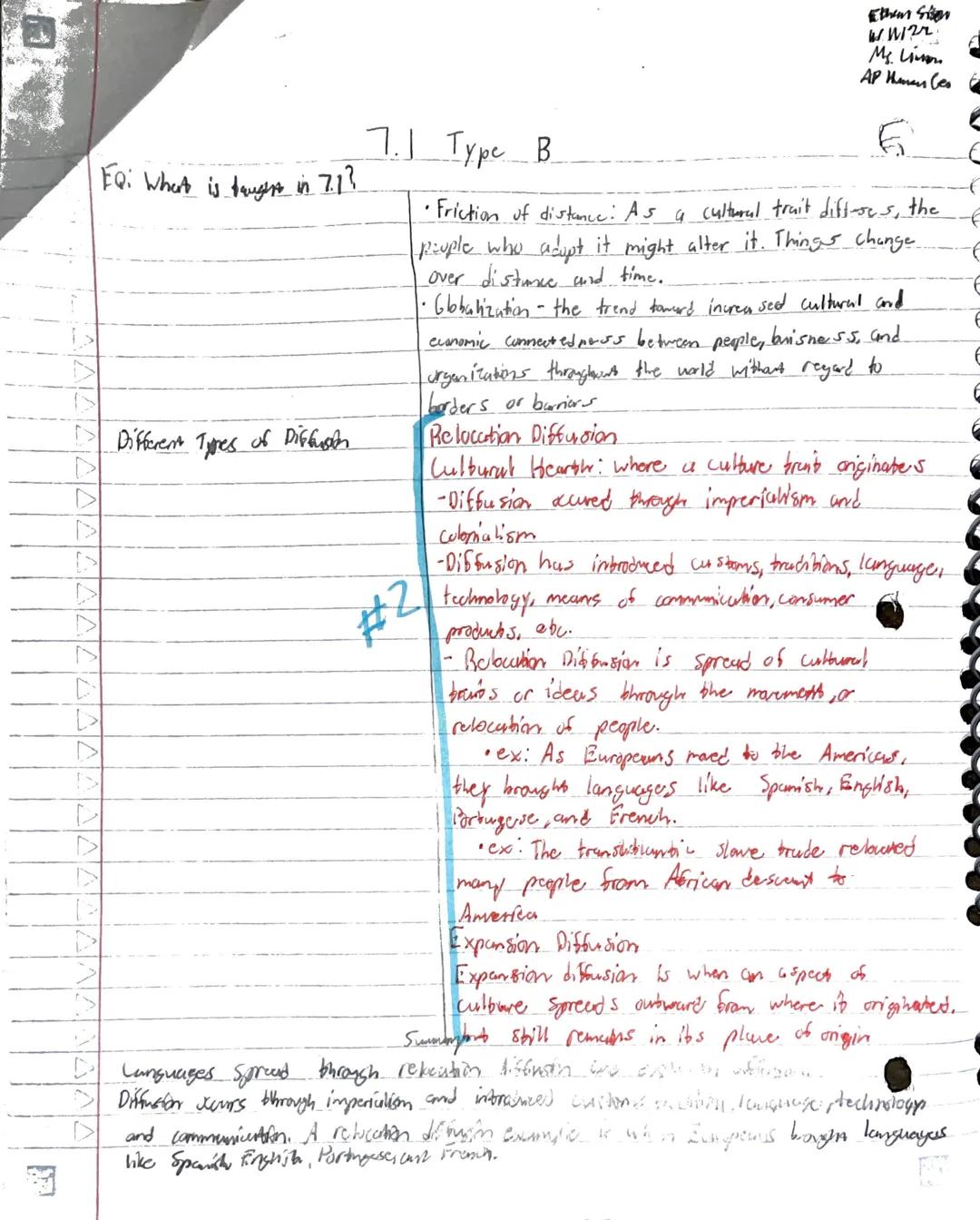
How Cultural Diffusion Works
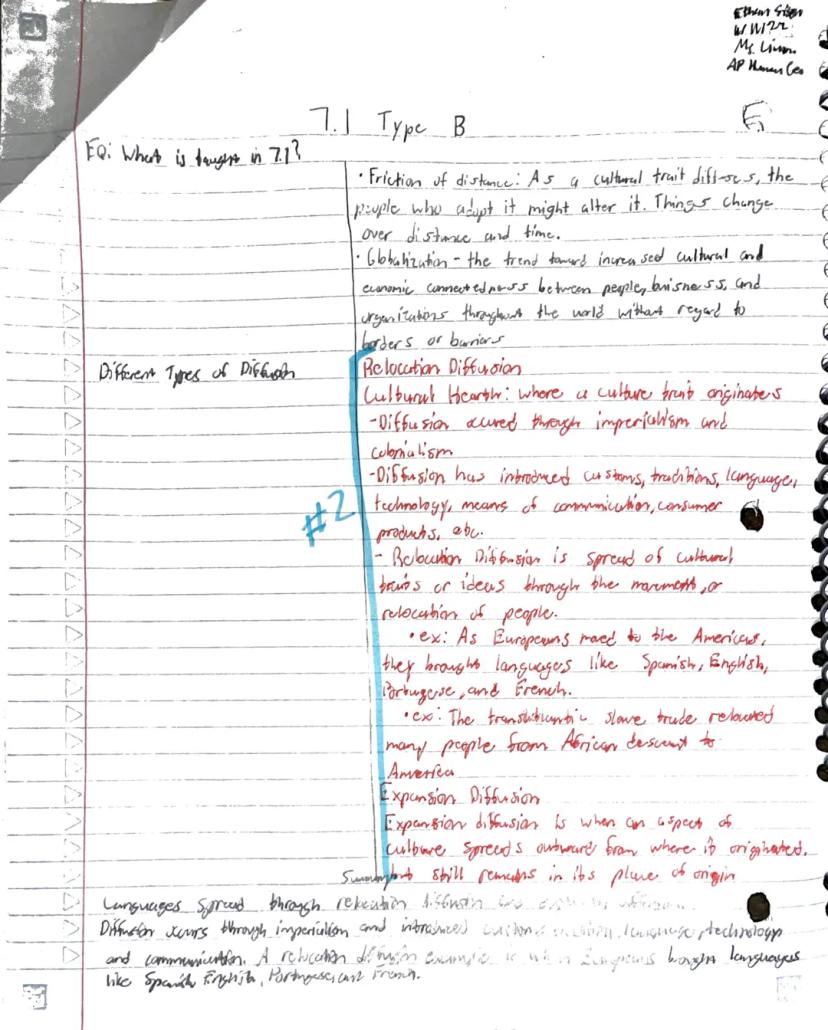
Cultural traits don't stay in one place—they spread! Diffusion is how ideas, objects, and behaviors move from one culture to another. As traits diffuse over distance and time, they often change—a concept called friction of distance.
Cultural hearths are where cultural traits originate before spreading outward. Historically, imperialism and colonialism were major vehicles for diffusion, introducing new customs, languages, technologies, and products to different regions.
Relocation diffusion happens when people physically move to new areas, bringing their culture with them. When Europeans moved to the Americas, they brought languages like Spanish, English, Portuguese, and French. The transatlantic slave trade similarly relocated African cultural elements to the Americas.
Globalization alert: Today's increased cultural and economic connectedness means diffusion happens faster than ever before! Ideas can spread worldwide in seconds through digital media.
8
of 10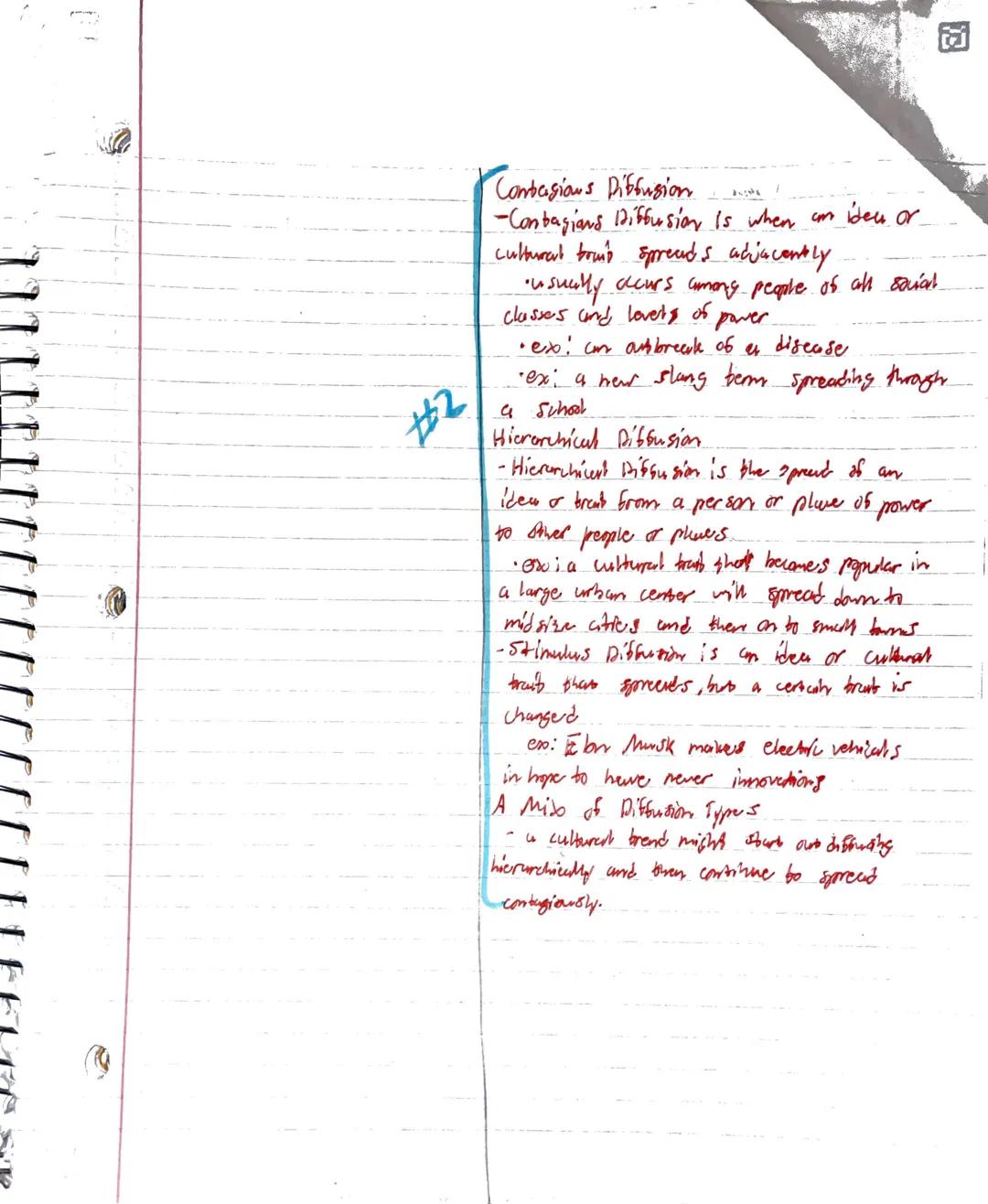
Types of Cultural Diffusion
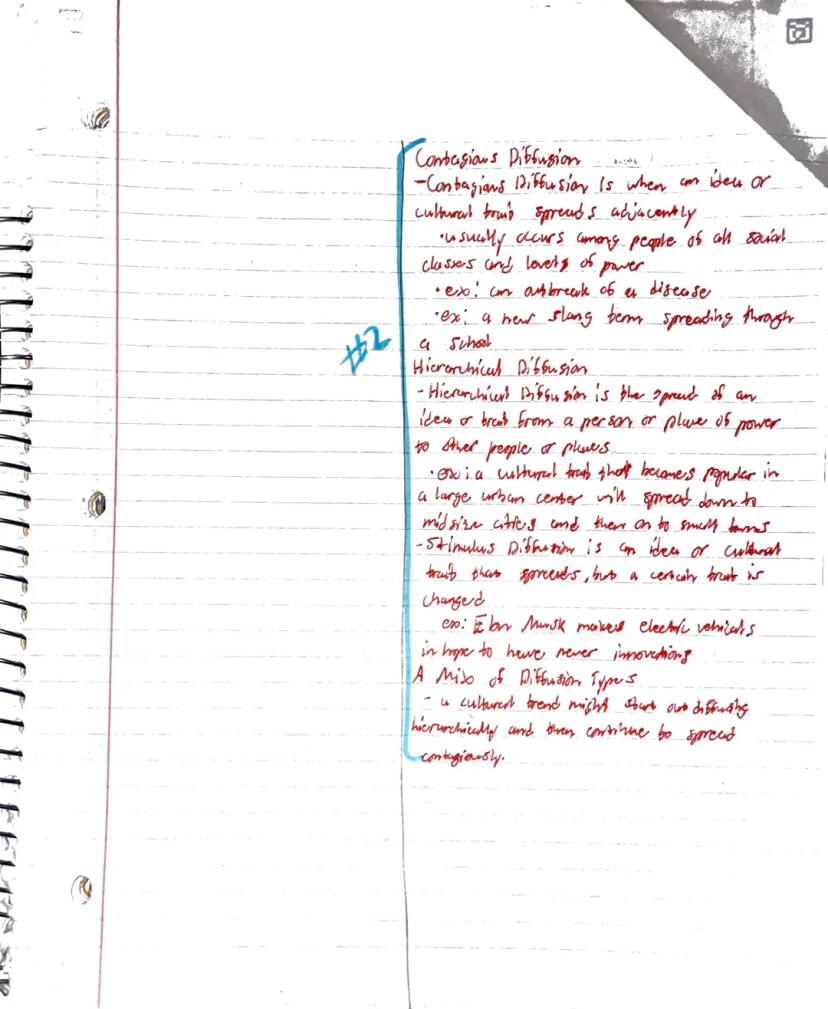
Cultural traits spread in different ways depending on who's involved and how they interact. Contagious diffusion happens when ideas spread to adjacent areas, like a new slang term moving through your school. It usually occurs among people of similar social classes and power levels.
Hierarchical diffusion works differently—it spreads from positions of power downward. Imagine a trend starting in major cities before trickling down to medium cities and finally to small towns. This top-down spread follows social hierarchies.
Sometimes, an idea spreads but changes along the way—that's stimulus diffusion. For example, when Dr. Musk markets electric vehicles, it might inspire other companies to create their own innovations rather than exact copies.
Real-world pattern: Most cultural trends use a mix of diffusion types! They might start spreading hierarchically (from influencers to followers) and then continue contagiously (person-to-person). Think about how TikTok trends spread!
9
of 10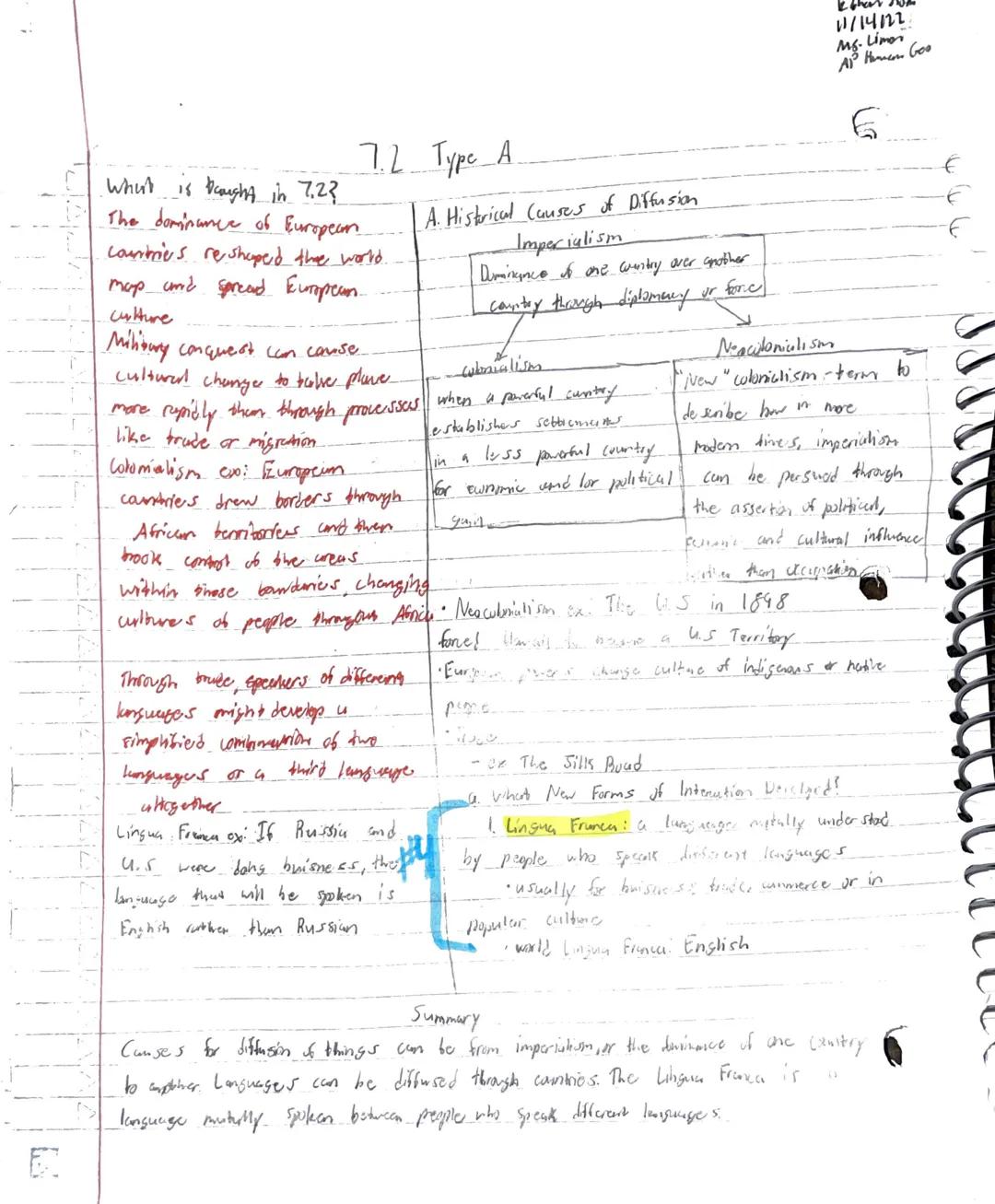
Historical Causes of Cultural Diffusion
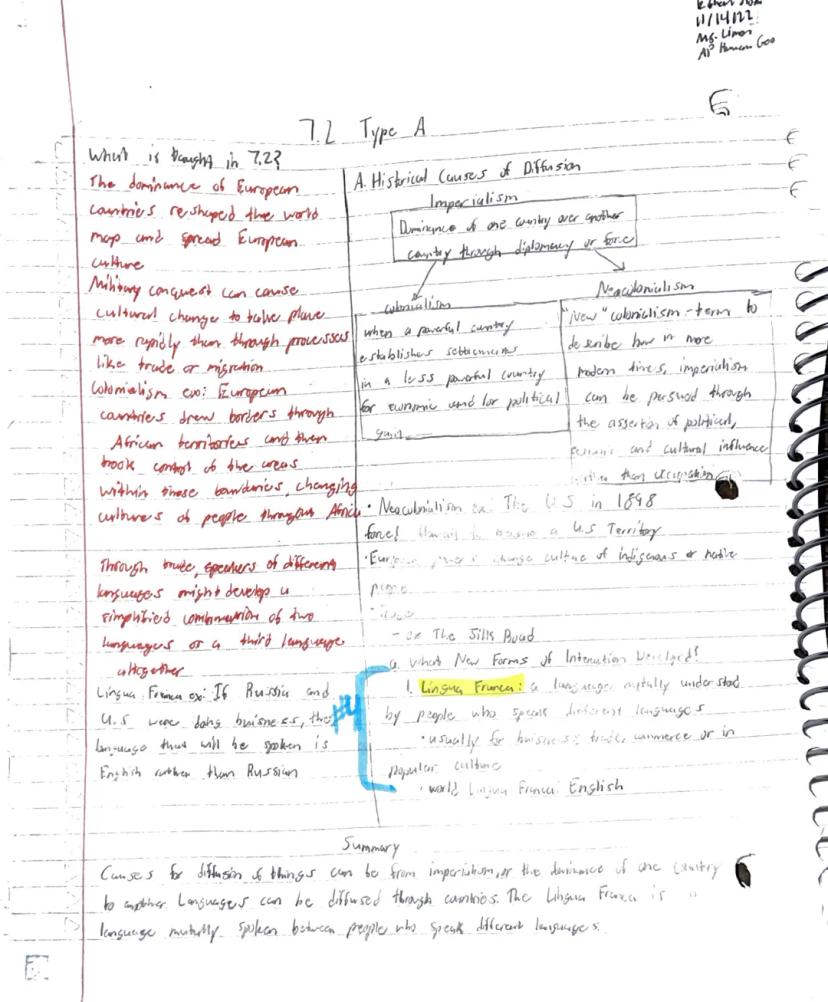
European dominance reshaped the world map and spread European culture far and wide. Imperialism—when one country dominates another through diplomacy or force—dramatically accelerated cultural change.
Colonialism happened when powerful countries established settlements in less powerful regions for economic and political gain. European countries drew borders through African territories and took control, forever changing local cultures. Neocolonialism is the modern version, where powerful countries assert influence through politics and economics rather than direct occupation—like when the U.S. forced Hawaii to become a territory in 1898.
Trade created new forms of communication. A lingua franca is a language mutually understood by people who speak different languages. Today's global lingua franca is English—if Russians and Americans do business together, they'll likely speak English rather than Russian.
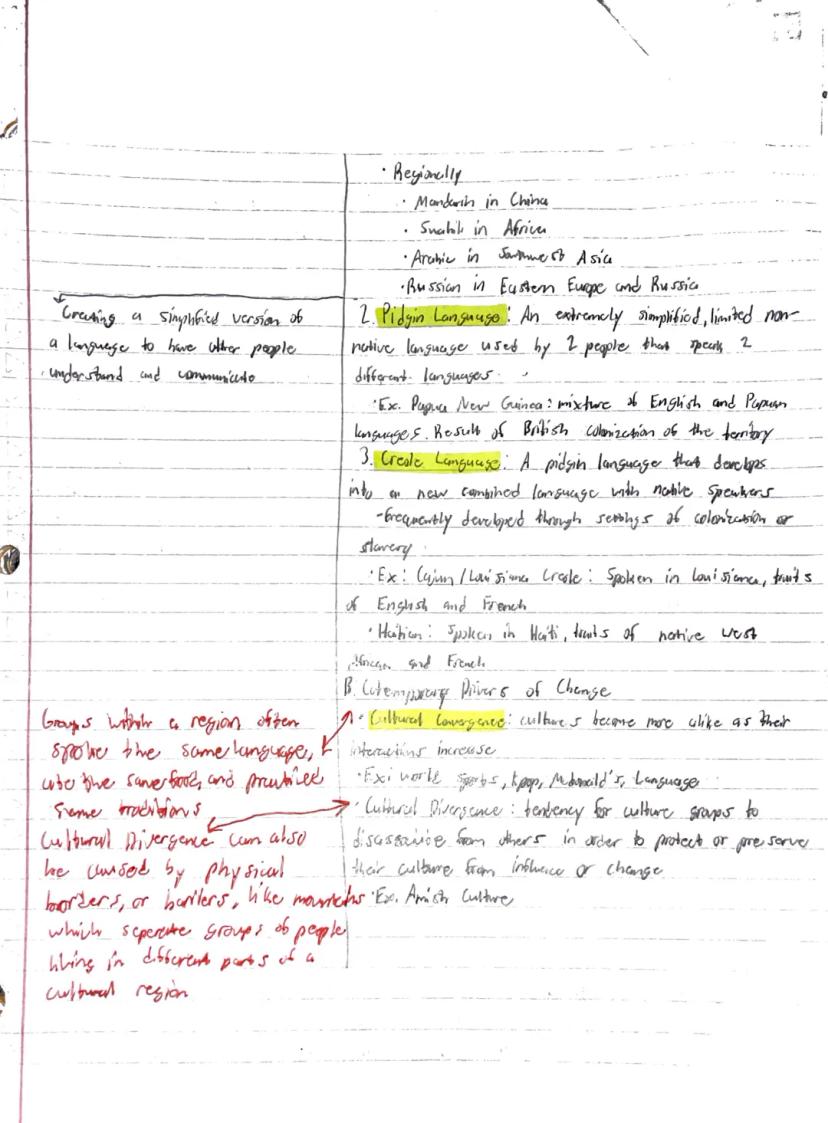
Communication bridge: When speakers of different languages need to communicate, they might develop a pidgin language—a simplified version combining elements of both languages. If children grow up speaking this hybrid, it can evolve into a full creole language with native speakers!
10
of 10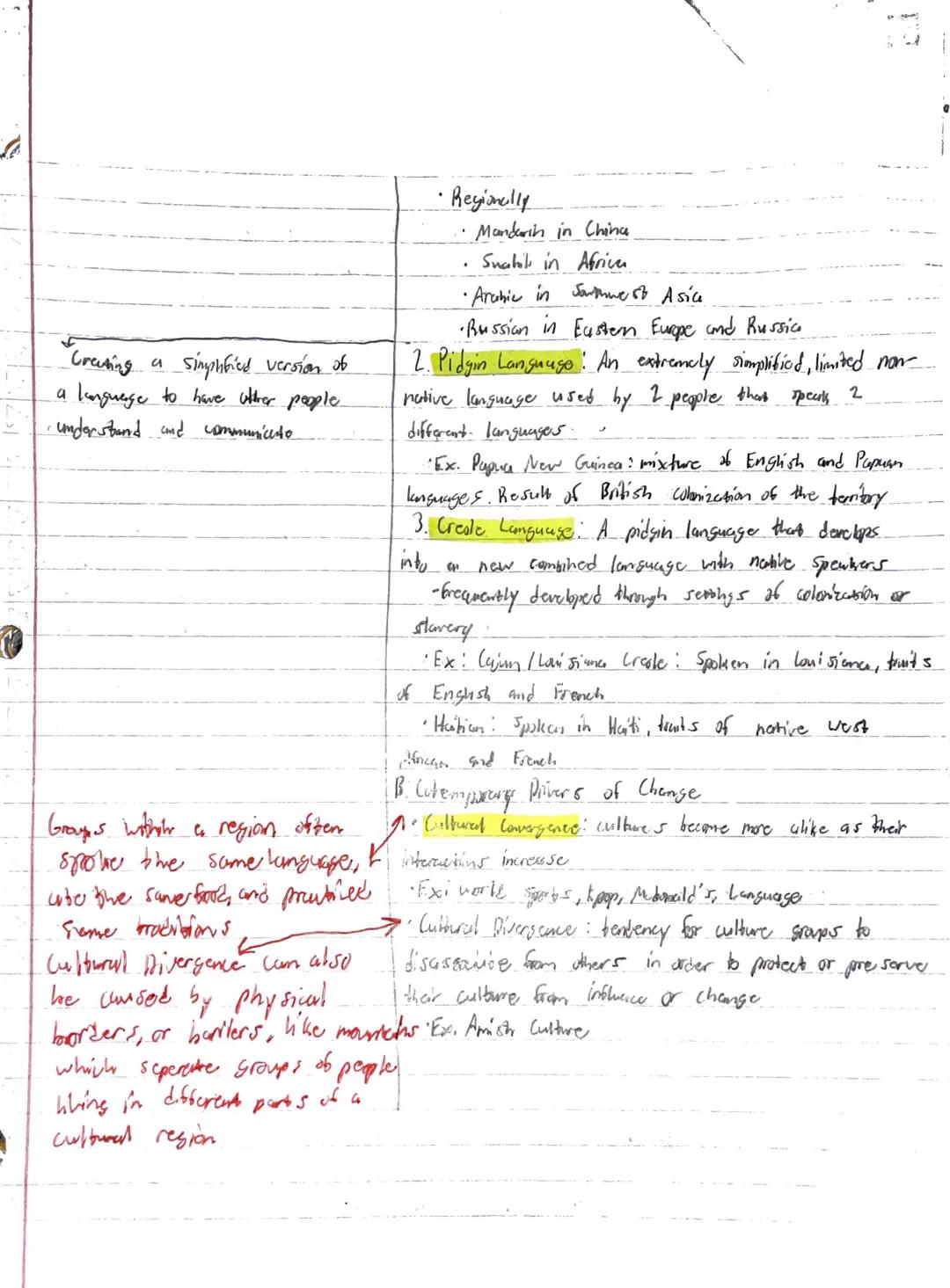
Contemporary Cultural Change
Today's world is more connected than ever, creating new patterns of cultural change. Cultural convergence happens when cultures become more alike as their interactions increase. Think about worldwide sports, K-pop, McDonald's, and English spreading globally.
The opposite can happen too! Cultural divergence occurs when groups intentionally maintain differences to preserve their traditions. The Amish community in the United States is a perfect example—they avoid modern conveniences like cars, electricity, and farming equipment to maintain their traditional way of life.
Physical borders and barriers can also cause cultural divergence by separating people. Mountains, rivers, and political boundaries keep groups living in different parts of a region from mixing freely, allowing distinct cultural traditions to develop.
Today's challenge: In our connected world, how do we balance the benefits of cultural exchange with the importance of preserving unique cultural identities? What traditions in your community are worth protecting?
We thought you’d never ask...
Our AI companion is specifically built for the needs of students. Based on the millions of content pieces we have on the platform we can provide truly meaningful and relevant answers to students. But its not only about answers, the companion is even more about guiding students through their daily learning challenges, with personalised study plans, quizzes or content pieces in the chat and 100% personalisation based on the students skills and developments.
You can download the app in the Google Play Store and in the Apple App Store.
That's right! Enjoy free access to study content, connect with fellow students, and get instant help – all at your fingertips.
Similar Content
 Environmental Science
Most popular content in AP Human Geography
9I
AP Human GeographyIntroduction to Geographic Data
Practice identifying types of geographic data, including qualitative and quantitative sources like census data and satellite imagery.
9th5500
I
AP Human GeographyIntroduction to Human-Environmental Interaction
Practice the foundational concepts of environmental determinism and possibilism and their influence on early geographic thought.
9th4520
I
AP Human GeographyIntroduction to Map Properties and Scale
Practice identifying types of map distortion and calculating map scale to understand how physical reality is represented on a flat surface.
9th2860
U
AP Human GeographyUnit 2 Measuring Population Density quiz
Measuring Population Density
9th1720
P
AP Human GeographyPopulation: quiz #1!
Master the fundamentals of population with these easy flashcards designed for high school students. Explore key concepts, terms, and examples to ace your exams!
9th1910
I
AP Human GeographyIntroduction to Geographic Data Scales
Practice identifying and differentiating between local, regional, national, and global scales of analysis using maps and data sets.
9th1810
A
AP Human GeographyAP HUG UNIT 1
This is a little test to help you practice for AP HUG
10th1900
A
AP Human GeographyAPHUG Unit 1
10 questions just general info you should know if you have listened in your class :D
9th1580
AP Human GeographyAP Human Geography Unit 4 Vocabulary
Unit 4: Political Patterns and Processes
9th80365
Most popular content
9O
 AP US History
Origins and Dynamics of the Columbian Exchange
Analyze the ecological and economic motivations behind the initial transfer of goods, people, and diseases between the Old and New Worlds.
9th3,1280
I
AP US HistoryIntroduction to Early Cultural Interactions
Analyze the initial social and religious encounters between Europeans, Africans, and Indigenous peoples in the colonial Americas.
9th2,7730
M
AP US HistoryMotivations for European Exploration
Analyze the economic, religious, and political factors that drove European powers to the Americas during the 15th and 16th centuries.
9th1,7780
O
 AP World History
Origins of Ancient River Civilizations
Analyze the environmental factors and technological innovations that led to the rise of early states in Mesopotamia, Egypt, and the Indus Valley.
9th3,1870
F
AP PsychologyFoundations of Ethical Guidelines in Research
Practice the core principles of the APA ethical code including informed consent, debriefing, and the role of Institutional Review Boards.
9th1,3360
I
AP US HistoryIntroduction to Native American Societies
Examine the diverse social, political, and economic structures of North American indigenous groups prior to European contact.
9th1,1100
I
AP US HistoryIntroduction to the Spanish Encomienda System
Explore the fundamental economic and social structures of the Spanish colonial system, focusing on the encomienda and the casta social hierarchy.
9th8890
I
 AP Biology
Introduction to Biological Elements of Life
Practice identifying the essential elements including carbon, nitrogen, phosphorus, and sulfur that compose biological macromolecules.
9th1,7410
F
AP PsychologyFoundations of Research Design and Methodology
Practice distinguishing between different research methods including experiments, correlations, and case studies while identifying key variables.
9th6670
Students love us — and so will you.
4.6/5App Store
4.7/5Google Play
The app is very easy to use and well designed. I have found everything I was looking for so far and have been able to learn a lot from the presentations! I will definitely use the app for a class assignment! And of course it also helps a lot as an inspiration.
Stefan SiOS user
This app is really great. There are so many study notes and help [...]. My problem subject is French, for example, and the app has so many options for help. Thanks to this app, I have improved my French. I would recommend it to anyone.
Samantha KlichAndroid user
Wow, I am really amazed. I just tried the app because I've seen it advertised many times and was absolutely stunned. This app is THE HELP you want for school and above all, it offers so many things, such as workouts and fact sheets, which have been VERY helpful to me personally.
AnnaiOS user
AP Human Geography130 views·Updated Jul 4, 2026·18 pagesAP Human Geography Notes: Comprehensive Unit 3 Overview
E
Ethan Sison@ethansison_oagl
Ready to dive into AP Human Geography? These notes cover cultural landscapes, diffusion patterns, and how societies shape their environments. You'll explore how people's beliefs, practices, and values create unique places and how cultural traits spread around the world.
1
of 10
Sign up to see the content. It's free!
- Access to all documents
- Improve your grades
- Join milions of students
Cultural Landscapes and Identity
Ever notice how neighborhoods and buildings tell stories about the people who live there? Cultural landscapes are natural environments modified by humans that reflect beliefs and values. Think of Japan's Shiroyama Senmaida rice paddies—they're not just farms but living traditions!
Ethnic neighborhoods form when people with common ancestry and culture live together, sometimes due to segregation or discrimination. These areas often feature distinct languages, restaurants, and religious buildings that showcase the community's identity.
When different groups occupy the same place over time, they each leave their mark—a concept called sequent occupancy. Picture a Pizza Hut in front of the Egyptian pyramids! Most cultural landscapes blend historic structures with modern additions.
Fun fact: Architecture tells cultural stories! Traditional buildings use local materials suited to the environment, while postmodern architecture embraces stronger materials and reflects global popular culture.
2
of 10Sign up to see the content. It's free!
- Access to all documents
- Improve your grades
- Join milions of students
Understanding Culture and Cultural Traits
Culture shapes everything around us! It's the collection of beliefs, values, practices, and technologies that define a society. You encounter it every day without even realizing it.
Cultural traits come in three main forms. Artifacts are visible objects like houses, clothing, and tools. Sociofacts are how societies organize themselves—think families, governments, and educational systems. Mentifacts include ideas, beliefs, and values that guide people's lives.
Culture comes in two main flavors. Local/traditional culture (folk culture) thrives in small, homogeneous groups in rural areas that change slowly. Their architecture uses local materials like stone, mud, and straw, creating a strong sense of place. Meanwhile, global/popular culture exists in large, diverse urban populations that change rapidly due to globalization and technology.
Remember: Cultural taboos are behaviors discouraged by a culture, while cultural relativism means viewing other cultures without bias or judgment.
3
of 10Sign up to see the content. It's free!
- Access to all documents
- Improve your grades
- Join milions of students
Cultural Differences and Perspectives
How do we view cultural differences? Some practices raise important questions about what's acceptable. Critics of extreme cultural relativism argue that we shouldn't accept practices that violate human rights, no matter the cultural context.
Global popular culture has its own distinct traits. Its architecture uses materials like glass, steel, drywall, and cement—quite different from traditional buildings. Land use tends to be urban and suburban, often creating placelessness where neighborhoods, houses, and malls start to look the same everywhere.
Cultural taboos are behaviors strongly discouraged within a culture. They vary widely around the world and help define cultural boundaries. Meanwhile, cultural relativism offers an unbiased way to view other cultures, suggesting that no single culture is superior to another.
Think about it: What examples of placelessness do you see in your own community? How many chain stores or restaurants look exactly the same no matter where you go?
4
of 10Sign up to see the content. It's free!
- Access to all documents
- Improve your grades
- Join milions of students
Gender and Land Use in Cultural Landscapes
Land tells stories about the people who live there! Religious symbols like crosses or statues on property reflect cultural beliefs and identity. These visual clues help us understand who lives in a place.
Gender roles are clearly visible in landscapes. We can see them by asking: Do women own property and businesses? Are they present in colleges? Do they work outside the home? Gendered spaces are places that reinforce different roles for men and women—like separate bathrooms or, in some cultures, entirely different social areas. In Kenya, for instance, men are more likely to own land while women often lack property rights.
Land use varies dramatically across cultures. Terrace farming in Asia and the Americas (especially for rice) shows how people adapt to mountainous terrain. Indigenous land use practices, like traditional whaling by tribes in Northern Alaska, reflect values of collectivism and sustainability passed through generations.
Cool connection: Traditional architecture uses local materials like stone and clay, perfectly suited to the local climate and environment. Next time you travel, notice how buildings differ based on what's locally available!
5
of 10Sign up to see the content. It's free!
- Access to all documents
- Improve your grades
- Join milions of students
Modern Architecture and Cultural Expression
Postmodern architecture represents a dramatic shift in how we build our environments. Unlike traditional buildings that use local materials, postmodern structures embrace diverse designs that showcase popular culture and economic success.
Look at skyscrapers in major cities—they're not just tall buildings but symbols of business achievement and technological advancement. These structures use stronger, more manufactured materials than traditional buildings, allowing for previously impossible designs.
This architectural style reflects our increasingly connected global culture. The same design principles might appear in Tokyo, New York, and Dubai, creating visual connections between distant places.
Think about it: Next time you're downtown, look up at modern buildings. How do they differ from older structures? What messages do they send about our current values and priorities?
6
of 10Sign up to see the content. It's free!
- Access to all documents
- Improve your grades
- Join milions of students
Language, Religion, and Ethnic Patterns
Your sense of place develops from memories and stories that give meaning to locations. People in South Boston, for example, identify as New Englanders—showing how regional identity forms.
Dialects are variations of a standard language with differences in vocabulary, pronunciation, and spelling. That's why people say "you," "y'all," or "you guys" depending on whether they're from New England, the South, or the Midwest! These variations form due to migrations and isolation from the original language.
Languages organize into families, branches, groups, languages, and dialects—with families being the largest category. The Indo-European family accounts for about 50% of the world's languages! An isogloss marks the geographic boundary where linguistic features change.
Did you know? Religion follows similar patterns of organization into branches, denominations, and sects. Different regions of the U.S. show distinct ethnic patterns too—like Latin Americans and Native Americans in the Southwest and Asian Americans in the West.
7
of 10Sign up to see the content. It's free!
- Access to all documents
- Improve your grades
- Join milions of students
How Cultural Diffusion Works
Cultural traits don't stay in one place—they spread! Diffusion is how ideas, objects, and behaviors move from one culture to another. As traits diffuse over distance and time, they often change—a concept called friction of distance.
Cultural hearths are where cultural traits originate before spreading outward. Historically, imperialism and colonialism were major vehicles for diffusion, introducing new customs, languages, technologies, and products to different regions.
Relocation diffusion happens when people physically move to new areas, bringing their culture with them. When Europeans moved to the Americas, they brought languages like Spanish, English, Portuguese, and French. The transatlantic slave trade similarly relocated African cultural elements to the Americas.
Globalization alert: Today's increased cultural and economic connectedness means diffusion happens faster than ever before! Ideas can spread worldwide in seconds through digital media.
8
of 10Sign up to see the content. It's free!
- Access to all documents
- Improve your grades
- Join milions of students
Types of Cultural Diffusion
Cultural traits spread in different ways depending on who's involved and how they interact. Contagious diffusion happens when ideas spread to adjacent areas, like a new slang term moving through your school. It usually occurs among people of similar social classes and power levels.
Hierarchical diffusion works differently—it spreads from positions of power downward. Imagine a trend starting in major cities before trickling down to medium cities and finally to small towns. This top-down spread follows social hierarchies.
Sometimes, an idea spreads but changes along the way—that's stimulus diffusion. For example, when Dr. Musk markets electric vehicles, it might inspire other companies to create their own innovations rather than exact copies.
Real-world pattern: Most cultural trends use a mix of diffusion types! They might start spreading hierarchically (from influencers to followers) and then continue contagiously (person-to-person). Think about how TikTok trends spread!
9
of 10Sign up to see the content. It's free!
- Access to all documents
- Improve your grades
- Join milions of students
Historical Causes of Cultural Diffusion
European dominance reshaped the world map and spread European culture far and wide. Imperialism—when one country dominates another through diplomacy or force—dramatically accelerated cultural change.
Colonialism happened when powerful countries established settlements in less powerful regions for economic and political gain. European countries drew borders through African territories and took control, forever changing local cultures. Neocolonialism is the modern version, where powerful countries assert influence through politics and economics rather than direct occupation—like when the U.S. forced Hawaii to become a territory in 1898.
Trade created new forms of communication. A lingua franca is a language mutually understood by people who speak different languages. Today's global lingua franca is English—if Russians and Americans do business together, they'll likely speak English rather than Russian.
Communication bridge: When speakers of different languages need to communicate, they might develop a pidgin language—a simplified version combining elements of both languages. If children grow up speaking this hybrid, it can evolve into a full creole language with native speakers!
10
of 10Sign up to see the content. It's free!
- Access to all documents
- Improve your grades
- Join milions of students
Contemporary Cultural Change
Today's world is more connected than ever, creating new patterns of cultural change. Cultural convergence happens when cultures become more alike as their interactions increase. Think about worldwide sports, K-pop, McDonald's, and English spreading globally.
The opposite can happen too! Cultural divergence occurs when groups intentionally maintain differences to preserve their traditions. The Amish community in the United States is a perfect example—they avoid modern conveniences like cars, electricity, and farming equipment to maintain their traditional way of life.
Physical borders and barriers can also cause cultural divergence by separating people. Mountains, rivers, and political boundaries keep groups living in different parts of a region from mixing freely, allowing distinct cultural traditions to develop.
Today's challenge: In our connected world, how do we balance the benefits of cultural exchange with the importance of preserving unique cultural identities? What traditions in your community are worth protecting?
We thought you’d never ask...
Our AI companion is specifically built for the needs of students. Based on the millions of content pieces we have on the platform we can provide truly meaningful and relevant answers to students. But its not only about answers, the companion is even more about guiding students through their daily learning challenges, with personalised study plans, quizzes or content pieces in the chat and 100% personalisation based on the students skills and developments.
You can download the app in the Google Play Store and in the Apple App Store.
That's right! Enjoy free access to study content, connect with fellow students, and get instant help – all at your fingertips.
Similar Content
Most popular content in AP Human Geography
9I
AP Human GeographyIntroduction to Geographic Data
Practice identifying types of geographic data, including qualitative and quantitative sources like census data and satellite imagery.
9th5500
I
AP Human GeographyIntroduction to Human-Environmental Interaction
Practice the foundational concepts of environmental determinism and possibilism and their influence on early geographic thought.
9th4520
I
AP Human GeographyIntroduction to Map Properties and Scale
Practice identifying types of map distortion and calculating map scale to understand how physical reality is represented on a flat surface.
9th2860
U
AP Human GeographyUnit 2 Measuring Population Density quiz
Measuring Population Density
9th1720
P
AP Human GeographyPopulation: quiz #1!
Master the fundamentals of population with these easy flashcards designed for high school students. Explore key concepts, terms, and examples to ace your exams!
9th1910
I
AP Human GeographyIntroduction to Geographic Data Scales
Practice identifying and differentiating between local, regional, national, and global scales of analysis using maps and data sets.
9th1810
A
AP Human GeographyAP HUG UNIT 1
This is a little test to help you practice for AP HUG
10th1900
A
AP Human GeographyAPHUG Unit 1
10 questions just general info you should know if you have listened in your class :D
9th1580
AP Human GeographyAP Human Geography Unit 4 Vocabulary
Unit 4: Political Patterns and Processes
9th80365
Most popular content
9O
AP US HistoryOrigins and Dynamics of the Columbian Exchange
Analyze the ecological and economic motivations behind the initial transfer of goods, people, and diseases between the Old and New Worlds.
9th3,1280
I
AP US HistoryIntroduction to Early Cultural Interactions
Analyze the initial social and religious encounters between Europeans, Africans, and Indigenous peoples in the colonial Americas.
9th2,7730
M
AP US HistoryMotivations for European Exploration
Analyze the economic, religious, and political factors that drove European powers to the Americas during the 15th and 16th centuries.
9th1,7780
O
AP World HistoryOrigins of Ancient River Civilizations
Analyze the environmental factors and technological innovations that led to the rise of early states in Mesopotamia, Egypt, and the Indus Valley.
9th3,1870
F
AP PsychologyFoundations of Ethical Guidelines in Research
Practice the core principles of the APA ethical code including informed consent, debriefing, and the role of Institutional Review Boards.
9th1,3360
I
AP US HistoryIntroduction to Native American Societies
Examine the diverse social, political, and economic structures of North American indigenous groups prior to European contact.
9th1,1100
I
AP US HistoryIntroduction to the Spanish Encomienda System
Explore the fundamental economic and social structures of the Spanish colonial system, focusing on the encomienda and the casta social hierarchy.
9th8890
I
AP BiologyIntroduction to Biological Elements of Life
Practice identifying the essential elements including carbon, nitrogen, phosphorus, and sulfur that compose biological macromolecules.
9th1,7410
F
AP PsychologyFoundations of Research Design and Methodology
Practice distinguishing between different research methods including experiments, correlations, and case studies while identifying key variables.
9th6670
Students love us — and so will you.
4.6/5App Store
4.7/5Google Play
The app is very easy to use and well designed. I have found everything I was looking for so far and have been able to learn a lot from the presentations! I will definitely use the app for a class assignment! And of course it also helps a lot as an inspiration.
Stefan SiOS user
This app is really great. There are so many study notes and help [...]. My problem subject is French, for example, and the app has so many options for help. Thanks to this app, I have improved my French. I would recommend it to anyone.
Samantha KlichAndroid user
Wow, I am really amazed. I just tried the app because I've seen it advertised many times and was absolutely stunned. This app is THE HELP you want for school and above all, it offers so many things, such as workouts and fact sheets, which have been VERY helpful to me personally.
AnnaiOS user