

The brain is the control center of your body, directing... Show more
 Algebra
 Biology
Sign up to see the contentIt's free!
Access to all documents
Improve your grades
Join milions of students
Knowunity AI
Subjects
Triangle Congruence and Similarity Theorems
Triangle Properties and Classification
Linear Equations and Graphs
Geometric Angle Relationships
Trigonometric Functions and Identities
Equation Solving Techniques
Circle Geometry Fundamentals
Division Operations and Methods
Basic Differentiation Rules
Exponent and Logarithm Properties
Show all topics
Human Organ Systems
Reproductive Cell Cycles
Biological Sciences Subdisciplines
Cellular Energy Metabolism
Autotrophic Energy Processes
Inheritance Patterns and Principles
Biomolecular Structure and Organization
Cell Cycle and Division Mechanics
Cellular Organization and Development
Biological Structural Organization
Show all topics
Chemical Sciences and Applications
Atomic Structure and Composition
Molecular Electron Structure Representation
Atomic Electron Behavior
Matter Properties and Water
Mole Concept and Calculations
Gas Laws and Behavior
Periodic Table Organization
Chemical Thermodynamics Fundamentals
Chemical Bond Types and Properties
Show all topics
European Renaissance and Enlightenment
European Cultural Movements 800-1920
American Revolution Era 1763-1797
American Civil War 1861-1865
Global Imperial Systems
Mongol and Chinese Dynasties
U.S. Presidents and World Leaders
Historical Sources and Documentation
World Wars Era and Impact
World Religious Systems
Show all topics
Classic and Contemporary Novels
Literary Character Analysis
Rhetorical Theory and Practice
Classic Literary Narratives
Reading Analysis and Interpretation
Narrative Structure and Techniques
English Language Components
Influential English-Language Authors
Basic Sentence Structure
Narrative Voice and Perspective
Show all topics
142
•
Updated Mar 24, 2026
•
The brain is the control center of your body, directing... Show more
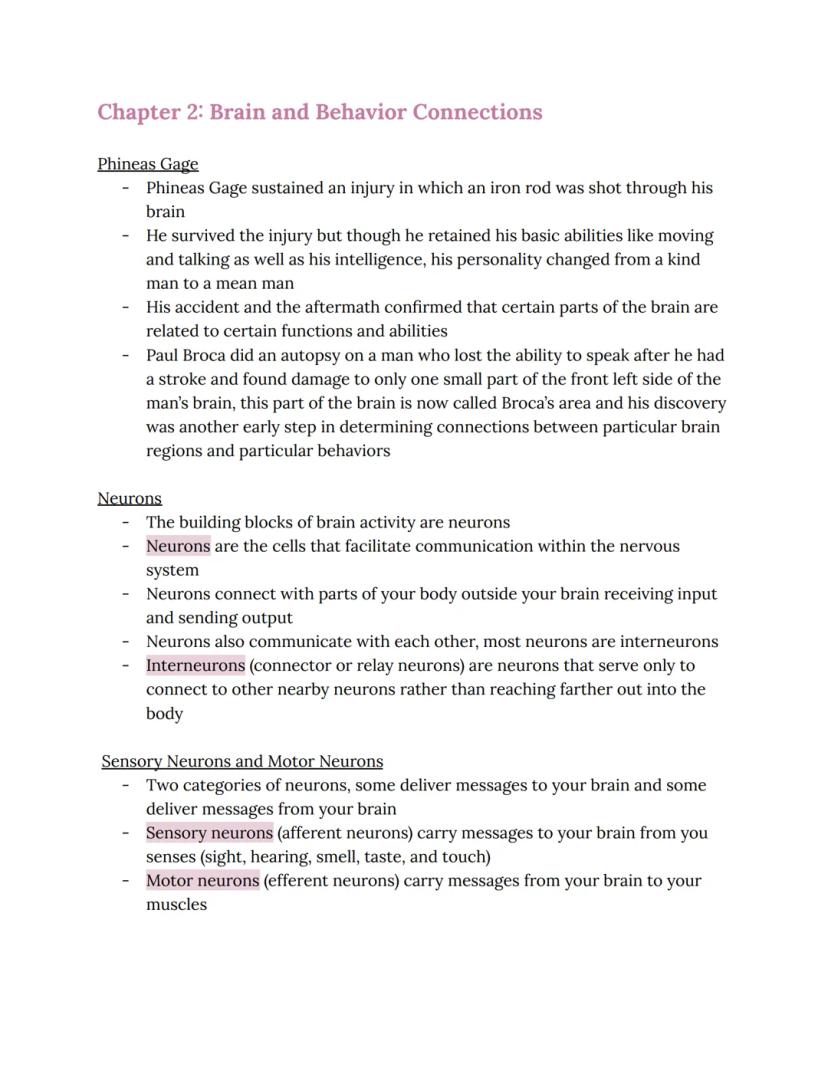
Ever wonder why you act the way you do? Your brain holds the answer! The famous case of Phineas Gage, who survived an iron rod shooting through his brain, showed scientists that specific brain regions control specific behaviors. While Gage kept his basic abilities and intelligence, his personality changed dramatically - from kind to mean.
Your brain functions through special cells called neurons, which are the building blocks of all brain activity. These amazing cells communicate within your nervous system, receiving input and sending output between your brain and body. Most neurons in your brain are interneurons, which connect only to other nearby neurons.
Two important types of neurons keep you functioning every day. Sensory neurons carry messages TO your brain from your senses (sight, smell, touch, etc.), while motor neurons carry messages FROM your brain to your muscles. Think about touching a hot stove - sensory neurons tell your brain "OUCH! HOT!" and motor neurons quickly tell your hand muscles "MOVE AWAY NOW!"
💡 Quick Fact: Reflexes are automatic responses that happen so fast they don't require conscious thought. This is why your hand jerks away from something hot before you even realize what happened!
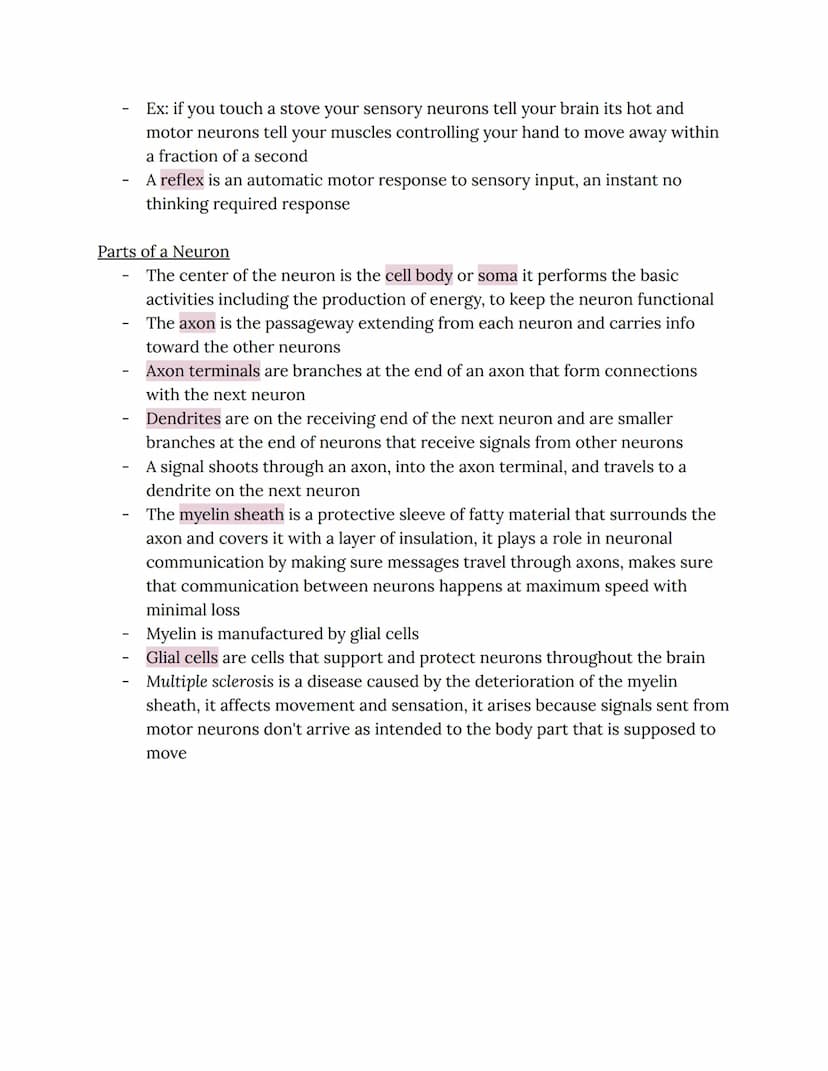
The parts of a neuron work together like a well-designed machine. At the center is the cell body (soma), which produces energy to keep the neuron functioning. Extending from this center is the axon, a long passage that carries information toward other neurons, ending in branched axon terminals that form connections with the next neuron.
On the receiving end of the next neuron are dendrites, smaller branches that collect signals from other neurons. The basic communication pattern is simple: a signal shoots through an axon, into the axon terminals, and travels to a dendrite on the next neuron.
Many axons are covered by a protective myelin sheath made of fatty material. This covering acts like insulation on electrical wires, ensuring messages travel at maximum speed with minimal loss. The myelin is manufactured by glial cells, which support and protect neurons throughout your brain.
Damage to myelin can cause serious problems. Multiple sclerosis is a disease caused by deterioration of the myelin sheath, affecting movement and sensation because signals from motor neurons don't arrive as intended to the body parts that need to move.
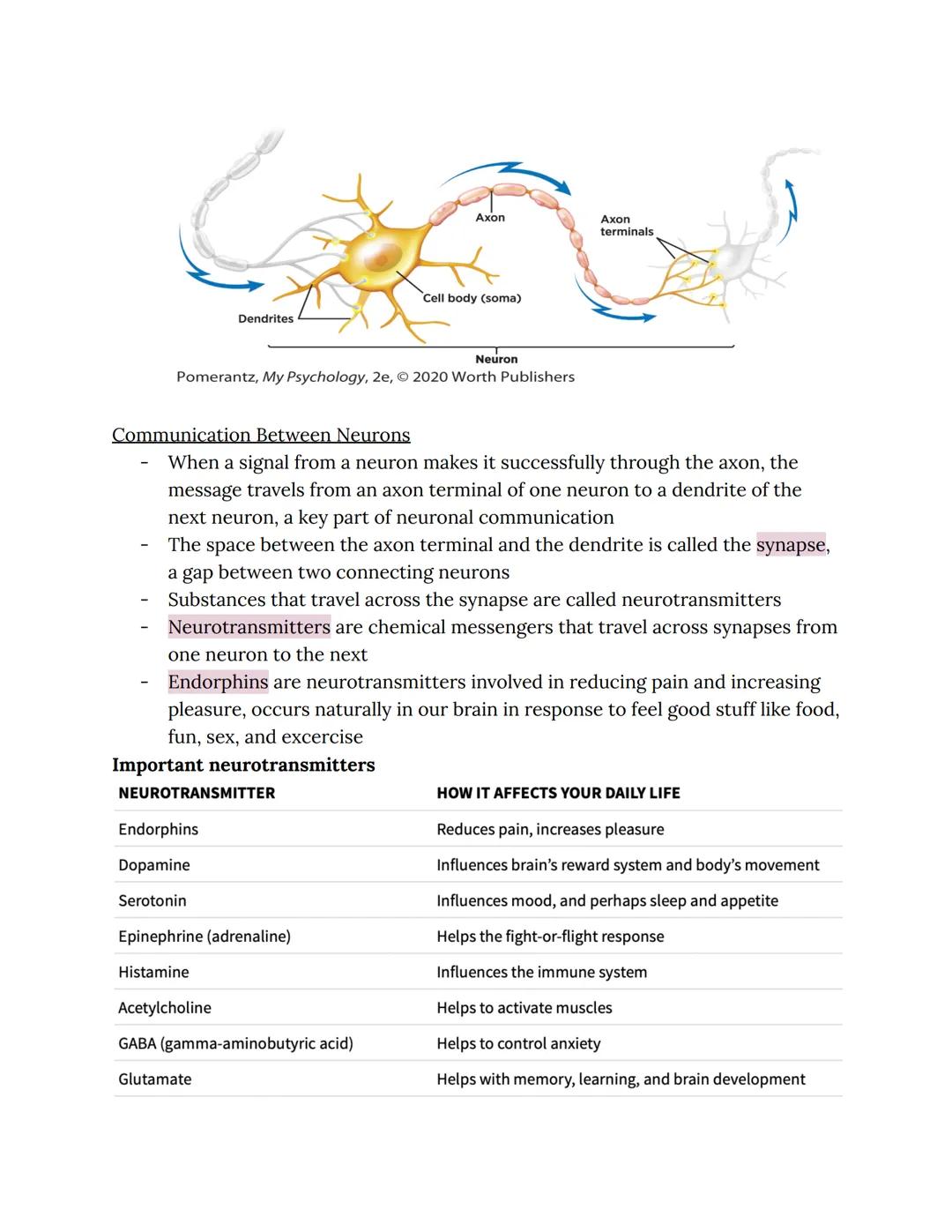
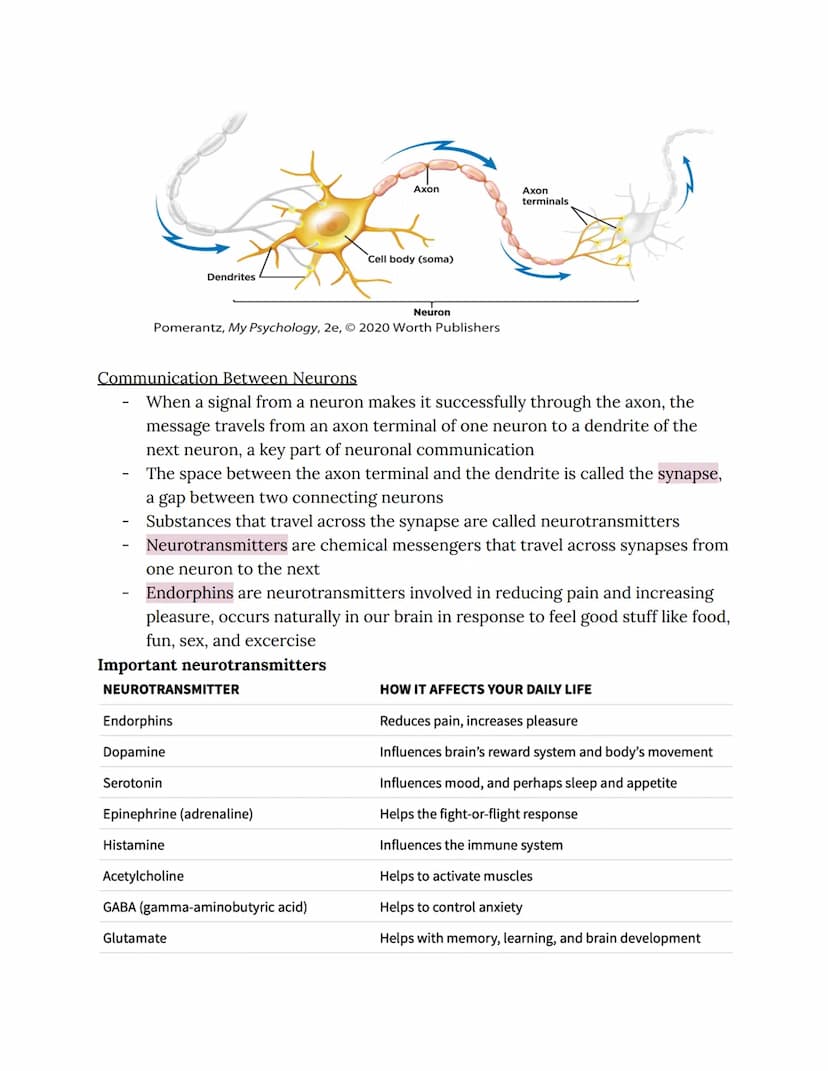
Your thoughts, feelings, and actions all depend on neurons "talking" to each other. When a signal reaches the end of an axon, it needs to cross a tiny gap called the synapse to reach the dendrite of the next neuron. This gap may be tiny, but crossing it is a big deal!
To bridge this gap, neurons release chemical messengers called neurotransmitters. These chemicals float across the synapse and attach to matching receptor sites on the receiving neuron - like keys fitting into specific locks. Not all neurotransmitters find a home; some don't fit the lock, and sometimes there aren't enough receptor sites.
Your brain uses many different neurotransmitters, each with unique effects. Endorphins reduce pain and increase pleasure (that's your natural "runner's high"). Dopamine influences your brain's reward system and body movement. Serotonin affects your mood, sleep, and appetite, while epinephrine (adrenaline) triggers your fight-or-flight response.
🧠 Brain Hack: Exercise naturally boosts your endorphins and other feel-good neurotransmitters. When you're feeling down or stressed, a quick workout can literally change your brain chemistry!
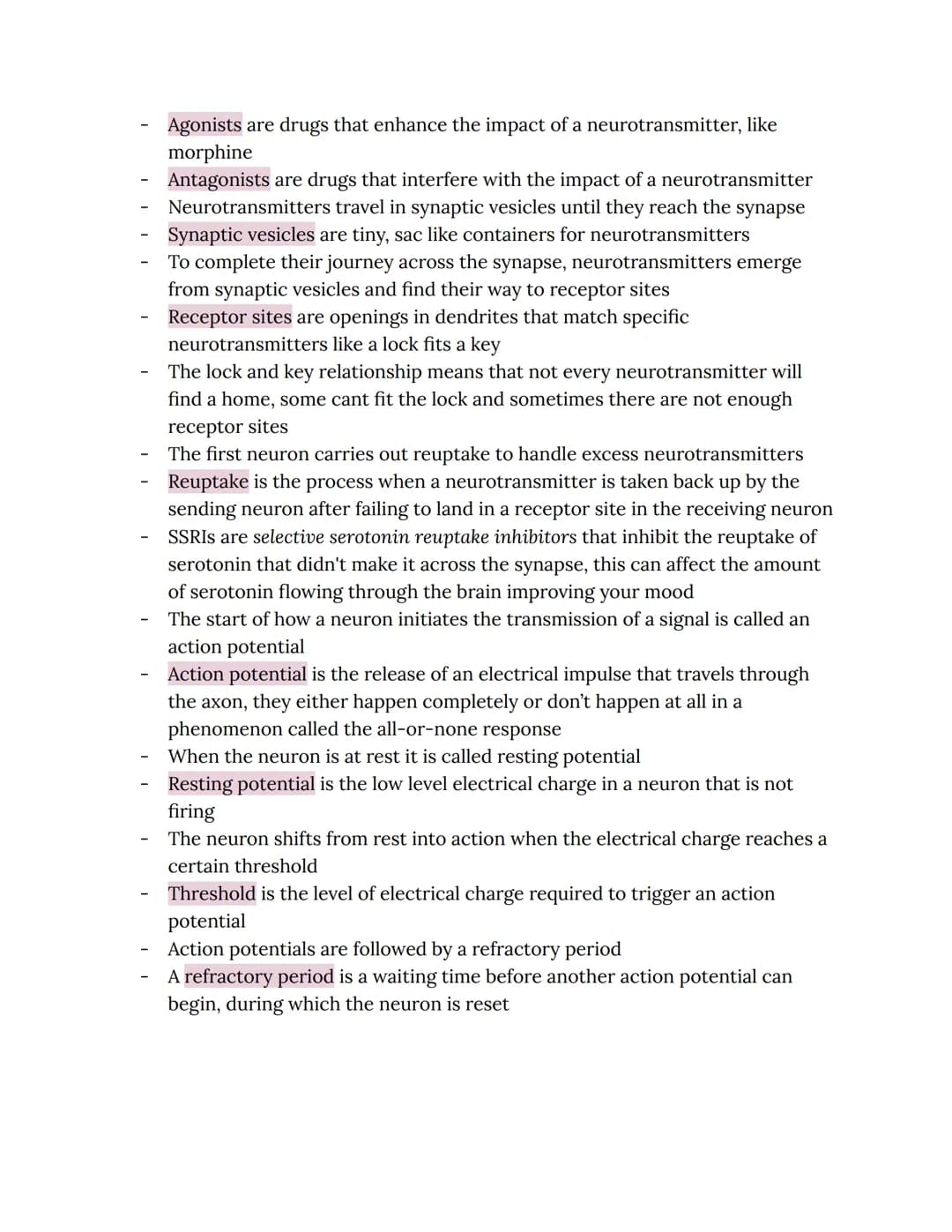
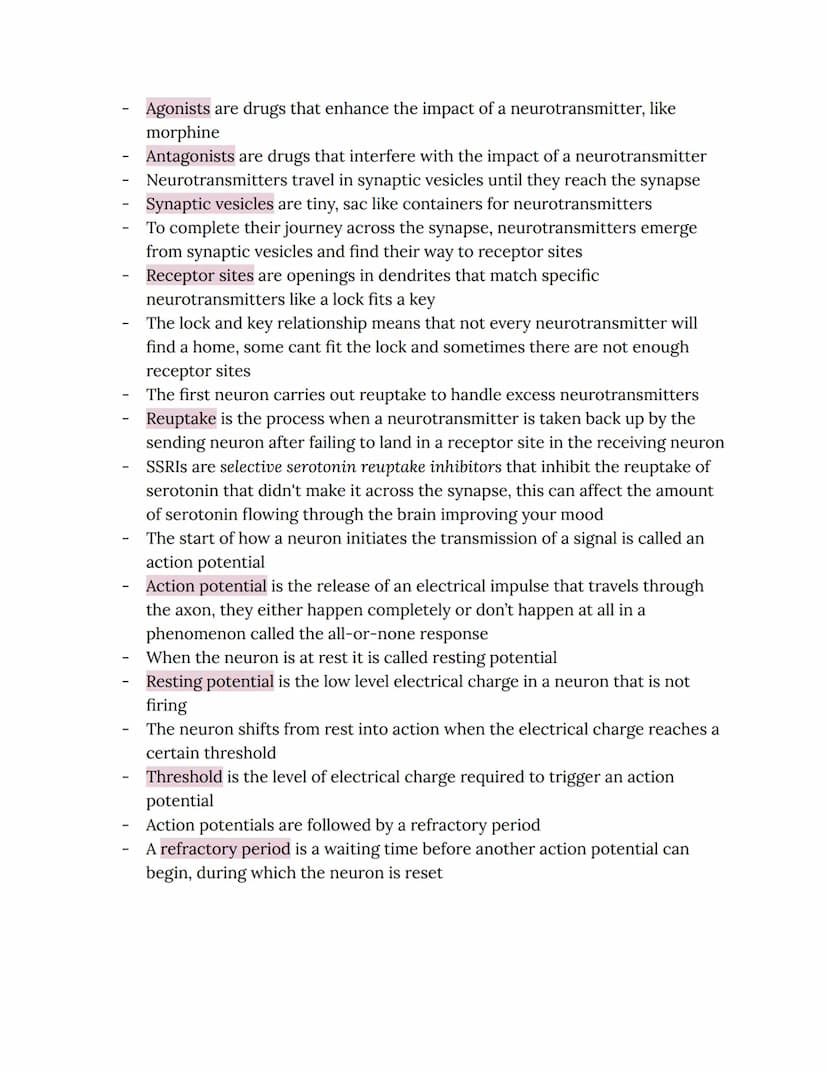
The electrical signal that travels through a neuron is called an action potential. This works on an "all-or-none" principle - it either happens completely or doesn't happen at all. When a neuron is at rest (not firing), it maintains a low electrical charge called resting potential. The neuron shifts from rest to action when the charge reaches a certain threshold level.
After an action potential fires, the neuron enters a refractory period - a waiting time during which the neuron resets before it can fire again. This ensures signals move in one direction and prevents overwhelming the system.
Some drugs affect how neurotransmitters work at the synapse. Agonists enhance a neurotransmitter's impact (like morphine enhancing endorphin effects), while antagonists block or interfere with neurotransmitters. When neurotransmitters don't find a receptor, they're often taken back by the sending neuron through a process called reuptake.
Depression medications called SSRIs (selective serotonin reuptake inhibitors) work by blocking the reuptake of serotonin, leaving more available in the synapse. This increases serotonin levels in your brain, which can improve your mood and reduce depression symptoms.
Your brain isn't just one uniform blob - it's organized into specialized regions that handle different functions. This idea that specific parts do specific jobs is called localization.
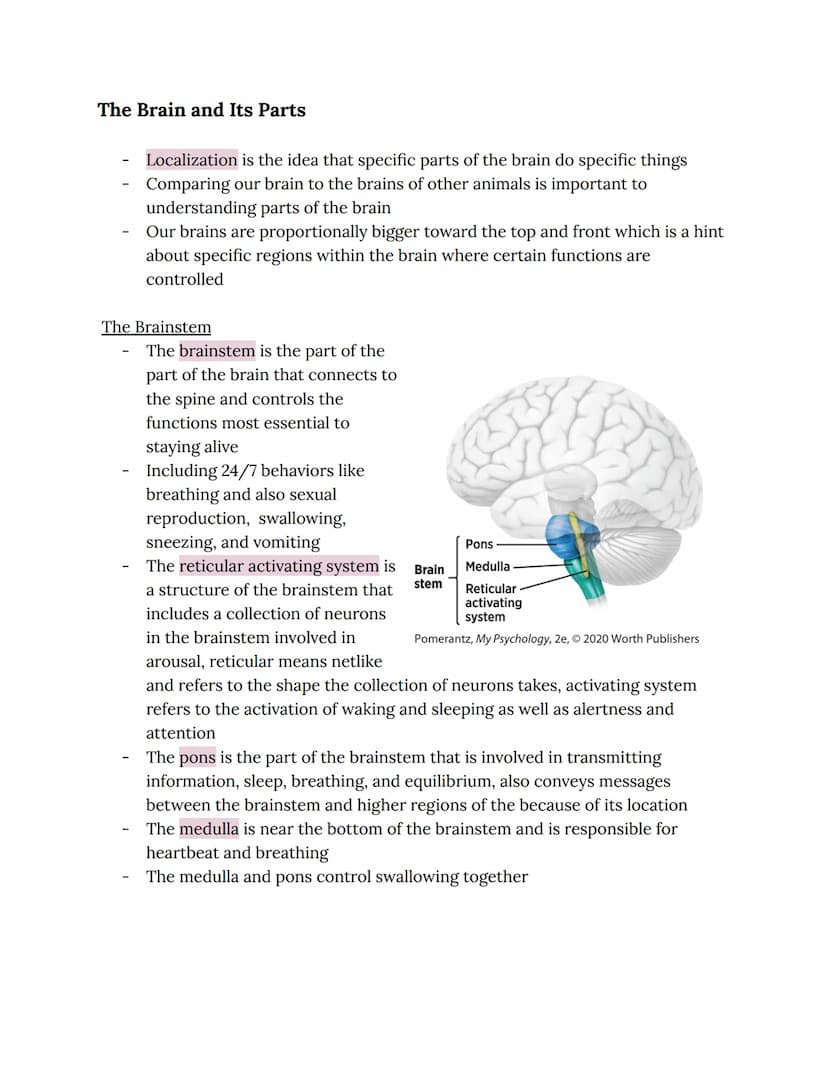
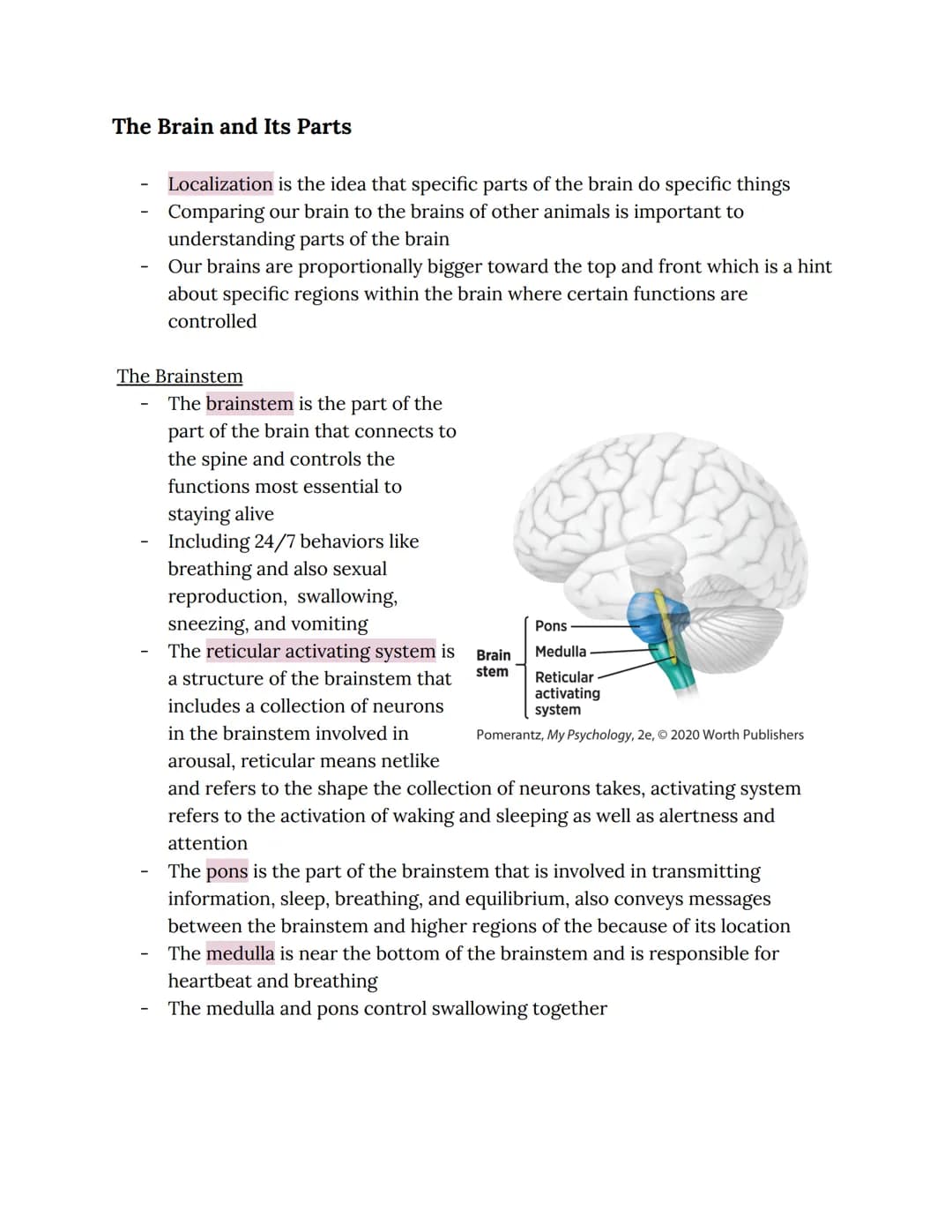
The most primitive part of your brain is the brainstem, which connects to your spine and controls functions essential to staying alive. Think of it as your body's autopilot, handling 24/7 behaviors like breathing, heart rate, swallowing, and even sneezing. Damage to this area can be life-threatening because it manages such vital functions.
Within the brainstem, the reticular activating system (RAS) contains a netlike collection of neurons involved in wakefulness, sleep, alertness, and attention. It's basically your brain's "wake-up call" system that filters important stimuli from background noise.
Two other important parts of the brainstem are the pons and the medulla. The pons transmits information and helps with sleep, breathing, and balance, while the medulla (near the bottom of the brainstem) controls your heartbeat and breathing. Together, they coordinate essential functions like swallowing.
🔍 Connection Alert: Ever wonder why you don't have to consciously remember to breathe? Thank your brainstem! It handles these critical functions automatically so your conscious mind can focus on other things.
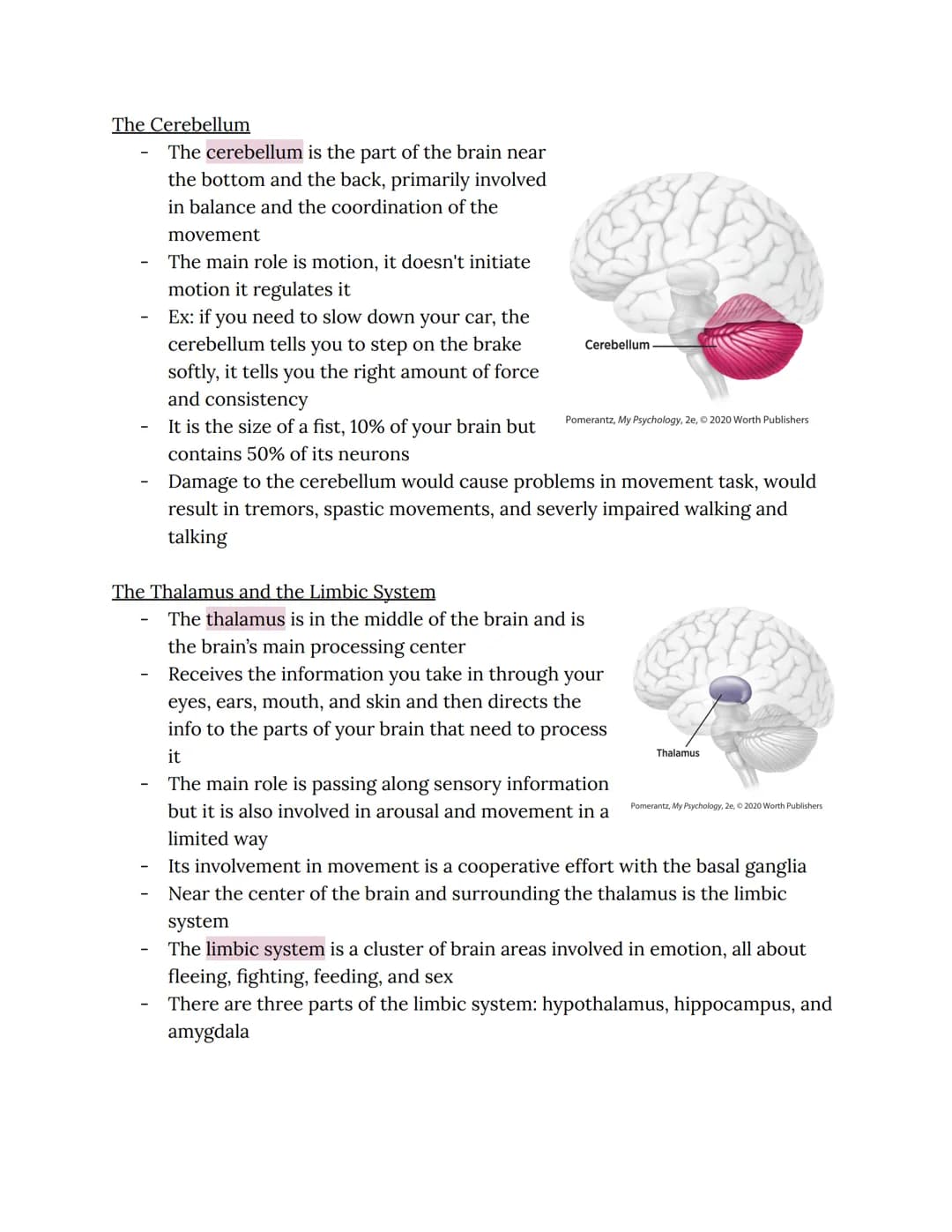
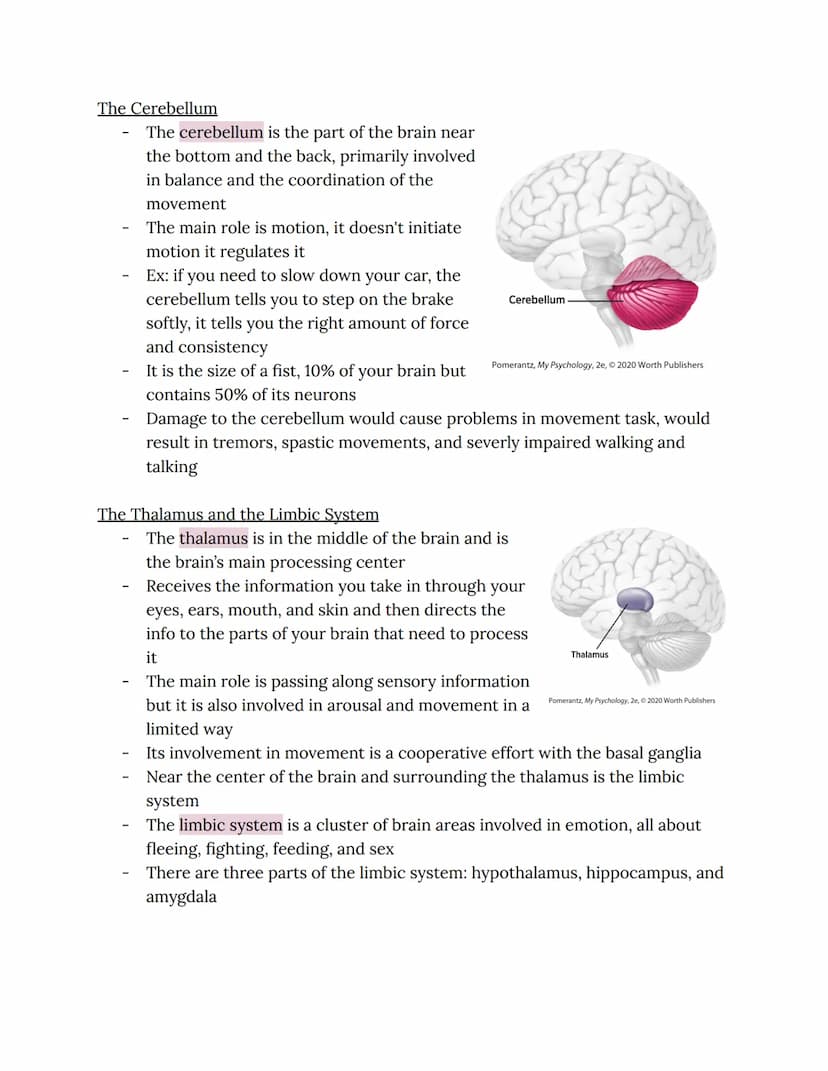
The cerebellum sits at the back bottom of your brain and looks like a mini-brain. Though only 10% of your brain's volume, it contains a whopping 50% of its neurons! Its main job is regulating movement - not starting movements, but making them smooth and coordinated. When you step on the brake pedal, your cerebellum determines exactly how much pressure to apply. Damage here would cause tremors, jerky movements, and problems walking or talking.
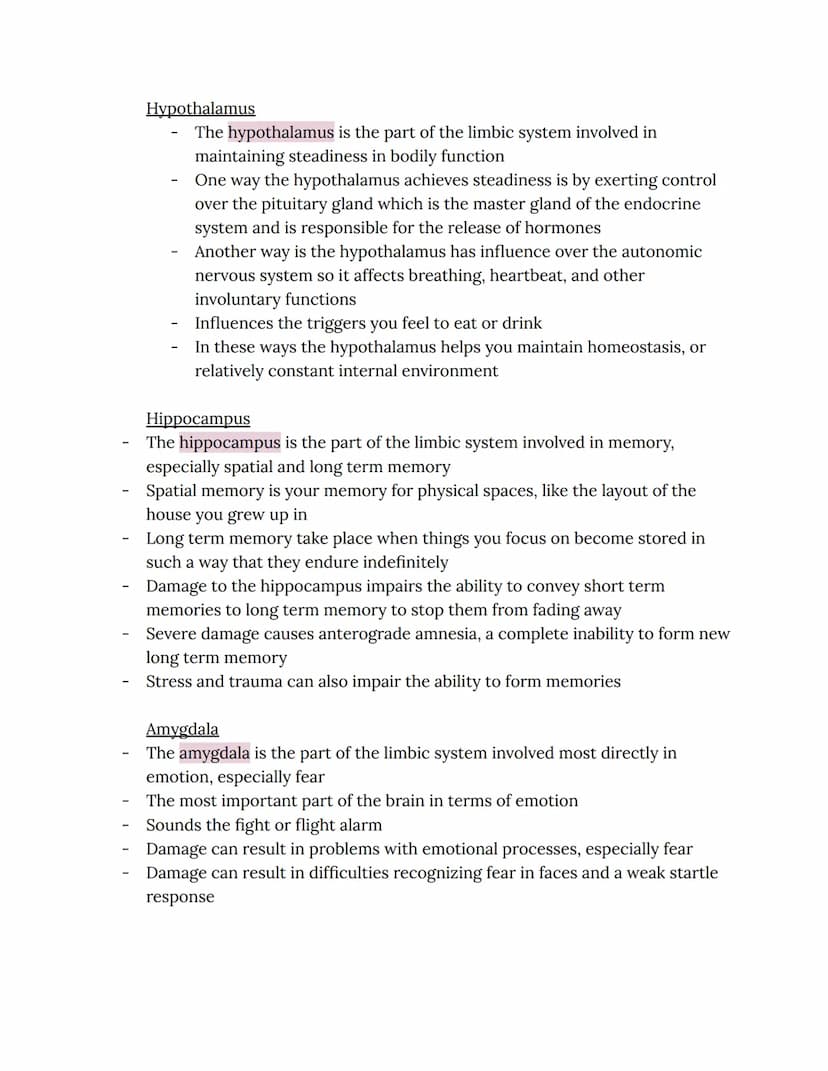
Near the center of your brain is the thalamus, your brain's main processing center. Think of it as a switchboard operator, receiving sensory information from your eyes, ears, mouth, and skin, then directing it to the right parts of your brain for processing. It also helps with arousal and some aspects of movement.
Surrounding the thalamus is the limbic system, a cluster of brain areas involved in emotion - particularly the four F's: fleeing, fighting, feeding, and sex. This system includes three critical parts: the hypothalamus, hippocampus, and amygdala. Each plays a unique role in your emotional life and basic survival functions.
The hypothalamus maintains steadiness in your bodily functions - like an internal thermostat. It controls the pituitary gland (the master gland releasing hormones) and influences your autonomic nervous system, affecting breathing, heartbeat, and other involuntary functions. It also triggers hunger and thirst, helping maintain homeostasis - your body's relatively constant internal environment. When you're too hot, it triggers sweating; when you're hungry, it makes you want food.
The hippocampus is crucial for memory formation, especially spatial memory (remembering physical spaces like your childhood home) and long-term memory (storing information indefinitely). Damage here makes it difficult to form new long-term memories. Severe damage can cause anterograde amnesia - the complete inability to create new long-term memories, even while old memories remain intact. This is why stress and trauma can affect your ability to remember things clearly.
The amygdala is your emotional center, especially for fear. When you see a threatening situation, your amygdala sounds the alarm, triggering your fight-or-flight response. People with amygdala damage often have trouble recognizing fear in faces and show weak startle responses. They might approach dangerous situations without appropriate caution because their brain's "danger detector" isn't working properly.
🧠 Brain Connection: Ever wondered why emotional memories are so powerful? Your hippocampus and amygdala work together - one storing the memory and the other attaching emotional significance to it. That's why you can vividly recall highly emotional events years later!
The cerebrum is the largest part of your brain, fitting over the brainstem, cerebellum, thalamus, and limbic system like a helmet. This upper, front part consists of two hemispheres and handles sophisticated, uniquely human abilities. The outer layer called the cerebral cortex processes sensory information and is what makes humans truly human.
What separates your brain from other animals? The cerebrum gives us distinctly human abilities like thinking, reasoning, planning, and language. Much of the cerebrum contains association areas - brain material devoted to synthesizing and interpreting information rather than merely taking in sensory data. This is where you make sense of your world!
Your cerebrum is divided into left and right cerebral hemispheres connected by the corpus callosum, a bundle of neurons that allows communication between the two sides. Interestingly, your left hemisphere controls the right side of your body, while your right hemisphere controls your left side. Each hemisphere specializes in different functions - the left is typically dominant for language tasks, while the right excels at recognizing objects and faces.
In rare cases of severe epilepsy, doctors may perform split-brain surgery, severing the corpus callosum to prevent seizures from spreading between hemispheres. After this procedure, each side of the body operates independently without awareness of the other side - sometimes body parts even compete with each other!
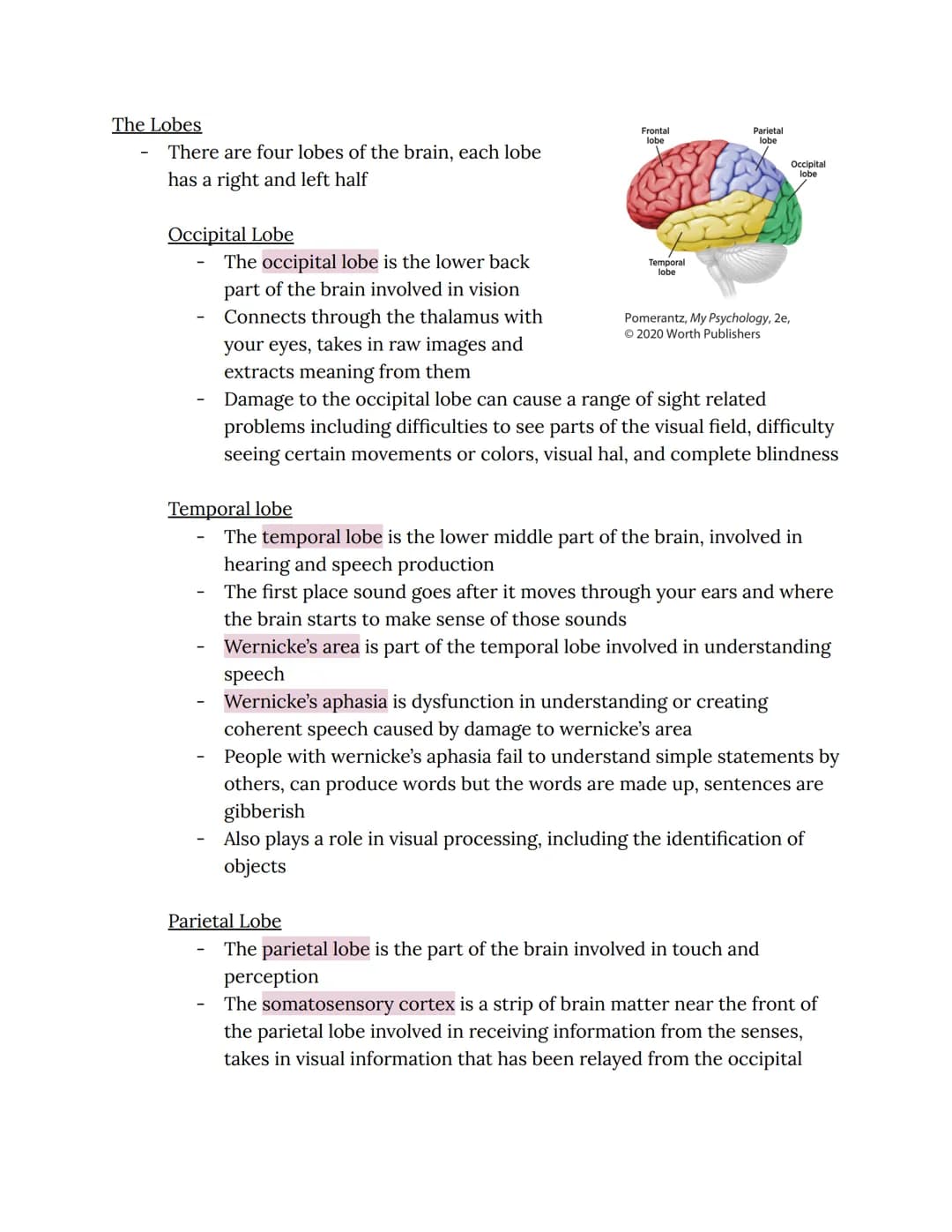
Your cerebrum divides into four pairs of lobes, each specialized for different functions. Think of them as departments in your brain's company, each handling specific responsibilities.
The occipital lobe at the lower back of your brain handles vision. It connects through the thalamus to your eyes, processing raw images and extracting meaning from them. Damage here can cause various sight-related problems - from difficulty seeing parts of your visual field to problems with color perception or even complete blindness.
The temporal lobe sits at the lower middle of your brain, processing hearing and speech. This is where sound goes after entering your ears, and where your brain starts making sense of those sounds. Inside the temporal lobe, Wernicke's area helps you understand speech. Damage here causes Wernicke's aphasia, where you can produce words but they're often made up, and you struggle to understand what others say.
The parietal lobe processes touch and spatial perception. Near its front sits the somatosensory cortex, which receives information from all your senses. It monitors touch sensations throughout your body, with specific spots corresponding to specific body parts (those for hands and face are especially large because we use them for precise sensations).
✨ Fascinating Fact: Your brain has a "map" of your entire body in the somatosensory cortex, but parts you use for precise sensing (like fingers and lips) get more brain space than less sensitive areas (like your back)!
The frontal lobe is your brain's most advanced region, sitting right behind your forehead. This powerhouse handles complex thinking tasks, planning, purposeful actions, and other sophisticated functions that set humans apart from other animals.
At the very front, the prefrontal region manages uniquely human behaviors and executive control - it's like your brain's CEO, overseeing tasks and solving problems as they arise. This region is responsible for your personality, decision-making ability, and social behavior. It's what helps you resist impulses and make thoughtful choices instead of just reacting.
Near the back of the frontal lobe runs the motor cortex, a strip of brain matter that controls voluntary movement. Different sections control different body parts, with more space devoted to areas requiring precise control (like your hands and face) compared to areas needing less precision (like your torso).
On the left side of the frontal lobe sits Broca's area, which is crucial for producing speech. Damage here causes Broca's aphasia - a condition where you can understand speech perfectly but struggle to produce it. People with this condition speak in short, simplified phrases and get frustrated because they know what they want to say but can't form the words.
🧠 Think About It: Your frontal lobe isn't fully developed until your mid-20s! This explains why teens and young adults sometimes make impulsive decisions - their brain's "impulse control center" is still under construction.
Our AI companion is specifically built for the needs of students. Based on the millions of content pieces we have on the platform we can provide truly meaningful and relevant answers to students. But its not only about answers, the companion is even more about guiding students through their daily learning challenges, with personalised study plans, quizzes or content pieces in the chat and 100% personalisation based on the students skills and developments.
You can download the app in the Google Play Store and in the Apple App Store.
That's right! Enjoy free access to study content, connect with fellow students, and get instant help – all at your fingertips.
App Store
Google Play
The app is very easy to use and well designed. I have found everything I was looking for so far and have been able to learn a lot from the presentations! I will definitely use the app for a class assignment! And of course it also helps a lot as an inspiration.
Stefan S
iOS user
This app is really great. There are so many study notes and help [...]. My problem subject is French, for example, and the app has so many options for help. Thanks to this app, I have improved my French. I would recommend it to anyone.
Samantha Klich
Android user
Wow, I am really amazed. I just tried the app because I've seen it advertised many times and was absolutely stunned. This app is THE HELP you want for school and above all, it offers so many things, such as workouts and fact sheets, which have been VERY helpful to me personally.
Anna
iOS user
I think it’s very much worth it and you’ll end up using it a lot once you get the hang of it and even after looking at others notes you can still ask your Artificial intelligence buddy the question and ask to simplify it if you still don’t get it!!! In the end I think it’s worth it 😊👍 ⚠️Also DID I MENTION ITS FREEE YOU DON’T HAVE TO PAY FOR ANYTHING AND STILL GET YOUR GRADES IN PERFECTLY❗️❗️⚠️
Thomas R
iOS user
Knowunity is the BEST app I’ve used in a minute. This is not an ai review or anything this is genuinely coming from a 7th grade student (I know 2011 im young) but dude this app is a 10/10 i have maintained a 3.8 gpa and have plenty of time for gaming. I love it and my mom is just happy I got good grades
Brad T
Android user
Not only did it help me find the answer but it also showed me alternative ways to solve it. I was horrible in math and science but now I have an a in both subjects. Thanks for the help🤍🤍
David K
iOS user
The app's just great! All I have to do is enter the topic in the search bar and I get the response real fast. I don't have to watch 10 YouTube videos to understand something, so I'm saving my time. Highly recommended!
Sudenaz Ocak
Android user
In school I was really bad at maths but thanks to the app, I am doing better now. I am so grateful that you made the app.
Greenlight Bonnie
Android user
I found this app a couple years ago and it has only gotten better since then. I really love it because it can help with written questions and photo questions. Also, it can find study guides that other people have made as well as flashcard sets and practice tests. The free version is also amazing for students who might not be able to afford it. Would 100% recommend
Aubrey
iOS user
Best app if you're in Highschool or Junior high. I have been using this app for 2 school years and it's the best, it's good if you don't have anyone to help you with school work.😋🩷🎀
Marco B
iOS user
THE QUIZES AND FLASHCARDS ARE SO USEFUL AND I LOVE Knowunity AI. IT ALSO IS LITREALLY LIKE CHATGPT BUT SMARTER!! HELPED ME WITH MY MASCARA PROBLEMS TOO!! AS WELL AS MY REAL SUBJECTS ! DUHHH 😍😁😲🤑💗✨🎀😮
Elisha
iOS user
This app is phenomenal down to the correct info and the various topics you can study! I greatly recommend it for people who struggle with procrastination and those who need homework help. It has been perfectly accurate for world 1 history as far as I’ve seen! Geometry too!
Paul T
iOS user
The app is very easy to use and well designed. I have found everything I was looking for so far and have been able to learn a lot from the presentations! I will definitely use the app for a class assignment! And of course it also helps a lot as an inspiration.
Stefan S
iOS user
This app is really great. There are so many study notes and help [...]. My problem subject is French, for example, and the app has so many options for help. Thanks to this app, I have improved my French. I would recommend it to anyone.
Samantha Klich
Android user
Wow, I am really amazed. I just tried the app because I've seen it advertised many times and was absolutely stunned. This app is THE HELP you want for school and above all, it offers so many things, such as workouts and fact sheets, which have been VERY helpful to me personally.
Anna
iOS user
I think it’s very much worth it and you’ll end up using it a lot once you get the hang of it and even after looking at others notes you can still ask your Artificial intelligence buddy the question and ask to simplify it if you still don’t get it!!! In the end I think it’s worth it 😊👍 ⚠️Also DID I MENTION ITS FREEE YOU DON’T HAVE TO PAY FOR ANYTHING AND STILL GET YOUR GRADES IN PERFECTLY❗️❗️⚠️
Thomas R
iOS user
Knowunity is the BEST app I’ve used in a minute. This is not an ai review or anything this is genuinely coming from a 7th grade student (I know 2011 im young) but dude this app is a 10/10 i have maintained a 3.8 gpa and have plenty of time for gaming. I love it and my mom is just happy I got good grades
Brad T
Android user
Not only did it help me find the answer but it also showed me alternative ways to solve it. I was horrible in math and science but now I have an a in both subjects. Thanks for the help🤍🤍
David K
iOS user
The app's just great! All I have to do is enter the topic in the search bar and I get the response real fast. I don't have to watch 10 YouTube videos to understand something, so I'm saving my time. Highly recommended!
Sudenaz Ocak
Android user
In school I was really bad at maths but thanks to the app, I am doing better now. I am so grateful that you made the app.
Greenlight Bonnie
Android user
I found this app a couple years ago and it has only gotten better since then. I really love it because it can help with written questions and photo questions. Also, it can find study guides that other people have made as well as flashcard sets and practice tests. The free version is also amazing for students who might not be able to afford it. Would 100% recommend
Aubrey
iOS user
Best app if you're in Highschool or Junior high. I have been using this app for 2 school years and it's the best, it's good if you don't have anyone to help you with school work.😋🩷🎀
Marco B
iOS user
THE QUIZES AND FLASHCARDS ARE SO USEFUL AND I LOVE Knowunity AI. IT ALSO IS LITREALLY LIKE CHATGPT BUT SMARTER!! HELPED ME WITH MY MASCARA PROBLEMS TOO!! AS WELL AS MY REAL SUBJECTS ! DUHHH 😍😁😲🤑💗✨🎀😮
Elisha
iOS user
This app is phenomenal down to the correct info and the various topics you can study! I greatly recommend it for people who struggle with procrastination and those who need homework help. It has been perfectly accurate for world 1 history as far as I’ve seen! Geometry too!
Paul T
iOS user
The brain is the control center of your body, directing everything from basic survival functions to complex thinking. Understanding how your brain works helps explain your behaviors, emotions, and abilities. Let's explore the fascinating connections between your brain and behavior!
Access to all documents
Improve your grades
Join milions of students
Ever wonder why you act the way you do? Your brain holds the answer! The famous case of Phineas Gage, who survived an iron rod shooting through his brain, showed scientists that specific brain regions control specific behaviors. While Gage kept his basic abilities and intelligence, his personality changed dramatically - from kind to mean.
Your brain functions through special cells called neurons, which are the building blocks of all brain activity. These amazing cells communicate within your nervous system, receiving input and sending output between your brain and body. Most neurons in your brain are interneurons, which connect only to other nearby neurons.
Two important types of neurons keep you functioning every day. Sensory neurons carry messages TO your brain from your senses (sight, smell, touch, etc.), while motor neurons carry messages FROM your brain to your muscles. Think about touching a hot stove - sensory neurons tell your brain "OUCH! HOT!" and motor neurons quickly tell your hand muscles "MOVE AWAY NOW!"
💡 Quick Fact: Reflexes are automatic responses that happen so fast they don't require conscious thought. This is why your hand jerks away from something hot before you even realize what happened!
Access to all documents
Improve your grades
Join milions of students
The parts of a neuron work together like a well-designed machine. At the center is the cell body (soma), which produces energy to keep the neuron functioning. Extending from this center is the axon, a long passage that carries information toward other neurons, ending in branched axon terminals that form connections with the next neuron.
On the receiving end of the next neuron are dendrites, smaller branches that collect signals from other neurons. The basic communication pattern is simple: a signal shoots through an axon, into the axon terminals, and travels to a dendrite on the next neuron.
Many axons are covered by a protective myelin sheath made of fatty material. This covering acts like insulation on electrical wires, ensuring messages travel at maximum speed with minimal loss. The myelin is manufactured by glial cells, which support and protect neurons throughout your brain.
Damage to myelin can cause serious problems. Multiple sclerosis is a disease caused by deterioration of the myelin sheath, affecting movement and sensation because signals from motor neurons don't arrive as intended to the body parts that need to move.
Access to all documents
Improve your grades
Join milions of students
Your thoughts, feelings, and actions all depend on neurons "talking" to each other. When a signal reaches the end of an axon, it needs to cross a tiny gap called the synapse to reach the dendrite of the next neuron. This gap may be tiny, but crossing it is a big deal!
To bridge this gap, neurons release chemical messengers called neurotransmitters. These chemicals float across the synapse and attach to matching receptor sites on the receiving neuron - like keys fitting into specific locks. Not all neurotransmitters find a home; some don't fit the lock, and sometimes there aren't enough receptor sites.
Your brain uses many different neurotransmitters, each with unique effects. Endorphins reduce pain and increase pleasure (that's your natural "runner's high"). Dopamine influences your brain's reward system and body movement. Serotonin affects your mood, sleep, and appetite, while epinephrine (adrenaline) triggers your fight-or-flight response.
🧠 Brain Hack: Exercise naturally boosts your endorphins and other feel-good neurotransmitters. When you're feeling down or stressed, a quick workout can literally change your brain chemistry!
Access to all documents
Improve your grades
Join milions of students
The electrical signal that travels through a neuron is called an action potential. This works on an "all-or-none" principle - it either happens completely or doesn't happen at all. When a neuron is at rest (not firing), it maintains a low electrical charge called resting potential. The neuron shifts from rest to action when the charge reaches a certain threshold level.
After an action potential fires, the neuron enters a refractory period - a waiting time during which the neuron resets before it can fire again. This ensures signals move in one direction and prevents overwhelming the system.
Some drugs affect how neurotransmitters work at the synapse. Agonists enhance a neurotransmitter's impact (like morphine enhancing endorphin effects), while antagonists block or interfere with neurotransmitters. When neurotransmitters don't find a receptor, they're often taken back by the sending neuron through a process called reuptake.
Depression medications called SSRIs (selective serotonin reuptake inhibitors) work by blocking the reuptake of serotonin, leaving more available in the synapse. This increases serotonin levels in your brain, which can improve your mood and reduce depression symptoms.
Access to all documents
Improve your grades
Join milions of students
Your brain isn't just one uniform blob - it's organized into specialized regions that handle different functions. This idea that specific parts do specific jobs is called localization.
The most primitive part of your brain is the brainstem, which connects to your spine and controls functions essential to staying alive. Think of it as your body's autopilot, handling 24/7 behaviors like breathing, heart rate, swallowing, and even sneezing. Damage to this area can be life-threatening because it manages such vital functions.
Within the brainstem, the reticular activating system (RAS) contains a netlike collection of neurons involved in wakefulness, sleep, alertness, and attention. It's basically your brain's "wake-up call" system that filters important stimuli from background noise.
Two other important parts of the brainstem are the pons and the medulla. The pons transmits information and helps with sleep, breathing, and balance, while the medulla (near the bottom of the brainstem) controls your heartbeat and breathing. Together, they coordinate essential functions like swallowing.
🔍 Connection Alert: Ever wonder why you don't have to consciously remember to breathe? Thank your brainstem! It handles these critical functions automatically so your conscious mind can focus on other things.
Access to all documents
Improve your grades
Join milions of students
The cerebellum sits at the back bottom of your brain and looks like a mini-brain. Though only 10% of your brain's volume, it contains a whopping 50% of its neurons! Its main job is regulating movement - not starting movements, but making them smooth and coordinated. When you step on the brake pedal, your cerebellum determines exactly how much pressure to apply. Damage here would cause tremors, jerky movements, and problems walking or talking.
Near the center of your brain is the thalamus, your brain's main processing center. Think of it as a switchboard operator, receiving sensory information from your eyes, ears, mouth, and skin, then directing it to the right parts of your brain for processing. It also helps with arousal and some aspects of movement.
Surrounding the thalamus is the limbic system, a cluster of brain areas involved in emotion - particularly the four F's: fleeing, fighting, feeding, and sex. This system includes three critical parts: the hypothalamus, hippocampus, and amygdala. Each plays a unique role in your emotional life and basic survival functions.
Access to all documents
Improve your grades
Join milions of students
The hypothalamus maintains steadiness in your bodily functions - like an internal thermostat. It controls the pituitary gland (the master gland releasing hormones) and influences your autonomic nervous system, affecting breathing, heartbeat, and other involuntary functions. It also triggers hunger and thirst, helping maintain homeostasis - your body's relatively constant internal environment. When you're too hot, it triggers sweating; when you're hungry, it makes you want food.
The hippocampus is crucial for memory formation, especially spatial memory (remembering physical spaces like your childhood home) and long-term memory (storing information indefinitely). Damage here makes it difficult to form new long-term memories. Severe damage can cause anterograde amnesia - the complete inability to create new long-term memories, even while old memories remain intact. This is why stress and trauma can affect your ability to remember things clearly.
The amygdala is your emotional center, especially for fear. When you see a threatening situation, your amygdala sounds the alarm, triggering your fight-or-flight response. People with amygdala damage often have trouble recognizing fear in faces and show weak startle responses. They might approach dangerous situations without appropriate caution because their brain's "danger detector" isn't working properly.
🧠 Brain Connection: Ever wondered why emotional memories are so powerful? Your hippocampus and amygdala work together - one storing the memory and the other attaching emotional significance to it. That's why you can vividly recall highly emotional events years later!
Access to all documents
Improve your grades
Join milions of students
The cerebrum is the largest part of your brain, fitting over the brainstem, cerebellum, thalamus, and limbic system like a helmet. This upper, front part consists of two hemispheres and handles sophisticated, uniquely human abilities. The outer layer called the cerebral cortex processes sensory information and is what makes humans truly human.
What separates your brain from other animals? The cerebrum gives us distinctly human abilities like thinking, reasoning, planning, and language. Much of the cerebrum contains association areas - brain material devoted to synthesizing and interpreting information rather than merely taking in sensory data. This is where you make sense of your world!
Your cerebrum is divided into left and right cerebral hemispheres connected by the corpus callosum, a bundle of neurons that allows communication between the two sides. Interestingly, your left hemisphere controls the right side of your body, while your right hemisphere controls your left side. Each hemisphere specializes in different functions - the left is typically dominant for language tasks, while the right excels at recognizing objects and faces.
In rare cases of severe epilepsy, doctors may perform split-brain surgery, severing the corpus callosum to prevent seizures from spreading between hemispheres. After this procedure, each side of the body operates independently without awareness of the other side - sometimes body parts even compete with each other!
Access to all documents
Improve your grades
Join milions of students
Your cerebrum divides into four pairs of lobes, each specialized for different functions. Think of them as departments in your brain's company, each handling specific responsibilities.
The occipital lobe at the lower back of your brain handles vision. It connects through the thalamus to your eyes, processing raw images and extracting meaning from them. Damage here can cause various sight-related problems - from difficulty seeing parts of your visual field to problems with color perception or even complete blindness.
The temporal lobe sits at the lower middle of your brain, processing hearing and speech. This is where sound goes after entering your ears, and where your brain starts making sense of those sounds. Inside the temporal lobe, Wernicke's area helps you understand speech. Damage here causes Wernicke's aphasia, where you can produce words but they're often made up, and you struggle to understand what others say.
The parietal lobe processes touch and spatial perception. Near its front sits the somatosensory cortex, which receives information from all your senses. It monitors touch sensations throughout your body, with specific spots corresponding to specific body parts (those for hands and face are especially large because we use them for precise sensations).
✨ Fascinating Fact: Your brain has a "map" of your entire body in the somatosensory cortex, but parts you use for precise sensing (like fingers and lips) get more brain space than less sensitive areas (like your back)!
Access to all documents
Improve your grades
Join milions of students
The frontal lobe is your brain's most advanced region, sitting right behind your forehead. This powerhouse handles complex thinking tasks, planning, purposeful actions, and other sophisticated functions that set humans apart from other animals.
At the very front, the prefrontal region manages uniquely human behaviors and executive control - it's like your brain's CEO, overseeing tasks and solving problems as they arise. This region is responsible for your personality, decision-making ability, and social behavior. It's what helps you resist impulses and make thoughtful choices instead of just reacting.
Near the back of the frontal lobe runs the motor cortex, a strip of brain matter that controls voluntary movement. Different sections control different body parts, with more space devoted to areas requiring precise control (like your hands and face) compared to areas needing less precision (like your torso).
On the left side of the frontal lobe sits Broca's area, which is crucial for producing speech. Damage here causes Broca's aphasia - a condition where you can understand speech perfectly but struggle to produce it. People with this condition speak in short, simplified phrases and get frustrated because they know what they want to say but can't form the words.
🧠 Think About It: Your frontal lobe isn't fully developed until your mid-20s! This explains why teens and young adults sometimes make impulsive decisions - their brain's "impulse control center" is still under construction.
Our AI companion is specifically built for the needs of students. Based on the millions of content pieces we have on the platform we can provide truly meaningful and relevant answers to students. But its not only about answers, the companion is even more about guiding students through their daily learning challenges, with personalised study plans, quizzes or content pieces in the chat and 100% personalisation based on the students skills and developments.
You can download the app in the Google Play Store and in the Apple App Store.
That's right! Enjoy free access to study content, connect with fellow students, and get instant help – all at your fingertips.
13
Smart Tools NEW
Transform this note into: ✓ 50+ Practice Questions ✓ Interactive Flashcards ✓ Full Practice Test ✓ Essay Outlines
AP Psychology, Unit 2
 AP Psychology
Explore the key concepts of the biological approach in psychology, including brain structures, genetics, and neurotransmitter functions. This summary covers the role of the frontal lobe, the impact of genetics on behavior, and the significance of twin studies in understanding psychological disorders. Ideal for exam preparation and understanding the biological basis of behavior.
 Psychology
ap classroom video notes
AP PsychologyApp Store
Google Play
The app is very easy to use and well designed. I have found everything I was looking for so far and have been able to learn a lot from the presentations! I will definitely use the app for a class assignment! And of course it also helps a lot as an inspiration.
Stefan S
iOS user
This app is really great. There are so many study notes and help [...]. My problem subject is French, for example, and the app has so many options for help. Thanks to this app, I have improved my French. I would recommend it to anyone.
Samantha Klich
Android user
Wow, I am really amazed. I just tried the app because I've seen it advertised many times and was absolutely stunned. This app is THE HELP you want for school and above all, it offers so many things, such as workouts and fact sheets, which have been VERY helpful to me personally.
Anna
iOS user
I think it’s very much worth it and you’ll end up using it a lot once you get the hang of it and even after looking at others notes you can still ask your Artificial intelligence buddy the question and ask to simplify it if you still don’t get it!!! In the end I think it’s worth it 😊👍 ⚠️Also DID I MENTION ITS FREEE YOU DON’T HAVE TO PAY FOR ANYTHING AND STILL GET YOUR GRADES IN PERFECTLY❗️❗️⚠️
Thomas R
iOS user
Knowunity is the BEST app I’ve used in a minute. This is not an ai review or anything this is genuinely coming from a 7th grade student (I know 2011 im young) but dude this app is a 10/10 i have maintained a 3.8 gpa and have plenty of time for gaming. I love it and my mom is just happy I got good grades
Brad T
Android user
Not only did it help me find the answer but it also showed me alternative ways to solve it. I was horrible in math and science but now I have an a in both subjects. Thanks for the help🤍🤍
David K
iOS user
The app's just great! All I have to do is enter the topic in the search bar and I get the response real fast. I don't have to watch 10 YouTube videos to understand something, so I'm saving my time. Highly recommended!
Sudenaz Ocak
Android user
In school I was really bad at maths but thanks to the app, I am doing better now. I am so grateful that you made the app.
Greenlight Bonnie
Android user
I found this app a couple years ago and it has only gotten better since then. I really love it because it can help with written questions and photo questions. Also, it can find study guides that other people have made as well as flashcard sets and practice tests. The free version is also amazing for students who might not be able to afford it. Would 100% recommend
Aubrey
iOS user
Best app if you're in Highschool or Junior high. I have been using this app for 2 school years and it's the best, it's good if you don't have anyone to help you with school work.😋🩷🎀
Marco B
iOS user
THE QUIZES AND FLASHCARDS ARE SO USEFUL AND I LOVE Knowunity AI. IT ALSO IS LITREALLY LIKE CHATGPT BUT SMARTER!! HELPED ME WITH MY MASCARA PROBLEMS TOO!! AS WELL AS MY REAL SUBJECTS ! DUHHH 😍😁😲🤑💗✨🎀😮
Elisha
iOS user
This app is phenomenal down to the correct info and the various topics you can study! I greatly recommend it for people who struggle with procrastination and those who need homework help. It has been perfectly accurate for world 1 history as far as I’ve seen! Geometry too!
Paul T
iOS user
The app is very easy to use and well designed. I have found everything I was looking for so far and have been able to learn a lot from the presentations! I will definitely use the app for a class assignment! And of course it also helps a lot as an inspiration.
Stefan S
iOS user
This app is really great. There are so many study notes and help [...]. My problem subject is French, for example, and the app has so many options for help. Thanks to this app, I have improved my French. I would recommend it to anyone.
Samantha Klich
Android user
Wow, I am really amazed. I just tried the app because I've seen it advertised many times and was absolutely stunned. This app is THE HELP you want for school and above all, it offers so many things, such as workouts and fact sheets, which have been VERY helpful to me personally.
Anna
iOS user
I think it’s very much worth it and you’ll end up using it a lot once you get the hang of it and even after looking at others notes you can still ask your Artificial intelligence buddy the question and ask to simplify it if you still don’t get it!!! In the end I think it’s worth it 😊👍 ⚠️Also DID I MENTION ITS FREEE YOU DON’T HAVE TO PAY FOR ANYTHING AND STILL GET YOUR GRADES IN PERFECTLY❗️❗️⚠️
Thomas R
iOS user
Knowunity is the BEST app I’ve used in a minute. This is not an ai review or anything this is genuinely coming from a 7th grade student (I know 2011 im young) but dude this app is a 10/10 i have maintained a 3.8 gpa and have plenty of time for gaming. I love it and my mom is just happy I got good grades
Brad T
Android user
Not only did it help me find the answer but it also showed me alternative ways to solve it. I was horrible in math and science but now I have an a in both subjects. Thanks for the help🤍🤍
David K
iOS user
The app's just great! All I have to do is enter the topic in the search bar and I get the response real fast. I don't have to watch 10 YouTube videos to understand something, so I'm saving my time. Highly recommended!
Sudenaz Ocak
Android user
In school I was really bad at maths but thanks to the app, I am doing better now. I am so grateful that you made the app.
Greenlight Bonnie
Android user
I found this app a couple years ago and it has only gotten better since then. I really love it because it can help with written questions and photo questions. Also, it can find study guides that other people have made as well as flashcard sets and practice tests. The free version is also amazing for students who might not be able to afford it. Would 100% recommend
Aubrey
iOS user
Best app if you're in Highschool or Junior high. I have been using this app for 2 school years and it's the best, it's good if you don't have anyone to help you with school work.😋🩷🎀
Marco B
iOS user
THE QUIZES AND FLASHCARDS ARE SO USEFUL AND I LOVE Knowunity AI. IT ALSO IS LITREALLY LIKE CHATGPT BUT SMARTER!! HELPED ME WITH MY MASCARA PROBLEMS TOO!! AS WELL AS MY REAL SUBJECTS ! DUHHH 😍😁😲🤑💗✨🎀😮
Elisha
iOS user
This app is phenomenal down to the correct info and the various topics you can study! I greatly recommend it for people who struggle with procrastination and those who need homework help. It has been perfectly accurate for world 1 history as far as I’ve seen! Geometry too!
Paul T
iOS user