The Experimental Method Basics
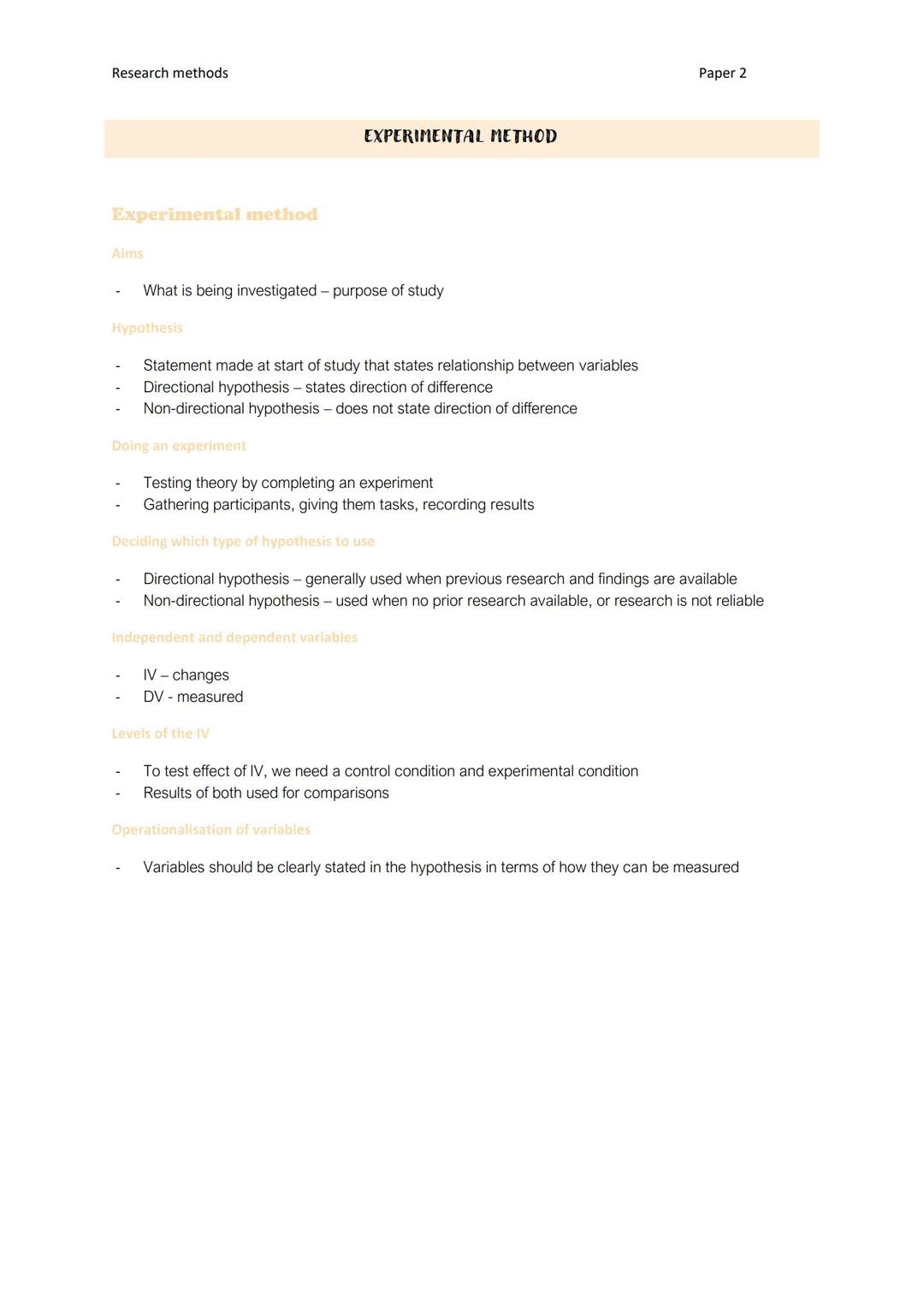
Every psychology experiment starts with an aim - basically, what you're trying to find out. Think of it as your research question that drives the entire study.
From your aim, you'll create a hypothesis, which is your educated guess about what will happen. This isn't just random speculation - it's a clear statement predicting the relationship between your variables. You're essentially saying "if I do this, then that will happen."
There are two types of hypotheses you need to know. A directional hypothesis tells you exactly which way the results will go (like "students will perform better with music than without"). A non-directional hypothesis just predicts a difference without specifying the direction like"therewillbeadifferenceinperformancebetweenthemusicandno−musicgroups".
Quick Tip: Use directional hypotheses when you've got solid previous research to back up your prediction. Go non-directional when you're exploring new territory or when existing research is dodgy.
The key to any experiment is understanding your independent variable (IV) - what you're changing - and your dependent variable (DV) - what you're measuring. You'll need different levels of the IV (usually a control condition and an experimental condition) to make meaningful comparisons. Finally, make sure your variables are operationalised - defined clearly enough that anyone could measure them the same way you did.

 Psychology
 English Literature
 Biology
 Sociology