
The social contract in democratic idealsforms the foundation of...
 AP US Government & Politics274 views·Updated Jun 11, 2026·3 pages
How the Social Contract and Federalist vs. Anti-Federalist Ideas Shaped Our Nation
M
Maddie Plas@maddieplas_exhq
1 / 3
1
of 3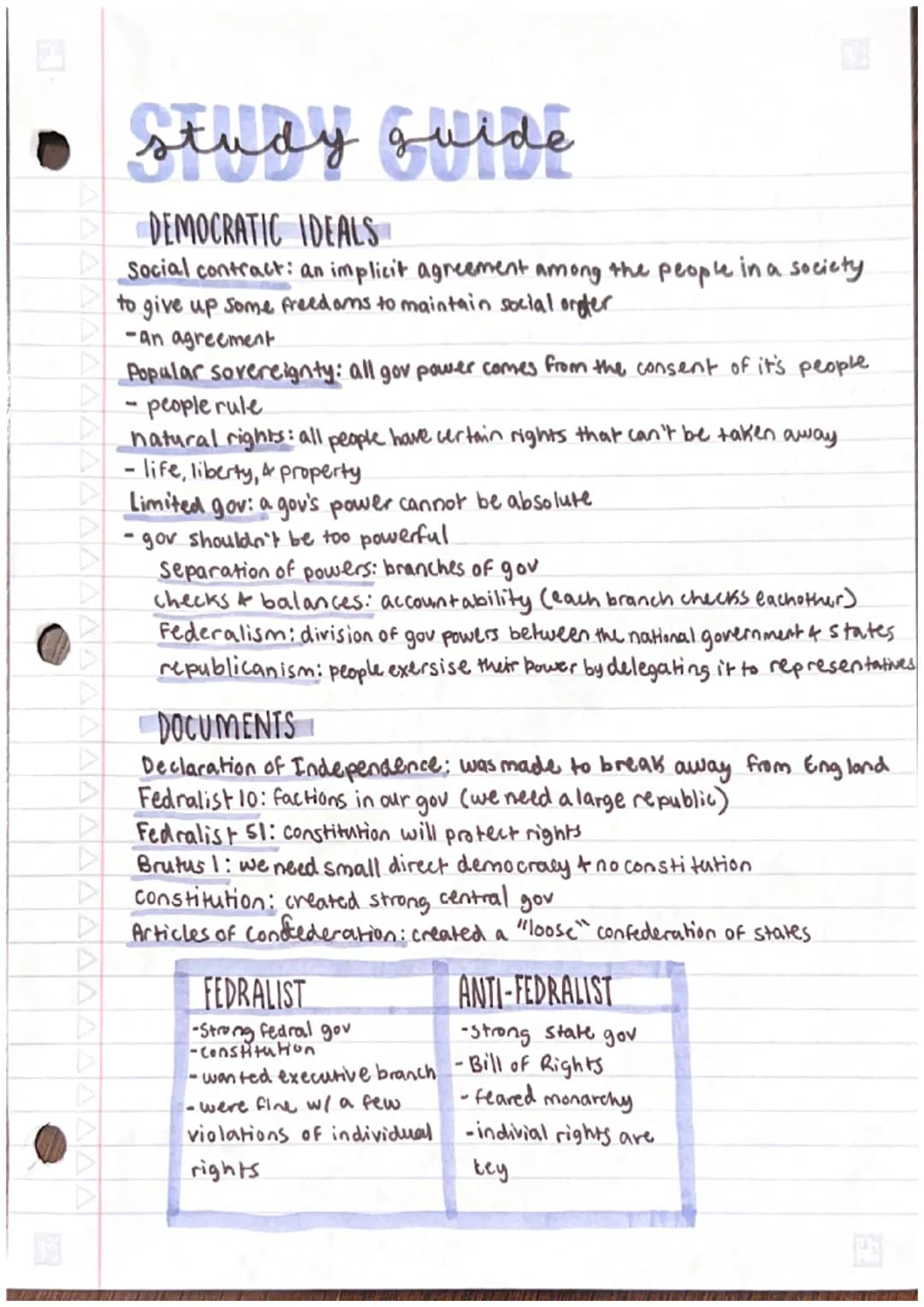
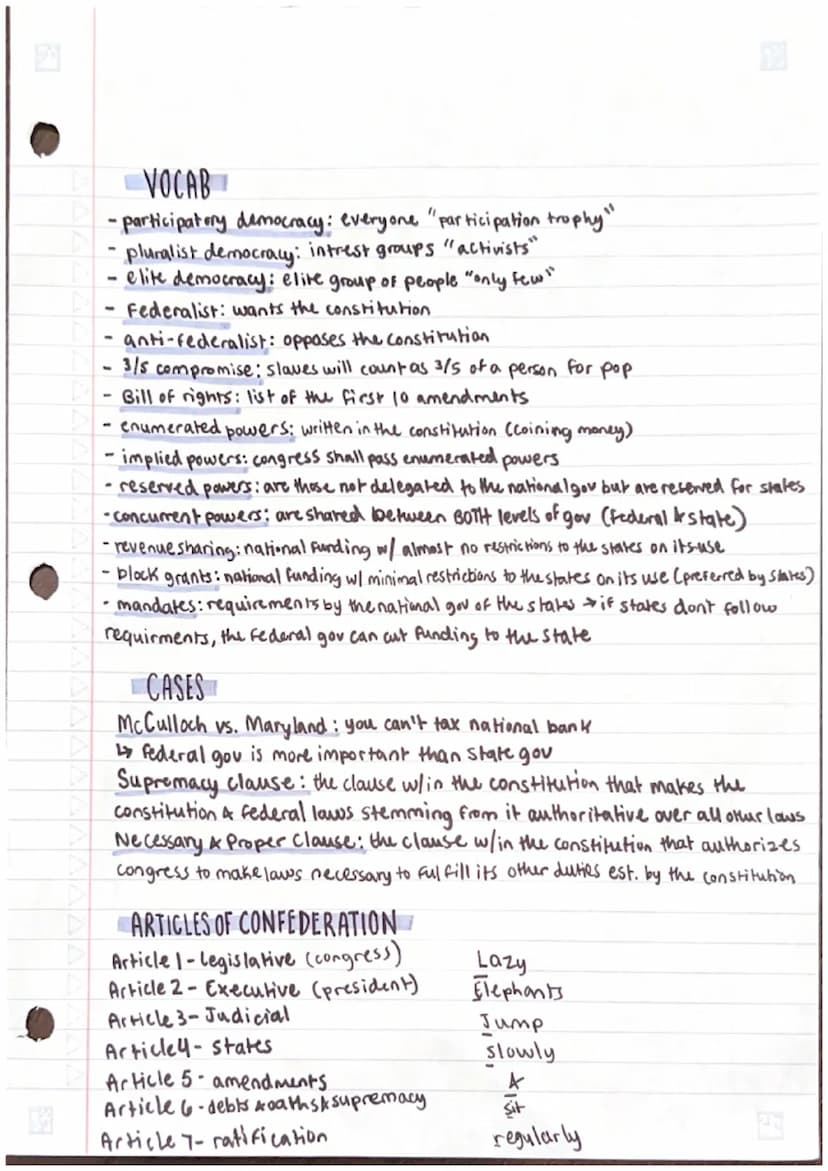
Constitutional Framework and Government Structure
The second page delves into various forms of democracy and the specific powers granted to different levels of government. It explains crucial legal concepts and landmark cases that shaped federal-state relations.
Definition: Participatory democracy involves direct citizen participation, while elite democracy restricts power to a select group.
Highlight: The McCulloch v. Maryland case established federal supremacy over state powers.
Vocabulary: Enumerated powers are explicitly stated in the Constitution, while implied powers are derived from necessary and proper clause.
Example: Revenue sharing and block grants demonstrate federal-state fiscal relationships.
2
of 3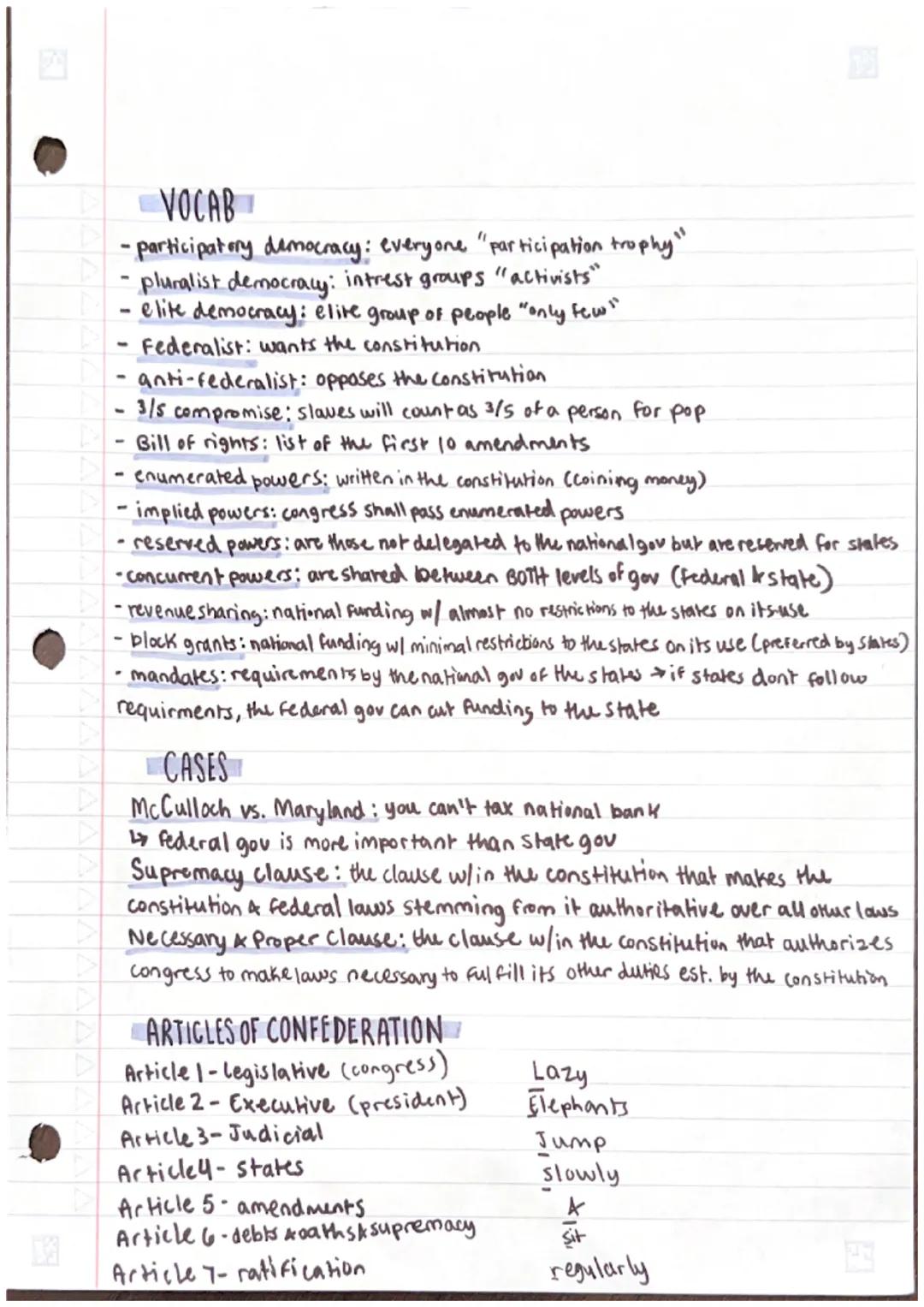
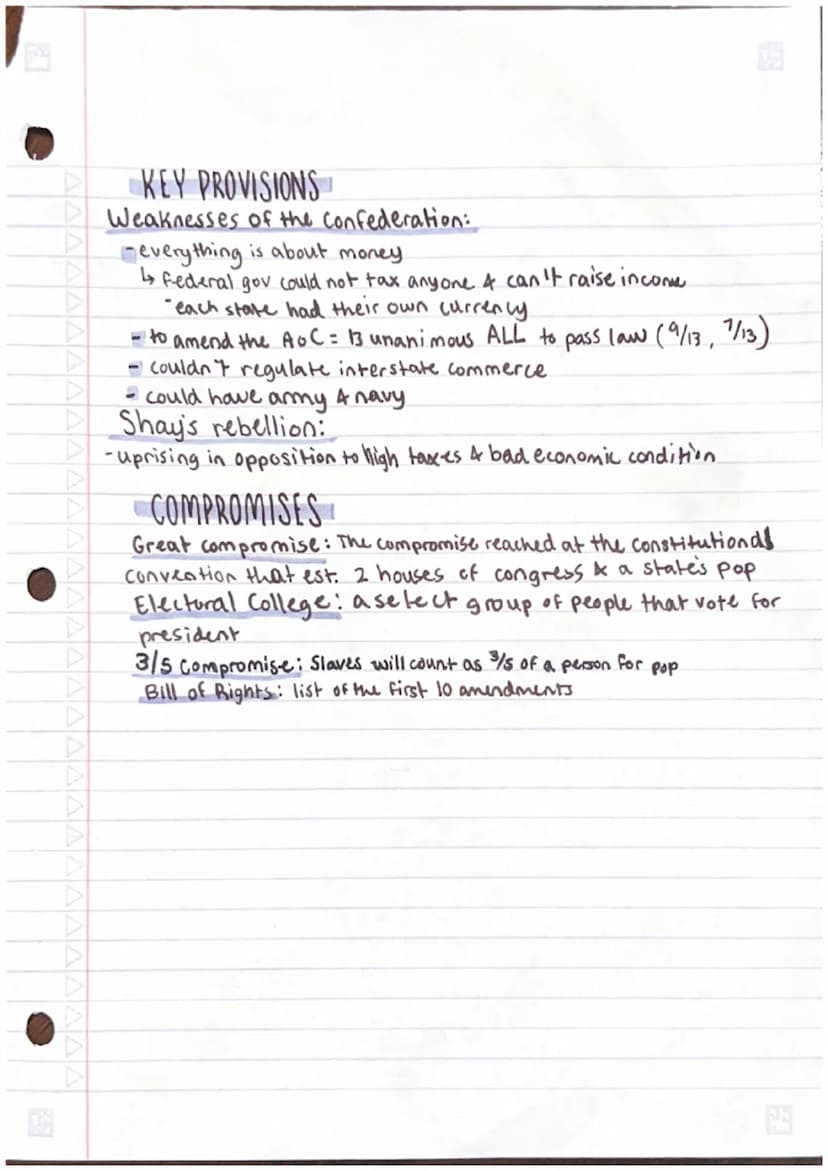
Constitutional Compromises and Early Challenges
The third page focuses on the weaknesses of the Articles of Confederation and the compromises that shaped the Constitution. It details specific problems that led to constitutional reform.
Highlight: The Articles of Confederation's requirement for unanimous consent among states to pass laws proved impractical.
Example: Shays' Rebellion demonstrated the weakness of the central government under the Articles of Confederation.
Definition: The Electoral College was established as a compromise method for presidential selection.
Quote: "Everything is about money" summarizes the primary challenges under the Articles of Confederation.
3
of 3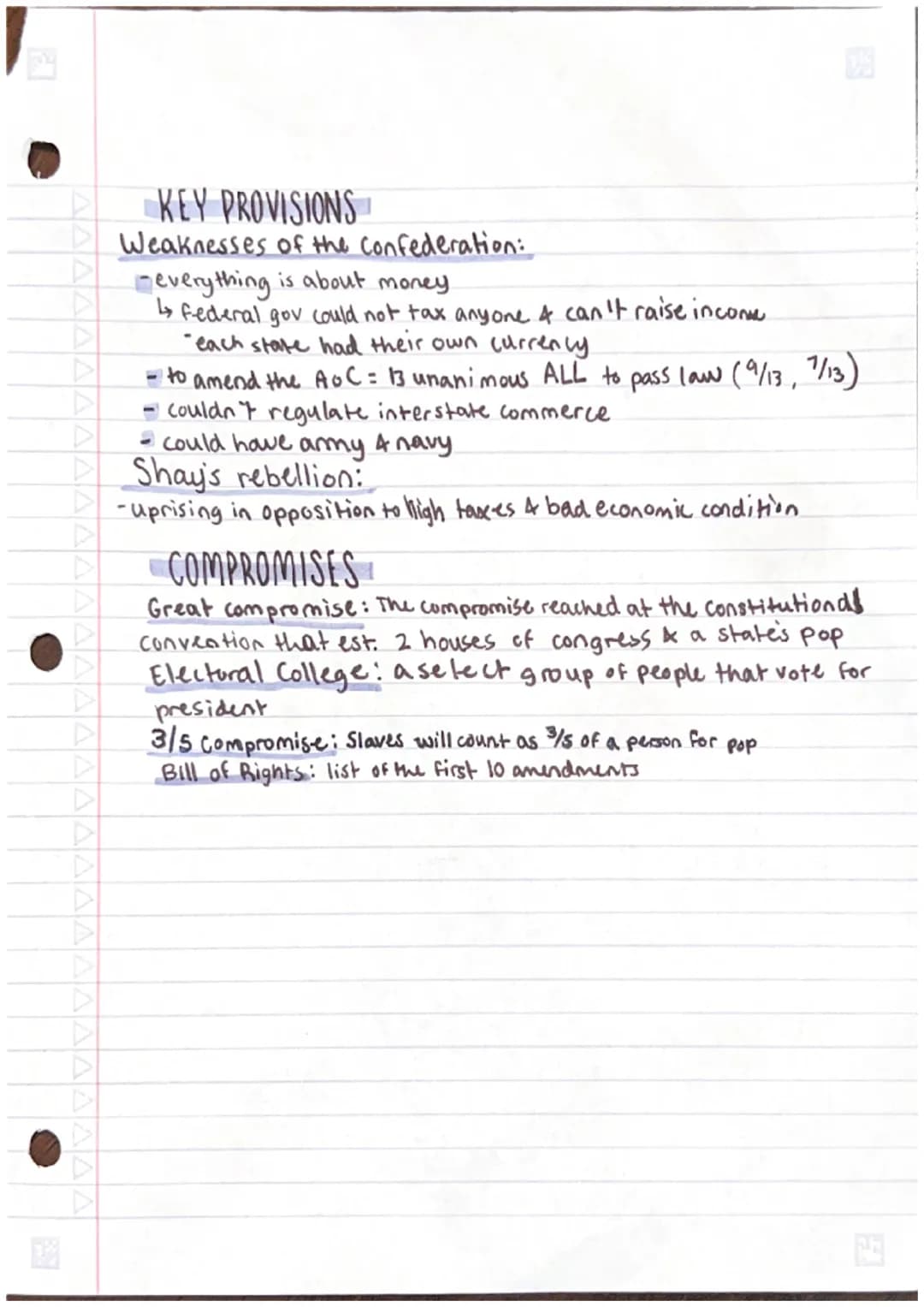
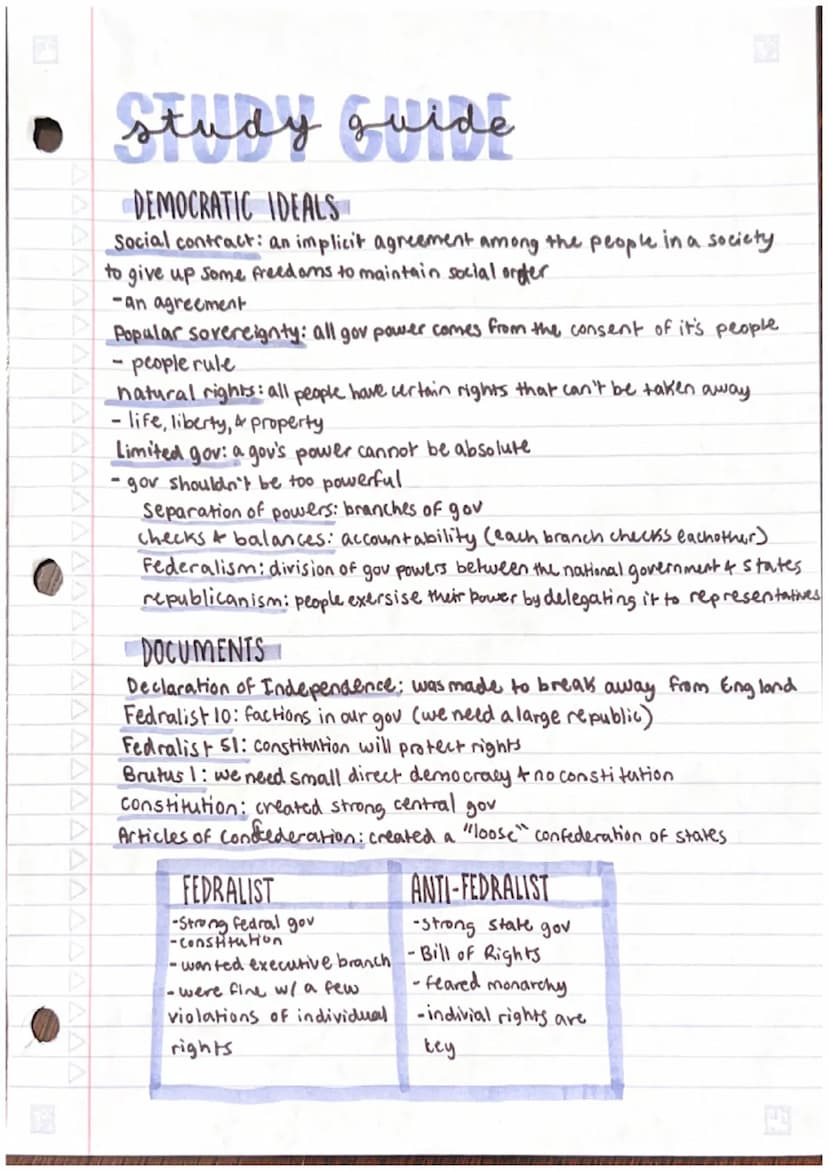
Democratic Ideals and Foundational Documents
The first page outlines fundamental democratic principles and key historical documents that shaped American democracy. The social contract theory establishes the relationship between citizens and government, while popular sovereignty ensures government power stems from the people.
Definition: Social contract represents an implicit agreement where citizens surrender certain freedoms to maintain social order.
Highlight: Popular sovereignty establishes that all governmental power derives from the consent of the governed.
Vocabulary: Federalism refers to the division of powers between national and state governments.
Example: The Federalist Papers (particularly No. 10 and 51) argued for a strong federal government and constitutional protections.
We thought you’d never ask...
What is the Knowunity AI companion?
Our AI companion is specifically built for the needs of students. Based on the millions of content pieces we have on the platform we can provide truly meaningful and relevant answers to students. But its not only about answers, the companion is even more about guiding students through their daily learning challenges, with personalised study plans, quizzes or content pieces in the chat and 100% personalisation based on the students skills and developments.
Where can I download the Knowunity app?
You can download the app in the Google Play Store and in the Apple App Store.
Is Knowunity really free of charge?
That's right! Enjoy free access to study content, connect with fellow students, and get instant help – all at your fingertips.
Similar Content
Most popular content in AP US Government & Politics
9O
AP US Government & PoliticsOrigins of the Articles of Confederation
Practice identifying the motivations for a weak central government and the specific powers granted to the states under the first U.S. constitution.
9th9370
I
AP US Government & PoliticsIntroduction to Federalism and Constitutional Powers
Practice defining federalism and distinguishing between delegated, reserved, concurrent, and implied powers within the U.S. constitutional system.
9th8000
I
AP US Government & PoliticsIntroduction to Democratic Ideals
Practice identifying core American political beliefs including limited government, natural rights, popular sovereignty, and social contract.
9th4590
I
AP US Government & PoliticsIntroduction to Ratification and Federalist No. 10
Practice identifying the core arguments for and against the Constitution, focusing on Madison's theory of factions and the republican remedy.
9th4170
I
AP US Government & PoliticsIntroduction to Separation of Powers
Practice identifying the specific powers granted to the legislative, executive, and judicial branches under Articles I, II, and III.
9th3680
I
AP US Government & PoliticsIntroduction to Types of Democracy
Practice identifying and defining the core characteristics of participatory, pluralist, and elite models of representative democracy.
9th2670
S
AP US Government & PoliticsStructure and Types of Federal Bureaucracy
Practice identifying the four types of federal organizations: cabinet departments, independent agencies, regulatory commissions, and corporations.
9th5680
C
AP US Government & PoliticsConstitutional Foundations of Presidential Checks
Students will identify the formal powers granted to Congress and the Judiciary in Articles I and III to limit executive authority.
9th2220
AP US Government & PoliticsThe US Constitution: Framework of the Federal Government
An overview of the US Constitution, the supreme law establishing the structure, powers, and framework of the federal government.
9th3574
Most popular content
9O
AP US HistoryOrigins and Dynamics of the Columbian Exchange
Analyze the ecological and economic motivations behind the initial transfer of goods, people, and diseases between the Old and New Worlds.
9th3,1280
I
AP US HistoryIntroduction to Early Cultural Interactions
Analyze the initial social and religious encounters between Europeans, Africans, and Indigenous peoples in the colonial Americas.
9th2,7730
O
 AP World History
Origins of Ancient River Civilizations
Analyze the environmental factors and technological innovations that led to the rise of early states in Mesopotamia, Egypt, and the Indus Valley.
9th3,1870
M
AP US HistoryMotivations for European Exploration
Analyze the economic, religious, and political factors that drove European powers to the Americas during the 15th and 16th centuries.
9th1,7780
F
 AP Psychology
Foundations of Ethical Guidelines in Research
Practice the core principles of the APA ethical code including informed consent, debriefing, and the role of Institutional Review Boards.
9th1,3360
I
AP US HistoryIntroduction to Native American Societies
Examine the diverse social, political, and economic structures of North American indigenous groups prior to European contact.
9th1,1100
I
 AP Biology
Introduction to Biological Elements of Life
Practice identifying the essential elements including carbon, nitrogen, phosphorus, and sulfur that compose biological macromolecules.
9th1,7390
I
AP US HistoryIntroduction to the Spanish Encomienda System
Explore the fundamental economic and social structures of the Spanish colonial system, focusing on the encomienda and the casta social hierarchy.
9th8890
O
AP World HistoryOrigins and Continuity of the Byzantine Empire
Analyze the political and cultural transitions from the Roman Empire to the Byzantine Empire, focusing on the reign of Justinian I and his code.
9th1,6320
Can't find what you're looking for? Explore other subjects.
Students love us — and so will you.
4.6/5App Store
4.7/5Google Play
The app is very easy to use and well designed. I have found everything I was looking for so far and have been able to learn a lot from the presentations! I will definitely use the app for a class assignment! And of course it also helps a lot as an inspiration.
Stefan SiOS user
This app is really great. There are so many study notes and help [...]. My problem subject is French, for example, and the app has so many options for help. Thanks to this app, I have improved my French. I would recommend it to anyone.
Samantha KlichAndroid user
Wow, I am really amazed. I just tried the app because I've seen it advertised many times and was absolutely stunned. This app is THE HELP you want for school and above all, it offers so many things, such as workouts and fact sheets, which have been VERY helpful to me personally.
AnnaiOS user
AP US Government & Politics274 views·Updated Jun 11, 2026·3 pagesHow the Social Contract and Federalist vs. Anti-Federalist Ideas Shaped Our Nation
M
Maddie Plas@maddieplas_exhq
The social contract in democratic ideals forms the foundation of American governance, establishing key principles of popular sovereignty and natural rights. The evolution from the weaknesses of articles of confederation to a stronger federal system showcases the battle between federalist...
1
of 3
Sign up to see the content. It's free!
- Access to all documents
- Improve your grades
- Join milions of students
Constitutional Framework and Government Structure
The second page delves into various forms of democracy and the specific powers granted to different levels of government. It explains crucial legal concepts and landmark cases that shaped federal-state relations.
Definition: Participatory democracy involves direct citizen participation, while elite democracy restricts power to a select group.
Highlight: The McCulloch v. Maryland case established federal supremacy over state powers.
Vocabulary: Enumerated powers are explicitly stated in the Constitution, while implied powers are derived from necessary and proper clause.
Example: Revenue sharing and block grants demonstrate federal-state fiscal relationships.
2
of 3Sign up to see the content. It's free!
- Access to all documents
- Improve your grades
- Join milions of students
Constitutional Compromises and Early Challenges
The third page focuses on the weaknesses of the Articles of Confederation and the compromises that shaped the Constitution. It details specific problems that led to constitutional reform.
Highlight: The Articles of Confederation's requirement for unanimous consent among states to pass laws proved impractical.
Example: Shays' Rebellion demonstrated the weakness of the central government under the Articles of Confederation.
Definition: The Electoral College was established as a compromise method for presidential selection.
Quote: "Everything is about money" summarizes the primary challenges under the Articles of Confederation.
3
of 3Sign up to see the content. It's free!
- Access to all documents
- Improve your grades
- Join milions of students
Democratic Ideals and Foundational Documents
The first page outlines fundamental democratic principles and key historical documents that shaped American democracy. The social contract theory establishes the relationship between citizens and government, while popular sovereignty ensures government power stems from the people.
Definition: Social contract represents an implicit agreement where citizens surrender certain freedoms to maintain social order.
Highlight: Popular sovereignty establishes that all governmental power derives from the consent of the governed.
Vocabulary: Federalism refers to the division of powers between national and state governments.
Example: The Federalist Papers (particularly No. 10 and 51) argued for a strong federal government and constitutional protections.
We thought you’d never ask...
What is the Knowunity AI companion?
Our AI companion is specifically built for the needs of students. Based on the millions of content pieces we have on the platform we can provide truly meaningful and relevant answers to students. But its not only about answers, the companion is even more about guiding students through their daily learning challenges, with personalised study plans, quizzes or content pieces in the chat and 100% personalisation based on the students skills and developments.
Where can I download the Knowunity app?
You can download the app in the Google Play Store and in the Apple App Store.
Is Knowunity really free of charge?
That's right! Enjoy free access to study content, connect with fellow students, and get instant help – all at your fingertips.
Similar Content
Most popular content in AP US Government & Politics
9O
AP US Government & PoliticsOrigins of the Articles of Confederation
Practice identifying the motivations for a weak central government and the specific powers granted to the states under the first U.S. constitution.
9th9370
I
AP US Government & PoliticsIntroduction to Federalism and Constitutional Powers
Practice defining federalism and distinguishing between delegated, reserved, concurrent, and implied powers within the U.S. constitutional system.
9th8000
I
AP US Government & PoliticsIntroduction to Democratic Ideals
Practice identifying core American political beliefs including limited government, natural rights, popular sovereignty, and social contract.
9th4590
I
AP US Government & PoliticsIntroduction to Ratification and Federalist No. 10
Practice identifying the core arguments for and against the Constitution, focusing on Madison's theory of factions and the republican remedy.
9th4170
I
AP US Government & PoliticsIntroduction to Separation of Powers
Practice identifying the specific powers granted to the legislative, executive, and judicial branches under Articles I, II, and III.
9th3680
I
AP US Government & PoliticsIntroduction to Types of Democracy
Practice identifying and defining the core characteristics of participatory, pluralist, and elite models of representative democracy.
9th2670
S
AP US Government & PoliticsStructure and Types of Federal Bureaucracy
Practice identifying the four types of federal organizations: cabinet departments, independent agencies, regulatory commissions, and corporations.
9th5680
C
AP US Government & PoliticsConstitutional Foundations of Presidential Checks
Students will identify the formal powers granted to Congress and the Judiciary in Articles I and III to limit executive authority.
9th2220
AP US Government & PoliticsThe US Constitution: Framework of the Federal Government
An overview of the US Constitution, the supreme law establishing the structure, powers, and framework of the federal government.
9th3574
Most popular content
9O
AP US HistoryOrigins and Dynamics of the Columbian Exchange
Analyze the ecological and economic motivations behind the initial transfer of goods, people, and diseases between the Old and New Worlds.
9th3,1280
I
AP US HistoryIntroduction to Early Cultural Interactions
Analyze the initial social and religious encounters between Europeans, Africans, and Indigenous peoples in the colonial Americas.
9th2,7730
O
AP World HistoryOrigins of Ancient River Civilizations
Analyze the environmental factors and technological innovations that led to the rise of early states in Mesopotamia, Egypt, and the Indus Valley.
9th3,1870
M
AP US HistoryMotivations for European Exploration
Analyze the economic, religious, and political factors that drove European powers to the Americas during the 15th and 16th centuries.
9th1,7780
F
AP PsychologyFoundations of Ethical Guidelines in Research
Practice the core principles of the APA ethical code including informed consent, debriefing, and the role of Institutional Review Boards.
9th1,3360
I
AP US HistoryIntroduction to Native American Societies
Examine the diverse social, political, and economic structures of North American indigenous groups prior to European contact.
9th1,1100
I
AP BiologyIntroduction to Biological Elements of Life
Practice identifying the essential elements including carbon, nitrogen, phosphorus, and sulfur that compose biological macromolecules.
9th1,7390
I
AP US HistoryIntroduction to the Spanish Encomienda System
Explore the fundamental economic and social structures of the Spanish colonial system, focusing on the encomienda and the casta social hierarchy.
9th8890
O
AP World HistoryOrigins and Continuity of the Byzantine Empire
Analyze the political and cultural transitions from the Roman Empire to the Byzantine Empire, focusing on the reign of Justinian I and his code.
9th1,6320
Can't find what you're looking for? Explore other subjects.
Students love us — and so will you.
4.6/5App Store
4.7/5Google Play
The app is very easy to use and well designed. I have found everything I was looking for so far and have been able to learn a lot from the presentations! I will definitely use the app for a class assignment! And of course it also helps a lot as an inspiration.
Stefan SiOS user
This app is really great. There are so many study notes and help [...]. My problem subject is French, for example, and the app has so many options for help. Thanks to this app, I have improved my French. I would recommend it to anyone.
Samantha KlichAndroid user
Wow, I am really amazed. I just tried the app because I've seen it advertised many times and was absolutely stunned. This app is THE HELP you want for school and above all, it offers so many things, such as workouts and fact sheets, which have been VERY helpful to me personally.
AnnaiOS user