
Civil liberties and civil rights form the backbone of American... Show more
 Algebra
Sign up to see the contentIt's free!
Access to all documents
Improve your grades
Join milions of students
Knowunity AI
Subjects
Triangle Congruence and Similarity Theorems
Triangle Properties and Classification
Linear Equations and Graphs
Geometric Angle Relationships
Trigonometric Functions and Identities
Equation Solving Techniques
Circle Geometry Fundamentals
Division Operations and Methods
Basic Differentiation Rules
Exponent and Logarithm Properties
Show all topics
Human Organ Systems
Reproductive Cell Cycles
Biological Sciences Subdisciplines
Cellular Energy Metabolism
Autotrophic Energy Processes
Inheritance Patterns and Principles
Biomolecular Structure and Organization
Cell Cycle and Division Mechanics
Cellular Organization and Development
Biological Structural Organization
Show all topics
Chemical Sciences and Applications
Atomic Structure and Composition
Molecular Electron Structure Representation
Atomic Electron Behavior
Matter Properties and Water
Mole Concept and Calculations
Gas Laws and Behavior
Periodic Table Organization
Chemical Thermodynamics Fundamentals
Chemical Bond Types and Properties
Show all topics
European Renaissance and Enlightenment
European Cultural Movements 800-1920
American Revolution Era 1763-1797
American Civil War 1861-1865
Global Imperial Systems
Mongol and Chinese Dynasties
U.S. Presidents and World Leaders
Historical Sources and Documentation
World Wars Era and Impact
World Religious Systems
Show all topics
Classic and Contemporary Novels
Literary Character Analysis
Rhetorical Theory and Practice
Classic Literary Narratives
Reading Analysis and Interpretation
Narrative Structure and Techniques
English Language Components
Influential English-Language Authors
Basic Sentence Structure
Narrative Voice and Perspective
Show all topics
109
•
Feb 18, 2026
•

Emily Spruill
@ecspruill
Civil liberties and civil rights form the backbone of American... Show more
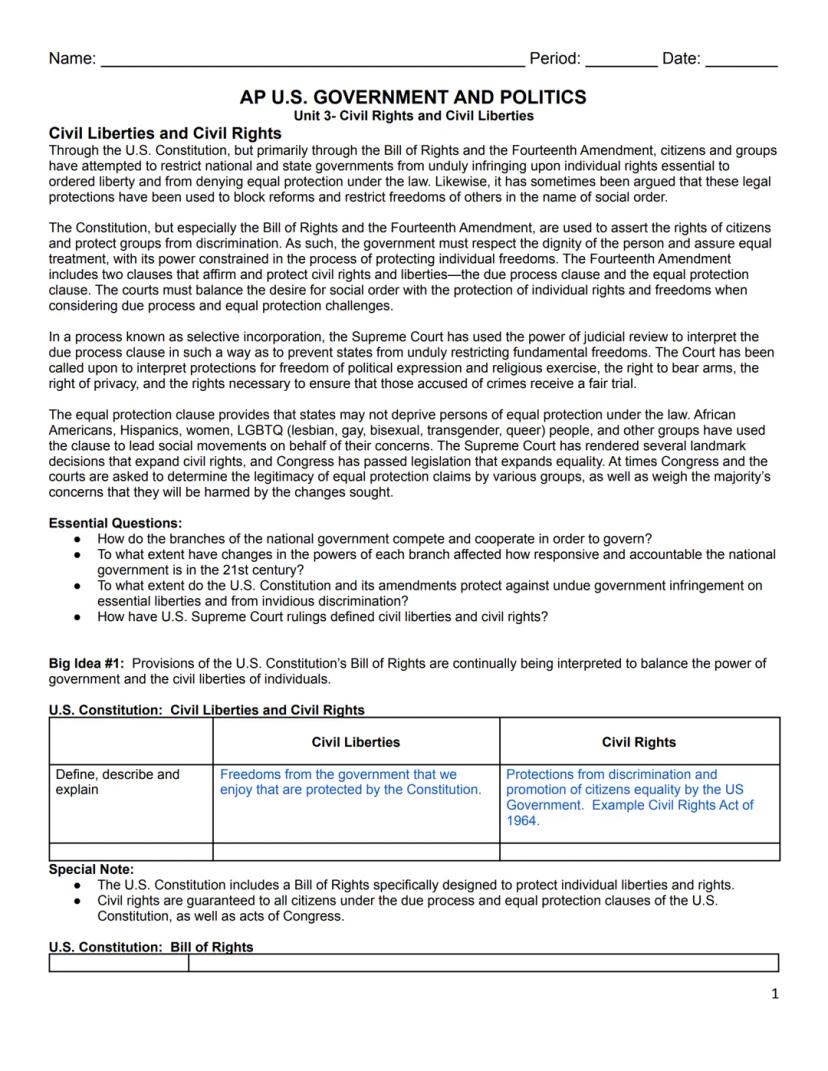
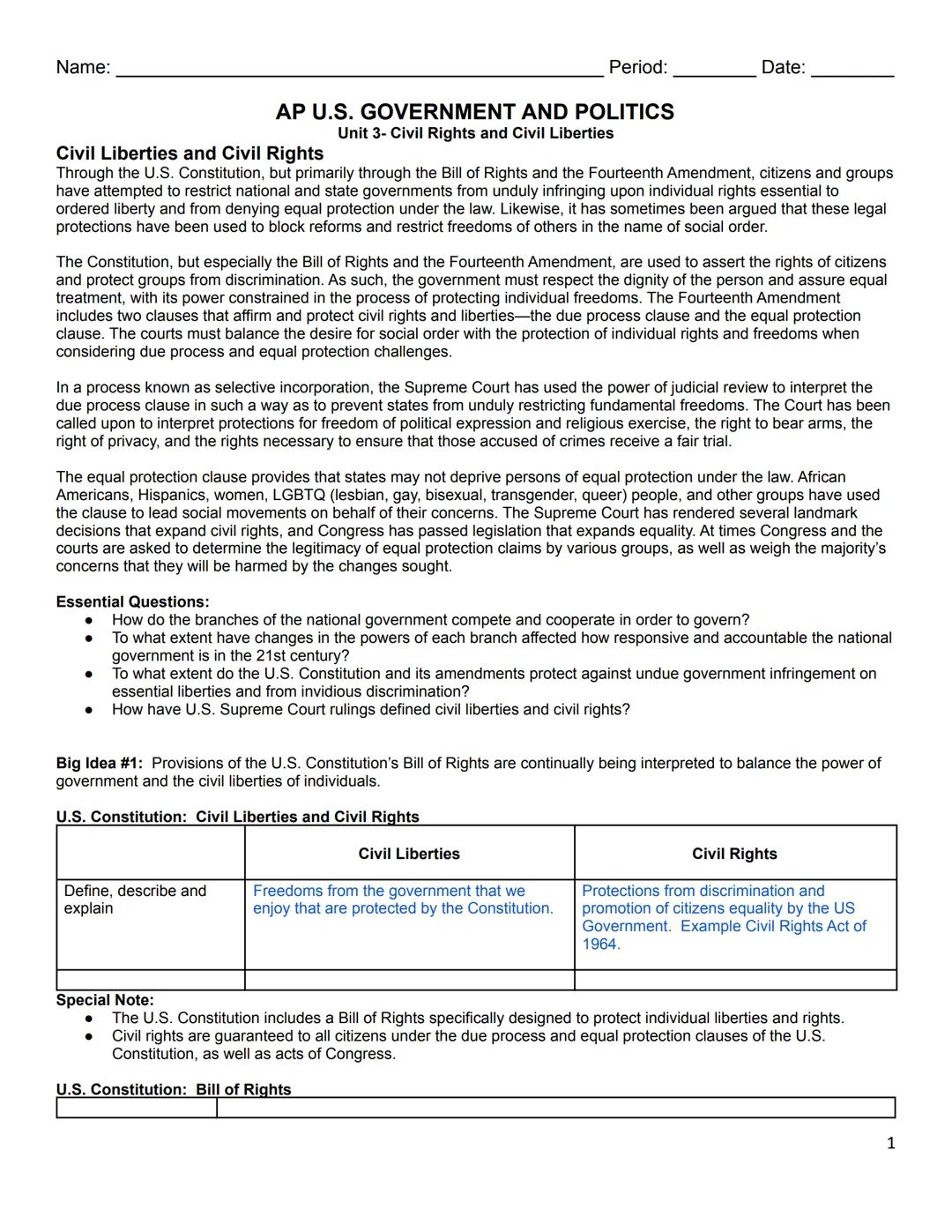
Ever wonder what protects you from the government taking away your freedoms? That's where civil liberties and civil rights come in! While they might sound similar, they serve different purposes:
Civil liberties are freedoms FROM government interference that are protected by the Constitution. These include your right to speak freely, practice religion, and receive fair treatment in the legal system.
Civil rights protect citizens FROM discrimination and promote equality. The Civil Rights Act of 1964, for example, prohibits discrimination based on race, color, religion, sex, or national origin.
The U.S. Constitution establishes these protections through two key components:
The government must balance competing interests when protecting rights:
Did you know? The interpretation of civil liberties and rights constantly evolves through Supreme Court decisions, legislation, and changing social values.
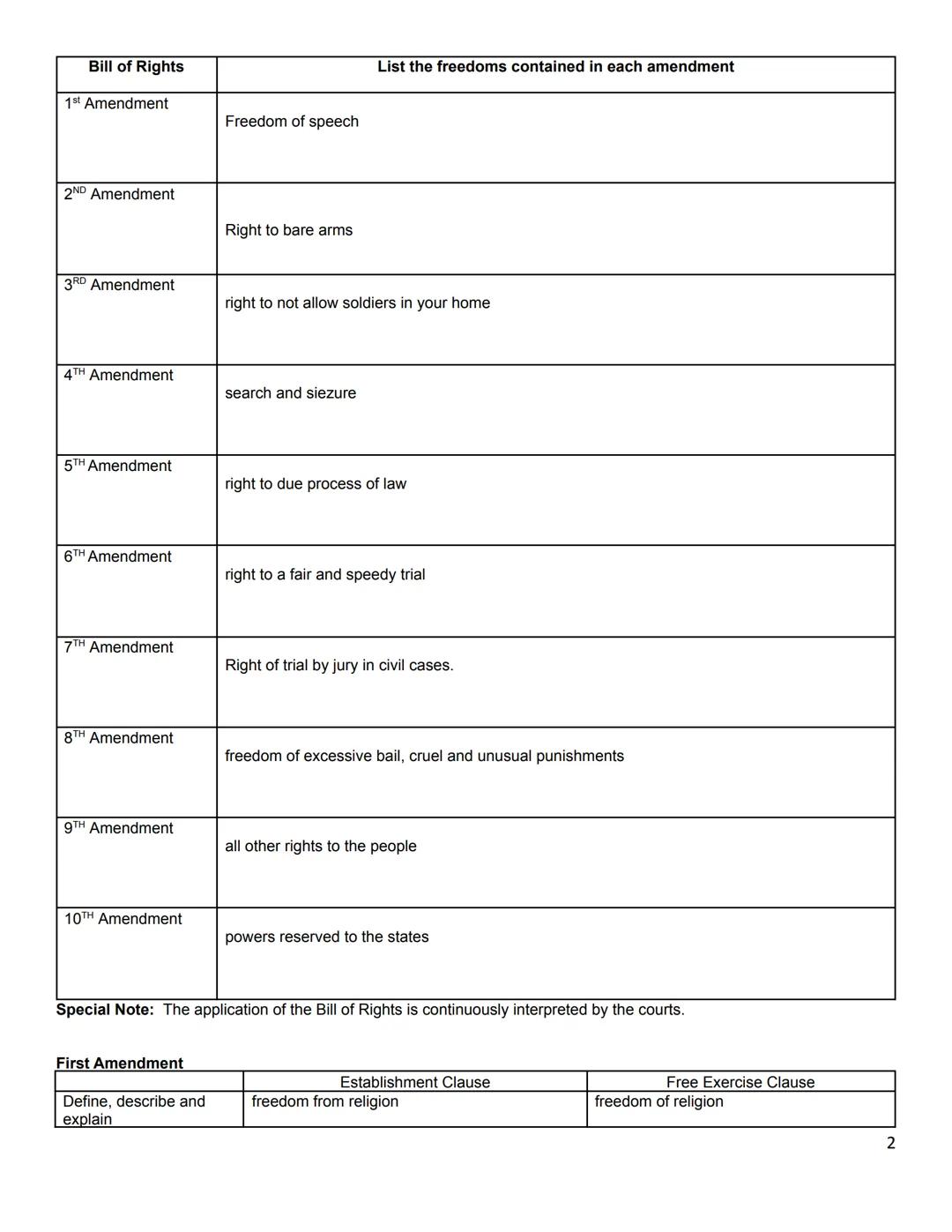
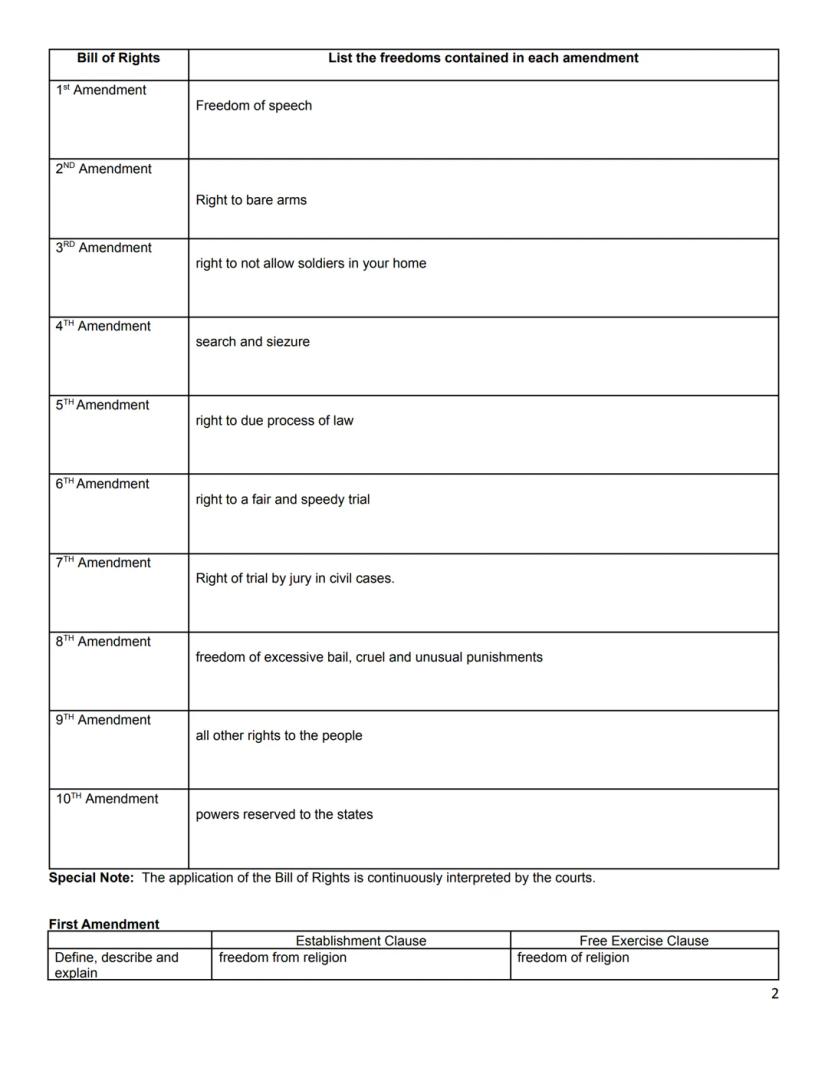
The first ten amendments to the Constitution, known as the Bill of Rights, establish your most fundamental freedoms. These aren't just historical documents—they affect your daily life!
First Amendment: Protects freedom of speech, religion, press, assembly, and petition Second Amendment: Guarantees the right to bear arms Third Amendment: Prevents forced housing of soldiers in private homes Fourth Amendment: Guards against unreasonable searches and seizures Fifth Amendment: Ensures due process of law and protects against self-incrimination Sixth Amendment: Guarantees right to a speedy and fair trial Seventh Amendment: Provides right to trial by jury in civil cases Eighth Amendment: Prohibits excessive bail and cruel and unusual punishment Ninth Amendment: Clarifies that people retain rights not specifically mentioned Tenth Amendment: Reserves powers not delegated to the federal government to states
The First Amendment includes two important clauses regarding religion:
Establishment Clause: Often described as "freedom from religion," this prevents the government from establishing an official religion or favoring one religion over others.
Free Exercise Clause: Protects your right to practice your religion without government interference.
Remember this! Courts constantly interpret these amendments to balance majority religious practices with individual religious freedoms. This tension between majority rule and minority rights is central to many Supreme Court cases.
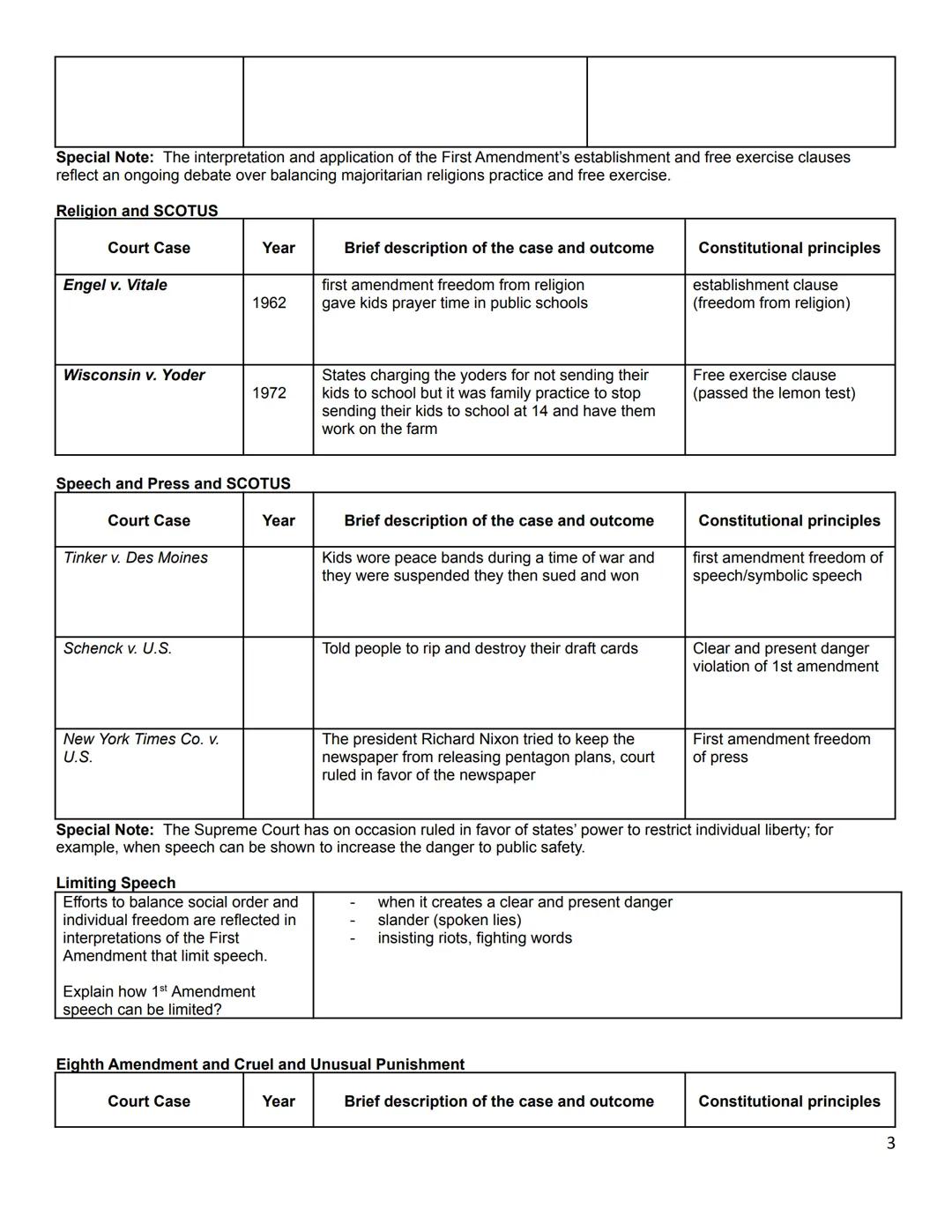
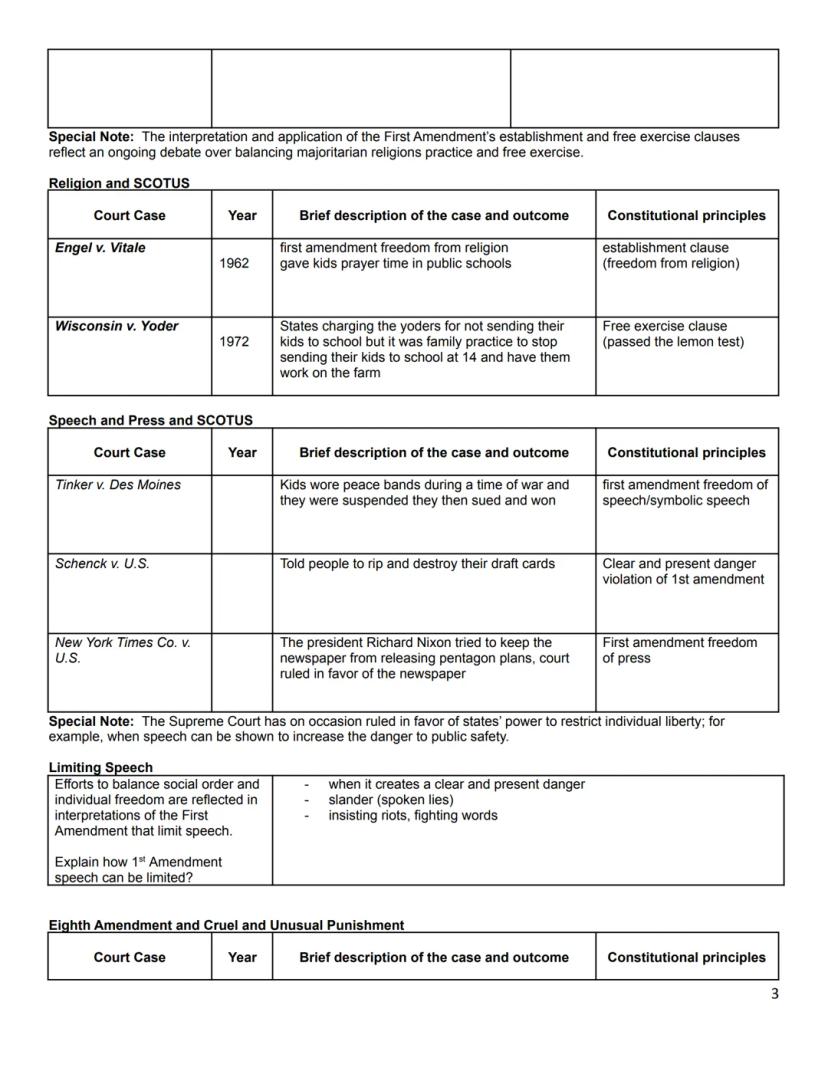
When do your constitutional rights have limits? Supreme Court cases help define these boundaries.
In Wisconsin v. Yoder (1972), Amish families challenged laws requiring school attendance until age 16. They argued their religion required children to stop formal education at 14 to work on family farms. The Court ruled in favor of the Amish, finding that their religious freedom outweighed the state's interest in mandatory education.
While the First Amendment protects free expression, there are situations where speech can be legally restricted:
These limitations reflect the ongoing balance between individual freedom and social order. The Supreme Court has sometimes ruled in favor of states' power to restrict liberty when speech threatens public safety.
The Eighth Amendment prohibits "cruel and unusual punishment," but what exactly does that mean? In cases like Gregg v. Georgia, the Court addressed whether the death penalty constitutes cruel and unusual punishment. The ruling determined that capital punishment itself doesn't violate the Eighth Amendment, though its application must follow certain guidelines.
Critical concept: Courts must constantly balance individual freedoms with the needs of society as a whole. This balance shifts over time as societal values and interpretations change.

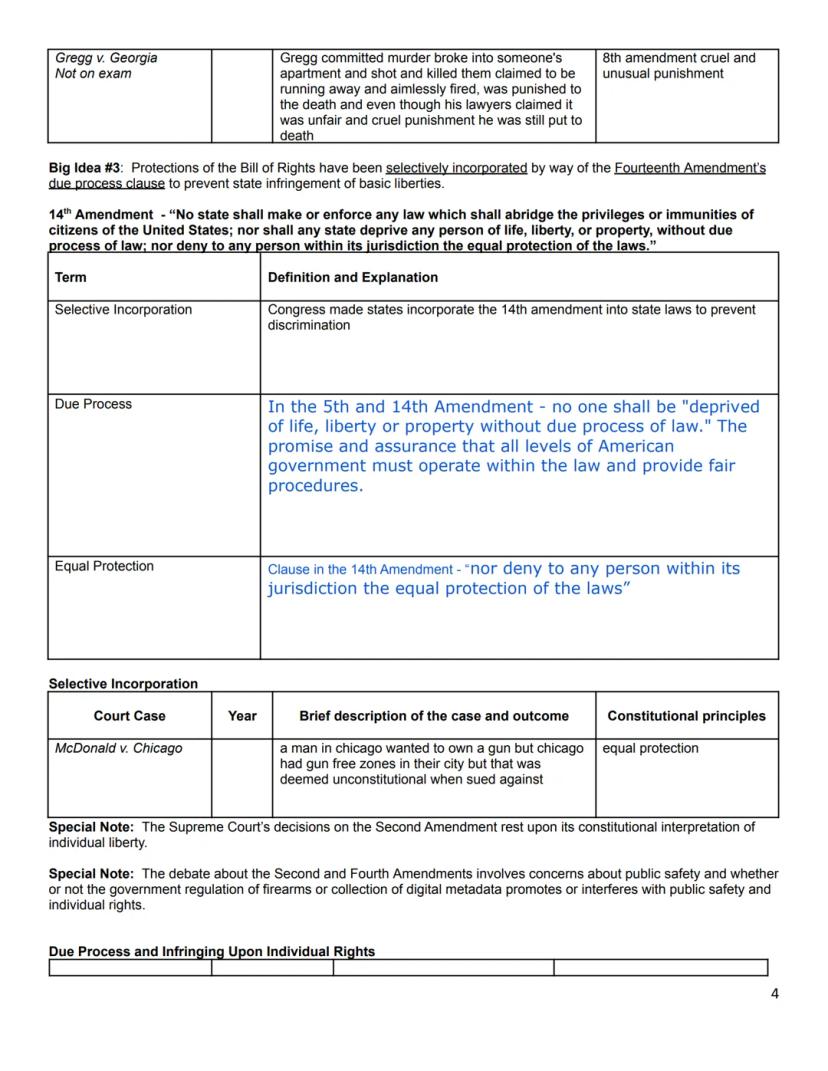
The Fourteenth Amendment might be the most powerful tool for protecting your rights against state governments. It states that no state shall "deprive any person of life, liberty, or property, without due process of law; nor deny to any person within its jurisdiction the equal protection of the laws."
Selective Incorporation is the process by which the Supreme Court has applied specific protections in the Bill of Rights to the states through the Fourteenth Amendment. Before this doctrine, the Bill of Rights only limited the federal government!
Due Process guarantees fair treatment through the judicial system, ensuring that laws and procedures are fair and that governments can't act arbitrarily.
Equal Protection requires that laws apply to all people equally and prohibits states from discriminating against specific groups.
In McDonald v. Chicago, the Court addressed whether Chicago's ban on handguns violated the Second Amendment. The Court ruled that the right to keep and bear arms applies to state governments through the Fourteenth Amendment's due process clause, striking down Chicago's handgun ban.
This case demonstrates how the Court balances public safety concerns with individual rights. The debate continues over whether government regulation of firearms promotes or interferes with public safety.
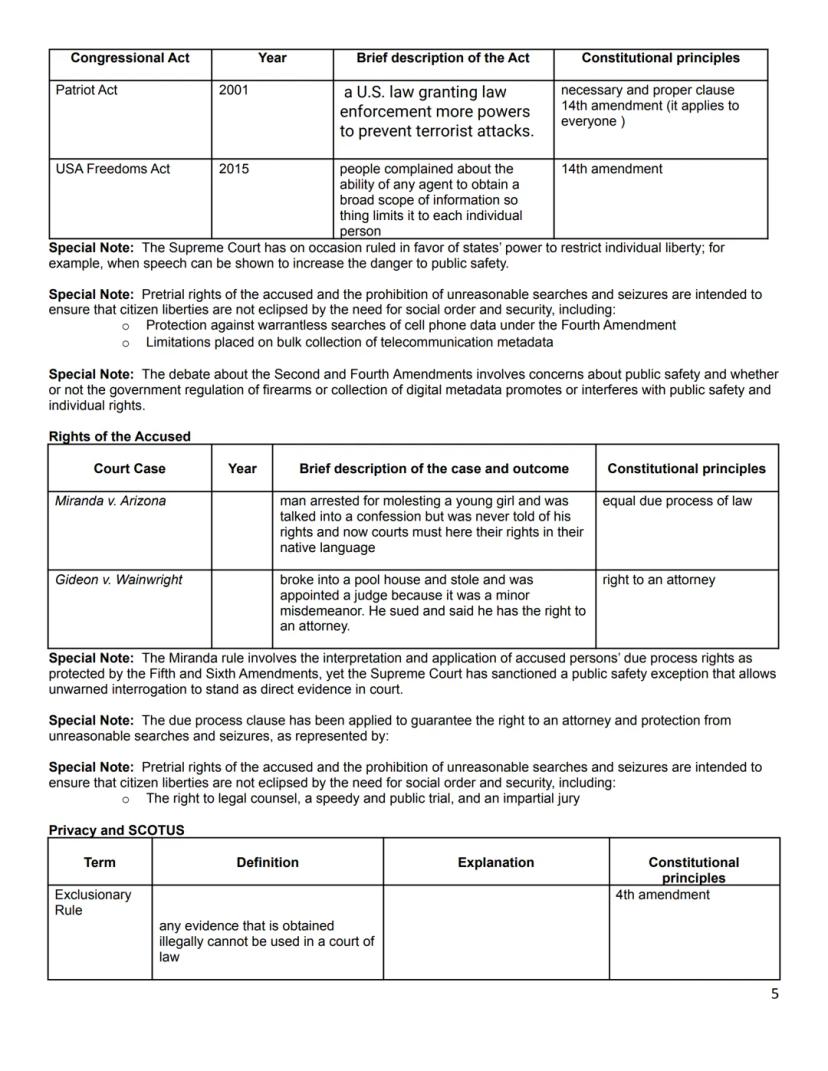
Think about this: The tension between security and liberty is constant in American law. The Patriot Act (2001) expanded government surveillance powers to prevent terrorism, while the USA Freedom Act (2015) later limited some of those powers in response to privacy concerns.
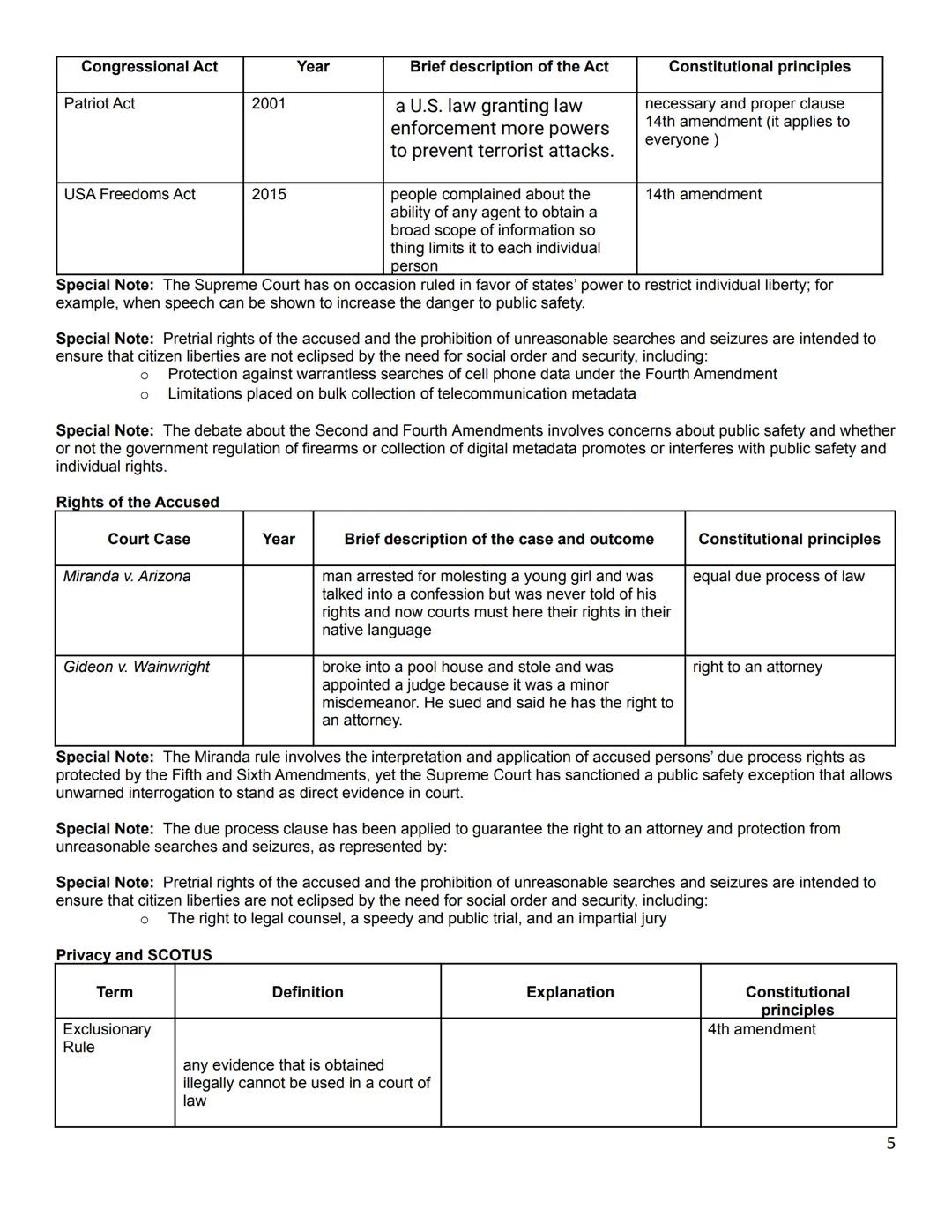
After 9/11, the balance between security and liberty shifted dramatically. The Patriot Act (2001) granted law enforcement expanded powers to prevent terrorist attacks, raising concerns about privacy rights.
In response to public criticism about surveillance overreach, the USA Freedom Act (2015) limited the government's ability to collect bulk telecommunications data, requiring more specific targeting.
Two landmark cases established crucial protections for those accused of crimes:
Miranda v. Arizona established that police must inform suspects of their rights before questioning, including the right to remain silent and the right to an attorney. If you've watched any police show, you've heard the famous "Miranda warnings."
Gideon v. Wainwright guaranteed the right to an attorney for defendants who cannot afford one, ensuring that economic status wouldn't determine access to legal representation.
The Exclusionary Rule is a critical protection that prevents illegally obtained evidence from being used in court. If police search your home without a warrant, for example, anything they find generally cannot be used against you.
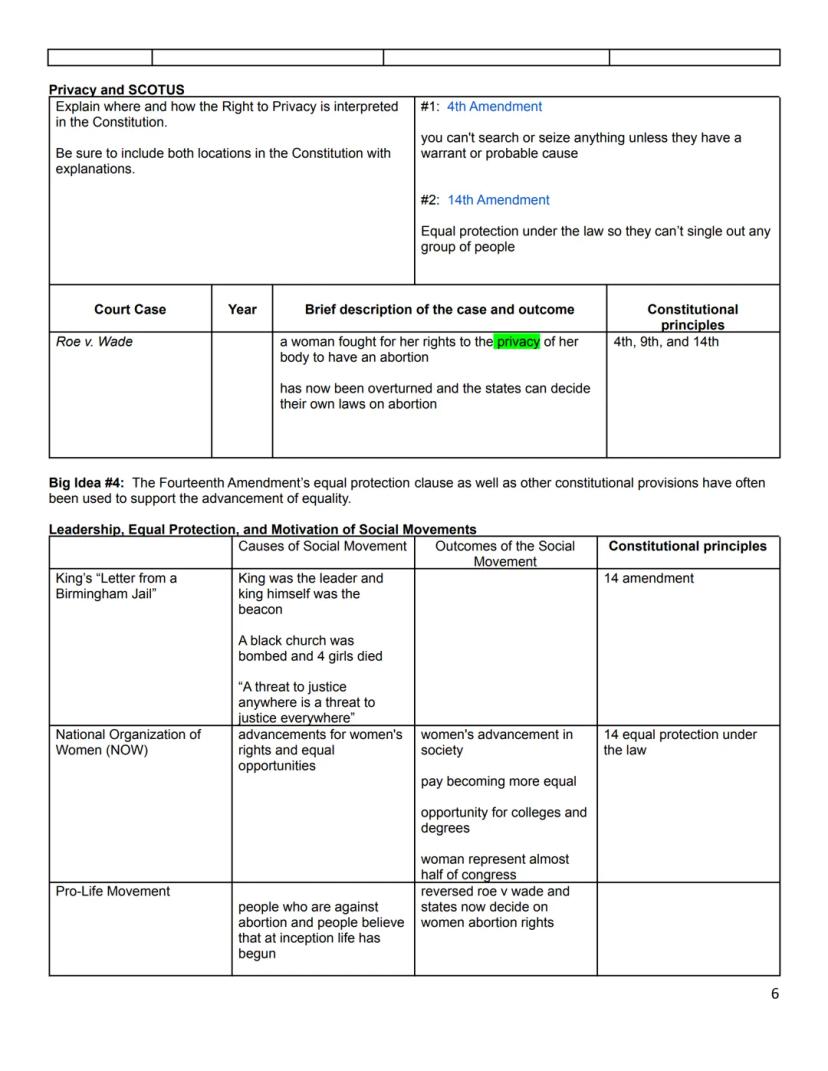
Important distinction: While the Constitution doesn't explicitly mention a "right to privacy," the Supreme Court has interpreted the Fourth Amendment (protection from unreasonable searches) and Fourteenth Amendment (due process and equal protection) to include various privacy protections.

While not explicitly stated in the Constitution, the right to privacy has been interpreted from several amendments:
The Fourth Amendment protects against unreasonable searches and seizures without a warrant or probable cause, establishing a zone of privacy around your person and property.
The Fourteenth Amendment's equal protection clause ensures that laws apply equally to all citizens, preventing the government from singling out specific groups.
One of the most controversial privacy cases was Roe v. Wade, which recognized a woman's right to privacy regarding abortion decisions based on the Fourth, Ninth, and Fourteenth Amendments. This ruling was recently overturned, allowing states to set their own abortion laws.
Social movements have often used constitutional arguments to advance equality:
Martin Luther King Jr.'s "Letter from Birmingham Jail" articulated the moral and constitutional basis for civil rights, arguing that "a threat to justice anywhere is a threat to justice everywhere." King's leadership became a beacon for the movement, especially after tragic events like the bombing of a Black church that killed four girls.
The National Organization for Women (NOW) fought for women's rights and equal opportunities, leading to significant advancements including more equal pay, expanded educational opportunities, and increased political representation.
Think about this: Constitutional interpretation isn't static—it evolves through social movements that challenge existing understandings of rights and equality. These movements often lead to new legislation or court decisions that expand protections.

Social movements have pushed for change, while government responses have evolved over time:
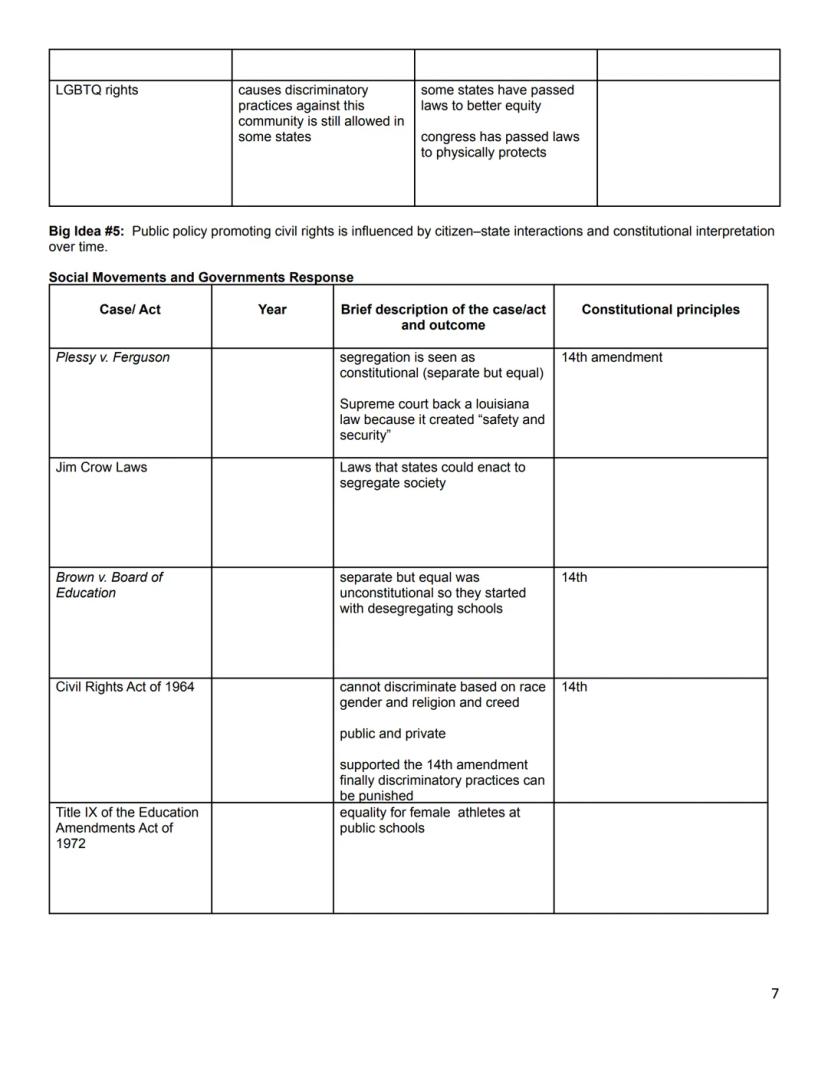
Plessy v. Ferguson (1896) upheld racial segregation under the "separate but equal" doctrine. The Supreme Court backed a Louisiana law requiring separate rail cars for Black and white passengers, claiming it promoted "safety and security."
Jim Crow Laws were state and local laws that enforced racial segregation throughout the South, creating a system of legally mandated discrimination.
Brown v. Board of Education (1954) overturned "separate but equal," ruling that segregated public schools were inherently unequal and violated the Fourteenth Amendment. This landmark decision became the legal foundation for desegregation.
Civil Rights Act of 1964: Prohibited discrimination based on race, color, religion, sex, and national origin in public accommodations, facilities, and schools. This comprehensive law finally gave teeth to the Fourteenth Amendment.
Title IX of the Education Amendments Act of 1972: Required gender equality in federally funded education programs, dramatically expanding opportunities for female students and athletes.
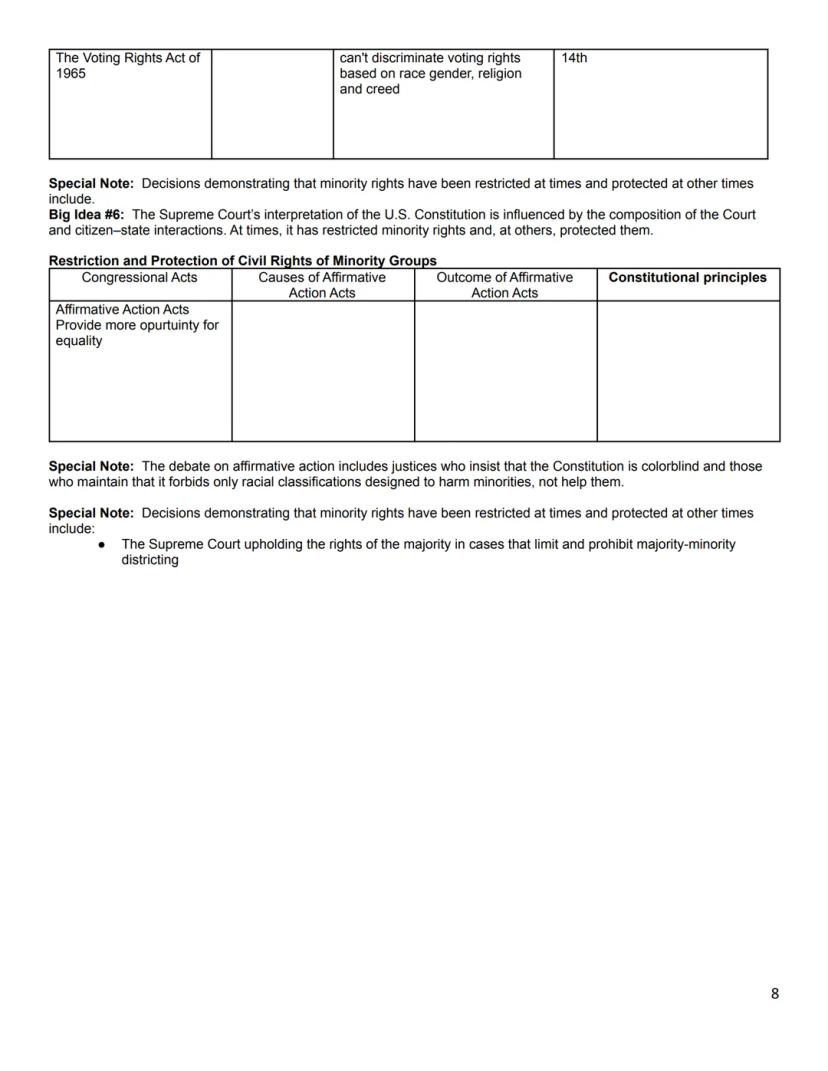
Voting Rights Act of 1965: Prohibited discriminatory voting practices that had disenfranchised racial minorities, outlawing literacy tests and other barriers to voting.
Important to understand: Civil rights progress hasn't been linear. The Supreme Court has sometimes restricted minority rights and at other times protected them, reflecting changing social values and Court composition.
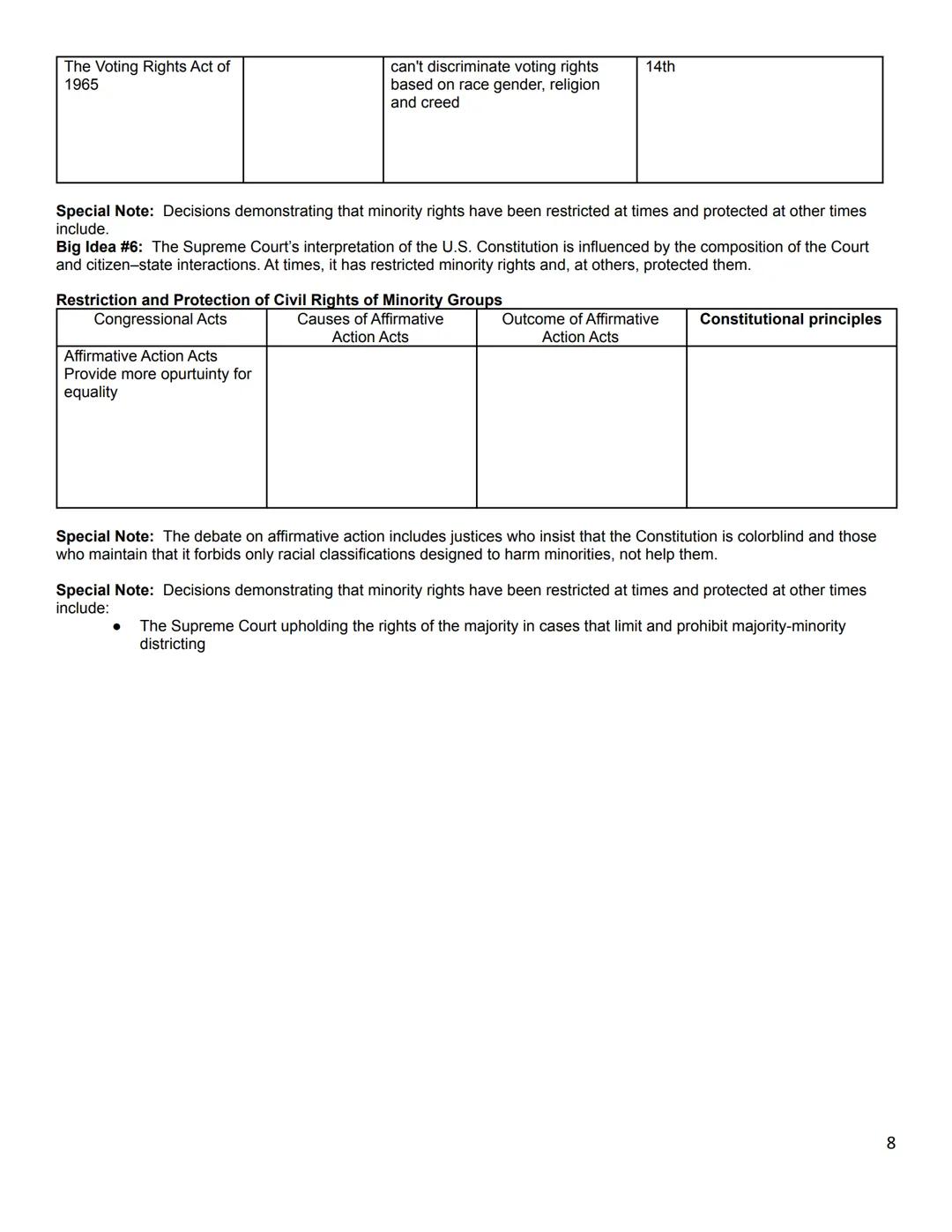
The journey toward equality has included proactive measures like Affirmative Action, which aims to increase representation of underrepresented groups in education and employment. These policies attempt to address historical discrimination by creating more opportunities for equality.
The Supreme Court's interpretation of the Constitution changes with its composition and societal evolution. This has created an ongoing debate about affirmative action between two perspectives:
This tension appears in cases involving majority-minority districting (drawing voting districts to create minority representation), where the Court has sometimes upheld the rights of the majority at the expense of minority representation.
Civil rights protections continue to evolve as new groups seek recognition and protection. The LGBTQ rights movement has fought against discriminatory practices, achieving varying levels of protection across states.
While some states have passed laws promoting equity, others maintain discriminatory policies. Congress has enacted legislation to provide physical protections against hate crimes, but comprehensive anti-discrimination protections remain inconsistent nationally.
Remember: Constitutional interpretation is never finished. Each generation must engage with fundamental questions about liberty, equality, and the proper balance between majority rule and minority rights.
Our AI companion is specifically built for the needs of students. Based on the millions of content pieces we have on the platform we can provide truly meaningful and relevant answers to students. But its not only about answers, the companion is even more about guiding students through their daily learning challenges, with personalised study plans, quizzes or content pieces in the chat and 100% personalisation based on the students skills and developments.
You can download the app in the Google Play Store and in the Apple App Store.
That's right! Enjoy free access to study content, connect with fellow students, and get instant help – all at your fingertips.
App Store
Google Play
The app is very easy to use and well designed. I have found everything I was looking for so far and have been able to learn a lot from the presentations! I will definitely use the app for a class assignment! And of course it also helps a lot as an inspiration.
Stefan S
iOS user
This app is really great. There are so many study notes and help [...]. My problem subject is French, for example, and the app has so many options for help. Thanks to this app, I have improved my French. I would recommend it to anyone.
Samantha Klich
Android user
Wow, I am really amazed. I just tried the app because I've seen it advertised many times and was absolutely stunned. This app is THE HELP you want for school and above all, it offers so many things, such as workouts and fact sheets, which have been VERY helpful to me personally.
Anna
iOS user
I think it’s very much worth it and you’ll end up using it a lot once you get the hang of it and even after looking at others notes you can still ask your Artificial intelligence buddy the question and ask to simplify it if you still don’t get it!!! In the end I think it’s worth it 😊👍 ⚠️Also DID I MENTION ITS FREEE YOU DON’T HAVE TO PAY FOR ANYTHING AND STILL GET YOUR GRADES IN PERFECTLY❗️❗️⚠️
Thomas R
iOS user
Knowunity is the BEST app I’ve used in a minute. This is not an ai review or anything this is genuinely coming from a 7th grade student (I know 2011 im young) but dude this app is a 10/10 i have maintained a 3.8 gpa and have plenty of time for gaming. I love it and my mom is just happy I got good grades
Brad T
Android user
Not only did it help me find the answer but it also showed me alternative ways to solve it. I was horrible in math and science but now I have an a in both subjects. Thanks for the help🤍🤍
David K
iOS user
The app's just great! All I have to do is enter the topic in the search bar and I get the response real fast. I don't have to watch 10 YouTube videos to understand something, so I'm saving my time. Highly recommended!
Sudenaz Ocak
Android user
In school I was really bad at maths but thanks to the app, I am doing better now. I am so grateful that you made the app.
Greenlight Bonnie
Android user
I found this app a couple years ago and it has only gotten better since then. I really love it because it can help with written questions and photo questions. Also, it can find study guides that other people have made as well as flashcard sets and practice tests. The free version is also amazing for students who might not be able to afford it. Would 100% recommend
Aubrey
iOS user
Best app if you're in Highschool or Junior high. I have been using this app for 2 school years and it's the best, it's good if you don't have anyone to help you with school work.😋🩷🎀
Marco B
iOS user
THE QUIZES AND FLASHCARDS ARE SO USEFUL AND I LOVE Knowunity AI. IT ALSO IS LITREALLY LIKE CHATGPT BUT SMARTER!! HELPED ME WITH MY MASCARA PROBLEMS TOO!! AS WELL AS MY REAL SUBJECTS ! DUHHH 😍😁😲🤑💗✨🎀😮
Elisha
iOS user
This app is phenomenal down to the correct info and the various topics you can study! I greatly recommend it for people who struggle with procrastination and those who need homework help. It has been perfectly accurate for world 1 history as far as I’ve seen! Geometry too!
Paul T
iOS user
The app is very easy to use and well designed. I have found everything I was looking for so far and have been able to learn a lot from the presentations! I will definitely use the app for a class assignment! And of course it also helps a lot as an inspiration.
Stefan S
iOS user
This app is really great. There are so many study notes and help [...]. My problem subject is French, for example, and the app has so many options for help. Thanks to this app, I have improved my French. I would recommend it to anyone.
Samantha Klich
Android user
Wow, I am really amazed. I just tried the app because I've seen it advertised many times and was absolutely stunned. This app is THE HELP you want for school and above all, it offers so many things, such as workouts and fact sheets, which have been VERY helpful to me personally.
Anna
iOS user
I think it’s very much worth it and you’ll end up using it a lot once you get the hang of it and even after looking at others notes you can still ask your Artificial intelligence buddy the question and ask to simplify it if you still don’t get it!!! In the end I think it’s worth it 😊👍 ⚠️Also DID I MENTION ITS FREEE YOU DON’T HAVE TO PAY FOR ANYTHING AND STILL GET YOUR GRADES IN PERFECTLY❗️❗️⚠️
Thomas R
iOS user
Knowunity is the BEST app I’ve used in a minute. This is not an ai review or anything this is genuinely coming from a 7th grade student (I know 2011 im young) but dude this app is a 10/10 i have maintained a 3.8 gpa and have plenty of time for gaming. I love it and my mom is just happy I got good grades
Brad T
Android user
Not only did it help me find the answer but it also showed me alternative ways to solve it. I was horrible in math and science but now I have an a in both subjects. Thanks for the help🤍🤍
David K
iOS user
The app's just great! All I have to do is enter the topic in the search bar and I get the response real fast. I don't have to watch 10 YouTube videos to understand something, so I'm saving my time. Highly recommended!
Sudenaz Ocak
Android user
In school I was really bad at maths but thanks to the app, I am doing better now. I am so grateful that you made the app.
Greenlight Bonnie
Android user
I found this app a couple years ago and it has only gotten better since then. I really love it because it can help with written questions and photo questions. Also, it can find study guides that other people have made as well as flashcard sets and practice tests. The free version is also amazing for students who might not be able to afford it. Would 100% recommend
Aubrey
iOS user
Best app if you're in Highschool or Junior high. I have been using this app for 2 school years and it's the best, it's good if you don't have anyone to help you with school work.😋🩷🎀
Marco B
iOS user
THE QUIZES AND FLASHCARDS ARE SO USEFUL AND I LOVE Knowunity AI. IT ALSO IS LITREALLY LIKE CHATGPT BUT SMARTER!! HELPED ME WITH MY MASCARA PROBLEMS TOO!! AS WELL AS MY REAL SUBJECTS ! DUHHH 😍😁😲🤑💗✨🎀😮
Elisha
iOS user
This app is phenomenal down to the correct info and the various topics you can study! I greatly recommend it for people who struggle with procrastination and those who need homework help. It has been perfectly accurate for world 1 history as far as I’ve seen! Geometry too!
Paul T
iOS user
Emily Spruill
@ecspruill
Civil liberties and civil rights form the backbone of American democracy, protecting individuals from government overreach and ensuring equal treatment under the law. The U.S. Constitution, particularly through the Bill of Rights and the Fourteenth Amendment, establishes these fundamental protections... Show more
Access to all documents
Improve your grades
Join milions of students
Ever wonder what protects you from the government taking away your freedoms? That's where civil liberties and civil rights come in! While they might sound similar, they serve different purposes:
Civil liberties are freedoms FROM government interference that are protected by the Constitution. These include your right to speak freely, practice religion, and receive fair treatment in the legal system.
Civil rights protect citizens FROM discrimination and promote equality. The Civil Rights Act of 1964, for example, prohibits discrimination based on race, color, religion, sex, or national origin.
The U.S. Constitution establishes these protections through two key components:
The government must balance competing interests when protecting rights:
Did you know? The interpretation of civil liberties and rights constantly evolves through Supreme Court decisions, legislation, and changing social values.
Access to all documents
Improve your grades
Join milions of students
The first ten amendments to the Constitution, known as the Bill of Rights, establish your most fundamental freedoms. These aren't just historical documents—they affect your daily life!
First Amendment: Protects freedom of speech, religion, press, assembly, and petition Second Amendment: Guarantees the right to bear arms Third Amendment: Prevents forced housing of soldiers in private homes Fourth Amendment: Guards against unreasonable searches and seizures Fifth Amendment: Ensures due process of law and protects against self-incrimination Sixth Amendment: Guarantees right to a speedy and fair trial Seventh Amendment: Provides right to trial by jury in civil cases Eighth Amendment: Prohibits excessive bail and cruel and unusual punishment Ninth Amendment: Clarifies that people retain rights not specifically mentioned Tenth Amendment: Reserves powers not delegated to the federal government to states
The First Amendment includes two important clauses regarding religion:
Establishment Clause: Often described as "freedom from religion," this prevents the government from establishing an official religion or favoring one religion over others.
Free Exercise Clause: Protects your right to practice your religion without government interference.
Remember this! Courts constantly interpret these amendments to balance majority religious practices with individual religious freedoms. This tension between majority rule and minority rights is central to many Supreme Court cases.
Access to all documents
Improve your grades
Join milions of students
When do your constitutional rights have limits? Supreme Court cases help define these boundaries.
In Wisconsin v. Yoder (1972), Amish families challenged laws requiring school attendance until age 16. They argued their religion required children to stop formal education at 14 to work on family farms. The Court ruled in favor of the Amish, finding that their religious freedom outweighed the state's interest in mandatory education.
While the First Amendment protects free expression, there are situations where speech can be legally restricted:
These limitations reflect the ongoing balance between individual freedom and social order. The Supreme Court has sometimes ruled in favor of states' power to restrict liberty when speech threatens public safety.
The Eighth Amendment prohibits "cruel and unusual punishment," but what exactly does that mean? In cases like Gregg v. Georgia, the Court addressed whether the death penalty constitutes cruel and unusual punishment. The ruling determined that capital punishment itself doesn't violate the Eighth Amendment, though its application must follow certain guidelines.
Critical concept: Courts must constantly balance individual freedoms with the needs of society as a whole. This balance shifts over time as societal values and interpretations change.
Access to all documents
Improve your grades
Join milions of students
The Fourteenth Amendment might be the most powerful tool for protecting your rights against state governments. It states that no state shall "deprive any person of life, liberty, or property, without due process of law; nor deny to any person within its jurisdiction the equal protection of the laws."
Selective Incorporation is the process by which the Supreme Court has applied specific protections in the Bill of Rights to the states through the Fourteenth Amendment. Before this doctrine, the Bill of Rights only limited the federal government!
Due Process guarantees fair treatment through the judicial system, ensuring that laws and procedures are fair and that governments can't act arbitrarily.
Equal Protection requires that laws apply to all people equally and prohibits states from discriminating against specific groups.
In McDonald v. Chicago, the Court addressed whether Chicago's ban on handguns violated the Second Amendment. The Court ruled that the right to keep and bear arms applies to state governments through the Fourteenth Amendment's due process clause, striking down Chicago's handgun ban.
This case demonstrates how the Court balances public safety concerns with individual rights. The debate continues over whether government regulation of firearms promotes or interferes with public safety.
Think about this: The tension between security and liberty is constant in American law. The Patriot Act (2001) expanded government surveillance powers to prevent terrorism, while the USA Freedom Act (2015) later limited some of those powers in response to privacy concerns.
Access to all documents
Improve your grades
Join milions of students
After 9/11, the balance between security and liberty shifted dramatically. The Patriot Act (2001) granted law enforcement expanded powers to prevent terrorist attacks, raising concerns about privacy rights.
In response to public criticism about surveillance overreach, the USA Freedom Act (2015) limited the government's ability to collect bulk telecommunications data, requiring more specific targeting.
Two landmark cases established crucial protections for those accused of crimes:
Miranda v. Arizona established that police must inform suspects of their rights before questioning, including the right to remain silent and the right to an attorney. If you've watched any police show, you've heard the famous "Miranda warnings."
Gideon v. Wainwright guaranteed the right to an attorney for defendants who cannot afford one, ensuring that economic status wouldn't determine access to legal representation.
The Exclusionary Rule is a critical protection that prevents illegally obtained evidence from being used in court. If police search your home without a warrant, for example, anything they find generally cannot be used against you.
Important distinction: While the Constitution doesn't explicitly mention a "right to privacy," the Supreme Court has interpreted the Fourth Amendment (protection from unreasonable searches) and Fourteenth Amendment (due process and equal protection) to include various privacy protections.
Access to all documents
Improve your grades
Join milions of students
While not explicitly stated in the Constitution, the right to privacy has been interpreted from several amendments:
The Fourth Amendment protects against unreasonable searches and seizures without a warrant or probable cause, establishing a zone of privacy around your person and property.
The Fourteenth Amendment's equal protection clause ensures that laws apply equally to all citizens, preventing the government from singling out specific groups.
One of the most controversial privacy cases was Roe v. Wade, which recognized a woman's right to privacy regarding abortion decisions based on the Fourth, Ninth, and Fourteenth Amendments. This ruling was recently overturned, allowing states to set their own abortion laws.
Social movements have often used constitutional arguments to advance equality:
Martin Luther King Jr.'s "Letter from Birmingham Jail" articulated the moral and constitutional basis for civil rights, arguing that "a threat to justice anywhere is a threat to justice everywhere." King's leadership became a beacon for the movement, especially after tragic events like the bombing of a Black church that killed four girls.
The National Organization for Women (NOW) fought for women's rights and equal opportunities, leading to significant advancements including more equal pay, expanded educational opportunities, and increased political representation.
Think about this: Constitutional interpretation isn't static—it evolves through social movements that challenge existing understandings of rights and equality. These movements often lead to new legislation or court decisions that expand protections.
Access to all documents
Improve your grades
Join milions of students
Social movements have pushed for change, while government responses have evolved over time:
Plessy v. Ferguson (1896) upheld racial segregation under the "separate but equal" doctrine. The Supreme Court backed a Louisiana law requiring separate rail cars for Black and white passengers, claiming it promoted "safety and security."
Jim Crow Laws were state and local laws that enforced racial segregation throughout the South, creating a system of legally mandated discrimination.
Brown v. Board of Education (1954) overturned "separate but equal," ruling that segregated public schools were inherently unequal and violated the Fourteenth Amendment. This landmark decision became the legal foundation for desegregation.
Civil Rights Act of 1964: Prohibited discrimination based on race, color, religion, sex, and national origin in public accommodations, facilities, and schools. This comprehensive law finally gave teeth to the Fourteenth Amendment.
Title IX of the Education Amendments Act of 1972: Required gender equality in federally funded education programs, dramatically expanding opportunities for female students and athletes.
Voting Rights Act of 1965: Prohibited discriminatory voting practices that had disenfranchised racial minorities, outlawing literacy tests and other barriers to voting.
Important to understand: Civil rights progress hasn't been linear. The Supreme Court has sometimes restricted minority rights and at other times protected them, reflecting changing social values and Court composition.
Access to all documents
Improve your grades
Join milions of students
The journey toward equality has included proactive measures like Affirmative Action, which aims to increase representation of underrepresented groups in education and employment. These policies attempt to address historical discrimination by creating more opportunities for equality.
The Supreme Court's interpretation of the Constitution changes with its composition and societal evolution. This has created an ongoing debate about affirmative action between two perspectives:
This tension appears in cases involving majority-minority districting (drawing voting districts to create minority representation), where the Court has sometimes upheld the rights of the majority at the expense of minority representation.
Civil rights protections continue to evolve as new groups seek recognition and protection. The LGBTQ rights movement has fought against discriminatory practices, achieving varying levels of protection across states.
While some states have passed laws promoting equity, others maintain discriminatory policies. Congress has enacted legislation to provide physical protections against hate crimes, but comprehensive anti-discrimination protections remain inconsistent nationally.
Remember: Constitutional interpretation is never finished. Each generation must engage with fundamental questions about liberty, equality, and the proper balance between majority rule and minority rights.
Our AI companion is specifically built for the needs of students. Based on the millions of content pieces we have on the platform we can provide truly meaningful and relevant answers to students. But its not only about answers, the companion is even more about guiding students through their daily learning challenges, with personalised study plans, quizzes or content pieces in the chat and 100% personalisation based on the students skills and developments.
You can download the app in the Google Play Store and in the Apple App Store.
That's right! Enjoy free access to study content, connect with fellow students, and get instant help – all at your fingertips.
4
Smart Tools NEW
Transform this note into: ✓ 50+ Practice Questions ✓ Interactive Flashcards ✓ Full Practice Test ✓ Essay Outlines
Overview of unit 3
 AP US Government & Politics
summarizes all 15 required court cases for AP United Sates Government and Politics
AP US Government & PoliticsStudy guide for Unit 1 of AP Gov
AP US Government & PoliticsAP Government, Bill of Rights presentation
AP US Government & Politicsall important court cases, definitions, and key terms for AP government unit three
AP US Government & PoliticsPowerPoint presentation
AP US Government & PoliticsApp Store
Google Play
The app is very easy to use and well designed. I have found everything I was looking for so far and have been able to learn a lot from the presentations! I will definitely use the app for a class assignment! And of course it also helps a lot as an inspiration.
Stefan S
iOS user
This app is really great. There are so many study notes and help [...]. My problem subject is French, for example, and the app has so many options for help. Thanks to this app, I have improved my French. I would recommend it to anyone.
Samantha Klich
Android user
Wow, I am really amazed. I just tried the app because I've seen it advertised many times and was absolutely stunned. This app is THE HELP you want for school and above all, it offers so many things, such as workouts and fact sheets, which have been VERY helpful to me personally.
Anna
iOS user
I think it’s very much worth it and you’ll end up using it a lot once you get the hang of it and even after looking at others notes you can still ask your Artificial intelligence buddy the question and ask to simplify it if you still don’t get it!!! In the end I think it’s worth it 😊👍 ⚠️Also DID I MENTION ITS FREEE YOU DON’T HAVE TO PAY FOR ANYTHING AND STILL GET YOUR GRADES IN PERFECTLY❗️❗️⚠️
Thomas R
iOS user
Knowunity is the BEST app I’ve used in a minute. This is not an ai review or anything this is genuinely coming from a 7th grade student (I know 2011 im young) but dude this app is a 10/10 i have maintained a 3.8 gpa and have plenty of time for gaming. I love it and my mom is just happy I got good grades
Brad T
Android user
Not only did it help me find the answer but it also showed me alternative ways to solve it. I was horrible in math and science but now I have an a in both subjects. Thanks for the help🤍🤍
David K
iOS user
The app's just great! All I have to do is enter the topic in the search bar and I get the response real fast. I don't have to watch 10 YouTube videos to understand something, so I'm saving my time. Highly recommended!
Sudenaz Ocak
Android user
In school I was really bad at maths but thanks to the app, I am doing better now. I am so grateful that you made the app.
Greenlight Bonnie
Android user
I found this app a couple years ago and it has only gotten better since then. I really love it because it can help with written questions and photo questions. Also, it can find study guides that other people have made as well as flashcard sets and practice tests. The free version is also amazing for students who might not be able to afford it. Would 100% recommend
Aubrey
iOS user
Best app if you're in Highschool or Junior high. I have been using this app for 2 school years and it's the best, it's good if you don't have anyone to help you with school work.😋🩷🎀
Marco B
iOS user
THE QUIZES AND FLASHCARDS ARE SO USEFUL AND I LOVE Knowunity AI. IT ALSO IS LITREALLY LIKE CHATGPT BUT SMARTER!! HELPED ME WITH MY MASCARA PROBLEMS TOO!! AS WELL AS MY REAL SUBJECTS ! DUHHH 😍😁😲🤑💗✨🎀😮
Elisha
iOS user
This app is phenomenal down to the correct info and the various topics you can study! I greatly recommend it for people who struggle with procrastination and those who need homework help. It has been perfectly accurate for world 1 history as far as I’ve seen! Geometry too!
Paul T
iOS user
The app is very easy to use and well designed. I have found everything I was looking for so far and have been able to learn a lot from the presentations! I will definitely use the app for a class assignment! And of course it also helps a lot as an inspiration.
Stefan S
iOS user
This app is really great. There are so many study notes and help [...]. My problem subject is French, for example, and the app has so many options for help. Thanks to this app, I have improved my French. I would recommend it to anyone.
Samantha Klich
Android user
Wow, I am really amazed. I just tried the app because I've seen it advertised many times and was absolutely stunned. This app is THE HELP you want for school and above all, it offers so many things, such as workouts and fact sheets, which have been VERY helpful to me personally.
Anna
iOS user
I think it’s very much worth it and you’ll end up using it a lot once you get the hang of it and even after looking at others notes you can still ask your Artificial intelligence buddy the question and ask to simplify it if you still don’t get it!!! In the end I think it’s worth it 😊👍 ⚠️Also DID I MENTION ITS FREEE YOU DON’T HAVE TO PAY FOR ANYTHING AND STILL GET YOUR GRADES IN PERFECTLY❗️❗️⚠️
Thomas R
iOS user
Knowunity is the BEST app I’ve used in a minute. This is not an ai review or anything this is genuinely coming from a 7th grade student (I know 2011 im young) but dude this app is a 10/10 i have maintained a 3.8 gpa and have plenty of time for gaming. I love it and my mom is just happy I got good grades
Brad T
Android user
Not only did it help me find the answer but it also showed me alternative ways to solve it. I was horrible in math and science but now I have an a in both subjects. Thanks for the help🤍🤍
David K
iOS user
The app's just great! All I have to do is enter the topic in the search bar and I get the response real fast. I don't have to watch 10 YouTube videos to understand something, so I'm saving my time. Highly recommended!
Sudenaz Ocak
Android user
In school I was really bad at maths but thanks to the app, I am doing better now. I am so grateful that you made the app.
Greenlight Bonnie
Android user
I found this app a couple years ago and it has only gotten better since then. I really love it because it can help with written questions and photo questions. Also, it can find study guides that other people have made as well as flashcard sets and practice tests. The free version is also amazing for students who might not be able to afford it. Would 100% recommend
Aubrey
iOS user
Best app if you're in Highschool or Junior high. I have been using this app for 2 school years and it's the best, it's good if you don't have anyone to help you with school work.😋🩷🎀
Marco B
iOS user
THE QUIZES AND FLASHCARDS ARE SO USEFUL AND I LOVE Knowunity AI. IT ALSO IS LITREALLY LIKE CHATGPT BUT SMARTER!! HELPED ME WITH MY MASCARA PROBLEMS TOO!! AS WELL AS MY REAL SUBJECTS ! DUHHH 😍😁😲🤑💗✨🎀😮
Elisha
iOS user
This app is phenomenal down to the correct info and the various topics you can study! I greatly recommend it for people who struggle with procrastination and those who need homework help. It has been perfectly accurate for world 1 history as far as I’ve seen! Geometry too!
Paul T
iOS user