
Ready to ace the math section of the SAT? These... Show more
 Trigonometry
 Algebra 1
Sign up to see the contentIt's free!
Access to all documents
Improve your grades
Join milions of students
Knowunity AI
Subjects
Triangle Congruence and Similarity Theorems
Triangle Properties and Classification
Linear Equations and Graphs
Geometric Angle Relationships
Trigonometric Functions and Identities
Equation Solving Techniques
Circle Geometry Fundamentals
Division Operations and Methods
Basic Differentiation Rules
Exponent and Logarithm Properties
Show all topics
Human Organ Systems
Reproductive Cell Cycles
Biological Sciences Subdisciplines
Cellular Energy Metabolism
Autotrophic Energy Processes
Inheritance Patterns and Principles
Biomolecular Structure and Organization
Cell Cycle and Division Mechanics
Cellular Organization and Development
Biological Structural Organization
Show all topics
Chemical Sciences and Applications
Atomic Structure and Composition
Molecular Electron Structure Representation
Atomic Electron Behavior
Matter Properties and Water
Mole Concept and Calculations
Gas Laws and Behavior
Periodic Table Organization
Chemical Thermodynamics Fundamentals
Chemical Bond Types and Properties
Show all topics
European Renaissance and Enlightenment
European Cultural Movements 800-1920
American Revolution Era 1763-1797
American Civil War 1861-1865
Global Imperial Systems
Mongol and Chinese Dynasties
U.S. Presidents and World Leaders
Historical Sources and Documentation
World Wars Era and Impact
World Religious Systems
Show all topics
Classic and Contemporary Novels
Literary Character Analysis
Rhetorical Theory and Practice
Classic Literary Narratives
Reading Analysis and Interpretation
Narrative Structure and Techniques
English Language Components
Influential English-Language Authors
Basic Sentence Structure
Narrative Voice and Perspective
Show all topics
1,170
•
Feb 20, 2026
•

Najilah
@sheheartsanime
Ready to ace the math section of the SAT? These... Show more
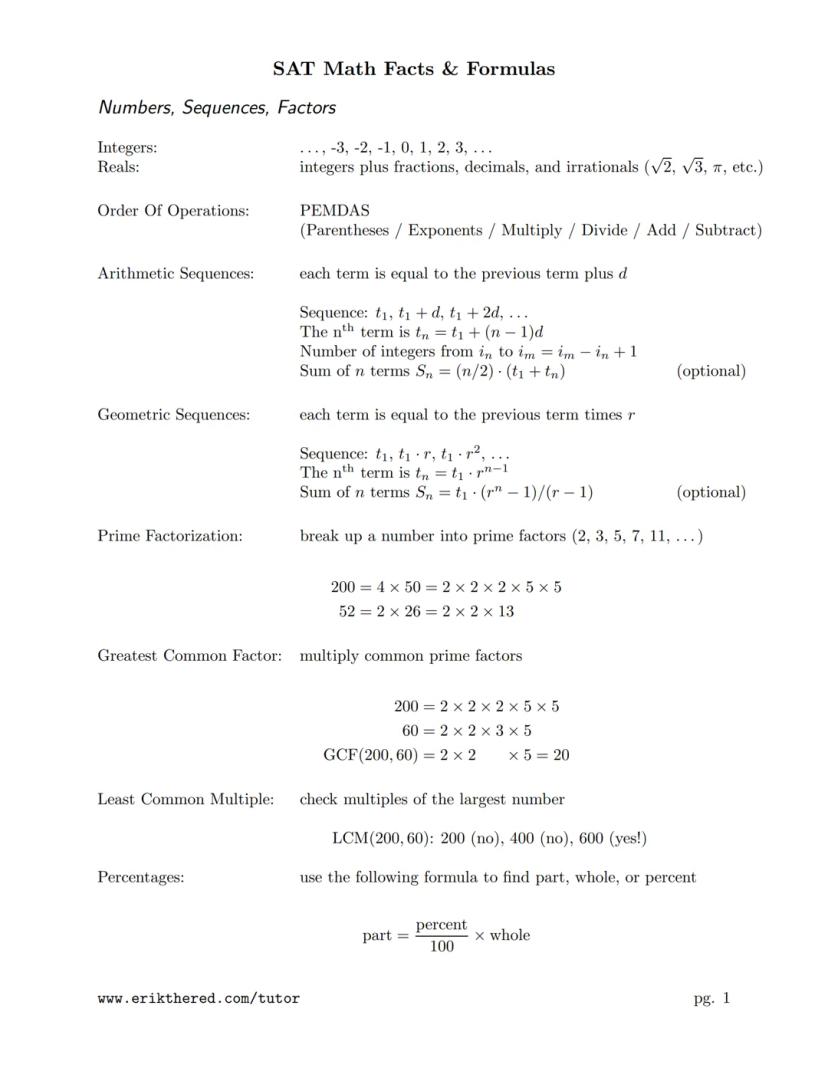
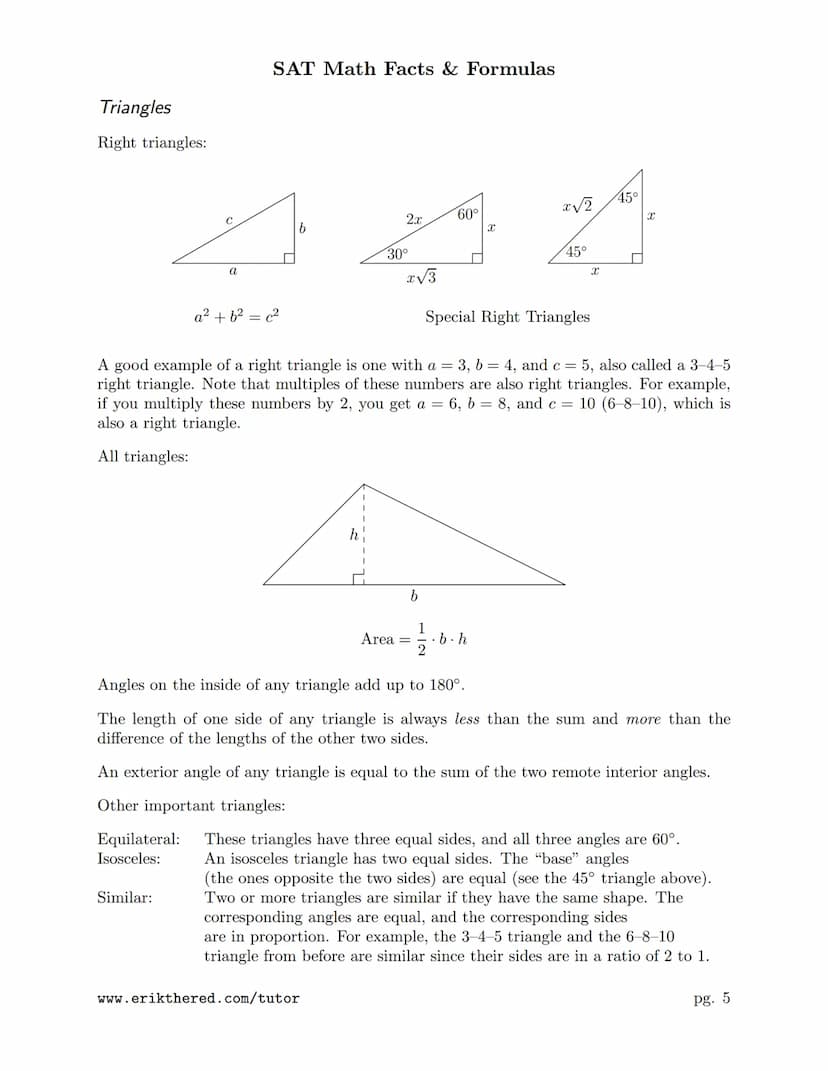
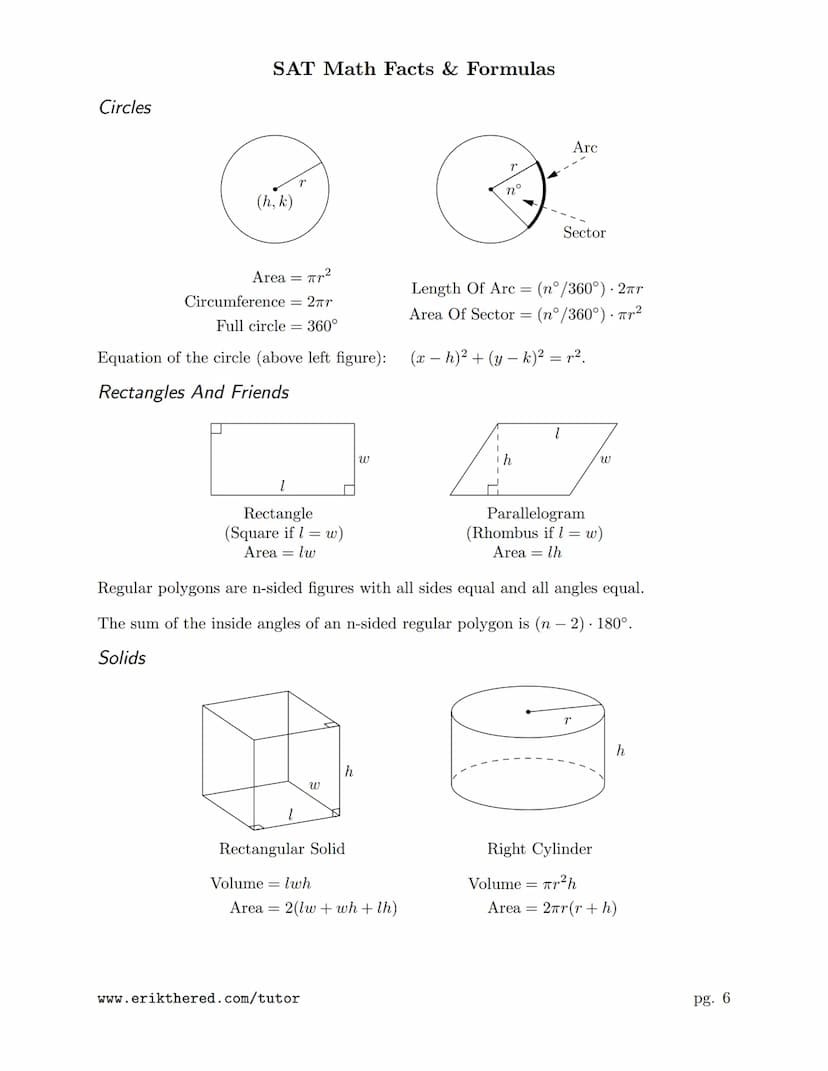
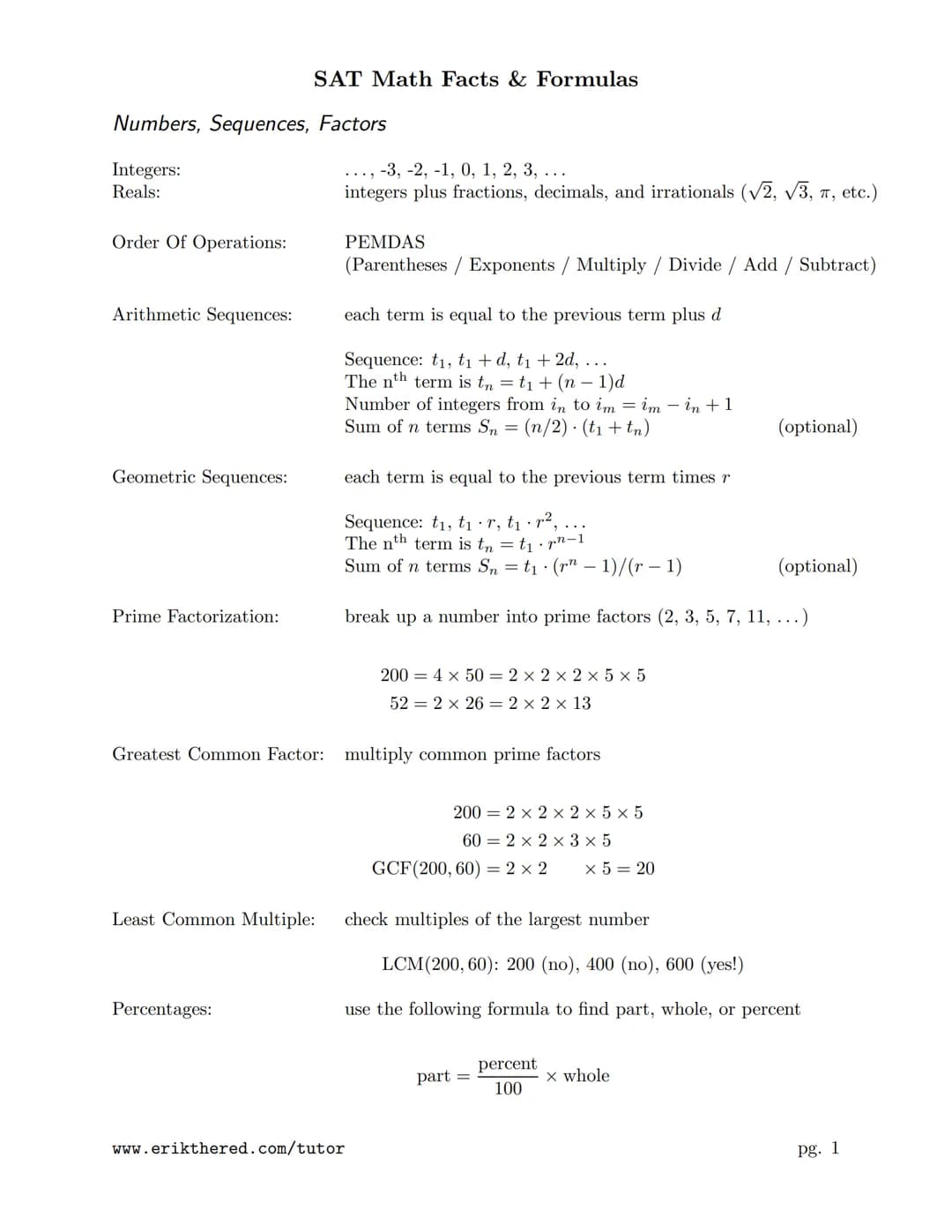
Ever wonder why some math problems seem to follow patterns? The SAT tests your understanding of number relationships and sequences. Integers include all whole numbers and their negatives (...-3, -2, -1, 0, 1, 2, 3...), while real numbers include all integers plus fractions, decimals, and irrationals like √2 and π.
When solving complex expressions, remember PEMDAS (Parentheses, Exponents, Multiplication, Division, Addition, Subtraction). For sequences, know that arithmetic sequences increase by adding the same number each time (like 3, 7, 11, 15...), while geometric sequences multiply by the same factor each time (like 3, 6, 12, 24...).
Understanding factors is crucial for simplifying fractions and solving equations. The prime factorization of a number breaks it into its prime number building blocks . To find the Greatest Common Factor (GCF) of multiple numbers, multiply their shared prime factors. For the Least Common Multiple (LCM), look for the smallest number divisible by all numbers in question.
💡 When working with percentages, remember this simple formula: part = × whole. This one formula can be rearranged to solve for any variable!
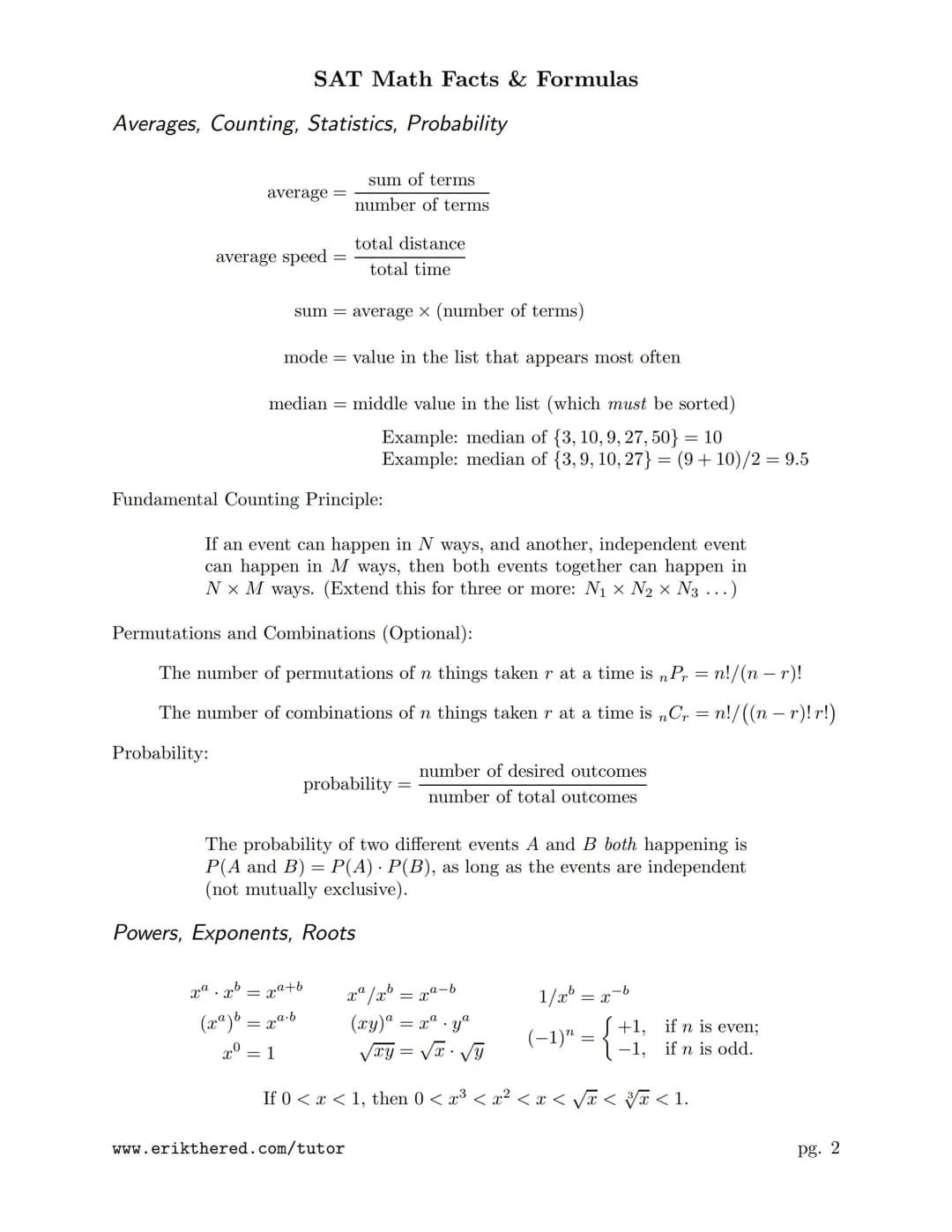
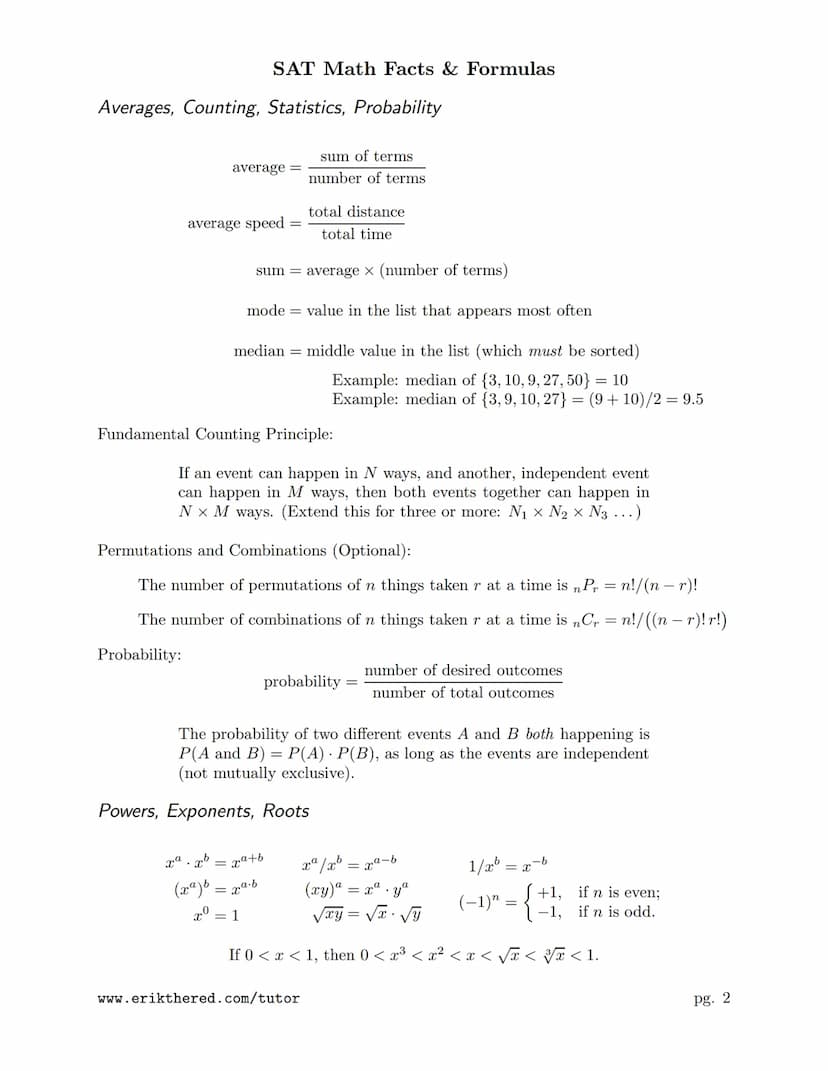
Averages show up everywhere on the SAT! The average (or mean) equals the sum of all values divided by the number of values. When working with speed problems, remember that average speed equals total distance divided by total time—not the average of individual speeds.
Statistical concepts are straightforward but important. The mode is simply the value that appears most often, while the median is the middle value when all numbers are arranged in order. If you have an even number of values, take the average of the two middle numbers.
Probability questions test your understanding of outcomes. The basic formula is probability = (desired outcomes)/(total outcomes). For independent events happening together, multiply their individual probabilities.
When working with powers and exponents, remember these key rules: when multiplying powers with the same base, add the exponents . When dividing powers with the same base, subtract the exponents . Any number raised to the power of zero equals 1.
🔑 Understanding the Fundamental Counting Principle is crucial for probability questions: If one event can happen in N ways and another independent event in M ways, together they can happen in N × M ways.
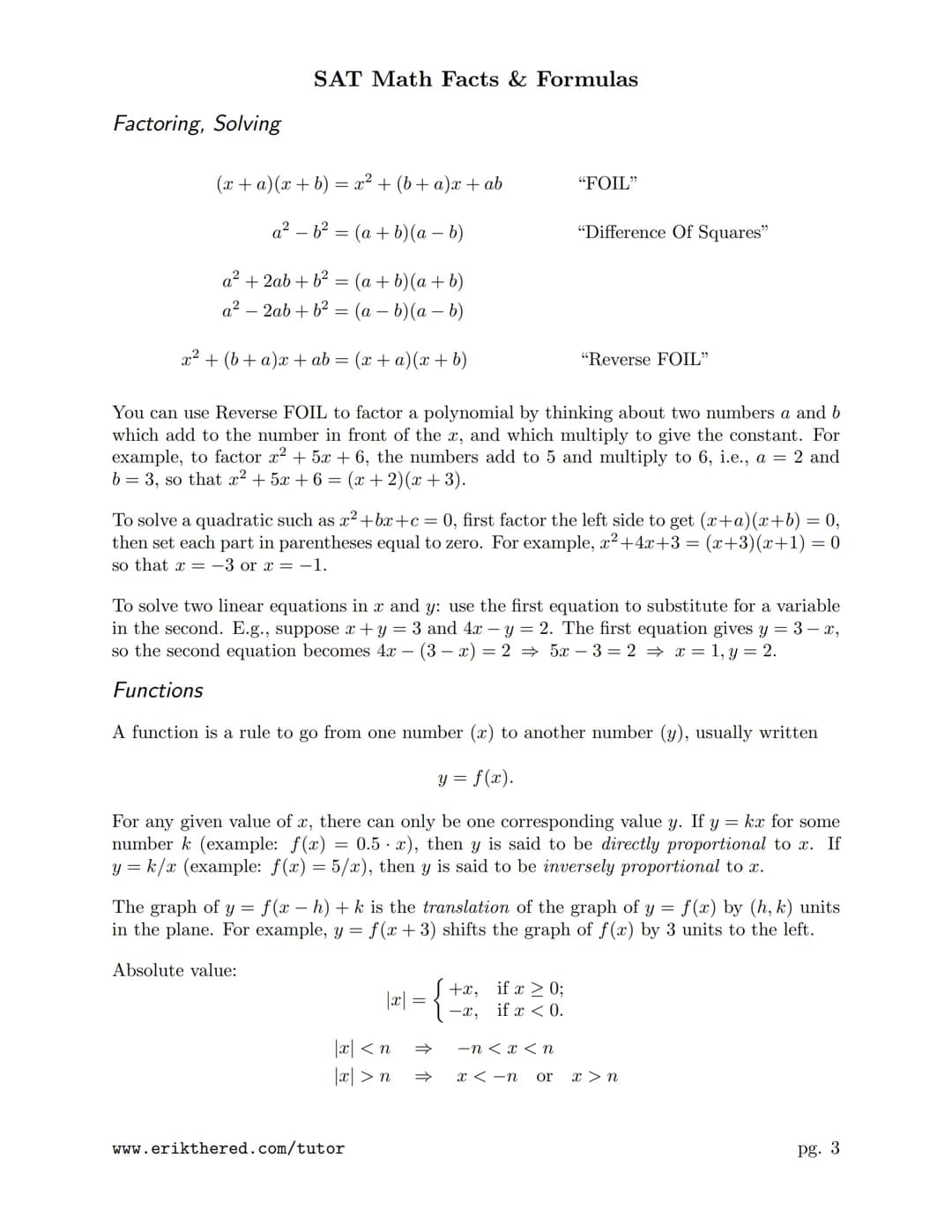
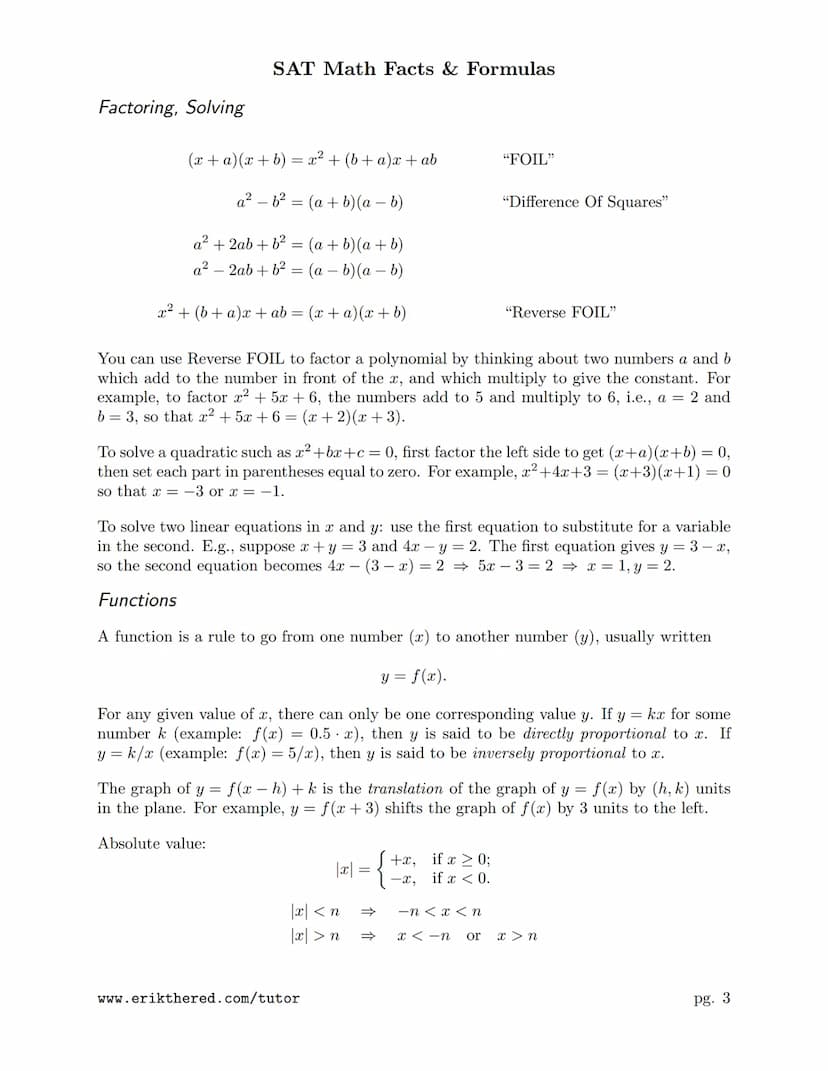
Factoring is your secret weapon for solving quadratic equations! The FOIL method helps you expand expressions like = x² + x + ab. Going in reverse (reverse FOIL) lets you factor expressions like x² + 5x + 6 into by finding numbers that multiply to give 6 and add to give 5.
To solve quadratic equations like x² + 4x + 3 = 0, factor the left side to get = 0, then find the values that make each factor equal zero . For systems of linear equations, use substitution—express one variable in terms of the other, then plug that expression into the second equation.
Functions are simply rules that convert one number (input) to another number (output). Remember that for any given input value, a function can only have one output value. Directly proportional functions have the form y = kx, while inversely proportional functions look like y = k/x.
Absolute value expressions can be tricky. Remember that |x| < n means x is between -n and n, while |x| > n means x is either less than -n or greater than n.
🧠 When solving equations with absolute values, always consider both possibilities: the expression inside the absolute value bars could be positive OR negative!
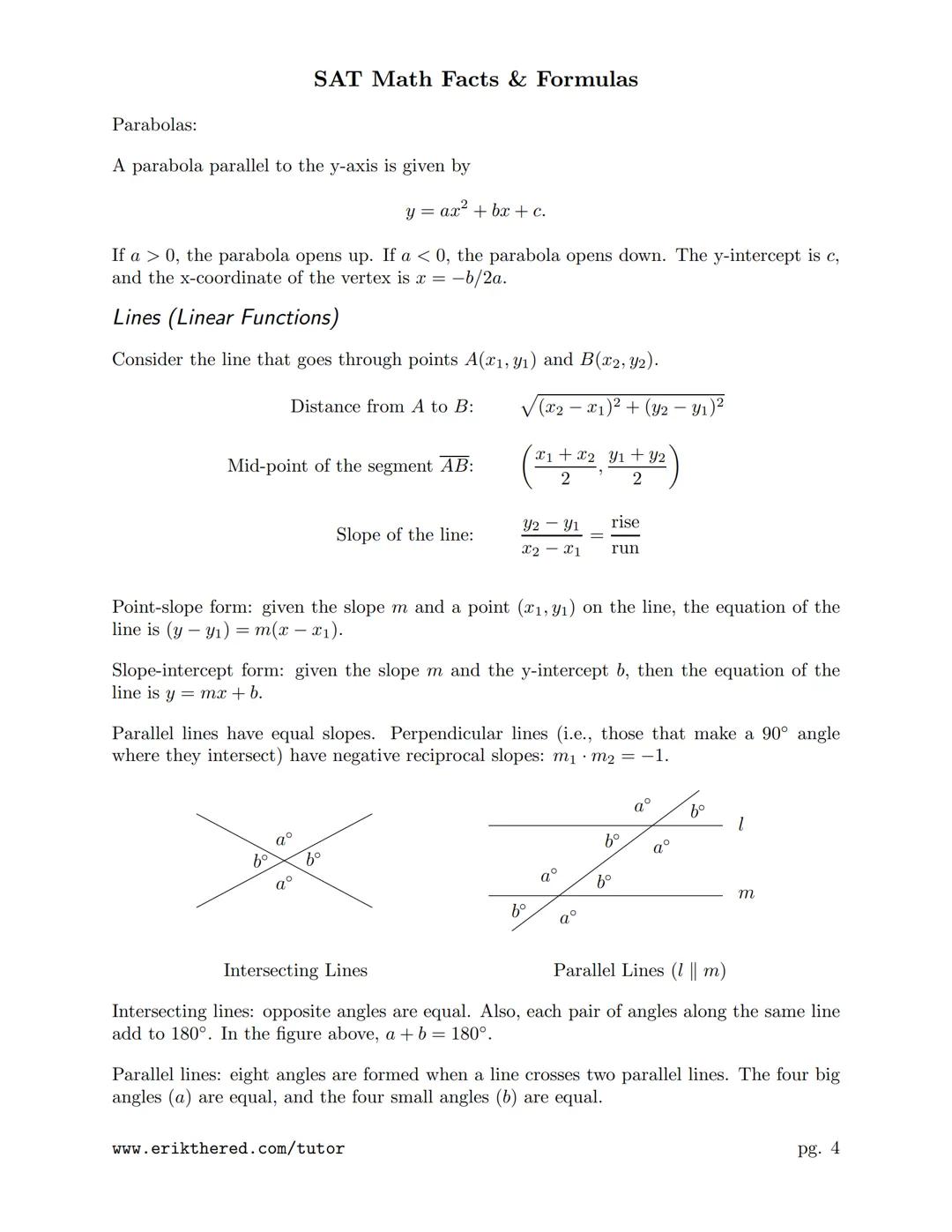
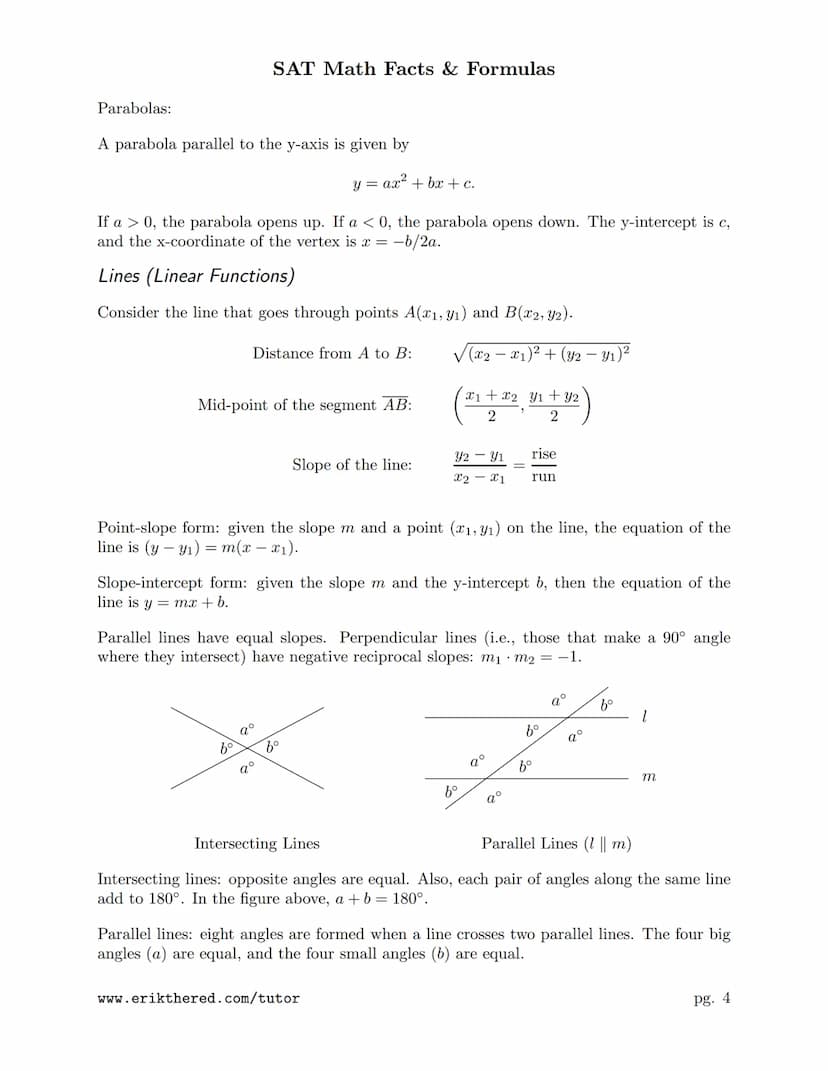
Mastering lines is essential for SAT success! The equation of a parabola takes the form y = ax² + bx + c. If a is positive, the parabola opens upward; if negative, it opens downward. The x-coordinate of the vertex is -b/2a, which is super helpful for finding maximum or minimum values.
For linear functions, know these key forms: point-slope form = m and slope-intercept form y = mx + b. The slope of a line is calculated as / between any two points.
When working with lines in the coordinate plane, remember that parallel lines have equal slopes, while perpendicular lines have slopes that are negative reciprocals of each other . This comes up frequently on the SAT!
For intersecting lines, remember that opposite angles are equal, and angles along the same line add up to 180°. When a line crosses two parallel lines, it creates eight angles—four of one size and four of another.
👍 The distance formula is just the Pythagorean theorem in disguise! To find the distance between points (x₁, y₁) and (x₂, y₂), calculate √.
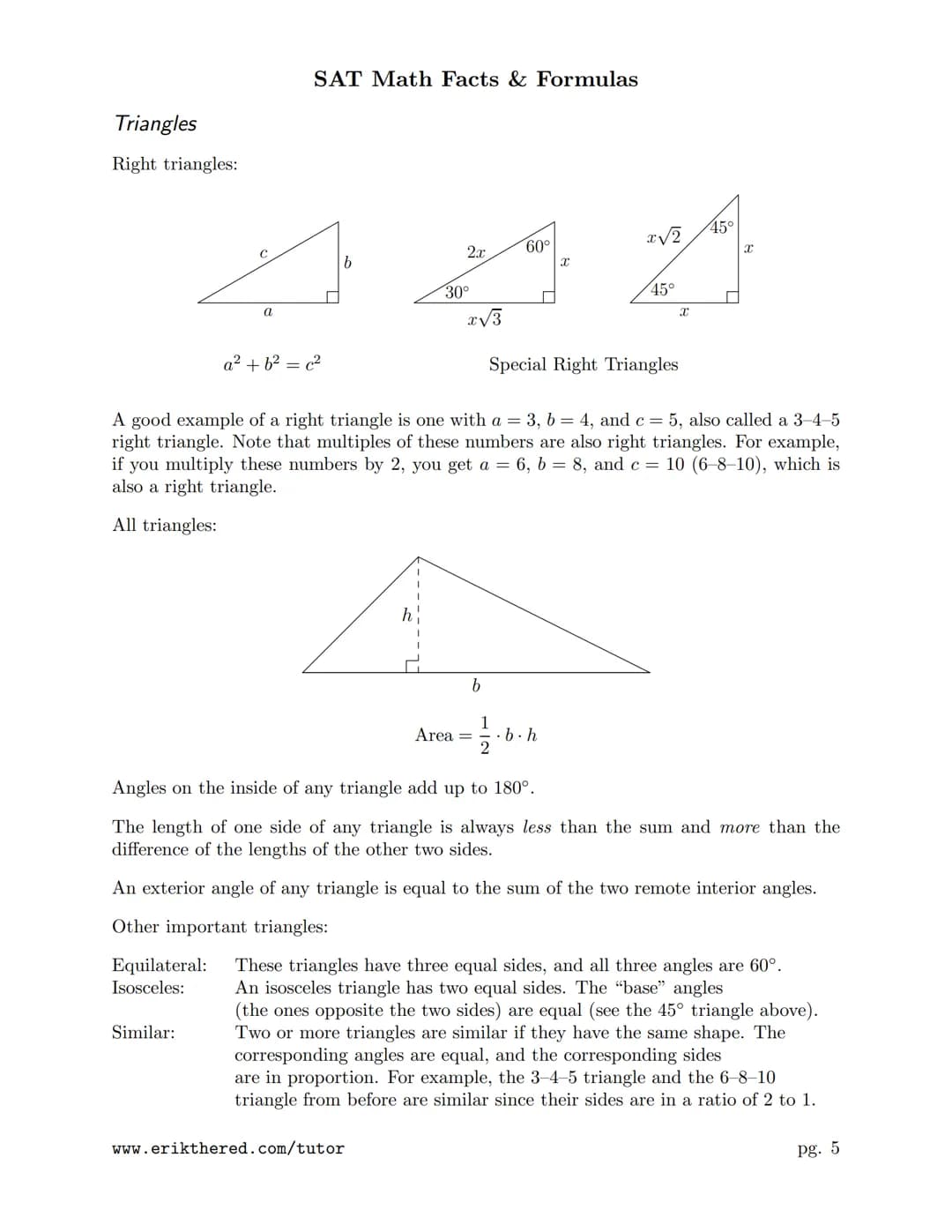
Right triangles are SAT favorites! Always remember the Pythagorean theorem: a² + b² = c², where c is the hypotenuse (longest side). The SAT loves to use special right triangles—particularly the 30°-60°-90° and 45°-45°-90° triangles—because their sides follow specific ratios.
In a 45°-45°-90° triangle, if the legs have length x, the hypotenuse has length x√2. In a 30°-60°-90° triangle, if the shortest leg has length x, the hypotenuse is 2x and the middle leg is x√3.
For any triangle, the area equals ½ × base × height. Remember that angles inside a triangle always add up to 180°, and an exterior angle equals the sum of the two remote interior angles.
Similar triangles have the same shape but different sizes. Their corresponding angles are equal, and their corresponding sides are proportional. This means you can set up ratios to find unknown sides. The classic 3-4-5 right triangle appears frequently on the test.
⭐ The triangle inequality theorem is a powerful check: any side of a triangle must be less than the sum of the other two sides but greater than their difference. If this rule is broken, the triangle can't exist!
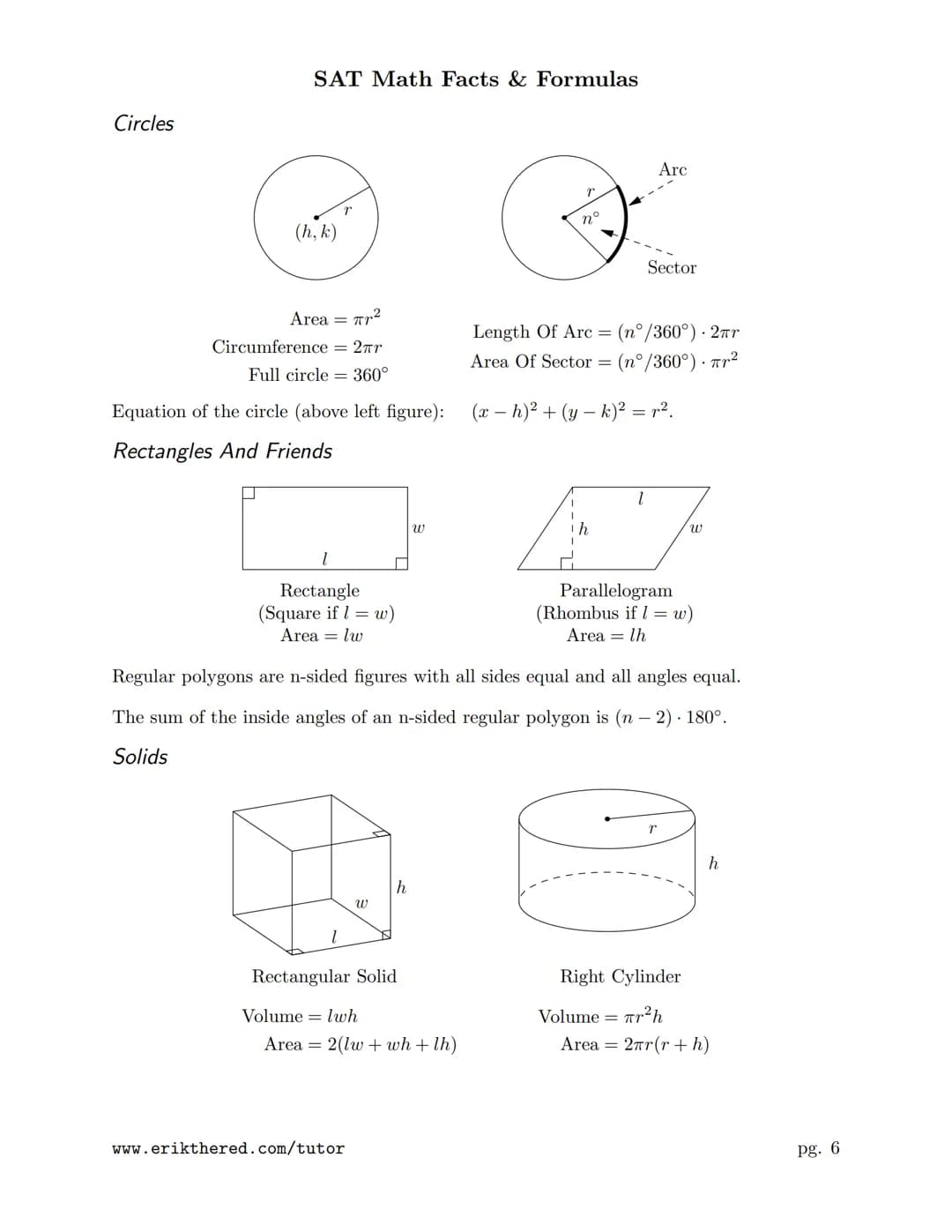
Circle problems appear regularly on the SAT. The area of a circle is πr², while the circumference is 2πr. For portions of a circle, remember that an arc length equals × 2πr, where n° is the central angle in degrees. Similarly, a sector's area equals × πr².
The equation of a circle with center (h, k) and radius r is ² + ² = r². This formula is useful when you need to find points on a circle or determine if points lie inside or outside a circle.
For rectangles and parallelograms, memorize the area formulas: rectangle area = length × width, and parallelogram area = base × height. In regular polygons (where all sides and angles are equal), the sum of interior angles equals × 180°, where n is the number of sides.
Three-dimensional shapes also appear on the SAT. The volume of a rectangular solid is length × width × height, while its surface area is 2. For a cylinder, the volume is πr²h, and the surface area is 2πr² + 2πrh, or more simply 2πr.
🔍 When working with 3D shapes, drawing a diagram can help you visualize the problem and identify which formula to use. Don't skip this important step!
Our AI companion is specifically built for the needs of students. Based on the millions of content pieces we have on the platform we can provide truly meaningful and relevant answers to students. But its not only about answers, the companion is even more about guiding students through their daily learning challenges, with personalised study plans, quizzes or content pieces in the chat and 100% personalisation based on the students skills and developments.
You can download the app in the Google Play Store and in the Apple App Store.
That's right! Enjoy free access to study content, connect with fellow students, and get instant help – all at your fingertips.
App Store
Google Play
The app is very easy to use and well designed. I have found everything I was looking for so far and have been able to learn a lot from the presentations! I will definitely use the app for a class assignment! And of course it also helps a lot as an inspiration.
Stefan S
iOS user
This app is really great. There are so many study notes and help [...]. My problem subject is French, for example, and the app has so many options for help. Thanks to this app, I have improved my French. I would recommend it to anyone.
Samantha Klich
Android user
Wow, I am really amazed. I just tried the app because I've seen it advertised many times and was absolutely stunned. This app is THE HELP you want for school and above all, it offers so many things, such as workouts and fact sheets, which have been VERY helpful to me personally.
Anna
iOS user
I think it’s very much worth it and you’ll end up using it a lot once you get the hang of it and even after looking at others notes you can still ask your Artificial intelligence buddy the question and ask to simplify it if you still don’t get it!!! In the end I think it’s worth it 😊👍 ⚠️Also DID I MENTION ITS FREEE YOU DON’T HAVE TO PAY FOR ANYTHING AND STILL GET YOUR GRADES IN PERFECTLY❗️❗️⚠️
Thomas R
iOS user
Knowunity is the BEST app I’ve used in a minute. This is not an ai review or anything this is genuinely coming from a 7th grade student (I know 2011 im young) but dude this app is a 10/10 i have maintained a 3.8 gpa and have plenty of time for gaming. I love it and my mom is just happy I got good grades
Brad T
Android user
Not only did it help me find the answer but it also showed me alternative ways to solve it. I was horrible in math and science but now I have an a in both subjects. Thanks for the help🤍🤍
David K
iOS user
The app's just great! All I have to do is enter the topic in the search bar and I get the response real fast. I don't have to watch 10 YouTube videos to understand something, so I'm saving my time. Highly recommended!
Sudenaz Ocak
Android user
In school I was really bad at maths but thanks to the app, I am doing better now. I am so grateful that you made the app.
Greenlight Bonnie
Android user
I found this app a couple years ago and it has only gotten better since then. I really love it because it can help with written questions and photo questions. Also, it can find study guides that other people have made as well as flashcard sets and practice tests. The free version is also amazing for students who might not be able to afford it. Would 100% recommend
Aubrey
iOS user
Best app if you're in Highschool or Junior high. I have been using this app for 2 school years and it's the best, it's good if you don't have anyone to help you with school work.😋🩷🎀
Marco B
iOS user
THE QUIZES AND FLASHCARDS ARE SO USEFUL AND I LOVE Knowunity AI. IT ALSO IS LITREALLY LIKE CHATGPT BUT SMARTER!! HELPED ME WITH MY MASCARA PROBLEMS TOO!! AS WELL AS MY REAL SUBJECTS ! DUHHH 😍😁😲🤑💗✨🎀😮
Elisha
iOS user
This app is phenomenal down to the correct info and the various topics you can study! I greatly recommend it for people who struggle with procrastination and those who need homework help. It has been perfectly accurate for world 1 history as far as I’ve seen! Geometry too!
Paul T
iOS user
The app is very easy to use and well designed. I have found everything I was looking for so far and have been able to learn a lot from the presentations! I will definitely use the app for a class assignment! And of course it also helps a lot as an inspiration.
Stefan S
iOS user
This app is really great. There are so many study notes and help [...]. My problem subject is French, for example, and the app has so many options for help. Thanks to this app, I have improved my French. I would recommend it to anyone.
Samantha Klich
Android user
Wow, I am really amazed. I just tried the app because I've seen it advertised many times and was absolutely stunned. This app is THE HELP you want for school and above all, it offers so many things, such as workouts and fact sheets, which have been VERY helpful to me personally.
Anna
iOS user
I think it’s very much worth it and you’ll end up using it a lot once you get the hang of it and even after looking at others notes you can still ask your Artificial intelligence buddy the question and ask to simplify it if you still don’t get it!!! In the end I think it’s worth it 😊👍 ⚠️Also DID I MENTION ITS FREEE YOU DON’T HAVE TO PAY FOR ANYTHING AND STILL GET YOUR GRADES IN PERFECTLY❗️❗️⚠️
Thomas R
iOS user
Knowunity is the BEST app I’ve used in a minute. This is not an ai review or anything this is genuinely coming from a 7th grade student (I know 2011 im young) but dude this app is a 10/10 i have maintained a 3.8 gpa and have plenty of time for gaming. I love it and my mom is just happy I got good grades
Brad T
Android user
Not only did it help me find the answer but it also showed me alternative ways to solve it. I was horrible in math and science but now I have an a in both subjects. Thanks for the help🤍🤍
David K
iOS user
The app's just great! All I have to do is enter the topic in the search bar and I get the response real fast. I don't have to watch 10 YouTube videos to understand something, so I'm saving my time. Highly recommended!
Sudenaz Ocak
Android user
In school I was really bad at maths but thanks to the app, I am doing better now. I am so grateful that you made the app.
Greenlight Bonnie
Android user
I found this app a couple years ago and it has only gotten better since then. I really love it because it can help with written questions and photo questions. Also, it can find study guides that other people have made as well as flashcard sets and practice tests. The free version is also amazing for students who might not be able to afford it. Would 100% recommend
Aubrey
iOS user
Best app if you're in Highschool or Junior high. I have been using this app for 2 school years and it's the best, it's good if you don't have anyone to help you with school work.😋🩷🎀
Marco B
iOS user
THE QUIZES AND FLASHCARDS ARE SO USEFUL AND I LOVE Knowunity AI. IT ALSO IS LITREALLY LIKE CHATGPT BUT SMARTER!! HELPED ME WITH MY MASCARA PROBLEMS TOO!! AS WELL AS MY REAL SUBJECTS ! DUHHH 😍😁😲🤑💗✨🎀😮
Elisha
iOS user
This app is phenomenal down to the correct info and the various topics you can study! I greatly recommend it for people who struggle with procrastination and those who need homework help. It has been perfectly accurate for world 1 history as far as I’ve seen! Geometry too!
Paul T
iOS user
Najilah
@sheheartsanime
Ready to ace the math section of the SAT? These essential math facts and formulas cover everything you'll need, from basic number properties to geometry concepts. Understanding these fundamentals will help you solve problems faster and with greater confidence on... Show more
Access to all documents
Improve your grades
Join milions of students
Ever wonder why some math problems seem to follow patterns? The SAT tests your understanding of number relationships and sequences. Integers include all whole numbers and their negatives (...-3, -2, -1, 0, 1, 2, 3...), while real numbers include all integers plus fractions, decimals, and irrationals like √2 and π.
When solving complex expressions, remember PEMDAS (Parentheses, Exponents, Multiplication, Division, Addition, Subtraction). For sequences, know that arithmetic sequences increase by adding the same number each time (like 3, 7, 11, 15...), while geometric sequences multiply by the same factor each time (like 3, 6, 12, 24...).
Understanding factors is crucial for simplifying fractions and solving equations. The prime factorization of a number breaks it into its prime number building blocks . To find the Greatest Common Factor (GCF) of multiple numbers, multiply their shared prime factors. For the Least Common Multiple (LCM), look for the smallest number divisible by all numbers in question.
💡 When working with percentages, remember this simple formula: part = × whole. This one formula can be rearranged to solve for any variable!
Access to all documents
Improve your grades
Join milions of students
Averages show up everywhere on the SAT! The average (or mean) equals the sum of all values divided by the number of values. When working with speed problems, remember that average speed equals total distance divided by total time—not the average of individual speeds.
Statistical concepts are straightforward but important. The mode is simply the value that appears most often, while the median is the middle value when all numbers are arranged in order. If you have an even number of values, take the average of the two middle numbers.
Probability questions test your understanding of outcomes. The basic formula is probability = (desired outcomes)/(total outcomes). For independent events happening together, multiply their individual probabilities.
When working with powers and exponents, remember these key rules: when multiplying powers with the same base, add the exponents . When dividing powers with the same base, subtract the exponents . Any number raised to the power of zero equals 1.
🔑 Understanding the Fundamental Counting Principle is crucial for probability questions: If one event can happen in N ways and another independent event in M ways, together they can happen in N × M ways.
Access to all documents
Improve your grades
Join milions of students
Factoring is your secret weapon for solving quadratic equations! The FOIL method helps you expand expressions like = x² + x + ab. Going in reverse (reverse FOIL) lets you factor expressions like x² + 5x + 6 into by finding numbers that multiply to give 6 and add to give 5.
To solve quadratic equations like x² + 4x + 3 = 0, factor the left side to get = 0, then find the values that make each factor equal zero . For systems of linear equations, use substitution—express one variable in terms of the other, then plug that expression into the second equation.
Functions are simply rules that convert one number (input) to another number (output). Remember that for any given input value, a function can only have one output value. Directly proportional functions have the form y = kx, while inversely proportional functions look like y = k/x.
Absolute value expressions can be tricky. Remember that |x| < n means x is between -n and n, while |x| > n means x is either less than -n or greater than n.
🧠 When solving equations with absolute values, always consider both possibilities: the expression inside the absolute value bars could be positive OR negative!
Access to all documents
Improve your grades
Join milions of students
Mastering lines is essential for SAT success! The equation of a parabola takes the form y = ax² + bx + c. If a is positive, the parabola opens upward; if negative, it opens downward. The x-coordinate of the vertex is -b/2a, which is super helpful for finding maximum or minimum values.
For linear functions, know these key forms: point-slope form = m and slope-intercept form y = mx + b. The slope of a line is calculated as / between any two points.
When working with lines in the coordinate plane, remember that parallel lines have equal slopes, while perpendicular lines have slopes that are negative reciprocals of each other . This comes up frequently on the SAT!
For intersecting lines, remember that opposite angles are equal, and angles along the same line add up to 180°. When a line crosses two parallel lines, it creates eight angles—four of one size and four of another.
👍 The distance formula is just the Pythagorean theorem in disguise! To find the distance between points (x₁, y₁) and (x₂, y₂), calculate √.
Access to all documents
Improve your grades
Join milions of students
Right triangles are SAT favorites! Always remember the Pythagorean theorem: a² + b² = c², where c is the hypotenuse (longest side). The SAT loves to use special right triangles—particularly the 30°-60°-90° and 45°-45°-90° triangles—because their sides follow specific ratios.
In a 45°-45°-90° triangle, if the legs have length x, the hypotenuse has length x√2. In a 30°-60°-90° triangle, if the shortest leg has length x, the hypotenuse is 2x and the middle leg is x√3.
For any triangle, the area equals ½ × base × height. Remember that angles inside a triangle always add up to 180°, and an exterior angle equals the sum of the two remote interior angles.
Similar triangles have the same shape but different sizes. Their corresponding angles are equal, and their corresponding sides are proportional. This means you can set up ratios to find unknown sides. The classic 3-4-5 right triangle appears frequently on the test.
⭐ The triangle inequality theorem is a powerful check: any side of a triangle must be less than the sum of the other two sides but greater than their difference. If this rule is broken, the triangle can't exist!
Access to all documents
Improve your grades
Join milions of students
Circle problems appear regularly on the SAT. The area of a circle is πr², while the circumference is 2πr. For portions of a circle, remember that an arc length equals × 2πr, where n° is the central angle in degrees. Similarly, a sector's area equals × πr².
The equation of a circle with center (h, k) and radius r is ² + ² = r². This formula is useful when you need to find points on a circle or determine if points lie inside or outside a circle.
For rectangles and parallelograms, memorize the area formulas: rectangle area = length × width, and parallelogram area = base × height. In regular polygons (where all sides and angles are equal), the sum of interior angles equals × 180°, where n is the number of sides.
Three-dimensional shapes also appear on the SAT. The volume of a rectangular solid is length × width × height, while its surface area is 2. For a cylinder, the volume is πr²h, and the surface area is 2πr² + 2πrh, or more simply 2πr.
🔍 When working with 3D shapes, drawing a diagram can help you visualize the problem and identify which formula to use. Don't skip this important step!
Our AI companion is specifically built for the needs of students. Based on the millions of content pieces we have on the platform we can provide truly meaningful and relevant answers to students. But its not only about answers, the companion is even more about guiding students through their daily learning challenges, with personalised study plans, quizzes or content pieces in the chat and 100% personalisation based on the students skills and developments.
You can download the app in the Google Play Store and in the Apple App Store.
That's right! Enjoy free access to study content, connect with fellow students, and get instant help – all at your fingertips.
47
Smart Tools NEW
Transform this note into: ✓ 50+ Practice Questions ✓ Interactive Flashcards ✓ Full Practice Test ✓ Essay Outlines
App Store
Google Play
The app is very easy to use and well designed. I have found everything I was looking for so far and have been able to learn a lot from the presentations! I will definitely use the app for a class assignment! And of course it also helps a lot as an inspiration.
Stefan S
iOS user
This app is really great. There are so many study notes and help [...]. My problem subject is French, for example, and the app has so many options for help. Thanks to this app, I have improved my French. I would recommend it to anyone.
Samantha Klich
Android user
Wow, I am really amazed. I just tried the app because I've seen it advertised many times and was absolutely stunned. This app is THE HELP you want for school and above all, it offers so many things, such as workouts and fact sheets, which have been VERY helpful to me personally.
Anna
iOS user
I think it’s very much worth it and you’ll end up using it a lot once you get the hang of it and even after looking at others notes you can still ask your Artificial intelligence buddy the question and ask to simplify it if you still don’t get it!!! In the end I think it’s worth it 😊👍 ⚠️Also DID I MENTION ITS FREEE YOU DON’T HAVE TO PAY FOR ANYTHING AND STILL GET YOUR GRADES IN PERFECTLY❗️❗️⚠️
Thomas R
iOS user
Knowunity is the BEST app I’ve used in a minute. This is not an ai review or anything this is genuinely coming from a 7th grade student (I know 2011 im young) but dude this app is a 10/10 i have maintained a 3.8 gpa and have plenty of time for gaming. I love it and my mom is just happy I got good grades
Brad T
Android user
Not only did it help me find the answer but it also showed me alternative ways to solve it. I was horrible in math and science but now I have an a in both subjects. Thanks for the help🤍🤍
David K
iOS user
The app's just great! All I have to do is enter the topic in the search bar and I get the response real fast. I don't have to watch 10 YouTube videos to understand something, so I'm saving my time. Highly recommended!
Sudenaz Ocak
Android user
In school I was really bad at maths but thanks to the app, I am doing better now. I am so grateful that you made the app.
Greenlight Bonnie
Android user
I found this app a couple years ago and it has only gotten better since then. I really love it because it can help with written questions and photo questions. Also, it can find study guides that other people have made as well as flashcard sets and practice tests. The free version is also amazing for students who might not be able to afford it. Would 100% recommend
Aubrey
iOS user
Best app if you're in Highschool or Junior high. I have been using this app for 2 school years and it's the best, it's good if you don't have anyone to help you with school work.😋🩷🎀
Marco B
iOS user
THE QUIZES AND FLASHCARDS ARE SO USEFUL AND I LOVE Knowunity AI. IT ALSO IS LITREALLY LIKE CHATGPT BUT SMARTER!! HELPED ME WITH MY MASCARA PROBLEMS TOO!! AS WELL AS MY REAL SUBJECTS ! DUHHH 😍😁😲🤑💗✨🎀😮
Elisha
iOS user
This app is phenomenal down to the correct info and the various topics you can study! I greatly recommend it for people who struggle with procrastination and those who need homework help. It has been perfectly accurate for world 1 history as far as I’ve seen! Geometry too!
Paul T
iOS user
The app is very easy to use and well designed. I have found everything I was looking for so far and have been able to learn a lot from the presentations! I will definitely use the app for a class assignment! And of course it also helps a lot as an inspiration.
Stefan S
iOS user
This app is really great. There are so many study notes and help [...]. My problem subject is French, for example, and the app has so many options for help. Thanks to this app, I have improved my French. I would recommend it to anyone.
Samantha Klich
Android user
Wow, I am really amazed. I just tried the app because I've seen it advertised many times and was absolutely stunned. This app is THE HELP you want for school and above all, it offers so many things, such as workouts and fact sheets, which have been VERY helpful to me personally.
Anna
iOS user
I think it’s very much worth it and you’ll end up using it a lot once you get the hang of it and even after looking at others notes you can still ask your Artificial intelligence buddy the question and ask to simplify it if you still don’t get it!!! In the end I think it’s worth it 😊👍 ⚠️Also DID I MENTION ITS FREEE YOU DON’T HAVE TO PAY FOR ANYTHING AND STILL GET YOUR GRADES IN PERFECTLY❗️❗️⚠️
Thomas R
iOS user
Knowunity is the BEST app I’ve used in a minute. This is not an ai review or anything this is genuinely coming from a 7th grade student (I know 2011 im young) but dude this app is a 10/10 i have maintained a 3.8 gpa and have plenty of time for gaming. I love it and my mom is just happy I got good grades
Brad T
Android user
Not only did it help me find the answer but it also showed me alternative ways to solve it. I was horrible in math and science but now I have an a in both subjects. Thanks for the help🤍🤍
David K
iOS user
The app's just great! All I have to do is enter the topic in the search bar and I get the response real fast. I don't have to watch 10 YouTube videos to understand something, so I'm saving my time. Highly recommended!
Sudenaz Ocak
Android user
In school I was really bad at maths but thanks to the app, I am doing better now. I am so grateful that you made the app.
Greenlight Bonnie
Android user
I found this app a couple years ago and it has only gotten better since then. I really love it because it can help with written questions and photo questions. Also, it can find study guides that other people have made as well as flashcard sets and practice tests. The free version is also amazing for students who might not be able to afford it. Would 100% recommend
Aubrey
iOS user
Best app if you're in Highschool or Junior high. I have been using this app for 2 school years and it's the best, it's good if you don't have anyone to help you with school work.😋🩷🎀
Marco B
iOS user
THE QUIZES AND FLASHCARDS ARE SO USEFUL AND I LOVE Knowunity AI. IT ALSO IS LITREALLY LIKE CHATGPT BUT SMARTER!! HELPED ME WITH MY MASCARA PROBLEMS TOO!! AS WELL AS MY REAL SUBJECTS ! DUHHH 😍😁😲🤑💗✨🎀😮
Elisha
iOS user
This app is phenomenal down to the correct info and the various topics you can study! I greatly recommend it for people who struggle with procrastination and those who need homework help. It has been perfectly accurate for world 1 history as far as I’ve seen! Geometry too!
Paul T
iOS user