
Scientific notation is a powerful way to express very large... Show more
 Maths
Maths Biology
 Sociology
Sign up to see the contentIt's free!
Access to all documents
Improve your grades
Join milions of students
By signing up you accept Terms of Service and Privacy Policy

Biology

Chemistry
AP Chemistry

English
AP English Literature
186
•
Dec 28, 2025
•
Dee scob
@deescob_ptdu
Scientific notation is a powerful way to express very large... Show more
When you encounter math problems that involve large numbers or measurements, scientific notation can be extremely helpful. Let's look at some example problems:
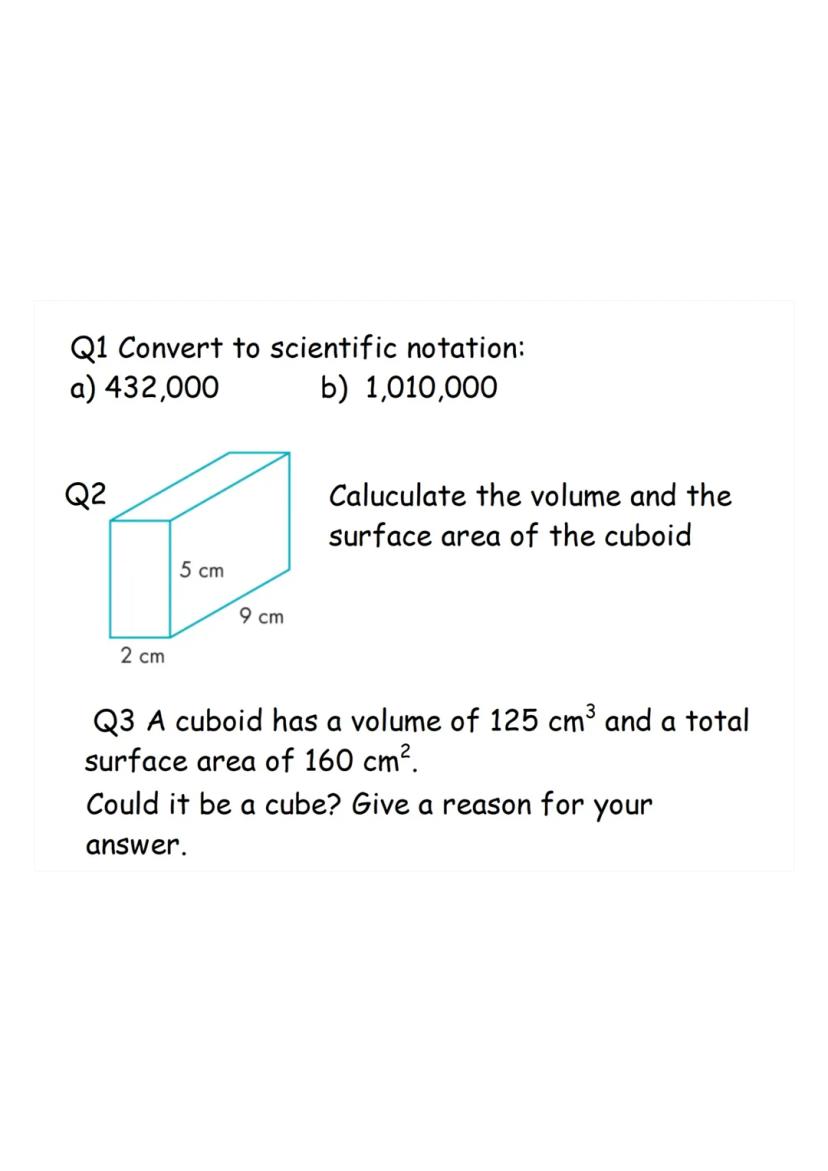
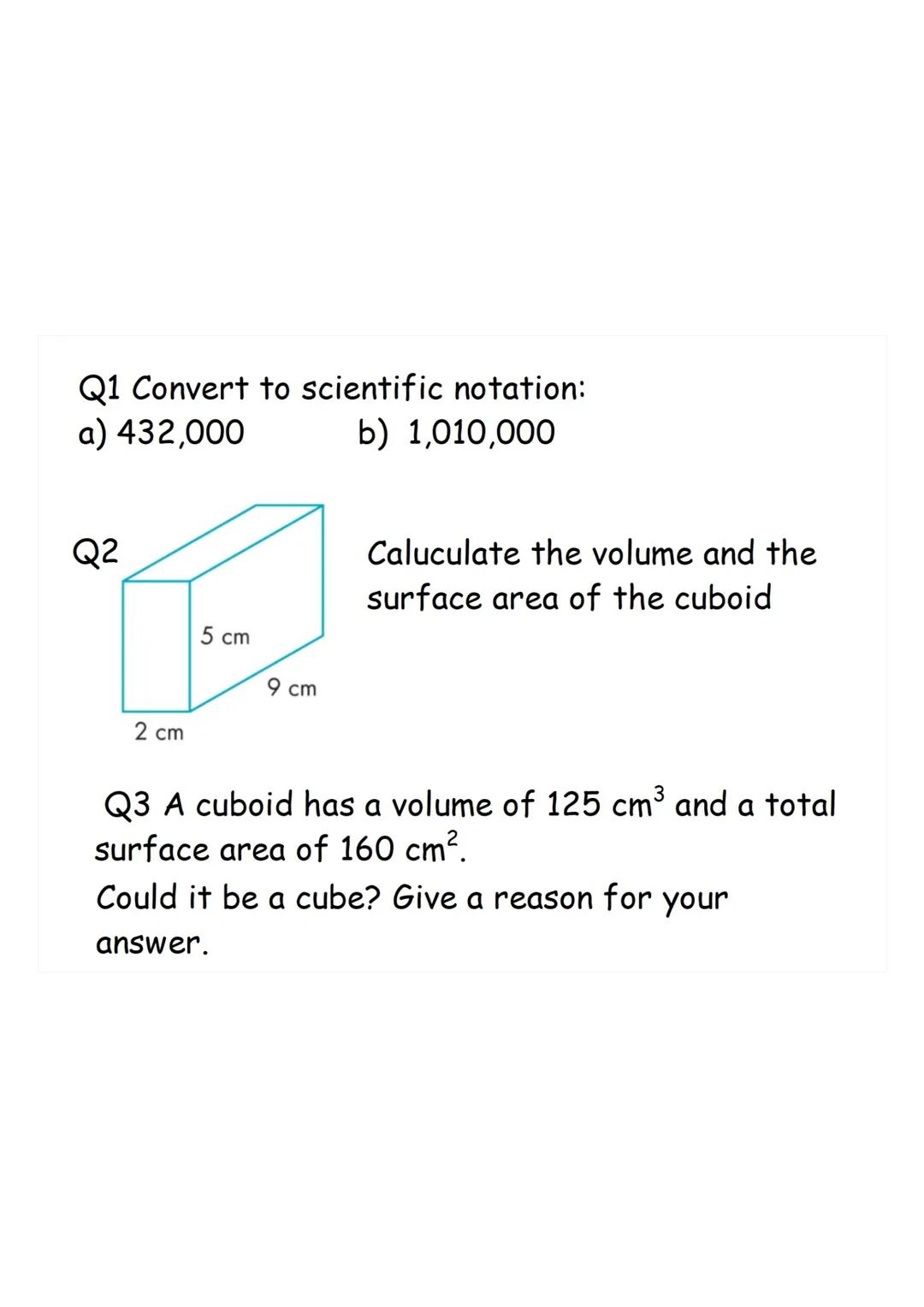
For Question 1, you need to convert 432,000 and 1,010,000 into scientific notation. This means expressing these numbers as a value between 1 and 10, multiplied by a power of 10.
Question 2 asks for the volume and surface area of a cuboid measuring 5 cm × 9 cm × 2 cm. Remember that volume = length × width × height, while surface area requires adding all six faces.
Quick Tip: For any 3D shape problem, draw a quick sketch to visualize the dimensions before calculating!
Question 3 challenges you to determine if a cuboid with a volume of 125 cm³ and surface area of 160 cm² could be a cube. You'll need to check if a cube with those measurements is mathematically possible.
Scientific notation helps us write very small numbers in a more manageable format. Instead of writing lots of zeros, we use powers of 10 to express the number's size.
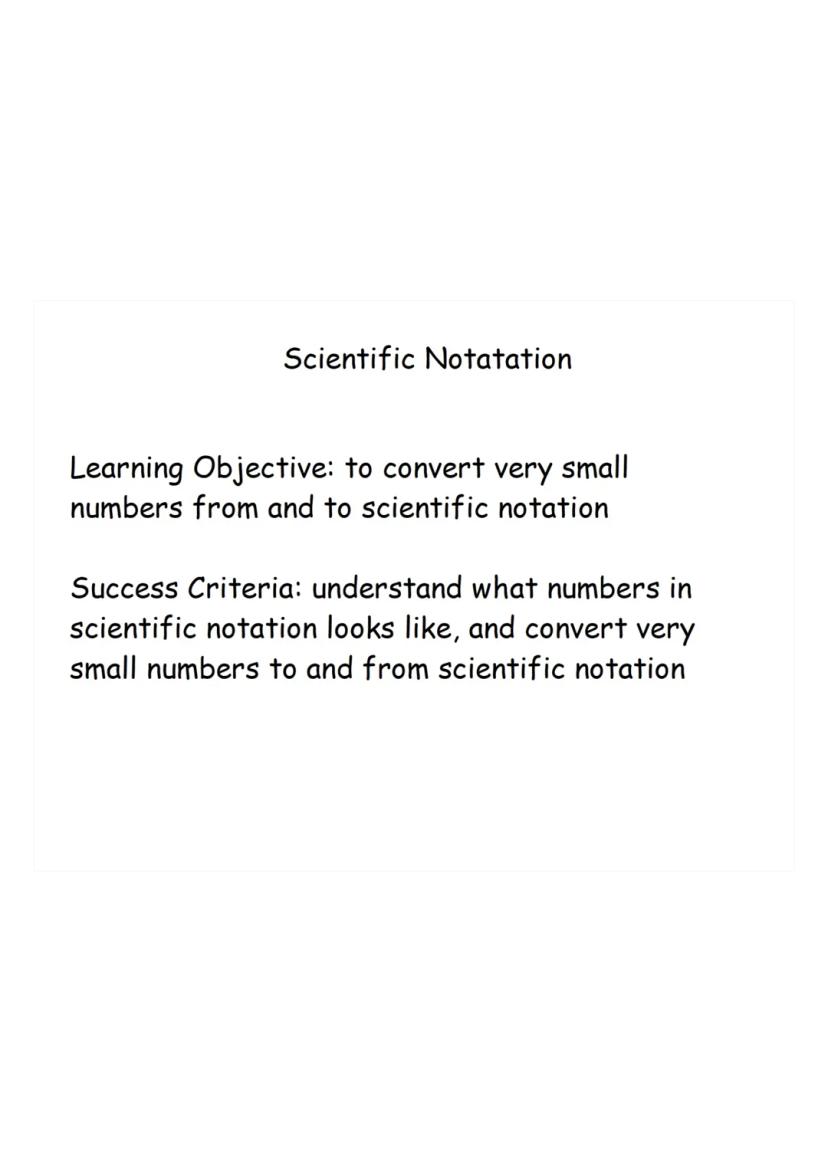
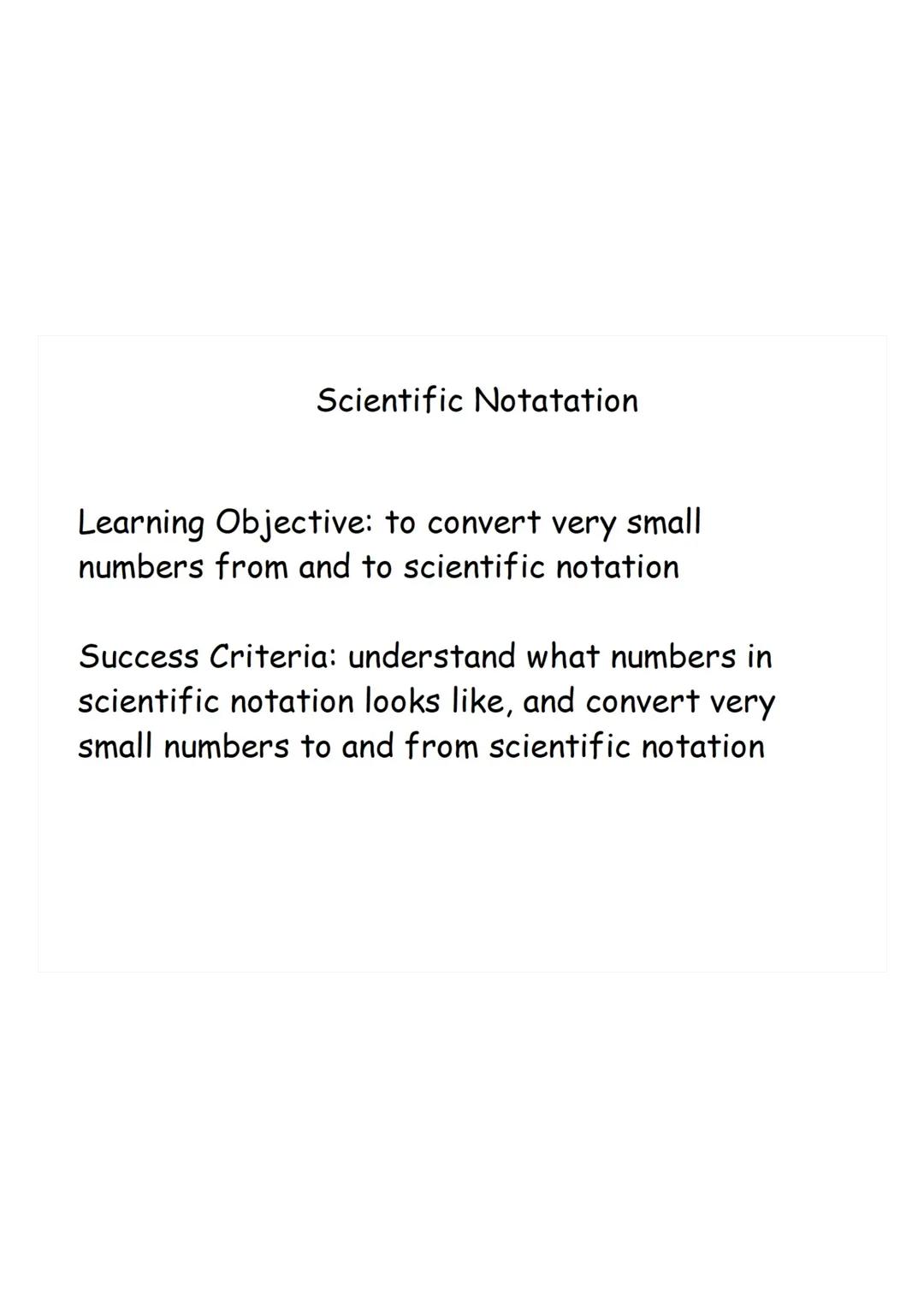
The learning objective is to convert very small numbers both to and from scientific notation. This skill is incredibly useful in science classes where you'll work with microscopic measurements.
To be successful with scientific notation, you need to understand what these expressions look like and how to convert between standard form and scientific notation. The pattern is always: a number between 1 and 10, multiplied by 10 raised to a power.
Remember: For very small numbers less than 1, the power of 10 will be negative!
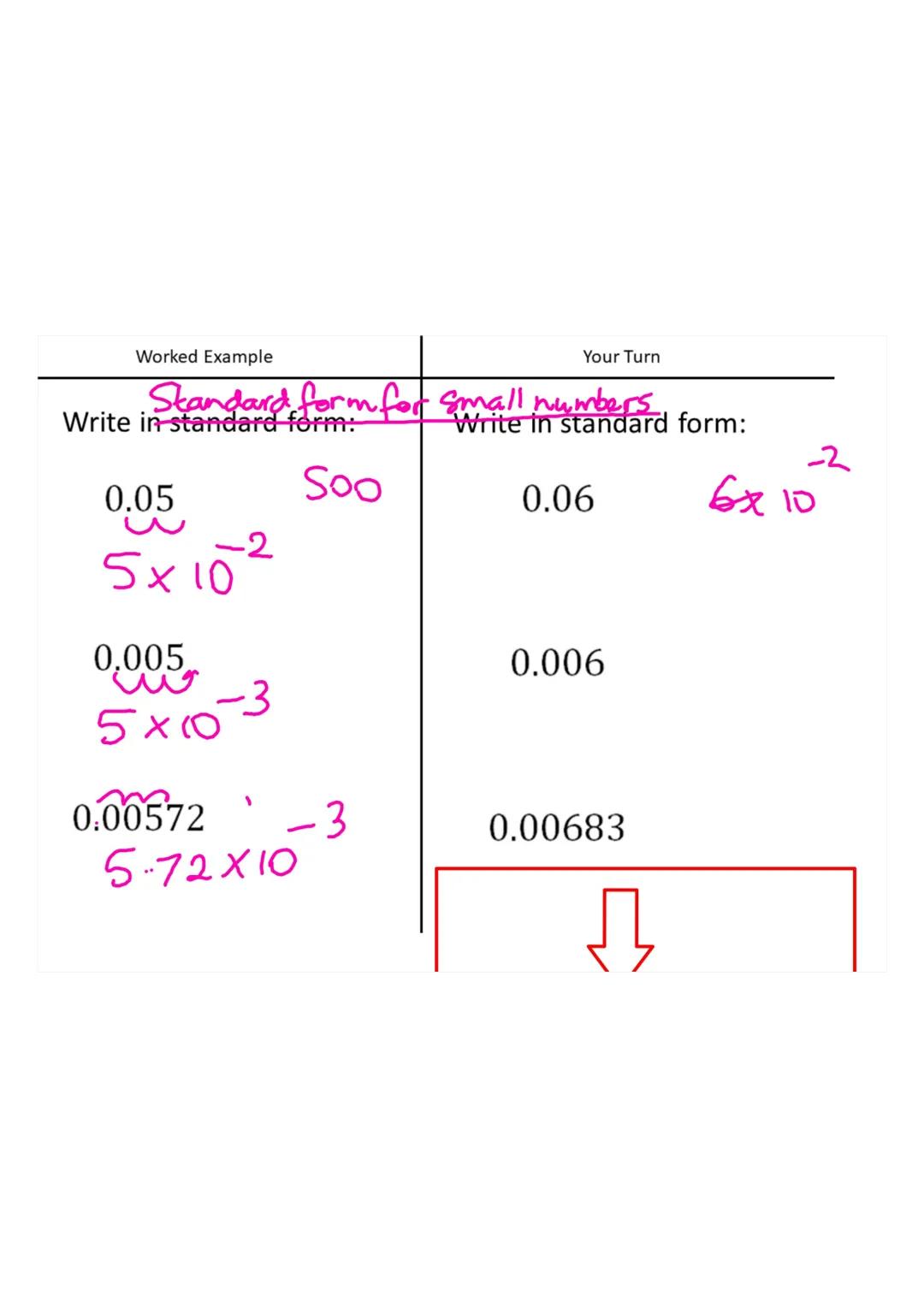
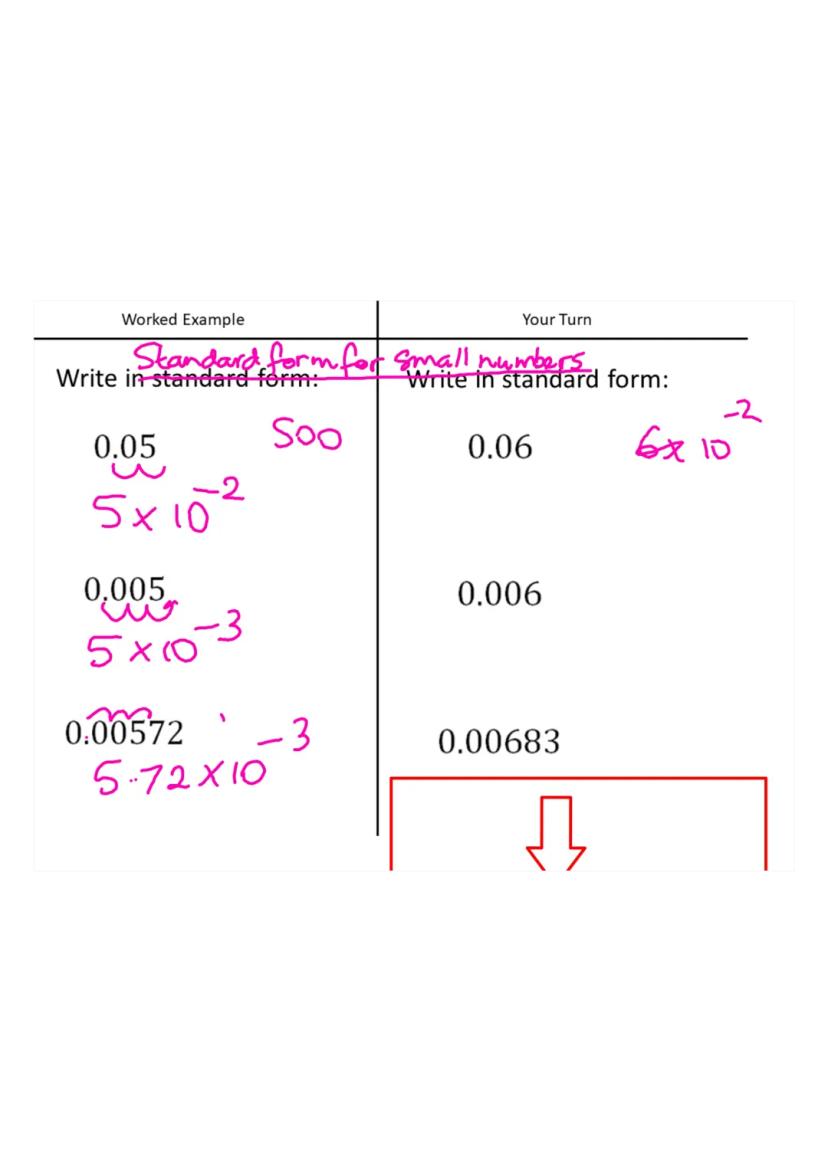
Converting small decimals to scientific notation follows a simple pattern. Move the decimal point to the right until you have a number between 1 and 10, then multiply by 10 to a negative power.
For example, 0.05 becomes 5 × 10^-2 because you moved the decimal point two places right. Similarly, 0.005 converts to 5 × 10^-3 after moving the decimal point three places.
When dealing with more complex decimals like 0.00572, follow the same process. Move the decimal point until you get 5.72, then multiply by 10^-3 since you moved three places.
Practice tip: Count the number of places you move the decimal point - this becomes the power of 10 (negative for small numbers).
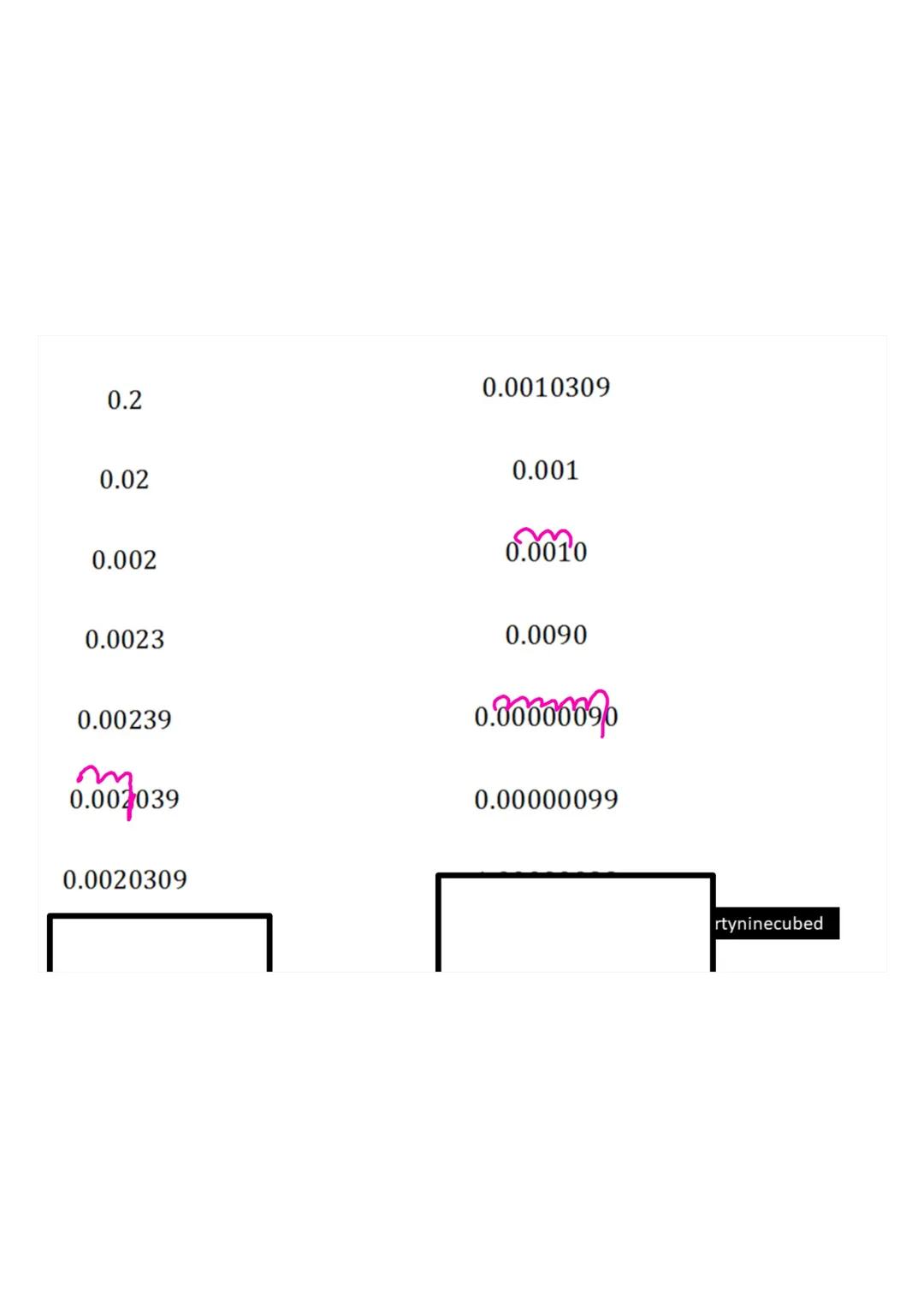
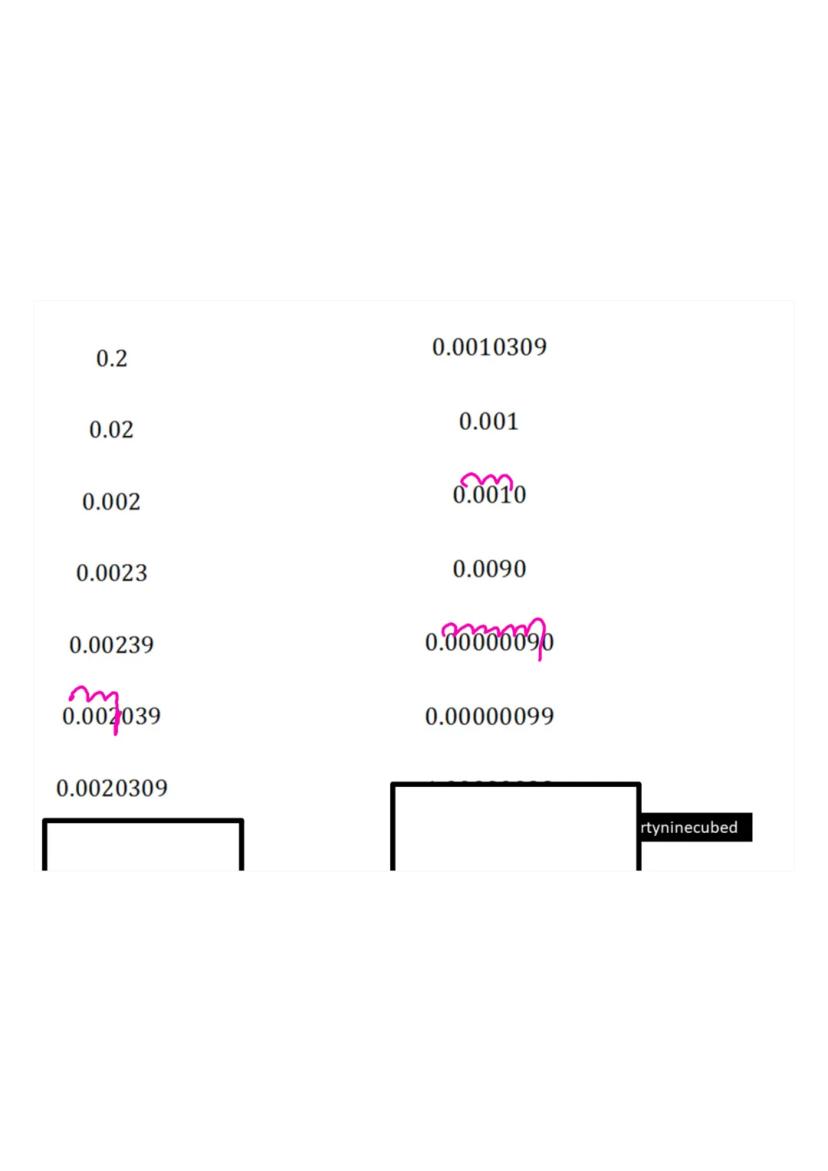
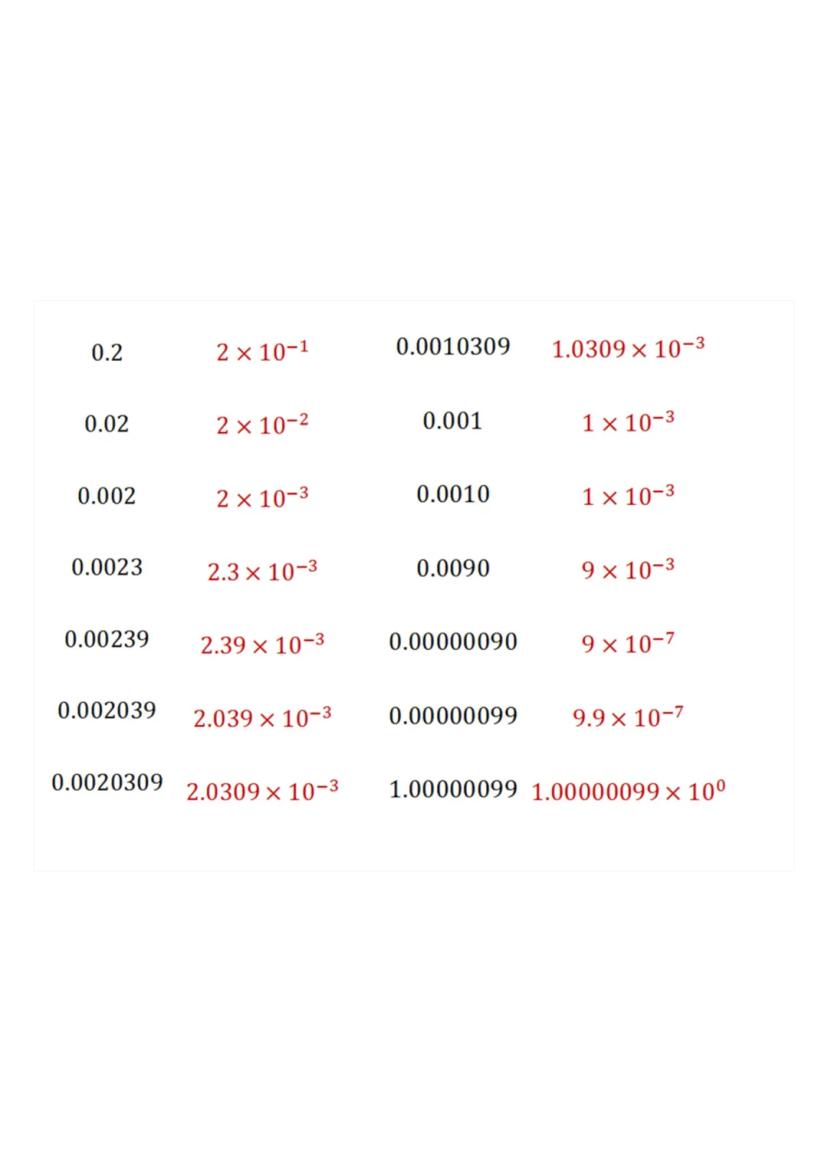
Looking at these decimal numbers, you can see they vary in size from 0.2 (which is fairly large) down to very tiny numbers like 0.00000090.
Each decimal has a specific pattern of zeros that determines how we'll convert it to scientific notation. The more zeros after the decimal point, the smaller the number and the more negative the exponent will be.
Notice the subtle differences between numbers like 0.001 and 0.0010 (they're actually the same value) or between 0.00000090 and 0.00000099 (the second is slightly larger).
Quick Check: Can you spot which number in this list is the smallest without converting to scientific notation?
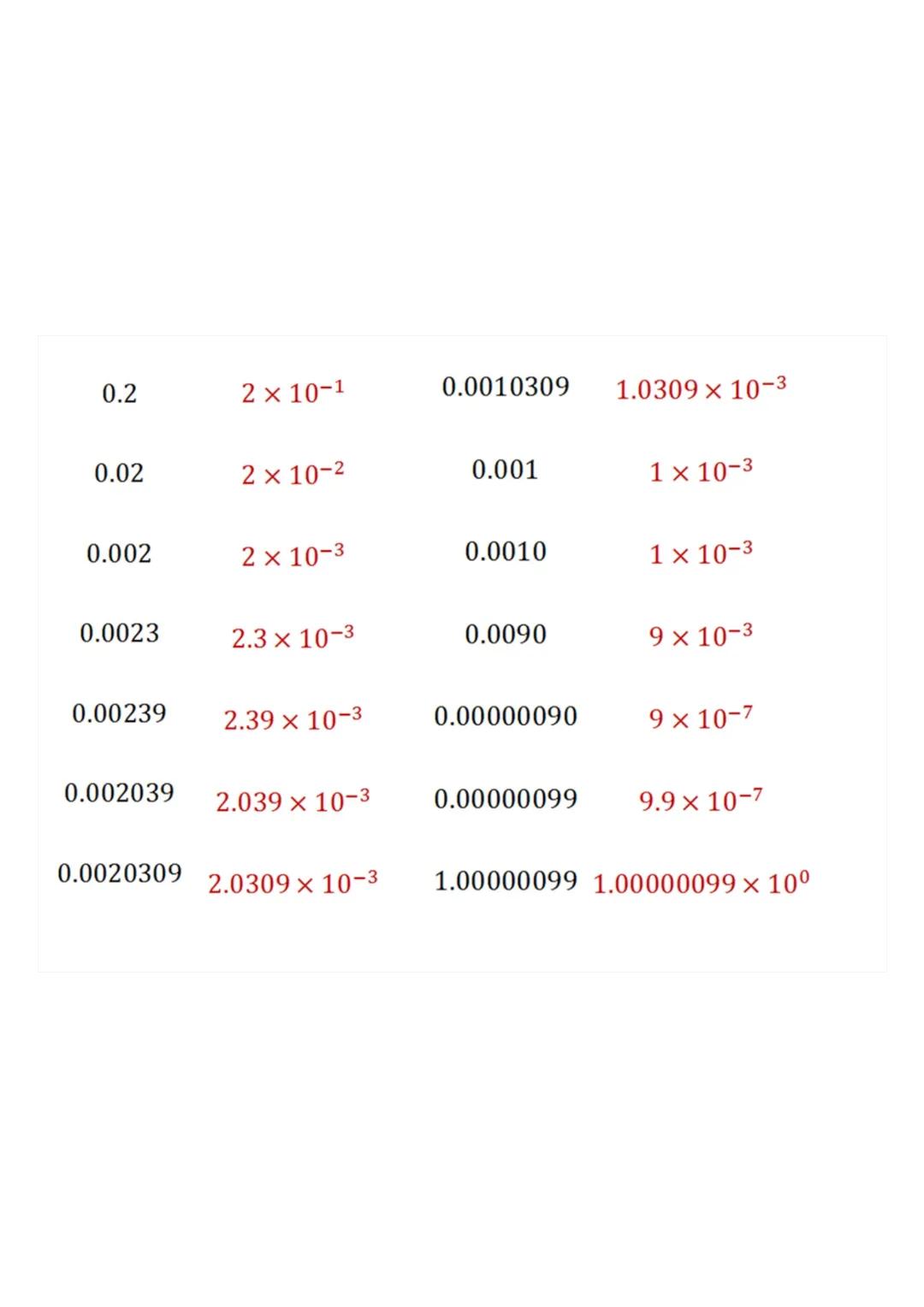
Here's how various decimals convert to scientific notation. For 0.2, we move the decimal point one place right to get 2 × 10^-1. For smaller numbers like 0.002, we move it three places to get 2 × 10^-3.
Notice how numbers with the same digits but different decimal placements have different exponents. For example, 0.00239 becomes 2.39 × 10^-3, while 0.002039 becomes 2.039 × 10^-3.
With very small numbers like 0.00000090, we move the decimal point seven places to get 9 × 10^-7. The number of zeros after the decimal point tells you how negative the exponent will be.
Interesting fact: The number 1.00000099 barely changes in scientific notation because it's already between 1 and 10!
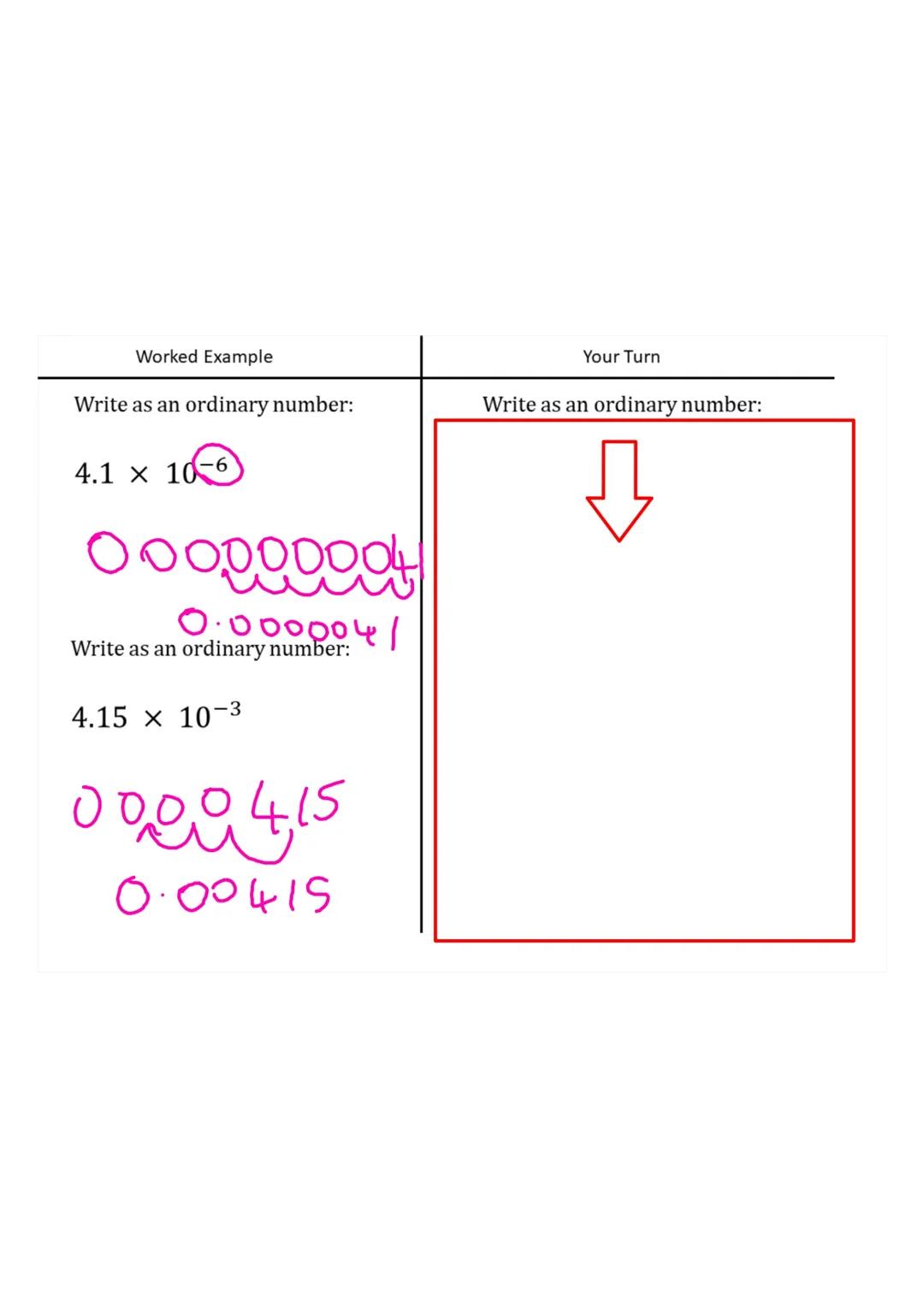
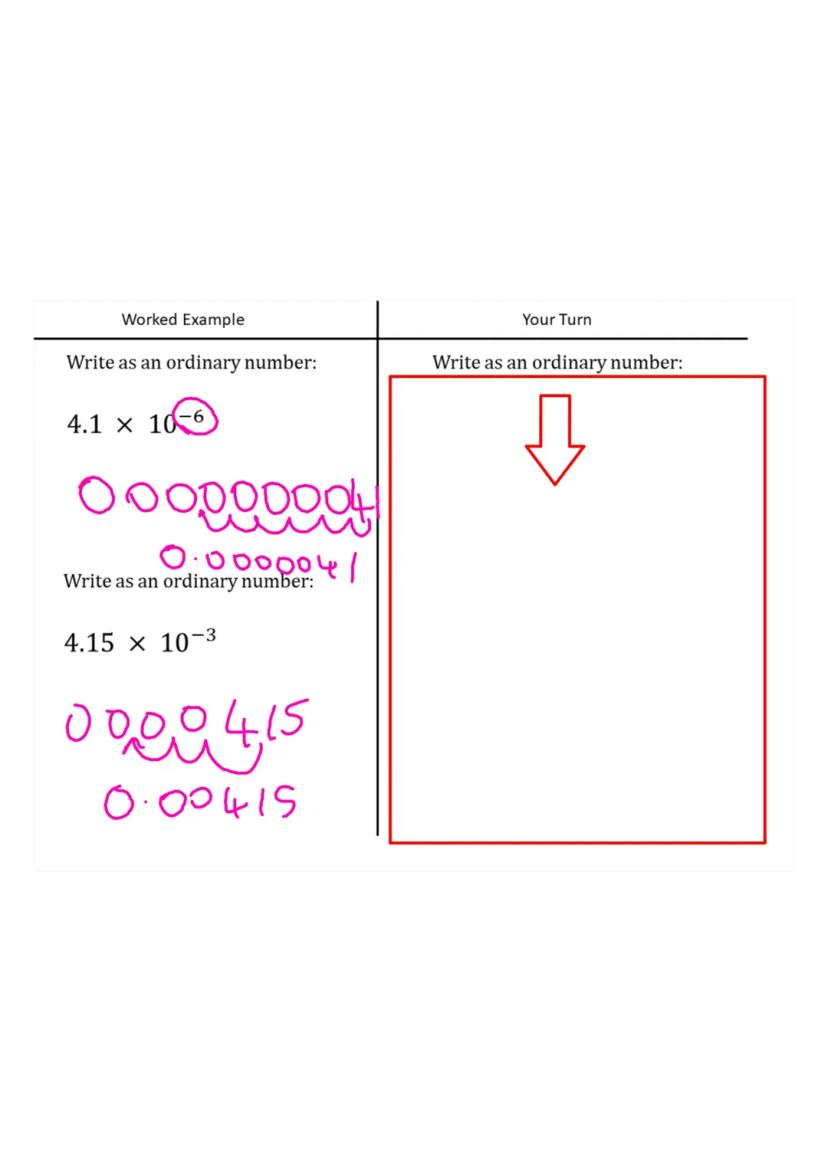
Converting from scientific notation back to a standard decimal works in reverse. For 4.1 × 10^-6, the negative exponent (-6) tells you to move the decimal point six places to the left, giving you 0.0000041.
Similarly, for 4.15 × 10^-3, move the decimal point three places left to get 0.00415. The negative exponent always indicates movement to the left.
Remember to add zeros as placeholders when needed. If you don't have enough digits, add zeros to ensure the decimal point can move the correct number of places.
Watch out! A common mistake is moving the decimal point in the wrong direction. Negative exponents mean move left (making the number smaller).
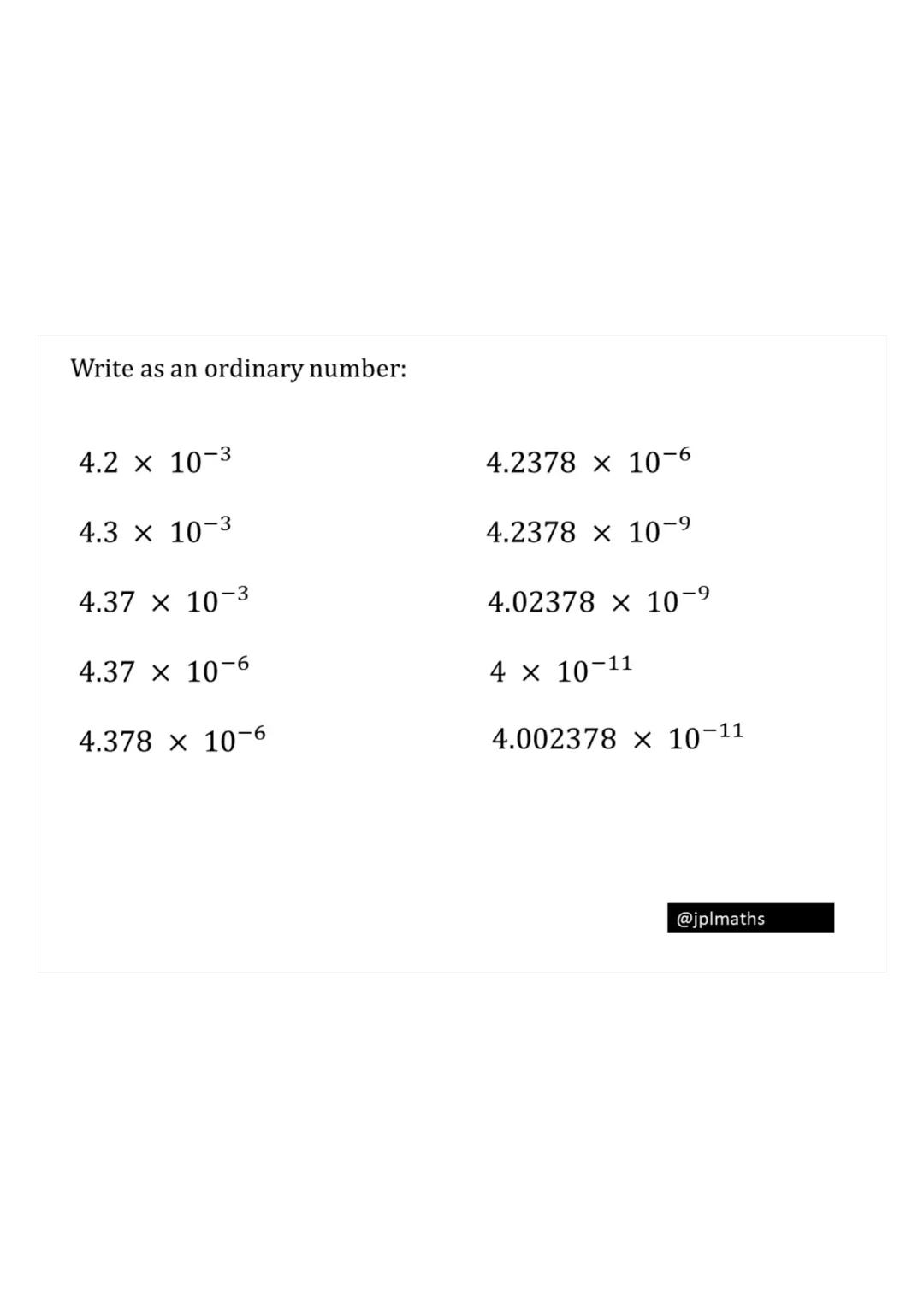
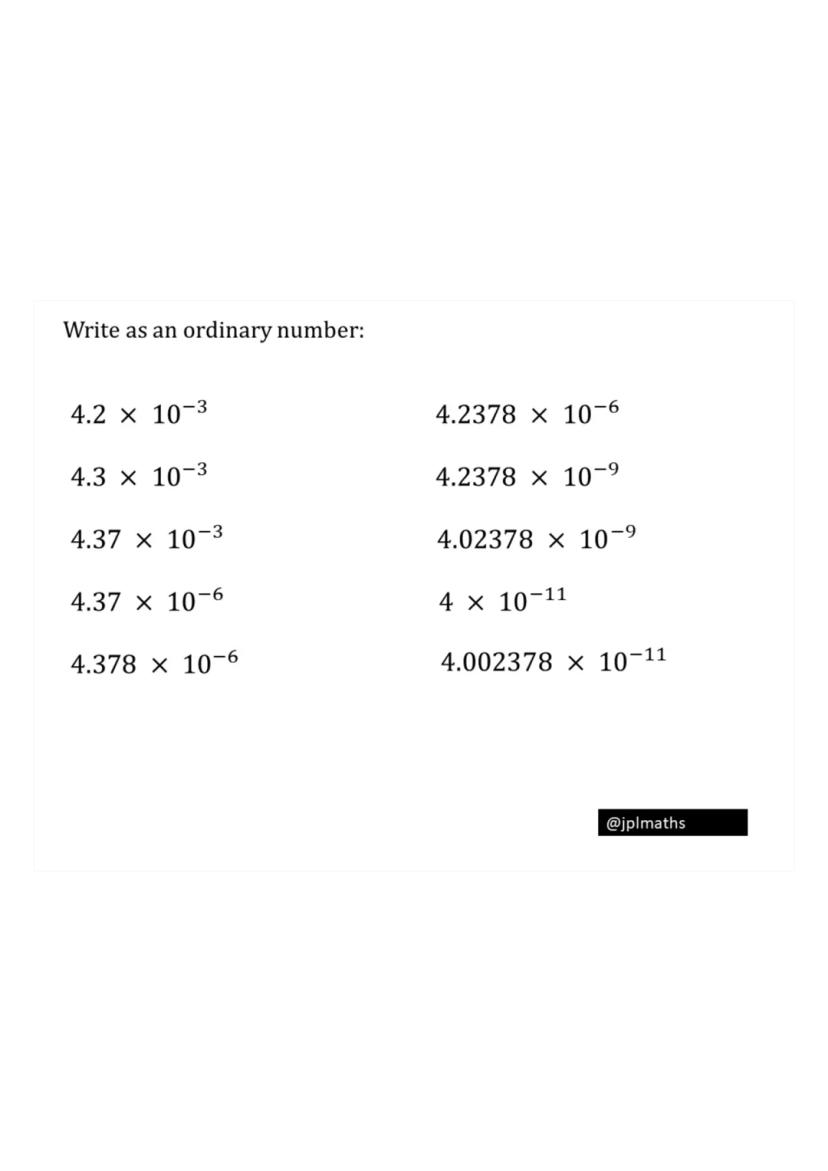
This page gives you several scientific notation examples to convert to ordinary numbers. Each example follows the pattern of a number between 1 and 10 multiplied by a negative power of 10.
Notice how the exponents range from -3 (meaning move three places left) all the way to -11 (meaning move eleven places left). The more negative the exponent, the smaller the resulting decimal.
Examples like 4.2378 × 10^-6 require you to move the decimal point six places left, which means you'll need to add zeros to create 0.0000042378.
Challenge yourself: Try converting these examples without looking at the answers first, then check your work on the next page!
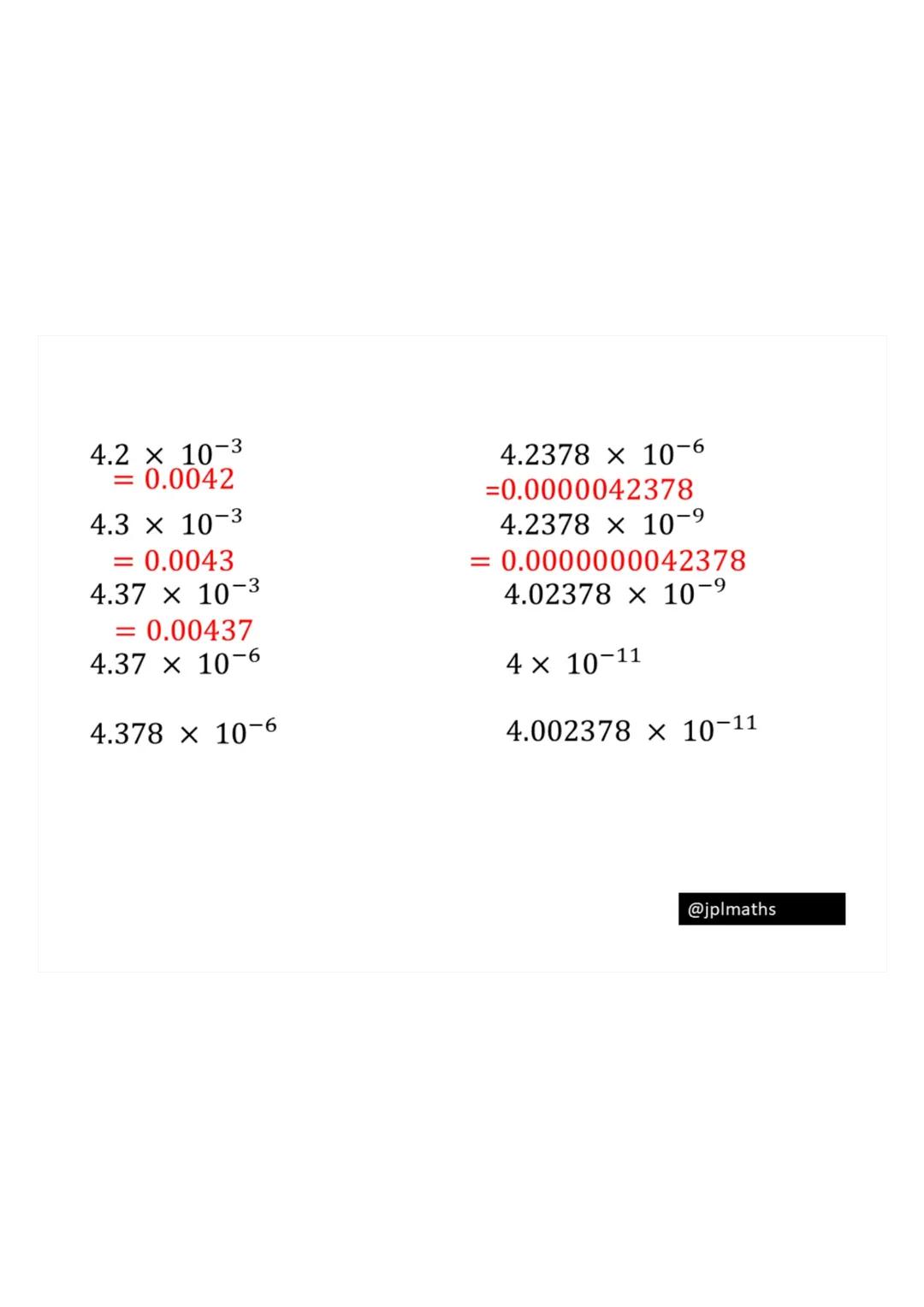
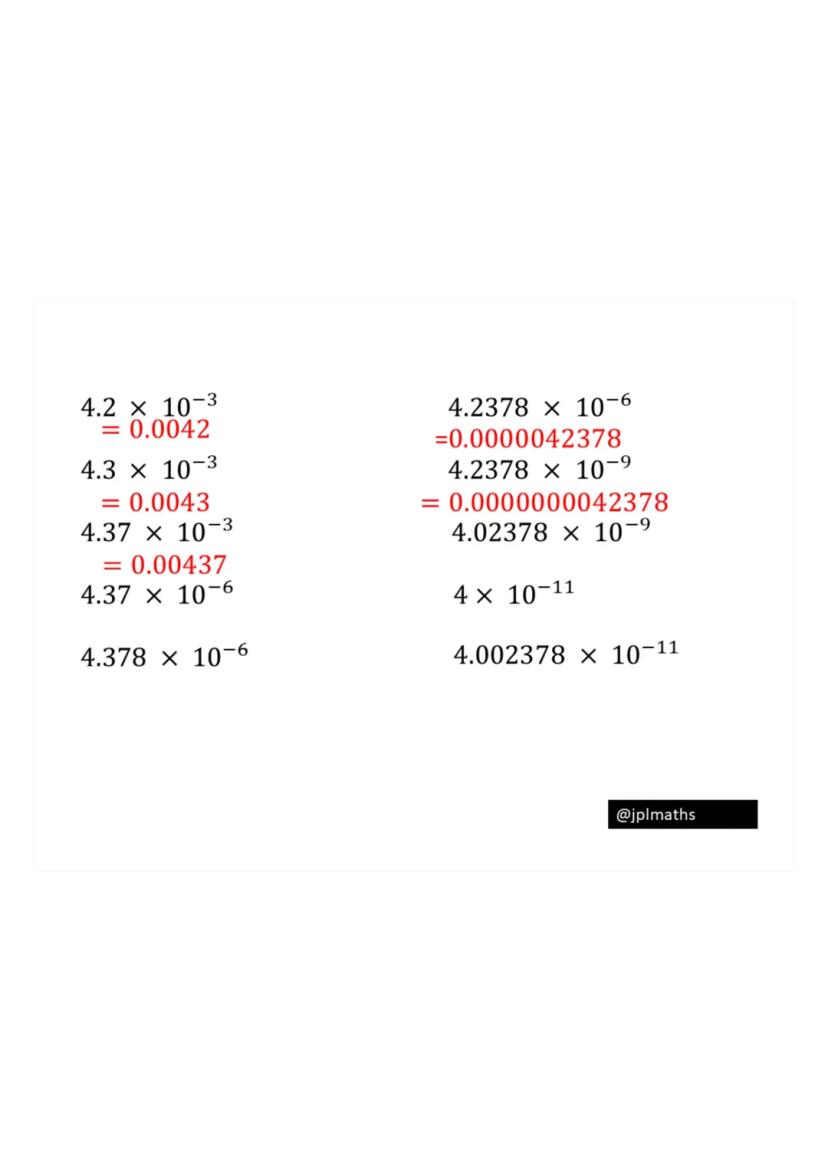
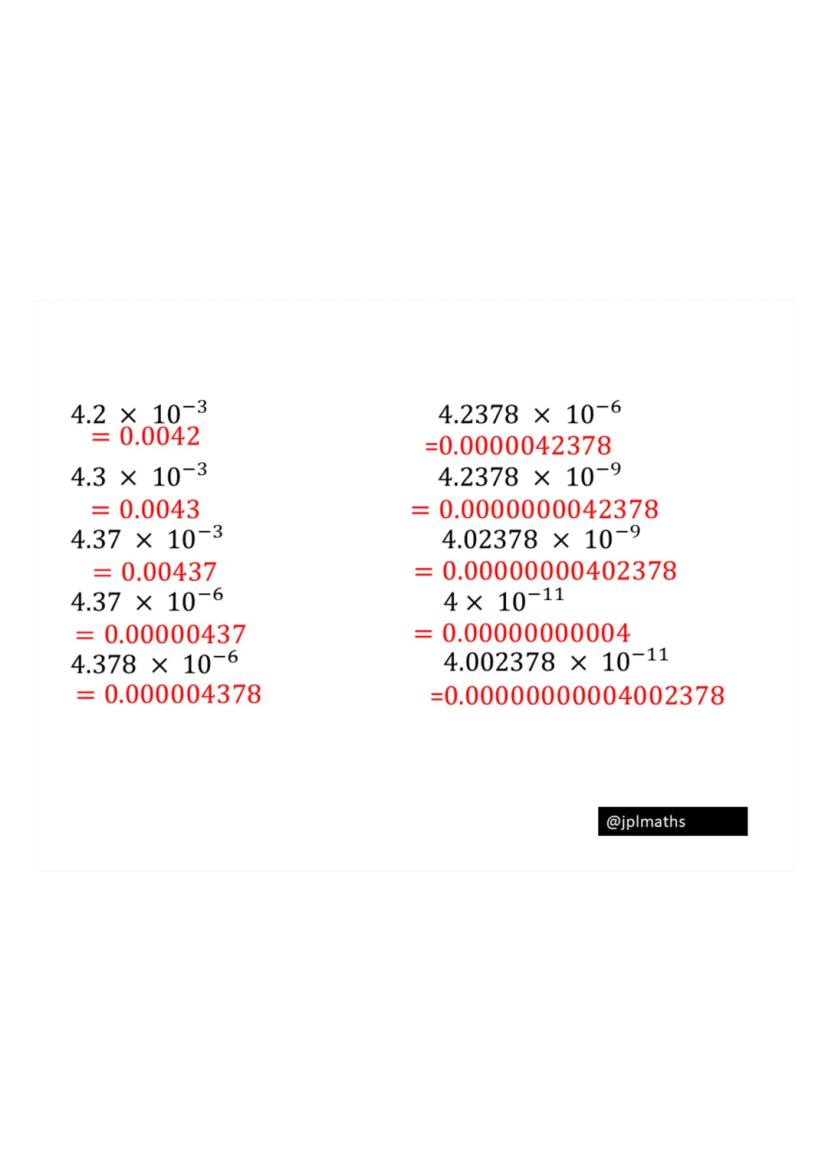
Here are the solutions for converting scientific notation to standard decimals. For 4.2 × 10^-3, moving the decimal point three places left gives 0.0042.
Similarly, 4.37 × 10^-3 becomes 0.00437 after moving the decimal point three places left. Notice how the digits stay the same, but their position changes.
For smaller numbers like 4.2378 × 10^-6, you need to move the decimal point six places left, giving 0.0000042378. The more negative the exponent, the more zeros you'll have after the decimal point.
Pattern alert: Notice that the number of zeros after the decimal point equals the magnitude of the negative exponent.
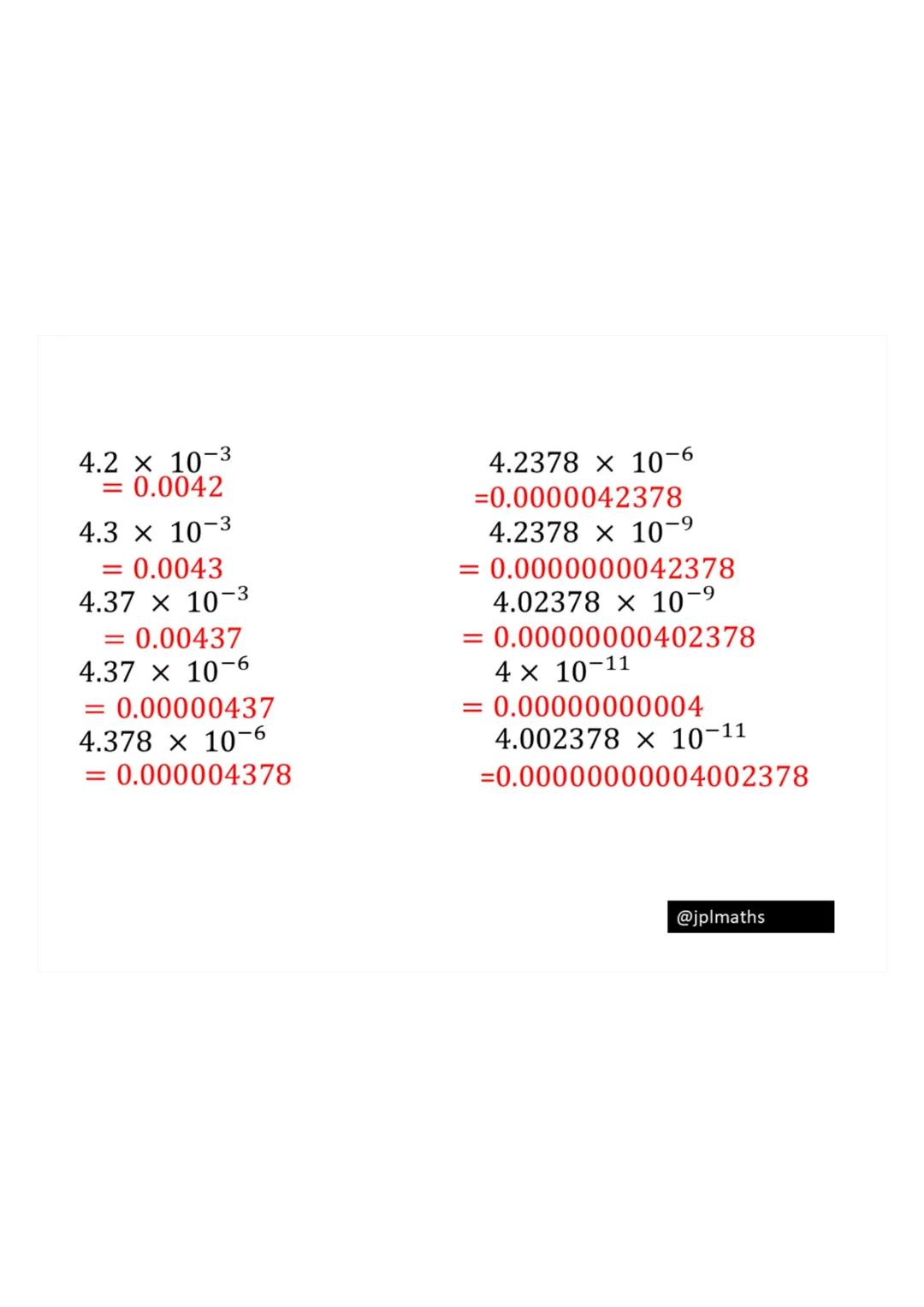
This page completes the solutions from the previous examples. Very small numbers like 4.02378 × 10^-9 become 0.00000000402378 when converted to standard form.
The smallest number shown is 4 × 10^-11, which equals 0.00000000004 - that's 10 zeros after the decimal point! Even adding small decimals like in 4.002378 × 10^-11 doesn't change the overall size much.
Notice how numbers with similar digits but different exponents result in vastly different decimals. The exponent has an enormous impact on the value of the number.
Did you know? Many scientific measurements, like the size of atoms, are so small they can only be reasonably expressed using scientific notation!
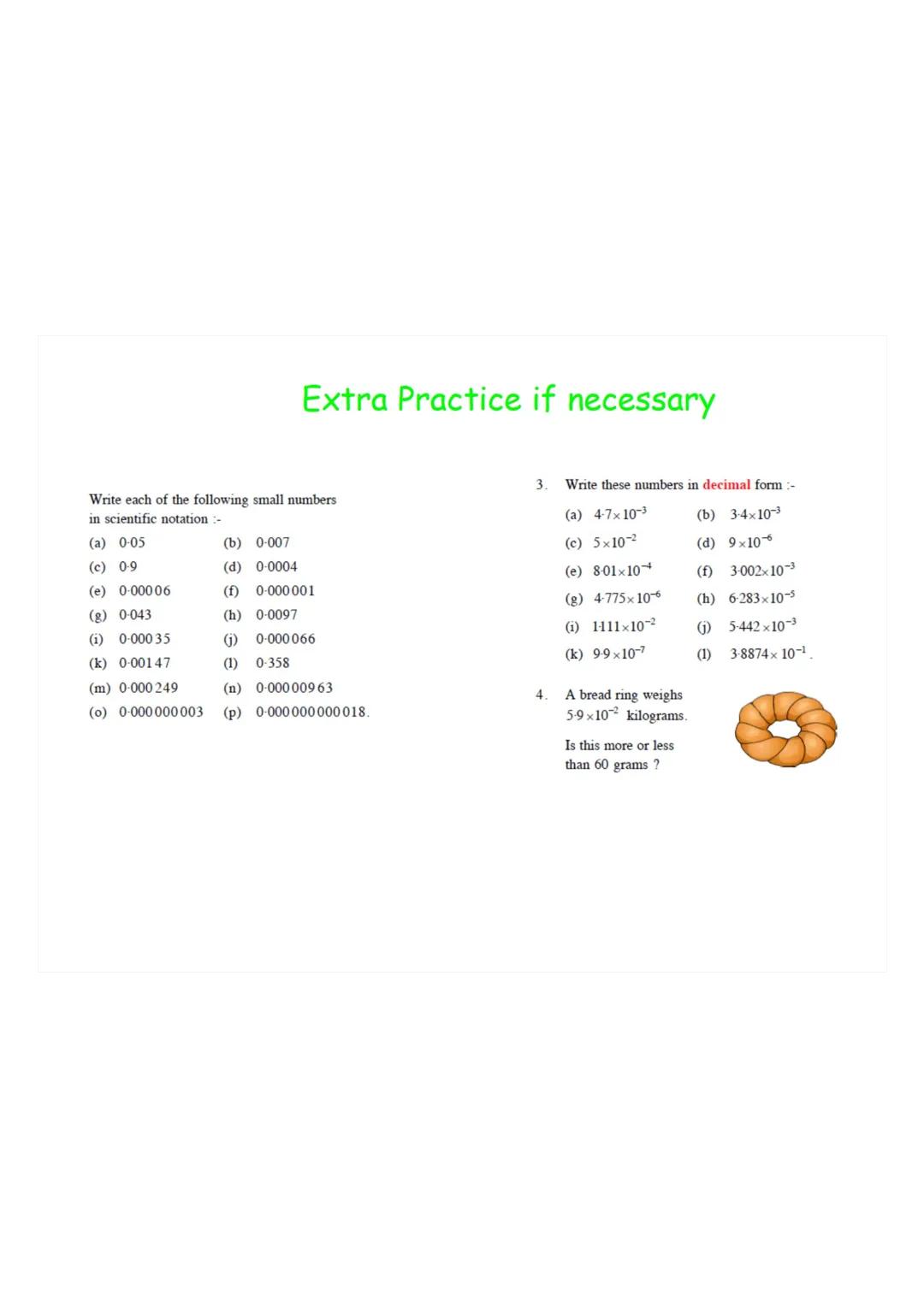
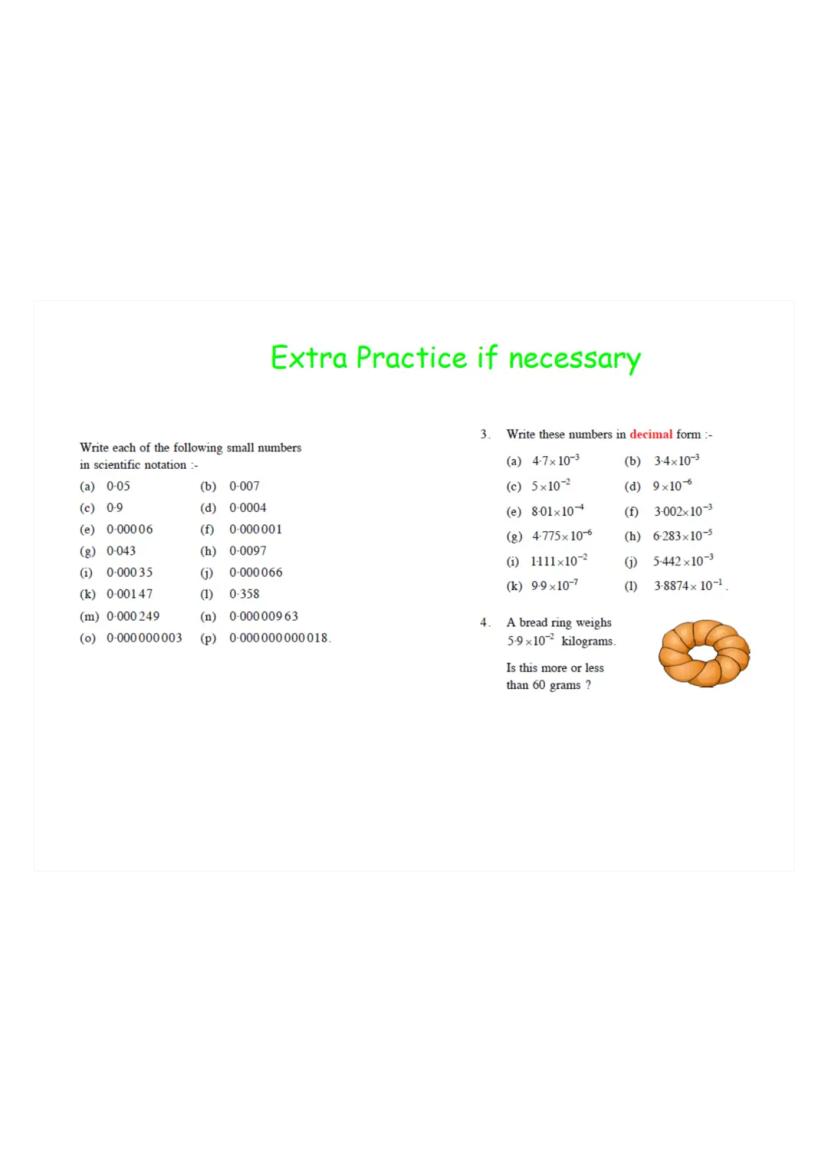
These problems give you more practice with both types of conversions. First, convert standard decimals like 0.05 and 0.007 to scientific notation. Then practice the reverse by converting expressions like 4.7 × 10^-3 to standard form.
Some tricky examples include 0.9, which becomes 9 × 10^-1, and values like 1111 × 10^-2, which isn't proper scientific notation (the first number should be between 1 and 10).
The final problem asks if 5.9 × 10^-2 kilograms is more or less than 60 grams. To solve this, you'll need to convert to the same units and then compare.
Application tip: Scientific notation is especially useful when comparing very small measurements that would be difficult to compare as decimals.
Our AI companion is specifically built for the needs of students. Based on the millions of content pieces we have on the platform we can provide truly meaningful and relevant answers to students. But its not only about answers, the companion is even more about guiding students through their daily learning challenges, with personalised study plans, quizzes or content pieces in the chat and 100% personalisation based on the students skills and developments.
You can download the app in the Google Play Store and in the Apple App Store.
That's right! Enjoy free access to study content, connect with fellow students, and get instant help – all at your fingertips.
App Store
Google Play
The app is very easy to use and well designed. I have found everything I was looking for so far and have been able to learn a lot from the presentations! I will definitely use the app for a class assignment! And of course it also helps a lot as an inspiration.
Stefan S
iOS user
This app is really great. There are so many study notes and help [...]. My problem subject is French, for example, and the app has so many options for help. Thanks to this app, I have improved my French. I would recommend it to anyone.
Samantha Klich
Android user
Wow, I am really amazed. I just tried the app because I've seen it advertised many times and was absolutely stunned. This app is THE HELP you want for school and above all, it offers so many things, such as workouts and fact sheets, which have been VERY helpful to me personally.
Anna
iOS user
I think it’s very much worth it and you’ll end up using it a lot once you get the hang of it and even after looking at others notes you can still ask your Artificial intelligence buddy the question and ask to simplify it if you still don’t get it!!! In the end I think it’s worth it 😊👍 ⚠️Also DID I MENTION ITS FREEE YOU DON’T HAVE TO PAY FOR ANYTHING AND STILL GET YOUR GRADES IN PERFECTLY❗️❗️⚠️
Thomas R
iOS user
Knowunity is the BEST app I’ve used in a minute. This is not an ai review or anything this is genuinely coming from a 7th grade student (I know 2011 im young) but dude this app is a 10/10 i have maintained a 3.8 gpa and have plenty of time for gaming. I love it and my mom is just happy I got good grades
Brad T
Android user
Not only did it help me find the answer but it also showed me alternative ways to solve it. I was horrible in math and science but now I have an a in both subjects. Thanks for the help🤍🤍
David K
iOS user
The app's just great! All I have to do is enter the topic in the search bar and I get the response real fast. I don't have to watch 10 YouTube videos to understand something, so I'm saving my time. Highly recommended!
Sudenaz Ocak
Android user
In school I was really bad at maths but thanks to the app, I am doing better now. I am so grateful that you made the app.
Greenlight Bonnie
Android user
I found this app a couple years ago and it has only gotten better since then. I really love it because it can help with written questions and photo questions. Also, it can find study guides that other people have made as well as flashcard sets and practice tests. The free version is also amazing for students who might not be able to afford it. Would 100% recommend
Aubrey
iOS user
Best app if you're in Highschool or Junior high. I have been using this app for 2 school years and it's the best, it's good if you don't have anyone to help you with school work.😋🩷🎀
Marco B
iOS user
THE QUIZES AND FLASHCARDS ARE SO USEFUL AND I LOVE THE SCHOOLGPT. IT ALSO IS LITREALLY LIKE CHATGPT BUT SMARTER!! HELPED ME WITH MY MASCARA PROBLEMS TOO!! AS WELL AS MY REAL SUBJECTS ! DUHHH 😍😁😲🤑💗✨🎀😮
Elisha
iOS user
This app is phenomenal down to the correct info and the various topics you can study! I greatly recommend it for people who struggle with procrastination and those who need homework help. It has been perfectly accurate for world 1 history as far as I’ve seen! Geometry too!
Paul T
iOS user
The app is very easy to use and well designed. I have found everything I was looking for so far and have been able to learn a lot from the presentations! I will definitely use the app for a class assignment! And of course it also helps a lot as an inspiration.
Stefan S
iOS user
This app is really great. There are so many study notes and help [...]. My problem subject is French, for example, and the app has so many options for help. Thanks to this app, I have improved my French. I would recommend it to anyone.
Samantha Klich
Android user
Wow, I am really amazed. I just tried the app because I've seen it advertised many times and was absolutely stunned. This app is THE HELP you want for school and above all, it offers so many things, such as workouts and fact sheets, which have been VERY helpful to me personally.
Anna
iOS user
I think it’s very much worth it and you’ll end up using it a lot once you get the hang of it and even after looking at others notes you can still ask your Artificial intelligence buddy the question and ask to simplify it if you still don’t get it!!! In the end I think it’s worth it 😊👍 ⚠️Also DID I MENTION ITS FREEE YOU DON’T HAVE TO PAY FOR ANYTHING AND STILL GET YOUR GRADES IN PERFECTLY❗️❗️⚠️
Thomas R
iOS user
Knowunity is the BEST app I’ve used in a minute. This is not an ai review or anything this is genuinely coming from a 7th grade student (I know 2011 im young) but dude this app is a 10/10 i have maintained a 3.8 gpa and have plenty of time for gaming. I love it and my mom is just happy I got good grades
Brad T
Android user
Not only did it help me find the answer but it also showed me alternative ways to solve it. I was horrible in math and science but now I have an a in both subjects. Thanks for the help🤍🤍
David K
iOS user
The app's just great! All I have to do is enter the topic in the search bar and I get the response real fast. I don't have to watch 10 YouTube videos to understand something, so I'm saving my time. Highly recommended!
Sudenaz Ocak
Android user
In school I was really bad at maths but thanks to the app, I am doing better now. I am so grateful that you made the app.
Greenlight Bonnie
Android user
I found this app a couple years ago and it has only gotten better since then. I really love it because it can help with written questions and photo questions. Also, it can find study guides that other people have made as well as flashcard sets and practice tests. The free version is also amazing for students who might not be able to afford it. Would 100% recommend
Aubrey
iOS user
Best app if you're in Highschool or Junior high. I have been using this app for 2 school years and it's the best, it's good if you don't have anyone to help you with school work.😋🩷🎀
Marco B
iOS user
THE QUIZES AND FLASHCARDS ARE SO USEFUL AND I LOVE THE SCHOOLGPT. IT ALSO IS LITREALLY LIKE CHATGPT BUT SMARTER!! HELPED ME WITH MY MASCARA PROBLEMS TOO!! AS WELL AS MY REAL SUBJECTS ! DUHHH 😍😁😲🤑💗✨🎀😮
Elisha
iOS user
This app is phenomenal down to the correct info and the various topics you can study! I greatly recommend it for people who struggle with procrastination and those who need homework help. It has been perfectly accurate for world 1 history as far as I’ve seen! Geometry too!
Paul T
iOS user
Dee scob
@deescob_ptdu
Scientific notation is a powerful way to express very large or very small numbers more conveniently. This method helps you write numbers in a format that's easier to read and work with, especially in science and mathematics.
Access to all documents
Improve your grades
Join milions of students
By signing up you accept Terms of Service and Privacy Policy
When you encounter math problems that involve large numbers or measurements, scientific notation can be extremely helpful. Let's look at some example problems:
For Question 1, you need to convert 432,000 and 1,010,000 into scientific notation. This means expressing these numbers as a value between 1 and 10, multiplied by a power of 10.
Question 2 asks for the volume and surface area of a cuboid measuring 5 cm × 9 cm × 2 cm. Remember that volume = length × width × height, while surface area requires adding all six faces.
Quick Tip: For any 3D shape problem, draw a quick sketch to visualize the dimensions before calculating!
Question 3 challenges you to determine if a cuboid with a volume of 125 cm³ and surface area of 160 cm² could be a cube. You'll need to check if a cube with those measurements is mathematically possible.
Access to all documents
Improve your grades
Join milions of students
By signing up you accept Terms of Service and Privacy Policy
Scientific notation helps us write very small numbers in a more manageable format. Instead of writing lots of zeros, we use powers of 10 to express the number's size.
The learning objective is to convert very small numbers both to and from scientific notation. This skill is incredibly useful in science classes where you'll work with microscopic measurements.
To be successful with scientific notation, you need to understand what these expressions look like and how to convert between standard form and scientific notation. The pattern is always: a number between 1 and 10, multiplied by 10 raised to a power.
Remember: For very small numbers less than 1, the power of 10 will be negative!
Access to all documents
Improve your grades
Join milions of students
By signing up you accept Terms of Service and Privacy Policy
Converting small decimals to scientific notation follows a simple pattern. Move the decimal point to the right until you have a number between 1 and 10, then multiply by 10 to a negative power.
For example, 0.05 becomes 5 × 10^-2 because you moved the decimal point two places right. Similarly, 0.005 converts to 5 × 10^-3 after moving the decimal point three places.
When dealing with more complex decimals like 0.00572, follow the same process. Move the decimal point until you get 5.72, then multiply by 10^-3 since you moved three places.
Practice tip: Count the number of places you move the decimal point - this becomes the power of 10 (negative for small numbers).
Access to all documents
Improve your grades
Join milions of students
By signing up you accept Terms of Service and Privacy Policy
Looking at these decimal numbers, you can see they vary in size from 0.2 (which is fairly large) down to very tiny numbers like 0.00000090.
Each decimal has a specific pattern of zeros that determines how we'll convert it to scientific notation. The more zeros after the decimal point, the smaller the number and the more negative the exponent will be.
Notice the subtle differences between numbers like 0.001 and 0.0010 (they're actually the same value) or between 0.00000090 and 0.00000099 (the second is slightly larger).
Quick Check: Can you spot which number in this list is the smallest without converting to scientific notation?
Access to all documents
Improve your grades
Join milions of students
By signing up you accept Terms of Service and Privacy Policy
Here's how various decimals convert to scientific notation. For 0.2, we move the decimal point one place right to get 2 × 10^-1. For smaller numbers like 0.002, we move it three places to get 2 × 10^-3.
Notice how numbers with the same digits but different decimal placements have different exponents. For example, 0.00239 becomes 2.39 × 10^-3, while 0.002039 becomes 2.039 × 10^-3.
With very small numbers like 0.00000090, we move the decimal point seven places to get 9 × 10^-7. The number of zeros after the decimal point tells you how negative the exponent will be.
Interesting fact: The number 1.00000099 barely changes in scientific notation because it's already between 1 and 10!
Access to all documents
Improve your grades
Join milions of students
By signing up you accept Terms of Service and Privacy Policy
Converting from scientific notation back to a standard decimal works in reverse. For 4.1 × 10^-6, the negative exponent (-6) tells you to move the decimal point six places to the left, giving you 0.0000041.
Similarly, for 4.15 × 10^-3, move the decimal point three places left to get 0.00415. The negative exponent always indicates movement to the left.
Remember to add zeros as placeholders when needed. If you don't have enough digits, add zeros to ensure the decimal point can move the correct number of places.
Watch out! A common mistake is moving the decimal point in the wrong direction. Negative exponents mean move left (making the number smaller).
Access to all documents
Improve your grades
Join milions of students
By signing up you accept Terms of Service and Privacy Policy
This page gives you several scientific notation examples to convert to ordinary numbers. Each example follows the pattern of a number between 1 and 10 multiplied by a negative power of 10.
Notice how the exponents range from -3 (meaning move three places left) all the way to -11 (meaning move eleven places left). The more negative the exponent, the smaller the resulting decimal.
Examples like 4.2378 × 10^-6 require you to move the decimal point six places left, which means you'll need to add zeros to create 0.0000042378.
Challenge yourself: Try converting these examples without looking at the answers first, then check your work on the next page!
Access to all documents
Improve your grades
Join milions of students
By signing up you accept Terms of Service and Privacy Policy
Here are the solutions for converting scientific notation to standard decimals. For 4.2 × 10^-3, moving the decimal point three places left gives 0.0042.
Similarly, 4.37 × 10^-3 becomes 0.00437 after moving the decimal point three places left. Notice how the digits stay the same, but their position changes.
For smaller numbers like 4.2378 × 10^-6, you need to move the decimal point six places left, giving 0.0000042378. The more negative the exponent, the more zeros you'll have after the decimal point.
Pattern alert: Notice that the number of zeros after the decimal point equals the magnitude of the negative exponent.
Access to all documents
Improve your grades
Join milions of students
By signing up you accept Terms of Service and Privacy Policy
This page completes the solutions from the previous examples. Very small numbers like 4.02378 × 10^-9 become 0.00000000402378 when converted to standard form.
The smallest number shown is 4 × 10^-11, which equals 0.00000000004 - that's 10 zeros after the decimal point! Even adding small decimals like in 4.002378 × 10^-11 doesn't change the overall size much.
Notice how numbers with similar digits but different exponents result in vastly different decimals. The exponent has an enormous impact on the value of the number.
Did you know? Many scientific measurements, like the size of atoms, are so small they can only be reasonably expressed using scientific notation!
Access to all documents
Improve your grades
Join milions of students
By signing up you accept Terms of Service and Privacy Policy
These problems give you more practice with both types of conversions. First, convert standard decimals like 0.05 and 0.007 to scientific notation. Then practice the reverse by converting expressions like 4.7 × 10^-3 to standard form.
Some tricky examples include 0.9, which becomes 9 × 10^-1, and values like 1111 × 10^-2, which isn't proper scientific notation (the first number should be between 1 and 10).
The final problem asks if 5.9 × 10^-2 kilograms is more or less than 60 grams. To solve this, you'll need to convert to the same units and then compare.
Application tip: Scientific notation is especially useful when comparing very small measurements that would be difficult to compare as decimals.
Our AI companion is specifically built for the needs of students. Based on the millions of content pieces we have on the platform we can provide truly meaningful and relevant answers to students. But its not only about answers, the companion is even more about guiding students through their daily learning challenges, with personalised study plans, quizzes or content pieces in the chat and 100% personalisation based on the students skills and developments.
You can download the app in the Google Play Store and in the Apple App Store.
That's right! Enjoy free access to study content, connect with fellow students, and get instant help – all at your fingertips.
2
Smart Tools NEW
Transform this note into: ✓ 50+ Practice Questions ✓ Interactive Flashcards ✓ Full Mock Exam ✓ Essay Outlines
App Store
Google Play
The app is very easy to use and well designed. I have found everything I was looking for so far and have been able to learn a lot from the presentations! I will definitely use the app for a class assignment! And of course it also helps a lot as an inspiration.
Stefan S
iOS user
This app is really great. There are so many study notes and help [...]. My problem subject is French, for example, and the app has so many options for help. Thanks to this app, I have improved my French. I would recommend it to anyone.
Samantha Klich
Android user
Wow, I am really amazed. I just tried the app because I've seen it advertised many times and was absolutely stunned. This app is THE HELP you want for school and above all, it offers so many things, such as workouts and fact sheets, which have been VERY helpful to me personally.
Anna
iOS user
I think it’s very much worth it and you’ll end up using it a lot once you get the hang of it and even after looking at others notes you can still ask your Artificial intelligence buddy the question and ask to simplify it if you still don’t get it!!! In the end I think it’s worth it 😊👍 ⚠️Also DID I MENTION ITS FREEE YOU DON’T HAVE TO PAY FOR ANYTHING AND STILL GET YOUR GRADES IN PERFECTLY❗️❗️⚠️
Thomas R
iOS user
Knowunity is the BEST app I’ve used in a minute. This is not an ai review or anything this is genuinely coming from a 7th grade student (I know 2011 im young) but dude this app is a 10/10 i have maintained a 3.8 gpa and have plenty of time for gaming. I love it and my mom is just happy I got good grades
Brad T
Android user
Not only did it help me find the answer but it also showed me alternative ways to solve it. I was horrible in math and science but now I have an a in both subjects. Thanks for the help🤍🤍
David K
iOS user
The app's just great! All I have to do is enter the topic in the search bar and I get the response real fast. I don't have to watch 10 YouTube videos to understand something, so I'm saving my time. Highly recommended!
Sudenaz Ocak
Android user
In school I was really bad at maths but thanks to the app, I am doing better now. I am so grateful that you made the app.
Greenlight Bonnie
Android user
I found this app a couple years ago and it has only gotten better since then. I really love it because it can help with written questions and photo questions. Also, it can find study guides that other people have made as well as flashcard sets and practice tests. The free version is also amazing for students who might not be able to afford it. Would 100% recommend
Aubrey
iOS user
Best app if you're in Highschool or Junior high. I have been using this app for 2 school years and it's the best, it's good if you don't have anyone to help you with school work.😋🩷🎀
Marco B
iOS user
THE QUIZES AND FLASHCARDS ARE SO USEFUL AND I LOVE THE SCHOOLGPT. IT ALSO IS LITREALLY LIKE CHATGPT BUT SMARTER!! HELPED ME WITH MY MASCARA PROBLEMS TOO!! AS WELL AS MY REAL SUBJECTS ! DUHHH 😍😁😲🤑💗✨🎀😮
Elisha
iOS user
This app is phenomenal down to the correct info and the various topics you can study! I greatly recommend it for people who struggle with procrastination and those who need homework help. It has been perfectly accurate for world 1 history as far as I’ve seen! Geometry too!
Paul T
iOS user
The app is very easy to use and well designed. I have found everything I was looking for so far and have been able to learn a lot from the presentations! I will definitely use the app for a class assignment! And of course it also helps a lot as an inspiration.
Stefan S
iOS user
This app is really great. There are so many study notes and help [...]. My problem subject is French, for example, and the app has so many options for help. Thanks to this app, I have improved my French. I would recommend it to anyone.
Samantha Klich
Android user
Wow, I am really amazed. I just tried the app because I've seen it advertised many times and was absolutely stunned. This app is THE HELP you want for school and above all, it offers so many things, such as workouts and fact sheets, which have been VERY helpful to me personally.
Anna
iOS user
I think it’s very much worth it and you’ll end up using it a lot once you get the hang of it and even after looking at others notes you can still ask your Artificial intelligence buddy the question and ask to simplify it if you still don’t get it!!! In the end I think it’s worth it 😊👍 ⚠️Also DID I MENTION ITS FREEE YOU DON’T HAVE TO PAY FOR ANYTHING AND STILL GET YOUR GRADES IN PERFECTLY❗️❗️⚠️
Thomas R
iOS user
Knowunity is the BEST app I’ve used in a minute. This is not an ai review or anything this is genuinely coming from a 7th grade student (I know 2011 im young) but dude this app is a 10/10 i have maintained a 3.8 gpa and have plenty of time for gaming. I love it and my mom is just happy I got good grades
Brad T
Android user
Not only did it help me find the answer but it also showed me alternative ways to solve it. I was horrible in math and science but now I have an a in both subjects. Thanks for the help🤍🤍
David K
iOS user
The app's just great! All I have to do is enter the topic in the search bar and I get the response real fast. I don't have to watch 10 YouTube videos to understand something, so I'm saving my time. Highly recommended!
Sudenaz Ocak
Android user
In school I was really bad at maths but thanks to the app, I am doing better now. I am so grateful that you made the app.
Greenlight Bonnie
Android user
I found this app a couple years ago and it has only gotten better since then. I really love it because it can help with written questions and photo questions. Also, it can find study guides that other people have made as well as flashcard sets and practice tests. The free version is also amazing for students who might not be able to afford it. Would 100% recommend
Aubrey
iOS user
Best app if you're in Highschool or Junior high. I have been using this app for 2 school years and it's the best, it's good if you don't have anyone to help you with school work.😋🩷🎀
Marco B
iOS user
THE QUIZES AND FLASHCARDS ARE SO USEFUL AND I LOVE THE SCHOOLGPT. IT ALSO IS LITREALLY LIKE CHATGPT BUT SMARTER!! HELPED ME WITH MY MASCARA PROBLEMS TOO!! AS WELL AS MY REAL SUBJECTS ! DUHHH 😍😁😲🤑💗✨🎀😮
Elisha
iOS user
This app is phenomenal down to the correct info and the various topics you can study! I greatly recommend it for people who struggle with procrastination and those who need homework help. It has been perfectly accurate for world 1 history as far as I’ve seen! Geometry too!
Paul T
iOS user