
The lymphatic system is vital for your body's health, working... Show more
 Fun Stuff
 Algebra
 Biology
Sign up to see the contentIt's free!
Access to all documents
Improve your grades
Join milions of students
Knowunity AI
Subjects
Triangle Congruence and Similarity Theorems
Triangle Properties and Classification
Linear Equations and Graphs
Geometric Angle Relationships
Trigonometric Functions and Identities
Equation Solving Techniques
Circle Geometry Fundamentals
Division Operations and Methods
Basic Differentiation Rules
Exponent and Logarithm Properties
Show all topics
Human Organ Systems
Reproductive Cell Cycles
Biological Sciences Subdisciplines
Cellular Energy Metabolism
Autotrophic Energy Processes
Inheritance Patterns and Principles
Biomolecular Structure and Organization
Cell Cycle and Division Mechanics
Cellular Organization and Development
Biological Structural Organization
Show all topics
Chemical Sciences and Applications
Atomic Structure and Composition
Molecular Electron Structure Representation
Atomic Electron Behavior
Matter Properties and Water
Mole Concept and Calculations
Gas Laws and Behavior
Periodic Table Organization
Chemical Thermodynamics Fundamentals
Chemical Bond Types and Properties
Show all topics
European Renaissance and Enlightenment
European Cultural Movements 800-1920
American Revolution Era 1763-1797
American Civil War 1861-1865
Global Imperial Systems
Mongol and Chinese Dynasties
U.S. Presidents and World Leaders
Historical Sources and Documentation
World Wars Era and Impact
World Religious Systems
Show all topics
Classic and Contemporary Novels
Literary Character Analysis
Rhetorical Theory and Practice
Classic Literary Narratives
Reading Analysis and Interpretation
Narrative Structure and Techniques
English Language Components
Influential English-Language Authors
Basic Sentence Structure
Narrative Voice and Perspective
Show all topics
165
•
Updated Apr 3, 2026
•

Arshi M.
@arshi_unicorn
The lymphatic system is vital for your body's health, working... Show more
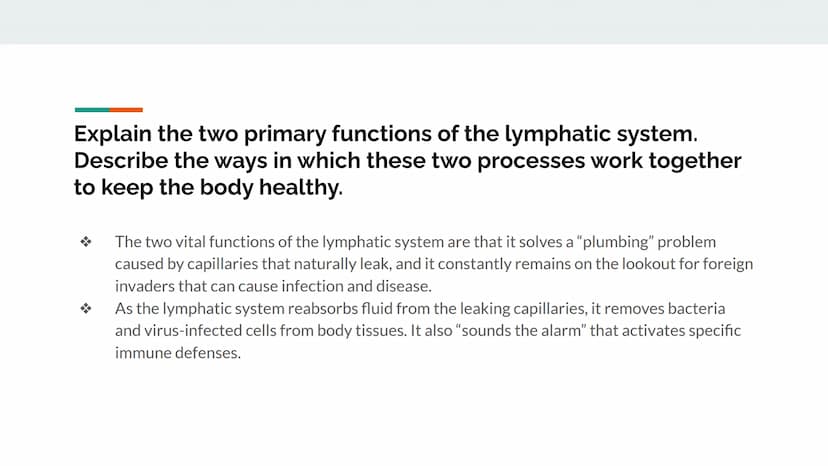
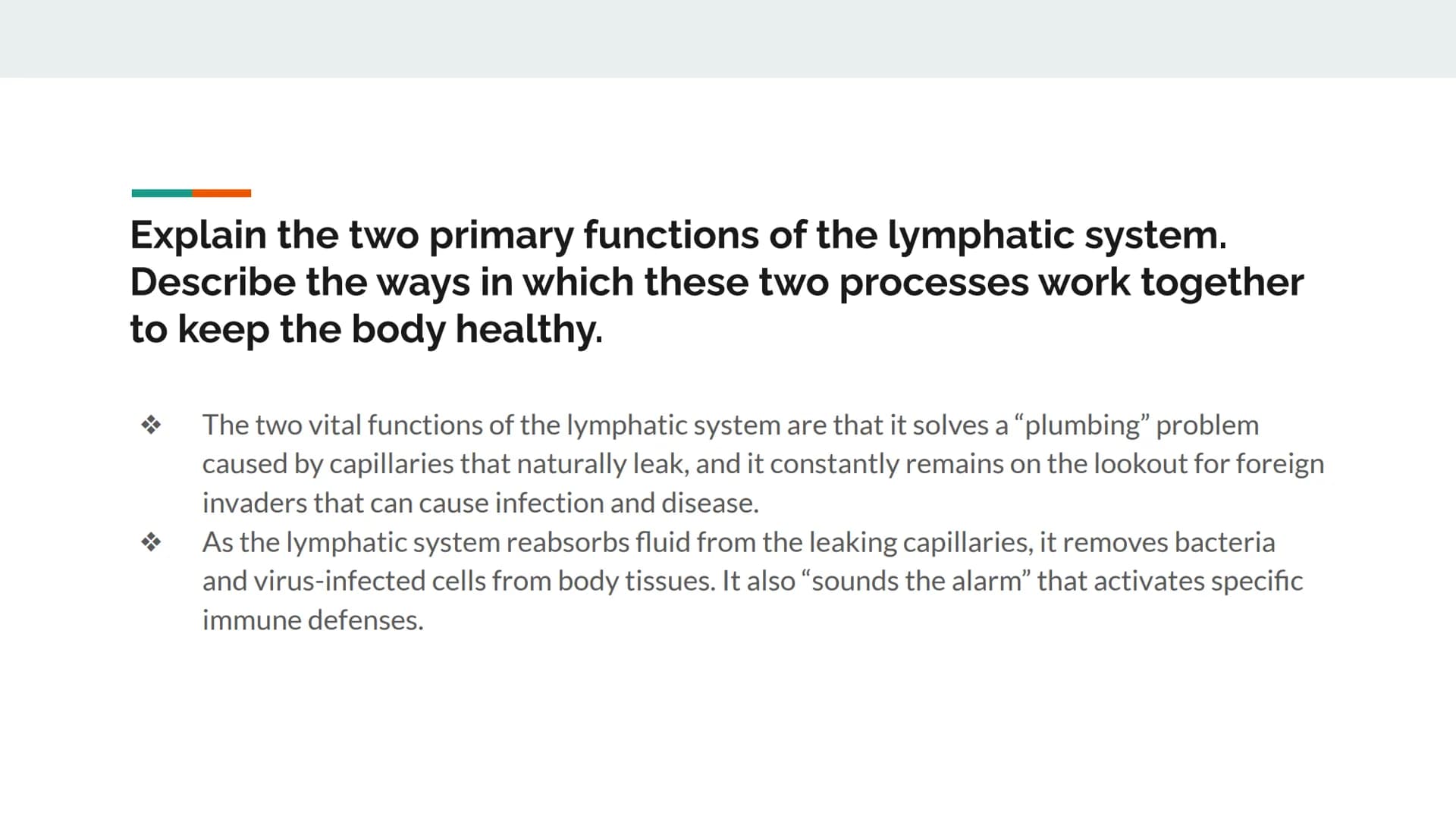
Your lymphatic system performs two critical jobs that keep you healthy every day. First, it solves a "plumbing problem" by collecting fluid that naturally leaks from your blood capillaries. Without this cleanup system, you'd swell up with excess fluid!
Second, it serves as your body's security system, constantly scanning for bacteria, viruses, and other threats. When it detects these invaders, it immediately triggers your immune defenses to fight back.
These two functions work together perfectly - as the lymphatic system collects leaked fluid, it also captures harmful microorganisms and infected cells, then activates specific immune responses to neutralize these threats.
Did you know? Your body's lymphatic vessels form a one-way highway system that's nearly as extensive as your blood vessels, but unlike blood circulation, lymph fluid moves without a pump like the heart!
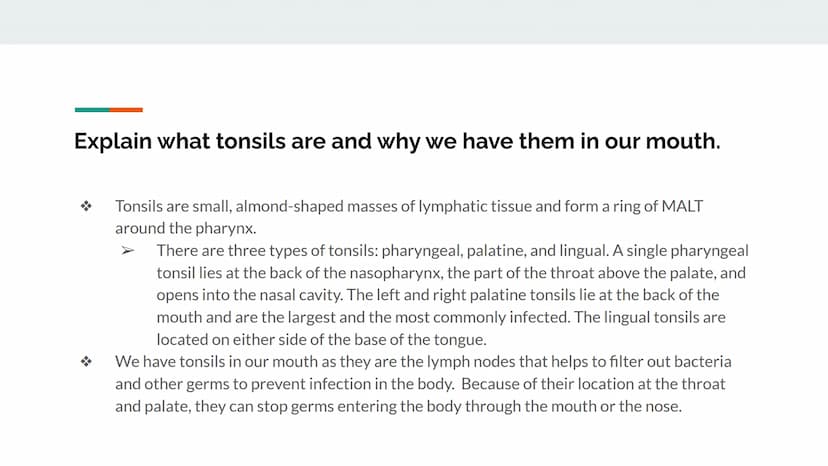
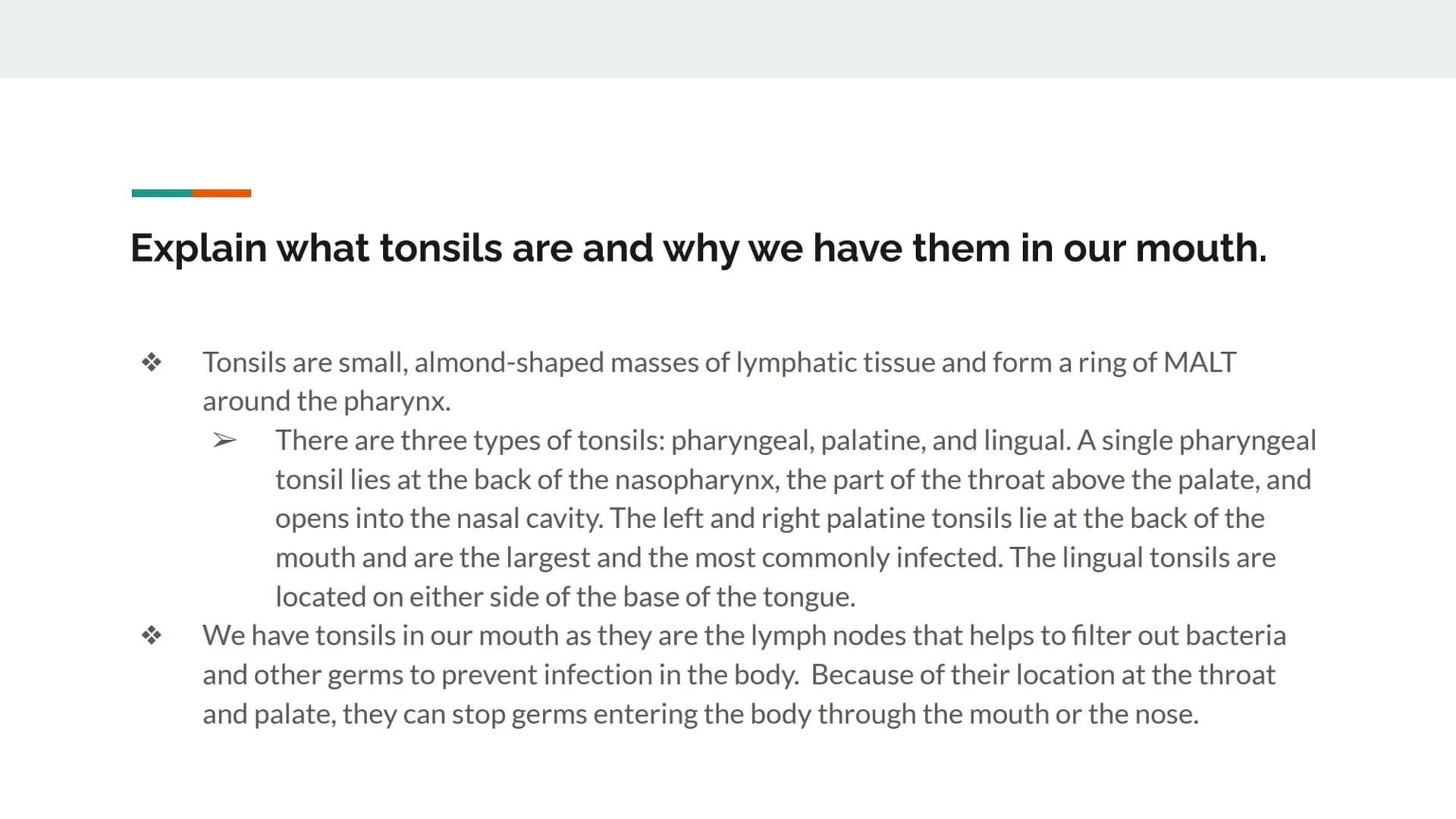
Ever wondered why those tonsils in the back of your throat exist? They're actually specialized lymphatic tissue that forms a protective ring around your throat. Think of them as security checkpoints that screen everything entering your body through your mouth and nose.
There are three types of tonsils working together: pharyngeal (single tonsil at the back of your nasal passage), palatine (the large pair at the back of your mouth that often get infected), and lingual (located at the base of your tongue).
Your tonsils trap bacteria and germs trying to enter your body through eating, drinking, or breathing. They contain immune cells that identify and neutralize these threats before they can cause infections deeper in your body.
Health Insight: When your tonsils get swollen or infected (tonsillitis), it's actually a sign they're working hard to fight off invaders - though sometimes they can become overwhelmed!
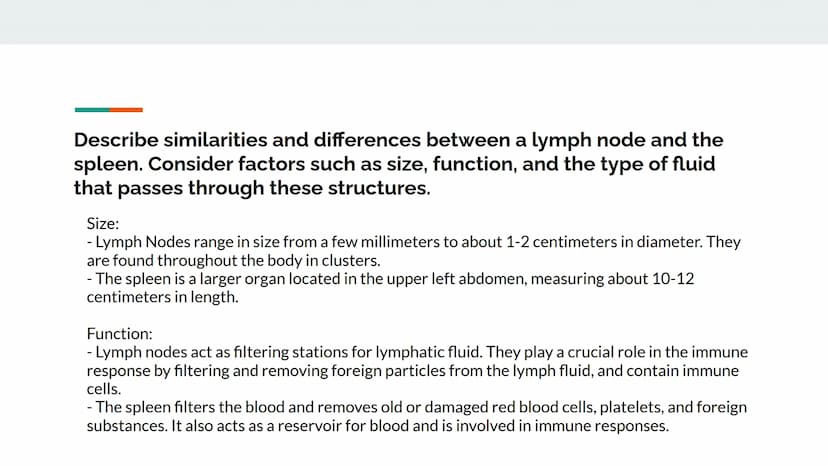
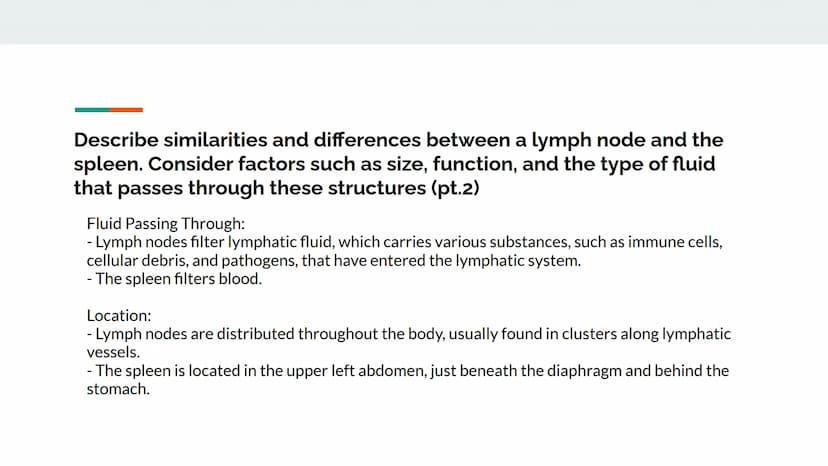
Your body contains two important filtering structures: lymph nodes and the spleen. While they both help protect you, they differ in several key ways.
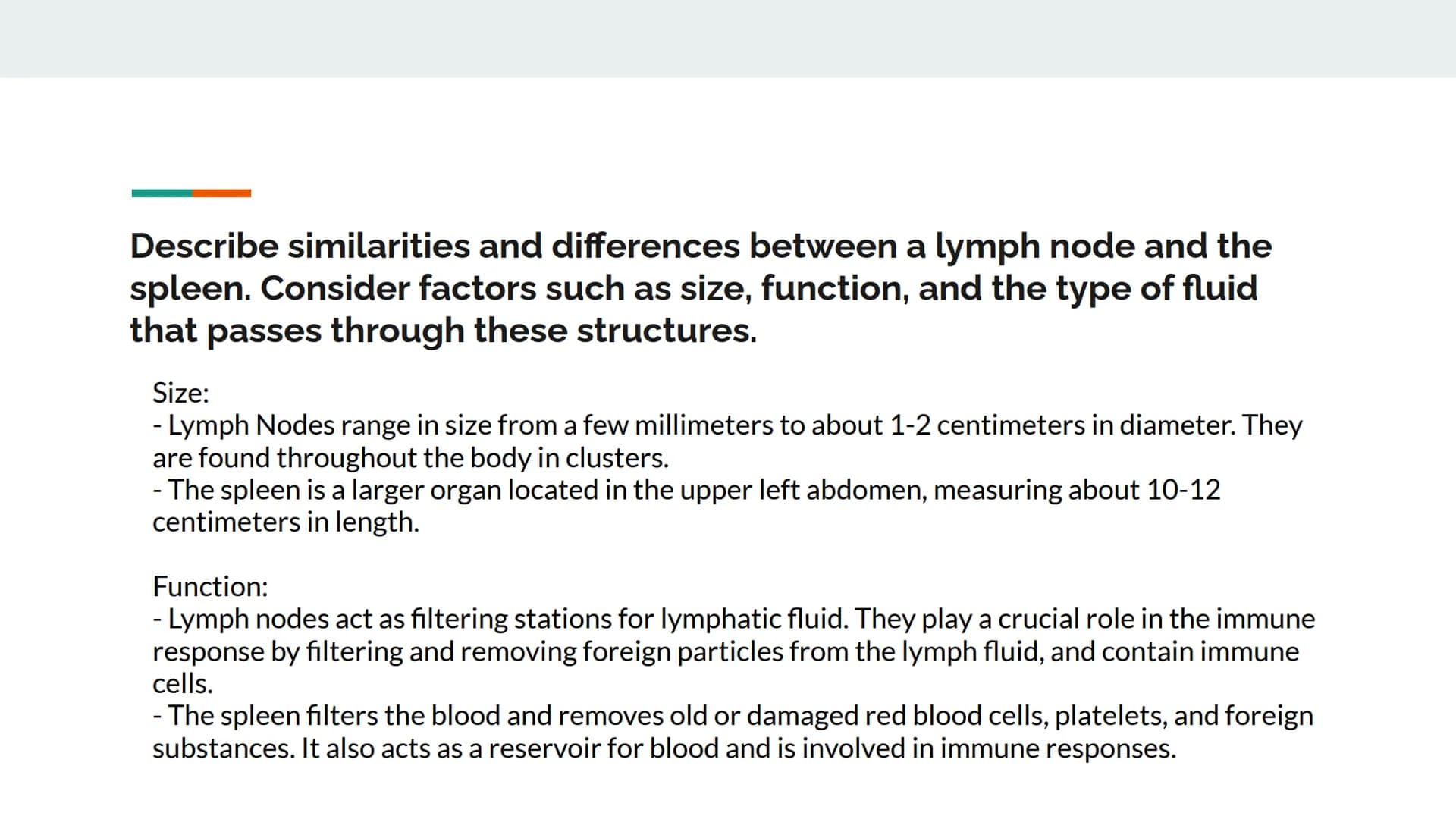
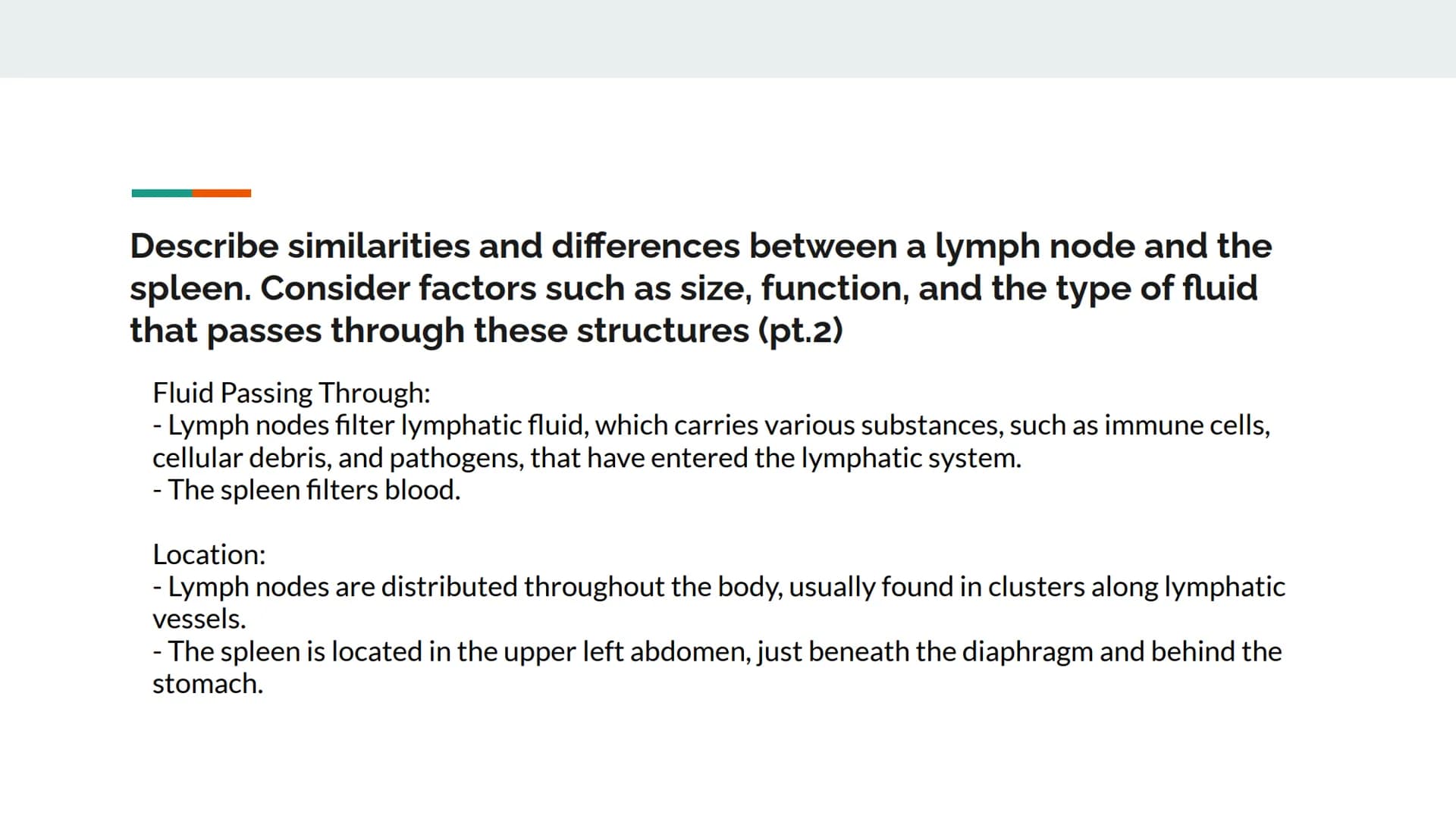
Size and location: Lymph nodes are small (about the size of a pea or bean) and clustered throughout your body. The spleen is much larger—about the size of a fist—and sits in your upper left abdomen behind your stomach.
Function: Lymph nodes filter lymphatic fluid, removing harmful substances and activating immune responses. The spleen performs similar functions but filters blood instead, removing damaged blood cells and foreign particles.
The main difference is in what they filter: lymph nodes handle lymphatic fluid (the clear fluid that leaks from blood vessels), while the spleen processes blood directly. Both contain specialized immune cells that help identify and fight infections.
Fascinating fact: When you have swollen, tender lymph nodes (like during a cold), that's actually a good sign—it means your immune system is actively fighting an infection!
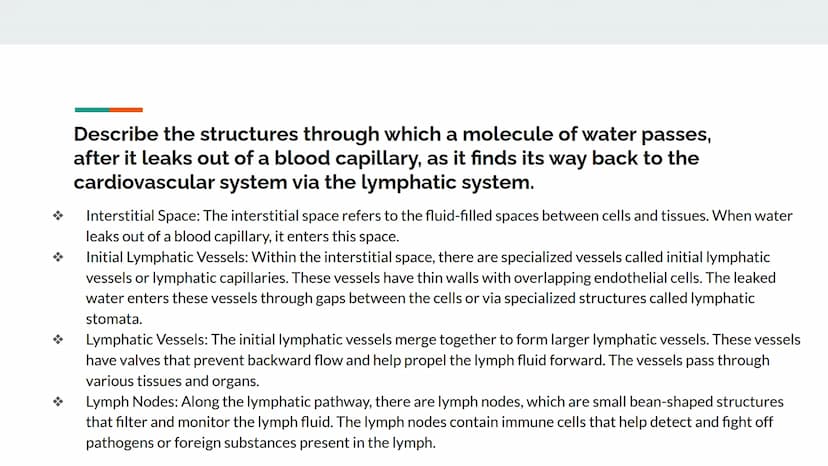
Have you ever wondered what happens when fluid leaks from your blood vessels? Let's track a water molecule's amazing journey back to circulation!
First, when water leaks from a blood capillary, it enters the interstitial space between your cells. From there, it's picked up by tiny lymphatic capillaries with special one-way openings that allow fluid in but not out.
The water molecule travels through progressively larger lymphatic vessels equipped with valves that prevent backflow. Along the way, it passes through lymph nodes where immune cells inspect the fluid for threats.
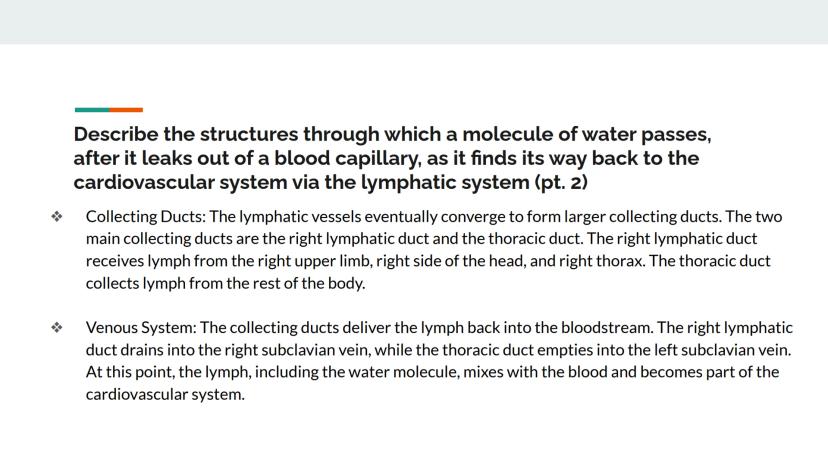
Finally, the water molecule reaches one of two major collecting ducts: the thoracic duct (handling most of your body) or the right lymphatic duct (handling your upper right body). These ducts empty into your subclavian veins near your shoulders, returning the water molecule to your bloodstream.
Cool connection: Your lymphatic system recycles about 3 liters of fluid daily—that's more than half the total volume of blood in your entire body!
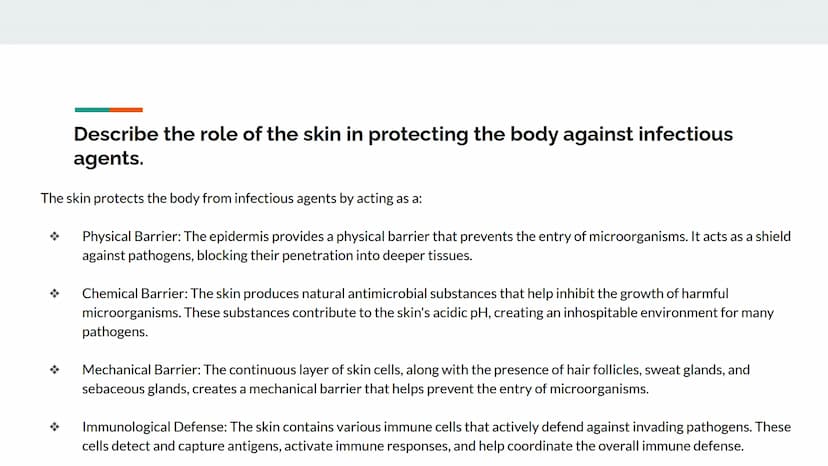
Your skin does way more than just hold your insides in—it's actually your body's largest immune organ! This amazing barrier provides multiple layers of protection against infectious agents.
As a physical barrier, your skin's tightly-packed cells block most pathogens from entering your body. The acid mantle on your skin creates a chemical barrier with a pH that makes it difficult for many harmful microorganisms to survive.
Your skin also forms a mechanical barrier with its continuous layer of cells, hair follicles, and glands. When you sweat or produce oils, you're actually washing away potential invaders.
Most impressively, your skin contains its own immune cells that actively patrol for threats. These specialized defenders can immediately recognize foreign substances and trigger defensive responses.
Think about it: Every time you wash your hands, you're helping your skin do its job by removing potential pathogens before they can find a way through your natural defenses!
The complement system is like having molecular booby traps in your bloodstream, ready to attack invaders. It's a group of proteins that work together in a cascade—each activating the next—to destroy pathogens.
There are two main ways this system gets triggered. The classical pathway requires antibodies to start the process. When antibodies attach to a pathogen, they signal the complement proteins to begin their attack. Think of it as a targeted strike that requires reconnaissance (antibodies) first.
The alternative pathway is more like an automatic security system. It's constantly active at low levels and can immediately recognize certain molecules on bacterial surfaces without needing antibodies. This allows for a faster response against common invaders.
Both pathways lead to the same result: punching holes in pathogen membranes, attracting immune cells to the area, and coating pathogens to make them easier for immune cells to destroy.
Mind-blowing fact: The complement system can escalate so quickly that it can punch holes in bacterial cell membranes and destroy them in seconds—faster than almost any other immune response!
When you scrape your knee and it gets red, warm, and swollen, you're witnessing your inflammatory response in action. This response is your body's way of signaling "Emergency here!" to mobilize defenses and begin repairs.
Inflammation serves several crucial purposes. First, it helps defend against pathogens by creating an environment hostile to invaders. Blood vessels near the injury dilate and become more permeable, allowing immune cells to flood the area.
The process also kickstarts tissue healing and repair by bringing in cells and nutrients needed to clean up damage. Special immune cells called macrophages arrive to engulf debris and dead cells, while growth factors stimulate new tissue formation.
The increased blood flow that causes redness and warmth also helps deliver oxygen and nutrients while removing waste products. While sometimes uncomfortable, this response is actually your body's way of protecting you and starting the healing process.
Pro tip: The classic signs of inflammation (redness, heat, swelling, and pain) have been recognized since ancient Rome and are known as "rubor, calor, tumor, and dolor" in Latin!
When you're running a fever, your body is actually using heat as a weapon against infection. It's not just an uncomfortable side effect—it's a strategic defense mechanism!
Fever begins when your immune cells detect pyrogens from bacteria, viruses, or damaged tissues. These trigger the release of chemicals called cytokines that travel to your brain's thermostat, the hypothalamus.
Your hypothalamus responds by raising your internal temperature set point. To reach this new higher temperature, your body starts conserving heat—blood vessels near your skin constrict (making you look pale), muscles contract involuntarily (causing shivering), and your metabolic rate increases.
This higher temperature creates a less hospitable environment for many pathogens and accelerates your immune responses. Your white blood cells work more efficiently at higher temperatures, while many bacteria and viruses struggle to replicate.
Smart strategy: When you take fever-reducing medication, you might feel better, but you're actually interfering with one of your body's natural defense mechanisms!
Your immune system uses two powerful approaches to fight infections. Humoral immunity involves antibodies circulating in your bloodstream, while cellular immunity relies on specialized cells that directly attack threats.
Humoral immunity works primarily against threats outside your cells. When B-cells detect an invader, they transform into plasma cells that produce specific antibodies. These Y-shaped proteins float through your blood and fluids, binding to pathogens to neutralize them or mark them for destruction.
Cellular immunity targets problems inside your cells, like viruses hiding within them. This response involves T-lymphocytes that can directly kill infected cells and activate other immune cells through chemical signals called cytokines.
These two systems work together perfectly—humoral immunity handles pathogens in your bloodstream and body fluids, while cellular immunity deals with infected cells and intracellular invaders.
Amazing teamwork: Your immune system can remember infections from decades ago and immediately recognize those same threats if they ever return!
Antigen-presenting cells (APCs) are like the teachers of your immune system, showing other immune cells what the enemy looks like. Without these crucial cells, your adaptive immune response couldn't function properly.
When a pathogen enters your body, APCs (including dendritic cells and macrophages) patrol tissues looking for anything unusual. Once they detect a threat, they engulf it through phagocytosis, breaking it down into fragments called antigens.
The APCs then display these antigens on their surface using special molecular structures. Next, they travel to lymph nodes where they present these antigens to T-cells, essentially saying, "This is what the invader looks like—now go find and destroy it."
This presentation process activates your adaptive immune response, causing T-cells to multiply and coordinate a targeted attack against the specific pathogen. APCs bridge your innate (general) and adaptive (specific) immune responses, making them vital communication hubs.
Think of it this way: APCs are like police officers showing a lineup of suspects (antigens) to detectives , helping them identify exactly who to pursue!
Our AI companion is specifically built for the needs of students. Based on the millions of content pieces we have on the platform we can provide truly meaningful and relevant answers to students. But its not only about answers, the companion is even more about guiding students through their daily learning challenges, with personalised study plans, quizzes or content pieces in the chat and 100% personalisation based on the students skills and developments.
You can download the app in the Google Play Store and in the Apple App Store.
That's right! Enjoy free access to study content, connect with fellow students, and get instant help – all at your fingertips.
App Store
Google Play
The app is very easy to use and well designed. I have found everything I was looking for so far and have been able to learn a lot from the presentations! I will definitely use the app for a class assignment! And of course it also helps a lot as an inspiration.
Stefan S
iOS user
This app is really great. There are so many study notes and help [...]. My problem subject is French, for example, and the app has so many options for help. Thanks to this app, I have improved my French. I would recommend it to anyone.
Samantha Klich
Android user
Wow, I am really amazed. I just tried the app because I've seen it advertised many times and was absolutely stunned. This app is THE HELP you want for school and above all, it offers so many things, such as workouts and fact sheets, which have been VERY helpful to me personally.
Anna
iOS user
I think it’s very much worth it and you’ll end up using it a lot once you get the hang of it and even after looking at others notes you can still ask your Artificial intelligence buddy the question and ask to simplify it if you still don’t get it!!! In the end I think it’s worth it 😊👍 ⚠️Also DID I MENTION ITS FREEE YOU DON’T HAVE TO PAY FOR ANYTHING AND STILL GET YOUR GRADES IN PERFECTLY❗️❗️⚠️
Thomas R
iOS user
Knowunity is the BEST app I’ve used in a minute. This is not an ai review or anything this is genuinely coming from a 7th grade student (I know 2011 im young) but dude this app is a 10/10 i have maintained a 3.8 gpa and have plenty of time for gaming. I love it and my mom is just happy I got good grades
Brad T
Android user
Not only did it help me find the answer but it also showed me alternative ways to solve it. I was horrible in math and science but now I have an a in both subjects. Thanks for the help🤍🤍
David K
iOS user
The app's just great! All I have to do is enter the topic in the search bar and I get the response real fast. I don't have to watch 10 YouTube videos to understand something, so I'm saving my time. Highly recommended!
Sudenaz Ocak
Android user
In school I was really bad at maths but thanks to the app, I am doing better now. I am so grateful that you made the app.
Greenlight Bonnie
Android user
I found this app a couple years ago and it has only gotten better since then. I really love it because it can help with written questions and photo questions. Also, it can find study guides that other people have made as well as flashcard sets and practice tests. The free version is also amazing for students who might not be able to afford it. Would 100% recommend
Aubrey
iOS user
Best app if you're in Highschool or Junior high. I have been using this app for 2 school years and it's the best, it's good if you don't have anyone to help you with school work.😋🩷🎀
Marco B
iOS user
THE QUIZES AND FLASHCARDS ARE SO USEFUL AND I LOVE Knowunity AI. IT ALSO IS LITREALLY LIKE CHATGPT BUT SMARTER!! HELPED ME WITH MY MASCARA PROBLEMS TOO!! AS WELL AS MY REAL SUBJECTS ! DUHHH 😍😁😲🤑💗✨🎀😮
Elisha
iOS user
This app is phenomenal down to the correct info and the various topics you can study! I greatly recommend it for people who struggle with procrastination and those who need homework help. It has been perfectly accurate for world 1 history as far as I’ve seen! Geometry too!
Paul T
iOS user
The app is very easy to use and well designed. I have found everything I was looking for so far and have been able to learn a lot from the presentations! I will definitely use the app for a class assignment! And of course it also helps a lot as an inspiration.
Stefan S
iOS user
This app is really great. There are so many study notes and help [...]. My problem subject is French, for example, and the app has so many options for help. Thanks to this app, I have improved my French. I would recommend it to anyone.
Samantha Klich
Android user
Wow, I am really amazed. I just tried the app because I've seen it advertised many times and was absolutely stunned. This app is THE HELP you want for school and above all, it offers so many things, such as workouts and fact sheets, which have been VERY helpful to me personally.
Anna
iOS user
I think it’s very much worth it and you’ll end up using it a lot once you get the hang of it and even after looking at others notes you can still ask your Artificial intelligence buddy the question and ask to simplify it if you still don’t get it!!! In the end I think it’s worth it 😊👍 ⚠️Also DID I MENTION ITS FREEE YOU DON’T HAVE TO PAY FOR ANYTHING AND STILL GET YOUR GRADES IN PERFECTLY❗️❗️⚠️
Thomas R
iOS user
Knowunity is the BEST app I’ve used in a minute. This is not an ai review or anything this is genuinely coming from a 7th grade student (I know 2011 im young) but dude this app is a 10/10 i have maintained a 3.8 gpa and have plenty of time for gaming. I love it and my mom is just happy I got good grades
Brad T
Android user
Not only did it help me find the answer but it also showed me alternative ways to solve it. I was horrible in math and science but now I have an a in both subjects. Thanks for the help🤍🤍
David K
iOS user
The app's just great! All I have to do is enter the topic in the search bar and I get the response real fast. I don't have to watch 10 YouTube videos to understand something, so I'm saving my time. Highly recommended!
Sudenaz Ocak
Android user
In school I was really bad at maths but thanks to the app, I am doing better now. I am so grateful that you made the app.
Greenlight Bonnie
Android user
I found this app a couple years ago and it has only gotten better since then. I really love it because it can help with written questions and photo questions. Also, it can find study guides that other people have made as well as flashcard sets and practice tests. The free version is also amazing for students who might not be able to afford it. Would 100% recommend
Aubrey
iOS user
Best app if you're in Highschool or Junior high. I have been using this app for 2 school years and it's the best, it's good if you don't have anyone to help you with school work.😋🩷🎀
Marco B
iOS user
THE QUIZES AND FLASHCARDS ARE SO USEFUL AND I LOVE Knowunity AI. IT ALSO IS LITREALLY LIKE CHATGPT BUT SMARTER!! HELPED ME WITH MY MASCARA PROBLEMS TOO!! AS WELL AS MY REAL SUBJECTS ! DUHHH 😍😁😲🤑💗✨🎀😮
Elisha
iOS user
This app is phenomenal down to the correct info and the various topics you can study! I greatly recommend it for people who struggle with procrastination and those who need homework help. It has been perfectly accurate for world 1 history as far as I’ve seen! Geometry too!
Paul T
iOS user
Arshi M.
@arshi_unicorn
The lymphatic system is vital for your body's health, working quietly behind the scenes to maintain fluid balance and defend against infections. It works alongside your immune system to clear out harmful substances and keep you healthy. Let's explore how... Show more
Access to all documents
Improve your grades
Join milions of students
Your lymphatic system performs two critical jobs that keep you healthy every day. First, it solves a "plumbing problem" by collecting fluid that naturally leaks from your blood capillaries. Without this cleanup system, you'd swell up with excess fluid!
Second, it serves as your body's security system, constantly scanning for bacteria, viruses, and other threats. When it detects these invaders, it immediately triggers your immune defenses to fight back.
These two functions work together perfectly - as the lymphatic system collects leaked fluid, it also captures harmful microorganisms and infected cells, then activates specific immune responses to neutralize these threats.
Did you know? Your body's lymphatic vessels form a one-way highway system that's nearly as extensive as your blood vessels, but unlike blood circulation, lymph fluid moves without a pump like the heart!
Access to all documents
Improve your grades
Join milions of students
Ever wondered why those tonsils in the back of your throat exist? They're actually specialized lymphatic tissue that forms a protective ring around your throat. Think of them as security checkpoints that screen everything entering your body through your mouth and nose.
There are three types of tonsils working together: pharyngeal (single tonsil at the back of your nasal passage), palatine (the large pair at the back of your mouth that often get infected), and lingual (located at the base of your tongue).
Your tonsils trap bacteria and germs trying to enter your body through eating, drinking, or breathing. They contain immune cells that identify and neutralize these threats before they can cause infections deeper in your body.
Health Insight: When your tonsils get swollen or infected (tonsillitis), it's actually a sign they're working hard to fight off invaders - though sometimes they can become overwhelmed!
Access to all documents
Improve your grades
Join milions of students
Your body contains two important filtering structures: lymph nodes and the spleen. While they both help protect you, they differ in several key ways.
Size and location: Lymph nodes are small (about the size of a pea or bean) and clustered throughout your body. The spleen is much larger—about the size of a fist—and sits in your upper left abdomen behind your stomach.
Function: Lymph nodes filter lymphatic fluid, removing harmful substances and activating immune responses. The spleen performs similar functions but filters blood instead, removing damaged blood cells and foreign particles.
The main difference is in what they filter: lymph nodes handle lymphatic fluid (the clear fluid that leaks from blood vessels), while the spleen processes blood directly. Both contain specialized immune cells that help identify and fight infections.
Fascinating fact: When you have swollen, tender lymph nodes (like during a cold), that's actually a good sign—it means your immune system is actively fighting an infection!
Access to all documents
Improve your grades
Join milions of students
Have you ever wondered what happens when fluid leaks from your blood vessels? Let's track a water molecule's amazing journey back to circulation!
First, when water leaks from a blood capillary, it enters the interstitial space between your cells. From there, it's picked up by tiny lymphatic capillaries with special one-way openings that allow fluid in but not out.
The water molecule travels through progressively larger lymphatic vessels equipped with valves that prevent backflow. Along the way, it passes through lymph nodes where immune cells inspect the fluid for threats.
Finally, the water molecule reaches one of two major collecting ducts: the thoracic duct (handling most of your body) or the right lymphatic duct (handling your upper right body). These ducts empty into your subclavian veins near your shoulders, returning the water molecule to your bloodstream.
Cool connection: Your lymphatic system recycles about 3 liters of fluid daily—that's more than half the total volume of blood in your entire body!
Access to all documents
Improve your grades
Join milions of students
Your skin does way more than just hold your insides in—it's actually your body's largest immune organ! This amazing barrier provides multiple layers of protection against infectious agents.
As a physical barrier, your skin's tightly-packed cells block most pathogens from entering your body. The acid mantle on your skin creates a chemical barrier with a pH that makes it difficult for many harmful microorganisms to survive.
Your skin also forms a mechanical barrier with its continuous layer of cells, hair follicles, and glands. When you sweat or produce oils, you're actually washing away potential invaders.
Most impressively, your skin contains its own immune cells that actively patrol for threats. These specialized defenders can immediately recognize foreign substances and trigger defensive responses.
Think about it: Every time you wash your hands, you're helping your skin do its job by removing potential pathogens before they can find a way through your natural defenses!
Access to all documents
Improve your grades
Join milions of students
The complement system is like having molecular booby traps in your bloodstream, ready to attack invaders. It's a group of proteins that work together in a cascade—each activating the next—to destroy pathogens.
There are two main ways this system gets triggered. The classical pathway requires antibodies to start the process. When antibodies attach to a pathogen, they signal the complement proteins to begin their attack. Think of it as a targeted strike that requires reconnaissance (antibodies) first.
The alternative pathway is more like an automatic security system. It's constantly active at low levels and can immediately recognize certain molecules on bacterial surfaces without needing antibodies. This allows for a faster response against common invaders.
Both pathways lead to the same result: punching holes in pathogen membranes, attracting immune cells to the area, and coating pathogens to make them easier for immune cells to destroy.
Mind-blowing fact: The complement system can escalate so quickly that it can punch holes in bacterial cell membranes and destroy them in seconds—faster than almost any other immune response!
Access to all documents
Improve your grades
Join milions of students
When you scrape your knee and it gets red, warm, and swollen, you're witnessing your inflammatory response in action. This response is your body's way of signaling "Emergency here!" to mobilize defenses and begin repairs.
Inflammation serves several crucial purposes. First, it helps defend against pathogens by creating an environment hostile to invaders. Blood vessels near the injury dilate and become more permeable, allowing immune cells to flood the area.
The process also kickstarts tissue healing and repair by bringing in cells and nutrients needed to clean up damage. Special immune cells called macrophages arrive to engulf debris and dead cells, while growth factors stimulate new tissue formation.
The increased blood flow that causes redness and warmth also helps deliver oxygen and nutrients while removing waste products. While sometimes uncomfortable, this response is actually your body's way of protecting you and starting the healing process.
Pro tip: The classic signs of inflammation (redness, heat, swelling, and pain) have been recognized since ancient Rome and are known as "rubor, calor, tumor, and dolor" in Latin!
Access to all documents
Improve your grades
Join milions of students
When you're running a fever, your body is actually using heat as a weapon against infection. It's not just an uncomfortable side effect—it's a strategic defense mechanism!
Fever begins when your immune cells detect pyrogens from bacteria, viruses, or damaged tissues. These trigger the release of chemicals called cytokines that travel to your brain's thermostat, the hypothalamus.
Your hypothalamus responds by raising your internal temperature set point. To reach this new higher temperature, your body starts conserving heat—blood vessels near your skin constrict (making you look pale), muscles contract involuntarily (causing shivering), and your metabolic rate increases.
This higher temperature creates a less hospitable environment for many pathogens and accelerates your immune responses. Your white blood cells work more efficiently at higher temperatures, while many bacteria and viruses struggle to replicate.
Smart strategy: When you take fever-reducing medication, you might feel better, but you're actually interfering with one of your body's natural defense mechanisms!
Access to all documents
Improve your grades
Join milions of students
Your immune system uses two powerful approaches to fight infections. Humoral immunity involves antibodies circulating in your bloodstream, while cellular immunity relies on specialized cells that directly attack threats.
Humoral immunity works primarily against threats outside your cells. When B-cells detect an invader, they transform into plasma cells that produce specific antibodies. These Y-shaped proteins float through your blood and fluids, binding to pathogens to neutralize them or mark them for destruction.
Cellular immunity targets problems inside your cells, like viruses hiding within them. This response involves T-lymphocytes that can directly kill infected cells and activate other immune cells through chemical signals called cytokines.
These two systems work together perfectly—humoral immunity handles pathogens in your bloodstream and body fluids, while cellular immunity deals with infected cells and intracellular invaders.
Amazing teamwork: Your immune system can remember infections from decades ago and immediately recognize those same threats if they ever return!
Access to all documents
Improve your grades
Join milions of students
Antigen-presenting cells (APCs) are like the teachers of your immune system, showing other immune cells what the enemy looks like. Without these crucial cells, your adaptive immune response couldn't function properly.
When a pathogen enters your body, APCs (including dendritic cells and macrophages) patrol tissues looking for anything unusual. Once they detect a threat, they engulf it through phagocytosis, breaking it down into fragments called antigens.
The APCs then display these antigens on their surface using special molecular structures. Next, they travel to lymph nodes where they present these antigens to T-cells, essentially saying, "This is what the invader looks like—now go find and destroy it."
This presentation process activates your adaptive immune response, causing T-cells to multiply and coordinate a targeted attack against the specific pathogen. APCs bridge your innate (general) and adaptive (specific) immune responses, making them vital communication hubs.
Think of it this way: APCs are like police officers showing a lineup of suspects (antigens) to detectives , helping them identify exactly who to pursue!
Our AI companion is specifically built for the needs of students. Based on the millions of content pieces we have on the platform we can provide truly meaningful and relevant answers to students. But its not only about answers, the companion is even more about guiding students through their daily learning challenges, with personalised study plans, quizzes or content pieces in the chat and 100% personalisation based on the students skills and developments.
You can download the app in the Google Play Store and in the Apple App Store.
That's right! Enjoy free access to study content, connect with fellow students, and get instant help – all at your fingertips.
8
Smart Tools NEW
Transform this note into: ✓ 50+ Practice Questions ✓ Interactive Flashcards ✓ Full Practice Test ✓ Essay Outlines
microbiology history
 Health & Medicine
PDF Health
Health & MedicineRoutine Urinalysis
Health & Medicineheart notes, function
Health & MedicineUnderstanding the language of anatomy and directional terms used to describe body structures and cavities for medical professionals and students.
Health & MedicineExplore the key concepts of ergonomics, chair design, and evaluation criteria in this comprehensive study note. Understand the pros and cons of different chair types, their impact on health and wellbeing, and the importance of material choice. Ideal for health and social studies, this resource provides insights into workplace ergonomics and health determinants.
 Health & Social Care
App Store
Google Play
The app is very easy to use and well designed. I have found everything I was looking for so far and have been able to learn a lot from the presentations! I will definitely use the app for a class assignment! And of course it also helps a lot as an inspiration.
Stefan S
iOS user
This app is really great. There are so many study notes and help [...]. My problem subject is French, for example, and the app has so many options for help. Thanks to this app, I have improved my French. I would recommend it to anyone.
Samantha Klich
Android user
Wow, I am really amazed. I just tried the app because I've seen it advertised many times and was absolutely stunned. This app is THE HELP you want for school and above all, it offers so many things, such as workouts and fact sheets, which have been VERY helpful to me personally.
Anna
iOS user
I think it’s very much worth it and you’ll end up using it a lot once you get the hang of it and even after looking at others notes you can still ask your Artificial intelligence buddy the question and ask to simplify it if you still don’t get it!!! In the end I think it’s worth it 😊👍 ⚠️Also DID I MENTION ITS FREEE YOU DON’T HAVE TO PAY FOR ANYTHING AND STILL GET YOUR GRADES IN PERFECTLY❗️❗️⚠️
Thomas R
iOS user
Knowunity is the BEST app I’ve used in a minute. This is not an ai review or anything this is genuinely coming from a 7th grade student (I know 2011 im young) but dude this app is a 10/10 i have maintained a 3.8 gpa and have plenty of time for gaming. I love it and my mom is just happy I got good grades
Brad T
Android user
Not only did it help me find the answer but it also showed me alternative ways to solve it. I was horrible in math and science but now I have an a in both subjects. Thanks for the help🤍🤍
David K
iOS user
The app's just great! All I have to do is enter the topic in the search bar and I get the response real fast. I don't have to watch 10 YouTube videos to understand something, so I'm saving my time. Highly recommended!
Sudenaz Ocak
Android user
In school I was really bad at maths but thanks to the app, I am doing better now. I am so grateful that you made the app.
Greenlight Bonnie
Android user
I found this app a couple years ago and it has only gotten better since then. I really love it because it can help with written questions and photo questions. Also, it can find study guides that other people have made as well as flashcard sets and practice tests. The free version is also amazing for students who might not be able to afford it. Would 100% recommend
Aubrey
iOS user
Best app if you're in Highschool or Junior high. I have been using this app for 2 school years and it's the best, it's good if you don't have anyone to help you with school work.😋🩷🎀
Marco B
iOS user
THE QUIZES AND FLASHCARDS ARE SO USEFUL AND I LOVE Knowunity AI. IT ALSO IS LITREALLY LIKE CHATGPT BUT SMARTER!! HELPED ME WITH MY MASCARA PROBLEMS TOO!! AS WELL AS MY REAL SUBJECTS ! DUHHH 😍😁😲🤑💗✨🎀😮
Elisha
iOS user
This app is phenomenal down to the correct info and the various topics you can study! I greatly recommend it for people who struggle with procrastination and those who need homework help. It has been perfectly accurate for world 1 history as far as I’ve seen! Geometry too!
Paul T
iOS user
The app is very easy to use and well designed. I have found everything I was looking for so far and have been able to learn a lot from the presentations! I will definitely use the app for a class assignment! And of course it also helps a lot as an inspiration.
Stefan S
iOS user
This app is really great. There are so many study notes and help [...]. My problem subject is French, for example, and the app has so many options for help. Thanks to this app, I have improved my French. I would recommend it to anyone.
Samantha Klich
Android user
Wow, I am really amazed. I just tried the app because I've seen it advertised many times and was absolutely stunned. This app is THE HELP you want for school and above all, it offers so many things, such as workouts and fact sheets, which have been VERY helpful to me personally.
Anna
iOS user
I think it’s very much worth it and you’ll end up using it a lot once you get the hang of it and even after looking at others notes you can still ask your Artificial intelligence buddy the question and ask to simplify it if you still don’t get it!!! In the end I think it’s worth it 😊👍 ⚠️Also DID I MENTION ITS FREEE YOU DON’T HAVE TO PAY FOR ANYTHING AND STILL GET YOUR GRADES IN PERFECTLY❗️❗️⚠️
Thomas R
iOS user
Knowunity is the BEST app I’ve used in a minute. This is not an ai review or anything this is genuinely coming from a 7th grade student (I know 2011 im young) but dude this app is a 10/10 i have maintained a 3.8 gpa and have plenty of time for gaming. I love it and my mom is just happy I got good grades
Brad T
Android user
Not only did it help me find the answer but it also showed me alternative ways to solve it. I was horrible in math and science but now I have an a in both subjects. Thanks for the help🤍🤍
David K
iOS user
The app's just great! All I have to do is enter the topic in the search bar and I get the response real fast. I don't have to watch 10 YouTube videos to understand something, so I'm saving my time. Highly recommended!
Sudenaz Ocak
Android user
In school I was really bad at maths but thanks to the app, I am doing better now. I am so grateful that you made the app.
Greenlight Bonnie
Android user
I found this app a couple years ago and it has only gotten better since then. I really love it because it can help with written questions and photo questions. Also, it can find study guides that other people have made as well as flashcard sets and practice tests. The free version is also amazing for students who might not be able to afford it. Would 100% recommend
Aubrey
iOS user
Best app if you're in Highschool or Junior high. I have been using this app for 2 school years and it's the best, it's good if you don't have anyone to help you with school work.😋🩷🎀
Marco B
iOS user
THE QUIZES AND FLASHCARDS ARE SO USEFUL AND I LOVE Knowunity AI. IT ALSO IS LITREALLY LIKE CHATGPT BUT SMARTER!! HELPED ME WITH MY MASCARA PROBLEMS TOO!! AS WELL AS MY REAL SUBJECTS ! DUHHH 😍😁😲🤑💗✨🎀😮
Elisha
iOS user
This app is phenomenal down to the correct info and the various topics you can study! I greatly recommend it for people who struggle with procrastination and those who need homework help. It has been perfectly accurate for world 1 history as far as I’ve seen! Geometry too!
Paul T
iOS user