
Evolution and natural selection are powerful processes that explain how... Show more
 Algebra
Sign up to see the contentIt's free!
Access to all documents
Improve your grades
Join milions of students
Knowunity AI
Subjects
Triangle Congruence and Similarity Theorems
Triangle Properties and Classification
Linear Equations and Graphs
Geometric Angle Relationships
Trigonometric Functions and Identities
Equation Solving Techniques
Circle Geometry Fundamentals
Division Operations and Methods
Basic Differentiation Rules
Exponent and Logarithm Properties
Show all topics
Human Organ Systems
Reproductive Cell Cycles
Biological Sciences Subdisciplines
Cellular Energy Metabolism
Autotrophic Energy Processes
Inheritance Patterns and Principles
Biomolecular Structure and Organization
Cell Cycle and Division Mechanics
Cellular Organization and Development
Biological Structural Organization
Show all topics
Chemical Sciences and Applications
Atomic Structure and Composition
Molecular Electron Structure Representation
Atomic Electron Behavior
Matter Properties and Water
Mole Concept and Calculations
Gas Laws and Behavior
Periodic Table Organization
Chemical Thermodynamics Fundamentals
Chemical Bond Types and Properties
Show all topics
European Renaissance and Enlightenment
European Cultural Movements 800-1920
American Revolution Era 1763-1797
American Civil War 1861-1865
Global Imperial Systems
Mongol and Chinese Dynasties
U.S. Presidents and World Leaders
Historical Sources and Documentation
World Wars Era and Impact
World Religious Systems
Show all topics
Classic and Contemporary Novels
Literary Character Analysis
Rhetorical Theory and Practice
Classic Literary Narratives
Reading Analysis and Interpretation
Narrative Structure and Techniques
English Language Components
Influential English-Language Authors
Basic Sentence Structure
Narrative Voice and Perspective
Show all topics
322
•
Feb 8, 2026
•

leslie 🌱
@apushhater
Evolution and natural selection are powerful processes that explain how... Show more
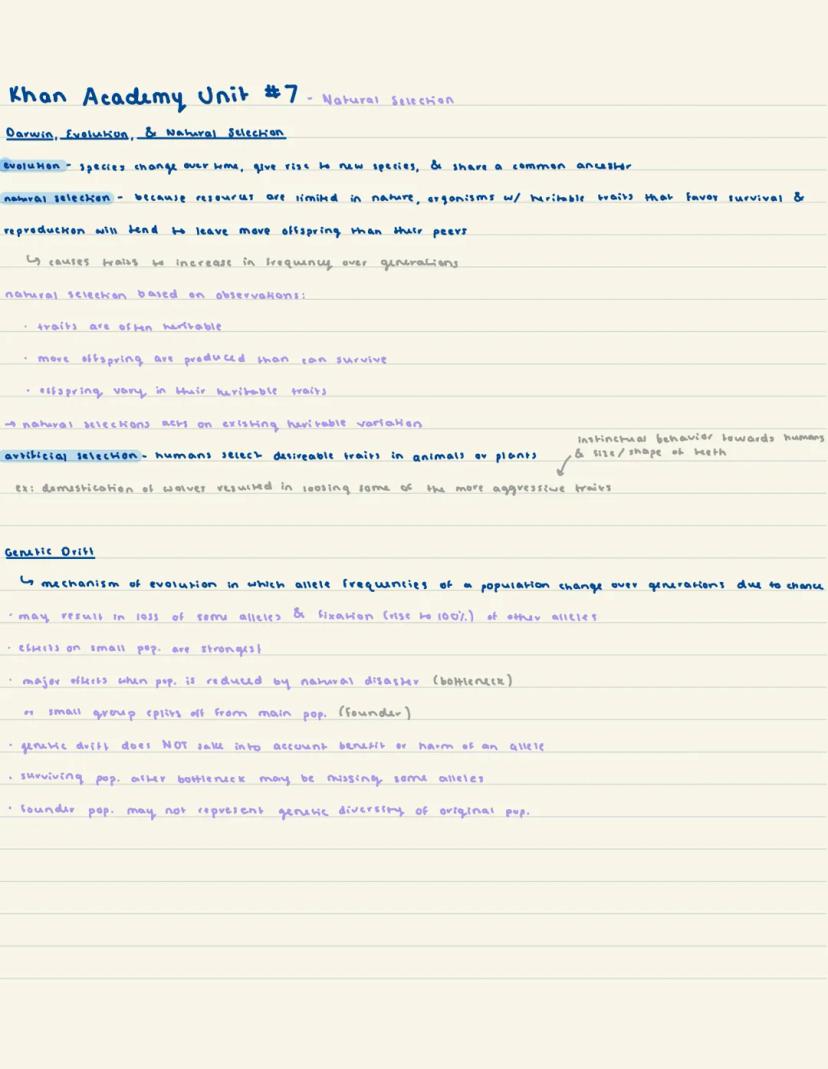
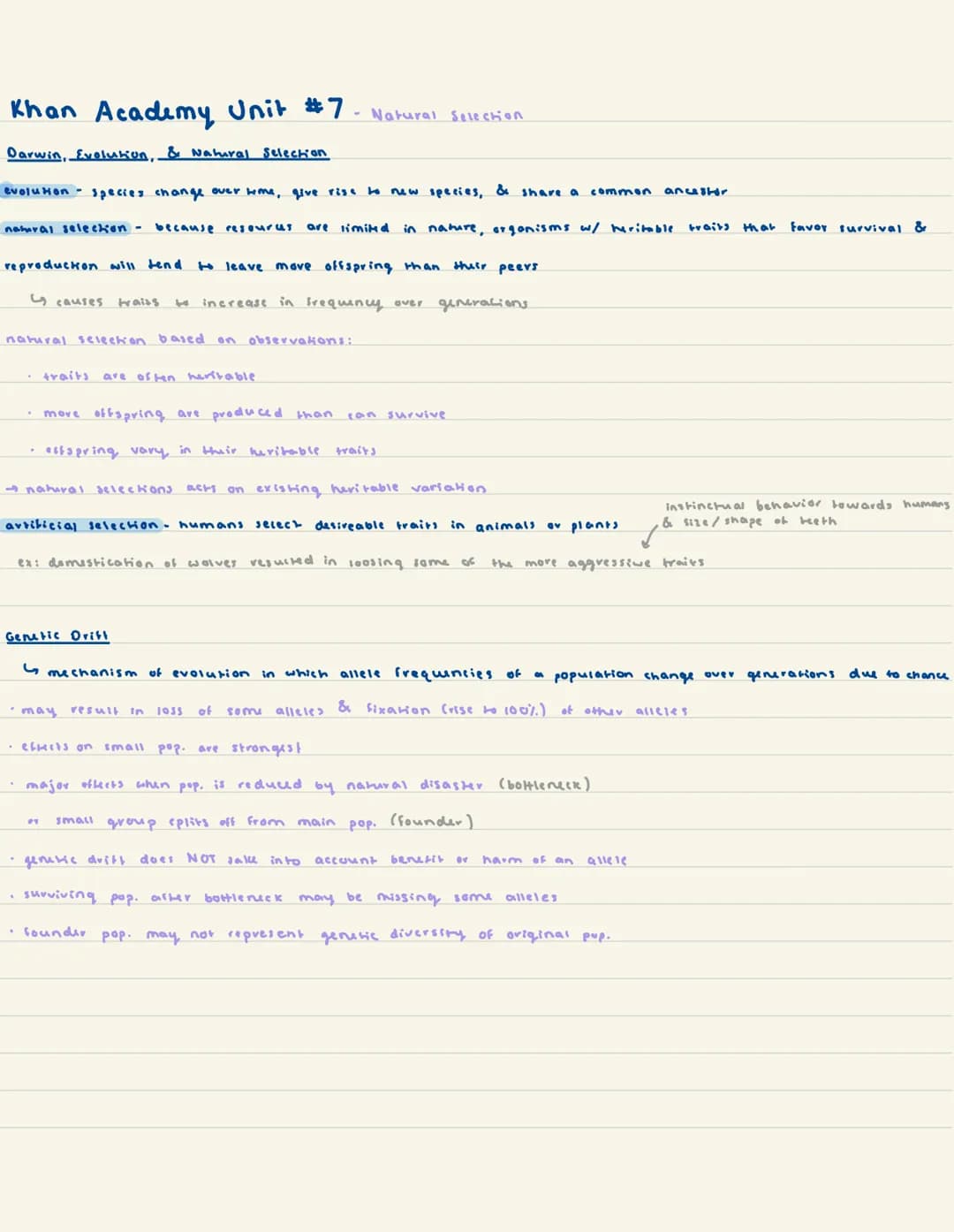
Evolution means species change over time, give rise to new species, and share common ancestors. The primary mechanism driving this process is natural selection. Since resources in nature are limited, organisms with traits that help them survive and reproduce tend to have more offspring, causing beneficial traits to increase over generations.
Natural selection works on existing heritable variation and is based on several key observations: traits are often passed down to offspring, more offspring are produced than can survive, and these offspring vary in their inherited traits. An interesting example of selection in action is artificial selection, where humans deliberately select desirable traits in plants and animals, like when wolves were domesticated by selecting for less aggressive behaviors.
Genetic drift is another evolutionary mechanism where allele frequencies change randomly over generations, not based on whether traits are beneficial or harmful. Its effects are strongest in small populations, especially after population bottlenecks (when disasters reduce numbers) or founder events (when small groups split off). Unlike natural selection, genetic drift can eliminate beneficial alleles purely by chance.
💡 Think of natural selection as "survival of the fittest" while genetic drift is more like "survival of the luckiest."
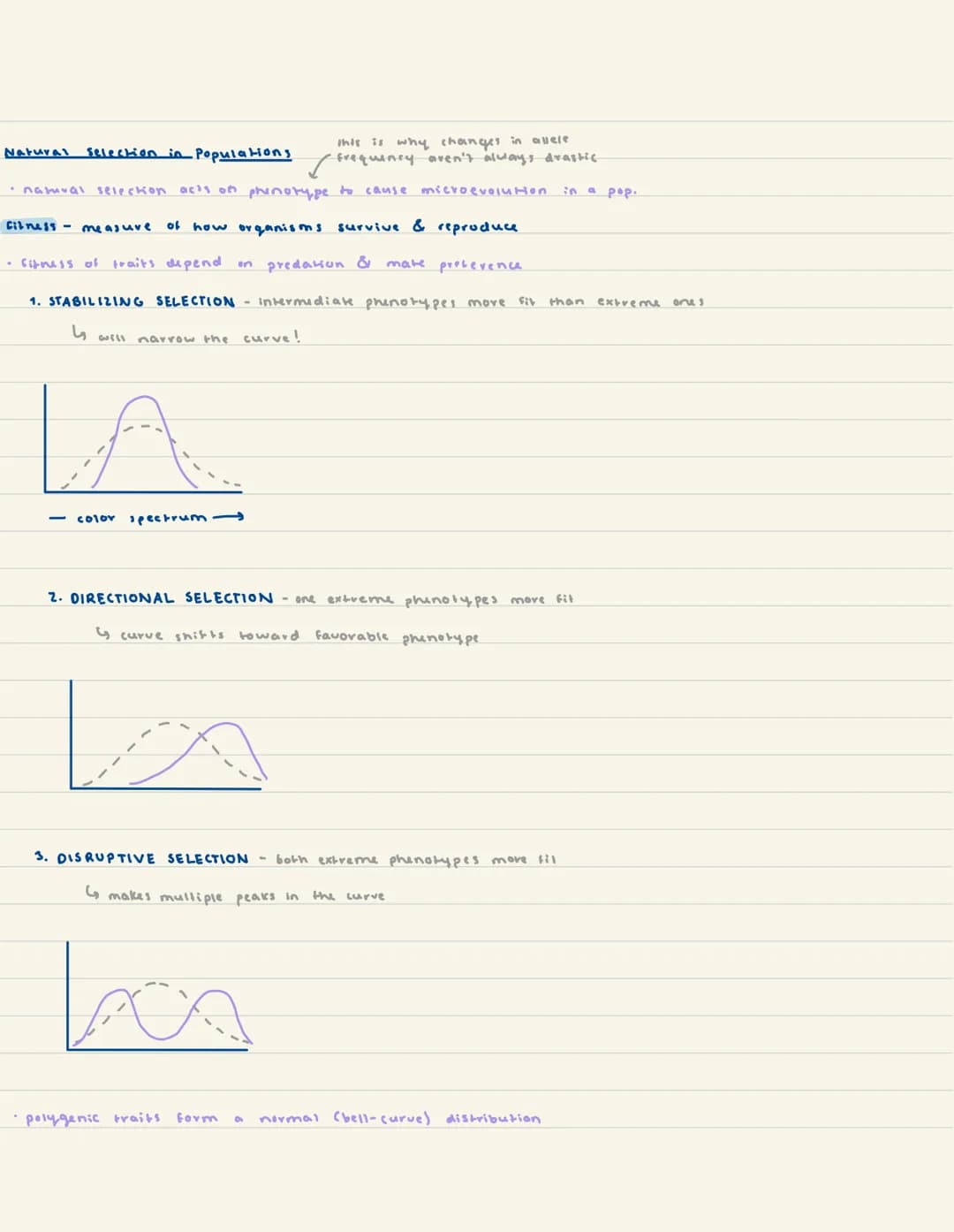
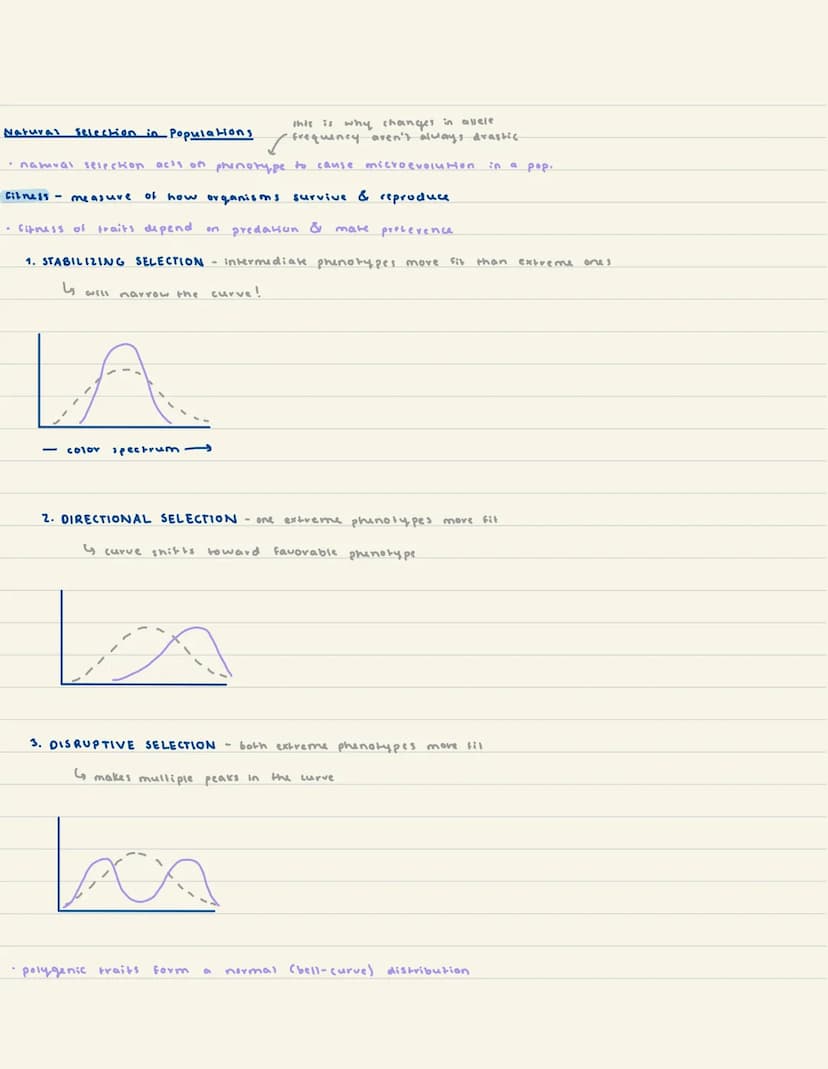
Changes in populations typically happen gradually because natural selection acts on phenotypes (observable traits) to cause microevolution. Fitness measures how well organisms survive and reproduce in their environment, with certain traits becoming more or less favorable depending on predators and mate preferences.
Natural selection can shape populations in three main ways. Stabilizing selection favors intermediate phenotypes and narrows the distribution curve, like when extremely large or small babies have lower survival rates. Directional selection favors one extreme phenotype, shifting the curve toward that favorable trait, such as giraffes with longer necks reaching more food. Disruptive selection favors both extremes, creating multiple peaks in the distribution curve.
Many important traits are polygenic (controlled by multiple genes) and form a bell-shaped distribution in populations. This explains why we see continuous variation in traits like human height rather than distinct categories.
🔍 Next time you're in a crowd, notice how human traits like height follow a bell curve - that's polygenic inheritance in action!
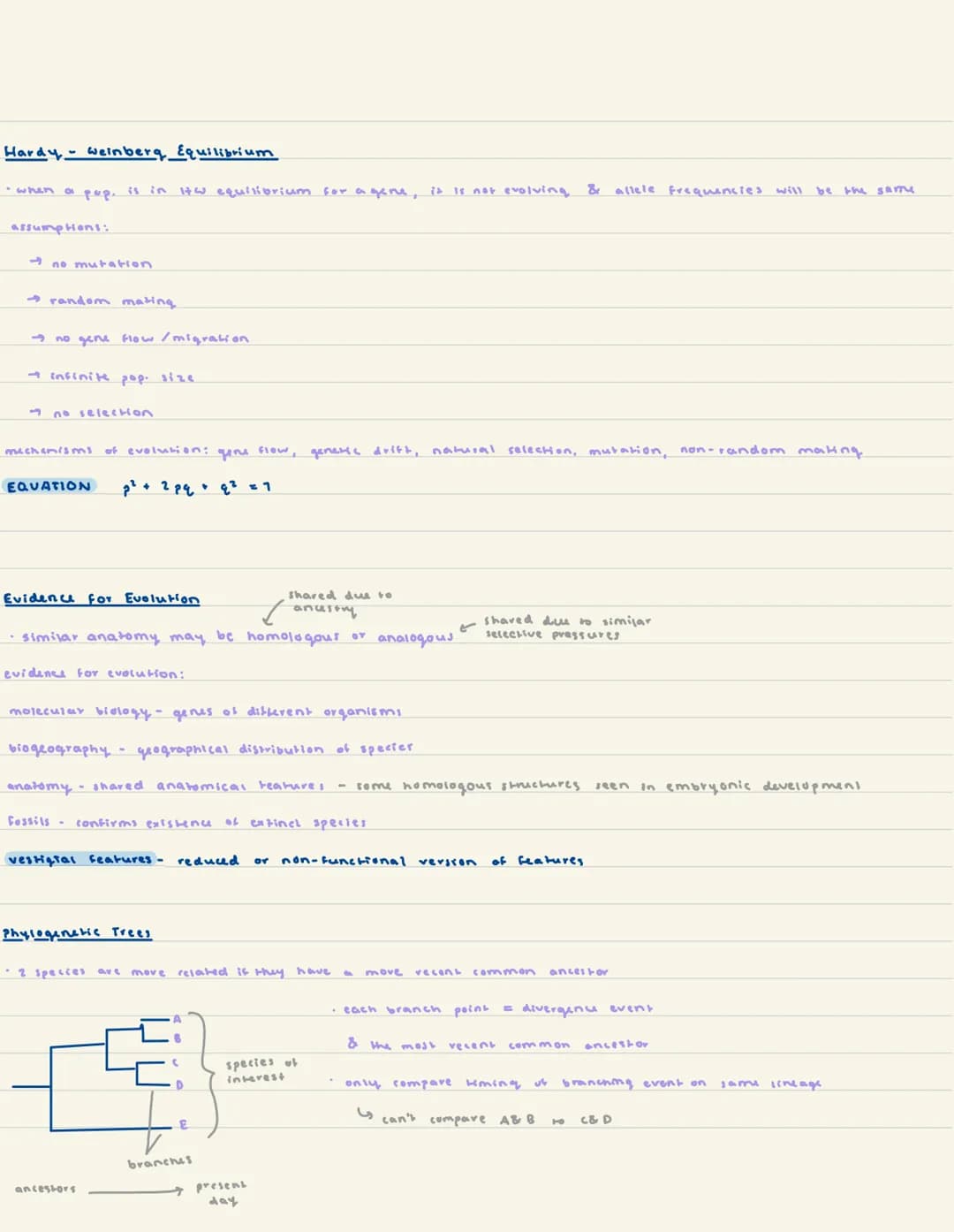
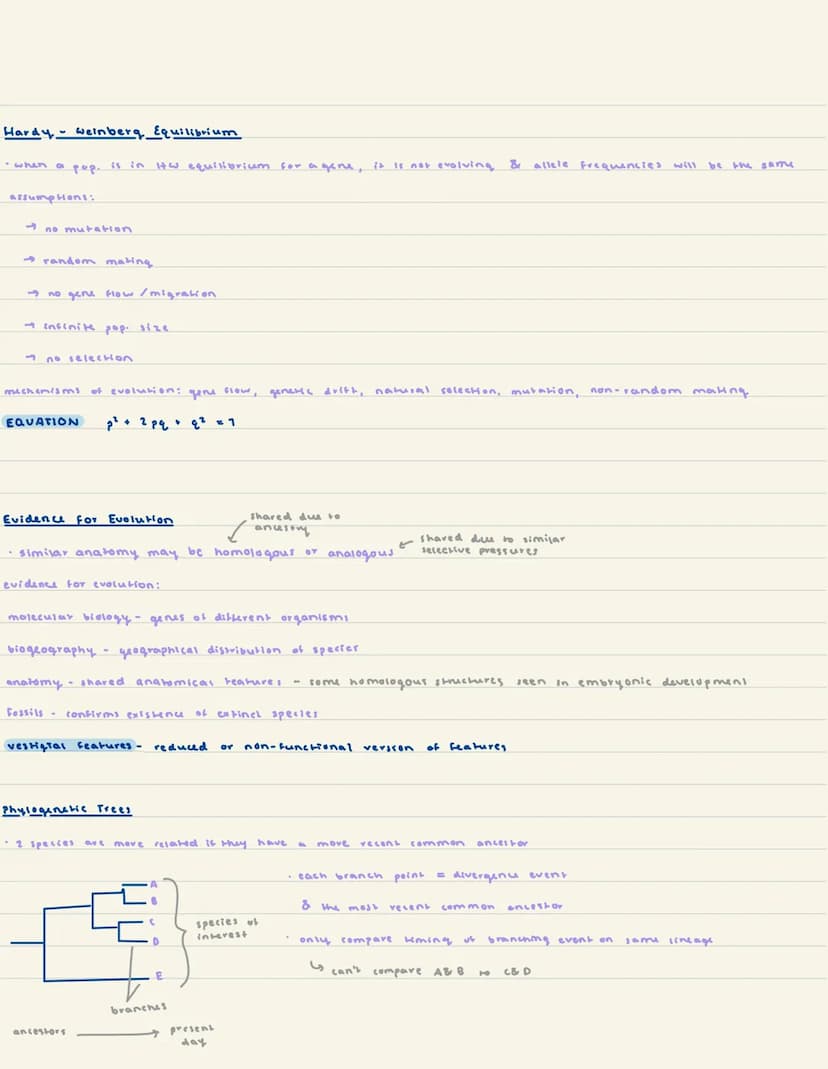
The Hardy-Weinberg equilibrium tells us when a population isn't evolving. For this to happen, five conditions must be met: no mutations, random mating, no migration, infinite population size, and no natural selection. When these conditions are violated, evolution occurs through mechanisms like gene flow, genetic drift, natural selection, mutation, or non-random mating.
Evolution has left evidence throughout the natural world. Molecular biology reveals genetic similarities between species. Biogeography shows how species are distributed across the planet. Comparative anatomy uncovers shared structures that developed from common ancestors (homologous) or similar environments (analogous). Fossils provide direct evidence of extinct species, and vestigial features show us once-useful structures that have lost their function.
Phylogenetic trees illustrate evolutionary relationships, with branch points representing divergence events where species split from common ancestors. When comparing relationships, remember that species are more closely related if they share a more recent common ancestor, and you can only compare timing of branching events on the same lineage.
🌟 Your own body contains evidence of evolution - the appendix and wisdom teeth are vestigial structures from our evolutionary past!
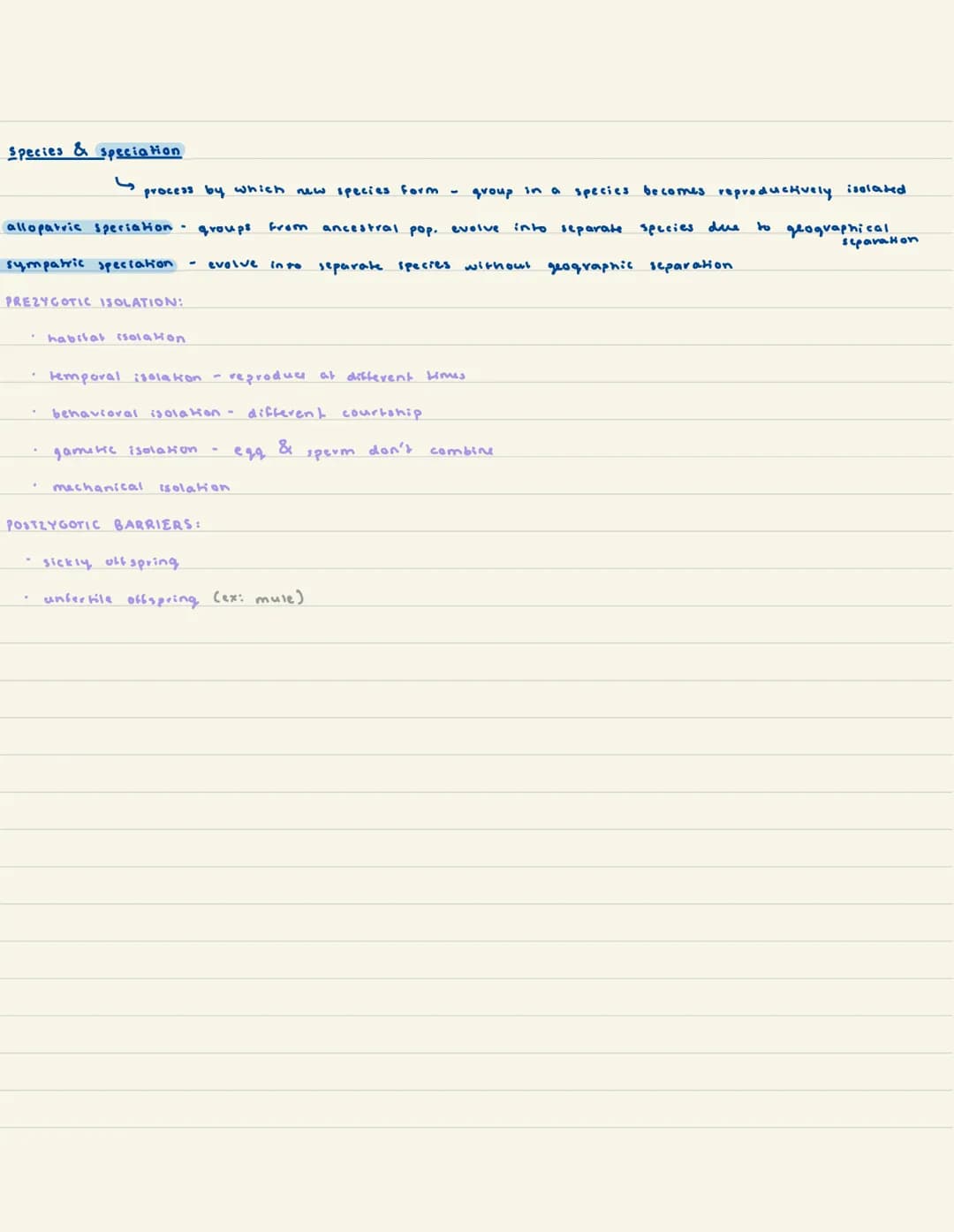
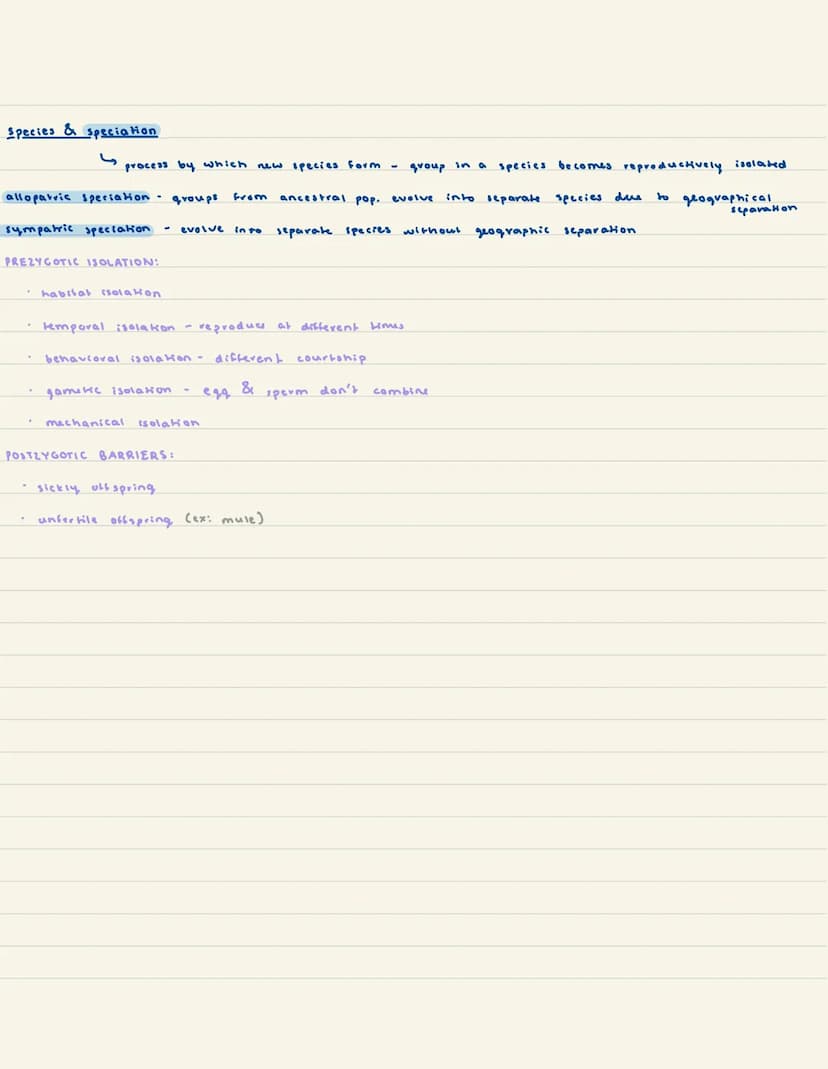
Speciation is the fascinating process by which new species form when groups become reproductively isolated. This can happen in two main ways: allopatric speciation occurs when geographical barriers physically separate populations (like a river forming or mountain rising), while sympatric speciation happens without geographic separation (such as through polyploidy in plants).
Nature has developed several barriers that prevent different species from interbreeding. Prezygotic isolation mechanisms prevent fertilization from occurring in the first place. These include habitat isolation (living in different places), temporal isolation (reproducing at different times), behavioral isolation (different courtship rituals), gametic isolation (sperm and egg incompatibility), and mechanical isolation (physical differences preventing mating).
If fertilization does occur between different species, postzygotic barriers can still prevent gene flow. The hybrid offspring might be weak and unhealthy, or they might be infertile like mules (the offspring of horses and donkeys). These barriers maintain the genetic distinctness of species even when they live in close proximity.
🧬 Consider how isolation mechanisms create biodiversity: without them, Earth might have far fewer species as everything would interbreed!
Our AI companion is specifically built for the needs of students. Based on the millions of content pieces we have on the platform we can provide truly meaningful and relevant answers to students. But its not only about answers, the companion is even more about guiding students through their daily learning challenges, with personalised study plans, quizzes or content pieces in the chat and 100% personalisation based on the students skills and developments.
You can download the app in the Google Play Store and in the Apple App Store.
That's right! Enjoy free access to study content, connect with fellow students, and get instant help – all at your fingertips.
App Store
Google Play
The app is very easy to use and well designed. I have found everything I was looking for so far and have been able to learn a lot from the presentations! I will definitely use the app for a class assignment! And of course it also helps a lot as an inspiration.
Stefan S
iOS user
This app is really great. There are so many study notes and help [...]. My problem subject is French, for example, and the app has so many options for help. Thanks to this app, I have improved my French. I would recommend it to anyone.
Samantha Klich
Android user
Wow, I am really amazed. I just tried the app because I've seen it advertised many times and was absolutely stunned. This app is THE HELP you want for school and above all, it offers so many things, such as workouts and fact sheets, which have been VERY helpful to me personally.
Anna
iOS user
I think it’s very much worth it and you’ll end up using it a lot once you get the hang of it and even after looking at others notes you can still ask your Artificial intelligence buddy the question and ask to simplify it if you still don’t get it!!! In the end I think it’s worth it 😊👍 ⚠️Also DID I MENTION ITS FREEE YOU DON’T HAVE TO PAY FOR ANYTHING AND STILL GET YOUR GRADES IN PERFECTLY❗️❗️⚠️
Thomas R
iOS user
Knowunity is the BEST app I’ve used in a minute. This is not an ai review or anything this is genuinely coming from a 7th grade student (I know 2011 im young) but dude this app is a 10/10 i have maintained a 3.8 gpa and have plenty of time for gaming. I love it and my mom is just happy I got good grades
Brad T
Android user
Not only did it help me find the answer but it also showed me alternative ways to solve it. I was horrible in math and science but now I have an a in both subjects. Thanks for the help🤍🤍
David K
iOS user
The app's just great! All I have to do is enter the topic in the search bar and I get the response real fast. I don't have to watch 10 YouTube videos to understand something, so I'm saving my time. Highly recommended!
Sudenaz Ocak
Android user
In school I was really bad at maths but thanks to the app, I am doing better now. I am so grateful that you made the app.
Greenlight Bonnie
Android user
I found this app a couple years ago and it has only gotten better since then. I really love it because it can help with written questions and photo questions. Also, it can find study guides that other people have made as well as flashcard sets and practice tests. The free version is also amazing for students who might not be able to afford it. Would 100% recommend
Aubrey
iOS user
Best app if you're in Highschool or Junior high. I have been using this app for 2 school years and it's the best, it's good if you don't have anyone to help you with school work.😋🩷🎀
Marco B
iOS user
THE QUIZES AND FLASHCARDS ARE SO USEFUL AND I LOVE Knowunity AI. IT ALSO IS LITREALLY LIKE CHATGPT BUT SMARTER!! HELPED ME WITH MY MASCARA PROBLEMS TOO!! AS WELL AS MY REAL SUBJECTS ! DUHHH 😍😁😲🤑💗✨🎀😮
Elisha
iOS user
This app is phenomenal down to the correct info and the various topics you can study! I greatly recommend it for people who struggle with procrastination and those who need homework help. It has been perfectly accurate for world 1 history as far as I’ve seen! Geometry too!
Paul T
iOS user
The app is very easy to use and well designed. I have found everything I was looking for so far and have been able to learn a lot from the presentations! I will definitely use the app for a class assignment! And of course it also helps a lot as an inspiration.
Stefan S
iOS user
This app is really great. There are so many study notes and help [...]. My problem subject is French, for example, and the app has so many options for help. Thanks to this app, I have improved my French. I would recommend it to anyone.
Samantha Klich
Android user
Wow, I am really amazed. I just tried the app because I've seen it advertised many times and was absolutely stunned. This app is THE HELP you want for school and above all, it offers so many things, such as workouts and fact sheets, which have been VERY helpful to me personally.
Anna
iOS user
I think it’s very much worth it and you’ll end up using it a lot once you get the hang of it and even after looking at others notes you can still ask your Artificial intelligence buddy the question and ask to simplify it if you still don’t get it!!! In the end I think it’s worth it 😊👍 ⚠️Also DID I MENTION ITS FREEE YOU DON’T HAVE TO PAY FOR ANYTHING AND STILL GET YOUR GRADES IN PERFECTLY❗️❗️⚠️
Thomas R
iOS user
Knowunity is the BEST app I’ve used in a minute. This is not an ai review or anything this is genuinely coming from a 7th grade student (I know 2011 im young) but dude this app is a 10/10 i have maintained a 3.8 gpa and have plenty of time for gaming. I love it and my mom is just happy I got good grades
Brad T
Android user
Not only did it help me find the answer but it also showed me alternative ways to solve it. I was horrible in math and science but now I have an a in both subjects. Thanks for the help🤍🤍
David K
iOS user
The app's just great! All I have to do is enter the topic in the search bar and I get the response real fast. I don't have to watch 10 YouTube videos to understand something, so I'm saving my time. Highly recommended!
Sudenaz Ocak
Android user
In school I was really bad at maths but thanks to the app, I am doing better now. I am so grateful that you made the app.
Greenlight Bonnie
Android user
I found this app a couple years ago and it has only gotten better since then. I really love it because it can help with written questions and photo questions. Also, it can find study guides that other people have made as well as flashcard sets and practice tests. The free version is also amazing for students who might not be able to afford it. Would 100% recommend
Aubrey
iOS user
Best app if you're in Highschool or Junior high. I have been using this app for 2 school years and it's the best, it's good if you don't have anyone to help you with school work.😋🩷🎀
Marco B
iOS user
THE QUIZES AND FLASHCARDS ARE SO USEFUL AND I LOVE Knowunity AI. IT ALSO IS LITREALLY LIKE CHATGPT BUT SMARTER!! HELPED ME WITH MY MASCARA PROBLEMS TOO!! AS WELL AS MY REAL SUBJECTS ! DUHHH 😍😁😲🤑💗✨🎀😮
Elisha
iOS user
This app is phenomenal down to the correct info and the various topics you can study! I greatly recommend it for people who struggle with procrastination and those who need homework help. It has been perfectly accurate for world 1 history as far as I’ve seen! Geometry too!
Paul T
iOS user
leslie 🌱
@apushhater
Evolution and natural selection are powerful processes that explain how species change over time. This unit explores Darwin's theories, genetic mechanisms driving evolution, and how new species form. You'll discover the fascinating ways life adapts and diversifies through both random... Show more
Access to all documents
Improve your grades
Join milions of students
Evolution means species change over time, give rise to new species, and share common ancestors. The primary mechanism driving this process is natural selection. Since resources in nature are limited, organisms with traits that help them survive and reproduce tend to have more offspring, causing beneficial traits to increase over generations.
Natural selection works on existing heritable variation and is based on several key observations: traits are often passed down to offspring, more offspring are produced than can survive, and these offspring vary in their inherited traits. An interesting example of selection in action is artificial selection, where humans deliberately select desirable traits in plants and animals, like when wolves were domesticated by selecting for less aggressive behaviors.
Genetic drift is another evolutionary mechanism where allele frequencies change randomly over generations, not based on whether traits are beneficial or harmful. Its effects are strongest in small populations, especially after population bottlenecks (when disasters reduce numbers) or founder events (when small groups split off). Unlike natural selection, genetic drift can eliminate beneficial alleles purely by chance.
💡 Think of natural selection as "survival of the fittest" while genetic drift is more like "survival of the luckiest."
Access to all documents
Improve your grades
Join milions of students
Changes in populations typically happen gradually because natural selection acts on phenotypes (observable traits) to cause microevolution. Fitness measures how well organisms survive and reproduce in their environment, with certain traits becoming more or less favorable depending on predators and mate preferences.
Natural selection can shape populations in three main ways. Stabilizing selection favors intermediate phenotypes and narrows the distribution curve, like when extremely large or small babies have lower survival rates. Directional selection favors one extreme phenotype, shifting the curve toward that favorable trait, such as giraffes with longer necks reaching more food. Disruptive selection favors both extremes, creating multiple peaks in the distribution curve.
Many important traits are polygenic (controlled by multiple genes) and form a bell-shaped distribution in populations. This explains why we see continuous variation in traits like human height rather than distinct categories.
🔍 Next time you're in a crowd, notice how human traits like height follow a bell curve - that's polygenic inheritance in action!
Access to all documents
Improve your grades
Join milions of students
The Hardy-Weinberg equilibrium tells us when a population isn't evolving. For this to happen, five conditions must be met: no mutations, random mating, no migration, infinite population size, and no natural selection. When these conditions are violated, evolution occurs through mechanisms like gene flow, genetic drift, natural selection, mutation, or non-random mating.
Evolution has left evidence throughout the natural world. Molecular biology reveals genetic similarities between species. Biogeography shows how species are distributed across the planet. Comparative anatomy uncovers shared structures that developed from common ancestors (homologous) or similar environments (analogous). Fossils provide direct evidence of extinct species, and vestigial features show us once-useful structures that have lost their function.
Phylogenetic trees illustrate evolutionary relationships, with branch points representing divergence events where species split from common ancestors. When comparing relationships, remember that species are more closely related if they share a more recent common ancestor, and you can only compare timing of branching events on the same lineage.
🌟 Your own body contains evidence of evolution - the appendix and wisdom teeth are vestigial structures from our evolutionary past!
Access to all documents
Improve your grades
Join milions of students
Speciation is the fascinating process by which new species form when groups become reproductively isolated. This can happen in two main ways: allopatric speciation occurs when geographical barriers physically separate populations (like a river forming or mountain rising), while sympatric speciation happens without geographic separation (such as through polyploidy in plants).
Nature has developed several barriers that prevent different species from interbreeding. Prezygotic isolation mechanisms prevent fertilization from occurring in the first place. These include habitat isolation (living in different places), temporal isolation (reproducing at different times), behavioral isolation (different courtship rituals), gametic isolation (sperm and egg incompatibility), and mechanical isolation (physical differences preventing mating).
If fertilization does occur between different species, postzygotic barriers can still prevent gene flow. The hybrid offspring might be weak and unhealthy, or they might be infertile like mules (the offspring of horses and donkeys). These barriers maintain the genetic distinctness of species even when they live in close proximity.
🧬 Consider how isolation mechanisms create biodiversity: without them, Earth might have far fewer species as everything would interbreed!
Our AI companion is specifically built for the needs of students. Based on the millions of content pieces we have on the platform we can provide truly meaningful and relevant answers to students. But its not only about answers, the companion is even more about guiding students through their daily learning challenges, with personalised study plans, quizzes or content pieces in the chat and 100% personalisation based on the students skills and developments.
You can download the app in the Google Play Store and in the Apple App Store.
That's right! Enjoy free access to study content, connect with fellow students, and get instant help – all at your fingertips.
3
Smart Tools NEW
Transform this note into: ✓ 50+ Practice Questions ✓ Interactive Flashcards ✓ Full Practice Test ✓ Essay Outlines
Glycolysis
 Biology
Notes and description on chemical and physiological role of botox
BiologyGizmos
BiologyLearn about the key phases of the cell cycle and their importance in cellular reproduction.
BiologyApp Store
Google Play
The app is very easy to use and well designed. I have found everything I was looking for so far and have been able to learn a lot from the presentations! I will definitely use the app for a class assignment! And of course it also helps a lot as an inspiration.
Stefan S
iOS user
This app is really great. There are so many study notes and help [...]. My problem subject is French, for example, and the app has so many options for help. Thanks to this app, I have improved my French. I would recommend it to anyone.
Samantha Klich
Android user
Wow, I am really amazed. I just tried the app because I've seen it advertised many times and was absolutely stunned. This app is THE HELP you want for school and above all, it offers so many things, such as workouts and fact sheets, which have been VERY helpful to me personally.
Anna
iOS user
I think it’s very much worth it and you’ll end up using it a lot once you get the hang of it and even after looking at others notes you can still ask your Artificial intelligence buddy the question and ask to simplify it if you still don’t get it!!! In the end I think it’s worth it 😊👍 ⚠️Also DID I MENTION ITS FREEE YOU DON’T HAVE TO PAY FOR ANYTHING AND STILL GET YOUR GRADES IN PERFECTLY❗️❗️⚠️
Thomas R
iOS user
Knowunity is the BEST app I’ve used in a minute. This is not an ai review or anything this is genuinely coming from a 7th grade student (I know 2011 im young) but dude this app is a 10/10 i have maintained a 3.8 gpa and have plenty of time for gaming. I love it and my mom is just happy I got good grades
Brad T
Android user
Not only did it help me find the answer but it also showed me alternative ways to solve it. I was horrible in math and science but now I have an a in both subjects. Thanks for the help🤍🤍
David K
iOS user
The app's just great! All I have to do is enter the topic in the search bar and I get the response real fast. I don't have to watch 10 YouTube videos to understand something, so I'm saving my time. Highly recommended!
Sudenaz Ocak
Android user
In school I was really bad at maths but thanks to the app, I am doing better now. I am so grateful that you made the app.
Greenlight Bonnie
Android user
I found this app a couple years ago and it has only gotten better since then. I really love it because it can help with written questions and photo questions. Also, it can find study guides that other people have made as well as flashcard sets and practice tests. The free version is also amazing for students who might not be able to afford it. Would 100% recommend
Aubrey
iOS user
Best app if you're in Highschool or Junior high. I have been using this app for 2 school years and it's the best, it's good if you don't have anyone to help you with school work.😋🩷🎀
Marco B
iOS user
THE QUIZES AND FLASHCARDS ARE SO USEFUL AND I LOVE Knowunity AI. IT ALSO IS LITREALLY LIKE CHATGPT BUT SMARTER!! HELPED ME WITH MY MASCARA PROBLEMS TOO!! AS WELL AS MY REAL SUBJECTS ! DUHHH 😍😁😲🤑💗✨🎀😮
Elisha
iOS user
This app is phenomenal down to the correct info and the various topics you can study! I greatly recommend it for people who struggle with procrastination and those who need homework help. It has been perfectly accurate for world 1 history as far as I’ve seen! Geometry too!
Paul T
iOS user
The app is very easy to use and well designed. I have found everything I was looking for so far and have been able to learn a lot from the presentations! I will definitely use the app for a class assignment! And of course it also helps a lot as an inspiration.
Stefan S
iOS user
This app is really great. There are so many study notes and help [...]. My problem subject is French, for example, and the app has so many options for help. Thanks to this app, I have improved my French. I would recommend it to anyone.
Samantha Klich
Android user
Wow, I am really amazed. I just tried the app because I've seen it advertised many times and was absolutely stunned. This app is THE HELP you want for school and above all, it offers so many things, such as workouts and fact sheets, which have been VERY helpful to me personally.
Anna
iOS user
I think it’s very much worth it and you’ll end up using it a lot once you get the hang of it and even after looking at others notes you can still ask your Artificial intelligence buddy the question and ask to simplify it if you still don’t get it!!! In the end I think it’s worth it 😊👍 ⚠️Also DID I MENTION ITS FREEE YOU DON’T HAVE TO PAY FOR ANYTHING AND STILL GET YOUR GRADES IN PERFECTLY❗️❗️⚠️
Thomas R
iOS user
Knowunity is the BEST app I’ve used in a minute. This is not an ai review or anything this is genuinely coming from a 7th grade student (I know 2011 im young) but dude this app is a 10/10 i have maintained a 3.8 gpa and have plenty of time for gaming. I love it and my mom is just happy I got good grades
Brad T
Android user
Not only did it help me find the answer but it also showed me alternative ways to solve it. I was horrible in math and science but now I have an a in both subjects. Thanks for the help🤍🤍
David K
iOS user
The app's just great! All I have to do is enter the topic in the search bar and I get the response real fast. I don't have to watch 10 YouTube videos to understand something, so I'm saving my time. Highly recommended!
Sudenaz Ocak
Android user
In school I was really bad at maths but thanks to the app, I am doing better now. I am so grateful that you made the app.
Greenlight Bonnie
Android user
I found this app a couple years ago and it has only gotten better since then. I really love it because it can help with written questions and photo questions. Also, it can find study guides that other people have made as well as flashcard sets and practice tests. The free version is also amazing for students who might not be able to afford it. Would 100% recommend
Aubrey
iOS user
Best app if you're in Highschool or Junior high. I have been using this app for 2 school years and it's the best, it's good if you don't have anyone to help you with school work.😋🩷🎀
Marco B
iOS user
THE QUIZES AND FLASHCARDS ARE SO USEFUL AND I LOVE Knowunity AI. IT ALSO IS LITREALLY LIKE CHATGPT BUT SMARTER!! HELPED ME WITH MY MASCARA PROBLEMS TOO!! AS WELL AS MY REAL SUBJECTS ! DUHHH 😍😁😲🤑💗✨🎀😮
Elisha
iOS user
This app is phenomenal down to the correct info and the various topics you can study! I greatly recommend it for people who struggle with procrastination and those who need homework help. It has been perfectly accurate for world 1 history as far as I’ve seen! Geometry too!
Paul T
iOS user