
DNA isn't just floating around randomly in your cells -... Show more
 Sociology
Sign up to see the contentIt's free!
Access to all documents
Improve your grades
Join milions of students
By signing up you accept Terms of Service and Privacy Policy

Biology

Chemistry
AP Chemistry

English
AP English Literature
149
•
Dec 5, 2025
•

Cami Carbo
@camicarbo123
DNA isn't just floating around randomly in your cells -... Show more
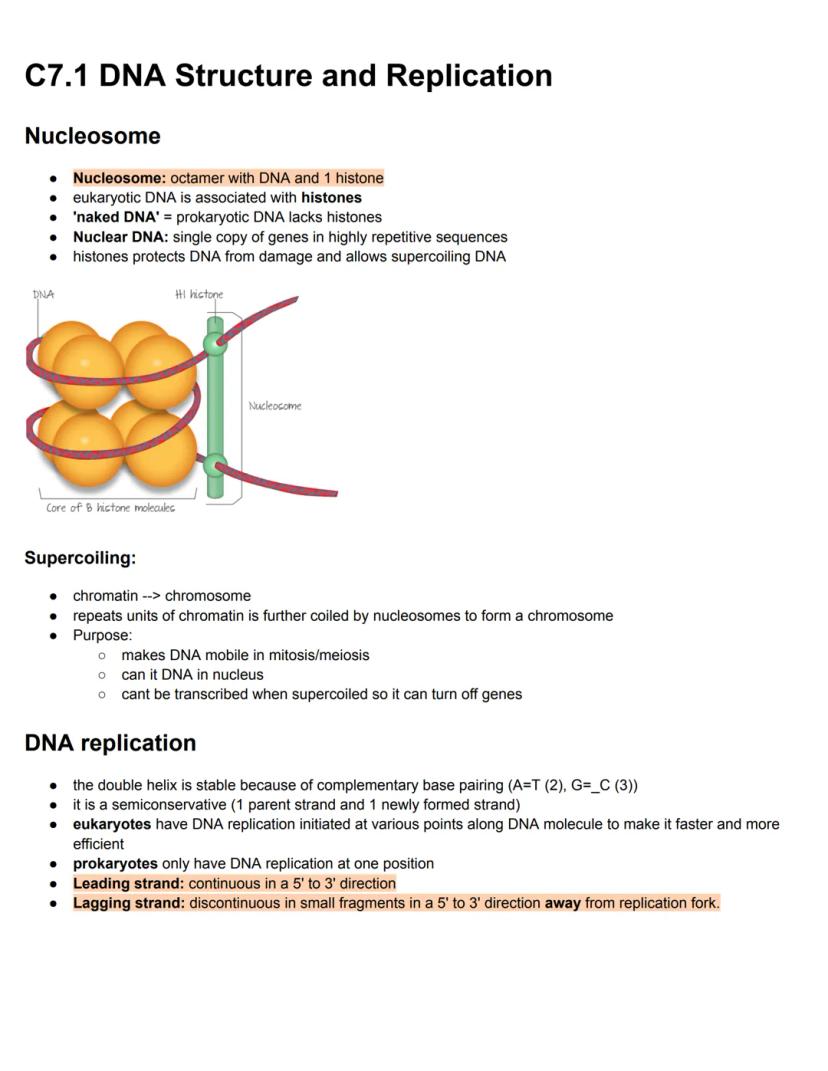
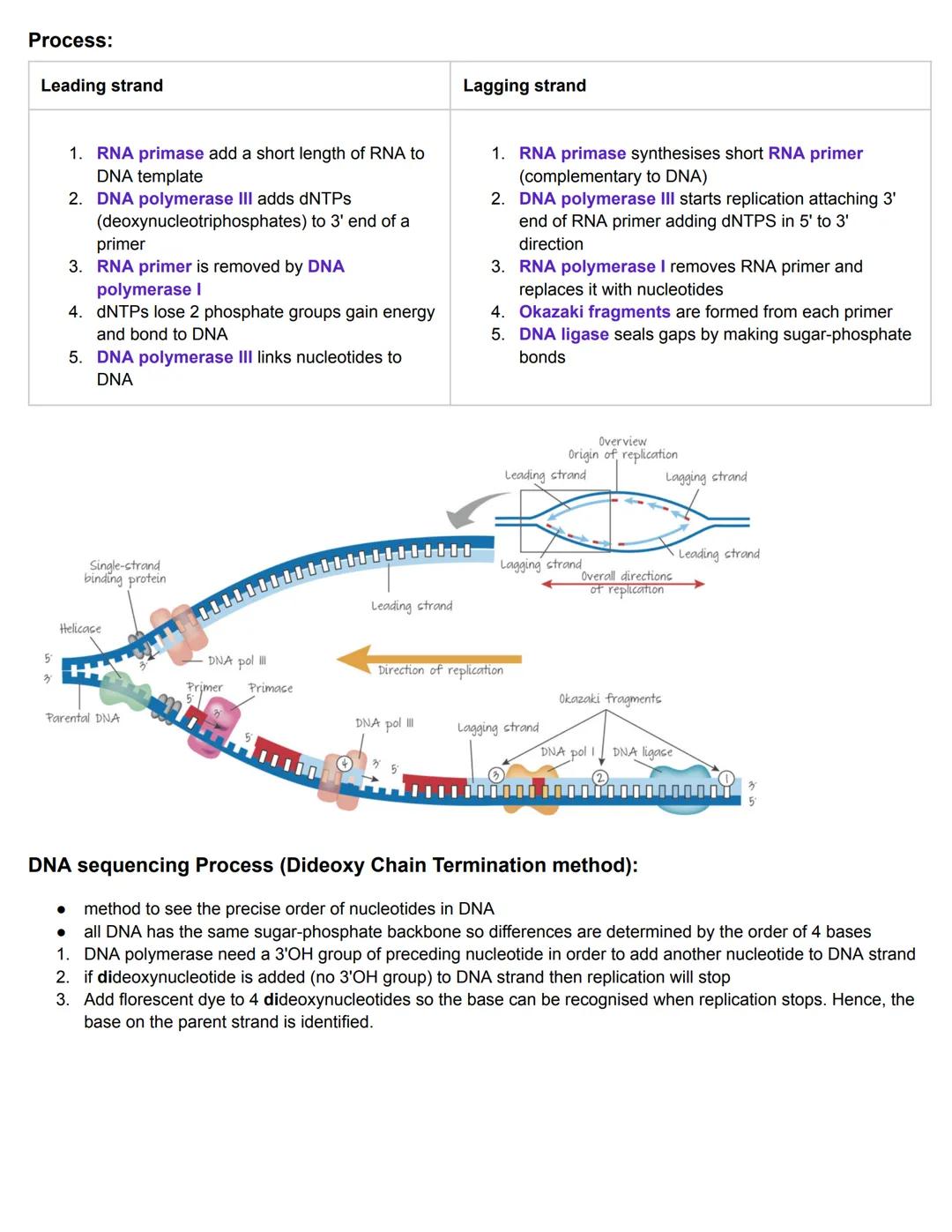
Your DNA needs to fit inside a tiny cell nucleus, which is like cramming 3 metres of thread into a space the size of a pinhead! Nucleosomes are the solution - they're like molecular spools where DNA wraps around eight histone proteins.
Think of histones as protective packaging that keeps DNA safe from damage and allows it to coil up super tightly. This process is called supercoiling, and it's brilliant because it makes DNA compact enough for cell division and can even switch genes off when they're not needed.
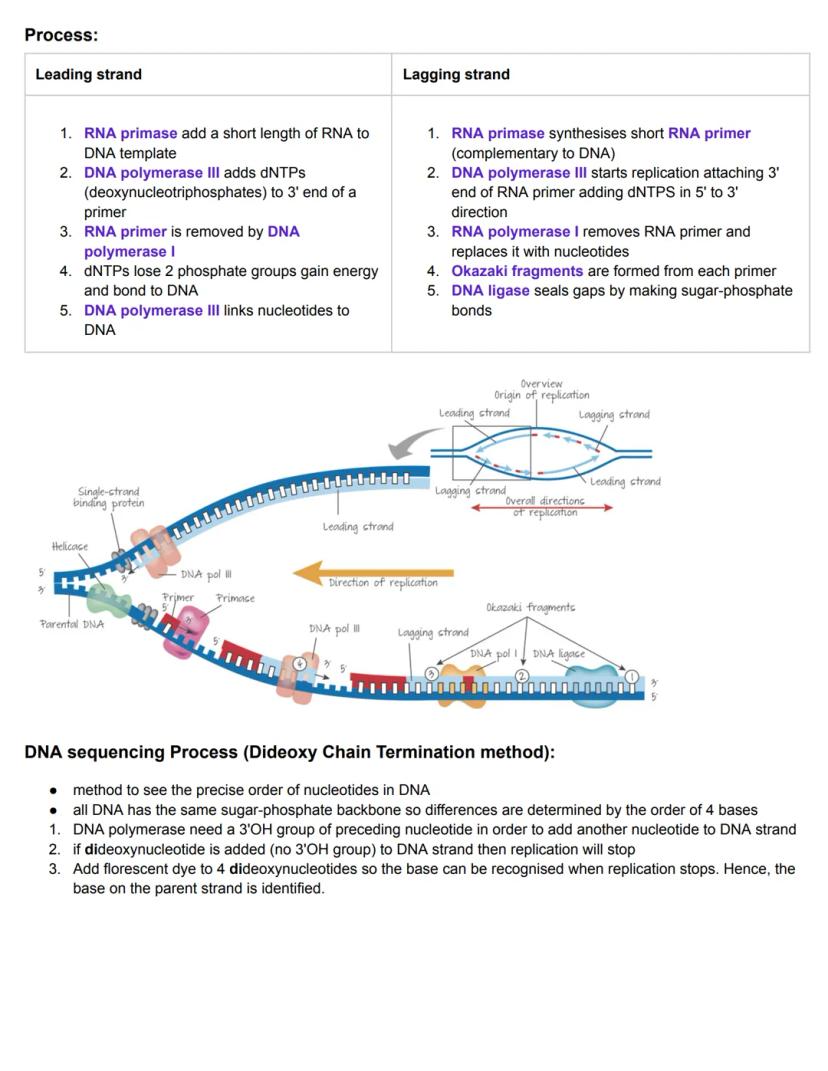
DNA replication follows the semiconservative model - each new DNA molecule contains one original strand and one newly made strand. The process happens much faster in eukaryotes because it starts at multiple points along the chromosome, whilst prokaryotes only start from one spot.
Key Point: The leading strand copies continuously in the 5' to 3' direction, but the lagging strand has to copy in short fragments called Okazaki fragments because DNA can only be built in one direction.
The DNA replication machinery works like a well-coordinated factory line. RNA primase starts things off by adding short RNA primers, giving DNA polymerase III something to grab onto as it adds new nucleotides.
On the leading strand, replication flows smoothly in one direction. But the lagging strand is trickier - it creates Okazaki fragments that need to be stitched together by DNA ligase after DNA polymerase I removes the RNA primers.
DNA sequencing uses a clever trick called the dideoxy method. Scientists add special nucleotides without the crucial 3'OH group, which stops replication dead in its tracks. Each base gets a different coloured fluorescent tag, so when replication stops, they can see exactly which base caused it.
Remember: DNA polymerase absolutely needs that 3'OH group to keep adding nucleotides - it's like needing the right connector to plug in the next piece!
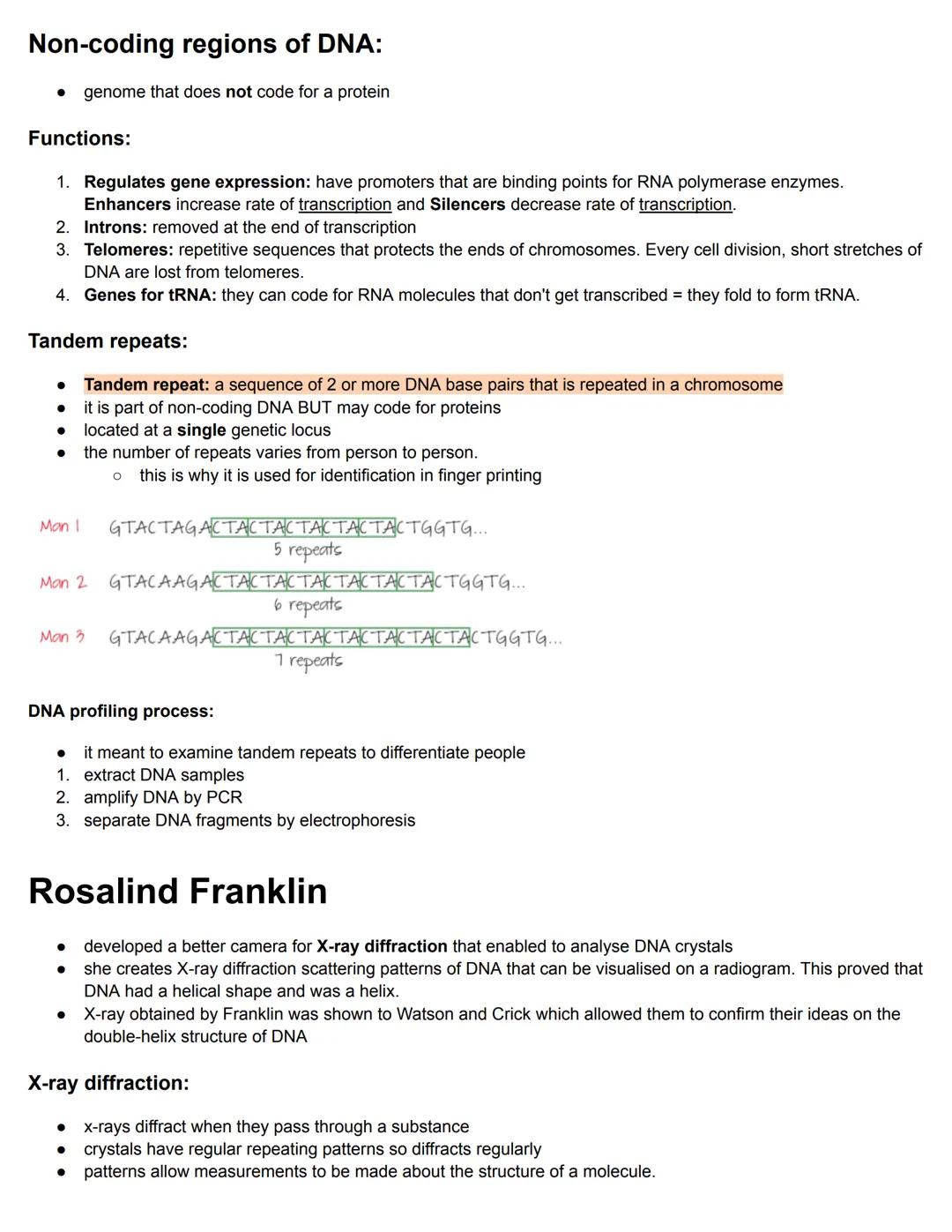
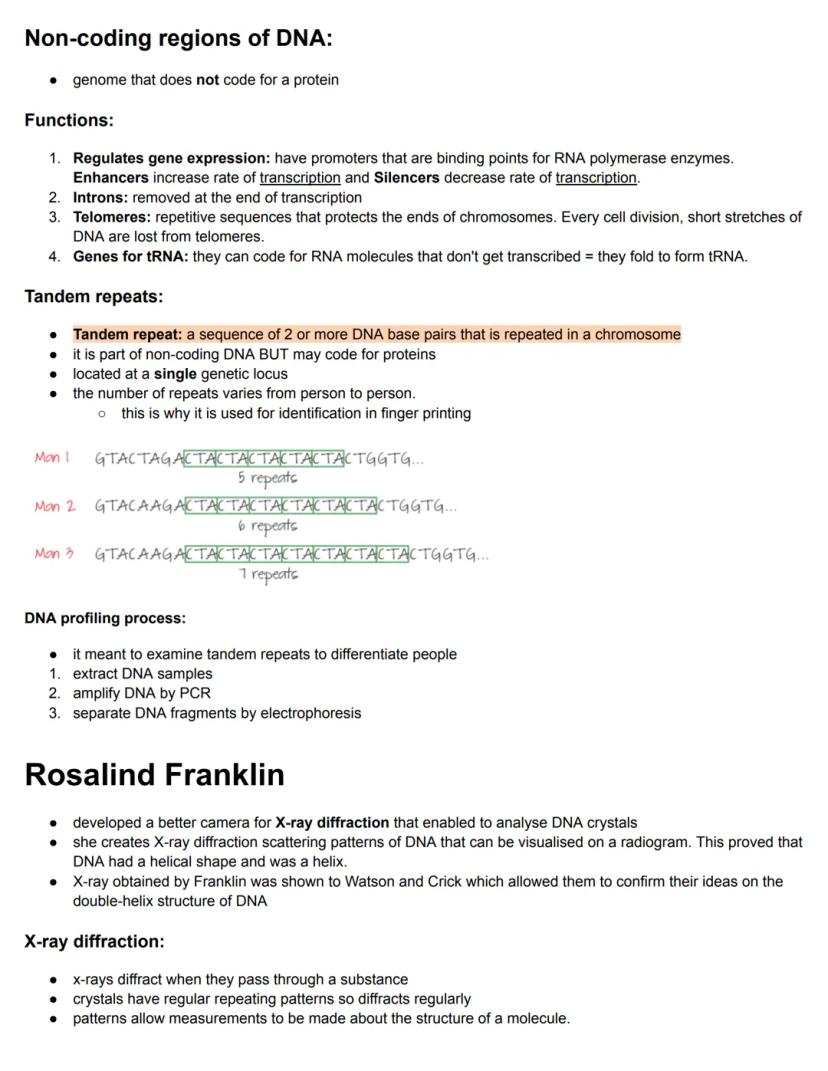
Not all your DNA codes for proteins - loads of it has other crucial jobs! Non-coding regions include promoters that tell RNA polymerase where to start, enhancers that speed up gene expression, and silencers that slow it down.
Tandem repeats are like DNA's fingerprint - short sequences that repeat different numbers of times in different people. These repeats are why DNA profiling works so well for identification, since everyone has their own unique pattern.
The process involves extracting DNA, amplifying it using PCR, then separating the fragments by electrophoresis. Telomeres are special tandem repeats that protect chromosome ends, getting shorter each time cells divide.
Rosalind Franklin used X-ray diffraction to photograph DNA crystals, creating the famous 'Photo 51' that proved DNA's helical structure. Her work was absolutely crucial for Watson and Crick's double helix model.
Fun Fact: Your tandem repeats are so unique that the chances of two unrelated people having identical patterns are about 1 in several billion!
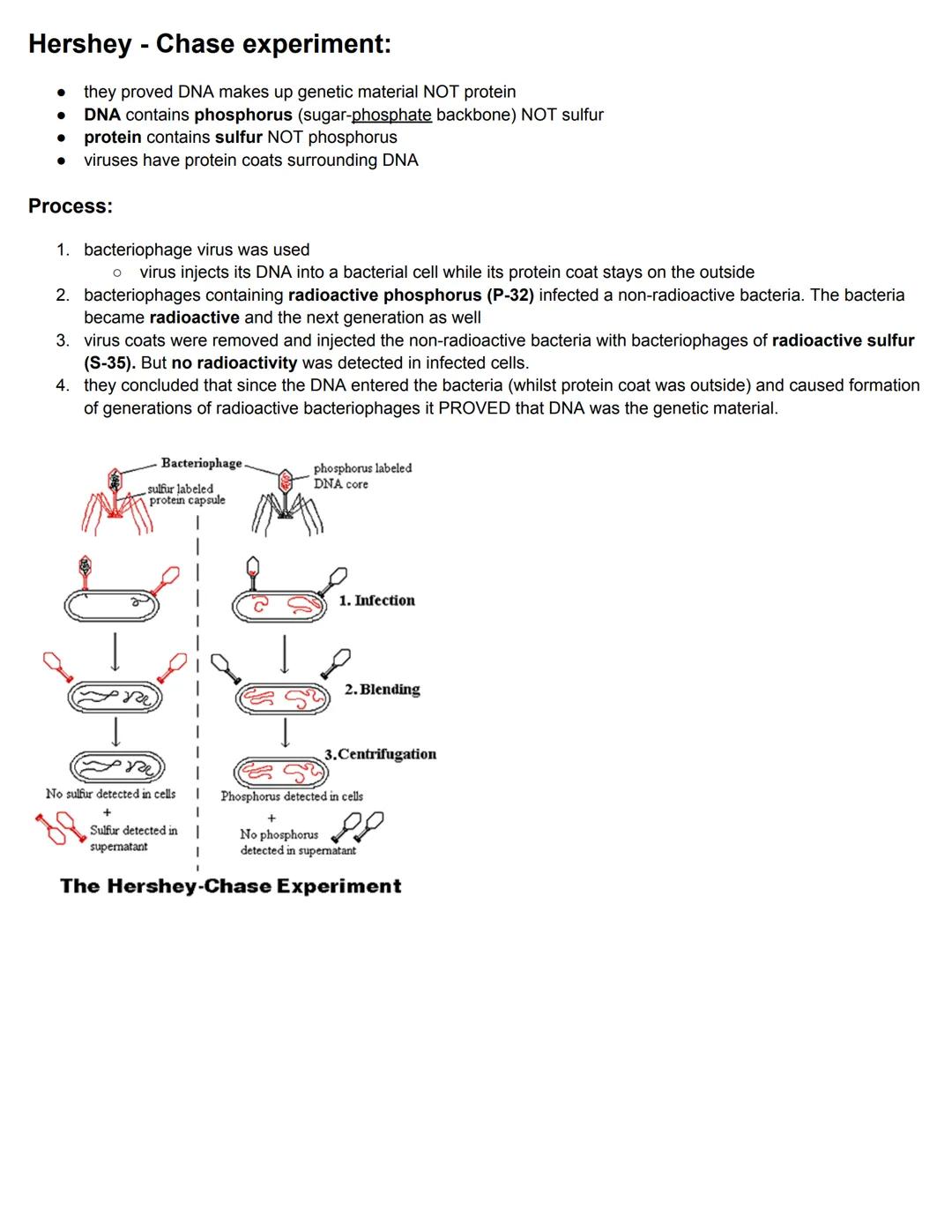
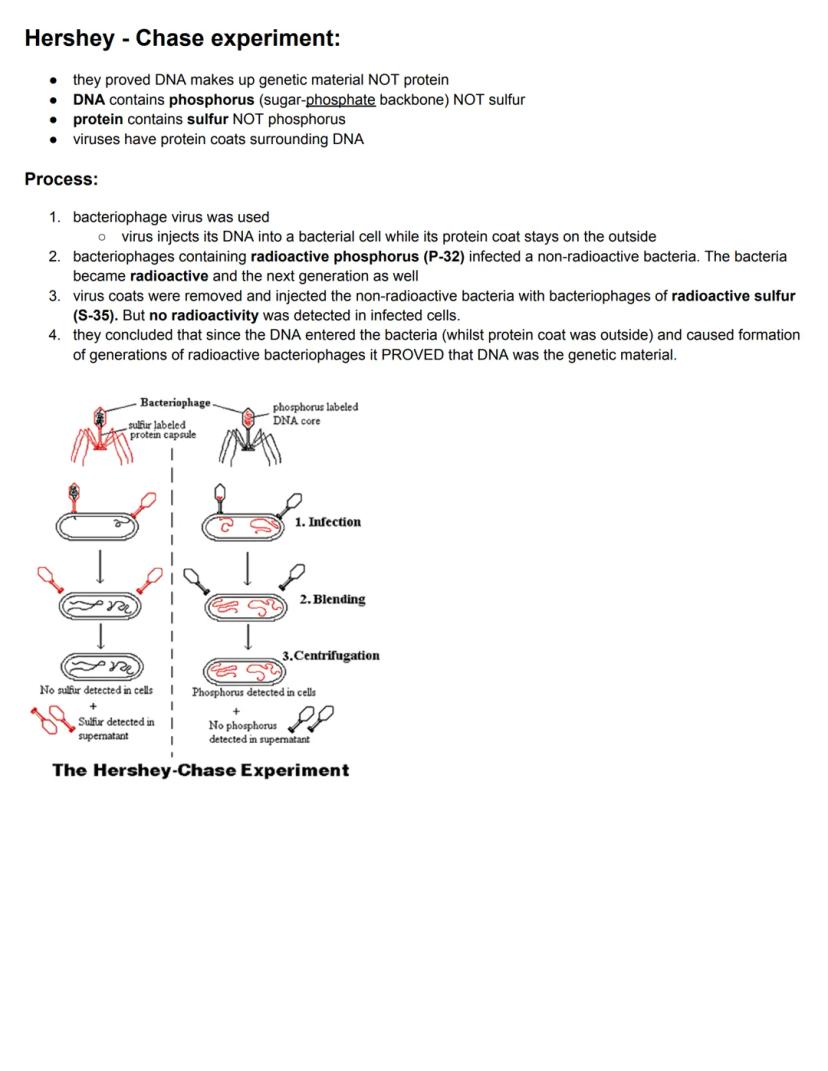
The Hershey-Chase experiment brilliantly proved that DNA, not protein, carries genetic information. They used the fact that DNA contains phosphorus but no sulfur, whilst proteins contain sulfur but no phosphorus.
Using bacteriophages (viruses that infect bacteria), they created two versions - one with radioactive phosphorus in the DNA and another with radioactive sulfur in the protein coat. When the virus infected bacteria, only the DNA entered the cell whilst the protein coat stayed outside.
The results were crystal clear: bacteria infected with radioactive DNA became radioactive and passed this to their offspring. But bacteria infected with viruses having radioactive protein coats showed no radioactivity inside the cells.
This experiment was a game-changer because it definitively settled the debate about what genetic material actually was, paving the way for all modern molecular biology.
Think About It: Before this experiment, many scientists thought proteins were too complex to be genetic material - DNA seemed too simple!
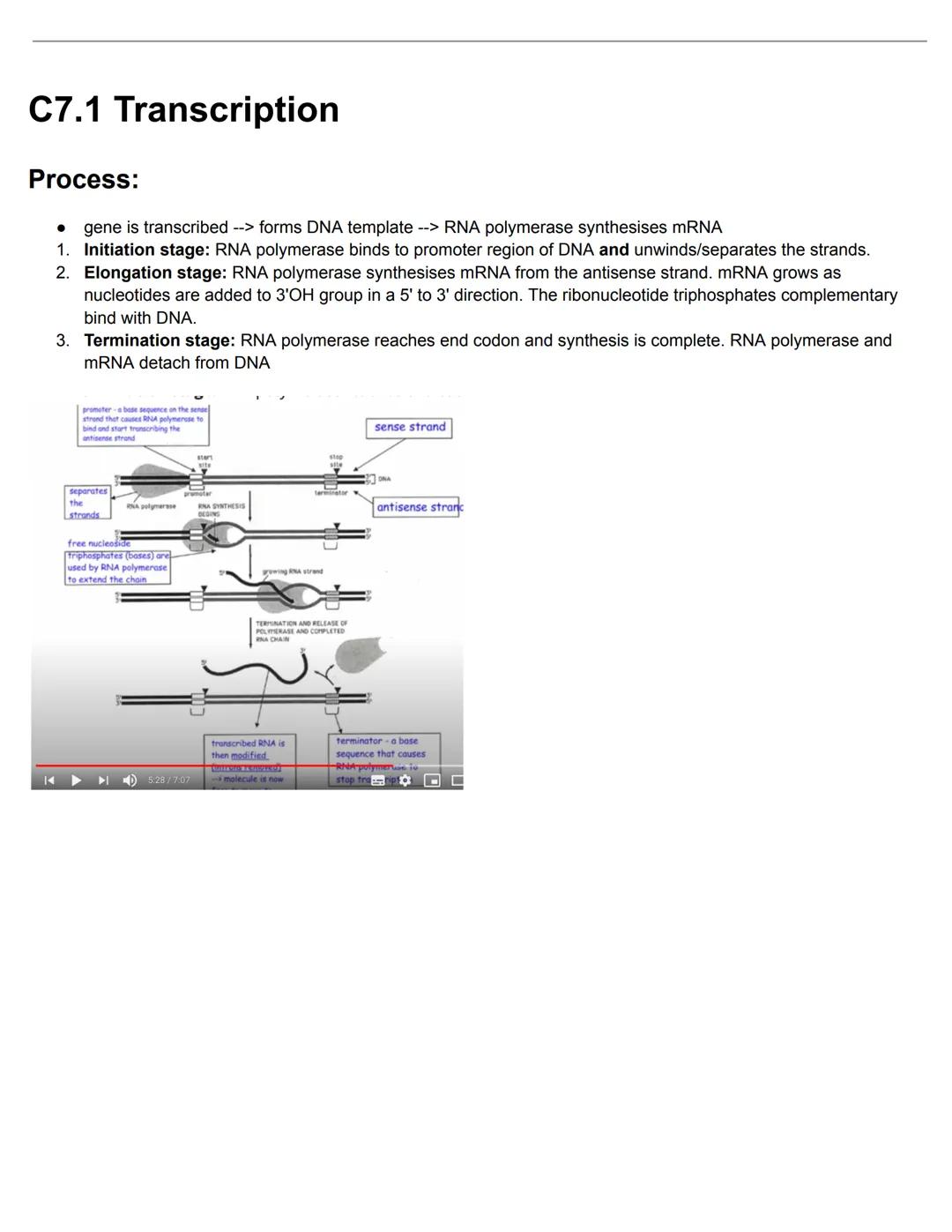
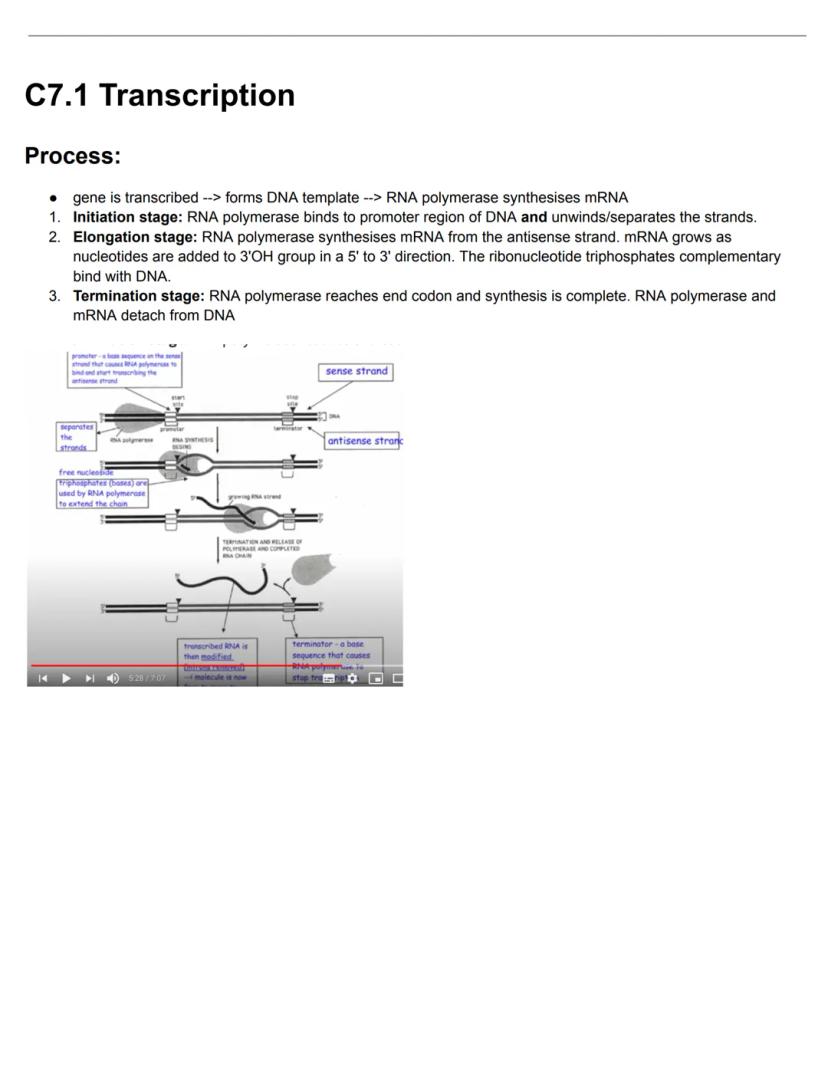
Transcription is where your DNA recipe gets copied into mRNA so it can leave the nucleus. RNA polymerase does all the heavy lifting, binding to the promoter region and unwinding the DNA strands.
The process has three clear stages: initiation (RNA polymerase binds and starts), elongation (mRNA grows as nucleotides are added in the 5' to 3' direction), and termination (everything detaches when the stop signal is reached).
Only the antisense strand gets transcribed - think of it as the template that creates a complementary mRNA copy. The sense strand has the same sequence as the mRNA (except T instead of U).
RNA polymerase reads the DNA template and adds complementary ribonucleotide triphosphates, building the mRNA molecule one base at a time until it hits the termination sequence.
Key Difference: Unlike DNA replication, transcription only copies one strand and doesn't need a primer to get started!
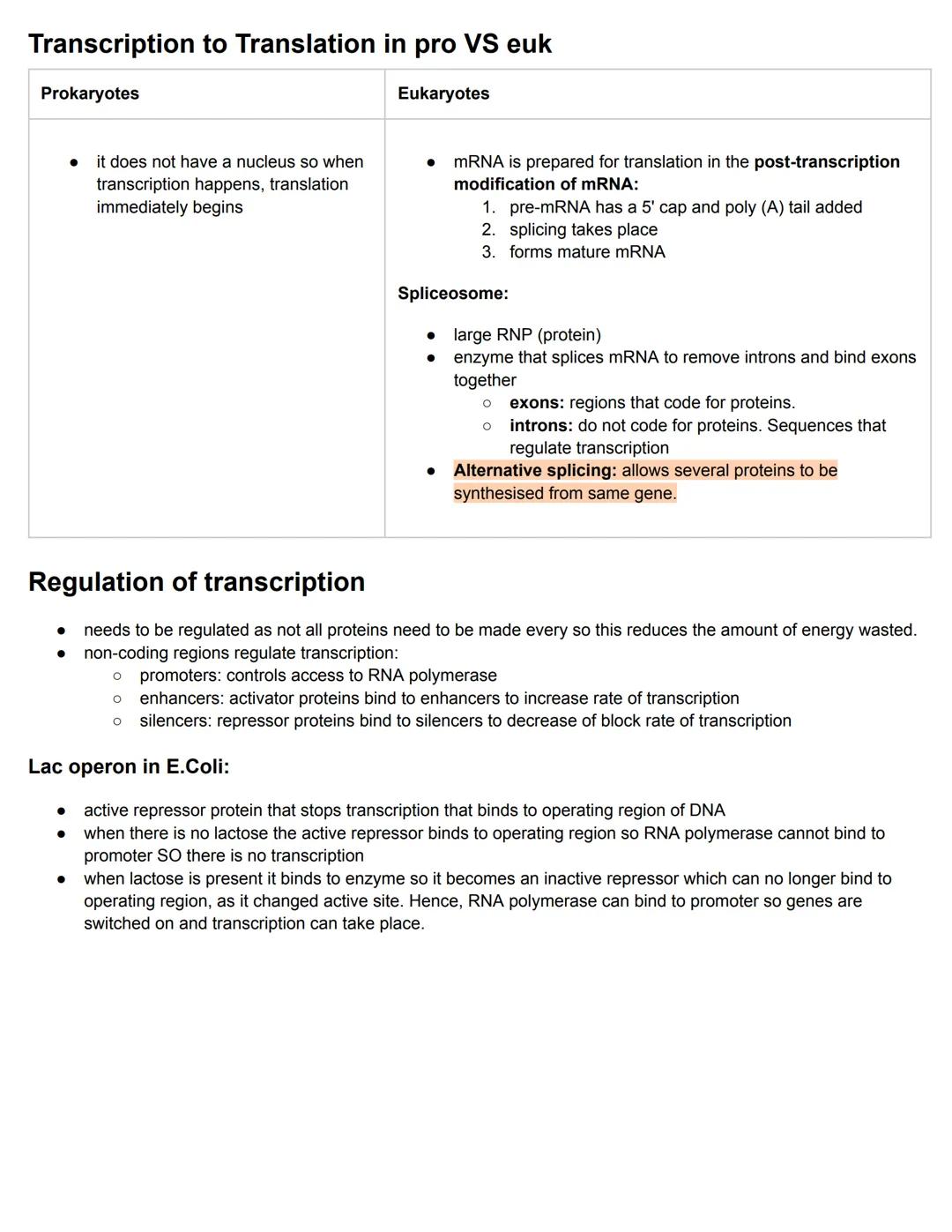
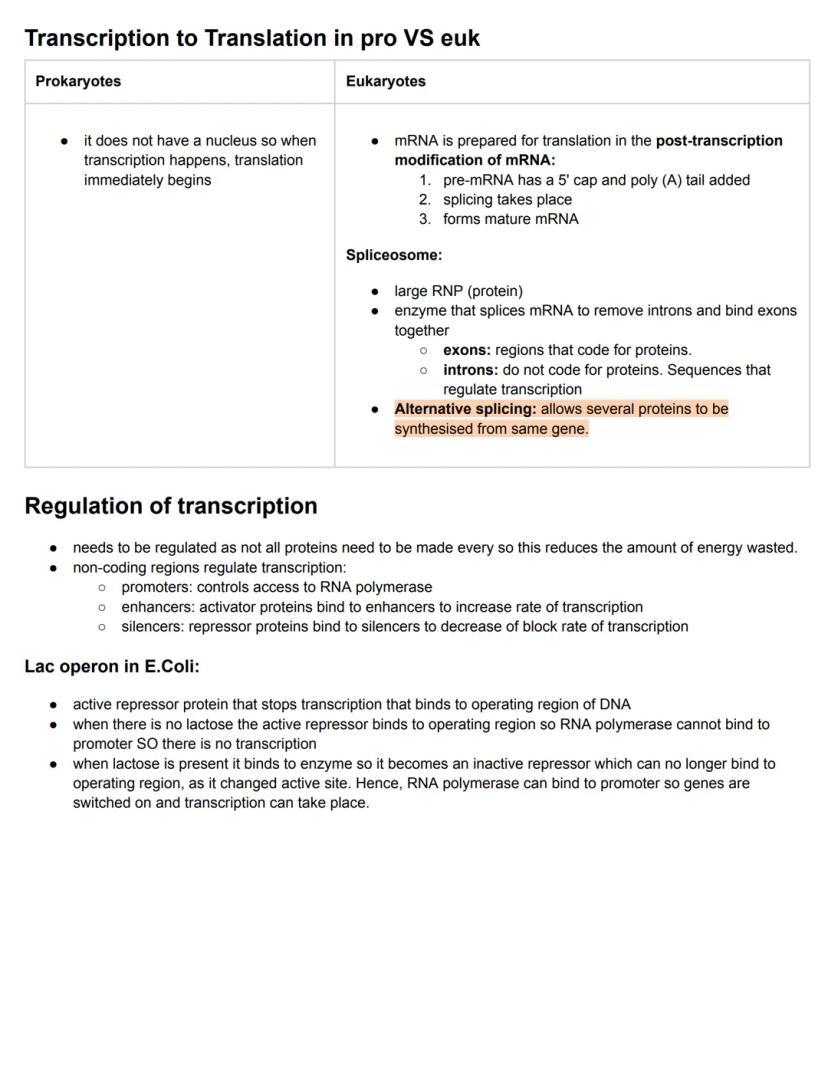
Prokaryotes and eukaryotes handle transcription very differently. In prokaryotes, translation starts immediately because there's no nucleus to separate the processes.
Eukaryotes need post-transcriptional modification - the initial pre-mRNA gets a 5' cap and poly(A) tail added for protection, then splicing removes introns and joins exons (coding sequences) together.
Spliceosomes are the molecular machines that do this cutting and pasting. Alternative splicing is brilliant because it lets one gene make several different proteins by including different combinations of exons.
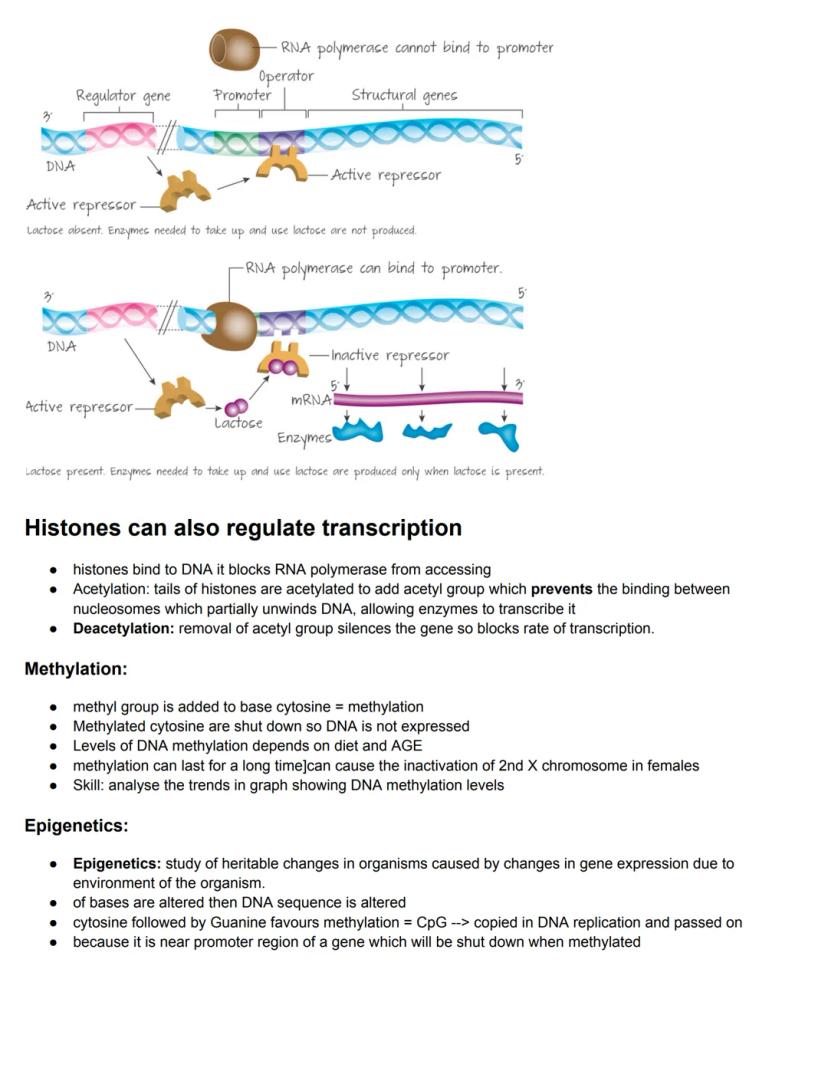
The lac operon in bacteria shows how gene regulation works. When lactose is absent, a repressor protein blocks RNA polymerase from accessing the promoter. When lactose appears, it binds to the repressor, changing its shape so transcription can proceed.
Cool Fact: Alternative splicing means humans can make over 100,000 different proteins from only about 20,000 genes!
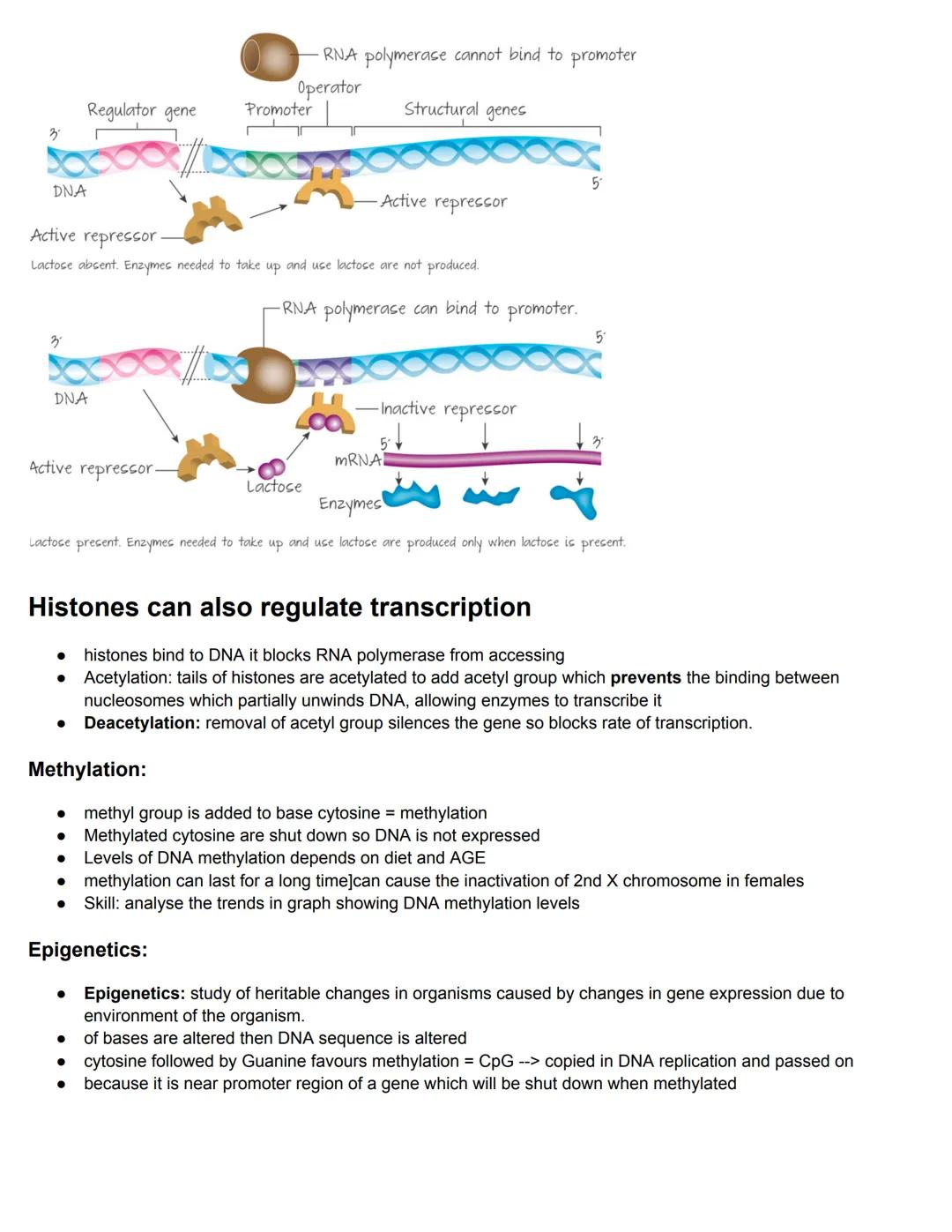
Histones aren't just DNA packaging - they're also gene switches! Acetylation adds acetyl groups to histone tails, loosening DNA packing so genes can be transcribed. Deacetylation does the opposite, silencing genes.
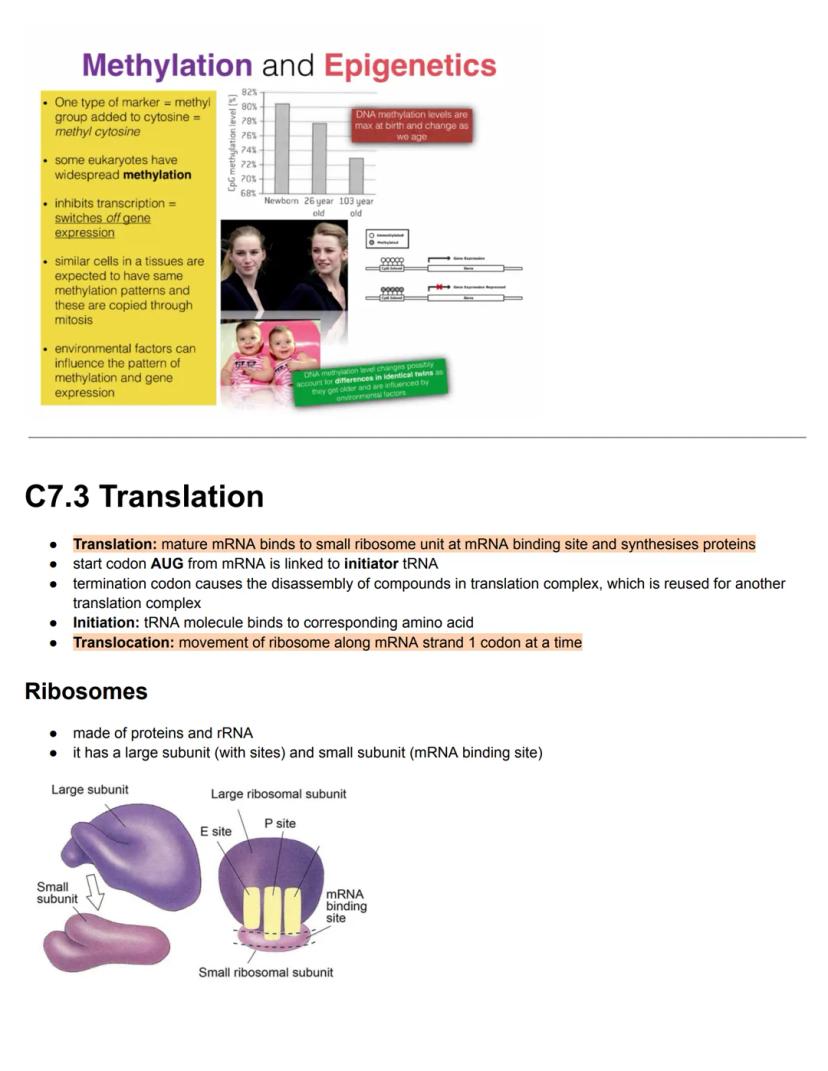
DNA methylation involves adding methyl groups to cytosine bases, particularly in CpG sequences near promoter regions. Methylated genes get switched off and stay off, even through cell divisions.
Epigenetics studies how environmental factors can change gene expression without altering the actual DNA sequence. Your diet, age, and lifestyle can influence methylation patterns, affecting which genes are active.
These changes can be inherited, which explains why identical twins can become more different as they age. DNA methylation levels are highest at birth and change throughout your lifetime.
Mind-Blowing: Your grandmother's diet during pregnancy might have affected your dad's genes, which could influence your health today!
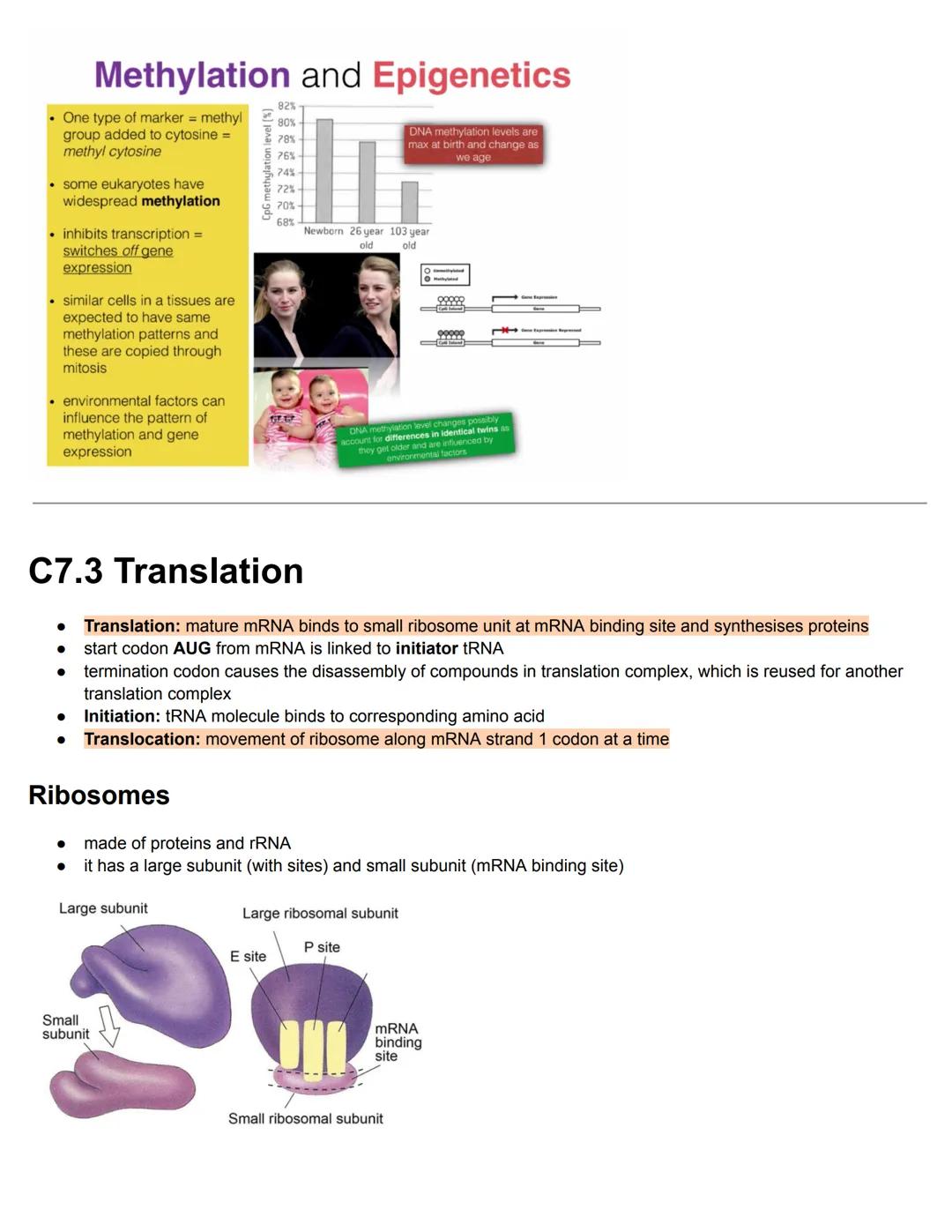
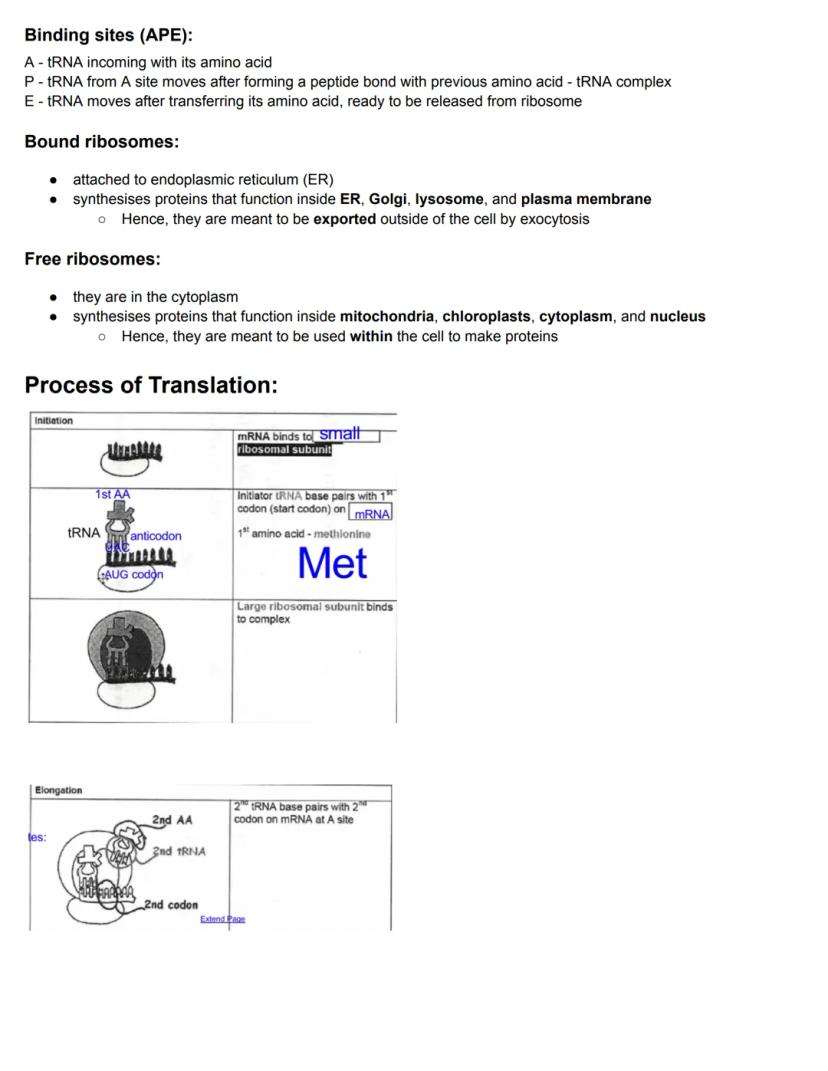
Translation is where mRNA finally becomes protein. Ribosomes are the protein factories, made of rRNA and proteins, with a small subunit that binds mRNA and a large subunit with three crucial binding sites.
The ribosome's A, P, and E sites work like a conveyor belt: tRNA enters at A (aminoacyl), moves to P (peptidyl) after forming peptide bonds, then exits at E (exit). It's a beautifully coordinated dance!
Bound ribosomes attach to the endoplasmic reticulum and make proteins destined for export or membrane insertion. Free ribosomes float in the cytoplasm and make proteins that stay inside the cell.
Translation starts when mRNA binds to the small ribosomal subunit, and the first tRNA (carrying methionine) pairs with the start codon AUG. The large subunit then joins to complete the ribosome.
Remember: Every protein in every organism starts with methionine - it's like the universal "start here" signal!
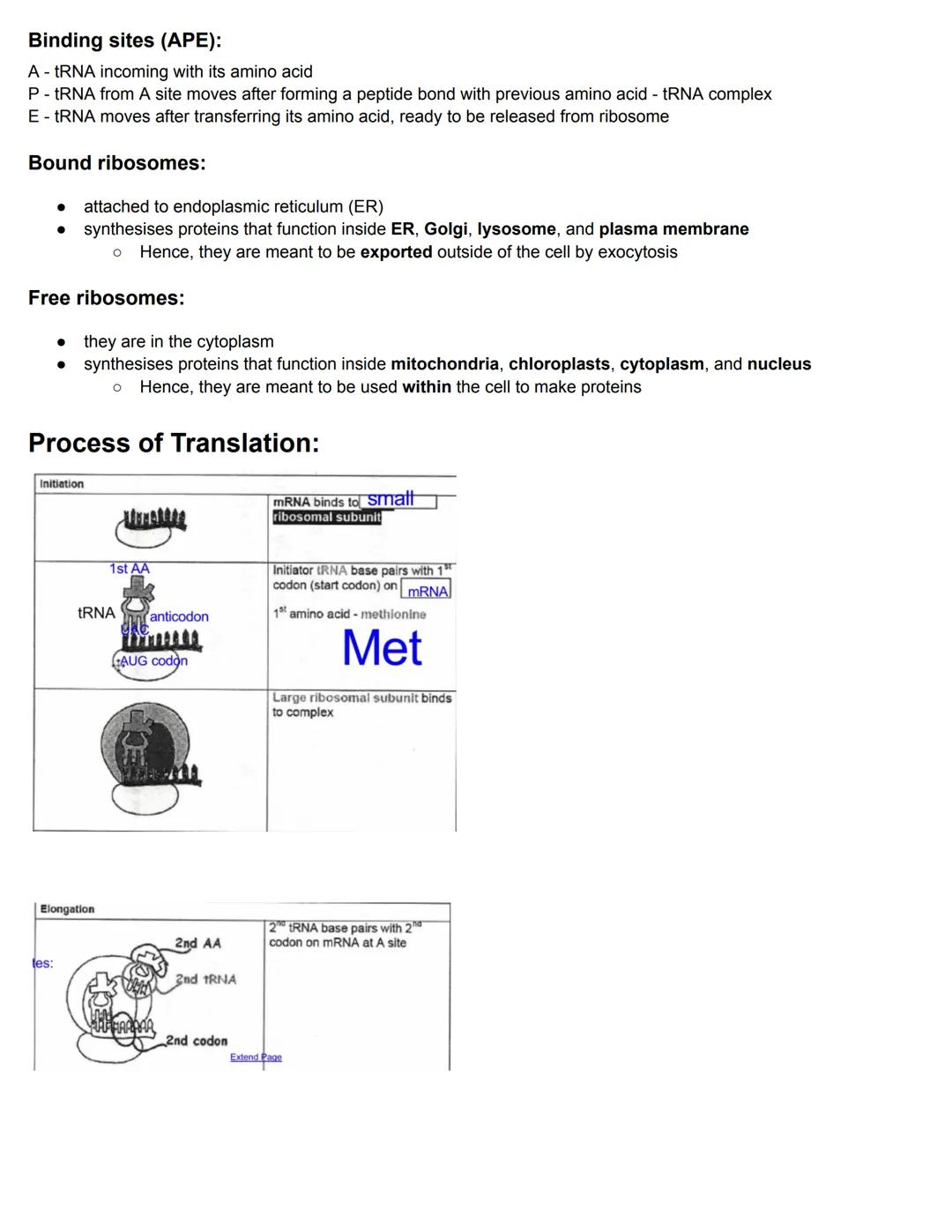
Translation initiation begins when the initiator tRNA carrying methionine base-pairs with the AUG start codon. The large ribosomal subunit then binds to form the complete translation complex.
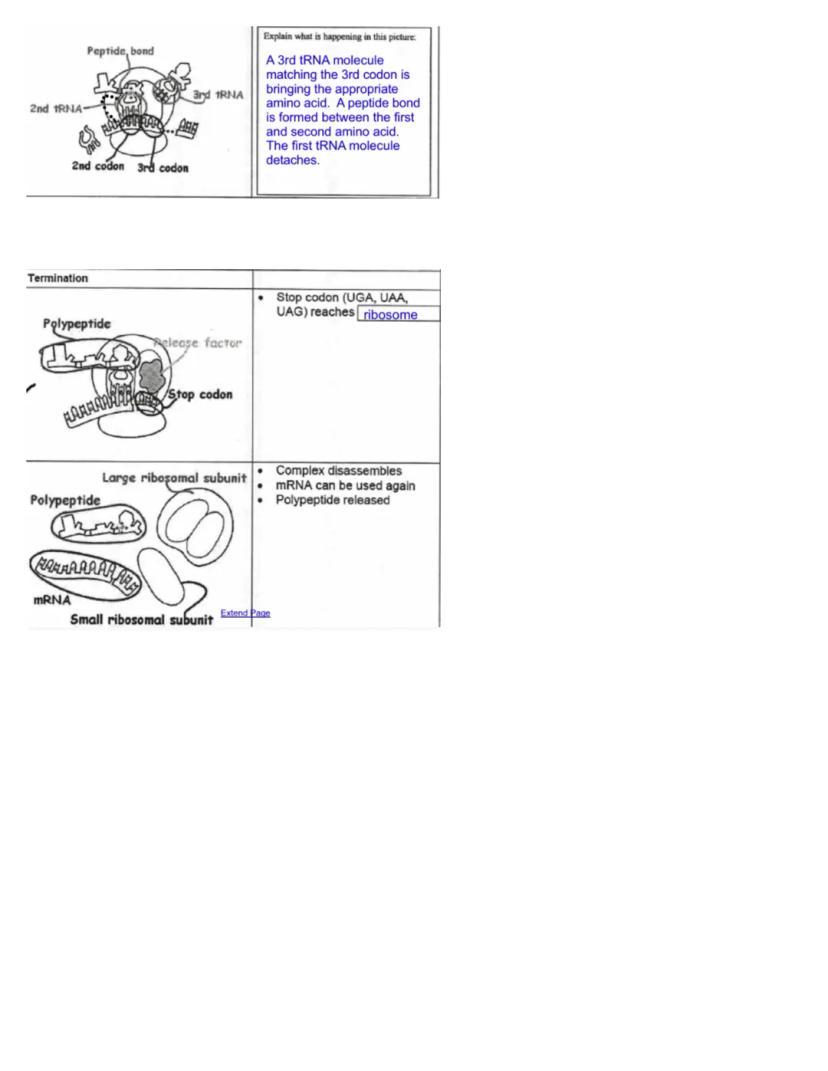
During elongation, tRNA molecules bring amino acids to the A site, where they match their anticodons with mRNA codons. Peptide bonds form between adjacent amino acids as the ribosome moves along the mRNA.
The process involves translocation - the ribosome shifts one codon at a time, moving tRNA from A to P to E sites. Used tRNA molecules exit at the E site and can be recycled for another round.
Each step requires energy and precise coordination. The growing polypeptide chain emerges from the ribosome and begins folding into its final protein shape even before translation finishes.
Efficiency Tip: One mRNA can have multiple ribosomes translating it simultaneously, making lots of protein copies quickly!
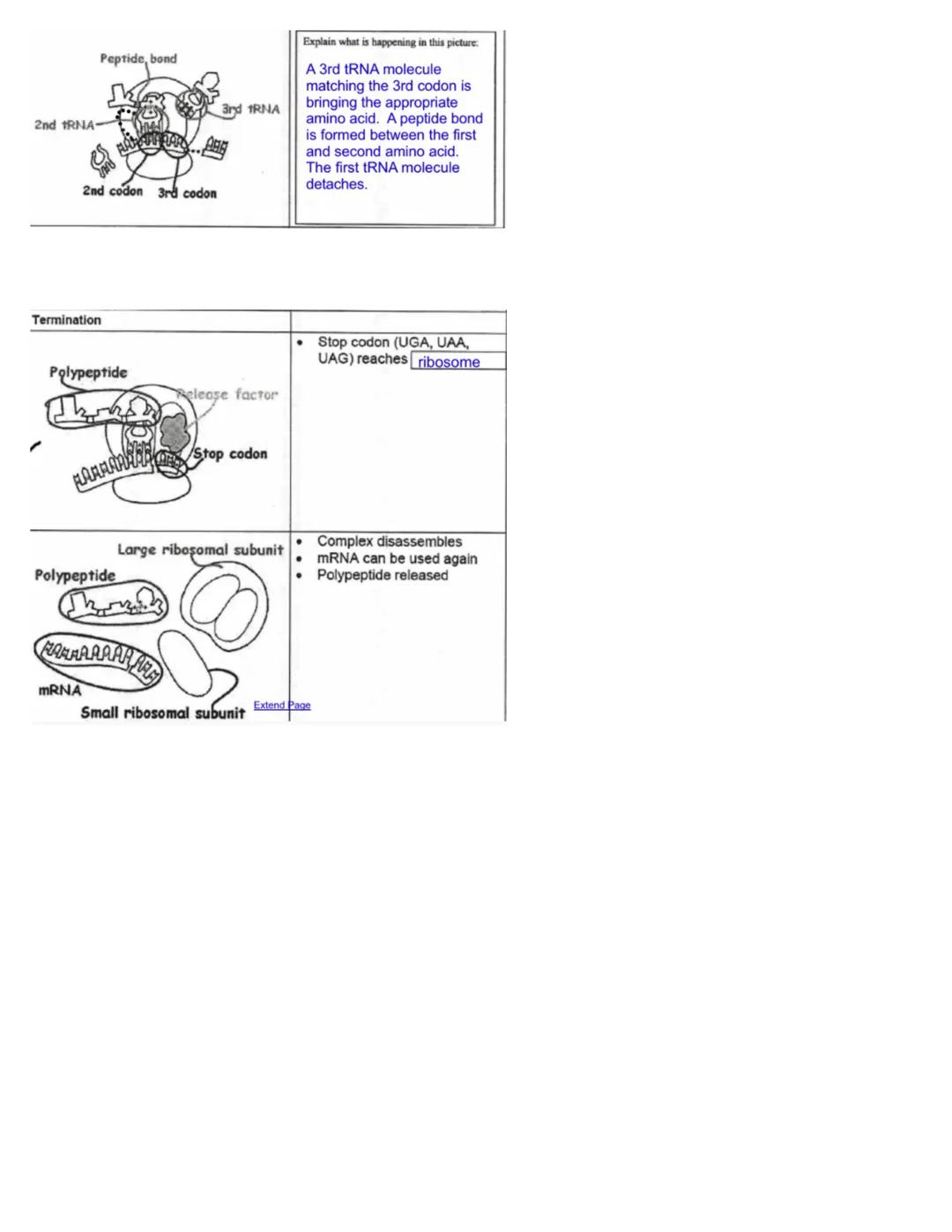
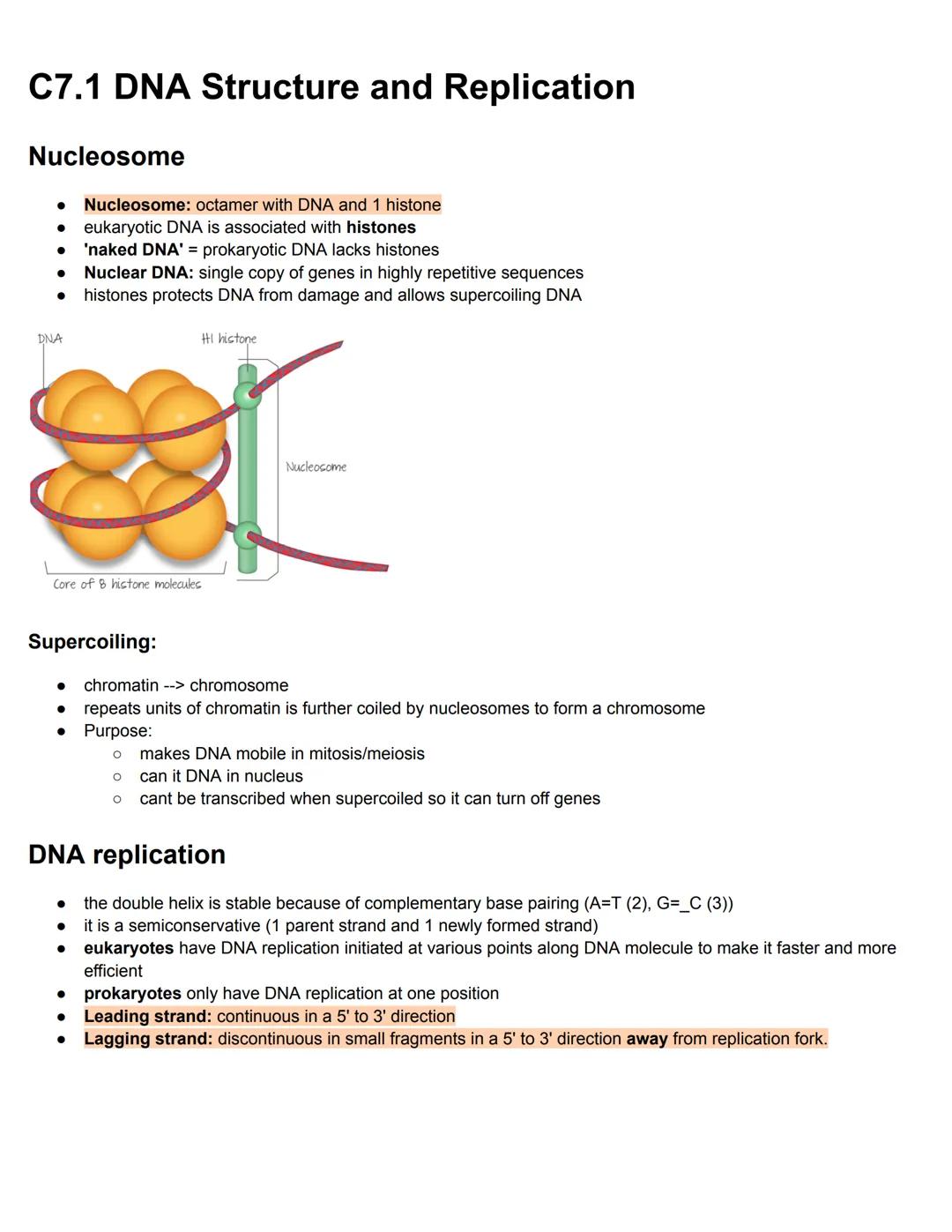
Translation termination happens when a stop codon (UAG, UAA, or UGA) enters the ribosome's A site. These don't code for amino acids - instead, release factors recognise them and trigger disassembly.
The completed polypeptide gets released, and the ribosomal subunits separate from the mRNA. Everything can be recycled for another round of protein synthesis, making the process incredibly efficient.
The translation complex disassembles in an organised way, with the mRNA remaining intact and ready for more ribosomes to use. This means one mRNA molecule can produce many copies of the same protein.
Once released, the new protein may need additional modifications like folding assistance from chaperones or chemical modifications before it becomes fully functional.
Final Thought: From DNA to protein, this entire process happens thousands of times per second in your cells - it's molecular machinery at its finest!
Our AI companion is specifically built for the needs of students. Based on the millions of content pieces we have on the platform we can provide truly meaningful and relevant answers to students. But its not only about answers, the companion is even more about guiding students through their daily learning challenges, with personalised study plans, quizzes or content pieces in the chat and 100% personalisation based on the students skills and developments.
You can download the app in the Google Play Store and in the Apple App Store.
That's right! Enjoy free access to study content, connect with fellow students, and get instant help – all at your fingertips.
App Store
Google Play
The app is very easy to use and well designed. I have found everything I was looking for so far and have been able to learn a lot from the presentations! I will definitely use the app for a class assignment! And of course it also helps a lot as an inspiration.
Stefan S
iOS user
This app is really great. There are so many study notes and help [...]. My problem subject is French, for example, and the app has so many options for help. Thanks to this app, I have improved my French. I would recommend it to anyone.
Samantha Klich
Android user
Wow, I am really amazed. I just tried the app because I've seen it advertised many times and was absolutely stunned. This app is THE HELP you want for school and above all, it offers so many things, such as workouts and fact sheets, which have been VERY helpful to me personally.
Anna
iOS user
I think it’s very much worth it and you’ll end up using it a lot once you get the hang of it and even after looking at others notes you can still ask your Artificial intelligence buddy the question and ask to simplify it if you still don’t get it!!! In the end I think it’s worth it 😊👍 ⚠️Also DID I MENTION ITS FREEE YOU DON’T HAVE TO PAY FOR ANYTHING AND STILL GET YOUR GRADES IN PERFECTLY❗️❗️⚠️
Thomas R
iOS user
Knowunity is the BEST app I’ve used in a minute. This is not an ai review or anything this is genuinely coming from a 7th grade student (I know 2011 im young) but dude this app is a 10/10 i have maintained a 3.8 gpa and have plenty of time for gaming. I love it and my mom is just happy I got good grades
Brad T
Android user
Not only did it help me find the answer but it also showed me alternative ways to solve it. I was horrible in math and science but now I have an a in both subjects. Thanks for the help🤍🤍
David K
iOS user
The app's just great! All I have to do is enter the topic in the search bar and I get the response real fast. I don't have to watch 10 YouTube videos to understand something, so I'm saving my time. Highly recommended!
Sudenaz Ocak
Android user
In school I was really bad at maths but thanks to the app, I am doing better now. I am so grateful that you made the app.
Greenlight Bonnie
Android user
I found this app a couple years ago and it has only gotten better since then. I really love it because it can help with written questions and photo questions. Also, it can find study guides that other people have made as well as flashcard sets and practice tests. The free version is also amazing for students who might not be able to afford it. Would 100% recommend
Aubrey
iOS user
Best app if you're in Highschool or Junior high. I have been using this app for 2 school years and it's the best, it's good if you don't have anyone to help you with school work.😋🩷🎀
Marco B
iOS user
THE QUIZES AND FLASHCARDS ARE SO USEFUL AND I LOVE THE SCHOOLGPT. IT ALSO IS LITREALLY LIKE CHATGPT BUT SMARTER!! HELPED ME WITH MY MASCARA PROBLEMS TOO!! AS WELL AS MY REAL SUBJECTS ! DUHHH 😍😁😲🤑💗✨🎀😮
Elisha
iOS user
This app is phenomenal down to the correct info and the various topics you can study! I greatly recommend it for people who struggle with procrastination and those who need homework help. It has been perfectly accurate for world 1 history as far as I’ve seen! Geometry too!
Paul T
iOS user
The app is very easy to use and well designed. I have found everything I was looking for so far and have been able to learn a lot from the presentations! I will definitely use the app for a class assignment! And of course it also helps a lot as an inspiration.
Stefan S
iOS user
This app is really great. There are so many study notes and help [...]. My problem subject is French, for example, and the app has so many options for help. Thanks to this app, I have improved my French. I would recommend it to anyone.
Samantha Klich
Android user
Wow, I am really amazed. I just tried the app because I've seen it advertised many times and was absolutely stunned. This app is THE HELP you want for school and above all, it offers so many things, such as workouts and fact sheets, which have been VERY helpful to me personally.
Anna
iOS user
I think it’s very much worth it and you’ll end up using it a lot once you get the hang of it and even after looking at others notes you can still ask your Artificial intelligence buddy the question and ask to simplify it if you still don’t get it!!! In the end I think it’s worth it 😊👍 ⚠️Also DID I MENTION ITS FREEE YOU DON’T HAVE TO PAY FOR ANYTHING AND STILL GET YOUR GRADES IN PERFECTLY❗️❗️⚠️
Thomas R
iOS user
Knowunity is the BEST app I’ve used in a minute. This is not an ai review or anything this is genuinely coming from a 7th grade student (I know 2011 im young) but dude this app is a 10/10 i have maintained a 3.8 gpa and have plenty of time for gaming. I love it and my mom is just happy I got good grades
Brad T
Android user
Not only did it help me find the answer but it also showed me alternative ways to solve it. I was horrible in math and science but now I have an a in both subjects. Thanks for the help🤍🤍
David K
iOS user
The app's just great! All I have to do is enter the topic in the search bar and I get the response real fast. I don't have to watch 10 YouTube videos to understand something, so I'm saving my time. Highly recommended!
Sudenaz Ocak
Android user
In school I was really bad at maths but thanks to the app, I am doing better now. I am so grateful that you made the app.
Greenlight Bonnie
Android user
I found this app a couple years ago and it has only gotten better since then. I really love it because it can help with written questions and photo questions. Also, it can find study guides that other people have made as well as flashcard sets and practice tests. The free version is also amazing for students who might not be able to afford it. Would 100% recommend
Aubrey
iOS user
Best app if you're in Highschool or Junior high. I have been using this app for 2 school years and it's the best, it's good if you don't have anyone to help you with school work.😋🩷🎀
Marco B
iOS user
THE QUIZES AND FLASHCARDS ARE SO USEFUL AND I LOVE THE SCHOOLGPT. IT ALSO IS LITREALLY LIKE CHATGPT BUT SMARTER!! HELPED ME WITH MY MASCARA PROBLEMS TOO!! AS WELL AS MY REAL SUBJECTS ! DUHHH 😍😁😲🤑💗✨🎀😮
Elisha
iOS user
This app is phenomenal down to the correct info and the various topics you can study! I greatly recommend it for people who struggle with procrastination and those who need homework help. It has been perfectly accurate for world 1 history as far as I’ve seen! Geometry too!
Paul T
iOS user
Cami Carbo
@camicarbo123
DNA isn't just floating around randomly in your cells - it's carefully packaged, copied, and used to make proteins through some pretty clever processes. Understanding how DNA gets organised, replicated, and turned into the proteins that keep you alive is... Show more
Access to all documents
Improve your grades
Join milions of students
By signing up you accept Terms of Service and Privacy Policy
Your DNA needs to fit inside a tiny cell nucleus, which is like cramming 3 metres of thread into a space the size of a pinhead! Nucleosomes are the solution - they're like molecular spools where DNA wraps around eight histone proteins.
Think of histones as protective packaging that keeps DNA safe from damage and allows it to coil up super tightly. This process is called supercoiling, and it's brilliant because it makes DNA compact enough for cell division and can even switch genes off when they're not needed.
DNA replication follows the semiconservative model - each new DNA molecule contains one original strand and one newly made strand. The process happens much faster in eukaryotes because it starts at multiple points along the chromosome, whilst prokaryotes only start from one spot.
Key Point: The leading strand copies continuously in the 5' to 3' direction, but the lagging strand has to copy in short fragments called Okazaki fragments because DNA can only be built in one direction.
Access to all documents
Improve your grades
Join milions of students
By signing up you accept Terms of Service and Privacy Policy
The DNA replication machinery works like a well-coordinated factory line. RNA primase starts things off by adding short RNA primers, giving DNA polymerase III something to grab onto as it adds new nucleotides.
On the leading strand, replication flows smoothly in one direction. But the lagging strand is trickier - it creates Okazaki fragments that need to be stitched together by DNA ligase after DNA polymerase I removes the RNA primers.
DNA sequencing uses a clever trick called the dideoxy method. Scientists add special nucleotides without the crucial 3'OH group, which stops replication dead in its tracks. Each base gets a different coloured fluorescent tag, so when replication stops, they can see exactly which base caused it.
Remember: DNA polymerase absolutely needs that 3'OH group to keep adding nucleotides - it's like needing the right connector to plug in the next piece!
Access to all documents
Improve your grades
Join milions of students
By signing up you accept Terms of Service and Privacy Policy
Not all your DNA codes for proteins - loads of it has other crucial jobs! Non-coding regions include promoters that tell RNA polymerase where to start, enhancers that speed up gene expression, and silencers that slow it down.
Tandem repeats are like DNA's fingerprint - short sequences that repeat different numbers of times in different people. These repeats are why DNA profiling works so well for identification, since everyone has their own unique pattern.
The process involves extracting DNA, amplifying it using PCR, then separating the fragments by electrophoresis. Telomeres are special tandem repeats that protect chromosome ends, getting shorter each time cells divide.
Rosalind Franklin used X-ray diffraction to photograph DNA crystals, creating the famous 'Photo 51' that proved DNA's helical structure. Her work was absolutely crucial for Watson and Crick's double helix model.
Fun Fact: Your tandem repeats are so unique that the chances of two unrelated people having identical patterns are about 1 in several billion!
Access to all documents
Improve your grades
Join milions of students
By signing up you accept Terms of Service and Privacy Policy
The Hershey-Chase experiment brilliantly proved that DNA, not protein, carries genetic information. They used the fact that DNA contains phosphorus but no sulfur, whilst proteins contain sulfur but no phosphorus.
Using bacteriophages (viruses that infect bacteria), they created two versions - one with radioactive phosphorus in the DNA and another with radioactive sulfur in the protein coat. When the virus infected bacteria, only the DNA entered the cell whilst the protein coat stayed outside.
The results were crystal clear: bacteria infected with radioactive DNA became radioactive and passed this to their offspring. But bacteria infected with viruses having radioactive protein coats showed no radioactivity inside the cells.
This experiment was a game-changer because it definitively settled the debate about what genetic material actually was, paving the way for all modern molecular biology.
Think About It: Before this experiment, many scientists thought proteins were too complex to be genetic material - DNA seemed too simple!
Access to all documents
Improve your grades
Join milions of students
By signing up you accept Terms of Service and Privacy Policy
Transcription is where your DNA recipe gets copied into mRNA so it can leave the nucleus. RNA polymerase does all the heavy lifting, binding to the promoter region and unwinding the DNA strands.
The process has three clear stages: initiation (RNA polymerase binds and starts), elongation (mRNA grows as nucleotides are added in the 5' to 3' direction), and termination (everything detaches when the stop signal is reached).
Only the antisense strand gets transcribed - think of it as the template that creates a complementary mRNA copy. The sense strand has the same sequence as the mRNA (except T instead of U).
RNA polymerase reads the DNA template and adds complementary ribonucleotide triphosphates, building the mRNA molecule one base at a time until it hits the termination sequence.
Key Difference: Unlike DNA replication, transcription only copies one strand and doesn't need a primer to get started!
Access to all documents
Improve your grades
Join milions of students
By signing up you accept Terms of Service and Privacy Policy
Prokaryotes and eukaryotes handle transcription very differently. In prokaryotes, translation starts immediately because there's no nucleus to separate the processes.
Eukaryotes need post-transcriptional modification - the initial pre-mRNA gets a 5' cap and poly(A) tail added for protection, then splicing removes introns and joins exons (coding sequences) together.
Spliceosomes are the molecular machines that do this cutting and pasting. Alternative splicing is brilliant because it lets one gene make several different proteins by including different combinations of exons.
The lac operon in bacteria shows how gene regulation works. When lactose is absent, a repressor protein blocks RNA polymerase from accessing the promoter. When lactose appears, it binds to the repressor, changing its shape so transcription can proceed.
Cool Fact: Alternative splicing means humans can make over 100,000 different proteins from only about 20,000 genes!
Access to all documents
Improve your grades
Join milions of students
By signing up you accept Terms of Service and Privacy Policy
Histones aren't just DNA packaging - they're also gene switches! Acetylation adds acetyl groups to histone tails, loosening DNA packing so genes can be transcribed. Deacetylation does the opposite, silencing genes.
DNA methylation involves adding methyl groups to cytosine bases, particularly in CpG sequences near promoter regions. Methylated genes get switched off and stay off, even through cell divisions.
Epigenetics studies how environmental factors can change gene expression without altering the actual DNA sequence. Your diet, age, and lifestyle can influence methylation patterns, affecting which genes are active.
These changes can be inherited, which explains why identical twins can become more different as they age. DNA methylation levels are highest at birth and change throughout your lifetime.
Mind-Blowing: Your grandmother's diet during pregnancy might have affected your dad's genes, which could influence your health today!
Access to all documents
Improve your grades
Join milions of students
By signing up you accept Terms of Service and Privacy Policy
Translation is where mRNA finally becomes protein. Ribosomes are the protein factories, made of rRNA and proteins, with a small subunit that binds mRNA and a large subunit with three crucial binding sites.
The ribosome's A, P, and E sites work like a conveyor belt: tRNA enters at A (aminoacyl), moves to P (peptidyl) after forming peptide bonds, then exits at E (exit). It's a beautifully coordinated dance!
Bound ribosomes attach to the endoplasmic reticulum and make proteins destined for export or membrane insertion. Free ribosomes float in the cytoplasm and make proteins that stay inside the cell.
Translation starts when mRNA binds to the small ribosomal subunit, and the first tRNA (carrying methionine) pairs with the start codon AUG. The large subunit then joins to complete the ribosome.
Remember: Every protein in every organism starts with methionine - it's like the universal "start here" signal!
Access to all documents
Improve your grades
Join milions of students
By signing up you accept Terms of Service and Privacy Policy
Translation initiation begins when the initiator tRNA carrying methionine base-pairs with the AUG start codon. The large ribosomal subunit then binds to form the complete translation complex.
During elongation, tRNA molecules bring amino acids to the A site, where they match their anticodons with mRNA codons. Peptide bonds form between adjacent amino acids as the ribosome moves along the mRNA.
The process involves translocation - the ribosome shifts one codon at a time, moving tRNA from A to P to E sites. Used tRNA molecules exit at the E site and can be recycled for another round.
Each step requires energy and precise coordination. The growing polypeptide chain emerges from the ribosome and begins folding into its final protein shape even before translation finishes.
Efficiency Tip: One mRNA can have multiple ribosomes translating it simultaneously, making lots of protein copies quickly!
Access to all documents
Improve your grades
Join milions of students
By signing up you accept Terms of Service and Privacy Policy
Translation termination happens when a stop codon (UAG, UAA, or UGA) enters the ribosome's A site. These don't code for amino acids - instead, release factors recognise them and trigger disassembly.
The completed polypeptide gets released, and the ribosomal subunits separate from the mRNA. Everything can be recycled for another round of protein synthesis, making the process incredibly efficient.
The translation complex disassembles in an organised way, with the mRNA remaining intact and ready for more ribosomes to use. This means one mRNA molecule can produce many copies of the same protein.
Once released, the new protein may need additional modifications like folding assistance from chaperones or chemical modifications before it becomes fully functional.
Final Thought: From DNA to protein, this entire process happens thousands of times per second in your cells - it's molecular machinery at its finest!
Our AI companion is specifically built for the needs of students. Based on the millions of content pieces we have on the platform we can provide truly meaningful and relevant answers to students. But its not only about answers, the companion is even more about guiding students through their daily learning challenges, with personalised study plans, quizzes or content pieces in the chat and 100% personalisation based on the students skills and developments.
You can download the app in the Google Play Store and in the Apple App Store.
That's right! Enjoy free access to study content, connect with fellow students, and get instant help – all at your fingertips.
2
Smart Tools NEW
Transform this note into: ✓ 50+ Practice Questions ✓ Interactive Flashcards ✓ Full Mock Exam ✓ Essay Outlines
Explore essential topics in Human Cells, including enzyme regulation, DNA replication, ATP production, and the role of stem cells. This comprehensive overview covers metabolic pathways, gene expression, and the functions of various cell types, providing a solid foundation for understanding cellular biology. Ideal for exam preparation and deepening your knowledge in higher human biology.
 Biology
Explore the essential concepts of DNA structure and replication, including the roles of DNA polymerase, Okazaki fragments, and the polymerase chain reaction (PCR). This summary covers key processes such as base pairing, leading and lagging strands, and the significance of nucleotides in genetic coding. Ideal for students studying higher human biology.
BiologyExplore key concepts in DNA structure, replication, gene expression, and evolution. This comprehensive summary covers genetic mutations, protein synthesis, and genomic sequencing, providing essential insights for SQA Higher Biology Unit 1. Ideal for students seeking to understand the intricacies of genetics and evolution.
BiologyExplore the processes of DNA transcription and translation in this detailed summary. Understand the roles of mRNA, tRNA, and ribosomes in protein synthesis, including the significance of splicing and the impact of introns on protein function. Ideal for AQA A-Level Biology students.
BiologyExplore key concepts in cell biology, including cancer mechanisms, mitosis and meiosis processes, and the role of stem cells in differentiation. This summary provides insights into somatic and germline cells, cellular differentiation, and the ethical considerations surrounding embryonic stem cell research. Ideal for students studying higher human biology.
BiologyExplore the intricate structure and lifecycle of viruses in this detailed mindmap. Understand key concepts such as viral replication, infection stages, and the role of genetic material. Ideal for AQA A-level Biology students seeking to grasp the fundamentals of virology.
BiologyApp Store
Google Play
The app is very easy to use and well designed. I have found everything I was looking for so far and have been able to learn a lot from the presentations! I will definitely use the app for a class assignment! And of course it also helps a lot as an inspiration.
Stefan S
iOS user
This app is really great. There are so many study notes and help [...]. My problem subject is French, for example, and the app has so many options for help. Thanks to this app, I have improved my French. I would recommend it to anyone.
Samantha Klich
Android user
Wow, I am really amazed. I just tried the app because I've seen it advertised many times and was absolutely stunned. This app is THE HELP you want for school and above all, it offers so many things, such as workouts and fact sheets, which have been VERY helpful to me personally.
Anna
iOS user
I think it’s very much worth it and you’ll end up using it a lot once you get the hang of it and even after looking at others notes you can still ask your Artificial intelligence buddy the question and ask to simplify it if you still don’t get it!!! In the end I think it’s worth it 😊👍 ⚠️Also DID I MENTION ITS FREEE YOU DON’T HAVE TO PAY FOR ANYTHING AND STILL GET YOUR GRADES IN PERFECTLY❗️❗️⚠️
Thomas R
iOS user
Knowunity is the BEST app I’ve used in a minute. This is not an ai review or anything this is genuinely coming from a 7th grade student (I know 2011 im young) but dude this app is a 10/10 i have maintained a 3.8 gpa and have plenty of time for gaming. I love it and my mom is just happy I got good grades
Brad T
Android user
Not only did it help me find the answer but it also showed me alternative ways to solve it. I was horrible in math and science but now I have an a in both subjects. Thanks for the help🤍🤍
David K
iOS user
The app's just great! All I have to do is enter the topic in the search bar and I get the response real fast. I don't have to watch 10 YouTube videos to understand something, so I'm saving my time. Highly recommended!
Sudenaz Ocak
Android user
In school I was really bad at maths but thanks to the app, I am doing better now. I am so grateful that you made the app.
Greenlight Bonnie
Android user
I found this app a couple years ago and it has only gotten better since then. I really love it because it can help with written questions and photo questions. Also, it can find study guides that other people have made as well as flashcard sets and practice tests. The free version is also amazing for students who might not be able to afford it. Would 100% recommend
Aubrey
iOS user
Best app if you're in Highschool or Junior high. I have been using this app for 2 school years and it's the best, it's good if you don't have anyone to help you with school work.😋🩷🎀
Marco B
iOS user
THE QUIZES AND FLASHCARDS ARE SO USEFUL AND I LOVE THE SCHOOLGPT. IT ALSO IS LITREALLY LIKE CHATGPT BUT SMARTER!! HELPED ME WITH MY MASCARA PROBLEMS TOO!! AS WELL AS MY REAL SUBJECTS ! DUHHH 😍😁😲🤑💗✨🎀😮
Elisha
iOS user
This app is phenomenal down to the correct info and the various topics you can study! I greatly recommend it for people who struggle with procrastination and those who need homework help. It has been perfectly accurate for world 1 history as far as I’ve seen! Geometry too!
Paul T
iOS user
The app is very easy to use and well designed. I have found everything I was looking for so far and have been able to learn a lot from the presentations! I will definitely use the app for a class assignment! And of course it also helps a lot as an inspiration.
Stefan S
iOS user
This app is really great. There are so many study notes and help [...]. My problem subject is French, for example, and the app has so many options for help. Thanks to this app, I have improved my French. I would recommend it to anyone.
Samantha Klich
Android user
Wow, I am really amazed. I just tried the app because I've seen it advertised many times and was absolutely stunned. This app is THE HELP you want for school and above all, it offers so many things, such as workouts and fact sheets, which have been VERY helpful to me personally.
Anna
iOS user
I think it’s very much worth it and you’ll end up using it a lot once you get the hang of it and even after looking at others notes you can still ask your Artificial intelligence buddy the question and ask to simplify it if you still don’t get it!!! In the end I think it’s worth it 😊👍 ⚠️Also DID I MENTION ITS FREEE YOU DON’T HAVE TO PAY FOR ANYTHING AND STILL GET YOUR GRADES IN PERFECTLY❗️❗️⚠️
Thomas R
iOS user
Knowunity is the BEST app I’ve used in a minute. This is not an ai review or anything this is genuinely coming from a 7th grade student (I know 2011 im young) but dude this app is a 10/10 i have maintained a 3.8 gpa and have plenty of time for gaming. I love it and my mom is just happy I got good grades
Brad T
Android user
Not only did it help me find the answer but it also showed me alternative ways to solve it. I was horrible in math and science but now I have an a in both subjects. Thanks for the help🤍🤍
David K
iOS user
The app's just great! All I have to do is enter the topic in the search bar and I get the response real fast. I don't have to watch 10 YouTube videos to understand something, so I'm saving my time. Highly recommended!
Sudenaz Ocak
Android user
In school I was really bad at maths but thanks to the app, I am doing better now. I am so grateful that you made the app.
Greenlight Bonnie
Android user
I found this app a couple years ago and it has only gotten better since then. I really love it because it can help with written questions and photo questions. Also, it can find study guides that other people have made as well as flashcard sets and practice tests. The free version is also amazing for students who might not be able to afford it. Would 100% recommend
Aubrey
iOS user
Best app if you're in Highschool or Junior high. I have been using this app for 2 school years and it's the best, it's good if you don't have anyone to help you with school work.😋🩷🎀
Marco B
iOS user
THE QUIZES AND FLASHCARDS ARE SO USEFUL AND I LOVE THE SCHOOLGPT. IT ALSO IS LITREALLY LIKE CHATGPT BUT SMARTER!! HELPED ME WITH MY MASCARA PROBLEMS TOO!! AS WELL AS MY REAL SUBJECTS ! DUHHH 😍😁😲🤑💗✨🎀😮
Elisha
iOS user
This app is phenomenal down to the correct info and the various topics you can study! I greatly recommend it for people who struggle with procrastination and those who need homework help. It has been perfectly accurate for world 1 history as far as I’ve seen! Geometry too!
Paul T
iOS user