Development Dynamics - The Big Picture
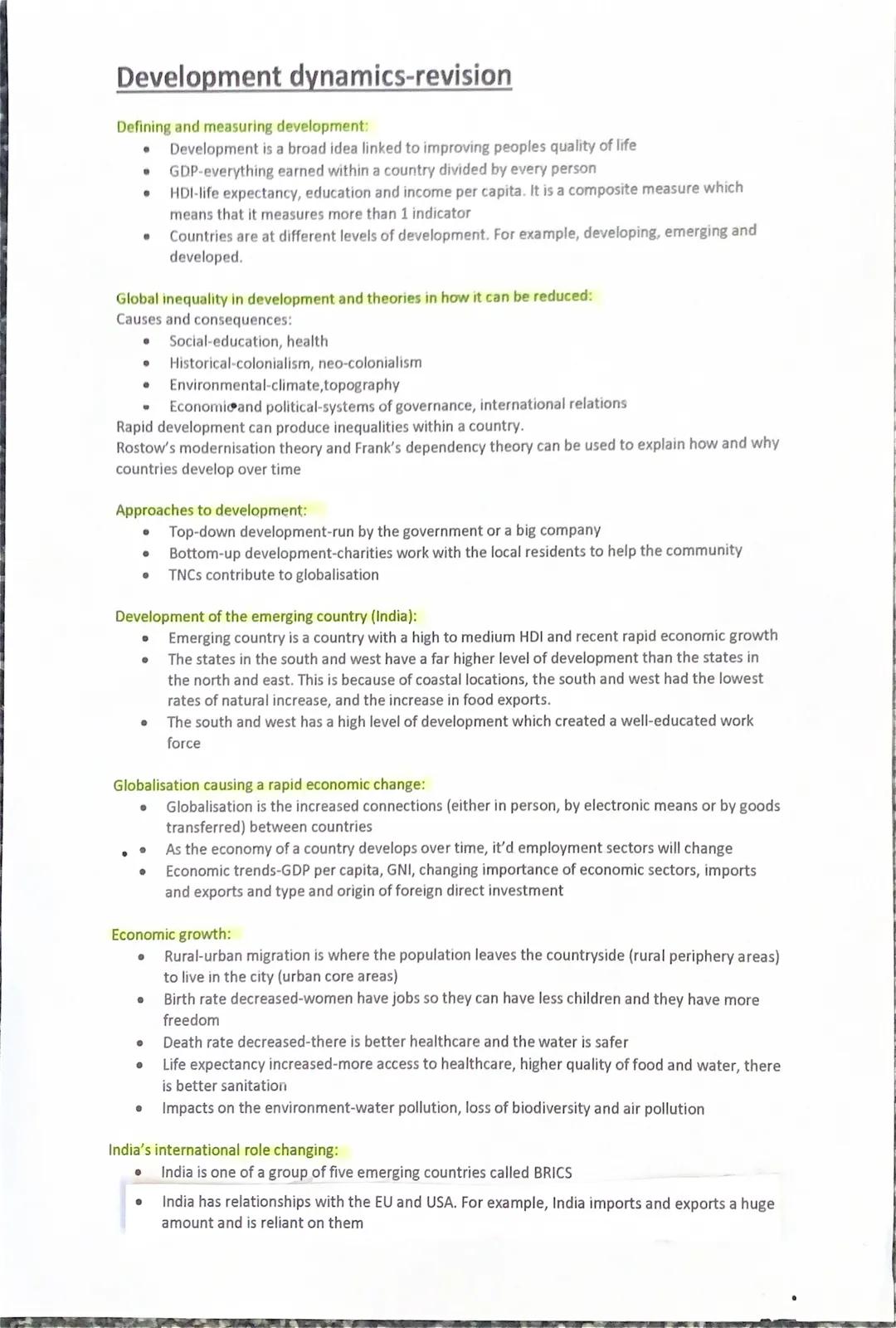
Ever wondered why some countries are wealthy whilst others aren't? Development is all about improving people's quality of life, and we measure it in several ways.
GDP (Gross Domestic Product) shows everything a country earns divided by its population - basically the average income per person. However, money isn't everything, which is why we also use HDI (Human Development Index). This composite measure looks at three things: how long people live, their education levels, and their income.
Countries fall into different development categories. You've got developing countries (lower HDI), emerging countries (rapidly growing economies like India), and developed countries (high HDI with stable economies). Think of it as a ladder - countries are constantly trying to climb up.
Quick Tip: Remember that HDI gives a more complete picture than GDP alone because it includes health and education, not just money.
Global inequality exists due to various factors: social issues (education and health), historical problems (like colonialism), environmental challenges (climate and geography), and economic/political systems. Two main theories explain development: Rostow's modernisation theory suggests all countries follow similar development stages, whilst Frank's dependency theory argues that wealthy countries keep poor ones dependent on them.

 Biology
 English Literature
 Sociology