
Ever wondered how everything around us came to be? The... Show more
 Environmental Science
 Algebra
 Overige
 Algebra 1
Sign up to see the contentIt's free!
Access to all documents
Improve your grades
Join milions of students
By signing up you accept Terms of Service and Privacy Policy
Subjects

Biology

Chemistry
AP Chemistry

English
AP English Literature
166
•
Dec 24, 2025
•

Mark Torosyan
@dilanyanvardanyan_gckv
Ever wondered how everything around us came to be? The... Show more
The formation of our universe and solar system is one of science's most fascinating stories. It's a tale that spans billions of years and helps explain why planets, stars, and galaxies exist as they do today.
You're about to discover how something smaller than a speck of dust expanded to become everything we know, and how a spinning cloud of gas and dust transformed into our sun and planets.
These cosmic origin stories aren't just interesting facts—they help explain fundamental patterns we observe in space and connect directly to why Earth exists as it does today.
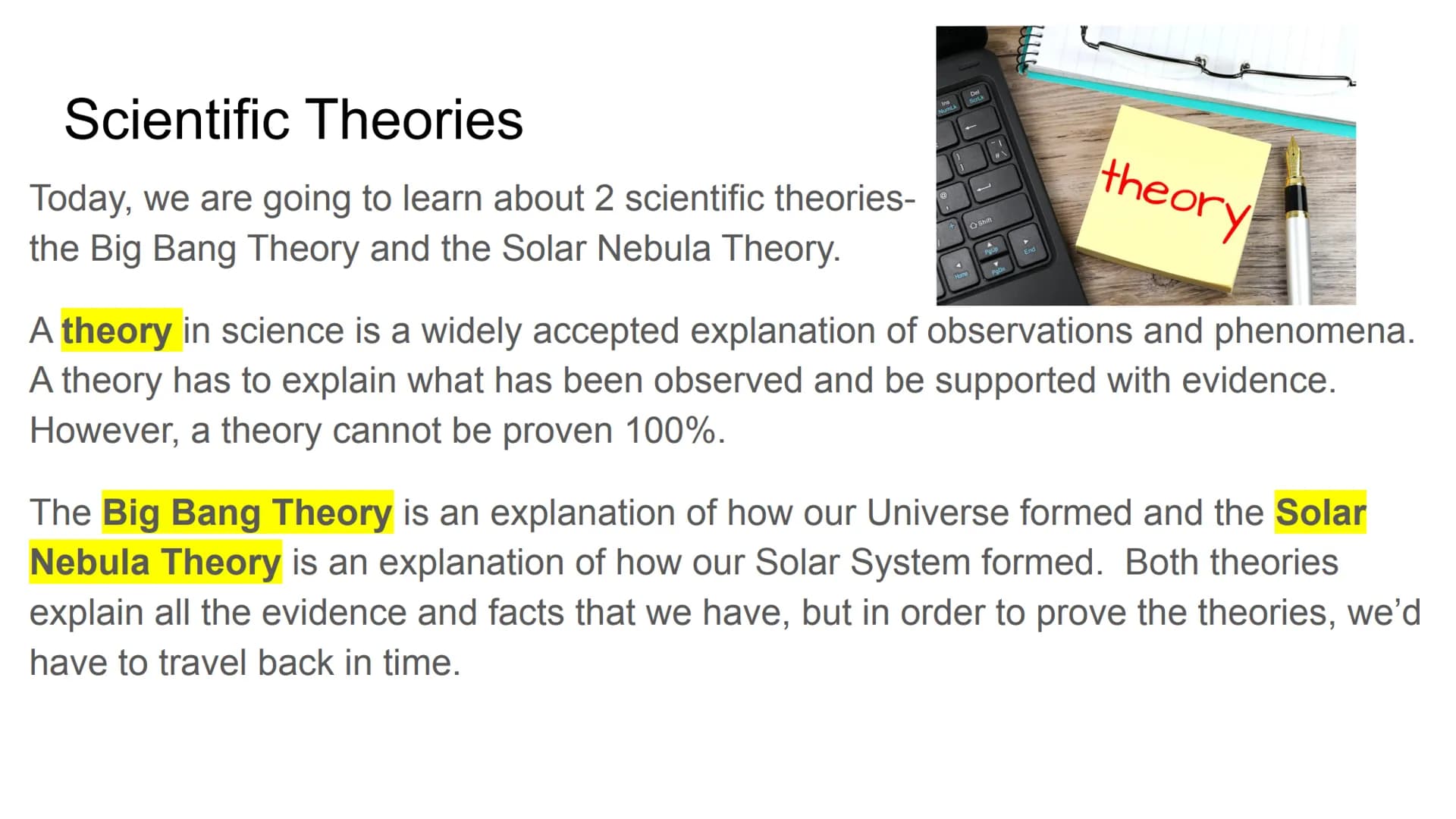
Scientific theories aren't just educated guesses—they're powerful explanations backed by mountains of evidence. The Big Bang Theory and Solar Nebula Theory are two perfect examples.
A scientific theory explains observations and phenomena with substantial supporting evidence. While theories can't be proven with 100% certainty (we can't travel back in time to witness these events!), they represent our best understanding based on all available data.
The Big Bang Theory explains how our entire universe formed, while the Solar Nebula Theory describes how our solar system came together. Both theories fit all observed evidence and help us understand our cosmic origins.
Think of it this way: Scientific theories are like detective work—scientists collect evidence, test explanations, and build models that best explain what we observe today.
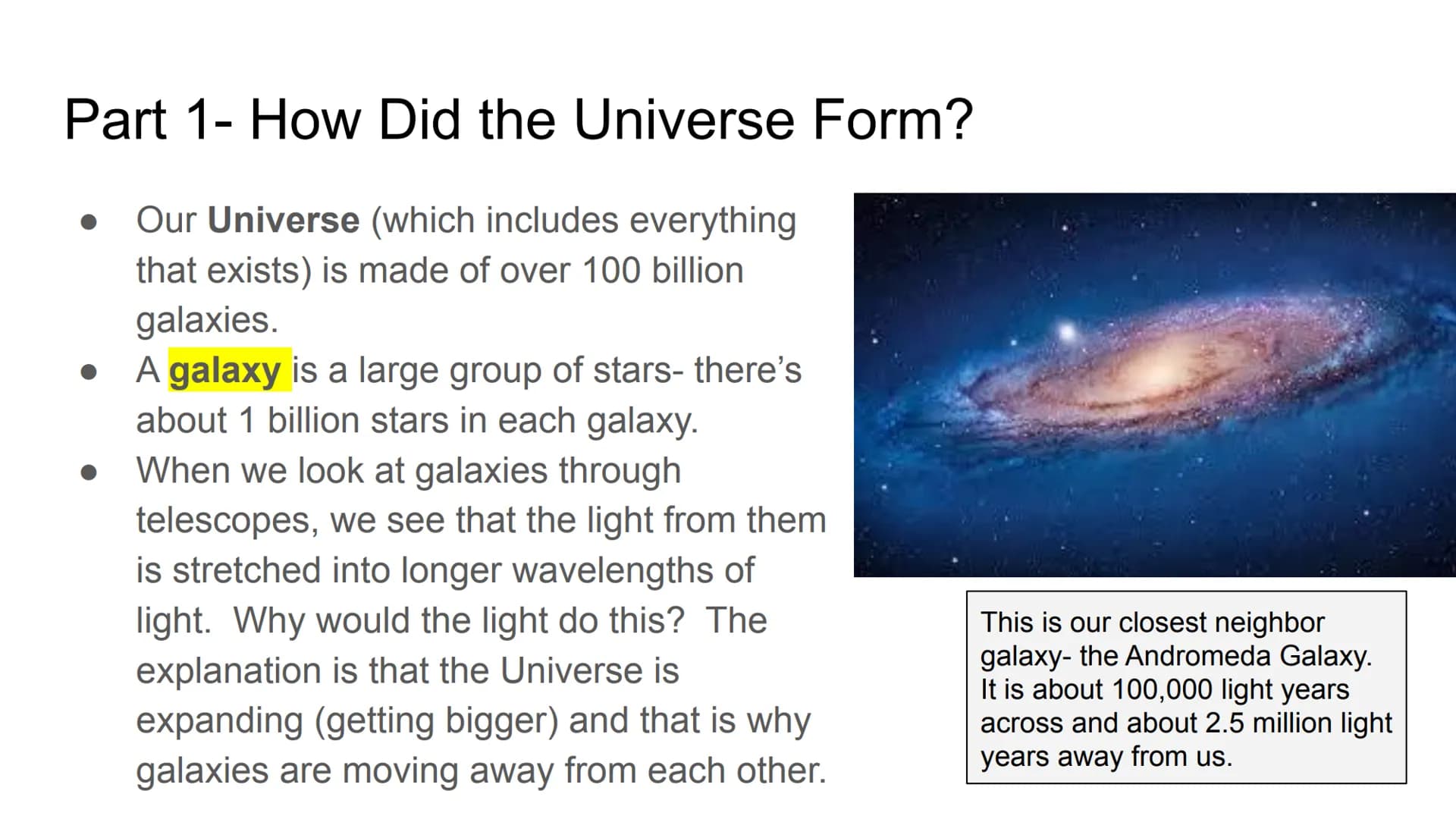
Our universe is mind-blowingly huge! It contains over 100 billion galaxies, each home to roughly a billion stars. That's a lot of cosmic real estate!
When astronomers study distant galaxies through telescopes, they notice something strange—the light from these galaxies stretches into longer wavelengths. This stretching happens because the universe is expanding, causing galaxies to move away from each other like dots on an inflating balloon.
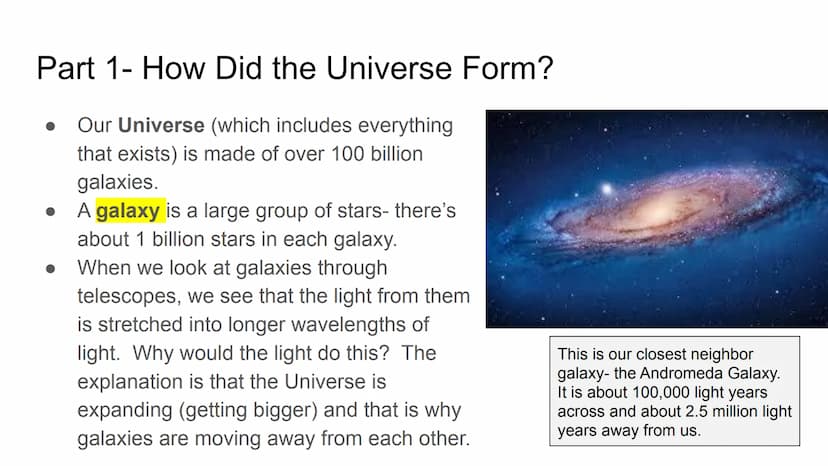
The Andromeda Galaxy, our closest galactic neighbor, gives us perspective on these massive scales. It spans about 100,000 light years across (that's how far light travels in 100,000 years!) and sits about 2.5 million light years away from us.
Cool fact: When you look at distant galaxies through a telescope, you're actually looking back in time because their light takes millions or billions of years to reach us!
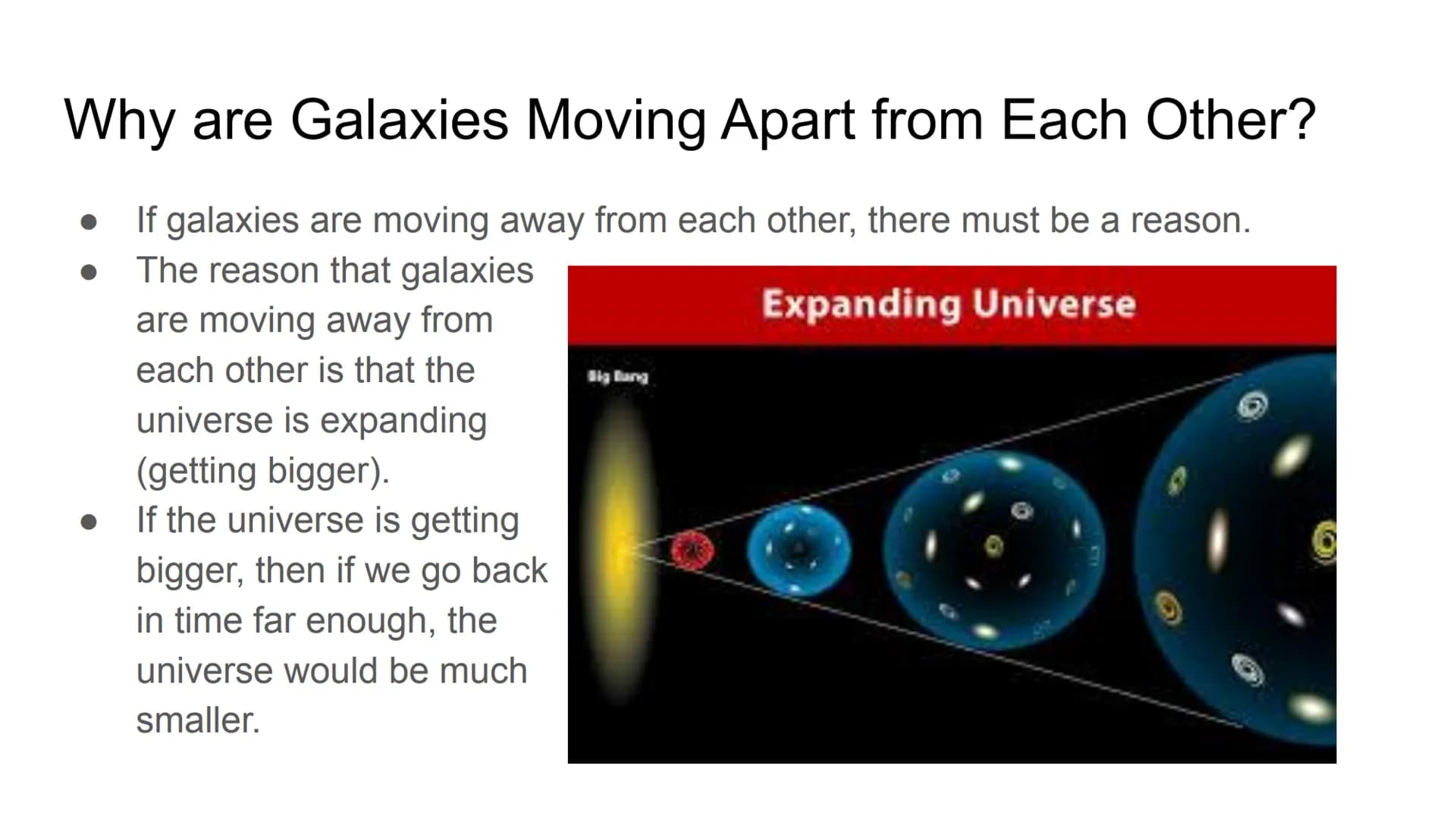
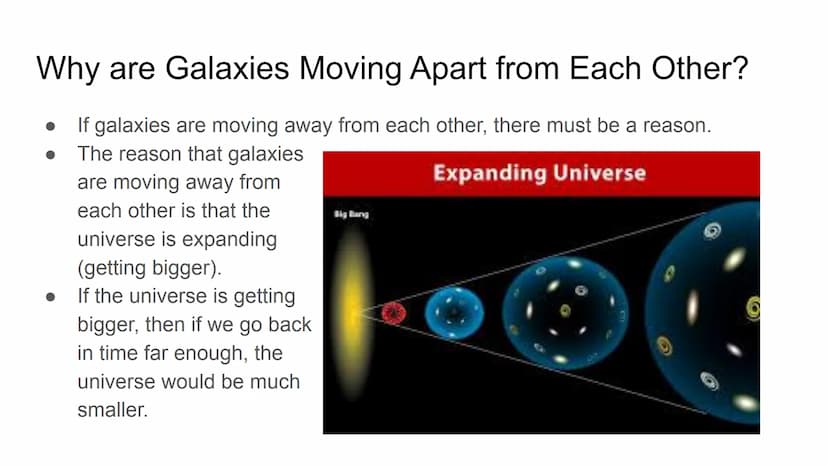
Ever blown up a balloon with dots drawn on it? As the balloon expands, the dots move away from each other—not because they're moving, but because the space between them is growing. This is exactly what's happening with galaxies!
Galaxies aren't racing away through space; rather, space itself is expanding. This cosmic expansion is happening everywhere in the universe at once, causing all galaxies to drift apart from one another.
Here's where it gets interesting: if the universe is expanding today, it must have been smaller in the past. By running this expansion backward in time, scientists realized that everything in the universe must have originated from a single point—the moment of the Big Bang.
Mind-bender: If you could watch the universe's history in reverse, you'd see galaxies rushing toward each other until everything compressed into an unimaginably small, dense, hot point!
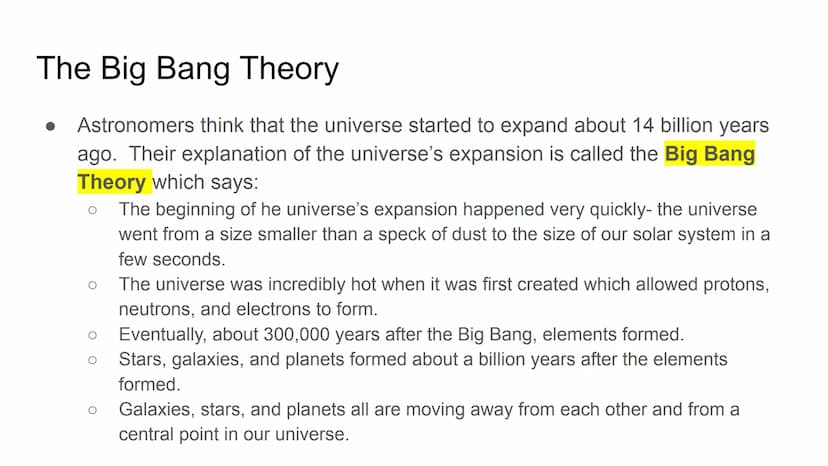
About 14 billion years ago, according to the Big Bang Theory, our entire universe began expanding from an incredibly small, dense point. This wasn't an explosion in space—it was an expansion of space itself.
The early universe was unimaginably hot, allowing fundamental particles like protons, neutrons, and electrons to form. About 300,000 years after the initial expansion, the universe cooled enough for these particles to combine into the first elements (mostly hydrogen and helium).
It took nearly a billion more years before these elements gathered into the first stars and galaxies. The formation of planets came even later as stars produced heavier elements through nuclear fusion.
Put it in perspective: If the 14-billion-year history of the universe were compressed into a single year, humans would only appear in the last few minutes of December 31st!
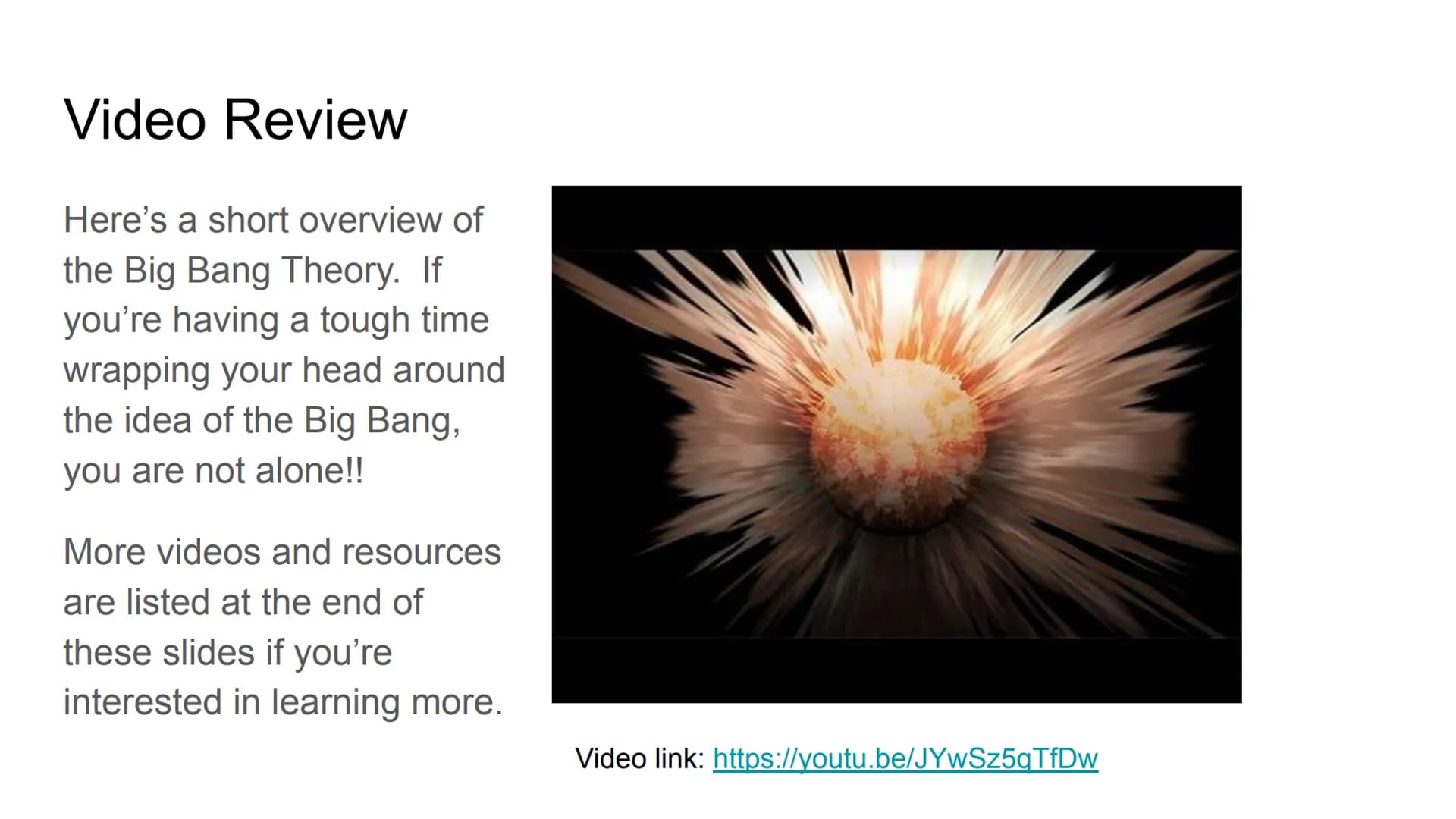
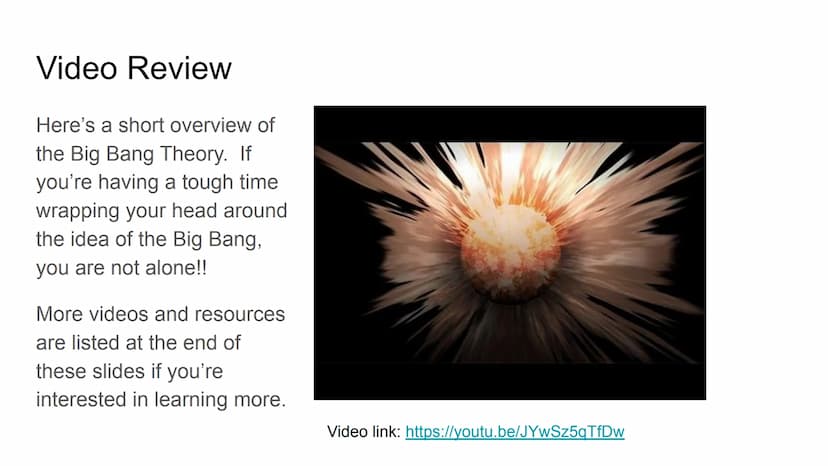
The Big Bang Theory can be difficult to wrap your head around—and that's completely normal! How can something come from nothing? How can space itself expand? These questions have puzzled even the greatest scientific minds.
The video overview provides a visual explanation that might help clarify how scientists believe the universe expanded from an incredibly small beginning to the vast cosmos we see today.
Remember that our understanding of the universe's origins continues to evolve as we develop better tools and gather more observations. What makes science exciting is that we're always refining our understanding!
Learning tip: When tackling complex concepts like the Big Bang, try explaining them in your own words to someone else. If you can explain it, you truly understand it!
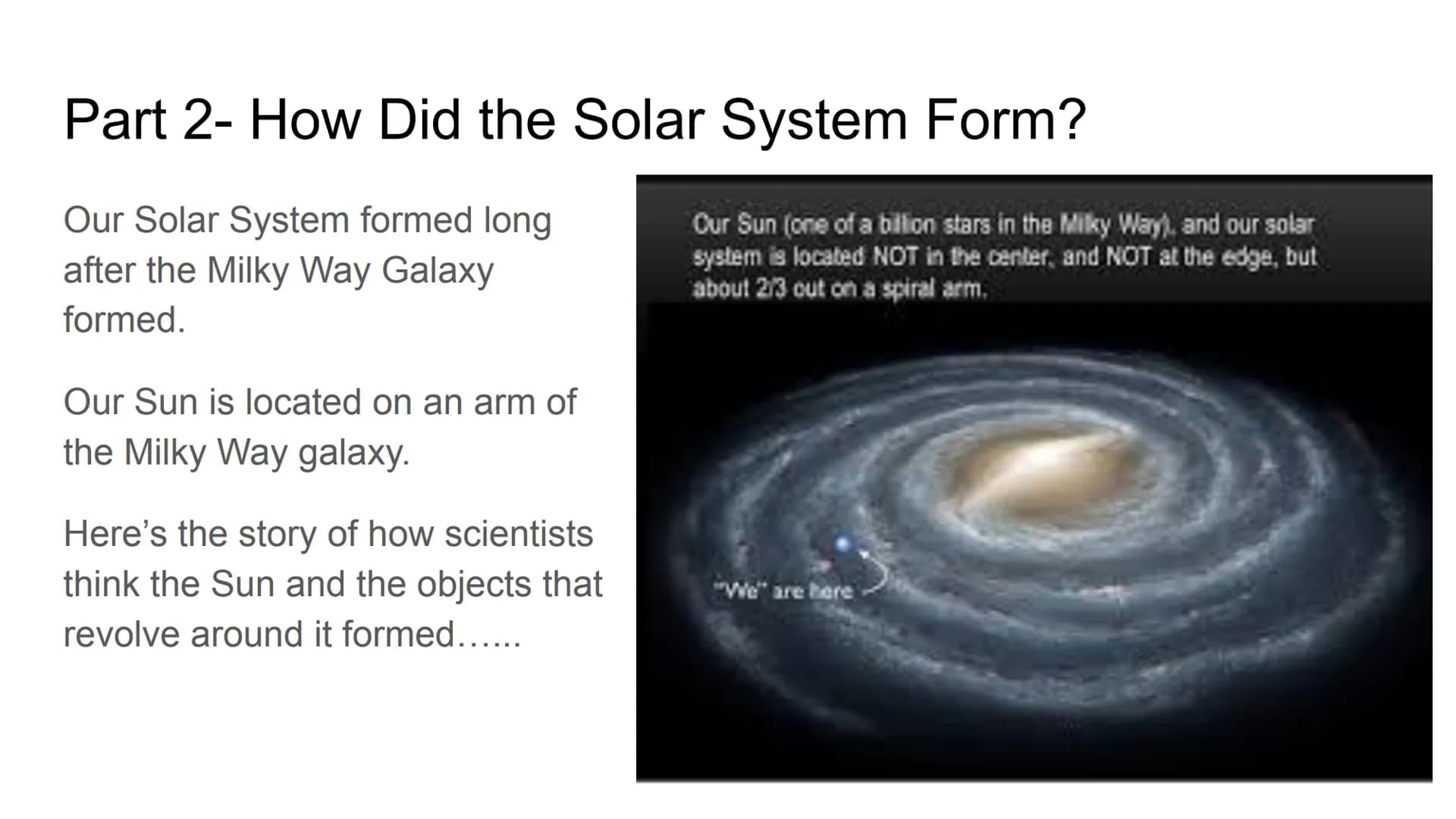
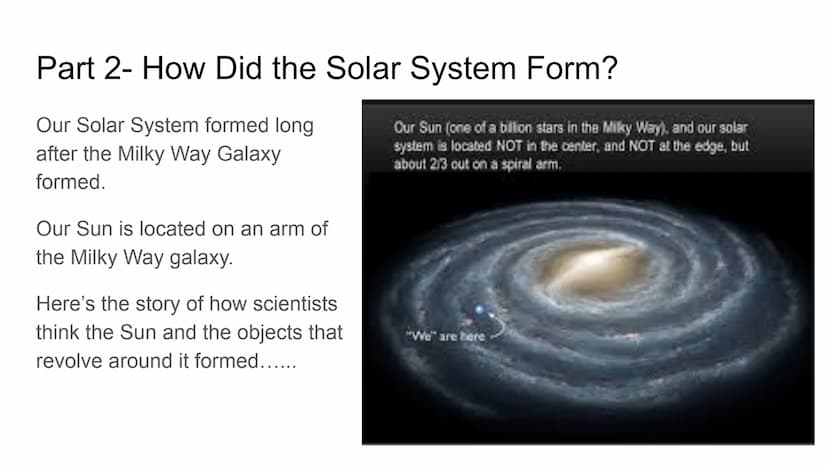
Our solar system is just one tiny neighborhood in the vast Milky Way galaxy, which contains about a billion stars like our sun. We're located about two-thirds of the way out on one of the galaxy's spiral arms—not in the center and not at the edge.
The solar system formed relatively recently in cosmic terms, about 4.6 billion years ago, long after the Milky Way galaxy itself had formed. This means our sun is actually a second or third-generation star!
The story of how our sun, planets, moons, and other objects formed follows a fascinating sequence of events that explains why our solar system has the structure and patterns we observe today.
Cosmic perspective: If you could zoom out far enough to see the entire Milky Way, our solar system would be just a microscopic dot among billions of stars!
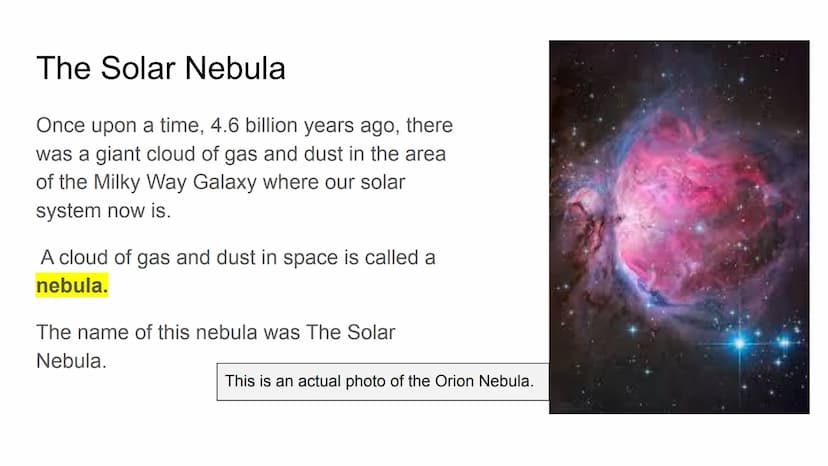
About 4.6 billion years ago, in the region of the Milky Way where our solar system now exists, there was an enormous cloud of gas and dust called the Solar Nebula. This wasn't unusual—such clouds exist throughout our galaxy.
This particular nebula contained elements created in previous generations of stars. When massive stars die in spectacular explosions called supernovas, they scatter these elements across space, enriching gas clouds like our Solar Nebula.
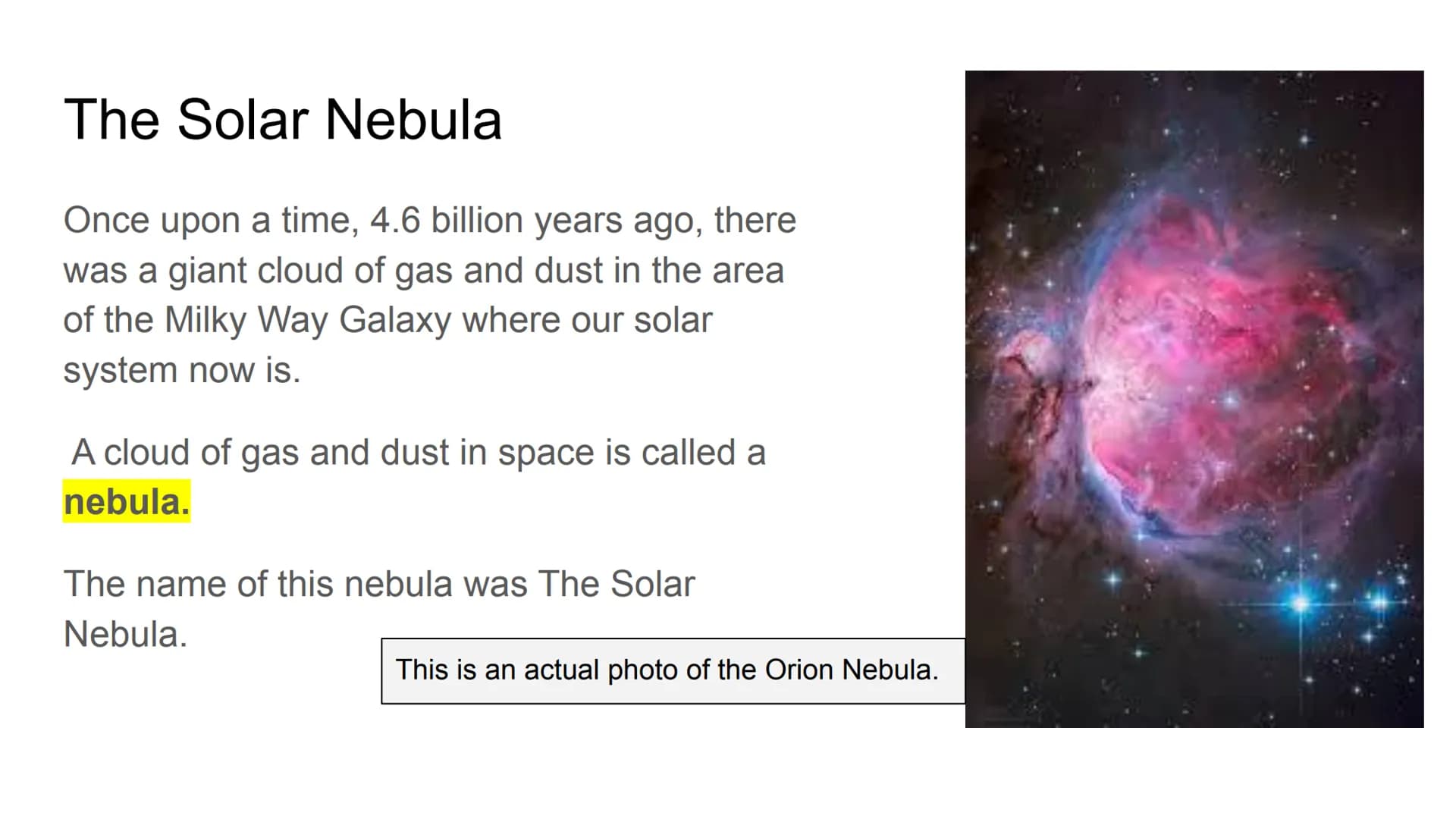
The beautiful Orion Nebula we can see today gives us a glimpse of what our own Solar Nebula might have looked like—a vast, glowing cloud of gas and dust with the potential to form new star systems.
Mind-blowing thought: The atoms in your body were once part of a nebula like this, and before that, they were forged inside stars that exploded billions of years ago!
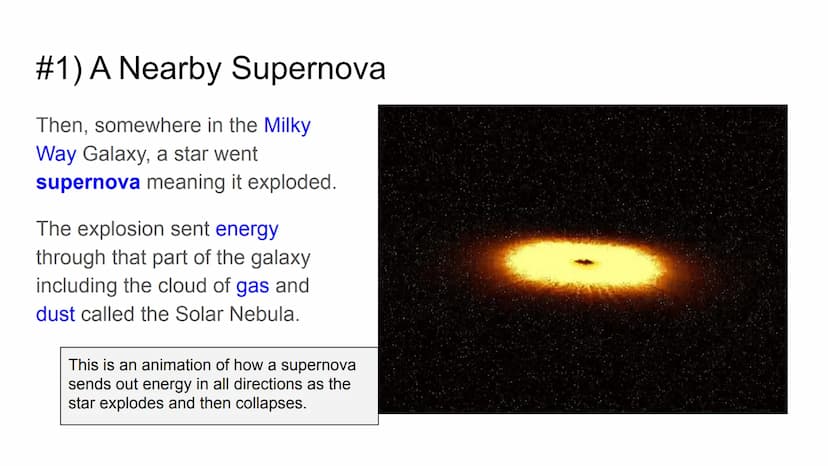
The birth of our solar system likely began with a dramatic event—a massive star in our cosmic neighborhood exploded in a supernova. This stellar explosion released an enormous amount of energy that rippled through nearby space.
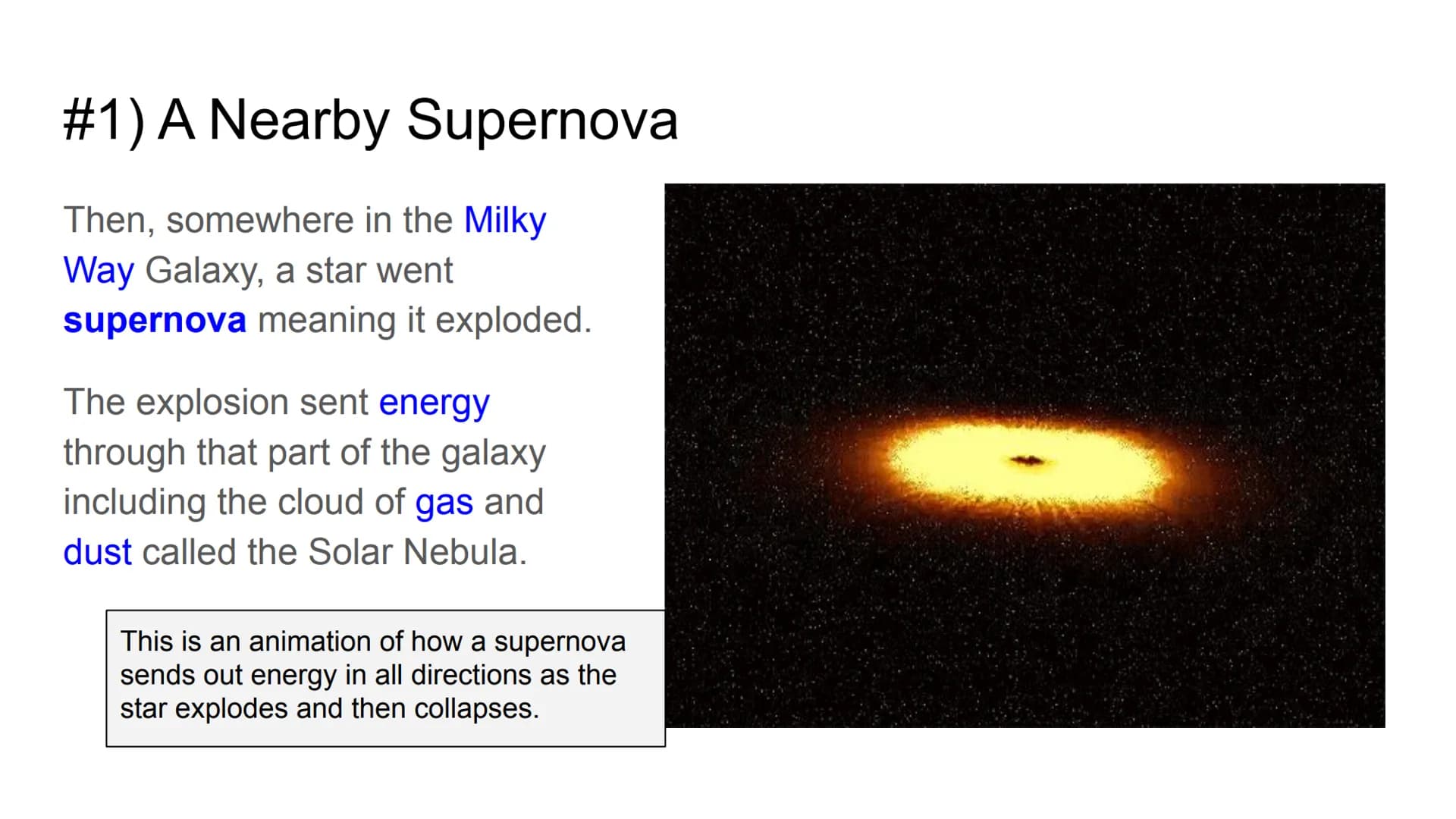
When a star goes supernova, it briefly outshines entire galaxies, releasing tremendous energy in all directions. This energy travels as a shockwave through space, disturbing everything in its path.
The energy from this supernova eventually reached the Solar Nebula, and this cosmic disturbance would trigger the first step in the formation of our solar system.
Star fact: Supernovas are so powerful that for a few weeks, a single exploding star can shine brighter than the 100 billion other stars in its galaxy combined!
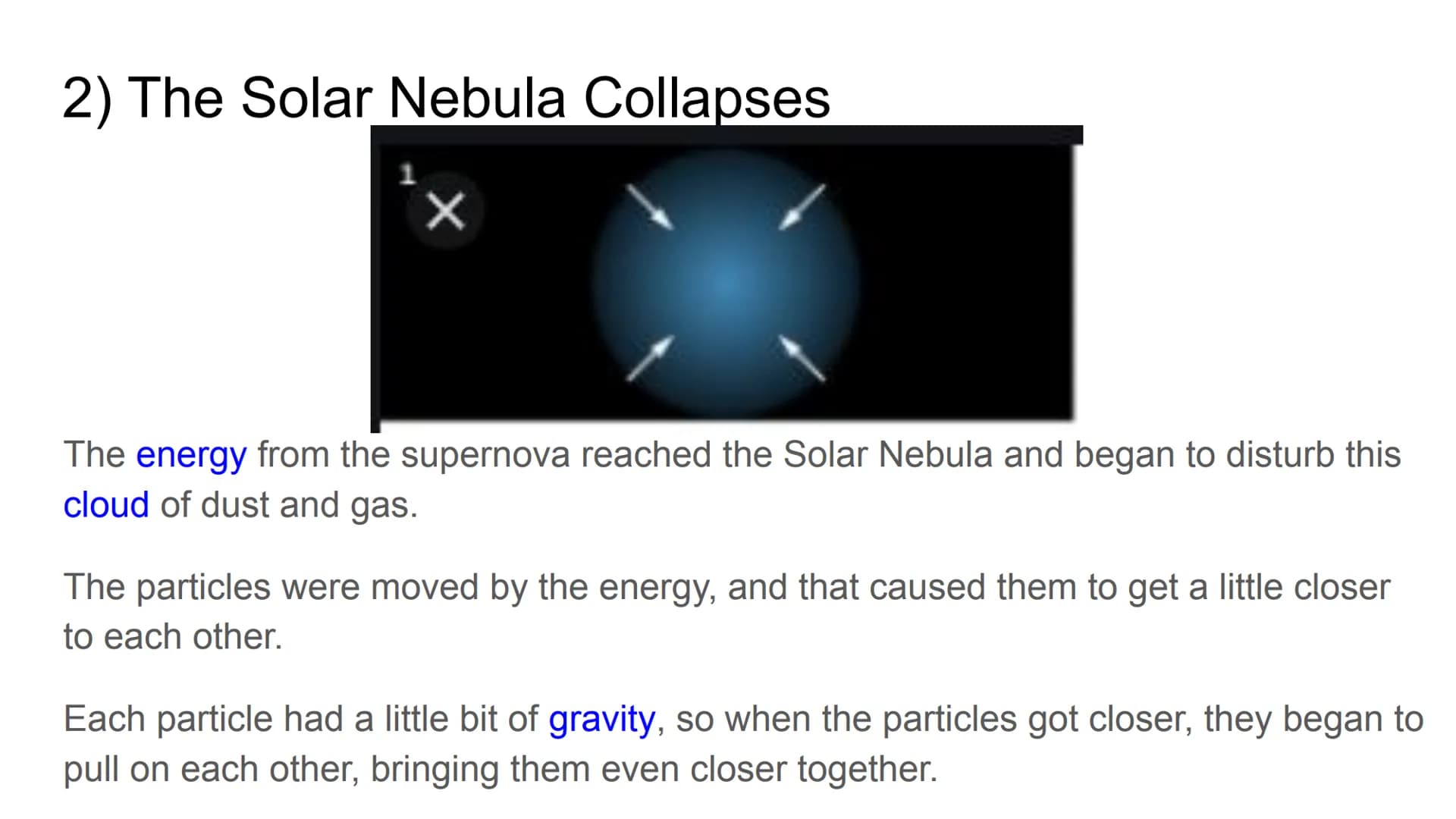
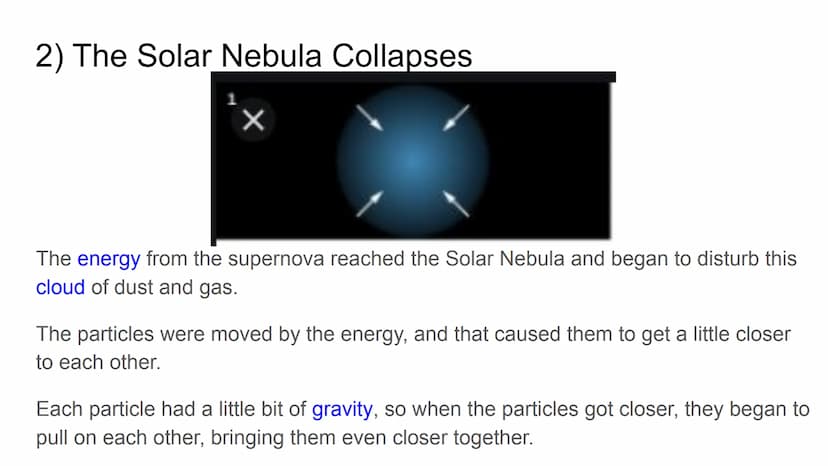
When energy from the nearby supernova hit our Solar Nebula, it caused a chain reaction that would eventually lead to our solar system. The disturbance pushed gas and dust particles slightly closer together.
Even though individual particles are tiny, each has a small amount of gravity. As particles moved closer together, their gravitational attraction increased, pulling even more material toward the center of the cloud.
This process created a snowball effect—more particles gathering meant stronger gravity, which attracted even more particles. The Solar Nebula began to collapse inward on itself, concentrating material toward its center.
Gravity insight: Gravity seems weak in everyday life, but it's the dominant force shaping our solar system and universe. Given enough matter and time, even the weak gravity of dust particles can build planets!
Our AI companion is specifically built for the needs of students. Based on the millions of content pieces we have on the platform we can provide truly meaningful and relevant answers to students. But its not only about answers, the companion is even more about guiding students through their daily learning challenges, with personalised study plans, quizzes or content pieces in the chat and 100% personalisation based on the students skills and developments.
You can download the app in the Google Play Store and in the Apple App Store.
That's right! Enjoy free access to study content, connect with fellow students, and get instant help – all at your fingertips.
App Store
Google Play
The app is very easy to use and well designed. I have found everything I was looking for so far and have been able to learn a lot from the presentations! I will definitely use the app for a class assignment! And of course it also helps a lot as an inspiration.
Stefan S
iOS user
This app is really great. There are so many study notes and help [...]. My problem subject is French, for example, and the app has so many options for help. Thanks to this app, I have improved my French. I would recommend it to anyone.
Samantha Klich
Android user
Wow, I am really amazed. I just tried the app because I've seen it advertised many times and was absolutely stunned. This app is THE HELP you want for school and above all, it offers so many things, such as workouts and fact sheets, which have been VERY helpful to me personally.
Anna
iOS user
I think it’s very much worth it and you’ll end up using it a lot once you get the hang of it and even after looking at others notes you can still ask your Artificial intelligence buddy the question and ask to simplify it if you still don’t get it!!! In the end I think it’s worth it 😊👍 ⚠️Also DID I MENTION ITS FREEE YOU DON’T HAVE TO PAY FOR ANYTHING AND STILL GET YOUR GRADES IN PERFECTLY❗️❗️⚠️
Thomas R
iOS user
Knowunity is the BEST app I’ve used in a minute. This is not an ai review or anything this is genuinely coming from a 7th grade student (I know 2011 im young) but dude this app is a 10/10 i have maintained a 3.8 gpa and have plenty of time for gaming. I love it and my mom is just happy I got good grades
Brad T
Android user
Not only did it help me find the answer but it also showed me alternative ways to solve it. I was horrible in math and science but now I have an a in both subjects. Thanks for the help🤍🤍
David K
iOS user
The app's just great! All I have to do is enter the topic in the search bar and I get the response real fast. I don't have to watch 10 YouTube videos to understand something, so I'm saving my time. Highly recommended!
Sudenaz Ocak
Android user
In school I was really bad at maths but thanks to the app, I am doing better now. I am so grateful that you made the app.
Greenlight Bonnie
Android user
I found this app a couple years ago and it has only gotten better since then. I really love it because it can help with written questions and photo questions. Also, it can find study guides that other people have made as well as flashcard sets and practice tests. The free version is also amazing for students who might not be able to afford it. Would 100% recommend
Aubrey
iOS user
Best app if you're in Highschool or Junior high. I have been using this app for 2 school years and it's the best, it's good if you don't have anyone to help you with school work.😋🩷🎀
Marco B
iOS user
THE QUIZES AND FLASHCARDS ARE SO USEFUL AND I LOVE THE SCHOOLGPT. IT ALSO IS LITREALLY LIKE CHATGPT BUT SMARTER!! HELPED ME WITH MY MASCARA PROBLEMS TOO!! AS WELL AS MY REAL SUBJECTS ! DUHHH 😍😁😲🤑💗✨🎀😮
Elisha
iOS user
This app is phenomenal down to the correct info and the various topics you can study! I greatly recommend it for people who struggle with procrastination and those who need homework help. It has been perfectly accurate for world 1 history as far as I’ve seen! Geometry too!
Paul T
iOS user
The app is very easy to use and well designed. I have found everything I was looking for so far and have been able to learn a lot from the presentations! I will definitely use the app for a class assignment! And of course it also helps a lot as an inspiration.
Stefan S
iOS user
This app is really great. There are so many study notes and help [...]. My problem subject is French, for example, and the app has so many options for help. Thanks to this app, I have improved my French. I would recommend it to anyone.
Samantha Klich
Android user
Wow, I am really amazed. I just tried the app because I've seen it advertised many times and was absolutely stunned. This app is THE HELP you want for school and above all, it offers so many things, such as workouts and fact sheets, which have been VERY helpful to me personally.
Anna
iOS user
I think it’s very much worth it and you’ll end up using it a lot once you get the hang of it and even after looking at others notes you can still ask your Artificial intelligence buddy the question and ask to simplify it if you still don’t get it!!! In the end I think it’s worth it 😊👍 ⚠️Also DID I MENTION ITS FREEE YOU DON’T HAVE TO PAY FOR ANYTHING AND STILL GET YOUR GRADES IN PERFECTLY❗️❗️⚠️
Thomas R
iOS user
Knowunity is the BEST app I’ve used in a minute. This is not an ai review or anything this is genuinely coming from a 7th grade student (I know 2011 im young) but dude this app is a 10/10 i have maintained a 3.8 gpa and have plenty of time for gaming. I love it and my mom is just happy I got good grades
Brad T
Android user
Not only did it help me find the answer but it also showed me alternative ways to solve it. I was horrible in math and science but now I have an a in both subjects. Thanks for the help🤍🤍
David K
iOS user
The app's just great! All I have to do is enter the topic in the search bar and I get the response real fast. I don't have to watch 10 YouTube videos to understand something, so I'm saving my time. Highly recommended!
Sudenaz Ocak
Android user
In school I was really bad at maths but thanks to the app, I am doing better now. I am so grateful that you made the app.
Greenlight Bonnie
Android user
I found this app a couple years ago and it has only gotten better since then. I really love it because it can help with written questions and photo questions. Also, it can find study guides that other people have made as well as flashcard sets and practice tests. The free version is also amazing for students who might not be able to afford it. Would 100% recommend
Aubrey
iOS user
Best app if you're in Highschool or Junior high. I have been using this app for 2 school years and it's the best, it's good if you don't have anyone to help you with school work.😋🩷🎀
Marco B
iOS user
THE QUIZES AND FLASHCARDS ARE SO USEFUL AND I LOVE THE SCHOOLGPT. IT ALSO IS LITREALLY LIKE CHATGPT BUT SMARTER!! HELPED ME WITH MY MASCARA PROBLEMS TOO!! AS WELL AS MY REAL SUBJECTS ! DUHHH 😍😁😲🤑💗✨🎀😮
Elisha
iOS user
This app is phenomenal down to the correct info and the various topics you can study! I greatly recommend it for people who struggle with procrastination and those who need homework help. It has been perfectly accurate for world 1 history as far as I’ve seen! Geometry too!
Paul T
iOS user
Mark Torosyan
@dilanyanvardanyan_gckv
Ever wondered how everything around us came to be? The universe and our solar system have fascinating origins. Two key scientific theories - the Big Bang Theory and the Solar Nebula Theory - explain how our universe expanded from something... Show more
Access to all documents
Improve your grades
Join milions of students
By signing up you accept Terms of Service and Privacy Policy
The formation of our universe and solar system is one of science's most fascinating stories. It's a tale that spans billions of years and helps explain why planets, stars, and galaxies exist as they do today.
You're about to discover how something smaller than a speck of dust expanded to become everything we know, and how a spinning cloud of gas and dust transformed into our sun and planets.
These cosmic origin stories aren't just interesting facts—they help explain fundamental patterns we observe in space and connect directly to why Earth exists as it does today.
Access to all documents
Improve your grades
Join milions of students
By signing up you accept Terms of Service and Privacy Policy
Scientific theories aren't just educated guesses—they're powerful explanations backed by mountains of evidence. The Big Bang Theory and Solar Nebula Theory are two perfect examples.
A scientific theory explains observations and phenomena with substantial supporting evidence. While theories can't be proven with 100% certainty (we can't travel back in time to witness these events!), they represent our best understanding based on all available data.
The Big Bang Theory explains how our entire universe formed, while the Solar Nebula Theory describes how our solar system came together. Both theories fit all observed evidence and help us understand our cosmic origins.
Think of it this way: Scientific theories are like detective work—scientists collect evidence, test explanations, and build models that best explain what we observe today.
Access to all documents
Improve your grades
Join milions of students
By signing up you accept Terms of Service and Privacy Policy
Our universe is mind-blowingly huge! It contains over 100 billion galaxies, each home to roughly a billion stars. That's a lot of cosmic real estate!
When astronomers study distant galaxies through telescopes, they notice something strange—the light from these galaxies stretches into longer wavelengths. This stretching happens because the universe is expanding, causing galaxies to move away from each other like dots on an inflating balloon.
The Andromeda Galaxy, our closest galactic neighbor, gives us perspective on these massive scales. It spans about 100,000 light years across (that's how far light travels in 100,000 years!) and sits about 2.5 million light years away from us.
Cool fact: When you look at distant galaxies through a telescope, you're actually looking back in time because their light takes millions or billions of years to reach us!
Access to all documents
Improve your grades
Join milions of students
By signing up you accept Terms of Service and Privacy Policy
Ever blown up a balloon with dots drawn on it? As the balloon expands, the dots move away from each other—not because they're moving, but because the space between them is growing. This is exactly what's happening with galaxies!
Galaxies aren't racing away through space; rather, space itself is expanding. This cosmic expansion is happening everywhere in the universe at once, causing all galaxies to drift apart from one another.
Here's where it gets interesting: if the universe is expanding today, it must have been smaller in the past. By running this expansion backward in time, scientists realized that everything in the universe must have originated from a single point—the moment of the Big Bang.
Mind-bender: If you could watch the universe's history in reverse, you'd see galaxies rushing toward each other until everything compressed into an unimaginably small, dense, hot point!
Access to all documents
Improve your grades
Join milions of students
By signing up you accept Terms of Service and Privacy Policy
About 14 billion years ago, according to the Big Bang Theory, our entire universe began expanding from an incredibly small, dense point. This wasn't an explosion in space—it was an expansion of space itself.
The early universe was unimaginably hot, allowing fundamental particles like protons, neutrons, and electrons to form. About 300,000 years after the initial expansion, the universe cooled enough for these particles to combine into the first elements (mostly hydrogen and helium).
It took nearly a billion more years before these elements gathered into the first stars and galaxies. The formation of planets came even later as stars produced heavier elements through nuclear fusion.
Put it in perspective: If the 14-billion-year history of the universe were compressed into a single year, humans would only appear in the last few minutes of December 31st!
Access to all documents
Improve your grades
Join milions of students
By signing up you accept Terms of Service and Privacy Policy
The Big Bang Theory can be difficult to wrap your head around—and that's completely normal! How can something come from nothing? How can space itself expand? These questions have puzzled even the greatest scientific minds.
The video overview provides a visual explanation that might help clarify how scientists believe the universe expanded from an incredibly small beginning to the vast cosmos we see today.
Remember that our understanding of the universe's origins continues to evolve as we develop better tools and gather more observations. What makes science exciting is that we're always refining our understanding!
Learning tip: When tackling complex concepts like the Big Bang, try explaining them in your own words to someone else. If you can explain it, you truly understand it!
Access to all documents
Improve your grades
Join milions of students
By signing up you accept Terms of Service and Privacy Policy
Our solar system is just one tiny neighborhood in the vast Milky Way galaxy, which contains about a billion stars like our sun. We're located about two-thirds of the way out on one of the galaxy's spiral arms—not in the center and not at the edge.
The solar system formed relatively recently in cosmic terms, about 4.6 billion years ago, long after the Milky Way galaxy itself had formed. This means our sun is actually a second or third-generation star!
The story of how our sun, planets, moons, and other objects formed follows a fascinating sequence of events that explains why our solar system has the structure and patterns we observe today.
Cosmic perspective: If you could zoom out far enough to see the entire Milky Way, our solar system would be just a microscopic dot among billions of stars!
Access to all documents
Improve your grades
Join milions of students
By signing up you accept Terms of Service and Privacy Policy
About 4.6 billion years ago, in the region of the Milky Way where our solar system now exists, there was an enormous cloud of gas and dust called the Solar Nebula. This wasn't unusual—such clouds exist throughout our galaxy.
This particular nebula contained elements created in previous generations of stars. When massive stars die in spectacular explosions called supernovas, they scatter these elements across space, enriching gas clouds like our Solar Nebula.
The beautiful Orion Nebula we can see today gives us a glimpse of what our own Solar Nebula might have looked like—a vast, glowing cloud of gas and dust with the potential to form new star systems.
Mind-blowing thought: The atoms in your body were once part of a nebula like this, and before that, they were forged inside stars that exploded billions of years ago!
Access to all documents
Improve your grades
Join milions of students
By signing up you accept Terms of Service and Privacy Policy
The birth of our solar system likely began with a dramatic event—a massive star in our cosmic neighborhood exploded in a supernova. This stellar explosion released an enormous amount of energy that rippled through nearby space.
When a star goes supernova, it briefly outshines entire galaxies, releasing tremendous energy in all directions. This energy travels as a shockwave through space, disturbing everything in its path.
The energy from this supernova eventually reached the Solar Nebula, and this cosmic disturbance would trigger the first step in the formation of our solar system.
Star fact: Supernovas are so powerful that for a few weeks, a single exploding star can shine brighter than the 100 billion other stars in its galaxy combined!
Access to all documents
Improve your grades
Join milions of students
By signing up you accept Terms of Service and Privacy Policy
When energy from the nearby supernova hit our Solar Nebula, it caused a chain reaction that would eventually lead to our solar system. The disturbance pushed gas and dust particles slightly closer together.
Even though individual particles are tiny, each has a small amount of gravity. As particles moved closer together, their gravitational attraction increased, pulling even more material toward the center of the cloud.
This process created a snowball effect—more particles gathering meant stronger gravity, which attracted even more particles. The Solar Nebula began to collapse inward on itself, concentrating material toward its center.
Gravity insight: Gravity seems weak in everyday life, but it's the dominant force shaping our solar system and universe. Given enough matter and time, even the weak gravity of dust particles can build planets!
Our AI companion is specifically built for the needs of students. Based on the millions of content pieces we have on the platform we can provide truly meaningful and relevant answers to students. But its not only about answers, the companion is even more about guiding students through their daily learning challenges, with personalised study plans, quizzes or content pieces in the chat and 100% personalisation based on the students skills and developments.
You can download the app in the Google Play Store and in the Apple App Store.
That's right! Enjoy free access to study content, connect with fellow students, and get instant help – all at your fingertips.
13
Smart Tools NEW
Transform this note into: ✓ 50+ Practice Questions ✓ Interactive Flashcards ✓ Full Mock Exam ✓ Essay Outlines
Overview of the solar system and the planets
 Earth and Space Science
This is about astronomy, the solar system, planets and the different theories of universe.
Earth and Space ScienceThis discusses the colors of the universe, space glossary and the solar system.
Earth and Space ScienceAn overview to the planets, orbits of the planets and the solar system.
Earth and Space ScienceApp Store
Google Play
The app is very easy to use and well designed. I have found everything I was looking for so far and have been able to learn a lot from the presentations! I will definitely use the app for a class assignment! And of course it also helps a lot as an inspiration.
Stefan S
iOS user
This app is really great. There are so many study notes and help [...]. My problem subject is French, for example, and the app has so many options for help. Thanks to this app, I have improved my French. I would recommend it to anyone.
Samantha Klich
Android user
Wow, I am really amazed. I just tried the app because I've seen it advertised many times and was absolutely stunned. This app is THE HELP you want for school and above all, it offers so many things, such as workouts and fact sheets, which have been VERY helpful to me personally.
Anna
iOS user
I think it’s very much worth it and you’ll end up using it a lot once you get the hang of it and even after looking at others notes you can still ask your Artificial intelligence buddy the question and ask to simplify it if you still don’t get it!!! In the end I think it’s worth it 😊👍 ⚠️Also DID I MENTION ITS FREEE YOU DON’T HAVE TO PAY FOR ANYTHING AND STILL GET YOUR GRADES IN PERFECTLY❗️❗️⚠️
Thomas R
iOS user
Knowunity is the BEST app I’ve used in a minute. This is not an ai review or anything this is genuinely coming from a 7th grade student (I know 2011 im young) but dude this app is a 10/10 i have maintained a 3.8 gpa and have plenty of time for gaming. I love it and my mom is just happy I got good grades
Brad T
Android user
Not only did it help me find the answer but it also showed me alternative ways to solve it. I was horrible in math and science but now I have an a in both subjects. Thanks for the help🤍🤍
David K
iOS user
The app's just great! All I have to do is enter the topic in the search bar and I get the response real fast. I don't have to watch 10 YouTube videos to understand something, so I'm saving my time. Highly recommended!
Sudenaz Ocak
Android user
In school I was really bad at maths but thanks to the app, I am doing better now. I am so grateful that you made the app.
Greenlight Bonnie
Android user
I found this app a couple years ago and it has only gotten better since then. I really love it because it can help with written questions and photo questions. Also, it can find study guides that other people have made as well as flashcard sets and practice tests. The free version is also amazing for students who might not be able to afford it. Would 100% recommend
Aubrey
iOS user
Best app if you're in Highschool or Junior high. I have been using this app for 2 school years and it's the best, it's good if you don't have anyone to help you with school work.😋🩷🎀
Marco B
iOS user
THE QUIZES AND FLASHCARDS ARE SO USEFUL AND I LOVE THE SCHOOLGPT. IT ALSO IS LITREALLY LIKE CHATGPT BUT SMARTER!! HELPED ME WITH MY MASCARA PROBLEMS TOO!! AS WELL AS MY REAL SUBJECTS ! DUHHH 😍😁😲🤑💗✨🎀😮
Elisha
iOS user
This app is phenomenal down to the correct info and the various topics you can study! I greatly recommend it for people who struggle with procrastination and those who need homework help. It has been perfectly accurate for world 1 history as far as I’ve seen! Geometry too!
Paul T
iOS user
The app is very easy to use and well designed. I have found everything I was looking for so far and have been able to learn a lot from the presentations! I will definitely use the app for a class assignment! And of course it also helps a lot as an inspiration.
Stefan S
iOS user
This app is really great. There are so many study notes and help [...]. My problem subject is French, for example, and the app has so many options for help. Thanks to this app, I have improved my French. I would recommend it to anyone.
Samantha Klich
Android user
Wow, I am really amazed. I just tried the app because I've seen it advertised many times and was absolutely stunned. This app is THE HELP you want for school and above all, it offers so many things, such as workouts and fact sheets, which have been VERY helpful to me personally.
Anna
iOS user
I think it’s very much worth it and you’ll end up using it a lot once you get the hang of it and even after looking at others notes you can still ask your Artificial intelligence buddy the question and ask to simplify it if you still don’t get it!!! In the end I think it’s worth it 😊👍 ⚠️Also DID I MENTION ITS FREEE YOU DON’T HAVE TO PAY FOR ANYTHING AND STILL GET YOUR GRADES IN PERFECTLY❗️❗️⚠️
Thomas R
iOS user
Knowunity is the BEST app I’ve used in a minute. This is not an ai review or anything this is genuinely coming from a 7th grade student (I know 2011 im young) but dude this app is a 10/10 i have maintained a 3.8 gpa and have plenty of time for gaming. I love it and my mom is just happy I got good grades
Brad T
Android user
Not only did it help me find the answer but it also showed me alternative ways to solve it. I was horrible in math and science but now I have an a in both subjects. Thanks for the help🤍🤍
David K
iOS user
The app's just great! All I have to do is enter the topic in the search bar and I get the response real fast. I don't have to watch 10 YouTube videos to understand something, so I'm saving my time. Highly recommended!
Sudenaz Ocak
Android user
In school I was really bad at maths but thanks to the app, I am doing better now. I am so grateful that you made the app.
Greenlight Bonnie
Android user
I found this app a couple years ago and it has only gotten better since then. I really love it because it can help with written questions and photo questions. Also, it can find study guides that other people have made as well as flashcard sets and practice tests. The free version is also amazing for students who might not be able to afford it. Would 100% recommend
Aubrey
iOS user
Best app if you're in Highschool or Junior high. I have been using this app for 2 school years and it's the best, it's good if you don't have anyone to help you with school work.😋🩷🎀
Marco B
iOS user
THE QUIZES AND FLASHCARDS ARE SO USEFUL AND I LOVE THE SCHOOLGPT. IT ALSO IS LITREALLY LIKE CHATGPT BUT SMARTER!! HELPED ME WITH MY MASCARA PROBLEMS TOO!! AS WELL AS MY REAL SUBJECTS ! DUHHH 😍😁😲🤑💗✨🎀😮
Elisha
iOS user
This app is phenomenal down to the correct info and the various topics you can study! I greatly recommend it for people who struggle with procrastination and those who need homework help. It has been perfectly accurate for world 1 history as far as I’ve seen! Geometry too!
Paul T
iOS user