
Life on Earth has a fascinating origin story, where scientists... Show more
 Chemistry
 Health & Medicine
 Algebra
Sign up to see the contentIt's free!
Access to all documents
Improve your grades
Join milions of students
Knowunity AI
Subjects
Triangle Congruence and Similarity Theorems
Triangle Properties and Classification
Linear Equations and Graphs
Geometric Angle Relationships
Trigonometric Functions and Identities
Equation Solving Techniques
Circle Geometry Fundamentals
Division Operations and Methods
Basic Differentiation Rules
Exponent and Logarithm Properties
Show all topics
Human Organ Systems
Reproductive Cell Cycles
Biological Sciences Subdisciplines
Cellular Energy Metabolism
Autotrophic Energy Processes
Inheritance Patterns and Principles
Biomolecular Structure and Organization
Cell Cycle and Division Mechanics
Cellular Organization and Development
Biological Structural Organization
Show all topics
Chemical Sciences and Applications
Atomic Structure and Composition
Molecular Electron Structure Representation
Atomic Electron Behavior
Matter Properties and Water
Mole Concept and Calculations
Gas Laws and Behavior
Periodic Table Organization
Chemical Thermodynamics Fundamentals
Chemical Bond Types and Properties
Show all topics
European Renaissance and Enlightenment
European Cultural Movements 800-1920
American Revolution Era 1763-1797
American Civil War 1861-1865
Global Imperial Systems
Mongol and Chinese Dynasties
U.S. Presidents and World Leaders
Historical Sources and Documentation
World Wars Era and Impact
World Religious Systems
Show all topics
Classic and Contemporary Novels
Literary Character Analysis
Rhetorical Theory and Practice
Classic Literary Narratives
Reading Analysis and Interpretation
Narrative Structure and Techniques
English Language Components
Influential English-Language Authors
Basic Sentence Structure
Narrative Voice and Perspective
Show all topics
145
•
Updated Mar 13, 2026
•

Alexa Obadiah
@alexaobad_lhfm
Life on Earth has a fascinating origin story, where scientists... Show more
Ever wondered how life actually began on Earth? This is one of biology's biggest mysteries! Scientists have developed different theories to explain how the first living things appeared on our planet.
The origin of life question touches everything from chemistry to evolution, as researchers try to understand how non-living chemicals might have organized into the first living cells.
This exploration takes us through key scientific theories and groundbreaking experiments that have shaped our understanding of life's beginnings.
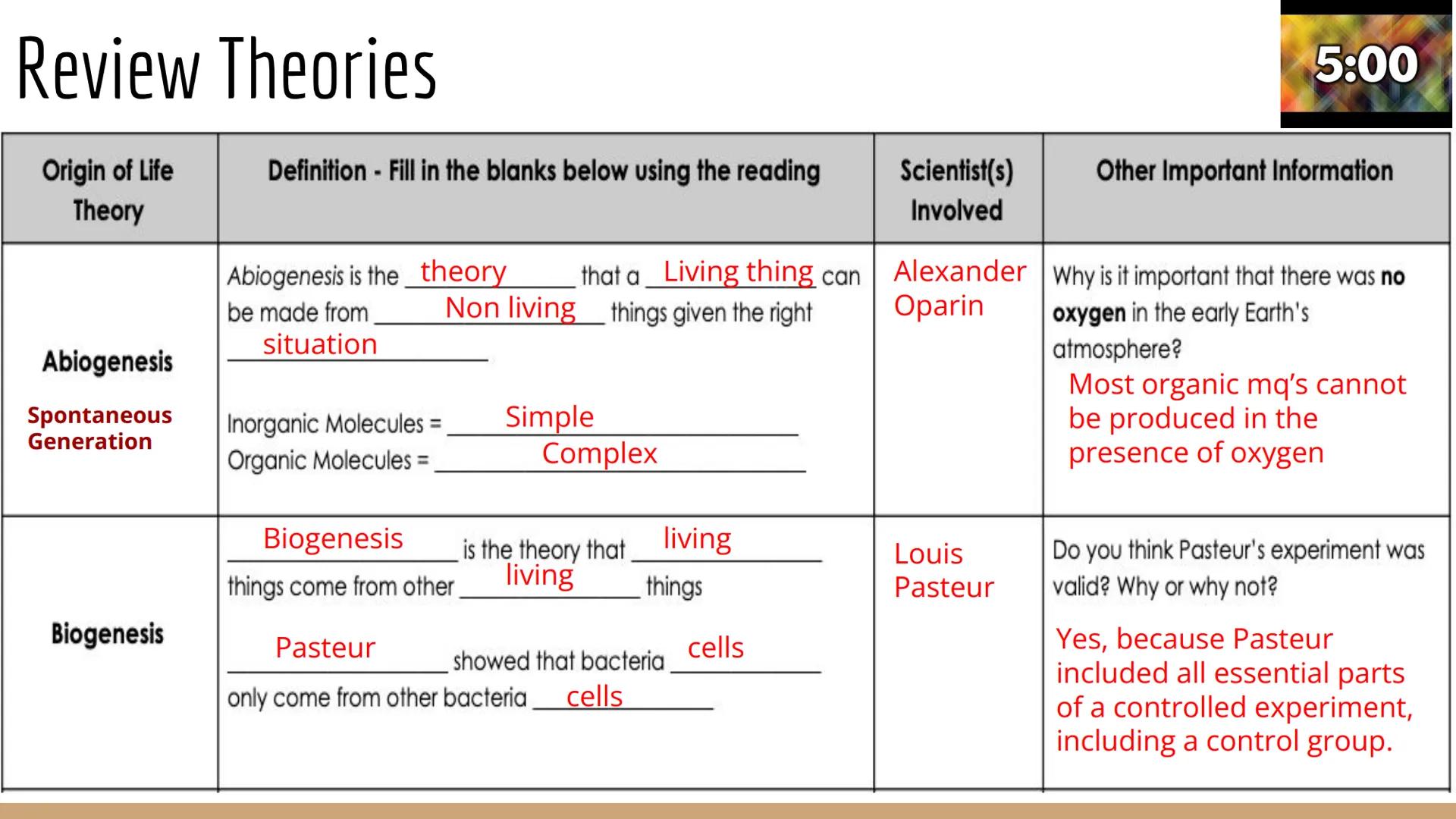
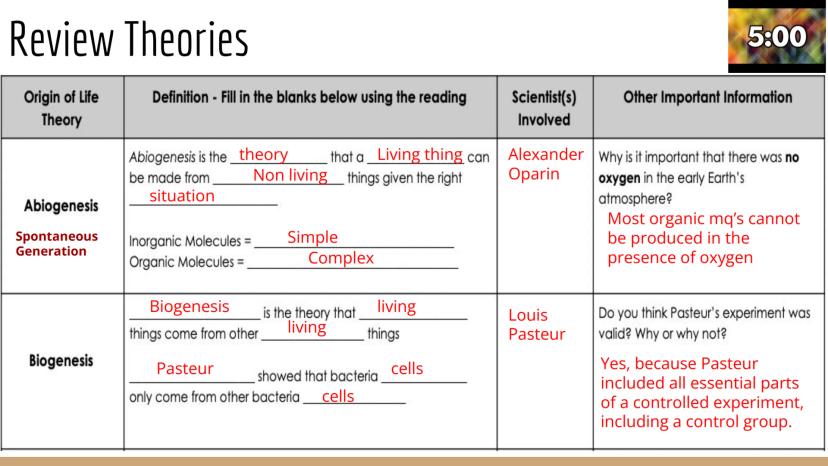
Two main theories compete to explain life's origins: abiogenesis and biogenesis. Abiogenesis suggests living things can form from non-living materials given the right conditions, while biogenesis states living things only come from other living things.
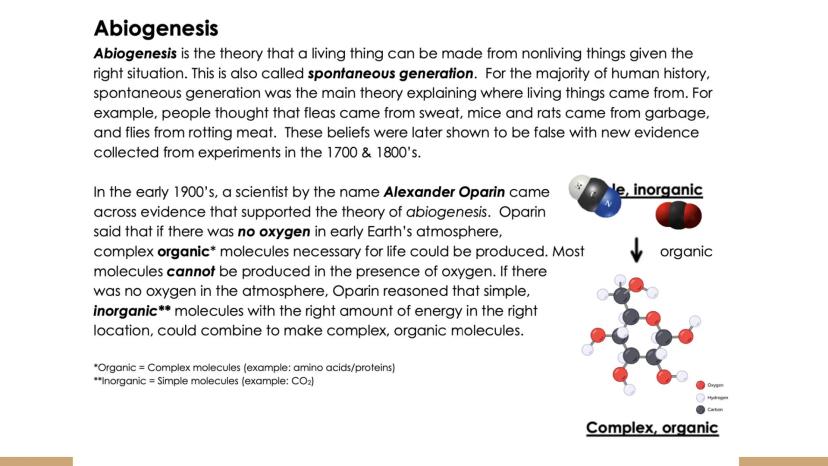
For abiogenesis to work, scientists believe Earth's early atmosphere needed to lack oxygen. Alexander Oparin proposed that without oxygen, simple inorganic molecules could combine to form complex organic molecules necessary for life.
Louis Pasteur conducted a famous experiment supporting biogenesis, showing bacteria only come from other bacteria. His experiment was considered valid because he included proper controls - a crucial element of good scientific testing.
💡 The difference matters! Inorganic molecules are simple (like carbon dioxide), while organic molecules are complex compounds (like proteins) typically found in living organisms.
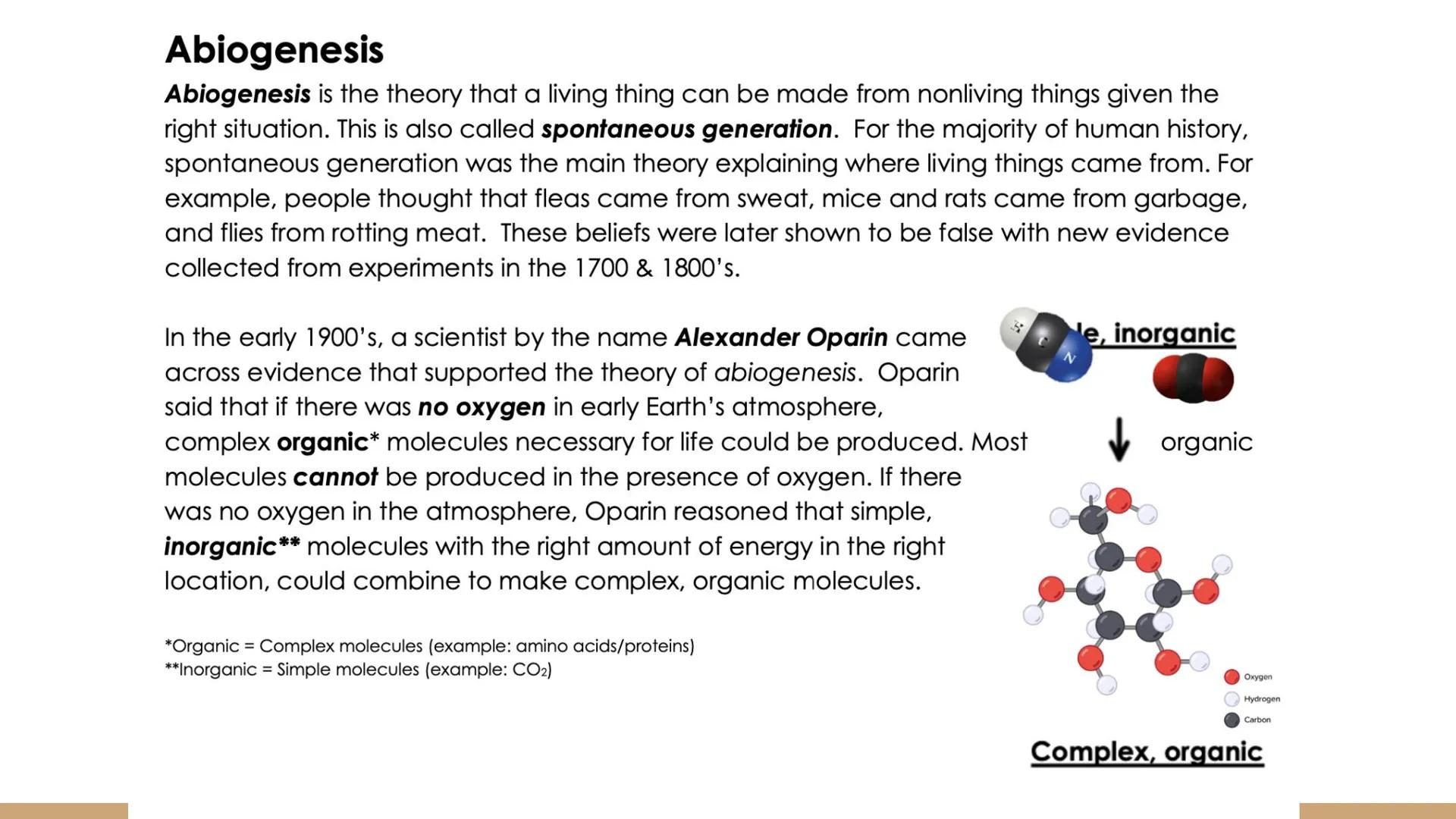
For most of human history, people believed in spontaneous generation - the idea that living things could appear from non-living matter. People thought mice came from garbage, flies from rotting meat, and fleas from sweat! Pretty wild, right?
In the early 1900s, scientist Alexander Oparin changed our understanding with new evidence. He proposed that Earth's early atmosphere had no oxygen, which was crucial because most organic molecules can't form when oxygen is present. This oxygen-free environment would have allowed simple inorganic molecules to combine into the complex organic molecules life needs.
Think of it like building with LEGOs - simple pieces (inorganic molecules like carbon dioxide) could connect to create complex structures (organic molecules like proteins) that eventually formed life. Oparin's ideas laid the groundwork for modern theories about how life might have started from chemistry.
💡 Try this memory trick: A-biogenesis starts with "A" like "Assembly" - it's about assembling life from non-living parts!
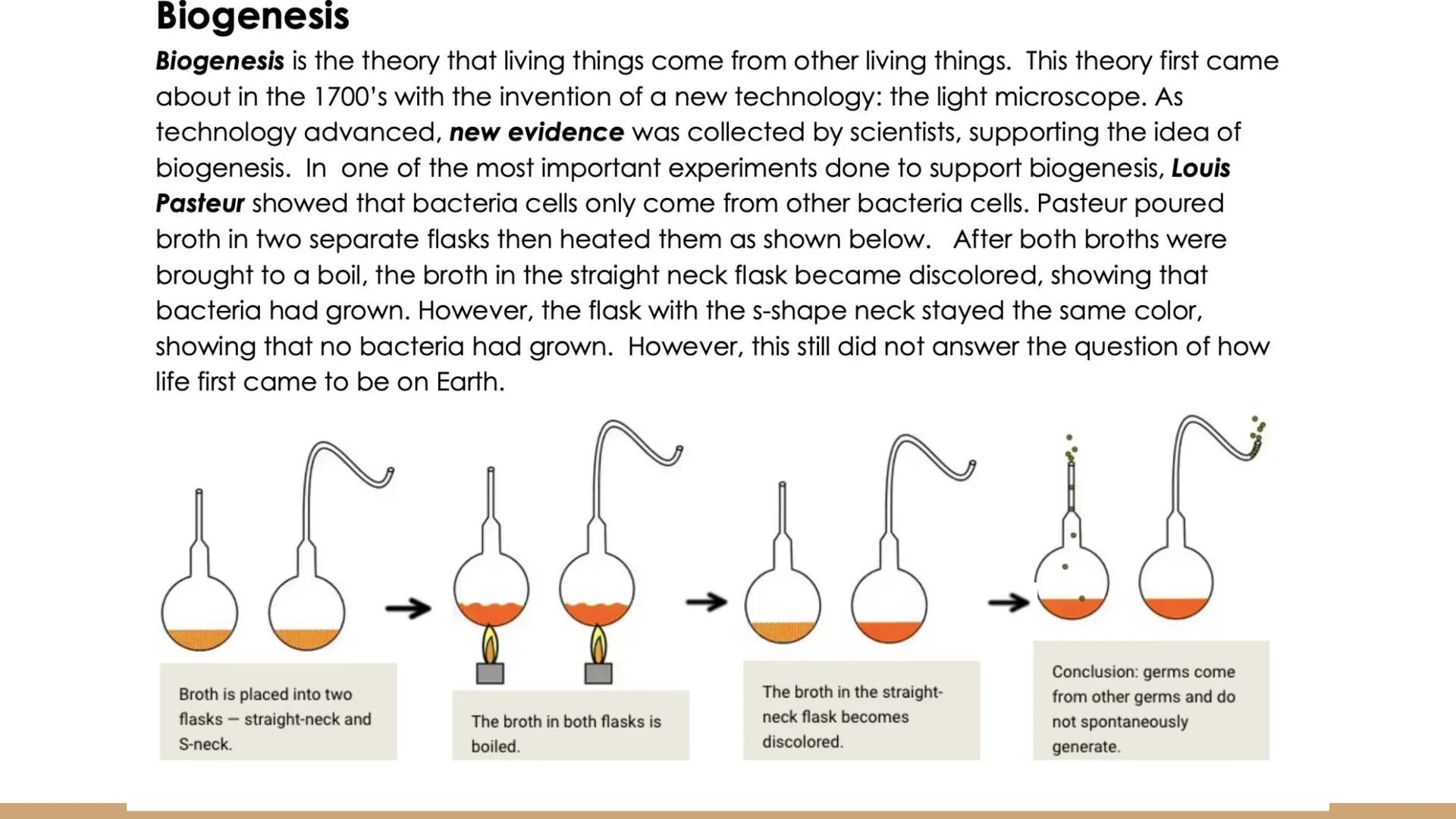
Biogenesis flipped our understanding of life's origins by proposing that living things only come from other living things. This theory gained traction in the 1700s when scientists started using the newly invented light microscope to see previously invisible organisms.
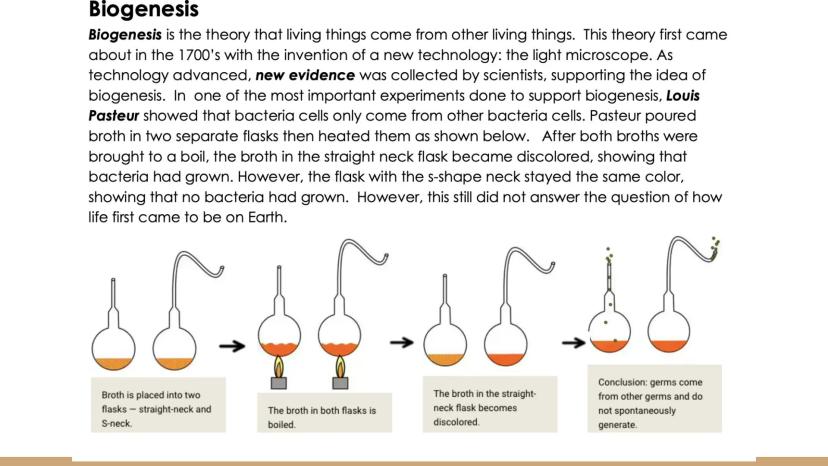
The most famous evidence came from Louis Pasteur's brilliant experiment with broth. He placed broth in two flasks - one with a straight neck and one with an S-shaped neck - then boiled both to kill any microorganisms. The straight-neck flask allowed airborne bacteria to enter and grow (turning the broth cloudy), while the S-neck trapped bacteria in its curves, keeping the broth clear.
Pasteur's experiment definitively showed that bacteria don't spontaneously generate but come from other bacteria in the air. This solved one mystery but created another - if living things only come from other living things, how did the first life form?
💡 Pasteur's experiment is a perfect example of how good science works - he changed just one variable (the flask neck shape) while keeping everything else the same, allowing him to draw a clear conclusion!
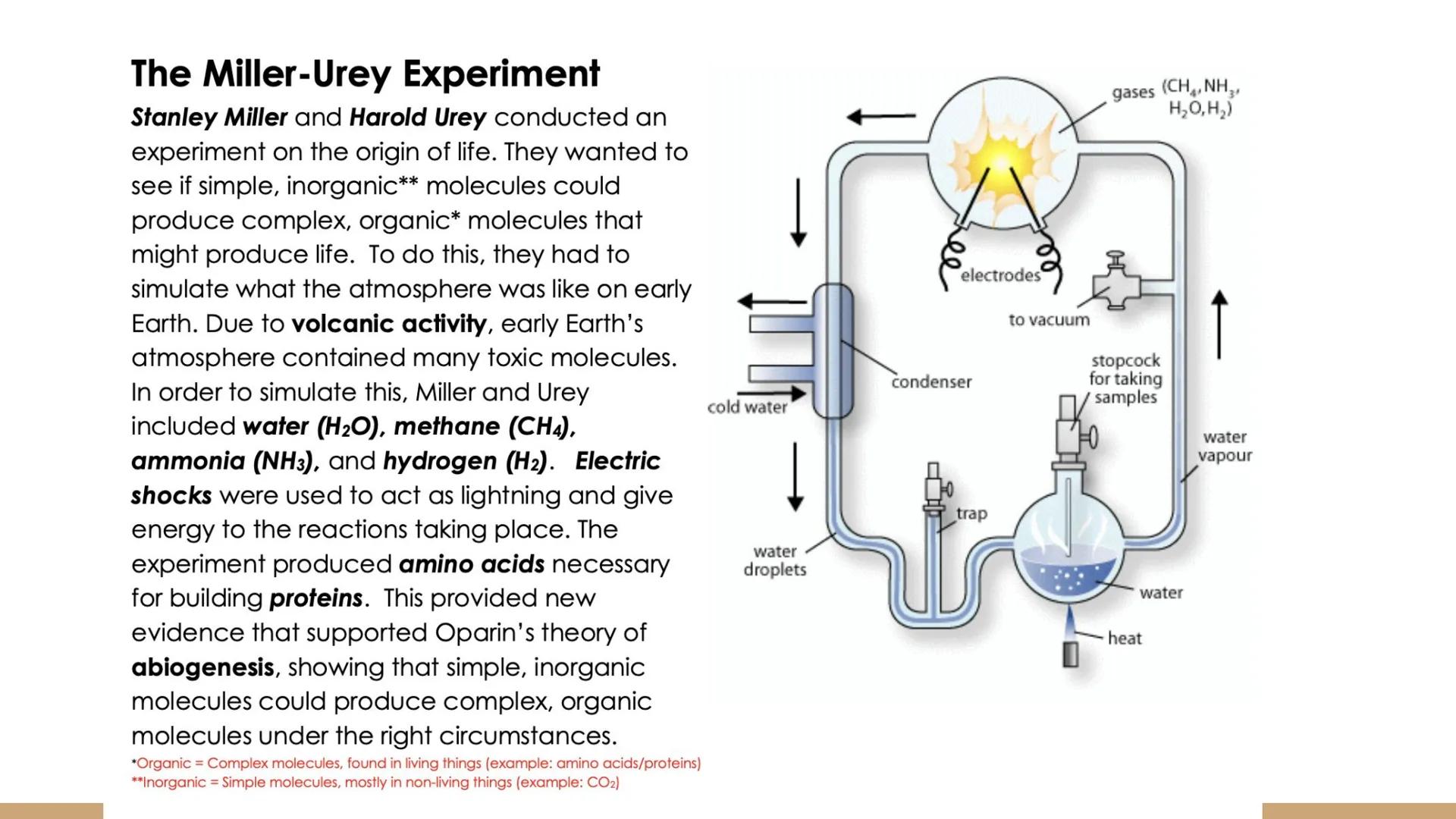
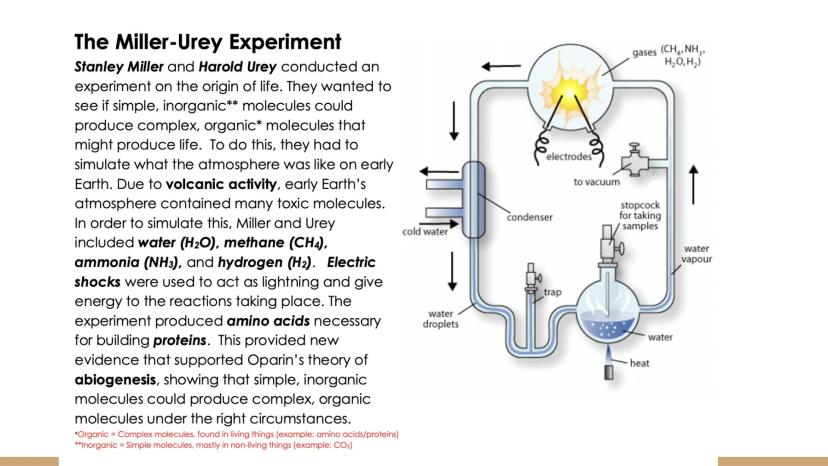
Have you ever wondered if we could recreate life's origins in a lab? That's exactly what Stanley Miller and Harold Urey attempted in their groundbreaking experiment! They built an apparatus to simulate Earth's early conditions and test if organic molecules could form spontaneously.
Their setup was like a mini-Earth: a chamber containing water, methane, ammonia, and hydrogen (simulating early Earth's atmosphere), with electric sparks (representing lightning) providing energy. After running the experiment, they discovered something amazing - amino acids had formed in their chamber! These are the building blocks of proteins, essential for all living things.
This experiment supported Oparin's abiogenesis theory by demonstrating that complex organic molecules needed for life could indeed form from simple inorganic chemicals under the right conditions. Miller and Urey essentially showed us a potential first step in life's origin story.
💡 The Miller-Urey experiment was like cooking a primordial soup - with the right ingredients and energy source, nature's kitchen could have produced the basic components needed for life!
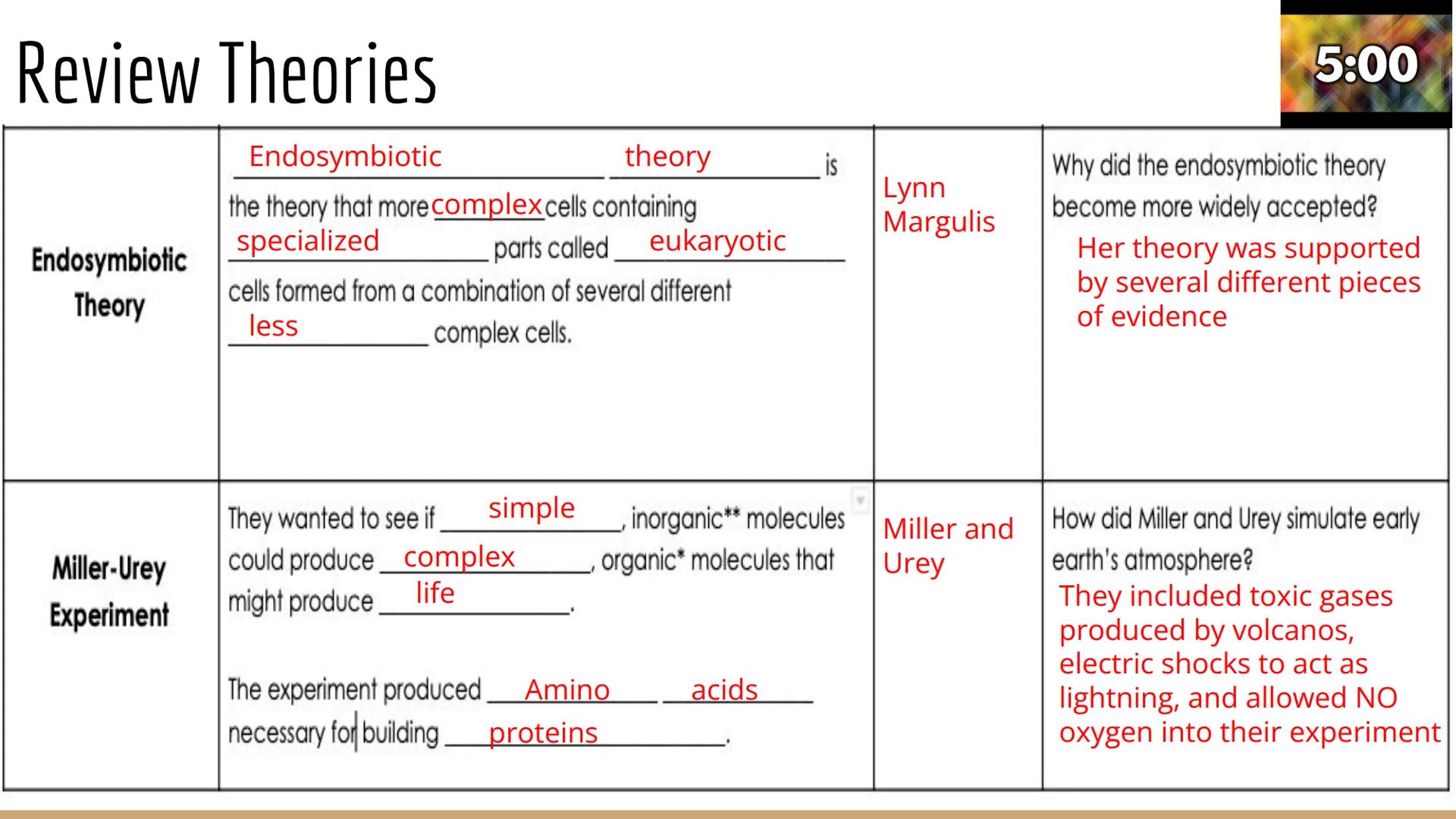
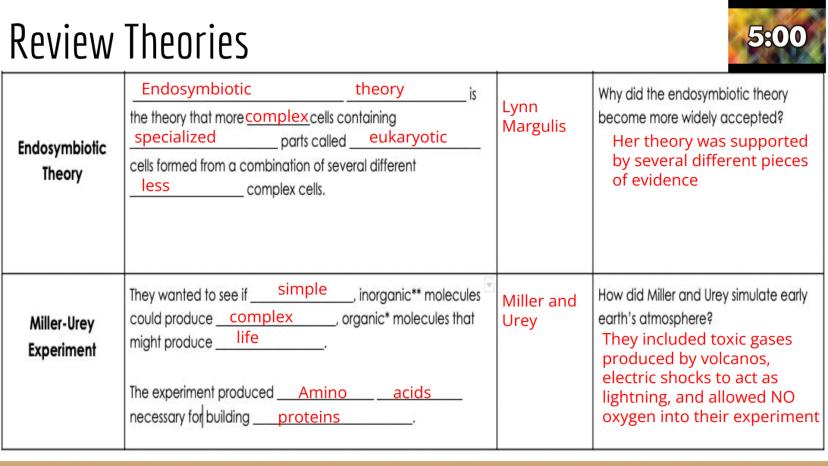
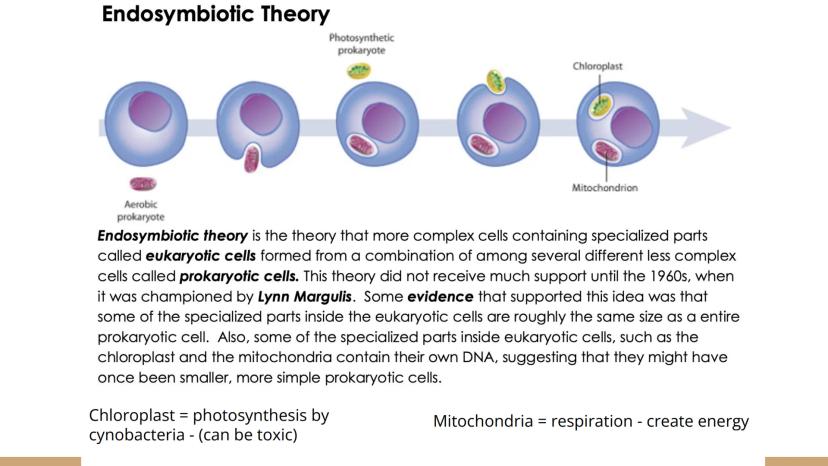
The Endosymbiotic Theory, developed by Lynn Margulis, explains how complex eukaryotic cells (the kind in your body) formed. According to this theory, specialized structures in our cells were once free-living bacteria that were engulfed by larger cells, creating a mutually beneficial relationship.
Margulis' theory gained acceptance because multiple lines of evidence supported it. For instance, mitochondria and chloroplasts have their own DNA and reproduce independently within cells, suggesting they were once separate organisms.
The Miller-Urey Experiment tested whether life's building blocks could form in Earth's early conditions. They simulated a primitive atmosphere with toxic volcanic gases (methane, ammonia, hydrogen), added water vapor, and zapped the mixture with electric "lightning." Importantly, they excluded oxygen, which would have prevented the necessary chemical reactions.
💡 The experiment successfully produced amino acids - the building blocks of proteins! This was huge evidence that the chemistry for life could have developed naturally on early Earth.
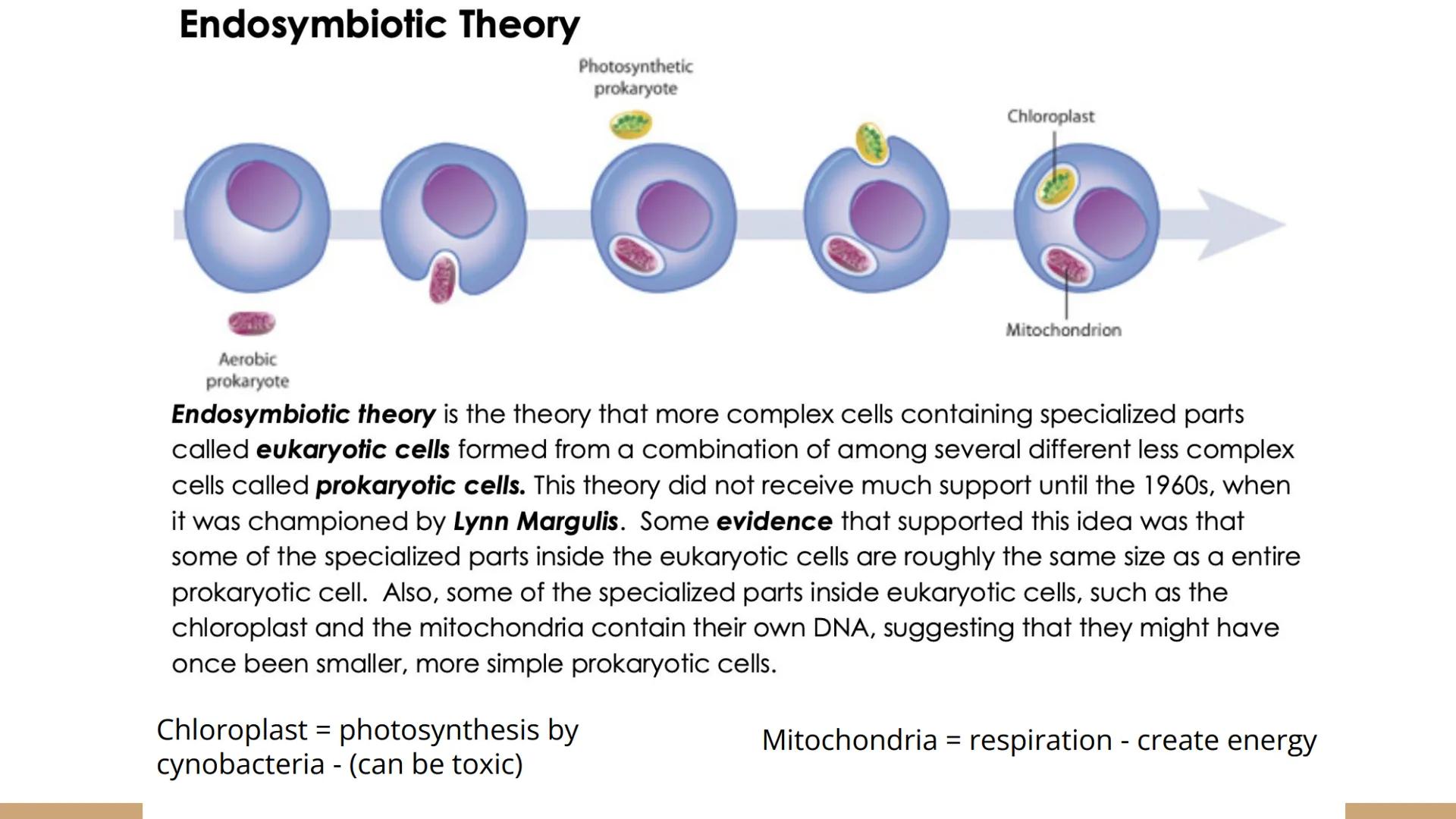
Your cells have tiny power plants inside them! The Endosymbiotic Theory explains how these specialized structures came to be. This fascinating theory suggests that complex eukaryotic cells (like those in your body) formed when larger cells engulfed smaller prokaryotic cells that then became permanent cellular components.
Lynn Margulis championed this theory in the 1960s despite initial skepticism. What convinced scientists? Several compelling pieces of evidence! First, structures like mitochondria and chloroplasts are roughly the same size as entire bacteria. Even more convincingly, these structures contain their own DNA separate from the cell's main DNA - like having their own instruction manuals!
Think of it as cellular teamwork that became permanent. Mitochondria (which generate energy) were likely once free-living bacteria that performed respiration. Similarly, chloroplasts (which perform photosynthesis in plant cells) probably originated from cyanobacteria. This cooperation between different organisms created the complex cells that make up plants, animals, and fungi today!
💡 Your cells are like tiny ecosystems with different organisms living together! Mitochondria, your cellular "power plants," still maintain their own DNA after billions of years of living inside other cells.
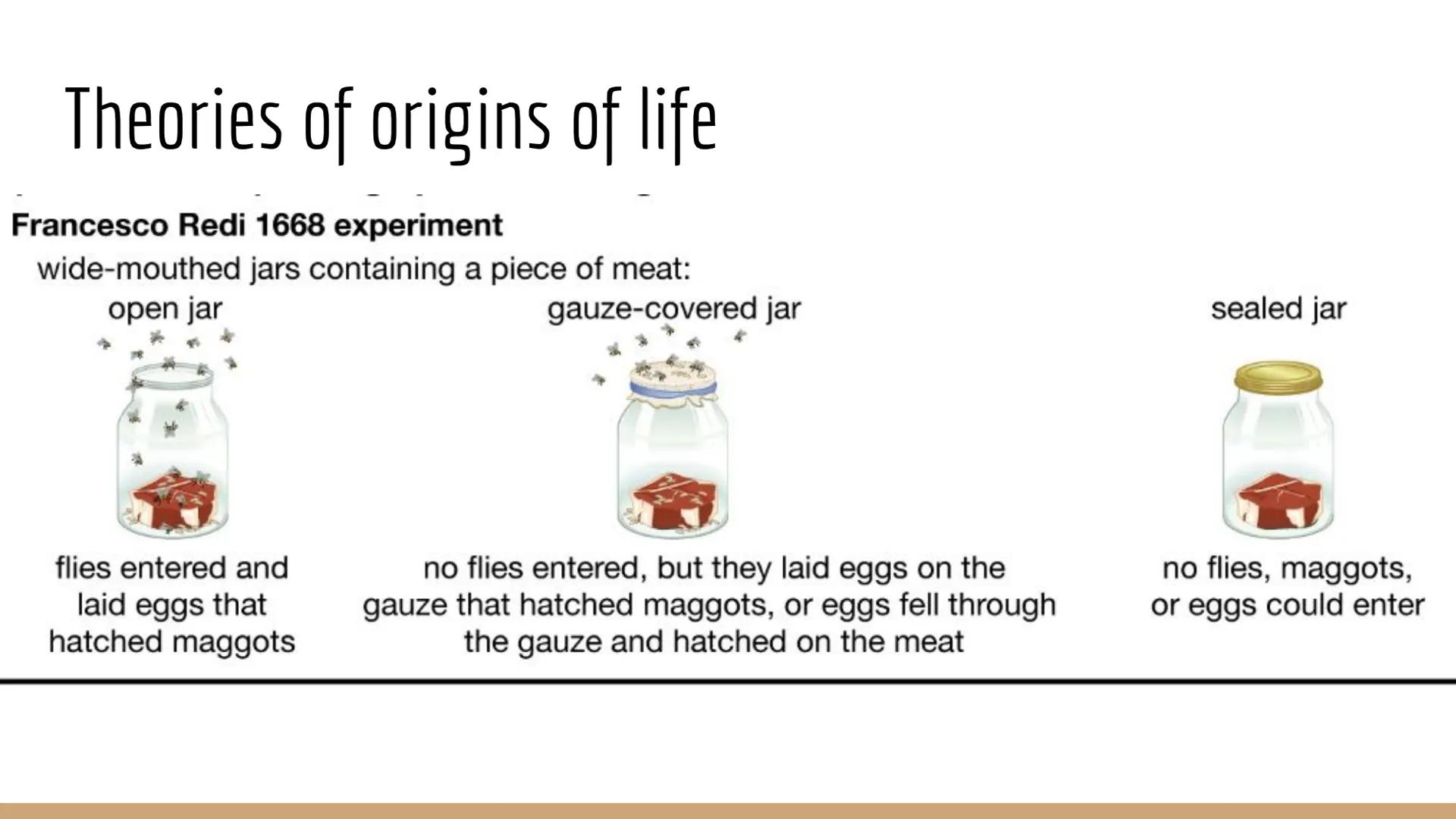
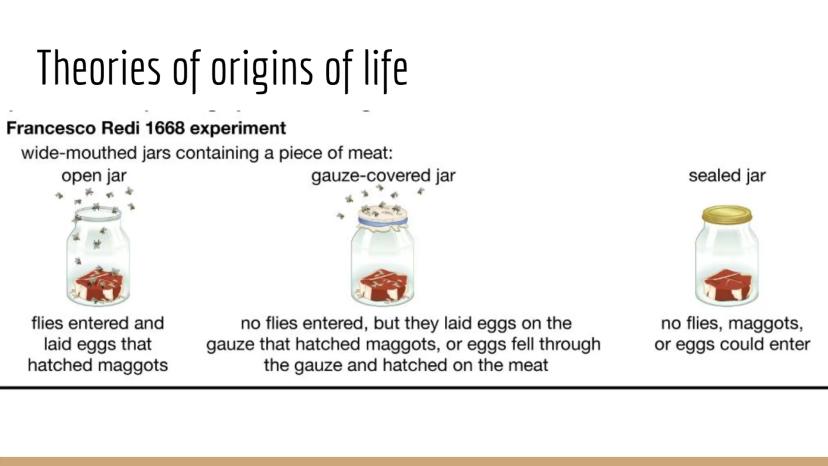
Ever seen flies buzzing around meat left out too long? In 1668, Francesco Redi designed a clever experiment to test whether maggots spontaneously generate from rotting meat or come from flies.
Redi set up three jars containing meat: one open, one covered with gauze, and one completely sealed. The results were eye-opening! In the open jar, flies entered freely, laid eggs, and maggots appeared. In the gauze-covered jar, flies couldn't enter but laid eggs on top of the gauze (some fell through onto the meat), and maggots still appeared. But the sealed jar? No flies could enter, and no maggots appeared!
This experiment delivered a serious blow to spontaneous generation theory. Redi showed that maggots don't magically appear from meat - they develop from eggs laid by flies. His work was one of the first to use controlled experiments to test a biological theory.
💡 Redi's experiment teaches an important scientific principle: the simplest explanation is usually correct. Maggots coming from fly eggs is simpler than them magically appearing from meat!
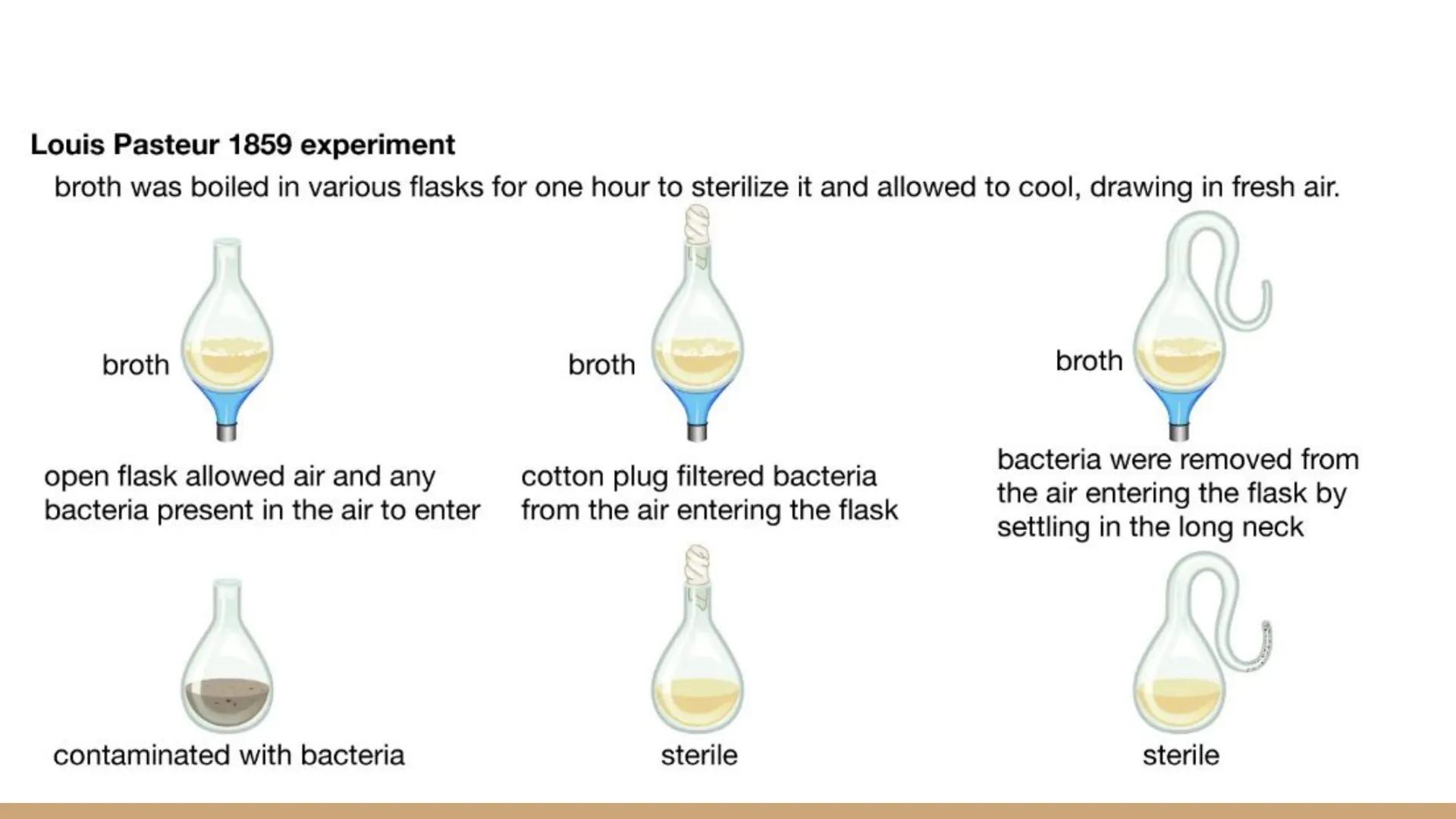
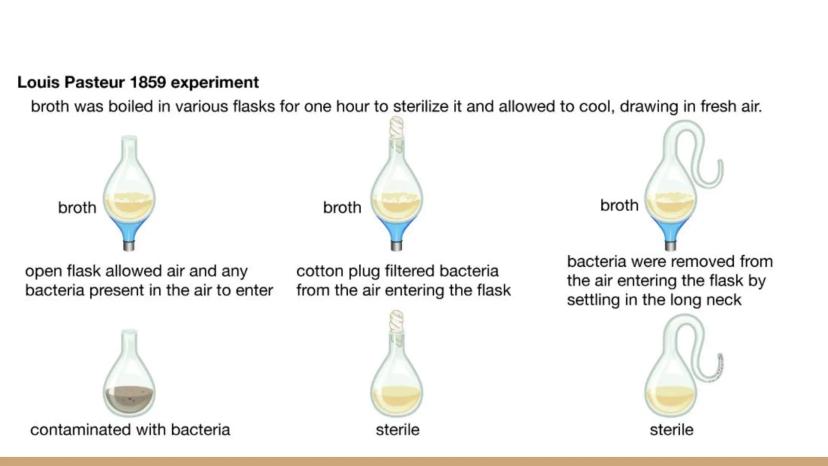
Louis Pasteur designed an elegant experiment that finally settled the spontaneous generation debate. His setup was brilliantly simple: he placed nutrient broth in different types of flasks, then boiled each flask for an hour to kill any existing microorganisms.
The magic was in the flask designs! One flask remained open, allowing air (and bacteria) to enter freely. Another had a cotton plug that filtered incoming air. The third had a long curved "swan neck" that trapped bacteria while still allowing air to pass through.
The results were crystal clear. The open flask became contaminated with bacteria and cloudy, while both the cotton-plugged and swan-necked flasks remained sterile and clear! This proved that bacteria in the air - not spontaneous generation - caused the contamination.
💡 Pasteur's experiment was so convincing because he showed that air itself wasn't causing contamination (since it flowed into all flasks) - it was the microorganisms in the air that made the difference!
Our AI companion is specifically built for the needs of students. Based on the millions of content pieces we have on the platform we can provide truly meaningful and relevant answers to students. But its not only about answers, the companion is even more about guiding students through their daily learning challenges, with personalised study plans, quizzes or content pieces in the chat and 100% personalisation based on the students skills and developments.
You can download the app in the Google Play Store and in the Apple App Store.
That's right! Enjoy free access to study content, connect with fellow students, and get instant help – all at your fingertips.
App Store
Google Play
The app is very easy to use and well designed. I have found everything I was looking for so far and have been able to learn a lot from the presentations! I will definitely use the app for a class assignment! And of course it also helps a lot as an inspiration.
Stefan S
iOS user
This app is really great. There are so many study notes and help [...]. My problem subject is French, for example, and the app has so many options for help. Thanks to this app, I have improved my French. I would recommend it to anyone.
Samantha Klich
Android user
Wow, I am really amazed. I just tried the app because I've seen it advertised many times and was absolutely stunned. This app is THE HELP you want for school and above all, it offers so many things, such as workouts and fact sheets, which have been VERY helpful to me personally.
Anna
iOS user
I think it’s very much worth it and you’ll end up using it a lot once you get the hang of it and even after looking at others notes you can still ask your Artificial intelligence buddy the question and ask to simplify it if you still don’t get it!!! In the end I think it’s worth it 😊👍 ⚠️Also DID I MENTION ITS FREEE YOU DON’T HAVE TO PAY FOR ANYTHING AND STILL GET YOUR GRADES IN PERFECTLY❗️❗️⚠️
Thomas R
iOS user
Knowunity is the BEST app I’ve used in a minute. This is not an ai review or anything this is genuinely coming from a 7th grade student (I know 2011 im young) but dude this app is a 10/10 i have maintained a 3.8 gpa and have plenty of time for gaming. I love it and my mom is just happy I got good grades
Brad T
Android user
Not only did it help me find the answer but it also showed me alternative ways to solve it. I was horrible in math and science but now I have an a in both subjects. Thanks for the help🤍🤍
David K
iOS user
The app's just great! All I have to do is enter the topic in the search bar and I get the response real fast. I don't have to watch 10 YouTube videos to understand something, so I'm saving my time. Highly recommended!
Sudenaz Ocak
Android user
In school I was really bad at maths but thanks to the app, I am doing better now. I am so grateful that you made the app.
Greenlight Bonnie
Android user
I found this app a couple years ago and it has only gotten better since then. I really love it because it can help with written questions and photo questions. Also, it can find study guides that other people have made as well as flashcard sets and practice tests. The free version is also amazing for students who might not be able to afford it. Would 100% recommend
Aubrey
iOS user
Best app if you're in Highschool or Junior high. I have been using this app for 2 school years and it's the best, it's good if you don't have anyone to help you with school work.😋🩷🎀
Marco B
iOS user
THE QUIZES AND FLASHCARDS ARE SO USEFUL AND I LOVE Knowunity AI. IT ALSO IS LITREALLY LIKE CHATGPT BUT SMARTER!! HELPED ME WITH MY MASCARA PROBLEMS TOO!! AS WELL AS MY REAL SUBJECTS ! DUHHH 😍😁😲🤑💗✨🎀😮
Elisha
iOS user
This app is phenomenal down to the correct info and the various topics you can study! I greatly recommend it for people who struggle with procrastination and those who need homework help. It has been perfectly accurate for world 1 history as far as I’ve seen! Geometry too!
Paul T
iOS user
The app is very easy to use and well designed. I have found everything I was looking for so far and have been able to learn a lot from the presentations! I will definitely use the app for a class assignment! And of course it also helps a lot as an inspiration.
Stefan S
iOS user
This app is really great. There are so many study notes and help [...]. My problem subject is French, for example, and the app has so many options for help. Thanks to this app, I have improved my French. I would recommend it to anyone.
Samantha Klich
Android user
Wow, I am really amazed. I just tried the app because I've seen it advertised many times and was absolutely stunned. This app is THE HELP you want for school and above all, it offers so many things, such as workouts and fact sheets, which have been VERY helpful to me personally.
Anna
iOS user
I think it’s very much worth it and you’ll end up using it a lot once you get the hang of it and even after looking at others notes you can still ask your Artificial intelligence buddy the question and ask to simplify it if you still don’t get it!!! In the end I think it’s worth it 😊👍 ⚠️Also DID I MENTION ITS FREEE YOU DON’T HAVE TO PAY FOR ANYTHING AND STILL GET YOUR GRADES IN PERFECTLY❗️❗️⚠️
Thomas R
iOS user
Knowunity is the BEST app I’ve used in a minute. This is not an ai review or anything this is genuinely coming from a 7th grade student (I know 2011 im young) but dude this app is a 10/10 i have maintained a 3.8 gpa and have plenty of time for gaming. I love it and my mom is just happy I got good grades
Brad T
Android user
Not only did it help me find the answer but it also showed me alternative ways to solve it. I was horrible in math and science but now I have an a in both subjects. Thanks for the help🤍🤍
David K
iOS user
The app's just great! All I have to do is enter the topic in the search bar and I get the response real fast. I don't have to watch 10 YouTube videos to understand something, so I'm saving my time. Highly recommended!
Sudenaz Ocak
Android user
In school I was really bad at maths but thanks to the app, I am doing better now. I am so grateful that you made the app.
Greenlight Bonnie
Android user
I found this app a couple years ago and it has only gotten better since then. I really love it because it can help with written questions and photo questions. Also, it can find study guides that other people have made as well as flashcard sets and practice tests. The free version is also amazing for students who might not be able to afford it. Would 100% recommend
Aubrey
iOS user
Best app if you're in Highschool or Junior high. I have been using this app for 2 school years and it's the best, it's good if you don't have anyone to help you with school work.😋🩷🎀
Marco B
iOS user
THE QUIZES AND FLASHCARDS ARE SO USEFUL AND I LOVE Knowunity AI. IT ALSO IS LITREALLY LIKE CHATGPT BUT SMARTER!! HELPED ME WITH MY MASCARA PROBLEMS TOO!! AS WELL AS MY REAL SUBJECTS ! DUHHH 😍😁😲🤑💗✨🎀😮
Elisha
iOS user
This app is phenomenal down to the correct info and the various topics you can study! I greatly recommend it for people who struggle with procrastination and those who need homework help. It has been perfectly accurate for world 1 history as far as I’ve seen! Geometry too!
Paul T
iOS user
Alexa Obadiah
@alexaobad_lhfm
Life on Earth has a fascinating origin story, where scientists debate how the first organisms emerged. You'll explore competing theories about whether life could have formed from non-living chemicals or must always come from existing life, and discover landmark experiments... Show more
Access to all documents
Improve your grades
Join milions of students
Ever wondered how life actually began on Earth? This is one of biology's biggest mysteries! Scientists have developed different theories to explain how the first living things appeared on our planet.
The origin of life question touches everything from chemistry to evolution, as researchers try to understand how non-living chemicals might have organized into the first living cells.
This exploration takes us through key scientific theories and groundbreaking experiments that have shaped our understanding of life's beginnings.
Access to all documents
Improve your grades
Join milions of students
Two main theories compete to explain life's origins: abiogenesis and biogenesis. Abiogenesis suggests living things can form from non-living materials given the right conditions, while biogenesis states living things only come from other living things.
For abiogenesis to work, scientists believe Earth's early atmosphere needed to lack oxygen. Alexander Oparin proposed that without oxygen, simple inorganic molecules could combine to form complex organic molecules necessary for life.
Louis Pasteur conducted a famous experiment supporting biogenesis, showing bacteria only come from other bacteria. His experiment was considered valid because he included proper controls - a crucial element of good scientific testing.
💡 The difference matters! Inorganic molecules are simple (like carbon dioxide), while organic molecules are complex compounds (like proteins) typically found in living organisms.
Access to all documents
Improve your grades
Join milions of students
For most of human history, people believed in spontaneous generation - the idea that living things could appear from non-living matter. People thought mice came from garbage, flies from rotting meat, and fleas from sweat! Pretty wild, right?
In the early 1900s, scientist Alexander Oparin changed our understanding with new evidence. He proposed that Earth's early atmosphere had no oxygen, which was crucial because most organic molecules can't form when oxygen is present. This oxygen-free environment would have allowed simple inorganic molecules to combine into the complex organic molecules life needs.
Think of it like building with LEGOs - simple pieces (inorganic molecules like carbon dioxide) could connect to create complex structures (organic molecules like proteins) that eventually formed life. Oparin's ideas laid the groundwork for modern theories about how life might have started from chemistry.
💡 Try this memory trick: A-biogenesis starts with "A" like "Assembly" - it's about assembling life from non-living parts!
Access to all documents
Improve your grades
Join milions of students
Biogenesis flipped our understanding of life's origins by proposing that living things only come from other living things. This theory gained traction in the 1700s when scientists started using the newly invented light microscope to see previously invisible organisms.
The most famous evidence came from Louis Pasteur's brilliant experiment with broth. He placed broth in two flasks - one with a straight neck and one with an S-shaped neck - then boiled both to kill any microorganisms. The straight-neck flask allowed airborne bacteria to enter and grow (turning the broth cloudy), while the S-neck trapped bacteria in its curves, keeping the broth clear.
Pasteur's experiment definitively showed that bacteria don't spontaneously generate but come from other bacteria in the air. This solved one mystery but created another - if living things only come from other living things, how did the first life form?
💡 Pasteur's experiment is a perfect example of how good science works - he changed just one variable (the flask neck shape) while keeping everything else the same, allowing him to draw a clear conclusion!
Access to all documents
Improve your grades
Join milions of students
Have you ever wondered if we could recreate life's origins in a lab? That's exactly what Stanley Miller and Harold Urey attempted in their groundbreaking experiment! They built an apparatus to simulate Earth's early conditions and test if organic molecules could form spontaneously.
Their setup was like a mini-Earth: a chamber containing water, methane, ammonia, and hydrogen (simulating early Earth's atmosphere), with electric sparks (representing lightning) providing energy. After running the experiment, they discovered something amazing - amino acids had formed in their chamber! These are the building blocks of proteins, essential for all living things.
This experiment supported Oparin's abiogenesis theory by demonstrating that complex organic molecules needed for life could indeed form from simple inorganic chemicals under the right conditions. Miller and Urey essentially showed us a potential first step in life's origin story.
💡 The Miller-Urey experiment was like cooking a primordial soup - with the right ingredients and energy source, nature's kitchen could have produced the basic components needed for life!
Access to all documents
Improve your grades
Join milions of students
The Endosymbiotic Theory, developed by Lynn Margulis, explains how complex eukaryotic cells (the kind in your body) formed. According to this theory, specialized structures in our cells were once free-living bacteria that were engulfed by larger cells, creating a mutually beneficial relationship.
Margulis' theory gained acceptance because multiple lines of evidence supported it. For instance, mitochondria and chloroplasts have their own DNA and reproduce independently within cells, suggesting they were once separate organisms.
The Miller-Urey Experiment tested whether life's building blocks could form in Earth's early conditions. They simulated a primitive atmosphere with toxic volcanic gases (methane, ammonia, hydrogen), added water vapor, and zapped the mixture with electric "lightning." Importantly, they excluded oxygen, which would have prevented the necessary chemical reactions.
💡 The experiment successfully produced amino acids - the building blocks of proteins! This was huge evidence that the chemistry for life could have developed naturally on early Earth.
Access to all documents
Improve your grades
Join milions of students
Your cells have tiny power plants inside them! The Endosymbiotic Theory explains how these specialized structures came to be. This fascinating theory suggests that complex eukaryotic cells (like those in your body) formed when larger cells engulfed smaller prokaryotic cells that then became permanent cellular components.
Lynn Margulis championed this theory in the 1960s despite initial skepticism. What convinced scientists? Several compelling pieces of evidence! First, structures like mitochondria and chloroplasts are roughly the same size as entire bacteria. Even more convincingly, these structures contain their own DNA separate from the cell's main DNA - like having their own instruction manuals!
Think of it as cellular teamwork that became permanent. Mitochondria (which generate energy) were likely once free-living bacteria that performed respiration. Similarly, chloroplasts (which perform photosynthesis in plant cells) probably originated from cyanobacteria. This cooperation between different organisms created the complex cells that make up plants, animals, and fungi today!
💡 Your cells are like tiny ecosystems with different organisms living together! Mitochondria, your cellular "power plants," still maintain their own DNA after billions of years of living inside other cells.
Access to all documents
Improve your grades
Join milions of students
Ever seen flies buzzing around meat left out too long? In 1668, Francesco Redi designed a clever experiment to test whether maggots spontaneously generate from rotting meat or come from flies.
Redi set up three jars containing meat: one open, one covered with gauze, and one completely sealed. The results were eye-opening! In the open jar, flies entered freely, laid eggs, and maggots appeared. In the gauze-covered jar, flies couldn't enter but laid eggs on top of the gauze (some fell through onto the meat), and maggots still appeared. But the sealed jar? No flies could enter, and no maggots appeared!
This experiment delivered a serious blow to spontaneous generation theory. Redi showed that maggots don't magically appear from meat - they develop from eggs laid by flies. His work was one of the first to use controlled experiments to test a biological theory.
💡 Redi's experiment teaches an important scientific principle: the simplest explanation is usually correct. Maggots coming from fly eggs is simpler than them magically appearing from meat!
Access to all documents
Improve your grades
Join milions of students
Louis Pasteur designed an elegant experiment that finally settled the spontaneous generation debate. His setup was brilliantly simple: he placed nutrient broth in different types of flasks, then boiled each flask for an hour to kill any existing microorganisms.
The magic was in the flask designs! One flask remained open, allowing air (and bacteria) to enter freely. Another had a cotton plug that filtered incoming air. The third had a long curved "swan neck" that trapped bacteria while still allowing air to pass through.
The results were crystal clear. The open flask became contaminated with bacteria and cloudy, while both the cotton-plugged and swan-necked flasks remained sterile and clear! This proved that bacteria in the air - not spontaneous generation - caused the contamination.
💡 Pasteur's experiment was so convincing because he showed that air itself wasn't causing contamination (since it flowed into all flasks) - it was the microorganisms in the air that made the difference!
Our AI companion is specifically built for the needs of students. Based on the millions of content pieces we have on the platform we can provide truly meaningful and relevant answers to students. But its not only about answers, the companion is even more about guiding students through their daily learning challenges, with personalised study plans, quizzes or content pieces in the chat and 100% personalisation based on the students skills and developments.
You can download the app in the Google Play Store and in the Apple App Store.
That's right! Enjoy free access to study content, connect with fellow students, and get instant help – all at your fingertips.
2
Smart Tools NEW
Transform this note into: ✓ 50+ Practice Questions ✓ Interactive Flashcards ✓ Full Practice Test ✓ Essay Outlines
Explore the two stages of photosynthesis: light reactions and carbon fixation. Understand the role of chlorophyll, the impact of limiting factors like light intensity and temperature, and the significance of ATP and NADPH in plant growth. This summary provides essential insights into the photosynthesis process, ideal for biology students preparing for exams.
 Biology
Learn how plants convert light energy into chemical energy through the process of photosynthesis and the role of chlorophyll in capturing light.
 Biology
An overview of the process of photosynthesis in various organisms, including plants, bacteria, and algae, and its significance in the ecosystem.
BiologyLearn about the main parts and processes of photosynthesis in chloroplasts, including light-dependent and light-independent reactions, pigment absorption, and ATP production.
BiologyEnzymes: Definition, Importance, Functions, Structure, Inhibition, Enzymes versus Coenzyme, Factors affecting Enzymes Activity.
BiologyNotes on cell cycle and transport in anatomy and physiology
BiologyApp Store
Google Play
The app is very easy to use and well designed. I have found everything I was looking for so far and have been able to learn a lot from the presentations! I will definitely use the app for a class assignment! And of course it also helps a lot as an inspiration.
Stefan S
iOS user
This app is really great. There are so many study notes and help [...]. My problem subject is French, for example, and the app has so many options for help. Thanks to this app, I have improved my French. I would recommend it to anyone.
Samantha Klich
Android user
Wow, I am really amazed. I just tried the app because I've seen it advertised many times and was absolutely stunned. This app is THE HELP you want for school and above all, it offers so many things, such as workouts and fact sheets, which have been VERY helpful to me personally.
Anna
iOS user
I think it’s very much worth it and you’ll end up using it a lot once you get the hang of it and even after looking at others notes you can still ask your Artificial intelligence buddy the question and ask to simplify it if you still don’t get it!!! In the end I think it’s worth it 😊👍 ⚠️Also DID I MENTION ITS FREEE YOU DON’T HAVE TO PAY FOR ANYTHING AND STILL GET YOUR GRADES IN PERFECTLY❗️❗️⚠️
Thomas R
iOS user
Knowunity is the BEST app I’ve used in a minute. This is not an ai review or anything this is genuinely coming from a 7th grade student (I know 2011 im young) but dude this app is a 10/10 i have maintained a 3.8 gpa and have plenty of time for gaming. I love it and my mom is just happy I got good grades
Brad T
Android user
Not only did it help me find the answer but it also showed me alternative ways to solve it. I was horrible in math and science but now I have an a in both subjects. Thanks for the help🤍🤍
David K
iOS user
The app's just great! All I have to do is enter the topic in the search bar and I get the response real fast. I don't have to watch 10 YouTube videos to understand something, so I'm saving my time. Highly recommended!
Sudenaz Ocak
Android user
In school I was really bad at maths but thanks to the app, I am doing better now. I am so grateful that you made the app.
Greenlight Bonnie
Android user
I found this app a couple years ago and it has only gotten better since then. I really love it because it can help with written questions and photo questions. Also, it can find study guides that other people have made as well as flashcard sets and practice tests. The free version is also amazing for students who might not be able to afford it. Would 100% recommend
Aubrey
iOS user
Best app if you're in Highschool or Junior high. I have been using this app for 2 school years and it's the best, it's good if you don't have anyone to help you with school work.😋🩷🎀
Marco B
iOS user
THE QUIZES AND FLASHCARDS ARE SO USEFUL AND I LOVE Knowunity AI. IT ALSO IS LITREALLY LIKE CHATGPT BUT SMARTER!! HELPED ME WITH MY MASCARA PROBLEMS TOO!! AS WELL AS MY REAL SUBJECTS ! DUHHH 😍😁😲🤑💗✨🎀😮
Elisha
iOS user
This app is phenomenal down to the correct info and the various topics you can study! I greatly recommend it for people who struggle with procrastination and those who need homework help. It has been perfectly accurate for world 1 history as far as I’ve seen! Geometry too!
Paul T
iOS user
The app is very easy to use and well designed. I have found everything I was looking for so far and have been able to learn a lot from the presentations! I will definitely use the app for a class assignment! And of course it also helps a lot as an inspiration.
Stefan S
iOS user
This app is really great. There are so many study notes and help [...]. My problem subject is French, for example, and the app has so many options for help. Thanks to this app, I have improved my French. I would recommend it to anyone.
Samantha Klich
Android user
Wow, I am really amazed. I just tried the app because I've seen it advertised many times and was absolutely stunned. This app is THE HELP you want for school and above all, it offers so many things, such as workouts and fact sheets, which have been VERY helpful to me personally.
Anna
iOS user
I think it’s very much worth it and you’ll end up using it a lot once you get the hang of it and even after looking at others notes you can still ask your Artificial intelligence buddy the question and ask to simplify it if you still don’t get it!!! In the end I think it’s worth it 😊👍 ⚠️Also DID I MENTION ITS FREEE YOU DON’T HAVE TO PAY FOR ANYTHING AND STILL GET YOUR GRADES IN PERFECTLY❗️❗️⚠️
Thomas R
iOS user
Knowunity is the BEST app I’ve used in a minute. This is not an ai review or anything this is genuinely coming from a 7th grade student (I know 2011 im young) but dude this app is a 10/10 i have maintained a 3.8 gpa and have plenty of time for gaming. I love it and my mom is just happy I got good grades
Brad T
Android user
Not only did it help me find the answer but it also showed me alternative ways to solve it. I was horrible in math and science but now I have an a in both subjects. Thanks for the help🤍🤍
David K
iOS user
The app's just great! All I have to do is enter the topic in the search bar and I get the response real fast. I don't have to watch 10 YouTube videos to understand something, so I'm saving my time. Highly recommended!
Sudenaz Ocak
Android user
In school I was really bad at maths but thanks to the app, I am doing better now. I am so grateful that you made the app.
Greenlight Bonnie
Android user
I found this app a couple years ago and it has only gotten better since then. I really love it because it can help with written questions and photo questions. Also, it can find study guides that other people have made as well as flashcard sets and practice tests. The free version is also amazing for students who might not be able to afford it. Would 100% recommend
Aubrey
iOS user
Best app if you're in Highschool or Junior high. I have been using this app for 2 school years and it's the best, it's good if you don't have anyone to help you with school work.😋🩷🎀
Marco B
iOS user
THE QUIZES AND FLASHCARDS ARE SO USEFUL AND I LOVE Knowunity AI. IT ALSO IS LITREALLY LIKE CHATGPT BUT SMARTER!! HELPED ME WITH MY MASCARA PROBLEMS TOO!! AS WELL AS MY REAL SUBJECTS ! DUHHH 😍😁😲🤑💗✨🎀😮
Elisha
iOS user
This app is phenomenal down to the correct info and the various topics you can study! I greatly recommend it for people who struggle with procrastination and those who need homework help. It has been perfectly accurate for world 1 history as far as I’ve seen! Geometry too!
Paul T
iOS user