
Cell biology is everywhere around you – from the bacteria... Show more
 Physics
 Sociology
Sign up to see the contentIt's free!
Access to all documents
Improve your grades
Join milions of students
By signing up you accept Terms of Service and Privacy Policy
Subjects

Biology

Chemistry
AP Chemistry

English
AP English Literature
7
0
emalie mcgrath
12/25/2025
Combined Science
science
371
•
Dec 25, 2025
•
emalie mcgrath
@emaliemcgrath_wszy
Cell biology is everywhere around you – from the bacteria... Show more
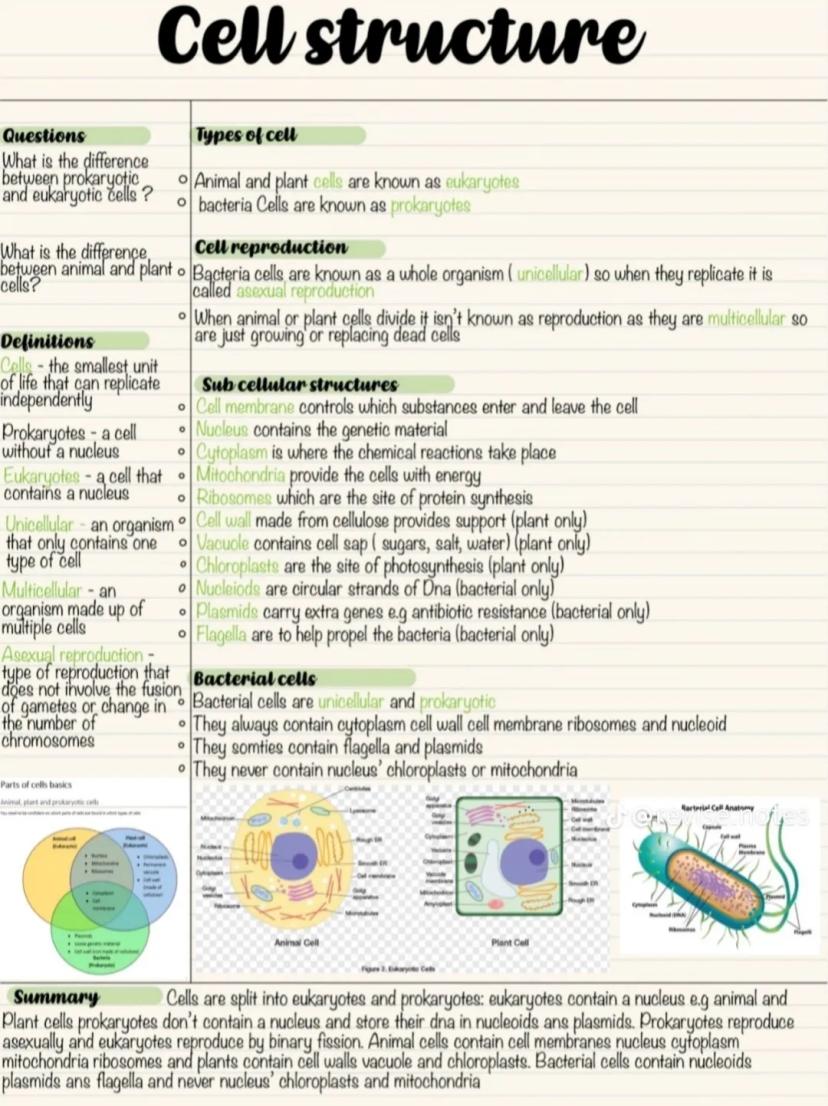
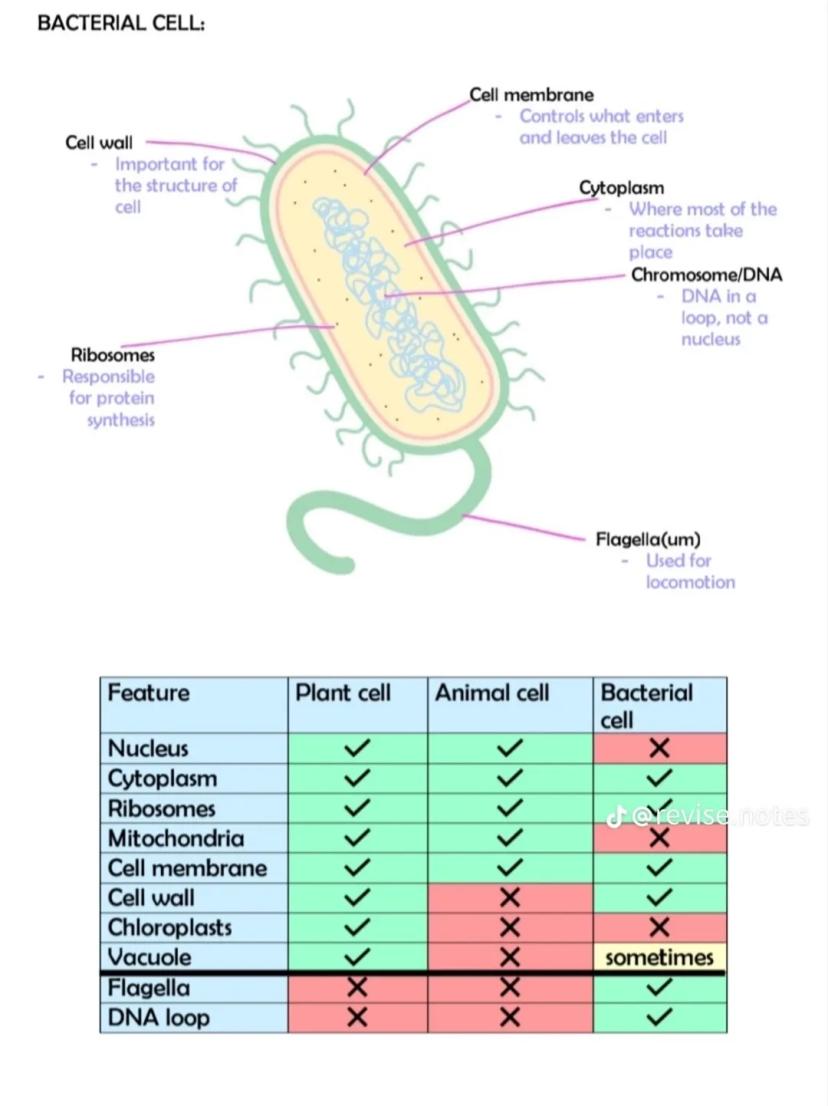
Here's where things get interesting – different types of cells have completely different structures depending on what job they need to do. Bacterial cells are the rebels of the cell world, doing things completely differently from animal and plant cells.
Bacterial cells are basically survival experts. They have flagella (like tiny propellers) to swim around, plasmids that carry extra genes (including antibiotic resistance – that's why superbugs are so dangerous!), and a tough cell wall for protection. What they don't have is a nucleus, mitochondria, or chloroplasts.
Plant cells are like animal cells with some serious upgrades. They've got everything animal cells have, plus a cell wall for structure, chloroplasts for photosynthesis, and a large vacuole filled with cell sap. Think of them as animal cells with solar panels and better storage!
The comparison table shows exactly what each cell type has and doesn't have. Animal cells are the basic model, plant cells are the eco-friendly version, and bacterial cells are the stripped-down, super-efficient model that's been around for billions of years.
Exam hack: Use the table to create memory tricks – bacteria are so tough they don't need mitochondria, but they do need flagella to escape danger!
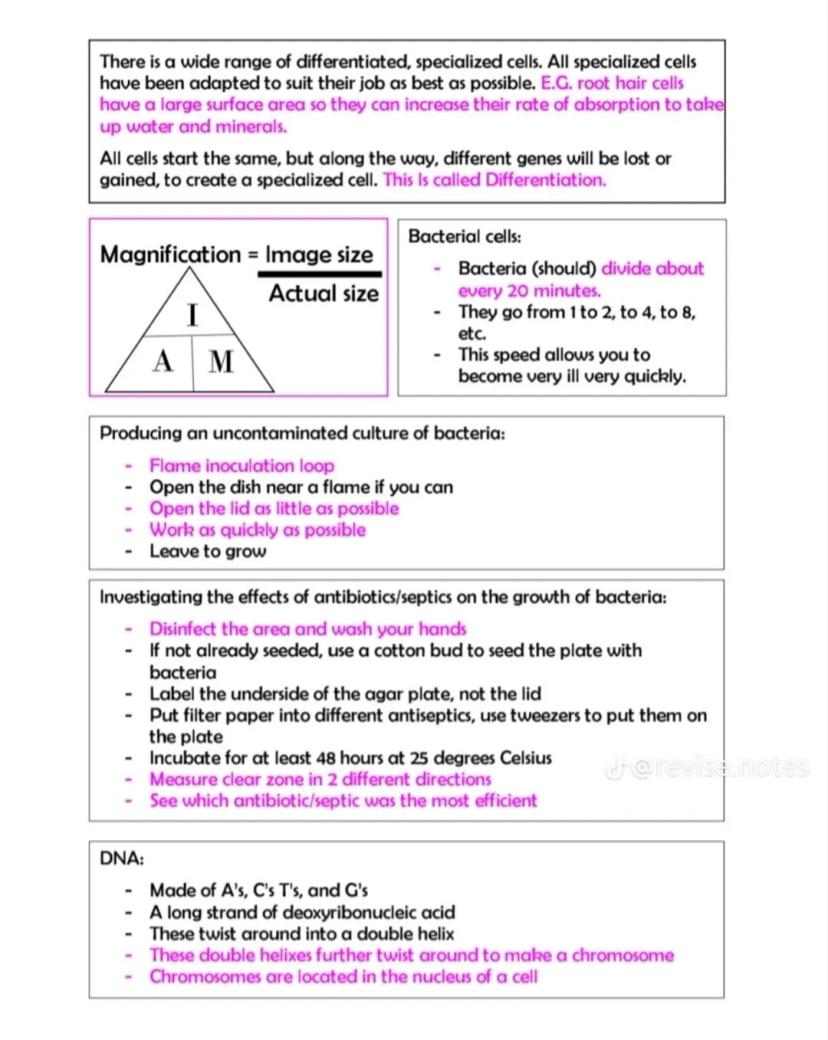
Here's the amazing bit – every cell in your body started exactly the same, but through differentiation, they became completely different specialists. A nerve cell looks nothing like a muscle cell, yet they both came from identical starting points!
Differentiation happens when cells switch certain genes on or off to become specialised. Root hair cells develop huge surface areas for absorbing water, whilst red blood cells lose their nucleus entirely to carry more oxygen. It's like students all starting in Year 7 but ending up with completely different careers!
Bacterial cells are reproduction speed demons – they can divide every 20 minutes under perfect conditions. That's how you can go from feeling fine to really ill so quickly when bacteria infect you. The numbers grow exponentially: 1 becomes 2, then 4, then 8, then 16, and so on.
When scientists want to study bacteria safely, they need uncontaminated cultures. This means flaming equipment, working near flames, opening dishes as little as possible, and incubating at exactly 25°C. Testing antibiotics involves placing filter papers soaked in different substances on bacterial cultures and measuring the clear zones where bacteria couldn't grow.
Real-world connection: Understanding bacterial reproduction helps explain why doctors are so concerned about antibiotic resistance – bacteria that survive treatment multiply incredibly quickly!
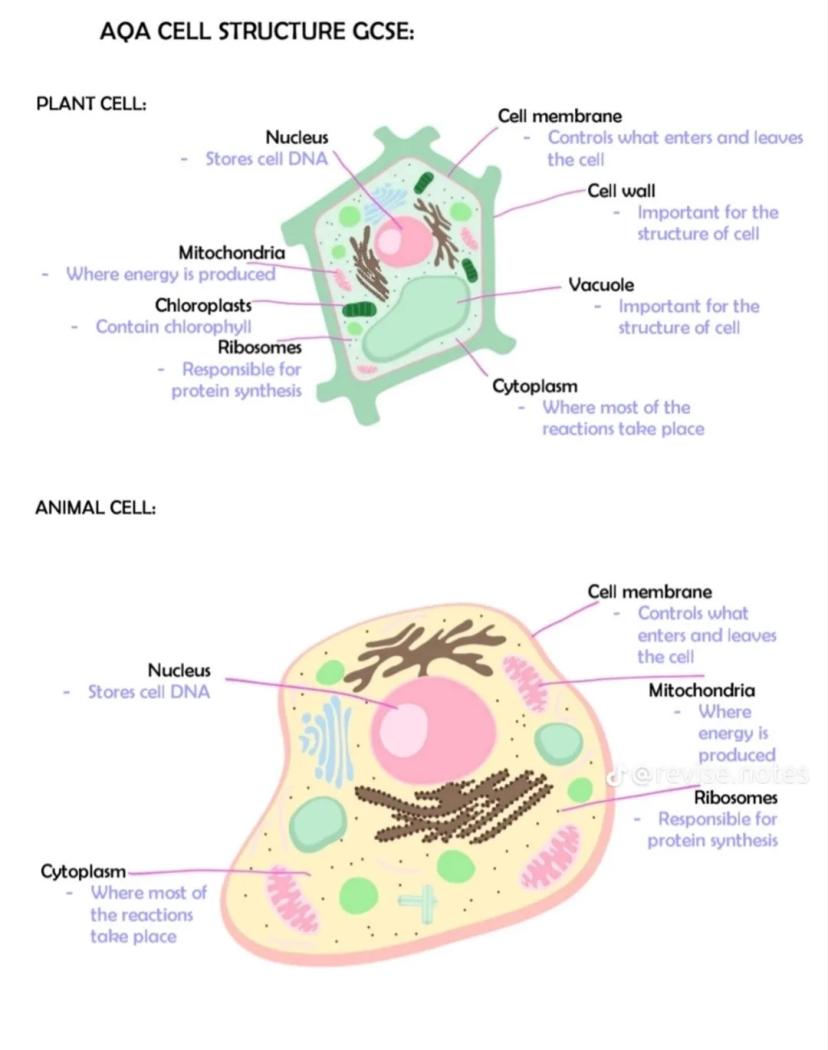
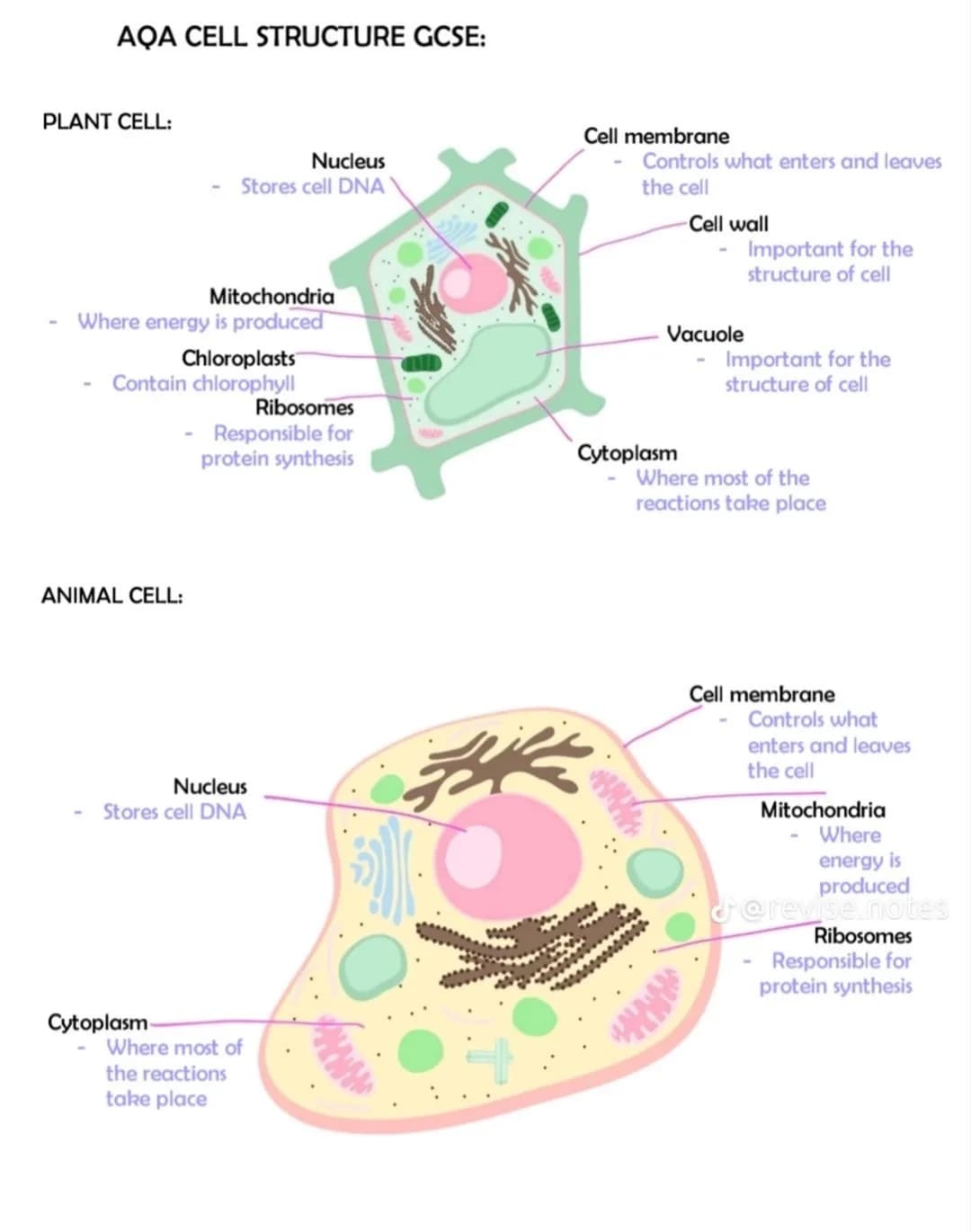
Getting the specific parts of plant and animal cells sorted is essential for your GCSE – and once you know what each bit does, it all makes perfect sense. These are the eukaryotic cells you'll be tested on most often.
Both cell types share the same basic toolkit: a nucleus storing DNA (like the cell's hard drive), mitochondria producing energy (the power stations), ribosomes making proteins (tiny factories), cytoplasm where reactions happen (the workspace), and a cell membrane controlling entry and exit (the security guard).
Plant cells get some exclusive extras because they live a completely different lifestyle. Chloroplasts contain chlorophyll for photosynthesis (they make their own food!), the cell wall provides rigid structure (so plants can stand tall), and the large vacuole maintains shape and stores important substances.
Think about why plants need these extras – they can't move to find food like animals can, so they make their own. They can't run away from danger, so they need strong cell walls for protection.
Quick check: Remember that animal cells are more flexible and mobile, whilst plant cells are structured and self-sufficient!
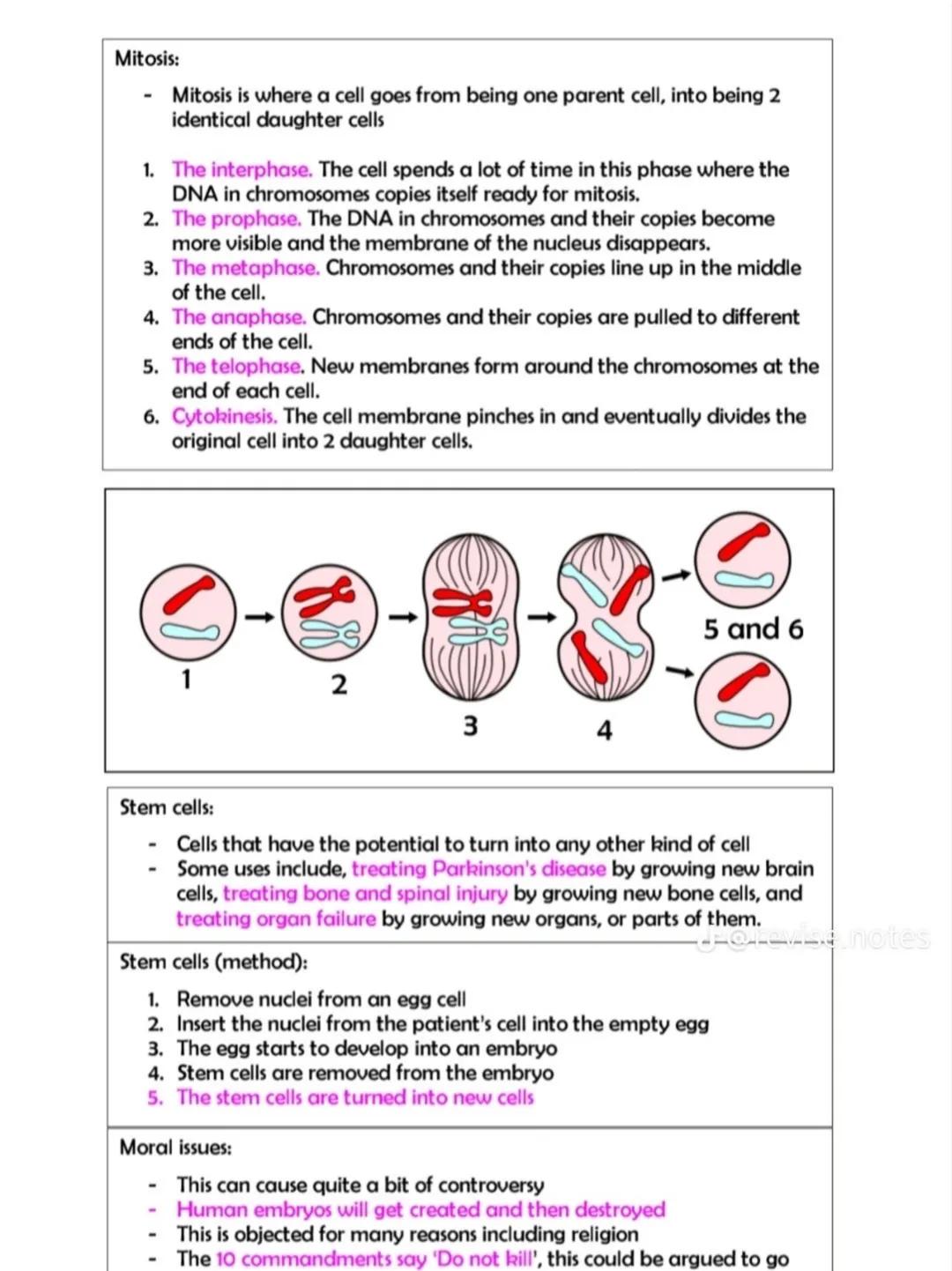
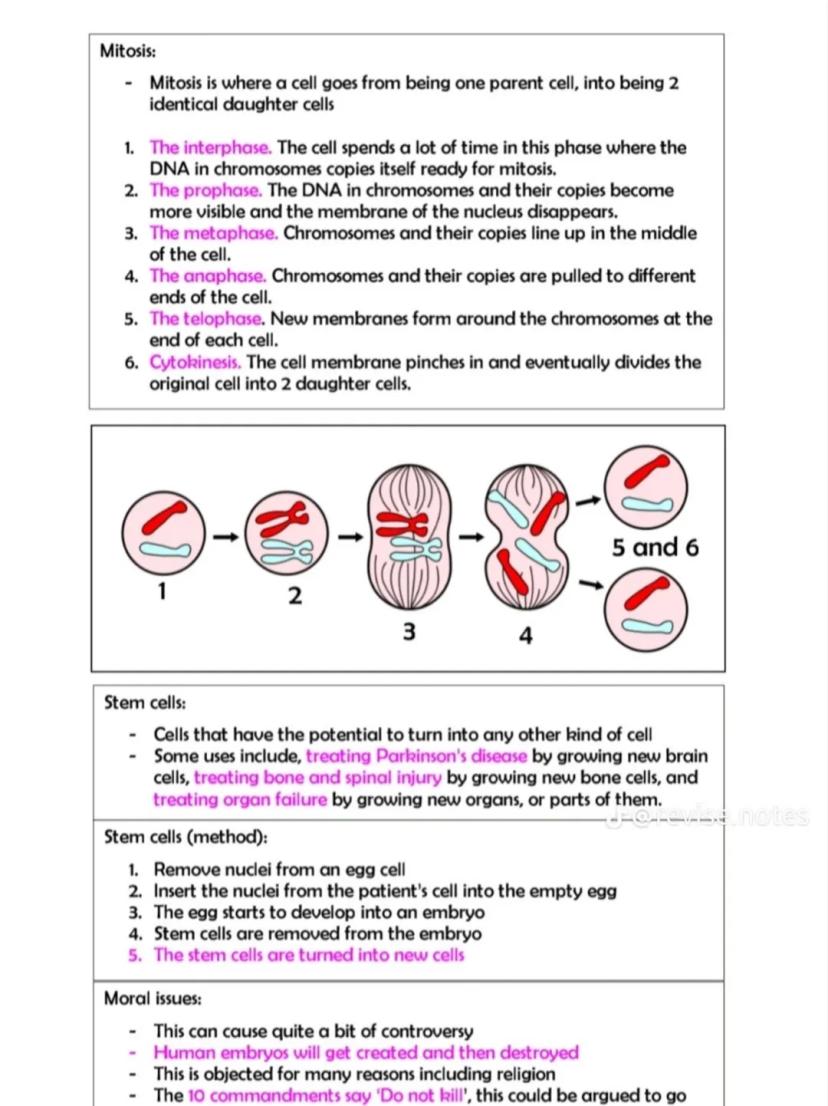
Ever wondered how a tiny cut on your finger heals itself? That's mitosis in action – the process where one parent cell becomes two identical daughter cells. Think of it as nature's photocopying machine!
Mitosis happens in six clear stages that you need to know. It starts with interphase, where the cell spends most of its time copying DNA. Then comes prophase (chromosomes become visible), metaphase (chromosomes line up in the middle), anaphase (chromosomes get pulled apart), telophase (new nuclei form), and finally cytokinesis (the cell actually splits in two).
Stem cells are like the ultimate shape-shifters – they can turn into any other type of cell your body needs. Scientists can use them to treat serious conditions like Parkinson's disease by growing new brain cells, or help people with spinal injuries by creating new bone cells. The process involves removing nuclei from egg cells and inserting patient DNA to create new stem cells.
Remember: Mitosis creates identical cells for growth and repair, whilst stem cells can become any specialised cell type your body needs.
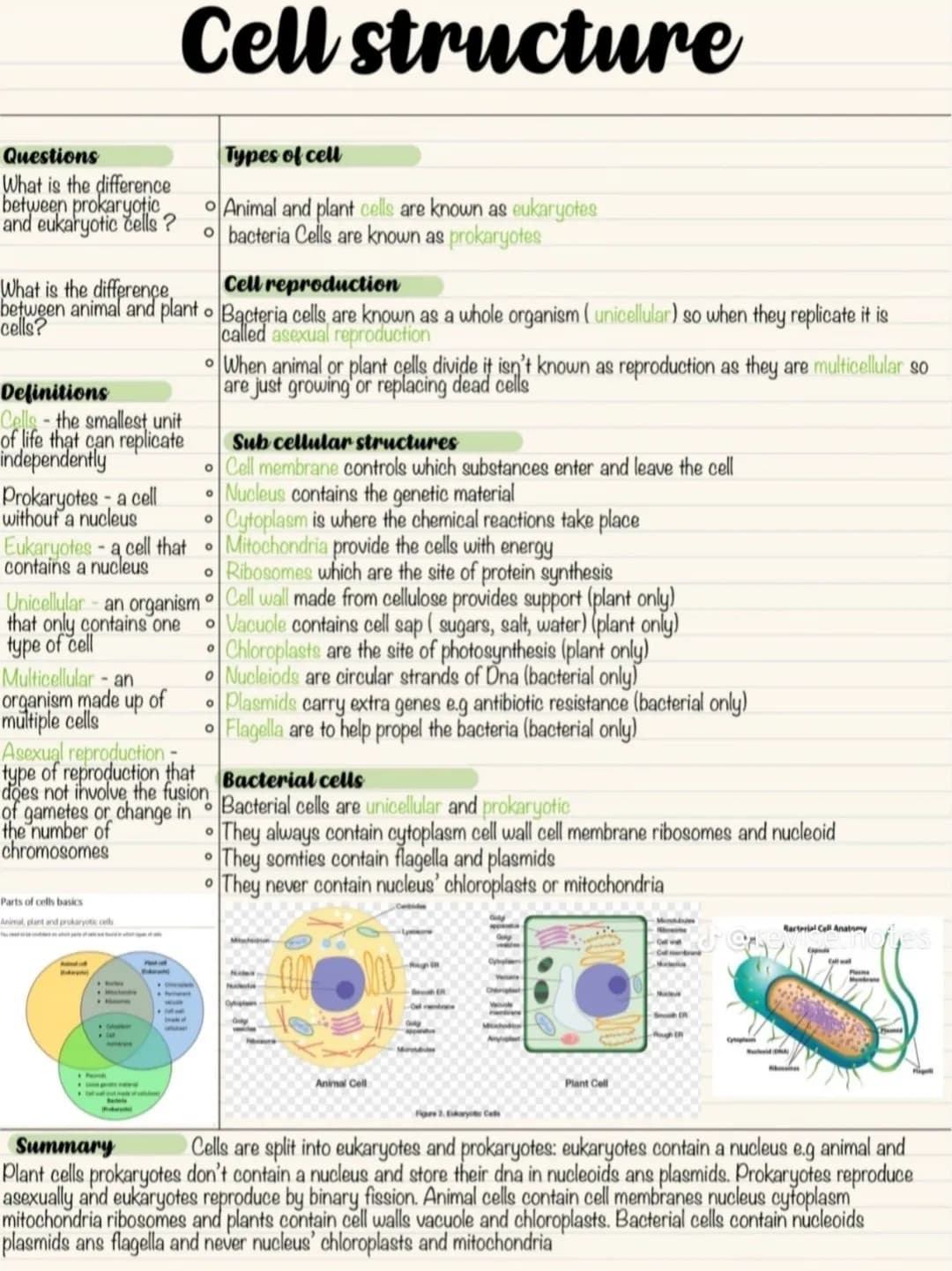
Not all cells are created equal! Understanding the difference between prokaryotic and eukaryotic cells is crucial for your exams, and it's actually quite straightforward once you get the hang of it.
Eukaryotic cells (like animal and plant cells) have a proper nucleus that acts like the cell's control centre. Prokaryotic cells (bacteria) don't have a nucleus – their DNA just floats around freely in circular strands called nucleoids. Think of eukaryotes as having a proper office with separate rooms, whilst prokaryotes are more like open-plan studios.
When bacteria divide, it's called asexual reproduction because they're complete organisms on their own. When your skin cells divide, it's just called cell division because you're multicellular – made up of millions of different cells working together.
Every cell has some basic parts: the cell membrane controls what goes in and out, cytoplasm is where chemical reactions happen, and ribosomes make proteins. Animal and plant cells also have mitochondria (the powerhouses) and a nucleus containing genetic material.
Top tip: Remember that ALL cells have cytoplasm, ribosomes, and a cell membrane – these are the absolute essentials for life!
Our AI companion is specifically built for the needs of students. Based on the millions of content pieces we have on the platform we can provide truly meaningful and relevant answers to students. But its not only about answers, the companion is even more about guiding students through their daily learning challenges, with personalised study plans, quizzes or content pieces in the chat and 100% personalisation based on the students skills and developments.
You can download the app in the Google Play Store and in the Apple App Store.
That's right! Enjoy free access to study content, connect with fellow students, and get instant help – all at your fingertips.
App Store
Google Play
The app is very easy to use and well designed. I have found everything I was looking for so far and have been able to learn a lot from the presentations! I will definitely use the app for a class assignment! And of course it also helps a lot as an inspiration.
Stefan S
iOS user
This app is really great. There are so many study notes and help [...]. My problem subject is French, for example, and the app has so many options for help. Thanks to this app, I have improved my French. I would recommend it to anyone.
Samantha Klich
Android user
Wow, I am really amazed. I just tried the app because I've seen it advertised many times and was absolutely stunned. This app is THE HELP you want for school and above all, it offers so many things, such as workouts and fact sheets, which have been VERY helpful to me personally.
Anna
iOS user
I think it’s very much worth it and you’ll end up using it a lot once you get the hang of it and even after looking at others notes you can still ask your Artificial intelligence buddy the question and ask to simplify it if you still don’t get it!!! In the end I think it’s worth it 😊👍 ⚠️Also DID I MENTION ITS FREEE YOU DON’T HAVE TO PAY FOR ANYTHING AND STILL GET YOUR GRADES IN PERFECTLY❗️❗️⚠️
Thomas R
iOS user
Knowunity is the BEST app I’ve used in a minute. This is not an ai review or anything this is genuinely coming from a 7th grade student (I know 2011 im young) but dude this app is a 10/10 i have maintained a 3.8 gpa and have plenty of time for gaming. I love it and my mom is just happy I got good grades
Brad T
Android user
Not only did it help me find the answer but it also showed me alternative ways to solve it. I was horrible in math and science but now I have an a in both subjects. Thanks for the help🤍🤍
David K
iOS user
The app's just great! All I have to do is enter the topic in the search bar and I get the response real fast. I don't have to watch 10 YouTube videos to understand something, so I'm saving my time. Highly recommended!
Sudenaz Ocak
Android user
In school I was really bad at maths but thanks to the app, I am doing better now. I am so grateful that you made the app.
Greenlight Bonnie
Android user
I found this app a couple years ago and it has only gotten better since then. I really love it because it can help with written questions and photo questions. Also, it can find study guides that other people have made as well as flashcard sets and practice tests. The free version is also amazing for students who might not be able to afford it. Would 100% recommend
Aubrey
iOS user
Best app if you're in Highschool or Junior high. I have been using this app for 2 school years and it's the best, it's good if you don't have anyone to help you with school work.😋🩷🎀
Marco B
iOS user
THE QUIZES AND FLASHCARDS ARE SO USEFUL AND I LOVE THE SCHOOLGPT. IT ALSO IS LITREALLY LIKE CHATGPT BUT SMARTER!! HELPED ME WITH MY MASCARA PROBLEMS TOO!! AS WELL AS MY REAL SUBJECTS ! DUHHH 😍😁😲🤑💗✨🎀😮
Elisha
iOS user
This app is phenomenal down to the correct info and the various topics you can study! I greatly recommend it for people who struggle with procrastination and those who need homework help. It has been perfectly accurate for world 1 history as far as I’ve seen! Geometry too!
Paul T
iOS user
The app is very easy to use and well designed. I have found everything I was looking for so far and have been able to learn a lot from the presentations! I will definitely use the app for a class assignment! And of course it also helps a lot as an inspiration.
Stefan S
iOS user
This app is really great. There are so many study notes and help [...]. My problem subject is French, for example, and the app has so many options for help. Thanks to this app, I have improved my French. I would recommend it to anyone.
Samantha Klich
Android user
Wow, I am really amazed. I just tried the app because I've seen it advertised many times and was absolutely stunned. This app is THE HELP you want for school and above all, it offers so many things, such as workouts and fact sheets, which have been VERY helpful to me personally.
Anna
iOS user
I think it’s very much worth it and you’ll end up using it a lot once you get the hang of it and even after looking at others notes you can still ask your Artificial intelligence buddy the question and ask to simplify it if you still don’t get it!!! In the end I think it’s worth it 😊👍 ⚠️Also DID I MENTION ITS FREEE YOU DON’T HAVE TO PAY FOR ANYTHING AND STILL GET YOUR GRADES IN PERFECTLY❗️❗️⚠️
Thomas R
iOS user
Knowunity is the BEST app I’ve used in a minute. This is not an ai review or anything this is genuinely coming from a 7th grade student (I know 2011 im young) but dude this app is a 10/10 i have maintained a 3.8 gpa and have plenty of time for gaming. I love it and my mom is just happy I got good grades
Brad T
Android user
Not only did it help me find the answer but it also showed me alternative ways to solve it. I was horrible in math and science but now I have an a in both subjects. Thanks for the help🤍🤍
David K
iOS user
The app's just great! All I have to do is enter the topic in the search bar and I get the response real fast. I don't have to watch 10 YouTube videos to understand something, so I'm saving my time. Highly recommended!
Sudenaz Ocak
Android user
In school I was really bad at maths but thanks to the app, I am doing better now. I am so grateful that you made the app.
Greenlight Bonnie
Android user
I found this app a couple years ago and it has only gotten better since then. I really love it because it can help with written questions and photo questions. Also, it can find study guides that other people have made as well as flashcard sets and practice tests. The free version is also amazing for students who might not be able to afford it. Would 100% recommend
Aubrey
iOS user
Best app if you're in Highschool or Junior high. I have been using this app for 2 school years and it's the best, it's good if you don't have anyone to help you with school work.😋🩷🎀
Marco B
iOS user
THE QUIZES AND FLASHCARDS ARE SO USEFUL AND I LOVE THE SCHOOLGPT. IT ALSO IS LITREALLY LIKE CHATGPT BUT SMARTER!! HELPED ME WITH MY MASCARA PROBLEMS TOO!! AS WELL AS MY REAL SUBJECTS ! DUHHH 😍😁😲🤑💗✨🎀😮
Elisha
iOS user
This app is phenomenal down to the correct info and the various topics you can study! I greatly recommend it for people who struggle with procrastination and those who need homework help. It has been perfectly accurate for world 1 history as far as I’ve seen! Geometry too!
Paul T
iOS user
emalie mcgrath
@emaliemcgrath_wszy
Cell biology is everywhere around you – from the bacteria that make you ill to the plants in your garden, everything living is made of cells. Understanding how cells work, divide, and specialise will help you make sense of everything... Show more
Access to all documents
Improve your grades
Join milions of students
By signing up you accept Terms of Service and Privacy Policy
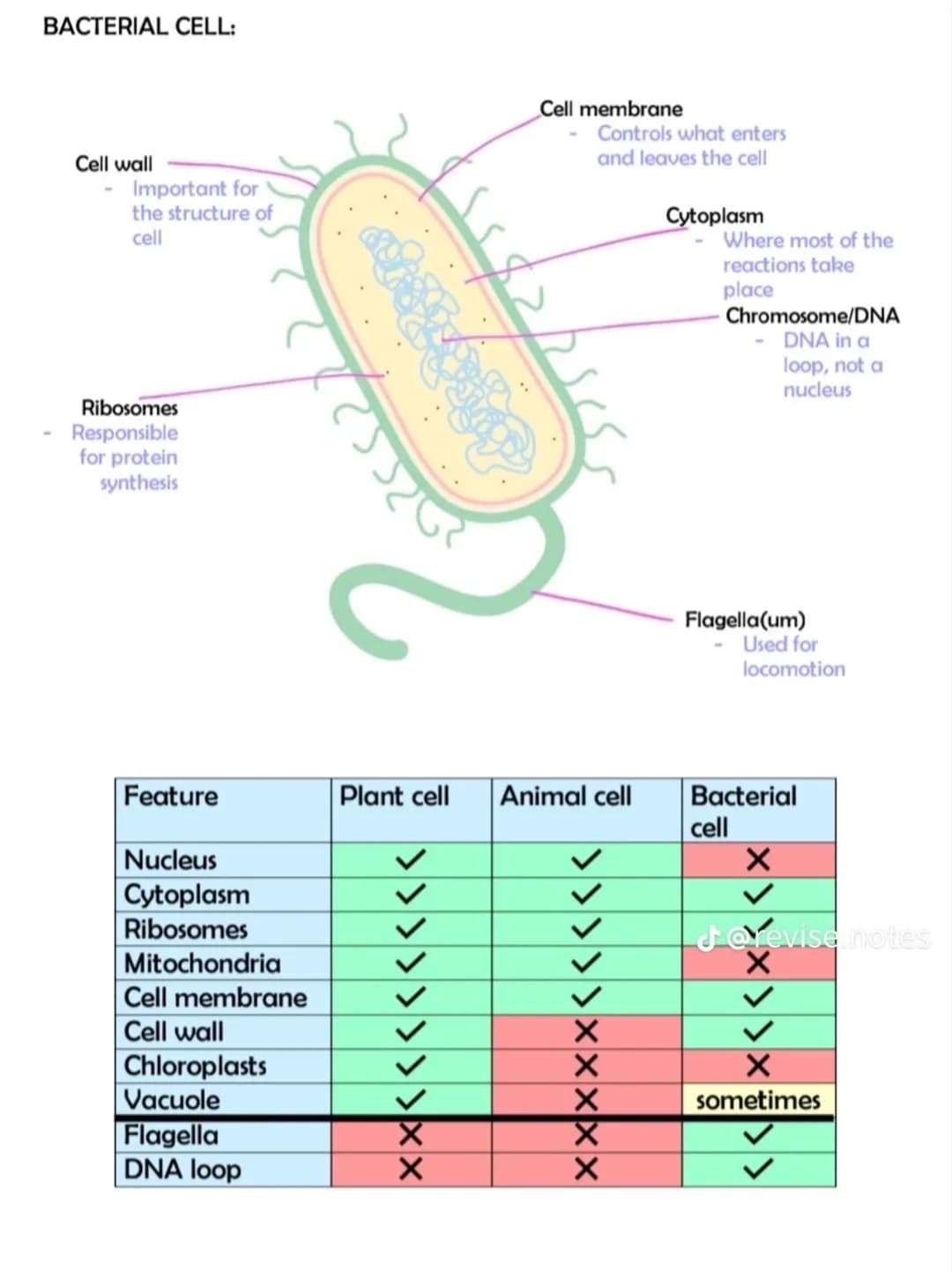
Here's where things get interesting – different types of cells have completely different structures depending on what job they need to do. Bacterial cells are the rebels of the cell world, doing things completely differently from animal and plant cells.
Bacterial cells are basically survival experts. They have flagella (like tiny propellers) to swim around, plasmids that carry extra genes (including antibiotic resistance – that's why superbugs are so dangerous!), and a tough cell wall for protection. What they don't have is a nucleus, mitochondria, or chloroplasts.
Plant cells are like animal cells with some serious upgrades. They've got everything animal cells have, plus a cell wall for structure, chloroplasts for photosynthesis, and a large vacuole filled with cell sap. Think of them as animal cells with solar panels and better storage!
The comparison table shows exactly what each cell type has and doesn't have. Animal cells are the basic model, plant cells are the eco-friendly version, and bacterial cells are the stripped-down, super-efficient model that's been around for billions of years.
Exam hack: Use the table to create memory tricks – bacteria are so tough they don't need mitochondria, but they do need flagella to escape danger!
Access to all documents
Improve your grades
Join milions of students
By signing up you accept Terms of Service and Privacy Policy
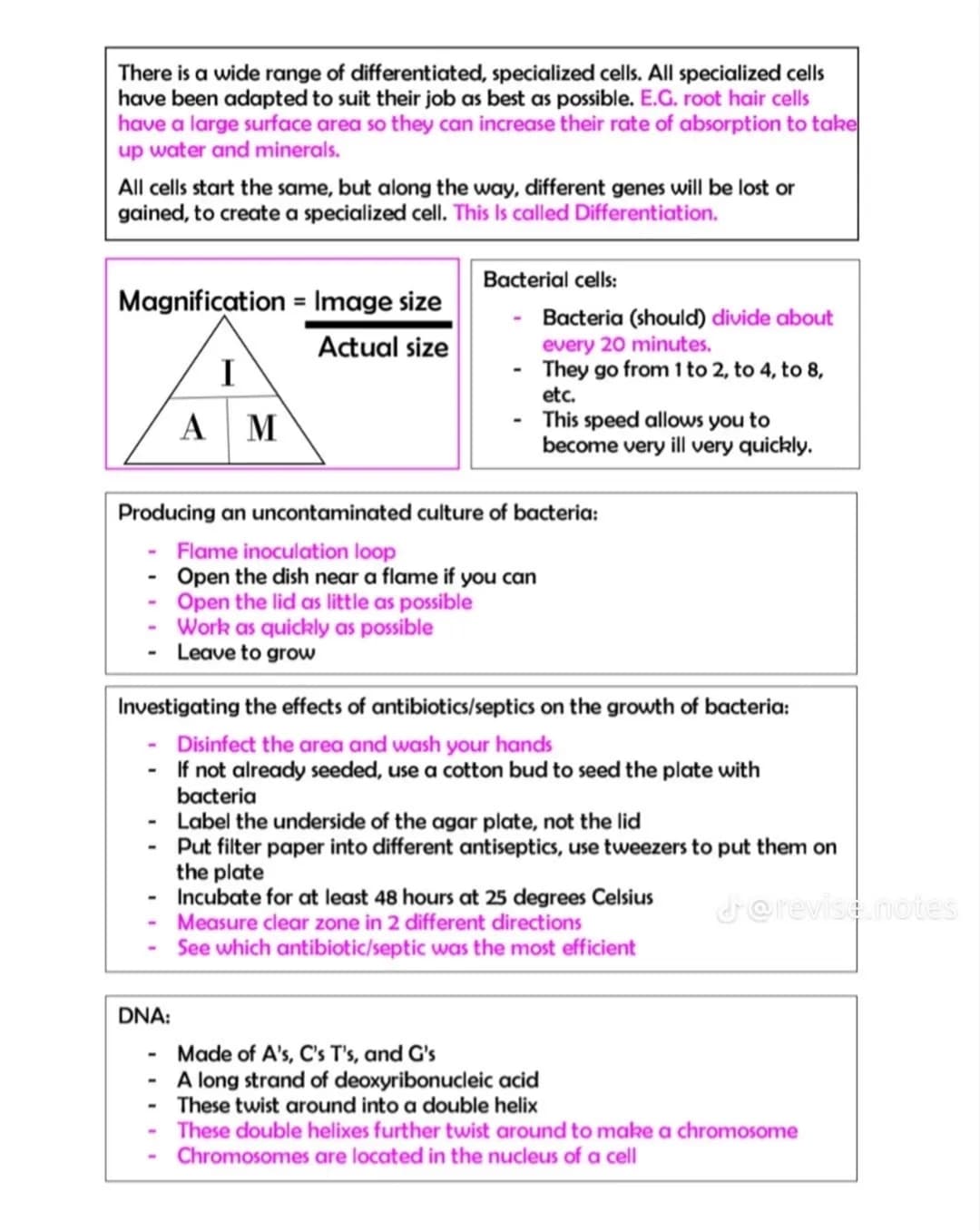
Here's the amazing bit – every cell in your body started exactly the same, but through differentiation, they became completely different specialists. A nerve cell looks nothing like a muscle cell, yet they both came from identical starting points!
Differentiation happens when cells switch certain genes on or off to become specialised. Root hair cells develop huge surface areas for absorbing water, whilst red blood cells lose their nucleus entirely to carry more oxygen. It's like students all starting in Year 7 but ending up with completely different careers!
Bacterial cells are reproduction speed demons – they can divide every 20 minutes under perfect conditions. That's how you can go from feeling fine to really ill so quickly when bacteria infect you. The numbers grow exponentially: 1 becomes 2, then 4, then 8, then 16, and so on.
When scientists want to study bacteria safely, they need uncontaminated cultures. This means flaming equipment, working near flames, opening dishes as little as possible, and incubating at exactly 25°C. Testing antibiotics involves placing filter papers soaked in different substances on bacterial cultures and measuring the clear zones where bacteria couldn't grow.
Real-world connection: Understanding bacterial reproduction helps explain why doctors are so concerned about antibiotic resistance – bacteria that survive treatment multiply incredibly quickly!
Access to all documents
Improve your grades
Join milions of students
By signing up you accept Terms of Service and Privacy Policy
Getting the specific parts of plant and animal cells sorted is essential for your GCSE – and once you know what each bit does, it all makes perfect sense. These are the eukaryotic cells you'll be tested on most often.
Both cell types share the same basic toolkit: a nucleus storing DNA (like the cell's hard drive), mitochondria producing energy (the power stations), ribosomes making proteins (tiny factories), cytoplasm where reactions happen (the workspace), and a cell membrane controlling entry and exit (the security guard).
Plant cells get some exclusive extras because they live a completely different lifestyle. Chloroplasts contain chlorophyll for photosynthesis (they make their own food!), the cell wall provides rigid structure (so plants can stand tall), and the large vacuole maintains shape and stores important substances.
Think about why plants need these extras – they can't move to find food like animals can, so they make their own. They can't run away from danger, so they need strong cell walls for protection.
Quick check: Remember that animal cells are more flexible and mobile, whilst plant cells are structured and self-sufficient!
Access to all documents
Improve your grades
Join milions of students
By signing up you accept Terms of Service and Privacy Policy
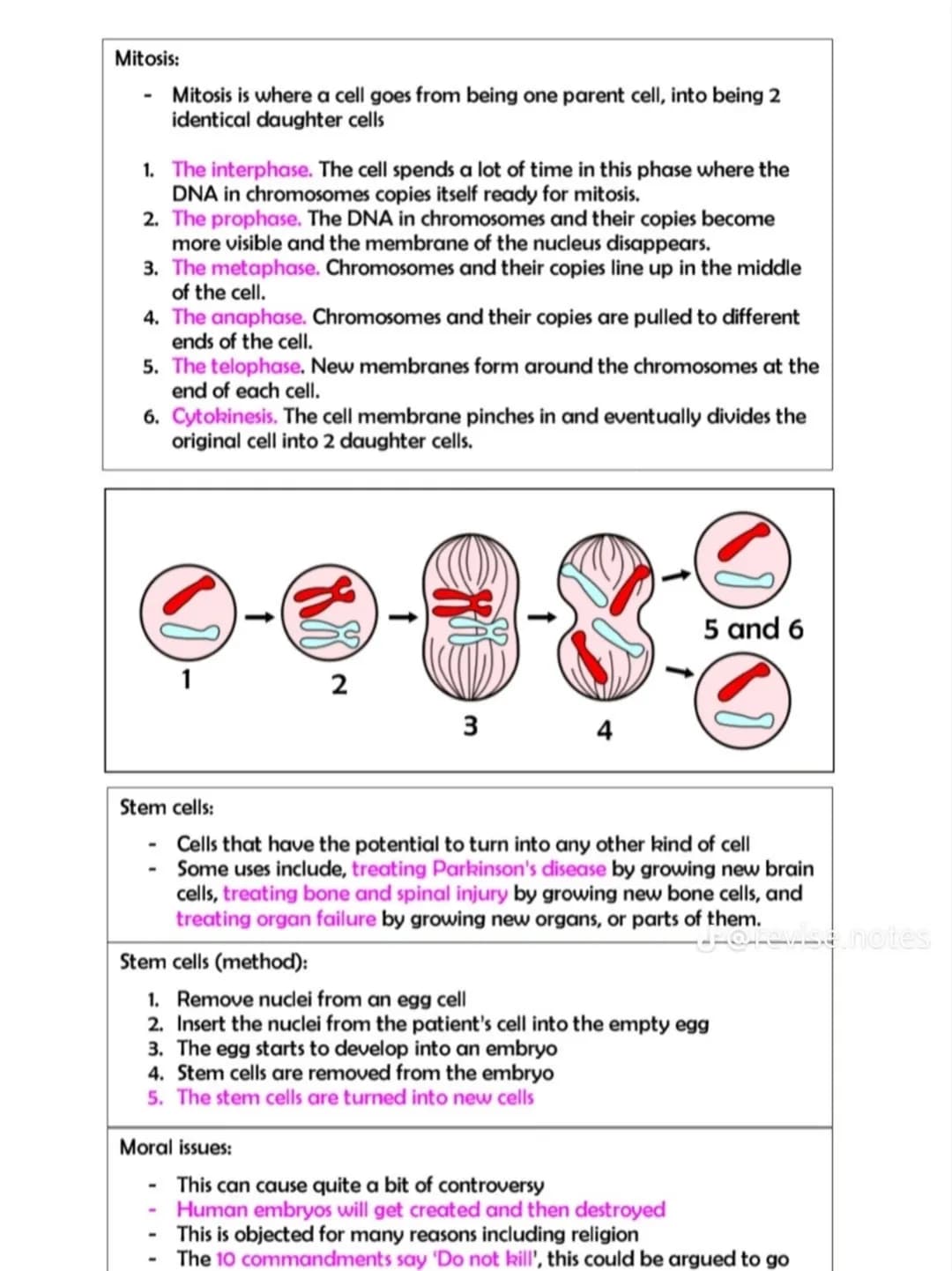
Ever wondered how a tiny cut on your finger heals itself? That's mitosis in action – the process where one parent cell becomes two identical daughter cells. Think of it as nature's photocopying machine!
Mitosis happens in six clear stages that you need to know. It starts with interphase, where the cell spends most of its time copying DNA. Then comes prophase (chromosomes become visible), metaphase (chromosomes line up in the middle), anaphase (chromosomes get pulled apart), telophase (new nuclei form), and finally cytokinesis (the cell actually splits in two).
Stem cells are like the ultimate shape-shifters – they can turn into any other type of cell your body needs. Scientists can use them to treat serious conditions like Parkinson's disease by growing new brain cells, or help people with spinal injuries by creating new bone cells. The process involves removing nuclei from egg cells and inserting patient DNA to create new stem cells.
Remember: Mitosis creates identical cells for growth and repair, whilst stem cells can become any specialised cell type your body needs.
Access to all documents
Improve your grades
Join milions of students
By signing up you accept Terms of Service and Privacy Policy
Not all cells are created equal! Understanding the difference between prokaryotic and eukaryotic cells is crucial for your exams, and it's actually quite straightforward once you get the hang of it.
Eukaryotic cells (like animal and plant cells) have a proper nucleus that acts like the cell's control centre. Prokaryotic cells (bacteria) don't have a nucleus – their DNA just floats around freely in circular strands called nucleoids. Think of eukaryotes as having a proper office with separate rooms, whilst prokaryotes are more like open-plan studios.
When bacteria divide, it's called asexual reproduction because they're complete organisms on their own. When your skin cells divide, it's just called cell division because you're multicellular – made up of millions of different cells working together.
Every cell has some basic parts: the cell membrane controls what goes in and out, cytoplasm is where chemical reactions happen, and ribosomes make proteins. Animal and plant cells also have mitochondria (the powerhouses) and a nucleus containing genetic material.
Top tip: Remember that ALL cells have cytoplasm, ribosomes, and a cell membrane – these are the absolute essentials for life!
Our AI companion is specifically built for the needs of students. Based on the millions of content pieces we have on the platform we can provide truly meaningful and relevant answers to students. But its not only about answers, the companion is even more about guiding students through their daily learning challenges, with personalised study plans, quizzes or content pieces in the chat and 100% personalisation based on the students skills and developments.
You can download the app in the Google Play Store and in the Apple App Store.
That's right! Enjoy free access to study content, connect with fellow students, and get instant help – all at your fingertips.
7
Smart Tools NEW
Transform this note into: ✓ 50+ Practice Questions ✓ Interactive Flashcards ✓ Full Mock Exam ✓ Essay Outlines
Notes describing the Cell Cycle in biology
Biology
BiologyVery good notes
 Environmental Science
Color coded, All of Case study 5 of freshman level Biology, key Located on notes. Covers cell cycle, vocabulary, tumors, call therapy.
BiologyLearn about the purpose and stages of meiosis, a unique cell division process that produces gametes and increases genetic diversity.
BiologyLearn about Mitosis and the four distinct phases of the eukaryotic cell cycle and their functions in cell growth and division.
ChemistryApp Store
Google Play
The app is very easy to use and well designed. I have found everything I was looking for so far and have been able to learn a lot from the presentations! I will definitely use the app for a class assignment! And of course it also helps a lot as an inspiration.
Stefan S
iOS user
This app is really great. There are so many study notes and help [...]. My problem subject is French, for example, and the app has so many options for help. Thanks to this app, I have improved my French. I would recommend it to anyone.
Samantha Klich
Android user
Wow, I am really amazed. I just tried the app because I've seen it advertised many times and was absolutely stunned. This app is THE HELP you want for school and above all, it offers so many things, such as workouts and fact sheets, which have been VERY helpful to me personally.
Anna
iOS user
I think it’s very much worth it and you’ll end up using it a lot once you get the hang of it and even after looking at others notes you can still ask your Artificial intelligence buddy the question and ask to simplify it if you still don’t get it!!! In the end I think it’s worth it 😊👍 ⚠️Also DID I MENTION ITS FREEE YOU DON’T HAVE TO PAY FOR ANYTHING AND STILL GET YOUR GRADES IN PERFECTLY❗️❗️⚠️
Thomas R
iOS user
Knowunity is the BEST app I’ve used in a minute. This is not an ai review or anything this is genuinely coming from a 7th grade student (I know 2011 im young) but dude this app is a 10/10 i have maintained a 3.8 gpa and have plenty of time for gaming. I love it and my mom is just happy I got good grades
Brad T
Android user
Not only did it help me find the answer but it also showed me alternative ways to solve it. I was horrible in math and science but now I have an a in both subjects. Thanks for the help🤍🤍
David K
iOS user
The app's just great! All I have to do is enter the topic in the search bar and I get the response real fast. I don't have to watch 10 YouTube videos to understand something, so I'm saving my time. Highly recommended!
Sudenaz Ocak
Android user
In school I was really bad at maths but thanks to the app, I am doing better now. I am so grateful that you made the app.
Greenlight Bonnie
Android user
I found this app a couple years ago and it has only gotten better since then. I really love it because it can help with written questions and photo questions. Also, it can find study guides that other people have made as well as flashcard sets and practice tests. The free version is also amazing for students who might not be able to afford it. Would 100% recommend
Aubrey
iOS user
Best app if you're in Highschool or Junior high. I have been using this app for 2 school years and it's the best, it's good if you don't have anyone to help you with school work.😋🩷🎀
Marco B
iOS user
THE QUIZES AND FLASHCARDS ARE SO USEFUL AND I LOVE THE SCHOOLGPT. IT ALSO IS LITREALLY LIKE CHATGPT BUT SMARTER!! HELPED ME WITH MY MASCARA PROBLEMS TOO!! AS WELL AS MY REAL SUBJECTS ! DUHHH 😍😁😲🤑💗✨🎀😮
Elisha
iOS user
This app is phenomenal down to the correct info and the various topics you can study! I greatly recommend it for people who struggle with procrastination and those who need homework help. It has been perfectly accurate for world 1 history as far as I’ve seen! Geometry too!
Paul T
iOS user
The app is very easy to use and well designed. I have found everything I was looking for so far and have been able to learn a lot from the presentations! I will definitely use the app for a class assignment! And of course it also helps a lot as an inspiration.
Stefan S
iOS user
This app is really great. There are so many study notes and help [...]. My problem subject is French, for example, and the app has so many options for help. Thanks to this app, I have improved my French. I would recommend it to anyone.
Samantha Klich
Android user
Wow, I am really amazed. I just tried the app because I've seen it advertised many times and was absolutely stunned. This app is THE HELP you want for school and above all, it offers so many things, such as workouts and fact sheets, which have been VERY helpful to me personally.
Anna
iOS user
I think it’s very much worth it and you’ll end up using it a lot once you get the hang of it and even after looking at others notes you can still ask your Artificial intelligence buddy the question and ask to simplify it if you still don’t get it!!! In the end I think it’s worth it 😊👍 ⚠️Also DID I MENTION ITS FREEE YOU DON’T HAVE TO PAY FOR ANYTHING AND STILL GET YOUR GRADES IN PERFECTLY❗️❗️⚠️
Thomas R
iOS user
Knowunity is the BEST app I’ve used in a minute. This is not an ai review or anything this is genuinely coming from a 7th grade student (I know 2011 im young) but dude this app is a 10/10 i have maintained a 3.8 gpa and have plenty of time for gaming. I love it and my mom is just happy I got good grades
Brad T
Android user
Not only did it help me find the answer but it also showed me alternative ways to solve it. I was horrible in math and science but now I have an a in both subjects. Thanks for the help🤍🤍
David K
iOS user
The app's just great! All I have to do is enter the topic in the search bar and I get the response real fast. I don't have to watch 10 YouTube videos to understand something, so I'm saving my time. Highly recommended!
Sudenaz Ocak
Android user
In school I was really bad at maths but thanks to the app, I am doing better now. I am so grateful that you made the app.
Greenlight Bonnie
Android user
I found this app a couple years ago and it has only gotten better since then. I really love it because it can help with written questions and photo questions. Also, it can find study guides that other people have made as well as flashcard sets and practice tests. The free version is also amazing for students who might not be able to afford it. Would 100% recommend
Aubrey
iOS user
Best app if you're in Highschool or Junior high. I have been using this app for 2 school years and it's the best, it's good if you don't have anyone to help you with school work.😋🩷🎀
Marco B
iOS user
THE QUIZES AND FLASHCARDS ARE SO USEFUL AND I LOVE THE SCHOOLGPT. IT ALSO IS LITREALLY LIKE CHATGPT BUT SMARTER!! HELPED ME WITH MY MASCARA PROBLEMS TOO!! AS WELL AS MY REAL SUBJECTS ! DUHHH 😍😁😲🤑💗✨🎀😮
Elisha
iOS user
This app is phenomenal down to the correct info and the various topics you can study! I greatly recommend it for people who struggle with procrastination and those who need homework help. It has been perfectly accurate for world 1 history as far as I’ve seen! Geometry too!
Paul T
iOS user