Open the App

Subjects

113

Dec 9, 2025

12 pages

Master Science: Your Comprehensive Revision Guide

user profile picture

Anna Rusin

@annarusin_cghn

This content covers fundamental chemistry and physics concepts that form... Show more

Page 1
Page 1
Page 1
Page 1
Page 1
Page 1
Page 1
Page 2
Page 2
Page 2
1 / 10
# The History of The Atom

You might have thought you were done with the atom after page 12. Unfortunately amigo,
you don't get away that ea

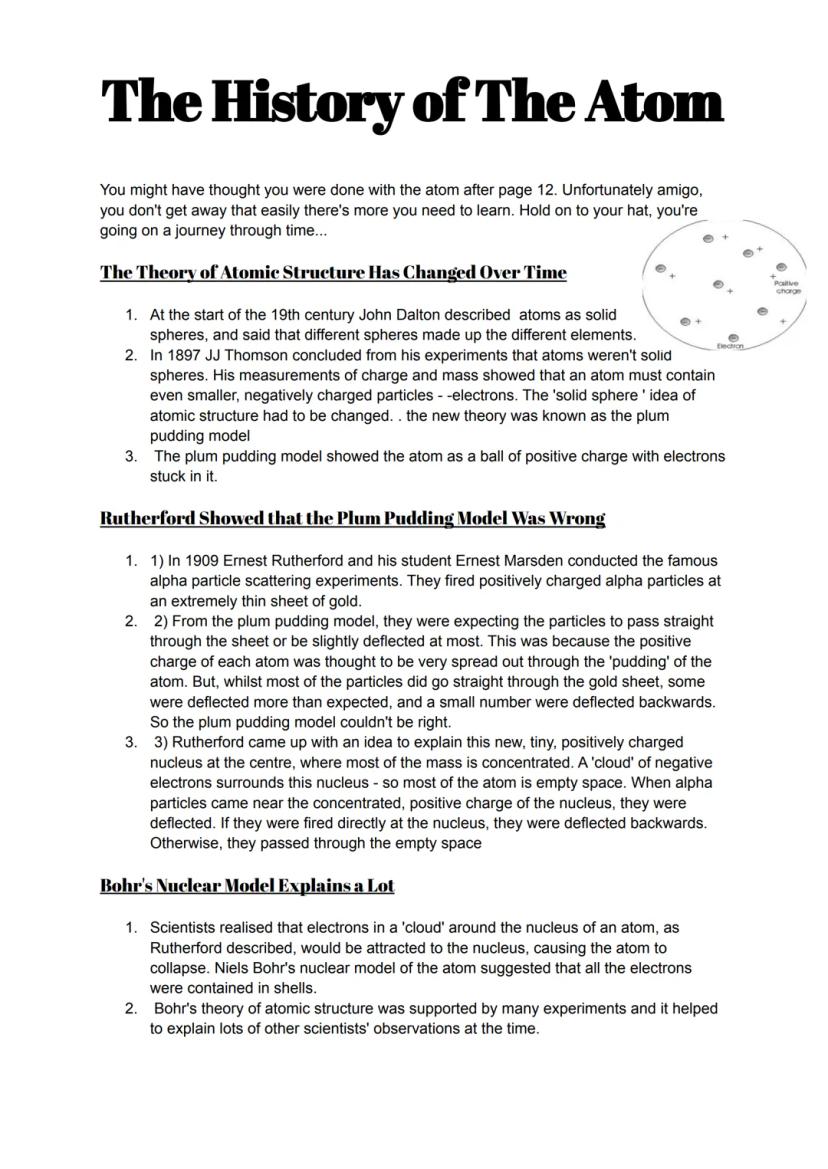
The History of the Atom

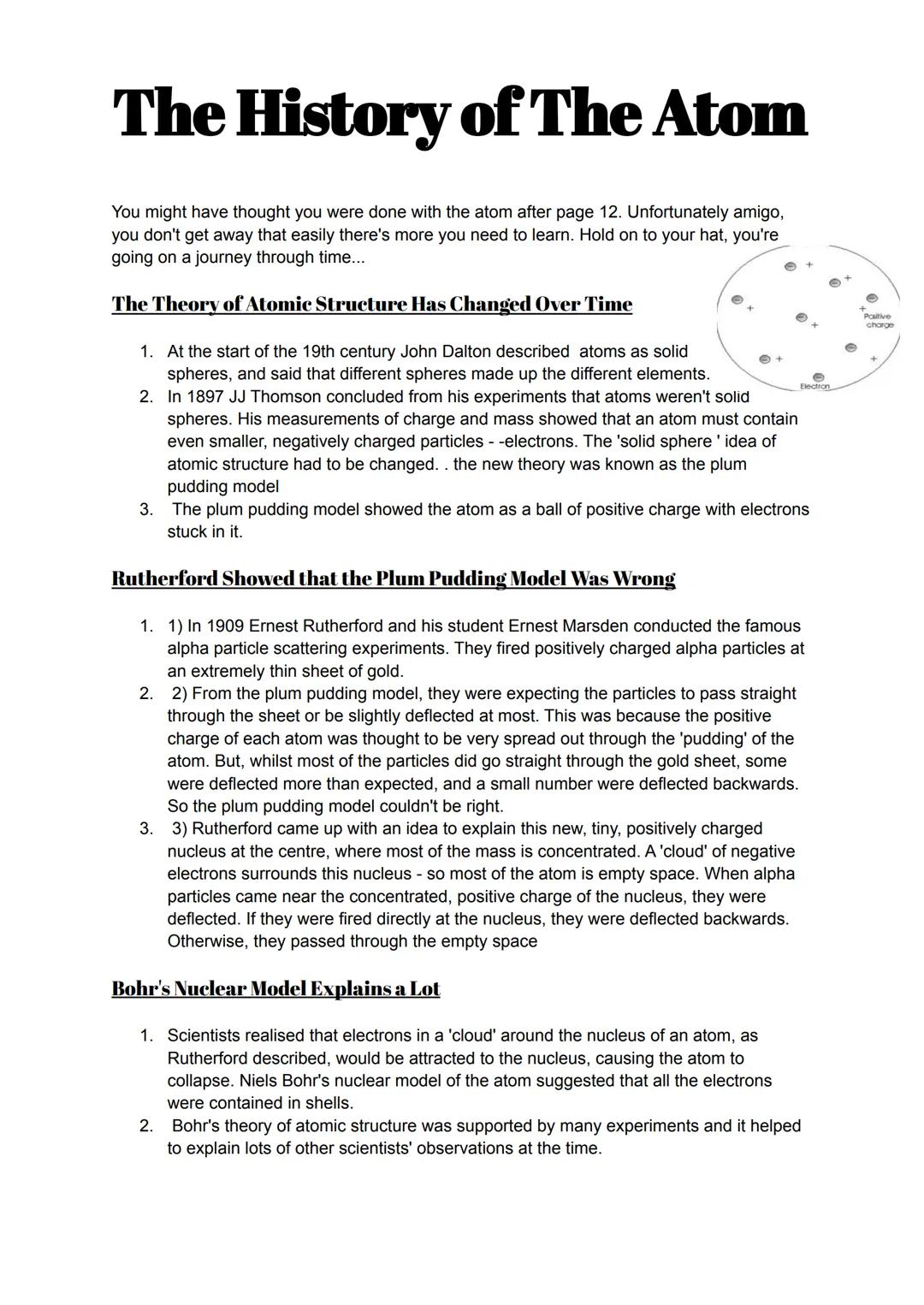
Scientists haven't always known what atoms look like - it's taken centuries of detective work! John Dalton started in the 1800s thinking atoms were solid spheres, like tiny snooker balls.

JJ Thomson discovered electrons in 1897 and created the plum pudding model - imagine a ball of positive charge with electrons stuck in it like raisins in a pudding. But Rutherford's famous experiment in 1909 proved this wrong by firing particles at gold foil.

Most particles went straight through, but some bounced back - proving atoms are mostly empty space with a tiny, dense nucleus at the centre. Niels Bohr then suggested electrons orbit in specific shells around the nucleus, preventing the atom from collapsing.

Think About It: If an atom was the size of a football stadium, the nucleus would be smaller than a marble in the centre!

# The History of The Atom

You might have thought you were done with the atom after page 12. Unfortunately amigo,
you don't get away that ea

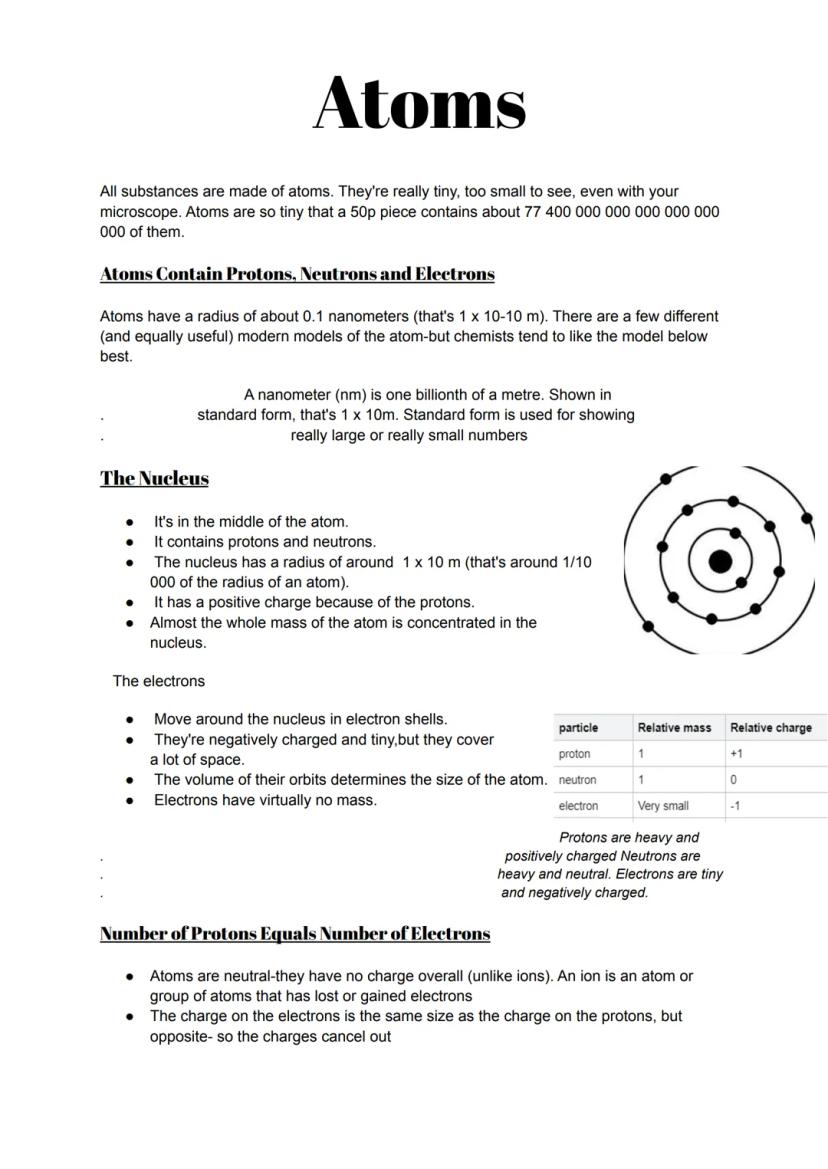
Atoms - The Building Blocks

Atoms are unimaginably tiny - about 0.1 nanometers across (that's 0.0000000001 metres!). Yet everything you see, touch, and breathe is made from these microscopic building blocks.

Each atom has a nucleus at its centre containing protons (positive charge) and neutrons (no charge). Electrons (negative charge) whizz around the nucleus in electron shells. The nucleus is incredibly dense - imagine squashing an elephant into a marble!

Atoms are neutral because they have equal numbers of protons and electrons, so the positive and negative charges cancel out. Ions are different - they've gained or lost electrons, giving them an overall charge.

Mind-Blowing Fact: A 50p coin contains about 77,400,000,000,000,000,000,000 atoms - that's more atoms than there are stars in the observable universe!

# The History of The Atom

You might have thought you were done with the atom after page 12. Unfortunately amigo,
you don't get away that ea

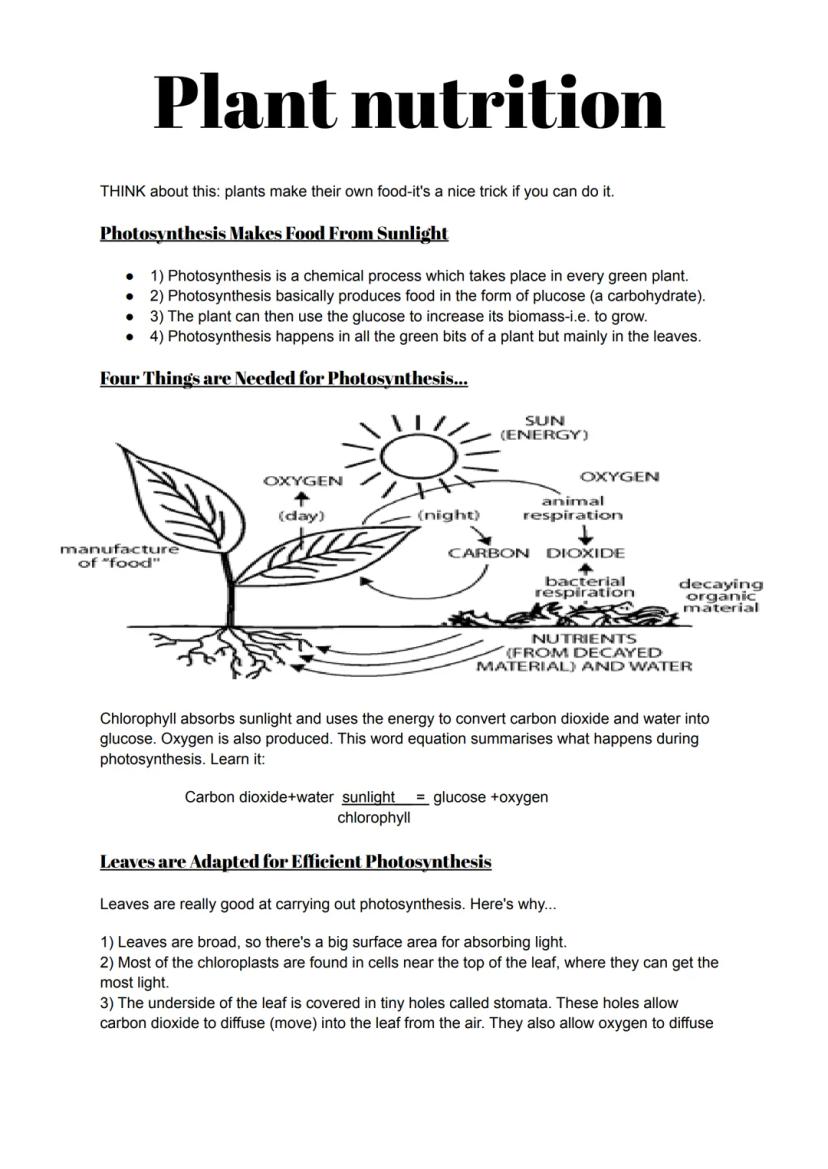
Plant Nutrition and Photosynthesis

Plants have mastered the ultimate life hack - making their own food from sunlight! Photosynthesis is the chemical process that turns carbon dioxide and water into glucose (sugar) using light energy.

The key player is chlorophyll, the green stuff in leaves that captures sunlight. The process needs four things: carbon dioxide (from air), water (from roots), sunlight (energy), and chlorophyll (the converter). The word equation is: carbon dioxide + water → glucose + oxygen.

Leaves are perfectly designed for this job. They're broad to catch maximum light, pack most chloroplasts near the top surface, and have tiny holes called stomata underneath for gas exchange. It's like having solar panels with built-in ventilation systems!

Cool Fact: The oxygen you're breathing right now was probably made by a plant through photosynthesis - thanks, plants!

# The History of The Atom

You might have thought you were done with the atom after page 12. Unfortunately amigo,
you don't get away that ea

Magnets and Magnetic Fields

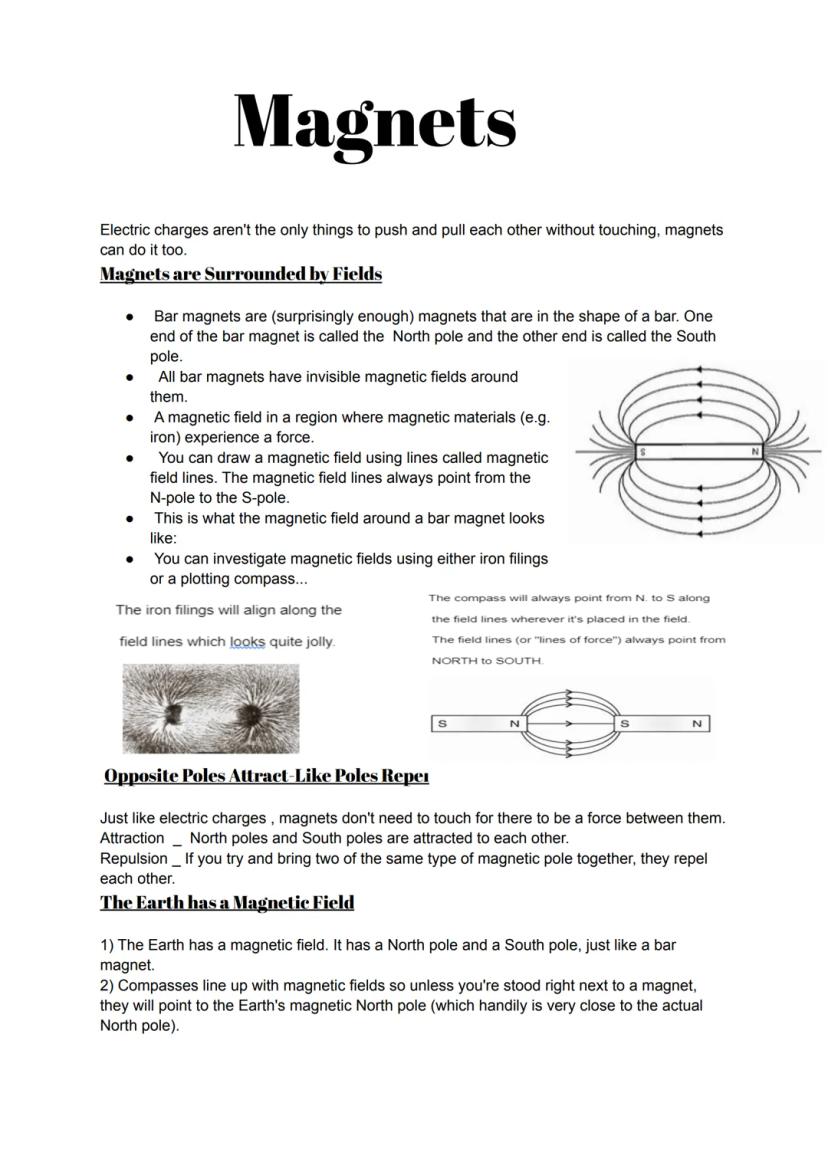
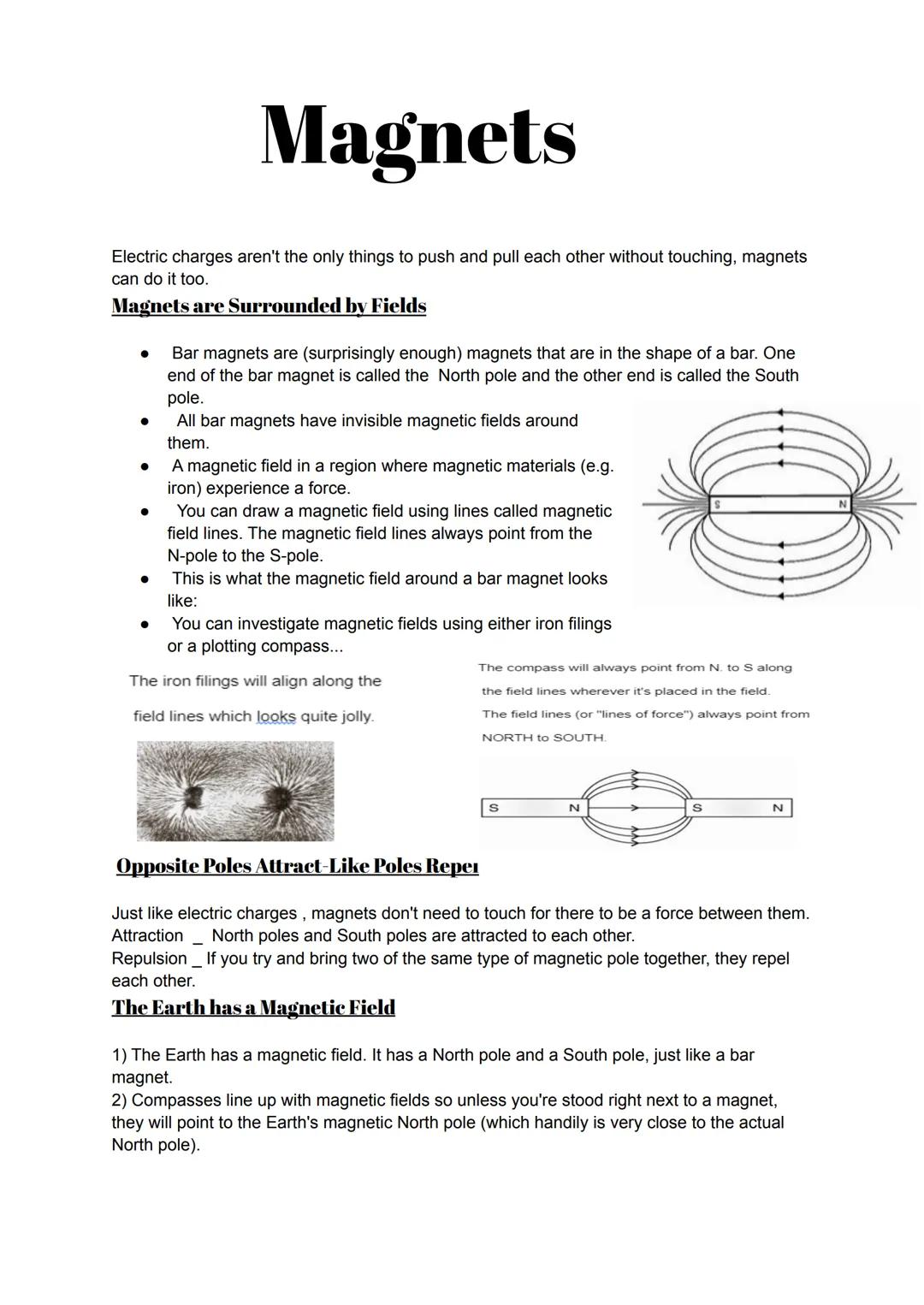
Magnets can push and pull without even touching - pretty cool superpower! Every bar magnet has a North pole and South pole with an invisible magnetic field surrounding it.

You can visualise these fields using magnetic field lines that always point from North to South. Iron filings sprinkled around a magnet will line up along these invisible lines, creating beautiful patterns. A compass needle does the same thing - it's basically a tiny magnet that aligns with the field.

The golden rule is simple: opposite poles attract, like poles repel. North and South poles pull towards each other, whilst two North poles (or two South poles) push apart. Even planet Earth acts like a giant magnet, which is why compasses point North!

Fun Fact: Earth's magnetic North pole isn't exactly the same as the geographical North pole, but it's close enough for navigation.

# The History of The Atom

You might have thought you were done with the atom after page 12. Unfortunately amigo,
you don't get away that ea

Elements and Atoms

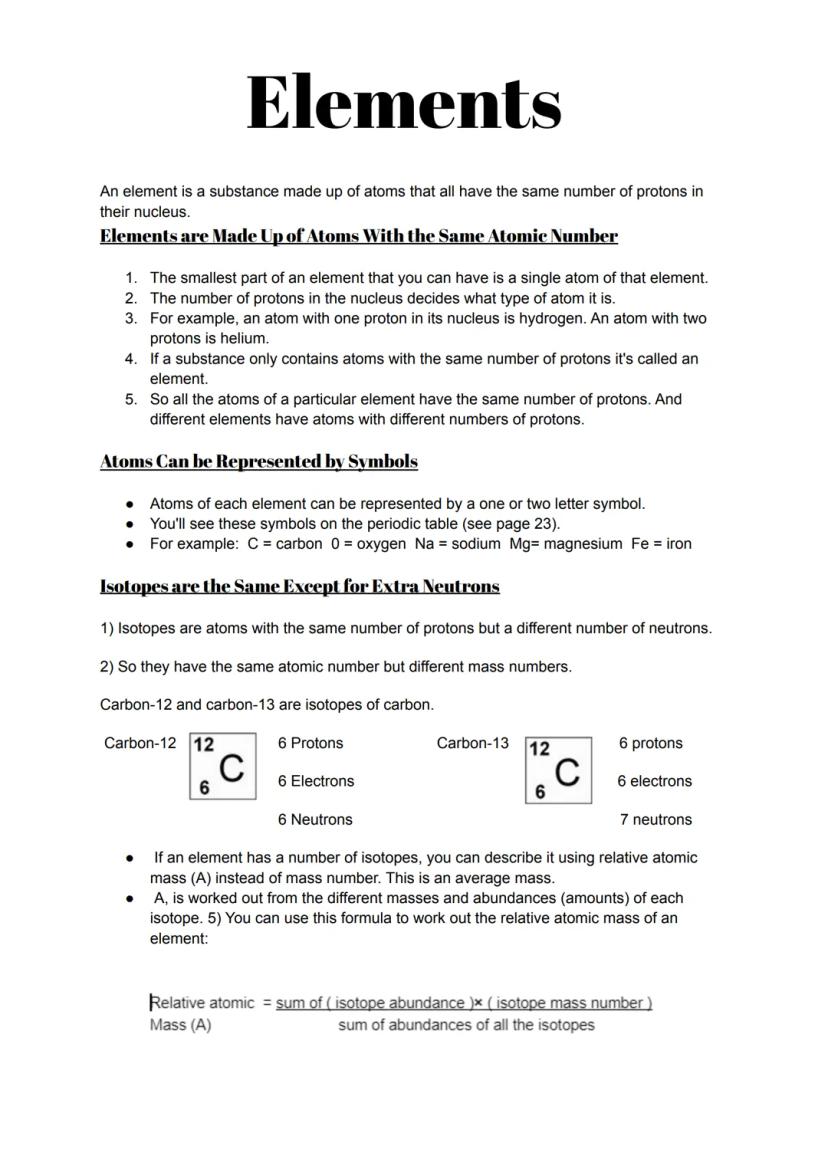
Think of elements as the ultimate building blocks - they're substances made entirely of atoms that have the same number of protons. It's like having a box of identical LEGO bricks, where each brick represents an atom.

The atomic number (number of protons) is what makes each element unique. Hydrogen has 1 proton, helium has 2 - it's that simple! Scientists use handy symbols like C for carbon and O for oxygen, though some seem random (like Na for sodium) because they come from old Latin names.

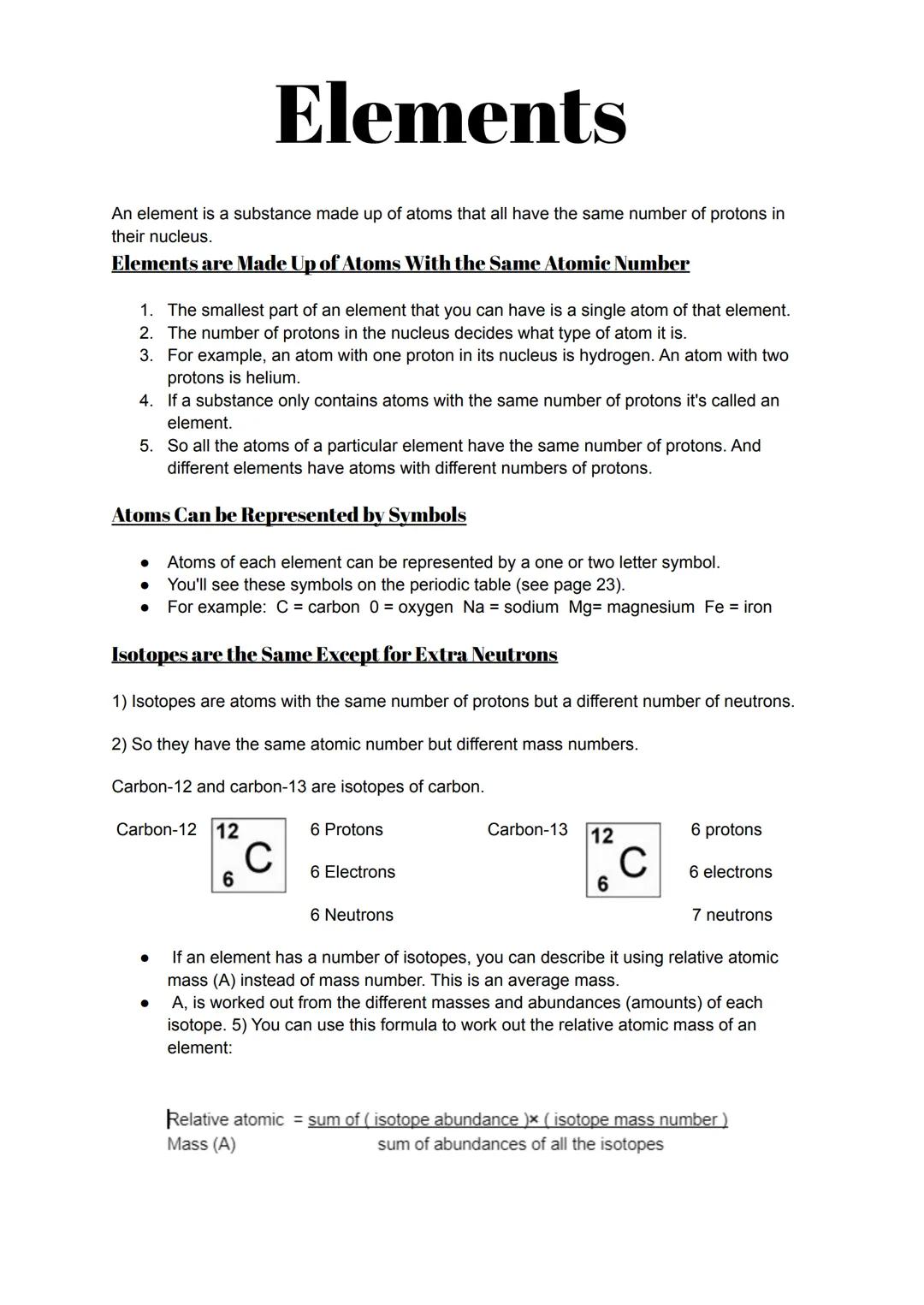
Isotopes are basically the same element with different weights. They have the same number of protons but different numbers of neutrons - like identical twins where one's eaten more cake! Carbon-12 and carbon-13 are perfect examples.

Quick Tip: Remember that the number of protons decides what element you're dealing with - this never changes for a specific element.

# The History of The Atom

You might have thought you were done with the atom after page 12. Unfortunately amigo,
you don't get away that ea

States of Matter

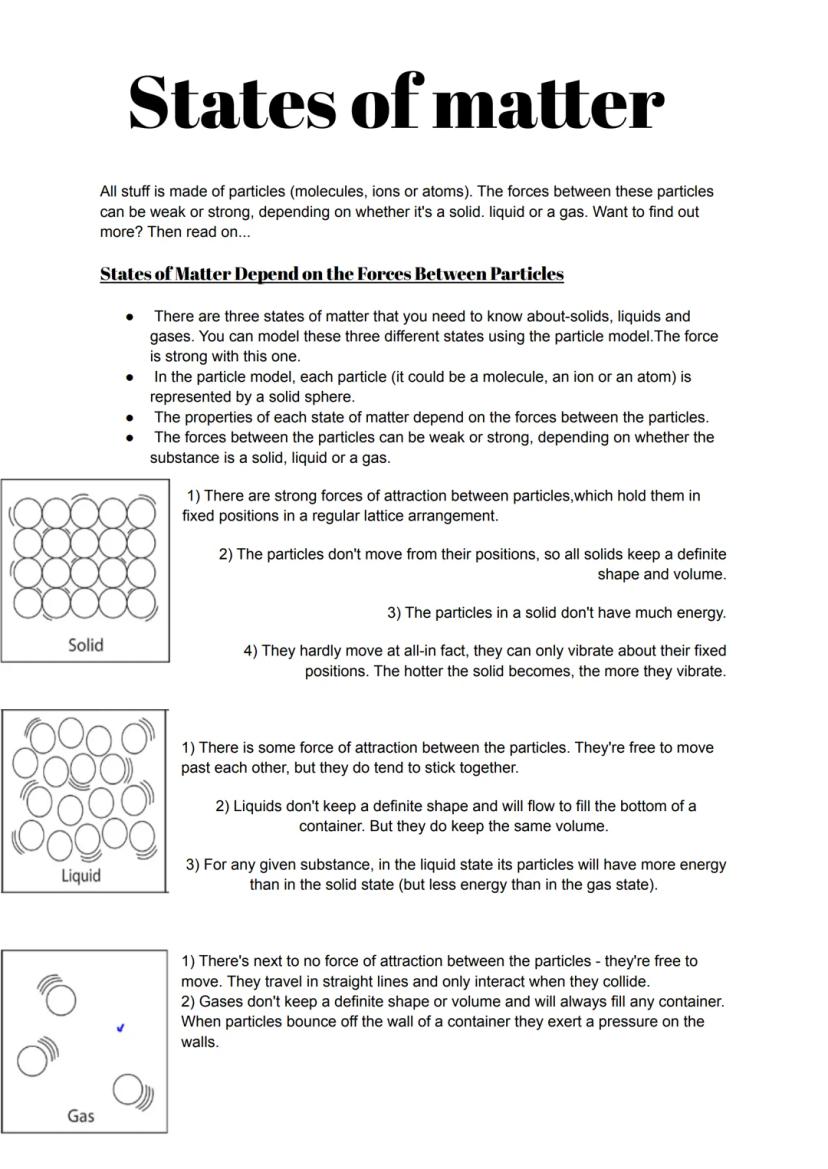
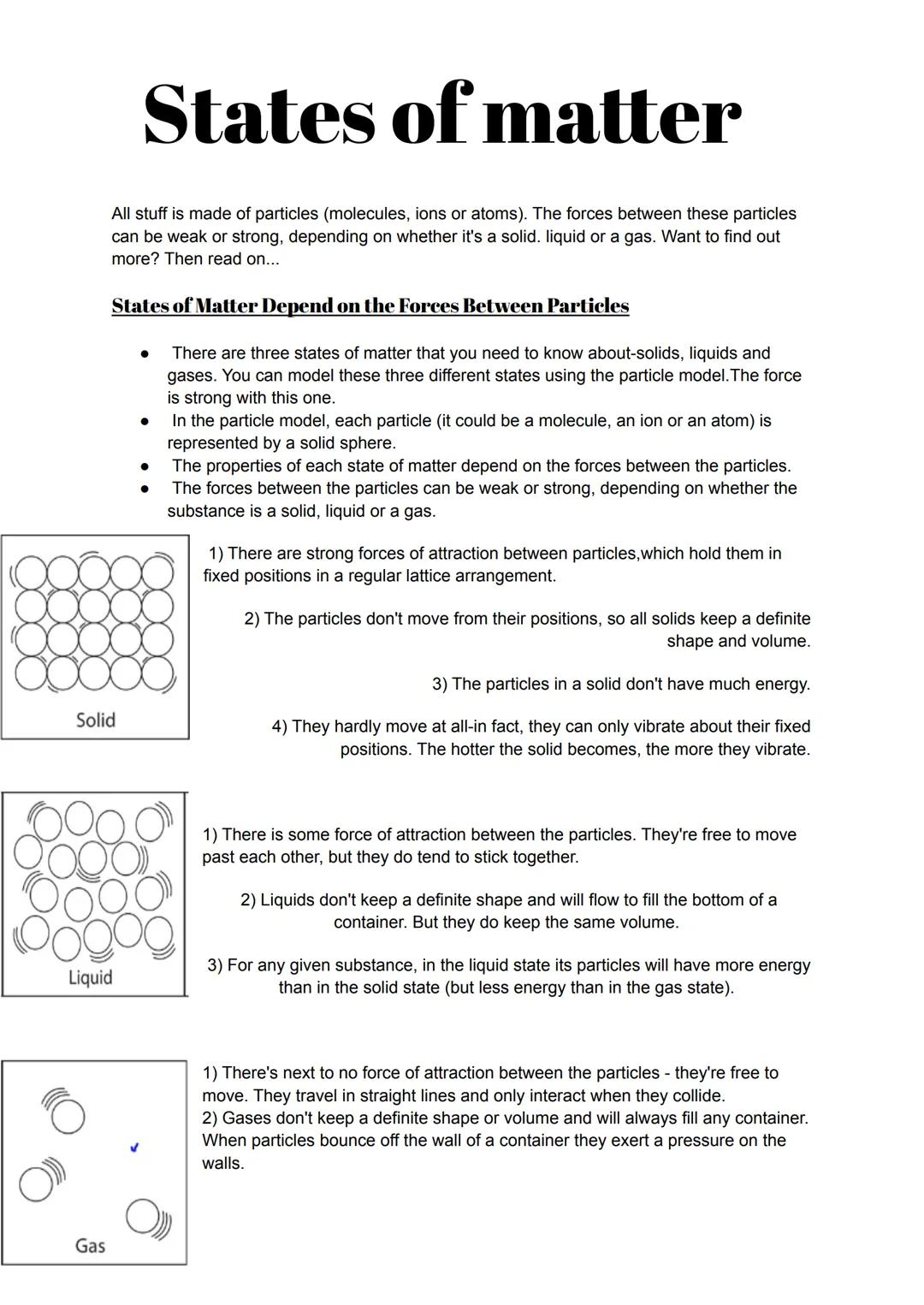
Every single thing around you is made of tiny particles, and how these particles behave determines whether something is solid, liquid, or gas. The particle model helps us picture this using solid spheres to represent each particle.

In solids, particles are locked in place by strong forces, creating rigid structures. They can only vibrate - which is why your desk doesn't suddenly become wobbly! Liquids have weaker forces between particles, letting them slide past each other whilst staying together. This is why water takes the shape of its container but doesn't fly apart.

Gases have virtually no forces holding particles together. The particles zoom around in straight lines, bouncing off walls and creating pressure. This explains why you can compress a syringe filled with air but not one filled with water.

Remember: More energy means particles move more - that's why ice melts when heated and water boils to become steam.

# The History of The Atom

You might have thought you were done with the atom after page 12. Unfortunately amigo,
you don't get away that ea

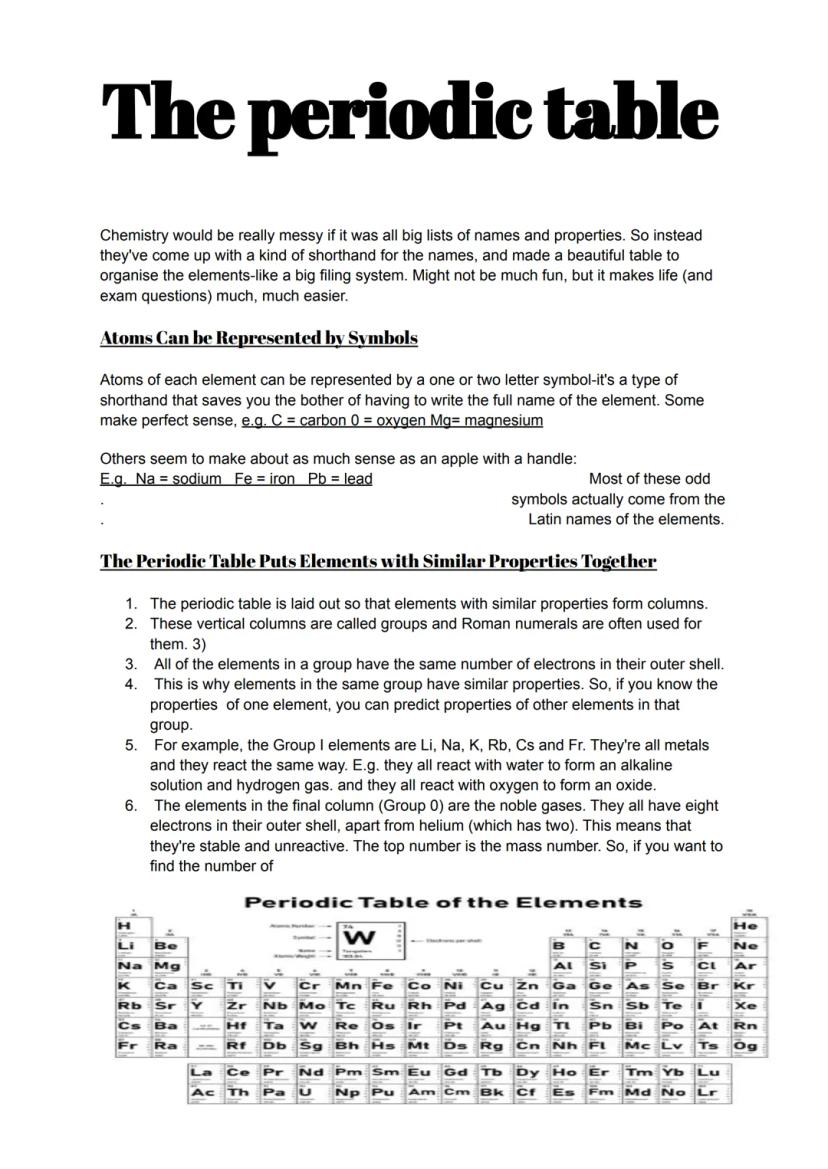
The Periodic Table

The periodic table is like a massive filing system that organises all the elements by their properties. Each element gets a symbol (some obvious like C for carbon, others tricky like Na for sodium from its Latin name).

The genius of this table is that elements in the same vertical group have similar properties because they have the same number of electrons in their outer shell. Group I elements all react with water the same way, whilst Group 0 (noble gases) are all unreactive because their outer shells are full.

Knowing one element's behaviour lets you predict how others in its group will act - it's like having a cheat sheet for chemistry! The table shows each element's mass number (top) and atomic number (bottom).

Memory Trick: Groups go down (vertical columns), periods go across (horizontal rows) - just like reading a book!

# The History of The Atom

You might have thought you were done with the atom after page 12. Unfortunately amigo,
you don't get away that ea

Atomic Structure Details

Understanding atomic number and mass number is crucial for describing any atom. The atomic number tells you how many protons an atom has - this never changes for a given element. The mass number is the total of protons plus neutrons.

To find the number of neutrons, simply subtract the atomic number from the mass number. For example, if carbon-12 has a mass number of 12 and atomic number of 6, it must have 6 neutrons (12 - 6 = 6).

Ions form when atoms gain or lose electrons. A 2- ion has gained two extra electrons, giving it more negative charges than positive ones. The number of protons stays the same - only electrons change in ions.

Exam Tip: Nuclear symbols show mass number (top) and atomic number (bottom) - memorise this layout as it appears in every chemistry exam!

# The History of The Atom

You might have thought you were done with the atom after page 12. Unfortunately amigo,
you don't get away that ea

More Atomic Discoveries

Scientists didn't stop after discovering the nucleus! Rutherford continued his research and found that the nucleus contains smaller particles called protons, each carrying a positive charge equal to a hydrogen nucleus.

About 20 years later, James Chadwick discovered neutrons - neutral particles also found in the nucleus. This completed our modern understanding of atomic structure, giving us the nuclear model we use today.

These discoveries happened through careful experimentation and observation. Each scientist built upon previous work, gradually revealing the atom's secrets through decades of research.

Science Insight: Scientific understanding develops over time - today's "facts" might be tomorrow's outdated theories as we learn more!

# The History of The Atom

You might have thought you were done with the atom after page 12. Unfortunately amigo,
you don't get away that ea

Magnets (Continued)

This page appears to be a continuation of the magnets topic covered earlier, focusing on the fundamental principles of magnetic attraction and repulsion that govern how magnets interact with each other and magnetic materials.


We thought you’d never ask...

What is the Knowunity AI companion?

Our AI companion is specifically built for the needs of students. Based on the millions of content pieces we have on the platform we can provide truly meaningful and relevant answers to students. But its not only about answers, the companion is even more about guiding students through their daily learning challenges, with personalised study plans, quizzes or content pieces in the chat and 100% personalisation based on the students skills and developments.

Where can I download the Knowunity app?

You can download the app in the Google Play Store and in the Apple App Store.

Is Knowunity really free of charge?

That's right! Enjoy free access to study content, connect with fellow students, and get instant help – all at your fingertips.

Most popular content: Atom

Most popular content in Biology

Most popular content

English - inspector calls quotes and analysis

Quotes from every main character

English LiteratureEnglish Literature
10

Can't find what you're looking for? Explore other subjects.

Students love us — and so will you.

4.9/5

App Store

4.8/5

Google Play

The app is very easy to use and well designed. I have found everything I was looking for so far and have been able to learn a lot from the presentations! I will definitely use the app for a class assignment! And of course it also helps a lot as an inspiration.

Stefan S

iOS user

This app is really great. There are so many study notes and help [...]. My problem subject is French, for example, and the app has so many options for help. Thanks to this app, I have improved my French. I would recommend it to anyone.

Samantha Klich

Android user

Wow, I am really amazed. I just tried the app because I've seen it advertised many times and was absolutely stunned. This app is THE HELP you want for school and above all, it offers so many things, such as workouts and fact sheets, which have been VERY helpful to me personally.

Anna

iOS user

I think it’s very much worth it and you’ll end up using it a lot once you get the hang of it and even after looking at others notes you can still ask your Artificial intelligence buddy the question and ask to simplify it if you still don’t get it!!! In the end I think it’s worth it 😊👍 ⚠️Also DID I MENTION ITS FREEE YOU DON’T HAVE TO PAY FOR ANYTHING AND STILL GET YOUR GRADES IN PERFECTLY❗️❗️⚠️

Thomas R

iOS user

Knowunity is the BEST app I’ve used in a minute. This is not an ai review or anything this is genuinely coming from a 7th grade student (I know 2011 im young) but dude this app is a 10/10 i have maintained a 3.8 gpa and have plenty of time for gaming. I love it and my mom is just happy I got good grades

Brad T

Android user

Not only did it help me find the answer but it also showed me alternative ways to solve it. I was horrible in math and science but now I have an a in both subjects. Thanks for the help🤍🤍

David K

iOS user

The app's just great! All I have to do is enter the topic in the search bar and I get the response real fast. I don't have to watch 10 YouTube videos to understand something, so I'm saving my time. Highly recommended!

Sudenaz Ocak

Android user

In school I was really bad at maths but thanks to the app, I am doing better now. I am so grateful that you made the app.

Greenlight Bonnie

Android user

I found this app a couple years ago and it has only gotten better since then. I really love it because it can help with written questions and photo questions. Also, it can find study guides that other people have made as well as flashcard sets and practice tests. The free version is also amazing for students who might not be able to afford it. Would 100% recommend

Aubrey

iOS user

Best app if you're in Highschool or Junior high. I have been using this app for 2 school years and it's the best, it's good if you don't have anyone to help you with school work.😋🩷🎀

Marco B

iOS user

THE QUIZES AND FLASHCARDS ARE SO USEFUL AND I LOVE THE SCHOOLGPT. IT ALSO IS LITREALLY LIKE CHATGPT BUT SMARTER!! HELPED ME WITH MY MASCARA PROBLEMS TOO!! AS WELL AS MY REAL SUBJECTS ! DUHHH 😍😁😲🤑💗✨🎀😮

Elisha

iOS user

This app is phenomenal down to the correct info and the various topics you can study! I greatly recommend it for people who struggle with procrastination and those who need homework help. It has been perfectly accurate for world 1 history as far as I’ve seen! Geometry too!

Paul T

iOS user

The app is very easy to use and well designed. I have found everything I was looking for so far and have been able to learn a lot from the presentations! I will definitely use the app for a class assignment! And of course it also helps a lot as an inspiration.

Stefan S

iOS user

This app is really great. There are so many study notes and help [...]. My problem subject is French, for example, and the app has so many options for help. Thanks to this app, I have improved my French. I would recommend it to anyone.

Samantha Klich

Android user

Wow, I am really amazed. I just tried the app because I've seen it advertised many times and was absolutely stunned. This app is THE HELP you want for school and above all, it offers so many things, such as workouts and fact sheets, which have been VERY helpful to me personally.

Anna

iOS user

I think it’s very much worth it and you’ll end up using it a lot once you get the hang of it and even after looking at others notes you can still ask your Artificial intelligence buddy the question and ask to simplify it if you still don’t get it!!! In the end I think it’s worth it 😊👍 ⚠️Also DID I MENTION ITS FREEE YOU DON’T HAVE TO PAY FOR ANYTHING AND STILL GET YOUR GRADES IN PERFECTLY❗️❗️⚠️

Thomas R

iOS user

Knowunity is the BEST app I’ve used in a minute. This is not an ai review or anything this is genuinely coming from a 7th grade student (I know 2011 im young) but dude this app is a 10/10 i have maintained a 3.8 gpa and have plenty of time for gaming. I love it and my mom is just happy I got good grades

Brad T

Android user

Not only did it help me find the answer but it also showed me alternative ways to solve it. I was horrible in math and science but now I have an a in both subjects. Thanks for the help🤍🤍

David K

iOS user

The app's just great! All I have to do is enter the topic in the search bar and I get the response real fast. I don't have to watch 10 YouTube videos to understand something, so I'm saving my time. Highly recommended!

Sudenaz Ocak

Android user

In school I was really bad at maths but thanks to the app, I am doing better now. I am so grateful that you made the app.

Greenlight Bonnie

Android user

I found this app a couple years ago and it has only gotten better since then. I really love it because it can help with written questions and photo questions. Also, it can find study guides that other people have made as well as flashcard sets and practice tests. The free version is also amazing for students who might not be able to afford it. Would 100% recommend

Aubrey

iOS user

Best app if you're in Highschool or Junior high. I have been using this app for 2 school years and it's the best, it's good if you don't have anyone to help you with school work.😋🩷🎀

Marco B

iOS user

THE QUIZES AND FLASHCARDS ARE SO USEFUL AND I LOVE THE SCHOOLGPT. IT ALSO IS LITREALLY LIKE CHATGPT BUT SMARTER!! HELPED ME WITH MY MASCARA PROBLEMS TOO!! AS WELL AS MY REAL SUBJECTS ! DUHHH 😍😁😲🤑💗✨🎀😮

Elisha

iOS user

This app is phenomenal down to the correct info and the various topics you can study! I greatly recommend it for people who struggle with procrastination and those who need homework help. It has been perfectly accurate for world 1 history as far as I’ve seen! Geometry too!

Paul T

iOS user


Combined Science

113

Dec 9, 2025

12 pages

Master Science: Your Comprehensive Revision Guide

user profile picture

Anna Rusin

@annarusin_cghn

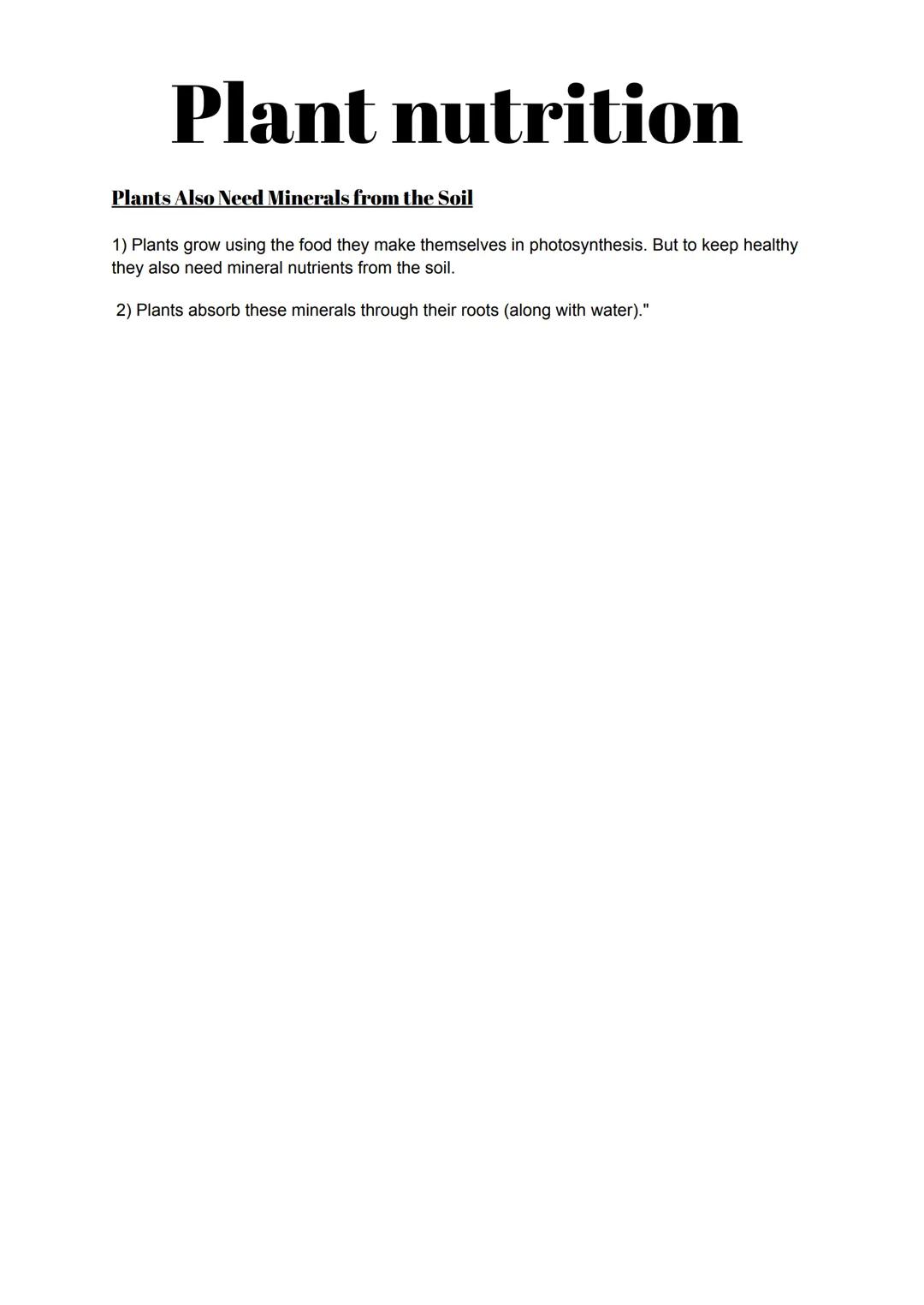
This content covers fundamental chemistry and physics concepts that form the building blocks of understanding matter. You'll explore atoms, elements, states of matter, the periodic table, magnets, and even how plants make their own food through photosynthesis!

# The History of The Atom

You might have thought you were done with the atom after page 12. Unfortunately amigo,
you don't get away that ea

Sign up to see the contentIt's free!

Access to all documents

Improve your grades

Join milions of students

By signing up you accept Terms of Service and Privacy Policy

The History of the Atom

Scientists haven't always known what atoms look like - it's taken centuries of detective work! John Dalton started in the 1800s thinking atoms were solid spheres, like tiny snooker balls.

JJ Thomson discovered electrons in 1897 and created the plum pudding model - imagine a ball of positive charge with electrons stuck in it like raisins in a pudding. But Rutherford's famous experiment in 1909 proved this wrong by firing particles at gold foil.

Most particles went straight through, but some bounced back - proving atoms are mostly empty space with a tiny, dense nucleus at the centre. Niels Bohr then suggested electrons orbit in specific shells around the nucleus, preventing the atom from collapsing.

Think About It: If an atom was the size of a football stadium, the nucleus would be smaller than a marble in the centre!

# The History of The Atom

You might have thought you were done with the atom after page 12. Unfortunately amigo,
you don't get away that ea

Sign up to see the contentIt's free!

Access to all documents

Improve your grades

Join milions of students

By signing up you accept Terms of Service and Privacy Policy

Atoms - The Building Blocks

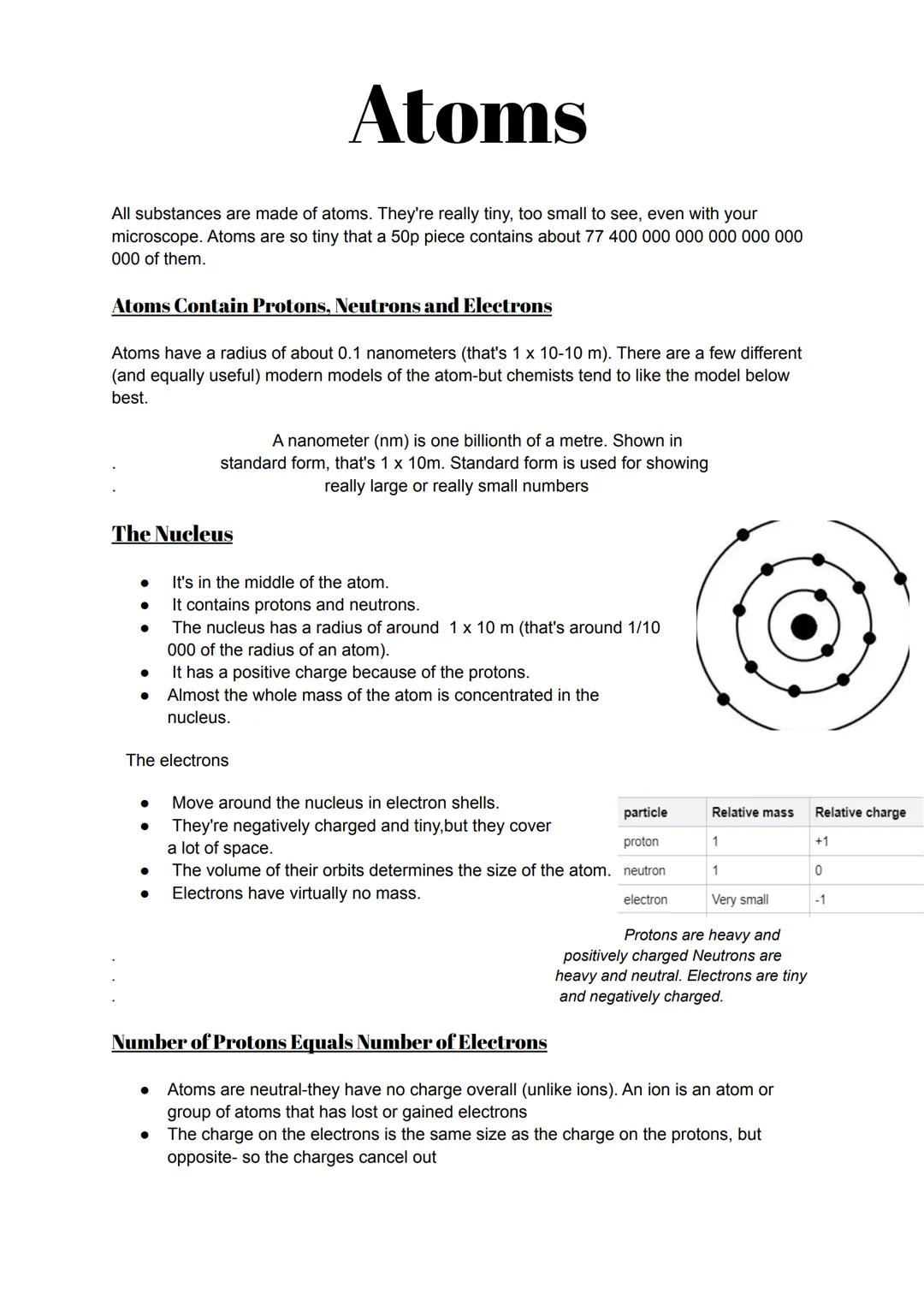
Atoms are unimaginably tiny - about 0.1 nanometers across (that's 0.0000000001 metres!). Yet everything you see, touch, and breathe is made from these microscopic building blocks.

Each atom has a nucleus at its centre containing protons (positive charge) and neutrons (no charge). Electrons (negative charge) whizz around the nucleus in electron shells. The nucleus is incredibly dense - imagine squashing an elephant into a marble!

Atoms are neutral because they have equal numbers of protons and electrons, so the positive and negative charges cancel out. Ions are different - they've gained or lost electrons, giving them an overall charge.

Mind-Blowing Fact: A 50p coin contains about 77,400,000,000,000,000,000,000 atoms - that's more atoms than there are stars in the observable universe!

# The History of The Atom

You might have thought you were done with the atom after page 12. Unfortunately amigo,
you don't get away that ea

Sign up to see the contentIt's free!

Access to all documents

Improve your grades

Join milions of students

By signing up you accept Terms of Service and Privacy Policy

Plant Nutrition and Photosynthesis

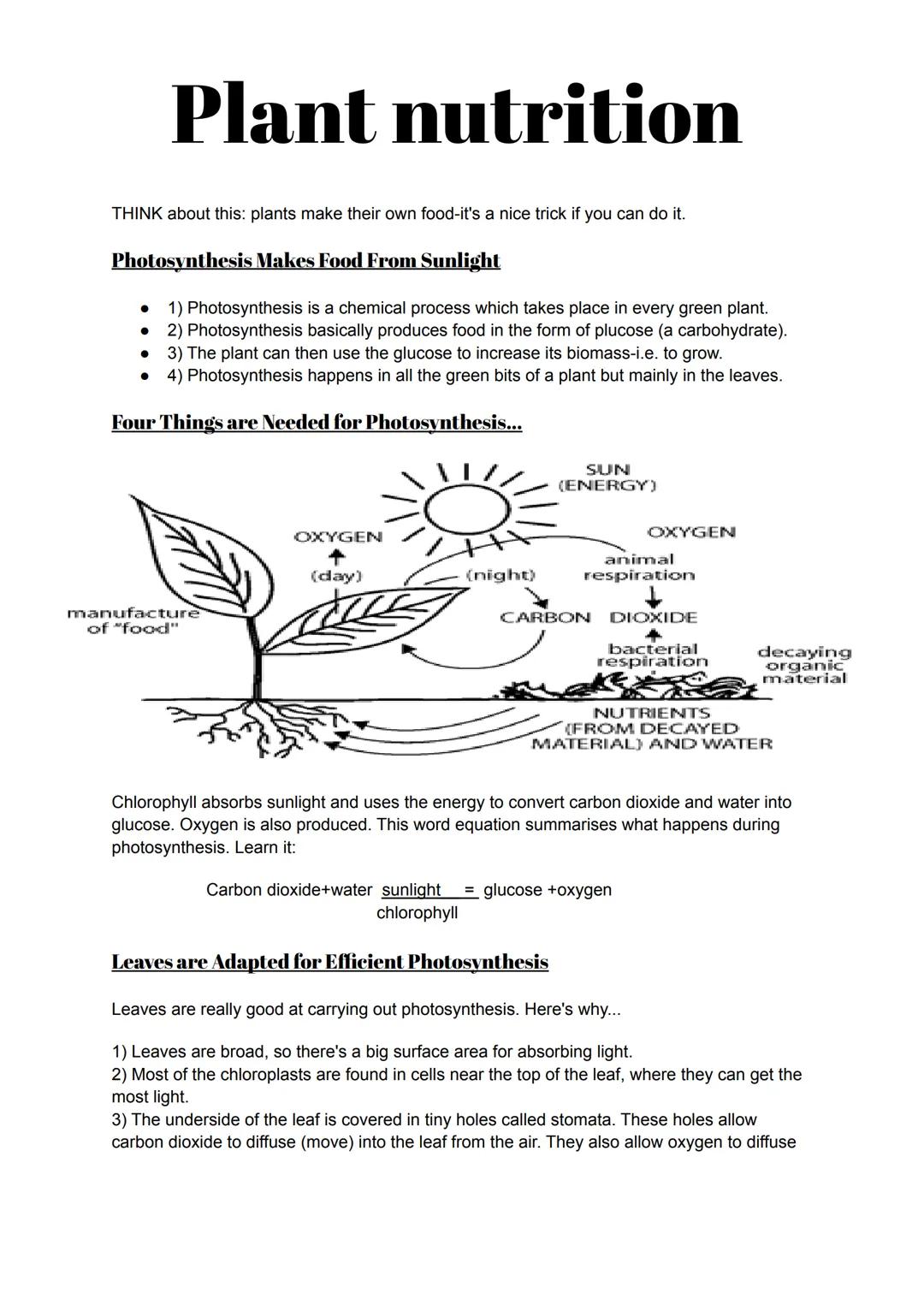
Plants have mastered the ultimate life hack - making their own food from sunlight! Photosynthesis is the chemical process that turns carbon dioxide and water into glucose (sugar) using light energy.

The key player is chlorophyll, the green stuff in leaves that captures sunlight. The process needs four things: carbon dioxide (from air), water (from roots), sunlight (energy), and chlorophyll (the converter). The word equation is: carbon dioxide + water → glucose + oxygen.

Leaves are perfectly designed for this job. They're broad to catch maximum light, pack most chloroplasts near the top surface, and have tiny holes called stomata underneath for gas exchange. It's like having solar panels with built-in ventilation systems!

Cool Fact: The oxygen you're breathing right now was probably made by a plant through photosynthesis - thanks, plants!

# The History of The Atom

You might have thought you were done with the atom after page 12. Unfortunately amigo,
you don't get away that ea

Sign up to see the contentIt's free!

Access to all documents

Improve your grades

Join milions of students

By signing up you accept Terms of Service and Privacy Policy

Magnets and Magnetic Fields

Magnets can push and pull without even touching - pretty cool superpower! Every bar magnet has a North pole and South pole with an invisible magnetic field surrounding it.

You can visualise these fields using magnetic field lines that always point from North to South. Iron filings sprinkled around a magnet will line up along these invisible lines, creating beautiful patterns. A compass needle does the same thing - it's basically a tiny magnet that aligns with the field.

The golden rule is simple: opposite poles attract, like poles repel. North and South poles pull towards each other, whilst two North poles (or two South poles) push apart. Even planet Earth acts like a giant magnet, which is why compasses point North!

Fun Fact: Earth's magnetic North pole isn't exactly the same as the geographical North pole, but it's close enough for navigation.

# The History of The Atom

You might have thought you were done with the atom after page 12. Unfortunately amigo,
you don't get away that ea

Sign up to see the contentIt's free!

Access to all documents

Improve your grades

Join milions of students

By signing up you accept Terms of Service and Privacy Policy

Elements and Atoms

Think of elements as the ultimate building blocks - they're substances made entirely of atoms that have the same number of protons. It's like having a box of identical LEGO bricks, where each brick represents an atom.

The atomic number (number of protons) is what makes each element unique. Hydrogen has 1 proton, helium has 2 - it's that simple! Scientists use handy symbols like C for carbon and O for oxygen, though some seem random (like Na for sodium) because they come from old Latin names.

Isotopes are basically the same element with different weights. They have the same number of protons but different numbers of neutrons - like identical twins where one's eaten more cake! Carbon-12 and carbon-13 are perfect examples.

Quick Tip: Remember that the number of protons decides what element you're dealing with - this never changes for a specific element.

# The History of The Atom

You might have thought you were done with the atom after page 12. Unfortunately amigo,
you don't get away that ea

Sign up to see the contentIt's free!

Access to all documents

Improve your grades

Join milions of students

By signing up you accept Terms of Service and Privacy Policy

States of Matter

Every single thing around you is made of tiny particles, and how these particles behave determines whether something is solid, liquid, or gas. The particle model helps us picture this using solid spheres to represent each particle.

In solids, particles are locked in place by strong forces, creating rigid structures. They can only vibrate - which is why your desk doesn't suddenly become wobbly! Liquids have weaker forces between particles, letting them slide past each other whilst staying together. This is why water takes the shape of its container but doesn't fly apart.

Gases have virtually no forces holding particles together. The particles zoom around in straight lines, bouncing off walls and creating pressure. This explains why you can compress a syringe filled with air but not one filled with water.

Remember: More energy means particles move more - that's why ice melts when heated and water boils to become steam.

# The History of The Atom

You might have thought you were done with the atom after page 12. Unfortunately amigo,
you don't get away that ea

Sign up to see the contentIt's free!

Access to all documents

Improve your grades

Join milions of students

By signing up you accept Terms of Service and Privacy Policy

The Periodic Table

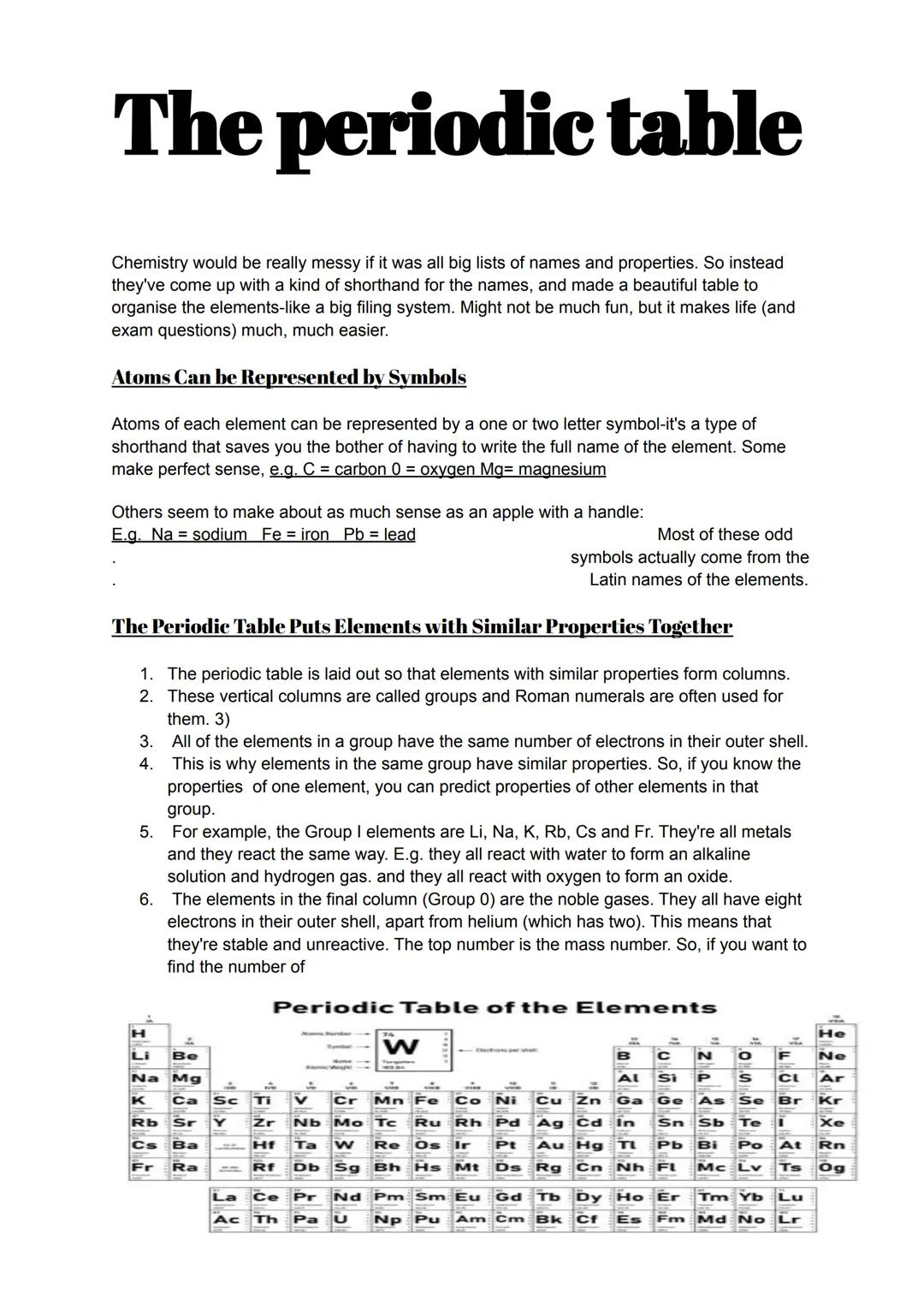
The periodic table is like a massive filing system that organises all the elements by their properties. Each element gets a symbol (some obvious like C for carbon, others tricky like Na for sodium from its Latin name).

The genius of this table is that elements in the same vertical group have similar properties because they have the same number of electrons in their outer shell. Group I elements all react with water the same way, whilst Group 0 (noble gases) are all unreactive because their outer shells are full.

Knowing one element's behaviour lets you predict how others in its group will act - it's like having a cheat sheet for chemistry! The table shows each element's mass number (top) and atomic number (bottom).

Memory Trick: Groups go down (vertical columns), periods go across (horizontal rows) - just like reading a book!

# The History of The Atom

You might have thought you were done with the atom after page 12. Unfortunately amigo,
you don't get away that ea

Sign up to see the contentIt's free!

Access to all documents

Improve your grades

Join milions of students

By signing up you accept Terms of Service and Privacy Policy

Atomic Structure Details

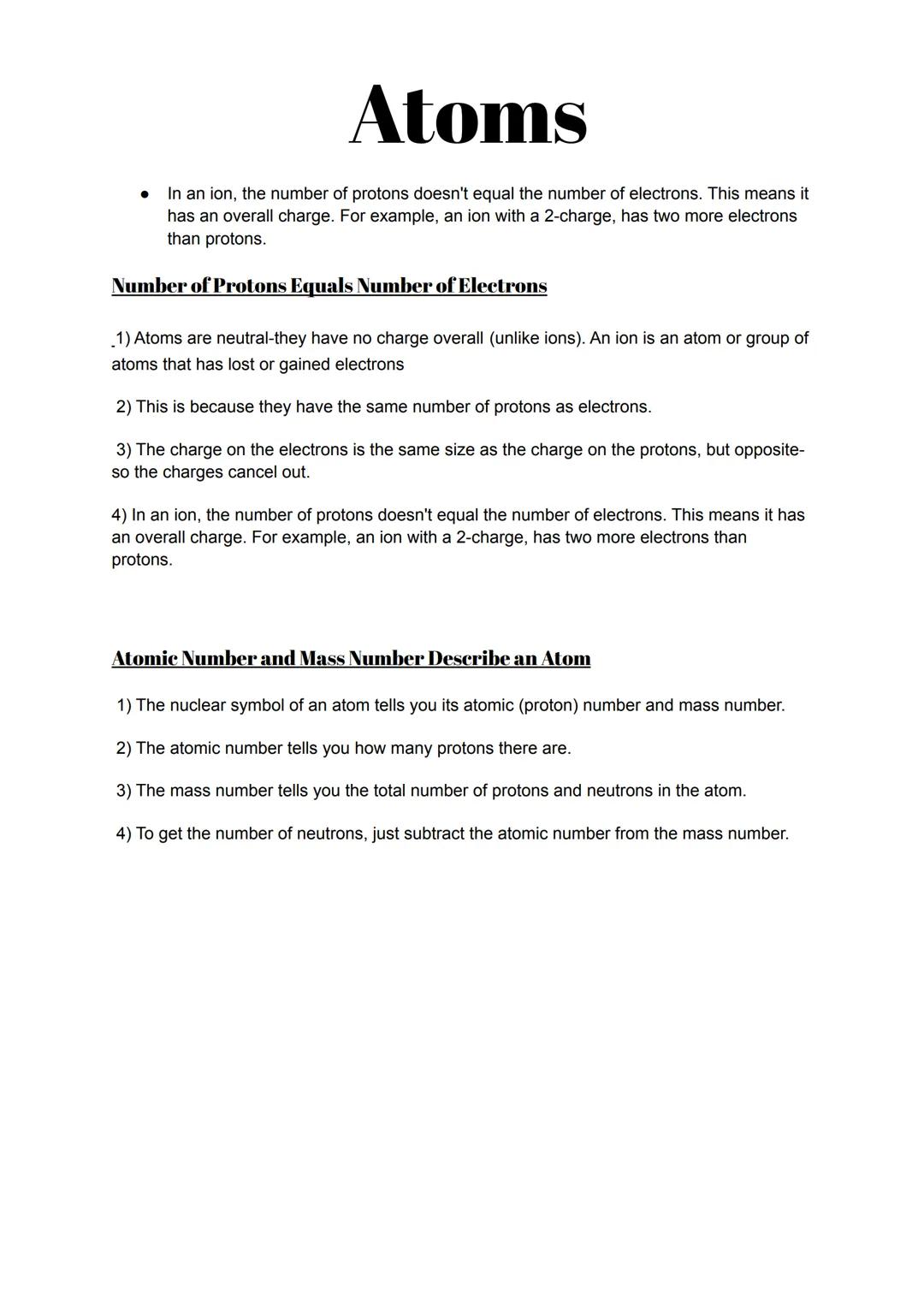
Understanding atomic number and mass number is crucial for describing any atom. The atomic number tells you how many protons an atom has - this never changes for a given element. The mass number is the total of protons plus neutrons.

To find the number of neutrons, simply subtract the atomic number from the mass number. For example, if carbon-12 has a mass number of 12 and atomic number of 6, it must have 6 neutrons (12 - 6 = 6).

Ions form when atoms gain or lose electrons. A 2- ion has gained two extra electrons, giving it more negative charges than positive ones. The number of protons stays the same - only electrons change in ions.

Exam Tip: Nuclear symbols show mass number (top) and atomic number (bottom) - memorise this layout as it appears in every chemistry exam!

# The History of The Atom

You might have thought you were done with the atom after page 12. Unfortunately amigo,
you don't get away that ea

Sign up to see the contentIt's free!

Access to all documents

Improve your grades

Join milions of students

By signing up you accept Terms of Service and Privacy Policy

More Atomic Discoveries

Scientists didn't stop after discovering the nucleus! Rutherford continued his research and found that the nucleus contains smaller particles called protons, each carrying a positive charge equal to a hydrogen nucleus.

About 20 years later, James Chadwick discovered neutrons - neutral particles also found in the nucleus. This completed our modern understanding of atomic structure, giving us the nuclear model we use today.

These discoveries happened through careful experimentation and observation. Each scientist built upon previous work, gradually revealing the atom's secrets through decades of research.

Science Insight: Scientific understanding develops over time - today's "facts" might be tomorrow's outdated theories as we learn more!

# The History of The Atom

You might have thought you were done with the atom after page 12. Unfortunately amigo,
you don't get away that ea

Sign up to see the contentIt's free!

Access to all documents

Improve your grades

Join milions of students

By signing up you accept Terms of Service and Privacy Policy

Magnets (Continued)

This page appears to be a continuation of the magnets topic covered earlier, focusing on the fundamental principles of magnetic attraction and repulsion that govern how magnets interact with each other and magnetic materials.

We thought you’d never ask...

What is the Knowunity AI companion?

Our AI companion is specifically built for the needs of students. Based on the millions of content pieces we have on the platform we can provide truly meaningful and relevant answers to students. But its not only about answers, the companion is even more about guiding students through their daily learning challenges, with personalised study plans, quizzes or content pieces in the chat and 100% personalisation based on the students skills and developments.

Where can I download the Knowunity app?

You can download the app in the Google Play Store and in the Apple App Store.

Is Knowunity really free of charge?

That's right! Enjoy free access to study content, connect with fellow students, and get instant help – all at your fingertips.

2

Smart Tools NEW

Transform this note into: ✓ 50+ Practice Questions ✓ Interactive Flashcards ✓ Full Mock Exam ✓ Essay Outlines

Mock Exam
Quiz
Flashcards
Essay

Most popular content: Atom

Most popular content in Biology

Most popular content

English - inspector calls quotes and analysis

Quotes from every main character

English LiteratureEnglish Literature
10

Can't find what you're looking for? Explore other subjects.

Students love us — and so will you.

4.9/5

App Store

4.8/5

Google Play

The app is very easy to use and well designed. I have found everything I was looking for so far and have been able to learn a lot from the presentations! I will definitely use the app for a class assignment! And of course it also helps a lot as an inspiration.

Stefan S

iOS user

This app is really great. There are so many study notes and help [...]. My problem subject is French, for example, and the app has so many options for help. Thanks to this app, I have improved my French. I would recommend it to anyone.

Samantha Klich

Android user

Wow, I am really amazed. I just tried the app because I've seen it advertised many times and was absolutely stunned. This app is THE HELP you want for school and above all, it offers so many things, such as workouts and fact sheets, which have been VERY helpful to me personally.

Anna

iOS user

I think it’s very much worth it and you’ll end up using it a lot once you get the hang of it and even after looking at others notes you can still ask your Artificial intelligence buddy the question and ask to simplify it if you still don’t get it!!! In the end I think it’s worth it 😊👍 ⚠️Also DID I MENTION ITS FREEE YOU DON’T HAVE TO PAY FOR ANYTHING AND STILL GET YOUR GRADES IN PERFECTLY❗️❗️⚠️

Thomas R

iOS user

Knowunity is the BEST app I’ve used in a minute. This is not an ai review or anything this is genuinely coming from a 7th grade student (I know 2011 im young) but dude this app is a 10/10 i have maintained a 3.8 gpa and have plenty of time for gaming. I love it and my mom is just happy I got good grades

Brad T

Android user

Not only did it help me find the answer but it also showed me alternative ways to solve it. I was horrible in math and science but now I have an a in both subjects. Thanks for the help🤍🤍

David K

iOS user

The app's just great! All I have to do is enter the topic in the search bar and I get the response real fast. I don't have to watch 10 YouTube videos to understand something, so I'm saving my time. Highly recommended!

Sudenaz Ocak

Android user

In school I was really bad at maths but thanks to the app, I am doing better now. I am so grateful that you made the app.

Greenlight Bonnie

Android user

I found this app a couple years ago and it has only gotten better since then. I really love it because it can help with written questions and photo questions. Also, it can find study guides that other people have made as well as flashcard sets and practice tests. The free version is also amazing for students who might not be able to afford it. Would 100% recommend

Aubrey

iOS user

Best app if you're in Highschool or Junior high. I have been using this app for 2 school years and it's the best, it's good if you don't have anyone to help you with school work.😋🩷🎀

Marco B

iOS user

THE QUIZES AND FLASHCARDS ARE SO USEFUL AND I LOVE THE SCHOOLGPT. IT ALSO IS LITREALLY LIKE CHATGPT BUT SMARTER!! HELPED ME WITH MY MASCARA PROBLEMS TOO!! AS WELL AS MY REAL SUBJECTS ! DUHHH 😍😁😲🤑💗✨🎀😮

Elisha

iOS user

This app is phenomenal down to the correct info and the various topics you can study! I greatly recommend it for people who struggle with procrastination and those who need homework help. It has been perfectly accurate for world 1 history as far as I’ve seen! Geometry too!

Paul T

iOS user

The app is very easy to use and well designed. I have found everything I was looking for so far and have been able to learn a lot from the presentations! I will definitely use the app for a class assignment! And of course it also helps a lot as an inspiration.

Stefan S

iOS user

This app is really great. There are so many study notes and help [...]. My problem subject is French, for example, and the app has so many options for help. Thanks to this app, I have improved my French. I would recommend it to anyone.

Samantha Klich

Android user

Wow, I am really amazed. I just tried the app because I've seen it advertised many times and was absolutely stunned. This app is THE HELP you want for school and above all, it offers so many things, such as workouts and fact sheets, which have been VERY helpful to me personally.

Anna

iOS user

I think it’s very much worth it and you’ll end up using it a lot once you get the hang of it and even after looking at others notes you can still ask your Artificial intelligence buddy the question and ask to simplify it if you still don’t get it!!! In the end I think it’s worth it 😊👍 ⚠️Also DID I MENTION ITS FREEE YOU DON’T HAVE TO PAY FOR ANYTHING AND STILL GET YOUR GRADES IN PERFECTLY❗️❗️⚠️

Thomas R

iOS user

Knowunity is the BEST app I’ve used in a minute. This is not an ai review or anything this is genuinely coming from a 7th grade student (I know 2011 im young) but dude this app is a 10/10 i have maintained a 3.8 gpa and have plenty of time for gaming. I love it and my mom is just happy I got good grades

Brad T

Android user

Not only did it help me find the answer but it also showed me alternative ways to solve it. I was horrible in math and science but now I have an a in both subjects. Thanks for the help🤍🤍

David K

iOS user

The app's just great! All I have to do is enter the topic in the search bar and I get the response real fast. I don't have to watch 10 YouTube videos to understand something, so I'm saving my time. Highly recommended!

Sudenaz Ocak

Android user

In school I was really bad at maths but thanks to the app, I am doing better now. I am so grateful that you made the app.

Greenlight Bonnie

Android user

I found this app a couple years ago and it has only gotten better since then. I really love it because it can help with written questions and photo questions. Also, it can find study guides that other people have made as well as flashcard sets and practice tests. The free version is also amazing for students who might not be able to afford it. Would 100% recommend

Aubrey

iOS user

Best app if you're in Highschool or Junior high. I have been using this app for 2 school years and it's the best, it's good if you don't have anyone to help you with school work.😋🩷🎀

Marco B

iOS user

THE QUIZES AND FLASHCARDS ARE SO USEFUL AND I LOVE THE SCHOOLGPT. IT ALSO IS LITREALLY LIKE CHATGPT BUT SMARTER!! HELPED ME WITH MY MASCARA PROBLEMS TOO!! AS WELL AS MY REAL SUBJECTS ! DUHHH 😍😁😲🤑💗✨🎀😮

Elisha

iOS user

This app is phenomenal down to the correct info and the various topics you can study! I greatly recommend it for people who struggle with procrastination and those who need homework help. It has been perfectly accurate for world 1 history as far as I’ve seen! Geometry too!

Paul T

iOS user