
Ecology explores how different organisms live together and interact in...
 Environmental Science91 views·Updated Jul 4, 2026·4 pages
Understanding Symbiotic Relationships in Nature

Bee Hyder@beehyder_lanm
1 / 4
1
of 4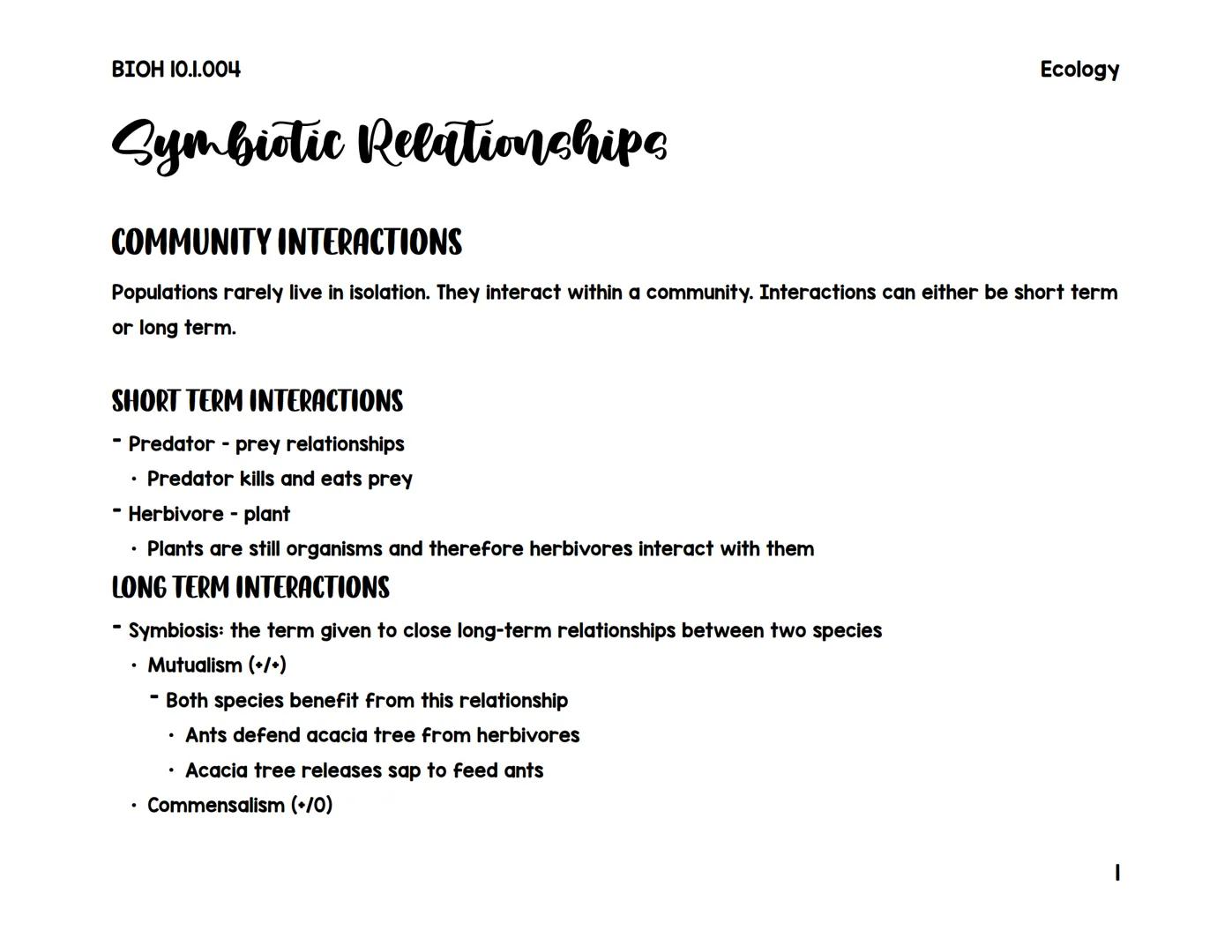
Community Interactions
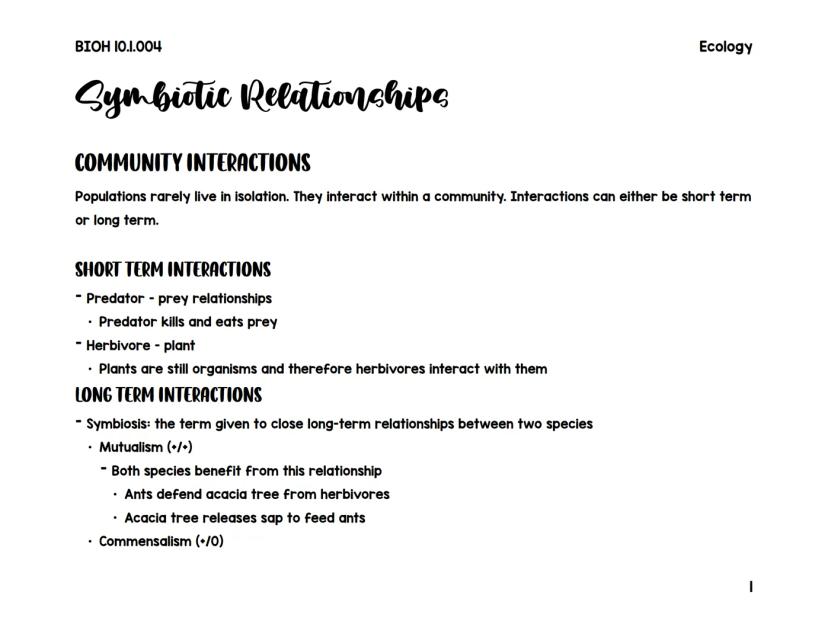
Living things rarely exist alone—they form communities where they constantly interact with other species. These interactions fall into two main categories: short-term and long-term.
Short-term interactions include predator-prey relationships where one organism kills and eats another. This includes obvious examples like lions hunting zebras, but also herbivores eating plants (yes, plants are organisms too!).
Long-term interactions are called symbiosis, which means close relationships between two species that last over time. One type is mutualism, where both species benefit. Think of ants protecting acacia trees from plant-eaters while the trees provide sap for the ants to eat—everybody wins!
Did you know? The word "symbiosis" comes from Greek words meaning "living together." You can remember the different types by thinking about whether each partner gets a plus (+) or zero (0) or minus (-) in the relationship!
2
of 4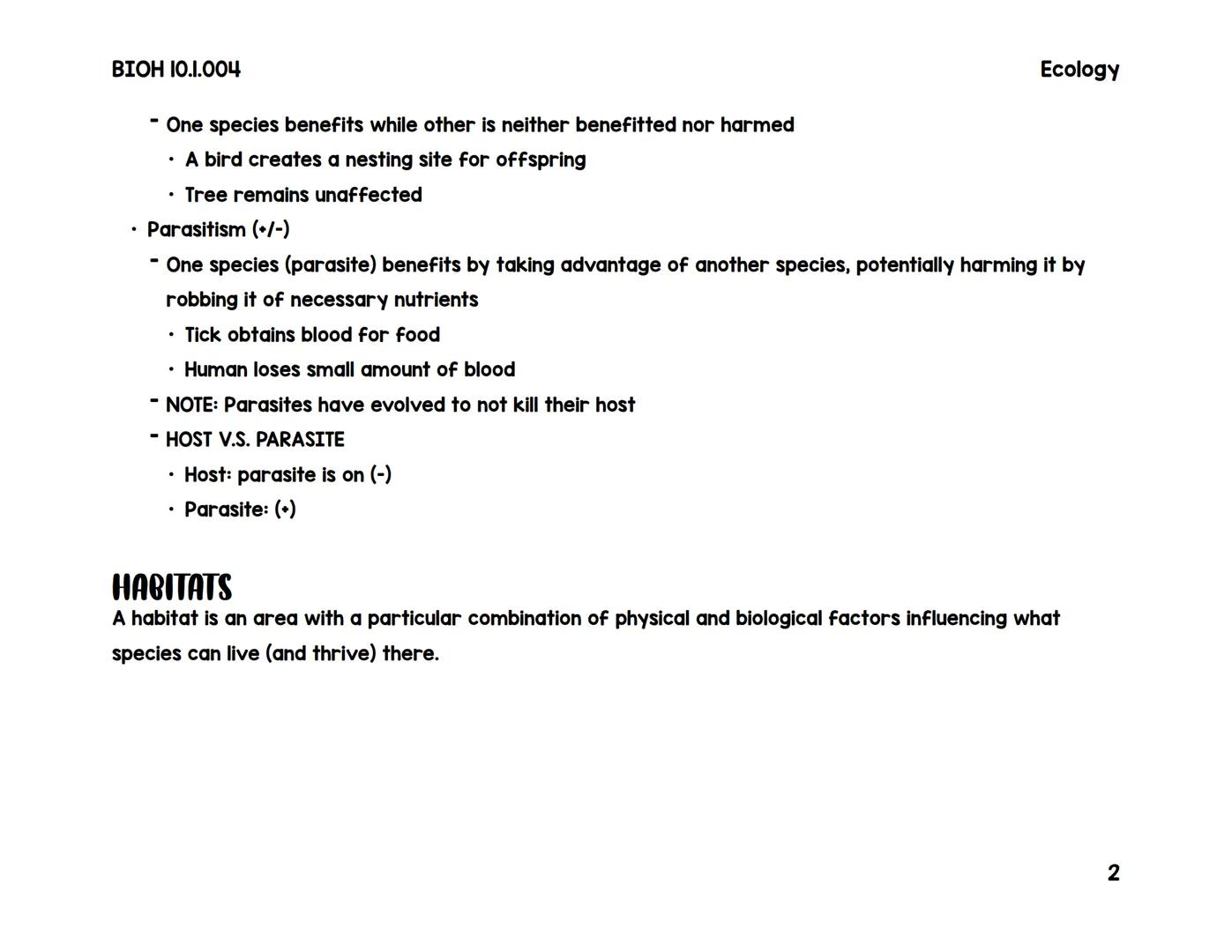
Types of Symbiosis and Habitats
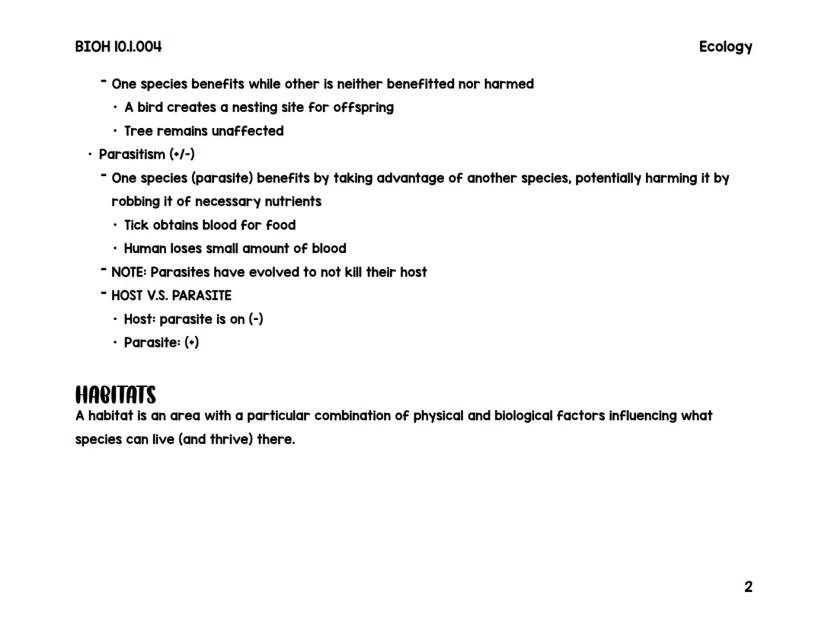
Commensalism is when one species benefits (+) while the other neither gains nor loses anything (0). For example, when birds build nests in trees, the birds get homes but the trees are basically unaffected.
Parasitism occurs when one organism (the parasite) benefits by taking advantage of another organism (the host). The parasite gets nutrients (+) while the host is harmed (-). A tick drinking human blood is a perfect example—the tick gets food while the human loses blood. Interestingly, parasites have evolved to avoid killing their hosts—dead hosts aren't useful!
A habitat is an area with specific physical and biological characteristics that determine which species can live there. Think of it as nature's neighborhood, with certain conditions that make it perfect for some creatures and impossible for others.
Remember this! In parasitism, the parasite always benefits (+) while the host is always harmed (-). Parasites are like unwelcome guests that take without giving back!
3
of 4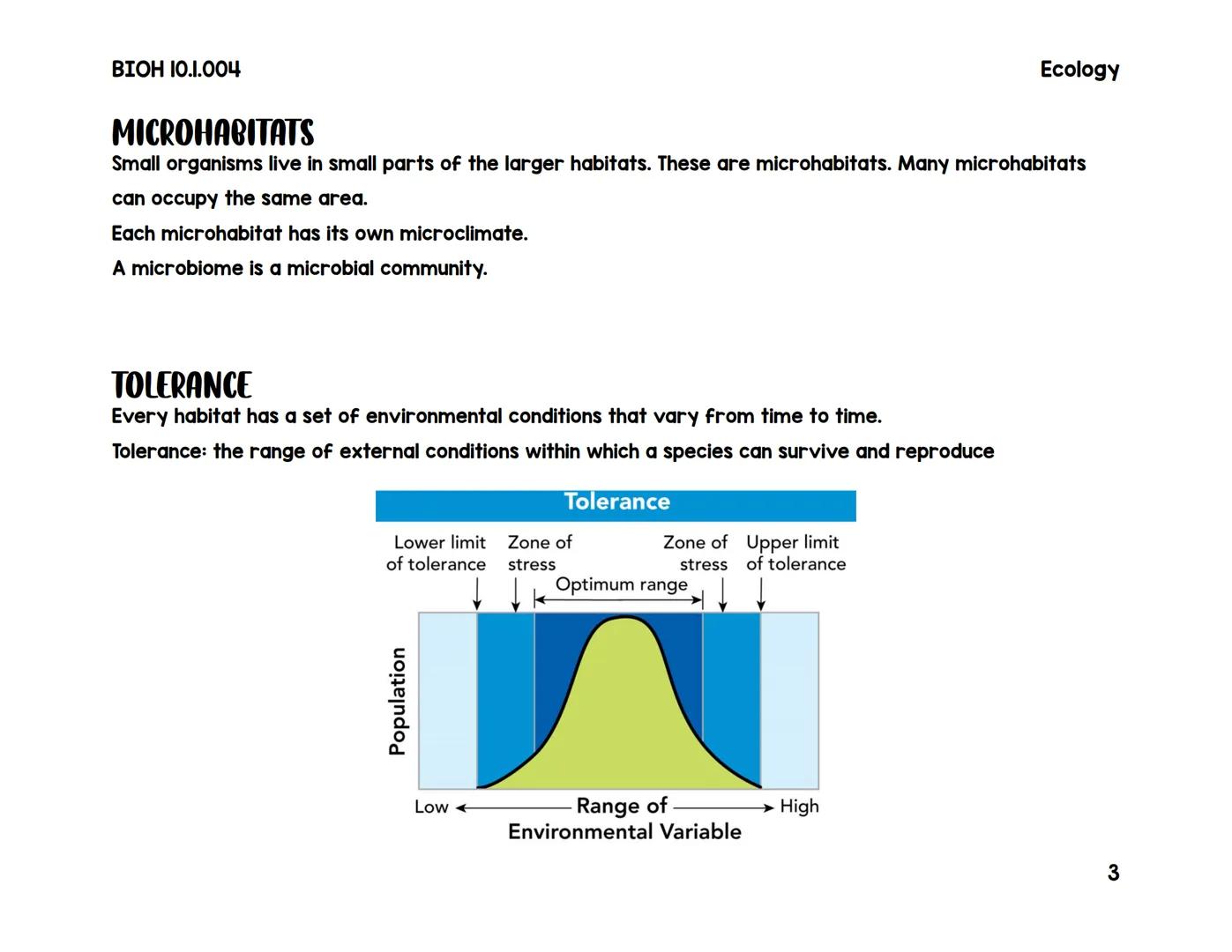
Microhabitats and Tolerance
Even within larger habitats, smaller spaces called microhabitats exist. These tiny environments can be found everywhere—under rocks, inside rotting logs, or even in your belly button! Many microhabitats can exist in the same area, each with its own microclimate (local environmental conditions).
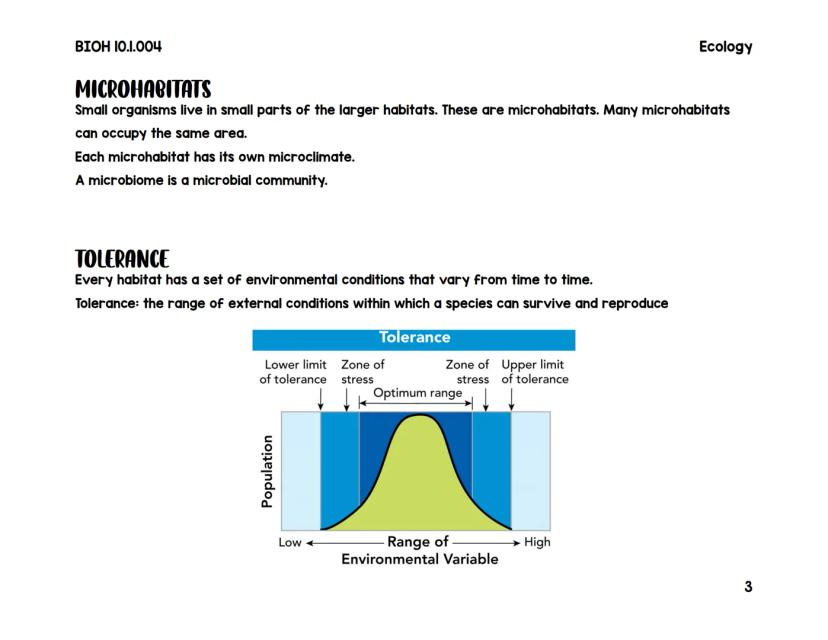
Every organism has a range of conditions it can tolerate to survive. This range is called tolerance. Within this range is an "optimum range" where organisms thrive best. Beyond their tolerance limits, organisms either struggle or die.
The tolerance range has different zones: the optimum range (where populations flourish), zones of stress (where survival is possible but difficult), and beyond the tolerance limits (where survival is impossible).
Think about it: You have tolerance ranges too! You can survive in temperatures from roughly 50°F to 100°F, but you're most comfortable (your optimum range) between 68°F and 75°F. Outside these ranges, you get stressed or worse!
4
of 4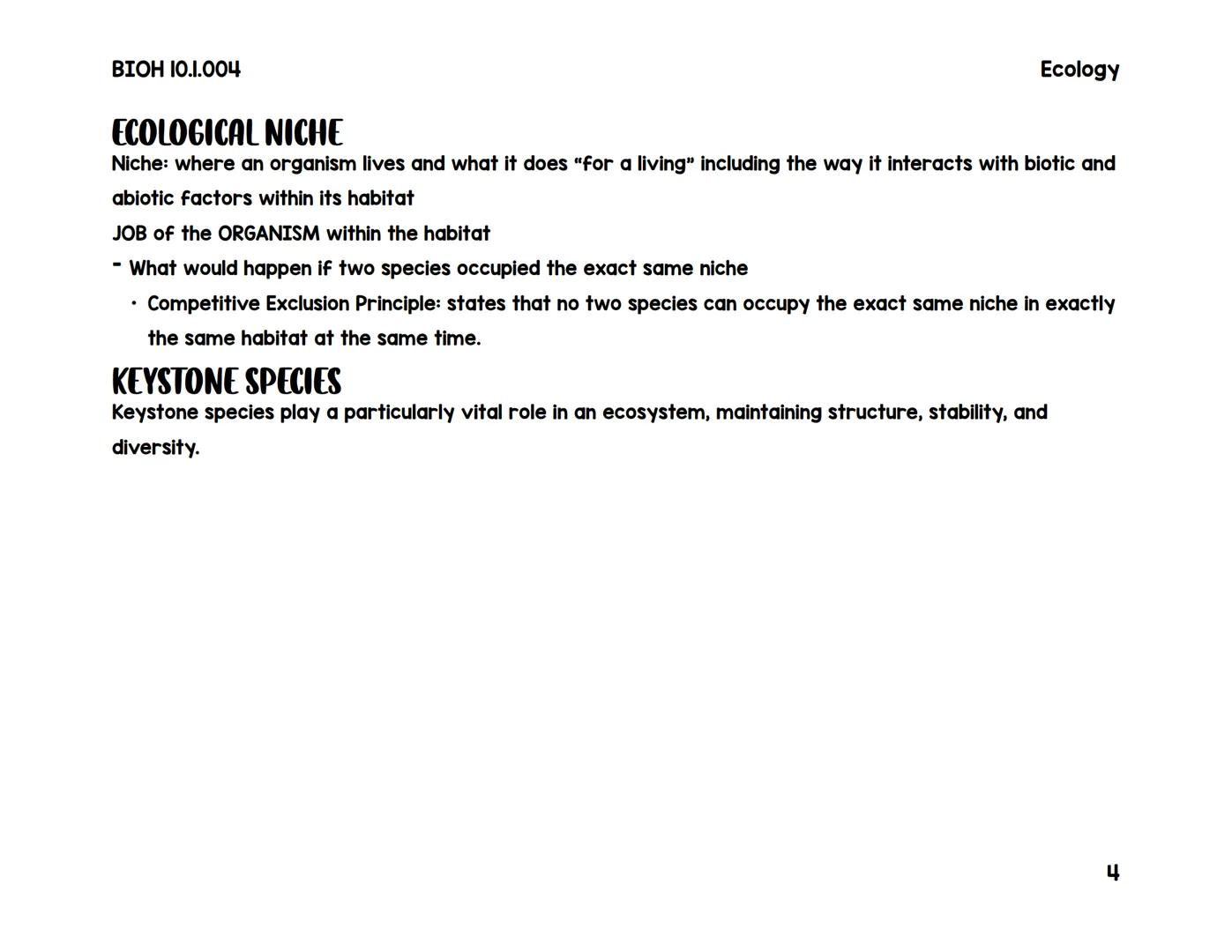
Ecological Niches and Keystone Species
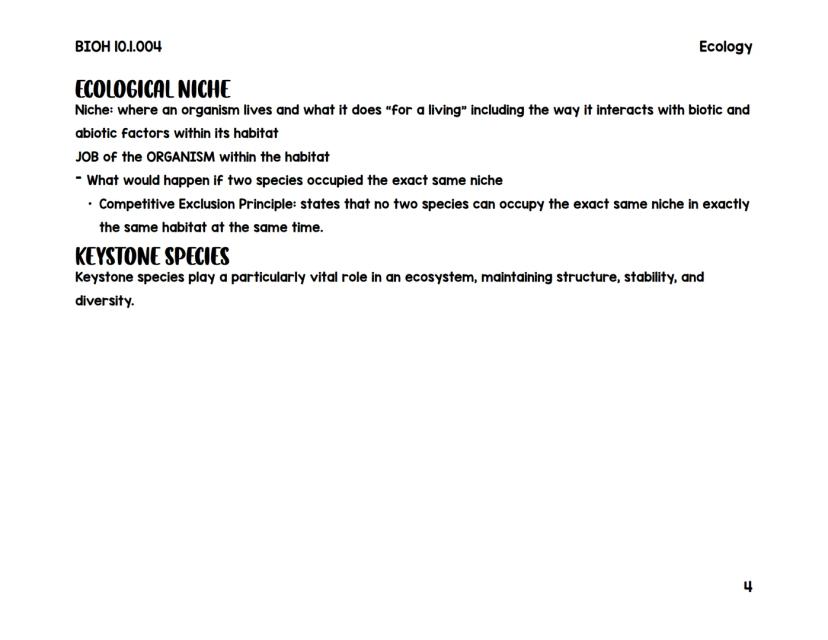
An ecological niche isn't just where an organism lives—it's the organism's entire "job description" in its habitat. This includes what it eats, when it's active, how it reproduces, and all its interactions with living and non-living parts of its environment.
The Competitive Exclusion Principle states that no two species can occupy exactly the same niche in the same habitat at the same time. If they try to, they'll compete until one either adapts, moves, or dies out. It's nature's way of preventing overcrowding in job positions!
Some organisms play especially important roles in their ecosystems. These keystone species maintain the structure, stability, and diversity of their entire ecosystem. Like the keystone in an arch, if you remove them, the whole system can collapse.
Cool fact: Sea otters are keystone species! They eat sea urchins that would otherwise devour kelp forests. Without otters, kelp forests disappear, eliminating habitat for countless marine creatures. One species can make all the difference!
We thought you’d never ask...
Our AI companion is specifically built for the needs of students. Based on the millions of content pieces we have on the platform we can provide truly meaningful and relevant answers to students. But its not only about answers, the companion is even more about guiding students through their daily learning challenges, with personalised study plans, quizzes or content pieces in the chat and 100% personalisation based on the students skills and developments.
You can download the app in the Google Play Store and in the Apple App Store.
That's right! Enjoy free access to study content, connect with fellow students, and get instant help – all at your fingertips.
Similar Content
Most popular content in Environmental Science
7C
Environmental ScienceCells
Basics
9th800
Environmental ScienceStudent Exploration: GMOs and the Environment Answer Key.pdf
GMOs and the Environment
4267
Environmental ScienceEcology
Gives an overview of Ecological levels of Organization .
1141
Environmental ScienceEarth and Space: Ch. 2- Minerals
Slideshow about Ch. 2 of Earth and Space Science
11th752
Environmental ScienceEarth and Space: Ch. 5- Weathering, Soil, and Mass Movements
Slideshow about Ch. 5 of Earth and Space Science
11th1424
 Earth and Space Science
Human Impact on the Earth: Effects of Environmental Change on Biodiversity
Very interesting and full of info presentation about human impact on our planet and the biodiversity among the animal species
390
Environmental ScienceAsexual vs Sexual Reproduction
Comparison of advantages and disadvantages of asexual and sexual reproduction, including mitosis and meiosis processes.
9th1567
Most popular content
9O
 AP US History
Origins and Dynamics of the Columbian Exchange
Analyze the ecological and economic motivations behind the initial transfer of goods, people, and diseases between the Old and New Worlds.
9th3,1280
I
AP US HistoryIntroduction to Early Cultural Interactions
Analyze the initial social and religious encounters between Europeans, Africans, and Indigenous peoples in the colonial Americas.
9th2,7730
O
AP World HistoryOrigins of Ancient River Civilizations
Analyze the environmental factors and technological innovations that led to the rise of early states in Mesopotamia, Egypt, and the Indus Valley.
9th3,1870
M
AP US HistoryMotivations for European Exploration
Analyze the economic, religious, and political factors that drove European powers to the Americas during the 15th and 16th centuries.
9th1,7780
F
 AP Psychology
Foundations of Ethical Guidelines in Research
Practice the core principles of the APA ethical code including informed consent, debriefing, and the role of Institutional Review Boards.
9th1,3360
I
AP US HistoryIntroduction to Native American Societies
Examine the diverse social, political, and economic structures of North American indigenous groups prior to European contact.
9th1,1100
I
AP US HistoryIntroduction to the Spanish Encomienda System
Explore the fundamental economic and social structures of the Spanish colonial system, focusing on the encomienda and the casta social hierarchy.
9th8890
I
 AP Biology
Introduction to Biological Elements of Life
Practice identifying the essential elements including carbon, nitrogen, phosphorus, and sulfur that compose biological macromolecules.
9th1,7410
O
AP US Government & PoliticsOrigins of the Articles of Confederation
Practice identifying the motivations for a weak central government and the specific powers granted to the states under the first U.S. constitution.
9th9370
Students love us — and so will you.
4.6/5App Store
4.7/5Google Play
The app is very easy to use and well designed. I have found everything I was looking for so far and have been able to learn a lot from the presentations! I will definitely use the app for a class assignment! And of course it also helps a lot as an inspiration.
Stefan SiOS user
This app is really great. There are so many study notes and help [...]. My problem subject is French, for example, and the app has so many options for help. Thanks to this app, I have improved my French. I would recommend it to anyone.
Samantha KlichAndroid user
Wow, I am really amazed. I just tried the app because I've seen it advertised many times and was absolutely stunned. This app is THE HELP you want for school and above all, it offers so many things, such as workouts and fact sheets, which have been VERY helpful to me personally.
AnnaiOS user
Environmental Science91 views·Updated Jul 4, 2026·4 pagesUnderstanding Symbiotic Relationships in Nature
Bee Hyder@beehyder_lanm
Ecology explores how different organisms live together and interact in communities. These interactions shape ecosystems and determine which species survive in specific environments. Understanding these relationships helps explain the complex web of life all around us.
1
of 4
Sign up to see the content. It's free!
- Access to all documents
- Improve your grades
- Join milions of students
Community Interactions
Living things rarely exist alone—they form communities where they constantly interact with other species. These interactions fall into two main categories: short-term and long-term.
Short-term interactions include predator-prey relationships where one organism kills and eats another. This includes obvious examples like lions hunting zebras, but also herbivores eating plants (yes, plants are organisms too!).
Long-term interactions are called symbiosis, which means close relationships between two species that last over time. One type is mutualism, where both species benefit. Think of ants protecting acacia trees from plant-eaters while the trees provide sap for the ants to eat—everybody wins!
Did you know? The word "symbiosis" comes from Greek words meaning "living together." You can remember the different types by thinking about whether each partner gets a plus (+) or zero (0) or minus (-) in the relationship!
2
of 4Sign up to see the content. It's free!
- Access to all documents
- Improve your grades
- Join milions of students
Types of Symbiosis and Habitats
Commensalism is when one species benefits (+) while the other neither gains nor loses anything (0). For example, when birds build nests in trees, the birds get homes but the trees are basically unaffected.
Parasitism occurs when one organism (the parasite) benefits by taking advantage of another organism (the host). The parasite gets nutrients (+) while the host is harmed (-). A tick drinking human blood is a perfect example—the tick gets food while the human loses blood. Interestingly, parasites have evolved to avoid killing their hosts—dead hosts aren't useful!
A habitat is an area with specific physical and biological characteristics that determine which species can live there. Think of it as nature's neighborhood, with certain conditions that make it perfect for some creatures and impossible for others.
Remember this! In parasitism, the parasite always benefits (+) while the host is always harmed (-). Parasites are like unwelcome guests that take without giving back!
3
of 4Sign up to see the content. It's free!
- Access to all documents
- Improve your grades
- Join milions of students
Microhabitats and Tolerance
Even within larger habitats, smaller spaces called microhabitats exist. These tiny environments can be found everywhere—under rocks, inside rotting logs, or even in your belly button! Many microhabitats can exist in the same area, each with its own microclimate (local environmental conditions).
Every organism has a range of conditions it can tolerate to survive. This range is called tolerance. Within this range is an "optimum range" where organisms thrive best. Beyond their tolerance limits, organisms either struggle or die.
The tolerance range has different zones: the optimum range (where populations flourish), zones of stress (where survival is possible but difficult), and beyond the tolerance limits (where survival is impossible).
Think about it: You have tolerance ranges too! You can survive in temperatures from roughly 50°F to 100°F, but you're most comfortable (your optimum range) between 68°F and 75°F. Outside these ranges, you get stressed or worse!
4
of 4Sign up to see the content. It's free!
- Access to all documents
- Improve your grades
- Join milions of students
Ecological Niches and Keystone Species
An ecological niche isn't just where an organism lives—it's the organism's entire "job description" in its habitat. This includes what it eats, when it's active, how it reproduces, and all its interactions with living and non-living parts of its environment.
The Competitive Exclusion Principle states that no two species can occupy exactly the same niche in the same habitat at the same time. If they try to, they'll compete until one either adapts, moves, or dies out. It's nature's way of preventing overcrowding in job positions!
Some organisms play especially important roles in their ecosystems. These keystone species maintain the structure, stability, and diversity of their entire ecosystem. Like the keystone in an arch, if you remove them, the whole system can collapse.
Cool fact: Sea otters are keystone species! They eat sea urchins that would otherwise devour kelp forests. Without otters, kelp forests disappear, eliminating habitat for countless marine creatures. One species can make all the difference!
We thought you’d never ask...
Our AI companion is specifically built for the needs of students. Based on the millions of content pieces we have on the platform we can provide truly meaningful and relevant answers to students. But its not only about answers, the companion is even more about guiding students through their daily learning challenges, with personalised study plans, quizzes or content pieces in the chat and 100% personalisation based on the students skills and developments.
You can download the app in the Google Play Store and in the Apple App Store.
That's right! Enjoy free access to study content, connect with fellow students, and get instant help – all at your fingertips.
Similar Content
Most popular content in Environmental Science
7C
Environmental ScienceCells
Basics
9th800
Environmental ScienceStudent Exploration: GMOs and the Environment Answer Key.pdf
GMOs and the Environment
4267
Environmental ScienceEcology
Gives an overview of Ecological levels of Organization .
1141
Environmental ScienceEarth and Space: Ch. 2- Minerals
Slideshow about Ch. 2 of Earth and Space Science
11th752
Environmental ScienceEarth and Space: Ch. 5- Weathering, Soil, and Mass Movements
Slideshow about Ch. 5 of Earth and Space Science
11th1424
Earth and Space ScienceHuman Impact on the Earth: Effects of Environmental Change on Biodiversity
Very interesting and full of info presentation about human impact on our planet and the biodiversity among the animal species
390
Environmental ScienceAsexual vs Sexual Reproduction
Comparison of advantages and disadvantages of asexual and sexual reproduction, including mitosis and meiosis processes.
9th1567
Most popular content
9O
AP US HistoryOrigins and Dynamics of the Columbian Exchange
Analyze the ecological and economic motivations behind the initial transfer of goods, people, and diseases between the Old and New Worlds.
9th3,1280
I
AP US HistoryIntroduction to Early Cultural Interactions
Analyze the initial social and religious encounters between Europeans, Africans, and Indigenous peoples in the colonial Americas.
9th2,7730
O
AP World HistoryOrigins of Ancient River Civilizations
Analyze the environmental factors and technological innovations that led to the rise of early states in Mesopotamia, Egypt, and the Indus Valley.
9th3,1870
M
AP US HistoryMotivations for European Exploration
Analyze the economic, religious, and political factors that drove European powers to the Americas during the 15th and 16th centuries.
9th1,7780
F
AP PsychologyFoundations of Ethical Guidelines in Research
Practice the core principles of the APA ethical code including informed consent, debriefing, and the role of Institutional Review Boards.
9th1,3360
I
AP US HistoryIntroduction to Native American Societies
Examine the diverse social, political, and economic structures of North American indigenous groups prior to European contact.
9th1,1100
I
AP US HistoryIntroduction to the Spanish Encomienda System
Explore the fundamental economic and social structures of the Spanish colonial system, focusing on the encomienda and the casta social hierarchy.
9th8890
I
AP BiologyIntroduction to Biological Elements of Life
Practice identifying the essential elements including carbon, nitrogen, phosphorus, and sulfur that compose biological macromolecules.
9th1,7410
O
AP US Government & PoliticsOrigins of the Articles of Confederation
Practice identifying the motivations for a weak central government and the specific powers granted to the states under the first U.S. constitution.
9th9370
Students love us — and so will you.
4.6/5App Store
4.7/5Google Play
The app is very easy to use and well designed. I have found everything I was looking for so far and have been able to learn a lot from the presentations! I will definitely use the app for a class assignment! And of course it also helps a lot as an inspiration.
Stefan SiOS user
This app is really great. There are so many study notes and help [...]. My problem subject is French, for example, and the app has so many options for help. Thanks to this app, I have improved my French. I would recommend it to anyone.
Samantha KlichAndroid user
Wow, I am really amazed. I just tried the app because I've seen it advertised many times and was absolutely stunned. This app is THE HELP you want for school and above all, it offers so many things, such as workouts and fact sheets, which have been VERY helpful to me personally.
AnnaiOS user