Classification of Living Organisms
Ever wondered how scientists keep track of millions of different living things? The classification system we use today was developed by Carolus Linnaeus in the 1700s. While his basic approach remains, scientists have updated it as we've learned more about evolutionary relationships.
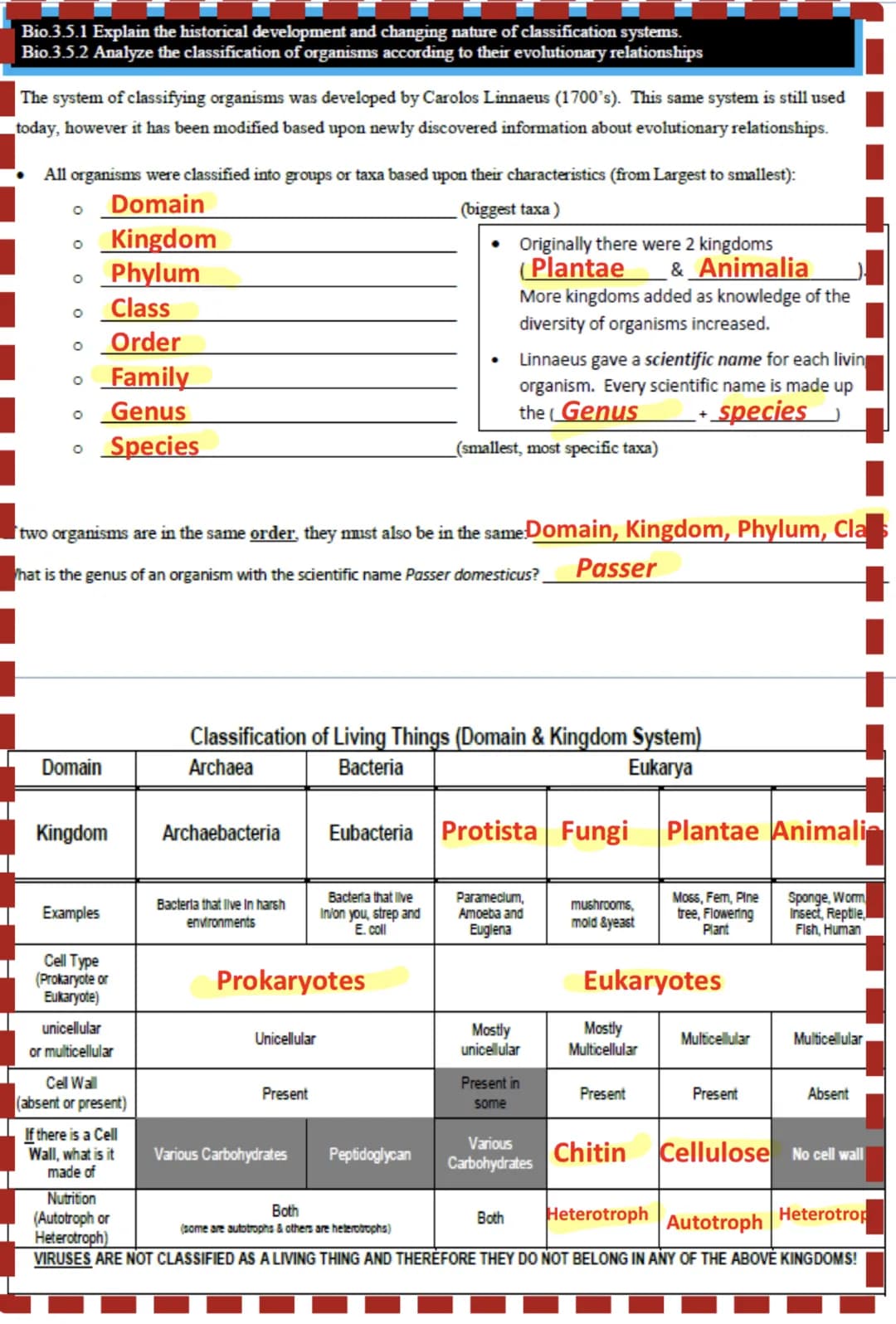
All organisms are sorted into groups called taxa, arranged from broadest to most specific: Domain → Kingdom → Phylum → Class → Order → Family → Genus → Species. When you hear scientific names like Homo sapiens (humans), that's actually the genus (Homo) and species (sapiens) combined.
Linnaeus originally created just two kingdoms (Plants and Animals), but modern classification recognizes three domains (Archaea, Bacteria, and Eukarya) and six kingdoms. Two organisms in the same order must also share the same domain, kingdom, phylum, and class—showing their evolutionary closeness.
Quick Tip: Remember the classification order with this mnemonic: "Dear King Philip Came Over For Good Soup" (Domain, Kingdom, Phylum, Class, Order, Family, Genus, Species).
The modern classification system divides life into:
- Domain Archaea: Single-celled prokaryotes living in extreme environments
- Domain Bacteria: Common single-celled prokaryotes found everywhere
- Domain Eukarya: All organisms with complex cells (eukaryotes), including:
- Kingdom Protista: Mostly single-celled organisms like amoebas
- Kingdom Fungi: Mushrooms, molds, and yeasts
- Kingdom Plantae: All plants from moss to flowering plants
- Kingdom Animalia: All animals from simple sponges to humans
Importantly, viruses don't appear in this classification because they're not considered living organisms!


 Biology
 Health
 Algebra