
Viruses are fascinating microscopic particles that blur the line between... Show more
 Biology
 Irish
Irish English
Sign up to see the contentIt's free!
Access to all documents
Improve your grades
Join milions of students
Knowunity AI
Subjects
Triangle Congruence and Similarity Theorems
Triangle Properties and Classification
Linear Equations and Graphs
Geometric Angle Relationships
Trigonometric Functions and Identities
Equation Solving Techniques
Circle Geometry Fundamentals
Division Operations and Methods
Basic Differentiation Rules
Exponent and Logarithm Properties
Show all topics
Human Organ Systems
Reproductive Cell Cycles
Biological Sciences Subdisciplines
Cellular Energy Metabolism
Autotrophic Energy Processes
Inheritance Patterns and Principles
Biomolecular Structure and Organization
Cell Cycle and Division Mechanics
Cellular Organization and Development
Biological Structural Organization
Show all topics
Chemical Sciences and Applications
Atomic Structure and Composition
Molecular Electron Structure Representation
Atomic Electron Behavior
Matter Properties and Water
Mole Concept and Calculations
Gas Laws and Behavior
Periodic Table Organization
Chemical Thermodynamics Fundamentals
Chemical Bond Types and Properties
Show all topics
European Renaissance and Enlightenment
European Cultural Movements 800-1920
American Revolution Era 1763-1797
American Civil War 1861-1865
Global Imperial Systems
Mongol and Chinese Dynasties
U.S. Presidents and World Leaders
Historical Sources and Documentation
World Wars Era and Impact
World Religious Systems
Show all topics
Classic and Contemporary Novels
Literary Character Analysis
Rhetorical Theory and Practice
Classic Literary Narratives
Reading Analysis and Interpretation
Narrative Structure and Techniques
English Language Components
Influential English-Language Authors
Basic Sentence Structure
Narrative Voice and Perspective
Show all topics
4
•
Updated Apr 2, 2026
•
Viruses are fascinating microscopic particles that blur the line between... Show more
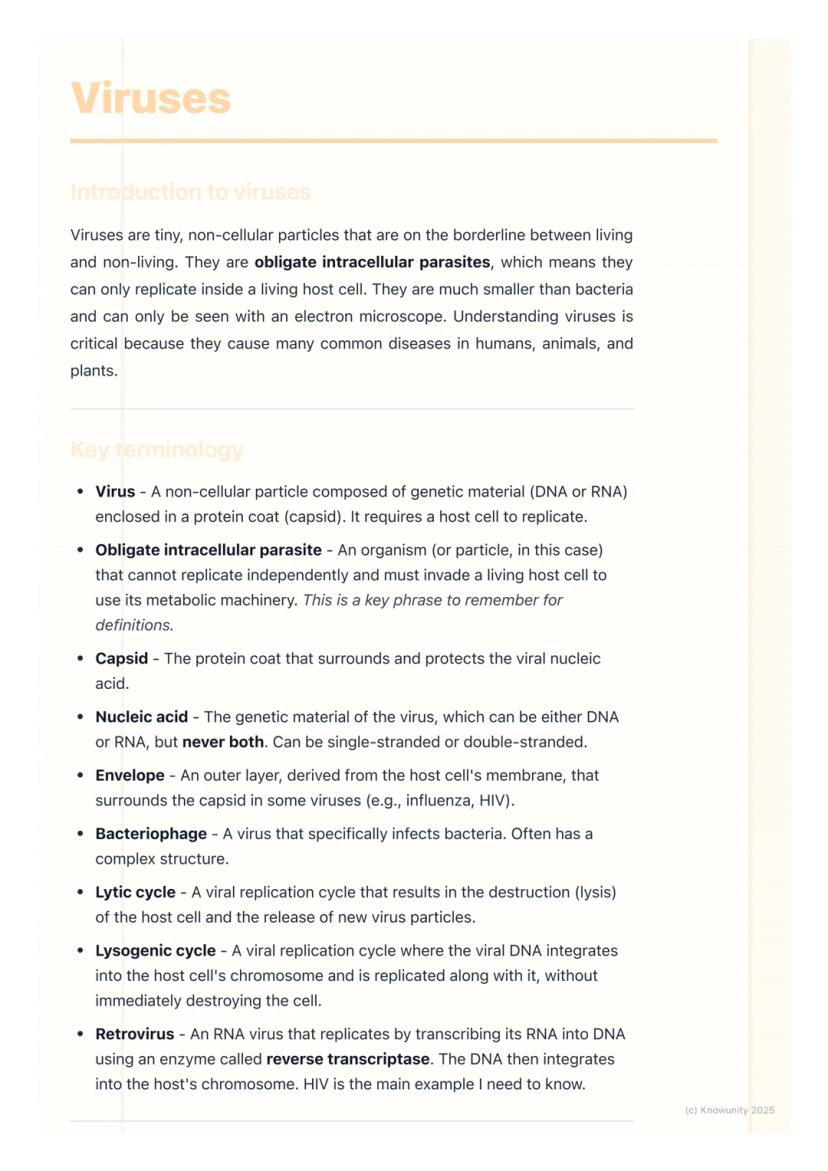

Think of viruses as nature's ultimate freeloaders - they literally can't survive without hijacking other cells! These tiny particles are non-cellular and exist as obligate intracellular parasites, meaning they absolutely must invade a living host cell to replicate. You can't see them with a regular microscope because they're much smaller than bacteria.
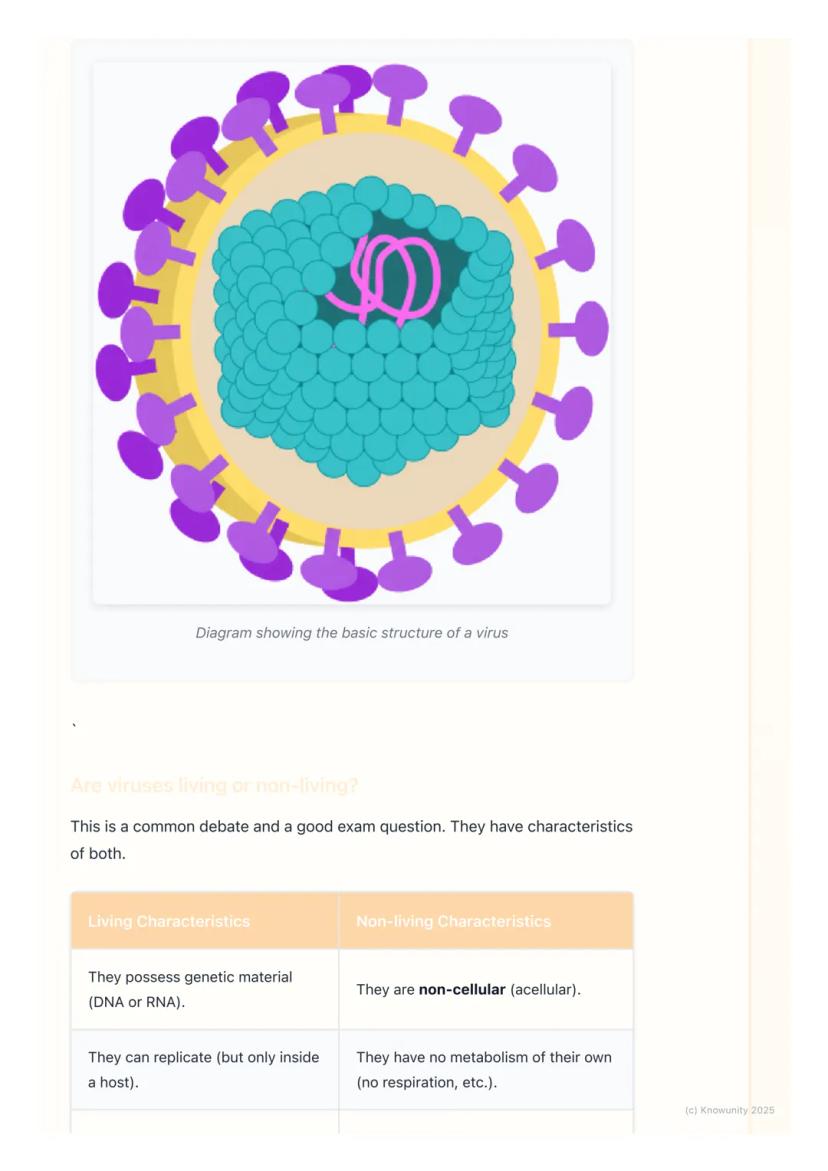
What makes viruses so interesting is their simple yet effective design. Each virus consists of genetic material (either DNA or RNA, never both) wrapped in a protective protein coat called a capsid. Some viruses also have an envelope - think of it as an extra outer layer stolen from their host cell's membrane.
Key terms you need to know: A bacteriophage specifically targets bacteria, whilst a retrovirus like HIV does something sneaky - it converts its RNA into DNA using an enzyme called reverse transcriptase. Remember these definitions as they're exam favourites!
Quick Tip: The phrase "obligate intracellular parasite" perfectly sums up what viruses are - learn this definition by heart!
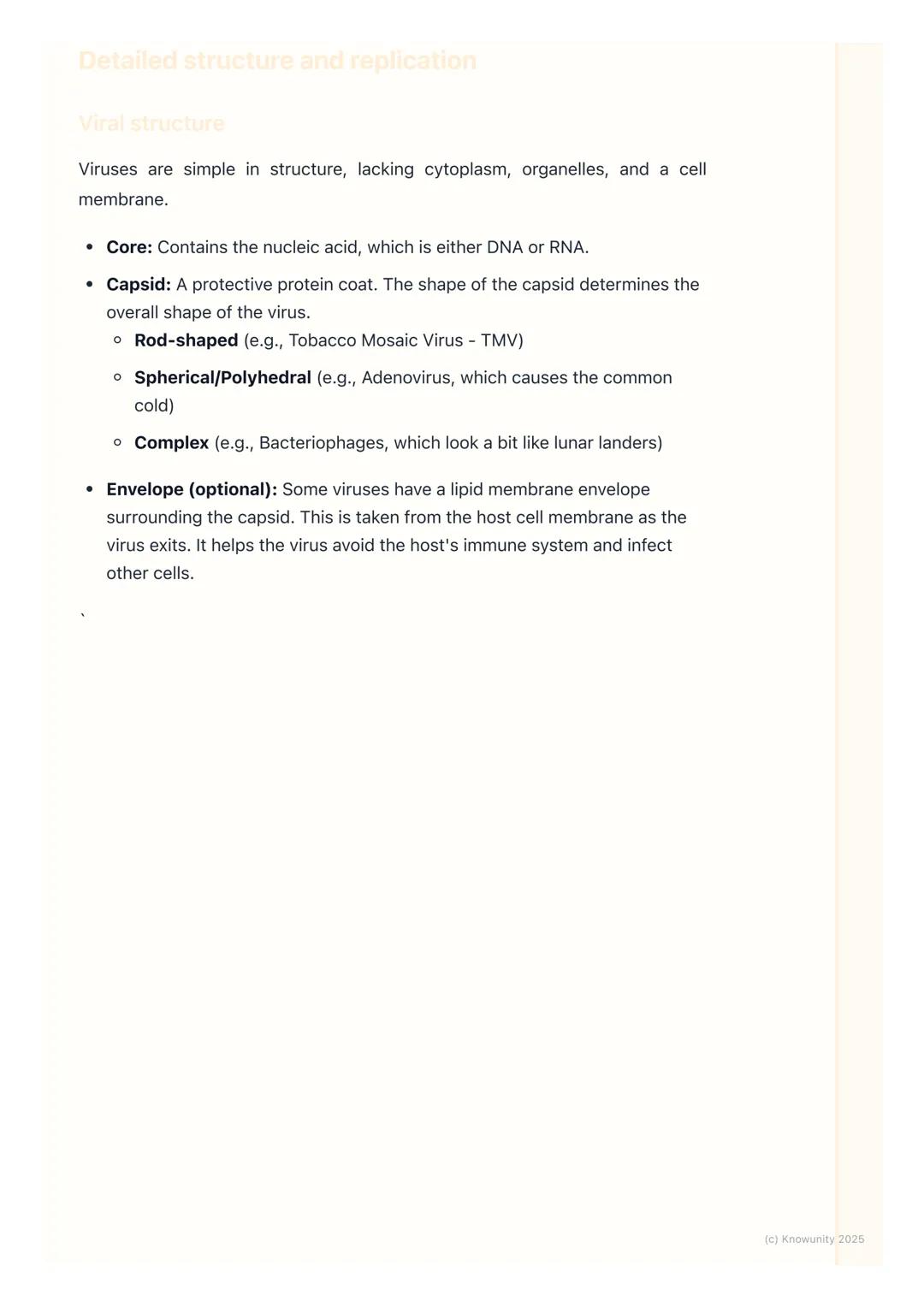
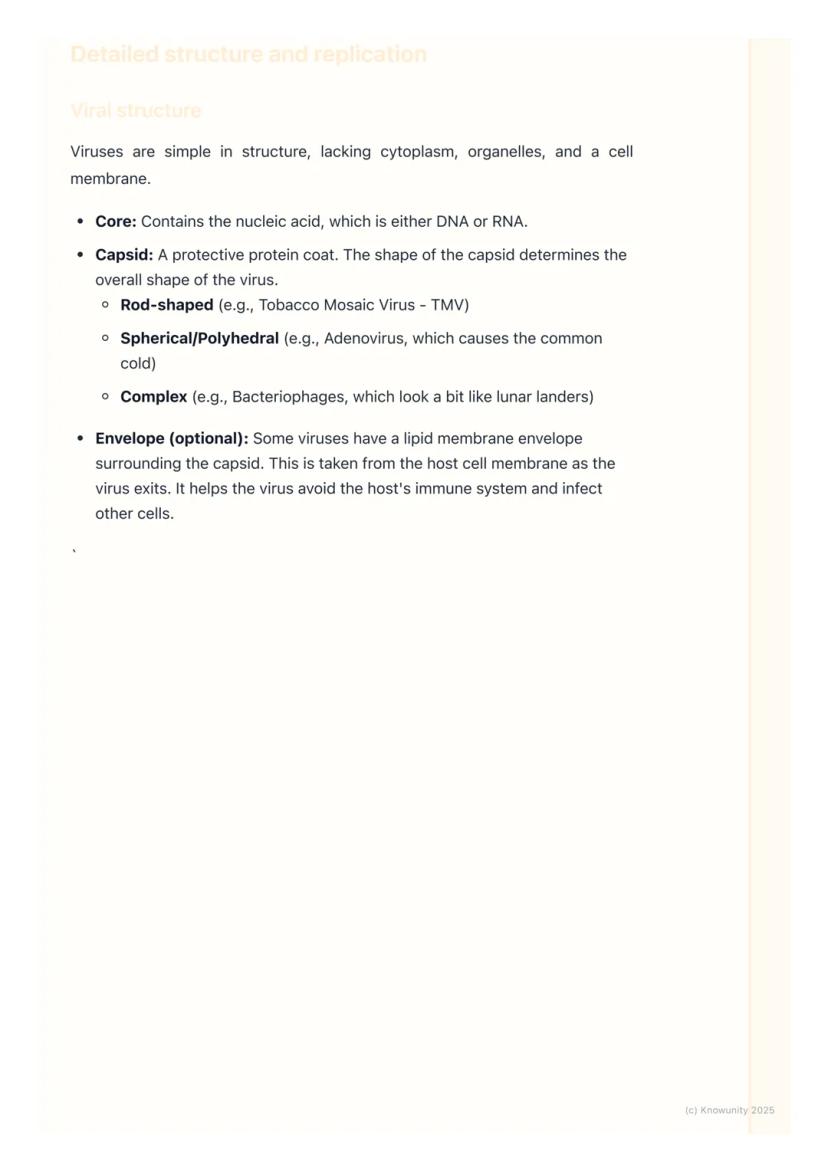
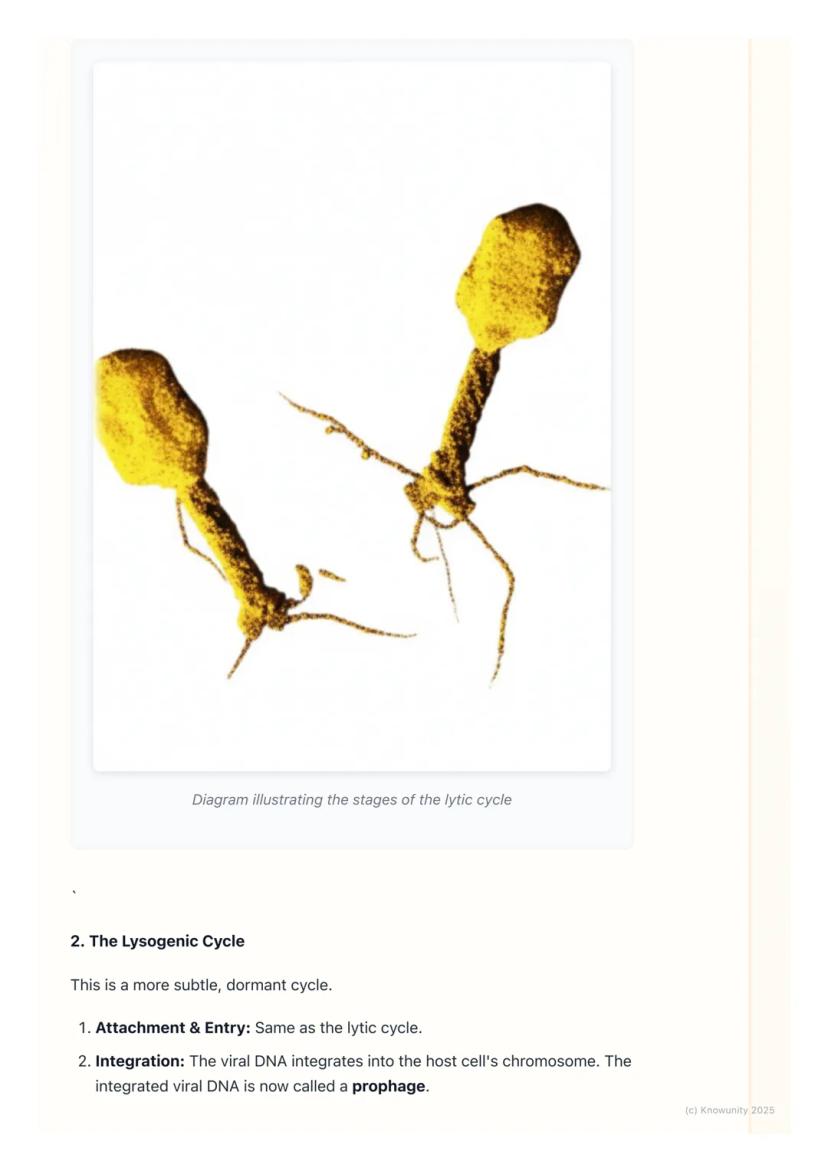
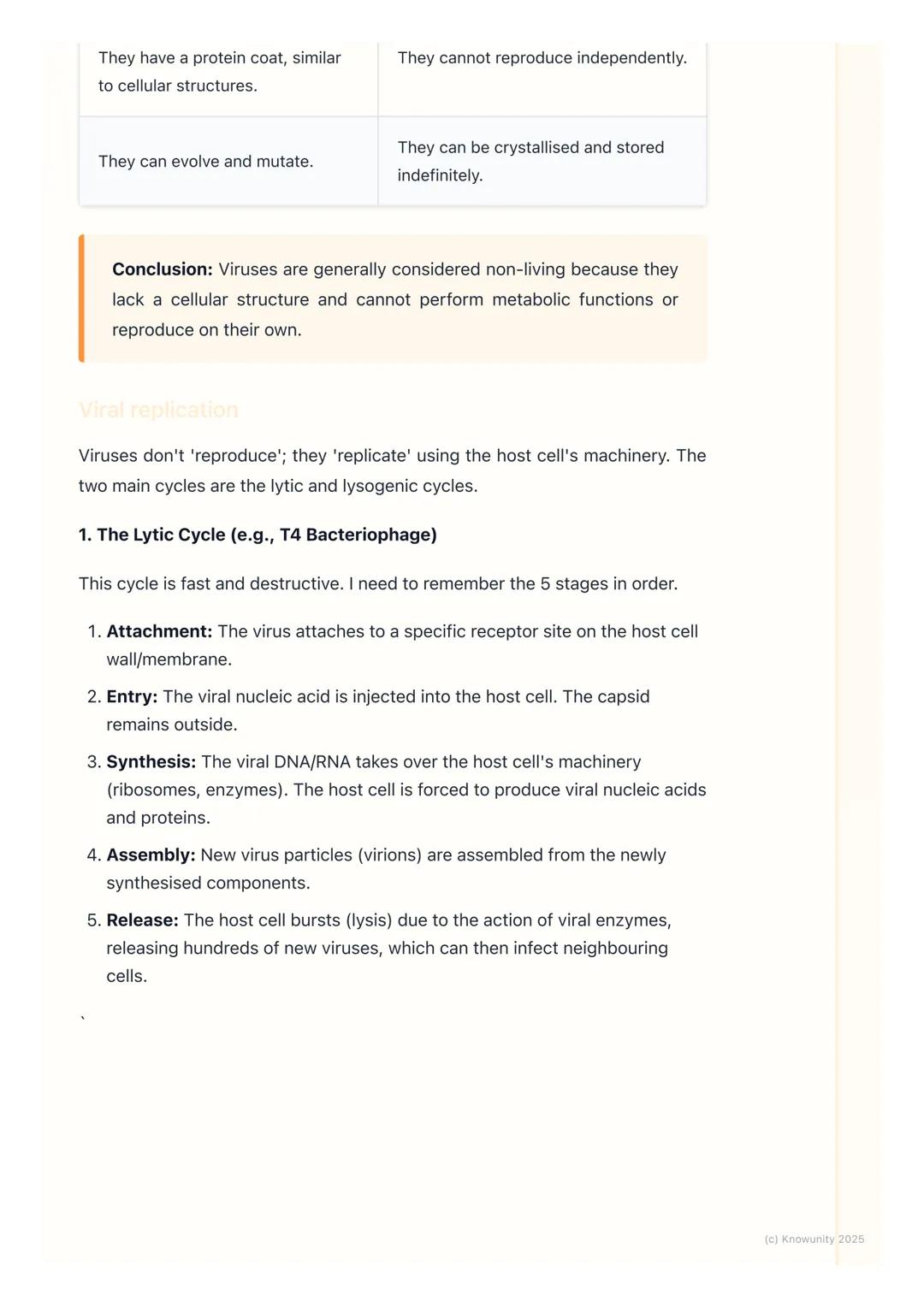
Viruses come in three main shapes that you should recognise: rod-shaped (like Tobacco Mosaic Virus), spherical (like the adenovirus causing common colds), and complex (like bacteriophages that look like tiny space landers). Their structure is surprisingly simple - no cytoplasm, no organelles, just the basics needed to hijack cells.
Here's a classic exam question: are viruses living or non-living? They're a bit of both, which makes them tricky! On the living side, they have genetic material, can replicate (sort of), and can evolve and mutate. However, they're considered non-living because they're not made of cells, have no metabolism, and can't reproduce independently.
The scientific consensus leans towards non-living since they lack the fundamental characteristics of life. You can even crystallise viruses and store them indefinitely - try doing that with your pet!
Exam Alert: Be ready to list both living and non-living characteristics of viruses - it's a popular comparison question!
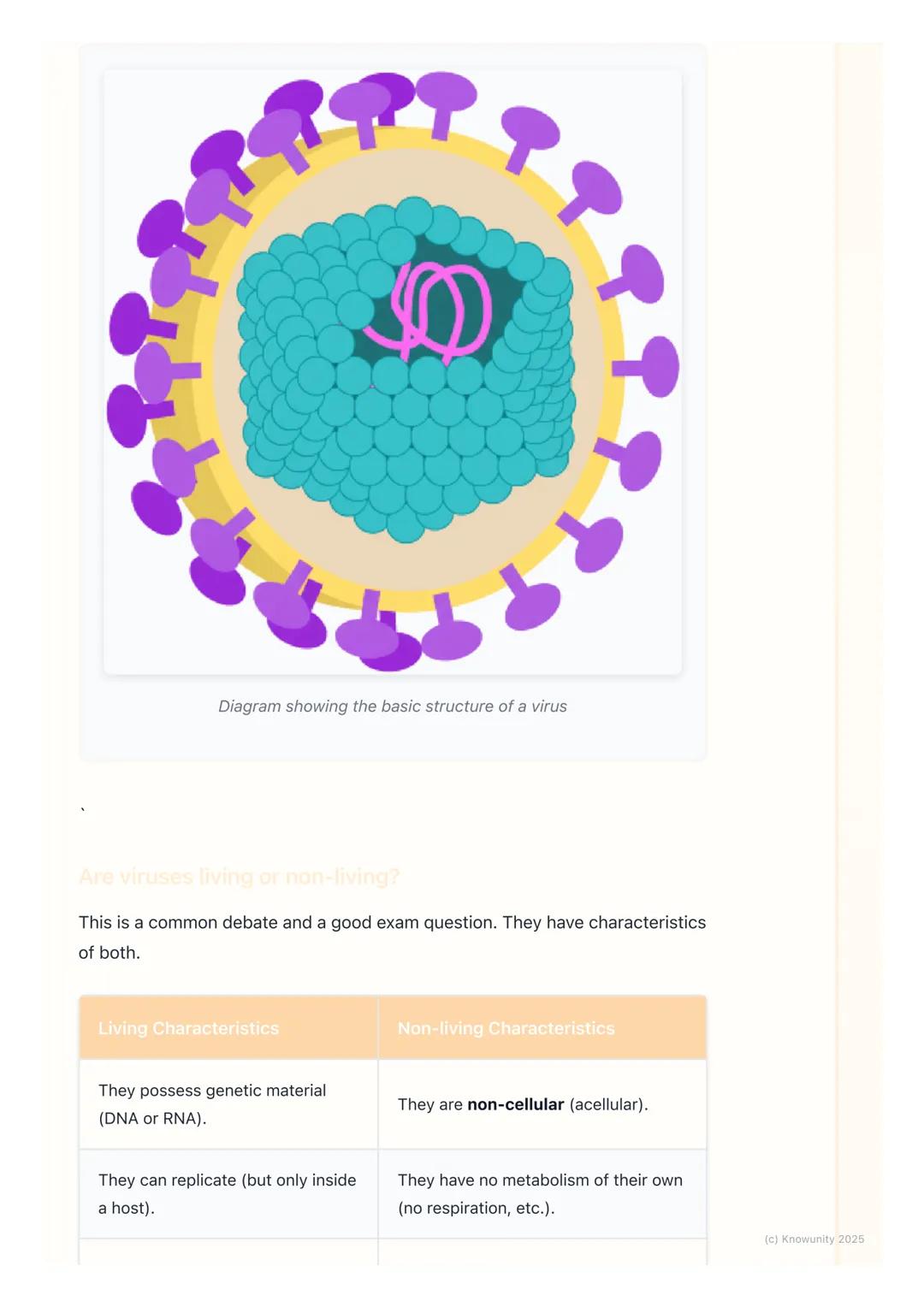
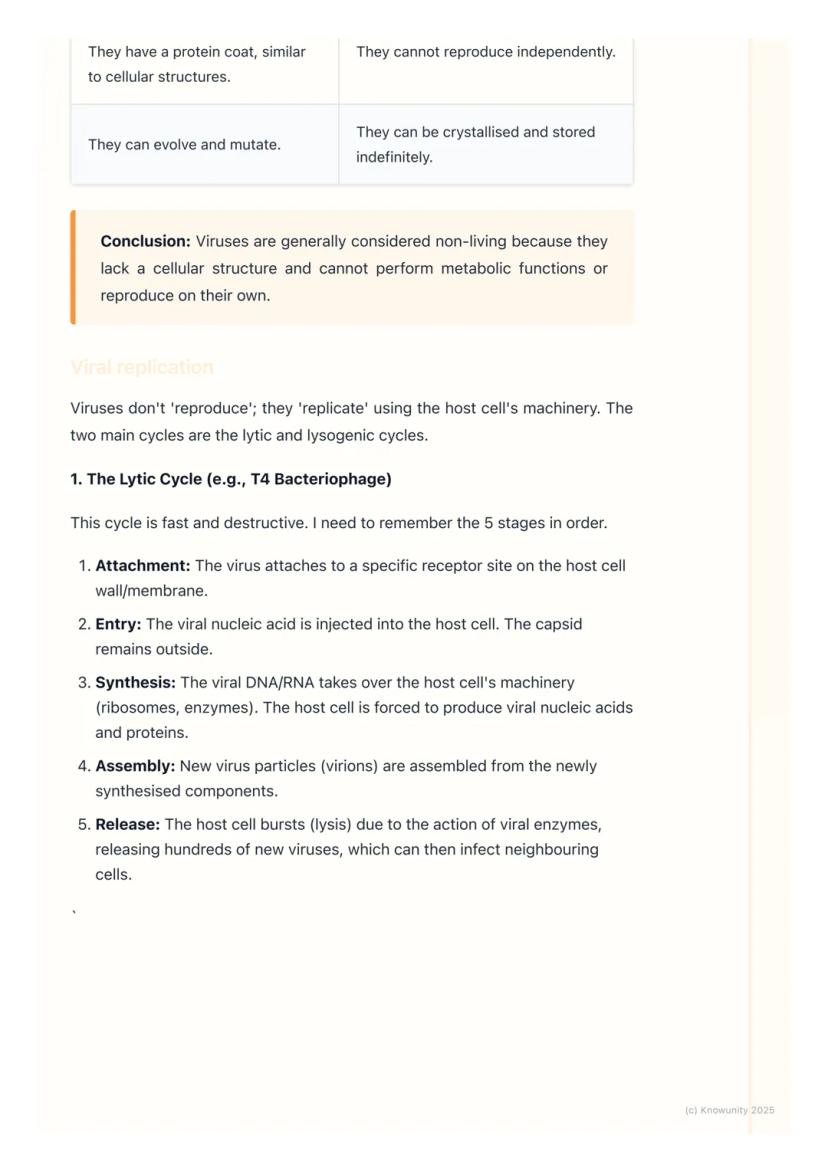
The lytic cycle is like a viral smash-and-grab operation that destroys the host cell. You need to memorise these five stages in order: Attachment, Entry, Synthesis, Assembly, and Release. It's actually quite brutal when you think about it!
First, the virus attaches to specific receptor sites on the host cell - it's picky about its targets. Then it enters by injecting its genetic material inside whilst leaving its protein coat outside. During synthesis, the viral DNA or RNA basically takes over the cell's machinery, forcing it to make viral components instead of doing its normal job.
Next comes assembly, where new virus particles are put together like a factory production line. Finally, release happens when the host cell bursts open (called lysis), releasing hundreds of new viruses ready to infect neighbouring cells. The whole process is fast and always ends with the host cell's death.
Memory Trick: Remember "AESAR" - Attachment, Entry, Synthesis, Assembly, Release - or make up your own phrase to remember the order!
The lysogenic cycle is much more patient and cunning than the lytic cycle. Instead of immediately destroying the host cell, the virus plays the long game by integrating its DNA into the host's chromosome, forming what's called a prophage.
Here's the clever bit: the host cell continues living normally, but every time it divides, it copies the viral DNA along with its own. The virus essentially becomes a permanent part of the cell's genetic makeup, passed down to all daughter cells like a family heirloom nobody wants.
The virus can stay dormant for ages until something triggers it - like UV radiation or chemical stress. When activated, the prophage exits the host chromosome and switches to the lytic cycle, suddenly producing new viruses and destroying the cell. It's like a sleeper agent finally getting the call to action!
This cycle explains why some viral infections can remain dormant in your body for years before causing problems again.
Real-Life Example: Cold sores are caused by herpes virus that stays dormant in your nerve cells and reactivates when you're stressed or run down!
Influenza is probably the viral infection you're most familiar with. This RNA virus with an envelope spreads through droplets when people cough or sneeze. It causes fever, muscle aches, and that generally awful feeling that makes you want to stay in bed all day. The tricky thing about flu is that it mutates rapidly, which is why you need a new vaccine every year.
HIV/AIDS represents one of the most serious viral diseases. HIV is a retrovirus that specifically targets and destroys T-helper cells - the very cells your immune system needs to fight infections. When these cells are depleted, you develop AIDS, making you vulnerable to infections that wouldn't normally be dangerous.
HIV spreads through exchange of bodily fluids like blood and semen, but not through casual contact like hugging or sharing food. There's no cure yet, but anti-retroviral drugs can help manage the infection by blocking reverse transcriptase.
Important Note: Antibiotics are useless against viruses - they only work on bacteria! Antiviral drugs are needed instead.
Tobacco Mosaic Virus (TMV) might not affect you directly, but it's a major headache for farmers. This virus creates a distinctive mottled pattern on plant leaves and seriously reduces crop yields. It spreads through contact, often on workers' hands or farming tools, making it difficult to control in agricultural settings.
Foot-and-Mouth Disease is a nightmare scenario for livestock farmers, especially here in Ireland. This highly contagious virus affects cattle, pigs, and sheep, causing fever and painful blisters in their mouths and on their feet. The economic impact is devastating because infected herds often need to be culled to prevent the disease spreading.
These examples show how viruses don't just affect human health - they have massive economic consequences too. When crops fail or livestock need to be destroyed, it affects food supplies and farmers' livelihoods.
The key lesson is that viral diseases ripple through entire ecosystems and economies, not just individual organisms.
Think About It: Consider how a single viral outbreak can affect global food prices and trade - viruses really do have worldwide impact!
Remember the crucial distinction: viruses are non-cellular whilst bacteria are prokaryotic cells - don't mix these up in exams! The definition "obligate intracellular parasite" is absolutely essential and perfectly captures what viruses are all about.
For the lytic cycle, memorise those five stages: Attachment, Entry, Synthesis, Assembly, Release. For the lysogenic cycle, focus on the integration forming a prophage that can remain dormant before switching to lytic mode.
Viruses have both advantages and disadvantages for humans. The disadvantages are obvious - disease, healthcare costs, and economic losses from crop and livestock infections. However, viruses are increasingly useful in genetic engineering as vectors to transfer genes between organisms, and phage therapy using bacteriophages to treat bacterial infections is showing promise.
Exam Strategy: Practice comparing viruses with bacteria in terms of size, structure, reproduction, and treatment options - it's a popular question format!
Nature: Non-cellular, obligate intracellular parasites that blur the line between living and non-living.
Structure: Core containing DNA OR RNA (never both) surrounded by a protein capsid. Some have an additional lipid envelope.
Replication cycles: Lytic cycle hijacks the cell, produces new viruses quickly, and destroys the host cell through lysis. Lysogenic cycle integrates viral DNA into host chromosome as a prophage, remains dormant, but can switch to lytic cycle when triggered.
Disease examples: Influenza and HIV in humans, TMV in plants, Foot-and-Mouth in animals. Control methods: Vaccines for prevention, antiviral drugs for treatment - remember that antibiotics don't work on viruses!
Final Reminder: Viruses are fascinating examples of how simple structures can have enormous impacts on life and society!
Our AI companion is specifically built for the needs of students. Based on the millions of content pieces we have on the platform we can provide truly meaningful and relevant answers to students. But its not only about answers, the companion is even more about guiding students through their daily learning challenges, with personalised study plans, quizzes or content pieces in the chat and 100% personalisation based on the students skills and developments.
You can download the app in the Google Play Store and in the Apple App Store.
That's right! Enjoy free access to study content, connect with fellow students, and get instant help – all at your fingertips.
App Store
Google Play
The app is very easy to use and well designed. I have found everything I was looking for so far and have been able to learn a lot from the presentations! I will definitely use the app for a class assignment! And of course it also helps a lot as an inspiration.
Stefan S
iOS user
This app is really great. There are so many study notes and help [...]. My problem subject is French, for example, and the app has so many options for help. Thanks to this app, I have improved my French. I would recommend it to anyone.
Samantha Klich
Android user
Wow, I am really amazed. I just tried the app because I've seen it advertised many times and was absolutely stunned. This app is THE HELP you want for school and above all, it offers so many things, such as workouts and fact sheets, which have been VERY helpful to me personally.
Anna
iOS user
I think it’s very much worth it and you’ll end up using it a lot once you get the hang of it and even after looking at others notes you can still ask your Artificial intelligence buddy the question and ask to simplify it if you still don’t get it!!! In the end I think it’s worth it 😊👍 ⚠️Also DID I MENTION ITS FREEE YOU DON’T HAVE TO PAY FOR ANYTHING AND STILL GET YOUR GRADES IN PERFECTLY❗️❗️⚠️
Thomas R
iOS user
Knowunity is the BEST app I’ve used in a minute. This is not an ai review or anything this is genuinely coming from a 7th grade student (I know 2011 im young) but dude this app is a 10/10 i have maintained a 3.8 gpa and have plenty of time for gaming. I love it and my mom is just happy I got good grades
Brad T
Android user
Not only did it help me find the answer but it also showed me alternative ways to solve it. I was horrible in math and science but now I have an a in both subjects. Thanks for the help🤍🤍
David K
iOS user
The app's just great! All I have to do is enter the topic in the search bar and I get the response real fast. I don't have to watch 10 YouTube videos to understand something, so I'm saving my time. Highly recommended!
Sudenaz Ocak
Android user
In school I was really bad at maths but thanks to the app, I am doing better now. I am so grateful that you made the app.
Greenlight Bonnie
Android user
I found this app a couple years ago and it has only gotten better since then. I really love it because it can help with written questions and photo questions. Also, it can find study guides that other people have made as well as flashcard sets and practice tests. The free version is also amazing for students who might not be able to afford it. Would 100% recommend
Aubrey
iOS user
Best app if you're in Highschool or Junior high. I have been using this app for 2 school years and it's the best, it's good if you don't have anyone to help you with school work.😋🩷🎀
Marco B
iOS user
THE QUIZES AND FLASHCARDS ARE SO USEFUL AND I LOVE Knowunity AI. IT ALSO IS LITREALLY LIKE CHATGPT BUT SMARTER!! HELPED ME WITH MY MASCARA PROBLEMS TOO!! AS WELL AS MY REAL SUBJECTS ! DUHHH 😍😁😲🤑💗✨🎀😮
Elisha
iOS user
This app is phenomenal down to the correct info and the various topics you can study! I greatly recommend it for people who struggle with procrastination and those who need homework help. It has been perfectly accurate for world 1 history as far as I’ve seen! Geometry too!
Paul T
iOS user
The app is very easy to use and well designed. I have found everything I was looking for so far and have been able to learn a lot from the presentations! I will definitely use the app for a class assignment! And of course it also helps a lot as an inspiration.
Stefan S
iOS user
This app is really great. There are so many study notes and help [...]. My problem subject is French, for example, and the app has so many options for help. Thanks to this app, I have improved my French. I would recommend it to anyone.
Samantha Klich
Android user
Wow, I am really amazed. I just tried the app because I've seen it advertised many times and was absolutely stunned. This app is THE HELP you want for school and above all, it offers so many things, such as workouts and fact sheets, which have been VERY helpful to me personally.
Anna
iOS user
I think it’s very much worth it and you’ll end up using it a lot once you get the hang of it and even after looking at others notes you can still ask your Artificial intelligence buddy the question and ask to simplify it if you still don’t get it!!! In the end I think it’s worth it 😊👍 ⚠️Also DID I MENTION ITS FREEE YOU DON’T HAVE TO PAY FOR ANYTHING AND STILL GET YOUR GRADES IN PERFECTLY❗️❗️⚠️
Thomas R
iOS user
Knowunity is the BEST app I’ve used in a minute. This is not an ai review or anything this is genuinely coming from a 7th grade student (I know 2011 im young) but dude this app is a 10/10 i have maintained a 3.8 gpa and have plenty of time for gaming. I love it and my mom is just happy I got good grades
Brad T
Android user
Not only did it help me find the answer but it also showed me alternative ways to solve it. I was horrible in math and science but now I have an a in both subjects. Thanks for the help🤍🤍
David K
iOS user
The app's just great! All I have to do is enter the topic in the search bar and I get the response real fast. I don't have to watch 10 YouTube videos to understand something, so I'm saving my time. Highly recommended!
Sudenaz Ocak
Android user
In school I was really bad at maths but thanks to the app, I am doing better now. I am so grateful that you made the app.
Greenlight Bonnie
Android user
I found this app a couple years ago and it has only gotten better since then. I really love it because it can help with written questions and photo questions. Also, it can find study guides that other people have made as well as flashcard sets and practice tests. The free version is also amazing for students who might not be able to afford it. Would 100% recommend
Aubrey
iOS user
Best app if you're in Highschool or Junior high. I have been using this app for 2 school years and it's the best, it's good if you don't have anyone to help you with school work.😋🩷🎀
Marco B
iOS user
THE QUIZES AND FLASHCARDS ARE SO USEFUL AND I LOVE Knowunity AI. IT ALSO IS LITREALLY LIKE CHATGPT BUT SMARTER!! HELPED ME WITH MY MASCARA PROBLEMS TOO!! AS WELL AS MY REAL SUBJECTS ! DUHHH 😍😁😲🤑💗✨🎀😮
Elisha
iOS user
This app is phenomenal down to the correct info and the various topics you can study! I greatly recommend it for people who struggle with procrastination and those who need homework help. It has been perfectly accurate for world 1 history as far as I’ve seen! Geometry too!
Paul T
iOS user
Viruses are fascinating microscopic particles that blur the line between living and non-living things. They're responsible for everything from the common cold to more serious diseases, and understanding how they work is crucial for your biology studies and everyday health... Show more
Access to all documents
Improve your grades
Join milions of students
Think of viruses as nature's ultimate freeloaders - they literally can't survive without hijacking other cells! These tiny particles are non-cellular and exist as obligate intracellular parasites, meaning they absolutely must invade a living host cell to replicate. You can't see them with a regular microscope because they're much smaller than bacteria.
What makes viruses so interesting is their simple yet effective design. Each virus consists of genetic material (either DNA or RNA, never both) wrapped in a protective protein coat called a capsid. Some viruses also have an envelope - think of it as an extra outer layer stolen from their host cell's membrane.
Key terms you need to know: A bacteriophage specifically targets bacteria, whilst a retrovirus like HIV does something sneaky - it converts its RNA into DNA using an enzyme called reverse transcriptase. Remember these definitions as they're exam favourites!
Quick Tip: The phrase "obligate intracellular parasite" perfectly sums up what viruses are - learn this definition by heart!
Access to all documents
Improve your grades
Join milions of students
Viruses come in three main shapes that you should recognise: rod-shaped (like Tobacco Mosaic Virus), spherical (like the adenovirus causing common colds), and complex (like bacteriophages that look like tiny space landers). Their structure is surprisingly simple - no cytoplasm, no organelles, just the basics needed to hijack cells.
Here's a classic exam question: are viruses living or non-living? They're a bit of both, which makes them tricky! On the living side, they have genetic material, can replicate (sort of), and can evolve and mutate. However, they're considered non-living because they're not made of cells, have no metabolism, and can't reproduce independently.
The scientific consensus leans towards non-living since they lack the fundamental characteristics of life. You can even crystallise viruses and store them indefinitely - try doing that with your pet!
Exam Alert: Be ready to list both living and non-living characteristics of viruses - it's a popular comparison question!
Access to all documents
Improve your grades
Join milions of students
The lytic cycle is like a viral smash-and-grab operation that destroys the host cell. You need to memorise these five stages in order: Attachment, Entry, Synthesis, Assembly, and Release. It's actually quite brutal when you think about it!
First, the virus attaches to specific receptor sites on the host cell - it's picky about its targets. Then it enters by injecting its genetic material inside whilst leaving its protein coat outside. During synthesis, the viral DNA or RNA basically takes over the cell's machinery, forcing it to make viral components instead of doing its normal job.
Next comes assembly, where new virus particles are put together like a factory production line. Finally, release happens when the host cell bursts open (called lysis), releasing hundreds of new viruses ready to infect neighbouring cells. The whole process is fast and always ends with the host cell's death.
Memory Trick: Remember "AESAR" - Attachment, Entry, Synthesis, Assembly, Release - or make up your own phrase to remember the order!
Access to all documents
Improve your grades
Join milions of students
The lysogenic cycle is much more patient and cunning than the lytic cycle. Instead of immediately destroying the host cell, the virus plays the long game by integrating its DNA into the host's chromosome, forming what's called a prophage.
Here's the clever bit: the host cell continues living normally, but every time it divides, it copies the viral DNA along with its own. The virus essentially becomes a permanent part of the cell's genetic makeup, passed down to all daughter cells like a family heirloom nobody wants.
The virus can stay dormant for ages until something triggers it - like UV radiation or chemical stress. When activated, the prophage exits the host chromosome and switches to the lytic cycle, suddenly producing new viruses and destroying the cell. It's like a sleeper agent finally getting the call to action!
This cycle explains why some viral infections can remain dormant in your body for years before causing problems again.
Real-Life Example: Cold sores are caused by herpes virus that stays dormant in your nerve cells and reactivates when you're stressed or run down!
Access to all documents
Improve your grades
Join milions of students
Influenza is probably the viral infection you're most familiar with. This RNA virus with an envelope spreads through droplets when people cough or sneeze. It causes fever, muscle aches, and that generally awful feeling that makes you want to stay in bed all day. The tricky thing about flu is that it mutates rapidly, which is why you need a new vaccine every year.
HIV/AIDS represents one of the most serious viral diseases. HIV is a retrovirus that specifically targets and destroys T-helper cells - the very cells your immune system needs to fight infections. When these cells are depleted, you develop AIDS, making you vulnerable to infections that wouldn't normally be dangerous.
HIV spreads through exchange of bodily fluids like blood and semen, but not through casual contact like hugging or sharing food. There's no cure yet, but anti-retroviral drugs can help manage the infection by blocking reverse transcriptase.
Important Note: Antibiotics are useless against viruses - they only work on bacteria! Antiviral drugs are needed instead.
Access to all documents
Improve your grades
Join milions of students
Tobacco Mosaic Virus (TMV) might not affect you directly, but it's a major headache for farmers. This virus creates a distinctive mottled pattern on plant leaves and seriously reduces crop yields. It spreads through contact, often on workers' hands or farming tools, making it difficult to control in agricultural settings.
Foot-and-Mouth Disease is a nightmare scenario for livestock farmers, especially here in Ireland. This highly contagious virus affects cattle, pigs, and sheep, causing fever and painful blisters in their mouths and on their feet. The economic impact is devastating because infected herds often need to be culled to prevent the disease spreading.
These examples show how viruses don't just affect human health - they have massive economic consequences too. When crops fail or livestock need to be destroyed, it affects food supplies and farmers' livelihoods.
The key lesson is that viral diseases ripple through entire ecosystems and economies, not just individual organisms.
Think About It: Consider how a single viral outbreak can affect global food prices and trade - viruses really do have worldwide impact!
Access to all documents
Improve your grades
Join milions of students
Remember the crucial distinction: viruses are non-cellular whilst bacteria are prokaryotic cells - don't mix these up in exams! The definition "obligate intracellular parasite" is absolutely essential and perfectly captures what viruses are all about.
For the lytic cycle, memorise those five stages: Attachment, Entry, Synthesis, Assembly, Release. For the lysogenic cycle, focus on the integration forming a prophage that can remain dormant before switching to lytic mode.
Viruses have both advantages and disadvantages for humans. The disadvantages are obvious - disease, healthcare costs, and economic losses from crop and livestock infections. However, viruses are increasingly useful in genetic engineering as vectors to transfer genes between organisms, and phage therapy using bacteriophages to treat bacterial infections is showing promise.
Exam Strategy: Practice comparing viruses with bacteria in terms of size, structure, reproduction, and treatment options - it's a popular question format!
Access to all documents
Improve your grades
Join milions of students
Nature: Non-cellular, obligate intracellular parasites that blur the line between living and non-living.
Structure: Core containing DNA OR RNA (never both) surrounded by a protein capsid. Some have an additional lipid envelope.
Replication cycles: Lytic cycle hijacks the cell, produces new viruses quickly, and destroys the host cell through lysis. Lysogenic cycle integrates viral DNA into host chromosome as a prophage, remains dormant, but can switch to lytic cycle when triggered.
Disease examples: Influenza and HIV in humans, TMV in plants, Foot-and-Mouth in animals. Control methods: Vaccines for prevention, antiviral drugs for treatment - remember that antibiotics don't work on viruses!
Final Reminder: Viruses are fascinating examples of how simple structures can have enormous impacts on life and society!
Our AI companion is specifically built for the needs of students. Based on the millions of content pieces we have on the platform we can provide truly meaningful and relevant answers to students. But its not only about answers, the companion is even more about guiding students through their daily learning challenges, with personalised study plans, quizzes or content pieces in the chat and 100% personalisation based on the students skills and developments.
You can download the app in the Google Play Store and in the Apple App Store.
That's right! Enjoy free access to study content, connect with fellow students, and get instant help – all at your fingertips.
0
Smart Tools NEW
Transform this note into: ✓ 50+ Practice Questions ✓ Interactive Flashcards ✓ Full Practice Test ✓ Essay Outlines
App Store
Google Play
The app is very easy to use and well designed. I have found everything I was looking for so far and have been able to learn a lot from the presentations! I will definitely use the app for a class assignment! And of course it also helps a lot as an inspiration.
Stefan S
iOS user
This app is really great. There are so many study notes and help [...]. My problem subject is French, for example, and the app has so many options for help. Thanks to this app, I have improved my French. I would recommend it to anyone.
Samantha Klich
Android user
Wow, I am really amazed. I just tried the app because I've seen it advertised many times and was absolutely stunned. This app is THE HELP you want for school and above all, it offers so many things, such as workouts and fact sheets, which have been VERY helpful to me personally.
Anna
iOS user
I think it’s very much worth it and you’ll end up using it a lot once you get the hang of it and even after looking at others notes you can still ask your Artificial intelligence buddy the question and ask to simplify it if you still don’t get it!!! In the end I think it’s worth it 😊👍 ⚠️Also DID I MENTION ITS FREEE YOU DON’T HAVE TO PAY FOR ANYTHING AND STILL GET YOUR GRADES IN PERFECTLY❗️❗️⚠️
Thomas R
iOS user
Knowunity is the BEST app I’ve used in a minute. This is not an ai review or anything this is genuinely coming from a 7th grade student (I know 2011 im young) but dude this app is a 10/10 i have maintained a 3.8 gpa and have plenty of time for gaming. I love it and my mom is just happy I got good grades
Brad T
Android user
Not only did it help me find the answer but it also showed me alternative ways to solve it. I was horrible in math and science but now I have an a in both subjects. Thanks for the help🤍🤍
David K
iOS user
The app's just great! All I have to do is enter the topic in the search bar and I get the response real fast. I don't have to watch 10 YouTube videos to understand something, so I'm saving my time. Highly recommended!
Sudenaz Ocak
Android user
In school I was really bad at maths but thanks to the app, I am doing better now. I am so grateful that you made the app.
Greenlight Bonnie
Android user
I found this app a couple years ago and it has only gotten better since then. I really love it because it can help with written questions and photo questions. Also, it can find study guides that other people have made as well as flashcard sets and practice tests. The free version is also amazing for students who might not be able to afford it. Would 100% recommend
Aubrey
iOS user
Best app if you're in Highschool or Junior high. I have been using this app for 2 school years and it's the best, it's good if you don't have anyone to help you with school work.😋🩷🎀
Marco B
iOS user
THE QUIZES AND FLASHCARDS ARE SO USEFUL AND I LOVE Knowunity AI. IT ALSO IS LITREALLY LIKE CHATGPT BUT SMARTER!! HELPED ME WITH MY MASCARA PROBLEMS TOO!! AS WELL AS MY REAL SUBJECTS ! DUHHH 😍😁😲🤑💗✨🎀😮
Elisha
iOS user
This app is phenomenal down to the correct info and the various topics you can study! I greatly recommend it for people who struggle with procrastination and those who need homework help. It has been perfectly accurate for world 1 history as far as I’ve seen! Geometry too!
Paul T
iOS user
The app is very easy to use and well designed. I have found everything I was looking for so far and have been able to learn a lot from the presentations! I will definitely use the app for a class assignment! And of course it also helps a lot as an inspiration.
Stefan S
iOS user
This app is really great. There are so many study notes and help [...]. My problem subject is French, for example, and the app has so many options for help. Thanks to this app, I have improved my French. I would recommend it to anyone.
Samantha Klich
Android user
Wow, I am really amazed. I just tried the app because I've seen it advertised many times and was absolutely stunned. This app is THE HELP you want for school and above all, it offers so many things, such as workouts and fact sheets, which have been VERY helpful to me personally.
Anna
iOS user
I think it’s very much worth it and you’ll end up using it a lot once you get the hang of it and even after looking at others notes you can still ask your Artificial intelligence buddy the question and ask to simplify it if you still don’t get it!!! In the end I think it’s worth it 😊👍 ⚠️Also DID I MENTION ITS FREEE YOU DON’T HAVE TO PAY FOR ANYTHING AND STILL GET YOUR GRADES IN PERFECTLY❗️❗️⚠️
Thomas R
iOS user
Knowunity is the BEST app I’ve used in a minute. This is not an ai review or anything this is genuinely coming from a 7th grade student (I know 2011 im young) but dude this app is a 10/10 i have maintained a 3.8 gpa and have plenty of time for gaming. I love it and my mom is just happy I got good grades
Brad T
Android user
Not only did it help me find the answer but it also showed me alternative ways to solve it. I was horrible in math and science but now I have an a in both subjects. Thanks for the help🤍🤍
David K
iOS user
The app's just great! All I have to do is enter the topic in the search bar and I get the response real fast. I don't have to watch 10 YouTube videos to understand something, so I'm saving my time. Highly recommended!
Sudenaz Ocak
Android user
In school I was really bad at maths but thanks to the app, I am doing better now. I am so grateful that you made the app.
Greenlight Bonnie
Android user
I found this app a couple years ago and it has only gotten better since then. I really love it because it can help with written questions and photo questions. Also, it can find study guides that other people have made as well as flashcard sets and practice tests. The free version is also amazing for students who might not be able to afford it. Would 100% recommend
Aubrey
iOS user
Best app if you're in Highschool or Junior high. I have been using this app for 2 school years and it's the best, it's good if you don't have anyone to help you with school work.😋🩷🎀
Marco B
iOS user
THE QUIZES AND FLASHCARDS ARE SO USEFUL AND I LOVE Knowunity AI. IT ALSO IS LITREALLY LIKE CHATGPT BUT SMARTER!! HELPED ME WITH MY MASCARA PROBLEMS TOO!! AS WELL AS MY REAL SUBJECTS ! DUHHH 😍😁😲🤑💗✨🎀😮
Elisha
iOS user
This app is phenomenal down to the correct info and the various topics you can study! I greatly recommend it for people who struggle with procrastination and those who need homework help. It has been perfectly accurate for world 1 history as far as I’ve seen! Geometry too!
Paul T
iOS user