
Matrices are powerful mathematical tools used to organize data and... Show more
 Calculus 1
 Algebra
 Algebra 1
 Overige
Sign up to see the contentIt's free!
Access to all documents
Improve your grades
Join milions of students
By signing up you accept Terms of Service and Privacy Policy

Biology

Chemistry
AP Chemistry

English
AP English Literature
73
•
Dec 10, 2025
•

Syethaba
@syethaba_edo8d
Matrices are powerful mathematical tools used to organize data and... Show more
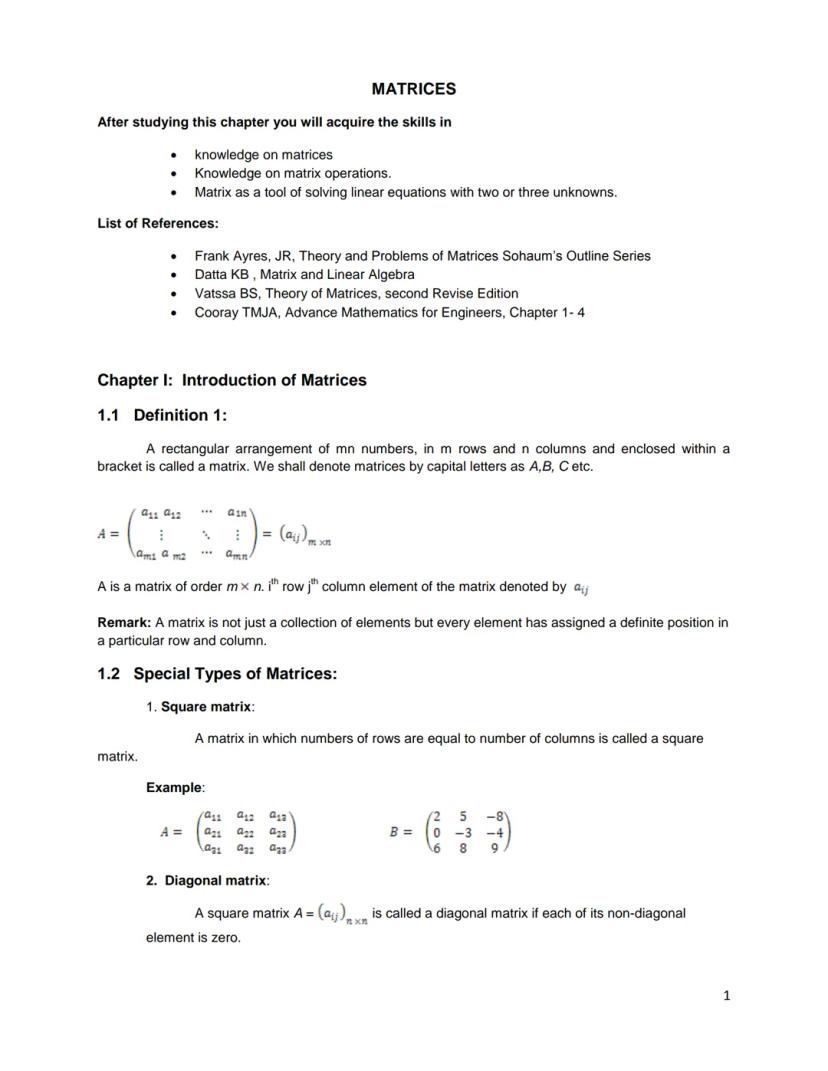
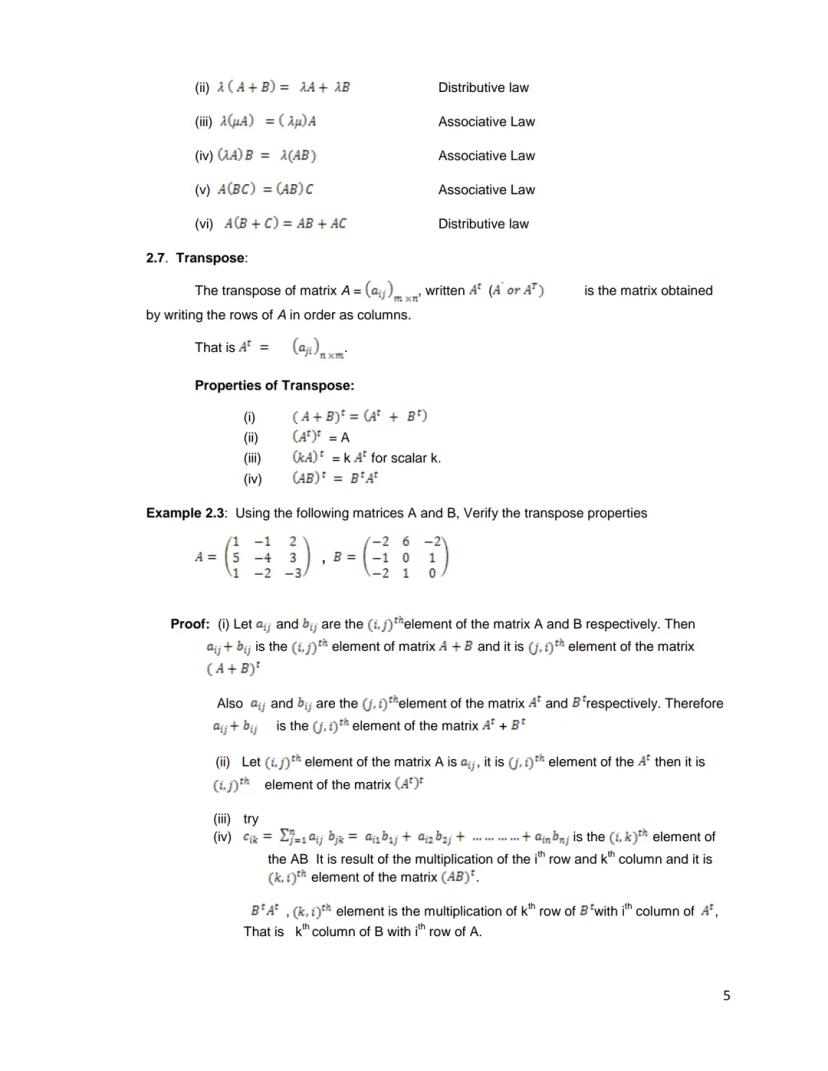
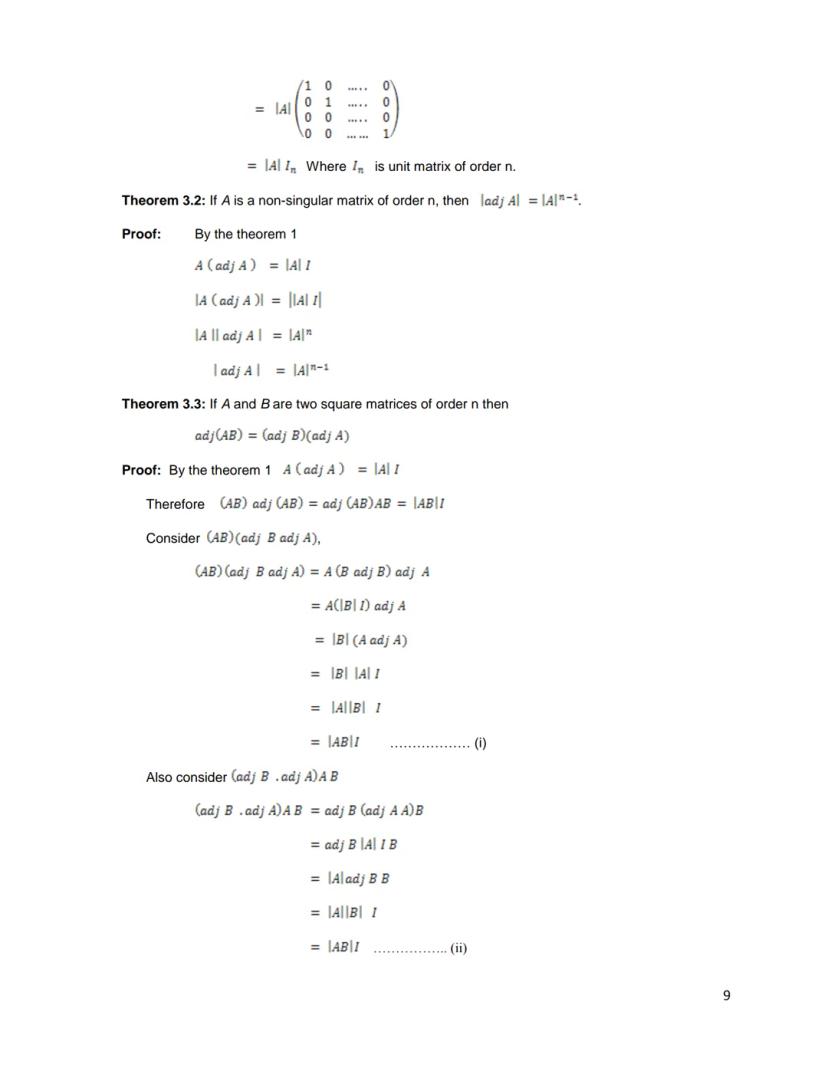
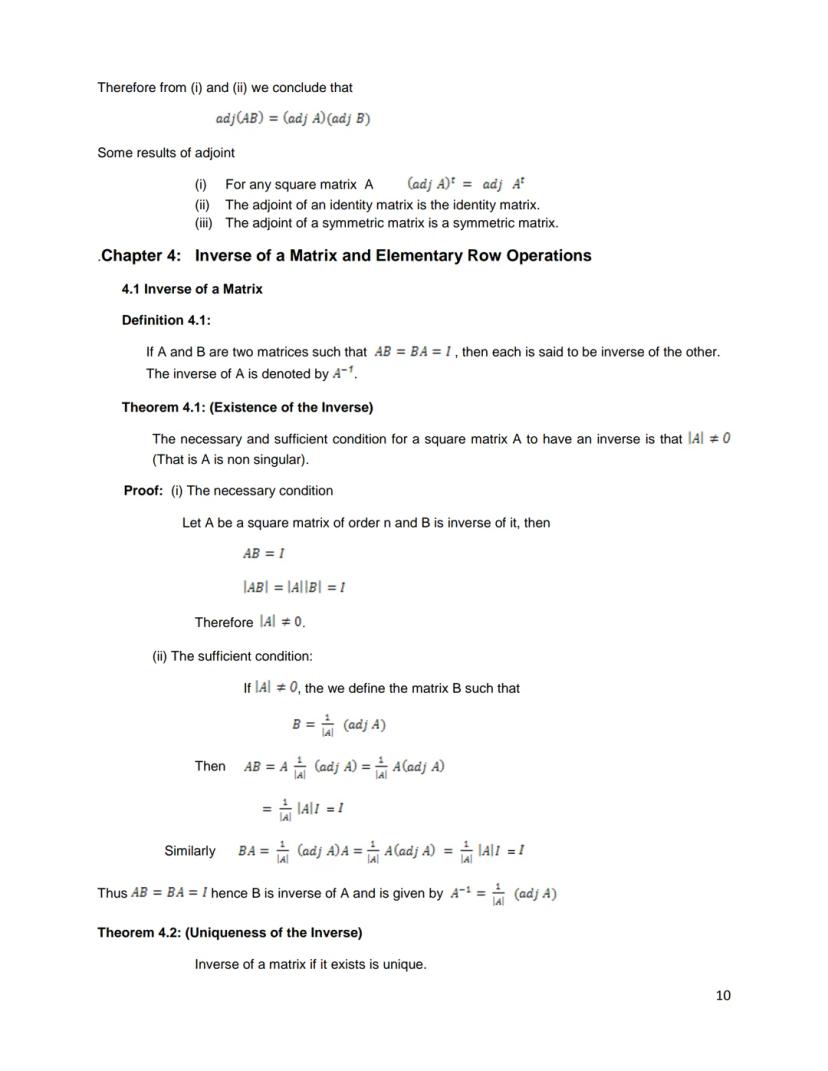
A matrix is a rectangular arrangement of numbers organized in rows and columns within brackets. When you see a matrix like , you're looking at an matrix with rows and columns.
Each element has a specific position - the element sits in the row and column. Remember that a matrix isn't just a random collection of numbers; the position of each element matters!
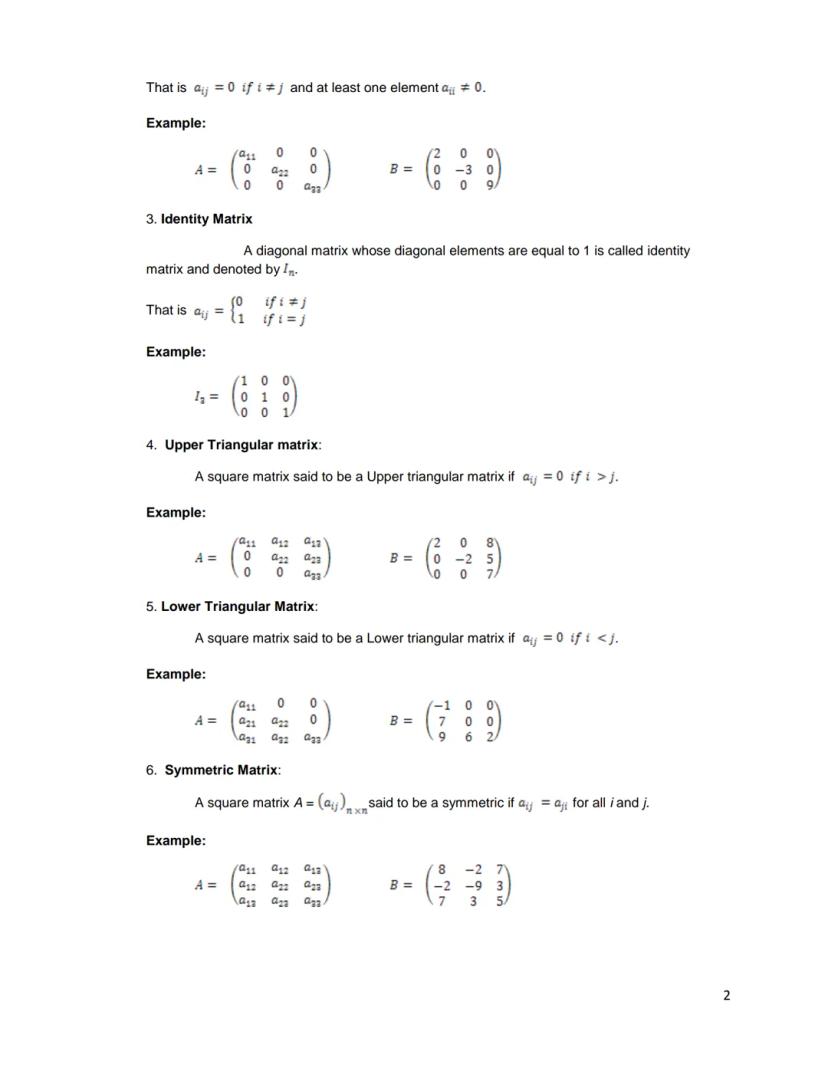
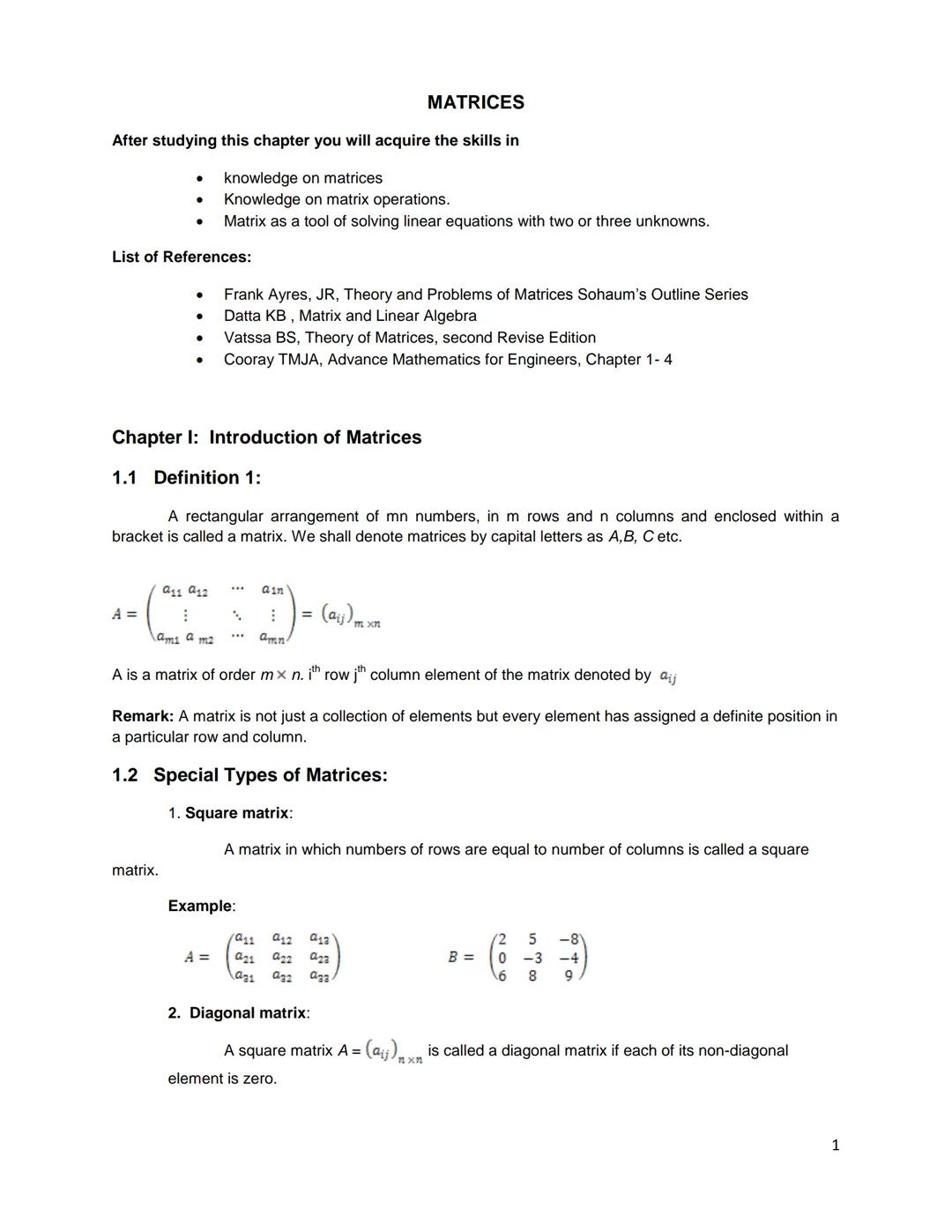
Several special types of matrices appear frequently in mathematics:
Remember This! Each matrix type has unique properties that make them valuable for solving different kinds of problems. Understanding these special types will help you recognize patterns and simplify complex matrix operations.
Matrices with specific structures like zero matrices, row vectors, and column vectors are also essential building blocks for more complex matrix operations.
Matrices follow specific rules when you perform operations on them. Two matrices are considered equal only when they have the same order and all corresponding elements are equal.
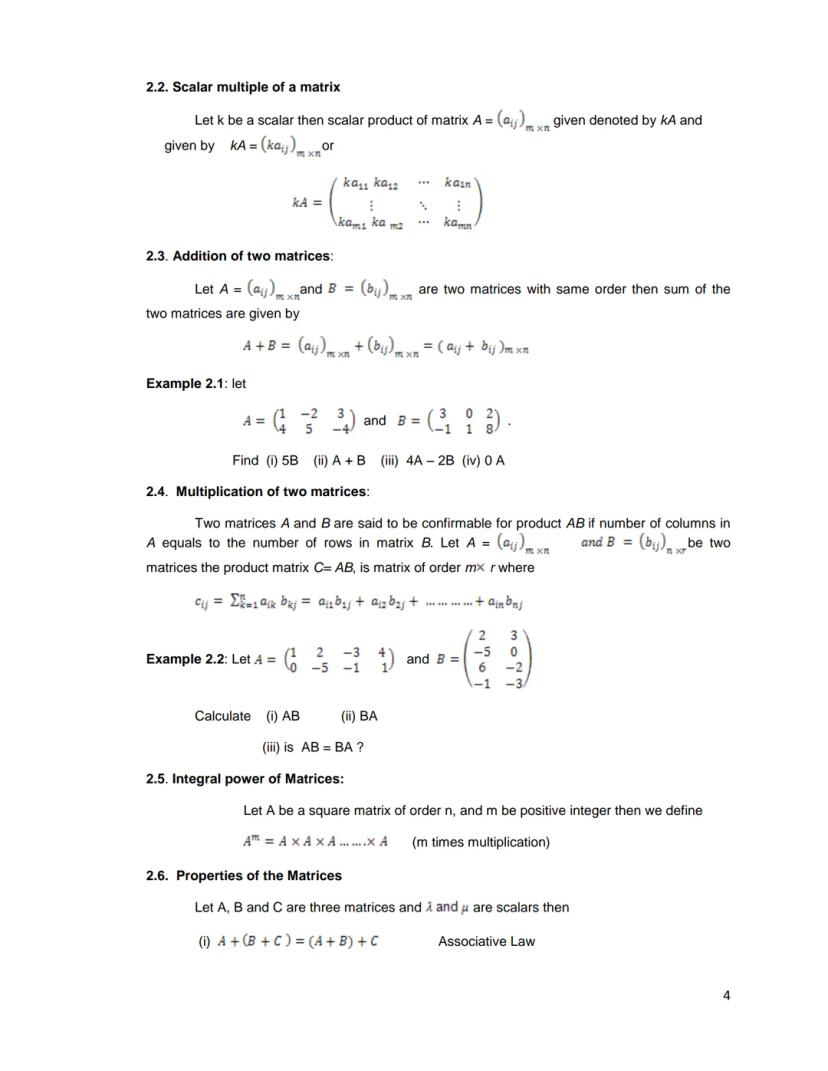
When multiplying a matrix by a scalar (ordinary number), you multiply every element in the matrix by that scalar:
Adding matrices is straightforward - you add the corresponding elements, but only when the matrices have the same order: $A + B = {m \times n} + (b{ij}){m \times n} = (a{ij} + b_{ij})_{m \times n}$
Matrix multiplication is more complex. For matrices of order $m \times n$ and of order $n \times r$, the product has order . Each element in the product matrix comes from multiplying the row of by the column of :
Pro Tip: Unlike regular numbers, matrix multiplication isn't commutative - in general, ! This is a crucial difference from the arithmetic you're used to.
For square matrices, you can calculate powers by repeated multiplication: (m times).
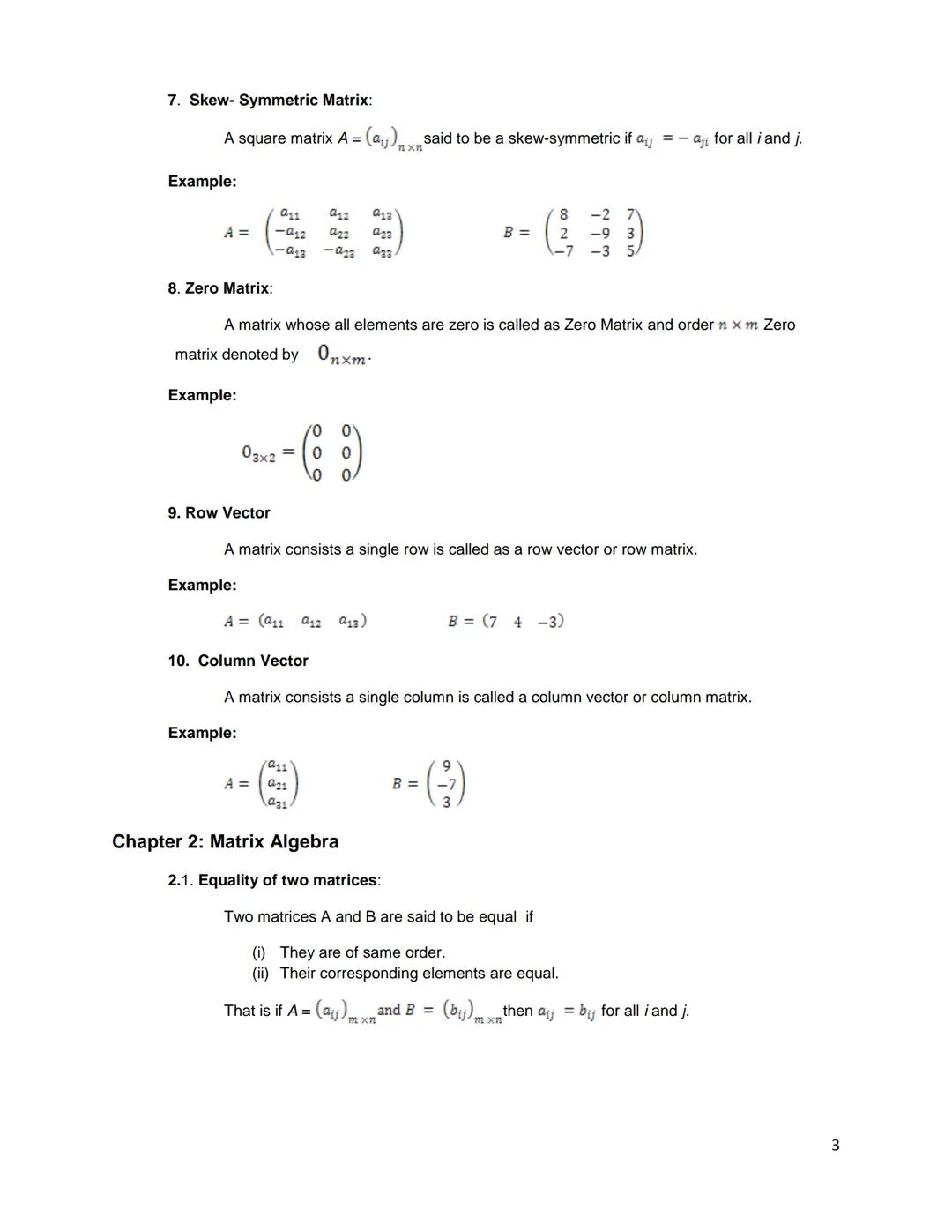
Understanding matrix types helps you predict how they'll behave in various operations. Here are some key special matrices:
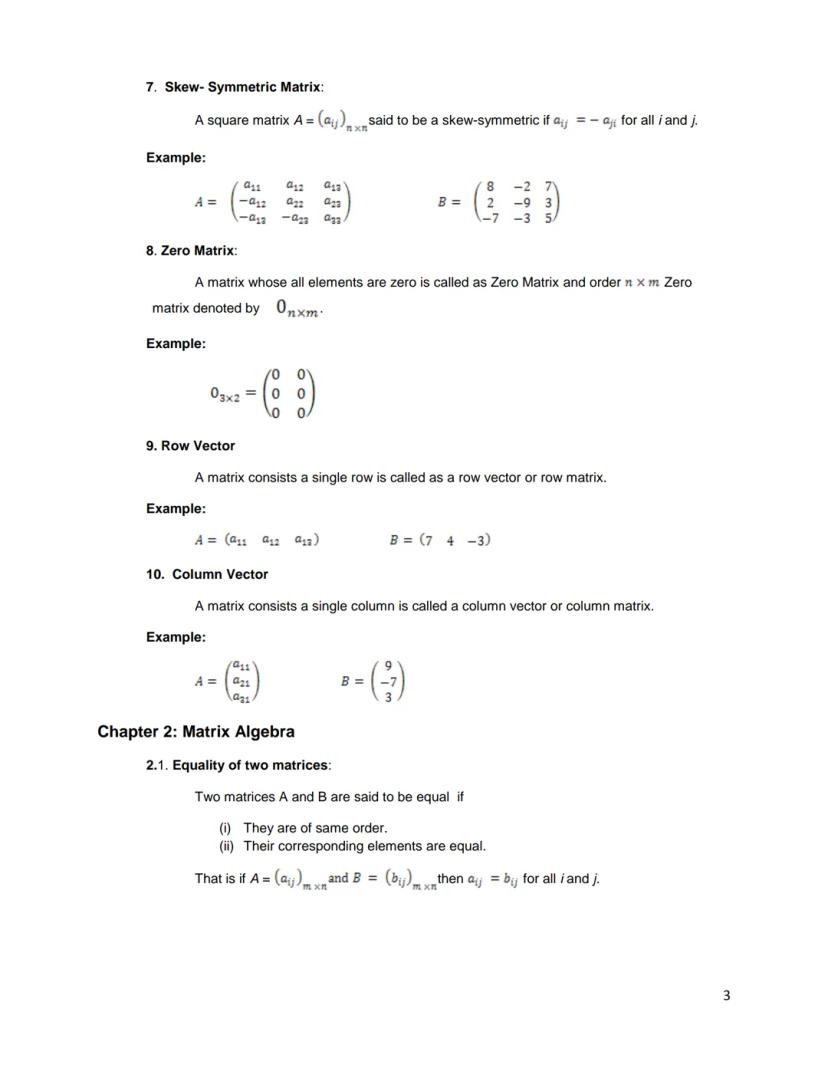
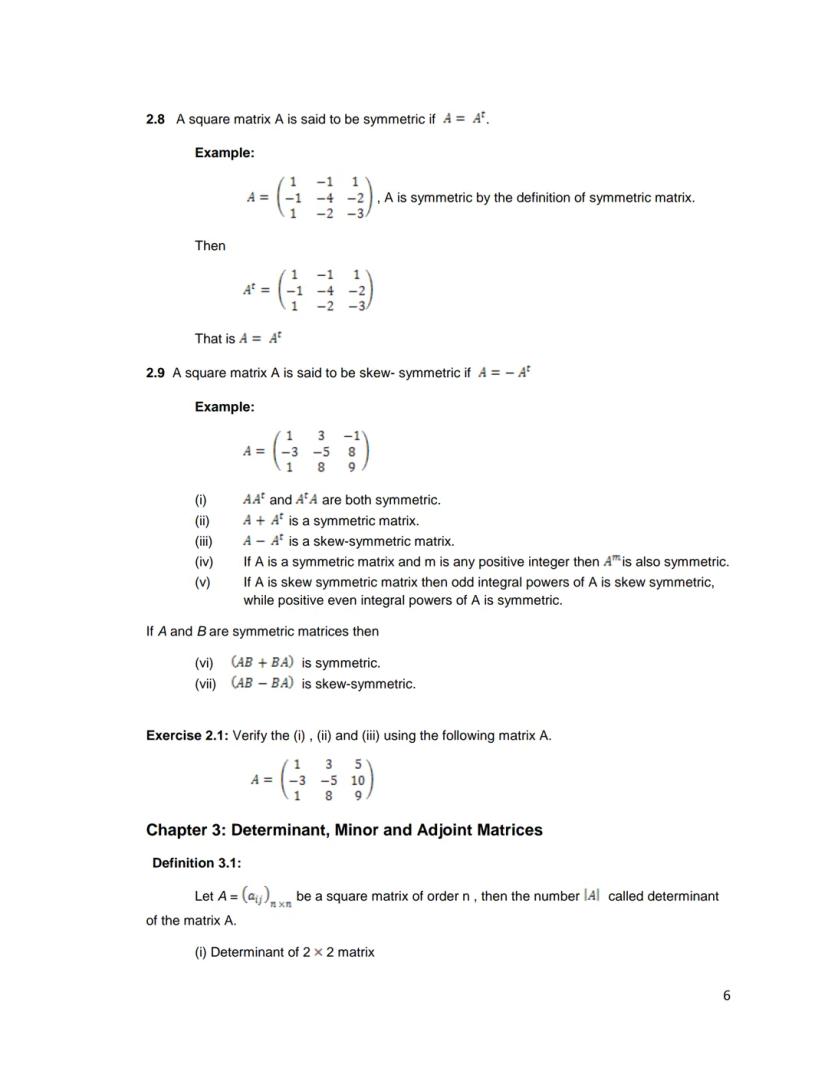
Skew-Symmetric Matrices have the property that for all and . This means each element across the diagonal is the negative of its counterpart. For example:
Zero Matrices contain only zero elements. They're the "zero" of matrix addition, as adding a zero matrix to any other matrix leaves the original matrix unchanged.
Row and Column Vectors are single-row or single-column matrices that represent points or directions in space.
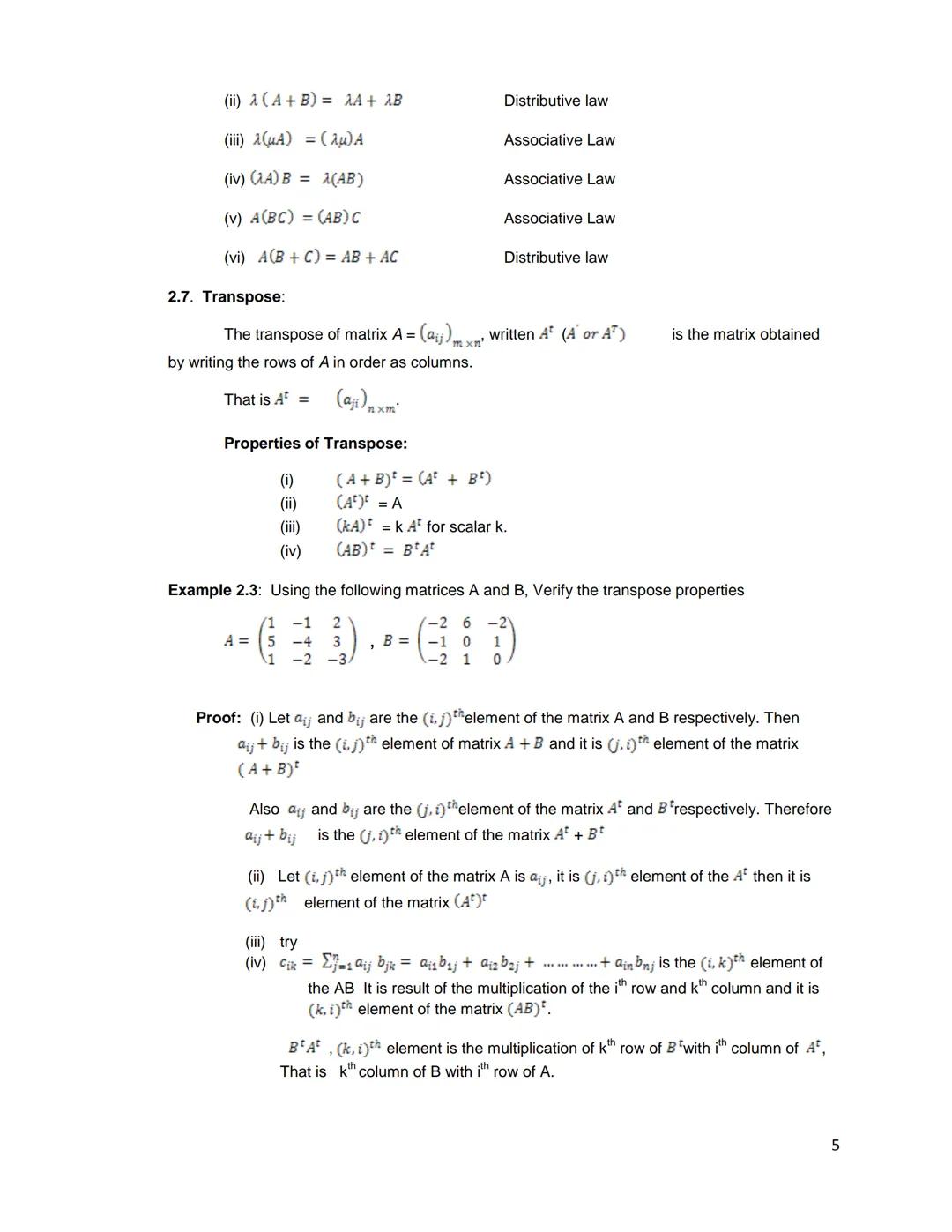
Matrix Transpose is a fundamental operation where rows and columns are exchanged. If $A = {m \times n}A^T = (a{ji})_{n \times m}$.
The transpose operation follows these important properties:
This is fascinating! When you transpose a product of matrices, not only do you transpose each matrix, but you also reverse their order. This property is extremely useful in many matrix applications.
Understanding these properties helps simplify complex matrix expressions and is essential for advanced topics like linear transformations.
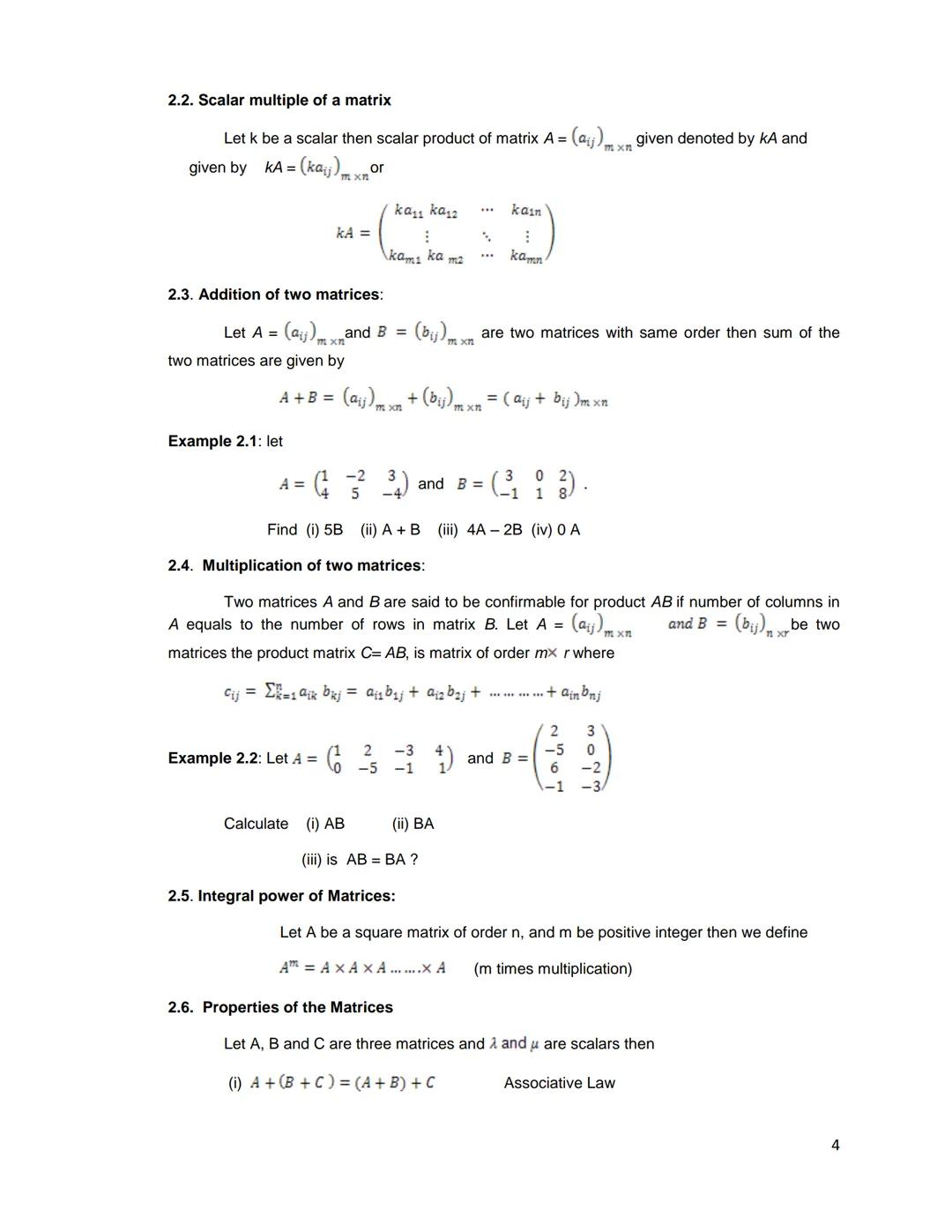
Matrices exhibit fascinating properties when we explore their symmetry. A matrix is symmetric when it equals its transpose $A = A^T$, meaning it's mirrored across its main diagonal.
Working with matrices requires understanding several key operations:
Scalar Multiplication extends your basic arithmetic knowledge to matrices:
Matrix Addition combines corresponding elements: $A + B = {m \times n} + (b{ij}){m \times n} = (a{ij} + b_{ij})_{m \times n}$
Matrix Multiplication requires matching inner dimensions and follows the rule:
Let's see these operations in action with an example: Given and We can find , , and
The product of matrices and always yields symmetric matrices, while always produces a skew-symmetric matrix.
Remember: Matrix operations don't always behave like regular number operations. Matrix multiplication isn't commutative, and you can only add matrices of the same dimensions!
These properties provide powerful tools for solving systems of equations and analyzing transformations in physics and engineering.
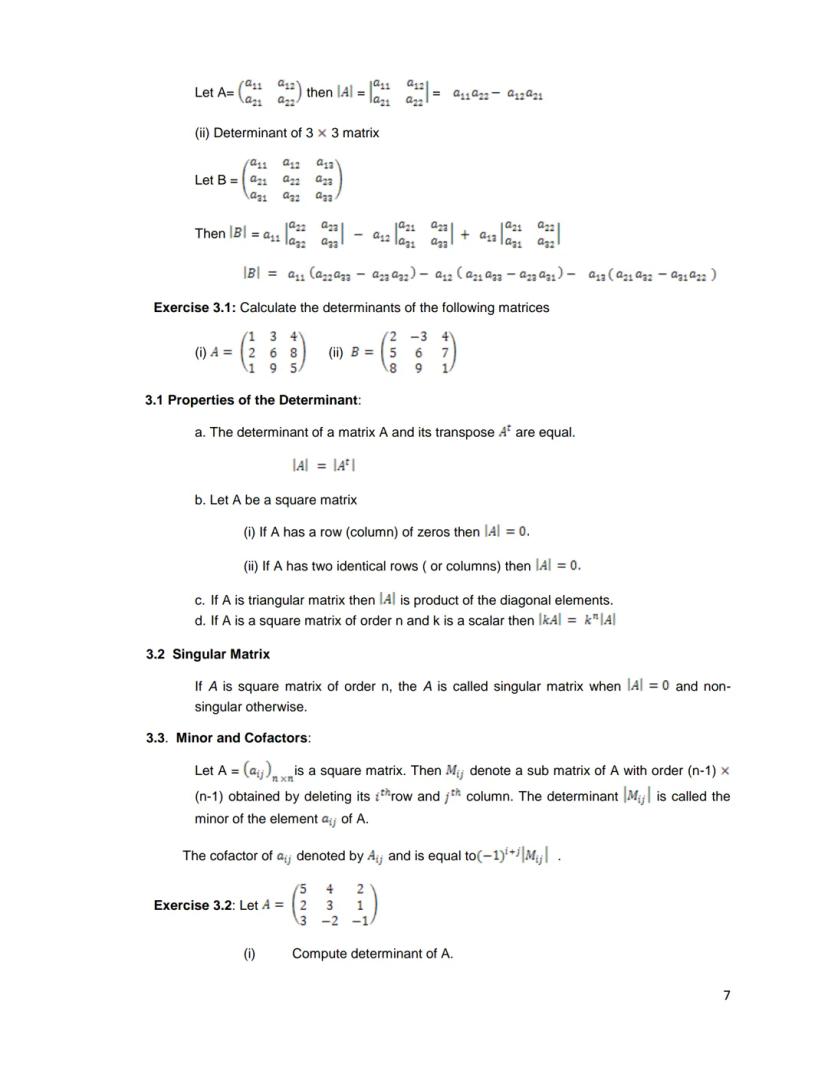
The determinant is a special number calculated from a square matrix that tells you important information about that matrix. It's like a matrix's fingerprint and helps determine whether a matrix has an inverse.
For a matrix , the determinant is:
For a matrix, calculating the determinant becomes more complex but follows a pattern:
Determinants follow several key properties:
A matrix is called singular when its determinant is zero, and non-singular otherwise. This property is crucial because only non-singular matrices have inverses.
Quick Insight: The determinant of a matrix tells you whether a system of linear equations has a unique solution. If the determinant is zero, the system either has no solution or infinitely many solutions!
The properties of determinants provide powerful tools for analyzing matrices and solving complex mathematical problems efficiently.
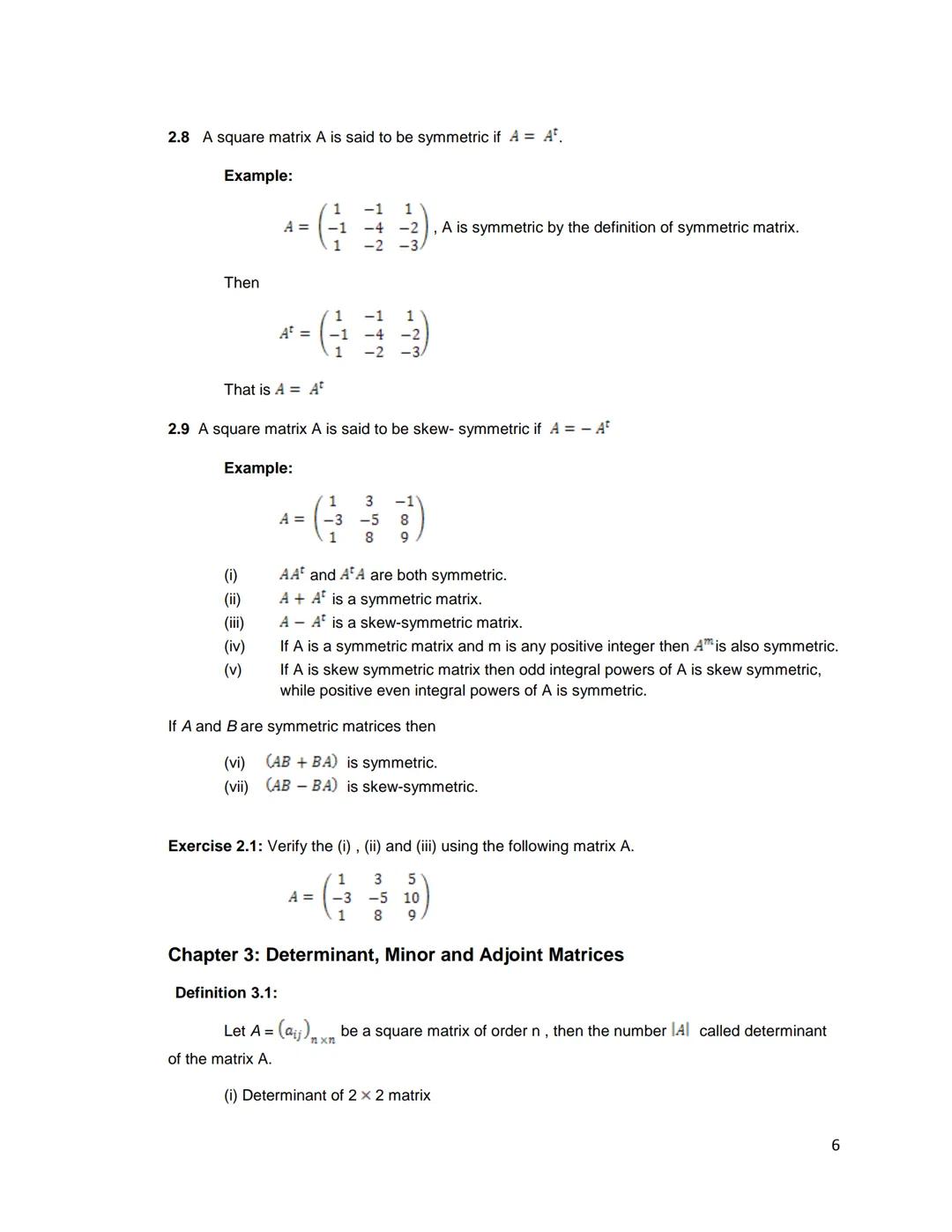
When working with matrices, understanding properties of symmetric and skew-symmetric matrices expands your analytical toolkit. A matrix is symmetric if , meaning it's mirrored across its main diagonal.
For example, is symmetric because .
A matrix is skew-symmetric if , which means each element is the negative of its counterpart across the diagonal.
Several important relationships emerge from these properties:
When working with symmetric matrices, you can derive these useful properties:
Application Insight: Symmetric matrices appear frequently in physics to represent physical quantities that don't depend on direction, like stress tensors and moments of inertia. Understanding symmetry properties helps simplify complex calculations in engineering and physics!
These properties aren't just mathematical curiosities—they're powerful tools for solving real-world problems in fields ranging from engineering to economics.
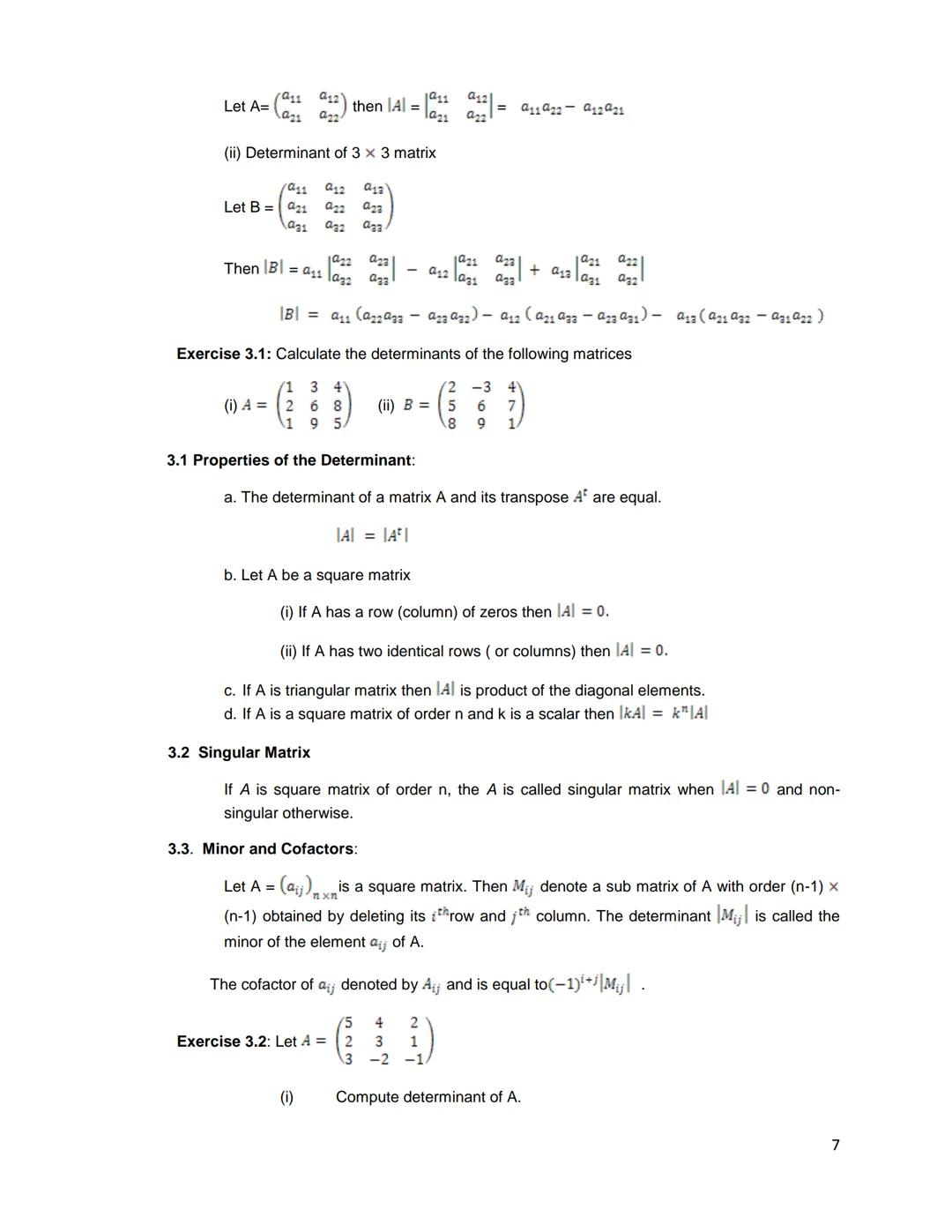
Determinants unlock powerful matrix techniques. For a matrix, you can calculate the determinant using cofactor expansion:
A minor of a matrix element , denoted by , is the determinant of the submatrix formed by removing the row and column.
The cofactor of is defined as . The cofactor matrix contains all the cofactors in their respective positions.
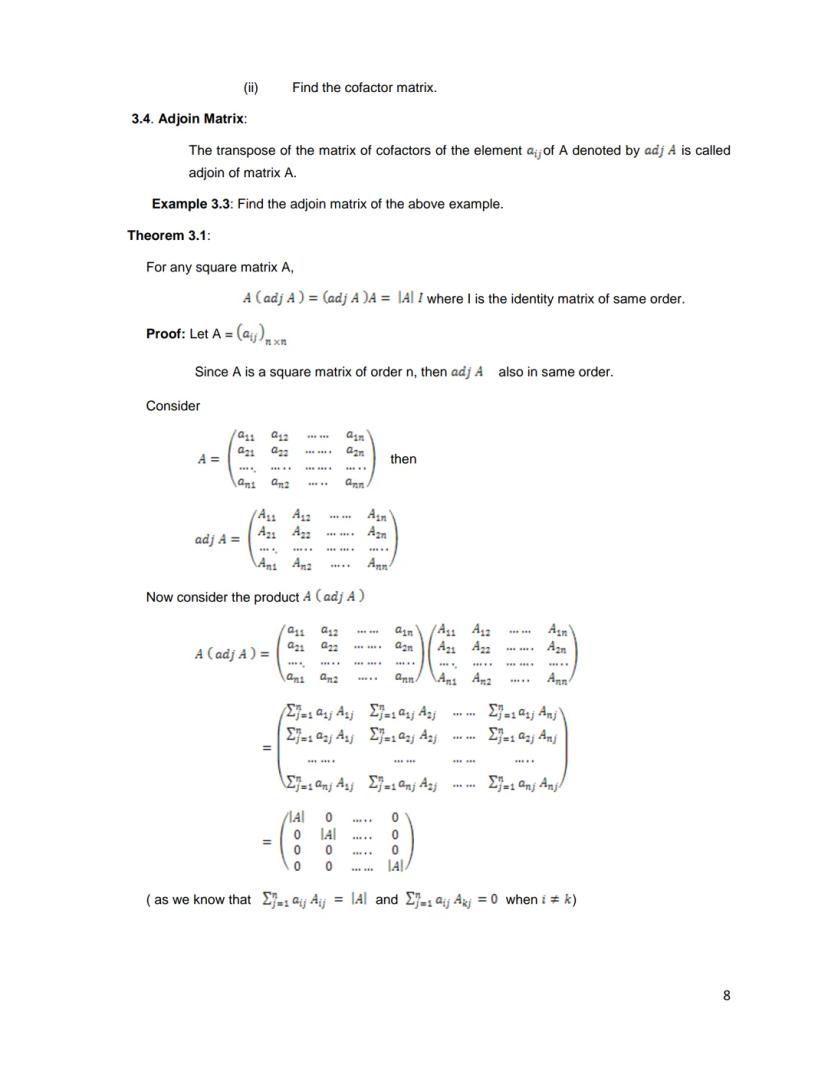
The adjoint matrix (adj A) is the transpose of the cofactor matrix. For example, if you have a matrix , you would:
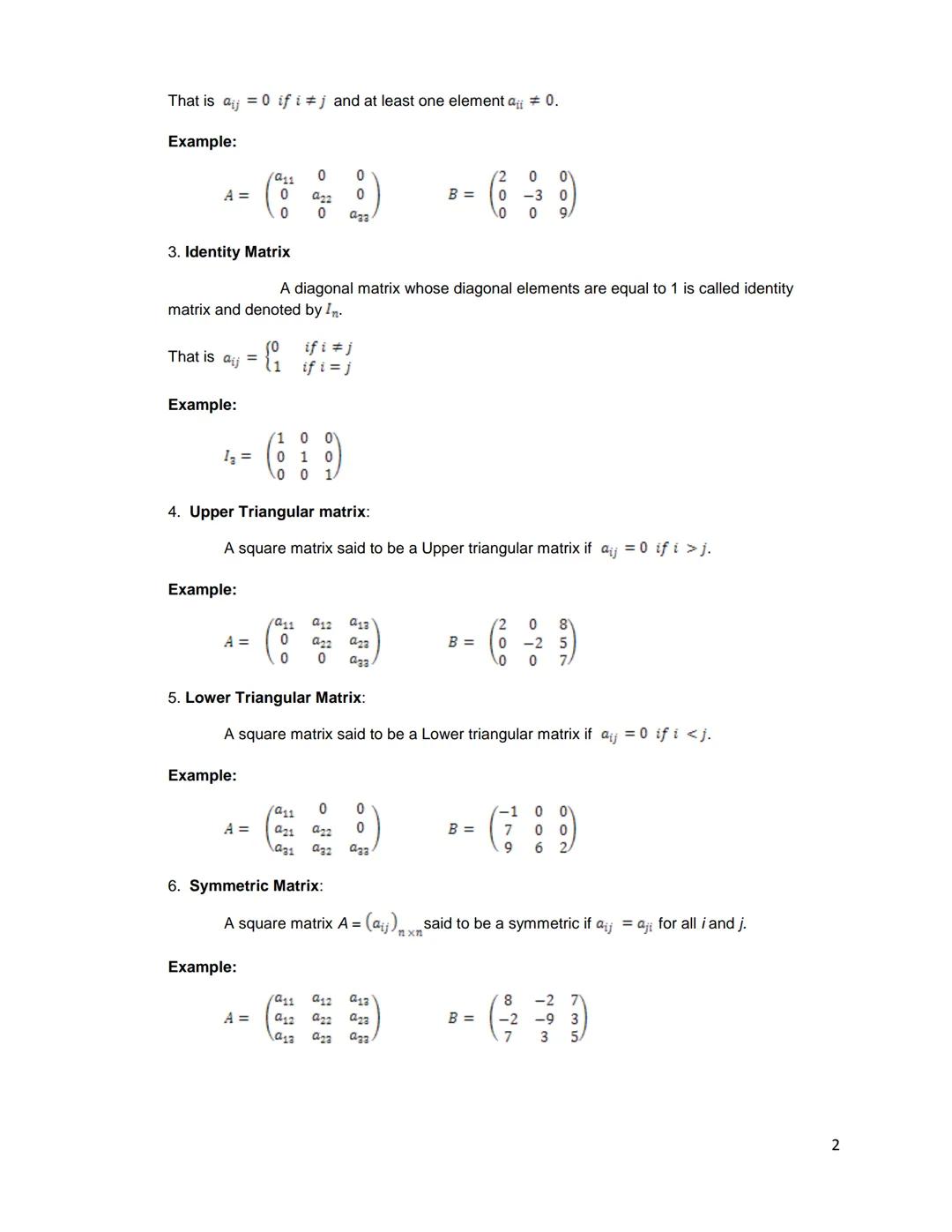
A key theorem states that for any square matrix :
This relationship is fundamental for finding matrix inverses and solving linear systems. Other important properties include:
Why This Matters: The adjoint matrix gives us a way to find the inverse of a matrix without using row operations. This is particularly useful when working with symbolic matrices where numerical calculations would be difficult.
These concepts form the foundation for solving complex systems of equations and understanding linear transformations in advanced mathematics.
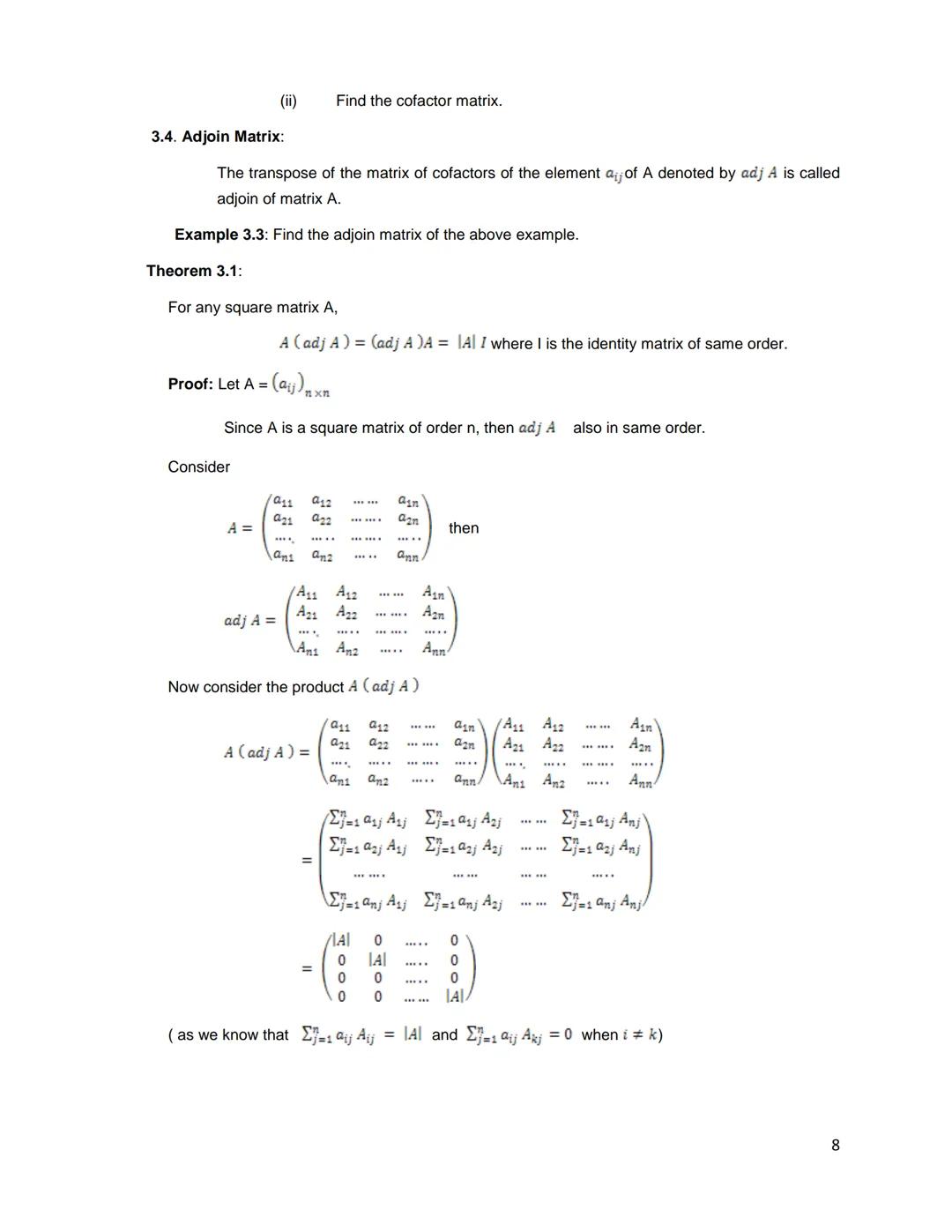
The adjoint matrix is a powerful tool in matrix algebra. For a square matrix , its adjoint (adj A) is the transpose of its cofactor matrix. This relationship is crucial because:
Where is the identity matrix of the same order. This equation reveals the deep connection between a matrix, its determinant, and its adjoint.
If we know the adjoint of a matrix , we can calculate other important properties:
For instance, with a 3×3 matrix, you would find:
Here's an important theorem: For matrices and , adj($AB$) = (adj $B$)(adj $A$). Notice the reversal of order, which connects to the pattern we saw with transposes.
Insight: The adjoint matrix gives us a formula-based approach to finding the inverse of a matrix. This is particularly valuable when working with symbolic matrices where numerical methods might be difficult to apply.
Understanding adjoints creates a foundation for finding matrix inverses, which we'll explore next.
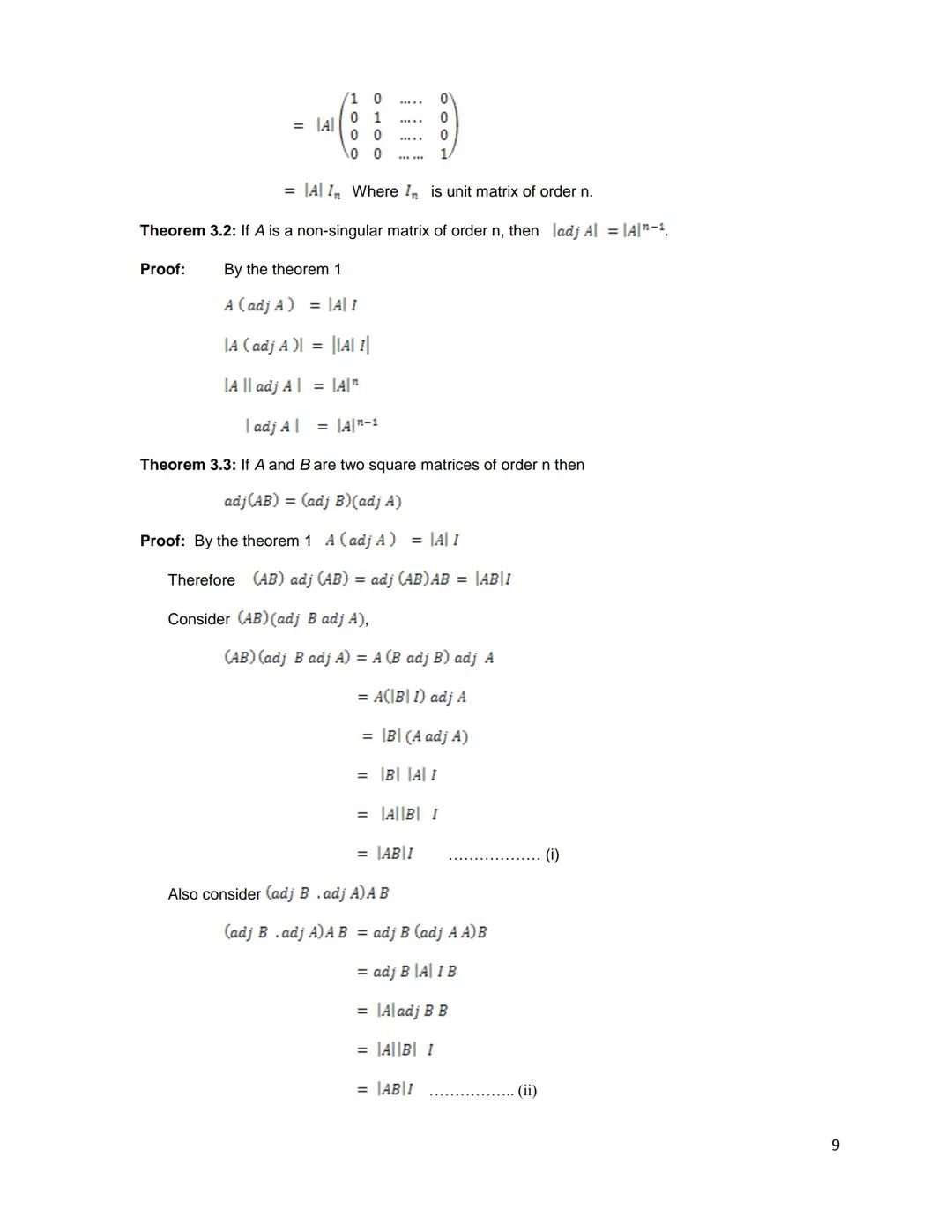
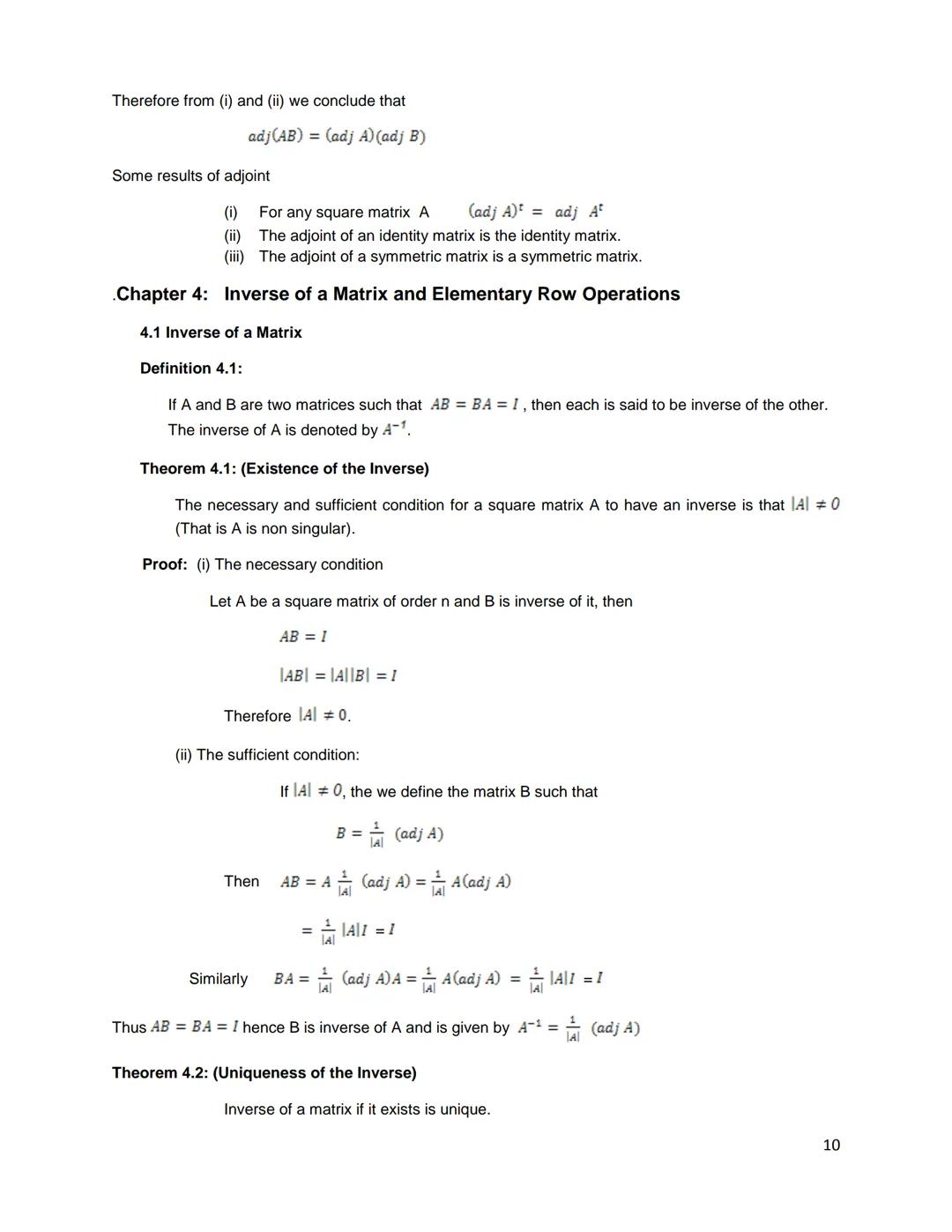
The inverse of a matrix is fundamental in solving matrix equations. A matrix is the inverse of matrix if , where is the identity matrix. We denote the inverse as .
Not all matrices have inverses! For a square matrix to have an inverse, it must be non-singular, meaning . When a matrix has an inverse, you can calculate it using:
This formula connects the concepts of determinants and adjoints we've been studying. Let's examine some key properties of inverses:
These properties help simplify complex matrix calculations. For example, to find the inverse of a product of matrices, you can find the inverses of individual matrices and multiply them in reverse order.
Application Note: Matrix inverses are essential in engineering and physics. When you solve systems like , the solution is (when $A$ is invertible). This appears in everything from circuit analysis to structural engineering!
Elementary transformations (row operations) offer an alternative method for finding matrix inverses, which we'll explore next.
Elementary transformations are powerful tools for manipulating matrices. There are three types of row operations:
Similar operations can be performed on columns. These transformations are used to simplify matrices and solve systems of equations.
Two matrices are considered equivalent if one can be transformed into the other through a sequence of elementary transformations. This is denoted by .
The rank of a matrix is a fundamental property that tells us the maximum number of linearly independent rows or columns. Formally, a matrix has rank if:
An echelon matrix has a special form where the number of leading zeros in each row increases as you move down the matrix. The rank of a matrix in echelon form equals the number of non-zero rows.
Why This Matters: The rank of a matrix determines whether a system of linear equations has solutions. If the coefficient matrix and augmented matrix have the same rank, the system has at least one solution!
Row reduction to echelon form is a systematic process for analyzing matrices and solving linear systems efficiently. This technique appears throughout engineering and data science for solving complex problems.
Our AI companion is specifically built for the needs of students. Based on the millions of content pieces we have on the platform we can provide truly meaningful and relevant answers to students. But its not only about answers, the companion is even more about guiding students through their daily learning challenges, with personalised study plans, quizzes or content pieces in the chat and 100% personalisation based on the students skills and developments.
You can download the app in the Google Play Store and in the Apple App Store.
That's right! Enjoy free access to study content, connect with fellow students, and get instant help – all at your fingertips.
App Store
Google Play
The app is very easy to use and well designed. I have found everything I was looking for so far and have been able to learn a lot from the presentations! I will definitely use the app for a class assignment! And of course it also helps a lot as an inspiration.
Stefan S
iOS user
This app is really great. There are so many study notes and help [...]. My problem subject is French, for example, and the app has so many options for help. Thanks to this app, I have improved my French. I would recommend it to anyone.
Samantha Klich
Android user
Wow, I am really amazed. I just tried the app because I've seen it advertised many times and was absolutely stunned. This app is THE HELP you want for school and above all, it offers so many things, such as workouts and fact sheets, which have been VERY helpful to me personally.
Anna
iOS user
I think it’s very much worth it and you’ll end up using it a lot once you get the hang of it and even after looking at others notes you can still ask your Artificial intelligence buddy the question and ask to simplify it if you still don’t get it!!! In the end I think it’s worth it 😊👍 ⚠️Also DID I MENTION ITS FREEE YOU DON’T HAVE TO PAY FOR ANYTHING AND STILL GET YOUR GRADES IN PERFECTLY❗️❗️⚠️
Thomas R
iOS user
Knowunity is the BEST app I’ve used in a minute. This is not an ai review or anything this is genuinely coming from a 7th grade student (I know 2011 im young) but dude this app is a 10/10 i have maintained a 3.8 gpa and have plenty of time for gaming. I love it and my mom is just happy I got good grades
Brad T
Android user
Not only did it help me find the answer but it also showed me alternative ways to solve it. I was horrible in math and science but now I have an a in both subjects. Thanks for the help🤍🤍
David K
iOS user
The app's just great! All I have to do is enter the topic in the search bar and I get the response real fast. I don't have to watch 10 YouTube videos to understand something, so I'm saving my time. Highly recommended!
Sudenaz Ocak
Android user
In school I was really bad at maths but thanks to the app, I am doing better now. I am so grateful that you made the app.
Greenlight Bonnie
Android user
I found this app a couple years ago and it has only gotten better since then. I really love it because it can help with written questions and photo questions. Also, it can find study guides that other people have made as well as flashcard sets and practice tests. The free version is also amazing for students who might not be able to afford it. Would 100% recommend
Aubrey
iOS user
Best app if you're in Highschool or Junior high. I have been using this app for 2 school years and it's the best, it's good if you don't have anyone to help you with school work.😋🩷🎀
Marco B
iOS user
THE QUIZES AND FLASHCARDS ARE SO USEFUL AND I LOVE THE SCHOOLGPT. IT ALSO IS LITREALLY LIKE CHATGPT BUT SMARTER!! HELPED ME WITH MY MASCARA PROBLEMS TOO!! AS WELL AS MY REAL SUBJECTS ! DUHHH 😍😁😲🤑💗✨🎀😮
Elisha
iOS user
This app is phenomenal down to the correct info and the various topics you can study! I greatly recommend it for people who struggle with procrastination and those who need homework help. It has been perfectly accurate for world 1 history as far as I’ve seen! Geometry too!
Paul T
iOS user
The app is very easy to use and well designed. I have found everything I was looking for so far and have been able to learn a lot from the presentations! I will definitely use the app for a class assignment! And of course it also helps a lot as an inspiration.
Stefan S
iOS user
This app is really great. There are so many study notes and help [...]. My problem subject is French, for example, and the app has so many options for help. Thanks to this app, I have improved my French. I would recommend it to anyone.
Samantha Klich
Android user
Wow, I am really amazed. I just tried the app because I've seen it advertised many times and was absolutely stunned. This app is THE HELP you want for school and above all, it offers so many things, such as workouts and fact sheets, which have been VERY helpful to me personally.
Anna
iOS user
I think it’s very much worth it and you’ll end up using it a lot once you get the hang of it and even after looking at others notes you can still ask your Artificial intelligence buddy the question and ask to simplify it if you still don’t get it!!! In the end I think it’s worth it 😊👍 ⚠️Also DID I MENTION ITS FREEE YOU DON’T HAVE TO PAY FOR ANYTHING AND STILL GET YOUR GRADES IN PERFECTLY❗️❗️⚠️
Thomas R
iOS user
Knowunity is the BEST app I’ve used in a minute. This is not an ai review or anything this is genuinely coming from a 7th grade student (I know 2011 im young) but dude this app is a 10/10 i have maintained a 3.8 gpa and have plenty of time for gaming. I love it and my mom is just happy I got good grades
Brad T
Android user
Not only did it help me find the answer but it also showed me alternative ways to solve it. I was horrible in math and science but now I have an a in both subjects. Thanks for the help🤍🤍
David K
iOS user
The app's just great! All I have to do is enter the topic in the search bar and I get the response real fast. I don't have to watch 10 YouTube videos to understand something, so I'm saving my time. Highly recommended!
Sudenaz Ocak
Android user
In school I was really bad at maths but thanks to the app, I am doing better now. I am so grateful that you made the app.
Greenlight Bonnie
Android user
I found this app a couple years ago and it has only gotten better since then. I really love it because it can help with written questions and photo questions. Also, it can find study guides that other people have made as well as flashcard sets and practice tests. The free version is also amazing for students who might not be able to afford it. Would 100% recommend
Aubrey
iOS user
Best app if you're in Highschool or Junior high. I have been using this app for 2 school years and it's the best, it's good if you don't have anyone to help you with school work.😋🩷🎀
Marco B
iOS user
THE QUIZES AND FLASHCARDS ARE SO USEFUL AND I LOVE THE SCHOOLGPT. IT ALSO IS LITREALLY LIKE CHATGPT BUT SMARTER!! HELPED ME WITH MY MASCARA PROBLEMS TOO!! AS WELL AS MY REAL SUBJECTS ! DUHHH 😍😁😲🤑💗✨🎀😮
Elisha
iOS user
This app is phenomenal down to the correct info and the various topics you can study! I greatly recommend it for people who struggle with procrastination and those who need homework help. It has been perfectly accurate for world 1 history as far as I’ve seen! Geometry too!
Paul T
iOS user
Syethaba
@syethaba_edo8d
Matrices are powerful mathematical tools used to organize data and solve complex problems. This introduction to matrix mathematics covers essential concepts from basic definitions to advanced applications, providing a foundation for understanding linear algebra and its real-world applications in science... Show more
Access to all documents
Improve your grades
Join milions of students
By signing up you accept Terms of Service and Privacy Policy
A matrix is a rectangular arrangement of numbers organized in rows and columns within brackets. When you see a matrix like , you're looking at an matrix with rows and columns.
Each element has a specific position - the element sits in the row and column. Remember that a matrix isn't just a random collection of numbers; the position of each element matters!
Several special types of matrices appear frequently in mathematics:
Remember This! Each matrix type has unique properties that make them valuable for solving different kinds of problems. Understanding these special types will help you recognize patterns and simplify complex matrix operations.
Matrices with specific structures like zero matrices, row vectors, and column vectors are also essential building blocks for more complex matrix operations.
Access to all documents
Improve your grades
Join milions of students
By signing up you accept Terms of Service and Privacy Policy
Matrices follow specific rules when you perform operations on them. Two matrices are considered equal only when they have the same order and all corresponding elements are equal.
When multiplying a matrix by a scalar (ordinary number), you multiply every element in the matrix by that scalar:
Adding matrices is straightforward - you add the corresponding elements, but only when the matrices have the same order: $A + B = {m \times n} + (b{ij}){m \times n} = (a{ij} + b_{ij})_{m \times n}$
Matrix multiplication is more complex. For matrices of order $m \times n$ and of order $n \times r$, the product has order . Each element in the product matrix comes from multiplying the row of by the column of :
Pro Tip: Unlike regular numbers, matrix multiplication isn't commutative - in general, ! This is a crucial difference from the arithmetic you're used to.
For square matrices, you can calculate powers by repeated multiplication: (m times).
Access to all documents
Improve your grades
Join milions of students
By signing up you accept Terms of Service and Privacy Policy
Understanding matrix types helps you predict how they'll behave in various operations. Here are some key special matrices:
Skew-Symmetric Matrices have the property that for all and . This means each element across the diagonal is the negative of its counterpart. For example:
Zero Matrices contain only zero elements. They're the "zero" of matrix addition, as adding a zero matrix to any other matrix leaves the original matrix unchanged.
Row and Column Vectors are single-row or single-column matrices that represent points or directions in space.
Matrix Transpose is a fundamental operation where rows and columns are exchanged. If $A = {m \times n}A^T = (a{ji})_{n \times m}$.
The transpose operation follows these important properties:
This is fascinating! When you transpose a product of matrices, not only do you transpose each matrix, but you also reverse their order. This property is extremely useful in many matrix applications.
Understanding these properties helps simplify complex matrix expressions and is essential for advanced topics like linear transformations.
Access to all documents
Improve your grades
Join milions of students
By signing up you accept Terms of Service and Privacy Policy
Matrices exhibit fascinating properties when we explore their symmetry. A matrix is symmetric when it equals its transpose $A = A^T$, meaning it's mirrored across its main diagonal.
Working with matrices requires understanding several key operations:
Scalar Multiplication extends your basic arithmetic knowledge to matrices:
Matrix Addition combines corresponding elements: $A + B = {m \times n} + (b{ij}){m \times n} = (a{ij} + b_{ij})_{m \times n}$
Matrix Multiplication requires matching inner dimensions and follows the rule:
Let's see these operations in action with an example: Given and We can find , , and
The product of matrices and always yields symmetric matrices, while always produces a skew-symmetric matrix.
Remember: Matrix operations don't always behave like regular number operations. Matrix multiplication isn't commutative, and you can only add matrices of the same dimensions!
These properties provide powerful tools for solving systems of equations and analyzing transformations in physics and engineering.
Access to all documents
Improve your grades
Join milions of students
By signing up you accept Terms of Service and Privacy Policy
The determinant is a special number calculated from a square matrix that tells you important information about that matrix. It's like a matrix's fingerprint and helps determine whether a matrix has an inverse.
For a matrix , the determinant is:
For a matrix, calculating the determinant becomes more complex but follows a pattern:
Determinants follow several key properties:
A matrix is called singular when its determinant is zero, and non-singular otherwise. This property is crucial because only non-singular matrices have inverses.
Quick Insight: The determinant of a matrix tells you whether a system of linear equations has a unique solution. If the determinant is zero, the system either has no solution or infinitely many solutions!
The properties of determinants provide powerful tools for analyzing matrices and solving complex mathematical problems efficiently.
Access to all documents
Improve your grades
Join milions of students
By signing up you accept Terms of Service and Privacy Policy
When working with matrices, understanding properties of symmetric and skew-symmetric matrices expands your analytical toolkit. A matrix is symmetric if , meaning it's mirrored across its main diagonal.
For example, is symmetric because .
A matrix is skew-symmetric if , which means each element is the negative of its counterpart across the diagonal.
Several important relationships emerge from these properties:
When working with symmetric matrices, you can derive these useful properties:
Application Insight: Symmetric matrices appear frequently in physics to represent physical quantities that don't depend on direction, like stress tensors and moments of inertia. Understanding symmetry properties helps simplify complex calculations in engineering and physics!
These properties aren't just mathematical curiosities—they're powerful tools for solving real-world problems in fields ranging from engineering to economics.
Access to all documents
Improve your grades
Join milions of students
By signing up you accept Terms of Service and Privacy Policy
Determinants unlock powerful matrix techniques. For a matrix, you can calculate the determinant using cofactor expansion:
A minor of a matrix element , denoted by , is the determinant of the submatrix formed by removing the row and column.
The cofactor of is defined as . The cofactor matrix contains all the cofactors in their respective positions.
The adjoint matrix (adj A) is the transpose of the cofactor matrix. For example, if you have a matrix , you would:
A key theorem states that for any square matrix :
This relationship is fundamental for finding matrix inverses and solving linear systems. Other important properties include:
Why This Matters: The adjoint matrix gives us a way to find the inverse of a matrix without using row operations. This is particularly useful when working with symbolic matrices where numerical calculations would be difficult.
These concepts form the foundation for solving complex systems of equations and understanding linear transformations in advanced mathematics.
Access to all documents
Improve your grades
Join milions of students
By signing up you accept Terms of Service and Privacy Policy
The adjoint matrix is a powerful tool in matrix algebra. For a square matrix , its adjoint (adj A) is the transpose of its cofactor matrix. This relationship is crucial because:
Where is the identity matrix of the same order. This equation reveals the deep connection between a matrix, its determinant, and its adjoint.
If we know the adjoint of a matrix , we can calculate other important properties:
For instance, with a 3×3 matrix, you would find:
Here's an important theorem: For matrices and , adj($AB$) = (adj $B$)(adj $A$). Notice the reversal of order, which connects to the pattern we saw with transposes.
Insight: The adjoint matrix gives us a formula-based approach to finding the inverse of a matrix. This is particularly valuable when working with symbolic matrices where numerical methods might be difficult to apply.
Understanding adjoints creates a foundation for finding matrix inverses, which we'll explore next.
Access to all documents
Improve your grades
Join milions of students
By signing up you accept Terms of Service and Privacy Policy
The inverse of a matrix is fundamental in solving matrix equations. A matrix is the inverse of matrix if , where is the identity matrix. We denote the inverse as .
Not all matrices have inverses! For a square matrix to have an inverse, it must be non-singular, meaning . When a matrix has an inverse, you can calculate it using:
This formula connects the concepts of determinants and adjoints we've been studying. Let's examine some key properties of inverses:
These properties help simplify complex matrix calculations. For example, to find the inverse of a product of matrices, you can find the inverses of individual matrices and multiply them in reverse order.
Application Note: Matrix inverses are essential in engineering and physics. When you solve systems like , the solution is (when $A$ is invertible). This appears in everything from circuit analysis to structural engineering!
Elementary transformations (row operations) offer an alternative method for finding matrix inverses, which we'll explore next.
Access to all documents
Improve your grades
Join milions of students
By signing up you accept Terms of Service and Privacy Policy
Elementary transformations are powerful tools for manipulating matrices. There are three types of row operations:
Similar operations can be performed on columns. These transformations are used to simplify matrices and solve systems of equations.
Two matrices are considered equivalent if one can be transformed into the other through a sequence of elementary transformations. This is denoted by .
The rank of a matrix is a fundamental property that tells us the maximum number of linearly independent rows or columns. Formally, a matrix has rank if:
An echelon matrix has a special form where the number of leading zeros in each row increases as you move down the matrix. The rank of a matrix in echelon form equals the number of non-zero rows.
Why This Matters: The rank of a matrix determines whether a system of linear equations has solutions. If the coefficient matrix and augmented matrix have the same rank, the system has at least one solution!
Row reduction to echelon form is a systematic process for analyzing matrices and solving linear systems efficiently. This technique appears throughout engineering and data science for solving complex problems.
Our AI companion is specifically built for the needs of students. Based on the millions of content pieces we have on the platform we can provide truly meaningful and relevant answers to students. But its not only about answers, the companion is even more about guiding students through their daily learning challenges, with personalised study plans, quizzes or content pieces in the chat and 100% personalisation based on the students skills and developments.
You can download the app in the Google Play Store and in the Apple App Store.
That's right! Enjoy free access to study content, connect with fellow students, and get instant help – all at your fingertips.
3
Smart Tools NEW
Transform this note into: ✓ 50+ Practice Questions ✓ Interactive Flashcards ✓ Full Mock Exam ✓ Essay Outlines
App Store
Google Play
The app is very easy to use and well designed. I have found everything I was looking for so far and have been able to learn a lot from the presentations! I will definitely use the app for a class assignment! And of course it also helps a lot as an inspiration.
Stefan S
iOS user
This app is really great. There are so many study notes and help [...]. My problem subject is French, for example, and the app has so many options for help. Thanks to this app, I have improved my French. I would recommend it to anyone.
Samantha Klich
Android user
Wow, I am really amazed. I just tried the app because I've seen it advertised many times and was absolutely stunned. This app is THE HELP you want for school and above all, it offers so many things, such as workouts and fact sheets, which have been VERY helpful to me personally.
Anna
iOS user
I think it’s very much worth it and you’ll end up using it a lot once you get the hang of it and even after looking at others notes you can still ask your Artificial intelligence buddy the question and ask to simplify it if you still don’t get it!!! In the end I think it’s worth it 😊👍 ⚠️Also DID I MENTION ITS FREEE YOU DON’T HAVE TO PAY FOR ANYTHING AND STILL GET YOUR GRADES IN PERFECTLY❗️❗️⚠️
Thomas R
iOS user
Knowunity is the BEST app I’ve used in a minute. This is not an ai review or anything this is genuinely coming from a 7th grade student (I know 2011 im young) but dude this app is a 10/10 i have maintained a 3.8 gpa and have plenty of time for gaming. I love it and my mom is just happy I got good grades
Brad T
Android user
Not only did it help me find the answer but it also showed me alternative ways to solve it. I was horrible in math and science but now I have an a in both subjects. Thanks for the help🤍🤍
David K
iOS user
The app's just great! All I have to do is enter the topic in the search bar and I get the response real fast. I don't have to watch 10 YouTube videos to understand something, so I'm saving my time. Highly recommended!
Sudenaz Ocak
Android user
In school I was really bad at maths but thanks to the app, I am doing better now. I am so grateful that you made the app.
Greenlight Bonnie
Android user
I found this app a couple years ago and it has only gotten better since then. I really love it because it can help with written questions and photo questions. Also, it can find study guides that other people have made as well as flashcard sets and practice tests. The free version is also amazing for students who might not be able to afford it. Would 100% recommend
Aubrey
iOS user
Best app if you're in Highschool or Junior high. I have been using this app for 2 school years and it's the best, it's good if you don't have anyone to help you with school work.😋🩷🎀
Marco B
iOS user
THE QUIZES AND FLASHCARDS ARE SO USEFUL AND I LOVE THE SCHOOLGPT. IT ALSO IS LITREALLY LIKE CHATGPT BUT SMARTER!! HELPED ME WITH MY MASCARA PROBLEMS TOO!! AS WELL AS MY REAL SUBJECTS ! DUHHH 😍😁😲🤑💗✨🎀😮
Elisha
iOS user
This app is phenomenal down to the correct info and the various topics you can study! I greatly recommend it for people who struggle with procrastination and those who need homework help. It has been perfectly accurate for world 1 history as far as I’ve seen! Geometry too!
Paul T
iOS user
The app is very easy to use and well designed. I have found everything I was looking for so far and have been able to learn a lot from the presentations! I will definitely use the app for a class assignment! And of course it also helps a lot as an inspiration.
Stefan S
iOS user
This app is really great. There are so many study notes and help [...]. My problem subject is French, for example, and the app has so many options for help. Thanks to this app, I have improved my French. I would recommend it to anyone.
Samantha Klich
Android user
Wow, I am really amazed. I just tried the app because I've seen it advertised many times and was absolutely stunned. This app is THE HELP you want for school and above all, it offers so many things, such as workouts and fact sheets, which have been VERY helpful to me personally.
Anna
iOS user
I think it’s very much worth it and you’ll end up using it a lot once you get the hang of it and even after looking at others notes you can still ask your Artificial intelligence buddy the question and ask to simplify it if you still don’t get it!!! In the end I think it’s worth it 😊👍 ⚠️Also DID I MENTION ITS FREEE YOU DON’T HAVE TO PAY FOR ANYTHING AND STILL GET YOUR GRADES IN PERFECTLY❗️❗️⚠️
Thomas R
iOS user
Knowunity is the BEST app I’ve used in a minute. This is not an ai review or anything this is genuinely coming from a 7th grade student (I know 2011 im young) but dude this app is a 10/10 i have maintained a 3.8 gpa and have plenty of time for gaming. I love it and my mom is just happy I got good grades
Brad T
Android user
Not only did it help me find the answer but it also showed me alternative ways to solve it. I was horrible in math and science but now I have an a in both subjects. Thanks for the help🤍🤍
David K
iOS user
The app's just great! All I have to do is enter the topic in the search bar and I get the response real fast. I don't have to watch 10 YouTube videos to understand something, so I'm saving my time. Highly recommended!
Sudenaz Ocak
Android user
In school I was really bad at maths but thanks to the app, I am doing better now. I am so grateful that you made the app.
Greenlight Bonnie
Android user
I found this app a couple years ago and it has only gotten better since then. I really love it because it can help with written questions and photo questions. Also, it can find study guides that other people have made as well as flashcard sets and practice tests. The free version is also amazing for students who might not be able to afford it. Would 100% recommend
Aubrey
iOS user
Best app if you're in Highschool or Junior high. I have been using this app for 2 school years and it's the best, it's good if you don't have anyone to help you with school work.😋🩷🎀
Marco B
iOS user
THE QUIZES AND FLASHCARDS ARE SO USEFUL AND I LOVE THE SCHOOLGPT. IT ALSO IS LITREALLY LIKE CHATGPT BUT SMARTER!! HELPED ME WITH MY MASCARA PROBLEMS TOO!! AS WELL AS MY REAL SUBJECTS ! DUHHH 😍😁😲🤑💗✨🎀😮
Elisha
iOS user
This app is phenomenal down to the correct info and the various topics you can study! I greatly recommend it for people who struggle with procrastination and those who need homework help. It has been perfectly accurate for world 1 history as far as I’ve seen! Geometry too!
Paul T
iOS user