
Carbon compounds are the foundation of organic chemistry and all... Show more
 Chemistry59 views·Updated May 23, 2026·2 pages
Understanding Carbon Compounds: Condensation and Hydrolysis Reactions

Yujun Ge@yujunge_jflh
1
of 2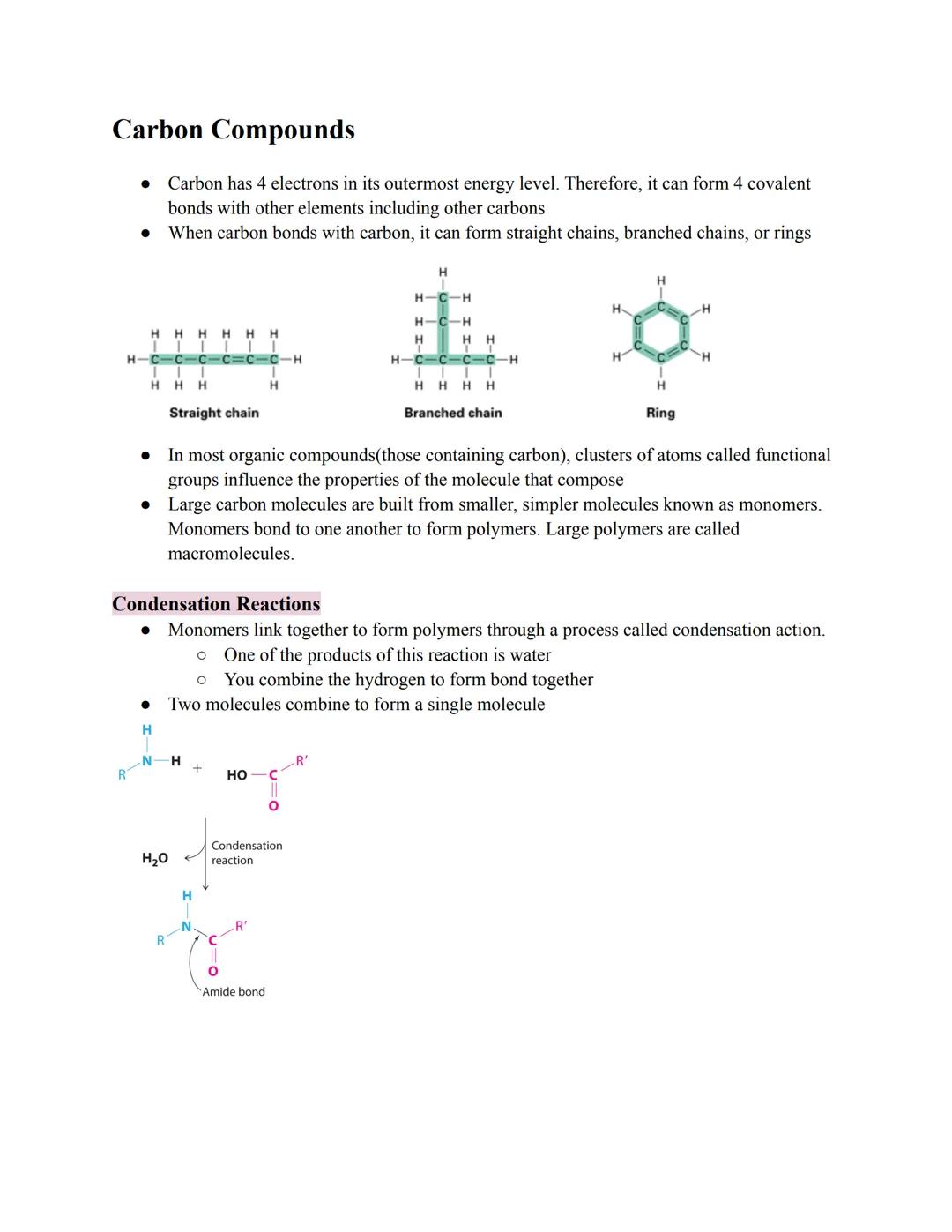
Carbon Compounds and Formation
Carbon atoms are incredibly versatile because they have 4 electrons in their outer shell, allowing them to form four covalent bonds with other elements or carbon atoms. These bonds create various structures like straight chains, branched chains, or rings, giving carbon compounds their diversity.
In organic molecules, special clusters of atoms called functional groups determine how compounds behave and interact. These functional groups give distinct properties to different carbon-based molecules.
Large carbon molecules follow a building-block approach. Small units called monomers join together through chemical bonds to create polymers. When these polymers get very large, we call them macromolecules—these form the basis of living organisms.
Did you know? The process that joins monomers into polymers is called a condensation reaction, which releases water as a byproduct. This is how your body builds many important molecules!
2
of 2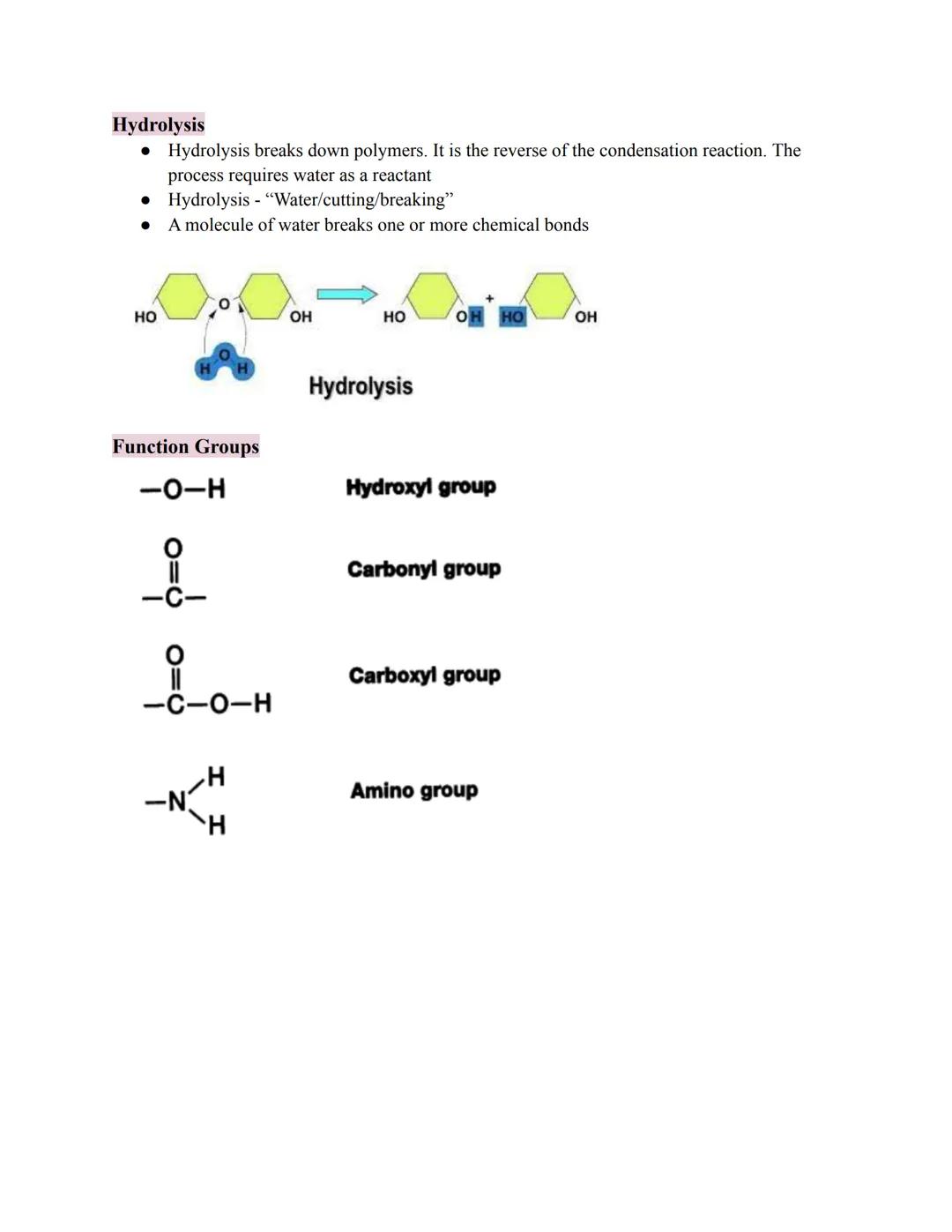
Breaking Down and Identifying Carbon Compounds
When polymers need to be broken down, a process called hydrolysis occurs. Think of hydrolysis as the opposite of a condensation reaction. The word literally means "water cutting" or "breaking with water," as water molecules split chemical bonds in the polymer.
Carbon compounds can be identified by their functional groups, which are specific arrangements of atoms that give molecules their chemical properties. Common functional groups include:
- The hydroxyl group
- The carbonyl group
- The carboxyl group
- The amino group
These functional groups act like chemical "personalities" that determine how molecules interact with each other and their environment. You can think of them as the active sites that allow chemicals to participate in reactions.
Quick tip: When studying organic molecules, identifying the functional groups first will help you predict how the molecule will behave in chemical reactions!
We thought you’d never ask...
What is the Knowunity AI companion?
Our AI companion is specifically built for the needs of students. Based on the millions of content pieces we have on the platform we can provide truly meaningful and relevant answers to students. But its not only about answers, the companion is even more about guiding students through their daily learning challenges, with personalised study plans, quizzes or content pieces in the chat and 100% personalisation based on the students skills and developments.
Where can I download the Knowunity app?
You can download the app in the Google Play Store and in the Apple App Store.
Is Knowunity really free of charge?
That's right! Enjoy free access to study content, connect with fellow students, and get instant help – all at your fingertips.
Similar Content
Most popular content in Chemistry
9Most popular content
9Can't find what you're looking for? Explore other subjects.
Students love us — and so will you.
4.6/5App Store
4.7/5Google Play
The app is very easy to use and well designed. I have found everything I was looking for so far and have been able to learn a lot from the presentations! I will definitely use the app for a class assignment! And of course it also helps a lot as an inspiration.
Stefan SiOS user
This app is really great. There are so many study notes and help [...]. My problem subject is French, for example, and the app has so many options for help. Thanks to this app, I have improved my French. I would recommend it to anyone.
Samantha KlichAndroid user
Wow, I am really amazed. I just tried the app because I've seen it advertised many times and was absolutely stunned. This app is THE HELP you want for school and above all, it offers so many things, such as workouts and fact sheets, which have been VERY helpful to me personally.
AnnaiOS user
Chemistry59 views·Updated May 23, 2026·2 pagesUnderstanding Carbon Compounds: Condensation and Hydrolysis Reactions
Yujun Ge@yujunge_jflh
Carbon compounds are the foundation of organic chemistry and all life on Earth. These molecules have unique properties based on carbon's ability to form four bonds, creating diverse structures from simple chains to complex polymers.
1
of 2Sign up to see the content. It's free!
- Access to all documents
- Improve your grades
- Join milions of students
Carbon Compounds and Formation
Carbon atoms are incredibly versatile because they have 4 electrons in their outer shell, allowing them to form four covalent bonds with other elements or carbon atoms. These bonds create various structures like straight chains, branched chains, or rings, giving carbon compounds their diversity.
In organic molecules, special clusters of atoms called functional groups determine how compounds behave and interact. These functional groups give distinct properties to different carbon-based molecules.
Large carbon molecules follow a building-block approach. Small units called monomers join together through chemical bonds to create polymers. When these polymers get very large, we call them macromolecules—these form the basis of living organisms.
Did you know? The process that joins monomers into polymers is called a condensation reaction, which releases water as a byproduct. This is how your body builds many important molecules!
2
of 2Sign up to see the content. It's free!
- Access to all documents
- Improve your grades
- Join milions of students
Breaking Down and Identifying Carbon Compounds
When polymers need to be broken down, a process called hydrolysis occurs. Think of hydrolysis as the opposite of a condensation reaction. The word literally means "water cutting" or "breaking with water," as water molecules split chemical bonds in the polymer.
Carbon compounds can be identified by their functional groups, which are specific arrangements of atoms that give molecules their chemical properties. Common functional groups include:
- The hydroxyl group
- The carbonyl group
- The carboxyl group
- The amino group
These functional groups act like chemical "personalities" that determine how molecules interact with each other and their environment. You can think of them as the active sites that allow chemicals to participate in reactions.
Quick tip: When studying organic molecules, identifying the functional groups first will help you predict how the molecule will behave in chemical reactions!
We thought you’d never ask...
What is the Knowunity AI companion?
Our AI companion is specifically built for the needs of students. Based on the millions of content pieces we have on the platform we can provide truly meaningful and relevant answers to students. But its not only about answers, the companion is even more about guiding students through their daily learning challenges, with personalised study plans, quizzes or content pieces in the chat and 100% personalisation based on the students skills and developments.
Where can I download the Knowunity app?
You can download the app in the Google Play Store and in the Apple App Store.
Is Knowunity really free of charge?
That's right! Enjoy free access to study content, connect with fellow students, and get instant help – all at your fingertips.
Similar Content
Most popular content in Chemistry
9Most popular content
9Can't find what you're looking for? Explore other subjects.
Students love us — and so will you.
4.6/5App Store
4.7/5Google Play
The app is very easy to use and well designed. I have found everything I was looking for so far and have been able to learn a lot from the presentations! I will definitely use the app for a class assignment! And of course it also helps a lot as an inspiration.
Stefan SiOS user
This app is really great. There are so many study notes and help [...]. My problem subject is French, for example, and the app has so many options for help. Thanks to this app, I have improved my French. I would recommend it to anyone.
Samantha KlichAndroid user
Wow, I am really amazed. I just tried the app because I've seen it advertised many times and was absolutely stunned. This app is THE HELP you want for school and above all, it offers so many things, such as workouts and fact sheets, which have been VERY helpful to me personally.
AnnaiOS user