

Energy changes are at the heart of every chemical reaction.... Show more
 Algebra
Sign up to see the contentIt's free!
Access to all documents
Improve your grades
Join milions of students
Knowunity AI
Subjects
Triangle Congruence and Similarity Theorems
Triangle Properties and Classification
Linear Equations and Graphs
Geometric Angle Relationships
Trigonometric Functions and Identities
Equation Solving Techniques
Circle Geometry Fundamentals
Division Operations and Methods
Basic Differentiation Rules
Exponent and Logarithm Properties
Show all topics
Human Organ Systems
Reproductive Cell Cycles
Biological Sciences Subdisciplines
Cellular Energy Metabolism
Autotrophic Energy Processes
Inheritance Patterns and Principles
Biomolecular Structure and Organization
Cell Cycle and Division Mechanics
Cellular Organization and Development
Biological Structural Organization
Show all topics
Chemical Sciences and Applications
Atomic Structure and Composition
Molecular Electron Structure Representation
Atomic Electron Behavior
Matter Properties and Water
Mole Concept and Calculations
Gas Laws and Behavior
Periodic Table Organization
Chemical Thermodynamics Fundamentals
Chemical Bond Types and Properties
Show all topics
European Renaissance and Enlightenment
European Cultural Movements 800-1920
American Revolution Era 1763-1797
American Civil War 1861-1865
Global Imperial Systems
Mongol and Chinese Dynasties
U.S. Presidents and World Leaders
Historical Sources and Documentation
World Wars Era and Impact
World Religious Systems
Show all topics
Classic and Contemporary Novels
Literary Character Analysis
Rhetorical Theory and Practice
Classic Literary Narratives
Reading Analysis and Interpretation
Narrative Structure and Techniques
English Language Components
Influential English-Language Authors
Basic Sentence Structure
Narrative Voice and Perspective
Show all topics
193
•
Feb 6, 2026
•
Energy changes are at the heart of every chemical reaction.... Show more
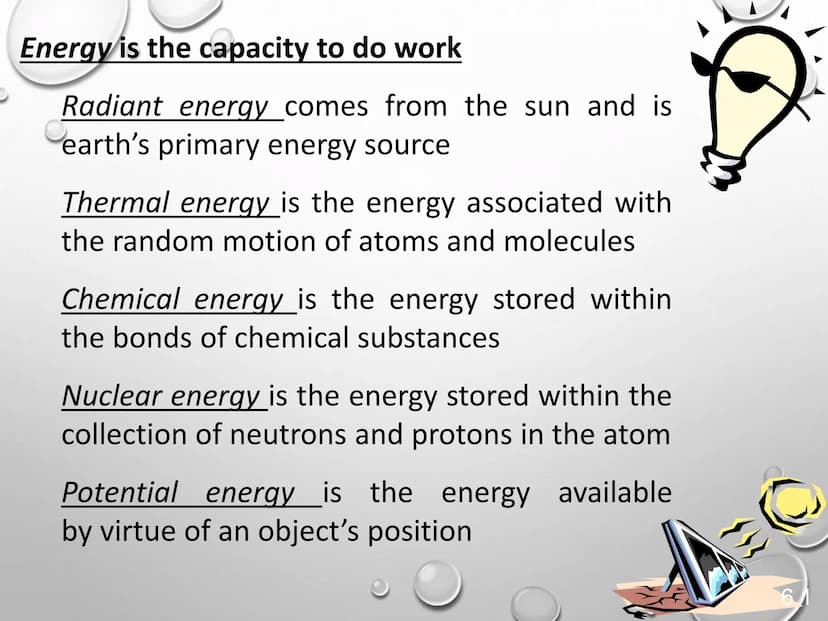
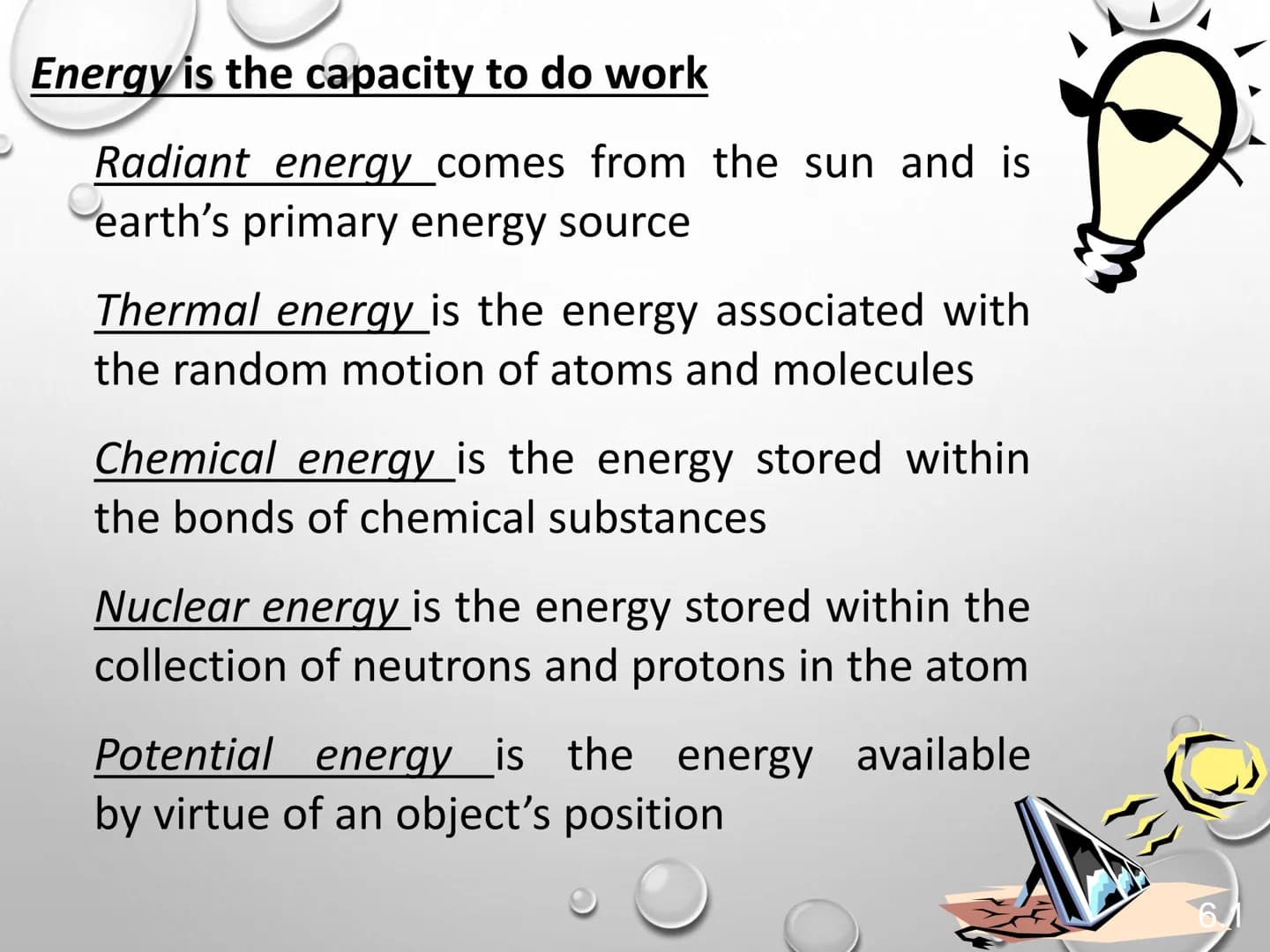
Energy is simply the capacity to do work, and it comes in several important forms that chemists need to understand. The sun provides our planet with radiant energy, which is Earth's primary energy source powering nearly all life processes.
When atoms and molecules move randomly, they possess thermal energy - this is what we typically associate with heat. Chemical energy is stored within the bonds between atoms, and gets released or absorbed during reactions. Meanwhile, nuclear energy is contained within the core of atoms themselves.
Potential energy depends on an object's position, like water held behind a dam. When chemicals react, they convert between different energy forms, releasing or absorbing heat in the process.
Remember: Energy can never be created or destroyed - it only changes form! This fundamental principle will help you understand all energy changes in chemistry.
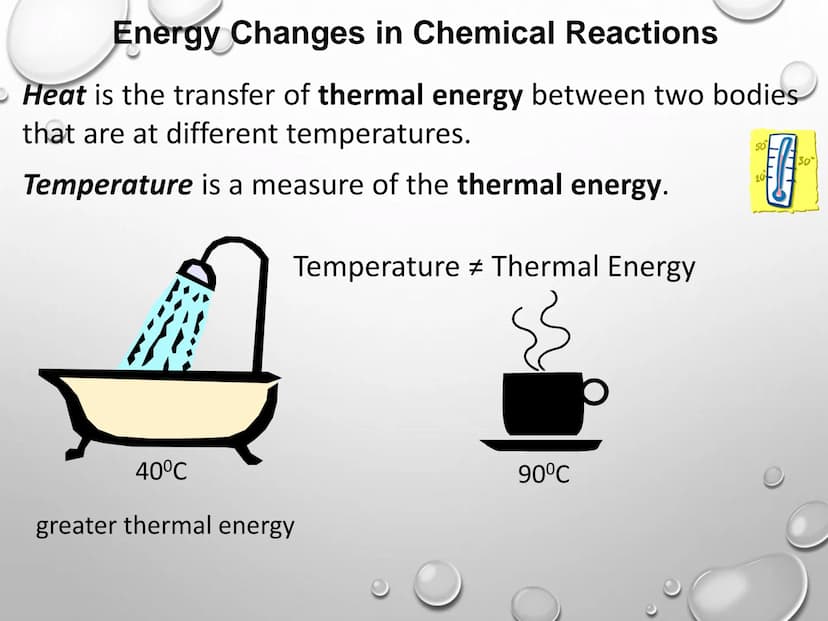
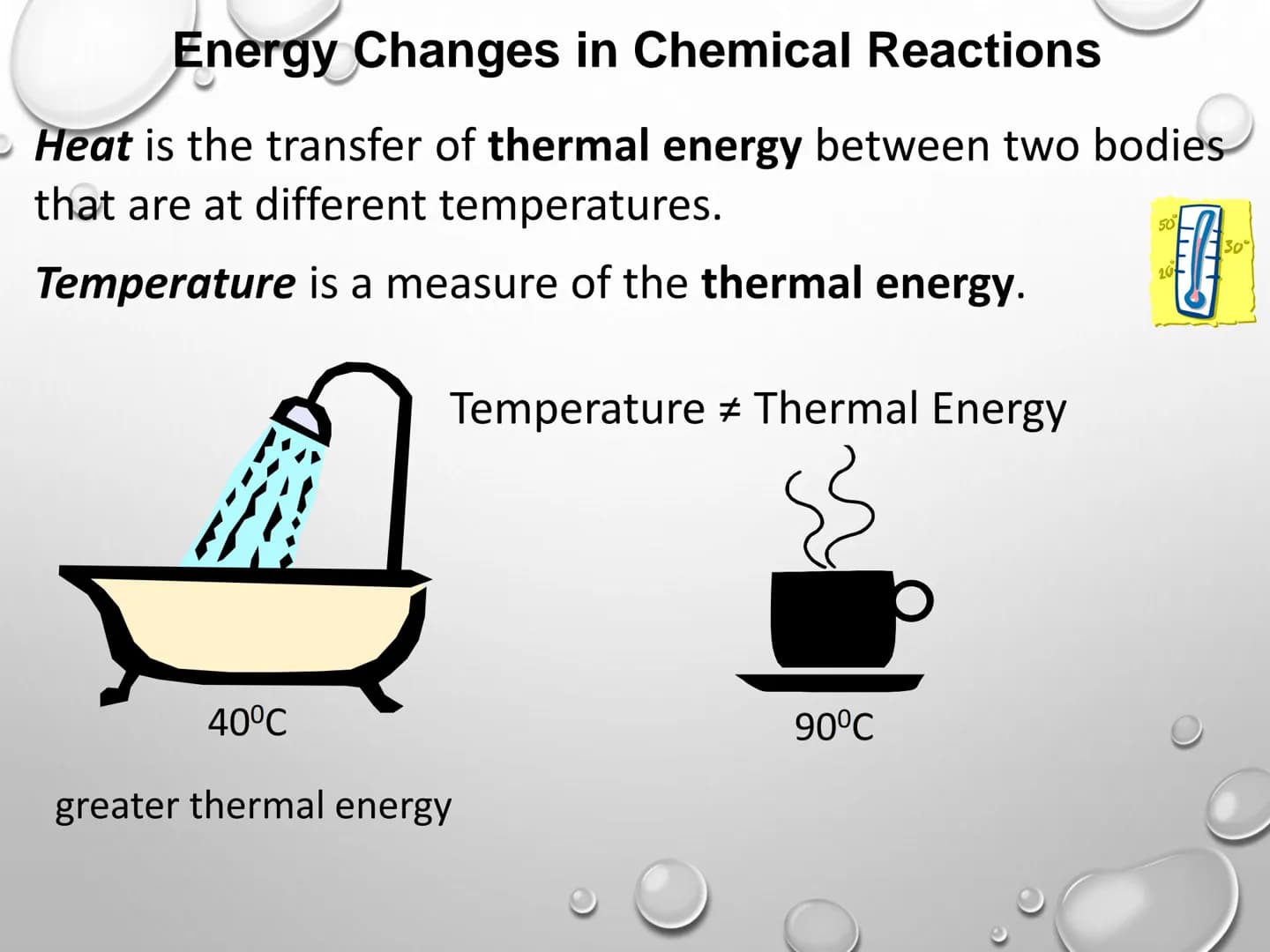
Heat and temperature might seem like the same thing, but they're actually quite different concepts. Heat is the transfer of thermal energy between two objects at different temperatures - it's energy in transit. Temperature simply measures how hot or cold something is.
Think about it this way: a cup of hot coffee and a bathtub of warm water might have different temperatures, but the bathtub contains more total thermal energy because there's more water.
When substances gain heat, their temperature typically rises. A substance at 90°C contains more thermal energy than the same substance at 40°C, but remember that temperature alone doesn't tell you the total energy contained.
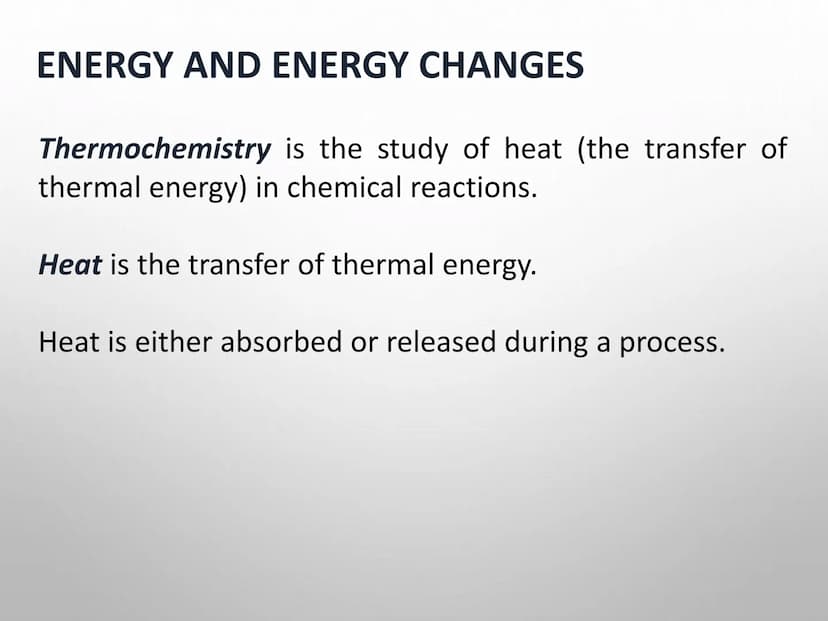
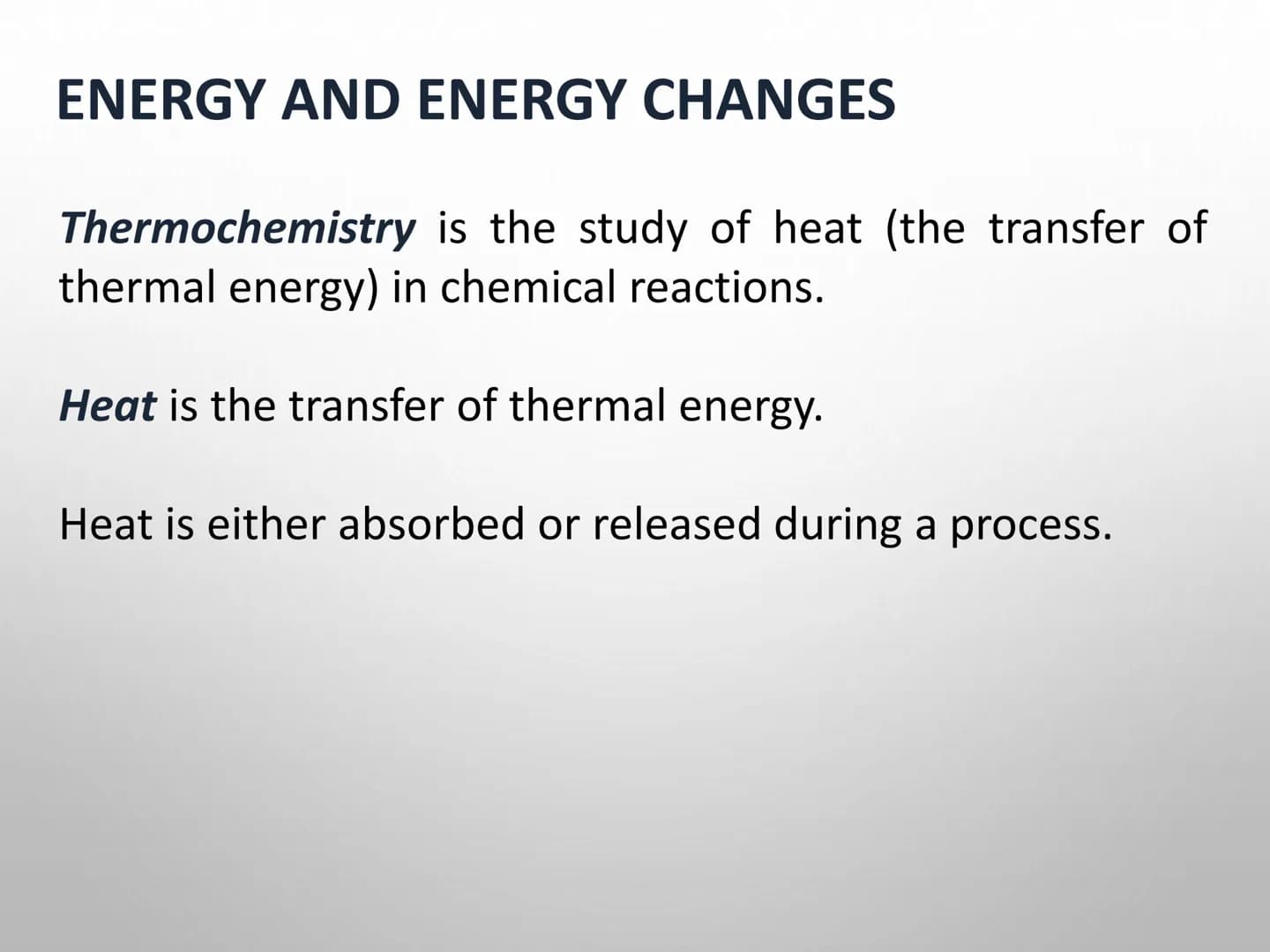
Thermochemistry specifically studies heat transfers during chemical reactions. When you see energy changes in reactions, you're witnessing thermochemistry in action!
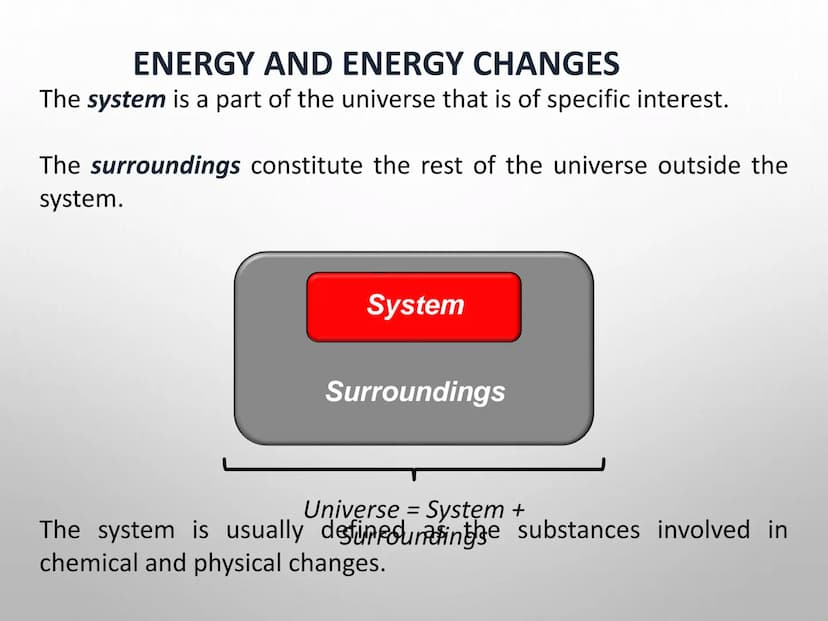
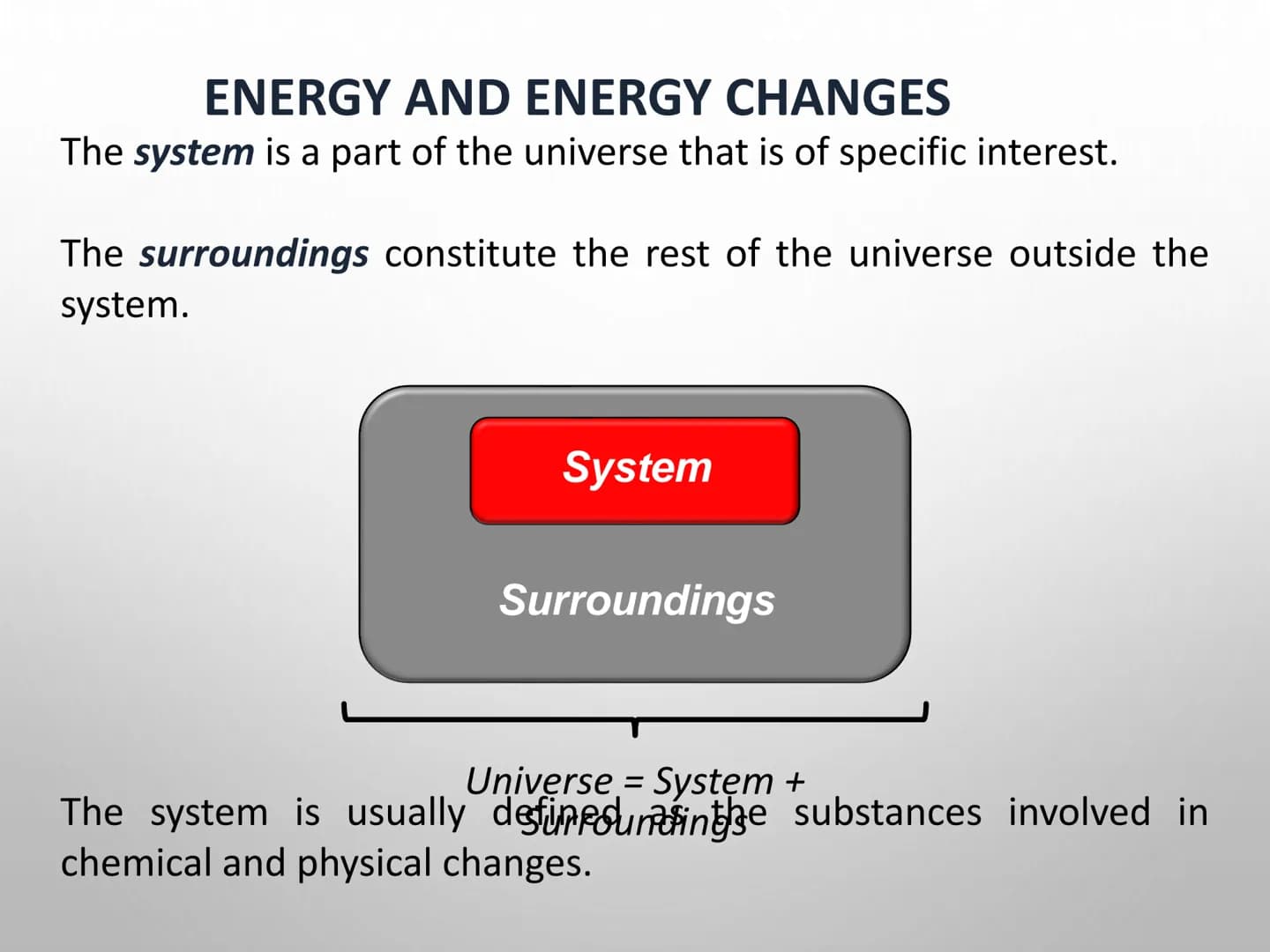
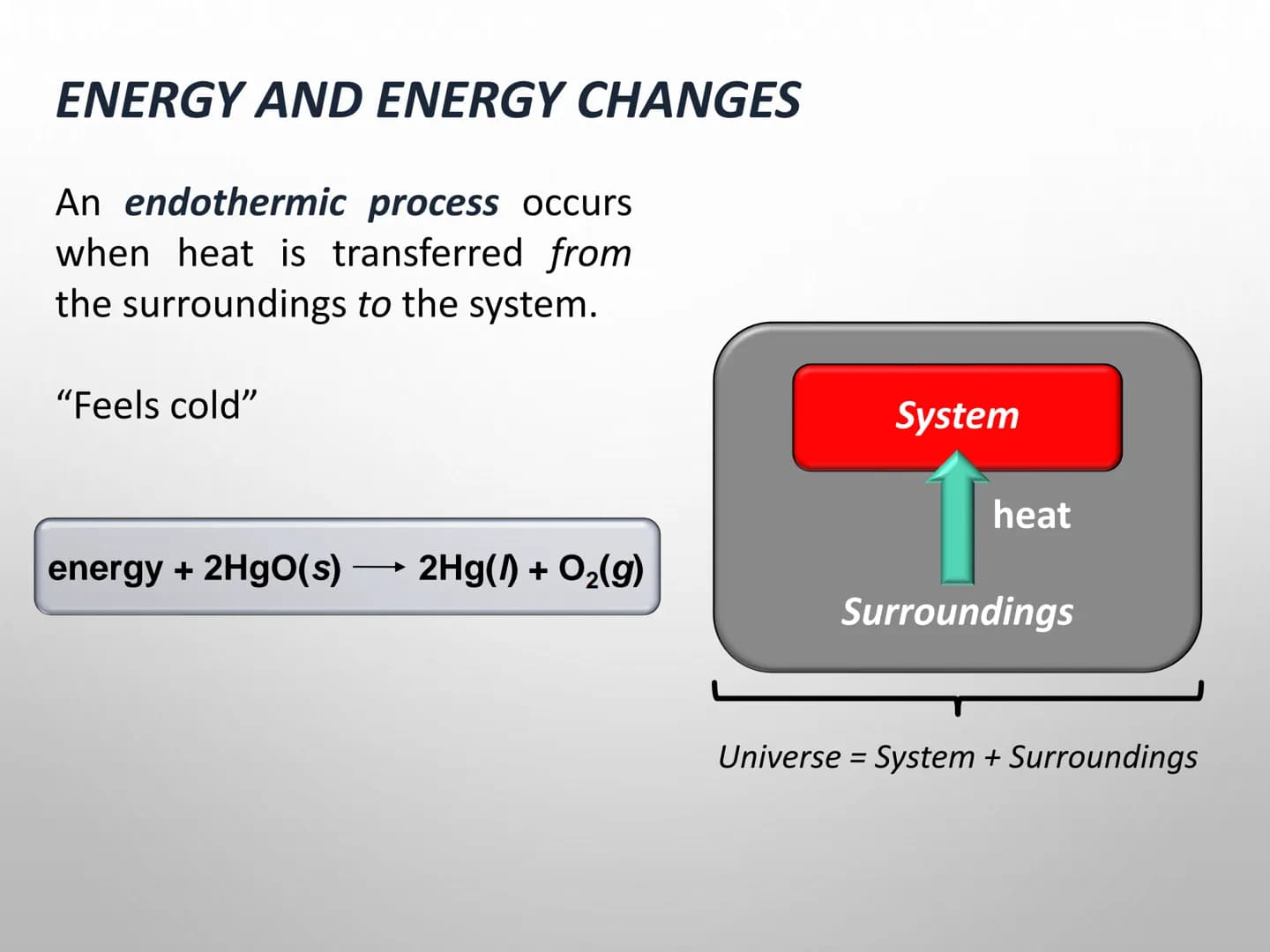
When studying energy changes, chemists divide the universe into two parts: the system and the surroundings. The system is whatever specific part we're studying - usually the chemicals reacting. The surroundings are everything else outside the system.
Together, the system and surroundings make up the universe. This division helps us track where energy is going during a reaction.
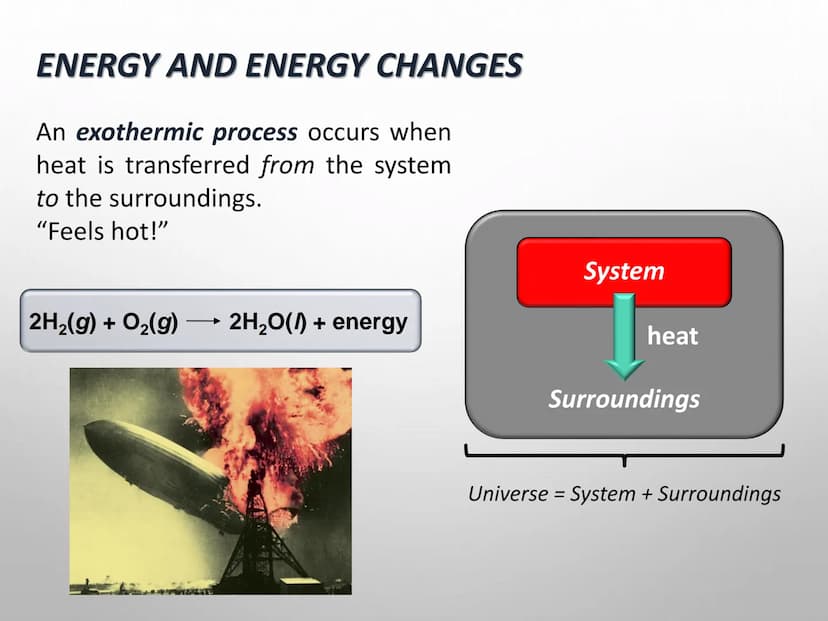
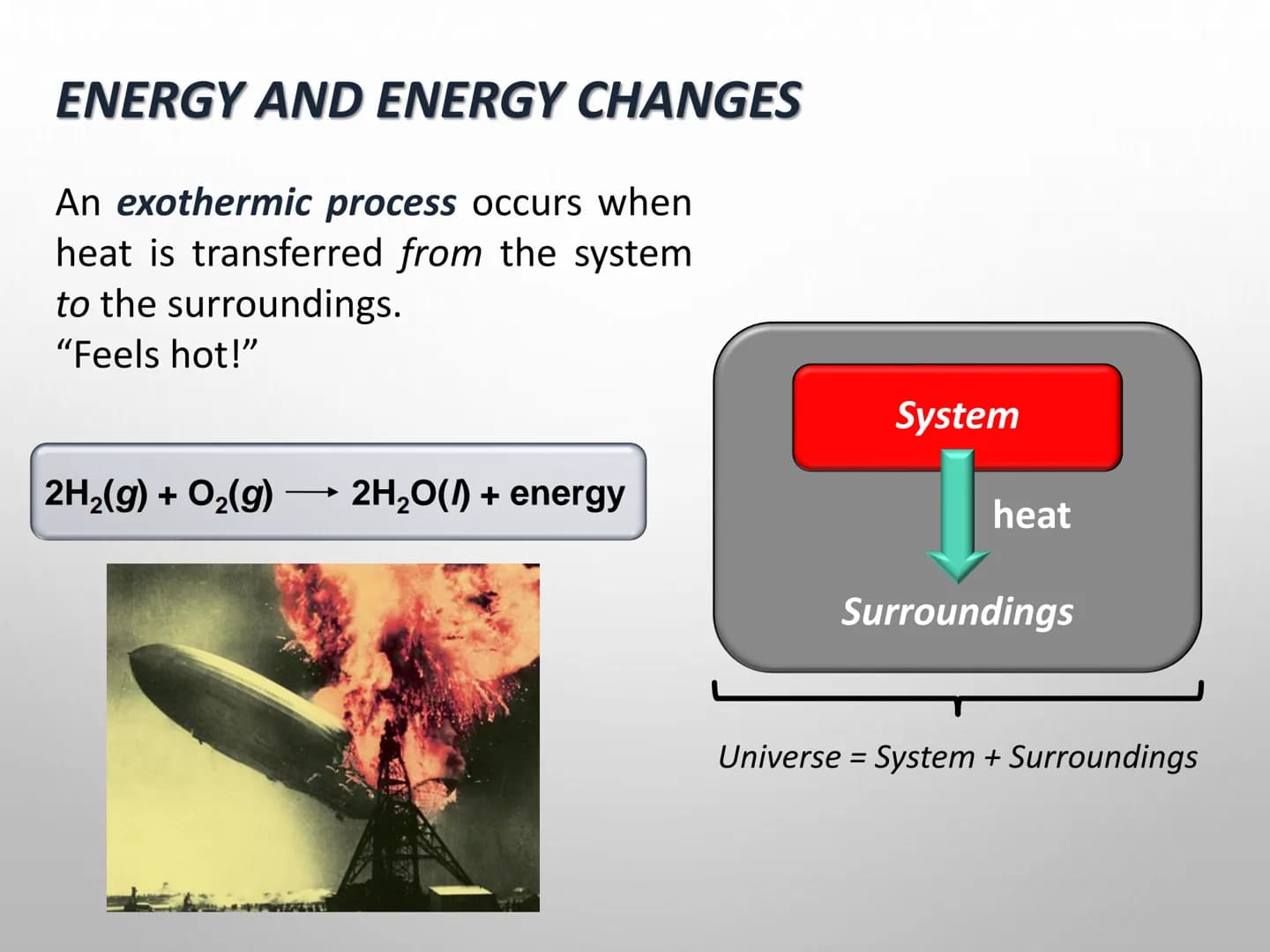
An exothermic process occurs when heat flows from the system to the surroundings. This makes the surroundings feel warmer - like when you burn fuel and feel heat. The reaction of hydrogen and oxygen to form water releases energy to the surroundings.
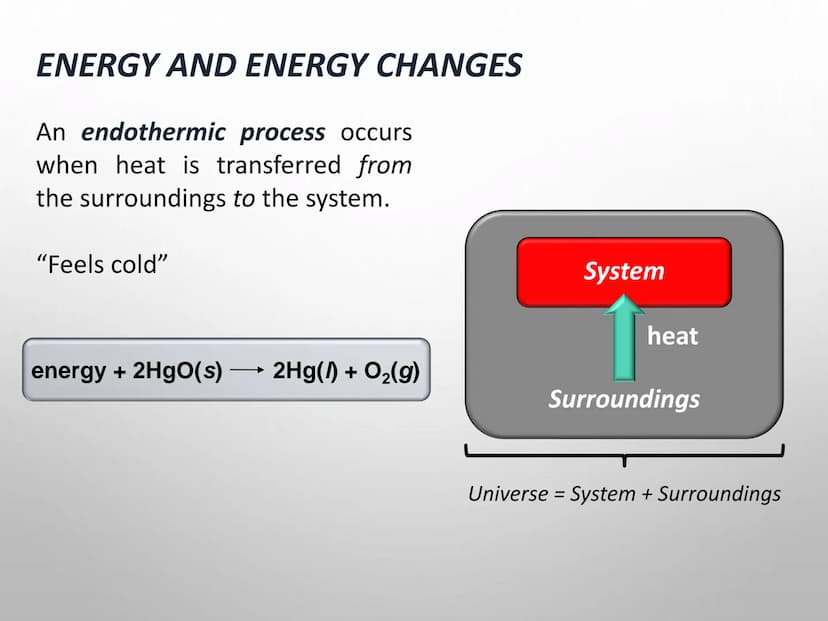
An endothermic process happens when heat flows from the surroundings into the system. The surroundings feel cooler - like when ice melts and absorbs heat from your hand. When mercury(II) oxide decomposes , it requires energy input.
Quick Tip: To remember which is which, think: EXOthermic reactions EXIT heat from the system (giving off heat), while ENDOthermic reactions NEED heat to END up with products.
Thermodynamics is the study of how energy transforms between heat and other forms. It provides the rules that govern all energy changes in the universe, making it crucial for understanding chemical reactions.
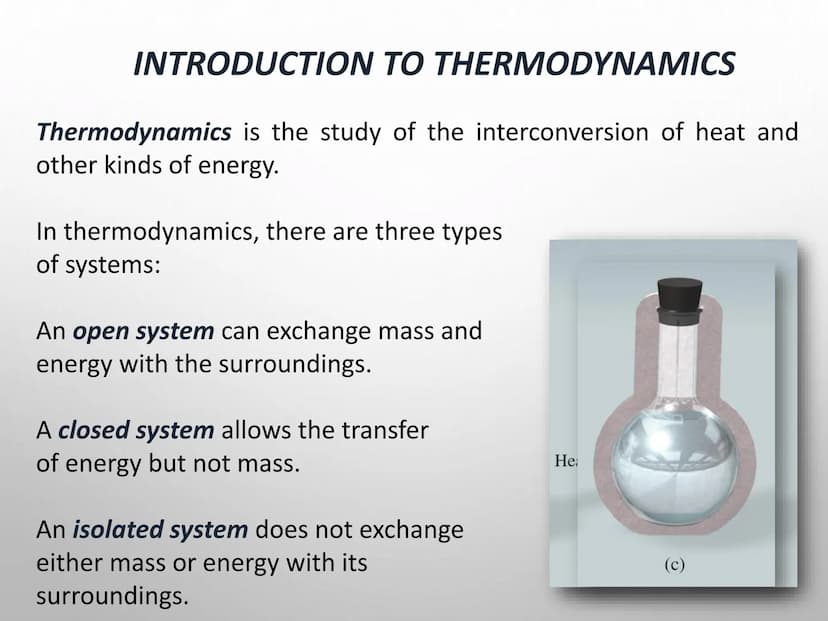
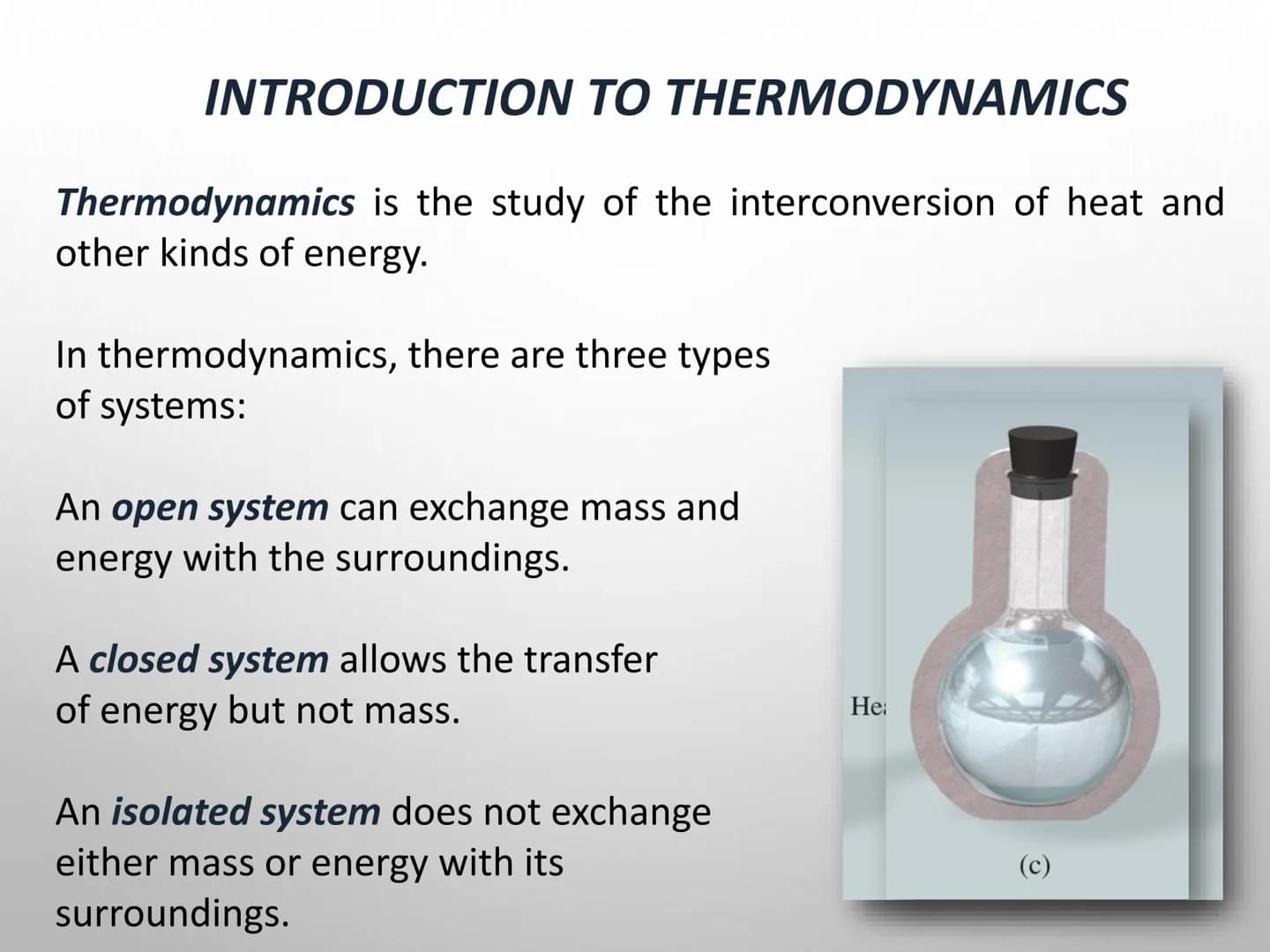
In thermodynamics, systems come in three varieties:
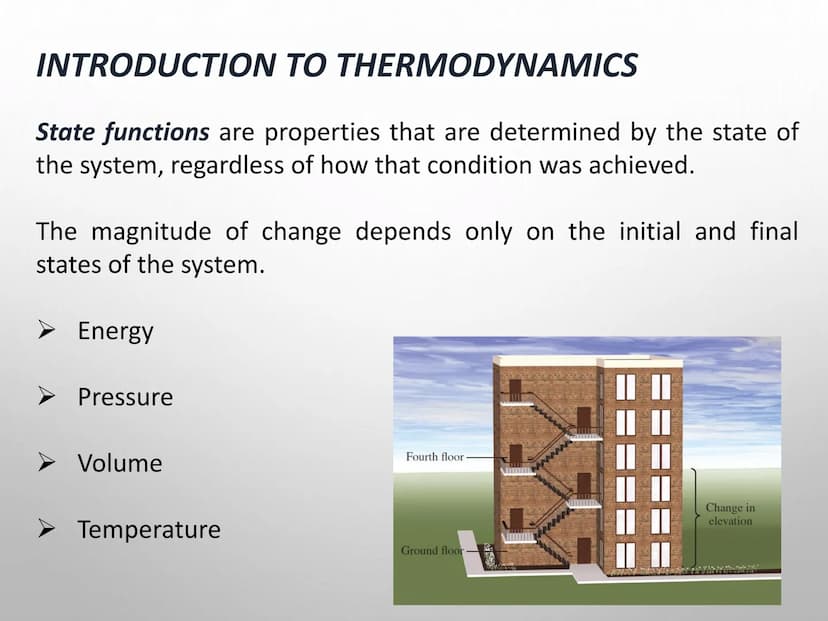
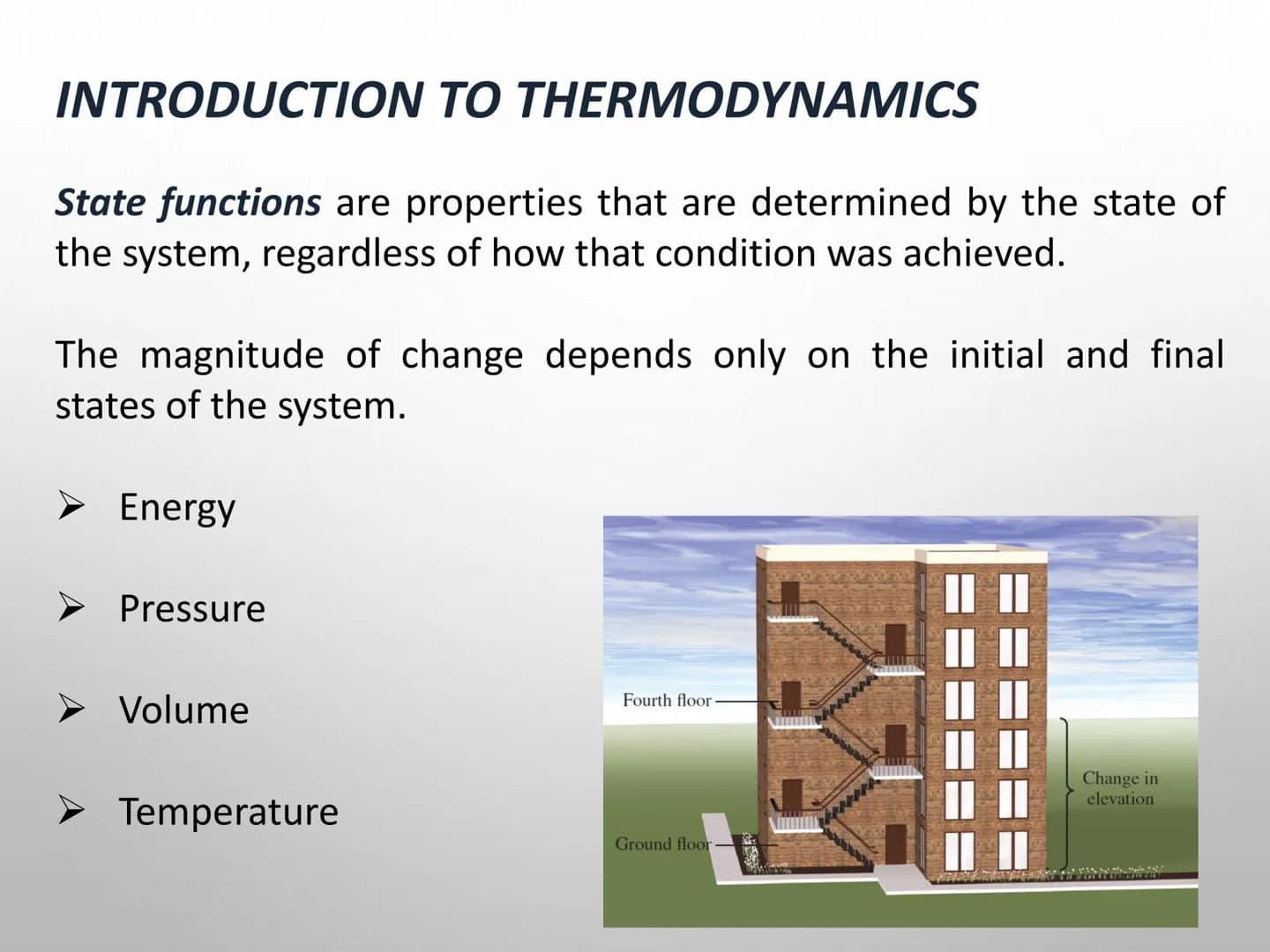
Chemists also use state functions - properties that depend only on the current state of a system, not how it got there. These include energy, pressure, volume, and temperature.
Think of state functions like elevation: whether you take the stairs, elevator, or climb the outside of a building, the change in height is exactly the same. The path doesn't matter - only the starting and ending states.
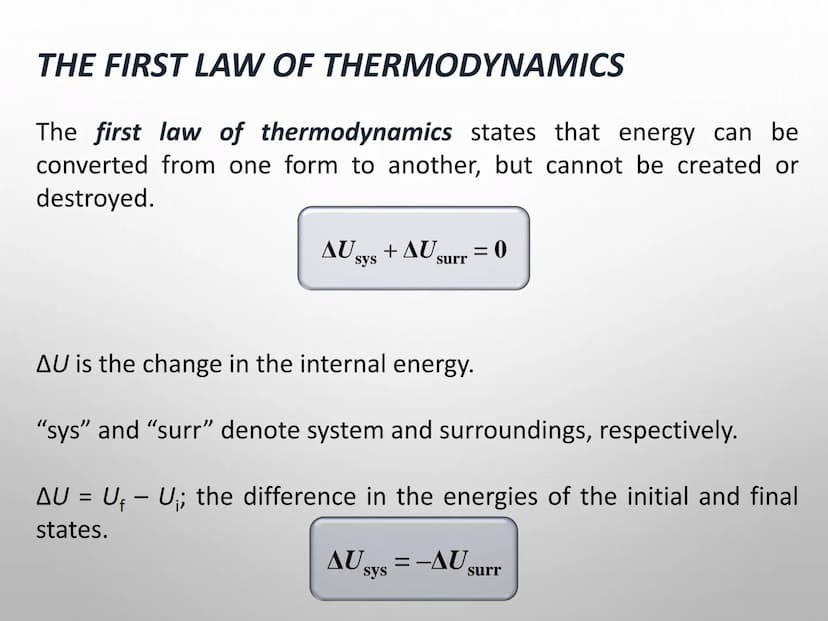
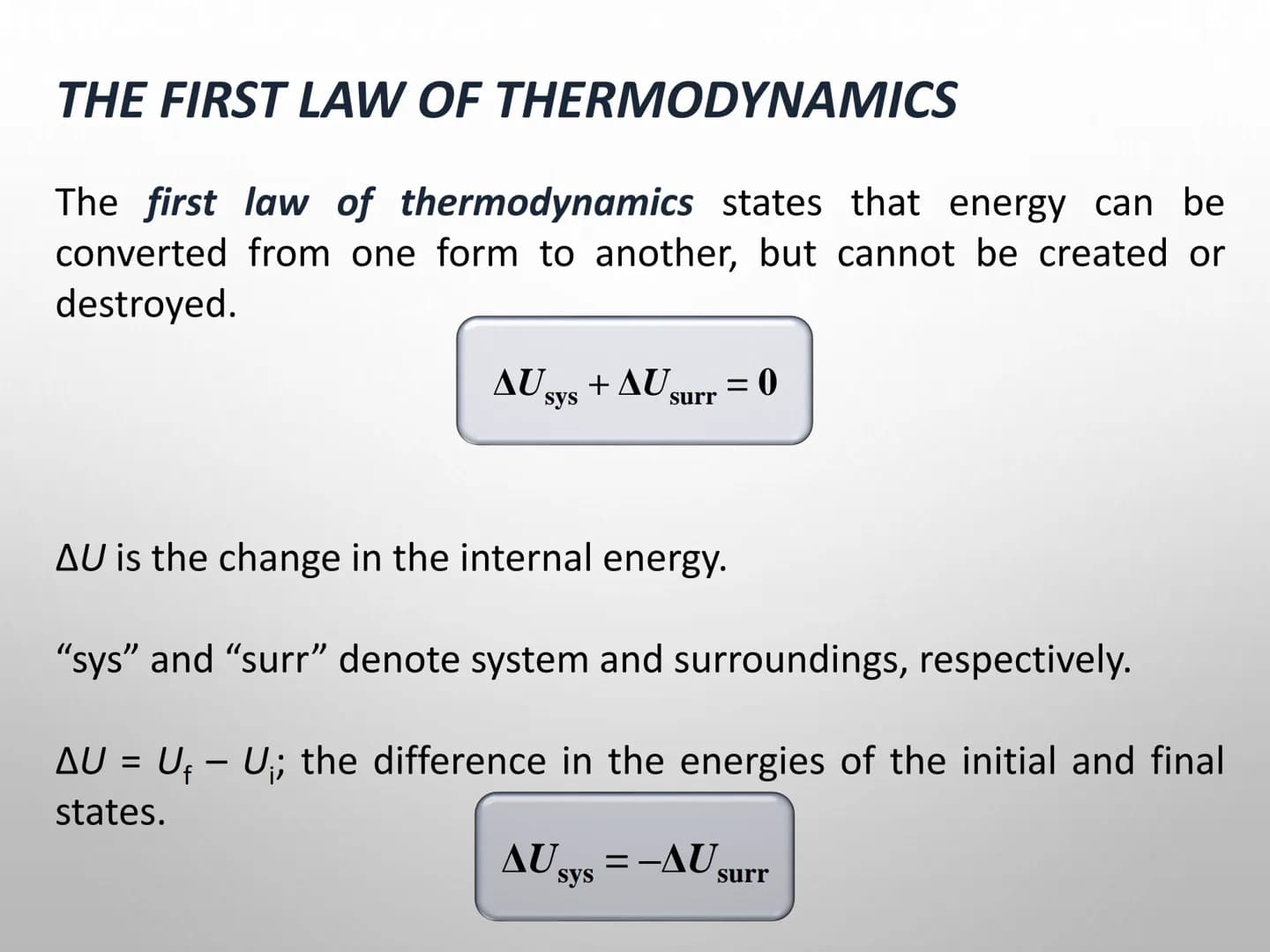
The first law of thermodynamics is essentially the law of conservation of energy applied to heat and work. It states that energy cannot be created or destroyed, only converted from one form to another.
Mathematically, this is written as: ΔU₍ₛᵧₛ₎ + ΔU₍ₛᵤᵣᵣ₎ = 0
This means that any energy change in the system (ΔU₍ₛᵧₛ₎) must be balanced by an opposite change in the surroundings (ΔU₍ₛᵤᵣᵣ₎). If the system gains energy, the surroundings must lose the same amount.
The change in internal energy (ΔU) is calculated as the difference between final and initial energy: ΔU = U₍ₗ₎ - U₍ᵢ₎
This principle is foundational for chemistry because it lets us track energy in chemical reactions. If a reaction releases energy (exothermic), that energy doesn't disappear - it transfers to the surroundings, often as heat.
Practical Application: When you burn food to get energy for your body, the chemical energy in food doesn't magically appear - it's converted from one form to another following the first law!
The overall change in a system's internal energy (ΔU) comes from two sources: heat (q) and work (w). This relationship is expressed as:
ΔU = q + w
When a system absorbs heat (endothermic), q is positive. When it releases heat (exothermic), q is negative.
Similarly, work has its own sign convention. When work is done on the system (like compressing a gas), w is positive. When the system does work on the surroundings (like a gas expanding), w is negative.
These sign conventions can be confusing, so remember this table:
For example, if a system absorbs 188 J of heat and does 141 J of work, its internal energy change would be: ΔU = 188 J + = 47 J
Think About It: When a hot air balloon rises, is the system (the heated air) absorbing or releasing heat? Is it doing work or having work done on it?
Calorimetry is the science of measuring heat changes in chemical reactions. Scientists use devices called calorimeters to capture and quantify the heat released or absorbed during reactions.
The specific heat (s) of a substance tells us how much heat energy is needed to raise the temperature of 1 gram of that substance by 1°C. Water has a remarkably high specific heat of 4.184 J/g°C, which is why oceans and lakes maintain relatively stable temperatures.
Materials vary widely in their specific heats:
A related concept is heat capacity (C) - the energy required to raise an object's entire temperature by 1°C. Heat capacity depends on both the material and its quantity.
The heat transferred during a temperature change is calculated using: q = msΔT (where m is mass, s is specific heat, and ΔT is temperature change).
A coffee-cup calorimeter is a simple but effective device for measuring heat changes at constant pressure. It typically consists of two Styrofoam cups (great insulators) containing water, a thermometer, and a stirrer.
This setup can measure various heat changes, including:
When a reaction occurs in the calorimeter, heat flows between the reaction (system) and the surrounding water. For an exothermic reaction, the system loses heat while the surroundings gain it .
For constant pressure processes, the heat flow is related to the change in enthalpy: qₚ = nΔH, where n is the number of moles.
Lab Tip: During calorimetry experiments, always stir the solution thoroughly to ensure even heat distribution throughout the water. Uneven heating leads to inaccurate measurements.
A constant-volume bomb calorimeter is used when reactions involve gases or when measuring combustion energies. Unlike coffee-cup calorimeters, these are sealed systems that don't allow volume changes.
The bomb calorimeter consists of a strong metal container (the "bomb") placed in water within an insulated bucket. The sample is placed inside the bomb, which is filled with oxygen and sealed. An ignition wire starts the reaction.
When the reaction occurs, heat transfers to the water surrounding the bomb. The temperature change in the water reveals how much heat was released or absorbed.
To calculate the heat of reaction: qᵣₓₙ = -CₖₐₗΔT, where Cₖₐₗ is the calorimeter's heat capacity (determined through calibration).
Remember that in any calorimetry experiment, the heat gained by the surroundings equals the heat lost by the system: Qₛᵧₛₜₑₘ = -Qₛᵤᵣᵣₒᵤₙₐᵢₙₓₛ
This relationship is fundamental to all calorimetry measurements and allows us to determine energy changes indirectly.
Enthalpy (H) is a thermodynamic property that represents the total heat content of a system. Though we can't measure absolute enthalpy, we can measure enthalpy changes (ΔH) during reactions.
The enthalpy change for a reaction is defined as: ΔH = H(products) - H(reactants)
This value tells us whether heat is absorbed or released during a reaction at constant pressure:
Enthalpy changes are typically measured under standard conditions (1 atmosphere pressure, specified concentration or state). These standard enthalpy changes are denoted with a degree symbol: ΔH°.
When working with lab reactions, the enthalpy change typically equals the heat transferred at constant pressure. This makes enthalpy extremely useful for predicting temperature changes in real-world chemical processes.
Connection to Life: Your body's metabolism is essentially a series of controlled exothermic reactions (negative ΔH). The heat released helps maintain your body temperature!
Our AI companion is specifically built for the needs of students. Based on the millions of content pieces we have on the platform we can provide truly meaningful and relevant answers to students. But its not only about answers, the companion is even more about guiding students through their daily learning challenges, with personalised study plans, quizzes or content pieces in the chat and 100% personalisation based on the students skills and developments.
You can download the app in the Google Play Store and in the Apple App Store.
That's right! Enjoy free access to study content, connect with fellow students, and get instant help – all at your fingertips.
App Store
Google Play
The app is very easy to use and well designed. I have found everything I was looking for so far and have been able to learn a lot from the presentations! I will definitely use the app for a class assignment! And of course it also helps a lot as an inspiration.
Stefan S
iOS user
This app is really great. There are so many study notes and help [...]. My problem subject is French, for example, and the app has so many options for help. Thanks to this app, I have improved my French. I would recommend it to anyone.
Samantha Klich
Android user
Wow, I am really amazed. I just tried the app because I've seen it advertised many times and was absolutely stunned. This app is THE HELP you want for school and above all, it offers so many things, such as workouts and fact sheets, which have been VERY helpful to me personally.
Anna
iOS user
I think it’s very much worth it and you’ll end up using it a lot once you get the hang of it and even after looking at others notes you can still ask your Artificial intelligence buddy the question and ask to simplify it if you still don’t get it!!! In the end I think it’s worth it 😊👍 ⚠️Also DID I MENTION ITS FREEE YOU DON’T HAVE TO PAY FOR ANYTHING AND STILL GET YOUR GRADES IN PERFECTLY❗️❗️⚠️
Thomas R
iOS user
Knowunity is the BEST app I’ve used in a minute. This is not an ai review or anything this is genuinely coming from a 7th grade student (I know 2011 im young) but dude this app is a 10/10 i have maintained a 3.8 gpa and have plenty of time for gaming. I love it and my mom is just happy I got good grades
Brad T
Android user
Not only did it help me find the answer but it also showed me alternative ways to solve it. I was horrible in math and science but now I have an a in both subjects. Thanks for the help🤍🤍
David K
iOS user
The app's just great! All I have to do is enter the topic in the search bar and I get the response real fast. I don't have to watch 10 YouTube videos to understand something, so I'm saving my time. Highly recommended!
Sudenaz Ocak
Android user
In school I was really bad at maths but thanks to the app, I am doing better now. I am so grateful that you made the app.
Greenlight Bonnie
Android user
I found this app a couple years ago and it has only gotten better since then. I really love it because it can help with written questions and photo questions. Also, it can find study guides that other people have made as well as flashcard sets and practice tests. The free version is also amazing for students who might not be able to afford it. Would 100% recommend
Aubrey
iOS user
Best app if you're in Highschool or Junior high. I have been using this app for 2 school years and it's the best, it's good if you don't have anyone to help you with school work.😋🩷🎀
Marco B
iOS user
THE QUIZES AND FLASHCARDS ARE SO USEFUL AND I LOVE Knowunity AI. IT ALSO IS LITREALLY LIKE CHATGPT BUT SMARTER!! HELPED ME WITH MY MASCARA PROBLEMS TOO!! AS WELL AS MY REAL SUBJECTS ! DUHHH 😍😁😲🤑💗✨🎀😮
Elisha
iOS user
This app is phenomenal down to the correct info and the various topics you can study! I greatly recommend it for people who struggle with procrastination and those who need homework help. It has been perfectly accurate for world 1 history as far as I’ve seen! Geometry too!
Paul T
iOS user
The app is very easy to use and well designed. I have found everything I was looking for so far and have been able to learn a lot from the presentations! I will definitely use the app for a class assignment! And of course it also helps a lot as an inspiration.
Stefan S
iOS user
This app is really great. There are so many study notes and help [...]. My problem subject is French, for example, and the app has so many options for help. Thanks to this app, I have improved my French. I would recommend it to anyone.
Samantha Klich
Android user
Wow, I am really amazed. I just tried the app because I've seen it advertised many times and was absolutely stunned. This app is THE HELP you want for school and above all, it offers so many things, such as workouts and fact sheets, which have been VERY helpful to me personally.
Anna
iOS user
I think it’s very much worth it and you’ll end up using it a lot once you get the hang of it and even after looking at others notes you can still ask your Artificial intelligence buddy the question and ask to simplify it if you still don’t get it!!! In the end I think it’s worth it 😊👍 ⚠️Also DID I MENTION ITS FREEE YOU DON’T HAVE TO PAY FOR ANYTHING AND STILL GET YOUR GRADES IN PERFECTLY❗️❗️⚠️
Thomas R
iOS user
Knowunity is the BEST app I’ve used in a minute. This is not an ai review or anything this is genuinely coming from a 7th grade student (I know 2011 im young) but dude this app is a 10/10 i have maintained a 3.8 gpa and have plenty of time for gaming. I love it and my mom is just happy I got good grades
Brad T
Android user
Not only did it help me find the answer but it also showed me alternative ways to solve it. I was horrible in math and science but now I have an a in both subjects. Thanks for the help🤍🤍
David K
iOS user
The app's just great! All I have to do is enter the topic in the search bar and I get the response real fast. I don't have to watch 10 YouTube videos to understand something, so I'm saving my time. Highly recommended!
Sudenaz Ocak
Android user
In school I was really bad at maths but thanks to the app, I am doing better now. I am so grateful that you made the app.
Greenlight Bonnie
Android user
I found this app a couple years ago and it has only gotten better since then. I really love it because it can help with written questions and photo questions. Also, it can find study guides that other people have made as well as flashcard sets and practice tests. The free version is also amazing for students who might not be able to afford it. Would 100% recommend
Aubrey
iOS user
Best app if you're in Highschool or Junior high. I have been using this app for 2 school years and it's the best, it's good if you don't have anyone to help you with school work.😋🩷🎀
Marco B
iOS user
THE QUIZES AND FLASHCARDS ARE SO USEFUL AND I LOVE Knowunity AI. IT ALSO IS LITREALLY LIKE CHATGPT BUT SMARTER!! HELPED ME WITH MY MASCARA PROBLEMS TOO!! AS WELL AS MY REAL SUBJECTS ! DUHHH 😍😁😲🤑💗✨🎀😮
Elisha
iOS user
This app is phenomenal down to the correct info and the various topics you can study! I greatly recommend it for people who struggle with procrastination and those who need homework help. It has been perfectly accurate for world 1 history as far as I’ve seen! Geometry too!
Paul T
iOS user
Energy changes are at the heart of every chemical reaction. When compounds form or break apart, energy is either released or absorbed. Understanding these energy transfers helps us predict how reactions will behave and allows us to harness chemistry for... Show more
Access to all documents
Improve your grades
Join milions of students
Energy is simply the capacity to do work, and it comes in several important forms that chemists need to understand. The sun provides our planet with radiant energy, which is Earth's primary energy source powering nearly all life processes.
When atoms and molecules move randomly, they possess thermal energy - this is what we typically associate with heat. Chemical energy is stored within the bonds between atoms, and gets released or absorbed during reactions. Meanwhile, nuclear energy is contained within the core of atoms themselves.
Potential energy depends on an object's position, like water held behind a dam. When chemicals react, they convert between different energy forms, releasing or absorbing heat in the process.
Remember: Energy can never be created or destroyed - it only changes form! This fundamental principle will help you understand all energy changes in chemistry.
Access to all documents
Improve your grades
Join milions of students
Heat and temperature might seem like the same thing, but they're actually quite different concepts. Heat is the transfer of thermal energy between two objects at different temperatures - it's energy in transit. Temperature simply measures how hot or cold something is.
Think about it this way: a cup of hot coffee and a bathtub of warm water might have different temperatures, but the bathtub contains more total thermal energy because there's more water.
When substances gain heat, their temperature typically rises. A substance at 90°C contains more thermal energy than the same substance at 40°C, but remember that temperature alone doesn't tell you the total energy contained.
Thermochemistry specifically studies heat transfers during chemical reactions. When you see energy changes in reactions, you're witnessing thermochemistry in action!
Access to all documents
Improve your grades
Join milions of students
When studying energy changes, chemists divide the universe into two parts: the system and the surroundings. The system is whatever specific part we're studying - usually the chemicals reacting. The surroundings are everything else outside the system.
Together, the system and surroundings make up the universe. This division helps us track where energy is going during a reaction.
An exothermic process occurs when heat flows from the system to the surroundings. This makes the surroundings feel warmer - like when you burn fuel and feel heat. The reaction of hydrogen and oxygen to form water releases energy to the surroundings.
An endothermic process happens when heat flows from the surroundings into the system. The surroundings feel cooler - like when ice melts and absorbs heat from your hand. When mercury(II) oxide decomposes , it requires energy input.
Quick Tip: To remember which is which, think: EXOthermic reactions EXIT heat from the system (giving off heat), while ENDOthermic reactions NEED heat to END up with products.
Access to all documents
Improve your grades
Join milions of students
Thermodynamics is the study of how energy transforms between heat and other forms. It provides the rules that govern all energy changes in the universe, making it crucial for understanding chemical reactions.
In thermodynamics, systems come in three varieties:
Chemists also use state functions - properties that depend only on the current state of a system, not how it got there. These include energy, pressure, volume, and temperature.
Think of state functions like elevation: whether you take the stairs, elevator, or climb the outside of a building, the change in height is exactly the same. The path doesn't matter - only the starting and ending states.
Access to all documents
Improve your grades
Join milions of students
The first law of thermodynamics is essentially the law of conservation of energy applied to heat and work. It states that energy cannot be created or destroyed, only converted from one form to another.
Mathematically, this is written as: ΔU₍ₛᵧₛ₎ + ΔU₍ₛᵤᵣᵣ₎ = 0
This means that any energy change in the system (ΔU₍ₛᵧₛ₎) must be balanced by an opposite change in the surroundings (ΔU₍ₛᵤᵣᵣ₎). If the system gains energy, the surroundings must lose the same amount.
The change in internal energy (ΔU) is calculated as the difference between final and initial energy: ΔU = U₍ₗ₎ - U₍ᵢ₎
This principle is foundational for chemistry because it lets us track energy in chemical reactions. If a reaction releases energy (exothermic), that energy doesn't disappear - it transfers to the surroundings, often as heat.
Practical Application: When you burn food to get energy for your body, the chemical energy in food doesn't magically appear - it's converted from one form to another following the first law!
Access to all documents
Improve your grades
Join milions of students
The overall change in a system's internal energy (ΔU) comes from two sources: heat (q) and work (w). This relationship is expressed as:
ΔU = q + w
When a system absorbs heat (endothermic), q is positive. When it releases heat (exothermic), q is negative.
Similarly, work has its own sign convention. When work is done on the system (like compressing a gas), w is positive. When the system does work on the surroundings (like a gas expanding), w is negative.
These sign conventions can be confusing, so remember this table:
For example, if a system absorbs 188 J of heat and does 141 J of work, its internal energy change would be: ΔU = 188 J + = 47 J
Think About It: When a hot air balloon rises, is the system (the heated air) absorbing or releasing heat? Is it doing work or having work done on it?
Access to all documents
Improve your grades
Join milions of students
Calorimetry is the science of measuring heat changes in chemical reactions. Scientists use devices called calorimeters to capture and quantify the heat released or absorbed during reactions.
The specific heat (s) of a substance tells us how much heat energy is needed to raise the temperature of 1 gram of that substance by 1°C. Water has a remarkably high specific heat of 4.184 J/g°C, which is why oceans and lakes maintain relatively stable temperatures.
Materials vary widely in their specific heats:
A related concept is heat capacity (C) - the energy required to raise an object's entire temperature by 1°C. Heat capacity depends on both the material and its quantity.
The heat transferred during a temperature change is calculated using: q = msΔT (where m is mass, s is specific heat, and ΔT is temperature change).
Access to all documents
Improve your grades
Join milions of students
A coffee-cup calorimeter is a simple but effective device for measuring heat changes at constant pressure. It typically consists of two Styrofoam cups (great insulators) containing water, a thermometer, and a stirrer.
This setup can measure various heat changes, including:
When a reaction occurs in the calorimeter, heat flows between the reaction (system) and the surrounding water. For an exothermic reaction, the system loses heat while the surroundings gain it .
For constant pressure processes, the heat flow is related to the change in enthalpy: qₚ = nΔH, where n is the number of moles.
Lab Tip: During calorimetry experiments, always stir the solution thoroughly to ensure even heat distribution throughout the water. Uneven heating leads to inaccurate measurements.
Access to all documents
Improve your grades
Join milions of students
A constant-volume bomb calorimeter is used when reactions involve gases or when measuring combustion energies. Unlike coffee-cup calorimeters, these are sealed systems that don't allow volume changes.
The bomb calorimeter consists of a strong metal container (the "bomb") placed in water within an insulated bucket. The sample is placed inside the bomb, which is filled with oxygen and sealed. An ignition wire starts the reaction.
When the reaction occurs, heat transfers to the water surrounding the bomb. The temperature change in the water reveals how much heat was released or absorbed.
To calculate the heat of reaction: qᵣₓₙ = -CₖₐₗΔT, where Cₖₐₗ is the calorimeter's heat capacity (determined through calibration).
Remember that in any calorimetry experiment, the heat gained by the surroundings equals the heat lost by the system: Qₛᵧₛₜₑₘ = -Qₛᵤᵣᵣₒᵤₙₐᵢₙₓₛ
This relationship is fundamental to all calorimetry measurements and allows us to determine energy changes indirectly.
Access to all documents
Improve your grades
Join milions of students
Enthalpy (H) is a thermodynamic property that represents the total heat content of a system. Though we can't measure absolute enthalpy, we can measure enthalpy changes (ΔH) during reactions.
The enthalpy change for a reaction is defined as: ΔH = H(products) - H(reactants)
This value tells us whether heat is absorbed or released during a reaction at constant pressure:
Enthalpy changes are typically measured under standard conditions (1 atmosphere pressure, specified concentration or state). These standard enthalpy changes are denoted with a degree symbol: ΔH°.
When working with lab reactions, the enthalpy change typically equals the heat transferred at constant pressure. This makes enthalpy extremely useful for predicting temperature changes in real-world chemical processes.
Connection to Life: Your body's metabolism is essentially a series of controlled exothermic reactions (negative ΔH). The heat released helps maintain your body temperature!
Our AI companion is specifically built for the needs of students. Based on the millions of content pieces we have on the platform we can provide truly meaningful and relevant answers to students. But its not only about answers, the companion is even more about guiding students through their daily learning challenges, with personalised study plans, quizzes or content pieces in the chat and 100% personalisation based on the students skills and developments.
You can download the app in the Google Play Store and in the Apple App Store.
That's right! Enjoy free access to study content, connect with fellow students, and get instant help – all at your fingertips.
12
Smart Tools NEW
Transform this note into: ✓ 50+ Practice Questions ✓ Interactive Flashcards ✓ Full Practice Test ✓ Essay Outlines
Explore the step-by-step process of synthesizing soluble salts using sulfuric acid and copper oxide. This practical guide includes essential techniques, safety tips, and clear diagrams to enhance your understanding of solubility and reactions in chemistry. Ideal for chemistry students and practical lab sessions.
 Chemistry
These A-Level Chemistry notes are designed to provide a thorough and in-depth understanding of the key concepts, principles, and theories that form the foundation of chemistry. Developed with the goal of assisting students in their A-Level studies, these
ChemistryExploring the electron configurations and valence electrons of various elements in the periodic table.
ChemistryExplore a comprehensive set of density calculation problems and solutions, covering various materials including tennis balls, ice, gold, and more. This resource includes step-by-step explanations for calculating density, volume, and mass, making it ideal for students preparing for exams in physics and chemistry.
 Combined Science
Learn about the importance of peptide bonds and protein structure in building and shaping proteins. And in addition, how sturctures like enzymes are important to our systems.
ChemistryExplore the fundamentals of enthalpy changes, including standard enthalpy of formation, exothermic and endothermic reactions, and energy transfer in chemical processes. This summary covers key concepts such as Hess's Law and reaction profiles, providing a clear understanding of how enthalpy is measured and its significance in thermodynamics.
ChemistryApp Store
Google Play
The app is very easy to use and well designed. I have found everything I was looking for so far and have been able to learn a lot from the presentations! I will definitely use the app for a class assignment! And of course it also helps a lot as an inspiration.
Stefan S
iOS user
This app is really great. There are so many study notes and help [...]. My problem subject is French, for example, and the app has so many options for help. Thanks to this app, I have improved my French. I would recommend it to anyone.
Samantha Klich
Android user
Wow, I am really amazed. I just tried the app because I've seen it advertised many times and was absolutely stunned. This app is THE HELP you want for school and above all, it offers so many things, such as workouts and fact sheets, which have been VERY helpful to me personally.
Anna
iOS user
I think it’s very much worth it and you’ll end up using it a lot once you get the hang of it and even after looking at others notes you can still ask your Artificial intelligence buddy the question and ask to simplify it if you still don’t get it!!! In the end I think it’s worth it 😊👍 ⚠️Also DID I MENTION ITS FREEE YOU DON’T HAVE TO PAY FOR ANYTHING AND STILL GET YOUR GRADES IN PERFECTLY❗️❗️⚠️
Thomas R
iOS user
Knowunity is the BEST app I’ve used in a minute. This is not an ai review or anything this is genuinely coming from a 7th grade student (I know 2011 im young) but dude this app is a 10/10 i have maintained a 3.8 gpa and have plenty of time for gaming. I love it and my mom is just happy I got good grades
Brad T
Android user
Not only did it help me find the answer but it also showed me alternative ways to solve it. I was horrible in math and science but now I have an a in both subjects. Thanks for the help🤍🤍
David K
iOS user
The app's just great! All I have to do is enter the topic in the search bar and I get the response real fast. I don't have to watch 10 YouTube videos to understand something, so I'm saving my time. Highly recommended!
Sudenaz Ocak
Android user
In school I was really bad at maths but thanks to the app, I am doing better now. I am so grateful that you made the app.
Greenlight Bonnie
Android user
I found this app a couple years ago and it has only gotten better since then. I really love it because it can help with written questions and photo questions. Also, it can find study guides that other people have made as well as flashcard sets and practice tests. The free version is also amazing for students who might not be able to afford it. Would 100% recommend
Aubrey
iOS user
Best app if you're in Highschool or Junior high. I have been using this app for 2 school years and it's the best, it's good if you don't have anyone to help you with school work.😋🩷🎀
Marco B
iOS user
THE QUIZES AND FLASHCARDS ARE SO USEFUL AND I LOVE Knowunity AI. IT ALSO IS LITREALLY LIKE CHATGPT BUT SMARTER!! HELPED ME WITH MY MASCARA PROBLEMS TOO!! AS WELL AS MY REAL SUBJECTS ! DUHHH 😍😁😲🤑💗✨🎀😮
Elisha
iOS user
This app is phenomenal down to the correct info and the various topics you can study! I greatly recommend it for people who struggle with procrastination and those who need homework help. It has been perfectly accurate for world 1 history as far as I’ve seen! Geometry too!
Paul T
iOS user
The app is very easy to use and well designed. I have found everything I was looking for so far and have been able to learn a lot from the presentations! I will definitely use the app for a class assignment! And of course it also helps a lot as an inspiration.
Stefan S
iOS user
This app is really great. There are so many study notes and help [...]. My problem subject is French, for example, and the app has so many options for help. Thanks to this app, I have improved my French. I would recommend it to anyone.
Samantha Klich
Android user
Wow, I am really amazed. I just tried the app because I've seen it advertised many times and was absolutely stunned. This app is THE HELP you want for school and above all, it offers so many things, such as workouts and fact sheets, which have been VERY helpful to me personally.
Anna
iOS user
I think it’s very much worth it and you’ll end up using it a lot once you get the hang of it and even after looking at others notes you can still ask your Artificial intelligence buddy the question and ask to simplify it if you still don’t get it!!! In the end I think it’s worth it 😊👍 ⚠️Also DID I MENTION ITS FREEE YOU DON’T HAVE TO PAY FOR ANYTHING AND STILL GET YOUR GRADES IN PERFECTLY❗️❗️⚠️
Thomas R
iOS user
Knowunity is the BEST app I’ve used in a minute. This is not an ai review or anything this is genuinely coming from a 7th grade student (I know 2011 im young) but dude this app is a 10/10 i have maintained a 3.8 gpa and have plenty of time for gaming. I love it and my mom is just happy I got good grades
Brad T
Android user
Not only did it help me find the answer but it also showed me alternative ways to solve it. I was horrible in math and science but now I have an a in both subjects. Thanks for the help🤍🤍
David K
iOS user
The app's just great! All I have to do is enter the topic in the search bar and I get the response real fast. I don't have to watch 10 YouTube videos to understand something, so I'm saving my time. Highly recommended!
Sudenaz Ocak
Android user
In school I was really bad at maths but thanks to the app, I am doing better now. I am so grateful that you made the app.
Greenlight Bonnie
Android user
I found this app a couple years ago and it has only gotten better since then. I really love it because it can help with written questions and photo questions. Also, it can find study guides that other people have made as well as flashcard sets and practice tests. The free version is also amazing for students who might not be able to afford it. Would 100% recommend
Aubrey
iOS user
Best app if you're in Highschool or Junior high. I have been using this app for 2 school years and it's the best, it's good if you don't have anyone to help you with school work.😋🩷🎀
Marco B
iOS user
THE QUIZES AND FLASHCARDS ARE SO USEFUL AND I LOVE Knowunity AI. IT ALSO IS LITREALLY LIKE CHATGPT BUT SMARTER!! HELPED ME WITH MY MASCARA PROBLEMS TOO!! AS WELL AS MY REAL SUBJECTS ! DUHHH 😍😁😲🤑💗✨🎀😮
Elisha
iOS user
This app is phenomenal down to the correct info and the various topics you can study! I greatly recommend it for people who struggle with procrastination and those who need homework help. It has been perfectly accurate for world 1 history as far as I’ve seen! Geometry too!
Paul T
iOS user