

Chemistry is the science of matter, its properties, and how... Show more
 Algebra
 Biology
Sign up to see the contentIt's free!
Access to all documents
Improve your grades
Join milions of students
Knowunity AI
Subjects
Triangle Congruence and Similarity Theorems
Triangle Properties and Classification
Linear Equations and Graphs
Geometric Angle Relationships
Trigonometric Functions and Identities
Equation Solving Techniques
Circle Geometry Fundamentals
Division Operations and Methods
Basic Differentiation Rules
Exponent and Logarithm Properties
Show all topics
Human Organ Systems
Reproductive Cell Cycles
Biological Sciences Subdisciplines
Cellular Energy Metabolism
Autotrophic Energy Processes
Inheritance Patterns and Principles
Biomolecular Structure and Organization
Cell Cycle and Division Mechanics
Cellular Organization and Development
Biological Structural Organization
Show all topics
Chemical Sciences and Applications
Atomic Structure and Composition
Molecular Electron Structure Representation
Atomic Electron Behavior
Matter Properties and Water
Mole Concept and Calculations
Gas Laws and Behavior
Periodic Table Organization
Chemical Thermodynamics Fundamentals
Chemical Bond Types and Properties
Show all topics
European Renaissance and Enlightenment
European Cultural Movements 800-1920
American Revolution Era 1763-1797
American Civil War 1861-1865
Global Imperial Systems
Mongol and Chinese Dynasties
U.S. Presidents and World Leaders
Historical Sources and Documentation
World Wars Era and Impact
World Religious Systems
Show all topics
Classic and Contemporary Novels
Literary Character Analysis
Rhetorical Theory and Practice
Classic Literary Narratives
Reading Analysis and Interpretation
Narrative Structure and Techniques
English Language Components
Influential English-Language Authors
Basic Sentence Structure
Narrative Voice and Perspective
Show all topics
180
•
Updated Mar 29, 2026
•
Chemistry is the science of matter, its properties, and how... Show more


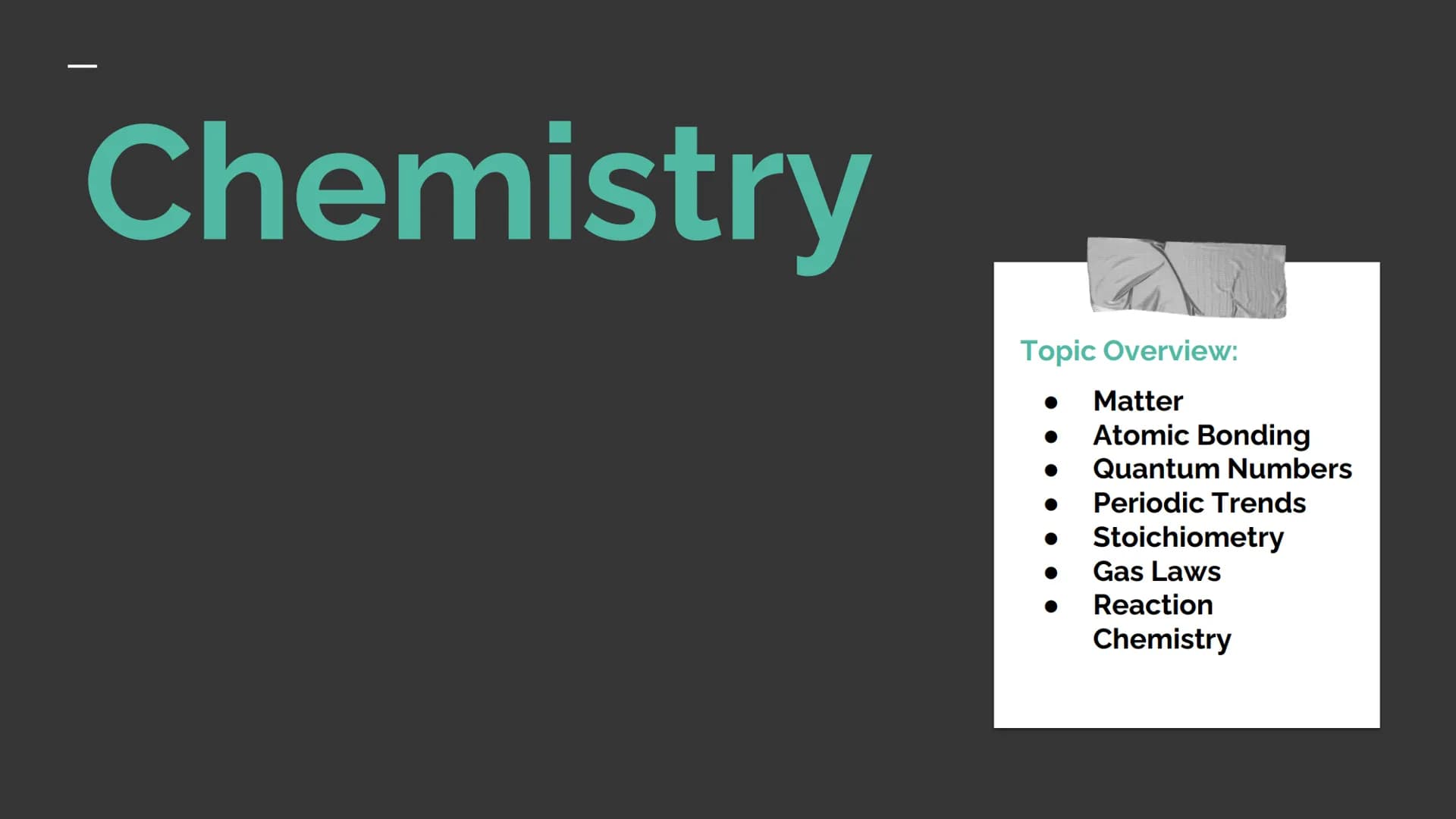
Ever wondered what topics you need to master in chemistry class? Your chemistry curriculum covers everything from the basic building blocks of matter to how substances change during reactions.
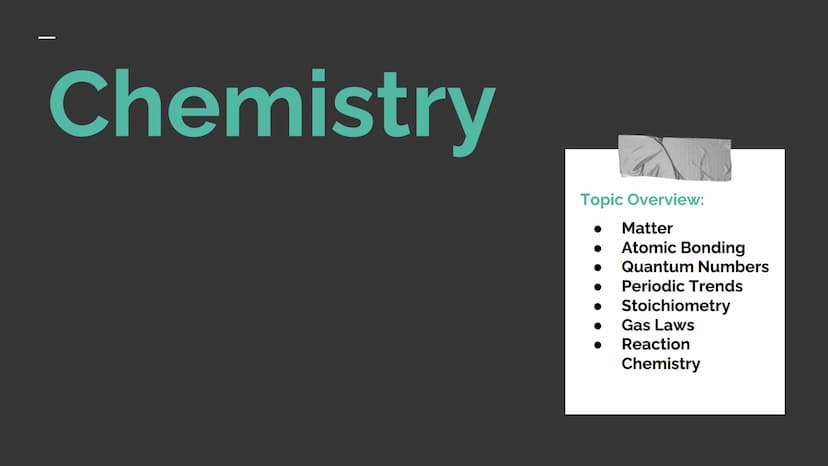
Key topics include understanding matter and its properties, how atoms bond together, quantum numbers that describe electrons, and periodic trends in the elements. You'll also learn about stoichiometry (the math of chemistry), gas laws that predict how gases behave, and reaction chemistry that explains how substances transform.
💡 Think of chemistry as a toolkit that helps you understand how everything in our world is made and how it changes.
Matter is literally everything around you—your desk, the air, even you! Understanding its properties helps you predict how substances behave.
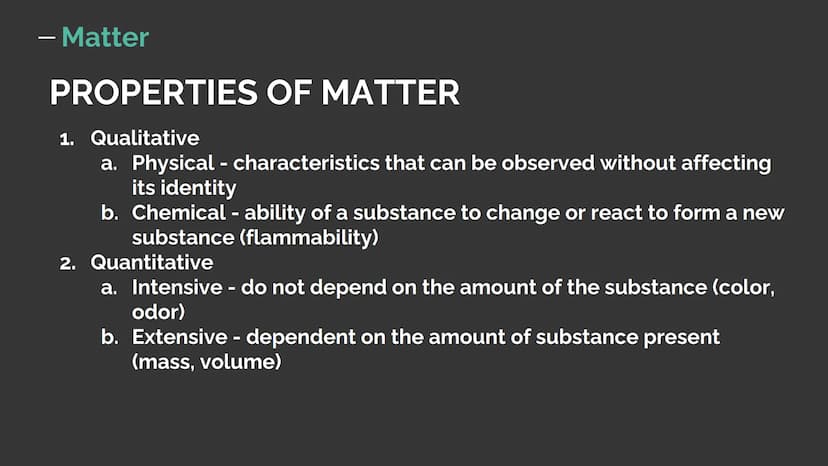
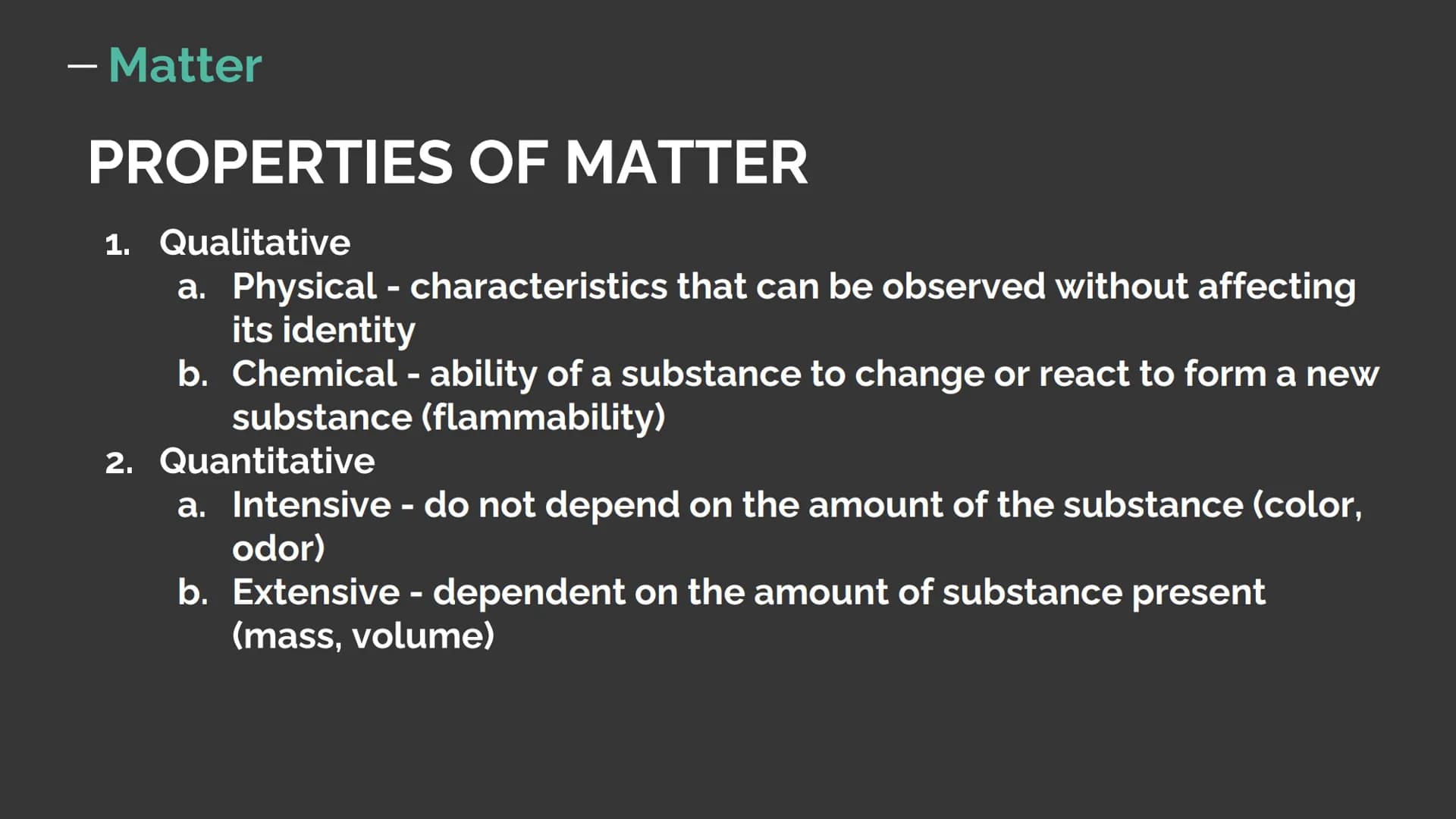
Qualitative properties describe matter without measurements. These include physical properties like color or texture that don't change a substance's identity, and chemical properties like flammability that show how substances can transform into new ones.
Quantitative properties can be measured numerically. Intensive properties like color or density stay the same regardless of sample size. Extensive properties like mass or volume depend on how much of the substance you have.
🔑 Remember: Intensive properties (like boiling point) remain constant whether you have a drop or an ocean of a substance, while extensive properties (like weight) change with amount.
The state of matter affects how a substance behaves, and it all comes down to the arrangement of molecules.
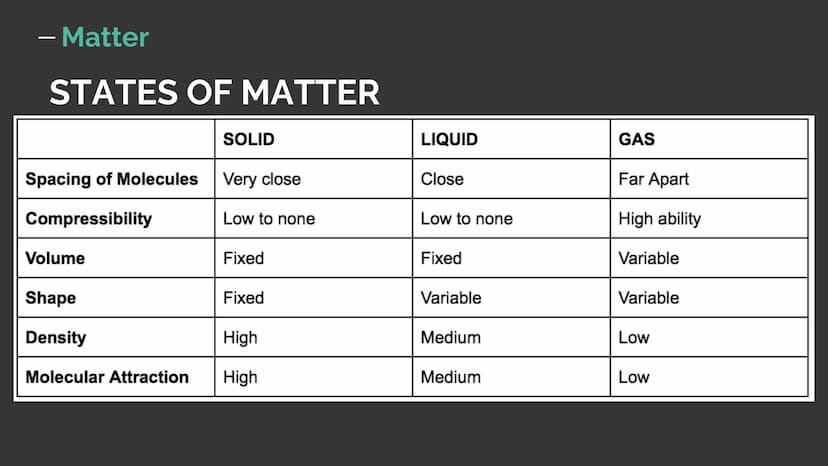
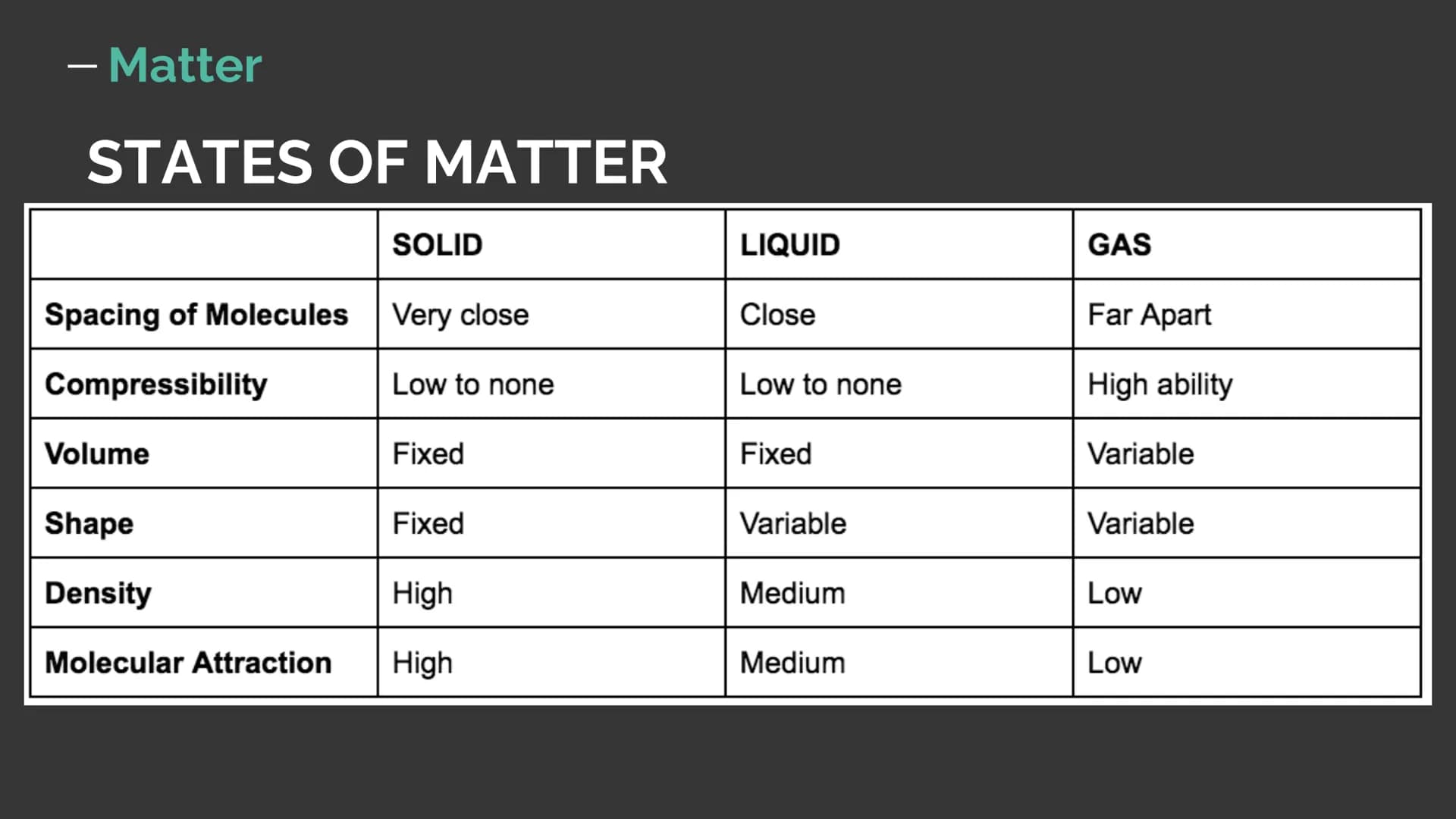
In solids, molecules are packed tightly together with strong attractions, giving them fixed shape, fixed volume, and high density. They're barely compressible because particles have little room to move.
Liquids have molecules closer together than gases but less organized than solids. They maintain a fixed volume but take the shape of their container with medium molecular attraction and density.
Gases feature molecules spaced far apart with minimal attraction. This gives gases variable shape and volume, low density, and high compressibility.
💡 Think about water in its three states: ice (solid) holds its shape, liquid water flows but doesn't compress, and steam (gas) expands to fill whatever space it's in.
Everything around you is constantly changing, but not all changes are created equal!
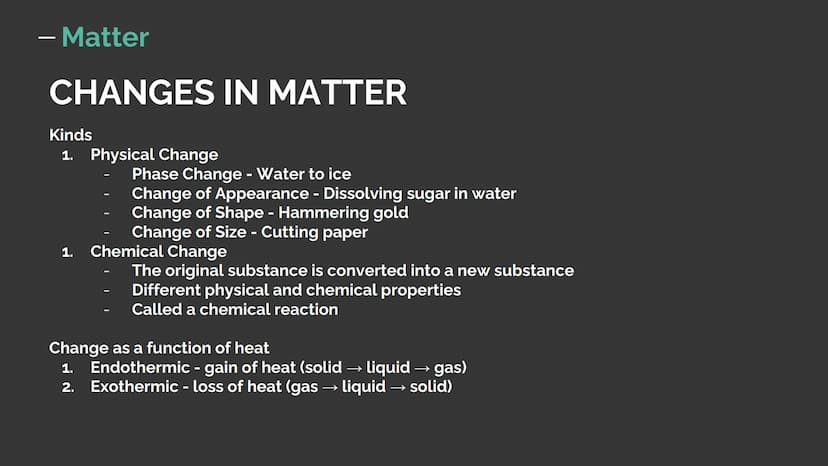
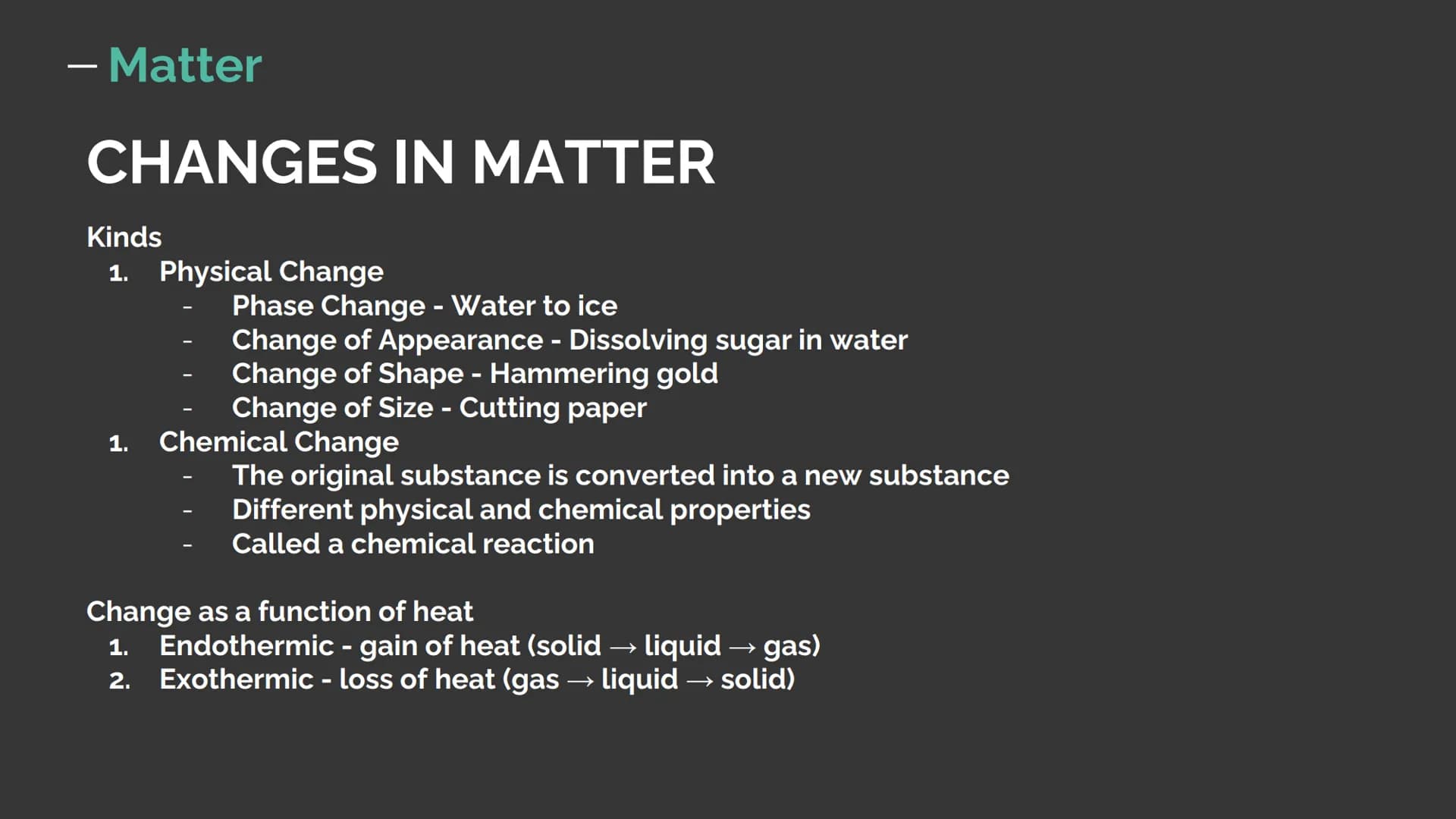
Physical changes alter appearance without creating new substances. Examples include phase changes (water freezing), dissolving (sugar in water), or reshaping objects (cutting paper). The chemical identity stays the same.
Chemical changes, also called reactions, transform substances into completely new ones with different properties. When wood burns or metal rusts, the original substance is fundamentally altered.
Changes also involve heat energy. Endothermic changes absorb heat from surroundings (like ice melting), while exothermic changes release heat (like burning wood). Generally, going from solid→liquid→gas absorbs heat, while gas→liquid→solid releases it.
🔑 Quick test: If you can reverse the change easily and get back the original substance with its same properties, it's probably physical. If not, it's likely chemical.
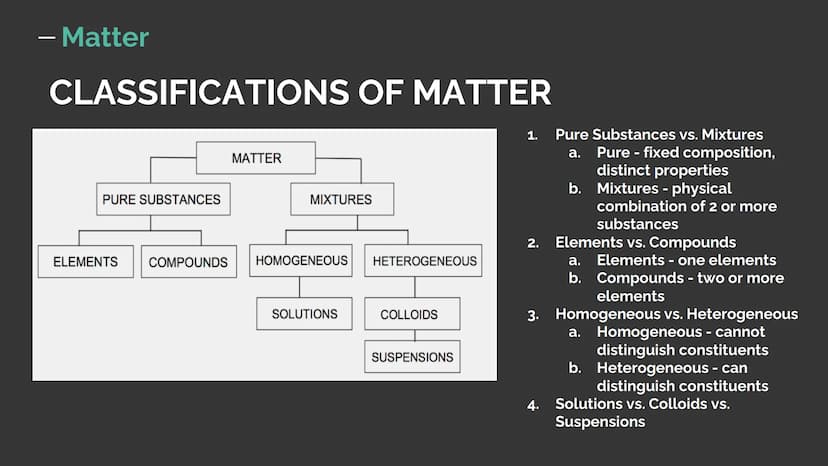
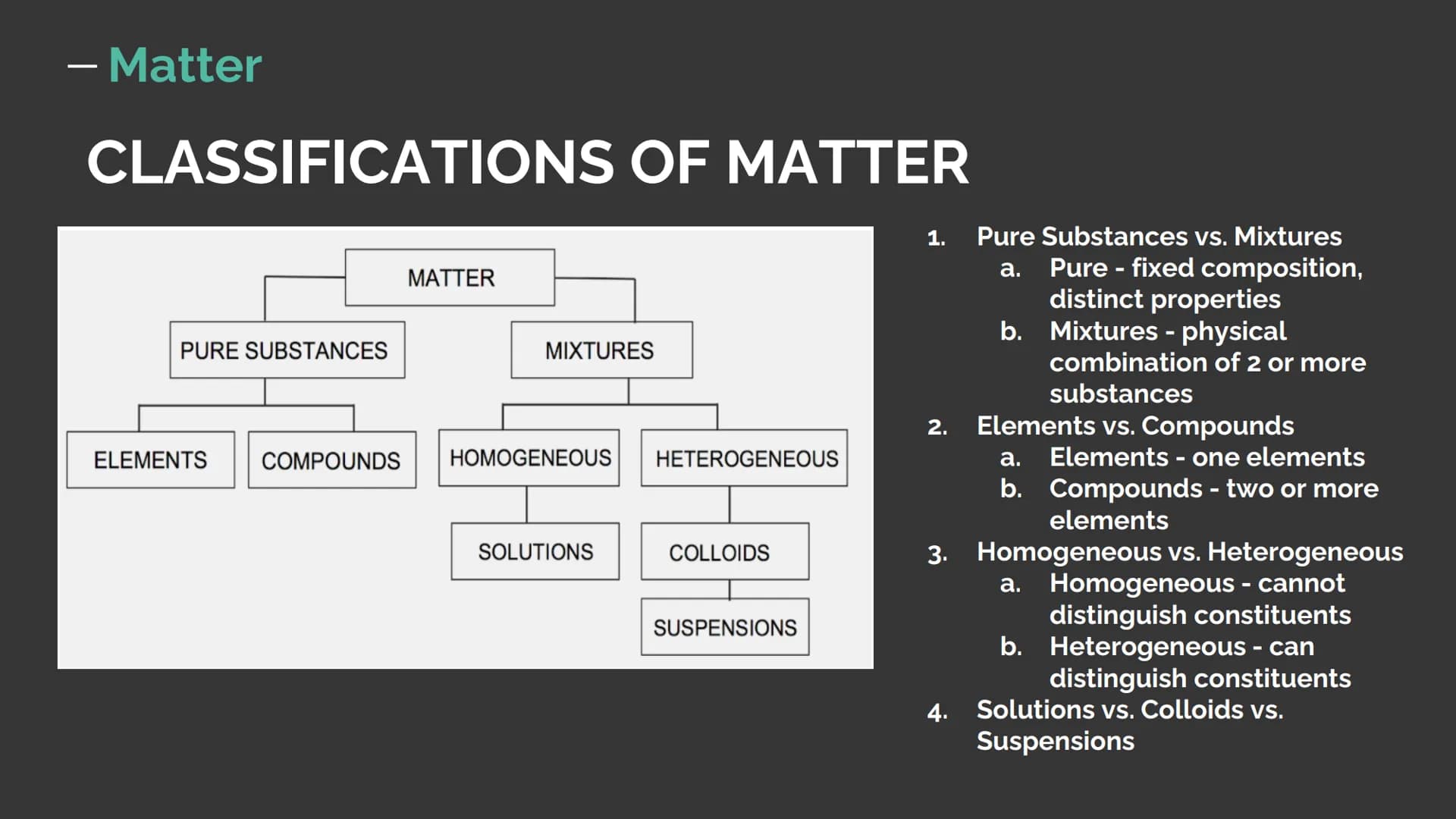
Matter can be organized into categories that help us understand its composition and behavior.
Pure substances have fixed compositions and distinct properties. They include elements (made of one type of atom, like oxygen) and compounds (different elements chemically bonded, like water).
Mixtures are physical combinations of two or more substances. Homogeneous mixtures (like salt water) appear uniform throughout—you can't distinguish the components visually. Heterogeneous mixtures (like a salad) have visibly distinct parts.
Homogeneous mixtures include solutions (like salt water), while heterogeneous mixtures include colloids (like milk) and suspensions (like muddy water).
💡 Think of it this way: Pure substances are like single instruments playing, while mixtures are like bands of different instruments playing together—either in harmony (homogeneous) or with distinct parts (heterogeneous).
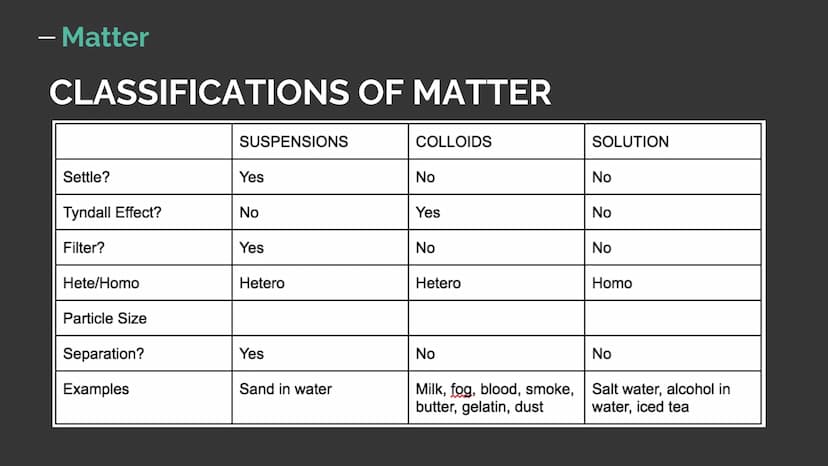
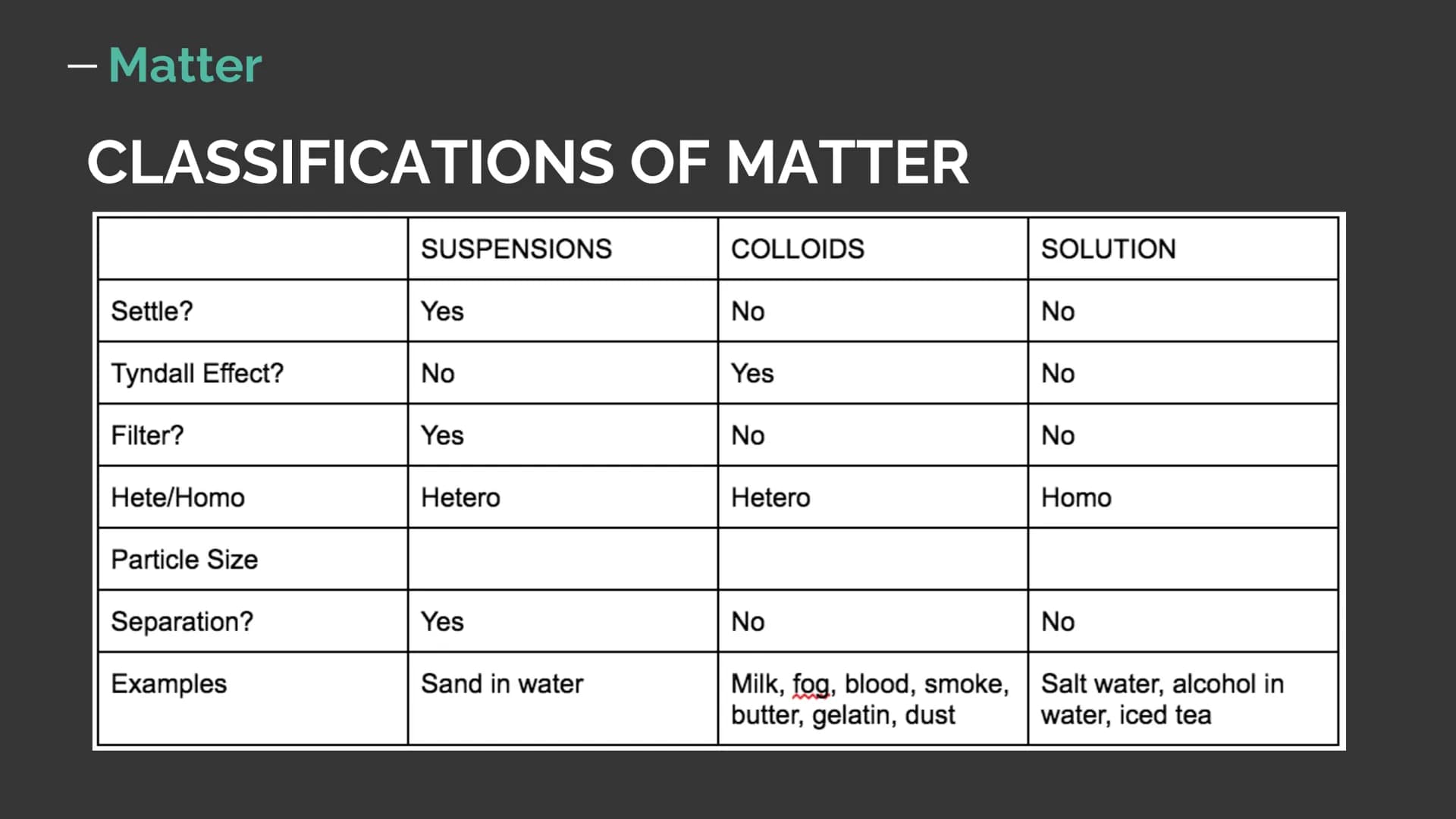
Not all mixtures behave the same way! Understanding the differences helps you predict their properties.
Solutions like salt water are homogeneous mixtures with particles smaller than 1 nanometer. The components won't settle out, can't be filtered, and don't scatter light (no Tyndall effect).
Colloids like milk or fog have medium-sized particles that don't settle out but do scatter light (showing the Tyndall effect). They're technically heterogeneous but may look uniform.
Suspensions like muddy water have large particles that will eventually settle out due to gravity. They scatter light, can be filtered, and are clearly heterogeneous.
🔑 Shine a flashlight through your drink: if you can see the beam (like in milk), it's a colloid. If not (like in tea), it's a solution. If particles are settling to the bottom, it's a suspension.
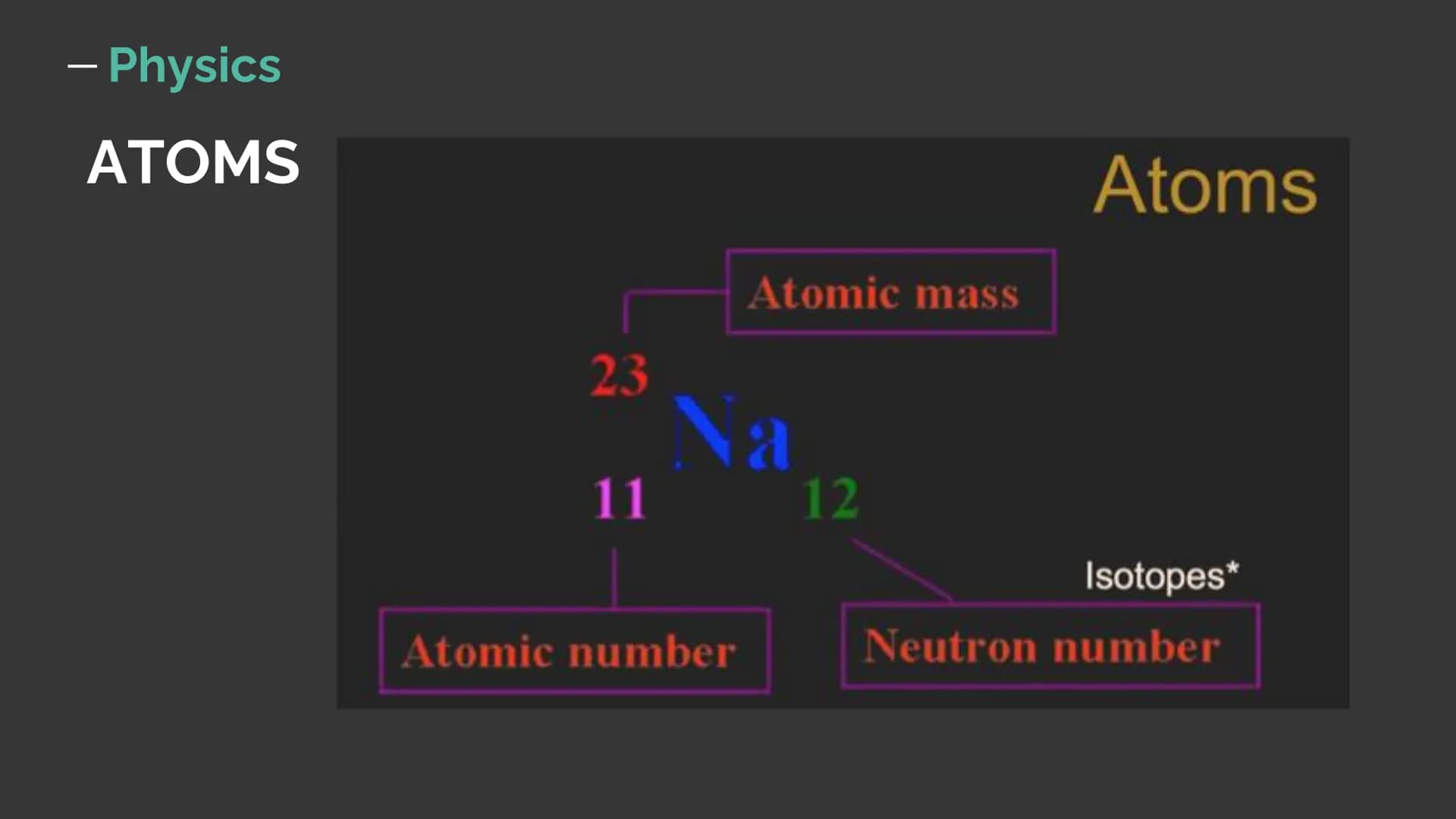
Atoms are the basic building blocks of matter, and understanding their structure is key to mastering chemistry.
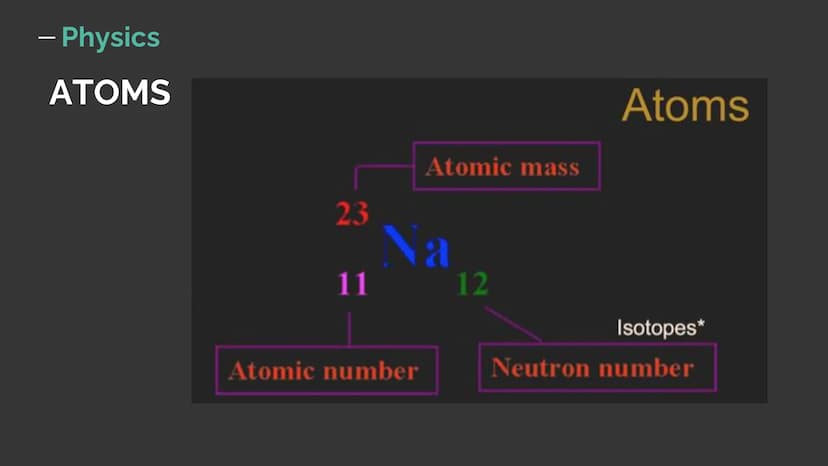
The atomic number (shown at the bottom of an element's symbol) tells you how many protons are in the nucleus. This number defines the element—for example, sodium (Na) always has 11 protons.
The atomic mass (shown at the top) approximates the total number of protons and neutrons. The neutron number can be calculated by subtracting the atomic number from the mass number.
Isotopes are atoms of the same element (same number of protons) but with different numbers of neutrons. For example, carbon-12 and carbon-14 are isotopes of carbon with different neutron counts.
💡 Think of isotopes like siblings in a family: they share the same "last name" (proton number) but have different "first names" (neutron counts).
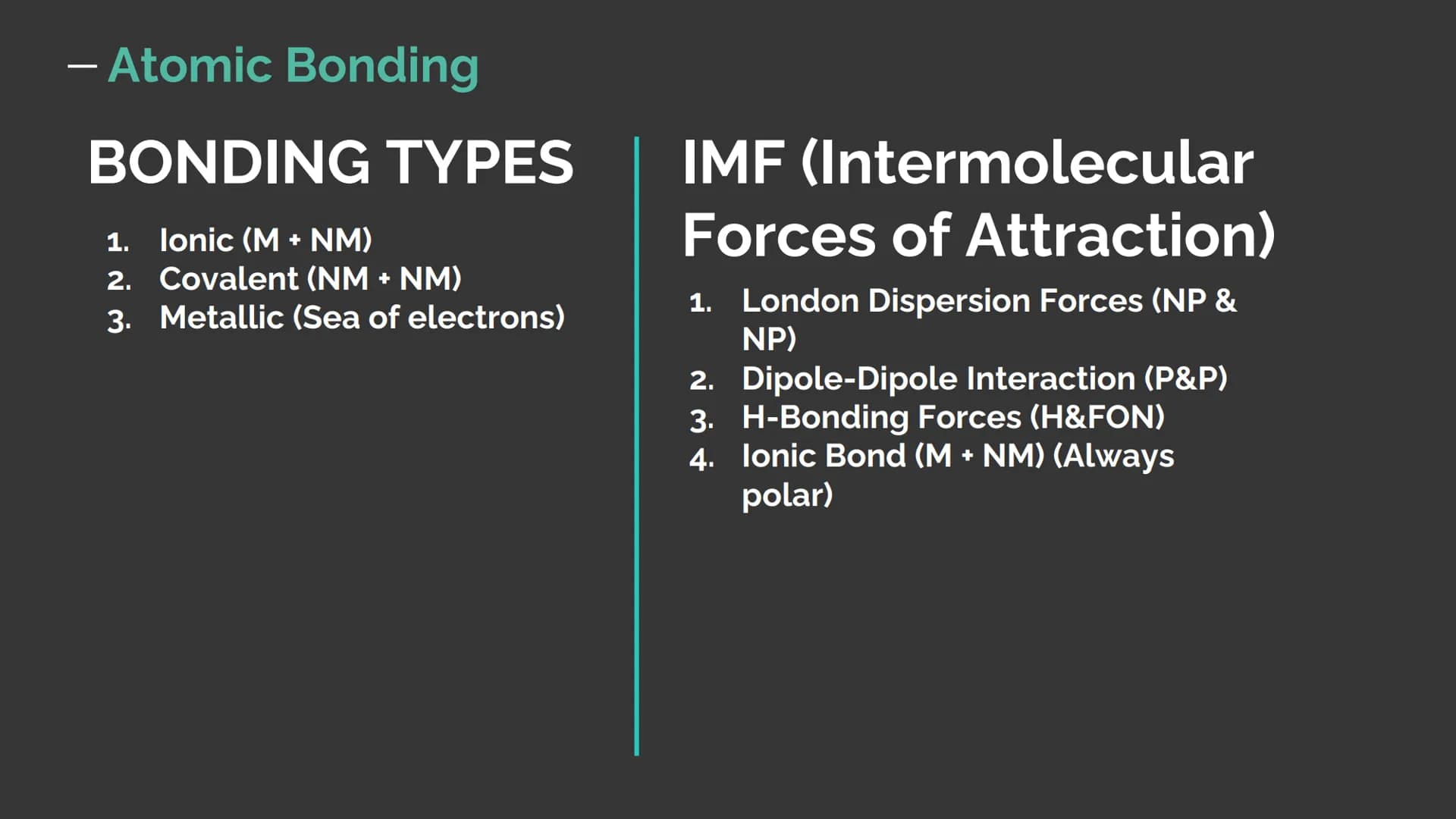
Chemical bonds are what hold atoms together, and they determine a substance's properties.
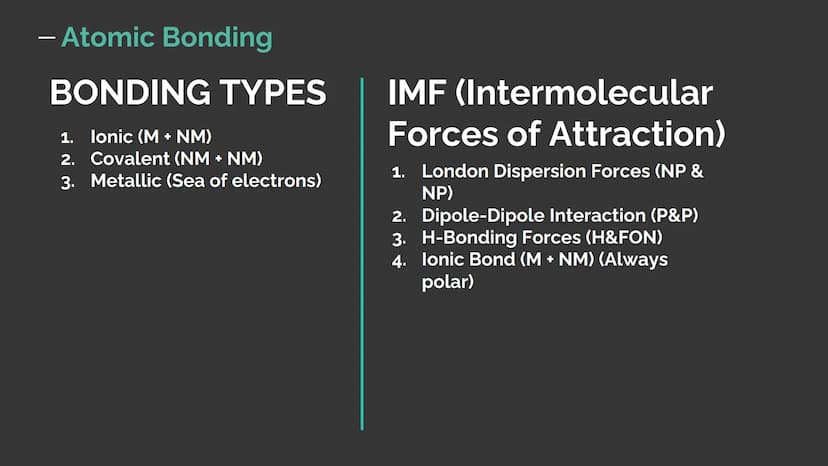
Ionic bonds form when a metal transfers electrons to a nonmetal (like in table salt, NaCl). The resulting opposite charges create a strong attraction. These compounds typically have high melting points and conduct electricity when dissolved.
Covalent bonds occur when nonmetals share electrons (like in water, H₂O). These can be polar (unequal sharing) or nonpolar (equal sharing).
Metallic bonds form in metals, where the outer electrons create a "sea of electrons" moving freely among positive metal ions, explaining why metals conduct electricity well.
Intermolecular forces (IMFs) are attractions between molecules. From weakest to strongest: London dispersion forces (between nonpolar molecules), dipole-dipole interactions (between polar molecules), and hydrogen bonds (when hydrogen bonds to F, O, or N).
🔑 The type of bonding explains why salt shatters when hit, water flows, and copper conducts electricity!
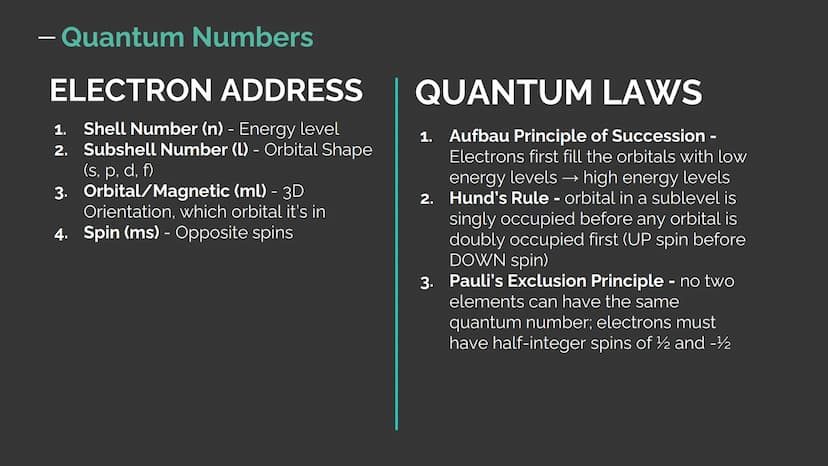
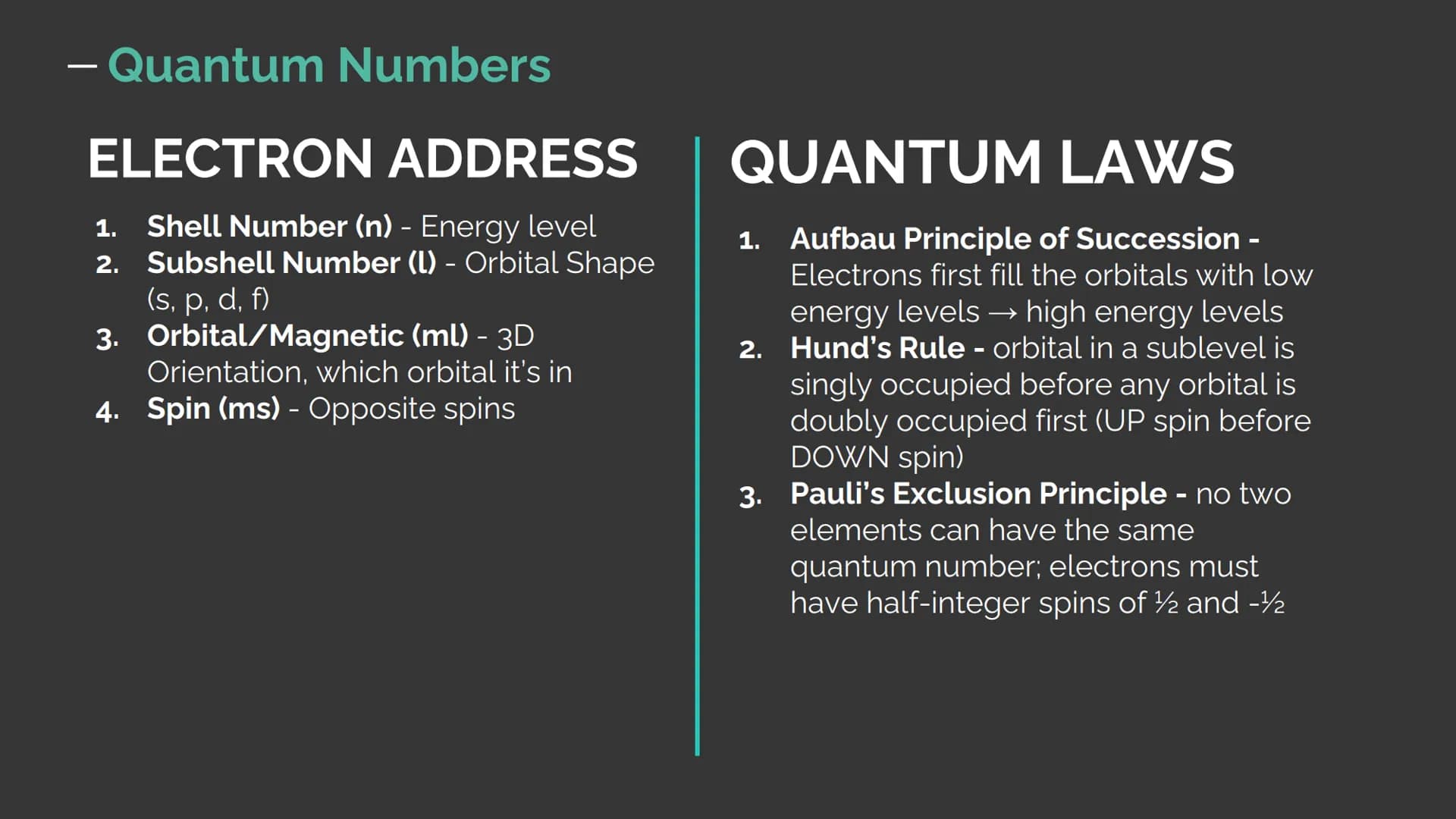
Electrons aren't randomly placed in atoms—they follow specific rules described by quantum numbers, which act like an "address" for each electron.
The principal quantum number (n) indicates the main energy level (shell), with higher numbers being farther from the nucleus. This determines the electron's energy.
The angular momentum quantum number (l) describes the shape of the orbital (s, p, d, f) within each energy level.
The magnetic quantum number (ml) shows the orbital's 3D orientation in space—which specific orbital within the subshell houses the electron.
The spin quantum number (ms) indicates the electron's spin direction .
💡 Remember three key laws: the Aufbau Principle (electrons fill lowest energy levels first), Hund's Rule (electrons occupy orbitals singly before pairing), and Pauli's Exclusion Principle (no two electrons can have identical quantum numbers).
The periodic table isn't randomly arranged—it reveals patterns that help predict element properties!
Atomic radius generally increases as you move down a group (adding new electron shells) and decreases across a period (increasing nuclear charge pulls electrons tighter).
Ionization energy—the energy needed to remove an electron—increases as you move right across a period and decreases as you move down a group. Elements that easily lose electrons (like metals) have low ionization energies.
Electron affinity—how likely an atom is to gain an electron—generally increases across a period and decreases down a group. High electron affinity means the element readily accepts electrons.
The columns (groups) tell you how many valence electrons an element has, which determines its chemical behavior.
🔑 Elements in the same column behave similarly because they have the same number of valence electrons—that's why lithium, sodium, and potassium all react vigorously with water!
Our AI companion is specifically built for the needs of students. Based on the millions of content pieces we have on the platform we can provide truly meaningful and relevant answers to students. But its not only about answers, the companion is even more about guiding students through their daily learning challenges, with personalised study plans, quizzes or content pieces in the chat and 100% personalisation based on the students skills and developments.
You can download the app in the Google Play Store and in the Apple App Store.
That's right! Enjoy free access to study content, connect with fellow students, and get instant help – all at your fingertips.
Study notes on chemical nomenclature of chemistry
 AP Chemistry
App Store
Google Play
The app is very easy to use and well designed. I have found everything I was looking for so far and have been able to learn a lot from the presentations! I will definitely use the app for a class assignment! And of course it also helps a lot as an inspiration.
Stefan S
iOS user
This app is really great. There are so many study notes and help [...]. My problem subject is French, for example, and the app has so many options for help. Thanks to this app, I have improved my French. I would recommend it to anyone.
Samantha Klich
Android user
Wow, I am really amazed. I just tried the app because I've seen it advertised many times and was absolutely stunned. This app is THE HELP you want for school and above all, it offers so many things, such as workouts and fact sheets, which have been VERY helpful to me personally.
Anna
iOS user
I think it’s very much worth it and you’ll end up using it a lot once you get the hang of it and even after looking at others notes you can still ask your Artificial intelligence buddy the question and ask to simplify it if you still don’t get it!!! In the end I think it’s worth it 😊👍 ⚠️Also DID I MENTION ITS FREEE YOU DON’T HAVE TO PAY FOR ANYTHING AND STILL GET YOUR GRADES IN PERFECTLY❗️❗️⚠️
Thomas R
iOS user
Knowunity is the BEST app I’ve used in a minute. This is not an ai review or anything this is genuinely coming from a 7th grade student (I know 2011 im young) but dude this app is a 10/10 i have maintained a 3.8 gpa and have plenty of time for gaming. I love it and my mom is just happy I got good grades
Brad T
Android user
Not only did it help me find the answer but it also showed me alternative ways to solve it. I was horrible in math and science but now I have an a in both subjects. Thanks for the help🤍🤍
David K
iOS user
The app's just great! All I have to do is enter the topic in the search bar and I get the response real fast. I don't have to watch 10 YouTube videos to understand something, so I'm saving my time. Highly recommended!
Sudenaz Ocak
Android user
In school I was really bad at maths but thanks to the app, I am doing better now. I am so grateful that you made the app.
Greenlight Bonnie
Android user
I found this app a couple years ago and it has only gotten better since then. I really love it because it can help with written questions and photo questions. Also, it can find study guides that other people have made as well as flashcard sets and practice tests. The free version is also amazing for students who might not be able to afford it. Would 100% recommend
Aubrey
iOS user
Best app if you're in Highschool or Junior high. I have been using this app for 2 school years and it's the best, it's good if you don't have anyone to help you with school work.😋🩷🎀
Marco B
iOS user
THE QUIZES AND FLASHCARDS ARE SO USEFUL AND I LOVE Knowunity AI. IT ALSO IS LITREALLY LIKE CHATGPT BUT SMARTER!! HELPED ME WITH MY MASCARA PROBLEMS TOO!! AS WELL AS MY REAL SUBJECTS ! DUHHH 😍😁😲🤑💗✨🎀😮
Elisha
iOS user
This app is phenomenal down to the correct info and the various topics you can study! I greatly recommend it for people who struggle with procrastination and those who need homework help. It has been perfectly accurate for world 1 history as far as I’ve seen! Geometry too!
Paul T
iOS user
The app is very easy to use and well designed. I have found everything I was looking for so far and have been able to learn a lot from the presentations! I will definitely use the app for a class assignment! And of course it also helps a lot as an inspiration.
Stefan S
iOS user
This app is really great. There are so many study notes and help [...]. My problem subject is French, for example, and the app has so many options for help. Thanks to this app, I have improved my French. I would recommend it to anyone.
Samantha Klich
Android user
Wow, I am really amazed. I just tried the app because I've seen it advertised many times and was absolutely stunned. This app is THE HELP you want for school and above all, it offers so many things, such as workouts and fact sheets, which have been VERY helpful to me personally.
Anna
iOS user
I think it’s very much worth it and you’ll end up using it a lot once you get the hang of it and even after looking at others notes you can still ask your Artificial intelligence buddy the question and ask to simplify it if you still don’t get it!!! In the end I think it’s worth it 😊👍 ⚠️Also DID I MENTION ITS FREEE YOU DON’T HAVE TO PAY FOR ANYTHING AND STILL GET YOUR GRADES IN PERFECTLY❗️❗️⚠️
Thomas R
iOS user
Knowunity is the BEST app I’ve used in a minute. This is not an ai review or anything this is genuinely coming from a 7th grade student (I know 2011 im young) but dude this app is a 10/10 i have maintained a 3.8 gpa and have plenty of time for gaming. I love it and my mom is just happy I got good grades
Brad T
Android user
Not only did it help me find the answer but it also showed me alternative ways to solve it. I was horrible in math and science but now I have an a in both subjects. Thanks for the help🤍🤍
David K
iOS user
The app's just great! All I have to do is enter the topic in the search bar and I get the response real fast. I don't have to watch 10 YouTube videos to understand something, so I'm saving my time. Highly recommended!
Sudenaz Ocak
Android user
In school I was really bad at maths but thanks to the app, I am doing better now. I am so grateful that you made the app.
Greenlight Bonnie
Android user
I found this app a couple years ago and it has only gotten better since then. I really love it because it can help with written questions and photo questions. Also, it can find study guides that other people have made as well as flashcard sets and practice tests. The free version is also amazing for students who might not be able to afford it. Would 100% recommend
Aubrey
iOS user
Best app if you're in Highschool or Junior high. I have been using this app for 2 school years and it's the best, it's good if you don't have anyone to help you with school work.😋🩷🎀
Marco B
iOS user
THE QUIZES AND FLASHCARDS ARE SO USEFUL AND I LOVE Knowunity AI. IT ALSO IS LITREALLY LIKE CHATGPT BUT SMARTER!! HELPED ME WITH MY MASCARA PROBLEMS TOO!! AS WELL AS MY REAL SUBJECTS ! DUHHH 😍😁😲🤑💗✨🎀😮
Elisha
iOS user
This app is phenomenal down to the correct info and the various topics you can study! I greatly recommend it for people who struggle with procrastination and those who need homework help. It has been perfectly accurate for world 1 history as far as I’ve seen! Geometry too!
Paul T
iOS user
Chemistry is the science of matter, its properties, and how it changes through reactions. This guide breaks down essential chemistry topics, from the basics of matter to complex reaction types, making them easy to understand and remember for your tests.
Access to all documents
Improve your grades
Join milions of students
Ever wondered what topics you need to master in chemistry class? Your chemistry curriculum covers everything from the basic building blocks of matter to how substances change during reactions.
Key topics include understanding matter and its properties, how atoms bond together, quantum numbers that describe electrons, and periodic trends in the elements. You'll also learn about stoichiometry (the math of chemistry), gas laws that predict how gases behave, and reaction chemistry that explains how substances transform.
💡 Think of chemistry as a toolkit that helps you understand how everything in our world is made and how it changes.
Access to all documents
Improve your grades
Join milions of students
Matter is literally everything around you—your desk, the air, even you! Understanding its properties helps you predict how substances behave.
Qualitative properties describe matter without measurements. These include physical properties like color or texture that don't change a substance's identity, and chemical properties like flammability that show how substances can transform into new ones.
Quantitative properties can be measured numerically. Intensive properties like color or density stay the same regardless of sample size. Extensive properties like mass or volume depend on how much of the substance you have.
🔑 Remember: Intensive properties (like boiling point) remain constant whether you have a drop or an ocean of a substance, while extensive properties (like weight) change with amount.
Access to all documents
Improve your grades
Join milions of students
The state of matter affects how a substance behaves, and it all comes down to the arrangement of molecules.
In solids, molecules are packed tightly together with strong attractions, giving them fixed shape, fixed volume, and high density. They're barely compressible because particles have little room to move.
Liquids have molecules closer together than gases but less organized than solids. They maintain a fixed volume but take the shape of their container with medium molecular attraction and density.
Gases feature molecules spaced far apart with minimal attraction. This gives gases variable shape and volume, low density, and high compressibility.
💡 Think about water in its three states: ice (solid) holds its shape, liquid water flows but doesn't compress, and steam (gas) expands to fill whatever space it's in.
Access to all documents
Improve your grades
Join milions of students
Everything around you is constantly changing, but not all changes are created equal!
Physical changes alter appearance without creating new substances. Examples include phase changes (water freezing), dissolving (sugar in water), or reshaping objects (cutting paper). The chemical identity stays the same.
Chemical changes, also called reactions, transform substances into completely new ones with different properties. When wood burns or metal rusts, the original substance is fundamentally altered.
Changes also involve heat energy. Endothermic changes absorb heat from surroundings (like ice melting), while exothermic changes release heat (like burning wood). Generally, going from solid→liquid→gas absorbs heat, while gas→liquid→solid releases it.
🔑 Quick test: If you can reverse the change easily and get back the original substance with its same properties, it's probably physical. If not, it's likely chemical.
Access to all documents
Improve your grades
Join milions of students
Matter can be organized into categories that help us understand its composition and behavior.
Pure substances have fixed compositions and distinct properties. They include elements (made of one type of atom, like oxygen) and compounds (different elements chemically bonded, like water).
Mixtures are physical combinations of two or more substances. Homogeneous mixtures (like salt water) appear uniform throughout—you can't distinguish the components visually. Heterogeneous mixtures (like a salad) have visibly distinct parts.
Homogeneous mixtures include solutions (like salt water), while heterogeneous mixtures include colloids (like milk) and suspensions (like muddy water).
💡 Think of it this way: Pure substances are like single instruments playing, while mixtures are like bands of different instruments playing together—either in harmony (homogeneous) or with distinct parts (heterogeneous).
Access to all documents
Improve your grades
Join milions of students
Not all mixtures behave the same way! Understanding the differences helps you predict their properties.
Solutions like salt water are homogeneous mixtures with particles smaller than 1 nanometer. The components won't settle out, can't be filtered, and don't scatter light (no Tyndall effect).
Colloids like milk or fog have medium-sized particles that don't settle out but do scatter light (showing the Tyndall effect). They're technically heterogeneous but may look uniform.
Suspensions like muddy water have large particles that will eventually settle out due to gravity. They scatter light, can be filtered, and are clearly heterogeneous.
🔑 Shine a flashlight through your drink: if you can see the beam (like in milk), it's a colloid. If not (like in tea), it's a solution. If particles are settling to the bottom, it's a suspension.
Access to all documents
Improve your grades
Join milions of students
Atoms are the basic building blocks of matter, and understanding their structure is key to mastering chemistry.
The atomic number (shown at the bottom of an element's symbol) tells you how many protons are in the nucleus. This number defines the element—for example, sodium (Na) always has 11 protons.
The atomic mass (shown at the top) approximates the total number of protons and neutrons. The neutron number can be calculated by subtracting the atomic number from the mass number.
Isotopes are atoms of the same element (same number of protons) but with different numbers of neutrons. For example, carbon-12 and carbon-14 are isotopes of carbon with different neutron counts.
💡 Think of isotopes like siblings in a family: they share the same "last name" (proton number) but have different "first names" (neutron counts).
Access to all documents
Improve your grades
Join milions of students
Chemical bonds are what hold atoms together, and they determine a substance's properties.
Ionic bonds form when a metal transfers electrons to a nonmetal (like in table salt, NaCl). The resulting opposite charges create a strong attraction. These compounds typically have high melting points and conduct electricity when dissolved.
Covalent bonds occur when nonmetals share electrons (like in water, H₂O). These can be polar (unequal sharing) or nonpolar (equal sharing).
Metallic bonds form in metals, where the outer electrons create a "sea of electrons" moving freely among positive metal ions, explaining why metals conduct electricity well.
Intermolecular forces (IMFs) are attractions between molecules. From weakest to strongest: London dispersion forces (between nonpolar molecules), dipole-dipole interactions (between polar molecules), and hydrogen bonds (when hydrogen bonds to F, O, or N).
🔑 The type of bonding explains why salt shatters when hit, water flows, and copper conducts electricity!
Access to all documents
Improve your grades
Join milions of students
Electrons aren't randomly placed in atoms—they follow specific rules described by quantum numbers, which act like an "address" for each electron.
The principal quantum number (n) indicates the main energy level (shell), with higher numbers being farther from the nucleus. This determines the electron's energy.
The angular momentum quantum number (l) describes the shape of the orbital (s, p, d, f) within each energy level.
The magnetic quantum number (ml) shows the orbital's 3D orientation in space—which specific orbital within the subshell houses the electron.
The spin quantum number (ms) indicates the electron's spin direction .
💡 Remember three key laws: the Aufbau Principle (electrons fill lowest energy levels first), Hund's Rule (electrons occupy orbitals singly before pairing), and Pauli's Exclusion Principle (no two electrons can have identical quantum numbers).
Access to all documents
Improve your grades
Join milions of students
The periodic table isn't randomly arranged—it reveals patterns that help predict element properties!
Atomic radius generally increases as you move down a group (adding new electron shells) and decreases across a period (increasing nuclear charge pulls electrons tighter).
Ionization energy—the energy needed to remove an electron—increases as you move right across a period and decreases as you move down a group. Elements that easily lose electrons (like metals) have low ionization energies.
Electron affinity—how likely an atom is to gain an electron—generally increases across a period and decreases down a group. High electron affinity means the element readily accepts electrons.
The columns (groups) tell you how many valence electrons an element has, which determines its chemical behavior.
🔑 Elements in the same column behave similarly because they have the same number of valence electrons—that's why lithium, sodium, and potassium all react vigorously with water!
Our AI companion is specifically built for the needs of students. Based on the millions of content pieces we have on the platform we can provide truly meaningful and relevant answers to students. But its not only about answers, the companion is even more about guiding students through their daily learning challenges, with personalised study plans, quizzes or content pieces in the chat and 100% personalisation based on the students skills and developments.
You can download the app in the Google Play Store and in the Apple App Store.
That's right! Enjoy free access to study content, connect with fellow students, and get instant help – all at your fingertips.
7
Smart Tools NEW
Transform this note into: ✓ 50+ Practice Questions ✓ Interactive Flashcards ✓ Full Practice Test ✓ Essay Outlines
Periodic trends
Chemistryabout the various groupings in the periodic table
ChemistryAn overview of the theory behind atoms and the connection it has within the periodic table of elements
ChemistryExplore the unique properties and characteristics of transition metals, including their position in the periodic table, physical and chemical properties, and their role as catalysts. This summary provides essential insights for understanding transition metals, their behavior in reactions, and their significance in various applications.
ChemistryOrganizing elements
ChemistryNotes describing the parts and structure of the Atom
ChemistryStudy notes on chemical nomenclature of chemistry
AP ChemistryApp Store
Google Play
The app is very easy to use and well designed. I have found everything I was looking for so far and have been able to learn a lot from the presentations! I will definitely use the app for a class assignment! And of course it also helps a lot as an inspiration.
Stefan S
iOS user
This app is really great. There are so many study notes and help [...]. My problem subject is French, for example, and the app has so many options for help. Thanks to this app, I have improved my French. I would recommend it to anyone.
Samantha Klich
Android user
Wow, I am really amazed. I just tried the app because I've seen it advertised many times and was absolutely stunned. This app is THE HELP you want for school and above all, it offers so many things, such as workouts and fact sheets, which have been VERY helpful to me personally.
Anna
iOS user
I think it’s very much worth it and you’ll end up using it a lot once you get the hang of it and even after looking at others notes you can still ask your Artificial intelligence buddy the question and ask to simplify it if you still don’t get it!!! In the end I think it’s worth it 😊👍 ⚠️Also DID I MENTION ITS FREEE YOU DON’T HAVE TO PAY FOR ANYTHING AND STILL GET YOUR GRADES IN PERFECTLY❗️❗️⚠️
Thomas R
iOS user
Knowunity is the BEST app I’ve used in a minute. This is not an ai review or anything this is genuinely coming from a 7th grade student (I know 2011 im young) but dude this app is a 10/10 i have maintained a 3.8 gpa and have plenty of time for gaming. I love it and my mom is just happy I got good grades
Brad T
Android user
Not only did it help me find the answer but it also showed me alternative ways to solve it. I was horrible in math and science but now I have an a in both subjects. Thanks for the help🤍🤍
David K
iOS user
The app's just great! All I have to do is enter the topic in the search bar and I get the response real fast. I don't have to watch 10 YouTube videos to understand something, so I'm saving my time. Highly recommended!
Sudenaz Ocak
Android user
In school I was really bad at maths but thanks to the app, I am doing better now. I am so grateful that you made the app.
Greenlight Bonnie
Android user
I found this app a couple years ago and it has only gotten better since then. I really love it because it can help with written questions and photo questions. Also, it can find study guides that other people have made as well as flashcard sets and practice tests. The free version is also amazing for students who might not be able to afford it. Would 100% recommend
Aubrey
iOS user
Best app if you're in Highschool or Junior high. I have been using this app for 2 school years and it's the best, it's good if you don't have anyone to help you with school work.😋🩷🎀
Marco B
iOS user
THE QUIZES AND FLASHCARDS ARE SO USEFUL AND I LOVE Knowunity AI. IT ALSO IS LITREALLY LIKE CHATGPT BUT SMARTER!! HELPED ME WITH MY MASCARA PROBLEMS TOO!! AS WELL AS MY REAL SUBJECTS ! DUHHH 😍😁😲🤑💗✨🎀😮
Elisha
iOS user
This app is phenomenal down to the correct info and the various topics you can study! I greatly recommend it for people who struggle with procrastination and those who need homework help. It has been perfectly accurate for world 1 history as far as I’ve seen! Geometry too!
Paul T
iOS user
The app is very easy to use and well designed. I have found everything I was looking for so far and have been able to learn a lot from the presentations! I will definitely use the app for a class assignment! And of course it also helps a lot as an inspiration.
Stefan S
iOS user
This app is really great. There are so many study notes and help [...]. My problem subject is French, for example, and the app has so many options for help. Thanks to this app, I have improved my French. I would recommend it to anyone.
Samantha Klich
Android user
Wow, I am really amazed. I just tried the app because I've seen it advertised many times and was absolutely stunned. This app is THE HELP you want for school and above all, it offers so many things, such as workouts and fact sheets, which have been VERY helpful to me personally.
Anna
iOS user
I think it’s very much worth it and you’ll end up using it a lot once you get the hang of it and even after looking at others notes you can still ask your Artificial intelligence buddy the question and ask to simplify it if you still don’t get it!!! In the end I think it’s worth it 😊👍 ⚠️Also DID I MENTION ITS FREEE YOU DON’T HAVE TO PAY FOR ANYTHING AND STILL GET YOUR GRADES IN PERFECTLY❗️❗️⚠️
Thomas R
iOS user
Knowunity is the BEST app I’ve used in a minute. This is not an ai review or anything this is genuinely coming from a 7th grade student (I know 2011 im young) but dude this app is a 10/10 i have maintained a 3.8 gpa and have plenty of time for gaming. I love it and my mom is just happy I got good grades
Brad T
Android user
Not only did it help me find the answer but it also showed me alternative ways to solve it. I was horrible in math and science but now I have an a in both subjects. Thanks for the help🤍🤍
David K
iOS user
The app's just great! All I have to do is enter the topic in the search bar and I get the response real fast. I don't have to watch 10 YouTube videos to understand something, so I'm saving my time. Highly recommended!
Sudenaz Ocak
Android user
In school I was really bad at maths but thanks to the app, I am doing better now. I am so grateful that you made the app.
Greenlight Bonnie
Android user
I found this app a couple years ago and it has only gotten better since then. I really love it because it can help with written questions and photo questions. Also, it can find study guides that other people have made as well as flashcard sets and practice tests. The free version is also amazing for students who might not be able to afford it. Would 100% recommend
Aubrey
iOS user
Best app if you're in Highschool or Junior high. I have been using this app for 2 school years and it's the best, it's good if you don't have anyone to help you with school work.😋🩷🎀
Marco B
iOS user
THE QUIZES AND FLASHCARDS ARE SO USEFUL AND I LOVE Knowunity AI. IT ALSO IS LITREALLY LIKE CHATGPT BUT SMARTER!! HELPED ME WITH MY MASCARA PROBLEMS TOO!! AS WELL AS MY REAL SUBJECTS ! DUHHH 😍😁😲🤑💗✨🎀😮
Elisha
iOS user
This app is phenomenal down to the correct info and the various topics you can study! I greatly recommend it for people who struggle with procrastination and those who need homework help. It has been perfectly accurate for world 1 history as far as I’ve seen! Geometry too!
Paul T
iOS user