Open the App

Subjects

Legal and Ethical Issues in Social Work: A Guide

0

0

user profile picture

Knowunity Philippines

12/12/2025

DIASS

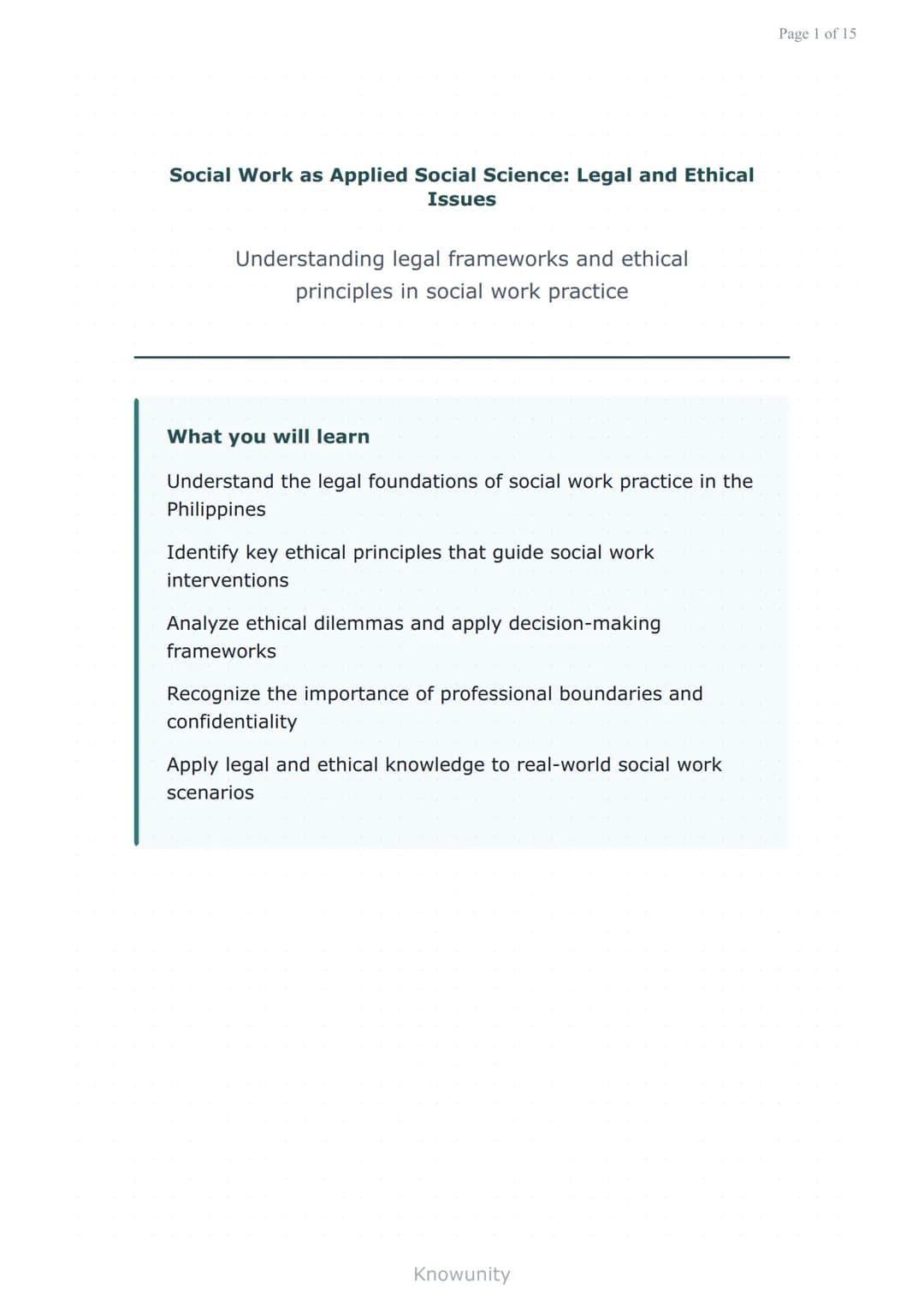
Social Work as Applied Social Science: Legal and Ethical Issues

25

Dec 12, 2025

15 pages

Legal and Ethical Issues in Social Work: A Guide

user profile picture

Knowunity Philippines

@knowunityphilippines

Social work combines scientific knowledge with practical skills to help... Show more

Page 1
Page 2
Page 3
Page 4
Page 5
Page 6
Page 7
Page 8
Page 9
Page 10
1 / 10
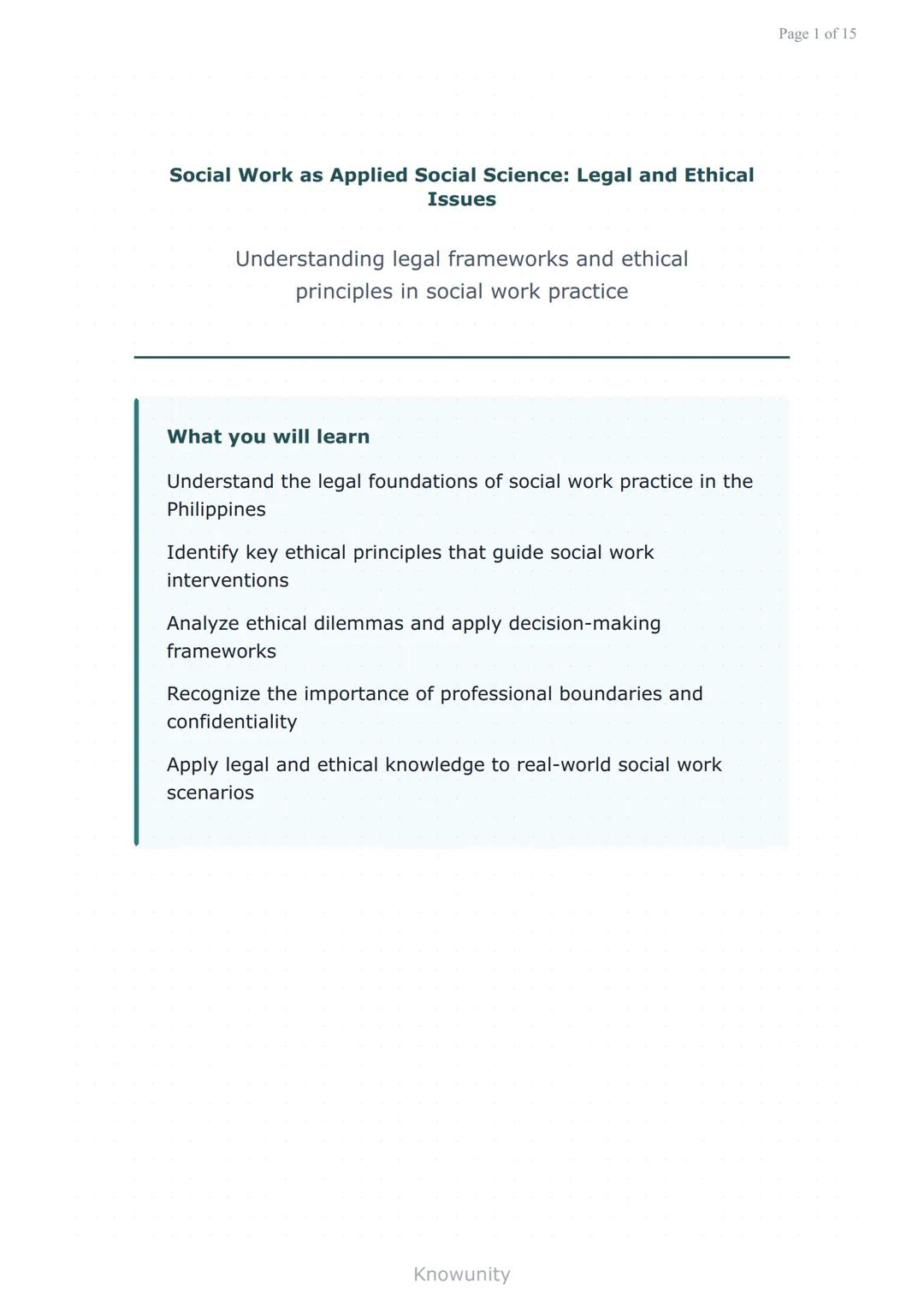
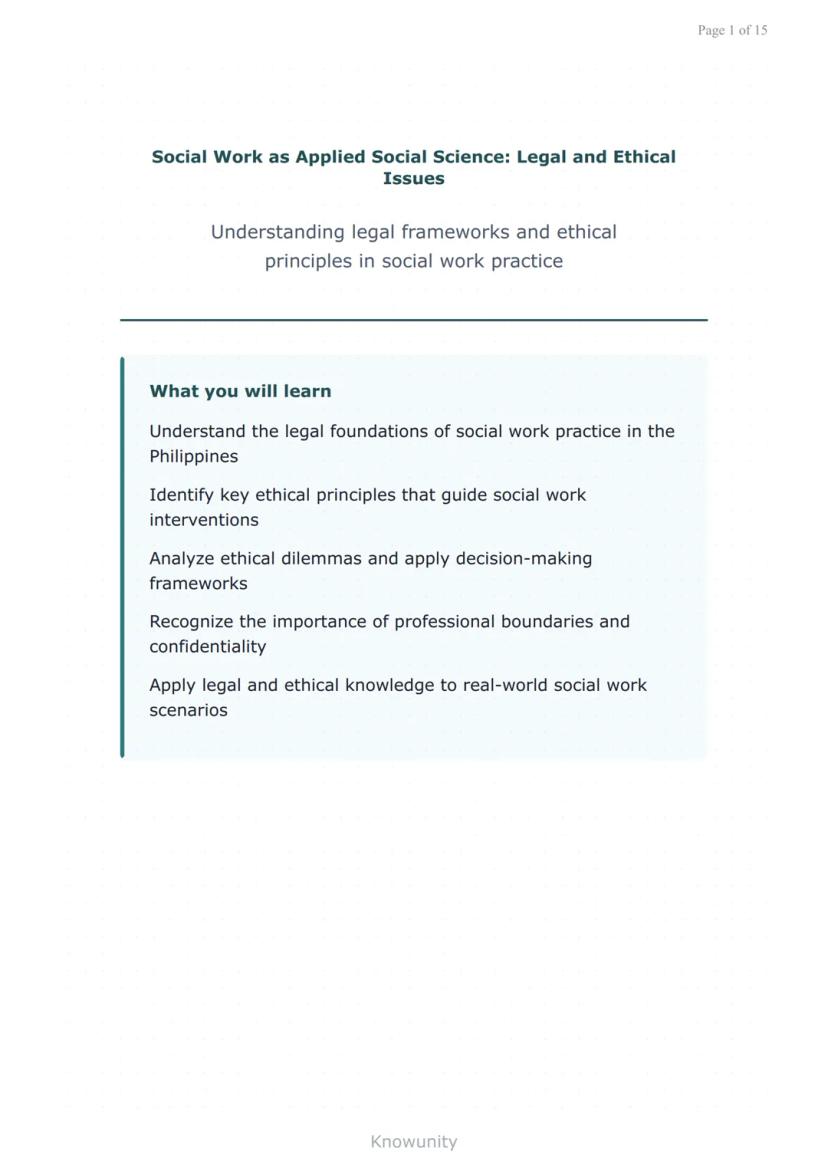
Social Work as Applied Social Science: Legal and Ethical
Issues
Understanding legal frameworks and ethical
principles in social work practic

Understanding Legal and Ethical Issues in Social Work

Social work is more than just helping people—it's a professional discipline with clear legal guidelines and ethical standards. When you enter this field, you'll need to understand the legal foundations that govern practice in the Philippines and recognize key ethical principles that shape your interactions with clients.

Ethical decision-making is a critical skill you'll develop as a social worker. You'll learn how to analyze complex situations where different values might conflict and apply frameworks to make sound professional judgments.

Professional boundaries and confidentiality will become second nature to your practice. These concepts protect both you and your clients while ensuring the helping relationship remains therapeutic and effective.

Quick Tip: Think of legal and ethical knowledge as your professional compass—it helps you navigate challenging situations while keeping both you and your clients safe.

Social Work as Applied Social Science: Legal and Ethical
Issues
Understanding legal frameworks and ethical
principles in social work practic

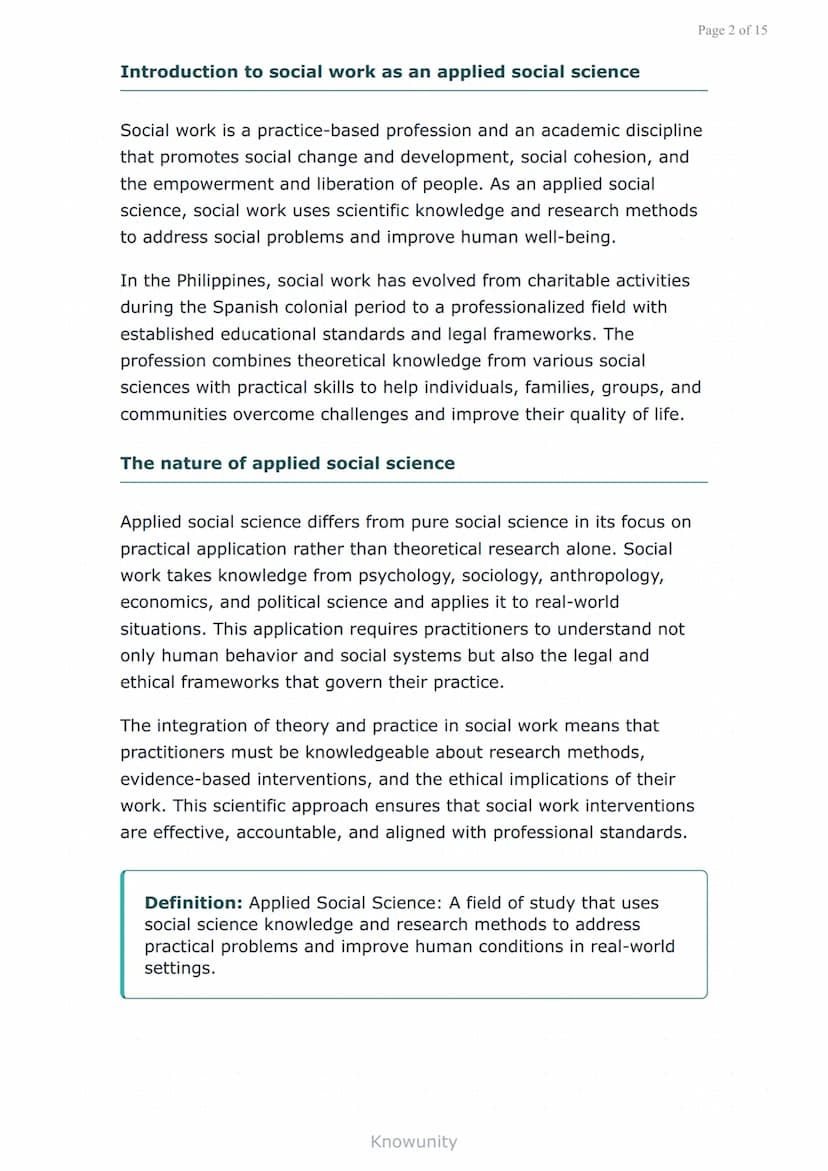
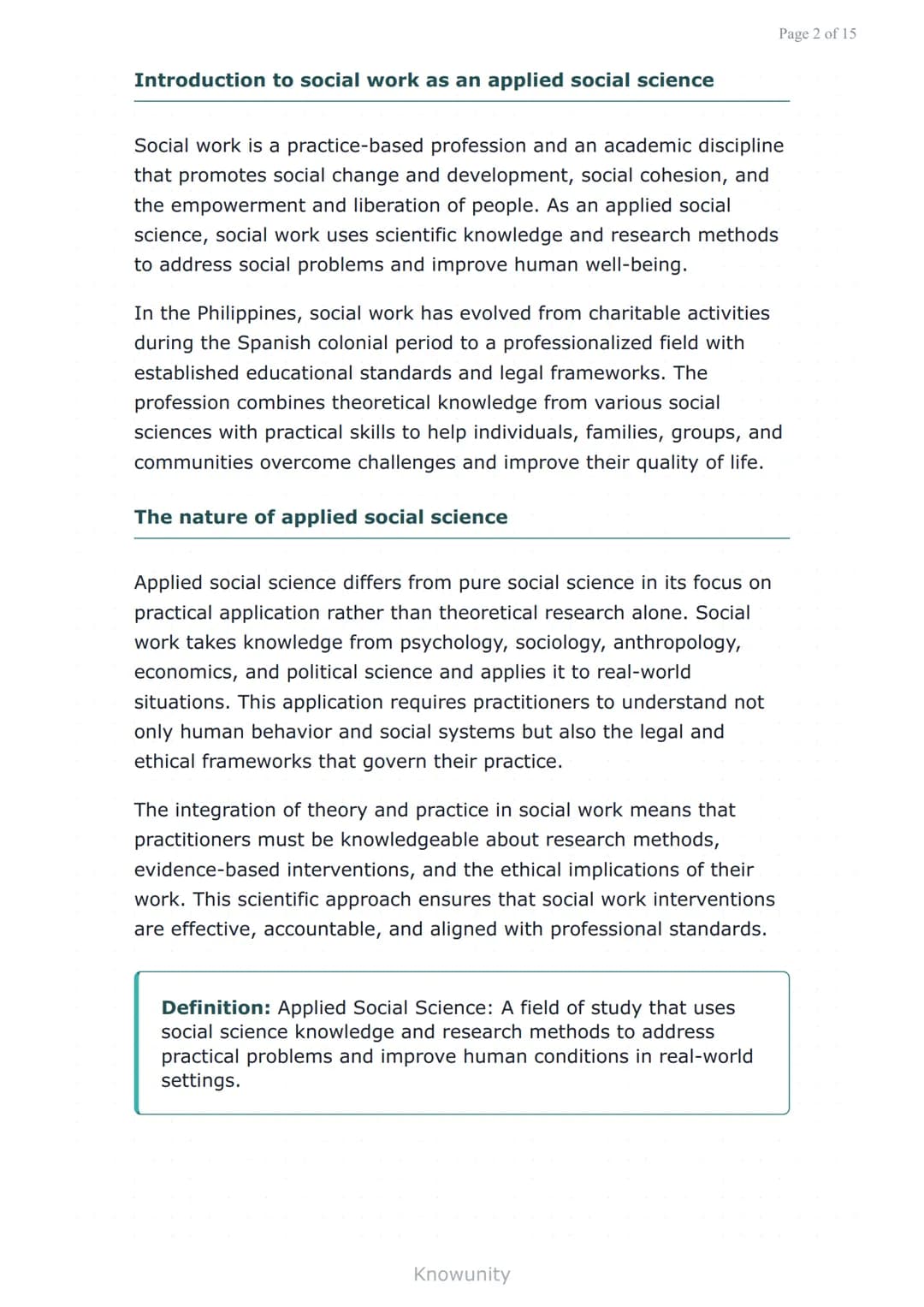
Social Work as an Applied Social Science

Ever wondered what makes social work unique among helping professions? Social work is both a practice-based profession and an academic discipline that promotes positive change, social development, and empowerment. Unlike purely theoretical fields, social work applies scientific knowledge to real-world problems.

In the Philippines, social work has transformed from charitable activities during Spanish colonial times to a regulated profession with established educational standards. Today's social workers combine theoretical understanding with practical interventions to support individuals, families, groups, and communities.

What separates applied social science from "pure" social science is its focus on practical application. Social workers draw knowledge from psychology, sociology, anthropology, economics, and political science—then use this knowledge to address real situations. This requires understanding both human behavior and the legal/ethical frameworks that govern practice.

The integration of theory and practice means you'll need to know research methods and evidence-based interventions. This scientific approach ensures your work is effective, accountable, and aligned with professional standards—preparing you to make a meaningful difference in people's lives.

Social Work as Applied Social Science: Legal and Ethical
Issues
Understanding legal frameworks and ethical
principles in social work practic

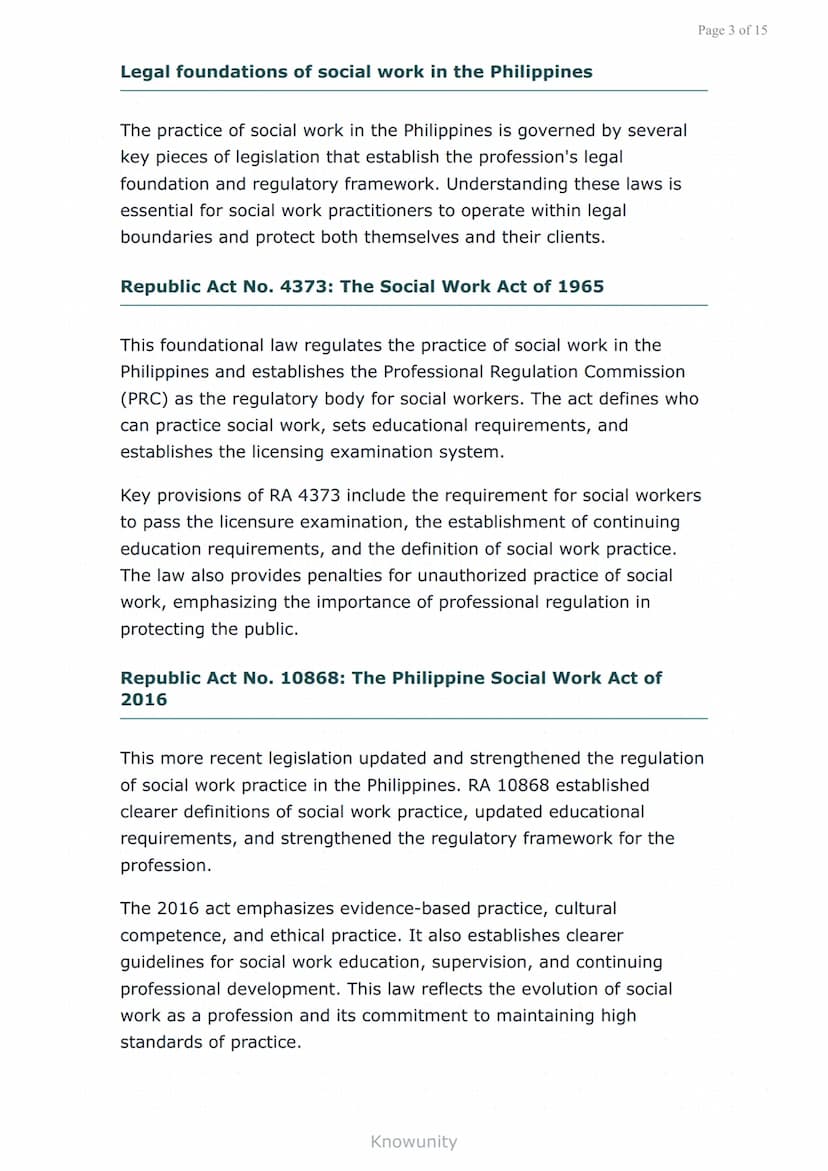
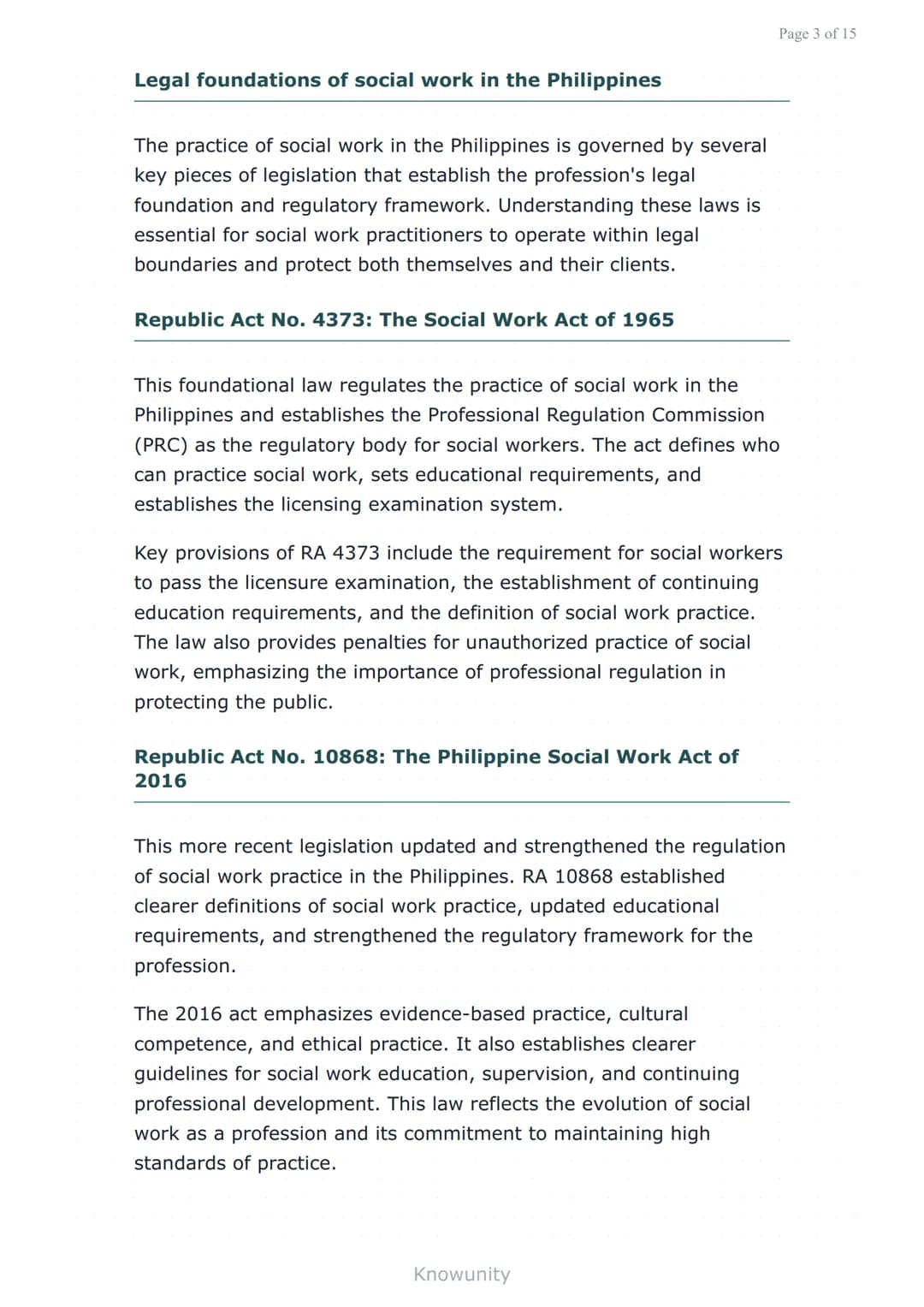
Legal Foundations of Social Work in the Philippines

The practice of social work in the Philippines isn't just about good intentions—it's governed by specific laws that establish professional boundaries and protect both practitioners and clients. Understanding these legal foundations will be crucial for your practice.

Republic Act No. 4373: The Social Work Act of 1965 set the groundwork for the profession. This foundational law established who can practice social work and created the Professional Regulation Commission (PRC) to oversee licensing. Under this act, you'll need to pass a licensure examination and meet continuing education requirements to practice legally.

Republic Act No. 10868: The Philippine Social Work Act of 2016 updated these regulations to reflect the profession's evolution. This newer legislation provides clearer definitions of social work practice and strengthens the emphasis on evidence-based approaches and cultural competence. It also updates educational requirements and regulatory frameworks to ensure high practice standards.

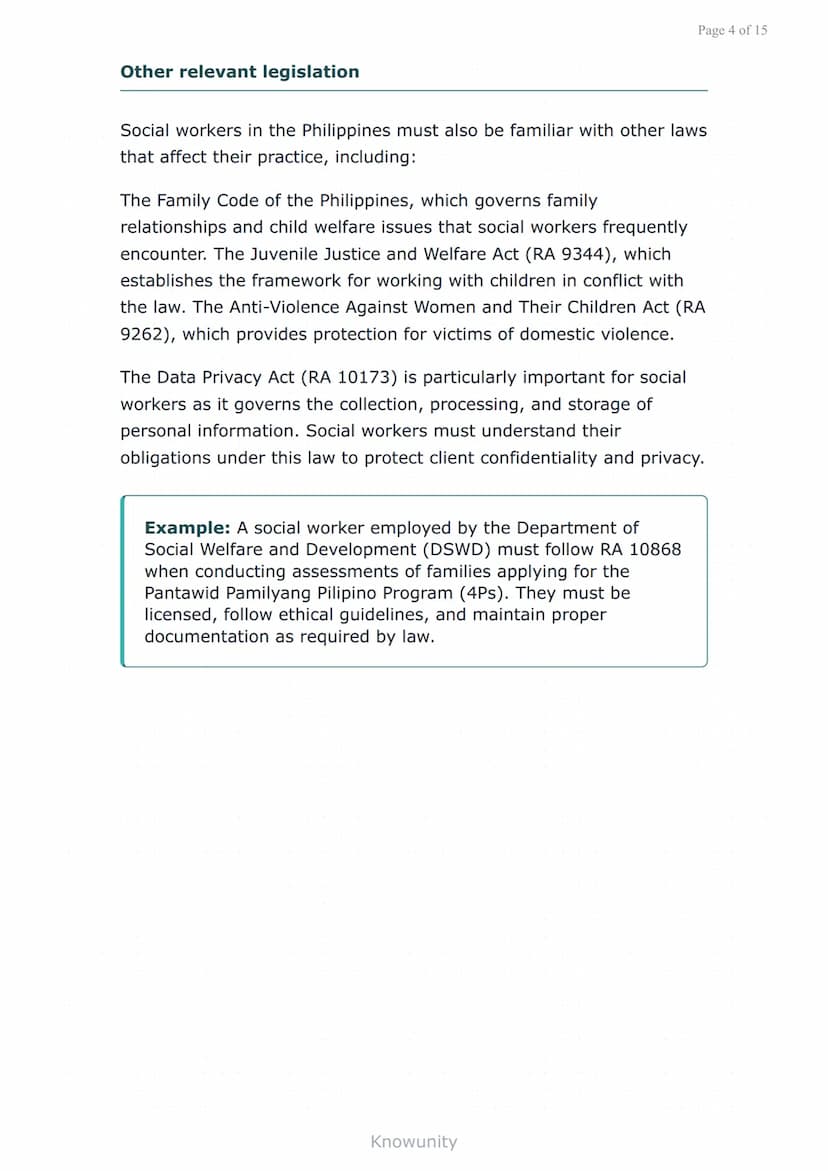
As a social worker, you'll also need to know other relevant laws that affect your practice. The Family Code, Juvenile Justice and Welfare Act, Anti-Violence Against Women Act, and the Data Privacy Act will all shape your work with clients. Understanding these legal requirements helps you navigate complex cases while staying within professional boundaries.

Remember: Legal knowledge isn't just about compliance—it empowers you to advocate effectively for clients while protecting yourself professionally.

Social Work as Applied Social Science: Legal and Ethical
Issues
Understanding legal frameworks and ethical
principles in social work practic

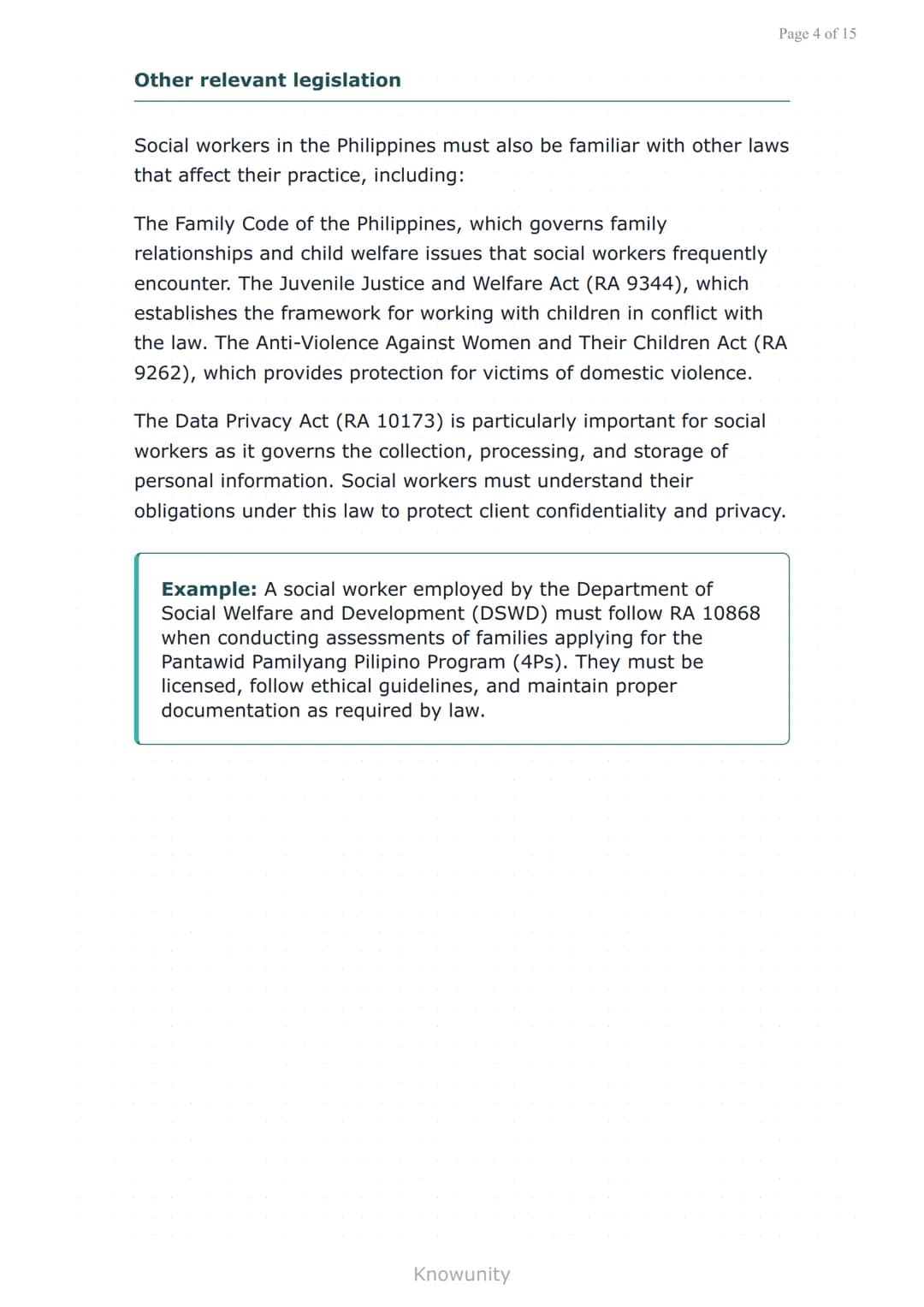
Other Relevant Legislation for Social Workers

Beyond social work-specific laws, you'll need to understand other legislation that affects your daily practice. These laws create the framework for how you'll address specific social issues and protect vulnerable populations.

The Family Code of the Philippines will be your guide when working with families and addressing child welfare issues. It defines family relationships and parental responsibilities that frequently arise in casework. Similarly, the Juvenile Justice and Welfare Act (RA 9344) establishes how you'll approach cases involving young people in conflict with the law.

When supporting survivors of domestic violence, the Anti-Violence Against Women and Their Children Act (RA 9262) provides protection mechanisms you'll need to understand. This legislation gives you tools to help clients escape dangerous situations and access legal remedies.

The Data Privacy Act (RA 10173) has special significance for social workers. Client confidentiality is central to ethical practice, and this law governs how you collect, process, and store personal information. Understanding your obligations helps you maintain trust while following legal requirements for documentation and information sharing.

Social Work as Applied Social Science: Legal and Ethical
Issues
Understanding legal frameworks and ethical
principles in social work practic

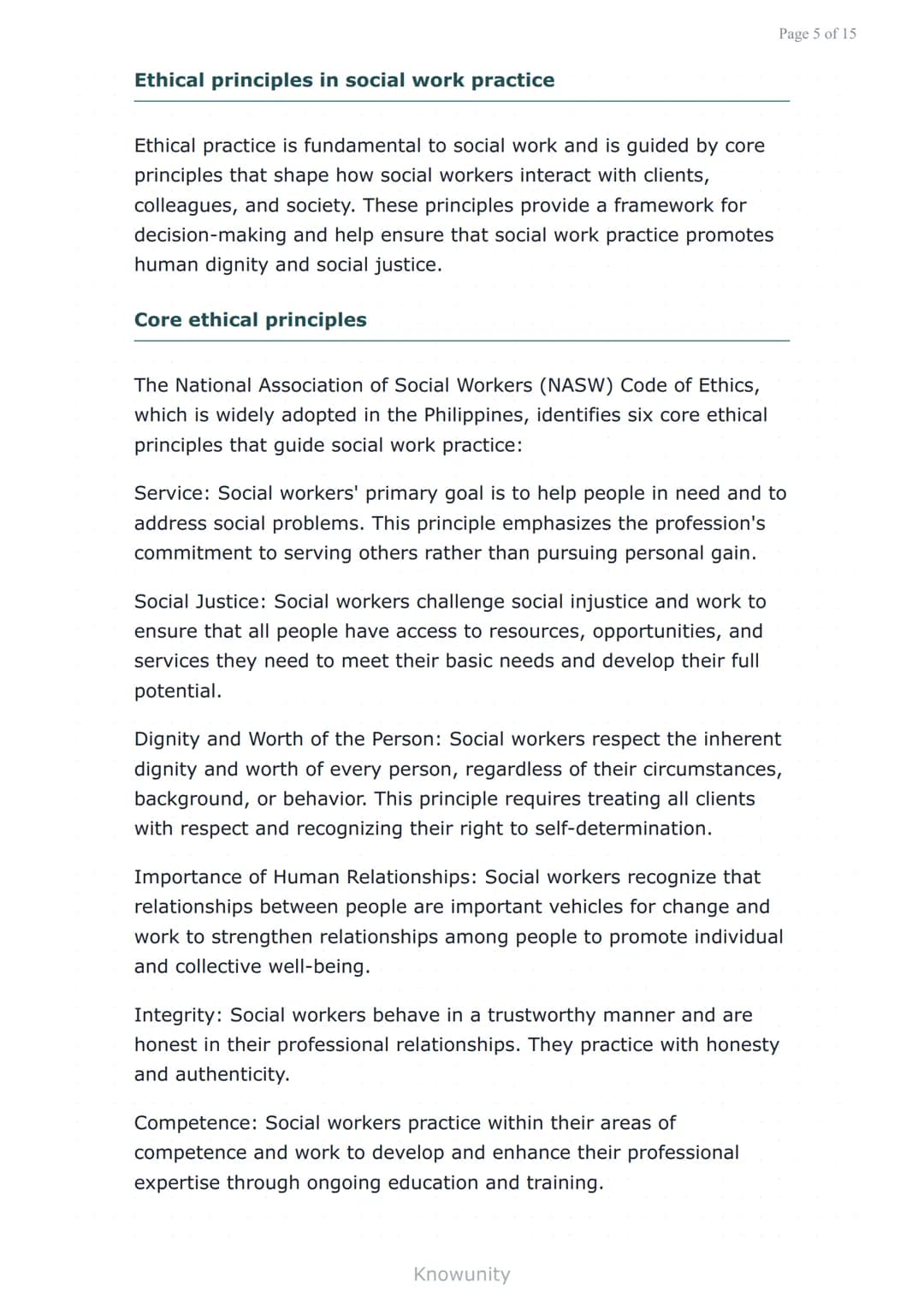
Ethical Principles in Social Work Practice

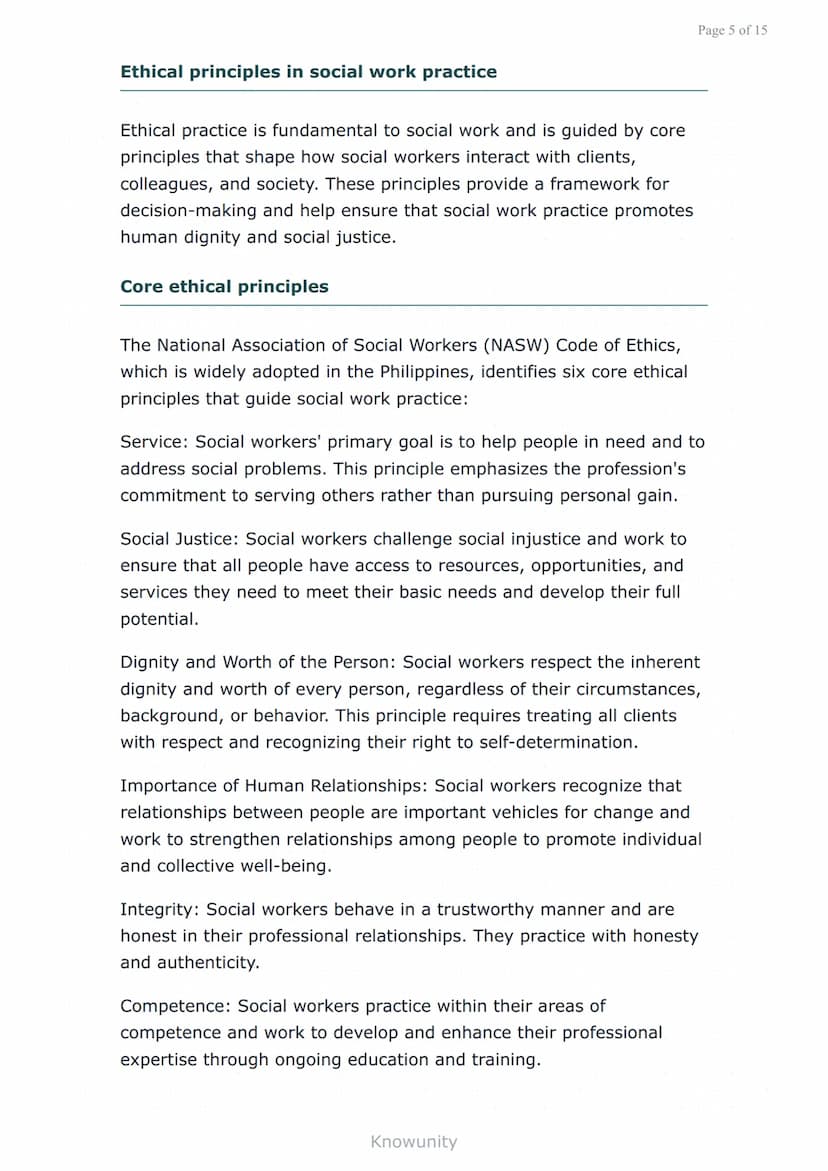
Ethics aren't just rules to follow—they're the foundation of your professional identity as a social worker. These principles shape how you'll interact with clients, colleagues, and communities, helping you make decisions that uphold human dignity and promote social justice.

The National Association of Social Workers (NASW) Code of Ethics outlines six core principles widely adopted in Philippine social work. Service places helping others above personal gain, while social justice commits you to challenging inequality and ensuring access to resources. The principle of dignity and worth of the person means respecting everyone regardless of their circumstances.

Equally important is recognizing the importance of human relationships as vehicles for positive change. Integrity requires honesty and trustworthiness in all professional interactions. Finally, competence means practicing within your expertise and continually developing your skills through ongoing education.

These principles aren't abstract concepts—they'll guide your daily practice decisions. When faced with difficult situations, they provide a framework to evaluate options and choose actions that best serve your clients while maintaining professional standards.

Practice Insight: Ethical principles often conflict in real-world situations. Learning to balance competing values (like confidentiality versus safety) is a key skill you'll develop throughout your career.

Social Work as Applied Social Science: Legal and Ethical
Issues
Understanding legal frameworks and ethical
principles in social work practic

Confidentiality and Self-Determination

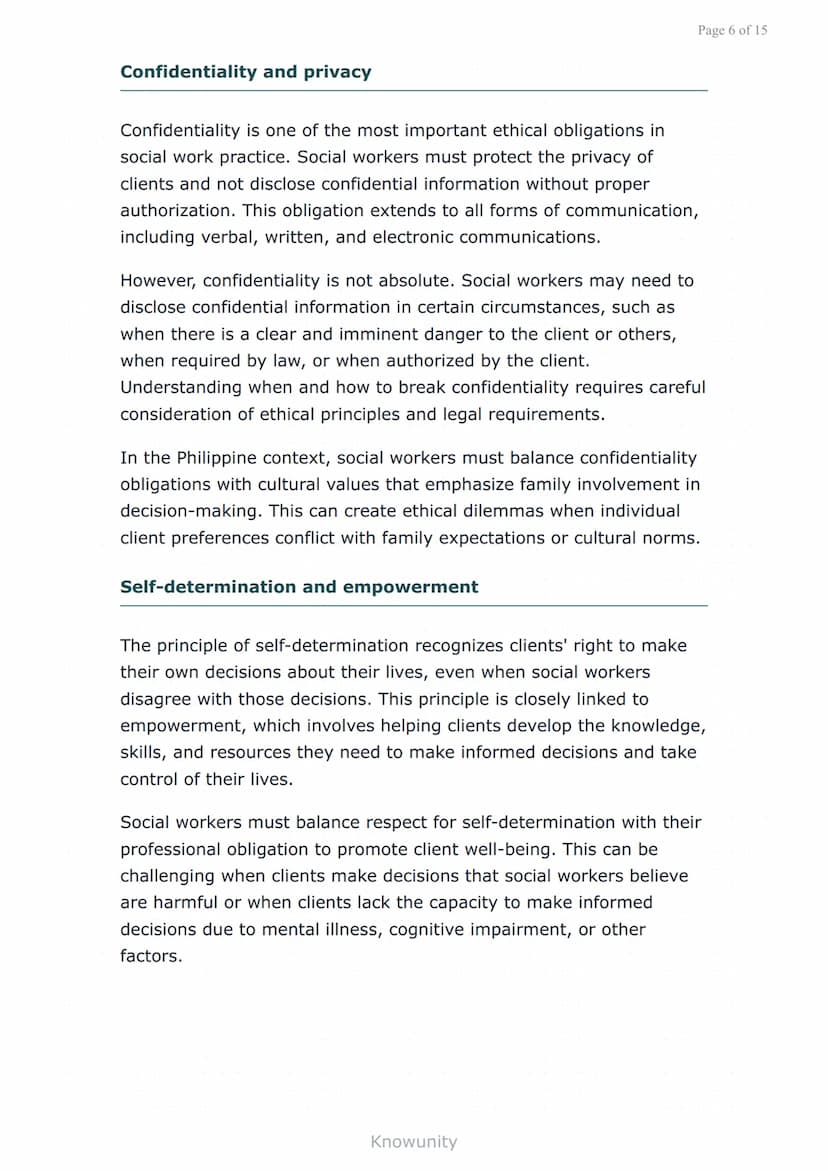
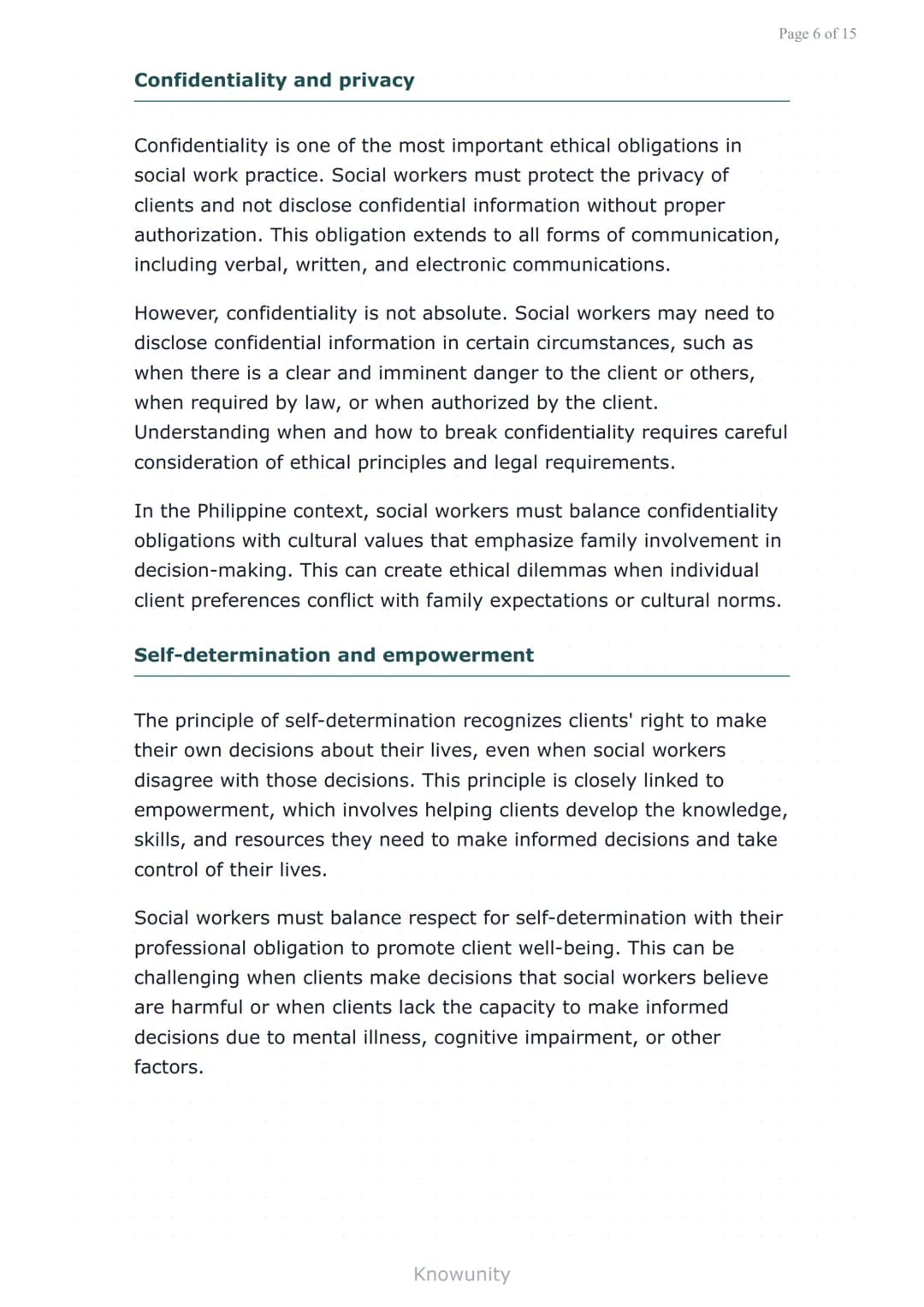
Confidentiality is one of your most important ethical obligations as a social worker. Your clients share sensitive information with you, trusting that you'll protect their privacy. This applies to all forms of communication—verbal discussions, written records, and electronic messages.

However, confidentiality isn't absolute. You may need to disclose information when there's clear danger to the client or others, when required by law, or when the client gives permission. Knowing when and how to break confidentiality requires careful judgment. In the Philippine context, you'll need to balance individual confidentiality with cultural values that emphasize family involvement in decision-making.

Self-determination recognizes clients' right to make their own decisions about their lives. This principle connects closely with empowerment—helping clients develop the knowledge and skills to take control of their situations. Even when you disagree with a client's choices, respecting their autonomy remains important.

The challenge comes when self-determination potentially conflicts with well-being. What happens when clients make decisions you believe are harmful? Or when mental illness or cognitive impairment affects their capacity? These situations require balancing respect for autonomy with your professional obligation to promote well-being—one of the most challenging aspects of ethical practice.

Social Work as Applied Social Science: Legal and Ethical
Issues
Understanding legal frameworks and ethical
principles in social work practic

Understanding Self-Determination

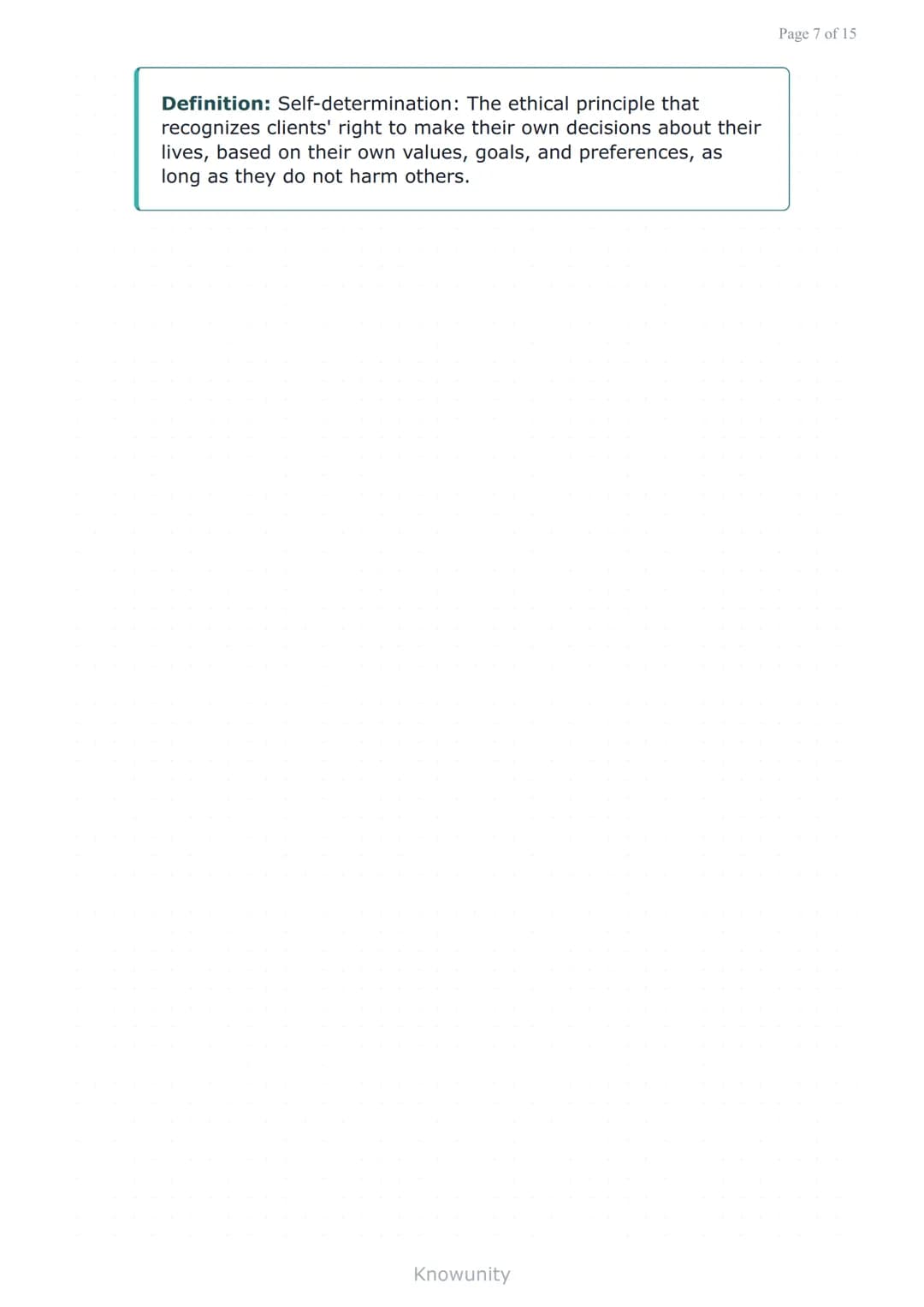
Self-determination stands as a cornerstone ethical principle in social work practice. It recognizes that clients have the fundamental right to make decisions about their own lives based on their personal values, goals, and preferences—provided these decisions don't harm others.

This principle reminds us that clients are experts in their own lives. While you bring professional knowledge and skills to the helping relationship, the client brings essential understanding of their situation, values, and priorities. Respecting self-determination means acknowledging this expertise and working collaboratively rather than dictating solutions.

Practicing self-determination means supporting clients in making informed choices even when those choices differ from what you might recommend. This can be challenging but ultimately leads to more sustainable outcomes as clients take ownership of their decisions.

Important Consideration: Self-determination doesn't mean abandoning professional responsibility. You still provide information, guidance, and consequences of different options to help clients make truly informed choices.

Social Work as Applied Social Science: Legal and Ethical
Issues
Understanding legal frameworks and ethical
principles in social work practic

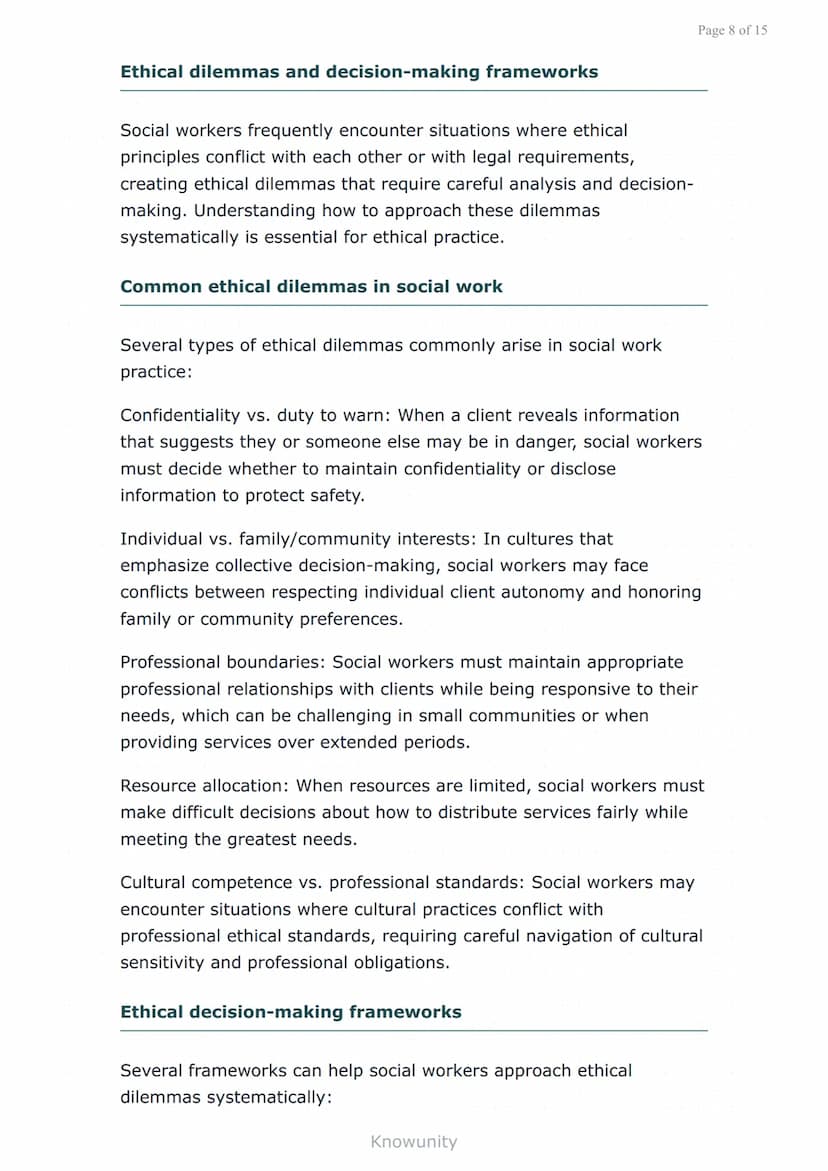
Ethical Dilemmas and Decision-Making Frameworks

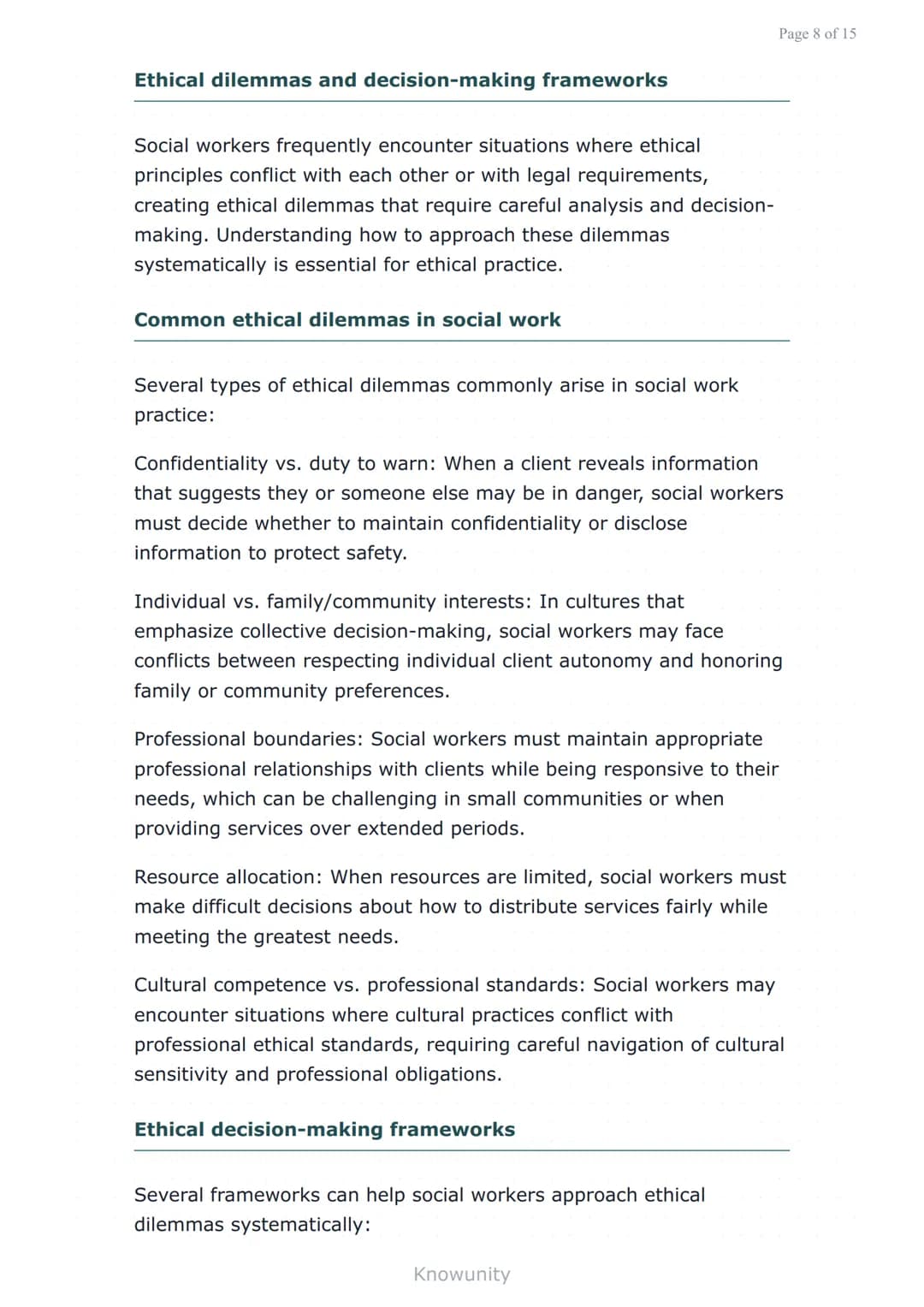
Ethical dilemmas are inevitable in social work practice. These situations arise when ethical principles conflict with each other or with legal requirements, leaving no perfect solution. Learning how to approach these dilemmas systematically will help you navigate complex situations with confidence.

Several common ethical dilemmas you'll likely encounter include balancing confidentiality against duty to warn when clients reveal potentially dangerous information. You may face conflicts between individual versus family/community interests, especially in cultures emphasizing collective decision-making. Maintaining professional boundaries can become challenging in small communities, and resource allocation decisions are difficult when needs exceed available help.

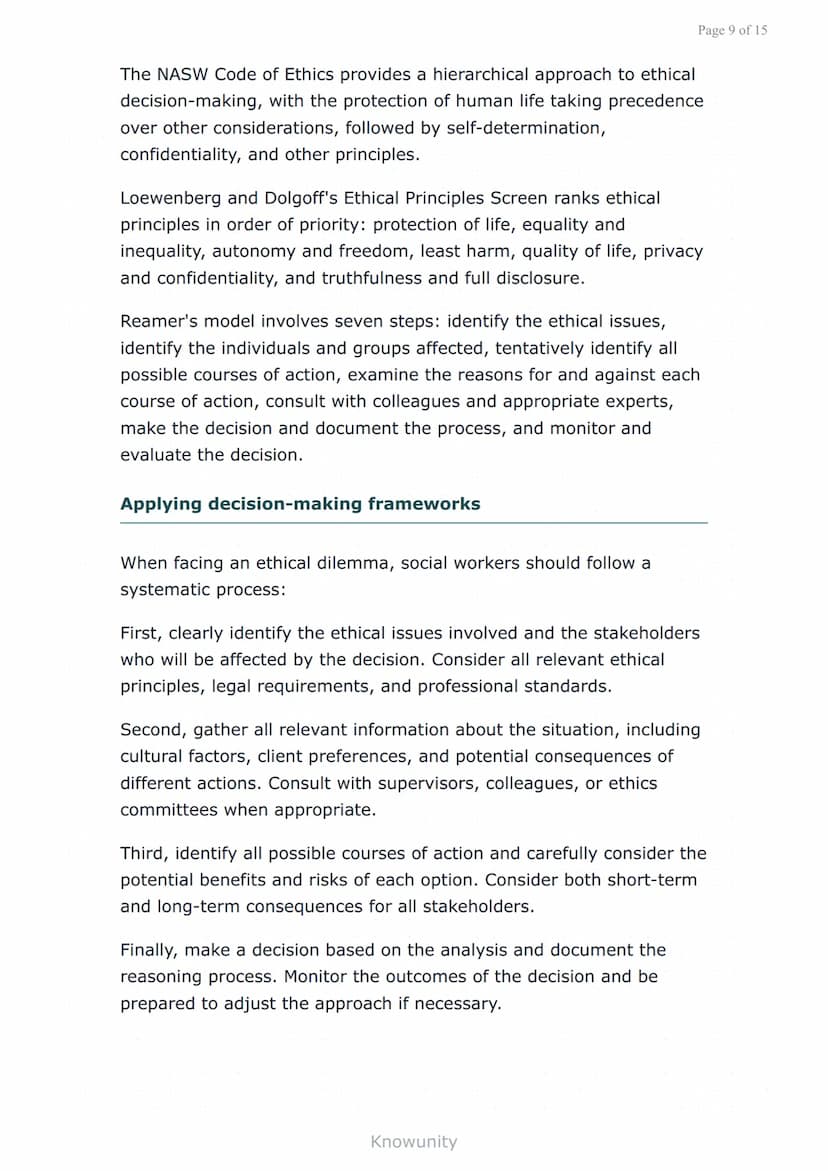
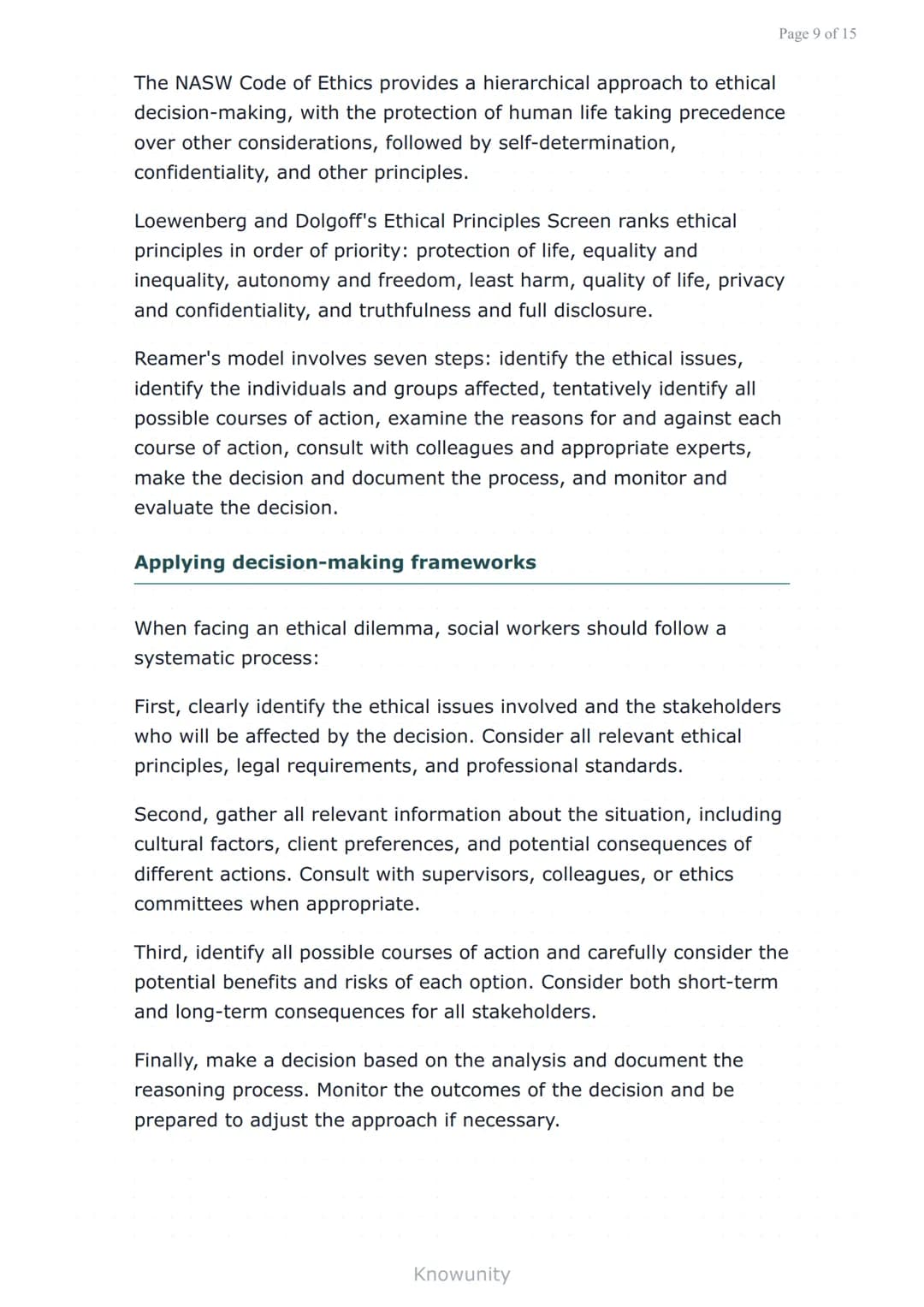
Fortunately, ethical decision-making frameworks provide structured approaches to these challenges. The NASW Code of Ethics offers a hierarchical approach with protection of life taking highest priority. Loewenberg and Dolgoff's Ethical Principles Screen ranks principles from protection of life to truthfulness. Reamer's model provides a seven-step process from identifying issues to evaluating outcomes.

When facing ethical dilemmas, follow a systematic process: identify the ethical issues and stakeholders involved, gather relevant information, explore all possible courses of action, weigh potential consequences, consult with colleagues when appropriate, make and document your decision, and monitor outcomes. This approach helps ensure thoughtful, defensible decisions in difficult situations.

Remember: Ethical dilemmas rarely have perfect solutions. Your goal is to make the best possible decision given the specific circumstances and competing values involved.

Social Work as Applied Social Science: Legal and Ethical
Issues
Understanding legal frameworks and ethical
principles in social work practic

Applying Ethical Decision-Making in Practice

Ethical decision-making isn't just theoretical—it's a practical skill you'll use throughout your social work career. Understanding frameworks is important, but knowing how to apply them to real situations is what makes the difference in effective practice.

The NASW Code of Ethics provides a helpful hierarchy of values, placing protection of human life at the top, followed by self-determination and confidentiality. This means when safety is at risk, it may take precedence over other considerations. Similarly, Loewenberg and Dolgoff's Ethical Principles Screen gives you a ranked order: protection of life, equality, autonomy, least harm, quality of life, privacy, and truthfulness.

For a step-by-step approach, Reamer's model breaks the process into manageable parts: identify the issues, recognize who's affected, explore possible actions, examine reasons for and against each option, consult with others, make and document your decision, and evaluate outcomes. This structured approach helps ensure you've considered all important factors.

When applying these frameworks, start by clearly identifying the ethical principles at stake and who will be affected by your decision. Gather all relevant information, including cultural factors and client preferences. Consider all possible options and their potential consequences, both immediate and long-term. Document your reasoning process thoroughly and be prepared to adjust your approach based on outcomes.

Social Work as Applied Social Science: Legal and Ethical
Issues
Understanding legal frameworks and ethical
principles in social work practic

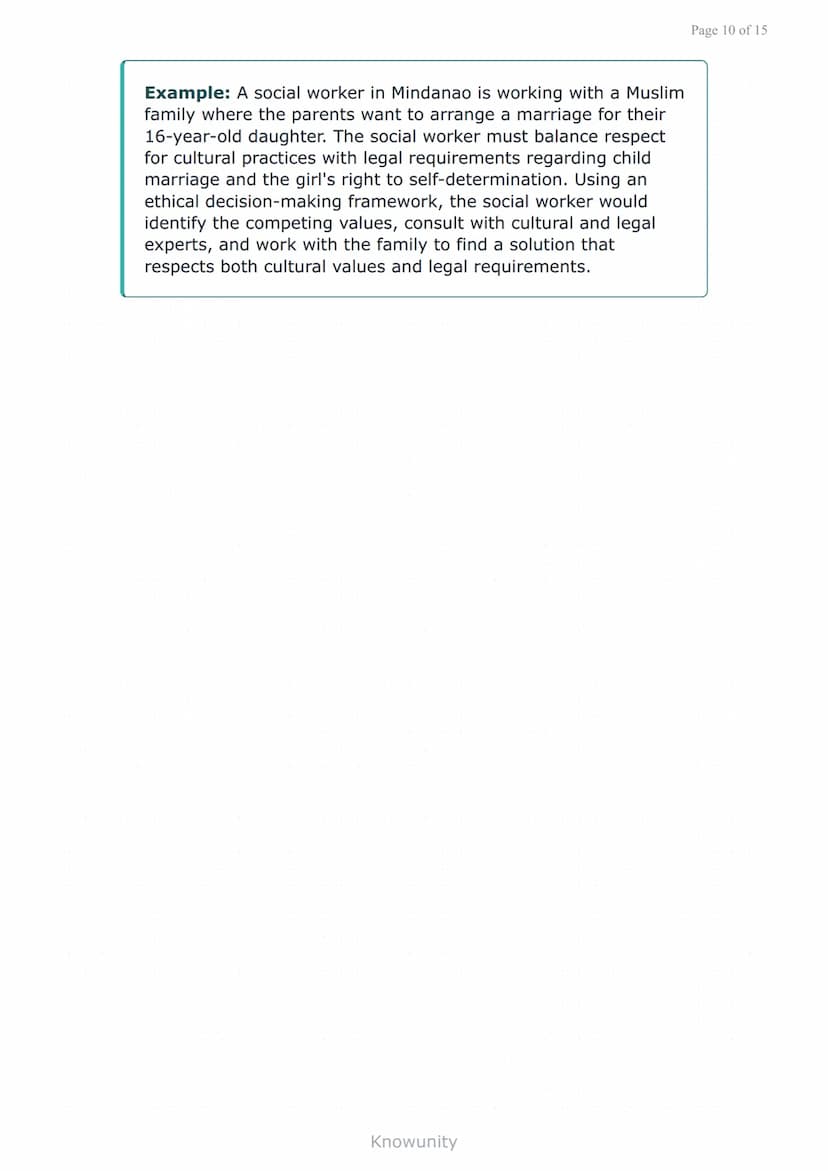
Cultural Considerations in Ethical Decision-Making

Ethical decisions rarely happen in a vacuum—they occur within specific cultural contexts that influence both the situation and potential responses. A social worker in Mindanao facing a case of arranged marriage for a 16-year-old Muslim girl demonstrates this complexity perfectly.

This situation presents competing values: respect for cultural practices versus legal requirements about child marriage, plus the girl's right to self-determination. Using an ethical decision-making framework would help the social worker navigate this challenging scenario with cultural sensitivity and legal compliance.

The social worker would first identify all the competing values and legal requirements at stake. Next, they would consult with cultural experts, legal advisors, and colleagues to understand different perspectives. They might explore whether the arrangement could be delayed until the girl reaches legal age, whether she genuinely consents, and what safeguards could protect her well-being.

Practice Tip: Cultural competence doesn't mean automatically accepting all cultural practices. Instead, it means engaging respectfully with different cultural perspectives while still upholding core professional values and legal requirements.


We thought you’d never ask...

What is the Knowunity AI companion?

Our AI companion is specifically built for the needs of students. Based on the millions of content pieces we have on the platform we can provide truly meaningful and relevant answers to students. But its not only about answers, the companion is even more about guiding students through their daily learning challenges, with personalised study plans, quizzes or content pieces in the chat and 100% personalisation based on the students skills and developments.

Where can I download the Knowunity app?

You can download the app in the Google Play Store and in the Apple App Store.

Is Knowunity really free of charge?

That's right! Enjoy free access to study content, connect with fellow students, and get instant help – all at your fingertips.

Can't find what you're looking for? Explore other subjects.

Students love us — and so will you.

4.9/5

App Store

4.8/5

Google Play

The app is very easy to use and well designed. I have found everything I was looking for so far and have been able to learn a lot from the presentations! I will definitely use the app for a class assignment! And of course it also helps a lot as an inspiration.

Stefan S

iOS user

This app is really great. There are so many study notes and help [...]. My problem subject is French, for example, and the app has so many options for help. Thanks to this app, I have improved my French. I would recommend it to anyone.

Samantha Klich

Android user

Wow, I am really amazed. I just tried the app because I've seen it advertised many times and was absolutely stunned. This app is THE HELP you want for school and above all, it offers so many things, such as workouts and fact sheets, which have been VERY helpful to me personally.

Anna

iOS user

I think it’s very much worth it and you’ll end up using it a lot once you get the hang of it and even after looking at others notes you can still ask your Artificial intelligence buddy the question and ask to simplify it if you still don’t get it!!! In the end I think it’s worth it 😊👍 ⚠️Also DID I MENTION ITS FREEE YOU DON’T HAVE TO PAY FOR ANYTHING AND STILL GET YOUR GRADES IN PERFECTLY❗️❗️⚠️

Thomas R

iOS user

Knowunity is the BEST app I’ve used in a minute. This is not an ai review or anything this is genuinely coming from a 7th grade student (I know 2011 im young) but dude this app is a 10/10 i have maintained a 3.8 gpa and have plenty of time for gaming. I love it and my mom is just happy I got good grades

Brad T

Android user

Not only did it help me find the answer but it also showed me alternative ways to solve it. I was horrible in math and science but now I have an a in both subjects. Thanks for the help🤍🤍

David K

iOS user

The app's just great! All I have to do is enter the topic in the search bar and I get the response real fast. I don't have to watch 10 YouTube videos to understand something, so I'm saving my time. Highly recommended!

Sudenaz Ocak

Android user

In school I was really bad at maths but thanks to the app, I am doing better now. I am so grateful that you made the app.

Greenlight Bonnie

Android user

I found this app a couple years ago and it has only gotten better since then. I really love it because it can help with written questions and photo questions. Also, it can find study guides that other people have made as well as flashcard sets and practice tests. The free version is also amazing for students who might not be able to afford it. Would 100% recommend

Aubrey

iOS user

Best app if you're in Highschool or Junior high. I have been using this app for 2 school years and it's the best, it's good if you don't have anyone to help you with school work.😋🩷🎀

Marco B

iOS user

THE QUIZES AND FLASHCARDS ARE SO USEFUL AND I LOVE THE SCHOOLGPT. IT ALSO IS LITREALLY LIKE CHATGPT BUT SMARTER!! HELPED ME WITH MY MASCARA PROBLEMS TOO!! AS WELL AS MY REAL SUBJECTS ! DUHHH 😍😁😲🤑💗✨🎀😮

Elisha

iOS user

This app is phenomenal down to the correct info and the various topics you can study! I greatly recommend it for people who struggle with procrastination and those who need homework help. It has been perfectly accurate for world 1 history as far as I’ve seen! Geometry too!

Paul T

iOS user

The app is very easy to use and well designed. I have found everything I was looking for so far and have been able to learn a lot from the presentations! I will definitely use the app for a class assignment! And of course it also helps a lot as an inspiration.

Stefan S

iOS user

This app is really great. There are so many study notes and help [...]. My problem subject is French, for example, and the app has so many options for help. Thanks to this app, I have improved my French. I would recommend it to anyone.

Samantha Klich

Android user

Wow, I am really amazed. I just tried the app because I've seen it advertised many times and was absolutely stunned. This app is THE HELP you want for school and above all, it offers so many things, such as workouts and fact sheets, which have been VERY helpful to me personally.

Anna

iOS user

I think it’s very much worth it and you’ll end up using it a lot once you get the hang of it and even after looking at others notes you can still ask your Artificial intelligence buddy the question and ask to simplify it if you still don’t get it!!! In the end I think it’s worth it 😊👍 ⚠️Also DID I MENTION ITS FREEE YOU DON’T HAVE TO PAY FOR ANYTHING AND STILL GET YOUR GRADES IN PERFECTLY❗️❗️⚠️

Thomas R

iOS user

Knowunity is the BEST app I’ve used in a minute. This is not an ai review or anything this is genuinely coming from a 7th grade student (I know 2011 im young) but dude this app is a 10/10 i have maintained a 3.8 gpa and have plenty of time for gaming. I love it and my mom is just happy I got good grades

Brad T

Android user

Not only did it help me find the answer but it also showed me alternative ways to solve it. I was horrible in math and science but now I have an a in both subjects. Thanks for the help🤍🤍

David K

iOS user

The app's just great! All I have to do is enter the topic in the search bar and I get the response real fast. I don't have to watch 10 YouTube videos to understand something, so I'm saving my time. Highly recommended!

Sudenaz Ocak

Android user

In school I was really bad at maths but thanks to the app, I am doing better now. I am so grateful that you made the app.

Greenlight Bonnie

Android user

I found this app a couple years ago and it has only gotten better since then. I really love it because it can help with written questions and photo questions. Also, it can find study guides that other people have made as well as flashcard sets and practice tests. The free version is also amazing for students who might not be able to afford it. Would 100% recommend

Aubrey

iOS user

Best app if you're in Highschool or Junior high. I have been using this app for 2 school years and it's the best, it's good if you don't have anyone to help you with school work.😋🩷🎀

Marco B

iOS user

THE QUIZES AND FLASHCARDS ARE SO USEFUL AND I LOVE THE SCHOOLGPT. IT ALSO IS LITREALLY LIKE CHATGPT BUT SMARTER!! HELPED ME WITH MY MASCARA PROBLEMS TOO!! AS WELL AS MY REAL SUBJECTS ! DUHHH 😍😁😲🤑💗✨🎀😮

Elisha

iOS user

This app is phenomenal down to the correct info and the various topics you can study! I greatly recommend it for people who struggle with procrastination and those who need homework help. It has been perfectly accurate for world 1 history as far as I’ve seen! Geometry too!

Paul T

iOS user


DIASS

25

Dec 12, 2025

15 pages

Legal and Ethical Issues in Social Work: A Guide

user profile picture

Knowunity Philippines

@knowunityphilippines

Social work combines scientific knowledge with practical skills to help people overcome challenges and improve their quality of life. As an applied social science, it operates within legal frameworks and ethical principles that guide professional practice and decision-making. Understanding these... Show more

Social Work as Applied Social Science: Legal and Ethical
Issues
Understanding legal frameworks and ethical
principles in social work practic

Sign up to see the contentIt's free!

Access to all documents

Improve your grades

Join milions of students

By signing up you accept Terms of Service and Privacy Policy

Understanding Legal and Ethical Issues in Social Work

Social work is more than just helping people—it's a professional discipline with clear legal guidelines and ethical standards. When you enter this field, you'll need to understand the legal foundations that govern practice in the Philippines and recognize key ethical principles that shape your interactions with clients.

Ethical decision-making is a critical skill you'll develop as a social worker. You'll learn how to analyze complex situations where different values might conflict and apply frameworks to make sound professional judgments.

Professional boundaries and confidentiality will become second nature to your practice. These concepts protect both you and your clients while ensuring the helping relationship remains therapeutic and effective.

Quick Tip: Think of legal and ethical knowledge as your professional compass—it helps you navigate challenging situations while keeping both you and your clients safe.

Social Work as Applied Social Science: Legal and Ethical
Issues
Understanding legal frameworks and ethical
principles in social work practic

Sign up to see the contentIt's free!

Access to all documents

Improve your grades

Join milions of students

By signing up you accept Terms of Service and Privacy Policy

Social Work as an Applied Social Science

Ever wondered what makes social work unique among helping professions? Social work is both a practice-based profession and an academic discipline that promotes positive change, social development, and empowerment. Unlike purely theoretical fields, social work applies scientific knowledge to real-world problems.

In the Philippines, social work has transformed from charitable activities during Spanish colonial times to a regulated profession with established educational standards. Today's social workers combine theoretical understanding with practical interventions to support individuals, families, groups, and communities.

What separates applied social science from "pure" social science is its focus on practical application. Social workers draw knowledge from psychology, sociology, anthropology, economics, and political science—then use this knowledge to address real situations. This requires understanding both human behavior and the legal/ethical frameworks that govern practice.

The integration of theory and practice means you'll need to know research methods and evidence-based interventions. This scientific approach ensures your work is effective, accountable, and aligned with professional standards—preparing you to make a meaningful difference in people's lives.

Social Work as Applied Social Science: Legal and Ethical
Issues
Understanding legal frameworks and ethical
principles in social work practic

Sign up to see the contentIt's free!

Access to all documents

Improve your grades

Join milions of students

By signing up you accept Terms of Service and Privacy Policy

Legal Foundations of Social Work in the Philippines

The practice of social work in the Philippines isn't just about good intentions—it's governed by specific laws that establish professional boundaries and protect both practitioners and clients. Understanding these legal foundations will be crucial for your practice.

Republic Act No. 4373: The Social Work Act of 1965 set the groundwork for the profession. This foundational law established who can practice social work and created the Professional Regulation Commission (PRC) to oversee licensing. Under this act, you'll need to pass a licensure examination and meet continuing education requirements to practice legally.

Republic Act No. 10868: The Philippine Social Work Act of 2016 updated these regulations to reflect the profession's evolution. This newer legislation provides clearer definitions of social work practice and strengthens the emphasis on evidence-based approaches and cultural competence. It also updates educational requirements and regulatory frameworks to ensure high practice standards.

As a social worker, you'll also need to know other relevant laws that affect your practice. The Family Code, Juvenile Justice and Welfare Act, Anti-Violence Against Women Act, and the Data Privacy Act will all shape your work with clients. Understanding these legal requirements helps you navigate complex cases while staying within professional boundaries.

Remember: Legal knowledge isn't just about compliance—it empowers you to advocate effectively for clients while protecting yourself professionally.

Social Work as Applied Social Science: Legal and Ethical
Issues
Understanding legal frameworks and ethical
principles in social work practic

Sign up to see the contentIt's free!

Access to all documents

Improve your grades

Join milions of students

By signing up you accept Terms of Service and Privacy Policy

Other Relevant Legislation for Social Workers

Beyond social work-specific laws, you'll need to understand other legislation that affects your daily practice. These laws create the framework for how you'll address specific social issues and protect vulnerable populations.

The Family Code of the Philippines will be your guide when working with families and addressing child welfare issues. It defines family relationships and parental responsibilities that frequently arise in casework. Similarly, the Juvenile Justice and Welfare Act (RA 9344) establishes how you'll approach cases involving young people in conflict with the law.

When supporting survivors of domestic violence, the Anti-Violence Against Women and Their Children Act (RA 9262) provides protection mechanisms you'll need to understand. This legislation gives you tools to help clients escape dangerous situations and access legal remedies.

The Data Privacy Act (RA 10173) has special significance for social workers. Client confidentiality is central to ethical practice, and this law governs how you collect, process, and store personal information. Understanding your obligations helps you maintain trust while following legal requirements for documentation and information sharing.

Social Work as Applied Social Science: Legal and Ethical
Issues
Understanding legal frameworks and ethical
principles in social work practic

Sign up to see the contentIt's free!

Access to all documents

Improve your grades

Join milions of students

By signing up you accept Terms of Service and Privacy Policy

Ethical Principles in Social Work Practice

Ethics aren't just rules to follow—they're the foundation of your professional identity as a social worker. These principles shape how you'll interact with clients, colleagues, and communities, helping you make decisions that uphold human dignity and promote social justice.

The National Association of Social Workers (NASW) Code of Ethics outlines six core principles widely adopted in Philippine social work. Service places helping others above personal gain, while social justice commits you to challenging inequality and ensuring access to resources. The principle of dignity and worth of the person means respecting everyone regardless of their circumstances.

Equally important is recognizing the importance of human relationships as vehicles for positive change. Integrity requires honesty and trustworthiness in all professional interactions. Finally, competence means practicing within your expertise and continually developing your skills through ongoing education.

These principles aren't abstract concepts—they'll guide your daily practice decisions. When faced with difficult situations, they provide a framework to evaluate options and choose actions that best serve your clients while maintaining professional standards.

Practice Insight: Ethical principles often conflict in real-world situations. Learning to balance competing values (like confidentiality versus safety) is a key skill you'll develop throughout your career.

Social Work as Applied Social Science: Legal and Ethical
Issues
Understanding legal frameworks and ethical
principles in social work practic

Sign up to see the contentIt's free!

Access to all documents

Improve your grades

Join milions of students

By signing up you accept Terms of Service and Privacy Policy

Confidentiality and Self-Determination

Confidentiality is one of your most important ethical obligations as a social worker. Your clients share sensitive information with you, trusting that you'll protect their privacy. This applies to all forms of communication—verbal discussions, written records, and electronic messages.

However, confidentiality isn't absolute. You may need to disclose information when there's clear danger to the client or others, when required by law, or when the client gives permission. Knowing when and how to break confidentiality requires careful judgment. In the Philippine context, you'll need to balance individual confidentiality with cultural values that emphasize family involvement in decision-making.

Self-determination recognizes clients' right to make their own decisions about their lives. This principle connects closely with empowerment—helping clients develop the knowledge and skills to take control of their situations. Even when you disagree with a client's choices, respecting their autonomy remains important.

The challenge comes when self-determination potentially conflicts with well-being. What happens when clients make decisions you believe are harmful? Or when mental illness or cognitive impairment affects their capacity? These situations require balancing respect for autonomy with your professional obligation to promote well-being—one of the most challenging aspects of ethical practice.

Social Work as Applied Social Science: Legal and Ethical
Issues
Understanding legal frameworks and ethical
principles in social work practic

Sign up to see the contentIt's free!

Access to all documents

Improve your grades

Join milions of students

By signing up you accept Terms of Service and Privacy Policy

Understanding Self-Determination

Self-determination stands as a cornerstone ethical principle in social work practice. It recognizes that clients have the fundamental right to make decisions about their own lives based on their personal values, goals, and preferences—provided these decisions don't harm others.

This principle reminds us that clients are experts in their own lives. While you bring professional knowledge and skills to the helping relationship, the client brings essential understanding of their situation, values, and priorities. Respecting self-determination means acknowledging this expertise and working collaboratively rather than dictating solutions.

Practicing self-determination means supporting clients in making informed choices even when those choices differ from what you might recommend. This can be challenging but ultimately leads to more sustainable outcomes as clients take ownership of their decisions.

Important Consideration: Self-determination doesn't mean abandoning professional responsibility. You still provide information, guidance, and consequences of different options to help clients make truly informed choices.

Social Work as Applied Social Science: Legal and Ethical
Issues
Understanding legal frameworks and ethical
principles in social work practic

Sign up to see the contentIt's free!

Access to all documents

Improve your grades

Join milions of students

By signing up you accept Terms of Service and Privacy Policy

Ethical Dilemmas and Decision-Making Frameworks

Ethical dilemmas are inevitable in social work practice. These situations arise when ethical principles conflict with each other or with legal requirements, leaving no perfect solution. Learning how to approach these dilemmas systematically will help you navigate complex situations with confidence.

Several common ethical dilemmas you'll likely encounter include balancing confidentiality against duty to warn when clients reveal potentially dangerous information. You may face conflicts between individual versus family/community interests, especially in cultures emphasizing collective decision-making. Maintaining professional boundaries can become challenging in small communities, and resource allocation decisions are difficult when needs exceed available help.

Fortunately, ethical decision-making frameworks provide structured approaches to these challenges. The NASW Code of Ethics offers a hierarchical approach with protection of life taking highest priority. Loewenberg and Dolgoff's Ethical Principles Screen ranks principles from protection of life to truthfulness. Reamer's model provides a seven-step process from identifying issues to evaluating outcomes.

When facing ethical dilemmas, follow a systematic process: identify the ethical issues and stakeholders involved, gather relevant information, explore all possible courses of action, weigh potential consequences, consult with colleagues when appropriate, make and document your decision, and monitor outcomes. This approach helps ensure thoughtful, defensible decisions in difficult situations.

Remember: Ethical dilemmas rarely have perfect solutions. Your goal is to make the best possible decision given the specific circumstances and competing values involved.

Social Work as Applied Social Science: Legal and Ethical
Issues
Understanding legal frameworks and ethical
principles in social work practic

Sign up to see the contentIt's free!

Access to all documents

Improve your grades

Join milions of students

By signing up you accept Terms of Service and Privacy Policy

Applying Ethical Decision-Making in Practice

Ethical decision-making isn't just theoretical—it's a practical skill you'll use throughout your social work career. Understanding frameworks is important, but knowing how to apply them to real situations is what makes the difference in effective practice.

The NASW Code of Ethics provides a helpful hierarchy of values, placing protection of human life at the top, followed by self-determination and confidentiality. This means when safety is at risk, it may take precedence over other considerations. Similarly, Loewenberg and Dolgoff's Ethical Principles Screen gives you a ranked order: protection of life, equality, autonomy, least harm, quality of life, privacy, and truthfulness.

For a step-by-step approach, Reamer's model breaks the process into manageable parts: identify the issues, recognize who's affected, explore possible actions, examine reasons for and against each option, consult with others, make and document your decision, and evaluate outcomes. This structured approach helps ensure you've considered all important factors.

When applying these frameworks, start by clearly identifying the ethical principles at stake and who will be affected by your decision. Gather all relevant information, including cultural factors and client preferences. Consider all possible options and their potential consequences, both immediate and long-term. Document your reasoning process thoroughly and be prepared to adjust your approach based on outcomes.

Social Work as Applied Social Science: Legal and Ethical
Issues
Understanding legal frameworks and ethical
principles in social work practic

Sign up to see the contentIt's free!

Access to all documents

Improve your grades

Join milions of students

By signing up you accept Terms of Service and Privacy Policy

Cultural Considerations in Ethical Decision-Making

Ethical decisions rarely happen in a vacuum—they occur within specific cultural contexts that influence both the situation and potential responses. A social worker in Mindanao facing a case of arranged marriage for a 16-year-old Muslim girl demonstrates this complexity perfectly.

This situation presents competing values: respect for cultural practices versus legal requirements about child marriage, plus the girl's right to self-determination. Using an ethical decision-making framework would help the social worker navigate this challenging scenario with cultural sensitivity and legal compliance.

The social worker would first identify all the competing values and legal requirements at stake. Next, they would consult with cultural experts, legal advisors, and colleagues to understand different perspectives. They might explore whether the arrangement could be delayed until the girl reaches legal age, whether she genuinely consents, and what safeguards could protect her well-being.

Practice Tip: Cultural competence doesn't mean automatically accepting all cultural practices. Instead, it means engaging respectfully with different cultural perspectives while still upholding core professional values and legal requirements.

We thought you’d never ask...

What is the Knowunity AI companion?

Our AI companion is specifically built for the needs of students. Based on the millions of content pieces we have on the platform we can provide truly meaningful and relevant answers to students. But its not only about answers, the companion is even more about guiding students through their daily learning challenges, with personalised study plans, quizzes or content pieces in the chat and 100% personalisation based on the students skills and developments.

Where can I download the Knowunity app?

You can download the app in the Google Play Store and in the Apple App Store.

Is Knowunity really free of charge?

That's right! Enjoy free access to study content, connect with fellow students, and get instant help – all at your fingertips.

0

Smart Tools NEW

Transform this note into: ✓ 50+ Practice Questions ✓ Interactive Flashcards ✓ Full Mock Exam ✓ Essay Outlines

Mock Exam
Quiz
Flashcards
Essay

Can't find what you're looking for? Explore other subjects.

Students love us — and so will you.

4.9/5

App Store

4.8/5

Google Play

The app is very easy to use and well designed. I have found everything I was looking for so far and have been able to learn a lot from the presentations! I will definitely use the app for a class assignment! And of course it also helps a lot as an inspiration.

Stefan S

iOS user

This app is really great. There are so many study notes and help [...]. My problem subject is French, for example, and the app has so many options for help. Thanks to this app, I have improved my French. I would recommend it to anyone.

Samantha Klich

Android user

Wow, I am really amazed. I just tried the app because I've seen it advertised many times and was absolutely stunned. This app is THE HELP you want for school and above all, it offers so many things, such as workouts and fact sheets, which have been VERY helpful to me personally.

Anna

iOS user

I think it’s very much worth it and you’ll end up using it a lot once you get the hang of it and even after looking at others notes you can still ask your Artificial intelligence buddy the question and ask to simplify it if you still don’t get it!!! In the end I think it’s worth it 😊👍 ⚠️Also DID I MENTION ITS FREEE YOU DON’T HAVE TO PAY FOR ANYTHING AND STILL GET YOUR GRADES IN PERFECTLY❗️❗️⚠️

Thomas R

iOS user

Knowunity is the BEST app I’ve used in a minute. This is not an ai review or anything this is genuinely coming from a 7th grade student (I know 2011 im young) but dude this app is a 10/10 i have maintained a 3.8 gpa and have plenty of time for gaming. I love it and my mom is just happy I got good grades

Brad T

Android user

Not only did it help me find the answer but it also showed me alternative ways to solve it. I was horrible in math and science but now I have an a in both subjects. Thanks for the help🤍🤍

David K

iOS user

The app's just great! All I have to do is enter the topic in the search bar and I get the response real fast. I don't have to watch 10 YouTube videos to understand something, so I'm saving my time. Highly recommended!

Sudenaz Ocak

Android user

In school I was really bad at maths but thanks to the app, I am doing better now. I am so grateful that you made the app.

Greenlight Bonnie

Android user

I found this app a couple years ago and it has only gotten better since then. I really love it because it can help with written questions and photo questions. Also, it can find study guides that other people have made as well as flashcard sets and practice tests. The free version is also amazing for students who might not be able to afford it. Would 100% recommend

Aubrey

iOS user

Best app if you're in Highschool or Junior high. I have been using this app for 2 school years and it's the best, it's good if you don't have anyone to help you with school work.😋🩷🎀

Marco B

iOS user

THE QUIZES AND FLASHCARDS ARE SO USEFUL AND I LOVE THE SCHOOLGPT. IT ALSO IS LITREALLY LIKE CHATGPT BUT SMARTER!! HELPED ME WITH MY MASCARA PROBLEMS TOO!! AS WELL AS MY REAL SUBJECTS ! DUHHH 😍😁😲🤑💗✨🎀😮

Elisha

iOS user

This app is phenomenal down to the correct info and the various topics you can study! I greatly recommend it for people who struggle with procrastination and those who need homework help. It has been perfectly accurate for world 1 history as far as I’ve seen! Geometry too!

Paul T

iOS user

The app is very easy to use and well designed. I have found everything I was looking for so far and have been able to learn a lot from the presentations! I will definitely use the app for a class assignment! And of course it also helps a lot as an inspiration.

Stefan S

iOS user

This app is really great. There are so many study notes and help [...]. My problem subject is French, for example, and the app has so many options for help. Thanks to this app, I have improved my French. I would recommend it to anyone.

Samantha Klich

Android user

Wow, I am really amazed. I just tried the app because I've seen it advertised many times and was absolutely stunned. This app is THE HELP you want for school and above all, it offers so many things, such as workouts and fact sheets, which have been VERY helpful to me personally.

Anna

iOS user

I think it’s very much worth it and you’ll end up using it a lot once you get the hang of it and even after looking at others notes you can still ask your Artificial intelligence buddy the question and ask to simplify it if you still don’t get it!!! In the end I think it’s worth it 😊👍 ⚠️Also DID I MENTION ITS FREEE YOU DON’T HAVE TO PAY FOR ANYTHING AND STILL GET YOUR GRADES IN PERFECTLY❗️❗️⚠️

Thomas R

iOS user

Knowunity is the BEST app I’ve used in a minute. This is not an ai review or anything this is genuinely coming from a 7th grade student (I know 2011 im young) but dude this app is a 10/10 i have maintained a 3.8 gpa and have plenty of time for gaming. I love it and my mom is just happy I got good grades

Brad T

Android user

Not only did it help me find the answer but it also showed me alternative ways to solve it. I was horrible in math and science but now I have an a in both subjects. Thanks for the help🤍🤍

David K

iOS user

The app's just great! All I have to do is enter the topic in the search bar and I get the response real fast. I don't have to watch 10 YouTube videos to understand something, so I'm saving my time. Highly recommended!

Sudenaz Ocak

Android user

In school I was really bad at maths but thanks to the app, I am doing better now. I am so grateful that you made the app.

Greenlight Bonnie

Android user

I found this app a couple years ago and it has only gotten better since then. I really love it because it can help with written questions and photo questions. Also, it can find study guides that other people have made as well as flashcard sets and practice tests. The free version is also amazing for students who might not be able to afford it. Would 100% recommend

Aubrey

iOS user

Best app if you're in Highschool or Junior high. I have been using this app for 2 school years and it's the best, it's good if you don't have anyone to help you with school work.😋🩷🎀

Marco B

iOS user

THE QUIZES AND FLASHCARDS ARE SO USEFUL AND I LOVE THE SCHOOLGPT. IT ALSO IS LITREALLY LIKE CHATGPT BUT SMARTER!! HELPED ME WITH MY MASCARA PROBLEMS TOO!! AS WELL AS MY REAL SUBJECTS ! DUHHH 😍😁😲🤑💗✨🎀😮

Elisha

iOS user

This app is phenomenal down to the correct info and the various topics you can study! I greatly recommend it for people who struggle with procrastination and those who need homework help. It has been perfectly accurate for world 1 history as far as I’ve seen! Geometry too!

Paul T

iOS user